How life sciences teachers use discursive moves to support learner meaning-making: An analysis of opportunities and gaps
Abstract
In this qualitative multiple case study, we examined how Life Sciences teachers' discursive moves create or constrain opportunities for learner meaning-making when they are teaching population ecology. Population ecology is a conceptually demanding topic in the South African Life Sciences curriculum in which ecological relationships and dynamic processes require conceptual reasoning. Grounded in a sociocultural perspective on learning, we conceptualised meaning-making as socially mediated and visible in learners' uptake, justification, questioning, and connections to prior knowledge. Three experienced South African Life Sciences teachers were video-recorded across twelve lessons during which they taught population ecology. We analysed transcripts using established frameworks for initiation and rejoinder moves, alongside inductive-deductive coding of learner contributions to identify patterns of dialogic engagement. Findings reveal that TDMs scaffold or foreclose meaning-making depending on how they are sequenced and sustained. Providing information as a discursive move supported meaning-making when paired with representations and followed by probing and extending rejoinders. However, frequent leading, rhetorical, or prematurely closed questions alongside teachers' difficulty in noticing learner contributions limited opportunities for meaning-making. Learner-initiated questions emerged as important sites of cognitive engagement, particularly when teachers sustained heightened interaction. This study contributes to the literature on teacher discourse and learner meaning-making by demonstrating that effective support lies less in the adoption of particular discursive moves than in classroom interactions. Implications are drawn for professional development programmes that integrate video-based reflection, collaborative lesson analysis, and coaching focused on noticing and in conceptually demanding science topics like population ecology.
population ecology; teacher discursive moves; dialogic teaching; meaning-making
Introduction
Life Sciences teaching in secondary schools faces the persistent challenge of helping learners move beyond memorisation of facts to meaning-making (Zhang & Lamb, 2025). Mainly, this is because learners hold misconceptions about biological phenomena that are rooted in everyday experiences and intuitive reasoning (Coley & Tanner, 2015), especially in topics like population ecology (Grotzer et al., 2013). Population ecology, taught in Grade 11 in South Africa, is particularly prone to misconceptions concerning population size, carrying capacity, predator-prey dynamics, and density-dependent regulation. These misconceptions arise partly from the oversimplification of ecological concepts (Hovardas & Korfiatis, 2011) and the absence of discourse that positions learners as active participants. Research in science education suggests that classroom discourse plays a crucial role in supporting the meaning-making processes. While there is a substantial body of work on teacher talk moves, dialogic teaching, and classroom discourse in science education (Bansal, 2018; Khoza & Msimanga, 2022; Mortimer & Scott, 2003; Soysal, 2020; Tytler & Aranda, 2015), few studies have examined the dual function of specific teachers' discursive moves (TDMs) as simultaneously enabling and constraining meaning-making in Life Sciences classrooms in South Africa, particularly in conceptually demanding topics such as population ecology. Meaning-making is not only an individual cognitive process but a social activity mediated by discourse (Scott, 1998). Therefore, teachers play a crucial role in orchestrating classroom discourse to support learner thinking and providing scaffolding that enables learners to participate in scientific ways of talking and reasoning (Mortimer & Scott, 2003).
The teacher establishes science classroom discourse through the use of discursive moves that invite learners' contributions at the initiation level and those that orchestrate interaction at the feedback level of the Initiation-Response-Feedback (IRF) interaction pattern (Khoza & Msimanga, 2022; Tytler & Aranda, 2015). TDMs represent specific conversational strategies that teachers employ to guide learner thinking and facilitate learning (Bansal, 2018). Recent research has identified several discursive moves that can support science learning, such as asking questions that promote reasoning rather than recall, using learners' ideas as building blocks for further discussion, and encouraging learners to make their thinking visible through requesting elaboration (Bansal, 2018; Tytler & Aranda, 2015). However, the effectiveness of these moves as opportunities for meaning-making depends not only on their implementation but also on their appropriateness to the learning context and learner needs at a specific time during classroom interactions. Thus, teachers' choices of discursive moves can either support meaning-making or foreclose such opportunities. The specific gap we address here lies in understanding how TDMs are sequenced and orchestrated across lessons to provide opportunities for learner meaning-making. This study was guided by the following research question:
In what ways do Life Sciences teachers' discursive moves support or constrain learner meaning-making during the teaching and learning of population ecology?
Theoretical foundations
Vygotsky's (1978) sociocultural theory provides a crucial underpinning for examining TDMs as mediational tools in meaning-making. From a Vygotskian perspective, learning is not merely an individual cognitive activity but a socially situated process in which tools, signs, and social interactions mediate the learner's construction of knowledge (Wertsch, 1991). TDMs such as probing, scaffolding, revoicing, and pressing for justification can thus be conceptualised as semiotic tools that create the conditions for learners to operate within their zone of proximal development (ZPD), where potential understanding is realised through guided participation. In particular, TDMs function as scaffolding mechanisms that bridge the gap between learners' current understanding and scientific ways of thinking (Mortimer & Scott, 2003). In Life Sciences classrooms, this scaffolding is particularly important for helping learners navigate classroom discourse as they attempt to make sense of scientific concepts. Hence, Lemke's (1990) work on talking science emphasised how teacher discursive moves must help learners learn to talk science by gradually introducing and supporting the use of scientific language and reasoning patterns. These theoretical constructs directly inform both the data analysis and interpretive framework of this study. Operationally, evidence of learners functioning within the ZPD is seen in transcript data through indicators such as extended explanatory contributions, justification of claims, building on or challenging peers' ideas, and learner-initiated questions that reveal conceptual engagement. These observable discourse features serve as proxies for ZPD activity, allowing us to assess whether TDMs create conditions for scaffolded meaning-making or for foreclosing such opportunities.
Conceptualising meaning-making in science classrooms
At its core, meaning-making in science education involves learners actively interpreting and connecting new information with their existing knowledge frameworks (Scott, 1998). Rather than simply memorising facts or procedures, learners engage in sense-making activities during which they grapple with scientific concepts, reconcile conflicting ideas, and build coherent explanations (Berland & Reiser, 2009). Meaning-making is not purely cognitive but involves individuals' sense of belonging in a classroom where scientific ideas are constructed (Martin et al., 2021). Thus, social interactions in science classrooms are important since learners participate in discourse practices. From the literature, we gathered ways in which meaning-making can be seen in classroom interactions. The first indicator is learners' internalising new information (Mortimer & Scott, 2003; Msimanga & Lelliott, 2012). This indicator includes how learners draw from their prior knowledge and incorporate the new knowledge (Odden & Russ, 2019), usually in response to a teacher's prompt. For this indicator, we envisaged that the nature of learner responses at different parts of the lesson would shed light on how they draw from their prior knowledge and internalise new information. The second indicator of meaning-making is how learners build knowledge through their responses to TDMs. To make sense of what is being taught, learners have to compare and contrast their views with the content in the science classroom (Mortimer & Scott, 2003). Therefore, meaning-making requires learners to undergo a process during which they compare and check their understanding against ideas being shared on a social plane, and this process demands self-evaluation (Furberg & Arnseth, 2009). The third indicator pertains to cognitive engagement (Khoza & Nyamupangedengu, 2018). This can be seen when, for example, a learner refers back to a concept that was dealt with previously to show that they have been thinking about that concept. Thus, learners need to make explicit their thinking during classroom discourse, and this is facilitated by TDMs.
Teacher discursive moves (TDMs)
Since the identification of the IRF pattern that exists in many science classrooms, science education research has been focusing on how teachers can move beyond this pattern because it restricts learners' engagement with science concepts. Much of this research has been influenced by Mortimer and Scott's (2003) framework of analysing classroom interaction patterns. In science classroom discourse, teachers can open interaction by using what Correnti et al. (2015) call initiation moves. In Tytler and Aranda's (2015) framework, the initiation is termed a new question that opens a line of inquiry or a point of entrance for learners to engage with concepts. Initiation TDMs are usually questions or instructions and can further be supplemented by non-verbal cues like the use of a diagram (Khoza & Makgata, 2024). Researchers often categorise questions as initiation moves into open-ended or closed-ended questions (see Khoza & Msimanga, 2022). While closed-ended questions often call for factual knowledge, open-ended questions provide learners with opportunities to explore and provide varied contributions (Reinsvold & Cochran, 2012). In this study, we draw from Correnti and colleagues' (2015) categorisation of initiation moves that they grouped into three categories called the launch, the literal, and the providing information moves. The launch moves are in the form of open questions that generate initial thinking from the learners (Lee & Glass, 2021). The literal move is in the form of closed questions that seek specific answers (Correnti et al., 2015). The providing information move gives learners information or instructions so that they can perform a task or provide inputs. Clearly, these moves serve different purposes in science classrooms. However, Khoza and Msimanga (2022) found that the issue is not about the nature of the initiating question asked but is about how rejoinder moves are used to weave classroom interaction.
Rejoinder moves are used at the 'F' level of the IRF interaction pattern, and they describe how teachers respond to learner contributions. Several frameworks have been developed to characterise rejoinder moves. For example, Tytler and Aranda (2015) worked with expert science teachers and suggested categories of TDM that can be used to move classroom interaction beyond the IRF pattern. Similarly, Bansal (2018) developed categories of teacher dialogic discursive moves that can lead to learner engagement. In this study, we drew from Tytler and Aranda's (2015) framework of discursive moves. These moves are classified into three broad categories that move from simple to complex. The first category is eliciting and acknowledging rejoinders with moves that "vary from simple recognition of learner contribution and to marking out contributions for special attention" (Tytler & Aranda, 2015, p. 432). Carpenter et al. (2020) as well as Khoza and Msimanga (2022) found that such moves can help the teacher to support learning. The second category consists of clarifying moves aimed at rewording learners' inputs to clarify the meaning. An example is requesting clarification-the teacher requests the learner to provide further information. In this category, teachers can also clarify the initial questions asked. The last category is extending moves aimed to "shift learners' ideas forward by challenging learners to extend or re-think their ideas or use them in another context" (Tytler & Aranda, 2015, p. 433). These moves allow the teacher to challenge learners, thus leading to heightened interaction characterised by argumentative discourses (Soysal, 2021). In addition, Khoza and Msimanga (2022) argued that careful use of the moves classified under these three categories can lead to heightened interaction. From the presented studies, there seems to be a conclusion that certain TDMs can lead to heightened interaction. However, this conclusion is often based on the fact that these moves lead to dialogic interaction and not on how they afford or restrict learner meaning-making. As argued by Berland and Hammer (2012), TDMs are useful when learners are positioned as sense-makers.
The topic of population ecology
One of the most difficult topics to understand in Life Sciences is population ecology. In South Africa, the topic of population ecology is taught in Grade 11 and is followed by the topic related to the human impact on the environment. This topic includes population size, interactions in the environment, social organisation, succession, and the human population. Learners have misconceptions regarding concepts related to the topic of population ecology. For example, learners confuse different terms such as species and population, and use them interchangeably (Department of Basic Education, 2021). Furthermore, learners have misconceptions regarding sections of this topic, such as density-dependent regulation and carrying capacity. One of the ways of dealing with these misconceptions and confusion is through encouraging more learner-centred teaching during which learner engagement is valued. Without a discourse in which learners' voices are heard, learners will have difficulty making sense of the concepts in population ecology. Hence, in this study, we looked at the talk moves that teachers use when they are teaching population ecology, and how these encourage learner meaning-making of population ecology concepts.
Methodology
We employed a qualitative multiple case-study design (Halkias et al., 2022) focused on detailed analysis of classroom discourse patterns. The approach was descriptive and interpretive and was aimed at understanding how Life Sciences teachers use TDMs to support or constrain learner meaning-making.
Participants and context
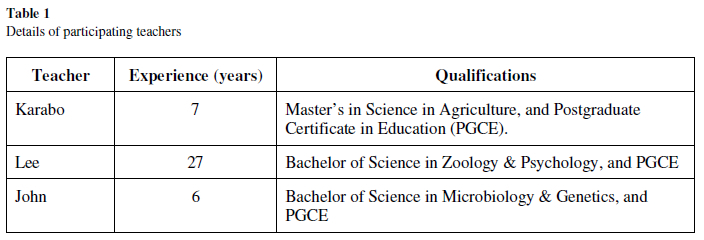
The participants in this study were three Life Sciences teachers teaching the topic of population ecology. These teachers were purposefully and conveniently sampled. Our interest was in teachers who have been teaching Life Sciences for at least five years. This is because, according to Graham et al. (2020), experienced teachers are likely to understand classroom dynamics. The teachers were given common South African names as pseudonyms. The details of these teachers are summarised in Table 1.
As can be seen in Table 1, all three teachers are qualified to teach Life Sciences and have more than five years of experience teaching this subject.
Data generation
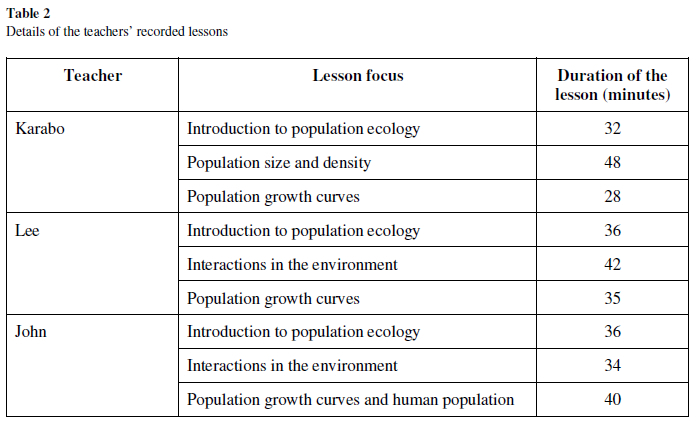
Data was generated through video-recording the teachers' lessons on the topic of population ecology. Video data was useful because it allows the researcher to capture moment-by-moment instruction, important for analysing classroom interactions. Table 2 shows the duration and focus of each lesson per teacher.
The lesson duration was calculated from the moment the teacher started teaching to when they ended. We excluded, for example, the time when a teacher gave learners a worksheet to work on in groups since our focus was on whole-class interactions. The video-recordings were transcribed verbatim for analysis. When transcribing, we paid attention to turn-taking sequences.
Data analysis procedures
We analysed the transcripts by coding both the teacher and learner utterances. First, we coded the TDMs by drawing from Correnti et al.'s (2015) work to characterise initiation moves and Tytler and Aranda's (2015) frameworks according to their classification system, which identifies TDMs based on their epistemic function in classroom interaction. Tytler and Aranda's (2015) framework was used to characterise rejoinder moves. Second, we coded learner responses both inductively and deductively. The deductive approach was influenced by the literature on meaning-making as well as by how learners typically respond to TDMs. For example, we coded if learner contributions were factual recall, explanation, prediction, justification, questioning, or building on peer ideas. We also paid attention to passive answering or active meaning-making. We then looked for patterns in the whole lesson transcript, such as looking at whether certain teacher moves correlate with learner responses showing deeper engagement, longer turns, explanatory language, or building on others' ideas, and if some lead to brief factual responses, passive participation, or reproduction rather than construction. The transcripts were dual-coded, showing the TDM category assigned to each teacher turn alongside the learner response category, and the analytical judgement about whether a meaning-making opportunity was created, missed, or foreclosed. The coding process proceeded in three stages: (1) a first pass applying the deductive framework categories to all teacher turns; (2) a second pass inductively coding learner response types and assigning meaning-making indicators; (3) a third pass identifying cross-lesson patterns and verifying the consistency of category application. To enhance the trustworthiness of the analysis, the first two authors independently coded a subset of transcripts, after which coding decisions were compared and discussed until consensus was reached. Discrepancies were resolved through discussion and reference back to the theoretical framework.
Findings
The findings1 here are presented per case (according to each teacher). We show examples of how meaning-making was fostered or restricted to reveal missed opportunities.
Case 1: Karabo
Excerpt 1
This comes from Karabo's first lesson. Karabo was introducing the concept of population.
Karabo: Okay, so a population is. Let me write it down for you. Let me say it, and then I'll write it down so that you can remember it again, yes?
Learners: Yes.
Karabo: A population is a group of the same species living in the same area…
Learners: At the same time
Karabo: So, in the picture here, we see that… (explanation continued)
In turn 1, Karabo used the board to write out the first part of a definition of the term "population" for the learners. After writing the definition, she began to define it out loud, thus providing information. She got the learners to join the conversation at a superficial level where they only completed her utterances instead of requesting them to formulate their own definitions (see turn 4). At this point, the provision of information in this regard restricted learners from making meaning. However, as she wrote the definition on the board, she also displayed various pictures of what populations look like in her PowerPoint presentation. Not only did this give the learners a picture of what a population looks like, but also what it does not look like. This provided learners with an opportunity to visualise what populations look like, thus differentiating the terms population and community. Later on in the lesson, while talking about characteristics of populations, the following discussion took place.
Excerpt 2
Excerpt 2 comes from Karabo's first lesson where he was introducing what defines a population.
Karabo: So, with the characteristics of populations that you need to know, we have….
Learner 1: Mam, the pictures you showed us…people are one population and dogs are another population?
Karabo: Yes! They are not the same species
Learner 2: Ohhh because the people and dogs cannot mate to produce an offspring…
In the above exchange, when Karabo wanted to transition to the characteristics of populations through providing information, Learner 1 interrupted and referred back to what they were shown. This reveals that the learner was linking their thinking to the pictures that were shown. Thus, it was not necessarily the providing of information move in Excerpt 1 but the fact that this move was supplemented with a representation that made the difference. Learner 2 was also able to vocalise their thinking, drawing from a definition of species dealt with earlier.
Excerpt 3
This also comes from the first lesson. Here, Karabo was teaching what the term species means, following the definition and examples of a population.
Karabo: Another perfect example. People in America at this very point, the United States of America and people in South Africa, are they the same species? Are they the same species?
Learners: Yes.
Karabo: Yes. Okay. Are they the same population?
Learners: No.
Karabo: No. I asked, are they the same species? You said yes. Why do you say they are the same species?
Learner 1: Because we are Homo sapiens.
Karabo: Why do you say they are the same species? Because?
Learners: We are all Homo sapiens.
Karabo: She says, because we are all Homo sapiens, which is true again. But are we the same population?
Learners: No.
Karabo: But why?
As shown in excerpt 3, Karabo introduced the term species by using the different populations of South Africa and the USA. She used a literal initiation move to ask the learners if the two groups were the same population. The learners offered a brief contribution in turn 2 in the form of a single-word answer in agreement. In turn 3, Karabo then asked them if they were the same population to ascertain whether the learners could differentiate between species and population. The learners demonstrated this in turn 4 by saying "no". Karabo offered the learners a meaning-making opportunity in turn 5 by using a rejoinder of challenging the learners to ask them to defend their answers as to why the same species is now two different populations. Again, Karabo used an example that the learners could relate to by immersing themselves in the scenario. A learner gave an extended contribution justifying his stance in turn 6 that both populations belong to Homo sapiens. A meaning-making opportunity was then created in turn 11 when Karabo challenged learners to explain why the two groups are not the same population.
Case 2: Lee
Excerpt 4
This comes from Lee's first lesson. In this lesson, Lee had just finished explaining the concept of population ecology and moved to define the concept of species.
Lee: So a single species or a species is of the same organism that can interbreed and form offspring that can also reproduce… Yes?
Learner 1: So, what about dogs?
Lee: Dogs? What do you mean?
Learner 1: Can different dogs have children?
Lee: What do you think?
Learner 2: I think they can. Are dogs not from the same species?
Learner 3: But some dogs look different. You see the ones with more feathers, and some are plain…those would not be the same species.
Lee: Yes, dogs can interbreed and have fertile offspring. Can we continue?
In turn 1, Lee provided information regarding the concept of species. As she completed providing information, Learner 1 in turn 2 asked a question, "What about dogs?" with a quest to understand the concept of species and breeding when it came to dogs. This was in response to the condition of similar characteristics. In turn 3, Lee requested clarification from the learner. Instead of Lee providing an extended response to Learner 1, she extended the discussion by challenging directly (see turn 5). The use of this move opened a new discussion where other learners joined the conversation, providing extended explanations coupled with questions (see turns 6 and 7). The fact that Learners 2 and 3 joined the conversation is an indication of meaning-making as they invoked new ideas and challenged the surface-level understanding. While Lee may have supported meaning-making through her challenge in turn 5, she further constrained it in turn 8 when, in our view, she prematurely closed the interaction by providing an affirmation to Learner 2 and neglecting Learner 3's contribution. Learner 3's contribution seems to have been battling with a misconception that if organisms look really different, they must be different species. This is a typical example of how teachers can miss an opportunity to further engage learners in a meaningful discussion following their contributions. Lee did not notice the inherent misconception in Learner 3's contribution, thus restricting an opportunity for this learner to voice their thinking.
Excerpt 5
This comes from Lee's second lesson. Lee had just finished a discussion on the concept of social organisation in different species. Here, Lee uses the example of honeybees to further teach the concept of social organisation.
Lee: So, tell me what you know about honeybees.
Learner 1: They make honey.
Lee: They make honey. Good. How do they live?
Learner 2: They're making pollen.
Lee: What is their social organisation? I explained it to you just now.
Learners: They have a queen.
In turn 1, Lee used a launch initiation move to ask an open-ended question that was expected to spark an interaction. Learner 1 promptly provided a brief response, for which Lee acknowledged and evaluated positively in turn 3. Lee further provided a platform for discussion by asking an extended question. Learner 2 responded. However, instead of Lee saying something about their contributions, she introduced a new idea of social organisation and further requested learners to draw from what she had just said (see turn 5). This excerpt reveals another example of how an abrupt use of literary moves (as seen in turn 5) without interrogating specific learner contributions can constrain meaning-making. In this case, Lee did not notice that Learner 2's contribution had a misconception. Instead, it seems as though she was in a rush to move the conversation to the idea of social organisation. The specific example of honeybees was never revisited, leaving Learner 2 with an unaddressed misconception.
Excerpt 6
This comes from Lee's third lesson during which the goal was to recap the previous lesson. After providing information, one learner asked a question.
Learner 1: I have a question, teacher. How can an earthquake cause a population to decrease?
Lee: How can it cause the population to decrease? What if members of the population fall into the ground?
Learner 2: Yes.
Lee: Then they'll die. So the population size will decrease.
Learners: Murmuring
Learner 3: Can I answer them? Can I answer you guys?
Lee: Okay, go ahead…
Learner 3: It will also decrease because like it also damages property. When property gets damaged, habitats get damaged, and so because of that, the people or the population get damaged as well.
Lee: So remember, we are not only talking about the human population. We're also talking about the population of other species in nature.
Learners: Yeah.
Lee: We're also talking about the population of other species in nature. Yes. So the human population also dies when there's an earthquake.
Learner 1: How?
Learner 2: A building falls on top of you.
Learners: [Discuss the answer. Unintelligible.]
Learner 1: I understand you now.
Lee: You understand? Ok.
Learner 1: Thank you, geography learners.
The learner's extended question in turn 1 is an indication that this learner was thinking about earthquakes, which was one of the concepts of interest in the previous lesson. Thus, we can claim that the learner was cognitively engaged. In essence, initiations from learners indicate a process of meaning-making. Instead of Lee responding in turn 2, she redirected a question to the class, which led to Learner 2's brief affirmative contribution response. What is interesting in this excerpt is Learner 3's quest to answer in turn 6, for which Lee provided the learner with an opportunity to voice her contributions. Learner 3 then answered with an extended contribution. A closer look at Learner 3's contribution revealed that they used the knowledge gained in the previous lesson, thus building on their prior knowledge. Lee then pointed out that Learner 3's answer was centred around human beings, which made sense considering where they drew their prior knowledge, but it must extend to other organisms as well. When another learner still expressed confusion, the learners worked cooperatively to get that learner to a point of understanding (shown in turns 12 through 15). Therefore, a key point here is that the teacher's use of rejoinders in learner-initiated discussions facilitates opportunities for meaning-making. Furthermore, learners' ability to respond to each other's questions during interactions and to help each other make meaning of a concept by using the knowledge gathered from the previous lesson indicates that meaning-making can also arise from learners providing each other with opportunities to voice their ideas. However, the teacher played a role in facilitating the interaction by requesting clarification and asking extended questions.
Excerpt 7
This comes from Lee's third lesson on population growth models and how environmental factors may influence the carrying capacity.
Lee: Have enough medication to keep healthy and have enough food and beautiful homes in which we can live in, even though the environmental like last night there was a storm, but we were in our homes, we were not affected by it.
Learner 1: Teacher, what about homeless people?
Lee: Sorry?
Learner 2: The roofs, teacher, of the houses.
Lee: Really?
Learners: Yes.
Lee: Where was that?
Learners: [Inaudible]
Learner 3: Teacher, a tree fell.
Lee: Ok, guys, that is a perfect example that we are not exposed to the environmental conditions. If we were not in homes, if we did not, it would not be technologically advanced, and we could not build our own homes, and we could not have heaters, and we could not have electricity. Imagine it had been exposed to the environment, we wouldn't have been able to. Our population would be de?
Learners: Decreasing
Lee: Decreasing. Because we would die because of the external conditions. You understand? That's what we mean when we say technological improvements. Yes?
Learner 1: Regarding the wind yesterday, what happens to the street kids and street adults when the wind is blowing?
Lee: The street kids?
Learner 2: Homeless people.
Lee: Yes! That's the problem. Exactly. They don't have homes, and if they did have homes. So that's what we are saying. Because we're technologically advanced, because we have these technological advancements we are not exposed to environmental conditions. So that's why our population is growing indefinitely because we are not subjected to the environment.
Learners: Yes.
Lee: With us there is it. We have overcome the environmental crisis because of our technological advance, you understand?
Learner 2: Homeless people?
Lee: Yes, those people are now exposed to the environment, but fortunately we have welfare people that could take care of them. We look after each other, isn't that so?
Learners: Yeah. Yes!
Lee: Yes.
Learner 4: There are orphanages and shelters.
In turn 1, Lee used the example that houses assisted in humans increasing in population because they provide shelter from the harsh environment. A learner, drawing from real-life examples, challenges this in turn 2 by asking about those who do not have houses to shelter them. From turn 4 to turn 9, the learners give accounts of an experience they had the night before, which was a storm, and how it damaged property. The learners were attempting to convey that they did not fully understand the fact that houses can fully shelter humans from environmental conditions. Lee saw the opportunity for the learners and explained the link between technological advancement and building homes for the human population in turn 10. She then used a literal initiation move to drive this point. Although it led to some interaction, this discussion took the focus away from Learner 1's question and did not lead to meaning-making. Learner 1 rephrased his original question from turn 2 in turn 13 (evidence of meaning-making). Although Lee did not fully answer the learner's question, she reiterated that homes have led to an increase in the human population. Learner 2 was still unsatisfied with Lee's answer (indicating immersion into the concepts) and continued to repeat Learner 1's question (turn 19), showing that she was attempting to make meaning, but could not do that without answering the question since she did not understand how the existence of homeless people could be ignored. Lee finally answered Learner 1's original question in turn 20 by using an uptake rejoinder. The learners affirmed this in turn 21, and learner 4 confirmed that he understood by giving an example. By giving examples, the learner demonstrated this understanding as a product of Lee's rejoinder. Therefore, learners made meaning by linking the concept being taught with their own experiences and the experiences of others.
Case 3: John
Excerpt 8
This excerpt comes from John's second lesson, where he was recapping the previous lesson.
John: Can we please recap what we said about species are? What did we say species are?
Learners: A group of organisms that…
John: A group of organisms that share similar?
Learners: characteristics
John: Characteristics. That one is important, that you show that they share similar…?
Learners: Characteristics
John: Characteristics, ok? So, meaning, they share similar characteristics, meaning they can do what? To interbreed and produce fertile offspring.
Learners: (simultaneously) To interbreed and produce fertile offspring.
John: Ok. So, meaning an organism that is not able to produce fertile offspring means that it's not the same? Species.
John started by asking the learners for the definition of the term in turn 1 using a literal initiation move. John did not allow the learners to complete the definition on their own, but instead guided them to the answer by giving the learners the next word in the definition (turn 3 to 8), and the learners repeated what he said. He stressed the importance of one of the conditions for species, and then, instead of offering the learners the opportunity to complete the definition, he did it for them. Although defining terminology constitutes rote learning, meaning-making can still take place if the learners can connect the definition with specific examples, an opportunity they were denied. Furthermore, by completing the definition for the learners, John prevented the learners from learning by making mistakes, taking away their autonomy to draw from what they had learnt in the previous lesson. What is also concerning is that this is a recap lesson, wherein the learners were supposed to already know the definition of species, but were not allowed to demonstrate that knowledge because of how John drove the authoritative interaction. Therefore, asking leading closed-ended questions puts a wall around learners' thinking, thus inhibiting opportunities for meaning-making. This type of questioning prevented the learners from making meaning because they were not given a chance to complete their thoughts, especially since this was recapping what had already been taught.
Excerpt 9
Excerpt 9 is taken from episode 1 of John's third lesson. This episode is about the human population and the factors that led to its exponential growth.
John: So we're gonna be looking at these graphs. The age population graphs. So when you talk about evolution, do you understand what we mean?
Learners: Yes.
John: Yes. Modern humans have been evolving, ok? Do you understand
Learners: Hmmm
John: The second reason is medicinal improvement. For example, HIV, when you compare with the olden days and now, you can see that more people are surviving HIV than the ones in the olden days, do you understand?
Learners: Yeah
John: That is what I mean, that in medicine there are more medicines when you compare it to olden days. Then we have a declining population pyramid. Obviously, if something is declining, it means it's obviously?
As shown in the excerpt above, there are many instances when John talks for extended periods (turns 1, 3, 5 and 7), that were broken by learners assenting to the seemingly rhetorical question of "You understand?" or John making predominantly literal initiation moves to ask the learner questions and not allowing the learners to answer them, by answering them immediately after asking. When he gave the learners the answer, John constrained the learners from making meaning of the content in this authoritative episode, as was common in most episodes of John's lessons. John also asked questions but did not allow the learners the opportunity to respond, simply continuing with the lesson. This lack of wait time prevented the learners from engaging with the content. In essence, although John asked questions, they were rhetorical and did not allow the learners to make meaning.
Excerpt 10
In the excerpt below from his final lesson and fourth episode, John is recapping symbiosis with the learners.
John: So the parasites may benefit, but the host will be harmed. Ok? Give me an example of parasitism.
Learners: Murmur
John: Just like, a day-to-day example. Dog and a?
Learner 1: Tick
John: A tick, neh? a dog and a tick, right? Meaning which one is parasite between the two?
Learners: The tick
John: The tick, right? So the tick is parasitising, huh? Parasitism. So, if the dog is being (explanation continued)
In this excerpt, John uses a literal move to request examples. However, when he asked, "Give me an example of parasitism," he was asking learners essentially to retrieve information rather than construct meaning. When the learners murmured (see turn 2), instead of probing that hesitation, John immediately provided a scaffold by narrowing it down in turn 3. This prompting structure, where John essentially supplies the answer himself, means the learners were not provided the opportunity for cognitive work. Instead, he led them to the answers rather than having them generate them by using a funnelling approach during which he narrowed the options progressively. While John's approach is supportive and keeps learners participating, it does not invite them to reason through why the tick is the parasite (see turns 4 to 6). Instead of providing information in turn 7, John could have asked why the tick is the parasite and not the dog, or what the tick is doing to the dog, to push learners to articulate the harm-benefit relationship. This would require them to connect back to his opening definition and construct a deeper understanding rather than simply filling in the blanks.
Discussion
The three teachers initiated interaction mostly by providing information, followed by a literal and/or launch move (seen most frequently in Karabo and John's lessons). In Excerpt 1, when Karabo defined population, she supplemented this information provision move with visual representations that showed both what populations look like and what they do not. The use of this representation enabled an opportunity for learner meaning-making. In Excerpt 2, when one learner returned to the pictures and asked a question, the cognitive engagement of the learner was evident (see Khoza & Nyamupangedengu, 2018). Therefore, the representation functioned as what Vygotsky (1978) would call a mediational tool, described as a semiotic tool that has the potential to make abstract concepts concrete and accessible for learner thinking. This finding extends the frameworks of Correnti et al. (2015) and Tytler and Aranda (2015) by showing that initiation moves, particularly those providing information, can be enhanced through strategic use of multimodal representations that help learners visualise abstract ecological concepts. As reported elsewhere, discursive moves that are accompanied by non-verbal prompts like pictures can heighten interaction and help learners produce complex explanations (Berland & Reiser, 2009; Khoza & Makgata, 2024).
The most striking pattern across all three teachers is their inability to notice misconceptions embedded in learner responses. Noticing has been described as a practice during which teachers recognise significant classroom events and respond appropriately (Chan et al., 2021). This finding challenges the assumption that simply asking more questions leads to better learning. Lee's missed opportunity to deal with the learner's misconceptions that dogs that look different are from different species and that bees make pollen (see Excerpts 4 and 5), perhaps by asking further questions, is an indication of a missed opportunity for using an appropriate rejoinder. This is precisely the type of oversimplification of population ecology concepts that Hovardas and Korfiatis (2011) identified as undermining learner construction of scientific knowledge. Lee's practice suggests that noticing misconceptions requires not only knowledge of what misconceptions exist but also a deliberate stance toward treating learner contributions as windows into thinking rather than as items that close interaction patterns (Khoza, 2023). The idea of noticing the inherent messages in learners' contributions requires the teacher to reflect before using a specific discursive move. The teacher needs to pause and perhaps ask an extending or clarifying question. This finding aligns with what Berland and Hammer (2012) emphasised in noting that TDMs are useful when learners are positioned as sense-makers. When Lee failed to notice the misconception, essentially, she positioned Learner 3 not as a sense-maker working through confusion, but as someone whose incorrect thinking could be simply affirmed and moved past. From a Vygotskian (1978) perspective, this represents a failure to recognise when the learner was actually operating within their ZPD and what scaffolding was needed.
Similar to Lee's practices, John's rhetorical questions mask a lack of noticing (Excerpts 8 and 9). In these two excerpts, John asks questions but provides answers almost immediately, allowing no wait time for learner responses (see Excerpts 8 and 10). The key point here is that John's approach prevents misconceptions from even becoming visible in discourse. By providing answers, he foreclosed the possibility of noticing misunderstandings. This is arguably the most restrictive pattern, where not only are misconceptions that emerge missed, but their emergence is entirely prevented. When John asked a question (see Excerpt 10, turn 2), he immediately narrowed the options rather than probing the hesitation or allowing learners to generate their own examples. This funnelling approach constrained learners from engaging in the cognitive work of meaning-making (Hagenah et al., 2018). Therefore, while teachers may ask questions following information provision, the effectiveness of these moves as opportunities for meaning-making depends not only on their implementation but also on their appropriateness to the learning context and learner needs at a specific time. John's leading questions did not scaffold learners toward independent thinking but, rather, led them towards passive compliance with predetermined answers.
Although the three teachers constrained learner meaning-making in some cases, the findings reveal that direct challenges and extended questions can enable meaning-making, but only when these moves are sustained and not prematurely terminated. When clarifying and extending rejoinders are used, teachers create platforms for extended discussion, learners return to earlier concepts, revise their understanding, and build increasingly sophisticated mental models. In this regard, learners draw from their prior knowledge and incorporate the new knowledge in response to a teacher's prompt. For example, one te one hand, Karabo's use of challenging moves (see Excerpt 3) aligned with what Tytler and Aranda (2015) called extending moves aimed at shifting learners' ideas forward by challenging them to extend or re-think their ideas. Excerpt 3 revealed that Karabo was not merely using an extending move as a comprehension check but rather an opportunity for learners to justify their thinking and connect it to an underlying principle (that members of Homo sapiens can interbreed). On the other hand, Lee's partial success with challenging moves (Excerpt 4) also reveals that questioning presented an opportunity for other learners to join the class discussion. This observation suggests that teachers like Lee have some capacity to use effective moves when learners have to compare and contrast their views with the content in the science classroom and undergo a process in which they compare and check their understanding against ideas being shared on a social plane (Mortimer & Scott, 2003). As Soysal and Yilmaz-Tuzun (2021) argue, when teachers create space for sustained discourse, learners engage in what Mortimer and Scott (2003) describe as comparative sense-making. Karabo's repeated challenges also elevated this comparative, self-evaluative work.
The findings in this study provide evidence that learner-initiated questions represent, to some extent, cognitive engagement and that when teachers respond to these questions with extended discourse, significant meaning-making opportunities emerge (see for example, Experts 4 and 6). Learner-initiated questions are not merely indicative of engagement but rather provide evidence of the social dimension of meaning-making, where they participate in discourse. When learners pose questions, they are essentially claiming a position and power in the interaction in the scientific discourse rather than remaining passive recipients of information (Reinsvold & Cochran, 2012). In this way, learners actively interpret and connect new information to their existing knowledge frameworks (Scott, 1998). However, teacher responsiveness in this regard is critical. Learner-initiated questions lead to sustained meaning-making only when teachers respond with engagement rather than dismissal or superficial acknowledgement. In Excerpt 6, when Lee sustained her engagement with learner questions, meaning-making was enabled. Learners not only articulated their own thinking but also helped each other refine their understanding. However, in some cases, Lee did not at first directly address the question (see Excerpt 7). The learner had to rephrase it many times before Lee fully engaged with it. It is in this rephrasing and grappling with science content that learners can make meaning of science concepts. It was only later that Lee provided an uptake rejoinder (see Tytler & Aranda, 2015) that actually addressed the learner's concern. It can therefore be argued that teachers' deliberate delay in closing interaction provides an opportunity for learner meaning-making. This pattern reveals that learner persistence in asking questions is itself evidence of cognitive engagement, but sustained non-response to those questions constrains meaning-making even as learners remain cognitively engaged.
While the patterns identified across these three cases are analytically suggestive, it is important to acknowledge that teacher discursive choices do not occur in a vacuum. Contextual factors including curriculum pressure, classroom size, and classroom culture are likely to have shaped the observed practices. For example, John's tendency toward authoritative, funnelling discourse may reflect in part the pressure to cover content in constrained lesson time, particularly in a high-stakes Grade 11 curriculum context. Similarly, class size influences the feasibility of heightened interaction: larger classes present practical challenges for tracking and responding to individual learner contributions. Classroom culture, including the extent to which learners are accustomed to voicing their thinking, also mediates the effectiveness of even well-executed TDMs. These contextual dimensions were not directly investigated in this study but are foregrounded here as important variables that future research should systematically incorporate. The findings of this study should therefore be understood as illustrative of how TDMs function in specific contextual conditions rather than as universally generalisable claims about teacher practice.
Conclusion
This study reveals that TDMs possess dual potential as enablers or constraints on learner meaning-making. When teachers provide information but supplement it with representations or concrete examples, followed by extended questioning that challenges learners to justify their thinking, meaning-making is supported. However, real-time noticing and responsiveness to learner thinking are important. The crucial factor determining whether moves support or constrain is not their sophistication but the overall orchestration of classroom interaction. When sophisticated moves are embedded in dialogic interaction patterns where learners are consistently positioned as thinkers and contributors, meaning-making is strongly supported. However, sustained engagement matters more than single moves. No single discursive move guarantees meaning-making. Furthermore, learner agency supports meaning-making in the sense that when teachers create conditions under which learners can ask questions, push back on explanations, and offer alternative perspectives, learners engage more deeply with concepts and support each other's construction of knowledge. Tentatively, based on these three cases, it appears that the years of experience that a teacher has does not necessarily mean that they are skilled in engaging learners in meaning-making.
Implications
The findings have implications for how we support science teaching. Rather than focusing narrowly on technique, professional development should help teachers restructure their interaction patterns fundamentally to center learner thinking and dialogue as the primary vehicles for meaning-making. Many professional development programs focus on teaching teachers new strategies, like new questioning techniques, new scaffolding methods, and new ways of engaging learners. This study suggests this approach may be insufficient. Teachers should be assisted in understanding the difference between expository and dialogic orchestration, as well as how to reposition learner contributions not just in theory, but in recognizing these patterns in their own teaching. This can be done through video analysis and reflection on specific topics like population ecology since, where misconceptions are persistent and the content is conceptually demanding, dialogic orchestration may be particularly important.
Limitations and future research
Several limitations of this study warrant acknowledgement. First, while discourse analysis suggests differential opportunities for meaning-making, actual learning and learner outcomes would require additional measurement. Second, the study examined population ecology specifically; patterns may differ for other science topics or subject areas. Third, only three teachers were studied, and the study could have led to different conclusions with more participants. Additionally, this analysis does not account for factors influencing teacher choices. Curriculum mandates, time constraints, class size, and learner demographic factors all influence how teachers teach. Therefore, there is need for a study to investigate how these factors contribute to how teachers facilitate learners' meaning-making by using discursive moves.
Disclosure of interest
The authors report there are no competing interests to declare.
Funding
This study is part of a larger project funded by the National Research Foundation of South Africa (Grant Number: TTK240426216108).
Ethics
This study was conducted in accordance with ethical guidelines of the University of Pretoria, Faculty of Education Ethics Committee under the protocol number EDU096/23.
References
- Bansal, G. (2018). Teacher discursive moves: Conceptualising a schema of dialogic discourse in science classrooms. International Journal of Science Education, 40(15), 1891-1912. https://doi.org/10.1080/09500693.2018.1514543
- Berland, L. K., & Hammer, D. (2012). Framing for scientific argumentation. Journal of Research in Science Teaching, 49(1), 68-94. https://doi.org/10.1002/tea.20446
- Berland, L. K., & Reiser, B. J. (2009). Making sense of argumentation and explanation. Science Education, 93(1), 26-55. https://doi.org/10.1002/sce.20286
- Carpenter, S. L., Kim, J., Nilsen, K., Irish, T., Bianchini, J. A., & Berkowitz, A. R. (2020). Secondary science teachers' use of discourse moves to work with student ideas in classroom discussions. International Journal of Science Education, 42(15), 2513-2533. https://doi.org/10.1080/09500693.2020.1820620
- Chan, K. K. H., Xu, L., Cooper, R., Berry, A., & van Driel, J. H. (2021). Teacher noticing in science education: Do you see what I see? Studies in Science Education, 57(1), 1-44. https://doi.org/10.1080/03057267.2020.1755803
- Coley, J. D., & Tanner, K. (2015). Relations between intuitive biological thinking and biological misconceptions in biology majors and nonmajors. CBE-Life Sciences Education, 14(1), 1-19. https://doi.org/10.1187/cbe.14-06-0094
- Correnti, R., Stein, M. K., Smith, M., Scherrer, J., McKeown, M., Greeno, J., & Ashley, K. (2015). Improving teaching at scale: Design for the scientific measurement and development of discursive practice. In L. Resnick, C. Asterban, & S. Clarke (Eds.), Socializing intelligence through academic talk and dialogue (pp. 315-334). American Educational Research Association. https://doi.org/10.3102/978-0-935302-43-1_25
- Department of Basic Education. (2021). National Senior Certificate Diagnostic Report Part 1: Content Subjects. South Africa: Basic Education
- Grotzer, T. A., Kamarainen, A. M., Tutwiler, M. S., Metcalf, S., & Dede, C. (2013). Learning to reason about ecosystems dynamics over time: The challenges of an event-based causal focus. BioScience, 63(4), 288-296. https://doi.org/10.1525/bio.2013.63.4.9
- Hagenah, S., Colley, C., & Thompson, J. (2018). Funneling versus focusing: When talk, tasks, and tools work together to support students' collective sensemaking. Science Education International, 29(4), 261-266.
- Halkias, D., Neubert, M., Thurman, P. W., & Harkiolakis, N. (2022). The multiple case study design: Methodology and application for management education. Routledge.
- Hovardas, T., & Korfiatis, K. (2011). Towards a critical re-appraisal of ecology education: Scheduling an educational intervention to revisit the 'balance of nature' metaphor. Science & Education, 20(10), 1039-1053. https://doi.org/10.1007/s11191-010-9325-0
- Khoza, H. C. (2023). Teacher noticing as a driver of interaction patterns in science classrooms. Journal of Pedagogical Research, 7(1), 53-66. https://doi.org/10.33902/JPR.202318784
- Khoza, H. C., & Makgata, T. I. (2024). Interaction of initiating prompts and the patterns of student engagement in higher education biology classrooms. Journal of Pedagogical Sociology and Psychology, 6(2), 64-77. https://doi.org/10.33902/jpsp.202426566
- Khoza, H. C., & Nyamupangedengu, E. (2018). Prompts used by biology lecturers in large lecture group settings to promote student interaction. African Journal of Research in Mathematics, Science and Technology Education, 22(3), 386-395. https://doi.org/10.1080/18117295.2018.1542553
- Lee, T. D., & Glass, B. (2021). Moving talk forward: novice science teachers approximate the practice of leading science discourse. International Journal of Science Education, 43(8), 1314-340. https://doi.org/10.1080/09500693.2021.1909772
- Lemke, J. L. (1990). Talking science: Language, learning, and values. Ablex Publishing.
- Martin, J., Xu, L., & Seah, L. H. (2021). Discourse analysis and multimodal meaning making in a science classroom: Meta-methodological insights from three theoretical perspectives. Research in Science Education, 51(1), 187-207. https://doi.org/10.1007/s11165-020-09961-7
- Mortimer, E. F., & Scott, P. H. (2003). Making meaning in secondary science classrooms. Open University Press.
- Msimanga, A., & Lelliott, A. (2012). Making sense of science: Argumentation for meaning making in a teacher-led whole class discussion. African Journal of Research in Mathematics, Science and Technology Education, 16(2), 192-206. https://doi.org/10.1080/10288457.2012.10740739
- Odden, T. O. B., & Russ, R. S. (2019). Defining sensemaking: Bringing clarity to a fragmented theoretical construct. Science Education, 103(1), 187-205. https://doi.org/10.1002/sce.21452
- Reinsvold, L. A., & Cochran, K. F. (2012). Power dynamics and questioning in elementary science classrooms. Journal of Science Teacher Education, 23(7), 745-768. https://doi.org/10.1007/s10972-011-9235-2
- Soysal, Y. (2020). Determining the mechanics of classroom discourse in Vygotskian sense: Teacher discursive moves reconsidered. Research in Science Education, 50(4), 1639-1663. https://doi.org/10.1007/s11165-018-9747-2
- Tytler, R., & Aranda, G. (2015). Expert teachers' discursive moves in science classroom interactive talk. International Journal of Science and Mathematics Education, 13(2), 425-446. https://doi.org/10.1007/s10763-015-9617-6
- Vygotsky, L. S. (1978). Mind in society: The development of higher psychological processes. Harvard University Press.
- Wertsch, J. V. (1991). Voices of the mind: A sociocultural approach to mediated action. Harvard University Press.
- Zhang, Z., & Lamb, M. (2025). Teachers' questioning practices in Chinese secondary biology classrooms. International Journal of Science and Mathematics Education, 23(4), 987-1012. https://doi.org/10.1007/s10763-024-10500-3
Accepted: 2 July 2026