Discipline and control: A Foucauldian perspective on discipline as a tool for creating docile bodies
Abstract
Discipline as a thorny issue has been a global challenge, and the South African education system is not spared. Section 10 of the South African Schools Act banned corporal punishment in schools. Nevertheless, recent studies suggest that educators link the rising problem of indiscipline in many schools to the ban on corporal punishment and the absence of effective alternative disciplinary approaches. This qualitative case study explores the intricacies of discipline in the post-apartheid classroom. This paper is anchored in Foucault's disciplinary techniques as described in his book, Discipline and Punish and argues that discipline as an expression and tool creates docile bodies through the effect of power. In Foucauldian thinking, the bodies of individuals are controlled to produce docile bodies whilst contributing to abating or curbing disciplinary challenges. The findings reveal that alternatives to corporal punishment at the case study school control learners' behaviour and mindset without inflicting pain. Drawing on the case study findings and Foucault's understanding of discipline, I argue that the disciplinary measures in both the apartheid and post-apartheid eras control individual's bodies to obey school rules and regulations.
control; corporal punishment; discipline; docile bodies; punishment
Introduction
Corporal punishment was frequently employed as a severe method of discipline in the past (Porteus et al., 2001). The conventional view of discipline included corporal punishment to control students, although its use could also steer defiant learners toward violent behaviour (Department of Education, 2000). In the post-apartheid era, corporal punishment was prohibited. As a result, many teachers feel disempowered because the traditional method of discipline has been banned (Smit, 2013). Some teachers find it challenging to adopt disciplinary alternatives to corporal punishment, and those alternatives often appear ineffective, leading to the continued use of corporal punishment (Obadire & Sinthumule, 2021; Padayachee & Gcelu, 2022; Pitsoe & Machaisa, 2023; Segalo & Rambuda, 2018; Shaikhnag & Assan 2014; Shaikhnag et al., 2015). Some individuals find it challenging to free their teaching methods from historical constraints (Kennedy, 1998). This paper considers discipline as a tool for fostering self-discipline in learners, enhancing their mental and emotional well-being, and promoting higher-order thinking skills (Sadik, 2018; Serame et al., 2013). A self-disciplined individual adheres to rules or codes of conduct willingly, without the influence of fear, threats, or coercion.
I utilise the works of Michel Foucault (1977, 1995) as theoretical tools to understand disciplinary power to perpetuate docility in schools with the aim of controlling individuals' behaviour and mind. For Foucault, discipline tended to produce docile bodies by controlling the body's positions through power. In other words, docility can be achieved through the act of discipline. To support these discussions, findings from a case study school were explored. The disciplinary strategies employed in the school can serve as mechanisms of control, enabling teachers to cultivate a compliant body for efficiency and productivity. This paper begins by exploring the traditional conception of discipline as corporal punishment. The second section explains the research site and corpus of data. The last section presents disciplinary measures as instrumental to the notion of control, which are illustrated by examples from findings in the study.
The conventional view of discipline as punishment
Corporal punishment refers to any intentional action directed at a child that causes physical pain or discomfort, even if mild, as a means of discipline or control (Government of South Africa, 2024). Educators shaped by the 1948 Christian National Education policy regarded corporal punishment as a suitable means of disciplining students within the apartheid system. Porteus et al. (2001) contended that the education system presupposed individuals lacked critical thinking and self-discipline, necessitating control by authorities through physical punishment. In traditional discipline practice, discipline is conceptualised based on the belief of "spare the rod, spoil the child" (Pitsoe & Letseka, 2014, p. 1528). The belief is from Proverbs 13:24, "Whoever spares the rod hates their children, but the one who loves their children is careful to discipline them" and "Do not withhold discipline from a child; if you punish them with the rod, they will not die." Proverbs 23:13-14 further asserted: "Punish them with the rod and save them from death." These Bible passages illustrate that caning or spanking is an effective disciplinary measure that parents, guardians, and teachers should use. In the same vein, the history of conventional school disciplinary methods in South Africa reflects a reliance on corporal punishment, most commonly in the form of spanking. Discipline is often viewed as a form of control because traditional approaches to discipline typically rely on punishment while teacher takes on a dominant and authoritative role (Haroun & O'Hanlon, 1997). This suggests that teachers during the apartheid era had a limited understanding of discipline, equating it primarily with punitive measures. Consequently, many students became passive-accepting teachers' authority out of fear; educators instructed while students quietly took notes, with learners being present but voiceless (Venkataramani, 2012). The Bantu Education Act was enacted in 1953, and corporal punishment was widely utilised and regarded as an effective disciplinary approach (Parker-Jenkins, 1999). Parker-Jenkins also noted that classes frequently became unruly due to the presence of underqualified teachers instructing the students. To illustrate the feelings of resentment among learners in the apartheid era, Naong (2007, p. 286) stated that "Thursdays were for recitations, revisions, and the solving of mathematical problems, schools experience the highest level of absenteeism among learners due to fear of merciless beatings by teachers." Corporal punishment was common in White boys' schools but limited in White girls' schools, while Black girls faced corporal punishment, unlike their White peers (Morrell, 2006). As a result, some students chose to leave school due to the intolerable use of corporal punishment (Mashau et al., 2015). In the apartheid era, both White and Black schools adopted authoritarian disciplinary methods, training Black South Africans to be obedient low-wage labourers while preparing White South Africans for compliant bureaucratic roles in white-collar professions (Porteus et al., 2001). The apartheid system perpetuated significant inequalities that deeply affected the education system, viewing Black children as inferior citizens.
In the 1970s, as opposition to apartheid increased, student groups called for an end to what they saw as mistreatment in classrooms. By the 1980s, there was active protest against corporal punishment (Department of Education, 2000). At the same time, global perspectives on corporal punishment began to shift, acknowledging children's rights. Countries such as Australia, Japan, and others began to view the prohibition of corporal punishment as an essential step toward fostering a more peaceful society (Cicognani, 2006; Department of Education, 2000). Following 1994, significant reforms were made to the education system, emphasising and promoting learners' rights (Department of Education, 2000; Government of South Africa, 2024; Venkataramani, 2012). Legislation enacted after 1994 banned corporal punishment and introduced alternative disciplinary methods in schools (Republic of South Africa, 1996). However, South African schools still struggle with discipline issues.
Some educators associate the increasing issue of indiscipline with the prohibition of corporal punishment and ineffective alternative disciplinary methods (Mahaye, 2023; Moyo et al., 2014; Venter & van Niekerk, 2011). Many educators contend that alternatives to corporal punishment are ineffective (Nkuna, 2022; Wolhuter & van der Walt, 2020). Many teachers confuse discipline with punishment and struggle to manage discipline in classrooms (Obadire & Sinthumule, 2021; Schoeman, 2024). Discipline issues have become a significant challenge in schools. As Ismail et al. (2018, p. 53) aptly wrote, "the most common problem at school is the dynamics of child discipline." Likewise, Pitsoe and Machaisa (2023, p. 32) stated that "teachers, parents, and other stakeholders are becoming increasingly concerned about the high level of indiscipline in public schools." Some educators face significant pressure to address disciplinary issues that can arise at any educational level and contribute to stress for teachers (Sadik, 2018). This work-related stress has negative impacts, such as diminishing teachers' motivation for teaching (Ayub et al., 2018). Consequently, it appears that teachers experience stress due to students' misbehaviour, and this stress interferes with their focus on instruction.
Research site and corpus of data
A qualitative case study approach was adopted, focusing on a public high school in a township of Cape Town. At the time of the study, the school had a total enrolment of 552 students and 20 teachers, with classroom sizes ranging from 25 to 35 students. Learners derive advantages from smaller class sizes in roomy classrooms that offer laboratories, an equipped library, and internet connectivity. An informal survey conducted at the school indicated that many students face poverty and violence in their everyday lives, with reports of assaults taking place on their way to school. Consequently, the school collaborates with a non-governmental organisation to provide financial support to address the social and emotional needs of the learners. Despite these challenges, the school has been recognised as a role model for others due to its learners' academic achievements. This school was selected for the study due to the remarkable achievements of its learners, despite being situated in an area affected by gang violence and drug abuse. What strategies does the school employ to thrive in such challenging circumstances? It can be contended that fostering effective teaching and learning is challenging in a disrupted classroom (Rossouw, 2003). What disciplinary measures are in place at the school?
I used interviews, observations, and documents to achieve data triangulation and capture various aspects of the same phenomenon. Data were collected through face-to-face, semi-structured interviews with five novice teachers (1-6 years of experience) and four experienced teachers (22-33 years of experience). Notably, all novice teachers began their careers at this school, while two of the experienced teachers had been employed at the institution for nine to 15 years. Participants were assigned identification numbers (1-9), with novice teachers designated as 1-5 and experienced teachers as 6-9. Observation was carried out to note context during the interviews, including classroom setup, tone of voice, body language, and facial expressions of the participants. The documents analysed in this study included materials related to the school, such as the school code of conduct and historical academic performance records like awards and newspaper articles. To analyse the data, I used thematic analysis. The data collected from interviews via recordings and fieldwork underwent transcription. The transcribed words were systematically identified and organised into codes. The texts prepared for analysis were coded into meaningful units and categorised to develop themes. The first theme discusses key insights on discipline, while the second theme reflects on discipline as a form of control through a Foucauldian lens.
Conceptualising discipline
Some educators characterise discipline not as punishing students for their misbehaviour, but as helping them comprehend the seriousness of their actions and the potential impact on their academic future. A disciplined student understands the difference between right and wrong and does not require coercion to make the right choices. Teacher 9 said:
Discipline is not that you must be punished for what you did wrong; discipline is knowing what is right or wrong.
And Teacher 7 said:
Discipline is when learners can adhere to what is required of them; that is, learners imbibe the culture of what is needed to be done at a particular time without being forced.
The implementation of corporal punishment affects both students and educators; students often become aggressive towards their teachers, resulting in a lack of knowledge acquisition due to their fear and resentment towards the teacher. Teacher 3 asserted:
Corporal punishment is not an effective disciplinary measure; at some stage, a learner might attack a teacher to take revenge. Once a teacher has been attacked, then his days are numbered.
Nonetheless, some inexperienced teachers advocated for the reintroduction of corporal punishment, associating the prohibition of such corporal punishment with disciplinary issues in schools. One of the novice teachers said:
To be honest with you I think it should come back . . . . when corporal punishment was in place, the youth of my generation were of good behaviour. Learners are always terrified of teachers, but nowadays there is no respect at all. (Teacher 3)
Some participants are still holding onto the past; disciplinary measures informed by corporal punishment control, torture, and dominate. Discipline can be transformative when it fosters the voluntary internalisation of self-discipline, enabling individuals to cultivate the skills needed to reach academic goals and coexist peacefully in the society without force. However, self-discipline does not occur by accident; it requires intentional practice.
Strategies for Discipline
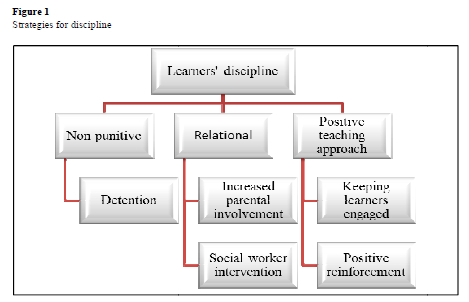
The school disciplinary policy incorporates three strategies: punitive (detention), relational (involving parents and social workers), and pedagogical (keeping learners engaged; positive reinforcements). To implement these, the school follows the institutional hierarchy and disciplinary structures. Learners with disciplinary concerns are first referred to the grade head. If the issue exceeds the grade head's authority, it is escalated to the head of department and principal, who then convenes a disciplinary committee. Teacher 8 asserted:
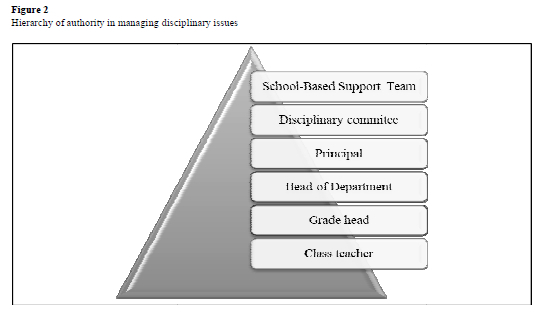
We have the class teacher, grade head, head of department, principal, disciplinary committee, and SBST [school-based support team].
Cases that teachers cannot manage are directed to the grade head. Grade heads oversee discipline and act as superiors. Their decisions are escalated to the deputy or principal. After the committee reviews a case, the school-based support team implements the necessary interventions. Learners generally improve their behaviour when the grade head or principal is involved because they wish to avoid further escalation. This structured approach helps reinforce discipline. The next section highlights strategies to curb misbehaviour. Figure 1 shows the strategies to manage discipline in the school.
Detention is one of the school's disciplinary strategies, where learners with infractions are assembled in the hall on Fridays after school for a set period before being dismissed. As Teacher 7 explained:
Like before, if you are late to school, you will undergo detention.
School management ensures parents are notified to expect their children home later than usual. However, a key question remains: "How does detention influence learner behaviour?" Several participants noted that learners perceived this disciplinary measure as routine and often associated it with fun. While many participants cited detention as a strategy to address misbehaviour, others noted its inconsistency and raised concerns about time and safety after school hours.
A second strategy is the relational intervention that involves the parents and social workers. The school keeps parents informed about their child's performance, behaviour, and any decisions regarding disciplinary matters. Beyond involving parents in disciplinary decisions, the school hosts workshops to address learners' challenges and guide parenting practices. Social workers address learners' psychological and emotional challenges, recognising that trauma and home-related issues often underlie misbehaviour and may require therapeutic support. Some learners struggle to express themselves without therapeutic support because home-related challenges often influence their behaviour at school. Referring learners to a social worker can help identify the root causes of misbehaviour. For instance, Teacher 9 observed anger issues among some learners and found that counselling was the most effective intervention. Social workers help uncover the underlying causes of learners' misbehaviour and provide counselling to support their personal growth.
The final disciplinary strategy is a pedagogical approach and positive reinforcement. The teaching approach is divided into three phases: "Do now," "I do," and "We do." This approach is adopted to keep learners engaged in the classroom. The "Do now" phase is for the learners; the teacher is the one doing the talking in the "I do" phase, and the "We do" phase is the discussion section. In the "Do now" phase, learners begin a task immediately upon the teacher's arrival, working quietly while the teacher monitors their progress. Learners who complete tasks early are rewarded, reinforcing positive behaviour. Incentives for task completion and appropriate behaviour aid other learners to exhibit good behaviour in the classroom. As Teacher 5 explained:
The only thing I know is positive reinforcement; it encourages them to do the right and positive things.
The "I do" phase involves the teaching of the lesson by the teacher. The teacher frequently checks for understanding by posing questions to learners. The last phase, the "We do," is interactive, allowing learners to ask questions and engage in discussion with the teacher. Homework is assigned at the end of this phase to consolidate learning. Keeping learners engaged until the last minute of the lesson reduces teacher stress and enhances the overall effectiveness of teaching and learning. Ultimately, both teachers and learners benefit from this structured, pedagogical approach.
Reflections on discipline
Discipline can be viewed with different lenses. Many researchers give a variety of interpretations and meanings to define discipline. Discipline is framed in two ways-punitive and normative methods (Maphosa & Shumba, 2010; Moyo et al., 2014; Ngubane, 2018). Punitive methods can inflict pain or discomfort through rules, external control, monitoring, and enforcement-all aimed at punishment (Ngubane, 2018; Pitsoe & Letseka, 2014). For many years, the punitive method of discipline was utilised in South African schools until the implementation of policy that prohibited corporal punishment (Pitsoe & Machaisa, 2023). In contrast, normative methods identify solutions to a problem and work to prevent it from occurring again (Moyo et al., 2014; Ngubane, 2018; Sadik, 2018). The shift from corporal punishment to alternative disciplinary methods represented a transition from punitive to normative approaches. The common lens for both approaches is control. While the punitive method uses force in the form of threats, the normative method uses intrinsic control, which emphasises continuing support and communication with learners. Among scholars who have explored the topics of punishment and discipline, Michel Foucault stands out as a figure who addressed the issues of control via disciplinary power (Pitsoe & Machaisa, 2023).
According to Foucault (1995), disciplinary power functions is a mechanism of control. Both punishment and discipline are instruments of power. While punishment inflicts pain, repression, oppression, control, and violation, it represents just one form of disciplinary power that makes bodies docile. Discipline serves as another aspect of this power because it controls and regulates human behaviour and actions. Discipline consists of a set of methods through which the body can be monitored, managed, and regulated. Thus, punishment and discipline control by rendering bodies docile through different techniques (Foucault, 1977). As Pitsoe and Letseka (2014, p. 1528) aptly wrote: "A body is docile, Foucault explains, when it is both obedient and teachable." From a Foucauldian perspective, discipline can be viewed with the same lens as punishment because both control behaviours or motions to achieve their goals, which are to obey rules and be teachable. According to Pitsoe and Machaisa (2023, p. 34), "successful discipline creates docile bodies." Discipline is successful when individuals are controlled to do what is expected of them. In the educational context, while corporal punishment inflicts pain and tortures the body through control, alternatives to corporal punishment control individual bodies to obey rules-but in a more subtle way.
Discipline as form of control
Foucault (1977) distinguished between the old mode of discipline and the modern one, noting that prior to the 18th century, public executions and corporal punishment were central to discipline within the German penal system. Punishment was brutal for those who broke the law because they had to face torture or public execution. However, during the 18th century, a demand emerged for reforming punishment to enhance the efficiency of power exertion. Penal imprisonment faced criticism for being ineffective and detrimental to society. Additionally, the implementation of this form of punishment was challenging to oversee, and the role of prison guards often resembled an exercise in tyranny. After the reformation, instead of public execution and torture of the body, the modern mode of discipline targets controlling the mind and behaviour of individuals to be obedient and teachable. Foucault (1995) argued that disciplinary power consists of three components: hierarchical observation, normalising judgment, and examination. The modern disciplinary measures encompass a form of power and a set of techniques that observe, control, and supervise the body of an individual (Egunlusi, 2020). With disciplinary power, various techniques are used through which people (described as "docile bodies") are influenced, controlled, and analysed to conform to the expected norm or behaviour. Through these disciplinary techniques, prisoners' bodies were controlled to conform to the accepted norm. Thus, "individuals were disciplined to conform to a norm, through corrective training that coerces using continuous examination and hierarchical observation" (Bogard, 1991, p. 8). Observation emerged as a model in Germany during the late 18th and early 19th centuries, particularly within schools, hospitals, and prisons. To Foucault, the use of discipline power to create docile bodies has the potential to be abused when used to maintain docility. Disciplinary measures through the exercise of power render the body of individual docile to conform to the acceptable norms, thus, disciplinary measures are instrumental to the notion of control, which is illustrated by examples from the case study findings.
These disciplinary measures include detention, relational strategies that involve parents or social workers in decisions regarding discipline and academic matters, as well as pedagogical approaches used in the classroom. With the Foucauldian lens, the body of learners is controlled by teachers to be obedient and teachable, which in turn, creates docile bodies, whilst contributing to abating or curbing learners' misbehaviour. I argue that both disciplinary measures in the apartheid and post-apartheid eras contribute to the creation and maintenance of docile bodies
Hierarchical structure: Form of control to be obedient and teachable
In Foucault's work, one of the correct means of training is hierarchical observation that "coerces using observation; an apparatus in which the techniques that make it possible to see induce effects of power" (Foucault, 1975, p. 170). Disciplinary power relies on a mechanism that enforces compliance through surveillance. To maintain discipline, there must be constant observation by one individual who can observe many others. Foucault argued that an individual can be coerced to act in a certain way through constant surveillance. Likewise, in the case of the school, the class teacher's continuous surveillance is an apparatus for learners to be observed closely. The goal of surveillance goal is to observe, categorise, and regulate individuals and their behaviour, creating a network of supervision. As a result, learners become persuaded to guard themselves into docility when they are being observed. Individuals not only experience self-consciousness, but their behaviour also changes, leading to effects on their bodies. The case study school built a hierarchical structure to follow up on disciplinary cases from class teacher to school-based support team. Learners are observed by class teachers, who report to (and are observed by) grade heads, who report to heads of department, who are observed by the principal, who reports to the disciplinary committee that is watched in turn, by the school-based support team, which falls under the jurisdiction of provincial or state departments of education. Figure 2 illustrates the hierarchy of authority.
As in Figure 2, the school assigned educators for the surveillance of learners' behaviour. This surveillance depicts Foucault's thinking, where humans (both teachers and learners) are observed and seen as part of a network of supervision. Through a hierarchical structure, learners are placed under constant observation in the quest to follow the school rules and maintain order in the school. There is also a power dynamic at play; learners are not the only ones being regulated; the teachers are also subject to control. Teachers are also a means to discipline others, and as such, they must report any misbehaviour to their superior. Reporting becomes an integral part of teachers' everyday reality because the elements that need to be assessed and judged are often imposed on teachers by their superiors. Hence, a hierarchical structure is formed to maintain authority and ensure compliance at every level.
Detention
Non-compliance with norms is unacceptable and "the whole indefinite domain of the non-conforming is punishable" (Foucault, 1975, p. 178). To maintain discipline, institutions establish a system that dictates what are considered acceptable norms, and thus, individuals become docile bodies. In the case study school, learners who contravene the school rules and regulations are judged according to a particular set of norms in terms of disciplinary measures. One of these measures is detention. Detention is a non-punitive disciplinary measure used in the school; learners displaying indisciplinary behaviour such as classroom disruption, are gathered together on Friday in the hall for a specified period of time. Their parents are contacted to inform them about their children's misconduct and that they will be in detention after school hours. In the hall, each learner is provided their own space to keep them apart. To avoid detention, learners need to conform to the class rules outlined for effective teaching and learning. For the period of teaching, due to the rules and regulations, learners' bodies and minds are controlled to become obedient and teachable. Learners' acceptance of rules, regulations, and norms is due to the fear of the consequences of non-conformity. However, rules accepted or obeyed under fear and coercion are not the same as being self-disciplined. How does detention impact students' behaviour? Some participants claim that learners perceive this disciplinary measure as normal and frequently associate it with enjoyment.
Relational intervention
Relational interventions, like involving parents and social workers in decisions regarding academic matters and discipline, are among the disciplinary measures implemented at the case study school. Relational intervention addresses the psychological and emotional challenges that can adversely impact students' behaviour in school. The school understands that students may misbehave due to psychological and emotional trauma and that some may struggle to express themselves without therapy. To keep parents informed, the school reaches out to discuss their child's performance and behaviour. Additionally, the school engages parents not only when issues arise but also by organising workshops to explore negative factors affecting their children's experiences at school, and measures to curb them. These efforts aim to educate parents on how to train their children. Contacting parents on how to train their children depicts Foucault's contention on making docile bodies of the parents. As Foucault stated, "the Christian School must not simply train docile children; it must also make it possible to supervise the parents, to gain information as to their way of life, their resources, their piety, their morals" (Foucault, 1995, p. 211). This implies that the school authorities create docile bodies out of the parents and learners through control. This was done by subtly observing and supervising parents' activity. Thus,
The Christian school colonises the family by not only turning the children into 'docile bodies,' but by also reducing their parents' 'docility' as well in so far as the perceived 'proper' education of the children is concerned. (Pitsoe & Letseka, 2014, p. 1527)
The school dictates and supervises parents on how to address their children's disciplinary matters and the methods for training them according to the school's standards of what is considered appropriate education and training. In a similar vein, relational interventions such as parents and social workers are involved in making docile bodies not only out of the learners but also of the parents. Parents are contacted to discuss their children's misbehaviour, inquire about family circumstances, determine if the student requires a social worker, and tell them how to address the misbehaviour. Where is the opportunity for parents to propose their own ideas or strategies for disciplining their children? Schools make docile bodies out of both the learners and parents by developing a system underpinned by relational intervention that involves the wider community such as teachers, learners, and their parents.
Pedagogical approach and positive reinforcement
Another strategy for discipline the school employs is the teaching approach, and positive reinforcement that keeps learners on their toes. The pedagogy approach is one of the subtle ways in which the teacher creates docile bodies. Foucault's contention that docility results in increased utility is particularly pertinent in this instance. This practice is prevalent among the teachers at the school, and I had the opportunity to observe it in one of the classes. Positive reinforcement motivates learners to maintain good behaviour. Some teachers believed that rewarding a well-behaved learner motivates and inspires others to do the same, which in turn, "marks the gaps, hierarchizes qualities, skills and aptitudes" (Foucault, 1975, p. 181) in learners. Similarly, in the case study school, teachers create pressure, which causes docile bodies to conform to the rules and finish the task on time. In turn, learners are rewarded based on merit and good behaviour. This pedagogical approach reflects banking education that controls and supervises the learners. With this approach, as Freire (1970, p. 73) explained:
The teacher talks and the students listen-meekly; the teacher disciplines and the students are disciplined; the teacher chooses and enforces his choice, and the students comply . . . the teacher chooses the program content, and the students (who were not consulted) adapt to it.
This practice mirrors control in that the teacher dominates the classroom.
Corporal punishment and alternatives as disciplinary measures to control learner's behaviour and mind
With the techniques of discipline, it is important to recognise that everyone in various social institutions, be they schools, churches, hospitals, or prisons, must adhere to some form of discipline (Pitsoe & Letseka, 2014). In the school context, corporal punishment and alternatives to corporal punishment control the learner's body by giving orders or instructions to get the attention of the learners and avoid disruption in the classroom. Foucault (1995, p. 136) argued that "the body becomes docile in so far as it can be subjected, used, transformed and/or improved." The attempt to control the attention of the learners contributes to the creation of learners' docile bodies through disciplinary power. As Pitsoe and Machaisa (2023, p. 36) commented:
It is noteworthy to mention that school discipline, as the main instrument of ideology and domination, is meant at endorsing and sustaining socially fitting behaviour, creating docile bodies; and controlling the movement and operations of the body in a constant manner.
Punishment and alternative modes of discipline are instruments of control, and as such, perpetuate docility. Thus Hirst and Peters's (1970, p. 123) distinction between authoritarian and more democratic, open-ended teaching approaches: "both seek to discipline and control the students; one through openly authoritarian means (the benevolent despot) and the other through more subtle means." Corporal punishment renders bodies docile through control, domination, oppression, and torture of a physical body while alternatives to corporal punishment also create a docile body, subtly and invisibly acting to shape learners' behaviour, thoughts, and habits. For instance, the progressive teacher, as stated by Hirst and Peters (1970, p. 123), exerts control subtly by saying things like "Now children, we would like to see the room tidy before we go home, wouldn't we? Or they used their own personal magnetism to charm children into compliance with their wishes." In this case, the teacher uses a subtle technique to control the mind of the learner to get them to do the task. It can be argued whether such approaches are in any way similar to the control that the apartheid teacher tried to achieve. These techniques portray Foucault's use of disciplinary power to control individuals and create docile bodies. Disciplinary power makes the body controllable, in the same way that:
A strict time-table, a system of prohibitions and obligations, continual supervision, exhortations, religious readings, a whole complex of methods "to draw towards good" and "to turn away from evil" held the prisoners in its grip from day to day. (Foucault 1995, p. 121)
It is paramount to know that discipline controls and forces learners to not object or act contrary to the accepted rules and norms, consequently, teachers dominate the class. A study carried out by Sadik (2018, p. 34) showed that some students perceived discipline "as power and control . . . they describe themselves as creatures forced to obey and to suffer." One of the students asserted:
Disciple is like a chain because it ties our hands and arms. We cannot do whatever we want.
Another student stated:
Discipline is like a jail because there are always prohibitions; cut your hair, wear your uniform, or no talking.
The learner's physical body, mind, and behaviour are easily controlled, supervised, and examined by teachers for what they perceive and accept as an educational outcome, which is to educate and build the learners. The teachers are aware of what rules are at play, and how to apply the rules, and those rules are used to make objects out of the learners. However, is it not possible for us to have discipline where learners are self-disciplined, such as knowing the right thing to do at the right time, without being controlled or supervised? Just like an artist who is self-disciplined, who knows when to get to the workshop, draw, paint, or craft objects to make a creative work out of their devising. We cannot not consider learners to be self-disciplined if they are forced to follow imposed rules because their compliance is not voluntary.
Recommendations
Considering that the challenge of discipline mentioned by some novice teachers is linked to the ban of corporal punishment, teacher education programmes must strengthen training to better equip student teachers for managing the classroom. Future research could investigate whether disciplinary challenges are specific to township schools, or expand the scope by comparing schools in both township and urban settings.
Conclusion
The education sector has undergone significant changes from the authoritarian disciplinary approach of the pre-1994 era to a more respectful disciplinary method after 1994. This paper does not aim to argue against the prohibition of corporal punishment but rather, argues that many alternatives to corporal punishment are instrumental to control, which is detrimental to learners' self-discipline. Egunlusi (2020) argued that self-discipline is demonstrated when a person willingly accepts rules and regulations without any external pressure or imposition. Interestingly, some participants perceived discipline as the capacity of learners to differentiate between right and wrong, equating it with self-discipline. However, the disciplinary measures implemented both in the apartheid and post-apartheid era are more of control, aimed at ensuring learners comply with the given rules. From a Foucauldian perceptive, both disciplinary measures used during apartheid and post apartheid produce and perpetuate docility. In my view, both disciplinary measures control the individual body to be obedient and teachable. In an educational context, the goal of both disciplinary measures is for learners to conform to acceptable norms in schools without objection and questioning. I conclude by highlighting Foucault's insight that constant observation can compel behaviour change through self-consciousness, demonstrating how power operates by controlling the body without physical force. It is therefore possible, through a Foucauldian lens, to argue that the distinction between the apartheid and post-apartheid disciplinary measures breaks down, because the intention of both is to control the learner, regulate the learner's body, and make it docile through disciplinary mechanisms.
References
- Ayub, A., Hussain, A. M., Ghulamullah, N. (2018). Causes and impact of work stress on teacher's performance in urban primary schools. Journal of Research in Social Sciences, 6(1), 81-100. https://www.proquest.com/docview/2006712280?sourcetype=Scholarly%20Journals
- Bogard, W. (1991). Discipline and deterrence: Rethinking Foucault on the question of power in contemporary society. Social Science Journal, 28(3), 325-346. https://doi.org/10.1016/0362-3319(91)90017-X
- Cicognani, L. (2006). To punish or discipline? Attitude towards the abolition of corporal punishment [Master's thesis, University of the Witwatersrand]. SciSpace. https://scispace.com/papers/to-punish-or-discipline-teachers-attitudes-towards-the-5chbkusdcl
- Department of Education (2000). Why corporal punishment is banned. https://www.education.gov.za/LinkClick.aspx?fileticket=yaorcjPboJE%3D&mid=4105&portalid=0&tabid=334
- Foucault, M. (1977). Discipline and punish: The birth of the prison (A. Sheridan, Trans.). Vintage Books.
- Foucault, M. (1995). Discipline and punish: The birth of the prison. Vintage Books.
- Freire, P. (1970). Pedagogy of the oppressed. Continuum.
- Government of South Africa. (2024). Basic Education Laws Amendment Act, 2024 (Act No. 32 of 2024, Government Gazette No. 51258). https://www.parliament.gov.za/storage/app/media/Acts/2024/Act_32_of_2024_Basic_Education_Laws_Amendment_Act.pdf
- Haroun, R., & O'Hanlon, C. (1997). Do teachers and students agree in their perception of what school discipline is? Educational Review, 49(3), 237-250. https://doi.org/10.1080/0013191970490303
- Hirst, P. H., & Peters, R. S. (1970). The logic of education. Routledge.
- Kennedy, V. N. (1998). Authority in schooling in post-1990 South Africa [Doctoral dissertation, University of the Western Cape]. UWC Scholar. https://uwcscholar.uwc.ac.za:8443/server/api/core/bitstreams/75fff59b-f553-47af-877e-d6eb2f566c45/content
- Mahaye, N. E. (2023). The challenges accosted by educators in the application of disciplinary procedures in secondary schools. Qeios, 1-18. https://pdfs.semanticscholar.org/0403/107a79bf907cb8780e8e0a7a7865d56ef452.pdf
- Moyo, G., Khewu, N. P. D., & Bayaga, A. (2014). Disciplinary practices in schools and principles of alternatives to corporal punishment strategies. South African Journal of Education, 34(1), 1-14. https://hdl.handle.net/10520/EJC148680
- Ngubane, L. P. (2018). Perceptions and experiences of learners on the banning of corporal punishment in South African schools: A case study of four township schools in the Pinetown District of KwaZulu-Natal [Doctoral dissertation, Universtiy of Kwazulu-Natal]. Research Space. https://researchspace.ukzn.ac.za/server/api/core/bitstreams/824bc57c-0f90-45df-9acf-878ea722c954/content
- Nkuna, N. S. (2022). Challenges in implementing alternatives to corporal punishment in secondary public schools [Master's thesis, University of Pretoria]. UPSpace. https://repository.up.ac.za/handle/2263/88767?show=full
- Parker-Jenkins, M. (1999). Sparing the rod: School discipline and children's rights. Trentham Books.
- Pitsoe, V. J., & Letseka, M. (2014). Foucault and school discipline: Reflections on South Africa. Mediterranean Journal of Social Sciences, 5(23), 1525-1532. https://doi.org/10.5901/mjss.2014.v5n23p1525
- Pitsoe, V. J., & Machaisa, P. R. (2023). Foucault and Althusser on alternative methods of discipline and positive reinforcement techniques policy: Reflections on South African education practice. OIDA International Journal of Sustainable Development, 16(5), 33-40. https://papers.ssrn.com/sol3/papers.cfm?abstract_id=4675023
- Porteus, K., Vally, S., & Ruth, T. (2001). Alternative to corporal punishment: Growing discipline and respect in our classrooms. Heineman.
- Republic of South Africa. (1996). South African Schools Act, No. 84 of1996. https://www.gov.za/sites/default/files/gcis_document/201409/act84of1996.pdf
- Rossouw, J. P. (2003). Learners discipline in South Africa public schools: A qualitative study. Koers Journal, 68(4), 413-435. https://koersjournal.org.za/index.php/koers/article/download/350/313
- Sadik, F. (2018). Children and discipline: Investigating secondary school students' perception of discipline through metaphors. European Journal of Educational Research, 7(1), 31-44. https://doi.org/10.12973/eu-jer.7.1.31
- Schoeman, M. (2024). Arguments for following a restorative approach to act in the best interest of at-risk youth: An interpretative review, Internet Journal of Restorative Justice, 12(1), 2056-2985. https://www.rj4allpublications.com/product/internet-journal-of-restorative-justice-volume-12-issue-1/
- Serame, N. J., Oosthuizen, I. J., Wolhuter, C. C., & Zulu, C. (2013). An investigation into the disciplinary methods used by teachers in a secondary township school in South Africa. Koers: Bulletin for Christian Scholarship, 78(3), 1-6. https://scielo.org.za/pdf/koers/v78n3/08.pdf
- Shaikhnag, N., & Assan, T. E. B. (2014). The effects of abolishing corporal punishment on leaners behaviour in South African high schools. Mediterranean Journal of Social Sciences, 5(7), 435-442. https://pdfs.semanticscholar.org/0d12/dd34529cbee1c975fd2dbcec79fc98978dbc.pdf
- Shaikhnag, N., Assan, T. B., & Loate, M. I. (2015). Abolition of corporal punishment and its impact on teacher motivation in secondary schools. Pakistan Journal of Social Sciences, 12(5/6), 25-31. http://docsdrive.com/pdfs/medwelljournals/pjssci/2015/25-31.pdf
- Venkataramani, A. (2012). An investigation into the perceptions and practices of teachers with regard to classroom discipline [Master's thesis, University of KwaZulu-Natal]. ResearchGate. https://www.researchgate.net/publication/362989219_Teacher_Perception_Practices_And_Attitudes_Towards_Approaches_To_Learning
- Venter, E., & van Niekerk, L. J. (2011). Reconsidering the role of power, punishment, and discipline in South African schools. Koers: Bulletin for Christian Scholarship, 76(2), 243-260. https://scielo.org.za/pdf/koers/v76n2/02.pdf
Accepted: 20 September 2025