How do Grade 12 EFAL learners use grammatical references to enhance cohesion in their essays?
Abstract
One of the key aspects of writing a well-connected essay is learners' ability to employ cohesive devices: this study aims to investigate how Grade 12 English First Additional Language (EFAL) learners in the Malamulele South circuit use grammatical references to enhance cohesion in their English essays. We employed a qualitative approach and collected data through document analysis. We found that these Grade 12 EFAL learners use all types of grammatical references, such as personal, demonstrative, comparative, and definite articles, as cohesive devices in their English essays. However, we also found errors of addition and mismatches in the learners' essays. The implication is that when learners use cohesive devices incorrectly this may hinder their understanding since these devices play a crucial role in helping readers link information across sentences in a text.
cohesion; demonstrative; grammatical reference; personal; definite article
Introduction
The ability to write proficiently in English is a crucial skill that English First Additional Language learners (EFAL) must attain for their academic success. The readability and the correct interpretation of a written message depend on its connectedness. According to Tran (2021), writing is used to inform, narrate, describe, convince, establish a fact, and caution or reprove, among other functions. These functions can be effectively achieved by using correct vocabulary, expressions, and sentence patterns that are logical and coherent. As noted by Livingston and Peña (2021) and Nadhifahet et al. (2026), writing a connected text is a foundational skill in language acquisition that requires the use of clear sentences, which then come together to form cohesive paragraphs. In South African schools, the Grade 10 to 12 English First Additional Language (EFAL) learners learn how to write different types of essays that form part of their assessment. Given that essays typically encompass a variety of sentence structures, learners need to develop strong writing skills to create effective ones. One of the factors that is considered by teachers when they are marking a learner' essay is its cohesiveness. Halliday and Hasan (1976) defined cohesion as a semantic relationship that exists between sentences and pointed out that this relationship is created by using cohesive devices. In addition, Abdi Tabari and Wind (2025) regarded cohesive devices as vital ones to the creation of a formal link that holds the written text together to produce a readable, logical, and clear message. According to Tian et al. (2024), a text is considered cohesive when the sentences are knitted together and provide meaning to the reader. In other words, cohesion is achieved when the right word is chosen in forming a sentence. Furthermore, the sentence must be semantically and structurally correct. Therefore, cohesion relies on the arguments and terms of a text being connected through cohesive devices. Cohesion plays a vigorous role in generating a text. For instance, in the following text: "Attest went to school. She sat next to Allot" the interpretation of the pronoun "she" depends on the lexical item "Attest". Therefore, the text is considered cohesive because we understand the meaning of the pronoun because we understand that Attest is a girl's name.
Cohesion is essential to a text because it is through this that the text is intelligible to the reader. Nadia et al. (2023) emphasised that the sentences in an essay that are written cohesively are functionally related to each other and the arrangement or order of such sentences cannot be altered without distorting the meaning. Siregaret et al. (2023) emphasised that learners should ensure that their sentences are logically connected when they are writing essays because well-connected sentences improve comprehension and interpretation, and lead to critical analysis for the reader or listener. The importance of maintaining correlation between and among sentences throughout an essay is related to the achievement of cohesion. According to Khalil and Abu-Ayyash (2023), cohesion in written texts may occur both at a lexical and grammatical level. However, these two forms of cohesion differ in terms of their functions because grammatical cohesion is grounded in the structural content of a text and in how these structures are knitted together logically. Halliday and Hasan (1976), cited in Rahmanet et al. (2023), introduced the notion of grammatical cohesive devices that consist of reference, substitution, ellipsis, and conjunction. Of the four types of grammatical cohesion, we focus on reference.
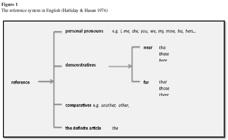
Reference pertains to language elements that, rather than being understood on their own, point to something else that is clear to both the sender and the receiver in the given context. In writing an essay, the device of reference helps the learner to introduce the speakers and maintain awareness of them throughout. The four main components of references are personal reference, demonstrative reference, comparative reference and the definite article. These components hold sentences together logically for readability and interpretability. In this study, we explore the use of these components by some Grade 12 EFAL learners.
Purpose of the study
This study aimed to investigate how Grade 12 EFAL learners in the Malamulele South circuit use grammatical references to enhance cohesion in essays.
Research questions
What types of grammatical references do the Grade 12 EFAL learners use in their essays to achieve cohesion?
How do the Grade 12 EFAL learners use grammatical references to achieve cohesion in their essays?
Grammatical reference is a crucial resource for achieving cohesion because it enables writers to create semantic ties between sentences by referring readers to information already introduced or assumed in the text. Halliday and Hasan's (1976) cohesion theory remains central to recent research on learner writing, particularly in English as a Foreign Language (EFL) and EFAL contexts, where reference is consistently identified as a dominant grammatical cohesive device. A recent study by Razaet et al. (2025) confirmed that EFAL and EFL learners rely heavily on grammatical reference to maintain continuity across sentences, but they often struggle to use reference items accurately or clearly and this has a negative impact on cohesion. These findings suggest that examining grammatical reference in learners' essays remains an important area of research, especially at the secondary school level.
Grammatical reference is divided into personal, demonstrative, comparative, and the definite article as demonstrated below.
Personal reference
According to Agustini et al. (2025), a personal reference is the use of personal and/or possessive pronouns such as he, she, it, they, his, and their to maintain continuity and avoid unnecessary repetition. A study conducted by Abu Hatab et al. (2024) revealed that personal reference is the most frequently used type of grammatical reference in learner writing because it allows writers to sustain topic flow economically. However, a recent study by Raza et al. (2025) showed that EFAL and EFL learners often overuse personal pronouns or employ them without clear antecedents and this results in ambiguity and weakened cohesion. He (2020) claimed that at the secondary school level, learners commonly rely on general pronouns such as it and they, which can obscure meaning if not properly anchored to specific referents. This indicates that while personal references are widely used, they are not always used effectively.
Demonstrative reference
Demonstrative reference includes items such as this, that, these, those, here, and there, which function to point to specific entities or ideas in the discourse. Several studies found that demonstrative references play an important role in cohesion by helping writers connect propositions and guide readers through argument development (Cokal & Von Heusinger, 2024; Halliday & Hasan, 1976, cited in He, 2020; Peeters et al., 2025; Rubab & Mahmood, 2025). He's study (2020) revealed that EFL learners tend to underuse demonstrative reference or use it imprecisely, particularly through vague expressions such as "this shows" or "this is important", without specifying what is being referred to. Studies focusing on learner essays further suggest that limited control over demonstrative reference reduces textual clarity and coherence, especially in argumentative writing.
Comparative reference
Comparative reference expresses similarity, difference, or identity through forms such as more, less, better, different, same, and another. Diep and Le (2024) asserted that this type of reference contributes to cohesion by explicitly linking ideas through comparison and contrast. According to Agustini et al. (2025), comparative reference is used far less frequently than personal or demonstrative reference in learner writing, particularly among secondary-level EFL learners. This underuse has been attributed to learners' limited grammatical range and uncertainty in forming comparative structures. Nevertheless, when used appropriately, comparative references support the logical progression of ideas and enhance cohesion in academic essays.
The definite article
The definite article functions as a grammatical reference device by signalling that a noun is identifiable in the discourse or through shared knowledge. According to FaqeAbdulla (2024), the definite article is a key cohesive marker because it directs readers to retrieve meaning from prior textual references. Raza et al. (2025) showed that EFAL and EFL learners frequently misuse or omit the definite article, thereby disrupting referential clarity and weakening cohesion in essays. Agustini et al. (2025) argued that while much research has focused on article errors at the sentence level, newer studies argue that inaccurate use of the definite article also affects discourse-level cohesion by breaking referential chains in learner texts.
Research gap
Existing research on cohesion in EFAL and ESL writing has established that grammatical reference is a key contributor to textual unity, with many studies confirming that reference devices are among the most frequently used grammatical cohesive mechanisms in learner writing. However, a critical review of the literature reveals several important gaps that justify the present study. First, most empirical studies on grammatical reference focus on tertiary-level or university EFAL/ESL learners, often analysing academic essays or research writing. They do not adequately reflect the linguistic realities of secondary school learners, particularly Grade 12 EFAL learners who are still developing foundational academic writing skills. As a result, there is limited understanding of how cohesion operates in high-stakes school examinations at the exit level. Second, although cohesion is frequently examined as a broad construct, many studies do not provide detailed disaggregated analysis of individual grammatical reference types. Personal reference, demonstrative reference, comparative reference, and the definite article are often grouped together or discussed superficially. This lack of specificity limits insight into how each reference type functions differently in learners' essays and which devices learners control successfully versus those that pose persistent challenges. Given this background, we found it fit to conduct this study to explore the use of grammatical and lexical cohesion in written English essays by the Grade 12 EFAL learners in the Malamulele South Circuit, Vhembe East District, Limpopo Province, South Africa.
Theoretical framework
This study was guided by Halliday and Hasan's (1976) influential Cohesion Theory, which emphasises the crucial functions of cohesive devices in facilitating the connection of words to form sentences and paragraphs for effective communication. These devices are classified into two main categories: grammatical cohesion and lexical cohesion. This theory addresses the central issues of cohesion that are the primary focus of this study. Lexical cohesion is defined by Halliday and Hasan (1976), cited in Rahman et al. (2023) as the cohesive effect achieved by the selection of vocabulary. This term is deeply rooted in the idea that the appropriate choice of words can create meaningful connections in a text to enable readers to grasp the underlying messages more easily. Lestariet et al. (2023) elaborated that this form of cohesion depends primarily on specific vocabulary rather than on grammatical ties. Therefore, Halliday and Hasan's (1976) Cohesion Theory is relevant to this study because it is a foundational framework for understanding how texts achieve unity and coherence. One of its key components is grammatical cohesion, particularly reference, that learners use to connect ideas across sentences and paragraphs in their essays. Therefore, when learners use pronouns, demonstratives, and comparatives effectively, they enhance clarity, avoid repetition, and maintain logical flow.
In this study, we focused specifically on reference, which involves a variety of essentials such as demonstratives, personal pronouns, comparatives and the definite article. FaqeAbdulla (2024) claimed that this technique enriches the text and enhances the reader's comprehension of both spoken and written communication.
Research design and methodology
In this study, we aimed to explore the grammatical and lexical cohesive devices in essays written by the Grade 12 EFAL learners at two selected schools in South Africa. We used a qualitative approach and descriptive case study design to explore how selected Grade 12 EFAL learners use grammatical references such as pronouns, demonstratives, articles, and comparatives to create cohesion in essay writing. The design allowed us to explore learners' writing practices, experiences, and challenges in detail.
Research setting and participants
The study was conducted at two selected secondary schools in an educational administrative unit located in the Collins Chabane Local Municipality that serves rural communities in between 100 and 120 villages with a significant population of approximately 500,000. The Malamulele area is predominantly occupied by Tsonga-speaking communities, with Xitsonga spoken by over 93% of the local population, Tshivenda (1.7%), English (1.2%) and other languages (3.5%). We used simple random sampling to sample fourteen Grade 12 EFAL learners from the population of 60 learners to ensure that every learner in the population had an equal probability of being selected to participate in the study. We wrote numbers on small pieces of paper ranging from 1 to 60 and folded the papers so that the number was not visible to the participants. The pieces of paper were put into a box, and learners were asked to pick one randomly. Learners who picked numbers from 1 to 7 were afforded the opportunity to participate in the study from the two selected schools. This method minimised selection bias. The sample size of 14 Grade 12 learners was considered adequate for the study, given the scope and practical constraints, while still providing sufficient data for meaningful analysis.
Data collection
We collected data through the learners' descriptive essays to determine their writing proficiency in our focusing on their use of grammatical and lexical cohesive devices in English essay writing to connect ideas smoothly and logically.
Data analysis
We used the step-by-step process of thematic analysis offered by Naeemet et al. (2023) to analyse learners' descriptive essays by focusing on reference, substitution, ellipsis, conjunction, repetition, synonymy, antonymy, collocation, and hyponymy to maintain topic consistency and enrich vocabulary use as well as the flow across sentences and paragraphs. The following step-by-step process of thematic analysis was considered:
a. The researcher's familiarisation with data
We read learners' essays several times to become familiar with the collected data. At this stage, we were making notes, deciding on what to code, employ, and regard as the best codes that reflected the research questions.
b. Generating codes
We organised data in a meaningful and systematic way. We captured or coded every piece of information relevant to the topic or that we found interesting. This meticulous approach allowed for easy retrieval and analysis, ensuring that no critical detail was overlooked. We employed various coding techniques, categorising data into themes that emerged during the analysis. By doing so, we were able to identify patterns and trends, which provided deeper insights into the subject matter. Additionally, we maintained a clear documentation system that tracked sources and methodologies, thus fostering transparency and reproducibility in our research process. This thorough organisation not only enhanced the credibility of the findings but also facilitated effective communication of the results to the broader academic community.
c. Combining codes to generate themes
We identified and analysed the essential themes, recurring ideas, and similar patterns. We reflected on the themes that signify the types of cohesive devices used in an essay and errors committed in each type of cohesive device, because these were the themes that reflected the research question. We collected data relevant to each theme.
d. Review of themes
We reviewed, modified, and developed the preliminary themes recognised in the third step. Furthermore, we reread the data to check its relevance. On every occasion, the analysis seemed inadequate, so we reassessed the data to find the missing information.
e. Defining and naming themes
In this step, themes and sub-themes were given names based on what each theme or sub-theme stood for or represented. This naming process was crucial because it provided clarity and context, allowing for a better understanding of the underlying messages or concepts. Each name reflected the essence of the theme in capturing its significance and role in the broader framework. Furthermore, these names served as tools for categorisation and facilitating discussions by providing a common language for all involved participants.
f. Reporting
Reporting was the final stage; we transcribed the report. During this phase, special attention was given to summarising comprehensively the findings and insights gained throughout the research process. We organised data and analysis meticulously into a coherent structure, making it easier for the intended audience to understand the implications of the research. This included introducing the topic and offering a detailed methodology section, results, and a discussion that connected the findings to the original research questions. We used Error Analysis theory to explore the grammatical and lexical errors committed by the Grade 12 English First Additional Language learner participants. We used the five steps of error analysis to achieve the objectives of the study.
Collection of a sample of learners
Identification of errors
Description of errors
Explanation of errors
Evaluation of errors
Using these steps, we were able to collect the samples from learners' scripts and identify, describe, explain, and evaluate errors. This systematic approach allowed for a comprehensive analysis of the common mistakes made by learners and allowed us to shed light on the underlying reasons for these errors. By categorising the errors into different types-omission, addition, mismatch and misplacement-we were able to develop a clearer understanding of the students' learning challenges. Furthermore, the evaluation process involved providing constructive feedback that aimed not only at correcting the errors but also at fostering a deeper understanding of the subject matter. Through this iterative examination, patterns emerged that highlighted specific areas in which instruction could be improved. Ultimately, this study not only contributed to individual learner growth but also provided valuable insights for teachers wanting to tailor their teaching strategies to better support learners' learning.
Trustworthiness measures
To ensure trustworthiness, the study applied credibility, dependability, confirmability and transferability criteria. Credibility was strengthened through independent coding by two researchers, prolonged engagement with the data, and use of direct learner extracts, member checking, and peer debriefing to ensure that the findings accurately reflected how Grade 12 EFAL learners use grammatical reference to enhance cohesion. Dependability was achieved by maintaining an audit trail documenting coding decisions, theme development, and analytical steps. Confirmability was ensured through reflexive notes and direct excerpts from learners' essays to support the findings. Transferability was enhanced by providing thick descriptions of the research context, participants, and illustrative examples, allowing readers to determine the relevance of findings to their own EFAL settings.
Results and discussions
This study aimed to explore the grammatical and lexical cohesive devices in essays written by the Grade 12 EFAL learners at two selected schools in South Africa. The discussions are based on the grammatical references such as personal, demonstrative, comparative and definite articles. In this section, the participants' extracts were used for discussions. The findings of this study are presented through the following themes.
Personal references
According to Msuya and Abdala (2025), the personal reference in English is a part of speech that substitutes for a noun, thereby preventing repetition in communication. Below are learners' extracts showing how they used personal references in their essays.
Extract 1: I was very happy as I woke up myself.
Extract 2: When you are facing a problem or a challenge in your life, your true friend will be there to rescue you and bring solution to our problems.
Extract 3: Money can make youré self killed by criminals.
Extract 4: Many people they were killed because of money.
The above extracts show that learners have common difficulties with pronoun use, particularly unnecessary reflexive pronouns, pronoun inconsistency, and double subjects. In Extract 1, "I woke up myself" incorrectly uses the reflexive pronoun "myself," since "wake up" does not normally require a reflexive form; it should be corrected to "I was very happy as I woke up." In Extract 2, there is a shift from second-person pronouns ("you, your") to the first-person plural ("our problems"), which creates inconsistency; the sentence should maintain one perspective, for example, "…bring solutions to your problems." Extract 3 misuses a reflexive pronoun in "youré self," which is both incorrectly formed and unnecessary; the idea would be clearer if expressed as "Money can cause people to be killed by criminals" or "Money can put you at risk of being killed by criminals." In Extract 4, the phrase "Many people they were killed" shows pronoun repetition, where both the noun and pronoun act as the subject; this should be corrected to either "Many people were killed because of money" or "They were killed because of money." Overall, the learners need support in avoiding redundant pronouns, keeping pronoun reference consistent, and ensuring that each sentence has only one clear subject. These findings concur with those of Jannah's (2021) study. Their results revealed that the eighth-grade students of SMP IT Roudlotussalam College have challenges using personal pronouns. The findings also align with those of Li (2021), who found that Thai non-English major students had challenges with cohesive devices and errors included misuse, misplacement, and overuse of some cohesive devices. Furthermore, these results concur with those of a study by Miryadi (2023), which found that learners used all types of pronouns. The study further revealed that a substantial number of learners committed pronoun errors in their essay writing. In other words, these errors included omission, mismatch, addition, and displacement of pronouns.
Demonstrative references
Jiang and Ren (2023)1 defined demonstrative pronouns as words that are used to refer to some other entity associated with a notion of relative distance (proximal/distal). Below are learners' extracts on how they used demonstrative references in their essays.
Extract 5: After that, he broke up with me in front of the all school.
Extract 6: This is caused by the shortage of coals.
Extract 7: When we arrived there, the pastor was waiting.
Extract 8: All this books are wet because of rain.
The extracts above show that learners have problems with reference words, including pronouns and determiners, as well as with unnecessary or unclear elements. For instance, in extract 5, no pronoun error occurred. Extract 6 contains no pronouns, but the demonstrative "This" is vague without a clear antecedent, making the reference unclear; it would be better to specify the noun in saying, for example, "This problem is caused by the shortage of coal." In extract 7, pronoun usage is correct, but the adverb "there" is redundant because the location is already implied in "arrived"; the sentence can be simplified to "When we arrived, the pastor was waiting." Extract 8 shows an error with the determiner "this," which is singular, used with the plural noun "books"; it should be corrected to "All these books are wet because of the rain." Overall, the learners need more practice in using clear reference words, matching determiners with nouns, and avoiding vague or unnecessary elements that weaken sentence clarity.
Definite articles
FaqeAbdulla (2024) stated that the definite article is used when talking about a particular person or thing. The definite article functions as a grammatical cohesive device, helping to specify and identify nouns that are familiar to the reader. This includes any singular or plural noun, countable or uncountable, if the noun has already been mentioned or is readily identifiable in context. The extracts below show how learners used or failed to use the definite article in their essays.
Extract 9: He broke up with me in front of the all school.
Extract 10: Your lover who means the world to you.
Extract 11: The pastor was not happy with our late arrival.
Extract 12: Sun was down when we arrived.
The findings show the incorrect, missing, or inappropriate use of the definite article which affects clarity and grammatical accuracy. In Extract 9, "in front of the all school" wrongly combines "the" with "all," since these do not function together in this context; the correct use of the definite article would be "in front of the whole school" or "in front of the entire school." Extract 10 does not require the definite article at all, but the extract is incomplete, functioning as a fragment rather than a full sentence; clarity would improve if it were completed; for example, "Your lover is the one who means the world to you." Extract 11 demonstrates correct use of the definite article in "The pastor," since it refers to a specific, identifiable person known to the speaker and listener, and no correction is needed. In Extract 12, the definite article is missing before "sun"; since the sun is a unique, known entity, it should be referred to as "the sun," making the corrected sentence "The sun was down when we arrived." This suggests that learners need more practice in understanding when "the" is required to refer to specific or unique nouns, when it is unnecessary, and when it must not be combined with determiners like "all".
Comparative reference
Adam (2024) elucidated that comparative reference signals similarities and differences that exist between two things being compared. Halliday and Hasan (1976) cited in Diessel (2025) indicated that comparative references include words like less, identical, other, than, similarly, likewise, better, same, more, equal identically, similar, so, different, else, worse etc. The extracts below show how learners used comparative reference in their essays.
Extract 13: She gave me a tight slap stronger than the ocean wave.
Extract 14: He behaved like his father in the meeting.
Extract 15: The first hotel was better because of its location as it was near our home.
Extract 16: His speech was more worse than his writing.
The findings revealed that learners have different understanding of comparative structures, with problems involving mainly incorrect comparative forms and unnecessary or unclear comparisons. In Extract 13, the comparative idea "stronger than the ocean wave" is grammatically correct, but the comparison itself is exaggerated and stylistically awkward; it would be more natural to say, "She gave me a slap as strong as an ocean wave" or "a very strong slap." Extract 14 does not use a comparative at all. Instead, it uses "like" to show similarity, which is correct, but if a comparison of degree was intended, it could be rephrased as "He behaved more like his father during the meeting." In Extract 15, the comparative "better" is used correctly to compare two hotels, and the supporting clause "because of its location" clearly explains the comparison, so no correction is needed. However, Extract 16 shows a clear error in comparative formation with the use of a double comparative "more worse"; since "worse" is already the comparative form of "bad," it should be corrected to "His speech was worse than his writing." It can be seen that learners need reinforcement on forming comparatives correctly, avoiding double comparatives, and choosing appropriate structures to express comparison clearly and naturally. We conclude that the analysis of the learners' extracts shows persistent challenges in the accurate use of personal pronouns, demonstratives, definite articles, and comparatives, which, taken collectively, affect clarity and grammatical correctness. Thus, the results suggest that learners require focused instruction on reference coherence, agreement between forms and nouns, correct article usage, and the proper formation of comparatives to achieve clearer and more grammatically correct written expression.
Conclusion
This study aimed to explore the use of cohesive devices in English essays written by the Grade 12 EFAL learners in the Malamulele South circuit. This research offered significant information about sentence construction in its paying special attention to the use of cohesive devices in English essays. The results indicate that the grade 12 EFAL learners in the area use reference relatively as their cohesive devices in English essays. The study further revealed that most writing challenges lie in the application of personal pronouns and this needs special attention to be paid by both teachers and learners if the latter are to learn how to write logical and readable English essays since the learners' failure to use cohesive devices correctly implies a hindrance to effective communication.
Limitations
This study was based on a sample of only 14 Grade 12 First Additional Language learners in the Malamulele South Circuit and two schools. This can be seen as a limitation of this study.
Recommendations
We recommend that essay-writing lessons be taught alongside those on how to use cohesive devices so teachers do not teach cohesive devices in isolation; they should be embedded in a text or a passage. Out differently, we recommend that English teachers should focus on teaching cohesive devices in context. This can be achieved effectively by exposing students to exemplary essay composition and by implementing process-oriented approaches that include group discussions, role-playing, peer editing, and debates to foster adept writing skills. This will help learners avoid memorising cohesive devices and applying them without understanding their function. It is essential to provide learners with progressively intensive practice to ensure that they have sufficient exposure to connecting and organising ideas coherently to produce meaningful and cohesive texts. Teachers should also offer students feedback on their performance thus enabling them to reflect on it. We further recommend that future researchers investigate ways of improving the teaching of cohesive devices by helping learners to pay attention to personal pronouns since this study found it challenging for many Grade 12 learners in the Malamulele South circuit.
References
Literature review
- Abdi Tabari, M. & Wind, A. M. (2025). Dynamic development of cohesive devices in English as a second language writing. International Review of Applied Linguistics in Language Teaching, 63(1), 433-469.
- Abu Hatab, W., Al-Tarawneh, A., & Al-Badawi, M. (2024). Reference in English narrative texts. In Frontiers of Human Centricity in the Artificial Intelligence-Driven Society, 5.0 (pp. 1401-1409). Cham: Springer Nature Switzerland. https://doi.org/10.1007/978-3-031-73545-5_131
- Adam, M. H. (2024). Postsecondary Arabic-Speaking English as a foreign language: Learners' perceptions of learning English Sentence Structure. [Doctoral dissertation, Walden University].
- Diessel, H. (2025). Demonstrative determiners in crosslinguistic perspective. Acta Linguistica Academica. An International Journal of Linguistics, 72(3), 331-355.
- Diep, G. L., & Le, T. N. D. (2024). An analysis of coherence and cohesion in English majors' academic essays. International Journal of Language Instruction, 3(3), 1-21.
- FaqeAbdulla, B. I. (2024). Analysis of definite and indefinite article usage in students' paragraphs. Koya University Journal of Humanities and Social Sciences, 7(1), 494-501.
- Halliday, M. A. K. & Hasan, R. (1976). Cohesion in English. Longman.
- He, Z. (2020). Cohesion in academic writing: A comparison of essays in English written by L1 and L2 university students. Theory and Practice in Language Studies, 10(7), 761-770. https://doi.org/10.17507/tpls.1007.06
- Jannah, L. N. F. H. R. (2021). An analysis of the use of personal pronouns in writing recount text paragraphs written by the eighth-grade students of SMP It Roudlotussalam in the academic year 2021/2022. [Doctoral dissertation, Islamic Institute of Darussalam, Blok Agung, Banyuwangi].
- Jiang, L., & Ren, M. (2023). A general theory of Ancient Chinese. Qizhen Humanities and Social Sciences Library. Springer, Singapore. https://doi.org/10.1007/978-981-16-6042-9
- Khalil, A. A. & Abu-Ayyash, E. A. (2023). Lexical cohesive devices and English writing quality. Journal of Advances in Linguistics, 14(1), 7-19.
- Lestari, F. T., Astutik, I. & Werdiningsih, I. (2023). An analysis on cohesive devices of students' recount paragraphs writing. Pubmedia Jurnal Pendidikan Bahasa Inggris, 1(1), 1-16.
- Livingston, M. A. & Peña, E. V. (2021). Latino male students' perceptions of writing in first year college writing courses. [Conference session]. American Association for Adult and Continuing Education (AAACE), Miramar Beach, FL, United States. https://files.eric.ed.gov/fulltext/ED611618.pdf
- Miryadi, Z. (2023). Analysing pronoun errors made by students in essay writing [Doctoral dissertation, Universitas Islam Negeri Ar-Raniry].
- Msuya, D. & Abdala, J. (2025). Exploring teaching practices for developing paragraph writing skills in English as a foreign language through a competence-based approach in Tanzania's secondary schools. Discover Education, 4(1), 84-91.
- Nadhifah, S., Khafshoh, A. L. & Suryati, N. (2026). EFL learning strategies of Indonesian university students for academic writing skills: A systematic literature review. Jurnal Pendidikan Humaniora, 11(4), 262-277.
- Naeem, M., Ozuem, W., Howell, K. & Ranfagni, S. (2023). A step-by-step process of thematic analysis to develop a conceptual model in qualitative research. International Journal of Qualitative Methods, 22, 1-8.
- Peeters, D., Schuurman, S., Zhai, T., Krahmer, E., Gu, Y. & Maes, A. (2025). Discourse genre predicts demonstrative use in text: Experimental evidence from Dutch and Mandarin. Cognition, 265, 1-7.
- Raza, H., Sarwar, M. S. & Qasim, H. M. (2025). Cohesion in ESL argumentative essays: An SFL analysis of university students' writing across Punjab. Pakistan Social Sciences Review, 9(1), 685-697. https://doi.org/10.35484/pssr.2025(9-I)52
- Rubab, Z. & Mahmood, M. A. (2025). Modal verbs in English and Shahmukhi Punjabi language: A corpus driven comparative study. Journal of Applied Linguistics and TESOL (JALT), 8(1), 1295-1305.
- Siregar, J., Nurlela, N. & Zein, T. T. (2023). An analysis of cohesive devices in EFL students' essay writing. Indonesian Journal of EFL and Linguistics, 8(1), 39-53.
- Tian, Y., Kim, M., Crossley, S. & Wan, Q. (2024). Cohesive devices as an indicator of L2 students' writing fluency. Reading and Writing, 37(2), 419-441.
Accepted: 4 June 2026