Khelobedu-L1 parents' attitudes towards using Khelobedu as a medium of instruction
Abstract
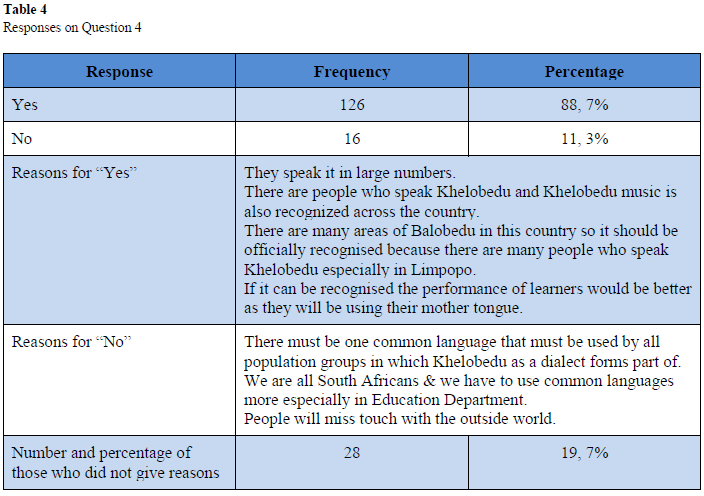
Learners who speak Khelobedu are taught in Sepedi because their language, Khelobedu, is classified as a dialect. Dialects are currently not accommodated in South African classrooms. The Khelobedu-L 1 learners therefore do not enjoy the constitutional and linguistic rights of being taught in their mother tongue as other learners are enjoying. Given this situation, we deemed it necessary to explore the attitudes of Kheloebdu-L1 parents towards the possibilities of using Khelobedu as a Medium of Instruction in the Foundation Phase. We conducted this study with 142 parents of Bolobedu South region, in Limpopo province. We used both quantitative and qualitative approaches and followed a case study design. Data was gathered through a questionnaire and semi-structured interviews and was analysed through descriptive statistics and thematic analysis. The results of the study revealed that Khelobedu-L1 parents embraced the use of Khelobedu as a MoI. The results also reflected that parents are wary that the use of Sepedi forces their children to follow other peoples' cultures, while suppressing theirs. In this paper, we discuss the factors that shape this attitude in parents.
learner achievement; parental involvement; cultural imperialism; Khelobedu; Sepedi