Intermediate phase pre-service teachers' interpretations of a learner's verbal statement about unit fractions: Conversion and treatment of semiotic representations
Abstract
Understanding fractions is important for the effective teaching of primary mathematics, and unit fractions are foundational to reasoning about rational numbers. Drawing on Duval's (2006) theory of semiotic representations, this study examines how Intermediate Phase pre-service teachers (PSTs) negotiate fraction language when moving between verbal and symbolic representations of unit fractions. Data were drawn from 158 intermediate phase PSTs' written responses to an assessment item where they were to identify and address a misconception embedded within a given verbal statement, followed by semi-structured interviews with 13 participants. Only 20 per cent of the 158 PSTs provided correct responses, with most struggling with conversion from the verbal to the symbolic register. A common error was conflating a third with 3 and a fifth with 5, suggesting a slippage between ordinal and fractional meaning. Sixteen participants successfully completed the Conversion but faltered during the Treatment transformations within the symbolic register, with errors revealing conceptual and procedural instability. Previous research on the linguistic forms of fractional concepts in local African languages suggests that certain linguistic forms reinforce whole-number reasoning and contribute to difficulties in fraction representations. Explicit engagement with the relationships between fraction language, symbolic representations, and whole-number reasoning are therefore recommended for PST education.
conversion; treatment; semiotic representations; registers; unit fractions
Introduction
A deep understanding of fractions is critical for teaching primary mathematics effectively. Yet, numerous studies have shown that pre-service teachers (PSTs) often harbour significant misconceptions about fractional concepts, particularly unit fractions such as one-half (½) and one-third (⅓) (Krowka et al., 2025; Ma, 1999). These misconceptions are not trivial; they have lasting implications on the quality of instruction delivered to young learners, and the perpetuation of mathematical misunderstandings across generations. Findings from a multi-level analysis of 3,496 students in 154 classrooms indicate that teachers' knowledge contributes to learners' understanding and learning progress through its influence on teachers' instructional skills and instructional quality (Blömeke et al., 2022). Unit fractions-fractions with a numerator of one-serve as foundational building blocks for understanding more complex operations with rational numbers such as percentages, ratios, and proportional reasoning; critical in STEM subjects. However, many PSTs as well as in-service teachers rely heavily on memorised procedures with little comprehension of the underlying logic (Siegler et al., 2011; Grigaliūnienė et al., 2025). Research by Tzur (2004) and Pantziara and Philippou (2012) has shown that when teachers lack a robust understanding of fractions, they are less likely to use effective teaching strategies, and more likely to pass on misunderstandings to their students. These finding are supported by Ezaki et al. (2024), who found that teachers with stronger mathematical knowledge demonstrated a better understanding of interconnected fraction concepts, highlighting the importance of robust subject matter knowledge for effective mathematics instruction. Furthermore, in their meta-analysis of studies on the impact of rational number interventions, Krowka et al. (2025) found that the teaching of mathematical language and the use of the number line had the greatest positive impact. This finding underscores the importance of learners being able to accurately interpret and translate verbal descriptions of fractional relationships into mathematical representations, an aspect of fraction learning that remains underexplored.
These pedagogical issues have relevance in contexts where teacher education programmes are under pressure from mass enrolment and resource constraints, such as in South Africa and other developing countries (Chimombo, 2005; Nyagope, 2020). Given the central role of fractions in early mathematics, and the widespread misconceptions surrounding their operations, this study investigates how Intermediate Phase PSTs interpret and reason about unit fractions by examining two key cognitive processes identified by Duval's (2006) theory of semiotic representation registers: Conversion between verbal and symbolic representations, and Treatment within the symbolic register.1 Specifically, the study explores how PSTs convert verbal statements involving the unit fractions a half, a third, and a fifth, into symbolic representations, and how they subsequently operate on these symbolic representations to solve a fraction problem. By identifying the more nuanced conceptual difficulties and strategies employed by pre-service teachers during both processes of Conversion and Treatment, the study seeks to inform teacher education practices to promote deeper mathematical thinking and more effective pedagogy.
Accordingly, the main research question is: "How do Intermediate Phase pre-service teachers conceptualise unit fractions and fractional relationships when interpreting and representing verbal statements involving problems with fractions?" It is hoped that the results will add to new knowledge about students' conceptualisations of the language of unit fractions, especially given that the unit fraction is a key concept in developing robust fraction schemes (Hackenberg & Lee, 2015).
In this review, we first briefly survey studies about difficulties with working with fractions, before moving to a discussion of models explaining the development of the understanding of fractions, within which a unit fraction is the central concept. The last section delves into the issue of language of fractions, which provides some insight into this study which focuses on the conversion of a statement from a verbal to a symbolic representation.
Understanding fraction operations remains a persistent challenge for learners at all levels, including pre-service teachers. Fractions, particularly unit fractions such as one-half ( ) and one-third (
 ), are foundational in early mathematics education yet are commonly associated with misconceptions and procedural errors (Krowka et al., 2025; Siegler et al., 2011). Studies have demonstrated an ongoing concern that pre-service teachers often carry misconceptions from their own schooling, which may influence their future instructional practices (Ball, 1990; Newton, 2008; Perry, 2023).
One prevalent misconception is viewing fractions as discrete whole-number components rather than parts of a continuous whole. This indicates a lack of conceptual understanding of fractions as relative quantities. For instance, many pre-service teachers believe that  is always smaller than
 because "3 is greater than 2" (Tzur, 2004). In a study involving 71 female PSTs, Rosli et al. (2020) found that participants demonstrated weak content knowledge of several foundational fraction concepts, including unit-whole relationships, part-whole relationships, equivalent areas, fraction operations, and the ordering of fractional values. However, the use of concrete models, problem-solving, and problem-posing activities was found to enhance PSTs' pedagogical content knowledge, as well as their perceptions and attitudes towards fractions. An earlier study by Pantziara and Philippou (2012) found that PSTs struggled to interpret unit fractions using visual models, suggesting insufficient experience with concrete and semi-concrete representations in their own learning. These findings highlight the importance of engaging PSTs with multiple representations and conceptual approaches to fractions, rather than focusing on procedural fluency and symbolic representations only. Such opportunities may support PSTs in developing more flexible and inter-related fraction schemes that enable them to interpret, represent, and explain fractional ideas effectively.
Siegler et al. (2013) noted that students mistakenly believe that the properties of whole numbers apply to fractions, which may not necessarily be true. Where a fraction is represented symbolically by a bar that separates two whole numbers is considered, this symbolic representation does not indicate an ordering according to magnitude. In contrast, the ordering of whole numbers follows the ordering of the natural numbers' sequence. Every whole number has a unique successor and a unique preceding number, but this is not the case for fractions. In considering operations, when two whole numbers are multiplied, the result is a larger number, however for fractions the multiplication may result in a smaller or a bigger number. It is for these reasons that Siegler et al. (2013) argue that one's numerical assumptions need to be reconsidered when learning fractions because children who have not encountered fractions yet assume that all numbers share the same properties with whole numbers.
The understanding of fractions is a developmental process that unfolds progressively over time (Hackenberg & Lee, 2015; Mostert & Roberts, 2022; Sfard, 2008; Steffe & Olive, 2010; Ubah & Bansilal, 2018). Sfard's notion of discursive compactification is used by Mostert and Roberts to explain how understanding of fractions develops from a process view of partitioning a whole into equal parts and selecting some of them, to an object view, where the fraction is conceived as a single entity (e.g. three-fourths), which can be subjected to other operations. Steffe and Olive argue that there are five fraction schemes that develop in sequence with respect to the understanding of fractions-starting with the part-whole scheme, and progressing to the iterative fraction scheme (Boyce & Norton, 2016; Steffe & Olive, 2010). Ubah and Bansilal used an APOS perspective to describe the progression starting with the Action of partitioning (Hackenberg & Lee, 2015) used to unitise a fraction, that is, splitting a whole into a certain number of equal parts. The Action is interiorised into a Process when an individual is able to predict the result without doing the concrete splitting action. The Partitioning Process is encapsulated as an Object when the result is taken as a totality, that is, a fractional number (Steffe & Olive, 2010), upon which transformations or operations can be carried out. That is, the understanding will have broadened to form an iterative fraction scheme (Hackenberg & Lee, 2015), allowing them to make sense of the symbol  , say, as being equivalent to 4 ×
 . The conceptualisation of a unit fraction as an Object, say, a fifth or a third, therefore marks a crucial step in constructing an iterative fraction scheme (Ubah & Bansilal, 2018). The operation of iterating means adding the same part repeatedly, to form a larger quantity by accumulation, for example, adding
 three times-3 multiples of
 (Hackenberg & Lee, 2015, p. 204). The iterative fraction scheme is constructed when a fraction
 can be interpreted as b pieces with each piece having a size of
 , that is, all fractions can be taken as an iteration of a unit fraction (Lovin et al., 2018). Within these schemes, the central concept is that of a unit fraction and hence the language of unit fractions is a crucial element in developing a robust understanding of fractions.
The teaching of mathematical language (e.g. mathematical vocabulary and terminology) was reported to have a significant positive impact on interventions to assist students who struggled with understanding fractions (Krowka et al., 2025). Language plays an important role in this study because participants were required to interpret a verbal statement involving unit fractions and translate it into symbolic notation. There is limited research delving into the role of language in understanding fractions (Mostert & Roberts, 2022). Language is not merely a vehicle for expressing mathematical ideas, but a central tool through which meaning is constructed and helps to organise thoughts and make connections. This broader role of language is particularly evident in how fractions are linguistically structured and named across different contexts. Mostert and Roberts looked at how fractions are named in isiXhosa, with a focus on the naming conventions of four-fifths. One convention names the denominator first as "izintlanu ezine," which means "fifths-they.are four" (Mostert & Roberts, 2022, p. 3-214). A second way of naming it is "isine kwisihlanu" which means "four in five" (p. 3-215), suggesting that the description derives from a collection view of fractions. The students in this study are predominantly isiZulu speakers, and the linguistic conventions are similar to those of isiXhosa because both are Nguni languages. Robertson and Graven (2019) argue that home language and everyday contexts can provide an important bridge for developing conceptual understanding by enabling learners to engage with mathematical ideas through familiar experiences before encountering more semantically dense mathematical language and symbolic representations. However, movement between linguistic forms requires careful mediation. Mpalami (2022) highlights that translation between English and home languages may not always preserve mathematical meanings, and that differences in linguistic structures can contribute to difficulties in mathematical tasks. Thus, while home language can support the development of conceptual understanding, learners need opportunities to explicitly connect everyday language, specialised mathematical language, and symbolic representations of fractions.
Theoretical framework: Working through symbolic and verbal fraction representations
Mathematical thinking may be expressed using different representations. Lesh's (2000) model describes five modes of representation, namely, real-life situations, verbal, symbolic, diagrammatic, and concrete representations. Representational fluency refers to an individual's ability to move flexibly between these representations and to make meaningful connections between them. In the context of fractions, a verbal representation may be expressed as spoken or written language, such as one-half or one-third, while the corresponding symbolic representations are  and
 . An important aspect of fraction understanding is the part-whole relationship, which can be represented through the symbolic representation of a fraction such as
 showing that there are 4 parts of the whole consisting of 5 equal parts. When learners fail to recognise this relationship, they may instead interpret the numerator and denominator as independent whole numbers and apply whole-number reasoning inappropriately (Siegler et al., 2013). The symbolic representation
 may also be used to describe a fraction as a collection, that is, 4 items out of a total of 5 items. A verbal representation is when we say or write the fraction, for example, three-quarters or a third-using words. Physical manipulatives or models of fractions include the use of fraction charts, circles where a fraction
 can show that there are four shaded parts out of the total of five parts, or collections (where 4 can be the number of items out of the total number in the collection of 5 items).
Notably, a representation is more than just a depiction of an object, but forms part of a semiotic system that is characterised by signs, the rules governing their use and the underlying meaning structure of these within the system (Ernest, 2006). A semiotic system is used to enhance communication about, and designation of, an object, and has its own specific way of working in and with mathematical objects. Duval (2006) maintains that mathematical activity is inseparable from systems of semiotic representation and that mathematical understanding depends on learners coordinating and transforming representations across different registers. Mathematical procedures therefore depend not only on the mathematical properties of an operation but also on the representational system within which the operation is performed (Duval, 2006). This is evident when you consider that the algorithm for adding fractions differs depending on whether they are written in fractional notation (e.g.  +
 ) or in decimal notation (0.2 + 0.25). The mental model underlying fraction notation may also influence the procedure that learners apply. For example, using the set or collection model where
 , for example, represents 3 items out of a collection of 5 items, and
 represents 4 items out of a collection of 6 items, some learners may incorrectly reason that combining the collections gives 7 selected items out of a total of 11 items, yielding
 . However, this is an incorrect extension of the collection interpretation because the two fractions refer to different wholes (or unit sizes) and therefore cannot be combined in this way. Thus, the representation through which learners interpret fractions can profoundly influence their understanding of fraction operations.
Duval differentiates between two types of transformations of semiotic representations that can occur during any mathematical activity, referred to as Treatments and Conversions. The first involves transformations from one semiotic representation to another within the same register, whereas the second involves changing the register while retaining reference to the same mathematical objects. In this study, on the one hand, the transformation of the verbal representations of unit fractions from halves, thirds, and fifths to the symbolic representation  ,
 , and
 respectively, constitute a Conversion activity. On the other hand, calculating the sum
 +
 =
 , constitutes a Treatment. Duval (2006, p. 127) argues that Conversions are the crucial mechanism that underpins understanding of mathematical objects, yet they are only necessary when we need to choose "the register in which the necessary Treatments can be carried out most economically." In this study, PSTs were required to interpret a learner's verbal statement about the sum of a half and a third being a fifth. To evaluate the correctness of this statement, they first needed to convert the verbal representations into symbolic notation before carrying out the necessary treatment within the symbolic register. Examining both the Conversion and Treatment processes therefore provides insight into the nature of PSTs' conceptual understanding of unit fractions, and the points at which their reasoning may break down.
Methods
This study was qualitative in nature and took an interpretive approach because we needed to understand the students' reality (Cohen et al., 2018) regarding their interpretations of a verbal representation of the sum of two-unit fractions being equal to a third unit fraction. The participants consisted of 158 second-year Intermediate Phase PSTs who were enrolled in a foundational numeracy module that also targeted the development of some pedagogic skills. These students had either passed Mathematics or Mathematical Literacy in their Grade 12 examination and almost all of them were isiZulu first-language speakers. The item under scrutiny in this study was part of an assessment in the module. The participants' written responses were initially analysed to identify common approaches that permeated the responses, and these were used to identify potential interviewees who were then approached, 13 of whom agreed to be interviewed. The interviews, which probed their understanding of fractions and the reasoning behind the methods that they used, were transcribed. The detailed analysis of the written responses was done in various stages. The response was coded as correct if the Conversion part and Treatment part was completed correctly and some feedback response was provided. Thereafter, the incorrect responses were coded in terms of the various results for the Conversions and the Treatments that were carried out. In this coding process, the authors worked separately, first identifying individual codes for the Conversion and Treatment parts to set up their own categories in an inductive manner, using a small sample of scripts. The themes were then refined in a collaborative process where each author presented their own coding to the group and then together agreed and elaborated on, collapsed, or distinguished between particular codes. After three cycles, a final coding scheme was documented forming a coding manual. Each author then coded each response according to the manual and thereafter, the coding of the participants' responses was compared until agreement was reached on each code assigned.
All ethical protocols specified by the host university were carefully followed, and ethical clearance was granted by the university research committee to conduct the research. The interview participants are reflected as S1 to S13 while the written extracts are not attributed to particular students, so as to preserve anonymity.
Results
The participants' responses to the following item are analysed below: "An 11-year-old states that a half added to a third is a fifth. How would you help this child to correct the misunderstanding here?"
We first do an overall summary of the results before focusing on specific issues arising with the Conversion and Treatment parts of the problem.
Overall summary
As explained in the theoretical framework, there were two stages in establishing the error in this question. The first stage involved carrying out the Conversion (Duval, 2006) on the given verbal representation to transform the statement to the symbolic equivalent:  +
 =
 . The second stage involves working out the sum
 +
 to establish the correct answer, that is, carrying out a Treatment (Duval, 2006) in the symbolic register. Thereafter, the student could craft a response to the 11-year-old, based on the answer they get in the second part.
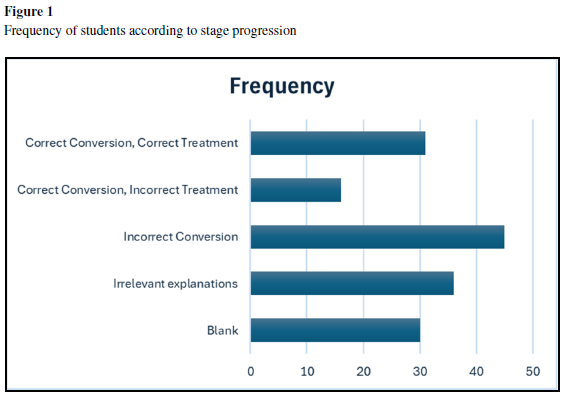
Thirty participants did not respond to the question at all, while 36 provided irrelevant explanations without carrying out any Conversion or Treatment transformation. There were 45 participants who were unable to complete Stage 1 (Conversion), that is, they were not able to move correctly from the verbal to the symbolic representation of the statement correctly. A further 16 provided the correct Conversion (Stage 1) but faltered at Stage 2 (Treatment). There were 31 participants who correctly completed the task-that is, they successfully completed Conversion from the verbal to the symbolic register, correctly performed Treatment transformations within the symbolic register, and provided relevant feedback. These results are depicted by the bar graph in Figure 1.
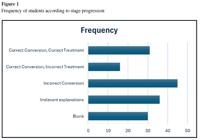
We explore these responses in further detail below.
Results for the conversion (Stage 1)
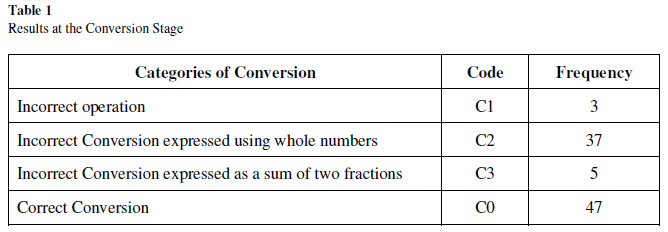
There were 92 responses excluding the blank and irrelevant responses. Forty-five of these were incorrect Conversions, while 47 were correct Conversions as represented in Table 1.
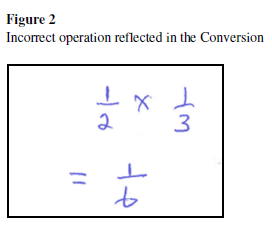
Of the 45 participants who did incorrect Conversions, three students (C1) used an incorrect operation, as shown in Figure 2 where, for example, one wrote  ×
 .
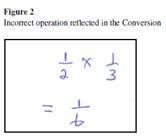
There were five participants whose translation was in terms of a fraction plus fraction, for example, one wrote:  +
 .
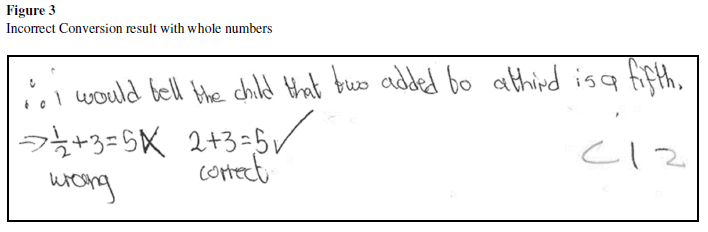
It was interesting that 37 students depicted one or more of the fractions using a whole number. There were seven participants who represented all three fractions in the sum as whole numbers, for example, one wrote 2 + 3 = 5, as seen in Figure 3.
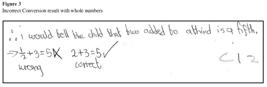
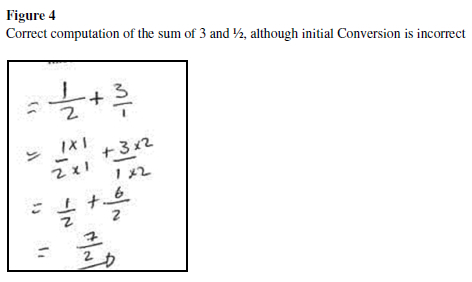
Of interest within the group of 45 incorrect Conversions, were 30 participants who translated the statement in terms of a fraction plus a whole number. One participant wrote  = 50. All of the other 29 participants wrote
 + 3. We then further investigated these 29 responses to study the solutions they obtained, and found that 22 of this group went on to complete the Treatment transformation correctly on the sum 3 + ½ to get 7/2 or 3,5-as illustrated by one response in Figure 4.
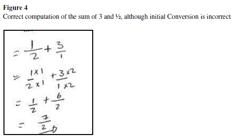
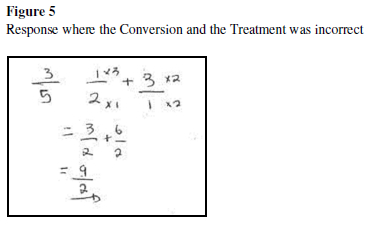
This means that this group of 29 participants carried out a correct further Treatment on an incorrect symbolic representation (Conversion). The remaining seven participants went on to commit further errors in the simplification of the sum, that is, the further Treatment they carried out was also wrong. Hence, they got both the Conversion and Treatment wrong. An example is shown in Figure 5.
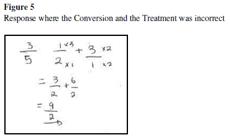
As seen in Figure 5, the participant has multiplied the first fraction by  and the second fraction in the sum by
 to get a final answer of
 . Such responses show high procedural instability.
The use of ad-hoc rules to find the sum of fractions was also apparent in the responses of the 16 participants who correctly reflected the verbal statement symbolically (correct Conversion), which is shown in Figure 1 and the paragraph preceding it.
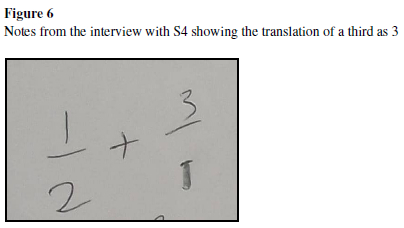
Interestingly, the most common incorrect Conversion involved the conflation of  with 3, evidenced in 29 responses, which has not been reported in previous literature. The interview responses confirm the participants' strong convictions that a third was the same as the number 3. The following is the extract of the initial part of the interview with S4 explaining her translation:
[Looking at the question] I think what I will do is I will just write down the question. A child 11 years old state a half added to a third. I will write like this one over two added to a third. I think I am not so sure added its addition sign [wrote  +
 , see Figure 6]. I think it's something like this. I am really not sure. I quite remember I got this one wrong.
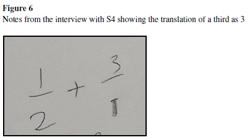
Some students also understood a fifth to mean the number 5. The interview with S8 shows that they believed that a third and a fifth were 3 and 5, respectively:
Interviewer: Okay So what is a third?
S8: A third is a three.
Interviewer: And a fifth?
S8: Is a five.
Interviewer: Okay, and half?
S8: Is one over two [immediate confident response with no confusion].
Interviewer: What is the difference between third and three [writing the word a third and three on the paper]?
S8: A third and three, right?
Interviewer: Yes, what is the difference between a third and three? Are they the same here?
S8: A third [showing three figures].
Interviewer: Yes.
S8: A three right [raising three figures]. I don't think there is a difference.
Interviewer: What about a fifth and a five?
S8: Aah [shaking head].
S8: [Nodding head in agreement]. Yes, a fifth and a five both are five.
In the extract of the interview with S8 above, the participant has repeated their contention that a third is 3, and a fifth is 5-showing how confident they are about the equivalence.
Results for responses with correct conversions but incorrect treatments
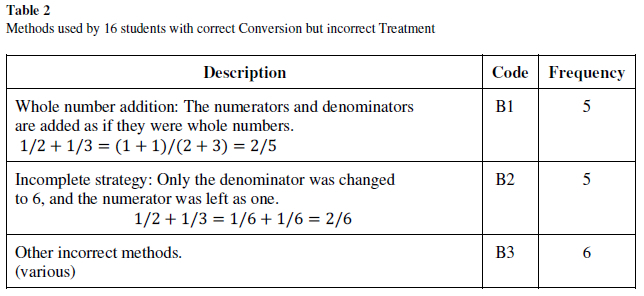
There were 16 participants who correctly translated the verbal statement into the symbolic form getting  +
 but faltered at Stage 2, where they struggled with the computation of this sum. The responses illustrated instability in the use of the procedures, where sometimes the wrong rules were used and at other times, there were errors in carrying out the appropriate strategy.
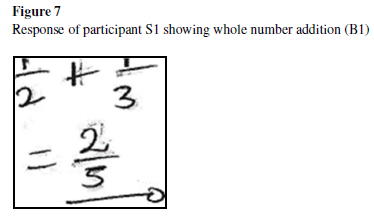
Five participants used whole-number addition applied separately to the numerators and denominators to get an answer of  (B1), that is, they applied the rule
 +
 =
 . So, in the addition of fractions, they found
 +
 =
 =
 as seen in the response of student S1 in Figure 7.
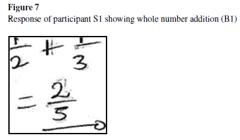
In the interview, the student S1 tried to explain her reasoning:
Interviewer: So how did you get the answer here [Pointing to the student's writing  +
 =
 ]. Half plus a third is equal to?
S1: Okay actually the answer is two over five [laughing, writing the answer].
Interviewer 1: So, the answer is actually two over five?
S1: Yes, so we add numerators and denominators here, Mem.
Interviewer: So why you did this here? [referring to other working details of S1 with the answer  ]. What is the reason you made the denominators here the same? [Showing
 +
 =
 +
 =
 +
 =
 ]. Why did you [pointing to
 +
 ] multiply by three over three here, and two over two here? What is the reason?
S1: Not sure, Mem.
Note that student S1 initially wrote  +
 =
 (B1) in their assessment (as shown in Figure 7). In the interview, they first gave the answer of
 then changed it to the correct answer
 , hence they vacillated between three different strategies and was not sure which was the correct one.
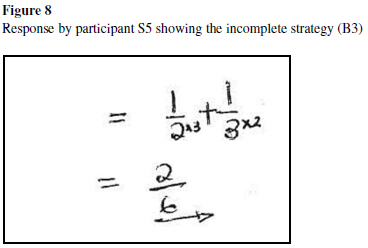
A second participant, S5, who was interviewed, also displayed similar uncertainty across the different strategies. As shown in Figure 8, the written response by S5 was based on the incomplete strategy of only changing the denominator, while leaving the numerator unchanged. There were five participants who opted for this method. They seem to realise that for  +
 , the common denominator was 6, so they multiplied 2 by 3 and multiplied 3 by 2. They did not multiply the numerators by 2 or 3. They wrote
 +
 =
 +
 =
 , that is, given we have
 +
 =
 +
 =
 +
 =
 .
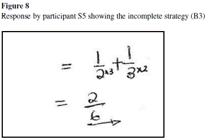
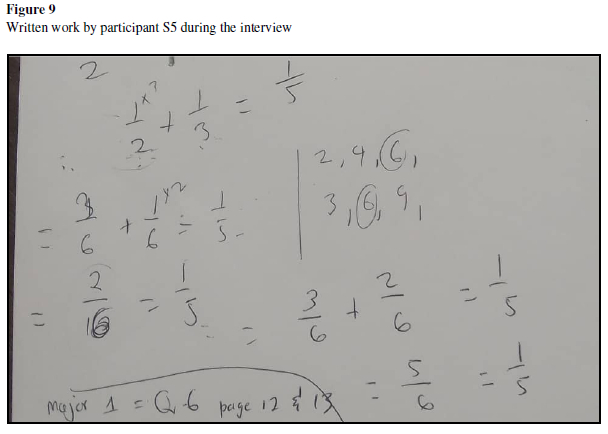
The following is the excerpt of the interview with S5, while Figure 9 shows the written work generated during the interview.
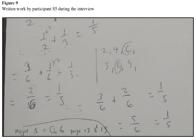
S5: [Writes  +
 =
 ] one over five is a fifth.
Interviewer: How will you assist the child? So, this is what the child did, so how will you respond to this child?
S5: I will go around this and say just like what I did here 2 4 6 8 and 3 6 9 [writing out multiples of 2 and then 3]. I will ask the child to give me the common denominator of the 2 and 3. Now can see it is a 6 like what I did at the top [pointing to what she wrote on the RHS of the page. They then wrote  +
 , and changed the 3 to 1 in the numerator of the first fraction, retaining the equal to one-fifth]. So, I am trying to explain to the child then the answer will be two over six, not one over five. The denominator remains the same [wrote
 =
 ].
Interviewer: Okay are you sure that a half is equal to one over six and one third is equal to one over six?
S5: [Looking again at their work] Okay, here I will say 1 times 3 over 6, and here I will say 1 times 2 over 6 [wrote × 3 above the  , and scribbled × 2 above the second one-sixth]. Then, I will add 3 plus 2 over 6 is equal to 1 over 5. The answer will be 5 over 6 [writing
 +
 =
 ≠
 ]. But the answer is 5 over 6, not 1 over 5.
The interviews with participants S5 and S1 show that the students were uncertain about how to add the fractions, and easily moved to different strategies yielding different answers with no conviction of which one was more correct than another, showing that although they were able to correctly carry out the Conversion of the verbal statement into its symbolic equivalent, they were quite uncertain of how to get to the correct answer for the sum. Participant S5 also struggled with communicating their reasoning when moving from a symbolic to verbal form.
Discussion
In this study we analysed 158 participants' responses to the statement "a half added to a third equals a fifth," and found that only 31 of them (20%) provided a correct answer. Given that these PSTs will be responsible for teaching fraction operations to Intermediate Phase learners, this finding is a matter of serious concern. There have been many studies that have raised concerns about the levels of understanding of fractions by PSTs (Bansilal & Ubah, 2020; Lamon, 2012; Pantziara & Philippou, 2012; Ubah & Bansilal, 2018), and it is important that teacher education institutions find ways to tackle this problem, given that PSTs only spend four years of training during which time it is difficult to address all the knowledge gaps they have unwittingly developed during their 12 years of schooling. However, this study illustrates the urgency for successful interventions that can address these gaps.
The study has brought new insights about PSTs' struggles with working with Conversions amongst different representations of fractions, an area that has not received much attention in the literature, although many studies have reported on students' challenges with carrying out Treatments such as the sum of fractions with the same or different denominators (Bansilal & Ubah, 2020; Lamon, 2012; Pantziara & Philippou, 2012; Ubah & Bansilal, 2018). This study found that besides those participants who did not respond, at least 81 students were not able to carry out a Conversion from a verbal statement involving fractions into the equivalent symbolic statement. Duval (2006) emphasised that Conversions come in when it is necessary to carry out a Treatment in a register different from the one that the object is being represented in, as was the case in this study. Here, these 81 participants were hampered in their progress to the next stage of computing the sum of the fractions using a symbolic representation because they could not complete the requisite Conversion. Hence, the study underlines the importance of helping students work with and between systems of representations so that they can choose the register that allows them to effect a transformation more effectively. Recognising gaps within the curriculum where representational fluency in PSTs can be developed is an area that needs more attention in PST education (Mkhwanazi et al., 2023).
Working out the sum of the two fractions, using the rules for addition of fractions, can be seen as a Treatment transformation because it is carried out within the same symbolic representation. Although Conversion transformations are taken as generally more challenging than Treatments (Bansilal et al., 2010; Duval, 2006), in this study the Treatment part presented many challenges to the participants. Even considering those students (16) who were able to complete the Conversion into the correct symbolic representation, they seem to have an ephemeral understanding of the operations, showing no clear conviction of the correct method and why it was so. This observation relates to both conceptual and procedural ways of working. Research on learning mathematics consistently shows that learners often rely on overgeneralised rules such as applying whole-number strategies to fractions by adding numerators and denominators separately, for example,  +
 =
 (Bansilal & Ubah, 2020; Kazunga & Bansilal, 2017). These strategies reflect an attempt to transfer familiar procedures learned under whole numbers onto misunderstood concepts related to fractions.
However, in this study, the participants who successfully translated the problem into symbolic form frequently demonstrated procedural instability, shifting between different methods without clear justification. For example, some participants applied whole-number addition (B1), while others identified a common denominator but failed to adjust the numerators (B2). Interview data further revealed that participants were uncertain about why procedures such as generating equivalent fractions were necessary. This aligns with the distinction between instrumental understanding (knowing how to perform a procedure) and relational understanding (knowing why the procedure works). The findings suggest that many participants possess fragmented procedural knowledge that is not grounded in a coherent conceptual understanding of fractions. This finding is supported by Dorner et al. (2026), who argue that conceptual knowledge can significantly influence errors and deficiencies in procedural performance. Drawing on the literature, they emphasise the recommendation that conceptual understanding should be integrated into the learning and practice of procedures (Friedlander & Arcavi, 2012). The authors further argue that empirical studies demonstrate that conceptual and procedural knowledge develop iteratively and mutually reinforce one another (Schneider et al., 2011).
Closely linked to this is the role of language in mediating both conceptual and procedural knowledge. Language is not merely a vehicle for expressing mathematical ideas, but a central tool through which meaning is constructed, negotiated, and refined across representations. Hence, language plays a central role in strengthening movement and coordination across representations, which is a crucial part of learning a concept. In other words, language facilitates the thinking and conceptualisation process itself, helping to organise thoughts and to make links across representations. Difficulties with language can therefore obstruct learners' ability to coordinate representations, and may manifest as procedural errors rooted in conceptual misunderstandings. In this regard, the most compelling finding in this study is the widespread conflation by students of a fifth with 5, and a third with 3, a pattern that does not appear to be reported in previous studies. One plausible explanation is that this reflects a language-based misconception linked to the interpretation as an ordinal number. In everyday usage, terms such as fifth and third are most commonly encountered as ordinal descriptors of position (e.g. fifth place, third in a sequence), where they denote the position associated with the numbers 5 and 3, respectively. It is therefore possible that students interpret these terms through an ordinal lens, mapping a fifth onto 5, and a third onto 3, rather than recognising them as fractional quantities representing one part of a partitioned whole. This suggests a slippage between ordinal and fractional meanings, where linguistic familiarity with positional number may interfere with the development of a more precise understanding of a unit fraction as an object which marks a crucial step in the construction of an iterative fraction scheme (Hackenberg & Lee, 2015; Steffe & Olive, 2010; Ubah & Bansilal, 2018). This involves conceptualising a fraction, say  , as 3 iterations of
 , and foregrounds the unit fraction fifth as a conceptual entity. In this study, we found that 37 participants conflated the unit fractions with whole numbers, showing that the iterative fraction scheme is yet to develop, which suggests that instructors in similar contexts may need to explicitly address this particular misconception when teaching fractions.
Another plausible explanation for learners translating a third as 3, or a fifth as 5 may relate to the linguistic structure of fraction names in certain African languages. While further research is needed to establish isiZulu-specific conventions, Mostert and Roberts (2022) show that isiXhosa fraction names may foreground the denominator, for example, "fifths-they.are-four" for four-fifths. Such a structure may make the denominator linguistically more prominent, particularly if fractions are interpreted as describing a collection of parts rather than a single part of a partitioned whole. Learners may therefore focus on the denominator overlooking the unit numerator. From Duval's perspective, this reflects a challenge in converting between the natural language and symbolic registers, where the relational meaning of the fraction is not fully preserved during translation.
Conclusion
This study was set up to investigate the ways in which PSTs first attended to the Conversion of a verbal statement concerning three-unit fractions (half, third, fifth), followed by the resulting computation within the symbolic register. Students were asked to identify a misconception embedded within the given statement. The results showed that only 20 per cent of the group of 158 PSTs were able to provide a correct response, which raises deep concerns.
Most participants were unable to effect the Conversion transformation from the given verbal statement into a symbolic representation. The most common error with the translation was the conflation of a third with 3, and a fifth with 5-suggesting a slippage of the ordinal with the fractional meaning. The reasons for this are not yet clear, and will warrant further research. An important step in understanding fractions is the ability to conceptualise a unit fraction as an object that can be iterated to form other fractions, and this study has found that most participants do not appear to have constructed a robust understanding of unit fractions. Across the group, students often slipped between different methods without distinguishing correct from incorrect ones, showing high procedural instability.
Furthermore, the study has identified the language-based misconceptions of students that warrant further investigation so we can better understand the barriers faced by students in developing the necessary unit fraction conceptions. It is clear that PSTs need effective opportunities to build up their understanding of unit fractions so that their fraction schemes can become more robust. This has implications for teacher educators who need to try to intervene in the short time they spend with PSTs to help them construct a robust understanding of fractions.
References
Literature review
- Ball, D. L. (1990). The mathematical understandings that prospective teachers bring to teacher education. The Elementary School Journal, 90(4), 449-466. http://dx.doi.org/10.1086/461626
- Bansilal, S., James, A., & Naidoo, M. (2010). Whose voice matters? LEARNERS. South African Journal of Education, 30, 153-165. https://doi.org/10.15700/saje.v30n1a236
- Bansilal, S., & Ubah, I. (2020). The use of cross multiplication and other mal-rules in fraction operations by pre-service teachers. The Journal of Mathematical Behavior, 58. https://doi.org/10.1016/j.jmathb.2020.100781
- Blömeke, S., Jentsch, A., Ross, N., Kaiser, G., & König, J. (2022). Opening up the black box: Teacher competence, instructional quality, and students' learning progress. Learning and Instruction, 79, 101600. https://doi.org/10.1016/j.learninstruc.2022.101600
- Boyce, S., & Norton, A. (2016). Co-construction of fractions schemes and units coordinating structures, The Journal of Mathematical Behavior 41, 10-25. https://doi.org/10.1016/j.jmathb.2015.11.003
- Chimombo, J. (2005). Quantity versus quality in education: Case studies in sub-Saharan Africa. International Review of Education, 51(2/3), 195-207. https://doi.org/10.1007/s11159-005-1842-8
- Cohen, L., Manion, L., & Morrison, K. (2018). Research methods in education (8th ed.). Routledge. https://doi.org/10.4324/9781315456539
- Duval, R. (2006). A cognitive analysis of problems of comprehension in the learning of mathematics. Educational Studies in Mathematics, 61, 103-131. https://doi.org/10.1007/s10649-006-0400-z
- Ernest, P. (2006). A semiotic perspective of mathematical activity: The case of number. Educational Studies in Mathematics, 61, 67-101. https://doi.org/10.1007/s10649-006-6423-7
-
Ezaki, J., Li, J., & Copur-Gencturk, Y. (2024). Teachers' knowledge of fractions, ratios, and proportional relationships: The relationship between two theoretically connected content areas. International Journal of Science and Mathematics Education, 22(2), 235-255. DOI:10.1007/s10763-023-10372-z
» https://doi.org/10.1007/s10763-023-10372-z - Friedlander, A., & Arcavi, A. (2012). Practicing algebraic skills: A conceptual approach. The Mathematics Teacher, 105(8), 608-614. https://doi.org/10.5951/mathteacher.105.8.0608
- Grigaliūnienė, M., Lehtinen, E., Verschaffel, L., & Depaepe, F. (2025). Systematic review of research on pedagogical content knowledge in mathematics: Insights from a topic-specific approach. ZDM: Mathematics Education, 57(4), 777-794. https://doi.org/10.1007/s11858-025-01684-1
- Hackenberg, A. J., & Lee, M. Y. (2015). Relationships between students' fractional knowledge and equation writing. Journal for Research in Mathematics Education 46(2), 196-243. https://doi.org/10.5951/jresematheduc.46.2.0196
- Kazunga, C., & Bansilal, S. (2017). Zimbabwean in-service mathematics teachers' understanding of matrix operations. Journal of Mathematical Behavior, 47, 81-95. http://dx.doi.org/10.1016/j.jmathb.2017.05.003
- Krowka, S. K., Jayanthi, M., Schumacher, R. F., Gersten, R., Haymond, K. S., & Newman-Gonchar, R. A. (2025). Identifying key instructional practices in rational number interventions: A systematic review and meta-analysis. Learning Disability Quarterly, 48(4), 227-241. https://doi.org/10.1177/07319487241288823
- Lamon, S. J. (2012). Teaching fractions and ratios for understanding: Essential content knowledge and instructional strategies for teachers. Routledge. https://doi.org/10.4324/9780203803165
- Lesh, R. (2000). Beyond constructivism: Identifying mathematical abilities that are most needed for success beyond school in an age of information. Mathematics Education Research Journal, 12(3), 177-195. https://doi.org/10.1007/BF03217084
- Ma, L. (1999). Knowing and teaching elementary mathematics: Teachers' understanding of fundamental mathematics in China and the United States. Lawrence Erlbaum. https://doi.org/10.4324/9781410602589
- Mostert, I., & Roberts, N. (2022). Interlinear morphemic gloss (IMG) of fraction naming conventions in isiXhosa. In C. Fernández, S. Llinares, A. Gutiérrez, & N. Planas (Eds.), Proceedings of the 45th Conference of the International Group for the Psychology of Mathematics Education (Vol. 3, pp. 211-218). PME.
- Mpalami, N. (2022). Complexities of translating mathematics tasks from English to learners' home languages. Pythagoras, 43(1), 1-6. https://doi.org/10.4102/pythagoras.v43i1.560
- Nyagope, T. S. (2020). Massification at higher education institutions: Challenges associated with teaching large classes and how it impacts the quality of teaching and learning in South Africa. Al-Mudarris: Journal of Education, 6(2), Article 1842. https://doi.org/10.32478/al-mudarris.v6i2.1842
- Perry, C. J. (2023). Elementary preservice mathematics teachers fraction knowledge: An integrative review of research. Educational Considerations, 49(1), 6. https://doi.org/10.4148/0146-9282.2346
- Robertson, S. A., & Graven, M. (2019). Exploratory mathematics talk in a second language: A sociolinguistic perspective. Educational Studies in Mathematics, 101(2), 215-232. https://doi.org/10.1007/s10649-018-9840-5
- Rosli, R., Goldsby, D., Onwuegbuzie, A. J., Capraro, M. M., Capraro, R. M., & Gonzalez, E. G. Y. (2020). Elementary preservice teachers' knowledge, perceptions and attitudes towards fractions: A mixed-analysis. Journal on Mathematics Education, 11(1), 59-76. https://doi.org/10.22342/jme.11.1.9482.59-76
- Schneider, M., Rittle-Johnson, B., & Star, J. R. (2011). Relations among conceptual knowledge, procedural knowledge, and procedural flexibility in two samples differing in prior knowledge. Developmental Psychology, 47(6), 1525-1538. https://doi.org/10.1037/a0024997
- Sfard, A. (2008). Thinking as communicating: Human development, the growth of discourses, and mathematizing. Cambridge University Press. https://doi.org/10.1017/CBO9780511499944
- Siegler, R. S., Fazio, L. K., Bailey, D. H., & Zhou, X. (2013). Fractions: The new frontier for theories of numerical development. Trends in Cognitive Sciences 17(1), 13-19. https://doi.org/10.1016/j.tics.2012.11.004
- Siegler, R. S., Thompson, C. A., & Schneider, M. (2011). An integrated theory of whole number and fractions development. Cognitive Psychology, 62(4), 273-296. https://doi.org/10.1016/j.cogpsych.2011.03.001
- Steffe, L. P., & Olive, J. (2010). Children's fractional knowledge. Springer. https://doi.org/10.1007/978-1-4419-0591-8
- Tzur, R. (2004). Teacher and students' joint production of a rationale in a class discussion. Journal of Mathematical Behaviour, 55(1-3), 89-124. https://doi.org/10.1016/j.jmathb.2003.12.006
- Ubah, I. J. A., & Bansilal, S. (2018). Pre-service primary mathematics teachers' understanding of fractions: An action-process-object- schema perspective, South African Journal of Childhood Education 8(2), a539. https://doi.org/10.4102/sajce.v8i2.539
Accepted: 2 August 2026