Over-aged learners burden school resources: An analysis of a Gauteng education district
Abstract
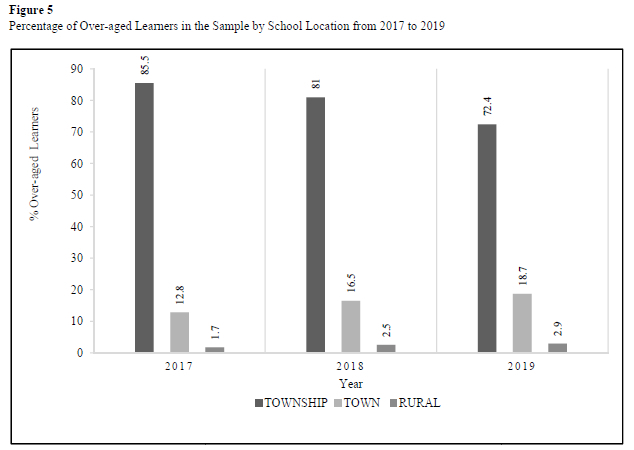
The Department of Education's National Policy on Promotion Requirements is often circumvented when learners repeat grades frequently thus becoming older than their grade peers. We aimed to quantify the number of over-aged learners and describe their influence in the classroom in a Gauteng Education District. We used a quantitative research approach, with purposive, convenient, non-probability sampling, in an education district comprising 187 schools (n=407 347 learners), representing 6% of the schools in the Gauteng province. Data was collected on learner ages, grades, and number of years over-aged for three consecutive years from the Department of Education database. Descriptive statistics were used to determine means, modes, and frequencies. Findings revealed that the number of over-aged learners increases annually with the mean age of x=15 and the Mode Mo=18. One-third of learners were over-aged, 60% were male, with some learners 14 years over-aged for their grade. The large number of over-aged learners causes over-crowded classrooms and heavy teacher workload, and often leads to aggressive behaviours, teenage pregnancy, and alcohol and drug abuse. Complex classroom dynamics result when there are different developmental stages in the same grade. We identified the need for over-aged learners to be supported since there is insufficient space in special needs and vocational schools. We exposed the inappropriate provision of career guidance that caused vulnerable learners to drop out. We urge education authorities to stringently implement the progression policy to enforce age-appropriate secondary school exit levels to curb the huge number of over-aged learners.
admissions policy; developmental theories; Gauteng education district; inclusive education; over-aged learners; progression policy; psycho-social challenges; school resources
 Thumbnail
 Thumbnail
 Thumbnail
 Thumbnail
 Thumbnail
 Thumbnail
 Thumbnail