Challenging a "rock and a hard place" in the higher education polycrisis: A reflexive, arts-based poetic self-study
Abstract
Educational research takes place in contexts shaped by interconnected political, social, and economic forces. In higher education, challenges linked to neoliberalism, globalisation, and a fast-paced market-driven society are inseparable concerns but, together with other contextual elements, form what is described as a polycrisis. This self-reflexive arts-based study was inspired by a panel chair at the 2025 South African Education Research Association conference, who proposed polyOpportunity as an alternative way to navigate the polycrisis. He suggested seeking alternative means to challenge the "negative" educational research space with a "positive," constructive educational vision. My research question was: "How can arts-based self-study support professional learning and help develop a deeper understanding of academic roles within the contemporary higher education polycrisis?" Arts-based methods facilitated a productive engagement within this "rock and a hard place" context. The conclusions highlight how arts-based self-study research methodology offers academics opportunities to manage role responsibilities constructively as a polyOpportunity.
professional academic learning; self-reflexive arts-based approach; metaphor study; poetic inquiry; polyOpportunity
Introduction
Humanity faces a deepening polycrisis that intensifies societal disruptions and highlights the need for systemic transformation (Sokol & Stephens, 2025). Polycrisis is characterised by the interconnectedness of global and local crises that are mutually reinforcing across ecological, economic, political, and social domains (Morin & Kern, 1999; Sokol & Stephens, 2025). These interacting pressures escalate and combine, resulting in extreme effects that are far more pervasive than those caused by individual crises in isolation. A recent Canadian study identified 10 specific challenges in their higher education polycrisis context:
Uncertain finances; affordability crisis; complexities of equity, diversity, inclusion, decolonization, and indigenization; intergenerational dissonance; public (ir)relevance; ecological destabilization; ambivalent AI; mental health epidemic; hyper-polarization; and lack of capacity for coordination." (Stein et al., 2025, p. 1572)
Within polycrisis contexts, it can be difficult to pinpoint, or delineate the boundaries of, specific challenges due to the interconnectedness of global crises. Nonetheless, Sokol and Stephens (2025, p. 5) have pointed out that poorer countries in the Global South are "being harder hit" by polycrisis contexts than most Global North nations. Furthermore, because higher education functions within global and local polycrisis contexts, institutions operating within the Global South's less privileged economies face intensified and widespread environmental, health, social, and political tensions that are deeply interconnected.
Higher education can be regarded as a "pawn" (de Wit et al., 2025, p. 1) due to its embedded position within broader political and economic systems. Moreover, the multifaceted entanglements of crises affecting higher education place severe and unforgiving demands on academics and students in the Global South. Over and above these contextual concerns, academics remain pressured by expectations related to "research, teaching, service to society, and the university" (Evans, 2025, p. 3). Additionally, the South African higher education context experiences apartheid and post-apartheid challenges. After the demolition of apartheid, the potential of living in a "new" democratic, post-apartheid society sparked hopes of constructive transformations. However, this optimism has been replaced by feelings of disenchantment, partly because of engrained consequences of apartheid in our market-driven higher education context (Badat, 2023).
Although apartheid was abolished more than three decades ago, South African higher education institutions show disappointing inclusion, social justice, and equity transformations. Many African students and academics endure lingering, unresolved epistemic injustice and racialised inequity (Mutongoza, 2025) experiences in post-apartheid higher education. Mutongoza (2025, p. 1) emphasised that the decolonisation of African academe promises a more "just, inclusive and equitable academic landscape" but the unsatisfactory, laboured pace of decolonisation progress hampers genuine change in higher education transformation, and he pointed out that responses to calls made for "reclamation of African ways of knowing and challenges [to] the dominance of Western epistemologies" require more active engagement.
Taylor (2008, p. 9) identified a race-centric view of the transformative learning theory; this conception of learning is "culturally bound, oppositional, and nonindividualistic," and fostering transformative learning requires promoting inclusion, promoting empowerment, and learning to negotiate between and across cultures. Limited progress towards a non-Eurocentric orientation of transformative learning may be because of the multiple South African cultures, together with myriad entangled challenges in higher education that complicate the development of an appropriate interconnected, holistic approach. Moreover, longstanding higher education underfunding, together with associated massification policies, adversely influences pedagogical practices as dwindling numbers of permanently appointed academics are required to teach and guide ever growing numbers of students. Le Grange (2024) pointed out that within the South African higher education polycrisis context, the threats and consequences of the entangled challenges appear to be unresolvable.
However, Maistry (2025), responding as chair of the National Keynote Panel at the 12th South African Educational Research Association (SAERA) conference, proposed an alternative way to engage with polycrisis, namely, through polyOpportunity. This play on polycrisis can be envisaged as a way of offering multiple pathways for people to work consciously and constructively within a polycrisis context rather than feeling paralysed and powerless- attempting to merely wish the situation away. Braidotti (2010, p. 51), an acclaimed posthumanism and new materialism theorist, noted that such negative emotions are "blackholes" that damage the self in addition to human and non-human relationships. However, Braidotti argued that this negativity is a necessary path for realising affirmative action. In other words, it is possible to transform negativity into positivity without being overwhelmed by negative emotions.
Developing and sustaining an affirmative stance, within a polycrisis context, is aligned with what Fariss (2025) described as polyOpportunity: a pathway to human and ecological thriving amidst adversity. Rather than presenting polycrisis as an unsolvable catastrophe, polyOpportunity invites counterreactions by being, realising, accepting, and embracing opportunities in times of polycrisis. Fariss encouraged response to polycrisis in humanistic ways such as seeking comfort in discomfort, and embracing possibilities through embodied artistic imagination. Engaging with the messiness of the polycrisis could generate positive transformative energy by de-escalating the urgent, fast-paced demands of global productivity associated with capitalism, and by creating possibilities for change through slower embodied activities. Thus, polyOpportunity serves as a means of stepping into uncertainty and comfortably discovering and imagining what could be when one dissociates from the ballistic pace of a neoliberal, globalist, market-driven society.
The SAERA (2025) conference theme Education in a Time of Polycrisis: Pathways of Hope, Creativity and Affirmative Ethics has served as a powerful motivation for my recent studies because it invited constructive, alternative, positive, and hopeful contributions. During my paper presentation to the conference, which focused on arts-based self-reflexive possibilities, (van Laren, 2025), I welcomed audience comments, suggestions, and interactions that facilitated rethinking to strengthen and extend my study-positioning it as a polyOpportunity. To guide the study, I generated this research question: "How can arts-based self-study support professional learning and help develop a deeper understanding of academic roles within the contemporary higher education polycrisis?" Although this study focuses on my lived experiences as an academic within a particular South African higher education polycrisis context, by making public my professional learning it becomes available for broader higher education scholarly debates where constructive research approaches are sought amidst the myriad challenges experienced by academics, researchers, educational leaders and beyond.
The sections below explain how I situate myself in the study, followed by a description of self-study methodology. Next, I present the arts-based data sources and data collection methods I employed. Thereafter, I explain the data analysis procedure using poetic inquiry, and present the associated findings. To complete the study, I discuss and answer my research question and conclude by responding to the "so-what?" question.
Situating myself in the study
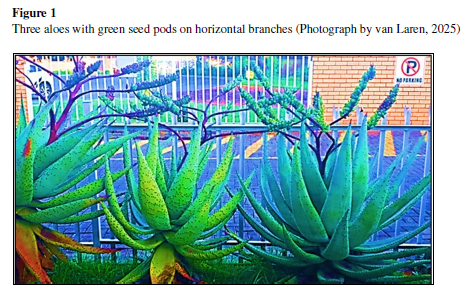
I am a White South African mathematics teacher educator who has, for more than two decades, published arts-based self-reflexive research in which I challenge and improve my professional practice within my higher education polycrisis context. Using the self-reflexive opportunities offered by self-study, I continually deepen my understanding of how this methodology enables research within the polycrisis. In this article, I used self-study as a polyOpportunity approach to professional learning, to create spaces for self-transformation within the productivity-driven, fast-paced context of higher education. I am a keen gardener and enjoy spending time and working in my garden. Figure 1 is my photograph of three succulent, perennial, flat-flowering aloes, which flourish in my semi-arid garden. The green seed pods, prominent in the image, mark the former positions of the tubular flowers along the horizontal inflorescence branches (racemes).
Planting a garden of any sort symbolises hope. Hope in tomorrow. Hope that something beautiful is about to happen. (Levine, 2017, para 1)
When a seed or seedling is planted, the gardener genuinely believes that the plant will grow and eventually flower. In other words, the gardener hopes that plant development will occur, and trusts that their gardening efforts will be rewarded. The gardener perseveres with optimism even though some plants are slow to grow and take a long time to flower. For example, I propagated those hardy, resilient aloes from seed I harvested and planted in 2015. In the winter of 2025, all three of the aloes flowered for the first time. Thus, only after a decade, were my hands-on, embodied gardening efforts rewarded by the yellow flowers with black stamens on huge, impressive inflorescences.
I was disappointed in the flower colour because I specifically chose seeds from a vibrant, orange-flowered aloe. The yellow flowers were probably due to crosspollination. Nevertheless, it was fascinating to watch numerous bird and insect pollinators visiting to feed on those nectar-filled flowers-hence the large number of green seed pods on the inflorescences.
Self-study methodology
Situating oneself in the study is useful for both the self-study researcher and the reader. Walshaw (2008, p. 328) explained this as means to provide "understanding [of] who I am and who you [the reader] see." Self-study researchers often use this process to deepen understanding of their own personal and professional learning and also, to inform readers about their background and interests in relation to the study. This also introduces readers to the self-study researcher so that the study can be appraised in terms of its plausibility, authenticity, and vigour (Faulkner, 2019).
In addition to emphasising the importance of researcher insight, self-study is characterised by a set of five requirements. LaBoskey (2004) listed these requirements as research that is initiated by and focused on self, improvement-aimed, interactive at one or more stages of the process, uses mainly qualitative research, and is offered for public scrutiny. Hauge (2021) noted that self-study is usually conducted by teacher educators who examine their own practice to gain insights for improving it within their specific academic context. And van Manen (1990, p. 1) described self-reflexive studies, such as self-study, as facilitating "researching lived experience [for] action sensitive pedagogy."
Self-study does not prescribe specific methods because it encourages experimentation. This allows the self-reflexive researcher to design new, creative approaches that evoke vulnerability through discomfort and uncertainty when engaging with complex social issues (Hauge, 2021). Moreover, the results and conclusions of self-study are not intended to provide clear-cut solutions. Instead, they aim to raise thought-provoking, challenging, and illuminating questions (Bullough & Pinnegar, 2001). Self-study frequently centres on possibilities for social change, which is an important factor for transformative research. When the researcher focuses on self-improvement using a "starting-with-myself ' approach (van Manen, 1990) and constructively engages with tensions, it becomes possible to initiate a bottom-up process of social transformation.
Self-studies should not be gauged in terms of rigour, replicability, objectivity, and generalisability as is required by traditional methodologies. Self-study's value is better measured in terms of research vigour (Faulkner, 2019), because of the importance of context-specificity during self-reflexivity within the researcher's lived experiences. Thus, alternative vigour qualities, such as research merit, competence, and enthusiasm, are more appropriate and favoured measures in self-study. Additionally, self-study methodology recommendations for enhancing trustworthiness, validity, and quality emphasise the importance of detailed, clear accounts of research procedures and making public impact potentials for critical scrutiny and dialogue (Pithouse-Morgan, 2022).
Generally, research ethics principles centre on maximising possible benefits and minimising harm. Cuenca (2020) outlined three additional considerations in self-study that focus on struggles with multiple researcher identities, managing tensions among collaborators, and coping with vulnerability when research is made public. This study did not expose or incite emotional or physical harm. I was the sole researcher and participant, which limits ethical concerns associated with having others as participants or possible tensions among collaborators. Additionally, exposing my professional challenges tensions/ inadequacies/discomforting experiences did not cause me or potential readers undue vulnerability because I constructively highlighted my professional improvement possibilities. By excluding harmful images, my photographs of chosen personal spaces and objects enhanced self-reflexivity, and complied with ethical guidelines for arts-based research provided by Mitchell (2011).
Data sources and collection methods
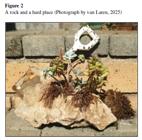
My reflections on each of two images (Figures 1 & 2) were the data sources for this study. I used the image in Figure 1 to situate myself in the study. The image in Figure 2 served as a metaphor to challenge a "rock and a hard place" mentality by stimulating under-utilised, under-valued sensory capabilities for constructive professional learning insights. This arts-based metaphor study was a polyOpportunity means to reflect on balancing academic responsibilities with fast-paced neoliberal expectations.
In addition to promoting reflection, self-expression, and deeper, richer insights, metaphor applications are often combined with elements of fun. Rose and Furness (2024) noted that using metaphors in research helps slow down the research process and encourages the spontaneous flow of ideas. This flow enables "the holistic sensation present when we act with total involvement" to generate a positive emotional condition that offers "a generative scope without being overwhelming" (Rose & Furness, 2024, p. 585). Furthermore, metaphors aid in the conveyance of concepts when one construct (the vehicle) is used to explore an alternative construct (the target). The vehicle is usually a well-known concept, and there should be an element of surprise due to the unexpected connection between the target and vehicle constructs (Macagno, 2020).
I utilised the following two self-directed prompts to explore how my metaphor supported self-reflection aimed at improving my professional practice (Samaras, 2011):
• Prompt 1: Describe the metaphor you chose to capture the main idea of your research interest. What is a title that signifies the core meaning of your metaphor?
• Prompt 2: Indicate what in the metaphor represents you, the teacher educator, and what represents your professional learning.
Poetic inquiry is a qualitative research method, often used for exploration of embodied experiences, that makes use of poetry to collect, analyse and present data (Butler-Kisber, 2020). In Pithouse-Morgan and Samaras' (2022) two-decade retrospective exploration of the arts-based poetic inquiry methods published articles by self-study researchers across the globe, they found that whenever critical tensions and academic challenges were addressed by self-study scholars, poetic inquiry increased self-awareness, provided lived experience insights, and facilitated teacher educator identity development and understanding. Additionally, Lemon et al. (2025) noted that poetic inquiry serves as a process for capturing personal experiences associated with teacher educator identity evolvement.
In my self-study, qualitative poetic inquiry allowed me to combine the act of situating myself with my prompt reflections in a focused, concise way, creating a narrative that highlights key concepts (Wetton, 2025) and supports constructive professional self-learning through a polyOpportunity approach. I created a butterfly cinquain (Tinker, 2009) as a research poem, and entitled it "Hopefully Digging, and Enjoying Embodied Imagination," which I chose because its shape reminded me of the unexpected winter butterflies that frequented the aloe flowers in my garden. Then, I utilised the research poem for analysis; each of the nine lines of the butterfly cinquain was interpreted to answer my research question.
My professional learning presented as a self-reflexive metaphor
Using the two prompts previously described, I explored how my metaphor conveyed the improvement in my professional learning-as a higher education academic contending with competing academic expectations-within my South African polycrisis context.
Prompt 1: Responses
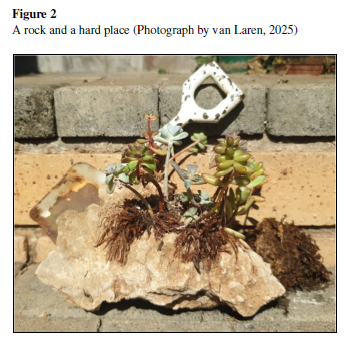
Despite it being a challenging gardening project, I was interested to see if I could grow succulents on a rock. About four years ago I selected a gnarled, porous, sandstone rock as a foundation for growing different succulents. I could not use sand on the rock as a plant substrate because sand would wash away with watering, so I decided to use peat moss as a water-absorbent growth medium. Then I planted small indigenous succulent cuttings into the moss. Some of the cuttings took root, and these resilient plants managed to grow, albeit very slowly.
The plants need frequent watering due to the thin, limiting moss substrate. Growing succulents on a rock proved to be an exciting, hopeful gardening experiment. In the image (Figure 2), the rock is positioned on a concrete bricked step. The rusted, well-used metal spade behind the rock is my childhood spade, which remains a useful tool for modest gardening tasks. Next to the rock is a small pile of peat moss.
The title of my metaphor is "Growing Professional Learning in a Polycrisis Context," which I selected because the succulents continue growing despite their difficult living circumstances.
Prompt 2: Response
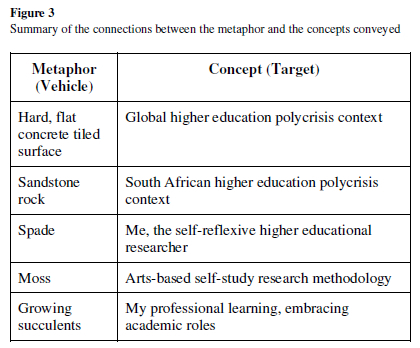
To summarise the links between the concept that I intend to convey (me, the teacher educator, and my professional learning) and the objects in the image (Figure 2), I constructed a table (Figure 3).
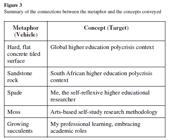
The rock's position on top of the tiled, hard, level step shows that the South African higher education polycrisis is probably more complex than many other global contexts because of the added constraints of post-apartheid living conditions. The rock thus stands out as being "over and above" the level step of "hard," challenging global contextual issues. However, the South African higher education polycrisis context is also underpinned and supported by general global challenges-just as the sandstone rock is propped up and bolstered by the concrete brick step.
A spade is an essential tool for many physical activities needed to improve and maintain a garden. It corresponds with what I consider important in my higher education context because I see myself as responsible for positively and actively making a difference. Although I am depicted as small spade, starting with myself to make a difference and improve my professional practice is a positive, constructive, active polyOpportunity process within my polycrisis context. Furthermore, the spade in the metaphor image is well-used, and has been put to good use over many years of gardening. I consider myself to be a dedicated self-study self-reflexive researcher, and have discovered a myriad opportunities for re-thinking, re-evaluating, and reinventing ways to improve professional learning in higher education. The worn, chipped paint reveals the metal the spade is made of-the inner core element and essence of the spade. This inner metal structure is not shiny or in perfect condition; it is dull and rusty. This reminds me of the idiom "exposing your true mettle," which, linked to self-reflexivity, means that the researcher's innermost qualities could be exposed-causing vulnerability. A commitment to acting and making a difference thus requires resilience, determination, perseverance, hopefulness, and an enthusiastic spirit for an academic in the higher education polycrisis context-qualities also important for dedicated gardeners. Instead of avoiding difficulties, my self-reflexive research enables me to engage with uncomfortable and challenging experiences, where I can explore embodied imagination (Fariss, 2025) through arts-based self-study as a polyOpportunity.
For my rock gardening challenge, I chose an alternative growing medium; I replaced the sand traditionally used in gardening, with moss. Likewise, I selected arts-based self-study rather than a traditional research methodology. The succulents that managed to survive the lack of substantial substrate and grow on the sandstone rock represent the professional learning competences required to cope with the many roles of being an academic-my academic knowledge substrate was also thin and insubstantial when I was a newly appointed mathematics teacher educator at the University of KwaZulu-Natal. Despite holding the required academic qualifications-two research master's degrees (in botany, and in mathematics education)-I was unprepared for my roles as an academic. As an experienced mathematics teacher educator (having been a college of education lecturer for 25 years, where pre-service teaching was prioritised), I was unprepared for the research and service to society, and higher education institutional roles. I lacked sufficient background knowledge in research, supervision, and other academic roles. I was encouraged to attend development workshops, seminars, weekend retreats, and to participate in funded projects to support the advancement of my research capacity. As a "young" newly appointed academic I was urged to prioritise productivity and research prowess over the pursuit of other academic roles in order to succeed as an academic (Evans, 2025).
Returning to the growing succulents (the academic roles), some varieties perform better than others but they are nonetheless able to co-exist on the meagre substrate available. My self-study (the substrate) facilitated the growth and development of more than one academic role. For example, in self-study research, teacher educators engage in self-reflexive examination of their professional practice, which supports both the improvement of their practice and the development of knowledge about teaching and learning in higher education (Hauge, 2021).
Analysis and findings
To synthesise and summarise my reflections, I created a butterfly cinquain research poem consisting of 42 syllables; it is composed of two interconnected cinquains and each of the nine lines comprises syllable counts of 2/4/6/8/2/8/6/4/2, respectively. This creative process involved selecting evocative, significant words and phrases that arose from my reflections on my responses to Prompts 1 and 2 above. The first cinquain, comprising the upper half of the butterfly, focuses on negative concepts related to a polycrisis. The lower portion examines polyOpportunities in which my pathways for transformation and improvement were supported through arts-based self-study.
"Hopefully Digging, and Enjoying Embodied Imagination"
context
challenging growth
uncomfortable hard
urged research productivity
hopeful
self-study methodology
knowledge development
spirit support
slowly
Meanings of the title and each of the poem's nine lines will now be explored by expanding, qualifying, and connecting the poem to the study's research question. The title, "Hopefully Digging, and Enjoying Embodied Imagination" connects my professional self-learning experiences with my gardening experiences as presented in this arts-based inquiry. I drew on my hopeful experiences, symbolised by the gardening spade, to explore both physical and metaphorical digging within my professional learning pathway amid the despondency of the higher education polycrisis. Through self-reflexivity, I effected my transition to positivity by using tangible, visual images to generate insight and imaginative possibilities.
The upper cinquain's first line consists of the single word "context." It signals the significance of the background and environment of my lived experience as an academic in the South African higher education polycrisis. The post-apartheid history, broader social conditions, and South African context provide the framework in which I carry out my academic roles at my higher education institution. The next line, "challenging growth," highlights the demanding, competitive, complexity of the higher education polycrisis teaching and learning context. The challenging circumstances that academics face involve numerous entangled difficulties in addition to the responsibilities required by their academic roles. Academics can feel pressured to reason progressively in neoliberal market-driven higher education environments. In such an environment the "uncomfortable hard" limits opportunities for deep reflection and creative, innovative processes. "Urged research productively" describes the reason why academics give precedence to research output over the pursuit of their other roles-because of its significance in career development within the neoliberal higher education environment. Beyond research productivity-where the quality of my work is measured by the number of outputs I produce within a given time-relatively little cognisance is taken of teaching crowded, pre-service teacher lecture halls or to leading activities that provide a service to society or the university.
Thus, I am persuaded to maximise my research output effectively and efficiently to become a performativity artisan (Tomlinson & Watermeyer, 2022) within specified time frames, at the expense of my other equally compelling academic roles.
The final line of the first cinquain, which simultaneously serves as the first line of the next cinquain, is "hopeful." This word is placed in a central, pivotal position as the turning point between the two cinquains. It forms the all-important body of the butterfly, which regulates all its vital systems and intentions. Although the words "hopeful" and "wishful" are both adjectives that describe future desires, being hopeful expresses a greater degree of confidence than merely wishing. Self-study researchers are hopeful in believing that challenges are transient, and feel optimistic, confident, and positive about improvement possibilities. Positive attitudes and approach are necessary to enable transformational energy for polyOpportunity (Fariss, 2025). Using action-oriented self-study research methods, I hopefully seek self-improvement opportunities to influence my professional learning positively.
"Self-study methodology" employs mostly qualitative research methods, and there are differences that set it apart from traditional research methodologies. "The Self-Study Movement," a poem created by Samaras et al. (2016), summarised the essence of this movement. Apart from the previously described defining characteristics (LaBoskey, 2004), another difference is that this self-reflexive approach can assist in developing the researcher's teacher educator identity and increase their self-awareness (Hauge, 2021). Moreover, when self-study researchers identify a challenge within their own practice, they are more likely to find and implement sustainable improvement possibilities than if other researchers recommend required practice changes (Shulman, 2004). This self-study helped me understand the importance of slow-paced reflexivity opportunities given that my teacher educator identity constantly requires tweaking and modification due to the rapidly changing teaching and learning higher education context. Thus, in addition to keeping abreast of traditional research-based suggestions for improving my professional practice (in contexts different to what I experience), and implementing worthwhile exogenous recommendations, it is necessary to start with myself to seek authentic, endogenous growth and improvement.
Self-study offers possibilities for "knowledge development" endogenously because discovering new, relevant insights requires providing a complete and systematic account of the inquiry (Feldman, 2003). To avoid a self-study being regarded a navel-gazing exercise, the studies need to consider how other educators could benefit from or add to their understandings (Hauge, 2021). Therefore, I need to demonstrate the potential significance and relevance of this self-study for others working in different contexts. "Spirit support" indicates that I enjoy learning how to improve my practice through arts-based poetic inquiry. Discovering professional and personal opportunities whilst working with poetic word patterns was satisfying, and simultaneously enhanced my academic roles of teaching and researching. Furthermore, self-studies often focus on social issues, and frequently centre on possibilities for social change (Gu∂jónsdóttiri & Dalmau, 2006), thus informing academics' service roles to society and their respective higher education institutions. Finally, working "slowly" on this study and using poetic inquiry gave me time to reflect and share my understandings through an embodied reflexivity polyOpportunity activity.
Conclusion and significance of the study
This study aimed to use arts-based self-study to explore how it can enhance professional learning and deepen understanding of academic roles within the polycrisis context of contemporary higher education. I focused on my educational research practice through self-learning to discover ways to balance my academic responsibilities in an enjoyable manner. I began by situating myself in the study to deepen my self-awareness-which ultimately influences my personal and professional learning development. Thereafter, my metaphor study helped expand my learning insights into academic roles within the context of the South African higher education polycrisis. I was surprised by the unexpected metaphorical connections that emerged between my target concept-the "rock and a hard place" polycrisis context-and the vehicle concept, the rock gardening project. My rock garden was not originally intended to form part of a research project; however, the metaphorical connections between the target and vehicle concepts generated valuable professional learning insights. Although I had started cultivating succulents on a rock four years prior to this arts-based self-study, and had cared for these plants long before the study began, meaningful learning emerged from the unexpected connections between the metaphor's target and vehicle concepts.
While analysing my research poem, I noticed that my gardening projects reflected features of embodiment, pace, and emotional experience that were similar to the professional learning I had gained through my arts-based self-study poetic inquiry. These features included intentionally making time, designing activities requiring mindfulness, immersing myself in tangible and visible actions, and allowing vulnerability in order to experience emotions such as concern and enjoyment. Thus, these two seemingly unrelated pursuits, gardening and researching, shared common experiential features. Furthermore, a constructive and optimistic sense of hopefulness emerged across the two pursuits, connecting the self-awareness I developed through gardening with my metaphor reflections. The analysis of the research poem also helped me to answer my research question by generating professional learning insights into academic roles within a productivity-driven higher education context.
Situating myself in this study and being the "woman in the mirror" facilitated the inclusion of personal experiences that lie outside my professional lived experiences. The process allowed me to gain deeper reflexive insights into the tensions inherent in academic role expectations within the context of higher education polycrisis. By situating myself in the study, I was able to reflect on rewarding emotional experiences-such as hopefulness (confidence in aloe seed growth) and excitement (when flowers appeared)-while also recognising the value of maintaining a constructive approach in the face of disappointments (yellow, rather than the expected orange flowers). The metaphor objects I selected were visually appealing. For example, the sandstone object (vehicle) is an interesting, textured sedimentary South African rock representing the polycrisis context in South Africa (target). From the beginning, these objects expressed positivity, reflecting an optimistic approach to the polycrisis, which I framed as polyOpportunity. Thus, this reflexive study revealed how approaching tensions-such as managing multiple academic roles in higher education-with a positive constructive mindset (like growing succulents) can promote professional learning and transformation.
Additionally, my arts-based self-study revealed that even though the impact of my lived experiences cannot be measured or quantified, being a gardener probably positively influenced my identity as a mathematics teacher educator, and enabled an optimistic stance towards my academic roles in the higher education context. In other words, this study exposed experiences, where I learnt to be patient, resilient, and enthusiastic in caring for non-human plants, which offered enabling possibilities for an ethical position in my academic professional life as "difference-at-work" (Braidotti, 2010, p. 42).
Hence, I realised that arts-based self-study provided opportunities to engage in research differently, allowing me to counteract the fast-paced expectations and pressures for proficiency and productivity characteristic of neoliberal higher education. Using self-study methodology enabled my teaching and research roles to benefit simultaneously because the inquiry also contributed to the improvement of teaching and learning. Moreover, when self-study is applied to areas related to social tensions, it can also encompass service to society and institutional responsibilities. This means that all four core academic roles-teaching, research, institutional service, and societal service-can be integrated within a single self-study project.
After coming to terms with the reality that higher education polycrisis tensions are probably unsolvable, I found the polyOpportunity concept to be effective and valuable for professional learning possibilities. Approaching challenges positively as polyOpportunity is in line with reflexive arts-based self-study methodology features and characteristics and allows for "pathways of hope, creativity and affirmative ethics" (SAERA, 2025). The ethically derived insights from this approach would not have been achievable through traditional research methods. I hope this self-study will inspire other researchers to explore and discuss similar (or alternative) creative, constructive and embodied approaches that foster positive, optimistic, and transformative polyOpportunity learning possibilities.
Badat, S. (2023, October 30-November 3). Commodification, corporatisation, complicity, and crisis: The university in contemporary South Africa [Nelson Mandela legacy lecture]. South African Education Research Association 10th Annual Conference, East London, South Africa. https://www.saera.co.za/wp-content/uploads/2024/02/SAERA-Keynote-Address-24Oct2023.pdf
References
- Braidotti, R. (2010). On putting the active back into activism. New Formations, 68(1), 42-57. https://doi.org/10.3898/newf.68.03.2009
- Bullough Jr, R. V., & Pinnegar, S. (2001). Guidelines for quality in autobiographical forms of self-study research. Educational Researcher, 30(3), 13-21. https://doi.org/10.3102/0013189X030003013
- Butler-Kisber, L. (2020). Poetic inquiry. In E. Fitzpatrick, & K. Fitzpatrick (Eds.), Poetry, method and education research (pp. 21-40). Routledge.
- Cuenca, A. (2020). Ethics of self-study research as a legitimate methodological tradition. In J. Kitchen, A. Berry, S. M. Bullock, A. R. Crowe, M. Taylor, H. Guõjónsdóttir, & L. Thomas. International handbook of self-study of teaching and teacher education practices (2nd ed., pp. 461-482). Springer. https://doi.org/10.1007/978-981-13-6880-6_14
- Evans, L. (2025). When teaching competes with research for academics' attention: Addressing a key challenge in developing teaching excellence in the European university, European Journal of Teacher Education. https://doi.org/10.1080/02619768.2024.2446497
- Fariss, J. (2025, June 9). From polycrisis to polyOpportunity: Creating spaces for transformative change with Joel Fariss [Audio podcast episode]. In Facilitating change. Podbean. https://changemakerallies.podbean.com/e/from-polycrisis-to-polyopportunity-creating-spaces-for-transformative-change-with-joel-fariss/
- Faulkner, S. L. (2019). Poetic inquiry: Craft, method and practice. Routledge.
- Gu∂jónsdóttiri, H., & Dalmau, M. C. (2006). Parallel engagements: Self-study of active group practice with educators. In L. Fitzgerald, M. Heston, & D. Tidwell (Eds.), Collaboration and community: Pushing boundaries through self-study. Proceedings of the 6th International Conference on Self-Study of Teacher Education Practices, Herstmonceux Castle, England (pp. 108-112). University of Northern Iowa.
- Hauge, K. (2021). Self-study research: Challenges and opportunities in teacher education. In M. J. Hernández-Serrano (Ed.), Teacher education in the 21st century: Emerging skills for a changing world (pp. 139-156). IntechOpen. https://doi.org/10.5772/intechopen.96252
- LaBoskey, V. K. (2004). The methodology of self-study and its theoretical underpinnings. In J. J. Loughran, M. L. Hamilton, V. K. LaBoskey, & T. Russell (Eds.), International handbook of self-study of teaching and teacher education practices (Part 2, pp. 817-869). Kluwer.
- le Grange, L. (2024). The many sides to performativity. Journal of Education, 96, 25-37. https://doi.org/10.17159/2520-9868/i96a02
- Levine, J. (2017). Planting a garden of any sort symbolizes hope. Option B. https://optionb.org/stories/you-never-know-syo9o6avw
- Maistry, S. (Chair). (2025, November 3-6). Critical perspectives on polycrisis [National keynote panel]. 12th SAERA Conference, Durban, KwaZulu-Natal, South Africa. https://tinyurl.com/yc5766ex
- Mitchell, C. (2011). Doing visual research. SAGE.
- Morin, E., & Kern, A. B. (1999). Homeland Earth: A manifesto for the new millennium. Hampton Press.
- Pithouse-Morgan, K. (2022). Self-study in teaching and teacher education: Characteristics and contributions. Teaching and Teacher Education, 119, 1-12. https://doi.org/10.1016/j.tate.2022.103880
- Samaras A. P. (2011). Self-study teacher research: Improving your practice through collaborative inquiry. SAGE.
- Samaras, A., Pithouse-Morgan, K., Chisanga, T., Conolly, J., Constantine, L. S., Meyiwa, T., Smith, L., & Timm, D. N. (2016). Networkism: Transcontinental dialoguing about co-facilitating transdisciplinary self-study professional learning communities. In D. Garbett & A. Ovens (Eds.), Enacting self-study as methodology for professional inquiry (pp. 163-170). Self-Study of Teacher Education Practices.
- Sokol, M., & Stephens, J. C. (2025). Universities, polycrisis and regional redistribution. The need for radical transformation. Review of Regional Research. https://doi.org/10.1007/s10037-025-00245-z
- South African Education Research Association. (2025, November 3-6). Education in a time of polycrisis: Pathways of hope, creativity and affirmative ethics [Conference]. University of KwaZulu-Natal, Durban, South Africa. https://www.saera.co.za/upcoming-conference/
- Stein, S., Andreotti, V., Restoule, J. P., Vukovic, R., McGregor, C., Pelton, L. F., Hundza, S., Milford, T., Seager, W., Randhawa, J., Brunner, L., & Mohajeri, A. (2025). Deepening relational capacity to confront the polycrisis in higher education and beyond. Higher Education Research & Development, 44(6), 1572-1587. https://doi.org/10.1080/07294360.2025.2525109
- Taylor, E. W. (2008). Transformative learning theory. New Directions for Adult and Continuing Education, (119), 5-15. https://doi.org/10.1002/ace.301
- Tinker. (2009). Visual verse or shape verse. Poetry Magnus Opus. http://www.poetrymagnumopus.com/index.php?showtopic=1001
- Tomlinson, M., & Watermeyer, R. (2022). When masses meet markets: Credentialism and commodification in twenty-first century higher education. Discourse: Studies in the Cultural Politics of Education 43(2),173-187. https://tinyurl.com/yc5766ex
Accepted: 11 August 2026