Humanising artificial intelligence for enhancing engagement and retention in open and distance learning in sub-Saharan Africa
Abstract
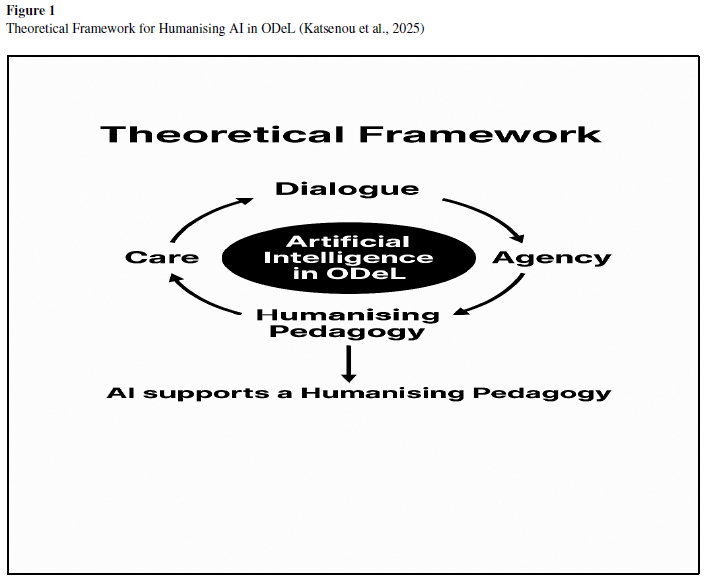
The integration of artificial intelligence (AI) into open and distance learning (ODeL) is reshaping engagement and retention in sub-Saharan Africa and offering new opportunities while also presenting significant constraints. In this conceptual paper, we examine how humanising AI can be embedded into ODeL design to strengthen dialogue, agency, care, and belonging. The study was guided by Freire's notion of critical pedagogy (1968/2000) and a human-centred AI perspective in aligning the use of technology with pedagogical goals, educator practices, and student needs. We employed a conceptual and interpretive design, supported by a narrative literature review, to generate theoretical insights rather than empirical findings. The key findings indicate that explainable learning analytics, intelligent tutoring systems, adaptive feedback, and conversational agents can personalise student support and identify early disengagement, while complementing rather than replacing human pedagogical presence. These technologies can enhance responsiveness in ODeL environments when integrated thoughtfully. The main implication is that their effectiveness depends on culturally relevant and ethically grounded implementation. We recommend strategies that consider infrastructural constraints, build educator capacity, and account for linguistic diversity to strengthen student engagement and retention in ODeL contexts in sub-Saharan Africa.
humanising pedagogy; artificial intelligence; distance education; student retention; ODeL
 Thumbnail