Coding and robotics meet early mathematics: Foundation Phase teachers' perceptions of play-based approaches in curriculum transformation
Abstract
Global educational ministries stress the importance of teaching coding and robotics because they have profoundly influenced children's mathematical computational thinking and problem-solving skills. In addition, play-based approaches in the Foundation Phase are significant because they develop children's holistic development skills. The Department of Basic Education recently integrated coding and robotics into the Foundation Phase curriculum in South Africa. Consequently, there is a shortage of skilled teachers equipped to meet the curriculum demands in the phase. Thus, this problem threatens technological and national development due to the connection between coding, robotics, and curriculum transformation. Piaget's constructivism theory underpinned this study because it supports play-based approaches and hands-on experience in childhood education. An interpretive case study design within qualitative research explored Foundation Phase teachers' perceptions of integrating play-based approaches in coding and robotics to enhance early mathematics learning within curriculum transformation. Semi-structured interviews were conducted to elicit teachers' voices on teaching coding and robotics to develop learners' mathematics skills. Twelve teachers from three primary schools in Limpopo were selected through homogeneous purposive sampling. Thematic data analysis was used to analyse the collected data. The findings revealed that teachers rely on unplugged or non-digital robots to teach mathematics in the Foundation Phase due to a lack of access to technological tools. Their voices highlight the need for additional skills to adapt to this curriculum transformation effectively. This paper introduces a novel contribution to global efforts by exploring innovative ways of using Lego bricks to teach coding and robotics to enhance early mathematics learning in the Foundation Phase.
coding and robotics; early mathematics; Piaget's constructivism theory; play-based approaches
Introduction and background
Recent developments in the Foundation Phase curriculum have increased interest in incorporating coding and robotics, mathematics, and play-based approaches. In the Foundation Phase, teachers are encouraged to integrate coding and robotics in teaching early mathematics to children aged five to nine years as part of curriculum transformation globally, to respond to the technological change in the Fourth Industrial Revolution. Educational policies from various countries encourage coding and robotics in their curricula. The United Kingdom's computing curriculum states that children aged five to 16 years should be taught programming and computational thinking early (Bers, 2020). Similarly, the Rwanda Coding Academy has initiated coding and software development to emphasise digital transformation in education systems (Pickin & Manjarrés, 2024). The South African Department of Basic Education (DBE; 2021) introduced a pilot programme into the curriculum for coding and robotics from Grades R-9. The integration of coding and robotics into mathematics teaching is gaining attention, yet there remains a need for teacher training in this area.
Integrating coding and robotics with teaching and learning mathematics in the Foundation Phase offers problem-solving, critical computation, and digital skills. Implementing this approach requires thoughtful curriculum design, teacher training, and providing hands-on manipulatives and materials to develop these skills. The DBE (2021) selected pilot schools for e-learning that integrates coding and robotics. However, South Africa needs more qualified teachers to teach coding and robotics (Geldenhuys & Fataar, 2021), thus, a need to train teachers in teaching mathematics through coding and robotics in childhood education. Play-based approaches to develop learners' holistic development, such as cognitive, emotional, social, and physical skills, are also emphasised (DBE, 2021). Against this background, teaching coding, robotics, and mathematics cannot be separated from incorporating play-based approaches in the Foundation Phase.
Play-based approaches in the Foundation Phase
The United Nations Children's Fund (UNICEF; 2018) encouraged play-based approaches in the Foundation Phase. The South African curriculum integrates play-based approaches in teaching mathematics in the Foundation Phase (DBE, 2011), and Bers (2020) highlighted that play-based approaches can be integrated into teaching mathematics through coding and robotics in this phase. Pollarolo et al. (2024) agreed that as children play with robots and follow code instructions, they develop an understanding of measurement, shapes, angles, and problem-solving skills. Thus, this paper explored Foundation Phase teachers' perceptions of integrating play-based approaches in coding and robotics to enhance early mathematics learning within curriculum transformation.
Coding and robotics in teaching early mathematics
Learners engage in hands-on experiences by programming code and robots. They also develop problem-solving and computation skills, critical thinking, and creativity from an early age. According to Gray and Thomsen (2021), coding and robotics programmes such as Scratch and Minecraft support children beyond interacting with computers and engaging in mathematical games. In addition, Chytas et al. (2024) showed that software like GeoGebra assists learners with mathematical concepts such as geometric shapes, transformations, and graph functions while coding, programming, and playing. Taley et al. (2024) posited that Scratch Junior allows children to create animations, games, and interactive stories demonstrating shapes, symmetry, and geometric patterns. Against this background, the author maintains that play-based approaches can be used in teaching mathematics through coding and robotics in the Foundation Phase. Nonetheless, there is debate from Geldenhuys and Fataar (2021) about whether the introduction of coding and robotics in South African schools would be successful, given the challenges of a lack of teacher training and professional development in teaching mathematics. Given these challenges, questions have been raised about whether the focus should be diverted to addressing these issues while transforming the curriculum. Thus the research question for this paper was: "How do Foundation Phase teachers perceive the integration of play-based approaches in coding and robotics to enhance early mathematics learning within curriculum transformation?"
Theoretical framework
This study is underpinned by the theoretical lens of Jean Piaget's (1952) constructivism theory, which suggests that when learners engage in play-based approaches integrating hands-on experience, they construct mathematical skills. This statement was corroborated by Rabillas et al. (2023), who stated that when learners play games, they develop cognitive skills and construct abstract mathematics. Thus, play-based approaches contribute to discovery learning in free or guided play activities. Given that coding and robotics rely on hands-on experiences, they contribute to constructing mathematical skills. The use of the constructivism theory led to the selection of the interpretivism research paradigm and assisted in interpreting and discussing the findings of this study.
Enhancing hands-on experiences
Hands-on experiences in childhood education are widely believed to develop children's mathematical skills. Montessori agreed with Piaget on using hands-on experiences to enhance children's emergent mathematics skills, and further noted that mathematical manipulatives contribute to mathematics, languages, and life skills in childhood education (as cited in Fayyaz et al., 2023). Recent literature from Luen et al. (2024) concurred that hands-on materials such as Lego bricks, counting blocks, and abacuses stimulate children's cognitive skills in teaching and learning mathematics. Furthermore, as children explore the materials, they communicate and stimulate social interaction among themselves and the teacher. Leung (2023) affirmed that hands-on experiences should be integrated with play pedagogies in mathematics and science content in the Foundation Phase. Thus, Foundation Phase teachers must use hands-on experiences to develop early mathematics. Additionally, as children play with robots, they develop fine and gross motor skills essential to their holistic development and mathematics learning.
Construction of mathematical knowledge through constructive, play-based approaches
Coding and robotics require hands-on experience where children learn mathematics by doing. In this way, they construct mathematical knowledge. Playing robot games such as Scratch Junior and Bee-Bots allows learners to learn mathematical concepts such as sequencing, counting, patterns, spatial orientations, space, and shapes in childhood education. Research by Berson et al. (2023) and Pelizzari et al. (2023) asserted that coding, robotics, and play-based approaches impact children's mathematics learning. Berson et al. (2023) expounded that robot coding as a play-based approach develops learners' spatial reasoning and computation thinking in preschool. They further explained the need for guided play in coding activities. Similarly, Pelizzari et al. (2023) corroborated that children from four years of age construct knowledge from the classroom environment to learn mathematics through coding, robotics, and play activities. The researcher agrees that coding, robotics, and play-based activities can assist learners in the Foundation Phase education in constructing knowledge and learning mathematical skills. All these views contribute to the interpretation of the views and experiences of teachers in using play-based approaches to teaching mathematics through coding and robotics in the Foundation Phase.
The literature on using play-based approaches in teaching mathematics in the Foundation Phase globally and in South Africa was reviewed. Recent empirical studies from international regions were reviewed to understand how teachers use play-based approaches and technology to teach mathematics in the Foundation Phase in the United States, South America, China, and South Africa, specifically in the Gauteng and Western Cape provinces. The studies were also cross-examined through the theoretical lens of Piaget's (1952) constructivism theory and used to discuss findings and make recommendations for this study. The literature review indicates little attention has been paid to using play-based approaches in teaching mathematics through coding and robotics in the Foundation Phase.
Casler-Failing (2021) investigated how Lego robotics teaching is incorporated into teaching mathematics in the United States' middle grades. A multiple-case study research design was employed, and five pre-service teachers were selected to engage in the study. Casler-Failing found that online technology needs to be incorporated into teaching mathematics through Lego robotics, as emphasised by the TPACK framework that integrates technology, pedagogy, and content knowledge to enhance the effectiveness and efficiency of teaching and learning processes. In South Africa, many Foundation Phase teachers may not have lived experiences in coding and robotics. Casler-Failing's (2021) findings highlight the importance of integrating the teaching of mathematics content with play-based approaches and culturally relevant activities for mathematics teaching. For example, accessible robotics toys can support understanding mathematics concepts, even in rural schools.
In the Republic of Panama, Muñoz et al. (2020) researched using a Bee-Bot robot to teach young children mathematics. A pilot programme was designed, developed, and implemented to use educational robotics to improve logical-mathematical skills in public school preschool and Grade 1 learners. Rubrics, checklists, and questionnaires in a pre-experimental design using a quantitative research approach were employed to collect data from 240 students between four and seven years of age. Their findings indicated that using the Bee-Bot robot teaches young children mathematics, programming sequences, learning inquiry, building solutions, and teamwork. Within South African classrooms where access to digital tools may be limited, Muñoz et al. give us hope that using low-cost robots can strengthen learners' mathematics and computation skills.
Yang et al. (2022) investigated the effects of a robot programming intervention versus a block play programme on kindergarteners' computational thinking, sequencing ability, and self-regulation. They used a quantitative study to experiment with a Matatalab screen-free robot teaching mathematics to young learners. One hundred preschool children from Beijing, China, participated. Their findings demonstrated the benefits of robot programming to learners' development in terms of computational thinking and sequencing ability, compared to a traditional curriculum activity in the Foundation Phase education block play. Yang et al.'s findings suggest that in South African classrooms, screen-free robots like Matatalab could provide learners with hands-on opportunities to engage with mathematics and computational concepts and bridge the gap of limited digital tools, rather than providing novelty.
Ogegbo and Aina (2020) examined the perceptions of Foundation Phase teachers on using technology in South African classrooms. Using a qualitative research approach, data were collected through semi-structured interviews and classroom observations. Four early childhood teachers from four Pretoria, South Africa centres participated. Their key findings were the need for more technological resources, teachers' poor knowledge, and lack of practical training on using developmentally appropriate technology. That research study concerned coding and robotics, early mathematics, or play-based approaches, and their findings highlighted the significance of technological manipulatives and the effect of a lack of teacher training in early grades on curriculum transformation.
In another study, Geldenhuys and Fataar (2021) investigated the experiences of Foundation Phase teachers teaching coding in their classroom contexts in the Western Cape, South Africa. Four Foundation Phase teachers from four schools, identified via purposive and snowball sampling, participated in in-depth interviews using a qualitative research approach. Their findings indicated that for the successful implementation of coding, it is essential to provide professional development on teaching methodologies for developing computational thinking skills in young learners, offer support for teachers, address time constraints in teaching the subject, and ensure the availability of necessary resources. Apart from Geldenhuys and Fataar's study, there remains a general lack of research in coding and robotics, mathematics, and play-based approaches in South Africa, including Limpopo.
Research methodology
The interpretivism research paradigm links with Piaget's (1952) constructivism theory, which suggests that learners construct knowledge through hands-on and play activities to learn mathematics. Similarly, interpretivism argues that reality is subjective and multiple realities are constructed socially (Panya & Nyarwath, 2022). As a result, individuals (teachers, learners, and the researcher) construct knowledge from their experiences shaped by their history and cultural and social perspectives (Moisander et al., 2020). These philosophical assumptions of interpretivism align with the qualitative research approach because it aims to collect rich and in-depth data from a social setting where the participants construct knowledge. The study adopted qualitative research to collect rich and in-depth data to understand the Foundation Phase teachers' perceptions of integrating play-based approaches in coding and robotics to enhance early mathematics learning.
An interpretive case study design was used to explore Foundation Phase teachers' perceptions of integrating play-based approaches in coding and robotics to enhance early mathematics learning within curriculum transformation. Dawadi et al. (2021) confirmed that researchers exploring social issues use a qualitative approach to collect in-depth data. In addition, Khoa et al. (2023) corroborated that a case study is usually used by researchers who aim to explore issues in a social setting and use the qualitative approach. A homogenous purposive sampling was used to select the participants for this research. As Veesart and Cannon (2022) stated, there should be guidelines (inclusion and exclusion criteria) for selecting participants in homogenous purposive sampling. Foundation Phase teachers with at least three years of experience in teaching mathematics, who integrate coding and robotics, and who use play-based approaches, were included in the sampling. Teachers who did not meet these criteria were excluded. Twelve Foundation Phase teachers from four public primary schools based in rural settings and chosen by the DBE to pilot coding and robotics in Limpopo province, South Africa, were selected. This means three educators (from Grades 1-3), each from one grade from four primary schools, were involved in this study.
Semi-structured interviews were used to elucidate Foundation Phase teachers' perceptions of integrating play-based approaches in coding and robotics to enhance early mathematics learning within curriculum transformation. Because of the nature of semi-structured interviews in a qualitative study, an interview schedule with diverse questions aligned with the research questions was used separately during the conversations between the interviewer (researcher) and the interviewees (teachers). Thus, one-on-one interviews were conducted face-to-face to allow teachers to narrate their perceptions without being influenced by others' views and experiences of the phenomenon under study. An interview schedule assisted in obtaining participant data (Thomas, 2021). Guided by Thomas, the researcher asked probing questions to determine the teachers' underlying experiences, perceptions, and views on integrating play-based approaches in coding and robotics to enhance early mathematics learning within curriculum transformation. The interview sessions took approximately 45 minutes for each participant. An audio recorder was used to capture the interview sessions with all the participants. This was done to increase internal validity in the qualitative study.
Before engaging with the teachers, the University of South Africa's Ethics Committee gave ethical clearance for the study (reference number 2023/10/11/64019209/38/AM). The Limpopo Department of Basic Education also approved the research (reference number LPREC/144/2023: PG) to allow the researcher to conduct the study in their primary schools. The interviews were conducted outside school hours to avoid disturbing teaching and learning activities. Teachers were given informed consent if they agreed to participate in this study. Twelve teachers signed the informed consent for their participation and were informed that they could withdraw from participating at any time should they feel uncomfortable without any penalty. The teachers were given pseudonyms to ensure the participants' and schools' confidentiality and anonymity. S1 represented School 1, and FPE1 represented the Foundation Phase Educator 1. Therefore, the 12 participants' pseudonyms are S1FPE1/2/3, S2FPE1/2/3, S3FPE1/2/3, and S4FPE1/2/3, respectively.
Johnson et al. (2020) explained that for qualitative research findings to be reliable and trustworthy, researchers must ensure credibility, dependability, transferability, and confirmability. This study established credibility and dependability due to the nature of the interpretivism case study. A colleague did a peer debriefing to uncover errors, detect biases, and improve the quality of a study, and prolonged engagement was done during interview sessions to ensure credibility (Nowell & Albrecht, 2019). This is where the researcher used phone calls and WhatsApp to delve into the perceptions teachers might have left out during the face-to-face interview sessions. In addition, an inquiry audit and internal validity (audio recording) were established to ensure the consistency and reliability of findings. The researcher was guided by Hasan et al. (2021) to use audio recordings to capture interview conversations to reduce internal bias. Three phases of coding were done to ensure dependability in qualitative research.
Thematic data analysis explored Foundation Phase teachers' perceptions of integrating play-based approaches in coding and robotics to enhance early mathematics learning. Before the analysis, the semi-structured data were prepared by transcribing them from audio to text. The research codes were created from the keywords of the study's research question. In the first coding stage, the researcher manually coded the semi-structured interview data using a Word document. Second, the data were uploaded to NVivo 12 software for re-coding. The literature review and theoretical framework were also imported into the software to assist with the data analysis. The same codes from coding were used to ensure the consistency of codes from the first stage. Lastly, an independent coder assisted with co-coding the same data to validate the analysis and determine emerging ideas from the participants until data saturation was reached.
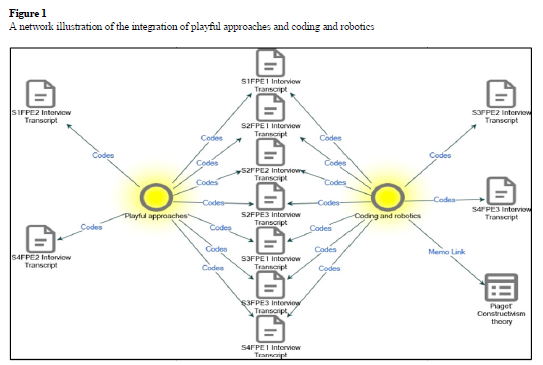
The researcher interpreted the meaning of data from the interviews through the reviewed literature and theoretical framework. Categories and patterns were created through the reviewed literature (Squires, 2023). Codes were grouped on NVivo 12 to formulate the categories used to present the results. Therefore, as per thematic analysis, the categories were also grouped to create themes through the lens of Piaget's (1952) constructivism theory used in the discussions of findings. During the analysis, illustrations such as networks, note hierarchy, and hierarchy charts were exported from NVivo 12 to assist with data analysis (for example, see Figure 1).
Figure 1 shows a network that analyses the integration of play-based approaches in teaching early mathematics through coding and robotics in the Foundation Phase; the teachers who integrated play-based approaches in teaching mathematics through coding and robotics were S1FPE1, S2FPE1, S2FPE2, S2FPE3, S3FPE1, S3FPE3, and S4FPE1. On the other hand, S1FPE2 and S4FPE2 only used play-based approaches in teaching mathematics, and S3FPE2 and S4FPE3 incorporated coding and robotics into their teaching and learning activities.
The data from the semi-structured interviews were interpreted through Piaget's (1952) constructivism theory, which served as a framework throughout this paper. Three themes emerged and were used to interpret the findings: the use of hands-on experiences, integration of play-based activities to construct mathematical skills, and lack of training and interventions.
Results
A key finding was that participants used play-based approaches in teaching mathematics through coding and robotics in the Foundation Phase to develop learners' mathematical concepts such as measurement, problem-solving, and spatial orientation. It was indicated that teachers were guided by the Lego Foundation's (2019) Six Bricks programme to design robots and manipulate them to learn mathematical skills. The strategies focused on play-based pedagogy and an introduction to coding and robotics. They used different games and manipulatives to teach mathematics through coding and robotics. Even though digital coding and robotics have yet to be introduced in most Foundation Phase classrooms, teachers must still be adequately trained. Therefore, there needs to be more training and interventions on play-based approaches in teaching mathematics through coding and robotics in the Foundation Phase.
The benefits of mathematics manipulatives and play-based approaches
Educators from S2, S3, and S4 attended training on Six Bricks and were provided with teachers' guides and mathematical manipulatives for learners, such as six Lego bricks. They used Lego bricks to engage in physical coding and robotics. In particular, S2FPE2, S2FPE3, S4FPE1, and S4FPE3 used Six Bricks to allow for hands-on experiences in teaching mathematics. S2FPE2 explained the guidelines from Six Bricks, mentioning coding and robotics in teaching and learning mathematics in the Foundation Phase. Another teacher added:
Yes. I have been to the Six Bricks workshop. They gave us lessons in coding, robotics, and online teaching. It was merely an overview of how to apply them in the educational setting. They provided teachers' manuals and learners with Lego bricks. The department did not organise it, but an NGO. They chose a few schools in our cluster. (S2FPE3)
A probing question was asked: Do you think the hands-on manipulatives they provided assist in your mathematics classroom? S4FPE4 responded:
I found it to be rather intriguing. It aids in classroom management and child discipline, helps learners to concentrate and even recall material, and maintains their attention on what you have to say. When you utilise Lego bricks to engage learners, you can say, "Red, red," and they will respond, "On my toes." Due to their strong sense of competition, kids would naturally want to get involved. (S4FPE3)
These results support the constructivism theory because the hands-on experience of using Six Bricks allows children to construct their own knowledge. In addition, children discover mathematical skills as they manipulate the Six Bricks. Teachers can use the manuals distributed by Six Bricks to plan lessons in which learners play with Lego bricks to develop their mathematical skills.
The guidelines from Six Bricks on using coding and robotics in early mathematics
The Six Bricks programme encouraged teachers to integrate play-based activities to assist with the construction of mathematical skills through coding and robotics. The guidelines on using coding and robotics from Six Bricks' teachers' guide show that teachers are provided with step-by-step instructions on incorporating play-based approaches through robotics and coding into math lessons. Revised guidelines on using coding and robotics in teaching mathematics step-by-step could assist teachers in teaching mathematics. On the other hand, there are no instructions for using robotics and coding online. Another probing question asked S3FPE1 how coding and robotics are used to teach mathematics, especially in Grade 1, eliciting the response:
We start from Scratch Junior. It is a cartoon cat. It shows the home and a question mark. The educator's role is to instruct learners on moving a Scratch Junior. There are question marks that show that learners can ask for answers. Let us say a Scratch Junior is going to farm animals. A learner needs to select their favourite animals. Whatever animal they would choose would appear on the screen. Even a square shape would appear if they are visiting different shapes. Scratch Junior is for Term 1, and shapes are for Term 2 and data handling [in Term] 3, and Term 4 is revision.
S3FPE1's narrative indicates that teachers know about different coding and robotics programmes that integrate play-based approaches for learners to construct mathematical knowledge, as supported by Piaget's (1952) constructivism theory.
The challenges of teaching coding and robotics in rural schools
The most common finding from the four schools was that the teachers needed to be adequately trained to use coding and robotics to teach mathematics to young learners. They used the strategies of the Six Bricks as an intervention programme, not a standalone teaching method. This indicates that more strategies for using play-based approaches in teaching mathematics through coding and robotics in the Foundation Phase are still needed. S1FPE3 and S3FPE2 supported this, and S3FPE2 explained:
Yes. We do attend training even though it is not as frequent. I just forgot some of the strategies that we can use. This could be caused by not attending them regularly. Kahoot, coding robotics, and a project-based teacher connection taught us about teaching and learning mathematics from Grades R to 12. For online teaching, we are trained by other educators.
Similarly, S1FPE1 and S2FPE3 explained that the knowledge they received from the intervention programmes was inadequate. They stated:
Indeed, we have participated in coding and robotics seminars. It was SADTU [teacher's union] that organised the workshop. Educators were only being introduced to it. The workshop did not fully fulfil our understanding of incorporating robotics and coding into teaching and learning activities. Although they indicated that we could use games, they did not address how we might use them online. (S1FPE1)
Yes. I have been to the Six Bricks workshop. They gave us lessons in coding, robotics, and online teaching. It was merely an overview of how to apply them in the educational setting. They provided teachers' manuals and learners with Lego bricks. The department did not organise it, but an NGO. They chose a few schools in our cluster. . . . They handed us booklets about coding and robotics, but I recall that day we did not do that. We are still uninformed about integrating coding and robotics in the Foundation Phase. That was not included in the training. (S4FPE3)
These results show that although coding and robotics were recently introduced, the teachers only attended the workshops occasionally. S3FPE2 explained:
Yes. We do attend training even though it is rare. I just need to remember some of the strategies that we can use. This could be caused by not attending them regularly.
Some teachers from S1 participated in a workshop about implementing coding and robotics in the Foundation Phase. They also mentioned that they attended it once. The findings showed that teachers use the Six Bricks strategies to guide them through coding and robotics in teaching and learning mathematics to learners, even though they need to be more adequately trained. The Foundation Phase teachers' perceptions of integrating play-based approaches in coding and robotics to enhance early mathematics learning within curriculum transformation attest to broader educational implications and literature.
Discussions of findings
This paper explored the Foundation Phase teachers' perceptions of integrating play-based approaches in coding and robotics to enhance early mathematics learning within curriculum transformation. The findings revealed that participants used strategies from Six Bricks, which encourages play-based pedagogy and coding and robotics in the Foundation Phase. Furthermore, most participants use the techniques of the Six Bricks programmes. They were trained and provided with Lego bricks (mathematical manipulatives) and teachers' guides on using Six Bricks strategies to teach learners in the Foundation Phase. However, Six Bricks does not integrate digital coding and robotics. Six Bricks was only introduced physically, not online.
Theme 1: Use of hands-on experiences in teaching early mathematics
This theme answers the research question of this study because it provides a discussion of findings on hands-on and constructive experiences of coding and robotics, which enhance Foundation Phase learners' mathematics. By exploring teachers' perceptions, this paper shows how hands-on, play-based approaches are implemented in the early mathematics classrooms to support curriculum transformation and enhance significant mathematics learning. The findings indicated that participants utilise hands-on experiences to use play-based approaches in teaching mathematics through coding and robotics in the Foundation Phase. The results showed that in the Foundation Phase, teachers use Lego Six Bricks to assist learners in building robots from a screen-free approach to enhance their mathematical concepts, such as measurements and spatial orientation. As mentioned in the literature review, there is a need to use hands-on experiences such as Lego robotics to teach young children mathematics (Casler-Failing, 2021). Similarly, Yang et al. (2022) agreed that block play in robot programming develops learners' computation skills. The theoretical framework supports these findings, and as Luen et al. (2024) highlighted, these Lego bricks stimulate children's cognitive skills to teach and learn mathematics. Therefore, this paper corroborates the significance of using hands-on experiences in teaching early mathematics, supporting Piaget's (1952) constructivist theory.
Theme 2: Integration of play-based activities to assist with the construction of mathematical skills
Theme 2 links well with Piaget's (1952) constructivist theory, which stresses that learners construct mathematical knowledge through active engagement and interaction with their environment. Play-based approaches and coding and robotics allow learners to explore, engage and interact within the mathematics classroom to develop computation and mathematical skills. To answer the study's research question, the findings reflect how learners construct mathematics skills in line with the South African curriculum aims for the Foundation Phase activities. The findings demonstrated teachers' integration of play-based activities to assist with the construction of mathematical skills. A strong relationship between play-based approaches and teaching mathematics through coding and robotics has been reported in the literature. Taley et al. (2024) noted that coding and robotics programmes such as Scratch Junior allow learners to play with shapes, symmetry, and geometric patterns. The literature from Muñoz et al. (2020) also confirmed that a Bee-Bot robot integrates play-based approaches that teach learners problem-solving skills. Yang et al. (2022) showed that the Matatalab screen-free robot teaches children the computational thinking needed in mathematics. On the same note, learners construct mathematical knowledge through robots, coding, and play-based approaches (Berson et al., 2023; Pelizzari et al., 2023), which shows that Piaget's (1952) constructivism theory is relevant to the study. Even though the results indicated that teachers use physical robots to enhance learners' mathematical skills, they can also increase their social skills, which are essential to holistic learning.
Theme 3: Lack of training and interventions
Teachers' perceptions are often shaped by the training, professional development, and support they receive from the policy makers. As a result, a lack of training or structured interventions can negatively affect how teachers implement play-based approaches, such as coding and robotics, to teach early mathematics. This theme addresses the research question by revealing the challenges and suggesting innovative ways of using Lego Bricks to enhance mathematics teaching in the Foundation Phase. The findings highlighted that there needs to be more training and interventions in using play-based approaches in teaching mathematics through coding and robotics in the Foundation Phase. Prior studies from Ogegbo and Aina (2020) and Geldenhuys and Fataar (2021) also noted teachers' poor knowledge, lack of practical training, and professional development in using play-based approaches in teaching mathematics through coding and robotics in the Foundation Phase in South Africa. The teachers depend on the strategies provided by Six Bricks to teach mathematics through coding and robotics. However, their training workshops could be more extensive and frequent. This finding shows that for teachers to successfully implement coding, robotics, play-based approaches, and mathematics teaching in childhood education, they need to be trained and monitored on these approaches. The Six Bricks strategy did not include any training on using it online. This result may be possible due to time constraints when engaging with digital content.
Innovative ways of using Six Bricks for coding and robotics in early mathematics
The findings from S4FPE3 revealed that Lego bricks can support classroom management, learner concentration, and engagement. Building on that perception, this paper suggests that learners can use coloured Lego bricks to sequence commands for robots, thereby learning mathematics in ways that mirror the benefits of coding and robotics highlighted by S4FPE3. Foundation Phase teachers can also encourage collaborative play through tasks such as "build a moving trapezium shape." Such play-based activities develop critical thinking, problem-solving, and mathematical reasoning, aligning with constructivist theory. Furthermore, learners can transfer these creations into coding programmes like Scratch Junior after designing mathematical models with Lego bricks. The narrative from S3FPE1 confirms that teachers already use Scratch Junior to teach shapes, data handling, and patterns, showing how Lego can serve as a scaffold for integrating hands-on play with digital coding.
Conclusion
The findings revealed that the Foundation Phase teachers use play-based approaches in teaching mathematics through coding and robotics to enhance learners' mathematical concepts such as measurements, problem-solving skills, and spatial orientation. Despite that, more training and professional development are needed for teachers to use play-based approaches in teaching early mathematics through coding and robotics in the Foundation Phase. The teachers use strategies from Six Bricks to allow hands-on experiences and integrate play-based activities to assist with constructing mathematical skills. Considering these findings, the study recommends that the DBE collaborate with Six Bricks to provide teachers with enough training and ongoing monitoring and evaluation activities. They could also introduce robotics and coding through technological tools to develop learners' digital and mathematical skills. This study's limitations include a small sample size, using only semi-structured interviews, and a small scope in qualitative research. Lamentably, the findings cannot be generalised to a larger population. The future can investigate this phenomenon on a larger scale.
References
Bers, M. U. (2020). Coding as a playground: Programming and computational thinking in the Foundation Phase classroom. Routledge.
Reviewed literature
- Berson, I. R., Berson, M. J., McKinnon, C., Aradhya, D., Alyaeesh, M., Luo, W., & Shapiro, B. R. (2023). An exploration of robot programming as a foundation for spatial reasoning and computational thinking in preschoolers' guided play. Early Childhood Research Quarterly, 65, 57-67. https://doi.org10.1016/j.ecresq.2023.05.015
- Casler-Failing, S. (2021). Learning to teach mathematics with robots: Developing the "T" in technological pedagogical content knowledge. Research in Learning Technology, 29, 1-15. https://doi.org/10.25304/rlt.v29.2555
- Chytas, C., van Borkulo, S. P., Drijvers, P., Barendsen, E., & Tolboom, J. L. (2024). Computational thinking in secondary mathematics education with GeoGebra: Insights from an intervention in calculus lessons. Digital Experiences in Mathematics Education, 1-32. https://doi.org/10.1007/s40751-024-00141-0
- Department of Basic Education. (2011). Curriculum Assessment and Policy Statement (CAPS), Mathematics Foundation Phase. https://tinyurl.com/w6a6c4pp
- Department of Basic Education. (2021). DBE will pilot draft the curriculum on coding and robotics in schools. https://www.education.gov.za/CodingRoboticsPilot.aspx
- Fayyaz, S., Lashari, A. A., Rafiq, K., & Jabeen, N. (2023). Montessori teachers' communication effects on the cognitive development of children. Journal of Namibian Studies: History, Politics, Culture, 33, 115-131. https://namibian-studies.com/index.php/JNS/article/view/4413/3054
- Gray, J. H., & Thomsen, B. S. (2021). Learning through digital play: The educational power of children making and sharing digital creations. LEGO Foundation.
- Johnson, J. L., Adkins, D., & Chauvin, S. (2020). A review of the quality indicators of rigour in qualitative research. American Journal of Pharmaceutical Education, 84(1), 7120. https://doi.org/10.5688/ajpe7120
- Khoa, B. T., Hung, B. P., & Hejsalem-Brahmi, M. (2023). Qualitative research in social sciences: Data collection, data analysis and report writing. International Journal of Public Sector Performance Management, 12(1/2), 187-209. https://doi.org/10.1504/IJPSPM.2022.10038439
- LEGO Foundation. (2019). Six Bricks: A guide to simple playful activities for young children [Educational programme]. https://info.firstinspires.org/hubfs/Education_Resources/LEGO_Foundation_Six_Bricks_Booklet.pdf?utm_source=chatgpt.com
- Luen, L. C., Guo, Y., & Jian, L. (2024). The pedagogical significance of STEAM toys for preschoolers. International Journal of Academic Research in Progressive Education and Development, 13(1), 2146-2154. https://doi.org/10.6007/IJARPED/v13-i1/21009
- Moisander, J., Närvänen, E., & Valtonen, A. (2020). Interpretive marketing research: Using ethnography in strategic market development. In P. Lisa, L. Visconti, & N. Ozcaglar-Toulouse (Eds.), Marketing management: A cultural perspective (2nd ed., pp. 1-20). Routledge.
- Muñoz, L., Villarreal, V., Morales, I., Gonzalez, J., & Nielsen, M. (2020). Developing an interactive environment through the teaching of mathematics with small robots. Sensors, 20(7), 1935. https://doi.org/10.3390/s20071935
- Ogegbo, A. A., & Aina, A. (2020). Early childhood development teachers' perceptions on the use of technology in teaching young children. South African Journal of Childhood Education, 10(1), a880. https://doi.org/10.4102/sajce.v10i1.880
- Panya, K. O., & Nyarwath, O. (2022). Demystifying philosophies and paradigms underpinning scientific research. The Strategic Journal of Business & Change Management, 9(4), 1367-1382. https://doi.org/10.61426/sjbcm.v9i4.2498
- Pelizzari, F., Marangi, M., Rivoltella, P. C., Peretti, G., Massaro, D., & Villani, D. (2023). Coding and childhood between play and learning: Research on the impact of coding in the learning of 4-year-olds. Research on Education and Media, 15(1), 9-19. https://doi.org/10.2478/rem-2023-0003
- Piaget, J. (1952). The origins of intelligence in children. International Universities Press.
- Pickin, S., & Manjarrés, Á. (2024). Chapter one: Service learning and appropriate technology in ICT education. In R. Musabe & J. S. Pettersson (Eds.), Imaging and assessing mobile technology for development (pp. 1-20). Cambridge Scholars Publishing.
- Pollarolo, E., Papavlasopoulou, S., Granone, F., & Reikerâs, E. (2024). Play with coding toys in early childhood education and care: Teachers' pedagogical strategies, views and impact on children's development. A systematic literature review. Entertainment Computing, 100637. https://doi.org/10.1016/j.entcom.2024.100637
- Squires, V. (2023). Thematic analysis. In Varieties of qualitative research methods: Selected contextual perspectives (pp. 463-468). Springer International.
- Taley, I. B., Amponsah, A., & Kpai, H. (2024). Exploring the factors that influence students' interest in using Scratch to learn coordinate Geometry: An integrated model based on the technology acceptance model. Journal of ICTin Education, 11(1), 24-44. https://doi.org/10.37134/jictie.vol11.1.3.2024
- Thomas, S. P. (2021). Resolving tensions in phenomenological research interviewing. Journal of Advanced Nursing, 77(1), 484-491. https://doi.org/10.1111/jan.14597
- United Nations Children's Fund. (2018). Learning through play: Strengthening learning through play in early childhood education programmes. Lego Foundation.
- Veesart, A., & Cannon, S. (2022). The lived experience of nursing students who were unsuccessful in an undergraduate nursing programme: A narrative inquiry. Nurse Education Today, 118, 105517. https://doi.org/10.1016/j.nedt.2022.105517
- Yang, W., Ng, D. T. K., & Gao, H. (2022). Robot programming versus block play in early childhood education: Effects on computational thinking, sequencing ability, and self-regulation. British Journal of Educational Technology, 53(6), 1817-1841. https://doi.org/10.1111/bjet.13215
Accepted: 29 September 2025