"You can't get to every learner": Rethinking differentiated teaching and remediation in selected South African schools
Abstract
This paper examines why differentiated teaching is rarely observed in South African high schools, despite being widely promoted as a response to variation in learner performance. Drawing on classroom observations and teacher interviews across eight schools in the Eastern and Western Cape, we find little evidence of differentiated teaching in practice. We argue that the limited use of differentiated teaching reflects the structural constraints under which teaching takes place-curriculum pacing requirements, accountability for coverage, large classes, limited instructional time, and automatic progression. Under these conditions, the system produces a misalignment between learners' expected and actual levels of grade-preparedness, and large numbers of under-performers. A communal pedagogy emerges as a rational, adaptive response to the system-produced bottom-heavy learner performance distribution. Remediation features largely as external and parallel to the formal school system. Improving and supporting the quality of communalised pedagogies, and inserting remediation into the formal school day requires attention.
differentiated teaching; heterogeneity; remediation; communal teaching
Introduction
Like many low-and middle-income countries, classrooms in South Africa are marked by a large variation in learner performance levels (Böhmer & Wills, 2025). In addition, the heterogeneous distribution of learner performance within grades is skewed towards the lower end of the performance spectrum in that around 80 per cent of South African learners are performing below grade level, a stable finding across research conducted over the past two decades (Schollar, 2018). Thus, the average public school teacher faces significant pedagogic challenges in teaching and assessing at the grade level expected by the curriculum.
Typically, responses to this problem include interventions and government policy focused on getting teachers to deliver teaching that more closely matches learners' proficiency levels, referred to as "differentiated teaching" (Graham et al., 2021). However, there is limited evidence that such approaches are widely implemented in practice (Ganimian & Djaker, 2022). This raises a central question: "If differentiated teaching is both widely advocated and pedagogically desirable, why is it so rarely observed in classrooms?"
This paper addresses this question using evidence from classroom observations and teacher interviews in a sample of South African high schools. Our classroom observations show little evidence of teaching that takes account of differences in learners' preparedness for the grade. One possible explanation, informed by a literature showing that teachers and education systems do not always have accurate information about learners' actual levels of understanding without explicit diagnostic assessment, is that teachers are unaware of the extent of academic heterogeneity within their classrooms (e.g. Djaker et al., 2023). Another explanation put forward in the literature is that teachers have difficulty implementing differentiated teaching (e.g. de Jager, 2017). Most literature (e.g. Tomlinson et al., 2003) advocating differentiation as a pedagogic response to academic heterogeneity assumes manageable class sizes, learners roughly within the expected grade level, and flexible curricula. The dominant models of differentiated teaching presuppose conditions that are not necessarily present in many classroom contexts in South Africa.
We argue that the limited use of differentiated teaching is a reflection of the conditions under which teaching takes place. In particular, teachers are required to cover a tightly paced curriculum in classrooms characterised by substantial variation in learner performance with a high proportion of under-prepared learners. Additionally, district officials hold teachers accountable for curriculum coverage, rather than learning, through strict enforcement of the Annual Teaching Plans (ATPs). Within these conditions, the scope for differentiated teaching is limited. Instead, a pedagogy that treats learners as homogenous dominates-often accompanied by slow pacing, repetition, and re-teaching despite pressure to adhere to the ATP, and the displacement of remediation outside the formal timetable. These patterns are not incidental, but represent a rational response to the structural demands that teachers face. By combining classroom observations with teacher interviews, the paper contributes evidence not only on what teachers report, but on what is enacted in classrooms and therefore, on what is pedagogically feasible under current conditions.
The findings have implications for how within-class variation in learner performance (academic heterogeneity) is understood and addressed in policy and practice. Much of the existing literature frames academic heterogeneity as a problem to be managed by teachers through differentiated teaching. This paper suggests that such expectations may be misaligned with the realities of classrooms in which many learners are not at grade level, and where institutional arrangements such as large classes and system-produced conditions constrain instructional choices. This paper therefore questions the transferability of global pedagogic models, arguing for solutions that address local conditions.
Outlining the South African education policy landscape
Two key features of education policy that make skewed distributions of learner performance almost inevitable in South Africa, are (1) a curriculum policy with explicit selection, sequencing, and pacing requirements and (2) a promotion policy that incorporates automatic grade progression. South Africa's Curriculum and Assessment Policy Statement (CAPS) regulates the selection and sequencing of contents and pacing of teaching for all school subjects at each grade level (Galant, 2013; Naidoo, 2019). CAPS documents are accompanied by the ATPs, which specify the topics to be taught and the assessments to be completed during each week of the school year. The ATPs serve both as planning documents for teachers and monitoring documents for heads of department and district officials (Graven, 2016). Previous research has argued that the accountability framework within which CAPS and the accompanying ATPs are implemented places strong emphasis on curriculum coverage rather than actual learning (Bertram et al., 2021; Naidoo, 2019). This emphasis is reinforced by district officials who look for evidence that teachers are on track with the ATPs, rather than whether learners have mastered the content (Graven, 2016; Naidoo, 2019). The stringent enforcement of the ATPs generates a dilemma for teachers who are required to meet the curriculum pace while teaching learners who are unable to keep up. As Bertram et al. (2021) show, teachers experience a tension between pacing demands of the curriculum and learners' levels of understanding and grade preparedness.
This dilemma is compounded by the South African education grade promotion policy. The Admission Policy for Ordinary Public Schools (Department of Education, 1998) stipulates that a learner may not repeat a grade more than once within a phase.1 Consequently, learners who do not meet the promotion requirements are automatically progressed if they have previously repeated a grade in that phase. Furthermore, automatically progressing learners through mark adjustment has increasingly become more common, particularly since COVID-19 (see Hoadley et al., 2025).
These policies contribute to classrooms in which learners are at very different levels of grade preparedness. Schollar (2018) argues that most South African classes are de facto multigrade classrooms. This is supported by national and international assessment data. For example, Wills et al. (2025) show large within-school gaps in learning using Trends in International Mathematics and Science Study (TIMSS) data, while national systemic assessments show that learner performance is concentrated at levels below grade expectation (Department of Basic Education [DBE], 2024).
At the same time, the curriculum assumes grade-level proficiency and provides limited scope and guidance for addressing accumulated learning backlogs. As learners progress without mastering prerequisite skills, these deficits compound over time and are particularly acute for subjects reliant on vertical progression such as mathematics (Spaull & Kotzé, 2015). The combination of automatic progression policies together with monitoring a tightly paced curriculum contributes to the presence of many under-prepared learners. These conditions create a persistent tension for teachers. Teaching at the prescribed pace risks leaving many learners behind, while slowing down to support learners makes it difficult to cover the curriculum.
Clarifying the concept of heterogeneity
The concept of heterogeneity encompasses multiple dimensions in the literature (e.g. Lim, 2024). This paper focuses on heterogeneity with respect to academic performance (academic heterogeneity) rather than cultural heterogeneity, which situates academic differences as part of a broader notion that includes race, gender, and so forth (Lim, 2024). Academic heterogeneity in this paper refers to the range of learner performance within classes and therefore, diversity in learners' academic success or preparedness for a grade.
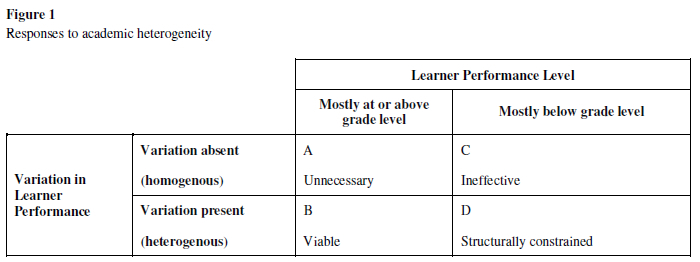
If we consider learner performance along two dimensions: (1) presence or absence of variation and (2) grade-level performance of learners as mostly at or above grade level versus mostly below grade-level, what results is a Cartesian product showing four different responses to academic heterogeneity under different classroom conditions. We have labelled the four responses A, B, C, and D in Figure 1. Overlaying all four cases described is a tightly sequenced and paced curriculum setting out grade-level expectations for learner performance.
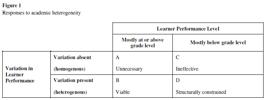
Each condition creates a different possibility with respect to differentiated teaching. For a homogenous class where learners are mostly at grade level (Case A), or mostly far below expected grade level (Case C), differentiated teaching is respectively not necessary or ineffective. A heterogenous class where learners are mostly at or above grade level (Case B) implies that a differentiated pedagogy is viable. However, a heterogeneous class coupled with learners overwhelmingly below grade level (Case D) suggests that differentiated teaching is structurally constrained. As outlined above, the South African learner performance data, characterised as exhibiting large variation (Böhmer & Wills, 2025) coupled with mostly below grade-level performance (DBE, 2024; Schollar, 2018), is indicative of Case D where structural conditions constrain differentiated teaching.
Individualising and communalising pedagogies
The term "differentiated teaching" is defined in different ways across the literature with no agreed-upon definition (Eikeland & Ohna, 2022). Drawing on Dowling and Brown (1996, 2009) and Hoadley (2008, 2017), we frame differentiated teaching in relation to individualising and communalising pedagogy. Although Dowling and Brown do not explicitly refer to individualising and communalising pedagogy, they distinguish between individual and communal strategies in pedagogic settings. Individualising strategies focus on learner differences whereas communal strategies emphasise the sameness of learners, thus treating learners as undifferentiated. A pedagogy dominated by communal strategies is described by Dowling and Brown (1996, para. 21) as follows:
The classroom is characterised as a site for the collective production and acquisition of the privileged text. The teacher is clearly the leader in this production and students are largely undifferentiated.
For Dowling and Brown (1996), individual and communal strategies in pedagogic settings are aligned to different forms of social cohesion. Individualising is characteristic of a form of social solidarity that emphasises differences, whereas communalising is premised on a form of social cohesion based on the sameness of the individuals constituting the group.
The terms, "individualising pedagogy" and "communalising pedagogy," were first coined by Hoadley (2008) to describe features of pedagogic forms in different social class settings. She defines communalising pedagogy as one where "a teacher worked with the whole class as a homogenous group, with little or no differentiation of tasks or differentiation of individual performances" (Hoadley, 2017, p. 166). In an individualising pedagogy,2 on the other hand, "learners are individualized in the instructional practice of the teacher. Learners are treated as different, with different learning competences and requirements" (Hoadley, 2008, p. 75). Hoadley's definitions are useful in marking out the characteristics of different pedagogic modalities as discussed in this paper.
Methodology
This paper is part of the Mixed Methods Investigation into Learning Assessment, Progression and Support (MILAPS) project. The broad research interest of MILAPS lies in the pedagogic and assessment practices of teachers in secondary schools, specifically the subjects English, history, mathematics, and mathematical literacy.
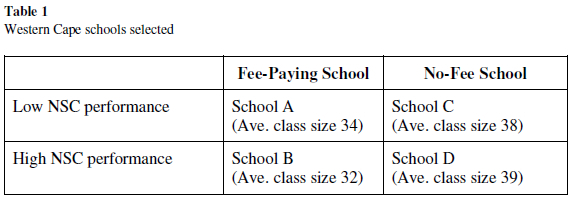
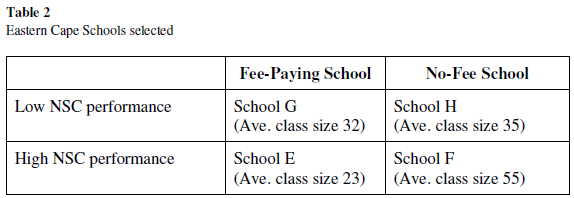
The study employed a multiple-case study design across eight secondary schools in the Eastern Cape and Western Cape provinces. Schools were purposively selected to reflect variation in socio-economic status (proxied by fee-paying status-see Soudien, 2004) and learner performance (based on National Senior Certificate [NSC] results). The sample includes four schools in each province, comprising high- and low-performing fee-paying and no-fee schools. In each school, we selected a teacher who taught a Grade 8 or Grade 10 class in one of four subjects: English home language or first additional language, history, mathematics, or mathematical literacy. The selection of schools along with their fee-paying status, NSC performance and average class size is shown in Table 1 (Western Cape, Schools A-D) and Table 2 (Eastern Cape, Schools E-H).
Overall, 99 lessons were observed, taught by 50 teachers. Each teacher, except for one, was observed teaching two consecutive lessons. The 50 teachers were also interviewed, mostly after the lesson observations. For the classroom observation data, one researcher accompanied by a trained fieldworker observed classroom pedagogy across two consecutive lessons, collected video and audio-recorded data, and produced a detailed, written description of both lessons. After each lesson, the data collectors completed a closed-ended observation schedule adapted from Wiliam and Thompson (2007), which focused on how teachers explained content, how they checked for learner understanding, how they provided feedback to learners, and whether in their interactions they singled out individual students or differentiated between students on the basis of different levels of academic preparedness. In this way, the tool was completed in reference to detailed narrative accounts and subjected to a form of inter-rater reliability at the point of data collection. The video and audio-recorded data also allowed for subsequent in-depth analysis and provided an opportunity for re-coding some indicators.
Two consecutive lesson observations per teacher is a limitation because they provide a slim observational window. We cannot therefore be certain that features that were absent in the two observed lessons are not potentially part of the teacher's practice at other times. However, as will be discussed later, the patterns observed in the observation data cut across subjects, grades, and schools, suggesting some entrenched practices emerging from the classroom observations.
The teacher interviews focused on teachers' perceptions of learner performance, promotion and repetition, and learner support and remediation. The teacher interviews were subjected to a thematic analysis focusing on what teachers say in relation to learners' performance, strategies for dealing with academically heterogeneous classes, remediation strategies, and other forms of learner support.
Quotes from the interviews are attributed to specific teachers using a code that includes a reference to school, the grade, and subject taught. The grade taught is either Grade 8 or Grade 10, and the subject codes are as follows: English home language (EHL), English first additional language (EFAL), history (H), mathematics (M) and mathematical literacy (ML). For example, a School G, Grade 8 mathematics teacher is labelled as Teacher G8M.
Ethics approval for the study was obtained from the Research Ethics Committee, School of Education, University of Cape Town.3 Consent was sought from all participants in the study.
Teachers' perceptions of within-class academic heterogeneity
Teachers consistently described their classes as academically heterogeneous, with many learners not performing at grade level. One teacher expressed the following opinion:
They come from primary school. My friends tell me that if a learner fails an assessment, they take it home so that they can get a 70%. I looked at their reports but even the Level 7 learners did not know Grade 7 work and their performance in the first Grade 8 assessment-they did not perform well. So, Grade 7 results are cooked. (Teacher G8M)
When asked how many learners in their class were repeaters, one teacher said:
There are too many of them, I do not even know their names. I just teach. (Teacher F10H)
Teachers' descriptions of their classes emphasised the extent of struggle among learners:
Ninety-five per cent are struggling. Their marks look like they were not even in the classroom. (Teacher D8H)
Way more than half [struggle]. Tough, because I have the top achiever in Grade 8 in my class and she is far ahead of everyone else. (Teacher B8EHL)
Several teachers described their classes as dominated by learners who struggle to keep up with grade-level demands:
It's all of them . . . except for the one boy, the top boy . . . can cope but the others slow him down. (Teacher B10M)
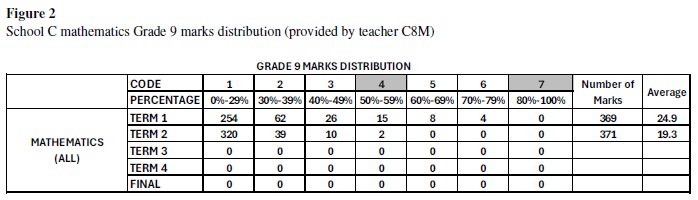
The majority fail. . . . Only three percent in Grade 9 managed to pass mathematics on their own. Only three percent out of 330. . . . Even in Grade 8, it was so small . . . only 97 learners out of 310 [passed]. (Teacher C8M)
Teacher C8M provided us with the Grade 9 marks distribution sheet for mathematics to corroborate his comments (shown in Figure 2). The figure shows the mathematics marks for Term 1 and Term 2 for School C. In Term 2, only 12 of 371 learners (3% of the learners in the grade) scored above 40%, the pass mark for mathematics, and 320 learners (86% of the learners in the grade) were in the 0-20% band.
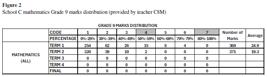
Similarly, the Grade 8 mathematics teacher at School D predicts, based on the performance in Term 2, that more than two-thirds of 306 Grade 8 learners will not meet the grade promotion requirements, but will be promoted to Grade 9 regardless. This evidence indicates that, in the selected classrooms, the distribution of learner performance is not simply uneven but overwhelmingly concentrated among learners performing below grade level.
Baseline testing of learner knowledge at the beginning of the year may be one way of assessing learner preparedness for the grade. However, based on our interviews, baseline testing does not appear to be an institutionalised practice across the schools selected and, in most schools, appears to be left to individual teachers. However, the Western Cape Education Department (2026) has instituted standardised baseline assessments in Foundation Phase reading and mathematics from 2026 as a means of identifying learning gaps to inform teaching.
In summary, participants' comments suggest that most teachers are acutely aware of academic heterogeneity in the classes they teach with many highlighting that many learners are not at grade level in their classes. Teachers' descriptions of learner performance of their classes mirror the national picture of South African learner performance emerging from international and national assessments discussed earlier. Furthermore, the teacher interviews provide insight into teachers' experience of the misalignment between expected and actual performance levels of learners. Next, we examine teachers' pedagogic responses to this misalignment.
Pedagogic response to misalignment between expected and actual learner performance
Galant et al. (2026) provide a detailed analysis of the classroom observation data, focusing on teachers' formative assessment practices that include the activities teachers engage learners with, how they monitor learners, and their feedback to learners. The analysis highlights similarities and differences across 99 lessons, and compares practices across the different subjects. In this paper, we draw on the classroom observation data that specifically relate to how teachers either do or do not respond to class heterogeneity. Our analysis did not focus on differences between subjects taught. Fieldworkers noted in all the lessons that all learners did the same activities at the same time. There were no observed instances of teachers giving individual learners or groups of learners different tasks that may have been tailored to learners' differential academic preparedness. Similarly, teacher questions in class seldom differentiated between individual students. In the majority of lessons observed (64%) across all school types, teacher questions were most frequently directed at the whole class for any learner to respond, rather than specific individuals. Even in lessons in small classes (fewer than 30 learners), teacher questions were mostly addressed to anyone in the class rather than to specific individuals. In the few lessons where teacher questions were directed at individual learners, it was not apparent that teachers were asking different learners different types of questions based on their academic preparedness. In most lessons observed therefore, teacher questions appear not to function as a mechanism to gauge the level of an individual learner's knowledge or understanding of the topic of the lesson, but rather as a mechanism to include learners in the lesson as a communal activity.
Our classroom observation analysis also suggests that teachers did not routinely monitor all learners while they were doing tasks. In only about a fifth of the lessons observed, teachers systematically monitored individual learners while they worked on a task. In about a third of the lessons observed, the teacher either did not monitor learners at all while they worked on tasks, or the teacher moved around the class but failed to check on individual learner's understanding. In these cases, teachers' monitoring attention was more focused on whether learners were on task rather than assessing individual learners' acquisition of knowledge or addressing misconceptions. Similarly, in lessons focused on homework or assessment tasks, feedback to learners and explanations of solutions were done as a communal activity rather than focused on any individual learner's errors. It was not apparent in any of the lessons observed that teachers specifically targeted struggling learners for special attention (either through questioning or monitoring while on task) or provided enrichment activities for top performers. Given that our study was limited to observations of only two consecutive lessons, it is possible that giving individual attention to struggling learners may be part of teachers' practices at other times.
Overall, we observed little pedagogic differentiation with respect to learners at different levels of academic preparedness. The dominant pedagogy across schools is a communal one where learners mostly engage in the same activities at the same time, assessment targets the whole class rather than individuals, remediation for struggling learners is limited, and enrichment for top performers is absent (see Dowling & Brown, 1996, 2009; Hoadley, 2008, 2017).
Additionally, at least three quarters of the observed lessons exhibited slow pacing. For example, in mathematics and mathematical literacy lessons, worked examples were presented to the whole class, followed by time given for learners to copy the worked examples into their notebooks. After this, one or two classwork examples were done by learners, sometimes in groups. These were then marked by either the teacher, who explained the problem, or a learner, who wrote the solution on the board. The class then copied the solution into their notebooks. This sequence unfolded at a slow pace, where only a small number of examples were covered, and considerable time was devoted to copying and whole-class explanation. Similarly, in some English classes, considerable time was taken up with learners copying notes from the board, which inevitably reduced time for moving the lesson along or for learners to engage in independent tasks related to the topic.
In the teacher interviews, 34% of the teachers specifically mentioned the slow pace of teaching, and how slowing down the pace by repeating lessons or re-teaching concepts is used to support struggling learners:
I go slowly. I don't try to cover the ATP. We end up lagging behind. (Teacher H8EFAL)
Pace is slow. Sometimes we retrack to areas of difficulty. This affects pace. (Teacher A8M)
I slow down pace of teaching to accommodate learners so that we don't lose all the learners. . . . So can't keep up with the pacesetter. (Teacher B10M)
Insufficient time and pressure to cover the curriculum were the most frequently mentioned reasons teachers gave for their inability to provide individual attention to learners, particularly struggling learners:
I don't have enough time to spend with individuals. (Teacher B8H & B10H)
There is not enough time and the volume of work we need to cover. (Teacher G10M)
The challenge of paying attention to the progress of individual learners is compounded by large classes and the difficulties this presents for monitoring individual learners. The fall-back for teachers is to slow the pace of teaching and learning for all learners and repeating or re-teaching topics, which again puts pressure on teachers in relation to curriculum coverage.
Some teachers highlighted the class size challenge:
There are too many of them [learners]. I can't give enough individual attention to them and with marking homework there's no way I can check that they all got the answers right and explain what's wrong. So I can only just see that they have done it. (Teacher B8M, class size 35)
There's no time to give them [struggling learners] attention because of the big number in class. It's difficult to identify them. You have to wait for them to write the assessment, then you can see. Because you don't have time to check them individually when it comes to classwork and homework. (Teacher D8M, class size 52)
In addition to class size, a few teachers also suggested they avoid individualising learners because it could lead to learner stigma or anxiety, as reflected in the comments from teachers:
Too many of them . . . and secondly the idea . . . how they interpret help . . . it's difficult to single them out. I have to tread carefully to protect their mental health. You don't want kids to feel anxiety about coming to class. (Teacher D8H, class size 48)
It's a big class so it's hard. I try not to single out a child, like we are going to do this because of you. I make it a common thing, because no-one wants to admit they can't do something. So I do it with everyone in one go. (Teacher A8EHL, class size 34)
I don't want learners to feel separated or make them feel like they are doing something wrong. (Teacher B8EHL & B10EHL, class size 33).
This places pressure on teachers to balance competing instructional demands. The challenge of paying attention to the progress of individual learners is exacerbated by large classes, particularly in classes where learners are mostly not at grade level. Together, the evidence from teacher interviews and classroom observations points to the difficult, and often untenable, situation teachers face; they are expected to cover a tightly paced curriculum in classrooms where learner performance is highly varied and heavily concentrated below grade level, often in large classes.
Remediation and support for struggling learners
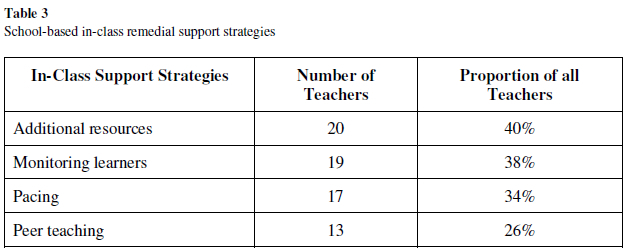
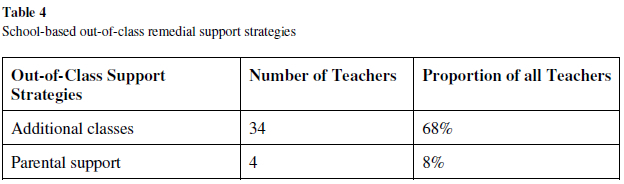
When asked in the interviews what remediation strategies they use to deal with struggling learners, teachers mentioned a range of support strategies. Strategies referred to here include in-class strategies (Table 3) and out-of-class support strategies (Table 4) which varied across schools and subjects. These strategies are described in more detail below.
In-class pedagogic support strategies
The most frequently mentioned in-class strategies to support struggling learners were providing them with additional resources (40%) and monitoring individual learners (38%). The additional resources mentioned by teachers include providing learners with extra workbooks, online textbooks, dictionaries, past examination papers, and reading books to take home. The history teacher at School B for example, said she did different things for Grade 8 and 10:
I give extra workbooks to the ones who struggle in Grade 8. In Grade 10, I give them past exam question papers as a way of preparing them. (Teacher B8H & B10H)
Providing extra resources to struggling learners comes with the challenge of monitoring whether learners use the resources. This was expressed for example by the English teacher at School C who said she provided an extra practice book for struggling learners:
I did have an extra practice book to practice comprehensions, to practice answering questions and also just reading. But it wasn't successful. Us as teachers we were also to blame 'cause we didn't monitor it, but learners were also slacking on their part. (Teacher C8EFAL)
In-class monitoring of struggling learners was expressed either as paying special attention to individual learners or organising seating arrangements that made monitoring of struggling learners easier. Monitoring learner progress for most teachers was about checking learner workbooks, as stated by these teachers for example:
Working one-on-one is best. Check their classwork. When you check their books, you can see it. (Teacher G8EFAL)
I feel like I neglect those who know their work and focus on those who don't work. I check the books of those who don't work more than those who do. (Teacher C8EFAL)
As mentioned before, about 20% of teachers were observed monitoring learners while they worked on a task. However, because our study was limited to observations of only two consecutive lessons, it is possible that monitoring of individual learners may be part of teachers' practices at other times. Intentional seating arrangements were mentioned by the following teachers for example as a way of monitoring struggling learners:
I put those that are struggling, I put them in front. Maybe they have sight or hearing problems. Those who are doing well can be seated at the back. (Teacher F10H)
Each row in my class is at a particular level. Level 7 learners are not getting a lot of teaching. Level 1 and Level 2 learners are targeted for re-explaining. Seating in class is intentional. I focus more on those who are struggling. (Teacher G10M)
Peer teaching was another strategy teachers (26%) mentioned that they use as a means of providing in-class support for struggling learners, especially in mathematics and mathematical literacy. Though few instances of this practice were observed during classroom observations, our observations were limited to only two lessons, so it is possible that peer teaching may be part of teachers' practices at other times. The following comments from teachers suggest intentional pairing of high performing learners with struggling learners, with the aim of the stronger learners assisting the weaker learners:
I pair struggling learners with better performing learners. They still need to do individual work but top learner there to help. (Teacher A8M)
I arrange seating of learners into groups. Weak learners are paired with strong learners. (Teacher D10M)
There are learners who are really struggling, especially learners who have progressed. We do peer teaching. Strong learners help the weaker ones. (Teacher D10ML)
Overall, the in-class strategies mentioned by teachers were not observed by fieldworkers during the observed lessons except for some instances of learners working in groups. Given that our classroom observations were limited to two lessons, we cannot be certain if these strategies are part of teachers' practices at other times. Nonetheless, the analysis of the lessons and teacher interviews suggests that teachers are aware of pedagogic strategies for dealing with struggling learners but appear to have difficulty implementing these strategies consistently.
Out-of-class but in-school remedial programmes/strategies
The most common strategy for providing remedial support was to offer extra lessons outside school hours. This was mentioned by 34 teachers (68%) across schools. Teachers explained that these classes mostly take place after school, although there were instances where teachers mentioned extra lessons that took place before school, on weekends, and during vacations and break times. Remedial support therefore appears to be thought of as supplementary to classwork. The additional classes are mostly voluntary, but five teachers claimed that the additional classes are compulsory for struggling learners. This is evident from the remarks made by the following teachers in response to questions regarding remedial strategies:
Intervention classes which are those extra classes and the repeaters, it is actually compulsory for them to go. . . . Progressed learners have free will to come to the classes. (Teacher A8M)
There are interventions for all learners but compulsory for learners failing. (Teacher E8M)
Compulsory for failures. Also for enrichment. (Teacher E10EHL)
Targeted intervention for at risk learners from [Grade] 8 to 11. (Teacher A10EHL)
Teachers complain that although additional classes are offered to learners, many do not attend the classes for various reasons, including teacher and learner exhaustion, teacher workload, learner transport, and safety:
We've tried and we're exhausted. We've tried afternoon classes. Kids are tired. You are also drained. (Teacher D10EFAL)
Extra classes not given. We are not doing that. Teachers have too much on their hands. (Teacher C8M)
Not safe to run afternoon classes. (Teacher H8M)
I ask them to come during breaks. They can't stay after school because they have to travel home. (Teacher G10EFAL)
Learners use transport so they can't stay late after school. (Teacher F10M)
Additionally, one teacher claimed that progressed learners do not attend additional classes because they "know that if they fail once, they can't fail again in that phase." (Teacher G10H).
Seven teachers (14%) remarked on the tendency to focus remedial support at learners in the FET phase, especially Grade 12, with little if any focus on the lower grades. Teachers' comments highlight this issue:
Concentration is more on Grade 12 because it is external. Lower grades are just left. (Teacher C8M)
Only at Grade 11 and 12. Nothing at Grade 8. The problem is at Grade 8, but they concentrate only at the end of the schooling system. (Teacher G8EFAL)
Very little remedial strategies used in the GET. Extra classes offered in FET. (Teacher G8H)
In Grade 12, there is remediation. In Grade 10, there are too many of them. They get Level 2s but they do not fail. I do not have the chance to help them, there are too many of them. (Teacher F10H, class sizes 82 and 79)
My focus is on Grade 11 and 12. I don't have the time for Grade 10. (Teacher A10M)
Seven teachers (14%) report that they recruit the assistance of parents to check notebooks, pay for tutorial support, or help learners with homework or additional tasks at home as indicated in the following comments:
I called the parents to inform them and ask them to help. (Teacher F8H)
It's a big class so it's hard. I send messages to parents ask them to check their notebooks. (Teacher A8EHL, class size 38)
Extra activities for struggling learners given to parents to monitor that learners do at home. . . . Parents asked to supervise additional homework. (Teacher A8M)
Parents advised that learners must work on Siyavula [online application]. (Teacher A10M)
We have got tutors . . . Parents pay. Tutors come to school on Saturdays and holidays. (Teacher D8M)
Parental support is requested but often not forthcoming as indicated by teachers' complaints:
Not all parents willing to assist. Only a handful that will assist and support. (Teacher A8M)
Parental support is bad, parents don't pitch for meetings, they don't check homework. (Teacher B10ML)
When I first came here the parents were hands on, they wanted to get feedback on their learners. I put a WhatsApp message on the parents group, and they don't respond. (Teacher D8H)
Only one teacher explicitly stated that no remedial support is provided for learners who have difficulty in keeping up with the pace of the grade requirements.
No, we have no remedial strategies for Grade 10s. I try to conscientise them that they need to read. (Teacher H10H)
Overall, providing additional classes before or after school or on weekends was the most frequently cited strategy used to support struggling learners. Although some teachers claimed these additional classes were compulsory for struggling learners, in most cases attendance is voluntary and according to several teachers' accounts, not always well attended. The fact that additional classes have become commonplace points to a structural mismatch between curriculum demands and the realities of learner preparedness; the standard school day simply does not allow teachers to remediate backlogs while keeping pace with the curriculum.
Additional classes are indicative of a supplementary repair system running in parallel with formal schooling, what Bray (2021) refers to as shadow education. However, Bray's notion of shadow education includes private tutoring (small groups or individual), typically used by learners whose parents can afford to pay. In contrast, the form of shadow education described by teachers in this study refers to voluntary unpaid work of teachers operating in ad hoc ways outside of the official school timetable and Grade 12 revision camps (boot camps) run by provincial departments of education in collaboration with schools. Grade 12 boot camps, funded by the DBE, focus on Matric final examination preparation aimed at improving Grade 12 pass rates in poor performing, mostly low quintile schools (DBE, 2026; Stott et al., 2015). Responses from the teachers interviewed in this study suggest that the focus on institutionalised Grade 12 examination training leads to neglect of lower grades, particularly Grades 8 and 9.
Remediation has effectively been externalised as a system running parallel to formal schooling. Other than the Grade 12 boot camps, this parallel system is under-resourced and operating on voluntary, unpaid work of teachers outside of school time. Remediation as supplementary is system-produced rather than a pedagogic choice.
Pedagogic strategies mentioned by teachers for enrichment of top performers
Although teachers tended to focus on struggling learners, some teachers referred to top performers or better performing learners in their class. Teachers mentioned differentiated teaching, additional classes, additional resources, and tutoring worse-performing peers as strategies for the enrichment of top performers.
Teachers explained that top performers tend to be neglected or get bored, as indicated by the following comments:
There are big disparities. Some students are top performers and they are bored. I have to slow down for those who are struggling and I don't know how to enrich the smart kids. The smarter kids can suffer as they get less attention. (Teacher E10H)
I try to accommodate the lower performing learners, then I build up from that. Those who already understand will be bored. (Teacher H8M).
While some teachers pitched lessons at the level of struggling learners, others such as a Grade 8 mathematics teacher used repetition to deal with the differentiated levels in her class:
You can't get to every learner. When I teach new concept, I will teach it three times. First strong learners should get it; second time, average learners get it then third time, weakest learners get it. The smart ones get bored. I give an exercise to stronger learners. Then I sit with the ones who are struggling. (Teacher G8M)
The practice referred to by Teacher G8M was not evident in the two lessons observed. We cannot be certain if these strategies are present in the teacher's practices at other times. She also mentions the use of additional resources for the "smart ones," a strategy used by other teachers as well or instructing those coping to move on while the teacher works with those not coping as indicated by this teacher:
The learner who is fast, I say they can move on to the next section. I don't want them to be bored. (Teacher C8H)
Generally, additional classes offered by schools tend to be for learners who are struggling, according to teachers. However, one teacher mentioned additional classes such as "AP [advanced programme] mathematics for kids who excel" (Teacher E10M). School E is the only school to mention the offering of AP mathematics. AP mathematics is an optional subject learners can take in addition to mathematics, and requires additional highly trained teachers.
Differentiated tasks were also mentioned by teachers as strategies to cater for the better performers, as seen in the comments from the following teachers:
I do do some higher order questions but not as in-depth as I would as with top set. (Teacher E10M)
Most of the class are low achievers. I must ask different questions for the top learners. It's a small class so easy to reach out to different levels. (Teacher E10H)
While within-class academic heterogeneity implies a range of learner preparedness, from struggling learners to learners who excel, our findings indicate that teacher support strategies focus mainly on struggling learners, with few references to enrichment tasks for higher-performing learners.
Discussion
At the outset, we sought to understand whether teachers in a sample of South African high schools implement teaching strategies that account for different levels of learner preparedness in their grade and, if not, why not. Our classroom observations show little evidence of teachers differentiating learners on the basis of their academic performance or preparedness for the grade. Although our classroom observations were limited to observations of only two consecutive lessons per teacher, and we cannot be certain that at other times teachers do differentiate learners on the basis of academic preparedness in their teaching, we observed this absence across 99 lessons, taught by 50 teachers, across eight different schools. This suggests at the very least, that if indeed teachers do implement teaching strategies that differentiate learners on the basis of academic performance or grade preparedness, this is not done consistently in every lesson. Possible explanations include teachers' lack of awareness of the extent of academic heterogeneity within their classrooms (e.g. Ganimian & Djaker, 2022) and the difficulty teachers have in implementing differentiated pedagogies (Bertram et al., 2021; de Jager, 2017).
Evidence from our teacher interviews does not fully support these explanations. Rather than reflecting a lack of awareness, teachers demonstrate a clear understanding of the wide variation in learner performance coupled with many learners not performing at grade level. Thus, our findings suggest that the limited use of strategies that address within class academic heterogeneity as evidenced from our classroom observations is not a teacher failure. Instead addressing within class academic heterogeneity is rendered either impossible or inconsistent in teachers' practices, reflecting the structural constraints within which teachers work.
These structural constraints are evident in both the policy context and classroom practice. A promotion policy with automatic progression results in a system-produced bottom-skewed learner performance distribution. Teachers are expected to cover a tightly paced curriculum, guided by the ATPs, in classrooms where learner performance is highly variable and often below grade level. At the same time, monitoring systems prioritise curriculum coverage over learning. The net policy effect generates a misalignment between curriculum expected level of learner preparedness and learners' actual level of grade-preparedness. Within this context, teachers face a persistent tension between maintaining curriculum pace and responding to learners' actual levels of understanding. This tension is further compounded by large classes and limited instructional time,4 which constrain opportunities for individualised support.
Within these constraints, teachers' responses take three main forms. Firstly, a communalised pedagogy dominates, with learners largely doing the same tasks at the same time with minimal evidence that assessment provides individual feedback. Secondly, teaching is often characterised by slow pacing, repetition, and re-teaching as teachers attempt to support large numbers of learners who are unable to keep up with grade-level demands. Thirdly, remediation is largely displaced outside of formal instructional time-into afternoons, breaks, early mornings, and weekends.
In the contexts examined in this study, the system forces pedagogic homogenisation. Communalised pedagogy appears to be a rational, adaptive response by teachers to the structural constraints outlined above. We have to bear in mind though that communalised pedagogies are not restricted to structurally constrained contexts (e.g. Alexander, 2001). Rather than assuming that differentiated pedagogies are intrinsically superior and can be readily implemented, greater attention should be given to supporting the quality of communalised pedagogies. Stott (2018), for example, provides suggestions for effective communalised pedagogy in science, while Bertram et al. (2026) identify instances of movement towards more conceptually demanding forms of knowledge within the communalised pedagogy observed in the classrooms in our study.
Limitations of the study
There are a number of limitations of the study relating to the research design, specifically with respect to the data collected and the sampling. Firstly, an important limitation is that the study did not include learner-level diagnostic assessments. We therefore cannot independently verify teachers' accounts of learner performance or quantify the extent of academic heterogeneity within the participating classes. Although these accounts are consistent with the broader South African evidence on below-grade-level performance and within-grade heterogeneity (Böhmer & Wills, 2025; Schollar, 2018), our findings in this regard concern teachers' reported perceptions and experiences rather than independently measured learner outcomes.
Secondly, our study was limited to observations of only two lessons by each teacher, in which we did not see many instances of teachers differentiating learners to take account of different levels of academic preparedness of learners. It is possible therefore, given teachers' awareness of within-class academic heterogeneity, that teachers may well deploy some of the strategies they mentioned at other times when lessons were not observed.
Thirdly, our findings cannot be generalised across schools. Our sampling set out to select public schools in two provinces on the basis of socio-economic status measured by school quintile and academic performance (a school's NSC performance). Sampling was not intended to cover every school type and urban/rural location or to be representative of provincial location. Our findings are therefore not generalisable beyond our sample to other provinces, school types, and rural schools. The findings, however, can be generalised to contexts with high levels of within-class academic heterogeneity coupled with low levels of learner preparedness which therefore extends to schools in other provinces, locations, and school types beyond that included in the sample.
Conclusion
Our findings have important implications for how we think about teaching in contexts characterised by high levels of within-class academic heterogeneity coupled with low levels of learner preparedness. In such contexts, where many learners are not performing at grade level, the expectation that teachers can differentiate teaching within the formal timetable is difficult to sustain. The findings suggest that, rather than placing primary emphasis on teaching which differentiates learners on the basis of their level of academic preparedness for the grade, greater attention should be given to how teachers can be supported to teach effectively under these conditions, including through strengthening the quality of communalised pedagogies (see for example Stott, 2018 and Bertram et al., 2026) and providing structured opportunities for remediation, particularly at Grades 8 and 9.
The results also raise important questions about the incentives facing teachers. Where monitoring systems prioritise curriculum coverage over learning, teachers are held accountable for keeping pace with the curriculum rather than ensuring that learners have mastered it. This creates a misalignment between what teachers are expected to do and what is pedagogically required in classrooms where many learners are not at grade level. On the one hand, slowing down to support struggling learners risks falling behind the prescribed curriculum. On the other hand, maintaining curriculum pace risks leaving large numbers of learners behind. In this sense, teachers are required to navigate competing demands that cannot easily be reconciled within existing institutional arrangements.
Addressing this tension is not straightforward. Removing progression policies to ensure that learners only advance once they have mastered grade-level content raises its own challenges, including increased repetition, overcrowding, and the risk of dropout. At the same time, continuing to progress under-prepared learners without providing systematic support perpetuates the accumulation of learning deficits. The findings therefore point to the need for a more coherent alignment between curriculum expectations, pacing requirements, assessment practices, and learner preparedness. This includes creating space within the formal timetable for structured remediation based on diagnostic assessment, trimming curricula to reduce curriculum load and to create space for remediation within the school day, relaxing the strict pacing requirements, as well as reconsidering the balance between curriculum coverage and learning in accountability systems. We need to build on our learnings of trimming curricula implemented as a strategy to accommodate learning losses due to COVID-19 (e.g. Hoadley, 2023). While these are not simple solutions, they are necessary if teaching is to become more responsive to the realities of learner performance in South African classrooms.
This paper has focused primarily on the organisational aspects of pedagogy (time, class size, pacing). A missing component is the cognitive-knowledge level. What happens to the disciplinary structure in a communalised pedagogy, accompanied by slow pacing and repetition, particularly vertical knowledge structures such as mathematics? Does a communalised pedagogy stabilise or distort learners' development of the subject? These are interesting questions to be pursued as a future project.
Alexander, R. (2001). Culture and pedagogy: International comparisons in primary education. Blackwell.
Bertram, C., Hoadley, U., Jaffer, S., & Galant, J. (2026). Finding epistemic lift in teacher-directed high school classrooms in South Africa (Working Paper No. 06/26). Research on Socio-economic policy (RESEP), Stellenbosch University. https://resep.sun.ac.za/wp-content/uploads/2026/10/WP06_26_Bertrametal-2.pdf
Acknowledgements
This paper was produced as part of the MILAPS project, funded by Optima.
References
- Bertram, C. A., Mthiyane, C. C. N., & Naidoo, J. (2021). The tension between curriculum coverage and quality learning: The experience of South African teachers. International Journal of Educational Development, 81, 102353. https://doi.org/10.1016/j.ijedudev.2021.102353
- Böhmer, B., & Wills, G. (2025). COVID-19 and inequality in reading outcomes in South Africa: PIRLS 2016 and 2021. Large-Scale Assessments in Education, 13(24), 1-31. https://doi.org/10.1186/s40536-025-00256-9
- Bray, M. (2021). Shadow education in Africa: Private supplementary tutoring and its policy implications. Comparative Education Research Centre, The University of Hong Kong. https://cerc.edu.hku.hk/books/shadow-education-in-africa-private-supplementary-tutoring-and-its-policy-implications/
- Department of Basic Education. (2024). South African Systemic Evaluation 2022 Volume 2 Learner Proficiency Report. https://www.education.gov.za/Portals/0/Documents/Reports/2024/SASE%20V2%20Learner%20Proficiency%20Report.pdf?ver=2024-12-19-210306-000
- Department of Basic Education. (2026). 2025 National Senior Certificate Examination report. The class of 2025-a hallmark of resilience. https://www.education.gov.za/Portals/0/Documents/Reports/2025%20NSC%20Examination%20Report.pdf?ver=2026-01-12-191404-240
- Department of Education. (1998). Admission policy for ordinary schools. https://www.education.gov.za/Portals/0/Admission%20Policy%20for%20ordinary%20public%20schools%20%28Notice%202432%20of%201998%29.pdf
- Djaker, S., Ganimian, A. J., & Sabarwal, S. (2023). Out of sight, out of mind? The gap between students' test performance and teachers' estimations in India and Bangladesh (EdWorkingPaper No: 23-750). Annenberg Institute at Brown University: https://doi.org/10.26300/9kgy-1a53
- Dowling, P., & Brown, A. (1996, June 13). Pedagogy and community in three South African Schools: A classroom study [Conference presentation]. Research into Social Perspectives in Mathematics Education. https://www.pauldowling.me/publications/dowlingandbrown1996/index.html
- Dowling, P., & Brown, A. (2009). Pedagogy and community in three South African schools: An iterative description. In P. C. Dowling (Ed.), Sociology as method: Departures from the forensics of culture, text and knowledge (pp. 149-191). Sense Publishers.
- Eikeland, I., & Ohna, S. E. (2022). Differentiation in education: A configurative review. Nordic Journal of Studies in Educational Policy, 8(3), 157-170. https://doi.org/10.1080/20020317.2022.2039351
- Galant, J., Hoadley, U., Bertram, C., & Jaffer, S. (2026). Investigating formative assessment in South African high school classrooms (RESEP Working Paper No. 07/26). Research on Socio-economic policy (RESEP), Stellenbosch University. https://resep.sun.ac.za/investigating-formative-assessment-in-south-african-high-school-classrooms/
- Ganimian, A. J., & Djaker, S. (2022). How can developing countries address heterogeneity in students' preparation for school? A review of the challenge and potential solutions. Jacobs Foundation. https://jacobsfoundation.org/wp-content/uploads/2023/03/Learning-Variability-in-Developing-Countries.pdf
- Hoadley, U. (2017). Pedagogy in poverty: Lessons from twenty years of curriculum reform in South Africa. Routledge.
- Hoadley, U. (2023). COVID-19 and the South African curriculum policy response. Research on Socio-Economic Policy, Stellenbosch University. https://resep.sun.ac.za/wp-content/uploads/2023/05/Hoadley_2023_COVID-19_curriculum_policy_response_SA_15May2023.pdf
- Hoadley, U., Wills, G, Bertram, C., & van der Berg, S. (2025). Schooling or learning? How South African students get through high school despite low academic outcomes in the early grades (RESEP Working paper 08/25). Stellenbosch University. https://resep.sun.ac.za/wp-content/uploads/2026/02/WP08_25_Carol-Bertram-et-al-Schooling-and-learning.pdf
- Muller, S. (2020). The tyranny of timespace [Unpublished doctoral thesis]. University of Cape Town.
- Schollar, E. (2018). Curriculum management, improving learner performance and the rise of multi-grade classes: A tangled web of challenges to the design, operation and evaluation of educational development programmes in South Africa. In P. Christie & M. Monyokolo (Eds.), Learning about sustainable change in education in South Africa: The Jika Imfundo Campaign 2015-2017 (pp. 99-124). Saide.
- Soudien, C. (2004). "Constituting the class": An analysis of the process of "integration" in South African schools. In L. Chisholm (Ed.), Changing class: Education and social change in post-apartheid South Africa. HSRC Press.
- Spaull, N., & Kotzé, J. (2015). Starting behind and staying behind in South Africa. The case of insurmountable learning deficits in mathematics. International Journal of Educational Development, 41, 13-24. https://doi.org/10.1016/j.ijedudev.2015.01.002
- Stott, A. (2018). Are instructivist pedagogies more appropriate for learning the sciences in South African low-quintile schools than Western literature suggests? Journal of Education, 71, 39-57. https://doi.org/10.17159/2520-9868/i71a03
Accepted: 16 August 2026
2 Individualising pedagogy is not necessarily an individualised pedagogy which provides unique learning pathways based on the needs of individual learners.
3 Ethics approval number: EDNREC20240404.
4 The reasons for limited instructional time are complex and vary, and could include curriculum overload, teacher workloads, or ineffective use of school time (see Muller, 2020).