Correlations of auditory discrimination, phonemic awareness, and literacy: Evidence from Grade 4 learners in a rural Gauteng primary school
Abstract
In South Africa, many Grade 4 learners transition from first-language instruction to English as the language of learning and teaching (LoLT). This often occurs without sufficient support for the development and transfer of foundational phonological and literacy skills. Additionally, there is limited research on the role of auditory discrimination in this process. In this study we examine the relationships among auditory discrimination, segmenting and blending skills, and literacy outcomes, including reading speed and spelling accuracy, among 83 Grade 4 learners in a rural primary school in Gauteng who transitioned from Setswana to English as the LoLT. We used a quantitative, retrospective, descriptive, and correlational design. The results indicated significant positive correlations between auditory discrimination skills and literacy skills. A moderate to strong positive correlation was found between auditory discrimination and spelling skills (rs = 0.500, p < 0.001), as well as between auditory discrimination and reading speed (rs = 0.448, p < 0.001). Unlike findings reported in some previous studies, participants demonstrated age-appropriate blending and segmentation skills in English. However, these phonological awareness skills did not correspond consistently with strong literacy outcomes. These outcomes are attributed to differences in phonology and orthographies, limited exposure to English, and the challenges of transitioning to a new LoLT without explicit support.
auditory discrimination; phonological awareness; literacy skills; orthographies; correlations
Introduction
Auditory discrimination refers to the ability to differentiate between similar-sounding phonemes and words (Couvee et al., 2022). It plays a crucial role in the development of phonological awareness (PA) since it leads to poor phonological representations of phonemes (Eccles et al., 2021; Janssen et al., 2016). Consequently, children who find phoneme discrimination challenging may struggle to acquire sufficient PA skills and have difficulty with language and literacy acquisition (Schaadt et al., 2013).
PA is an oral language skill (Hipfner-Boucher et al., 2014). It encompasses the intentional use and modification of sounds and sound structures in a language, with the potential to produce new words by drawing on available phonological knowledge across languages (Giazitzidou et al., 2023). Therefore, PA is a metalinguistic skill that incorporates various phonological skills, which develop on a continuum (Clauss, 2023). Over time, skills become increasingly complex from the least to the most sophisticated (Hodgins & Harrison, 2021).
According to the PA hierarchy, sound awareness develops from large to smaller units (Schaadt et al., 2013). The simplest skills, including rhyme and syllable awareness, form the basis from which more complex PA skills develop. As the hierarchy progresses, awareness of onset-rime and skills at phonemic levels are achieved (Zoubrinetzky et al., 2016). The most sophisticated PA skill is phonemic awareness (PhA), which has a significant impact on the development of literacy skills (Siregar et al., 2023). PhA refers to the ability to recognise and manipulate sound structures for new word formations (Eccles et al., 2021). Initial PhA includes skills such as identifying initial sounds and segmenting and blending sounds into a cohesive and meaningful unit. Auditory discrimination skills contribute to the development of PhA skills by facilitating awareness that changing a sound alters pronunciation and word meaning (Clauss, 2023).
In this study, auditory discrimination is regarded theoretically as a fundamental auditory-perceptual skill that supports the development of phonological awareness, phoneme-grapheme correspondence, and subsequent literacy acquisition (Eccles et al., 2021). In multilingual educational contexts, auditory discrimination may play a particularly important role in facilitating learners' sensitivity to unfamiliar phonemic contrasts in the LoLT, especially where the phonological and orthographic systems of the first and second languages differ (Le Roux et al., 2017).
Studies show a strong correlation between phoneme awareness and phoneme identification (Zoubrinetzky et al., 2016). PhA, therefore, allows children to decode words into phonemes, thus facilitating reading (De Witt & Lessing, 2016; Siregar et al., 2023). Auditory discrimination forms the foundation for the development of phoneme-grapheme correspondence, and, consequently, future reading speed and spelling accuracy (Johann et al., 2020; Ouellette et al., 2017). Lester and Wheeler established as early as 1954 that auditory discrimination is strongly correlated with reading success, indicating the sequential development of auditory discrimination, PhA, and reading skills in the first language (L1) and second language (L2) (Dykstra, 1966; Le Roux et al., 2017; Schuele & Boudreau, 2008).
The sensitivity of a child's PA and PhA skills depends on the complexity of their L1 sound structure (Bassetti et al., 2020; Le Roux et al., 2017). Phoneme discrimination is facilitated by the sound structure of the individual's L1 (Guzek & Iwanicka-Pronicka, 2023). Krenca et al. (2019) provided evidence in support of the linguistic interdependence hypothesis, which states that the development of PA in the L1 forms the foundation for the development of PA in the L2. The successful transfer of PA and PhA skills from the L1 to the L2 for academic purposes is contingent upon having well-established comprehension, use, and competence in the L1 (Chung et al., 2019; Krenca et al., 2019). Therefore, children with poor L1 skills often lack the language ability necessary for academic learning in the L2, which leads to flat learning trajectories (Taylor & Von Fintel, 2016; Wildschut et al., 2016). Insufficient oral language skills in the L1, including PA skills, may result in an inability to transfer language skills to the L2. This may include a failure to discriminate between sounds in their L2 (Janssen et al., 2016). This is particularly so in South Africa, where only 8.7% of the population speaks the LoLT that is predominantly English (Howie et al., 2017; Statistics SA, 2022).
Many South African children are taught in their L1 until the end of Grade 3 and then transfer to L2 instruction at the beginning of Grade 4. These learners are English second language (EL2) learners but are expected to function at the same level as English first language learners (EL1) (Sibanda, 2017). EL2 learners may find mastering PhA skills challenging because of poor L1 skills (Roux et al., 2023), and consequently, literacy development may be compromised (Eslick et al., 2020). This phenomenon can be illustrated by EL2 learners in South Africa, who have had limited exposure to rhyme since it is uncommon in African languages, as Professor P. M. Sebate at The University of South Africa has pointed out (Manten et al., 2020). Rhyme identification depends on adequate auditory discrimination skills (Abdusalimovna, 2024) and is a crucial skill for developing PhA (Máčajová et al., 2019) since rhyme awareness stimulates the development of more advanced PA skills. Given that PhA skills improve reading skills in general (Grofčíková & Máčajová, 2021), insufficient skill at the phoneme level contributes to the lack of literacy (Rokhman et al., 2020).
Researchers have found that foundation-phase EL2 learners' PA and PhA skills are substantially lower than those of EL1 learners (Potgieter et al., 2016; Von Hagen et al., 2021). The differences in phoneme inventories, especially those of the vowels, and the syllabic structures of the African languages and English may also contribute to lower levels of PhA skills and phonics in EL2 learners (Le Roux et al., 2017). The vowel inventories of the African languages are usually comprised of five to seven vowel phonemes, with an open syllabic system; all syllables end on a vowel (Le Roux et al., 2017; Ziervogel, 1967), while South African English has an extensive vowel phoneme inventory of 19 to 20 phonemes (Bekker, 2009; Miller, 2019). The English syllabic system allows for open and closed syllables since they can end on vowels or consonants (Hilte & Reitsma, 2011; Shahid & Mahmood, 2022). English also has distinct phonological rules that govern the combination of consonants in consonant clusters. Consonant clusters in the African languages are usually comprised of a plosive followed by a fricative, for example /ts/, while in English, clusters can consist of a combination of various sounds, such as fricatives followed by a plosive, for instance /sp/, which do not occur in the African languages (Ziervogel, 1967). Differences in phoneme inventories may be responsible for insufficient auditory recognition skills in the LoLT and may affect EL2 learners' PA and PhA skills development (Le Roux et al., 2017; Seeff-Gabriel, 2003).
These linguistic and orthographic differences may complicate the transfer of phonological processing skills from the L1 to English, particularly in educational contexts where learners experience inadequate exposure to English prior to the LoLT transition (Janssen et al., 2016; Le Roux et al., 2017; Probert & De Vos, 2016).
Previous research consistently identified phonological awareness as foundational to literacy acquisition. However, studies conducted in multilingual contexts have suggested that strong phonological awareness skills do not always translate into successful literacy outcomes when learners transition between languages with substantially different phonological and orthographic systems (Eslick et al., 2020; Le Roux et al., 2017; Probert & De Vos, 2016).
Lower levels of PA and PhA skills affect literacy acquisition (Aysel & Sevilay, 2022). Peregoy and Boyle (2000) observed earlier that a strong foundation in reading abilities in the L1 is necessary to acquire reading skills in an L2. According to the 2021 Progress in International Reading Literacy Study (PIRLS), EL2 learners tested in their L1 scored significantly lower than children tested in Afrikaans or English (Roux et al., 2023). Grade 4 EL2 learners often lack foundational reading skills in their L1, which are essential for acquiring reading proficiency in their L2 (Pretorius, 2014). Additionally, South African EL2 learners in rural communities may lack access to print resources in either language (Roux et al., 2023). This may have a negative impact on the acquisition of the necessary PA and PhA skills, thus affecting literacy development (Eslick et al., 2020; Roux et al., 2023).
The PIRLS framework identified the purpose of academic reading as information retrieval and literary experience (Van der Berg et al., 2022). Eighty-one per cent of Grade 4 learners participating in the PIRLS 2021 study could not read with comprehension (Roux et al., 2023). The PIRLS 2021 indicated that South Africa had lost all the progress made in the past decade, with a score identical to that of the results from 2011 (Roux et al., 2023), thus placing South Africa approximately seven years behind the best-performing nations (Howie et al., 2017; Roux et al., 2023). Studies such as those of Eslick et al. (2020), Le Roux et al. (2017), and Manten et al. (2020), which focus on the literacy skills of EL2 learners, found that lower PA and PhA skills correlate with lower literacy skills in the research populations.
Collectively, preceding studies have suggested that phonological awareness and phonemic awareness are closely related to literacy acquisition in both first- and second-language contexts (Alshaboul et al., 2014; Eslick et al., 2020; Siregar et al., 2023). Nevertheless, findings also indicated that the transfer of these skills across languages may be influenced by differences in phonological structures, orthographic transparency, vocabulary exposure, and the linguistic demands of the educational context (Bassetti et al., 2020; Chung et al., 2019; Krenca et al., 2019; Probert & De Vos, 2016). Taken together, the literature illustrates broad agreement regarding the importance of phonological awareness for literacy acquisition. However, there is less consensus on how these relationships operate in multilingual educational environments characterised by differing orthographic systems, language transitions, and varying levels of exposure to the language of learning and teaching.
Various South African studies have examined phonological awareness, different phoneme inventories, different orthographies and literacy development in EL2 learners (Le Roux et al., 2017; Manten et al., 2020; Schaffler et al., 2021). Comparatively limited attention has been paid to the specific contribution of auditory discrimination in multilingual contexts characterised by transitions between typologically different languages (Eccles et al., 2021).
The areas of auditory discrimination, PhA, and literacy in the L1 and L2 populations remain challenging in multilingual global contexts. Although previous studies have established associations between phonological awareness and literacy development in EL2 learners (Eslick et al., 2020; Le Roux et al., 2017; Manten et al., 2020), several limitations remain evident in the literature. Much of the existing research has focused primarily on phonological awareness and phonemic awareness as predictors of literacy outcomes, with comparatively limited attention having been paid to the role of auditory discrimination in multilingual educational contexts (Eccles et al., 2021). Furthermore, previous findings regarding the transfer of phonological skills from African languages to English literacy acquisition remain context-dependent, particularly in cases where learners transition between languages with substantially different phonological and orthographic systems (Probert & De Vos, 2016). As a result, it remains unclear how auditory discrimination relates to both phonemic awareness and literacy outcomes in learners undergoing the LoLT transition in South African classrooms. Adding specific and detailed studies to the existing data corpus may support and inform instructional and teaching plans. Therefore, the dual-posited research questions are:
1) What is the correlation between auditory discrimination and the PhA skills of segmenting and blending of Grade 4 learners who have recently transitioned from L1 instruction in Setswana to English as their LoLT, having been exposed to English only as an additional language for the first three years of schooling?
2) What are possible correlations between auditory discrimination, reading speed, and spelling skills in this group?
The null hypothesis (Ho) stated that no statistically significant correlation would be found between auditory discrimination and the PhA skills of segmenting and blending of Grade 4 learners who have recently transitioned from L1 instruction in Setswana to English as their LoLT, having been exposed to English only as an additional language for the first three years of schooling. The alternative hypothesis (Ha) proposed that a statistically significant correlation will exist between auditory discrimination and the PhA skills of segmenting and blending in this group.
Method
Aims
Main aim
The main aim was to investigate correlations between the PhA skills of segmenting and blending and the auditory discrimination skills of Grade 4 learners who recently transferred from Setswana L1 instruction to English as the LoLT.
Sub-aim
The sub-aim was to investigate the correlations between auditory discrimination and reading speed and spelling skills in EL2 participants in this group.
Objectives
The objectives were:
to determine the average age-equivalent auditory discrimination skills scores of the participants;
to determine the average age-equivalent skills scores of syllable and phoneme blending and segmenting;
to determine the average age-equivalent skills scores of reading speed and spelling skills;
to investigate any correlations between the average of the auditory discrimination skills and the average scores of syllable and phoneme blending and segmenting skills; and
to investigate correlations between the average auditory discrimination skills and reading speed and spelling skills.
Research design
Following Ahmad et al., (2019), we used a quantitative, retrospective, descriptive, and correlational research design to investigate relationships between auditory discrimination, phonemic awareness, and literacy skills in Grade 4 EL2 learners transitioning from Setswana to English as the LoLT. A quantitative approach was fitting because we aimed to analyse standardised numerical assessment scores across many different literacy-related variables. The correlational component enabled us to determine whether statistically significant relationships existed among auditory discrimination, phonemic awareness skills, and literacy outcomes in this multilingual educational context (see Taherdoost, 2022).
Participant information and sampling
The participants were 83 Grade 4 learners from a primary school in rural Gauteng who recently transitioned from instruction in their L1 (Setswana) to English as their primary LoLT. The inclusion criteria for this study were that participants speak Setswana as their L1, were taught in Setswana until the end of Grade 3, and thereafter in English. Participants were screened prior to selection to identify those with potential hearing difficulties. The screening was conducted by speech-language therapists (SLTs), who collected data using the HearZa Application (De Sousa et al., 2018). No participants with hearing difficulties were identified. Any potential participants with cognitive impairments and/or language disorders, as determined by the school, were examined to consider exclusion based on prior assessments done by the school. Again, no such participants were identified.
Data collection procedure
Non-probability convenience sampling was employed for this study. The data was collected early in the school year by final-year SLT students, postgraduate students, and qualified SLT researchers. Standardised early literacy and literacy assessment tools were used. The assessment took place in a quiet venue at the school and lasted approximately one hour per participant that included short rest periods. The results were stored originally in paper format and then converted to a secure digital format by encoding participants' data in an Excel Spreadsheet.
Materials
EL2 learners who transition from first-language instruction at the end of Grade 3 to English as the medium of instruction in Grade 4 are seen to be on par with their English L1 peers (Schaffler et al., 2021). Therefore, we used standardised, formally published tools to ensure reliability and validity. We used various standardised assessment materials to collect data on the participants' early and later literacy skills.
Assessment 1
Reading speed was assessed with the One-Minute Reading Test, standardised for ages 6-16 (Transvaal Education Department, 1987).
Assessment 2
Spelling skills were measured using the Schonell Spelling Test, which provides age-equivalent scores for learners aged 5-15 (Schonell & Schonell, 1971).
Assessment 3
The Phonological Awareness Screening Test (PAST) (Kilpatrick, 2018) was used to assess the PhA skills of syllable and phoneme blending and syllable and phoneme segmentation.
Assessment 4
Auditory Discrimination was assessed using the Auditory Discrimination subtest of the Test of Auditory Processing Skills Third Edition (TAPS-3) (Martin & Brownell, 2005).
Data analysis
The data was imported into the Statistical Package for the Social Sciences (SPSS) version 29 for data analysis. Results were determined according to the measurements set out in each standardised assessment mentioned in the previous section. The participants' raw scores for each tool were then recorded, used to determine their performance, and compared to the normative data of each assessment tool. The results were analysed statistically by determining the scores of each test and sub-test. The scores were compared against the norms of the various instruments. The continuous data was tested for normality using the Shapiro-Wilk test. Since the p-values were not greater than 0.05, the data was non-normal and, accordingly, the nonparametric Spearman correlation (rs) was employed for further data analysis. A p-value of less than or equal to 0.05 was considered statistically significant. The nonparametric Spearman correlation was used to test for statistically significant correlations. The G*Power software (Faul et al., 2007) was used to determine the minimum sample size requirement for a statistical power of at least 0.8 when the significance level is 5%. For correlations, the minimum requirement is 84 observations. However, with 83 respondents, the obtained power was equal to 0.796, which is close to the desired statistical power of at least 0.8, indicating that the sample size is sufficient.
Reliability and validity
Reliability and validity were ensured by limiting visual and auditory distractions while administering the tests (see Horne, 2020). Trained individuals used the standardised and formally published tools to ensure reliability and validity. Maintaining basal and ceiling levels helps ensure that the study accurately assessed the participants' skills and minimised the possibility of ceiling or floor effects, which can enhance the reliability and validity of the study's outcomes (Stone-MacDonald et al., 2018).
Additionally, to reduce potential linguistic and cultural bias during assessment, instructions and task expectations were clarified in Setswana where necessary to ensure participant understanding. Where appropriate, assessors provided familiar contextual examples and demonstrations using culturally relevant objects or language from the learners' everyday environments without altering the standardised assessment items themselves. These measures aimed to minimise construct-irrelevant linguistic barriers during testing.
Ethical considerations
Before the commencement of the current retrospective study and data collection, consent was obtained from the Faculty of Humanities (HUM039/0720) and the Department of Speech-Language Pathology and Audiology at the University of Pretoria. The Gauteng Department of Education also granted permission for the study to be conducted. Consent was received from the principal and caregivers. Assent was obtained from the participants. The participants' information is kept strictly confidential; the results of each participant were assigned an alphanumeric code when stored. These regulations stipulate that any collected data will be stored in a secure storage space. Access to the original data is limited to the team members of this research project.
Results
The study aimed to investigate correlations between the PhA skills of segmenting and blending and the auditory discrimination skills of Grade 4 learners who recently transferred from Setswana L1 instruction to English as their LoLT. Furthermore, the study aimed to investigate the correlations between auditory discrimination, reading speed, and spelling skills in EL2 participants from the same group. We hypothesised that there would be a significant correlation between auditory discrimination, syllable and phoneme segmentation and blending, and literacy skills. For this study, all age-equivalent scores below 9 years, 0 months (9-0) were considered inappropriate.
Average age-equivalent auditory discrimination, syllable and phoneme blending and segmenting, reading speed and spelling skills score
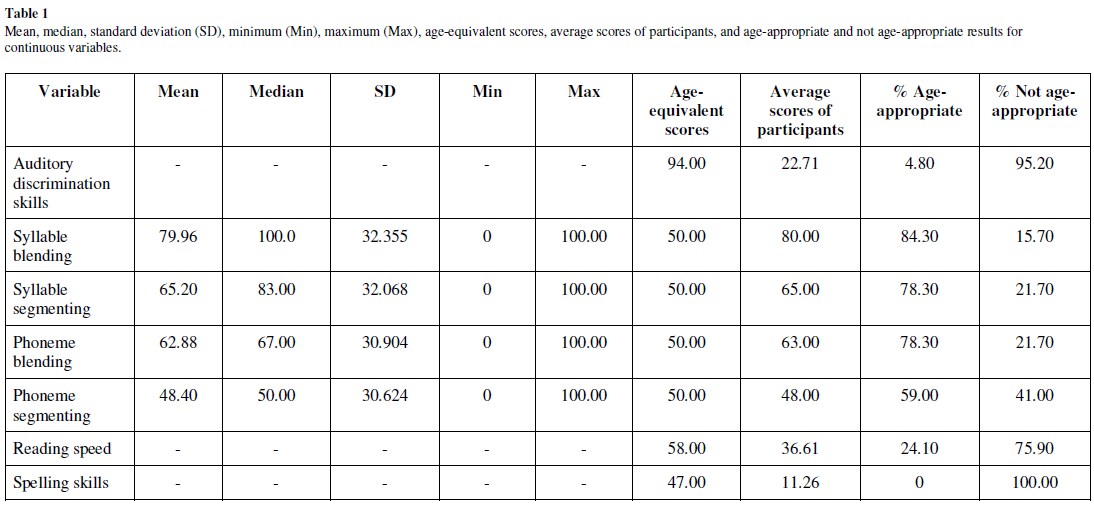
In Table 1, the results of the assessments are portrayed.
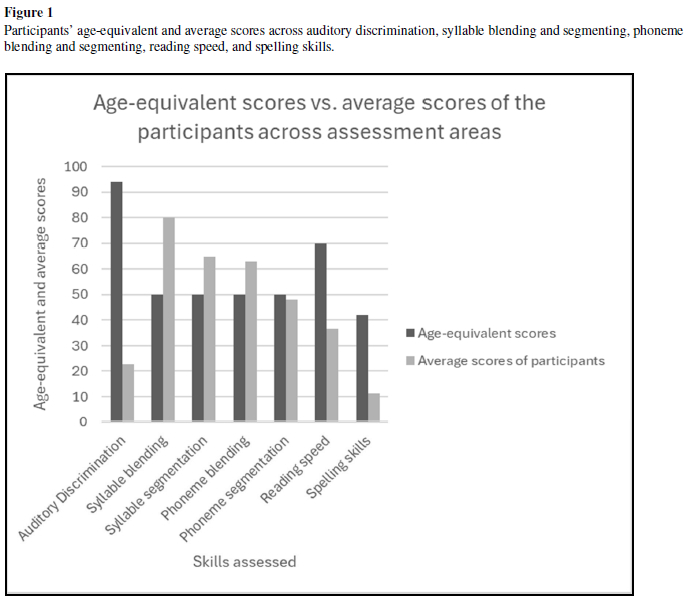
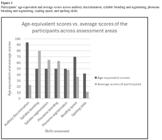
In Figure 1, the age-equivalent and average scores of participants across all assessment areas are portrayed.
Correlations between auditory discrimination skills and the scores of syllable and phoneme segmenting and blending skills
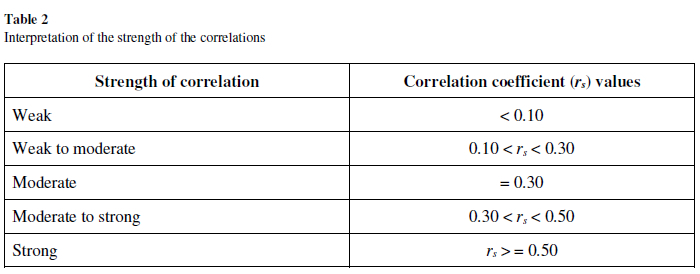
The strength of the correlation coefficients (rs) is interpreted as indicated in Table 2 according to Owens et al. (2021) and Téllez et al. (2015).
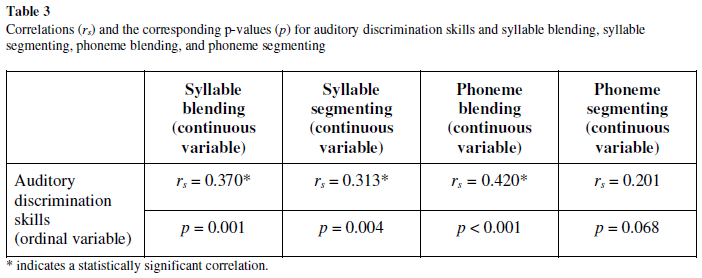
Table 3 illustrates the relationships between auditory discrimination skills and four PA tasks: syllable blending; syllable segmentation; phoneme blending; and phoneme segmentation.
Correlations between auditory discrimination skills, reading speed, and spelling skills
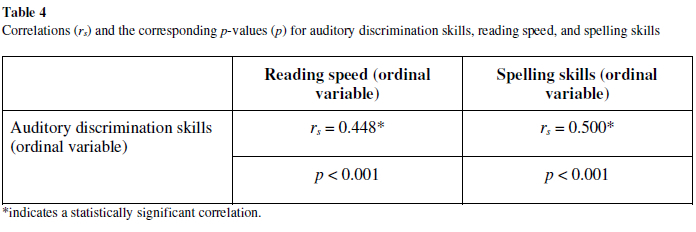
The correlation between auditory discrimination skills and reading speed and spelling skills is evident in Table 4.
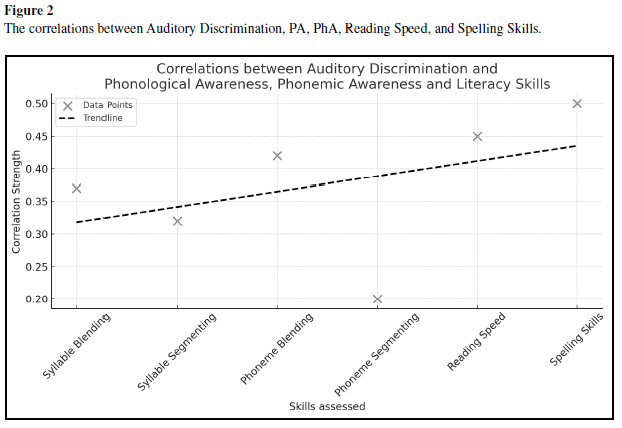
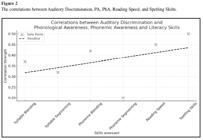
Figure 2 shows the correlations between auditory discrimination, PA skills, PhA skills, and literacy skills.
Discussion
The results highlight the challenges learners face in the South African multilingual educational context, yet highlight the positive consequences of a multilingual context, including heightened metalinguistic awareness and the facilitation of the transfer of PA skills from the L1 to the L2 (Le Roux et al., 2025; Walla, 2025). The findings present valuable insights into PA -, PhA -, and literacy skill development of EL2 learners.
The auditory discrimination subtest of the TAPS-3 was used to assess whether participants could distinguish phonological differences between similar-sounding word pairs, such as "rot" and "rut" (see Martin & Brownell, 2005). Auditory discrimination relies on the ability to perceive delicate phonemic contrasts, especially vowel differences. In the TAPS-3 subtest, successful auditory discrimination of nine out of the 32-word pairs (28.13% of the subtest) depends on differentiating vowel differences (Le Roux, 2016). Furthermore, 31 of the 32-word pairs contain vowels and diphthongs that are not present in Setswana including [ɪ], [e], [æ], [ɑ], [ʌ], [ɒ], [eɪ], [ə], [əʊ], [ɔ:], [ɚ], and [aʊ] (Bekker, 2009; Le Roux et al., 2017). According to Seeff-Gabriel (2003), EL2 learners often experience challenges in distinguishing English vowels, since many of these vowels are absent from their L1 phoneme inventory, thus reducing their sensitivity to these sounds. Additionally, learners are more likely to focus on the meaning of a word than on its individual sounds. EL2 learners often lack a well-developed L2 vocabulary (Hjetland et al., 2023) and experience meaning loss during auditory discrimination tasks in the L2 (Le Roux, 2016). Only 4.8% of learners demonstrated age-appropriate auditory discrimination skills thus underscoring the need to support the development of auditory discrimination skills for EL2 learners.
To assess foundational PA skills, the syllable blending and segmenting sub-tests of the PAST (Kilpatrick, 2018) were used to evaluate the learners' ability to combine syllables to form words, for example, "rain + bow = rainbow", and to divide words into their constituent syllables, for example, "bedroom = bed + room". Participants demonstrated generally age-appropriate performance on the syllable blending and segmenting tasks. Syllable blending and segmenting are basic PA skills that lay the foundation for later PhA skills and literacy development. EL2 learners' experience with the transparent orthographies of their L1 in Grades 1 to 3 may strengthen PA skills given the close correspondence between letters and sounds, thus facilitating syllable blending, segmentation, and, therefore, enhanced metalinguistic awareness (Ziegler & Goswami, 2005). The development of PA in the L1 forms the foundation for transferring PA skills to the L2 (Krenca et al., 2019), which could explain why the participants achieved higher PA scores than expected. EL2 learners may be more sensitive to syllables than to phonemes (Wilsenach, 2019) since syllable awareness develops before phoneme awareness (Vazeux et al., 2020). In Setswana, as mentioned above, syllables end predominantly with vowels, which are characteristic of an open syllabic structure (Mahura & Pascoe, 2016). These phenomena offer possible explanations for the high average scores in syllable blending and segmenting obtained by participants in this study. However, this positive effect of multilingualism may not persist into later educational years when English's opaque orthography becomes more challenging and affects reading skill development negatively (Probert & de Vos, 2016; Wilsenach, 2019).
The PAST's (Kilpatrick, 2018) subtest for phoneme blending and segmenting was used to evaluate participants' ability to synthesise isolated phonemes into a whole word as, for example, "/b/ /e/ /d/ = bed" and to analyse a word into its constituent sounds, for example, "ship = /sh/ /i/ /p/". Participants exhibited relatively strong performance on phoneme blending and segmenting tasks, although phoneme segmenting remained comparatively weaker. Despite advanced scores in simpler tasks like syllable blending, the participants' slightly weaker phoneme segmenting ability emphasises the increased complexity as PA progresses to PhA skills. PhA is a more reliable predictor of reading success than syllable awareness (Wilsenach, 2019). Thus, it is perturbing that the participants in this study achieved lower scores for the skill that is a better predictor of literacy outcomes. Phoneme blending is generally easier than phoneme segmentation because it requires sound recognition rather than manipulation, which supports the participants' higher phoneme blending scores compared to phoneme segmentation.
As mentioned above, the One-Minute Reading Test1 (Transvaal Education Department, 1987) was used to assess the participants' reading speed, and the Schonell Spelling Test2 (Schonell & Schonell, 1971) to evaluate spelling skills. Notwithstanding relatively strong PA and PhA performance, participants showed notably weak literacy outcomes in reading speed and spelling skills. The reading speed and spelling skills results confirmed the critical role of contextual factors in acquiring these skills (Hogan et al., 2005). The positive effect of well-developed PA skills on literacy skill development lessens as learners progress to more complex academic tasks, particularly in languages with opaque orthographies. This suggests that PA skills are not the only predictors of successful literacy skill acquisition. Despite the participants' average-to-above-average PA and PhA skills, only 24.1% demonstrated age-appropriate reading speed, and none had age-appropriate spelling skills, which is concerning. The participants' low literacy skill scores may be associated with the challenges of transitioning from Setswana, a language with a transparent orthography, to English, which has a comparatively opaque orthography and places greater demands on decoding and spelling processes (Probert & De Vos, 2016). These results show possible overlap in phonological structures between English and those of the African languages, enhancing participants' blending and segmenting skills on an isolated phoneme and syllable level. However, the lack of generalisation of phoneme and syllable blending and segmenting to more complex tasks, such as reading speed and spelling skills, may affect literacy skill development negatively. Decoding abilities depend on the orthography of the L1 since specific decoding strategies are employed early (Acha et al., 2023). The transfer of these strategies from the L1 to the L2 may be more challenging when the L2 orthography is more opaque than that of the L1 (Probert & De Vos, 2016). This is the case with the opaque English orthography compared to Setswana, which is transparent. Additionally, EL2 learners often have limited English vocabulary and limited L2 exposure, and this results in limited sight-word recognition (Zeng et al., 2025). Sight-word recognition affects reading speed, explaining possibly the participants' low reading speed scores (see Wilsenach, 2019), regardless of the appropriate phoneme blending skills scores obtained.
Significant positive relationships were observed between auditory discrimination and most PA and PhA scores, supporting the notion that auditory discrimination underpins phonological skill development (Couvee et al., 2022; Eccles et al., 2021; Janssen et al., 2016). Auditory discrimination and phoneme segmenting had a weak-to-moderate positive correlation (rs = 0.201; p = 0.068). This could be attributed to auditory discrimination relying on bottom-up processing, requiring the listener to identify the phonemes heard. In contrast, phoneme segmentation relies more on top-down processing and uses background knowledge of the language to break down a word (Zoghbor, 2016). Transitioning from a transparent Setswana orthography to English's opaque orthography increases the demands on top-down processing involved in more complex phoneme segmenting tasks (Yee et al., 2023). Auditory discrimination skills may be less influenced by differing orthographies than phoneme segmentation skills, which may explain the weak-to-moderate positive correlation found in this study (see Nayernia et al., 2019).
A concerning 95.2% of participants in this study did not demonstrate age-appropriate auditory discrimination skills. A moderate to strong positive correlation between auditory discrimination and reading speed (rs = 0.448; p < 0.001) was found. This means that L2 learners with poor auditory discrimination skills are less likely to distinguish accurately between the sounds, particularly vowels, that do not occur in the L1 vowel inventory. This may contribute to obstacles in developing efficient reading skills, such as fluent reading speed (Johann et al., 2020). Learners may rely more on contextual cues than on phonetic knowledge when decoding words and this can affect their reading speed.
A strong positive correlation was found between auditory discrimination and spelling skills (rs = 0.500; p < 0.001), indicating that none of the participants had age-appropriate spelling skills. Furthermore, accurate spelling is associated with strong awareness of the individual phonemes and the ability to sequence them correctly (Ehri, 2022; Treiman, 2017). Learners may also experience challenges in matching the correct phoneme to its corresponding grapheme, which can be attributed to differences in orthography. This mismatch may influence phoneme-grapheme correspondence negatively (Sammour-Shehadeh et al., 2025). The moderate-to-strong positive correlation between auditory discrimination and phoneme blending (rs = 0.420, p < 0.001) suggests that deficits in sound differentiation continue to affect later literacy skills, such as spelling and reading speed (Schaffler et al., 2021). These results suggest that auditory discrimination is a significant correlate of later literacy skill acquisition in EL2 (Couvee et al., 2022).
Regardless of moderate to strong positive correlations of syllable blending with reading speed (rs = 0.309; p = 0.005) and spelling skills (rs = 0.478; p < 0.001) as well as syllable segmenting with reading speed (rs = 0.381; p < 0.001) and spelling skills (rs = 0.464; p < 0.001), strong foundational PA skills do not always guarantee adequate literacy skill development in a multilingual context (Wealer et al., 2022). Furthermore, the results indicated a strong positive correlation between phoneme blending and spelling skills (rs = 0.645; p < 0.001), suggesting that these PhA skills are associated with phoneme-grapheme correspondence and literacy development (Eslick et al., 2020). Interestingly, there was a weak to moderate positive correlation between phoneme segmenting and reading speed (rs = 0.291; p = 0.008), suggesting that while phoneme segmenting is somewhat related to reading speed, phoneme blending skills play a more significant role in supporting both reading speed and spelling skills (Elhassan et al., 2017).
The results of this study support the potential value of structured, sustained input focused on enhancing L2 abilities in improving the literacy outcomes of EL2 learners. Starting in Grade R, intensive intervention and explicit instruction may provide the necessary PA, PhA, and auditory discrimination skills to reduce the cumulative effects of delayed literacy acquisition in EL2 learners. This may be especially significant in South Africa, where many learners transition to English as the LoLT at the beginning of Grade 4 before fully mastering PA skills in their L1. This study provided valuable local evidence on the relationships among auditory discrimination, phonological awareness, and literacy outcomes in Setswana-speaking EL2 learners. The findings also contribute to studies on literacy acquisition by suggesting that the relationship between phonological awareness and literacy development may be more complex in multilingual educational contexts than is often assumed. Although participants demonstrated largely age-appropriate phonological and phonemic awareness skills, these strengths were not consistently reflected in literacy outcomes. This finding expands current understanding of the PA-literacy relationship by highlighting the potential influence of auditory discrimination, language transition, and orthographic differences on literacy development in multilingual environments.
Additionally, the results of the current study suggest that auditory discrimination may provide a better indication of literacy skill development in a multilingual context involving transitions between languages with differing phoneme inventories and orthographies. Explicit instruction in auditory discrimination and PA should begin early and be systematically integrated into L1 and L2 literacy instruction for EL2 learners to thrive in an L2 academic environment.
Conclusion
This study examined correlations between auditory discrimination, PA, PhA, and specific literacy outcomes in 83 Grade 4 Setswana-speaking learners transitioning to English as the LoLT. A quantitative, retrospective, correlational design using standardised assessments revealed significant positive correlations between auditory discrimination and reading speed (rs = 0.448, p < 0.001) and between auditory discrimination and spelling skills (rs = 0.500, p < 0.001). Moderate correlations emerged with blending and segmenting tasks. The null hypothesis (Ho) stated that no statistically significant correlation would be found between auditory discrimination and the PhA skills of segmenting and blending in Grade 4 learners who had recently transitioned from L1 instruction in Setswana to English as their L2 and had only been exposed to English as an additional language. The alternative hypothesis (Ha) proposed that a statistically significant correlation will exist between auditory discrimination and the PhA skills of segmenting and blending in this group. The alternative hypothesis (Ha) is therefore partially accepted.
Despite some relatively strong PA and PhA skills, learners demonstrated poor literacy outcomes, suggesting that transitions between transparent and opaque orthographies may influence literacy acquisition in multilingual contexts.
The findings also emphasise the importance of teacher professional development in multilingual educational contexts. Educators need specialised knowledge of how phonological processing skills transfer across languages and orthographies. Additionally, they require evidence-based strategies to support auditory discrimination, phonological awareness, decoding, and spelling skills, as well as literacy development in EL2 learners. By addressing teacher skills in these areas, educators may better support learners during the transition to English literacy learning.
The findings further support the value of multilingual and linguistically reactive educational practices that recognise and build on learners' existing linguistic knowledge. Strengthening foundational phonological and literacy skills in multilingual learners may contribute to much-needed improved literacy outcomes and more equitable educational opportunities in linguistically diverse and under-resourced contexts. The findings also have implications for educational policy, particularly in relation to support for learners transitioning from first-language instruction to English as the LoLT in Grade 4.
Limitations and future recommendations
The PAST test used to evaluate syllable and phoneme blending and segmenting skills had limited test items, which may have influenced the results. Furthermore, English norms do not fully account for the participants' L1 background. Additionally, the findings are based on a relatively small, context-specific sample drawn from a single rural school in Gauteng and should therefore be interpreted with caution when one is making broader generalisations to other multilingual educational contexts in South Africa. Furthermore, convenience sampling was used to recruit participants, which may have introduced selection bias and reduced the representativeness of the sample. Additionally, the correlational design allows identification of relationships between variables but does not permit conclusions about causal relationships. Future research should consider different assessment tools to determine correlations between auditory discrimination, PA-, PhA- and literacy skills. Structured and explicit instructional programs should be tailored to address auditory discrimination and PhA skills, which remain lacking, since more complex academic writing impacts complex educational contexts negatively at different stages.
References
- Abdusalimovna, K. D. (2024). The importance of rhyming in phonological awareness for early language development. Formation of Psychology and Pedagogy as Interdisciplinary Sciences, 3(30), 119-123.
- Acha, J., Rodriguez, N., & Perea, M. (2023). The role of letter knowledge acquisition ability on children's decoding and word identification: Evidence from an artificial orthography. Journal of Research in Reading, 46(4), 358-375. https://doi.org/10.1111/1467-9817.12432
- Ahmad, S., Wasim, S., Irfan, S., Gogoi, S., Srivastava, A., & Farheen, Z. (2019). Qualitative v/s. quantitative research- A summarized review. Journal of Evidence-Based Medicine and Healthcare, 1(2), 2828-2832. https://doi.org/10.18410/jebmh/2019/587
- Alshaboul, Y., Asassfeh, S., Alshboul, S., & Alodwan, T. (2014). The contribution of L1 phonemic awareness into L2 reading: The case of Arab EFL readers. International Education Studies, 7(3), 99-111. https://doi.org/10.5539/ies.v7n3p99
- Aysel, F. O., & Sevilay, Y. (2022). Direct and indirect effects between first literacy errors, visual perception, and phonological awareness variables. International Journal of Cognitive Research in Science, Engineering and Education, 10(3), 1-16. http://doi.org/10.23947/2334-8496-2022-10-3-1-16
- Bassetti, B., Mairano, P., Masterson, J., & Cerni, T. (2020). Effects of orthographic forms on second language speech production and phonological awareness, with consideration of speaker-level predictors. Language Learning, 70(4), 1218-1256. https://doi.org/10.1111/lang.12423
- Bekker, I. (2009). The vowels of South African English. [Doctoral dissertation, Potchefstroom University for Christian Higher Education].
- Chung, C. S., Chen, X., & Geva, E. (2019). Deconstructing and reconstructing cross-language transfer in bilingual reading development: An interactive framework. Journal of Neurolinguistics, 50, 149-161. https://doi.org/10.1016/j.jneuroling.2018.01.003
- Clauss, S. J. (2023). Analysing the relationship between phonemic proficiency and orthographic learning. [Doctoral dissertation, Rivier University].
- Couvee, S., Wauters, L., Verhoeven, L., Knoors, H., & Segers, E. (2022). Predicting early literacy: Auditory and visual speech decoding in deaf and hard-of-hearing children. Journal of Deaf Studies and Deaf Education, 27(4), 311-323. https://doi.org/10.1093/deafed/enac019
- De Sousa, K. C., Swanepoel, D., Moore, D. R., & Smits, C. (2018). A smartphone national hearing test: performance and characteristics of users. American Journal of Audiology, 27(3), 448-454. https://doi.org/10.1044/2018_AJA-IMIA3-18-0016
- De Witt, M., & Lessing, A. (2016). The influence of a school readiness program on the language and phonological awareness skills of preschool children in rural areas of South Africa. Australasian Journal of Early Childhood, 41(1), 106-114. https://doi.org/10.1177/183693911604100114
- Dykstra, R. (1966). Auditory discrimination abilities and beginning reading achievement. Reading Research Quarterly, 5-34.
- Eccles, R., Van der Linde, J., Le Roux, M., Holloway, J., MacCutcheon, D., Ljung, R., & Swanepoel, D. W. (2021). Is phonological awareness related to pitch, rhythm, and speech-in-noise discrimination in young children? Language, Speech, and Learning Services in Schools, 52(1), 383-395. https://doi.org/10.1044/2020_LSHSS-20-00032
- Ehri, L. C. (2022). What teachers need to know and do to teach letter-sounds, phonemic awareness, word reading, and phonics. The Reading Teacher, 76(1), 53-61. https://doi.org/10.1002/trtr.2095
- Elhassan, Z., Crewther, S. G., & Bavin, E. L. (2017). The contribution of phonological awareness to reading fluency and its individual sub-skills in readers aged 9-12 years. Frontiers in Psychology, 8, 533. https://doi.org/10.3389/fpsyg.2017.00533
- Faul, F., Erdfelder, E., Lang, F., & Buchner, M. (2007). G*Power 3: A flexible statistical power analysis program for the social, behavioral, and biomedical sciences. Behavior Research Methods, 39(2), 175-191. https://doi.org/10.3758/BF03193146
- Giazitzidou, S., Grigorakis, I., Mouzaki, A., & Padeliadu, S. (2023). Exploring the relations of morphological awareness with phonological awareness and vocabulary: The case of the Greek language. Journal of Psycholinguistic Research, 52(6), 2621-2644. https://doi.org/10.1007/s10936-023-10006-z
- Grofčíková, S., & Máčajová, M. (2021). Rhyming in the context of the phonological awareness of pre-school children. CEPS Journal, 11(1), 115-138. https://doi.org/10.25656/01:21895
- Guzek, A., & Iwanicka-Pronicka, K. (2023). Auditory discrimination - a missing piece of speech and language development: a study on 6-9-year-old children with auditory processing disorder. Brain Sciences, 13(4), 1-16. https://doi.org/10.3390/brainsci13040606
- Hipfner-Boucher, K., Milburn, T., Weitzman, E., Greenberg, J., Pelletier, J., & Girolametto, L. (2014). Relationships between preschoolers' oral language and phonological awareness. First Language, 34(2), 178-197. https://doi.org/10.1177/0142723714525945
- Hilte, M., & Reitsma, P. (2011). Effects of explicit rules in learning to spell open-and closed-syllable words. Learning and Instruction, 21(1), 34-45. https://doi.org/10.1016/j.learninstruc.2009.10.002
- Hjetland, H. N., Hofslundsengen, H., Klem, M., Karlsen, J., Hagen, Å. M., Engevik, L. I., Geva, E., Norbury, C., Monsrud, M. B. & Næss, K. A. B. (2023). Vocabulary interventions for second language (L2) learners up to six years of age. Cochrane Database of Systematic Reviews, (8), 1-82. https://doi.org/10.1002/14651858.CD014890.pub2
- Hodgins, H., & Harrison, G. L. (2021). Improving phonological awareness with Talking Tables in at-risk kindergarten readers. Research in Developmental Disabilities, 115, 1-9. https://doi.org/10.1016/j.ridd.2021.103996
- Hogan, T. P., Catts, H. W. & Little, T. D. (2005). The relationship between phonological awareness and reading. Language, Speech, and Hearing Services in Schools, 36(4), 285-293. https://doi.org/10.1044/0161-1461(2005/029)
- Horne, J. (2020). Cognitive Profiling System for 4 to 7 years (7th ed.). GL Education.
- Howie, S., Combrinck, C., Roux, K., Tshele, M., Mokoena, G., & Palane, N. M. (2017). Progress in International Reading Literacy Study 2016: South African children's reading literacy achievement. Centre for Evaluation and Assessment (CEA), Faculty of Education, University of Pretoria, 1-124.
- Janssen, C., Segers, E., McQueen, J., & Verhoeven, L. (2016). Transfer from implicit to explicit phonological abilities in first and second language learners. Bilingualism: Language and Cognition, 20(4), 795-812. https://doi.org/10.1017/S1366728916000523
- Johann, V., Könen, T., & Karbach, J. (2020). The unique contribution of working memory, inhibition, cognitive flexibility, and intelligence to reading comprehension and reading speed. Child Neuropsychology, 26(3), 324-344. https://doi.org/10.1080/09297049.2019.1649381
- Kilpatrick, D. A. (2018). The Phonological Awareness Screening Test (PAST). State University of New York College at Cortland, East Syracuse-Minoa Central School District.
- Le Roux, M. (2016). An acoustic investigation of English vowels as produced by English L1 and Setswana L1 foundation phase learners. [Doctoral dissertation, University of Pretoria].
- Le Roux, M., Geertsema, S., Jordaan, H., & Prinsloo, D. (2017). Phonemic awareness of English second language learners. South African Journal of Communication Disorders, 64(1), 1-9. https://doi.org/10.4102/sajcd.v64i1.164
- Máčajová, M., Grofčíková, S., & Zajacova, Z. (2019). Creation of rhymes as part of the development of phonemic awareness of preschool children. XLinguae, 12(3), 66-79. https://doi.org/10.18355/XL.2019.12.03.06
- Mahura, O. O., & Pascoe, M. (2016). The acquisition of Setswana segmental phonology in children aged 3.0-6.0 years: A cross-sectional study. International Journal of Speech-Language Pathology, 18(6), 533-549. https://doi.org/10.3109/17549507.2015.1126639
- Martin, N. A., & Brownell, R. (2005). Test of Auditory Processing Skills (3rd ed.; TAPS-3). Academic Therapy Publications.
- Miller, R. T. (2019). English Orthography and Reading. The TESOL Encyclopedia of English Language Teaching, 1(7), 1-6. https://doi.org/10.1002/9781118784235.eelt046
- Nayernia, L., van de Vijver, R., & Indefrey, P. (2019). The influence of orthography on phonemic knowledge: An experimental investigation on German and Persian. Journal of Psycholinguistic Research, 48(6), 1391-1406. https://doi.org/10.1007/s10936-019-09664-9
- Ouellette, G., Martin-Chang, S., & Rossi, M. (2017). Learning from our mistakes: Improvements in spelling lead to gains in reading speed. Scientific Studies of Reading, 21(4), 350-357. https://doi.org/10.1080/10888438.2017.1306064
- Owens, M. M., Potter, A., Hyatt, C. S., Albaugh, M., Thompson, W. K., Jernigan, T., Yuan, D., Hahn, S., Allgaier, N., & Garavan, H. (2021). Recalibrating expectations about effect size: A multi-method survey of effect sizes in the ABCD study. PLOS ONE, 16(9), 1-13. https://doi.org/10.1371/journal.pone.0257535
- Peregoy, S., & Boyle, O. (2000). English learners reading English: what we know, what we need to know. Theory Into Practice, 39(4), 237-247. https://doi.org/10.1207/s15430421tip3904_7
- Potgieter, J. M., Swanepoel, D., Myburgh, H. C., Hopper, T. C., & Smits, C. (2016). Development and validation of a smartphone-based digits-in-noise hearing test in South African English. International Journal of Audiology, 55(7), 405-411. https://doi.org/10.3109/14992027.2016.1172269
- Pretorius, E. J. (2014). Supporting transition or playing catch-up in Grade 4? Implications for standards in education and training. Perspectives in Education, 32(1), 51-76. https://hdl.handle.net/10520/EJC151359
- Probert, T., & De Vos, M. (2016). Word recognition strategies amongst isiXhosa/English bilingual learners: The interaction of orthography and language of learning and teaching. Reading & Writing: Journal of the Reading Association of South Africa, 7(1), 1-10. https://hdl.handle.net/10520/EJC189965
- Rokhman, M. F., Lintangsari, A. P., & Perdhani, W. C. (2020). EFL learners' phonemic awareness: A correlation between English phonemic identification skill and word processing. Journal of English Educators Society, 5(2), 135-141. https://doi.org/10.21070/jees.v5i2.467
- Roux, K., Van Staden, S., & Tshele, M. (2023). Progress in International Reading Literacy Study 2021: South African Main Report, 24-73. Department of Basic Education. https://www.education.gov.za/Portals/0/Documents/Reports/2023/PIRLS%202021%20Main%20Report.pdf
- Sammour-Shehadeh, R., Prior, A., & Kahn-Horwitz, J. (2025). Spelling challenges in English as a foreign language: Vowels, digraphs, and novel phonemes. Reading and Writing, 1-24. https://doi.org/10.1007/s11145-025-10659-3
- Schaadt, G., Pannekamp, A., & van der Meer, E. (2013). Auditory phoneme discrimination in illiterates: Mismatch negativity-A question of literacy? Developmental Psychology, 49(11), 2179-2190. https://doi.org/10.1037/a0031765
- Schonell, F. J., & Schonell, A. J. (1971). The Schonell Spelling Test. University of London Press.
- Schuele, C. M., & Boudreau, D. (2008). Phonological awareness intervention: Beyond the basics. Language, Speech, and Hearing Services in Schools, 39(1), 3-20.
- Seeff-Gabriel, B. (2003). Phonological processing: A platform for assisting second-language learners with English spelling. Child Language Teaching and Therapy, 19(3), 291-310. https://doi.org/10.1191/0265659003ct256oa
- Shahid, M. A., & Mahmood, A. (2022). An analytical study of English syllabic structure by EFL learners. Hayatian Journal of Linguistics and Literature, 6(1), 184-206.
- Sibanda, J. (2017). Language at the grade three and four interface: The theory-policy-practice nexus. South African Journal of Education, 37(2), 1-9. https://doi.org/10.15700/saje.v37n2a1287
- Siregar, D. Y., Khairani, & Lubis, Y. (2023). The influence of phonological awareness on early literacy development. Jurnal Pendidikan dan Sosial Humaniora, 1(3), 1-14. https://doi.org/10.59061/guruku.v1i3.185
- Statistics South Africa. (2022). Census 2022: Statistical Release. Department: Statistics South Africa, 1-96. https://census.statssa.gov.za/assets/documents/2022/P03014_Census_2022_Statistical_Release.pdf
- Stone-MacDonald, A., Pizzo, L., & Feldman, N. (2018). Fidelity of implementation in assessment of infants and toddlers. Springer International Publishing. http://doi.org/10.1007/978-3-319-74618-0
- Taherdoost, H. (2022). What are different research approaches? Comprehensive review of qualitative, quantitative, and mixed method research, their applications, types, and limitations. Journal of Management Science & Engineering Research, 5(1), 53-63. https://doi.org/10.30564/jmser.v5i1.4538
- Taylor, S., & Von Fintel, M. (2016). Estimating the impact of language of instruction in South African primary schools: A fixed effects approach. Economics of Education Review, 50, 75-89. https://doi.org/10.1016/j.econedurev.2016.01.003
- Téllez, A., García, C. H., & Corral-Verdugo, V. (2015). Effect size, confidence intervals and statistical power in psychological research. Psychology in Russia: State of the Art, 8(3), 27-46. https://doi.org/10.11621/pir.2015.0303
- Transvaal Education Department. (1987). One-Minute Reading Test.
- Treiman, R. (2017). Learning to spell: Phonology and beyond. Cognitive Neuropsychology, 34(3-4), 83-93. https://doi.org/10.1080/02643294.2017.1337630
- Van der Berg, S., Hoadley, U., Galant, J., van Wyk, C., & Böhmer, B. (2022). Learning losses from COVID-19 in the Western Cape: Evidence from systemic tests. Research on Socio-Economic Policy (RESEP), Stellenbosch University, 1-96. https://resep.sun.ac.za/wp-content/uploads/2022/05/RESEP-WCED-Systemic-Tests-%E2%80%93-Report_WEB.pdf
- Walla, D. (2025). Metalinguistic awareness in the multilingual EFL classroom: A study of grade 5-7 students in Norway. International Journal of Multilingualism, 22(2), 944-959. https://doi.org/10.1080/14790718.2024.2340035
- Wealer, C., Fricke, S., Loff, A., & Engel de Abreu, P. M. J. (2022). Preschool predictors of learning to read and spell in an additional language: A two-wave longitudinal study in a multilingual context. Reading and Writing, 35(5), 1265-1288. https://doi.org/10.1007/s11145-021-10239-1
- Wilsenach, C. (2019). Phonological awareness and reading in Northern Sotho - Understanding the contribution of phonemes and syllables in Grade 3 reading attainment. South African Journal of Childhood Education, 9(1), 1-10. https://hdl.handle.net/10520/EJC-15832888ae
- Yee, J., Yap, N. T., Mahmud, R., & Saripan, M. I. (2023). Effects of orthographic transparency on rhyme judgement. Frontiers in Psychology, 14, 1-13. https://doi.org/10.3389/fpsyg.2023.1038630
- Zeng, Y., Kuo, L.-J., Chen, L., Lin, J.-A., & Shen, H. (2025). Vocabulary instruction for English learners: A systematic review connecting theories, research, and practices. Education Sciences, 15(3), 1-22. https://doi.org/10.3390/educsci15030262
- Ziegler, J. C., & Goswami, U. (2005). Reading acquisition, developmental dyslexia, and skilled reading across languages: A psycholinguistic grain size theory. Psychological Bulletin, 131(1), 3-29. https://doi.org/10.1037/0033-2909.131.1.3
- Ziervogel, D. (Ed.). (1967). Handbook of the speech sounds and sound changes of the Bantu languages of South Africa (Vol. 3). University of South Africa.
- Zoghbor, W. S. (2016). A model for speech processing in second language listening activities. English Language Teaching, 9(2), 13-19. https://doi.org/10.5539/elt.v9n2p13
- Zoubrinetzky, R., Collet, G., Serniclaes, W., Nguyen-Morel, M. A., & Valdois, S. (2016). Relationships between categorical perception of phonemes, phoneme awareness, and visual attention span in developmental dyslexia. PLOS ONE, 11(3), 1-26. https://doi.org/10.1371/journal.pone.015101
Accepted: 2 July 2026
2 This is a gold standard tool in the Department of Basic Education in South Africa. Given the multilingual context in South Africa, this tool has longstanding value for application across different cultures in this country particularly since no new tests have been developed.