Time to read: A critical review of early grade reading curriculum policy and enactment in South Africa
Abstract
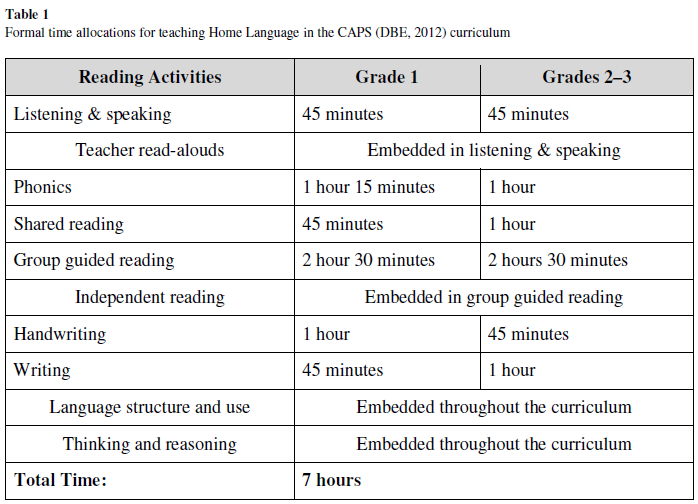
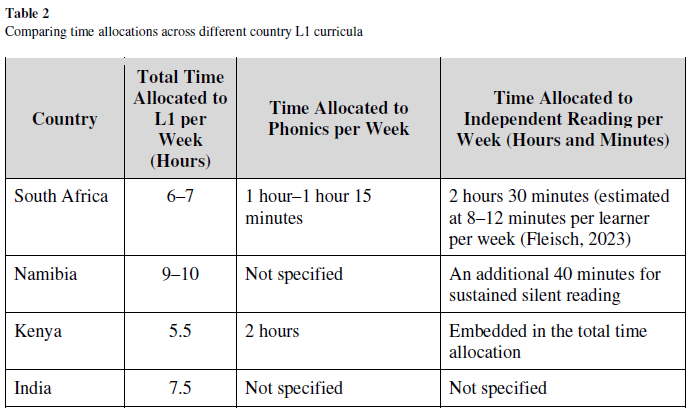
Research shows that children from literate, middle-class homes typically receive up to 1,000 hours of joint caregiver-child book reading prior to starting school (Rose, 2006). In contrast, many South African children begin formal schooling not knowing the rudiments of book handling such as which way to hold a book or how to turn a page (Ramadiro & Porteus, 2017). Schools play a pivotal role in supporting children from homes with limited resources by building foundational reading skills and providing sufficient time in which to do this. Differential access to time in school is an important aspect of educational inequality. Despite policy frameworks prescribing, for over a decade, how to teach reading and for how long, international standardised tests show that most South African children are unable to read with understanding in their home language by the end of the Foundation Phase. This paper draws on an extensive review of current curriculum policy and research on time allocations for teaching reading in the early years. The review reveals that while the CAPS curriculum allocates adequate time for reading when compared to other comparable countries, challenges in teacher capacity and complex reading activities limit time spent reading in classrooms. The paper argues for transforming reading activities to accommodate contextual realities, thus addressing tensions between policy intentions and the classroom realities where these are enacted. Structured pedagogic programmes that include scripted lesson plans for teachers, one-on-one material for learners, and teacher assistants may show some promise in optimising time spent reading in Foundation Phase classrooms, but these programmes need meaningful teacher support and improved accountability mechanisms across the system.
early grade reading; curriculum; reading pedagogy; instructional time; time use; South Africa