A framework for module template development using authentic teaching and learning: A professional engineering case study at the University of KwaZulu-Natal
Abstract
Curriculum reform in South Africa increasingly emphasises competence development alongside disciplinary knowledge, reflecting global shifts towards authentic, performance-oriented higher education. Within this context, authentic teaching, learning, and assessment provide a means of making embedded competences explicit and enhancing their transferability to professional practice. This study addresses the absence of practical curriculum design tools that assist academics in identifying, embedding, and assessing competences within module design. Drawing on the theoretical perspectives of Biesta (2020), Wiggins (1990), and Ashford-Rowe et al. (2014), a framework for competence-focused module template design was developed to support authentic teaching and assessment. A qualitative case study was undertaken at the University of KwaZulu-Natal, where the framework was iteratively refined and validated through focus group discussions with seven purposively selected academics from the School of Engineering. The findings indicate that participants regarded the framework as relevant, practical, and sufficiently flexible to support curriculum design while making embedded competences more explicit. Participants also highlighted its potential to strengthen constructive alignment, facilitate authentic assessment, and support accreditation processes through clearer documentation of graduate attributes and professional competences. The study contributes a contextually grounded framework that provides academics with a structured approach to designing competence-focused modules and offers a practical mechanism for advancing curriculum transformation within engineering education, with potential applicability for adaptation in other disciplinary contexts.
authentic learning; competence-based education; curriculum reform; module design; professional accreditation
Introduction
Higher education globally is undergoing a paradigmatic shift from content-based instruction toward competence-based education (CBE) that emphasises application, problem-solving, and contextual performance (Biggs & Tang, 2011; OECD, 2018; Tahirsylaj & Sundberg, 2026). In South Africa, this transformation is particularly pressing as universities respond to national imperatives for curriculum renewal that promote graduate employability, social responsiveness, and lifelong learning (Human-Hendricks & Meier, 2024). The Department of Higher Education and Training (DHET, 2020) has called for curricula that explicitly articulate and assess competences rather than merely deliver disciplinary knowledge. Consequently, university academics are challenged to rethink their pedagogical designs and assessment practices to better align with these expectations.
While the discourse on CBE is well established, its practical implementation within module and programme design remains uneven. Academics often lack structured tools that guide the integration of authentic teaching and learning strategies (Ajjawi et al., 2020)-tools that simulate or replicate real-world contexts and require students to apply knowledge in meaningful ways (Gulikers et al., 2004; Wiggins, 1990). The result is a disconnect between the intended learning outcomes stated in curriculum documents and the actual competencies developed through classroom practices. Biesta (2020) cautions against the growing learnification of education, where the focus shifts from purposeful teaching to generic learning processes detached from real-world application. This critique underscores the need for frameworks that restore purpose and contextual relevance to higher education teaching and assessment.
At the University of KwaZulu-Natal (UKZN), ongoing curriculum reform initiatives have foregrounded the importance of competence development across disciplines. However, the process of embedding competencies in module templates and aligning them with authentic learning and assessment remains ad hoc and largely dependent on individual academic interpretation. This gap presents both a challenge and an opportunity: a challenge because the lack of systematic tools can undermine curriculum coherence and graduate capability; and an opportunity to design a practical framework that can guide academics in developing modules that intentionally cultivate and assess competencies.
This paper presents a framework for module template development that integrates principles of authentic teaching, learning, and assessment. Grounded in theoretical perspectives from Biesta (2020), Wiggins (1990), and Ashford-Rowe et al. (2014), the framework seeks to operationalise the concept of competence within everyday teaching practice. It emerged from a qualitative case study conducted at UKZN, involving iterative development and validation through focus group discussions with academic staff. The framework aims to support academics in designing performance-oriented, contextually grounded modules aligned with both institutional and national curriculum priorities.
Although substantial scholarship has established the principles of CBE, authentic assessment, and constructive alignment, considerably less attention has been given to how these principles can be operationalised within institutional module design processes that must simultaneously satisfy professional accreditation requirements. Existing curriculum design models generally emphasise teaching, learning, and assessment alignment but provide limited guidance on documenting and validating embedded competencies against exit-level outcomes (ELOs) required by professional councils. This represents an important gap in professionally accredited disciplines such as engineering, where curriculum innovation must balance pedagogical authenticity with regulatory accountability. The framework proposed in this study was therefore not intended to replace existing models but to extend them by integrating authentic competence design with accreditation-oriented curriculum validation within a structured module development process.
CBE and curriculum reform
The global higher education landscape has witnessed a decisive shift toward CBE, which prioritises demonstrable capability over the accumulation of theoretical knowledge (Mulder, 2017; Wawire et al., 2026). CBE frameworks emphasise the integration of knowledge, skills, and attitudes necessary for effective performance in complex, real-world contexts (OECD, 2018). Unlike traditional curricula organised around disciplinary silos, CBE focuses on learning outcomes that are transferable and measurable, aiming to produce graduates who can adapt to changing professional and societal needs (Biggs & Tang, 2011).
In South Africa, curriculum reform initiatives have mirrored these international trends. The DHET (2020) has promoted outcome and competence-based approaches through its policies on programme qualification mix and graduate attributes. Universities are increasingly expected to articulate not only what students should know, but also what they should be able to do upon graduation. However, operationalising this shift at the module level remains challenging, particularly where academic staff are accustomed to traditional content-driven pedagogy (Council on Higher Education [CHE], 2014). The translation of competence frameworks into module templates often lacks practical guidance, resulting in uneven implementation across disciplines.
South African higher education has approached competence-based curriculum reform within a broader agenda of social transformation, graduate employability, and responsiveness to national development priorities. Rather than viewing competence solely as the acquisition of workplace skills, curriculum reform has increasingly emphasised the development of graduates who are capable of critical thinking, ethical reasoning, and socially responsible professional practice (CHE, 2014). The Higher Education Qualifications Sub-Framework further requires institutions to demonstrate how programme outcomes develop integrated knowledge, practical skills, and applied competence appropriate to qualification level (DHET, 2013). Consequently, universities are expected to design curricula that move beyond disciplinary content coverage to explicitly articulate how graduates will demonstrate competence within authentic professional and societal contexts.
South African scholars have similarly argued that curriculum transformation requires more than the adoption of outcome statements or graduate attributes. Shay (2013) contends that competence should be understood as the ability to mobilise disciplinary knowledge appropriately within complex professional situations rather than as the achievement of isolated learning outcomes. Likewise, Luckett (2016) argues that curriculum design should integrate epistemological access with professional capability, ensuring that graduates not only acquire disciplinary knowledge but also develop the judgement required to apply that knowledge responsibly within diverse social contexts. These perspectives suggest that competence development is fundamentally a curriculum design challenge requiring explicit alignment between intended outcomes, learning activities, assessment practices, and professional expectations.
Curriculum reform within professionally accredited disciplines introduces an additional layer of complexity that has received comparatively limited attention within the literature. Engineering, construction, and other professionally regulated programmes must demonstrate alignment not only with institutional graduate attributes but also with externally prescribed ELOs and accreditation standards. While national policy provides broad guidance regarding competence development (CHE, 2014; DHET, 2013), academics are often left without practical mechanisms for translating these requirements into module-level curriculum design. This implementation gap provides the context for the present study, which seeks to operationalise competence development through a structured module design framework that integrates authentic pedagogy with accreditation-oriented curriculum validation.
Authentic teaching, learning, and assessment
Authentic teaching and learning have emerged as central pedagogical responses to the challenges of competence development. Rooted in constructivist theory, authentic learning situates knowledge construction within contexts that mirror the complexity and ambiguity of real-world tasks (Herrington et al., 2010; Nachtigall et al., 2024). Wiggins (1990) was among the first to argue for authentic assessment, which is the evaluation of tasks that require students to perform meaningful activities demonstrating the application of knowledge and skills. In contrast to traditional assessment methods that focus on recall and procedural accuracy, authentic assessment foregrounds judgment, adaptability, and integration across cognitive domains.
Gulikers et al. (2004) proposed a five-dimensional framework for evaluating authenticity in assessment, encompassing the task, physical context, social context, result, and assessment criteria. Their model underscores that authenticity extends beyond mere realism; it requires alignment between instructional tasks and professional or societal expectations. Similarly, Ashford-Rowe et al. (2014) advanced an eight-element framework defining authentic assessment through attributes such as ill-defined problems, multiple possible solutions, collaboration, and reflection. These frameworks collectively highlight that authenticity is not a pedagogical add-on but a structural design principle for fostering competence.
Within South Africa, authentic learning has become increasingly associated with curriculum transformation that is socially responsive, contextually relevant, and attentive to local realities. Following the #RhodesMustFall and #FeesMustFall movements, universities have been challenged to reconsider not only what students learn but also whose knowledge is valued and how learning connects to the lived experiences of students and communities (Leibowitz, 2017). Authentic learning, therefore, extends beyond the simulation of professional practice to include meaningful engagement with the social, economic, and cultural contexts within which graduates will ultimately work. This perspective aligns closely with calls for decolonised curricula that prepare graduates to address complex local challenges while remaining globally competent.
Authentic learning also necessitates the deliberate design of environments that promote situated cognition and reflective practice (Ashford-Rowe et al., 2014; Lombardi, 2007). For educators, this involves shifting from a transmission model of teaching toward a facilitative role that enables learners to engage in inquiry, experimentation, and synthesis. However, the practical implementation of such approaches requires institutional support, consideration of workload, and design tools that help lecturers translate abstract principles into structured learning experiences (Herrington et al., 2010).
Critique of learnification, and the purpose of education
According to Biesta (2010), learnification is the process whereby education is increasingly understood solely in terms of learning-shifting attention away from questions of educational purpose, curriculum content, and teaching towards the facilitation of learning itself. Biesta (2020) goes on to critique this by stating that when education is conceptualised solely in terms of learning outcomes and performance indicators, it risks becoming instrumental and losing its transformative potential. In the context of higher education curriculum reform, this critique is particularly relevant. Competence-based approaches, if implemented uncritically, may become overly technical, focusing on measurable outputs while neglecting the formation of judgment, ethical reasoning, and civic responsibility. Integrating Biesta's perspective into competence-oriented curriculum design, therefore, requires balancing accountability with educational purpose. Frameworks for module design must make space for the why of education, the values, dispositions, and professional identities that underpin authentic competence. This implies a shift from designing learning merely for compliance to designing for meaningful engagement and contribution to society.
Frameworks and tools for module design
A growing body of research addresses how curriculum design can operationalise competence and authenticity at the module level. Biggs and Tang's (2011) theory of constructive alignment provides a foundational principle: learning outcomes, teaching activities, and assessment tasks must be coherently aligned to ensure that what is taught and assessed reflects what students are intended to learn. Despite its wide adoption, constructive alignment often remains abstract, leaving academics uncertain about how to express competences within institutional templates (Loughlin et al., 2021).
Recent efforts have sought to bridge this gap through design frameworks and templates that scaffold authentic learning design. For instance, Herrington et al. (2014) proposed a design model for authentic e-learning, integrating real-world tasks, access to expert performance, and opportunities for reflection and articulation. Similarly, Oliver (2015) developed a curriculum mapping approach that aligns graduate attributes and competences across programmes. However, these models were largely developed in Global North contexts and may require adaptation to local institutional and socio-economic realities in South Africa.
At South African universities, the drive toward decolonised and socially responsive curricula adds another dimension to module design. Authentic learning must not only replicate professional practices but also engage with local contexts, challenges, and knowledge systems (Engström & Lennholm, 2025). Therefore, frameworks for authentic teaching and learning need to be context-sensitive, enabling academics to embed competences that are both globally relevant and locally meaningful.
Toward a framework for authentic, competence-based module design
The literature consistently demonstrates that CBE depends upon constructive alignment, authentic teaching, and authentic assessment to promote meaningful learning and professional capability. However, existing models primarily explain what effective curriculum design should achieve rather than how academics can systematically translate these principles into institutional module templates while simultaneously satisfying professional accreditation requirements. Although constructive alignment provides a powerful curriculum design philosophy (Biggs & Tang, 2011), and authentic assessment frameworks articulate characteristics of meaningful assessment (Ashford-Rowe et al., 2014; Wiggins, 1990), neither explicitly addresses the validation of embedded competencies against programme ELOs or accreditation documentation. This limitation is particularly significant within professionally accredited South African programmes, where module design must simultaneously satisfy institutional curriculum requirements, graduate attribute development, and external professional body expectations. Consequently, the challenge is not simply aligning learning outcomes, teaching activities, and assessment tasks, but demonstrating how embedded competencies contribute to programme-level professional standards in a transparent and auditable manner.
The framework developed in this study responds to this challenge by extending established curriculum design principles through the incorporation of a structured accreditation and ELO validation layer. Rather than replacing existing theories, the framework integrates authentic teaching, authentic assessment, constructive alignment, and competence mapping into a practical module design process that enables academics to identify, document, validate, and evaluate embedded competencies throughout curriculum development. The empirical refinement of the framework through engagement with engineering academics further ensured that the model addressed practical curriculum design challenges encountered within an accredited professional context, rather than serving merely as a synthesis of existing educational theories.
Methodology
Research design
This study employed a qualitative case study to develop and refine a framework for competence-focused module template design. A qualitative case study was selected because it enables the investigation of complex educational phenomena within their real-life institutional context (Yin, 2018). The bounded case comprised curriculum renewal activities at UKZN, where increasing emphasis has been placed on embedding graduate attributes, competence development, and authentic assessment within programme and module design.
The study was exploratory and developmental rather than evaluative. Instead of testing a predetermined framework, the research sought to iteratively develop, critique, and refine a practical curriculum design framework through engagement with academic practitioners. This approach is consistent with design-based research, which emphasises the collaborative development of educational innovations through iterative cycles of design, implementation, evaluation, and refinement in authentic educational settings (Reeves, 2006; Yin, 2018). The intention was therefore not to produce a universally generalisable model but to co-construct a contextually grounded framework capable of supporting curriculum design within professionally accredited higher education programmes.
Study context
The study was undertaken at UKZN, a research-intensive public university in South Africa. Established in 2004 through the merger of the former University of Natal and the University of Durban-Westville, UKZN was created to advance educational transformation, broaden access, and strengthen research excellence within the South African higher education sector. As a comprehensive university with multiple colleges and professionally accredited programmes, UKZN has placed increasing emphasis on curriculum renewal, graduate attribute development, and the alignment of teaching, learning, and assessment with institutional and national quality assurance priorities.
The study was situated within the School of Engineering in the College of Agriculture, Engineering and Science. Engineering provides an appropriate context because programme curricula are subject to rigorous professional accreditation requirements prescribed by the Engineering Council of South Africa. Academics are therefore required to demonstrate explicit alignment between module outcomes, graduate competencies, and programme ELOs. This accreditation environment provided an ideal setting for developing and validating a framework intended to integrate authentic teaching and assessment with competence mapping and curriculum documentation.
Participants and sampling
Purposive sampling was employed to recruit academics directly involved in curriculum design, module development, and teaching within undergraduate engineering programmes. Seven academics participated in the study, representing a range of engineering disciplines, academic ranks, and levels of teaching experience. Participants had an average of eight years' experience in higher education, ranging from early-career lecturers to senior academics with extensive curriculum development responsibilities.
Within qualitative design-based research, sample adequacy is determined by the depth and richness of participant engagement rather than statistical representativeness (McKenney & Reeves, 2018). The purpose of this study was not to achieve statistical generalisability but to generate detailed institutional insights capable of informing the iterative development of a prototype curriculum design framework. The relatively small sample enabled sustained discussion, collaborative critique, and repeated engagement with participants across multiple design cycles, which are recognised characteristics of design-based research (Reeves, 2006).
Data collection
Data were collected through two iterative rounds of focus group discussions, each lasting approximately 90 minutes. Focus groups were selected because they facilitate interaction, reflection, and collaborative meaning-making among participants with shared professional experience, making them particularly appropriate for framework development.
The first focus group concentrated on framework conceptualisation. Participants discussed their understanding of competence development, authentic teaching, authentic assessment, constructive alignment, and existing challenges associated with module template design. These discussions identified shortcomings in current curriculum documentation and informed the development of the initial framework.
The second focus group focused on framework validation and refinement. Participants critically reviewed the draft framework, evaluating its conceptual clarity, practicality, usability, and alignment with institutional curriculum processes and professional accreditation requirements. Feedback obtained during this phase informed the refinement of the framework, including modifications to terminology, sequencing, and the incorporation of the accreditation and ELO validation component.
Data Analysis
Data were analysed using Braun and Clarke's (2019) six-phase reflexive thematic analysis. This approach was selected because it provides a systematic yet flexible process for identifying patterns of meaning while supporting theory development within qualitative research.
During Phase 1 (Familiarisation), all focus group recordings were transcribed verbatim and repeatedly read alongside field notes to develop an in-depth understanding of participants' perspectives. Initial observations and analytic memos were recorded throughout this process.
During Phase 2 (Generating Initial Codes), transcripts were coded inductively to identify meaningful segments relating to competence development, authentic learning, curriculum design practices, constructive alignment, assessment, accreditation, and module documentation. Coding remained data-driven while being sensitised by the study's conceptual framework.
In Phase 3 (Generating Initial Themes), related codes were grouped into broader conceptual categories. Emerging themes captured recurring issues concerning the explicit articulation of competencies, alignment between learning outcomes and authentic assessment, curriculum coherence, and the challenges associated with documenting competencies within existing module templates.
During Phase 4 (Reviewing and Developing Themes), themes were systematically reviewed against the complete dataset to ensure internal coherence and clear distinctions between themes. At this stage, the emerging thematic structure was compared with the preliminary framework developed from the literature. Rather than confirming the literature-derived framework, participant feedback reshaped its structure by highlighting the need for clearer sequencing, stronger integration of authentic assessment, and an explicit accreditation and ELO validation stage. This iterative refinement reflects the collaborative design principles underpinning design-based research.
In Phase 5 (Defining and Naming Themes), each theme was refined and clearly defined according to its contribution to competence-focused curriculum design. These refined themes formed the conceptual basis for the framework's four core curriculum design components, while participant recommendations informed the addition of the overarching accreditation and ELO validation layer that distinguishes the framework from existing curriculum design models.
Finally, Phase 6 (Producing the Report) involved integrating the thematic findings with the relevant theoretical literature on authentic assessment, constructive alignment, CBE, and curriculum design. The resulting framework therefore represents an empirically informed interpretation of participants' experiences rather than a simple synthesis of existing theory.
Trustworthiness
Trustworthiness was enhanced through several strategies consistent with Lincoln and Guba's (1985) criteria for qualitative research. Credibility was strengthened through iterative engagement with participants across two rounds of focus group discussions, allowing participants to critique and refine the emerging framework. Dependability was supported by maintaining an audit trail documenting coding decisions, framework revisions, and analytic memos throughout the study. Confirmability was enhanced through reflexive memo-writing and ongoing comparison between participant accounts and the developing framework to minimise researcher bias. Thick descriptions of the institutional context and participant characteristics support transferability by enabling readers to judge the applicability of the findings to similar professionally accredited higher education contexts.
Ethical considerations
Ethical approval for the study was granted by the UKZN Humanities and Social Sciences Research Ethics Committee. Participation was voluntary, and written informed consent was obtained from all participants prior to data collection. Participants were informed of their right to withdraw at any stage without consequence. To protect confidentiality, all identifying information was removed from transcripts and participants are referred to using pseudonyms throughout the paper.
Limitations
As a qualitative case study situated within a single engineering school at one South African university, the findings are intended to provide analytical rather than statistical generalisation (Yin, 2018). The framework was developed within the context of professionally accredited engineering programmes, and although its principles may have broader applicability, further validation across other disciplines and institutional contexts is required. In addition, the study focused on framework development and validation rather than classroom implementation or student outcomes.
Findings
The analysis generated four interconnected themes that collectively informed the development of the proposed Authentic Module Development Framework: (1) competence mapping, (2) authentic learning design, (3) authentic assessment alignment, and (4) reflective integration. Rather than representing independent curriculum design activities, these themes emerged as an iterative process through which participants conceptualised competence-based module development. The themes capture how academics understood the challenges associated with designing authentic, competence-focused modules and how these understandings shaped the structure of the framework.
The findings are presented according to the sequence in which the framework evolved during the study. Phase 1 reports the themes that emerged during the conceptualisation of the framework and demonstrates how participant experiences informed each of its four core components. Phase 2 then presents the refinement of the framework following participant validation, illustrating how professional accreditation and ELO validation emerged as an overarching design consideration.
Theme 1: Competence mapping: Making embedded competences explicit
The first theme centred on the visibility of competence within module design. Across the focus group discussions, participants consistently distinguished between traditional learning outcomes and the broader professional capabilities that graduates are expected to develop. Although participants recognised competence as central to curriculum reform, they also acknowledged considerable uncertainty regarding how competences should be identified, articulated, and embedded within existing module templates. Rather than viewing competence as absent from their teaching, participants described it as implicit, often assumed to develop through disciplinary content rather than being deliberately designed and documented. This distinction became evident as participants reflected on their curriculum design practices.
We all agree that competence is important, but the module template still asks for learning outcomes; it doesn't tell us how to express competence in those outcomes. (Participant 3)
We write outcomes, but we do not always stop to ask what competence sits behind that outcome. (Participant 4)
Competence gets lost in translation; it's either too generic or too detailed. We need guidance on what it looks like in practice. (Participant 7)
Sometimes the competences are there, but they are hidden inside the topic or the assessment task. (Participant 1)
Collectively, these accounts reveal that the challenge experienced by participants was not the absence of competence within their modules, but the absence of a structured process for making competence explicit during curriculum design. Participants described module templates as encouraging the specification of learning outcomes and content coverage, while providing little opportunity to identify the transferable capabilities that underpin professional practice. Consequently, competences remained embedded within teaching activities or assessment tasks without being systematically documented or intentionally developed.
The discussions also highlighted that participants viewed competence as extending beyond disciplinary knowledge. In engineering modules, they identified capabilities such as problem-solving, professional judgement, ethical reasoning, communication, and decision-making as essential graduate attributes. These capabilities were consistently described as integrated forms of professional performance that could not be adequately represented through conventional outcome statements alone. Participants therefore recognised a disconnect between the competences they expected students to develop and the manner in which module templates required these expectations to be documented.
Importantly, the data suggest that competence mapping is not simply an additional administrative step within curriculum design. Rather, participants viewed it as the conceptual starting point from which subsequent teaching and assessment decisions should be made. Making competences explicit enabled academics to clarify the intended professional capabilities before selecting learning activities or designing assessment tasks. In this way, competence mapping functioned as a mechanism for transforming tacit disciplinary expectations into visible curriculum intentions.
These findings directly informed the first component of the proposed framework. The empirical evidence indicated that module development should begin with the explicit identification and documentation of embedded competences before consideration is given to learning activities or assessment. The competence mapping component therefore emerged as the foundation of the framework because it establishes a shared understanding of the professional capabilities that the remainder of the curriculum design process is intended to develop. Rather than treating competence as an implicit consequence of teaching, the framework positions competence identification as the point of departure for authentic module design.
Theme 2: Authentic learning design-connecting content to real-world practice
The second theme centred on the design of learning experiences that deliberately connect disciplinary knowledge with authentic professional practice. Participants consistently expressed concern that although competence development was widely acknowledged as an educational objective, existing module templates provided limited guidance on how learning activities could be structured to support the application of knowledge in realistic contexts. Rather than viewing authenticity as the inclusion of isolated case studies or workplace examples, participants described it as the deliberate creation of learning environments in which students engage with the complexity, ambiguity, and decision-making demands characteristic of professional practice. This perspective was reflected in several participant responses.
We want students to apply what they learn to real projects or communities, but the assessment sections in the template don't guide us on how to do that. (Participant 3)
Authenticity means more than using case studies, it's about situating learning in the realities our students will face after graduation. (Participant 4)
Students can pass the exam, but when they face an actual problem on site, they struggle to apply the theory. (Participant 6)
These accounts suggest that participants perceived a disconnect between classroom teaching and the contexts in which graduates are expected to demonstrate professional competence. The challenge was therefore not simply to expose students to authentic examples but to design learning activities that required them to interpret information, exercise judgement, collaborate with others, and respond to situations for which there may be no single correct solution. Authenticity was consequently understood as a characteristic of the learning process rather than merely the context in which learning occurs.
Participants also broadened the concept of authenticity beyond professional practice to include the social and contextual realities within which graduates would ultimately work. They recognised that authentic learning should prepare students not only for technical practice but also for engagement with the communities and environments that shape professional decision-making.
For me, authenticity is about linking theory to the lived experiences of our students and communities, not just to industry standards. (Participant 1)
Authenticity for our students must also reflect South African realities, not only textbook professional examples. (Participant 3)
These responses demonstrate that participants viewed authentic learning as contextually situated, requiring curriculum design that acknowledges both professional expectations and local realities. Rather than reproducing idealised workplace scenarios, they advocated learning experiences that reflected the complexity of the environments in which graduates would eventually practise. Participants proposed a range of learning activities capable of supporting this approach, including case-based learning, simulated workplace scenarios, community-based projects, industry problem briefs, and interdisciplinary collaborative tasks. Although varied in format, these activities shared a common purpose: creating opportunities for students to integrate disciplinary knowledge with professional reasoning within meaningful contexts.
Collectively, these findings informed the second component of the framework, authentic learning design. The data indicate that competence development requires more than the transmission of disciplinary knowledge; it depends upon intentionally designed learning experiences that enable students to apply, evaluate, and adapt their knowledge in response to authentic professional and societal challenges. Consequently, the framework positions authentic learning as the mechanism through which identified competences are deliberately developed before, they are assessed.
Theme 3: Authentic assessment alignment-assessing professional competence
The third theme concerned the relationship between assessment practices and competence development. Across the focus group discussions, participants consistently identified assessment as the aspect of module design most resistant to curriculum reform. While many reported adopting active and authentic teaching approaches, they acknowledged that assessment practices frequently continued to privilege knowledge recall over the demonstration of professional capability. This concern was expressed succinctly by participants:
We say we want critical thinkers, but then we test memory. (Participant 2)
There is a mismatch between the kind of graduate we want and the kind of assessments we use. (Participant 1)
These responses indicate that participants viewed assessment as a powerful determinant of student learning behaviour. Rather than merely evaluating learning, assessment was understood to communicate institutional priorities by signalling the knowledge, skills, and capabilities that students perceived to be most important. Consequently, participants recognised that CBE cannot be achieved if authentic teaching activities continue to be evaluated through traditional assessment approaches. Participants argued that competences such as professional judgement, ethical reasoning, collaboration, communication, and problem-solving should be demonstrated through assessment tasks that require students to perform rather than simply recall knowledge. Suggested approaches included portfolio assessments, project-based submissions, professional reports, oral presentations and defences, scenario-based problem-solving exercises, and reflective journals. Although these assessment formats differed considerably, participants consistently emphasised their capacity to evaluate integrated professional performance rather than isolated content knowledge. One participant captured this relationship between assessment and learning particularly clearly.
Assessment tells students what really matters. If we only test recall, then recall becomes the curriculum. (Participant 5)
This observation extends beyond assessment design itself to highlight the influence of assessment on curriculum implementation. Participants suggested that authentic assessment serves not only as a mechanism for evaluating competence but also as a driver of student engagement with authentic learning activities. The alignment of assessment with intended competences was therefore viewed as essential for ensuring consistency throughout the curriculum design process.
These findings informed the third component of the framework, authentic assessment alignment. The framework requires assessment tasks to provide explicit opportunities for students to demonstrate the competences identified during competence mapping and developed through authentic learning activities. In doing so, assessment becomes the mechanism through which competence development is evidenced rather than inferred.
Theme 4: Reflective integration-ensuring coherence and purpose
The fourth theme emerged from participants' reflections on the overall process of module development. Rather than focusing on individual curriculum components, participants considered how learning outcomes, teaching activities, and assessment were brought together within the module template. They consistently described existing module development practices as fragmented, with individual template sections often completed independently rather than being considered as part of a coherent educational design. This concern was reflected in the following comments.
Sometimes we complete the template in sections without asking whether it all actually fits together. (Participant 6)
The framework helps us step back and see whether the module tells one coherent educational story. (Participant 4)
These responses suggest that participants regarded curriculum coherence as an outcome of deliberate reflection rather than automatic alignment. Completing each section of a module template successfully did not necessarily result in a module that developed competence in a systematic or meaningful manner. Instead, participants emphasised the importance of reviewing the completed module holistically to determine whether the intended competences, learning activities, and assessment strategies collectively supported the educational purpose of the module.
The data further indicate that participants valued reflective integration because it shifted the function of the module template from administrative documentation to an academic design tool. Reflection enabled academics to reconsider whether competences had been explicitly identified, whether learning activities genuinely supported their development, and whether assessment provided appropriate evidence of student performance. This process encouraged participants to evaluate the coherence of the curriculum rather than the completion of individual template sections. One participant highlighted this change in perspective.
The template will now feel like something that supports teaching rather than just approval. (Participant 3)
This statement illustrates an important shift in how participants understood module development. Rather than perceiving curriculum documentation primarily as an institutional compliance requirement, they viewed the framework as facilitating reflective curriculum design that supports ongoing pedagogical improvement. These findings informed the fourth component of the framework, reflective integration. Positioned as the final stage of the curriculum design cycle, this component requires academics to evaluate the coherence of the completed module by considering whether identified competences, learning activities, and assessment collectively support the intended educational purpose. Reflection therefore functions as the mechanism through which the integrity of the entire curriculum design process is reviewed before implementation, ensuring that competence development remains visible, intentional, and pedagogically coherent throughout the module.
Outcome Phase 1: Framework conceptualisation
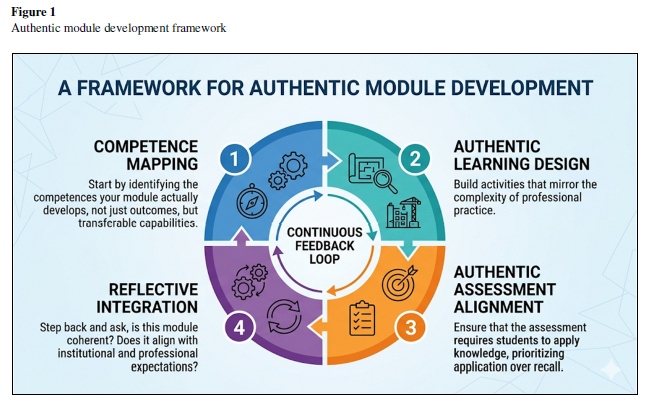
The first phase of the study resulted in the development of an initial framework that synthesised the four themes emerging from the focus group discussions. Rather than representing independent curriculum design activities, the themes formed a coherent and iterative process through which academics described designing competence-focused modules. Participants consistently emphasised that effective module development begins by making professional competences explicit, followed by the deliberate design of authentic learning experiences and assessment tasks, before concluding with a holistic review of curriculum coherence. These interconnected processes formed the conceptual basis of the proposed framework. Importantly, the framework did not emerge from the literature alone but from participants' shared experiences of curriculum design within their institutional context. The data revealed that academics experienced module development as a fragmented process in which learning outcomes, teaching activities, and assessment were frequently considered independently. The emerging framework therefore sought to address this fragmentation by providing a structured process that guides academics through a sequence of interconnected curriculum design decisions, ensuring that competence development remains explicit throughout module planning.
The resulting framework comprises four iterative components. Competence Mapping establishes the professional capabilities that students are expected to develop throughout the module. These identified competences then inform Authentic Learning Design, where learning activities are intentionally structured to provide opportunities for students to develop those capabilities within meaningful professional and contextual settings. The third component, Authentic Assessment Alignment, ensures that assessment tasks provide appropriate evidence of the identified competences by requiring students to demonstrate integrated professional performance. Finally, Reflective Integration provides an opportunity for academics to review the completed module holistically, evaluating whether the competences, learning activities, and assessment strategies collectively support the intended educational purpose.
Although presented sequentially, participants described these components as iterative rather than linear. Decisions made during one stage frequently prompted reconsideration of earlier design choices, resulting in an ongoing process of refinement rather than a fixed sequence of curriculum development. Figure 1 illustrates the initial authentic module development framework generated during Phase 1. The figure represents an iterative pedagogical design cycle in which competence identification, authentic learning, authentic assessment, and reflective integration operate as mutually reinforcing processes that collectively support competence-focused curriculum design.
Outcome Phase 2: Framework validation and refinement
The second phase of the study moved beyond validating the initial framework and instead provided important conceptual refinements that strengthened its applicability within professionally accredited programmes. While participants agreed that the four-component framework provided a coherent process for competence-focused curriculum design, they consistently argued that it did not fully capture the realities of curriculum development within engineering education, where module design is shaped by mandatory professional accreditation requirements. Participants explained that curriculum decisions are influenced not only by pedagogical considerations but also by externally prescribed ELOs and accreditation standards established by the Engineering Council of South Africa. Consequently, competence identification, learning design, and assessment cannot be considered solely from an educational perspective; they must simultaneously demonstrate alignment with programme accreditation requirements. Participant 3 described this challenge as follows:
In our school, the ELOs aren't suggestions; they are the law. When we map a module template, we aren't just looking at what the student should know, but what the Council requires them to prove. If the authentic task doesn't explicitly trigger the specific ELO assessment criteria, the module fails its audit.
This observation highlighted that curriculum mapping within professionally accredited programmes involves a process of dual alignment. Academics are required to ensure that module activities support meaningful competence development while simultaneously demonstrating how those competences contribute to prescribed programme ELOs. Rather than functioning as separate processes, participants described these educational and accreditation requirements as interdependent throughout module design. Participant 2 further explained the practical implications of this relationship:
The challenge is making the task authentic without losing the technical rigour required by the Engineering Council of South Africa. You can't just have a "cool project"; you need a project where the design phase directly maps, for example, to ELO 3 [Engineering Design] and the impact phase maps to ELO 7 [Sustainability]. The template has to force that connection.
These accounts demonstrate that authenticity alone was considered insufficient within professionally accredited programmes. Participants argued that authentic learning activities must also generate explicit evidence demonstrating the achievement of programme-level professional competencies. This insight represented an important refinement of the framework because it extended the focus from pedagogical coherence to include accountability within professional accreditation systems. A similar concern was expressed by Participant 7:
Engineering is unique because our "real world" is governed by a Code of Conduct and strict safety standards. Our template for module development needs to embed those council requirements into the Authentic Design phase from day one, or we risk producing graduates who are creative but unregistrable.
Collectively, these findings revealed that accreditation requirements should not be viewed as a final compliance exercise undertaken after module development has been completed. Instead, participants argued that professional accreditation considerations should shape curriculum design from the outset by informing competence identification, authentic learning activities, assessment design, and reflective review. The empirical evidence therefore suggested that accreditation functions as an overarching design consideration that influences every stage of the curriculum development process.
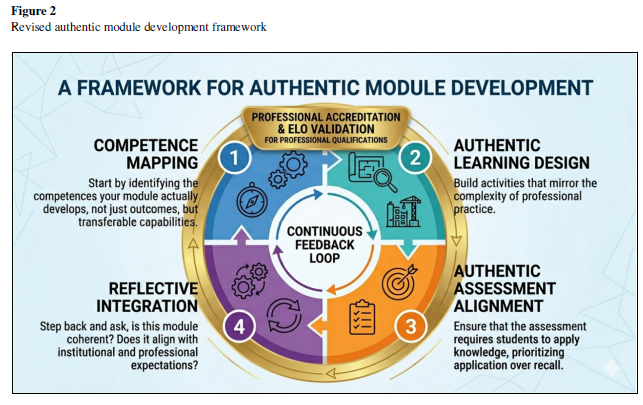
This insight resulted in the most significant refinement of the framework. Rather than introducing an additional fifth stage, the revised framework incorporates professional accreditation and ELO validation as an overarching layer that surrounds and informs the four pedagogical components. The inner cycle continues to represent the iterative curriculum design process through which competences are identified, developed, assessed, and reviewed. The outer accreditation layer ensures that each of these curriculum decisions remains explicitly aligned with programme accreditation requirements and professional standards.
The revised framework therefore distinguishes between pedagogical design and professional accountability while demonstrating their interdependence. Competence mapping and authentic learning design are informed by programme ELOs; authentic assessment alignment provides explicit evidence that these outcomes have been achieved; and reflective integration serves as the final review point, confirming both pedagogical coherence and alignment with accreditation expectations. Rather than functioning as a separate quality assurance process, accreditation validation becomes an integral consideration throughout module design.
Figure 2 illustrates this refined framework. The inner cycle represents the iterative pedagogical process developed during Phase 1, while the surrounding professional accreditation and ELO validation layer reflects the principal refinement emerging from Phase 2. The relationship between these two elements demonstrates that competence-focused curriculum design and professional accreditation are mutually reinforcing rather than competing priorities. This refinement represents the study's principal conceptual contribution by integrating authentic curriculum design with systematic accreditation-oriented curriculum validation within a single module development framework.
Discussion
The purpose of this study was to develop and empirically refine a framework that supports competence-focused module design through the integration of authentic teaching, learning, and assessment. While the findings identified four interconnected curriculum design components- competence mapping, authentic learning design, authentic assessment alignment, and reflective integration-their significance extends beyond describing preferred curriculum practices. Collectively, the findings demonstrate that competence-based curriculum design is not achieved simply by adopting authentic learning principles or constructive alignment independently. Rather, competence development depends upon a deliberate design process that makes professional capabilities explicit, intentionally develops them through authentic learning experiences, evaluates them through authentic assessment, and continually reviews their coherence within the curriculum. The discussion therefore interprets these findings in relation to existing scholarship and demonstrates how the empirical evidence extends current understandings of competence-focused curriculum design.
Competence mapping: From implicit expectations to explicit curriculum design
The first theme demonstrates that one of the greatest challenges facing academics is not identifying the competences required of graduates, but making those competences explicit during curriculum design. Participants consistently described professional capabilities such as ethical judgement, problem-solving, communication, teamwork, and professional decision-making as integral to engineering education. However, these capabilities were frequently assumed to develop implicitly through disciplinary teaching rather than being intentionally articulated within module documentation.
This finding extends current understandings of CBE by suggesting that the principal barrier to competence development is not pedagogical intent but curriculum visibility. Existing literature argues that competence involves the integrated mobilisation of knowledge, skills, attitudes, and professional judgement within authentic contexts (Mulder, 2017). Similarly, South African curriculum scholarship emphasises that graduate competence requires the integration of disciplinary knowledge with professional capability rather than the accumulation of isolated learning outcomes (Luckett, 2016; Shay, 2013). The present study demonstrates that although academics broadly share these understandings, existing module templates often fail to provide mechanisms for explicitly documenting embedded competences during curriculum planning.
This observation also extends constructive alignment theory. Biggs and Tang (2011) propose that curriculum coherence depends upon the alignment of intended learning outcomes, teaching activities, and assessment. The findings suggest, however, that constructive alignment assumes that intended outcomes have already captured the professional competences expected of graduates. Participants revealed that this assumption is not always warranted. In practice, academics frequently write outcome statements that prioritise disciplinary content while leaving broader professional capabilities implicit. Consequently, alignment occurs around knowledge outcomes rather than professional competence.
The competence mapping component developed through this study therefore represents more than an administrative curriculum exercise. It introduces an explicit curriculum design stage that precedes constructive alignment by requiring academics to identify and document the competences that underpin disciplinary learning before learning activities and assessment are designed. In doing so, the framework extends competence-based curriculum design from asking "What should students know?" to asking "What should students be capable of doing within authentic professional contexts?" This distinction shifts competence from being an assumed by-product of teaching to becoming the organising principle around which curriculum decisions are made.
Authentic learning design: Reframing authenticity as professional participation
The second theme demonstrates that participants conceptualised authentic learning as considerably more than the inclusion of workplace examples or applied case studies. Rather, authenticity was understood as designing learning experiences that require students to think, make decisions, and respond to uncertainty in ways that resemble professional practice. This interpretation moves beyond surface realism towards the deliberate cultivation of professional reasoning. These findings reinforce Biesta's (2020) critique of learnification, whereby educational success becomes measured primarily through learning processes rather than broader educational purposes. Participants consistently argued that authentic learning should prepare students for the complexity of professional judgement rather than simply facilitate knowledge acquisition. Authenticity therefore becomes a means through which education supports qualification, socialisation, and the development of professional identity simultaneously, reflecting Biesta's broader conception of educational purpose.
The findings also provide an important refinement of authentic learning literature. Wiggins (1990) and Ashford-Rowe et al. (2014) argue that authenticity is achieved when learning and assessment resemble the complexity of real-world practice. Participants in the present study supported this position but extended it by emphasising that authenticity must also reflect the contextual realities within which graduates will ultimately work. References to community engagement, South African professional contexts, and locally situated engineering challenges suggest that authenticity should not simply replicate generic professional practice but should prepare graduates for the specific social, environmental, and economic conditions in which professional decisions are enacted. This finding has important implications for curriculum design. Authentic learning should not be viewed as an isolated teaching strategy added to an otherwise traditional curriculum. Rather, it represents the pedagogical mechanism through which identified competences are intentionally developed. The framework therefore positions authentic learning design as a direct consequence of competence mapping. Once professional competences have been explicitly identified, learning activities can be intentionally designed to create opportunities for students to practise and progressively develop those capabilities. This relationship establishes a stronger conceptual connection between competence identification and pedagogical practice than is typically articulated within existing curriculum design models.
Furthermore, the findings suggest that authentic learning should be understood as developmental rather than episodic. Participants did not advocate occasional authentic activities embedded within conventional teaching; instead, they described authenticity as a curriculum-wide design philosophy that progressively increases students' engagement with professional complexity. Such an interpretation supports the development of transferable competences that can be mobilised across diverse professional situations, thereby strengthening the relationship between authentic pedagogy and graduate preparedness.
Authentic assessment alignment: Demonstrating competence rather than measuring knowledge
The third theme demonstrates that competence-based curriculum design cannot be realised without corresponding changes to assessment practices. Participants consistently identified a disconnect between authentic teaching activities and assessment approaches that continued to privilege knowledge recall over professional performance. This finding reinforces the central role of assessment in shaping student learning while simultaneously suggesting that assessment remains the least transformed component of competence-based curriculum reform.
Existing scholarship argues that authentic assessment should evaluate students' ability to apply knowledge within realistic professional contexts rather than simply reproduce disciplinary content (Ashford-Rowe et al., 2014; Wiggins, 1990). The present findings support this position but also reveal that academics frequently experience difficulty translating these principles into module design. Participants recognised that although authentic learning opportunities were increasingly incorporated into teaching, assessment often remained constrained by conventional institutional practices, resulting in a misalignment between intended graduate capabilities and the evidence used to evaluate them.
Importantly, the findings suggest that authentic assessment should not be understood solely as an alternative assessment strategy but as the primary mechanism through which competence becomes visible. Competence, by its nature, cannot be inferred from content knowledge alone; it must be demonstrated through performance within meaningful contexts. Assessment therefore serves a dual function: it provides evidence of student achievement while simultaneously signalling the professional capabilities that the curriculum values most. Participants' observation that "assessment tells students what really matters" illustrates how assessment influences not only evaluation but also students' approaches to learning and professional identity formation. These findings extend constructive alignment by reinforcing that alignment should occur around demonstrated competence rather than disciplinary knowledge alone. While Biggs and Tang (2011) argue that assessment should align with intended learning outcomes, the present study suggests that authentic assessment should instead provide explicit evidence that identified competences have been developed and can be transferred across professional contexts. Consequently, the framework positions authentic assessment alignment as the stage through which competence development becomes observable, measurable, and educationally meaningful.
Reflective integration: Curriculum coherence as an iterative design process
The fourth theme extends existing understandings of curriculum coherence by demonstrating that alignment is not achieved automatically through the completion of curriculum documentation. Participants consistently described module design as an iterative process requiring continual reflection on the relationships between competences, learning activities, and assessment rather than the independent completion of individual template sections. This finding reinforces contemporary views of curriculum design as a dynamic process of continuous improvement rather than a linear sequence of planning activities. Reflection enabled participants to reconsider whether identified competences remained visible throughout the module, whether learning activities genuinely supported their development, and whether assessment generated appropriate evidence of student capability. Consequently, curriculum coherence emerged not as an administrative requirement but as an ongoing process of pedagogical decision-making.
The findings also suggest that reflective integration contributes to institutional curriculum quality in ways that extend beyond individual module design. Participants indicated that structured reflection encouraged academics to engage more critically with educational purpose, making explicit the relationships between disciplinary knowledge, professional competence, and graduate preparedness. In doing so, reflection shifted the module template from functioning primarily as an institutional compliance document towards becoming a pedagogical design tool that supports continuous curriculum enhancement. This interpretation complements Biesta's (2020) argument that educational quality should be judged not only by learning outcomes but also by the purposes education seeks to fulfil. Reflective integration provides a mechanism through which academics continually evaluate whether curriculum decisions contribute to qualification, professional socialisation, and the development of graduates capable of exercising informed judgement within complex professional environments. Rather than representing the final stage of curriculum development, reflection becomes the mechanism through which each component of the framework is continually reviewed and refined.
Theoretical contribution
The findings make several contributions to scholarship on competence-based curriculum design. First, the study extends existing understandings of constructive alignment by demonstrating that competence identification should precede the alignment of learning outcomes, teaching activities, and assessment. While constructive alignment assumes that intended learning outcomes adequately represent the capabilities students are expected to develop, participants consistently demonstrated that important professional competences often remain implicit within curriculum documentation. The introduction of an explicit competence mapping stage therefore represents a conceptual extension of constructive alignment by positioning competence articulation as a prerequisite for meaningful curriculum alignment.
Second, the study contributes to authentic learning literature by conceptualising authenticity as a curriculum design principle rather than a collection of teaching or assessment techniques. Existing frameworks have primarily focused on the characteristics of authentic learning environments and authentic assessment tasks. The present findings demonstrate that authenticity acquires greater educational value when it functions as an organising principle linking competence identification, pedagogical design, assessment, and curriculum review within a coherent developmental process. Authenticity therefore becomes embedded throughout curriculum design rather than being associated with isolated learning activities.
Finally, the study contributes to CBE by demonstrating that competence development requires explicit curriculum visibility. The findings suggest that many challenges associated with implementing CBE arise not from disagreement regarding graduate capabilities but from the absence of systematic mechanisms for identifying, documenting, and evaluating those capabilities during module development. By making competence explicit throughout curriculum design, the framework provides a practical means of operationalising principles that have often remained conceptual within the literature.
Original contribution: Integrating professional accreditation and ELO validation
The principal original contribution of this study lies not in proposing new principles of CBE or authentic assessment, but in extending these established pedagogical theories through the integration of professional accreditation requirements within module design. While the four-component curriculum design cycle builds upon existing scholarship in constructive alignment and authentic pedagogy, the empirical refinement undertaken during Phase 2 revealed an important dimension that is largely absent from current curriculum design models.
Participants consistently demonstrated that curriculum development within professionally accredited programmes is shaped simultaneously by pedagogical objectives and regulatory requirements. Existing curriculum design frameworks provide valuable guidance for aligning learning outcomes, teaching activities, and assessment, yet they offer limited support for demonstrating how embedded competences contribute to programme-level ELOs and accreditation expectations. This limitation is particularly significant in disciplines such as engineering, where academics must provide transparent evidence that curriculum design satisfies both educational and professional standards.
The introduction of the professional accreditation and ELO validation layer addresses this gap by integrating pedagogical quality with professional accountability within a single curriculum design framework. Rather than functioning as a final quality assurance exercise, accreditation validation becomes an overarching consideration that informs every stage of curriculum development. Competence identification, authentic learning activities, assessment design, and reflective review are therefore undertaken with explicit reference to programme accreditation requirements throughout the design process.
This refinement represents the framework's principal conceptual contribution because it moves beyond existing curriculum design models that primarily address pedagogical coherence. By embedding accreditation and ELO validation within the iterative curriculum design cycle, the framework provides academics with a structured mechanism for simultaneously supporting competence development, curriculum coherence, and professional accreditation. In doing so, it operationalises authentic curriculum design within professionally regulated higher education contexts and offers a practical extension to existing CBE literature.
Conclusion
This study set out to address a practical challenge in competence-based curriculum design: the absence of structured mechanisms that assist academics in explicitly identifying, embedding, and evaluating professional competences within module development. Drawing on a qualitative case study conducted within the School of Engineering at UKZN, the research developed and iteratively refined an Authentic Module Development Framework through engagement with academics directly involved in curriculum design. The findings demonstrated that competence-focused module development is strengthened when curriculum design explicitly integrates competence mapping, authentic learning, authentic assessment, and reflective curriculum review within a coherent and iterative process.
The study contributes to the growing body of scholarship on CBE by extending existing curriculum design approaches in two important ways. First, it demonstrates that competence identification should precede constructive alignment, ensuring that professional capabilities are made explicit before learning activities and assessment are designed. Second, and most significantly, the empirical refinement of the framework highlighted the importance of embedding professional accreditation and ELO validation as an overarching consideration throughout module development. Rather than functioning as a separate quality assurance exercise, accreditation requirements were shown to shape curriculum design decisions across each stage of the framework. This integration represents the principal conceptual contribution of the study by operationalising authentic, competence-focused curriculum design within the context of a professionally accredited programme.
The findings should, however, be interpreted within the context of the study's design. The framework was developed and refined through engagement with seven academics from a single engineering school at one South African university. As a qualitative case study, the intention was not to achieve statistical or disciplinary generalisation but to develop a contextually grounded framework capable of addressing an identified curriculum design challenge within a specific institutional and professional setting. Consequently, while the framework demonstrates promise for supporting competence-focused curriculum development in similar professionally accredited contexts, its applicability beyond engineering and beyond the study institution requires further empirical investigation.
Future research should therefore examine the implementation and refinement of the framework across different disciplines, institutional contexts, and professional education settings. Longitudinal studies that explore its influence on curriculum design practices, student competence development, authentic assessment, and accreditation processes would provide valuable evidence of its broader utility and adaptability. Such work would enable the framework to be further refined while evaluating its contribution to competence-based curriculum transformation across higher education.
Ultimately, this study argues that authentic curriculum transformation requires more than the adoption of competence-based principles or authentic assessment practices in isolation. It requires structured curriculum design processes that make professional competences explicit, align teaching and assessment with those competences, and provide transparent evidence of their achievement within professionally accredited programmes. Within the context examined, the proposed framework offers a practical and theoretically informed approach to supporting this process and provides a foundation for continued research into competence-focused curriculum design in higher education.
References
- Ajjawi, R., Tai, J., Huu Nghia, T. L., Boud, D., Johnson, L., & Patrick, C. J. (2020). Aligning assessment with the needs of work-integrated learning: The challenges of authentic assessment in a complex context. Assessment & Evaluation in Higher Education, 45(2), 304-316. https://doi.org/10.1080/02602938.2019.1639613
- Ashford-Rowe, K., Herrington, J., & Brown, C. (2014). Establishing the critical elements that determine authentic assessment. Assessment & Evaluation in Higher Education, 39(2), 205-222. https://doi.org/10.1080/02602938.2013.819566
- Biesta, G. J. J. (2010). Good education in an age of measurement: Ethics, politics, democracy. Paradigm Publishers.
- Biesta, G. (2020). Educational research: An unorthodox introduction. Bloomsbury.
- Biggs, J., & Tang, C. (2011). Teaching for quality learning at university (4th ed.). Open University Press.
- Council on Higher Education. (2014). Higher Education Qualifications Sub-Framework (HEQSF). https://www.che.ac.za
- Department of Higher Education and Training. (2013). White Paper for post-school education and training: Building an expanded, effective and integrated post-school system.
- Department of Higher Education and Training. (2020). DHETRevised Strategic Plan 2020-2025. https://www.dhet.gov.za/
- Human-Hendricks, N., & Meier, C. (2024). Three key drivers in devising a responsive curriculum in South African higher education institutions. South African Journal of Higher Education, 38(6), 79-95. https://doi.org/10.20853/38-6-5082
- Herrington, J., Reeves, T. C., & Oliver, R. (2010). A guide to authentic e-learning. Routledge.
- Herrington, J., Reeves, T. C., & Oliver, R. (2014). Authentic learning environments. In J. Spector, M. D. Merrill, J. Elen, & M. J. Bishop (Eds.), Handbook of research on educational communications and technology (pp. 401-412). Springer.
- Lincoln, Y., & Guba, E. G. (1985). Naturalistic inquiry. SAGE.
- Luckett, K. (2016). Curriculum contestation in a post-colonial context: A view from the South. Teaching in Higher Education, 21(4), 415-428. https://doi.org/10.1080/13562517.2016.1155547
- McKenney, S., & Reeves, T. (2018). Conducting educational design research (2nd ed.). Routledge. https://doi.org/10.4324/9781315105642
- Mulder, M. (2017). Competence-based vocational and professional education. Springer.
- Nachtigall, V., Shaffer, D. W., & Rummel, N. (2024). The authenticity dilemma: Towards a theory on the conditions and effects of authentic learning. European Journal of Psychology of Education, 39(4), 3483-3509. https://doi.org/10.1007/s10212-024-00892-9
- Oliver, B. (2015). Redefining graduate employability and work-integrated learning: Proposals for effective higher education in disrupted economies. Journal of Teaching and Learning for Graduate Employability, 6(1), 56-65. https://doi.org/10.21153/jtlge2015vol6no1art573
- OECD. (2018). The future of education and skills: Education 2030. https://doi.org/10.1787/54ac7020-en
- Reeves, T. C. (2006). Design research from a technology perspective. In J. van den Akker, K. Gravemeijer, S. McKenney, & N. Nieveen (Eds.), Educational design research (pp. 52-66). Routledge.
- Wawire, B. A., Kiambati, F., Muhia, N., Gathoni, G., & Abuya, B. (2026). Competence-based curriculum implementation in Africa: A scoping review of pedagogical and assessment practices. Journal of Curriculum Studies, 1-30. https://doi.org/10.1080/00220272.2025.2523429
- Wiggins, G. (1990). The case for authentic assessment. Practical Assessment, Research, and Evaluation, 2(2), 1-3. https://doi.org/10.7275/ffb1-mm19
Accepted: 11 August 2026