Coding and robotics for inclusive education in South African higher education teacher training contexts
Abstract
In this study I explore the potential of coding and robotics to enhance inclusive teaching practices in a private higher education institution in South Africa. Grounded in a qualitative, interpretivist research design, my study examines how pre-service teachers engage with these tools and how they think about their value in relation to learner diversity. Participants completed coding and robotics activities and provided written reflections through structured questionnaires focused on accessibility, engagement, and pedagogical value. The findings contribute to emerging research on contextually relevant, technology-driven strategies for inclusive education in under-resourced settings, showing that, when adapted critically, such tools can promote equitable participation and support learner-centred pedagogy.
inclusive education; coding and robotics; educational technology; diverse learners; teacher training; South Africa
Introduction
The South African education system continues to reflect deep inequalities rooted in apartheid, particularly in relation to access, quality, and inclusion (Muyambi & Ahiaku, 2025). Although policies such as White Paper 6 (Department of Education, 2001) advocate for a more equitable system, significant disparities remain, especially in low socio-economic contexts. These challenges highlight the need for innovative and contextually responsive teaching approaches. At the same time, recent scholarship points to the growing role of emerging technologies in addressing these gaps (Tshidi & Dewa, 2024). Tools such as coding and robotics offer opportunities to strengthen digital literacy while encouraging interdisciplinary participatory learning (Breazeal, 2004). Despite their recognised value internationally, there is limited research on how coding and robotics can be meaningfully applied to support inclusion in South African education, particularly in under-resourced schools (Aruleba & Jere, 2022; Tshidi & Dewa, 2024).
In this study, I address that gap by examining how pre-service teachers perceive the potential of coding and robotics for inclusive teaching in different classrooms. Using a qualitative approach based on questionnaire data, I explore how these tools may be used to respond to learners' diverse intellectual, physical, and socio-emotional needs.
The study is guided by the following research questions:
1. How do pre-service teachers perceive the potential of coding and robotics to support inclusive education in different classrooms?
2. In what ways do they believe these tools can address learners' cognitive, physical and socio-emotional needs?
3. What barriers and opportunities do they identify for implementing these technologies in low socio-economic schools?
Existing research suggests that coding and robotics can encourage active participation, develop critical thinking, and accommodate different ways of learning (Alam and Mohanty, 2024). Robot-based activities have also shown promise in supporting learners with developmental and learning challenges in mainstream settings (Díaz-Boladeras et al., 2023). Furthermore, educational robotics has been linked to social, emotional and cognitive inclusion through collaborative and learner-centred approaches (Kálózi-Szabó et al., 2022). Together, these findings suggest that these tools are adaptable and useful, potentially, in responding to learner diversity.
Building on this literature, I argue that integrating coding and robotics into mainstream classrooms may contribute to more inclusive pedagogical practice. This involves recognising learner differences, encouraging participation, and rethinking traditional approaches to teaching and learning (Loureiro & Meirinhos, 2023). By engaging with these questions, I contribute to ongoing discussions on technology-enhanced inclusion and the preparation of teachers for diverse and resource-constrained educational environments.
Historical and policy perspectives: Inclusive education in South Africa
As noted by Donohue and Bornman (2014), despite policy reforms that position education as a basic human right in South Africa, under-resourced schools continue to experience significant disparities in access, quality, and inclusion. The introduction of White Paper 6 (Department of Education, 2001) marked an important step towards developing an inclusive education system, but the legacy of apartheid continues to shape persistent inequalities.
Engelbrecht and Muthukrishna (2019) argued that implementation remains uneven since many schools lack the capacity, resources, and institutional support required to address learner diversity effectively. Similarly, Tshidi and Dewa (2024) highlighted that although inclusive education policies are widely endorsed, their practical enactment remains challenging. Key constraints include limited learning support materials, overcrowded classrooms, and inadequate teacher preparation. These ongoing challenges underscore the need for innovative and contextually responsive teaching strategies.
Educational technologies and inclusive pedagogies
Increasingly, emerging digital tools are becoming recognised as valuable for promoting inclusion in education globally. Hsu et al. (2018) found that technologies such as educational robotics and interactive platforms can enhance learner engagement while supporting differentiated instruction. Bouchey et al. (2021) similarly emphasised that such technologies enable multimodal learning.
Robotics-based learning can also be adapted to support children with different learning and developmental needs, as highlighted by Díaz-Boladeras et al. (2023). Their findings suggested that these tools can enhance both social interaction and academic engagement when implemented in an inclusive pedagogical framework. Likewise, coding and robotics can support participatory, hands-on learning by fostering differentiated learning outcomes through collaboration and critical thinking (Alam & Mohanty, 2024).
Gaps in the South African context
Suhaimi et al. (2019) pointed out that most studies on coding and robotics have been conducted in high-income, well-resourced contexts, thus raising concerns about their relevance and feasibility in settings such as South Africa, where resources are limited. In a recent scoping review, Tshidi and Dewa (2024) found that only 10 out of the 61 studies explicitly addressed teacher preparedness and practical implementation. Their review also highlighted inadequate teacher training and limited technological infrastructure as critical challenges that must be addressed to ensure equitable access. This suggests that empirical research on the practical integration of coding and robotics in low-resource, inclusive environments remains underdeveloped.
The reviewed literature highlights progress in policy development for inclusive education in South Africa, alongside the growing global recognition of educational technologies such as coding and robotics as tools for inclusion. However, in under-resourced learning environments, practical implementation remains under-researched. Despite policy change, restricted infrastructure, insufficient teacher training, and scarce national research continue to hinder progress.
This lack of research demonstrates the need for context-specific studies that explore how coding and robotics can be integrated meaningfully into inclusive classrooms in South Africa. My study responds to that gap by exploring how pre-service teachers at a private higher education institution engage with these tools to promote inclusive teaching practices and learner participation.
Theoretical framework
This study is guided by Social Constructivism that views learning as a process shaped through interaction with peers, teachers, and cultural tools (Vygotsky, 1978; Wibowo et al., 2025). This framework aligns with the study's focus on collaborative practice, active participation, differentiated teaching and learning, and the use of educational technologies to support engagement.
Drawing on Castro et al. (2024), coding and robotics activities can support learners in their Zone of Proximal Development (ZPD) by introducing tasks that are slightly beyond their current abilities and that require problem solving and peer engagement. As learners work alongside peers and teachers to complete increasingly complex tasks, they are supported through scaffolding that can accommodate diverse learning needs. This process has been shown to enhance participation and learning outcomes in inclusive classrooms (Alam & Mohanty, 2024; Castro et al., 2024)
Social constructivism also helps explain why coding and robotics may be especially useful in inclusive education. These tools can function as mediating resources that allow learners to engage with content in ways that are interactive, collaborative, and meaningful.
Methodology
Study design
I used a qualitative design rooted in an interpretivist paradigm. My aim was to explore pre-service teachers' experiences with coding and robotics activities, and their perceptions of how these tools may support inclusive education. Using the interpretivist perspective allowed me to examine participants' views and reflections in relation to their own educational context (see Creswell & Creswell, 2018).
Participants engaged in coding and robotics activities and completed structured questionnaires with open-ended items. These instruments captured their reflections on confidence, perceived accessibility, and possible barriers to integrating educational technologies.
I conducted this study at a private higher education institution in South Africa and focused on first- and second-year pre-service teachers enrolled in a teacher training programme. A pilot programme was launched as an optional, self-paced, extracurricular course introducing participants to foundational coding and robotics concepts through curriculum-aligned interactive modules. While the platform itself did not explicitly focus on accessibility or learner-support features, students were encouraged to reflect critically on how these technologies could support inclusive teaching. Drawing on prior learning from the inclusive education module, participants were asked to consider how coding and robotics could be adapted to accommodate learners with diverse cognitive, physical, and socio-emotional needs. Ethical clearance was granted by the IIEVC Research Ethics Committee (R.0002125 [REC]).
Recruitment and sampling
I used a non-probability, voluntary sampling method and participation in both the course and the study was entirely voluntary. All pre-service teachers who enrolled in the optional coding and robotics course were invited to complete three structured questionnaires. This strategy allowed me to gather data from individuals with direct experience of the course and a willingness to share their perspectives.
Data collection
I sent out a series of three structured questionnaires between October and December. Each questionnaire was designed to capture the participants' reflections on their engagement with the course. The questions focused on their experiences of the platform, whether it improved accessibility, and how useful coding and robotics might be in supporting inclusive education. Because the structured questionnaires included open-ended items, I gathered written reflections, but the format did not allow for probing or follow-up clarification.
Before participation, I obtained informed consent from all participants. They were informed that involvement was voluntary and that they could withdraw at any point without penalty. I also told them that their responses would remain confidential and anonymous.
Data analysis
I used thematic analysis, as outlined by Braun and Clarke (2006), to analyse the qualitative responses. This process involved familiarisation with the data, coding, searching for themes, reviewing themes, defining and naming themes, and producing the final report. Responses were read carefully and interpreted to identify underlying meanings (see Xu & Zammit, 2020). By examining how participants described their experiences, I established themes in relation to inclusive practice, learner engagement, and perceived barriers to implementation (Naeem et al., 2023).
The analysis was guided by my aim to understand how pre-service teachers perceive the role of coding and robotics in fostering inclusive classroom practices. The coding process was iterative, and I refined the themes to ensure internal consistency and alignment with the research questions.
Trustworthiness
To support trustworthiness, analytical decisions were discussed with colleagues and regularly reviewed to reduce bias and strengthen credibility (see Stahl & King, 2020).
Limitations
For the study, I used structured questionnaires, which provided useful reflective data but limited opportunities for probing, clarification, and deeper interaction. As a result, the findings reflect participants' written perceptions rather than observed classroom practice or in-depth interview data.
Findings
I organised data collected from the structured questionnaires into meaningful units and analysed these thematically to explore pre-service teachers' reflections on how coding and robotics can support inclusive classroom practices in low socio-economic schools. Although participants were not applying these tools directly in schools, their reflections drew on their learning experiences in the online, self-paced course and projected how such tools could be adapted to diverse educational contexts.
The first questionnaire (Check-in 1) yielded responses from 17 Bachelor of Education students aged 18 to 22, with varied levels of technological familiarity. Only two participants had prior experience with coding and robotics. The second questionnaire (Check-in 2) was completed by 12 students of the same cohort after they had engaged further with the course content. The third questionnaire received no response since none of the students participated.
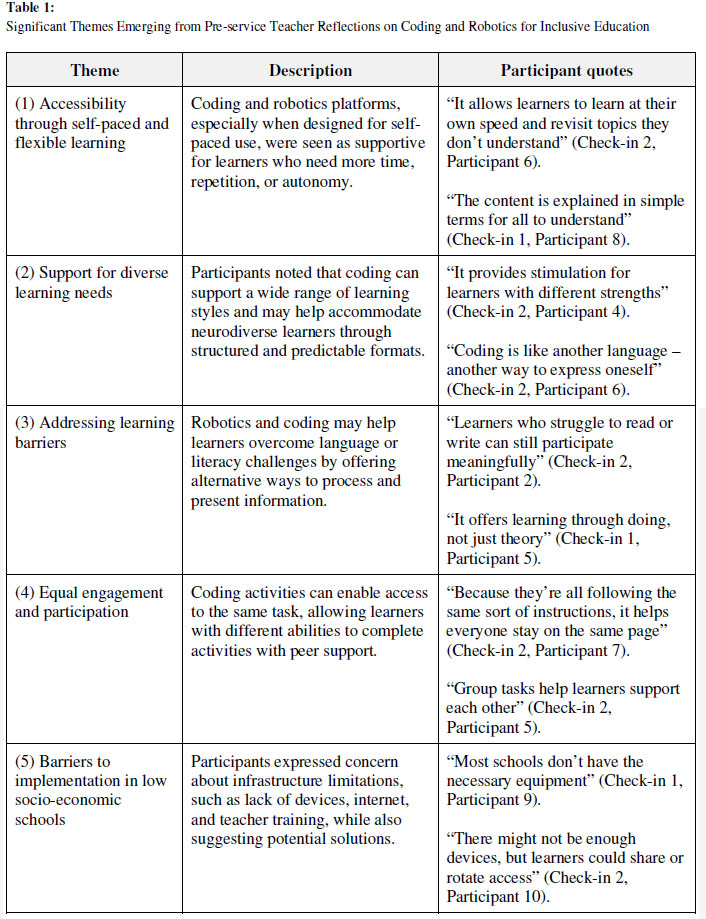
Despite their limited initial experience, many participants showed growth in confidence and conceptual understanding over time. Five key themes emerged from the data:
1. Accessibility through self-paced and flexible learning;
2. Support for diverse learning needs;
3. Addressing learning barriers;
4. Equal engagement and participation; and
5. Barriers to implementation in low socio-economic schools.
These themes1 are summarised in Table 1.
Thematic discussion
I explore each of the identified themes below, with attention to how pre-service teachers reasoned about the use of coding and robotics for inclusive education in low socio-economic schools.
Accessibility through self-paced and flexible learning
Participants consistently emphasised the value of a self-paced learning environment. This feature positions coding and robotics as more inclusive than many traditional methods, particularly in classrooms in which learners progress at different speeds. In low socio-economic schools, where large class sizes and limited teacher support are common, participants noted that self-paced learning could allow learners to revisit concepts, practise at their own speed, and engage without fear of falling behind.
Some learners might take longer to understand things. With a coding and robotics platform, they can work through at their own pace without feeling embarrassed or left behind. (Check-in 2, Participant 3)
This is especially important in the South African context, where many classrooms still operate with limited resources and support. Traditionally overcrowded classrooms often lead to high noise levels and make it difficult for teachers to provide individual attention. Flexible learning can help learners remain included even when teachers cannot always provide direct support, while also allowing them to learn at their own pace in a controlled environment (West & Meier, 2020).
From a Social Constructivist perspective, the coding and robotics platform becomes a mediating tool that enables learners to move through tasks independently while still receiving opportunities for social interaction and feedback. In this way, learners can remain engaged in their ZPD, with the environment offering scaffolding in the form of guided tasks, visual support, and repetition.
Support for diverse learning needs
Many pre-service teachers identified coding and robotics as a multidimensional way of learning, supporting visual, kinaesthetic, logical, and linguistic engagement. This was seen as particularly beneficial in inclusive classrooms serving learners with diverse learning abilities, including those with attention difficulties, language barriers, and learning disabilities. Participants explained that coding and robotics offer ways for learners to explore, create, and problem-solve, rather than relying only on reading or writing.
It provides stimulation for learners with different strengths because of the different visual, auditory sort of stimulation (Check-in 2, Participant 4).
In South Africa, this is especially relevant because many classrooms are linguistically diverse and poorly resourced (Phajane, 2022). These reflections indicate that some pre-service teachers may be beginning to understand inclusion as providing many different access points to learning rather than simplifying content. This is important in South African inclusive education, where policy encourages participation for all learners, but classroom realities often make it difficult to respond to different needs through traditional teaching alone.
From a theoretical perspective, this aligns with Vygotsky's (1978) emphasis on learning as a social and cultural process shaped by the tools available to learners. Coding and robotics serve as such tools, enabling learners to construct meaning through hands-on experiences and collaborative tasks.
Furthermore, the integration of coding and robotics was seen as supporting learners in their ZPD, allowing those who might struggle with conventional methods to succeed when provided with scaffolded, interactive tasks. As highlighted by Castro et al. (2024), these technologies can offer guided problem-solving opportunities during which learners are supported by peers or teachers as they work through increasingly complex challenges. This suggests that future teachers need practical strategies for using technology to support inclusion in classrooms where learner diversity is high and individual support is often limited.
The self-paced and analytical nature of coding may assist learners with autism or anxiety because they feel safe and focused (Check-in 2, Participant 3).
It is apparent that coding and robotics can remove barriers to participation, improve learner confidence, and promote more inclusive learning for all learners.
Addressing learning barriers
Participants observed that these tools could support learners who struggle with the traditional forms of assessment, such as reading or writing, by offering alternative ways to understand and present information. This is particularly relevant in South Africa, where classrooms are often linguistically diverse and where learners may not have equal access to literacy support outside of school (Pillay & Mbatha, 2026).
Learners who struggle to read or write can still participate meaningfully (Check-in 2, Participant 2).
It offers learning through doing, not just theory (Check-in 1, Participant 5).
These reflections align with the principles of Social Constructivism since learning is understood as an active process (Morchid, 2020). From this perspective, coding and robotics platforms can be seen as cultural tools that facilitate the co-construction of knowledge through inquiry-based learning and collaborative problem solving. In South African teacher education, this matters because technologies that go beyond written language may help future teachers include learners who are marginalised by literacy-based instruction (Fitas, 2025).
By offering authentic and meaningful learning experiences, coding and robotics enable learners to engage with complex concepts through many different modes of learning (Saleem et al., 2021). However, successful implementation still requires teacher preparation that includes practical strategies for resource-constrained contexts. Overall, these technologies have significant potential to enhance inclusive learning environments by promoting engagement, independence, and accessibility.
Equal engagement and participation
Participants also emphasised how coding and robotics activities promoted equal participation in classroom tasks. Learners with varying abilities could engage in similar activities by following the same set of instructions, with peer support contributing significantly to participation. This finding is especially important in South Africa where classrooms are diverse, overcrowded, and characterised by unequal access to support (West & Meier, 2020). This feature of coding tasks during which the whole class engages in the same activity but at individual levels of ability, was seen as an effective way to foster collaboration and inclusive participation.
Because they're all following the same sort of instructions, it helps everyone stay on the same page but at their own pace (Check-in 2, Participant 7).
Group tasks help learners support each other. You can learn from one another and ask questions if you don't understand (Check-in 2, Participant 5).
Peer collaboration in coding and robotics tasks fosters social inclusion by aligning with the principles of cooperative learning and collaborative problem solving (Demetroulis et al., 2023). According to Huang and Lajoie (2023), when students work together to navigate complex challenges, they improve both their intellectual skills and the socially mediated process of learning. In relation to South African teacher education, this suggests that collaborative technologies may support future teachers in developing more inclusive classroom practices, particularly where individual support is limited, and learners benefit from learning with and from one another.
This collaborative effort reflects Vygotsky's (1978) concept of scaffolding, where peer support enables learners to achieve tasks they may not accomplish independently, thereby allowing each learner to engage in their own ZPD (Rigopouli et al., 2025). Through this mutual assistance, learners with varying abilities are able to participate meaningfully and build confidence in inclusive educational settings.
Barriers to implementation in low socio-economic schools
While participants valued the potential of coding and robotics, they also highlighted practical concerns about implementation, particularly in under-resourced schools. Challenges such as access to devices, internet connectivity, and teacher preparedness were seen as major obstacles. According to Muyambi and Ahiaku (2025), these challenges are particularly significant in South Africa, where unequal resources continue to affect low socio-economic schools. Some participants suggested that in the absence of sufficient resources, schools could share devices or use shared access models.
Most schools don't have the necessary equipment (Check-in 1, Participant 9).
There might not be enough devices, but learners could share or rotate access (Check-in 2, Participant 10).
From a Social Constructivist perspective, learning is shaped not only by social interaction but also by the tools and environment available to the learner (Vygotsky, 1978). The barriers identified, such as lack of infrastructure, limited access to devices, and insufficient teacher training, highlight how contextual factors can restrict opportunities for scaffolded learning. In South African schools, these resource constraints may further limit learners' engagement in peer-mediated, hands-on learning experiences.
In settings in which resources are scarce, learners may not have consistent access to the technological tools that support active, peer-mediated learning (Demetroulis et al., 2023). However, participants' suggestions to share or rotate devices show an understanding of learning as a social and cooperative process, even in constrained environments. These creative solutions aim to maintain participation and collaboration, which are central to Social Constructivism, despite the external limitations (Saleem et al., 2021).
Discussion
In this study, I explored how pre-service teachers think about the use of coding and robotics to support inclusive education in low socio-economic schools. The questionnaire responses suggest that participants were beginning to view inclusion not only as support for learners with disabilities, but also as a way of ensuring that all learners have access to meaningful learning experiences. Grounded in Social Constructivism (Vygotsky, 1978), the findings show how learning is shaped by social interaction, the environment, and the use of tools such as coding and robotics.
Learning as a mediated social process
Participants highlighted how self-paced learning environments allow learners to revisit content and progress at their own pace, which is especially important in overcrowded, under-resourced classrooms. They suggested that coding and robotics platforms enabled autonomy while still offering structure and support. This is consistent with Vygotsky's ZPD: learners do not simply learn faster but they learn more effectively (Samanta & Mudi, 2024).
In settings where teacher attention is limited, this kind of scaffolded learning becomes even more important. Pre-service teachers recognised that learning at one's own pace could help students who might otherwise fall behind. In South Africa, where most classrooms are often overcrowded and unevenly resourced, teacher education should prepare future teachers to use flexible, self-paced tools that support learning in such resource-constrained environments.
Differentiated learning and support for diverse needs
The reflections of pre-service teachers suggest that coding and robotics are well suited to differentiated learning. Participants noted that these platforms can support multimodal learning in enabling learners to engage in tasks that suit their strengths visually, kinaesthetically, auditorily, and/or logically. According to Jardinez and Natividad (2024), this aligns with the inclusive education principle of responding to learner diversity and with the thrust of South African inclusive education literature that emphasises the difficulty of responding to learner diversity in overcrowded classrooms where teachers without sufficient support or resources must differentiate instruction.
Rather than seeing learner differences as a barrier, participants framed coding and robotics as a tool that can build on learner strengths. For example, learners who struggle with reading or writing may find that they can better express themselves through visual programming. Similarly, learners with attention difficulties or sensory sensitivities may benefit from the structured and predictable environment that coding provides.
These views are consistent with those of Jardinez and Natividad (2024), who argue that inclusive education must go beyond simplifying content. It should instead create many different means of engagement, expression, and understanding. Participants also recognised that neurodiverse learners, such as those with autism or anxiety, may respond positively to the clear feedback, structured programmes, and visual stimulation present in coding tasks. This is particularly relevant in classrooms characterised by linguistic diversity, uneven quality of schooling, and varying levels of prior knowledge all of which require teaching approaches that can accommodate wide differences in learner readiness.
Redefining inclusion through shared participation
Participants also highlighted how coding and robotics promoted peer collaboration and cooperative learning, in line with Vygotsky's (1978) emphasis on the social nature of learning (Wibowo et al., 2025). Consistent with Vygotsky's findings, structured group activities in coding and robotics can enable learners to problem-solve together, ask questions, and support one another in their ZPD. South African research on classroom practice similarly highlights that peer-supported learning is often one of the few feasible strategies for inclusion in contexts where individualised teacher attention is constrained.
This type of peer engagement is especially important in inclusive classrooms because it allows all learners to participate and feel competent. According to Demetroulis et al. (2023), collaborative technologies are well suited to diverse classrooms because they enhance both social inclusion and cognitive development. In classrooms where large class sizes and limited teacher support are common, such collaborative approaches are important for ensuring that all learners can participate meaningfully in learning activities.
Contextual barriers and adaptive strategies
Among the themes identified, contextual barriers and adaptive strategies were particularly significant given the South African context. These challenges are particularly pronounced in contexts where infrastructure constraints, limited access to digital devices, and varying levels of teacher preparedness continue to affect the implementation of technology-enhanced learning. While participants were enthusiastic about the potential of coding and robotics, they were also realistic about the challenges of implementation in under-resourced schools. The main challenges identified were limited access to devices, unreliable internet connectivity, and insufficient teacher training (see Mathebula et al., 2025). If these are not addressed, they can widen educational inequality and weaken inclusive efforts.
This concern aligns with the central principle of Social Constructivism that emphasises that learning is shaped by the tools available and the context in which it takes place. As Chisango and Marongwe (2021) noted, learners in low socio-economic schools often lack access to the technological support needed for digital learning and innovation, which can exclude them from its benefits.
Importantly, participants not only identified barriers but also suggested practical, context-specific solutions. They proposed strategies such as rotating devices among learners and using group-based activities. These ideas show a proactive and fair-minded approach and reflect the kind of innovation future teachers will need in challenging educational settings.
It is important to note that this study reflects the views of a small cohort (n = 17 at Check-in 1, n = 12 at Check-in 2) from one private higher education institution and relies on structured questionnaires rather than classroom observations. Consequently, transferability is limited, and future research should include classroom-based implementation across diverse higher education institutions.
Recommendations
Integration into teacher training
Based on these findings, institutions should integrate coding and robotics formally into initial teacher training programmes, with a clear focus on inclusive strategies. Embedding such tools will help teachers develop both the confidence and competence to use them meaningfully, especially those in low socio-economic schools.
Access and infrastructure support
Education departments and policymakers should prioritise digital infrastructure, including affordable devices, improved connectivity, and technical support for low socio-economic schools. Without addressing these basic barriers, the inclusive potential of coding and robotics cannot be fully realised.
Promote peer collaboration and group-based activities
Teaching and learning strategies should reflect the collaborative nature of coding and robotics, thus ensuring that all learners can participate meaningfully. Group tasks and collaborative learning allow learners with different abilities to contribute in ways that suit their strengths (Li, 2023). This reflects the Social Constructivist view that knowledge is co-constructed, and learning is enhanced through shared goals and peer interaction (Morchid, 2020).
To support inclusive practice in low socio-economic schools and ensure sustainability, it is essential to support both pre-service and in-service teachers in developing adaptive, context-specific strategies. These may include rotating devices, shared learning stations between and among schools in the same circuit, or unplugged coding activities that do not require technology. Ongoing professional development through workshops, mentorship, and online learning communities is also important. Together, these efforts can strengthen teacher confidence and build capacity for creating equitable and inclusive learning environments despite contextual constraints.
Further research
Further research should explore the long-term impact of using coding and robotics in classrooms. This could include observing learner engagement, evaluating school-level implementation across different socio-economic contexts, or conducting classroom-based observations. Greater insight into how these tools function in real, different settings will be critical for refining teacher preparation and educational policy.
Conclusion
In this study, I show that pre-service teachers, through engagement with a self-paced coding and robotics course, began to think about inclusive education in more innovative, learner-centred ways. Their reflections suggest that digital technologies, when framed by the principles of Social Constructivism, can offer alternative pathways to participation, differentiated learning, and peer collaboration in low-resource classrooms.
Significantly, my research shows a shift in their mindset from viewing inclusion as support for a few to recognising it as a learning experience for all. Coding and robotics were seen as pedagogical mediators that hold promise for reducing educational inequalities and fostering inclusive participation, even under constraints. Participants demonstrated both critical awareness of systemic barriers and creativity in proposing flexible strategies.
References
Literature review
- Alam, A., & Mohanty, A. (2024). Integrated constructive robotics in education (ICRE) model: A paradigmatic framework for transformative learning in educational ecosystem. Cogent Education, 11(1). https://doi.org/10.1080/2331186X.2024.2324487
- Aruleba, K., & Jere, N. (2022). Exploring digital transforming challenges in rural areas of South Africa through a systematic review of empirical studies. Scientific African, 16, e01190. https://doi.org/10.1016/j.sciaf.2022.e01190
- Braun, V., & Clarke, V. (2006). Using thematic analysis in psychology. Qualitative Research in Psychology, 3(2), 77-101. https://doi.org/10.1191/1478088706qp063oa
- Breazeal, C. (2004). Social interactions in HRI: The robot view. IEEE Transactions on Systems, Man and Cybernetics, Part C (Applications and Reviews), 34(2), 181-186. https://doi.org/10.1109/TSMCC.2004.826268
- Bouchey, B., Castek, J., & Thygeson, J. (2021). Multimodal learning. In Transforming teaching and learning with digital media (pp. 35-54). Springer. https://doi.org/10.1007/978-3-030-58948-6_3
- Chisango, G., & Marongwe, N. (2021). The digital divide at three disadvantaged secondary schools in Gauteng, South Africa. Journal of Education, 82, 149-165. https://doi.org/10.17159/2520-9868/i82a09
- Creswell, J. W. & Creswell. J. D. (2018). Research Design: Qualitative, Quantitative, and Mixed Methods Approaches (5th ed.). SAGE Publications.
- Demetroulis, E. A., Theodoropoulos, A., Wallace, M., Poulopoulos, V., & Antoniou, A. (2023). Collaboration skills in educational robotics: A methodological approach-results from two case studies in primary schools. Education Sciences, 13(5), 468. https://doi.org/10.3390/educsci13050468
- Department of Education. (2001). Education White Paper 6: Special Needs Education - Building an Inclusive Education and Training System. www.gov.za/sites/default/files/gcis_document/201409/educ61.pdf
- Díaz-Boladeras, M., Claver i Díaz, A., & García-Sánchez, M. (2023). Robots for inclusive classrooms: A scoping review. ResearchGate, 127-151. https://doi.org/10.1007/s10209-023-01065-z
- Engelbrecht, P., & Muthukrishna, N. (2019). Inclusive education as a localised project in complex contexts: a South African case study. https://www.researchgate.net/publication/334290839
- Fitas, R. (2025). Inclusive education with AI: Supporting special needs and tackling language barriers. AI and Ethics, 5(6), 5729-5757. https://doi.org/10.1007/s43681-025-00824-3
- International Commission on the Futures of Education. (2021). Reimagining our futures together: A new social contract for education. United Nations Educational, Scientific and Cultural Organization. https://doi.org/10.54675/ASRB4722
- Jardinez, M. J., & Natividad, L. R. (2024). The advantages and challenges of inclusive education: Striving for equity in the classroom. Shanlax International Journal of Education, 12(2), 57-65. https://doi.org/10.34293/education.v12i2.7182
- Li, R. (2023). How can group work be more effective in classroom? Lecture Notes in Education Psychology and Public Media, 6(1), 255-261. https://doi.org/10.54254/2753-7048/6/20220302
- Loureiro, A. C., & Meirinhos, M. (2023). Educational robotics and programming in inclusive educational settings: A scoping review. 25th International Symposium on Computers in Education, SIIE 2023. https://doi.org/10.1109/SIIE59826.2023.10423697
- Mathebula, N. Z., Moila, O., Maile, S., & Mnisi, S. (2025). Inadequate teacher training as a barrier to ICT integration in early childhood education: A case of selected primary schools in Tshwane West District Circuit 4. International Journal of Learning, Teaching and Educational Research, 24(3), 55-74. https://doi.org/10.26803/ijlter.24.3.3
- Morchid, Dr. N. (2020). The social constructivist response to educational technology. International Journal of English Literature and Social Sciences, 5(1), 263-270. https://doi.org/10.22161/ijels.51.46
- Naeem, M., Ozuem, W., Howell, K., & Ranfagni, S. (2023). A step-by-step process of thematic analysis to develop a conceptual model in qualitative research. International Journal of Qualitative Methods, 22. https://doi.org/10.1177/16094069231205789
- Pervin, N., & Mokhtar, M. (2022). The interpretivist research paradigm: A subjective notion of a social context. International Journal of Academic Research in Progressive Education and Development, 11(2). https://doi.org/10.6007/IJARPED/v11-i2/12938
- Phajane, M. (2022). Languages of learning and teaching in multilingual classrooms: educational use of the African languages. Journal for the Education of Gifted Young Scientists, 10(1), 47-62. https://doi.org/10.17478/jegys.1057028
- Rigopouli, K., Kotsifakos, D., & Psaromiligkos, Y. (2025). Vygotsky's creativity options and ideas in 21st-century technology-enhanced learning design. Education Sciences, 15(2), 257. https://doi.org/10.3390/educsci15020257
- Saleem, A., Kausar, H., & Deeba, F. (2021). Social constructivism: A new paradigm in teaching and learning environment. Perennial Journal of History, 2(2), 403-421. https://doi.org/10.52700/pjh.v2i2.86
- Stahl, N. A. & King, K. J. R. (2020). Expanding approaches for research: Understanding and using trustworthiness in qualitative research. Journal of Developmental Education, 44(1), 26-28. https://www.researchgate.net/publication/346425936
- Suhaimi, S., Rosli, A. N., Ariffin, A. H., Muniandy, T., & Wahab, M. H. A. (2019). Education 4.0: The impact of computer architecture and organization course on students' computer anxiety and computer self-efficacy. International Journal of Advanced Trends in Computer Science and Engineering, 8(6), 3022-3025. https://doi.org/10.30534/ijatcse/2019/57862019
- Tshidi, M., & Dewa, A. (2024). The promise and peril of coding & robotics education in South Africa: A scoping review of teacher preparation and generative artificial intelligence's potential for delivering equity. Article in Journal of Education. https://doi.org/10.17159/2520-9868/i96a08%20
- Vygotsky, L. S. (1978). Mind in society: The development of higher psychological processes (M. Cole, V. John-Steiner, S. Scribner, & E. Souberman, Eds.). Harvard University Press.
- West, J., & Meier, C. (2020). Overcrowded classrooms - The Achilles heel of South African education? South African Journal of Childhood Education, 10(1). https://doi.org/10.4102/sajce.v10i1.617
- Wibowo, S., Wangid, M. N., & Firdaus, F. M. (2025). The relevance of Vygotsky's constructivism learning theory with the differentiated learning primary schools. Journal of Education and Learning, 19(1), 431-440. https://doi.org/10.11591/edulearn.v19i1.21197
- Xu, W., & Zammit, K. (2020). Applying thematic analysis to education: A hybrid approach to interpreting data in practitioner research. International Journal of Qualitative Methods, 19. https://doi.org/10.1177/160940692091881
Accepted: 23 June 2026