Managing anxiety and building resilience: Novice life sciences teachers' experiences in teaching in townships and rural secondary schools
Abstract
Teaching life sciences in under-resourced contexts extends beyond content delivery to navigating the emotional demands of teaching. This study examines the sources of anxiety experienced by novice teachers in rural and township secondary schools, how they manage anxiety in their teaching practice, and how resilience is developed within these contexts. An interpretivist qualitative design was employed involving an adapted Betz (1978) Likert-scale questionnaires, workshop discussions, classroom observations, field notes, and semi-structured interviews with four novice life sciences teachers from rural Northern KwaZulu-Natal and township schools in Gauteng. The findings show that anxiety is not solely linked to abstract content, but emerges through layered structural, linguistic, and interactional conditions that differ across contexts. The findings suggest that novice teachers initially managed anxiety through control-oriented practices. While later findings emanating from the participating novice teachers' reflections and observations indicated attempts to draw on affective pedagogical tools in ways that supported more reflective and adaptive responses to arising challenges in their practices. Across the four cases, resilience did not emerge as the absence of anxiety, but as teachers' developing capacity to remain engaged with difficult teaching situations and adapt their pedagogical responses despite uncertainty. The study highlights the need for context-sensitive professional development that addresses both pedagogical and affective dimensions of teaching, especially for inexperienced novice teachers.
anxieties; resilience; growth zone model; life sciences education; and rural and township education
Introduction
Teaching life sciences in South African township and rural secondary schools occurs under conditions of resource constraints, multilingual classrooms, conceptual complexity, and competing social and cultural expectations surrounding scientific knowledge. These conditions shape not only what teachers teach but also how they experience the emotional demands of teaching (Frenzel et al., 2018; Martin & Wilson, 2025). Despite growing international recognition of anxiety as an important factor influencing teaching and learning, it remains an under-examined dimension of life sciences education, especially in the South African context.
Existing scholarship demonstrates that anxiety interferes with working memory, reasoning, and problem-solving, often resulting in avoidance behaviour, disengagement, and reliance on surface-level learning strategies (Ashcraft, 2002; Beilock, 2008; Molin et al., 2021). However, this work has focused predominantly on learners, with considerably less attention paid to how teachers experience, interpret, and respond to anxiety in their professional practice. This omission is important because teachers are not neutral transmitters of knowledge; their confidence, uncertainty, and emotional responses shape the conditions under which effective teaching and learning occurs.
The nature of life sciences further intensifies these challenges. Topics such as genetics, human reproduction, and evolution are conceptually demanding and often involve abstract or invisible processes (Buma & Nyamupangedengu, 2023; Salleh et al., 2021). Their teaching may also require teachers to respond to learners' misconceptions, questions, and resistance shaped by cultural or religious beliefs (Buma & Nyamupangedengu, 2023). For teachers who are uncertain about either content knowledge or its pedagogical representation, such moments may generate forms of pedagogical vulnerability in which anxiety is experienced not only as a cognitive challenge but also as a professional and emotional risk. Although these difficulties are well documented in science education, they are often treated as inherent features of the discipline rather than as experiences amplified by contextual realities.
Teacher resilience has increasingly been used to explain how educators can cope with such challenges. However, resilience is frequently framed in individualistic terms that emphasise perseverance, adaptability, and bounce-back capacity (Day & Gu, 2014). While valuable, this perspective risks obscuring the relational and contextual dimensions of resilience, particularly in under-resourced settings where teachers' experiences are shaped by systemic constraints. Furthermore, resilience scholarship has largely emerged from Global North contexts (e.g. Day & Gu, 2014; Johnston-Wilder & Lee, 2024; Mansfield et al., 2016) and often assumes relatively stable institutional environments, with comparatively little attention given to multilingual and resource-constrained educational settings. Consequently, resilience is often treated as something teachers possess rather than something they develop through practice.
This individualised understanding of resilience has been challenged by Global South scholarship, which views resilience as a socially situated and professionally enacted process emerging through communities of practice and everyday pedagogical problem-solving (Boateng et al., 2025; Jonker et al., 2024). This perspective is particularly relevant to science education, where teachers frequently negotiate disciplinary complexity alongside challenges that extend beyond the classroom itself.
Affective pedagogical approaches such as the Growth Zone Model (Lee & Johnston-Wilder, 2014) and the Ladder Model (Johnston-Wilder & Lee, 2024) offer promising ways of recognising and managing anxiety as part of learning. However, relatively little is known about how these approaches are adapted and enacted within South African rural and township life sciences classrooms or how local interactional norms, resource constraints, and linguistic practices shape their use.
Against this backdrop, this study examines how novice life sciences teachers in Gauteng township schools and rural schools in northern KwaZulu-Natal experience and manage anxiety and how resilience is enacted within these contexts. The study was guided by two central research questions:
• What are the source(s) of anxiety experienced by rural and township novice life sciences teachers in their teaching contexts?
• How do life sciences novice teachers manage anxiety in their teaching practice, and what enables them to remain resilient in the face of pedagogical and contextual challenges?
This study contributes to science teacher education research in three ways. First, it shifts attention from learner anxiety to teachers' emotional experiences. Second, it demonstrates that teacher anxiety emerges through the intersection of structural, pedagogical, interactional, and linguistic factors and may shape teachers' pedagogical responses in different ways across contexts. Third, it conceptualises resilience as a situated pedagogical practice rather than an individual trait. In doing so, the study contributes to growing scholarship that seeks to understand how teachers remain pedagogically engaged under conditions of uncertainty and constraint.
Theoretical framework and literature review
Framing anxiety through Pekrun's control-value theory
Anxiety is increasingly recognised as an affective condition that can shape learning and performance, particularly in cognitively demanding domains such as mathematics and science education (Ashcraft, 2002; Molin et al., 2021; Pekrun, 2014, 2024). Anxiety, characterised by worry, tension, and physiological arousal, can disrupt concentration, working memory, and problem-solving in situations perceived as threatening or uncertain (Johnston-Wilder & Lee, 2024; Putwain & Daly, 2014). Pekrun's Control-Value Theory (CVT) provides a useful explanation for how such anxiety may develop. The theory proposes that emotions associated with achievement are shaped by the value individuals attach to an activity or outcome and their perceived control over achieving it (Pekrun, 2014, 2024). Anxiety is therefore more likely when success is highly valued but perceived control over achieving it is uncertain or constrained (Pekrun, 2014, 2024).
Although anxiety research has predominantly focused on learners, teachers are increasingly recognised as emotional actors whose experiences of uncertainty, vulnerability, and pressure can shape instructional decision-making, classroom climate, and learner participation (Frenzel et al., 2018). These experiences are also connected to professional identity because moments of pedagogical uncertainty may challenge teachers' perceptions of themselves as competent educators (Flores, 2020). For teachers, perceived control therefore extends beyond knowing the disciplinary content. Perceived control also concerns whether they feel able to transform that knowledge into teaching that supports learner understanding (Pekrun, 2024).
This distinction is particularly important in life sciences where the nature of the topics is often highly abstract, terminology dense, and cognitively complex (Buma & Nyamupangedengu, 2023). This places considerable demands on a teacher's pedagogical content knowledge (PCK), particularly when teachers must anticipate misconceptions and make specialised disciplinary knowledge accessible without compromising scientific accuracy (Mavhunga & Rollnick, 2017). These demands may become more pronounced when teachers work in multilingual classrooms, have limited access to appropriate teaching resources, or encounter uncertainty about learner understanding.
From a CVT perspective, these conditions are significant not because they inevitably produce anxiety, but because they may constrain teachers' perceived pedagogical control over outcomes they value (Pekrun, 2014, 2024). For example, a teacher may value conceptual understanding but struggle to make an invisible process accessible, value learner participation but receive little indication of whether learners understand, or value scientific accuracy while experiencing difficulty communicating specialised terminology. Anxiety can therefore be examined through the relationship between what teachers seek to accomplish pedagogically and the conditions that enable or constrain those intentions. In this study, CVT consequently provides a lens for examining teacher anxiety as an affective response embedded within the pedagogical and contextual conditions of life sciences teaching, rather than as an individual teacher deficit.
Reframing resilience: From individual capacity to pedagogical tools as mediational means
In response to these challenges associated with anxiety, resilience has increasingly been positioned as a means of supporting teaching and learning under conditions of difficulty. Resilience is commonly defined as the capacity to adapt, persist, and recover in the face of adversity (Mansfield et al., 2016). However, dominant approaches frequently conceptualise resilience as an individual attribute, emphasising perseverance, coping ability, and psychological strength (Day & Gu, 2014). Such framings as earlier mentioned are insufficient in contexts shaped by structural constraints, resource limitations, and complex classroom dynamics because they overlook resilience as something developed through practice rather than possessed in advance.
Recent work in affective STEM education offers a more practice-oriented perspective on resilience development. The Mathematical Resilience Framework (Johnston-Wilder & Lee, 2024; Lee & Johnston-Wilder, 2014) introduces pedagogical tools designed to support individuals in recognising and managing anxiety as part of the learning process. Central among these is the Growth Zone Model, which conceptualises learning across three zones: the comfort zone, the learning zone characterised by productive struggle, and the panic zone where anxiety inhibits engagement. The model enables teachers and learners to locate emotional experiences and reframe discomfort as part of conceptual development (Johnston-Wilder & Lee, 2024). Complementing this, the Ladder Model scaffolds learning by breaking complex tasks into manageable steps, thereby supporting gradual progression, and reducing anxiety associated with failure and uncertainty.
Although originally developed to support learners' emotional regulation, the Relaxation Response (Benson, 2000) and Hand Model of the Brain (Siegel, 2012) were used in this study as mediational resources through which teachers could recognise, interpret, and regulate their own emotional responses during challenging teaching situations. The Relaxation Response introduced simple breathing techniques to reduce physiological arousal, while the Hand Model of the Brain provided a shared language for understanding how emotional responses may override cognitive functioning during moments of stress (Alon et al., 2025). Importantly, these tools were not conceptualised as therapeutic interventions but as pedagogical resources that teachers could draw upon when responding to uncertainty, learner questions, conceptual difficulty, and classroom tension.
These approaches shift the focus from eliminating anxiety to working productively within it, enabling both teachers and learners to reinterpret challenges as part of learning. Despite their potential, existing studies have largely focused on learner outcomes, with limited attention to how teachers themselves develop resilience through such practices, particularly in under-resourced contexts (see Alon et al., 2025; Day & Gu, 2014; Ross et al., 2022). Furthermore, there is little research examining how these approaches are shared, adapted, and sustained across teacher communities, especially where professional learning extends beyond formal workshops into ongoing peer interaction. Drawing on this perspective, the present study conceptualises anxiety and resilience as interconnected and practice-based phenomena. In this study, resilience is viewed as developing through the process of managing anxiety in teaching practice, shaped by both individual experience and collective professional interaction. This framing enables an examination of how teachers learn to work with anxiety over time and how such practices emerge, evolve, and circulate across rural and township contexts.
Methodology
This study was located within an interpretivist paradigm, recognising that teachers' experiences of anxiety and resilience are socially produced, contextually shaped, and embedded within everyday classroom practice. The study did not seek to measure anxiety as a variable but rather to understand its sources and how it was experienced and managed by life sciences novice teachers working in different contexts. A qualitative approach was therefore adopted because it enabled close engagement with teachers' lived experiences and provided flexibility to explore the intersection of emotional, pedagogical, and structural dimensions of teaching (Creswell & Poth, 2018; Merriam & Tisdell, 2016). This orientation aligns with teacher emotion research, which conceptualises emotions as relational and situated within broader institutional and classroom ecologies rather than residing solely within individuals (Frenzel et al., 2018; Martin & Wilson, 2025).
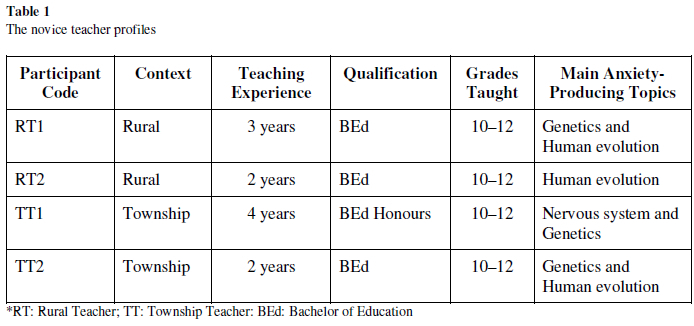
The study formed part of a broader National Research Foundation-funded teacher development project exploring anxiety and resilience in STEM education. Purposive sampling was employed to identify information-rich cases capable of providing insight into the emotional dimensions of life sciences teaching in under-resourced contexts (Patton, 2015). Phase 1, involved recruiting four novice life sciences teachers who were purposively selected, comprising two teachers from rural secondary schools in Northern KwaZulu-Natal and two from township secondary schools in Gauteng Province as shown in Table 1 below.
Participants were selected according to four criteria: (1) they taught life sciences in Grades 10-12, (2) they had fewer than five years of teaching experience, (3) they taught topics widely regarded as conceptually demanding, including genetics, human evolution, and human nervous system, and (4) they agreed to participate in all phases of the study, including completing questionnaires, workshops, classroom observations, and interviews. The intention was not statistical generalisation but analytical depth and contextual understanding consistent with interpretivist qualitative inquiry (Merriam & Tisdell, 2016). Rural and township schools were selected because they represent distinct educational environments characterised by different material conditions, classroom interactional norms, and linguistic practices that shape especially novice teachers' experiences of anxiety and resilience in different ways.
To establish baseline, teachers completed open-ended questionnaires adapted from Betz's (1978) mathematics anxiety instruments. The items were modified to focus on life science concepts (e.g. teaching genetics, and managing classroom discussions on evolution). To ensure content validity, the adapted instrument was reviewed by a panel of two science education researchers and piloted with two non-participating teachers before use. Although the questionnaire generated descriptive indications of anxiety across topics and teaching situations, it was not used as a psychometric instrument for measuring anxiety levels or for inferential statistical analysis. Instead, questionnaire responses were used alongside observations, field notes, and interviews to identify topics teachers found difficult to teach, situations that generated anxiety, and strategies employed to manage these experiences. These methods were deliberately combined to facilitate triangulation and capture not only what teachers reported about their experiences but also how these experiences were enacted in practice (Lincoln & Guba, 1985; Meydan & Akkaş, 2024). The initial phase provided a broad mapping of anxiety across contexts and informed the design of the subsequent workshop.
Phase 2 involved inviting all four participating teachers to a two-day workshop in Johannesburg, which served as a reflective, collaborative space where teachers were introduced to the Growth Zone Model, the Ladder Model, the Hand Model of the Brain, and the Relaxation Response. Rather than presenting these as prescriptive techniques, the workshop focused on how teachers could adapt these tools to their unique classroom settings. Discussions were audio-recorded and documented via detailed researcher field notes.
During Phase 3, the researcher conducted two classroom observations per teacher (eight observations total), using a structured observation schedule. Observations focused on how teachers introduced abstract concepts, handled student questions, used languages (code-switching), and responded to moments of tension or silence. Pre-intervention, post-workshop, and post-observation interviews (averaging 45-60 minutes) were conducted, recorded, and transcribed. These conversations allowed teachers to reflect on their pedagogical decisions and emotional experiences. The interviews were conducted in a conversational manner, allowing teachers to share their experiences in ways that were both personal and contextually grounded (Kvale & Brinkmann, 2015).
Data analysis was iterative and inductive, drawing on principles of thematic analysis to identify patterns across the dataset (Braun & Clarke, 2021). Rather than applying predefined categories, the analysis began with repeated readings of all data sources to develop familiarity and sensitivity to the nuances within teachers' accounts. Initial coding focused on instances where teachers described anxiety, uncertainty, or related emotional experiences, as well as the conditions under which these experiences arose. These codes were then examined in relation to one another, allowing patterns to emerge that reflected the layered and interconnected nature of anxiety in teaching. Particular attention was paid to how different factors such as resource constraints, language demands, classroom interaction, and structural pressures, combined to shape teachers' experiences of anxiety, its sources, how it is managed and how resilience is developed. Through this process, the analysis moved beyond listing challenges to developing analytically coherent themes that captured both the production of anxiety and the ways in which teachers responded to it. Differences between rural and township contexts were also carefully considered to avoid collapsing distinct experiences into a single narrative.
Several strategies were employed to enhance the trustworthiness of the study. The use of multiple data sources enabled triangulation, allowing findings to be supported by converging evidence across questionnaires, observations, interviews, and workshop discussions (Lincoln & Guba, 1985; Meydan & Akkaş, 2024). The iterative nature of the analysis, including repeated engagement with the data and refinement of themes, contributed to depth and credibility. The inclusion of verbatim excerpts from participants ensures that interpretations remain grounded in teachers' own voices, providing transparency and authenticity. In addition, the study adopted a reflexive stance, recognising the researcher's role in shaping both the data and its interpretation. Given the researcher's involvement in the workshop and familiarity with the educational context, ongoing reflection was necessary to balance insider understanding with critical distance (Berger, 2015; Dodgson, 2019).
Ethical clearance was obtained from the relevant institutional review boards, and participation in the study was voluntary. Informed consent was obtained from all participants, and confidentiality was maintained using pseudonyms (RT1, RT2, TT1, TT2). Given the sensitivity of discussing anxiety and professional challenges, care was taken to create a respectful and non-judgmental environment throughout the research process, ensuring that teachers could share their experiences openly and without fear of evaluation.
Presentation of the findings
Theme 1: Contextual production and immediate management of anxiety
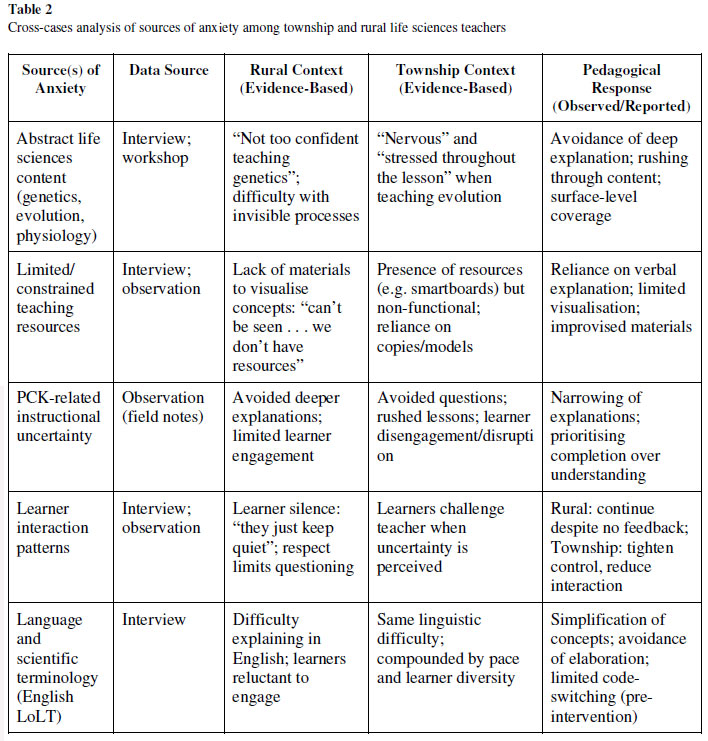
Across the dataset, novice teachers consistently described experiencing anxiety when teaching life sciences. Although topics such as genetics, human evolution, and the nervous and human nervous systems were frequently identified as difficult to teach, anxiety was not simply a consequence of conceptual complexity. Rather, the findings suggest that it emerged through the interaction of five sources: (1) difficulties explaining invisible processes, (2) limited opportunities for visualisation, (3) pedagogical uncertainty, (4) classroom interactional pressures, and (5) linguistic demands, as shown in Table 2.
Across the four cases, these conditions rarely operated in isolation. Rather, the findings suggest that they combined in ways that produced anxiety in real time while simultaneously shaping how teachers responded to it. For many novice teachers, anxiety began with the challenge of explaining abstract and invisible biological processes. However, this difficulty was experienced not only cognitively but also affectively as a lack of confidence in teaching. For example, during workshop discussions one rural life sciences novice teacher expressed that:
To be honest, genetics is the worst topic for me . . . I am not confident when I teach it. Even when I prepare, I feel unsure when learners start asking questions. (RT2_WD)
This sense of uncertainty appeared to intensify when novice teachers were required to respond spontaneously to learner questions, as one of the teachers added during the discussions:
Genetics and Evolutions are really stressful topics to teach, I really get nervous throughout the lesson, especially when learners start asking too many questions that I am unsure about . . . I am always worried I will not explain it properly and think I do not know answers to their questions. (TT2_WD)
These accounts suggest that anxiety was closely associated with PCK in use, particularly during moments where novice teachers were required to explain complex concepts or respond spontaneously to learner questions. This finding aligns with literature suggesting that teacher anxiety is shaped not only by content difficulty but also by contextual and instructional factors (Frenzel et al., 2018; Pekrun, 2014). Similar patterns have been reported in science education, where teachers' uncertainty about explaining complex concepts contributes to instructional anxiety (Udo et al., 2004).
The difficulty of explaining such content was compounded by limited or ineffective teaching resources, which restricted the novice teachers' ability to make abstract concepts visible. In rural contexts, this absence was explicitly expressed during semi-structured interviews, where one novice teacher explained:
These things like DNA, genes when teaching genetics they can't be seen. And we don't have resources to show them. That makes it stressful and very frustrating to teach, yes, the textbooks help but videos would help bring these structures and their processes to life . . . we theorise too much and sometimes it's frustrating because you go on and on and you can see that the learners are confused and I sometimes end up confusing myself as well and start panicking. (RT1_SI)
In township contexts, the issue was not always the absence of teaching resources but rather the functionality of the resources already available. One novice teacher explained during the semi-structured interview:
We have smartboards, but most of them don't work. So, you end up just explaining everything which is mentally exhausting and stressful. (TT1_SI)
In both contexts, classroom observations indicated that the lack of visual support intensified novice teachers' reliance on verbal explanation, increasing pressure to explain certain concepts clearly and accurately and thereby amplifying anxiety. These observations are consistent with broader findings suggesting that limited access to appropriate teaching resources may constrain science instruction and contribute to experiences of stress and uncertainty among teachers (Mavhunga & Rollnick, 2017; OECD, 2019).
In rural classrooms, novice teachers described learner silence as a persistent challenge that limited their ability to assess understanding, as one teacher noted during workshop discussions:
You ask a question, and they just keep quiet . . . you don't know if they understand or they are completely lost. (RT1_WD)
This silence was often interpreted within cultural norms of respect, as another rural novice teacher explained during the semi-structured interview:
They respect the teacher too much. Even if they don't understand, they won't ask. (RT2_SI)
Field observations confirmed extended teacher talk with minimal learner feedback. In this context, anxiety emerged not from content difficulty alone but from uncertainty about whether teaching was effective. Teachers often responded by continuing with the lesson despite this uncertainty, as illustrated by one rural teacher's response during the semi-structured interview:
You just continue because if you wait, nothing happens. (RT1_SI)
In township classrooms, the interactional dynamic was markedly different. Rather than silence, the two novice teachers described learner challenge and the risk of losing control. For example, one teacher explained during workshop discussions:
When learners see that you are not sure, they start challenging you . . . and then the lesson becomes difficult. (TT1_SI)
These sentiments suggest that anxiety was linked not to the absence of feedback, but to the public exposure of uncertainty within highly interactive and sometimes disruptive classrooms. These interactional differences further suggest that teachers' experiences of anxiety may be shaped not only by content demands but also by the social organisation of classroom participation (Frenzel et al., 2018).
Layered onto these challenges was the issue of language, which novice teachers identified as a persistent source of anxiety. The difficulty lay not only in using English as the language of instruction but also in combining it with specialised scientific terminology. This form of anxiety was evident across both contexts. For example, one rural novice teacher explained during the post-observation interview:
I understand the concept but explaining it in English using those terms is difficult and doesn't even help simplify the terms so it is better when I try to use isiZulu which is a language both myself and learners are familiar with. (RT1_SI)
One township novice teacher echoed similar concerns:
Sometimes I panic when I have to explain using those terms, Especially, Australopithecus Africanus, Omo sapiens, Homo erectus, Homo habilis and homo what whats yohh aii [phrases signalling distress] . . . because the topic in general makes me uncomfortable . . . so during the nerves if I say these terms wrong, aiii the learners lose confidence in me and it's stressful . . . and explaining in English doesn't help simplify these terms either and funny because I realised that in the township learners do not like talking English at all even saying the terms they usually avoid saying the terminology. (RT2_SI)
Novice teachers reported that these linguistic demands sometimes resulted in simplification of explanations or avoidance of further elaboration during lessons. As one novice rural teacher explained:
Sometimes you just try to simplify and move on so that you don't confuse them more. (RT2_WD)
This finding aligns with literature showing that the language of instruction and disciplinary discourse can act as barriers to meaningful engagement in science classrooms (Mavhunga & Rollnick, 2017). In sum, the findings from these four cases suggest that anxiety in life sciences teaching may be better understood as a layered and contextually produced phenomenon rather than a singular or isolated experience. Anxiety emerged through the interaction of conceptual difficulty, resource limitations, interactional dynamics, and language demands. At the same time, novice teachers' responses to anxiety were immediate and embedded within practice, often oriented towards maintaining lesson flow and curriculum progression. In this sense, anxiety and its management were inseparable processes unfolding within the everyday realities of classroom teaching practices.
Theme 2: Reworking pedagogy and the emergence of resilience through practice
During classroom observations and semi-structured interviews, the participating novice teachers continued to describe experiences of anxiety associated with abstract content, classroom interaction, and linguistic demands. However, after being exposed to the STEM resilience toolkit, the novice teachers reported shifts in how they interpreted and responded to these experiences within their teaching practice. Although anxiety remained present, particularly when engaging with abstract content, large classes, and linguistic demands, the findings suggest movement away from purely control-oriented responses towards more deliberate and reflective pedagogical adjustments, albeit unevenly and within contextual constraints.
Several novice teachers described a rethinking of what anxiety meant within teaching. Previously, moments of uncertainty were experienced as indicators of "weakness" or "lack of competence." Following participation in the workshop, most of the novice teachers began to reinterpret these moments as part of the teaching process. For instance, one rural teacher explained during the post-observation interview:
Yohh, I remember before the workshop, when I felt anxious, I used to think that it means I am failing as a teacher. . . . But now I see it is part of learning, even for me, I think for the first time I really understand what it means to be a lifelong learner. (RT2_POSI)
Another township novice teacher expressed similar sentiments:
Although I still get nervous when I teach difficult topics like DNA, genetics . . . but I don't panic the same way and lose control and embarrass myself. I try to work through it instead of avoiding it, because that feeling of shame stays with you forever and it becomes loud and stressful with each and every lesson. . . . Now I am not afraid to tell my learners that their questions put me in the red-zone which is the danger zone . . . a language we now use during our lesson when using the Growth Zone Model and I must say it does kinda bring a little fun. (TT1_POSI)
These moments did not represent a complete transformation of practice but suggest a growing recognition that emotional responses are part of teaching and learning. This aligns with work on the affective dimensions of pedagogy (Martin & Wilson, 2025), although in this study it was grounded in teachers' attempts to manage both their own and their learners' anxiety simultaneously. The data also indicate that these shifts were neither consistent nor uniform.
Most of the novice teachers frequently described moving between new and established practices depending on context, time pressures, and topic difficulty. For example, one rural teacher explained during the post-interview:
Sometimes I try these approaches, but they take time, so when exams are near, I go back to just teaching and finishing quickly despite how everyone feels including myself. (RT1_POSI)
Another novice teacher in the township context similarly admitted:
It's not easy to change completely. When the class is difficult, you go back to what you know. (RT2_POSI)
These accounts suggest that resilience development may be non-linear and time dependent. Rather than replacing control-oriented approaches entirely, teachers appeared to expand their pedagogical repertoire, drawing on different strategies according to the demands of particular teaching situations and time available.
The uptake of workshop tools was similarly uneven across contexts. In rural classrooms, elements of the Growth Zone Model were used to normalise confusion and encourage participation. One novice teacher explained during the semi-structured interview:
I tell them it is okay not to understand immediately or all the time. Real learning happening in the learning zone. I now stop to also ask who is in the red zone when I see that they are giving me those blank stares or when they go silent whenever I ask a question. (RT1_POSI)
In township classrooms, novice teachers more frequently combined the Growth Zone Model with either breathing exercises or the Ladder Model as a means of structuring and scaffolding lessons. For example:
The ladder model helps me and the learners to better scaffold or organise the lesson so no one feels lost and confused . . . we do not climb the next rung unless we are certain that almost everyone is on the same rung . . . I now find myself saying "are we all climbing together?" and they usually provide hilarious responses sometimes. (TT2_POSI)
These findings suggest that professional learning was interpreted and adapted within local contexts rather than directly implemented, a pattern similarly observed in teacher professional development literature (Admiraal et al., 2021).
Overall, the findings suggest that resilience was experienced less as a fixed personal trait and more as a situated pedagogical practice through which teachers attempted to remain engaged with difficult teaching situations. Rather than emerging through the absence of anxiety, resilience developed through teachers' efforts to work productively with uncertainty while adapting their pedagogical responses to the constraints and possibilities of their contexts. Structural, linguistic, and interactional conditions continued to shape these efforts, meaning that resilience was characterised not by the elimination of anxiety but by changes in how novice teachers worked with it.
Discussion, implications, limitations, and conclusion
This study sought to understand how novice life sciences teachers in rural and township contexts experience and manage anxiety in their teaching practice, identify its sources, and explore how resilience develops under these conditions. What emerges is not a simple account of anxious novice teachers becoming resilient through intervention, but a more nuanced account of teachers working within layered constraints, negotiating uncertainty, and gradually reworking their pedagogical responses in ways that are both enabling and constrained.
A central insight from this study is that anxiety in life sciences teaching cannot be adequately understood as an individual or purely cognitive phenomenon. Although existing literature often associate anxiety with the abstract nature of scientific concepts and disciplinary language (Ashcraft, 2002; Pekrun, 2014), the findings suggest that such explanations are often incomplete. Across the four cases, anxiety emerged through the interaction of multiple contextual conditions. These ranged from difficulties in representing invisible processes and PCK-related uncertainty to resource constraints, limited classroom interaction, overcrowding, pacing pressures, and the complexities of teaching through a second language. These conditions interacted in ways that intensified the emotional demands of teaching and situated anxiety within the everyday realities of classroom practice.
Importantly, these conditions were not experienced uniformly. Rural novice life sciences teachers' anxiety appeared to be shaped largely by learner silence and the difficulty of interpreting understanding, whereas township novice teachers experienced anxiety more acutely through overcrowding, pacing, and the negotiation of authority in highly interactive classrooms. This distinction challenges tendencies to generalise teacher anxiety and instead points towards a more contextually differentiated understanding of how anxiety is produced and experienced in schools often grouped together as under-resourced. The findings therefore suggest that life sciences novice teachers' experiences of anxiety are shaped not only by disciplinary content but also by the conditions under which teaching occurs.
At the same time, the findings complicate deficit-oriented interpretations of teacher anxiety. The findings revealed that the four participating life science novice teachers were not passive recipients of anxiety; rather, they actively managed it in ways that made sense within their immediate teaching contexts. Practices such as simplifying content, limiting questioning, and prioritising lesson continuity may easily be interpreted as shortcomings. However, within these contexts they emerged as situated responses to uncertainty, pressure, and limited resources. This reframing shift attention from what teachers lack towards how they cope, adapt, and sustain teaching under constrained conditions, raising important questions about how teacher competence is evaluated in such environments.
Participation in the workshop did not eliminate these challenges, nor did it produce uniform changes in practice. Rather, post-workshop interviews and classroom observations suggested that some teachers began to reinterpret moments of uncertainty less as indicators of failure and more as expected features of teaching complex scientific ideas. For several participants, this appeared to create opportunities to remain engaged with difficult content, experiment with alternative pedagogical responses, and create greater space for learner participation.
These developments were neither linear nor complete. Teachers moved between new and familiar practices, particularly under pressures associated with time constraints and assessment demands. The uptake of workshop tools was similarly uneven, with teachers adapting them to their classroom realities rather than implementing them directly. These findings suggest that professional development may be better understood as a process of interpretation, negotiation, and contextual adaptation rather than simple implementation or transfer (Admiraal et al., 2021). The value of such initiatives may therefore lie less in fidelity of implementation and more in their ability to create opportunities for teachers to rethink practice, even when such change remains partial or temporary.
These findings carry implications for both policy and practice. Supporting life sciences novice teachers requires moving beyond a narrow focus on content knowledge towards addressing the broader conditions shaping teaching, including resources, classroom organisation, language, and interactional norms. Professional development should be context-responsive and support novice teachers in adapting strategies to their local realities rather than applying them prescriptively. Equally important is the recognition that emotions are not peripheral to teaching but integral to professional practice. Science teacher professional development programmes may therefore benefit from attending explicitly to teacher emotions, uncertainty, and vulnerability alongside disciplinary knowledge and PCK.
The study is not without limitations. As an interpretivist qualitative study involving four participants, the intention was not statistical generalisation but contextual and analytical insight into teachers' experiences of anxiety and resilience within specific educational settings. Furthermore, the study captured a particular moment in time and therefore cannot speak to the long-term sustainability of the observed shifts in practice. Teachers' reflections may also have been influenced by their participation in the workshop discussions. These limitations point towards the need for future longitudinal research examining how anxiety and resilience evolve across time and contexts.
In conclusion, this study offers a contextually grounded account of anxiety and resilience in life sciences teaching. The findings suggest that anxiety may be more productively understood as a response to the conditions under which teaching occurs rather than as an individual deficit located solely within teachers themselves. Resilience similarly emerged not through the absence of anxiety but through teachers' efforts to remain pedagogically engaged despite uncertainty and constraint. The findings therefore provide a more grounded basis for thinking about support, professional development, and change within science education.
References
- Admiraal, W., Schenke, W., De Jong, L., Emmelot, Y., & Sligte, H. (2021). Schools as professional learning communities: What can schools do to support professional development of their teachers? Professional Development in Education, 47(4), 684-698. https://doi.org/10.1080/19415257.2019.1665573
- Alon, L., Schwarts, G., & Sabbah, S. (2025). Resilience as a pedagogical process: A multidimensional model of STEM teachers' cognitive, emotional, and social resilience during crisis. Teaching and Teacher Education, 167, 105225. https://doi.org/10.1016/j.tate.2025.105225
- Ashcraft, M. H. (2002). Math anxiety: Personal, educational, and cognitive consequences. Current Directions in Psychological Science, 11(5), 181-185. https://doi.org/10.1111/1467-8721.00196
- Beilock, S. L. (2008). Math performance in stressful situations. Current Directions in Psychological Science, 17(5), 339-343. https://doi.org/10.1111/j.1467-8721.2008.00602.x
- Benson, H. (2000). The relaxation response. Harper Collins.
- Betz, N. E. (1978). Prevalence, distribution, and correlates of math anxiety in college students. Journal of Counseling Psychology, 25(5), 441-448. https://doi.org/10.1037/0022-0167.25.5.441
- Boateng, S., Mudadigwa, B., & Johnston-Wilder, S. (2025). Examining gendered patterns in mathematics and science anxiety levels among physical science pre-service teachers. Eurasia Journal of Mathematics, Science and Technology Education, 21(1), Article em2564. https://doi.org/10.29333/ejmste/15800
- Braun, V., & Clarke, V. (2021). Thematic analysis: A practical guide. SAGE.
- Buma, A., & Nyamupangedengu, E. (2023). Investigating the quality of enacted pedagogical content knowledge by mapping out component interactions: A case study of a teacher educator teaching basic genetics. Journal of Science Teacher Education, 34(8), 820-840. https://doi.org/10.1080/1046560X.2022.2158267
- Creswell, J. W., & Poth, C. N. (2018). Qualitative inquiry and research design: Choosing among five approaches (4th ed.). SAGE.
- Day, C., & Gu, Q. (2014). Resilient teachers, resilient schools. Building and sustaining quality in testing times. Routledge. https://doi.org/10.4324/97802 03578 490
-
Flores, M. A. (2020). Preparing teachers to teach in complex settings: Opportunities for professional learning and development. European Journal of Teacher Education, 43(3), 297-300. https://doi.org//297-300. doi:10.1080/ 02619768.2020.1771895
» https://doi.org/10.1080/ 02619768.2020.1771895 - Johnston-Wilder, S., & Lee, C. (Eds.). (2024). The mathematical resilience book: How everyone can progress in mathematics. Taylor & Francis.
- Kvale, S., & Brinkmann, S. (2015). Interviews: Learning the craft of qualitative research interviewing (3rd ed.). SAGE.
- Lee, C., & Johnston-Wilder, S. (2014). Mathematical resilience: What is it and why is it important? In S. Chinn (Ed.), The Routledge international handbook of dyscalculia and mathematical learning difficulties (pp. 337-345). Routledge.
- Lincoln, Y. S., & Guba, E. G. (1985). Naturalistic inquiry. SAGE.
- Mansfield, C. F., Beltman, S., Broadley, T., & Weatherby-Fell, N. (2016). Building resilience in teacher education. Teaching and Teacher Education, 54, 77-87. https://doi.org/10.1016/j.tate.2015.11.016
- Martin, R., & Wilson, S. (2025). Uncovering the emotional dimension of developing teaching practice through uncertainty: A multimodal methodology. International Journal for Academic Development, 30(3), 331-344. https://doi.org/10.1080/1360144X.2024.2358832
- Mavhunga, E., & Rollnick, M. (2017). Implementing PCK topic by topic in methodology courses. In A. Sickel & S. Witzig (Eds.), Designing and teaching the secondary science methods course: An international perspective (pp. 149-170). Sense Publishers.
- Merriam, S. B., & Tisdell, E. J. (2016). Qualitative research: A guide to design and implementation (4th ed.). Jossey-Bass.
- Meydan, C. H., & Akkaş, H. (2024). The role of triangulation in qualitative research: Converging perspectives. In A. Elhami, A. Roshan, & H. Chandan (Eds.), Principles of conducting qualitative research in multicultural settings (pp. 101-132). IGI Global.
- Molin, F., Cabus, S., Haelermans, C., & Groot, W. (2021). Toward reducing anxiety and increasing performance in physics education: Evidence from a randomized experiment. Research in Science Education, 51, 233-249. https://doi.org/10.1007/s11165-019-9845-9
- OECD. (2019). PISA 2018 results (Volume I): What students know and can do. https://doi.org/10.1787/5f07c754-en
- Patton, M. Q. (2015). Qualitative research & evaluation methods (4th ed.). SAGE.
- Pekrun, R. (2014). Emotions and learning (Educational Practices Series, Vol. 24). International Academy of Education and International Bureau of Education.
- Putwain, D. W., & Daly, A. L. (2014). Test anxiety prevalence and gender differences in a sample of English secondary school students. Educational Studies, 40(5), 554-570. https://doi.org/10.1080/03055698.2014.953914
- Siegel, D. J. (2012, February 29). Dr. Daniel Siegel presenting a hand model of the brain [Video]. YouTube. https://www.youtube.com/watch?v=gm9CIJ74Oxw
Accepted: 11 August 2026