The potential of ubuntu in shaping an African perspective of entrepreneurial education
Abstract
This study explores how a botho/ubuntu-oriented pedagogy of entrepreneurial education can be realised within the school curriculum while navigating the dialectical tensions between neoliberalism and botho/ubuntu philosophy in education and Botswana's economic development agenda. It takes, as a point of departure, the assumption that the pursuit of national development under the influence of globalisation requires a give-and-take interaction between local and global influences, wherein local programmes take the shape of local needs and values while simultaneously incorporating international influences (DeJaeghere, 2017; Tabulawa, 2023). Therefore, this study employs a Hegelian dialectical theoretical framework to explore the dialectical tensions between neoliberal entrepreneurialism and botho/ubuntu philosophy, aiming to develop a botho/ubuntu-oriented perspective on entrepreneurial education. The findings reveal that, although entrepreneurship education may not be receiving sufficient critique, a syncretism may be forged between botho/ubuntu and entrepreneurship in practice and education.
botho; entrepreneurial education; entrepreneurship education; neoliberalism; globalisation; botho pedagogy
Introduction
Across the globe, the culture of entrepreneurialism has been on the rise. Education has become a means through which young people are socialised towards being entrepreneurial citizens. For many African countries such as Botswana, developing entrepreneurial citizens is even more appealing for the following reasons: Botswana experienced a series of recessions in the years 2012, 2015, and 2020 owing to lack of diversification from minerals; unemployment figures rose from 17.6 per cent in the year 2015 to 22.7 per cent in the year 2022 (with the 15-24 age group reported at 43.6 per cent); decline in poverty reduction, with more than 330,000 people living in poverty in a population of 2.3 million; and being among the top 10 unequal nations in the world with a Gini coefficient of 53 per cent in rural areas and 51.1 per cent in urban areas, respectively (World Bank, 2024). Additionally, Botswana aspires to develop into a high-income, knowledge-based economy by 2036 (Government of Botswana, 2016; World Bank, 2024). Such an economy requires the use of new technologies and innovations, as well as a highly skilled, versatile, adaptable, and innovative workforce and entrepreneurs, to increase its competitiveness in the global space (Tabulawa, 2023). As a result, Botswana's educational policy reform has taken a neoliberal turn, beginning with the advent of the Revised National Policy on Education (RNPE; Republic of Botswana, 1994) to the latest policy known as the Education and Training Sector Strategic Plan (ETSSP) 2015-2020 (Republic of Botswana, 2015a) with the hope of achieving the aforementioned aspirations (Tabulawa, 2009, 2023).
Peters (2001, p. 60) has characterised neoliberalism as "a shift from a welfare state to a Schumpeterian workfare state." This implies rolling back the government's role in the economy and allowing the private sector to play a more prominent role. Put another way, from a neoliberal perspective, every citizen's well-being is optimised when every individual within a society egoistically pursues their happiness through the exercise of choice and freedom to make decisions that maximise wealth accumulation for themselves (Rose, 1998, as cited in Lackéus, 2017). Understandably, the neoliberal turn is characterised by the reversal of welfare development models, with a preference for privatisation, marketisation, competition, and regulation, among others (Tabulawa, 2023).
Unfortunately, such a policy shift at the national development level and educational policy reform is paradoxically antithetical to botho/ubuntu philosophy, which is central to the African way of life in many African nations in Southern Africa, Eastern Africa, and even Western Africa (DeJaeghere, 2017; Kupangwa, 2025). In Botswana, botho philosophy is enshrined in the national development agenda, as demonstrated by its significant role in the national Vision 2036 (Government of Botswana, 2016) as well as more recent key documents in education, such as the ETSSP (Republic of Botswana, 2015a) and the National Curriculum and Assessment Framework (Republic of Botswana, 2015b).
By definition, botho encompasses values such as humaneness, ethics, morality, solidarity, collectivism, and communalism (Bohwasi, 2020; Gareegope, 2020). It brings together the ideas of morality, character, and development. Characteristically, a person with botho possesses "a well-rounded character . . . is well-mannered, courteous and disciplined, and realises his or her full potential both as an individual and as a part of the community to which he or she belongs" (Government of Botswana, 1997, p. 5). Understandably, so pivotal is botho to Botswana that the national Vision 2016 urged for it to "permeate every aspect of our lives, like the air we breathe" by integrating it into the education system, the home, community life, the workplace, and national policy as a central pillar that holds these institutions together (Government of Botswana, 1997, p. 5).
Interestingly, the consequences of choosing a neoliberal path in national development and educational policy reforms, which emphasise neoliberal entrepreneurialism and the potential resultant contradictions, have not been seriously interrogated. The shift towards entrepreneurialism in education has the potential to cause tensions with the values of the philosophy of botho/ubuntu, and even overshadow them (DeJaeghere, 2017). These tensions stem from the fact that neoliberal entrepreneurial education promotes values such as individualism, competition, and materialism, while simultaneously exacerbating inequalities and inequities in society (Berglund, 2013; Giroux, 2005), which are contradictory to the spirit of botho/ubuntu mentioned above (DeJaeghere, 2017). Even with these concerns, Botswana and other Southern African countries such as Lesotho and South Africa emphasise an entrepreneurial education strand that emphasises the individualistic economic rationalism of the free market economy (Dungey & Ansell, 2022; Waghid, 2019). For example, Waghid found that the curricula for secondary school economic and management sciences and business studies in South Africa do not adequately integrate social entrepreneurship, and it is not even included in the training of pre-service teachers. This means that although botho/ubuntu is one of the national values and principles of many African countries, there seems to be no clarity on how its values will be integrated into entrepreneurship-related curricula.
Therefore, the purpose of this study is to investigate whether a botho/ubuntu-oriented pedagogy of entrepreneurship education can be incorporated into the school curriculum. It takes a pragmatic view that the neoliberal shift in the local economy and education is a reality that cannot be easily escaped, and an understanding that global influences on local states are not zero sum (DeJaeghere, 2017; Tabulawa, 2023). Therefore, local states can develop local versions of policies and programmes that may take a different shape from where they originate as they are integrated into local contexts.
Method
This position paper is structured as a conceptual analysis of key documents that drive Botswana's educational reform and national development agenda, examining them through the lens of literature on botho philosophy and entrepreneurial education. The documents that we analysed included:
• Report of the National Commission on Education (Republic of Botswana, 1993).
• Revised National Policy on Education (Republic of Botswana, 1994).
• Education and Training Sector Strategic Plan (ETSSP; Republic of Botswana, 2015a).
• National Curriculum and Assessment Framework (NCAF; Republic of Botswana, 2015b).
• The first national vision statement that was guiding planning and policy at the beginning of the millennium, Vision 2016 (Government of Botswana, 1997).
• The second national vision statement, Vision 2036 (Government of Botswana, 2016).
• Business subjects syllabi at secondary school.
The analysis focused on how these different documents address the nexus between Botho philosophy and entrepreneurialism in education, particularly as influenced by the neoliberal agenda.
The findings reveal that the Report of the National Commission on Education (Republic of Botswana, 1993) was the first document to set the stage for a shift towards neoliberal globalisation. It emerged at a time when global economies were deeply engaged in the discourse of a shift towards fast capitalism (Tabulawa, 2023). This commission led to the development of the RNPE (Republic of Botswana, 1994), which is saturated with neoliberal terminology, including concepts such as creativity, innovation, problem-solving, lifelong learning, and self-employment. The nexus between the economy and education is here emphasised, where education is presented as a panacea to address socioeconomic problems and drive the development agenda, thereby increasing Botswana's competitiveness in global markets.
Furthermore, the RNPE also led to the introduction of commercial subjects at both junior secondary school and senior secondary school levels for the first time in 1998 (Republic of Botswana, 1994; Weeks, 2002). Although entrepreneurship was not established as a separate subject during this period, a substantial number of topics related to entrepreneurship were included in the business studies syllabi at junior secondary school (Republic of Botswana, 2008a, 2008b). The teaching period allocated for entrepreneurship content is 40%, which accounts for 90 of the 230-238 periods allocated for the subject within a 3-year period (Farstad, 2002). At senior secondary school, prior to the advent of ETSSP (Republic of Botswana, 2015a), entrepreneurship was infused into the business studies syllabus. However, there is also a notable silence on the mention of botho in business subjects' syllabi at both these levels of lower education. This absence of the explicit reference to botho philosophy is also notable in both the Ten Years Basic Education Programme (Republic of Botswana, 1995) and the Senior Secondary School Programme curriculum blueprints (Republic of Botswana, 1998).
However, a later reform, in the ETSSP (Republic of Botswana, 2015a) and its curriculum blueprint, the NCAF (Republic of Botswana, 2015b) seems to carry forward the ideals of neoliberalism in education while also espousing botho philosophy. In terms of a neoliberal outlook on the economy, the ETSSP, NCAF, and business subjects' syllabi that emerged from this latest reform continued to emphasise the need to shift towards a knowledge economy. Challenges of high unemployment and the lacklustre performance of the diamond industry were cited as among the major reasons for such a shift in the syllabi for business subjects (Republic of Botswana, 2020). Furthermore, these key documents highlighted botho as one of the cardinal pillars in Botswana's education system. In fact, the NCAF went further to unpack what an education anchored in botho philosophy should focus on. It proposed that education should foster the traditional values of botho by promoting appreciation for one's culture and tolerance for cultural diversity; developing responsible citizens capable of managing their own affairs; encouraging a culture of excellence and good work ethic; instilling values of compassion, care for others, and justice; building personal discipline and accountability; and producing citizens with a high moral values and tolerance (Republic of Botswana, 2015b).
Contrary to the RNPE (Republic of Botswana, 1994), the ETSSP introduced a fully-fledged entrepreneurship subject at the senior secondary education level. Notably, this newly developed syllabus arising from the ETSSP (Republic of Botswana, 2015a) explicitly referenced botho philosophy at least twice. In line with botho, they aimed to inculcate in learners a "cultural and national identity, including the inculcation of attitudes and values that nurture respect for self and for others" (Republic of Botswana, 2020, p. 5). Interestingly, the entrepreneurship syllabus readily acknowledges that the NCAF is "a consolidation of national and global policy documents" (Republic of Botswana, 2020, p. 13), but there is no mention of the potential tension between the botho philosophy and neoliberal globalisation that has contributed to the educational reform, and how those tensions will be defused. The content of entrepreneurship remains uncritically heavily skewed towards an individualistic, economic, and profit-oriented approach. No mention is made of alternative approaches such as social entrepreneurship, especially for a curriculum founded on botho philosophy. Therefore, we employ the Hegelian dialectical theoretical framework to explore the possibilities of a botho-oriented pedagogy of entrepreneurial education. This framework is explicated in the section below and drives the rest of the study.
Theoretical framework
This study adopts the Hegelian dialectical framework because the interactions between neoliberal entrepreneurialism and botho/ubuntu ideology are dialectical. According to Basseches (2005), the concept of dialectic entails developmental transformation that happens through constitutive and interactive relationships. The Hegelian dialectical framework appears suitable due to its idealistic and pragmatic nature, which fosters an understanding and synthesis between perspectives that may exhibit dialectical tensions (Basseches, 2005; Lackéus, 2017). It consists of three main steps: 1) thesis, that is, the presentation of a particular perspective on a controversial matter, 2) antithesis, the presentation of an opposed perspective on the same matter, 3) synthesis/sublation, the infusion of the two antithetical positions to engender a deeper and more nuanced understanding (Dybicz & Pyles, 2011; Lackéus, 2017; Saumantri, 2023). Therefore, dialectical thinking and analysis seem suitable for examining the dialectical tensions arising from the process of social and economic re-engineering in globalised neoliberal entrepreneurialism because it interacts with botho/ubuntu philosophy's outlook on development and education from local contexts. It enables the development of a pragmatic and syncretised view of entrepreneurial education that balances global and local demands yet remains relevant for 21st-century learners. Our use of the Hegelian dialectical framework is inspired by Lackéus (2017), who employed it in entrepreneurial education research to investigate whether entrepreneurship education leads to more or less neoliberalism, with a particular focus on European contexts.
Thesis: Entrepreneurial education cultivates more neoliberal dispositions in learners
Entrepreneurship in education is often discussed using the terms "entrepreneurship education" and "enterprise education," which are often used interchangeably as if they were synonymous (Erkkilä, 2000; Mwasalwiba, 2010). At face value, it appears that entrepreneurship education is a term commonly used in the United States of America and Canada, whereas enterprise education is a more European term (Mwasalwiba, 2010). However, the differences extend far beyond the geographical location to include philosophical orientations, the substance of the subject matter, the ways of implementation in the classroom, and the expected learning outcomes (Dal et al., 2016; Erkkilä, 2000; Jones & Iredale, 2010; Lackéus & Sävetun, 2019). In other words, these two terms form the facets of entrepreneurship in education, for which an umbrella term, entrepreneurial education, has been adopted (Erkkilä, 2000).
Ideologically, enterprise education is grounded in the ideals and values of humanism and liberal education, promoting the principles of equality, equity, individual freedom, and liberty within the business context. In contrast, entrepreneurship education is predicated on libertarianism or neoliberalism (Jones & Iredale, 2010). Characteristically, neoliberalism operates on the principles and values of capitalism, which include, among others, the free market, risk-taking, and competition to satisfy one's quest for materialism, personal happiness, and wealth creation (Komulainen et al., 2013). On the other hand, liberalism, or liberal education, celebrates the ideals, ethos, and values of humanism, such as equality, equity, and solidarity, above the pursuit of happiness and hedonistic pleasure-seeking (Komulainen et al., 2013).
Entrepreneurship education, also known as external entrepreneurship (Dal et al., 2016; Ruskovaara & Pihkala, 2015) or the narrow approach to instructing students on entrepreneurship (Lackéus & Sävetun, 2019), has an economic leaning, focusing on equipping learners with entrepreneurship content to develop entrepreneurial competencies to create, manage, and grow their ventures (Jones & Iredale, 2010; Lackéus & Sävetun, 2019). Enterprise education, on the other hand, focuses more on entrepreneurial pedagogies or instructional methods employed across various subjects in the curriculum and at all levels of education, rather than teaching entrepreneurship content (Garnett, 2013; Lackéus & Sävetun, 2019; Leffler, 2009). As a result, it has earned itself the appellation pedagogical entrepreneurship (Dal et al., 2016) or the broader view of entrepreneurial education. It is premised on what Lackéus and Sävetun (2019, p. 35) have termed the "inverted definitional foundation" because it focuses on inculcating general enterprising skills, attributes, and attitudes possessed by entrepreneurs, excluding the element of new business formation (Caird, 1990; Dal et al., 2016; Lackéus & Sävetun, 2019).
In European countries such as Austria, Finland, Ireland, and the United Kingdom, enterprise education is introduced at the primary education level, whereas entrepreneurship education is offered from secondary school through to tertiary education (Hytti & O'Gorman, 2004). Quite notably, in these European countries, some teachers are reportedly reluctant, and struggle to teach enterprise education due to the ambiguity and lack of generally accepted conceptualisations (Haara et al., 2016; Leffler, 2009). Tensions also emanate from perceived ideological contradictions, where educators and researchers alike feel that neoliberal entrepreneurial education is fast replacing the humanistic liberal values of their education with neoliberal values (Ringarp, 2013). These tensions are pronounced in Nordic countries between the local philosophy of education, Bildung (based on humanism and liberalism), and neoliberal-oriented entrepreneurial education (Kergel, 2021; Komulainen et al., 2013; Leffler, 2009; Ringarp, 2013).
Botswana, like many other southern African countries, such as South Africa and Lesotho, entrepreneurial education, although infused in other subjects, appears to adopt an economic or neoliberal orientation without any comparable protest. In Botswana, entrepreneurship was introduced into the junior secondary school business studies curriculum in 1998 and into the senior secondary school curriculum in 2000 (Weeks, 2002). This introduction followed the advent of the Revised National Policy on Education (Republic of Botswana, 1994), which was greatly influenced by globalised neoliberalism, whose aim in education (among others) is to develop self-entrepreneurial citizens to meet the demands of a capitalist labour market (DeJaeghere, 2017; Tabulawa, 2023). Around the same time, in South Africa, entrepreneurship was integrated into economic and management sciences (EMS) in 2000, and into business studies in 2005 (Waghid, 2019). A similar trend is observed in Lesotho, where the 2009 curriculum and assessment policy is replete with neoliberal ideals and terminology, such as entrepreneurship, creativity, innovation, and self-employment (Dungey & Ansell, 2022). Although all these countries espouse botho/ubuntu, there appears to be a scarcity of studies that examine the extent to which these neoliberal developments in education, particularly through entrepreneurship education, are compatible with or incompatible with the perspective of the botho/ubuntu philosophy.
The neoliberal ideology and its effect on entrepreneurial education
Entrepreneurial education, as noted above, is not ideologically neutral. The question then is: "What makes neoliberal-influenced entrepreneurial education problematic?" This can be answered by understanding neoliberalism as an ideology of economic development. Giroux (2005, p. 12) argued that neoliberalism extends far beyond being a mere economic ideology, but is an "implicitly cultural theory-a historical and socially constructed ideology that needs to be made visible, critically engaged, and shaken from the stranglehold of power it currently exercises over most of the commanding institutions of national and global life."
Through a form of control that is known as the regulation approach, the neoliberal architecture uses the twin processes of "regime of accumulation" and "modes of regulation" to impose on a national economy a hegemonic structure of wealth accumulation and protection in favour of the ruling class (Tabulawa, 2023). In the process, it reverses liberal policies intended to tame excessive corporate power by transferring it to profit-driven financial markets (Giroux, 2005; Tabulawa, 2023). This allows the ultra-rich minorities and their corporations to freely exercise undue hegemonic power using state institutions to destroy democracy, subjugate the marginalised, and increase the inequality gap while attributing their plight to a lack of self-determination and entrepreneurial spirit (Gill, 2014; Giroux, 2005; Petersen & O'Flynn, 2007, as cited in Lackéus, 2017).
Furthermore, neoliberalism can be understood as a process of cultural reconstruction (Peters, 2001; DeJaeghere, 2017). DeJaeghere (2017, p. 23) related this process of cultural reconstruction to entrepreneurship education, which she deemed "a technology of governing and a technology of self that are used by entities such as international agencies, governments and communities to shape and produce citizens towards specific ends." As a governance technology, entrepreneurship education is integrated into policies and programmes that encourage and support youth participation in entrepreneurship. As a technology of the self, it uses educational practices to foster their responsibilisation and participation in their national economies; once socially engineered in this way, they willingly reshape their identities to become entrepreneurs or be gainfully employed as self-entrepreneurial employees (DeJaeghere, 2017).
The spirit of entrepreneurialism, which is propagated through concepts such as the entrepreneurial self or the entrepreneurial citizen, one of the features of neoliberalism, has been problematised (Kergel, 2021; Peters, 2001; Struame, 2011). An entrepreneurial citizen could either be an entrepreneur who uses their talents, knowledge, and skills to create new ventures or an enterprising individual who applies their enterprising skills, such as creativity, innovation, autonomy, adaptability, and multitasking for success within an organisation (Caird, 1990; Kergel, 2021; Tabulawa, 2023). For learners who might become entrepreneurs, entrepreneurship is often portrayed as a means to address socioeconomic issues such as poverty and unemployment. With a shift from welfarism to fast-capitalist ideology, governments see it as their responsibility only to ensure that there are graduates with the right skills to exploit existing job opportunities or even create employment for themselves and other unemployed citizens. While this understanding brings closer together the connection between economic development and education, it also creates a situation where the victims of unemployment and underemployment are blamed for their misfortune, while the government is absolved of the responsibility to create the much-needed employment for the youth (Tabulawa, 2023).
The challenges brought by neoliberalism in African countries
African countries are allegedly notorious for uncritically adopting neoliberal programmes and policies that enable large and powerful businesses to cannibalise small, promising businesses through unequal access to capital (Hossain et al., 2024; Mamman et al., 2018). Ultimately, the attempt to make everyone an entrepreneur perpetuates structural inequalities, where the rich and powerful accumulate more power and wealth, while those at the bottom of the economic strata are pushed further into the socioeconomic abyss (Gill, 2014). This means that, although entrepreneurship promises a sense of autonomy, freedom, and wealth creation, the high failure rate of newly established ventures among those with limited resources (especially among the youth) leaves them in huge debt and exposes their property that might have been used as collateral, putting them at risk of loss.
The exploitative nature of entrepreneurialism on young graduates
Now we explore the idea of an entrepreneurial citizen (or self) as an enterprising person who utilises their entrepreneurial skills in their job. According to Standing (2011), in a typical workfare state, unemployed people eligible for jobs are required to exchange labour for some form of government allowance that is usually lower than the going market rate for people holding similar qualifications. If they refuse to work, they lose the benefits. A typical example is the Youth Internship Programme in Botswana, where young graduates are attached to businesses and organisations to gain some job entry skills and experience for a period of two years (Bakwena & Sebudubudu, 2016). Neoliberal programmes of this nature eventually become tools for host organisations to benefit themselves while incurring little to not costs at all. The graduates, however, are underpaid and underemployed for a prolonged period of 24 months, with no guarantee of employment (Bakwena & Sebudubudu, 2016).
How neoliberalism impacts self-entrepreneurial employees
The other neoliberal problem relates to "entreployees" or "self-entrepreneurial" employees (Pongratz & Voß, 2003). Pongratz and Voß are credited with coining the term "entreployees," which describes employees epitomised by self-control, self-commercialisation, and self-rationalisation. Self-control entails the worker's engagement in planning, controlling, and monitoring oneself against required deliverables in the workplace. Self-commercialisation, on the other hand, has to do with "intensified active and practical "production" and "commercialisation" of one's own capacities and potential on the labour market as well as within companies" (Pongratz & Voß, 2003, p. 8). Lastly, self-rationalisation describes a situation where the lines between the self-entrepreneurial employee's daily life and the long-term plans, interests, or demands of the employer are blurred, consequently posing a challenge to maintaining a healthy work-life balance. This is not helped by the fact that a post-Fordist economy is generally characterised by insecurity, uncertainty, and volatility, which has resulted in flexible firms that can easily lay off or increase the workforce speedily, depending on changes in the free market (Tabulawa, 2023).
In addition, these flexible firms tend to employ workers on a short-term contract basis, consequently forcing them to continually engage in lifelong learning or upskilling so that they are easily versatile and adaptable to stay ahead of the competition (Hägg & Jones, 2021; Kergel, 2021; Struame, 2011). As a result, self-entrepreneurial employees are continually subjected to pressure, anxiety, insecurity, and a fear of competition and job loss (Kergel, 2021; Standing, 2011; Straume, 2011), while simultaneously pursuing the illusion of success and financial freedom. In this sense, the dreams and ideals of agency, self-determination, and freedom are compromised, if not contaminated and sacrificed, at the altar of neoliberalism. Its promised freedom turns out to be governed freedom while agency becomes forced and helpless submission in lieu of the interaction between an entreployee's personal action and reflexivity (Kergel, 2021). This somewhat demonstrates the ruthless and exploitative nature of neoliberalism in the Schumpeterian workfare state.
Entrepreneurial education as a tool of neoliberal indoctrination
Firstly, neoliberal education aims to equip everyone with entrepreneurial skills as part of a larger entrepreneurial society, where individuals are self-providers who take initiative and responsibility for their own destiny (Bröckling, 2015; Kergel, 2021). Through the strong arm of educational policies, teachers are burdened with the responsibility of indoctrinating learners into capitalist values and attitudes, rather than liberal and humanistic ideals, through entrepreneurial education (Kergel, 2021; Komulainen et al., 2013; Leffler, 2009). In other words, entrepreneurship education seems to foster what has come to be known as the "cult of the self," where individualism, competitiveness, profiteering, hedonistic pursuit of happiness, and lavish lifestyles become the main objects of life without caring for the well-being of others (Maistry & David, 2017; Lackéus, 2017; Rose, 1998). This indoctrination is further cemented through high-stakes testing and grades to foster in unsuspecting learners "a consciousness of competition" (Kergel, 2021, Kindle, p. 114) and textbook materials that paint entrepreneurship as an easy way to success and happiness, while toning down on entrepreneurial failure (Maistry & David, 2017). Regardless of the unequal chances of success, learners are given a false impression that they can outperform their peers as long as they are more assertive, innovative, and self-reliant (Bröckling, 2015; Maistry & David, 2017).
Ultimately, neoliberal entrepreneurship education tends to foster more neoliberalism in learners, which, in the long run, will perpetuate the socioeconomic disparities that remain a challenge (Giroux, 2005; Lackéus, 2017). It imparts in learners the values and dispositions that are diametrically opposed to botho, which is anti-materialistic and sees solidarity, collectivism, and communalism as contributors to happiness and fulfilment in life (Venter, 2004). This creates a need for a humanised entrepreneurship education that teaches learners to strike a balance between self-oriented entrepreneurship and others-oriented entrepreneurship that is sustainable (Lackéus, 2017, p. 646). In the next section, we explore the question of whether sustainable botho/ubuntu-oriented entrepreneurship is possible and, by extension, whether it can be taught while imparting its values of self-determination, humanity, solidarity, and other related principles.
Antithesis: Entrepreneurship is amenable to other influences outside of neoliberalism
In the immediate past section, we have attempted to demonstrate that entrepreneurship education, as emphasised in many 21st-century educational policies, draws to a large extent from neoliberalism. In this section, we argue that entrepreneurship in education and practice, free from the trappings of neoliberalism, is also possible, especially drawing on the influence of botho/ubuntu. According to Wanyoike and Maseno (2021), individuals can choose to pursue entrepreneurship from either an individualistic or collectivist perspective, based on their motivation, intention, and context. Therefore, desisting from uncritically equating entrepreneurship with free market neoliberalism makes it possible to "engage more effectively with wider issues of sustainable business development within the context of cultures, social issues, and environment" (Gibb, 2002, p. 251). In agreement, Hossain et al. (2024) pointed out that commonly invoked theories of entrepreneurial motivation and intentions tend to overlook the sociological dimension that shapes the philosophy and the modus operandi of an entrepreneur in a particular society and culture.
Non-neoliberal entrepreneurial education is possible
As shown above, entrepreneurial education has two broad streams: one focusing on the economic view, which emphasises value creation through venturing, and the other acting on ideas and windows of opportunity, where value creation benefits others. In addition to fostering other entrepreneurial attributes, a broad view of entrepreneurship in education might educate learners about citizenship education, civic responsibilities, and skills that can be used in the workplace (Haara et al., 2016; Jones & Iredale, 2010; Leffler, 2009). These could be employed in various contexts, such as at home, in the community, and within organisations, as intrapreneurs and entreployees, providing effective service to fellow humanity (Jones & Iredale, 2010).
Notwithstanding, there is evidence that entrepreneurial education can be used to teach value creation for others. To illustrate, Hytti and O'Gorman (2004) have found that in countries such as Austria, Finland, Ireland, and Britain, there are enterprise education programmes designed to help learners develop enterprising skills and an appreciation of the workplace through projects that serve their communities. Surlemont (2007) also reported on how secondary school students in Australia used a project about waste management to develop an awareness course and teach it to lower primary school classes. Although the project did not have an economic side, it addressed social issues faced by the community, devised creative solutions, and freely shared them with the community. This demonstrates that a curriculum that balances self-centred and others-centred entrepreneurship is feasible at the secondary education level. Therefore, it is not necessarily the teaching of entrepreneurship or entrepreneurial mindset that is problematic; it is the design of the programme and the undesirable learning outcomes that are problematic.
The practice of entrepreneurship is less leaning towards neoliberalism
Given the scarcity of studies that focus on botho/ubuntu-oriented teaching of entrepreneurship, the lives of practising African entrepreneurs might offer valuable insights into a non-neoliberal approach to entrepreneurship. First, we note that not all entrepreneurs are driven by the egotistic and hedonistic pursuit of happiness, wealth, and power at the expense of others, as associated with neoliberal entrepreneurialism. For instance, a case study of an entrepreneur operating in the hospitality and service sector in Northern Ghana, conducted by Hossain et al. (2024), found that the ubuntu philosophy may guide intentions, decision-making, and entrepreneurial action. The entrepreneur started the business for both personal and community benefit by offering critical services that were not previously available. During difficult times, guided by the ubuntu values, the entrepreneur became more concerned with the collective interests of the community and his employees than with his personal gain (Hossain et al., 2024). He achieved this by investing more capital into the business to keep it running and retain his loyal employees. In return, the employees reciprocated through hard work, creativity, and innovation, yielding a mutually beneficial outcome. This case illustrates the diversity of motives that may drive venturing, ranging from individualistic economic rationalism to collective and communalistic growth (Hossain et al., 2024).
Secondly, another study on South African women entrepreneurs by de Villiers et al. (2017) revealed that culture, social contexts and the balance of individualism with collectivism influence their entrepreneurial activities and success. The study found that women entrepreneurs leverage "on Ubuntu values to gain access to collective resources from their in-groups, lowering perceived risks and turning threatening contingencies into opportunities to enhance their entrepreneurial initiatives" (de Villiers et al., 2017, p. 29). The study corroborated the findings of other studies from different parts of the world, which suggest that cultural values, particularly collectivism, are predictors of entrepreneurial behaviour in women (Braches & Elliot, 2017; Bullough et al., 2017). In fact, Bullough et al. found that while collectivism at the in-group level influenced women's entrepreneurial behaviour, collectivism at the societal level shaped what occurs at the in-group level while also creating a platform for women entrepreneurs to thrive. The implication of these studies is that botho/ubuntu values, such as solidarity and collectivism, can be harnessed to marshal community resources and reduce the cost of doing business, as well as share insights and opportunities throughout the entrepreneurial journey.
Perhaps another area to examine botho/ubuntu in relation to entrepreneurship is by reviewing empirical studies on family businesses. This is important because family businesses play a significant role in community and national development (Kupangwa et al., 2023), while culture and family, as influenced by the ubuntu philosophy, are central to indigenous Black African businesses (Bohwasi, 2020). Kupangwa et al. (2023) studied the role of family values on the longevity of businesses owned by Indigenous Black South Africans. They found that values contribute to the guiding behaviour of family members (and, in turn, the business as a whole) and shape the identity of families and family businesses, cultivate a sense of community and success, and ultimately, contribute to continuity and success (Kupangwa et al., 2023). This study seems to confirm that, indeed, entrepreneurs "receive socialisation within the family system, which helps them to shape the horizon of their entrepreneurial limits" (Bohwasi, 2020, p. 110). These values originate from the social context and culture of Ubuntu, demonstrating how its knowledge and value system can transform business organisations into sustainable ventures that span generations (Kupangwa, 2025).
Synthesis: Towards botho-oriented entrepreneurial education
Drawing on the understanding that a global-local compromise, resulting in a win-win, is imperative in education, where globally influenced programmes may take on a distinct shape based on local influences (DeJaeghere, 2017; Tabulawa, 2023), we aim to develop an understanding of botho/ubuntu-oriented entrepreneurial education. Our assumption is that while African countries may endeavour to develop entrepreneurial citizens to contribute to national development, such a citizen does not have to be a mirror image of one developed in neoliberal societies and cultures but rather, in botho/ubuntu values and ethos. In this way, Africa can utilise botho as a resource for just and sustainable development, where economic development serves as a means to human development (Mofuoa, 2010).
Although there are notable differences between ubuntu's philosophy and the neoliberal, individualistic economic rationalism of the market economy, there are possible areas where both worldviews can converge in the pedagogy and practice of entrepreneurship. Hägg and Jones (2021) have proposed the concept of a "prudent entrepreneurial self," where entrepreneurial education fosters individuation and agency, enabling individuals to reflect on their decisions and actions within the context of the collective environment they are part of. Mofuoa (2010, p. 282) quoted Nelson Mandela, who once said: "Ubuntu does not mean that people should not enrich themselves. The question, therefore, is: Are you going to do so to enable the community around you to be able to improve?"
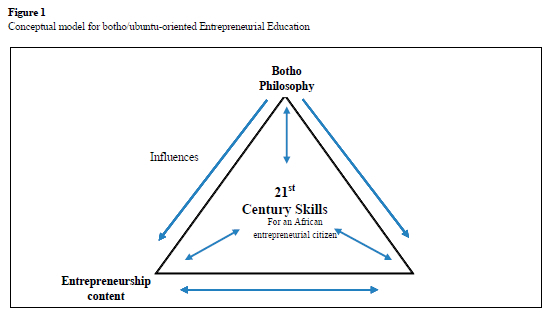
Therefore, the question is not so much whether entrepreneurial education should be taught to develop entrepreneurial selves or entrepreneurial citizens as demanded by the changes of the 21st century. Instead, the question is, what kind of entrepreneurial education will our students receive and for what purposes? Citizenship education in Botswana has been criticised for too many ideological frameworks that are disconnected from learners' immediate contexts (Ntheetsang & Jotia, 2012). The noted result of this neglect is a "gradual extinction of African philosophical systems that shape character" (Matsagopane & Luo, 2024, p. 370). Matsagopane and Luo suggested that botho, as a concept and systematic model, should be used to develop a type of citizen Africa deems desirable through systems and processes thinking. A robust and coherent yet responsive and dynamic systematic model helps to avoid pitfalls of simplistic ideas of decolonisation of knowledge that see Afrocentric education as only one that focuses on and accepts as legitimate the rudimentary and stereotypical conceptions of African practices and knowledge systems, and frowns on modern African-grown advances in knowledge and innovations (Jansen & Walters, 2022). In Figure 1, we present a model that conceptualises how botho could be integrated into entrepreneurial education.
To develop an entrepreneurial citizen who can either be an entrepreneur (including social entrepreneur) or a self-entrepreneurial employee, as required by the post-Fordist economy, we suggest an integrated triumvirate of botho philosophy, botho pedagogy, and entrepreneurship. In this interaction, the 21st-century skills are at the centre (as shown in Figure 1) as skills and attitudes that an African entrepreneurial citizen must possess.
Globally, the 21st-century skills are deemed to be necessary to develop graduates with specific character attributes and skill sets that allow them to function in highly competitive, unpredictable, volatile and dynamic environments that require high performance, versatility, critical thinking, teamwork, creativity, innovation, and adaptability necessary for one to thrive in a post-Fordist economy (Ghafar, 2020; Tabulawa, 2023).
Although these skills are modern, they can be aligned with different principles and values of botho/ubuntu. They cannot be developed in African contexts in a vacuum, and it would be terrible for entrepreneurial education to pursue them from a Western world perspective. Therefore, the integration of botho philosophy and its core principles of solidarity, co-existence, compassion, and respect and dignity provide an overarching foundation and context for developing these skills in a culturally relevant pedagogy of entrepreneurship content (Matsagopane & Luo, 2024; Ngubane & Makua, 2021). Botho pedagogy helps to operationalise botho values within the curriculum. Linking with generally recommended entrepreneurial pedagogies that are experiential, action oriented, and constructivist (Mwasalwiba, 2010), botho pedagogy also emphasises learner centredness, inclusion and tolerance for the learner's humanity, appreciation of the unique wealth of experience a learner brings from their cultural background, and learning experiences that bring together learners, teachers and the community (Ngubane & Makua, 2021). Botho-oriented entrepreneurial pedagogy may draw inspiration from pedagogical entrepreneurship in developing enterprising skills when integrating entrepreneurship across various subjects (Caird, 1990; Garnett, 2013; Hytti & O'Gorman, 2004; Leffler, 2009). For example, instead of students working on projects that emphasise profit for themselves, they could work on social entrepreneurial projects that benefit their communities.
How then can 21st-century skills be developed within an entrepreneurship subject or course from the perspective of botho/ubuntu? In the context of Botswana, the 21st-century skills are unpacked in the NCAF (Republic of Botswana, 2015b), centring on the following themes: ways of thinking and learning, ways of working, tools of working, living in the world (Republic of Botswana, 2015b). The ways of working emphasise values of good work ethic and productivity in collaborative contexts. This may align quite easily with the values of botho, such as respect for others, dignity, humanness, and collaboration, rather than the individualistic tendencies of neoliberal-oriented entrepreneurial education (Ngubane & Makua, 2021). Botho emphasises the importance of educating learners to develop their full potential as individuals and as part of the community in which they belong (Republic of Botswana, 2015b). In terms of ways of thinking and learning, botho-oriented entrepreneurial education might focus on imparting the skills of creativity, innovation, critical thinking, and problem-solving (Republic of Botswana, 2015b) to foster agentic entrepreneurial action that stretches one's ingenuity for advancement and solidarity with the community. Botho pedagogy must use learner-centred teaching strategies and activities that challenge these skills to develop innovations for society and the world at large (Mwasalwiba, 2010; Ngubane & Makua, 2021). Some of these projects or innovations could be in the mould of social entrepreneurship. Critical thinking also implies that learners must be taught to critically reflect on neoliberal, individualistic, and economic rationality, rather than being indoctrinated into accepting it as the only way of doing entrepreneurship (Komulainen et al., 2013; Maistry & David, 2017).
In addition, students must be taught to master and utilise the tools of working in the 21st century. This means that pedagogy in entrepreneurship must foster the proficient use of language, information and communication technology, as well as skills for effective online research, evaluation, and information (Republic of Botswana, 2015b). African students must be taught to leverage emerging technologies to develop innovative solutions that create value for themselves and others (Jansen & Walters, 2022). Living in the world is an important theme for learners to develop a sense of identity and belonging. Botho pedagogy must develop entrepreneurs who are proud of their African heritage through cultural awareness and expression, while simultaneously fostering tolerance for diversity (Republic of Botswana, 2015b). Entrepreneurial education oriented toward botho could draw from the cultural funds of knowledge within the context of learners, as well as wisdom from distant places. Ways of living may also integrate entrepreneurialism. However, students must be challenged not only to view entrepreneurship as a means for the selfish pursuit of happiness, but also to balance being both takers and givers, as well as the pursuit of happiness and the meaningfulness of life and purpose (Lackéus, 2017). This might require the addition of projects that serve their communities (Caird, 1990; Garnett, 2013; Hytti & O'Gorman, 2004), critiquing capitalist-oriented entrepreneurship, as well as incorporating social entrepreneurship into the secondary school entrepreneurship education curriculum.
Conclusion
This study employed the Hegelian dialectical framework to develop an understanding of how a botho-oriented teaching of entrepreneurship can be realised in African secondary school education, given the dialectical tensions between neoliberal entrepreneurialism and botho philosophy. In the process of developing an African entrepreneurial citizen, we see botho philosophy as invaluable in developing entrepreneurship in education that espouses the values of ubuntu in lieu of neoliberalism.
Therefore, we recommend that the curriculum developers be more deliberate in introducing other perspectives to entrepreneurship, such as social entrepreneurship. We also recommend a pedagogical entrepreneurship that is less profit-oriented and more others-oriented. This can be achieved through entrepreneurial projects that serve communities sustainably, rather than focusing solely on projects that prioritise individualistic profiteering. Furthermore, classroom instruction and textbooks might also utilise case studies and guest speakers who subscribe to botho values, demonstrating how they apply them in their own practice. Learners could also be engaged in activities that critically reflect on the shortcomings of the individualistic economic view of entrepreneurship, rather than being presented exclusively in a positive light.
While we consider it a positive development that the ETSSP (Republic of Botswana, 2015a) and the NCAF (Republic of Botswana, 2015b) emphasised the botho philosophy, we urge further studies to investigate different ways in which this philosophy might be operationalised in classroom realities. Equally, while we are proponents of botho's philosophy and pedagogy in entrepreneurial education, we concede that it is not a perfect philosophy and therefore, could have its shortcomings in terms of its application to the challenges of the modern world (Venter, 2004). This means that, as a new development, there must be continued critical reflection of how this philosophy should be integrated into the classroom while also remaining relevant to the times.
References
- Bakwena, M., & Sebudubudu, D. (2016). Implications of the internship programme for youth employment in Botswana. Mosenodi Journal, 19(1), 3-13. https://journals.ub.bw/index.php/mosenodi/article/view/1064
- Basseches, M. (2005). The development of dialectical thinking as an approach to integration. A Transdisciplinary and Transcultural Journal for New Thought, Research, and Praxis, 1(1), 47-63. https://www.researchgate.net/publication/26507960_The_Development_of_Dialectical_Thinking_As_An_Approach_to_Integration
- Berglund, K. (2013). Fighting against all odds: Entrepreneurship education as employability training. Ephemera: Theory & politics in organization, 13(4), 717-735. https://ephemerajournal.org/sites/default/files/2022-01/13-4berglund.pdf
- Bohwasi, P. (2020). African business models: An exploration of the role of culture and family in entrepreneurship. African Journal of Social Work, 10(1), 109-115. https://www.ajol.info/index.php/ajsw/article/view/194117
- Braches, B., & Elliott, C. (2017). Articulating the entrepreneurship career: A study of German women entrepreneurs. International Small Business Journal, 35(5), 535-557. http://doi.org/10.1177/0266242616651921
- Bröckling, U. (2015). The entrepreneurial self: Fabricating a new type of subject. SAGE.
- Caird, S. (1990). What does it mean to be enterprising? British Journal of Management, 1(3), 137-145. https://doi.org/10.1111/j.1467-8551.1990.tb00002.x
- Dal, M., Elo, J., Leffler, E., Svedberg, G., & Westerberg, M. (2016). Research on pedagogical entrepreneurship-a literature review based on studies from Finland, Iceland and Sweden. Education Inquiry, 7(2), 159-182. https://doi.org/10.3402/edui.v7.30036
- DeJaeghere, J. (2017). Educating entrepreneurial citizens: Neoliberalism and youth livelihoods in Tanzania. Routledge.
- de Villiers Scheepers, M. J., Boshoff, C., & Oostenbrink, M. (2017). Entrepreneurial women's cognitive ambidexterity: Career and cultural influences. South African Journal of Business Management, 48(4), 21-33. https://doi.org/10.4102/sajbm.v48i4.40
- Dybicz, P., & Pyles, L. (2011). The dialectic method: A critical and postmodern alternative to the scientific method. Advances in Social Work, 12(2), 301-317. https://doi.org/10.18060/1905
- Erkkilä, K. (2000). Entrepreneurial education: Mapping the debates in the United States, the United Kingdom, and Finland. Garland.
- Farstad, H. (2002). Integrated entrepreneurship education in Botswana, Uganda and Kenya: Final report (Study report). National Institute of Technology, Oslo. https://documents1.worldbank.org/curated/en/821241468326682566/pdf/778770WP0P115100Study0report0final.pdf
- Gareegope, T. M. (2020). Aspects of botho/ubuntu in Botswana. University of Botswana Law Journal, 28, 41-58. https://journals.ub.bw/index.php/ublj/article/view/2055
- Garnett, J. (2013). Enterprise pedagogy in music: An exploration of multiple pedagogies. Music Education Research, 15(1). https://doi.org/10.1080/14613808.2012.703175
- Gill, R. (2014). "If you're struggling to survive day-to-day": Class optimism and contradiction in entrepreneurial discourse. Organization, 21(1), 50-67. https://doi.org/10.1177/1350508412464895
- Giroux, H. A. (2005). The terror of neoliberalism: Rethinking the significance of cultural politics. College Literature, 32(1), 1-19. https://doi.org/10.1353/lit.2005.0006
- Government of Botswana. (1997). Vision 2016: Towards prosperity for all. https://extranet.who.int/countryplanningcycles/sites/default/files/country_docs/Botswana/mediac_102.pdf
- Government of Botswana. (2016). Vision 2036: Achieving prosperity for all. https://www.statsbots.org.bw/sites/default/files/documents/Vision%202036.pdf
- Haara, F. O., Jenssen, E. S., Foss0y, I., & Odegârd, I. K. R. (2016). The ambiguity of pedagogical entrepreneurship-the state of the art and its challenges. Education Inquiry, 7(2), 183-210. https://doi.org/10.3402/edui.v7.29912
- Hägg, G., & Jones, C. (2021). Educating towards the prudent entrepreneurial self: An educational journey including agency and social awareness to handle the unknown. International Journal of Entrepreneurial Behavior & Research, 27(9), 82-103. https://doi.org/10.1108/IJEBR-10-2020-0668
- Hossain, F., Ibrahim, M., & Yeboah-Assiamah, E. (2024). In search of ubuntu in an African SME: A case of a transitional entrepreneur. Africa Journal of Management, 10(2), 150-175. https://doi.org/10.1080/23322373.2024.2349482
- Hytti, U., & O'Gorman, C. (2004). What is "enterprise education"? An analysis of the objectives and methods of enterprise education programmes in four European countries. Education+ training, 46(1), 11-23. https://doi.org/10.1108/00400910410518188
- Jansen, J. D., & Walters, C. A. (2022). Decolonisation of knowledge: Radical ideas and the shaping of institutions in South Africa and beyond. Cambridge University Press.
- Kergel, D. (2021). Bildung versus the entrepreneurial self. In K. B. Petersen, K. von Brömssen, G. H. Jacobsen, J. Garsdal, M. Paulsen, & O. Koefoed (Eds.), Rethinking education in light of global challenges: Scandinavian perspectives on culture, society, and the Anthropocene (pp. 112-120). Routledge.
- Kupangwa, W. (2025). The African philosophy of Ubuntu and family businesses: A perspective article. Journal of Family Business Management, 15(1), 57-67. https://doi.org/10.1108/JFBM-10-2023-0216
- Kupangwa, W., Farrington, S. M., & Venter, E. (2023). The role of values in enhancing longevity among indigenous black South African family businesses. The Southern African Journal of Entrepreneurship and Small Business Management, 15(1), 1-14. https://doi.org/10.4102/sajesbm.v15i1.555
- Lackéus, M. (2017). Does entrepreneurial education trigger more or less neoliberalism in education? Education and Training, 59(6), 635-650. https://doi.org/10.1108/ET-09-2016-0151
- Lackéus, M., & Sävetun, C. (2019). Assessing the impact of enterprise education in three leading Swedish compulsory schools. Journal of Small Business Management, 57(S1), 33-59. https://doi.org/10.1111/jsbm.12497
- Maistry, S. M., & David, R. (2017). Phantasmagoria: communicating an illusion of entrepreneurship in South African school textbooks. Educational Research for Social Change, 6(2), 101-114. http://dx.doi.org/10.17159/2221-4070/2017/v6i2a7
- Mamman, A., Kamoche, K., & Zakaria, H. B. (2018). Rethinking human capital development in Africa. In K. Amaeshi, A. Okupe, & U. Idemudia (Eds.), Africapitalism: Rethinking the role of business in Africa (pp. 99-136). Cambridge University Press.
- Mofuoa, K. V. (2010). Reflections on Botho as a resource for a just and sustainable economy towards Africa's development path in modern history. World Journal of Entrepreneurship, Management and Sustainable Development, 6(4), 273-291. https://doi.org/10.1108/20425961201000021
- Mwasalwiba, E. S. (2010). Entrepreneurship education: A review of its objectives, teaching methods, and impact indicators. Education and Training, 52(1), 20-47. https://doi.org/10.1108/00400911011017663
- Ngubane, N., & Makua, M. (2021). Ubuntu pedagogy-transforming educational practices in South Africa through an African philosophy: From theory to practice. Inkanyiso: Journal of Humanities and Social Sciences, 13(1), 1-12. https://doi.org/10.4102/ink.v13i1.9
- Ntheetsang, F., & Jotia, A. L. (2012). Exploring citizenship education: Cultural study curriculum in Botswana. US-China Education Review, 3(1), 337-346. https://files.eric.ed.gov/fulltext/ED532913.pdf
- Peters, M. (2001). Education, enterprise culture and the entrepreneurial self: A Foucauldian perspective. The Journal of Educational Enquiry, 2(2), 58-71. https://ojs.unisa.edu.au/index.php/EDEQ/article/view/558
- Pongratz, H. J., & Voß, G. G. (2003). From employee to 'entreployee': Towards a 'self entrepreneurial work force? Concepts and Transformation, 8(3), 239-254. https://doi.org/10.1075/cat.8.3.04pon
- Republic of Botswana. (1993). Report of the National Commission on Education, 1993. https://unesdoc.unesco.org/ark:/48223/pf0000171937
- Republic of Botswana. (1994). Revised national policy on education. Ministry of Education. https://openlibrary.org/books/OL1267908M/The_revised_national_policy_on_education_March_1994
- Republic of Botswana. (1995). Curriculum blueprint: Ten years basic education programme. Ministry of Education. https://unesdoc.unesco.org/ark:/48223/pf0000188603
- Republic of Botswana. (1998). Curriculum blueprint: Senior secondary school programme of 1998. Ministry of Education. https://unesdoc.unesco.org/ark:/48223/pf0000188605
- Republic of Botswana. (2008a). Three-year junior secondary school commerce and accounting syllabus. Ministry of Education and Skills Development. https://www.scribd.com/document/212411912/Jc-Commerce-and-Accounting
- Republic of Botswana. (2008b). Three-year junior secondary school commerce and office procedures syllabus. Ministry of Education and Skills Development.
- Republic of Botswana. (2015a). Education and training sector strategic plan (ETSSP 2015-2020). Ministry of Education and Skills Development. https://www.gov.bw/sites/default/files/2020-03/ETSSP%20Final%20Document.pdf
- Republic of Botswana. (2015b). National curriculum and assessment framework (NCAF) "Learning matters. " Ministry of Education and Skills Development. https://www.coursehero.com/file/56368525/national-curriculum-frameworkpdf
- Republic of Botswana. (2020). Entrepreneurship syllabus. Ministry of Education and Skills Development.
- Ringarp, J. (2013). From bildung to entrepreneurship: Trends in education policy in Sweden. Policy Futures in Education, 11(4), 456-464. https://doi.org/10.2304/pfie.2013.11A456
- Rose, N. (1998). Inventing ourselves: Psychology, power, and personhood. Cambridge University Press.
- Saumantri, T. (2023). Hegel's rationalism: The dialectical method of approaching metaphysical problems. Jurnal Filsafat Indonesia, 6(3), 455-464. https://tinyurl.com/44bmjkje
- Standing, G. (2011). Workfare and the precariat. Soundings, 47(47), 35-43. https://doi.org/10.3898/136266211795427549
- Straume, I. S. (2011). Learning and signification in neoliberal governance. In I. S. Straume & J. F. Humphrey (Eds), Depoliticization: The political imaginary of global capitalism (pp. 229-259). Nordic Summer University Press.
- Surlemont, B. (2007). Promoting enterprising: A strategic move to get schools' cooperation in the promotion of entrepreneurship. In Fayolle, A. (Ed.), Handbook of research in entrepreneurship education (Vol. 2, pp. 255-272). Edward Elgar.
- Tabulawa, R. T. (2009). Education reform in Botswana: Reflections on policy contradictions and paradoxes. Comparative Education, 45(1), 87-107. https://doi.org/10.1080/03050060802661410
- Tabulawa, R. (2023). Globalisation and education policy reform in Botswana. Routledge.
- Venter, E. (2004). The notion of ubuntu and communalism in African educational discourse. Studies in philosophy and education, 23(2), 149-160. https://doi.org/10.1023/B:SPED.0000024428.29295.03
- Waghid, Z. (2019). Examining the business education curricula in South Africa: Towards integrating social entrepreneurship. Education + Training, 61(7/8), 940-962. https://doi.org/10.1108/ET-05-2018-0115
- Wanyoike, C. N., & Maseno, M. (2021). Exploring the motivation of social entrepreneurs in creating successful social enterprises in East Africa. New England Journal of Entrepreneurship, 24(2), 79-104. https://doi.org/10.1108/NEJE-07-2020-0028
Accepted: 6 October 2025