Shared foundations of the nature of science and STEAM: A conceptual lens for curriculum transformation
Abstract
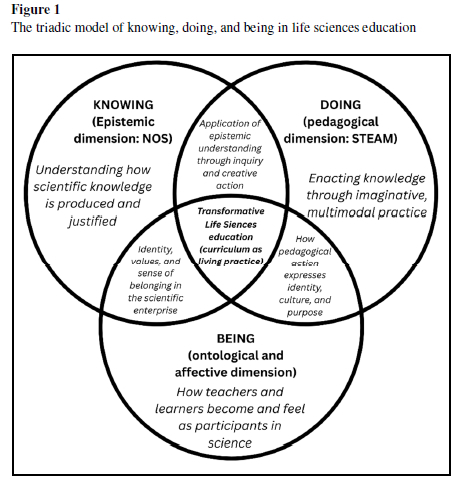
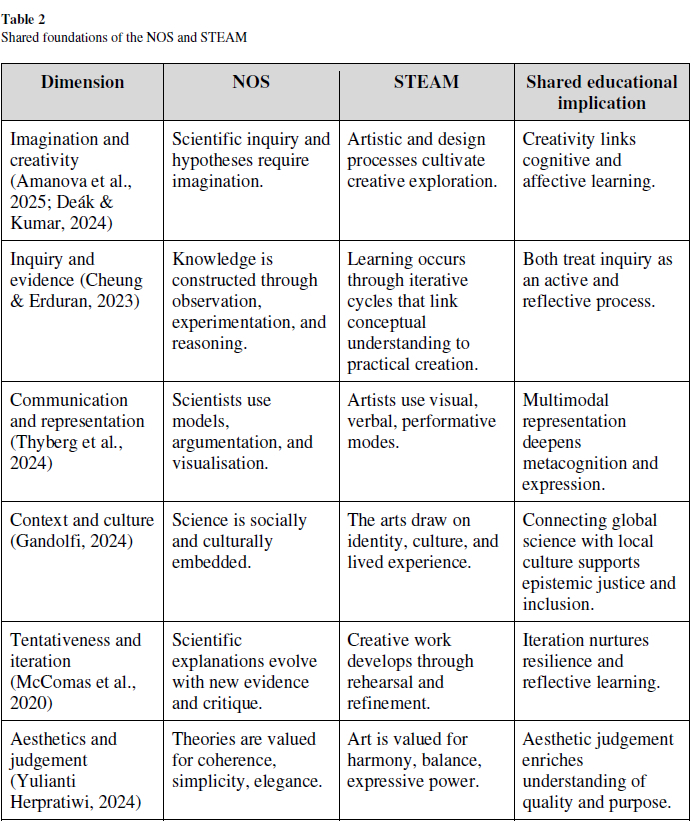
Life sciences education is increasingly expected to address complex socio-environmental challenges, yet classroom practice often remains dominated by transmissive, assessment-driven approaches that marginalise creativity, contextual relevance, and epistemic reflection. This paper argues that a coherent conceptual framework is needed to foreground the shared epistemic foundations of the nature of science (NOS) and science, technology, engineering, arts, and mathematics (STEAM), particularly their emphasis on scientific knowledge as tentative, creative, socially negotiated, and culturally embedded. Drawing on illustrative, non-evaluative examples from a professional development intervention, the paper proposes a NOS-STEAM conceptual lens, and a triadic model of knowing-doing-being to support curriculum design, teacher professional development, and assessment in life sciences. This paper offers practical heuristics and policy-relevant insights for advancing rigorous, imaginative, and contextually grounded life sciences education that bridges global scientific frameworks with local knowledge.
curriculum transformation; epistemic justice; life sciences education; nature of science (NOS); scientific literacy; STEAM education; teacher professional development
 Thumbnail