Shared foundations of the nature of science and STEAM: A conceptual lens for curriculum transformation
Abstract
Life sciences education is increasingly expected to address complex socio-environmental challenges, yet classroom practice often remains dominated by transmissive, assessment-driven approaches that marginalise creativity, contextual relevance, and epistemic reflection. This paper argues that a coherent conceptual framework is needed to foreground the shared epistemic foundations of the nature of science (NOS) and science, technology, engineering, arts, and mathematics (STEAM), particularly their emphasis on scientific knowledge as tentative, creative, socially negotiated, and culturally embedded. Drawing on illustrative, non-evaluative examples from a professional development intervention, the paper proposes a NOS-STEAM conceptual lens, and a triadic model of knowing-doing-being to support curriculum design, teacher professional development, and assessment in life sciences. This paper offers practical heuristics and policy-relevant insights for advancing rigorous, imaginative, and contextually grounded life sciences education that bridges global scientific frameworks with local knowledge.
curriculum transformation; epistemic justice; life sciences education; nature of science (NOS); scientific literacy; STEAM education; teacher professional development
Introduction
Science education in the 21st century faces unprecedented demands in an era characterised by volatility, uncertainty, complexity, and ambiguity-often termed the "VUCA" era-(Antonio & Prudente, 2023). Global socio-environmental challenges require citizens who can think critically and engage ethically with scientific issues (Herman et al., 2022; Viehmann et al., 2024). These pressures have intensified calls for curriculum transformation in science education, shifting beyond static policy prescriptions and rote content coverage toward a more dynamic, responsive approach (Ngobeni et al., 2023). As Pinar (2004) and others have argued, meaningful curriculum reform entails viewing curriculum as a verb: an ongoing, active process of co-constructing knowledge, rather than a fixed noun or mere syllabus (Schubert, 2009). This notion of curriculum-as-lived experience also resonates with contemporary curriculum studies debates that foreground curriculum as a conversational, ethical, and contextual practice (Le Grange et al., 2024). Despite these curriculum aspirations, life sciences education lacks a coherent conceptual framework that explicitly integrates the epistemic foundations of the nature of science (NOS) and STEAM (science, technology, engineering, arts, and mathematics) to support epistemic justice, inquiry, and contextual relevance (Lederman & Lederman, 2019; Mutongoza, 2025; Perignat & Katz-Buonincontro, 2019). Building on these notions, this paper positions the shared foundations of the NOS and STEAM as a conceptual lens for reimagining life sciences education in South Africa and beyond. Accordingly, this paper develops a NOS-STEAM conceptual lens and a triadic model of knowing-doing-being to guide curriculum design and teacher professional development in life sciences.
South Africa provides a compelling context for exploring this NOS-STEAM convergence. Post-apartheid curriculum reforms (notably the Curriculum and Assessment Policy Statement, or CAPS) have explicitly aimed to promote scientific literacy, environmental responsibility, and inclusion of Indigenous knowledge systems alongside Western science (Mudaly, 2018; Photo & McKnight, 2024). These goals speak to epistemic justice: the idea that multiple knowledge systems and ways of knowing, especially those of marginalised communities, deserve recognition and integration in education (Mphahlele & Pitsoe, 2023). However, despite well-intended policy, many South African science classrooms remain teacher-centred and focused on factual recall to prepare learners for high-stakes assessments (Buma & Nyamupangedengu, 2020; Ramnarain et al., 2023).
Tensions arising from the persistent misalignment between policy aspirations and classroom realities highlight the need for pedagogical frameworks that support equitable, inquiry-oriented, and epistemically inclusive life sciences learning. A NOS-STEAM framework offers a promising way of addressing these tensions. By deliberately integrating the NOS with the arts within STEM (science, technology, engineering, and mathematics) learning, teachers can bridge global scientific frameworks with local knowledge systems while reconciling inquiry-rich pedagogy with the realities of assessment (Namakula & Akerson, 2024). This, however, requires teachers to move out of their comfort zones of "chalk-and-talk" to embrace new roles as facilitators of inquiry and co-creators of knowledge (Ramey & Stevens, 2023). Effective teacher professional development is therefore key to enabling curriculum transformation. This paper draws on a professional development intervention, using it as an illustrative case of how shared NOS-STEAM tenets can be enacted in practice.
The paper makes two conceptual contributions. First, it synthesises the shared foundations of the NOS and STEAM into a coherent conceptual lens for understanding curriculum as a living practice. Second, it proposes a triadic model of knowing-doing-being to guide curriculum design, assessment, and teacher professional development toward more rigorous, culturally responsive, and imaginative life sciences education. Together, these contributions support curriculum transformation that is epistemically grounded, pedagogically sound, and attentive to the lived realities of South African classrooms.
The NOS and scientific literacy
According to Abd-El-Khalick (2013), the NOS includes the fundamental characteristics of scientific knowledge, namely, that it is provisional, grounded in empirical observation, influenced by theoretical perspectives and human subjectivity, shaped by imagination and creativity, and situated within broader social and cultural contexts. Collectively, these ideas portray science not as a simple accumulation of facts, but as a dynamic human enterprise for constructing explanations about the world (Erduran & Dagher, 2014; Mody, 2025). An understanding of the NOS is widely regarded as a critical component of scientific literacy (Ramnarain & Padayachee, 2015).
Scientific literacy involves knowing scientific concepts, understanding how scientific knowledge is generated and validated, and applying scientific thinking to real-world issues (Holbrook & Rannikmae, 2009; Kelp et al., 2023). Lederman (2007) and Ben-Horin et al. (2023) argued that learners who grasp the NOS are better equipped to make sense of scientific information and to engage in informed decision-making about socio-scientific problems. For example, knowing that scientific conclusions are tentative may help learners remain critical and open-minded about emerging scientific evidence (Mueller & Reiners, 2023). Understanding that science is socially and culturally embedded can foster appreciation for how science both influences and is influenced by society, politics, and culture (Fernández et al., 2022).
Global science education reforms consistently call for emphasising the NOS in curricula. In South Africa, post-2000 curricula explicitly incorporate NOS-related aims (Department of Basic Education [DBE], 2011). The life sciences CAPS document outlines several aims that align with the tenets of the NOS (DBE, 2011). The curriculum emphasises that learners should not only acquire factual knowledge, but also develop the cognitive and process skills necessary to investigate phenomena, analyse and evaluate data, and apply their understanding to unfamiliar contexts (Bertram et al., 2021). The curriculum foregrounds the historical and cultural situatedness of science, highlighting the evolution of scientific knowledge and its interaction with Indigenous knowledge systems, and positioning science as a human, socially embedded endeavour (DBE, 2011). This reflects a shift from the apartheid-era biology syllabus, which was content-heavy and positivist, towards a curriculum that values inquiry and the understanding of science as a process (Ngobeni et al., 2023; Ramnarain & Padayachee, 2015).
Despite these curriculum intentions, research suggests persistent implementation gaps. Ramnarain and Padayachee (2015) found that South African life sciences textbooks still overwhelmingly portrayed science as a fixed body of knowledge, with less emphasis on science as inquiry or science in society. This misalignment means that without teacher professional development and curriculum resources, learners may not adequately learn about the NOS (Chanetsa & Ramnarain, 2025; Philander & Botha, 2021). Furthermore, many science teachers themselves have fragmented or naive conceptions of the NOS (Chuene & Singh, 2024).
Explicit integration of the NOS into science teaching has been linked to better reasoning about scientific and socio-scientific issues (Högström et al., 2024) and may promote greater willingness to engage in science learning (Namakula & Akerson, 2024). However, integrating the NOS into classroom practice can be challenging. It requires discussions about how knowledge is constructed, which many life sciences teachers are not entirely prepared for (Chuene & Singh, 2024; Preminger et al., 2024). Abd-El-Khalick and Lederman (2000) emphasised that NOS instruction should be explicit and reflective; learners should not only engage in inquiry activities but also reflect on what those activities show about the NOS. This approach aligns with engaging, learner-centred teaching, which provides a natural conceptual bridge to STEAM.
STEAM education and the role of the arts
STEAM education is an approach that integrates the arts into STEM to enhance creativity, engagement, and contextual learning (Land, 2013). In a STEAM framework, the arts are not just add-ons but access points for guiding learner inquiry, dialogue, and critical thinking in STEM subjects (Cook et al., 2025; Danielson et al., 2022). The core idea is that scientific learning can be enriched by artistic processes that foster imagination, empathy, innovation, and a connection to personal and cultural expression (Cook et al., 2025; Okwara & Pretorius, 2023). STEAM advocates argue that the arts humanise STEM learning, making it more holistic and better suited to developing the adaptable, inventive thinkers needed in the 21st century (Cook et al., 2025; Okwara & Pretorius, 2023). Notably, STEAM's inclusion of the arts enables cultural relevance and emotional engagement by validating learners' cultural backgrounds (Salehjee & Watts, 2023). Therefore, the arts can serve as a bridge between scientific content and the learners' communities and identities, which is crucial in diverse classrooms.
STEAM is inherently transdisciplinary (Wilson et al., 2021). Rather than teaching subjects in isolation, STEAM education involves tackling real-world problems that require multiple lenses (Filipe et al., 2024). Furthermore, STEAM invites diverse ways of knowing, including artistic and Indigenous perspectives, into learning (Matindike & Ramdhany, 2025). Emerging meta-analytic evidence suggests that STEAM interventions can support learning outcomes, though effects vary by context, design, and implementation (Amanova et al., 2025).
Teachers involved in STEAM education often report renewed enthusiasm and deeper understanding of content themselves as they collaborate across disciplines (Quigley & Herro, 2019). However, implementing STEAM calls for careful planning, collaboration between teachers of different subjects, and a shift in assessment approaches to value creative processes and products (Erawan & Mariana, 2025; Perales & Aróstegui, 2021). Furthermore, some science teachers worry that adding arts can dilute scientific rigour (Okwara & Pretorius, 2023). Yakman's (2017) conceptualisation of STEAM includes maintaining the integrity of each respective discipline while contributing to a richer whole. In practice, support and professional development are needed for teachers to feel confident in integrating arts into their science teaching, especially if they lack an arts background (Bertling et al., 2025).
Shared foundations: A synthesised lens
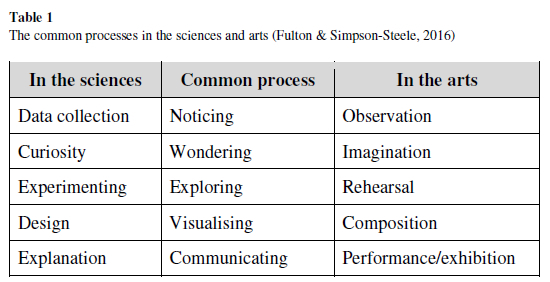
Although science and the arts may appear to inhabit different domains, they share deep structural affinities: curiosity, creativity, and the human drive to construct meaning. Recognising this shared pursuit of understanding is vital for curriculum transformation in life sciences because it demonstrates how the NOS and STEAM education align through parallel ways of knowing and doing. This alignment forms the basis of the NOS-STEAM conceptual lens suggested in this paper. Fulton and Simpson-Steele (2016) captured this overlap, illustrating how scientific and artistic inquiry share common processes of noticing, imagining, exploring, designing, and communicating. Table 1 shows these parallels.
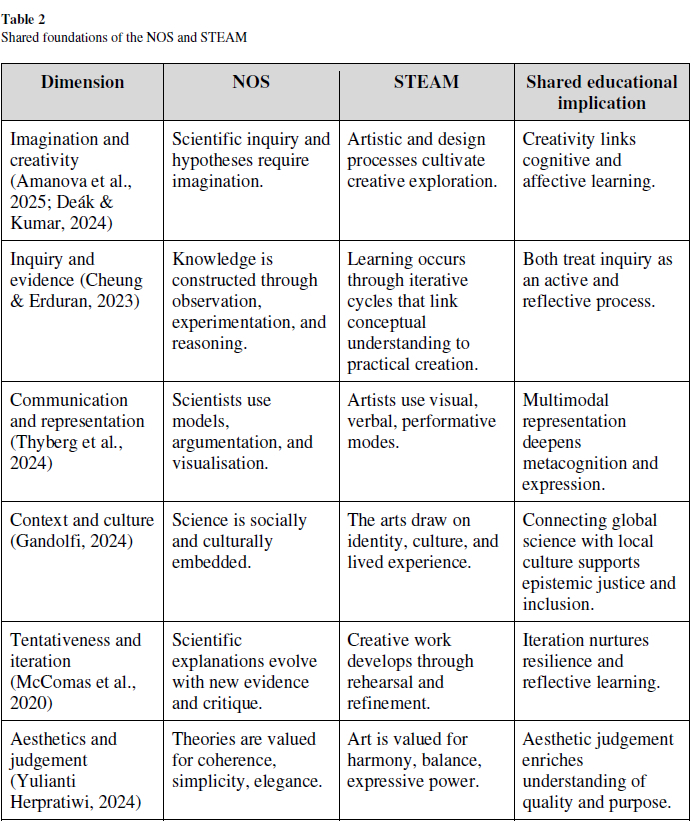
Recent scholarship affirms that the NOS and STEAM align on a set of shared commitments that together constitute a powerful conceptual lens for curriculum transformation. Both frameworks challenge transmissive, content-heavy teaching by emphasising science as a human, imaginative, and socially embedded process (Erduran & Dagher, 2014; Mejía et al., 2023). The six interrelated dimensions depicted in Table 2 illustrate how the epistemological tenets of the NOS and the pedagogical practices of STEAM overlap to form a unified conceptual lens for curriculum transformation in life sciences.
These shared foundations reveal that the NOS and STEAM are not competing agendas but complementary dimensions of a broader educational paradigm. The NOS offers epistemological clarity, while STEAM provides pedagogical and affective means to enact these ideas through experiential, culturally relevant practice. Viewed together, they form a NOS-STEAM conceptual lens that positions curriculum as a living process of knowing, doing, and being. This idea reflects curriculum-as-lived experience and foregrounds curriculum enactment as situated, interpretive, and relational. This lens underpins the argument in this paper: that re-envisioning life sciences education through the NOS-STEAM convergence can promote more inclusive, imaginative, and epistemically just learning.
While the NOS-STEAM conceptual lens offers a coherent framework for curriculum transformation, it is not without challenges. Literature notes that creativity and arts-based pedagogies can be difficult to operationalise in science classrooms constrained by time, assessment pressures, and large class sizes, risking superficial integration (Bossér, 2024; Perignat & Katz-Buonincontro, 2019). There are also concerns that arts integration may dilute scientific rigour if epistemic aims are not made explicit and disciplinary boundaries are poorly negotiated (Colucci-Gray et al., 2019). In addition, without adequate professional development, teachers may struggle to align creative activities with core scientific concepts and NOS tenets (Lederman et al., 2014; Perignat & Katz-Buonincontro, 2019). Acknowledging these tensions highlights the need for deliberate pedagogical design, explicit epistemic focus, and sustained teacher support when enacting the NOS-STEAM lens in practice.
Tensions in the South African science education landscape
It is important to situate the discussion within the specific tensions of the South African science education context, many of which are echoed in international debates. South Africa's educational landscape is marked by tensions between progressive curricular ideals and practical constraints (Bertram & Rusznyak, 2024).
Firstly, the pressure of high-stakes summative assessments often leads teachers to prioritise content coverage and assessment preparation over exploratory learning (Kanjee et al., 2022). Even teachers who personally value inquiry may feel constrained by factors such as completing the syllabus on time, large class sizes, and limited resources, which discourage them from inquiry-rich teaching and learning (Ramnarain et al., 2023). This results in the predominance of teacher-centred pedagogy. Although this tension is not unique to South Africa, it is particularly acute due to accountability measures and historical inequalities in school resourcing (de Clercq, 2020; Ehren & Hwa, 2025). Without system-level shifts, teachers need support to innovate within the existing system, striking a balance between covering content and engaging learners in learning (Ingulfsen et al., 2023).
In post-colonial contexts like South Africa, there are calls to decolonise the curriculum, which includes integrating Indigenous knowledge and locally relevant knowledge (Blackie, 2024; de Beer & Kriek, 2021). However, in practice, meaningful integration of Indigenous or local knowledge into science classes has been limited (Blackie, 2024). The NOS offers one rationale for bridging this gap; if science is culturally embedded and there are multiple ways of observing and solving problems, then local knowledge can be discussed as an additional way humans construct an understanding of nature. Complementarily, STEAM offers practical avenues; using local crafts, music, or storytelling as part of science teaching naturally incorporates Indigenous perspectives.
Lastly, sustaining teacher growth and innovative classroom practices in the face of several systemic pressures remains a challenge (Nwoko et al., 2023). Professional development opportunities may be sporadic or short-term due to funding and logistical challenges (DBE, 2019). Implementing STEAM, which might require materials for art projects or technology use, can seem daunting in these conditions. The tension of sustainment also involves administrative support; if schools are fixated on assessment results, teachers may feel pressure to revert to transmissive teaching (O'Shea, 2021).
The South African science education context is at a pivotal juncture where the vision of a forward-looking, socially responsive curriculum must contend with practical realities and historical inequities. The NOS-STEAM conceptual lens directly addresses these tensions by showing that assessment and deeper learning are not mutually exclusive, integrating global scientific content with local knowledge in a culturally responsive way, and supporting teacher professional development while promoting sustainable change through community and institutional support. Together, these possibilities emphasise curriculum as a living, negotiated process that is continually reinterpreted in practice.
Theoretical framework
The theoretical framework merges the conceptual overlap of the NOS and STEAM with a social constructivist view of learning and an activity-theory perspective on teacher change. At its heart is the notion of curriculum as a dynamic, negotiated process, a view informed by both curriculum theorists and the principles of the NOS and STEAM. Pinar's (2004) idea of curriculum as an intellectual pursuit rather than an institutional or bureaucratic one underpins this approach, suggesting that curriculum development is an ongoing act of inquiry by teachers and learners. Fundamentally, the curriculum comes alive through the interactions of learners, teachers, and content in context-curriculum-in-action, not merely through documents and plans. This view resonates with curriculum-as-lived experience and foregrounds curriculum enactment as relational, ethical, and situated.
This paper draws on illustrative examples from a professional development intervention. The professional development design drew on social constructivism (Vygotsky, 1978). From a social constructivist point of view, knowledge is constructed through social interaction and is deeply influenced by cultural context. Vygotsky often turned to artistic metaphors to explain learning. Veresov (2004) showed that even his formulation of the zone of proximal development, anchored in the two developmental planes of learning, first through social interaction and then through internalisation, was originally expressed through a metaphor from Russian theatre, depicting development as a dramatic encounter between actors on a stage. The professional development activities were designed to foreground collaborative dialogue, shared problem-solving, and joint reflection, allowing teachers to co-construct understandings of NOS-STEAM concepts in relation to their classroom contexts. These interactions also informed the interpretation of the illustrative examples, which were analysed as socially mediated processes rather than isolated individual practices.
Finally, the framework assumes that teacher professional development is a journey that involves changes in knowledge, practice, and belief, and that these do not happen suddenly or in a linear sequence (Kager et al., 2023; Rodgers et al., 2022). Drawing on activity-theoretic perspectives, teacher change is understood as emerging from participation in a broader activity system shaped by tools, rules, community, and contextual constraints, rather than as an individual cognitive shift alone. Thus, an implicit part of the framework was reflective practice: encouraging teachers to reflect on their experiences during and after the professional development intervention. Reflection acts as the bridge between action and theory (Riyanti, 2021), aiding teachers in the integration of NOS-STEAM concepts into their unique teaching philosophy. Reflection also supports teachers' professional judgement, a key emphasis in contemporary curriculum studies (Philp-Clark & Grieshaber, 2024).
While this integrated theoretical framework offers a robust lens for understanding curriculum enactment and teacher learning, it is not without limitations. Applying activity-theoretic perspectives in resource-constrained contexts can be challenging because systemic factors such as limited time, materials, and institutional support may restrict opportunities for expansive learning and sustained change (Opfer & Pedder, 2011). Similarly, social constructivist approaches rely on collaborative engagement (Vygotsky, 1978), which may be uneven across professional development contexts. Acknowledging these constraints reinforces the need to interpret the illustrative examples cautiously and highlights the importance of contextual sensitivity when applying the NOS-STEAM framework in diverse educational settings.
In summary, the theoretical framework guiding this paper is an integration of NOS-STEAM conceptual alignment with social constructivist and activity-theoretic perspectives on learning. It sees the teacher as a reflective practitioner and the curriculum as a living process, guided by principles of inquiry, creativity, and contextual relevance. This theoretical framing underpins the paper's two conceptual contributions: the NOS-STEAM conceptual lens and the triadic model of knowing-doing-being. To ground these conceptual arguments in practice, the following section briefly introduces the context from which the illustrative examples are drawn.
Context and illustrative cases
Although this paper draws on insights from a professional development intervention for life sciences teachers, it does not report empirical findings. Instead, examples from a 2023-2024 professional development intervention are used as illustrative cases to ground the conceptual argument, with analytic deductions drawn from recurring patterns in teacher reflection and practice informing the design of the triadic model and the interpretive claims advanced in the conclusion. No evaluative or generalisable claims are made. These cases therefore function as conceptual illustrations rather than as empirical evidence.
The professional development intervention involved a group of in-service life sciences teachers from diverse South African school contexts who voluntarily participated in the intervention. All participants taught life sciences in the Further Education and Training phase and had prior teaching experience but limited explicit exposure to the NOS or STEAM. The intervention, conducted online, introduced teachers to the NOS concepts and STEAM education through inquiry-based, collaborative, and arts-integrated activities. Participants were supported in designing lessons that reflected these shared principles through structured online workshops, collaborative discussion, guided reflection, and feedback on teacher-generated artefacts.
Rather than being analysed as research data, the various artefacts generated during the intervention, including teacher reflections (such as guided reflective activities and written prompts), creative outputs (such as visual representations, storytelling tasks, and activity design), and lesson planning attempts, were used heuristically to illustrate how the NOS-STEAM conceptual lens can operate in practice. These artefacts serve as conceptual anchors that demonstrate how teachers' experiences exemplify or challenge the NOS-STEAM conceptual lens. In this way, the professional development context provides a backdrop for exploring the affordances and constraints of implementing inquiry-rich, creative, and contextually responsive pedagogy in South African life sciences classrooms.
Illustrations & design heuristics
Illustrative shifts in NOS understanding
The professional development intervention offers a glance at how teachers began to rethink the NOS when they encountered pedagogy that foregrounds inquiry, creativity, and context. Two patterns offer useful insight. Firstly, creativity serves as a doorway to the NOS. Arts-based tasks made the creativity of scientific work accessible to teachers. Secondly, several teachers recognised that their continual emphasis on "correct answers" had obscured how knowledge is generated, argued, and revised.
Some enduring challenges remained, particularly distinguishing between scientific theories and laws, and recognising the subtler dimensions of science's social and cultural embeddedness. Thus, the professional development intervention functioned as a window into the types of experiences that can initiate or support NOS learning, rather than as evidence of a completed transformation.
The value of STEAM
Although the professional development intervention was not explicitly positioned around the shared foundations of the NOS and STEAM, teacher-generated artefacts highlight why the NOS-STEAM intersection offers a compelling framework for rethinking life sciences teaching and learning. Transdisciplinary teaching and learning encourages learner participation (Atkinson-Toal, 2024). Role-play, poetry and other art forms can engage learners who might otherwise remain passive during lessons. These tasks situate science alongside everyday experience, inviting ethical reasoning, empathy, and communication, which are skills closely aligned with scientific literacy (Bossér, 2024). Taken heuristically, these examples, informed by observation of participant interactions, discussions with participants, and engagement with teacher-generated artefacts, suggest that STEAM can operationalise a NOS-informed view of the life sciences curriculum: learning as doing, representing, arguing, and caring, rather than merely recalling.
Navigating systemic pressures
The illustrative materials shed light on practical design heuristics for working within policy and assessment constraints. Firstly, creative tasks should explicitly align with prescribed learning outcomes. When teachers connect STEAM tasks to CAPS content and skills, innovations are experienced as legitimate rather than supplementary. Secondly, integrating local and Indigenous knowledge into life sciences teaching enhances understanding and relevance without undermining learning outcomes. The arts offer a natural pathway for this localisation while maintaining scientific accuracy. Finally, the professional development intervention underscored the value of communities of practice. Based on observed peer interaction during online discussions and shared artefacts, peer exchange appeared to help teachers refine resources, share ideas, and sustain momentum. Such networks provide additional resources but do not replace the need for institutional support.
In this context, navigating these tensions demonstrates that alignment and transformation are not mutually exclusive. Creative reinterpretation of existing policies and assessments can serve as catalysts for meaningful change.
Why the NOS and STEAM reinforce each other
Interpreted heuristically, the illustrative examples from the professional development intervention, informed by observation, dialogue, and engagement with teacher-generated artefacts, suggest three mechanisms through which the NOS and STEAM can be mutually enabling in practice. Firstly, making, modelling, and performing render the process of knowledge production visible, which naturally opens discussion of tentativeness, creativity, and evidence. Secondly, encountering multiple valid representations foregrounds interpretation and perspective, supporting theory-ladenness and socio-cultural embeddedness. Finally, affective experiences of joy and identification often pave the way for the rigorous explanation and critique. These mechanisms are not presented as causal explanations but as practice-based design insights that can guide decisions in curriculum and professional development.
Continuing challenges and analytical limits
The preceding illustrations offer only a partial view of the complexities involved. Time pressures, assessment requirements, and limited support determine what is feasible. Some teachers remain sceptical of arts-integrated pedagogies until they witness their advantages, while others need more support in the understanding of the NOS. For policy and system stakeholders, the key insight is that lasting change requires investment in sustained, supported cycles of planning, enactment, and reflection, alongside recognition of more diverse forms of evidence in school-based assessment.
Conceptual contributions
Read as a conceptual argument, the professional development intervention aids in recasting curriculum as a living practice, one that interweaves knowing, doing, and being rather than functioning as a checklist of topics to be covered. It also helps to frame the NOS not as an additional topic to be covered, but as cultivated through modelling scientific reasoning and engaging learners in evidence-based discussions. Finally, it conceptualises STEAM as a pedagogical language through which these ways of knowing and teaching take shape in practice, particularly in settings where relevance, identity, and resourcefulness underpin authentic life sciences learning.
These insights are generative for curriculum transformation. They identify mechanisms that can enable life sciences education that is both rigorous and contextually grounded. Together, they strengthen the conceptual basis for the NOS-STEAM conceptual lens advanced in this paper.
The triadic model of knowing-doing-being in life sciences education
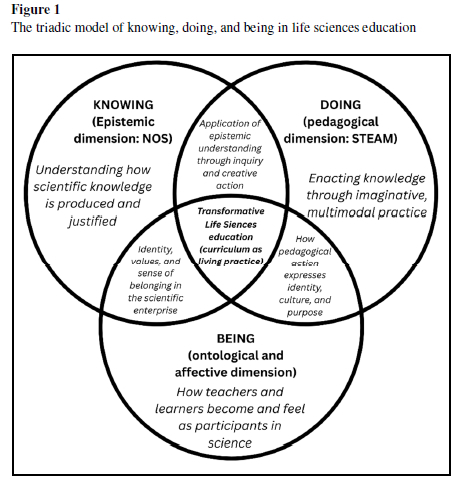
Building on the synthesis of ideas in this paper, and informed by broader curriculum and science education scholarship that conceptualises disciplinary learning as involving interrelated ways of knowing, doing, and being (Barnett & Coate, 2005; Craig, 2018; Rahm, 2014), this paper adapts these traditions to propose a conceptual triadic model (see Figure 1) of knowing-doing-being specifically for life sciences education. The model captures how epistemic, pedagogical, and ontological dimensions intersect to enable transformative curriculum enactment in the South African context. It conceptualises life sciences education as an intersection of three interdependent domains: knowing (the epistemic dimension, represented through the tenets of the NOS), doing (the pedagogical dimension, represented through STEAM), and being (the ontological, affective, and contextual dimension that encompasses teacher agency, identity, values, emotions, and sociocultural realities).
Within this triadic relationship, the NOS provides the conceptual grounding for understanding how knowledge is generated, validated, and situated. STEAM, in turn, offers a repertoire of creative, transdisciplinary, and design-orientated practices through which these epistemic understandings are enacted in the classroom. The dimension of being integrates teachers' and learners' identities, purposes, and affective orientations, including curiosity, care, empathy, and emotional engagement, recognising that teaching and learning are embodied and value-laden acts. Attending to this affective and identity-based dimension is especially important in life sciences, where topics such as climate change, loss of biodiversity, and ethical responsibility invoke deep personal and societal meanings.
Taken together, the triadic model extends existing knowing-doing-being frameworks by explicitly aligning the epistemic commitments of the NOS with the creative pedagogies of STEAM and the lived, situated, and ethical dimensions emphasised in curriculum-as-lived scholarship. This conceptualisation underscores that transformative life sciences education emerges when teachers and learners are simultaneously empowered to know scientifically, do creatively, and be ethically and affectively engaged in the natural world.
Recommendations
Teacher learning and professional development
An explicit focus on the NOS and STEAM should be prioritised in both pre-service and in-service teacher learning in life sciences. Embedding these dimensions as core elements of teacher education would strengthen epistemic awareness, creativity, and transdisciplinary thinking among life sciences teachers. Such preparation also enhances teachers' professional judgement and curriculum agency, both key considerations in contemporary curriculum studies (Philp-Clark & Grieshaber, 2024), for example, through collaborative lesson design and reflective dialogue.
Curriculum and assessment alignmentThe life sciences CAPS document endorsed inquiry and creativity but marginalised them in assessment weighting (DBE, 2011). Stronger policy emphasis on authentic assessment and continuing learning would signal institutional endorsement of a NOS-STEAM framework. Sustaining NOS-STEAM integration depends on assessment systems that value creativity, reasoning, and epistemic understanding alongside factual accuracy. For example, authentic assessment in life sciences could include inquiry projects, learner-designed models, or performances that explain scientific concepts, or projects linking scientific ideas to local socio-environmental issues. Aligning assessment with the triadic model would further ensure that knowing, doing, and being are recognised as interdependent and complementary dimensions of learning.
Resources and partnerships
Although many activities within a NOS-STEAM framework can be implemented with minimal resources, equitable access requires purposeful systemic support. Education departments and relevant stakeholders could develop resource kits combining art and science materials with accompanying pedagogical guides. Such kits might include low-cost materials for modelling, visual arts resources for representing scientific processes, and guidance on explicitly linking these activities to NOS tenets. Partnerships with museums, cultural centres, and environmental organisations can anchor science learning in local contexts. Investments in digital infrastructure would further enable teachers to integrate artistic and scientific modes of inquiry.
Curriculum transformation is collective, requiring coherence among teachers, school leaders, parents, and communities (Mincu, 2022). Leadership training should therefore engage with NOS-STEAM principles, equipping school management teams to enable innovation rather than constrain it. Furthermore, community participation can bridge formal scientific and local knowledge. Such partnerships increase the social relevance of life sciences education and affirm schools as spaces of creativity, dialogue, and inclusion. These collaborative arrangements reinforce curriculum as a lived, relational, and contextually grounded practice.
Ongoing research and knowledge building
Continuing inquiry into NOS-STEAM integration is necessary for both theoretical refinement and practical improvement. Findings from such research should be shared through teacher conferences and academic networks. As both the NOS and STEAM evolve, integration efforts should remain responsive to new developments, incorporating emerging domains such as digital media, environmental humanities, and creative technologies. Sustained research will also support iterative refinement of the NOS-STEAM conceptual lens and the triadic model. Findings from such research should be shared through teacher conferences, professional learning communities, and academic networks.
These recommendations underscore that NOS-STEAM integration represents a conceptual reorientation of life sciences education. When curriculum, pedagogy, assessment, and policy operate in alignment, life sciences education can become more rigorous, inclusive, and contextually grounded. The triadic model of knowing-doing-being provides a theoretical foundation for this reorientation, emphasising that transformation arises through the entanglement of epistemic understanding, creative and inquiry-based practice, and the cultivation of identity, culture, and purpose. Embracing this paradigm allows life sciences education to move beyond the transmission of knowledge toward the development of curious, critical, and compassionate citizens. This orientation contributes to broader curriculum futures debates by positioning life sciences as a space for ethical, imaginative, and socially responsive learning.
Conclusion
This paper argues that the shared foundations of the NOS and STEAM offer a robust conceptual lens for reimagining the life sciences curriculum as a dynamic process of inquiry and creation rather than a static body of knowledge. Conceiving curriculum as a living practice, as an interaction of knowing, doing, and being, invites a reorientation of life sciences education toward creativity, inclusivity, and contextual responsiveness. Within this framework, the NOS clarifies the epistemic character of science, while STEAM provides the pedagogical and affective mechanisms through which these ideas are enacted. Together, these frameworks support a curriculum-as-lived perspective.
Integrating the NOS and STEAM advances two interrelated aims: strengthening scientific literacy and promoting epistemic justice. It enables learners to not only understand scientific knowledge but also how and why it is generated and revised, while validating diverse cultural and expressive modes of engagement with scientific ideas. Embedding Indigenous knowledge and creative modalities within life sciences learning can help counter historical inequities and make science more accessible and empowering, particularly in post-colonial contexts such as South Africa.
The illustrative cases suggest that NOS-STEAM integration can serve as a catalyst for professional development. As teachers adopt inquiry-based and arts-integrated pedagogies, they often reconsider their assumptions about science and learning, gaining renewed agency, curiosity, and confidence. Such growth is crucial in systems where systemic pressures can limit innovation, suggesting that conceptually grounded professional development can reconnect teachers with the intellectual and imaginative purposes of life sciences education. The NOS-STEAM conceptual lens also provides practical pathways for navigating these systemic pressures by showing how innovation can coexist with policy demands and resource constraints.
Ultimately, the shared NOS-STEAM conceptual lens positions life sciences education as a means of cultivating learners who think critically, act creatively, and engage ethically with complex global challenges. It aligns with international imperatives while addressing local needs for contextual relevance and inclusion. Embracing this paradigm enables life sciences education to move beyond the transmission of knowledge toward the nurturing of curiosity, imagination, and social consciousness-qualities essential not only for understanding the world but for transforming it. In this way, the NOS-STEAM conceptual lens and the triadic model contribute to broader curriculum futures debates by offering a theoretically grounded and contextually responsive pathway for transformative life sciences education.
References
Literature review
- Abd-El-Khalick, F. (2013). Teaching with and about nature of science, and science teacher knowledge domains. Science & Education, 22, 2087-2107. https://doi.org/10.1007/s11191-012-9520-2
- Abd-El-Khalick, F., & Lederman, N. G. (2000). Improving science teachers' conceptions of the nature of science: A critical review of the literature. International Journal of Science Education, 22(7), 665-701. https://doi.org/10.1080/09500690050044044
- Amanova, A. K., Butabayeva, L. A., Abayeva, G. A., Umirbekova, A. N., Abildina, S. K., & Makhmetova, A. A. (2025). A systematic review of the implementation of STEAM education in schools. Eurasia Journal of Mathematics, Science and Technology Education, 21(1), em2568. https://doi.org/10.29333/ejmste/15894
- Antonio, R. P., & Prudente, M. S. (2023). Effects of inquiry-based approaches on students' higher-order thinking skills in science: A meta-analysis. International Journal of Education in Mathematics, Science and Technology, 12(1), 251-281. https://doi.org/10.46328/ijemst.3216
- Atkinson-Toal, A. (2024). Student value of a transdisciplinary approach to curriculum development. Journal of Marketing Education. https://doi.org/10.1177/02734753241288182
- Barnett, R., & Coate, K. (2005). Engaging the curriculum in higher education. Open University Press.
- Bertram, C., Mthiyane, C., & Naidoo, J. (2021). The tension between curriculum coverage and quality learning: The experiences of South African teachers. International Journal of Educational Development, 81, 102353. https://doi.org/10.1016/j.ijedudev.2021.102353
- Bertram, C., & Rusznyak, L. (2024). Navigating tensions in designing a curriculum that prepares preservice teachers for school-based learning. Education as Change, 28(1), 1-23. https://doi.org/10.25159/1947-9417/14677
- Blackie, M. A. L. (2024). Indigenous knowledge systems and science education. South African Journal of Science, 120(5/6), 1-4. https://doi.org/10.17159/sajs.2024/16860
- Bossér, U. (2024). Transformation of school science practices to promote functional scientific literacy. Research in Science Education, 54, 265-281. https://doi.org/10.1007/s11165-023-10138-1
- Buma, A., & Nyamupangedengu, E. (2020). Investigating teacher talk moves in lessons on basic genetics concepts in a teacher education classroom. African Journal of Research in Mathematics, Science and Technology Education, 24(1), 92-104. https://doi.org/10.1080/18117295.2020.1731647
- Chanetsa, T., & Ramnarain, U. (2025). The effect of textbook analysis as a teacher professional development tool on teacher understanding of nature of science. Science & Education, 34(1), 73-93. https://doi.org/10.1007/s11191-023-00442-7
- Cheung, K. K. C., & Erduran, S. (2023). A systematic review of research on family resemblance approach to nature of science in science education. Science & Education, 32, 1637-1673. https://doi.org/10.1007/s11191-022-00379-3
- Chuene, K. J., & Singh, S. K. (2024). Exploring science teachers' views about the nature of science and the implications on their pedagogical content knowledge: A case of 11 in-service South African teachers. Eurasia Journal of Mathematics, Science and Technology Education, 20(1), em2384. https://doi.org/10.29333/ejmste/14090
- Colucci-Gray, L., Burnard, P., Gray, D., & Cooke, C. (2019). A critical review of STEAM (science, technology, engineering, arts, and mathematics). In Oxford Research Encyclopedia of Education. Oxford University Press. https://doi.org/10.1093/acrefore/9780190264093.013.398
- Cook, K. L., Cox, R., Edelen, D., & Bush, S. B. (2025). Elementary student perspectives on STEAM education. Education Sciences, 15(6), 689. https://doi.org/10.3390/educsci15060689
- Craig, C. J. (2018). Metaphors of knowing, doing and being: Capturing experience in teaching and teacher education. Teaching and Teacher Education, 69, 300-311. https://doi.org/10.1016/j.tate.2017.09.011
- Deák, C., & Kumar, B. (2024). A systematic review of STEAM education's role in nurturing digital competencies for sustainable innovations. Education Sciences, 14(3), 226. https://doi.org/10.3390/educsci14030226
- de Beer, J. J., & Kriek, J. (2021). Insights provided into the decolonisation of the science curriculum, and teaching and learning of indigenous knowledge, using cultural-historical activity theory. South African Journal of Higher Education, 35(6), 47-63. https://doi.org/10.20853/35-6-4217
- de Clercq, F. (2020). The persistence of South African educational inequalities: The need for understanding and relying on analytical frameworks. Education as Change, 24(1), 1-22. https://doi.org/10.25159/1947-9417/7234
- Department of Basic Education. (2011). Curriculum and Assessment Policy Statement (CAPS), Life Sciences Grades 10-12. https://www.education.gov.za/Curriculum/CurriculumAssessmentPolicyStatements(CAPS).aspx
- Department of Basic Education. (2019). Action plan to 2024: Towards the realization of schooling 2030. https://www.education.gov.za/Portals/0/Documents/Publications/Action%20Plan%202024.pdf
- Ehren, M., & Hwa, Y. Y. (2025). The multilevel context of teacher accountability: Findings from low- and high-performing schools in South Africa. Teaching and Teacher Education, 163, 1-13. https://doi.org/10.1016/j.tate.2025.105076
- Erawan, G. M., & Mariana, N. (2025). Development and challenges of STEAM learning implementation in elementary schools: A comprehensive literature review. International Journal of Emerging Research and Review, 3(1), 94-104. https://doi.org/10.56707/ijoerar.v3i1.94
- Erduran, S., & Dagher, Z. R. (2014). Reconceptualizing the nature of science for science education: Scientific knowledge, practices and other family categories. Springer. https://doi.org/10.1007/978-94-017-9057-4_4
- Fernández, N., Benitez, F., & Romero-Maltrana, D. (2022). Social character of science and its connection to epistemic reliability. Science & Education, 31, 1429-1448. https://doi.org/10.1007/s11191-021-00290-3
- Gandolfi, H. E. (2024). (Re)considering nature of science education in the face of environmental and socio-political challenges. Science & Education. Advance online publication. https://doi.org/10.1007/s11191-024-00536-w
- Herman, B. C., Clough, M. P., & Rao, A. (2022). Socioscientific issues thinking and action in the midst of science-in-the-making. Science & Education, 31(5), 1105-1139. https://doi.org/10.1007/s11191-021-00306-y
- Högström, P., Gericke, N., Wallin, J., & Bergman, E. (2024). Teaching socioscientific issues: A systematic review. Science & Education, 34(5), 3079-3122. https://doi.org/10.1007/s11191-024-00542-y
- Ingulfsen, L., Furberg, A., & Knain, E. (2023). The role of teacher support in students' engagement with representational construction. Cultural Studies of Science Education, 18(4), 1311-1341. https://doi.org/10.1007/s11422-023-10193-0
- Kager, K., Mynott, J. P., & Vock, M. (2023). A conceptual model for teachers' continuous professional development through lesson study: Capturing inputs, processes, and outcomes. International Journal of Educational Research Open, 5, 100304. https://doi.org/10.1016/j.ijedro.2023.100304
- Kanjee, A., Roberts, N., Sadeck, O., & Ramollo, J. K. (2022). Entrenching performativity or enhancing pedagogy: Addressing the challenge of assessment policy and practice. Journal of Education, 87, Article i87a01. https://doi.org/10.17159/2520-9868/i87a01
- Land, M. H. (2013). Full STEAM ahead: The benefits of integrating the arts into STEM. Procedia Computer Science, 20, 547-552. https://doi.org/10.1016/j.procs.2013.09.317
- Lederman, N. G. (2007). Nature of science: Past, present, and future. In S. K. Abell & N. G. Lederman (Eds.), Handbook of research on science education (pp. 831-879). Lawrence Erlbaum Associates.
- Lederman, N. G., Antink-Meyer, A., & Bartos, S. (2014). Nature of science, scientific inquiry, and socio-scientific issues arising from genetics: A pathway to developing a scientifically literate citizenry. Science & Education, 23(2), 285-302. https://doi.org/10.1007/s11191-012-9503-3
- Lederman, N. G., & Lederman, J. S. (2019). Teaching and learning of nature of scientific knowledge and scientific inquiry: Building capacity through systematic research-based professional development. Journal of Science Teacher Education, 30(7), 737-762. https://doi.org/10.1080/1046560X.2019.1625572
- Le Grange, L., Du Preez, P., Maistry, S. M., Simmonds, S., Blignaut, S., Ramrathan, L., & Reddy, C. (2024). The becoming of a curriculum studies special interest group: Reactive, interactive and intra-active complicated conversations. Journal of Education, (94), 28-49. https://doi.org/10.17159/2520-9868/i94a02
- Matindike, F., & Ramdhany, V. (2025). Incorporating indigenous knowledge perspectives in integrated STEM education: A systematic review. Research in Science & Technological Education. Advance online publication. https://doi.org/10.1080/02635143.2024.2413675
- McComas, W. F., Clough, M. P., & Nouri, N. (2020). Nature of science and classroom practice: A review of the literature with implications for effective NOS instruction. In W. F. McComas (Ed.), Nature of science in science instruction: Rationales and strategies (pp. 67-111). Springer. https://doi.org/10.1007/978-3-030-57239-6_4
- Mejía, G. M., Henriksen, D., Xie, Y., García-Topete, A., Malina, R. F., & Jung, K. (2023). From researching to making futures: A design mindset for transdisciplinary collaboration. Interdisciplinary Science Reviews, 48(1), 1-32. https://doi.org/10.1080/03080188.2022.2131086
- Mincu, M. (2022). Why is school leadership key to transforming education? Structural and cultural assumptions for quality education in diverse contexts. Prospects, 52, 231-242. https://doi.org/10.1007/s11125-022-09625-6
- Mody, C. C. (2025). Where do, and should, science and science education happen? Science & Education, 1-21. https://doi.org/10.1007/s11191-025-00651-2
- Mphahlele, R. S., & Pitsoe, V. J. (2023). Dominant pedagogical practices and the epistemic justice of online learning: A discourse. Social Sciences and Education Research Review, 10(2), 132-140. https://doi.org/10.5281/zenodo.15254248
- Mudaly, R. (2018). Towards decolonising a module in the pre-service science teacher education curriculum: The role of indigenous knowledge systems in creating spaces for transforming the curriculum. Journal of Education, (74), 47-66. https://doi.org/10.17159/2520-9868/i74a04
- Mueller, S., & Reiners, C. S. (2023). Pre-service chemistry teachers' views about the tentative and durable nature of scientific knowledge. Science & Education, 32(6), 1813-1845. https://doi.org/10.1007/s11191-022-00374-8
- Mutongoza, B. (2025). Epistemic justice, institutional transformation and the pursuit of a decolonised African academe. Interdisciplinary Journal of Sociality Studies, 5(1), a04. https://doi.org/10.38140/ijss-2025.vol5.1.04
- Namakula, E. K., & Akerson, V. L. (2024). Explicit incorporation of the nature of science (NOS) in an undergraduate preservice teacher science content course: Action research. International Journal of Research in Education and Science, 10(2), 241-278. https://doi.org/10.46328/ijres.3354
- Nwoko, J. C., Emeto, T. I., Malau-Aduli, A. E. O., & Malau-Aduli, B. S. (2023). A systematic review of the factors that influence teachers' occupational wellbeing. International Journal of Environmental Research and Public Health, 20(12), 6070. https://doi.org/10.3390/ijerph20126070
- Okwara, V. U., & Pretorius, J. P. H. (2023). The STEAM vs STEM educational approach: The significance of the application of the arts in science teaching for learners' attitudes change. Journal of Culture and Values in Education, 6(2), 18-33. https://doi.org/10.46303/jcve.2023.6
- Perignat, E., & Katz-Buonincontro, J. (2019). STEAM in practice and research: An integrative literature review. Thinking Skills and Creativity, 31, 31-43. https://doi.org/10.1016/j.tsc.2018.10.002
- Philander, C. J., & Botha, M.-L. (2021). Natural sciences teachers' continuous professional development through a community of practice. South African Journal of Education, 41(4), Article 1918. https://doi.org/10.15700/saje.v41n4a1918
- Photo, P., & McKnight, M. (2024). Investigating indigenous knowledge awareness among South African science teachers for developing a guideline. Curriculum Perspectives, 44(1), 61-71. https://doi.org/10.1007/s41297-023-00224-9
- Pinar, W. F. (2004). What is curriculum theory? Lawrence Erlbaum Associates. https://doi.org/10.4324/9781410609793
- Quigley, C. F., & Herro, D. (2019). An educator's guide to STEAM: Engaging students in real-world problems. Teachers College Press.
- Rahm, J. (2014). Reframing research on informal learning in science: An introduction to a special issue. Journal of Research in Science Teaching, 51(3), 329-341. https://doi.org/10.1002/tea.21141
- Ramey, K. E., & Stevens, R. (2023). Dilemmas experienced by teachers in adapting to the role of facilitator in the STEAM classroom. Teaching and Teacher Education, 133, 104271. https://doi.org/10.1016/j.tate.2023.104271
- Ramnarain, U., & Padayachee, K. (2015). A comparative analysis of South African life sciences and biology textbooks for inclusion of the nature of science. South African Journal of Education, 35(1), 1-8. https://doi.org/10.15700/201503062358
- Ramnarain, U., Ncube, R., & Teo, T. (2023). South African life sciences teachers' pedagogical beliefs and their influence on information communication and technology integration. Frontiers in Education, 8, 1217826. https://doi.org/10.3389/feduc.2023.1217826
- Riyanti, D. (2021). Reflective teaching as a tool for teacher professional development. English Education Journal of English Teaching and Research, 6(2), 101-110. https://doi.org/10.29407/jetar.v6i2.16526
- Rodgers, E., McMahon-Lakin, J., & Yorke, M. (2022). Teachers' beliefs and their students' progress in professional development. Journal of Teacher Education, 73(4), 347-366. https://doi.org/10.1177/00224871221075275
- Salehjee, S., & Watts, M. (2023). STEAM success stories: Refocusing the framework of intersectionality. London Review of Education, 21(1), Article 32. https://doi.org/10.14324/LRE.21.1.32
- Schubert, W. H. (2009). Currere and disciplinarity in curriculum studies: Possibilities for education research. Educational Researcher, 38(2), 136-142. https://doi.org/10.3102/0013189x09332136
- Thyberg, A., Schönborn, K., & Gericke, N. (2024). Investigating students' meaning-making of multiple visual representations of epigenetics at different levels of biological organisation. International Journal of Science Education, 46(1), 1-27. https://doi.org/10.1080/09500693.2023.2289175
- Veresov, N. (2004). Zone of proximal development (ZPD): The hidden dimension? In A. Ostern & R. Heila-Ylikallio (Eds.), Språk som kultur: Brytningar i tid och rum (Vol. 1, pp. 13-30). Vasa.
- Viehmann, C., Fernández Cárdenas, J. M., & Reynaga Peña, C. G. (2024). The use of socioscientific issues in science lessons: A scoping review. Sustainability, 16(14), 5827. https://doi.org/10.3390/su16145827
- Vygotsky, L. S. (1978). Mind in society: The development of higher psychological processes. Harvard University Press.
- Wilson, H. E., Song, H., Johnson, J., Presley, L., & Olson, K. (2021). Effects of transdisciplinary STEAM lessons on student critical and creative thinking. Journal of Educational Research, 114(5), 445-457. https://doi.org/10.1080/00220671.2021.1975090
- Yakman, G. (2017). STEAM education: An overview of creating a model of integrative education. In M. Khine & S. Areepattamannil (Eds.), STEAM education (pp. 265-283). Springer. https://doi.org/10.1007/978-3-030-04003-1
- Yulianti, D., & Herpratiwi. (2024). Development of a science, environment, technology, and society (SETS)-based learning module to foster critical thinking in elementary students. Journal of Education and Learning (EduLearn), 18(4), 1372-1384. https://doi.org/10.11591/edulearn.v18i4.21713
Accepted: 17 February 2026