Rethinking curriculum reform through a triadic lens: Transformation, decolonisation, and digitisation in higher education
Abstract
Transformation, decolonisation, and digitisation increasingly intersect with curriculum reform in higher education in South Africa, yet these agendas often evolve independently and perpetuate structural and epistemic inequalities. This study systematically reviewed peer-reviewed research published between 2020 and 2025, screening 460 records across major academic databases and analysing 25 that met the inclusion criteria. Guided by the PRISMA 2020 protocol and a triadic framework grounded in epistemic justice, the review examined how these reform trajectories intersect in theory and practice. The findings indicate that decolonisation functions as the primary epistemic driver, transformation operates as the institutional mechanism, and digitisation acts ambivalently as both an enabler and a constraint. The study advances a triadic model integrating social redress, epistemic plurality, and digital equity, offering a theoretically grounded framework for coherent and socially just curriculum reform in the digital era.
curriculum reform; transformation; decolonisation; digitisation; epistemic justice; higher education
Introduction
Across the world, curriculum reform has become a central site of contestation in higher education, shaped by the intertwined imperatives of transformation, decolonisation, and digitisation. These reform agendas increasingly converge around questions of justice, knowledge, and power, demanding that universities critically re-examine who produces knowledge and whose knowledge is legitimised within higher education systems (Mbembe, 2016; Santos, 2016). Bosch et al. (2023) contended that curriculum reform extends beyond structural adjustments to encompass epistemic transformation because it redefines what counts as valid knowledge and reshapes how such knowledge is constructed, organised, and valued within educational systems. Despite this recognition, many reforms remain fragmented, evolving in isolation and producing what Fataar (2025, p. 1) called "symbolic change" in appearance without epistemic renewal.
In South Africa, the tension between access and epistemic change has been a defining feature of post-apartheid higher education. Early transformation policies aimed to enhance participation and rectify historical exclusions; however, their execution frequently prioritised representational diversity over ontological and epistemological reconstruction (Mendy & Madiope, 2020). The 2015-2016 #RhodesMustFall and #FeesMustFall student protest movements reinvigorated calls for curriculum decolonisation, situating knowledge reform within the broader pursuit of epistemic justice. Scholars such as Ndlovu-Gatsheni (2018) and Santos and May (2024) argued that this decolonial turn has redefined curriculum as an ethical and political project aimed at recovering Indigenous epistemologies and restoring African intellectual sovereignty. Escobar (2022) envisioned the university as a pluriversal and planetary space where diverse knowledge systems coexist equitably, challenging Eurocentric hierarchies and fostering an inclusive, relational form of humanism grounded in epistemic plurality. As universities worldwide grapple with the unfinished business of decolonisation, these debates have gained renewed urgency in response to persistent epistemic inequalities and calls for more inclusive knowledge systems (Jansen & Walters, 2022; Mbembe, 2016; Mendy & Madiope, 2020; Santos, 2016).
At the same time, digitisation has reconfigured the landscape of teaching and learning. As Bozkurt et al. (2022) and Seymour et al. (2020) noted, the Fourth Industrial Revolution and the COVID-19 pandemic have accelerated digital adoption, enabled flexible and multimodal learning, but also amplified inequality. In South Africa, Mateko et al. (2025) demonstrated how digital transformation has expanded access to learning while exposing structural imbalances between historically advantaged and disadvantaged institutions. Recent studies demonstrate that artificial intelligence and data-driven pedagogies are transforming curriculum design, frequently neglecting considerations of ethics and inclusion (Gadmi et al., 2024). This ambivalence underscores Knox's (2020) concern that technology, unless critically governed, risks reproducing the epistemic hierarchies it promises to dismantle. Indeed, Mncube (2024) and Prinsloo and Roberts (2020) revealed that open educational resources have enhanced localisation of learning materials while simultaneously entrenching dependence on Global North digital infrastructure.
Although transformation, decolonisation, and digitisation each aim to advance justice, their parallel evolution has produced theoretical and institutional silos. Transformation studies tend to prioritise policy and metrics; decolonisation research, as Mashilo and Govender (2023) cautioned, often remains rhetorical; and digitisation literature continues to under-theorise its epistemic consequences (Bozkurt et al., 2022). This reflects a disjointed reform ecology in which structural, epistemic, and technological agendas fail to converge, resulting in fragmented and uneven implementation across higher education systems, often characterised by competing priorities, institutional constraints, and misaligned policy frameworks (Santos, 2016). Scholars increasingly argue for an integrative perspective that links social redress, epistemic plurality, and digital inclusion as interdependent processes rather than discrete projects, highlighting the need for systemic approaches to equity and transformation (Santos, 2016). At the same time, persistent structural inequalities and institutional constraints continue to complicate these efforts in practice (Badat, 2023).
To respond to this gap, the present study adopts a triadic conceptual framework that connects transformation, decolonisation, and digitisation through the mediating principle of epistemic justice. Fricker's (2007) notion of epistemic justice as the moral obligation to recognise the epistemic agency of all knowers, provides a unifying theoretical lens for understanding curriculum reform beyond policy and technology. In this framework, transformation is viewed as the institutional mechanism that enables structural redress; decolonisation, as the epistemological re-centring of marginalised knowledge systems; and digitisation, as the technological space where access, participation, and representation are negotiated (Heleta, 2022). When aligned, these dimensions constitute a relational nexus that repositions curriculum reform as both an ethical and technological negotiation within the broader project of social justice.
Against this conceptual backdrop, the present study systematically reviews peer-reviewed research published between 2020 and 2025 to examine how these reform trajectories intersect to shape curriculum reform in higher education. Guided by the PRISMA 2020 protocol, the review synthesised 460 records from Scopus, Web of Science, ERIC, and supplementary Google Scholar searches, retaining 25 studies for analysis. By tracing patterns, tensions, and synergies among the three reform imperatives, the study seeks to clarify how curriculum reform can simultaneously address structural inequality, epistemic renewal, and digital inclusion. South Africa provides the focal context, yet the analysis resonates with broader Global South efforts to forge justice-orientated and contextually grounded curricula. The study proposes a triadic framework that examines how transformation, decolonisation, and digitisation interact in shaping curriculum reform in contemporary higher education. The following question guided our research: "How do transformation, decolonisation, and digitisation intersect to shape curriculum reform in higher education between 2020 and 2025, and what pedagogical, institutional, and theoretical insights emerge from this intersection?"
Theoretical underpinnings
This study is anchored in a triadic conceptual framework that connects transformation, decolonisation, and digitisation through the principle of epistemic justice. Drawing on Fricker's (2007) concept of epistemic injustice, which refers to the exclusion or misrecognition of specific knowers, the framework frames curriculum reform as a moral and political endeavour. In higher education, epistemic justice provides the lens through which structural access, epistemic renewal, and technological inclusion can be understood as inseparable dimensions of social change. Heleta (2022) advanced this argument by showing how epistemic justice links the structural imperatives of transformation with the epistemological commitments of decolonisation. From this perspective, the curriculum becomes a site where knowledge systems are not only transmitted but also negotiated, contested, and rehumanised.
Transformation is conceptualised here as the institutional and cultural reimagining of higher education aimed at promoting inclusion and responsiveness. Badat (2023) contended that transformation must transcend mere demographic representation to include epistemic profundity and curricular significance. When pursued superficially, as Mendy and Madiope (2020) cautioned, transformation risks devolving into procedural reform that reproduces existing hierarchies. Decolonisation, in contrast, serves as the epistemic core of renewal. Mbembe's (2016) call to recentre Africa as a generative locus of knowledge, together with Ndlovu-Gatsheni's (2018) vision of epistemic freedom, positions decolonisation as both critique and reconstruction. It challenges Eurocentric hierarchies while affirming Indigenous and community-based epistemologies through participatory pedagogies (Connell, 2020; Santos & May, 2024). Digitisation complements these trajectories in the technological domain, in which access and participation are negotiated. While Bozkurt et al. (2022) highlighted its transformative potential, scholars such as Knox (2020) and Mncube (2024) warned that technology can replicate exclusion unless guided by critical, equity-orientated design.
To ensure clarity in terminology, it's crucial to differentiate between the concepts of digitisation, digitalisation, and digital transformation, which, while often used interchangeably, represent analytically distinct processes. Digitisation refers to the technical conversion of analogue information into digital form such as by scanning texts or archiving records electronically. Digitalisation describes the integration of digital technologies into existing organisational and pedagogical processes, for example, through the adoption of learning management systems, online assessment platforms, or AI-assisted feedback tools. Digital transformation, by contrast, entails systemic restructuring in which digital technologies reconfigure institutional governance, curriculum design, pedagogical relations, and epistemic authority. While this study employs the term "digitisation" in alignment with the reviewed literature, its analytical concern is closer to digital transformation, insofar as the focus is not merely on technological adoption but on how digital infrastructures reshape subjectivity, authority, temporality, and knowledge validation within higher education.
Beyond questions of access, digitisation redefines the conditions under which knowledge is produced, authorised, and circulated. Digital platforms structure visibility, participation, and temporality in ways that can recentralise epistemic authority through data ownership, algorithmic ordering, and proprietary infrastructure. In this sense, digitisation is not only a delivery mechanism but also a curricular form that shapes whose knowledge is amplified, how learning is sequenced, and what counts as legitimate participation. These concepts are not treated as settled. Decolonisation, pluriversality, and epistemic renewal remain contested and are often institutionally incorporated without structural change. Decolonisation may become symbolic curricular inclusion; pluriversality raises unresolved questions about authority and commensurability; and epistemic renewal risks being reduced to representational diversity if assessment, resources, and governance remain intact. Epistemic justice is therefore approached as an incomplete and materially mediated project.
Epistemic justice therefore serves as the integrative thread that binds these reform imperatives into a coherent whole. Decolonisation provides the epistemological direction, transformation provides the institutional architecture, and digitisation provides the technological medium for enacting reform. When aligned, these dimensions can be conceptualised as an ecology of reform, reflecting the interconnected and contested nature of social redress, epistemic plurality, and digital equity in shaping a more just higher education system (Fataar, 2025; Santos, 2016; Shay, 2015). The framework thus reconceptualises curriculum reform as a dynamic, interdependent process, one that situates South African higher education and, by extension, the Global South as a critical site for theorising contextually grounded yet globally resonant models of change.
This study mobilises epistemic justice in three analytically distinct yet related ways. First, it functions as a normative horizon, denoting the ethical commitment to recognise the epistemic agency of historically marginalised knowers and reconfigure the curriculum as a site of equitable knowledge validation. In this sense, it provides the moral orientation of curriculum reform. Second, epistemic justice operates as an analytic lens through which the reviewed literature is interpreted. It enables the study to examine how institutional arrangements, pedagogical practices, and digital infrastructures either enable or constrain epistemic participation. Here, it is not a prescriptive ideal but a heuristic for analysing patterns, absences, and tensions across the corpus. Third, epistemic justice is approached as a political-institutional project. This dimension foregrounds the material and organisational conditions required for epistemic inclusion including governance structures, resource distribution, technological sovereignty, and the reorganisation of authority in knowledge production. Distinguishing these three registers prevents the conflation of ethical aspiration, analytical interpretation, and programmatic reform and allows the triadic framework to be read both as an explanatory device and as a proposal for praxis.
Methodology
The study adopted a systematic literature review design to examine how transformation, decolonisation, and digitisation intersect in curriculum reform scholarship. This approach was chosen because systematic reviews enable the synthesis of emerging theoretical and empirical insights while maintaining transparency and replicability (Snyder, 2019). The review followed the PRISMA 2020 protocol (Page et al., 2021), which provides a structured 4-stage process-identification, screening, eligibility, and inclusion-ensuring that the synthesis meets internationally recognised standards for rigour. Guided by the study's triadic framework, each methodological decision was informed by the principle of epistemic justice, seeking equitable representation of diverse voices across global higher education systems.
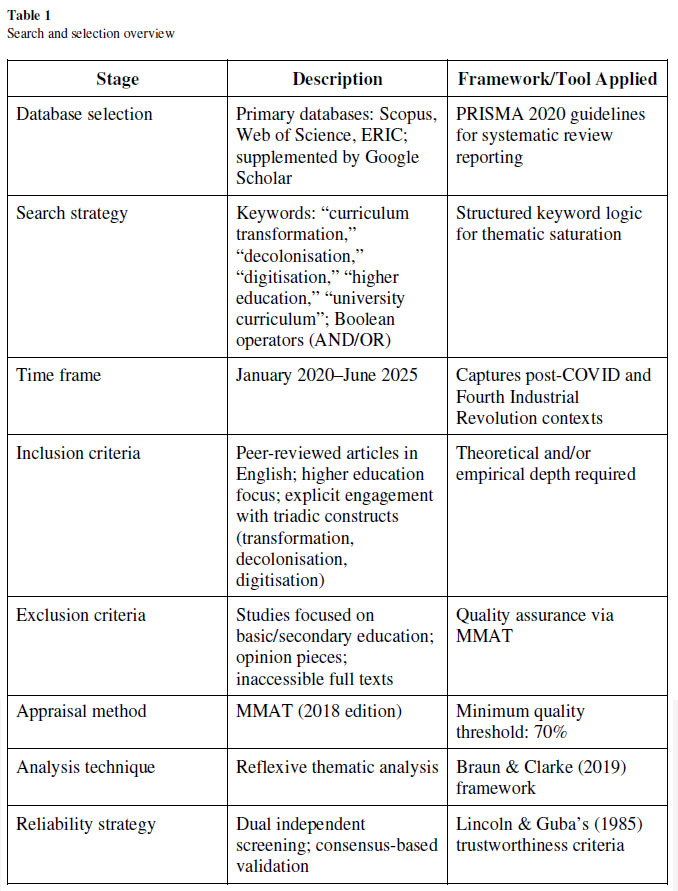
Searches were performed in Scopus, Web of Science Core Collection, and ERIC, which were chosen because they cover a wide range of international and discipline-specific research. The search and selection overviews are summarised in Table 1. To complement these databases, Google Scholar was used to trace open access and regionally indexed publications, particularly from Africa, Latin America, and South Asia, where decolonial and digital discourses are strongly articulated. This strategy also reflects the politics of knowledge production in systematic reviews because database indexing, English-language inclusion criteria, and uneven research funding shape the visibility of what can be synthesised. Search terms included "curriculum transformation," "decolonisation," "digitisation," "higher education," "university curriculum," "digital pedagogy," "online learning," "learning management systems," "artificial intelligence in education," and related terms combined with Boolean operators (AND/OR) to ensure both conceptual breadth and disciplinary precision. The period from January 2020 to June 2025 was purposefully chosen to capture scholarship shaped by post-pandemic digitisation and the intensification of decolonial reform debates (Bozkurt et al., 2022; Khunou, 2024). All retrieved records were managed in Mendeley Desktop for systematic documentation and duplicate removal.
The inclusion criteria privileged conceptual or empirical studies focusing on curriculum reform in higher education that explicitly engaged one or more of the triadic constructs: transformation, decolonisation, or digitisation. Only peer-reviewed publications written in English and published between 2020 and 2025 were considered. Studies were excluded if they addressed basic education, lacked analytical rigour (e.g. commentaries or editorials), or were unavailable in full text. Screening was undertaken by two independent reviewers to enhance inter-rater reliability. Discrepancies were resolved through discussion until full agreement was reached. Each retained study underwent methodological appraisal using the Mixed Methods Appraisal Tool (MMAT; Hong et al., 2018). This instrument was selected because it accommodates qualitative, quantitative, and mixed-method designs, reflecting the epistemic plurality central to the study's framework. Studies scoring below 70 per cent on MMAT quality indicators were excluded from synthesis.
Data extraction followed a structured template capturing author details, publication year, country, methodological orientation, disciplinary context, and major findings. A reflexive thematic analysis, as delineated by Braun and Clarke (2019), was utilised to discern recurring themes and conceptual trends. The coding process occurred in two phases: initially inductively, to identify emergent themes, and subsequently deductively, corresponding to the triadic categories of transformation, decolonisation, and digitisation. Single construct studies were analytically coded within the relevant triadic category and subsequently interpreted relationally during the deductive phase of analysis. The researcher engaged in iterative memo writing and peer debriefing to preserve interpretive consistency and to reflect critically on positionality and potential bias (Lincoln & Guba, 1985). The themes were honed until conceptual saturation was reached, guaranteeing alignment between empirical results and the study's epistemic justice framework. Ethical clearance was not required because the analysis drew exclusively on published secondary data.
Results
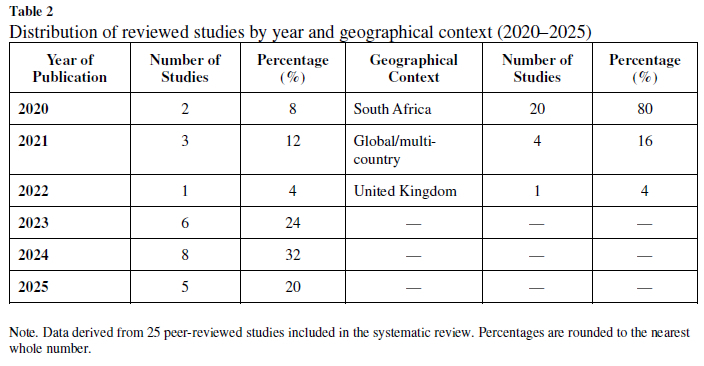
Table 2 summarises the outcome of the systematic search by presenting the distribution of the reviewed studies by publication year and geographical context. The pattern shows a steady rise in publications between 2023 and 2025, signalling growing global interest in curriculum reform framed through the interconnected dimensions of transformation, decolonisation, and digitisation.
The results show that most scholarship originated in South Africa (80%). While this reflects the country's sustained engagement with decolonial curriculum debates (Mendy & Madiope, 2020), it also signals the uneven visibility of other Global South contexts in indexed and English-language publications and therefore the methodological limits of the review.
Disciplinary coverage
The 25 studies represented diverse academic fields, reflecting cross-sector engagement and disciplinary permeability. These encompassed cross-disciplinary or institutional case analyses (9), linguistics and language education (2), science education (2), health sciences (2), anthropology (1), digital media studies (1), academic literacy (1), teacher education (1), humanities (1), and multi-disciplinary analyses (5). This distribution demonstrates that the triadic concerns of equity, epistemology, and technology transcend disciplinary boundaries and are becoming integral to higher-education curriculum studies worldwide.
Study designs and evidence types
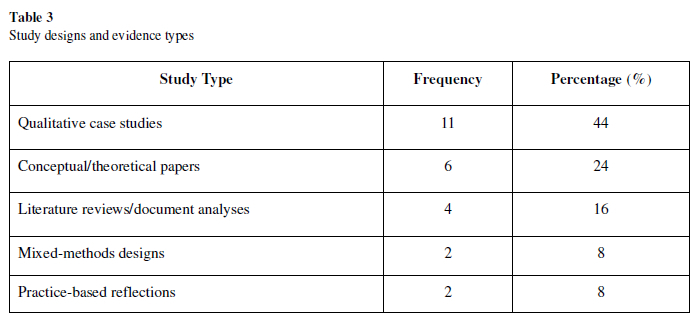
The reviewed studies employed varied methodological approaches with a clear dominance of qualitative and conceptual designs reflecting the interpretive orientation of curriculum theory research. The distribution of methodological approaches across the reviewed studies is summarised in Table 3, highlighting the predominance of qualitative case studies and conceptual analyses within the dataset.
The prevalence of qualitative inquiry and conceptual reflection illustrates an ongoing epistemic shift in higher-education research, away from positivist evaluation models and toward contextually grounded, critical-theoretical approaches (Badat, 2023; Heleta, 2022).
PRISMA flow summary (study identification process)
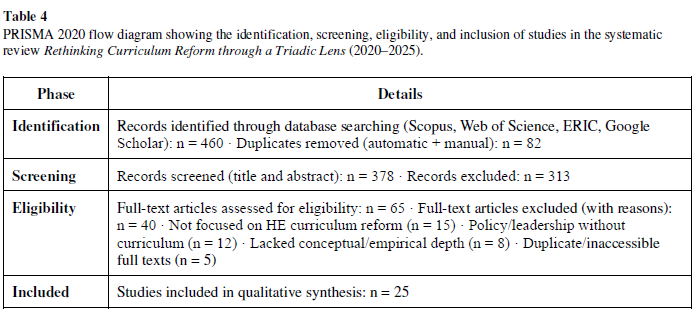
To enhance transparency, Table 4 summarises the study's identification, screening, eligibility, and inclusion processes following the PRISMA 2020 guidelines. The initial search across Scopus, Web of Science, ERIC, and Google Scholar yielded 460 records. After removing 82 duplicates, 378 records remained for screening. Titles and abstracts were reviewed for relevance, and 313 records were excluded for not meeting the inclusion criteria. The full texts of 65 articles were assessed, of which 40 were excluded: fifteen did not focus on higher education curriculum reform, twelve discussed policy or leadership without curriculum analysis, eight lacked conceptual or empirical depth, and five were duplicates or inaccessible. Finally, 25 studies met all criteria and were included in the qualitative synthesis.
Thematic distribution across the triadic lens
Analysis of the 25 included studies revealed three dominant and interrelated themes aligned with the triadic framework: decolonisation, transformation, and digitisation. Although these trajectories were conceptually interconnected, their representation across the corpus was uneven. Decolonisation dominated the discourse, featuring as a central construct in 21 studies (84%), while transformation appeared explicitly in 16 (64%) and digitisation in only 10 (40%). This imbalance indicates that decolonisation continues to function as the moral and intellectual anchor of curriculum reform, whereas transformation remains institutionally procedural and digitisation is still emerging as a critical site of inquiry. Similar trends are observed in broader higher-education research, where decolonisation is often theorised more deeply than it is operationalised (Heleta, 2022).
Decolonisation-focused studies consistently framed curriculum reform as a struggle for epistemic justice. Authors such as Ndlovu-Gatsheni (2018) and Santos and May (2024) conceptualised decolonisation not only as a critique of Eurocentrism but also as a reconstructive project aimed at recovering Indigenous and community-based epistemologies. These studies foregrounded pedagogy as a site of epistemic agency, advocating dialogic, participatory, and multilingual teaching approaches. Across the corpus, decolonisation was frequently invoked as a corrective discourse responding to the perceived failure of earlier transformation policies to achieve epistemic renewal. Yet, as Badat (2023) noted, the tendency to moralise decolonisation without structural or digital enactment risks producing rhetorical rather than systemic reforms. This tension was evident in several South African studies, which called for a fusion of decolonial epistemologies with inclusive institutional practices and open access digital tools to enable authentic curricular change.
Transformation-orientated studies, by contrast, approached reform from an institutional and policy perspective. These papers examined how universities negotiate equity, access, and representational justice within post-apartheid systems of governance. In alignment with Mendy and Madiope's (2020) critique of procedural reform, most studies described transformation as a compliance-driven process constrained by bureaucratic targets rather than as a catalyst for epistemic innovation. However, a small subset of research offered a more integrated view, where transformation was interpreted as a process of reimagining institutional culture in tandem with epistemic renewal. In such cases, transformation functioned as the structural mechanism through which decolonisation and digitisation could be institutionalised. This was particularly visible in studies that investigated curriculum redesign at historically disadvantaged universities, where transformation was linked to resource equity and digital inclusion (Khunou, 2024).
The digitisation theme emerged as the least theoretically developed but the most practically dynamic. Only 10 studies directly addressed the intersection between digital innovation and epistemic justice, though they all recognised technology as a critical enabler of curriculum access and pedagogical flexibility. Bozkurt et al. (2022, p. 1) described the post-pandemic period as part of a "new educational ecology" in which digital learning environments have become central to transformations in teaching and learning practices. Studies from South Africa, Kenya, and Nigeria illustrated how open educational resources and AI-assisted feedback systems expanded participation but also reproduced existing inequalities due to uneven connectivity and digital literacy (Mncube, 2024; Prinsloo & Roberts, 2020). A few contributions, particularly those adopting critical digital pedagogy (Knox, 2020), warned that digitisation without epistemic localisation risks entrenching epistemic dependency on Global North platforms. Nevertheless, the most innovative cases positioned technology as a mediating tool that could extend decolonial pedagogies into hybrid and community-responsive formats, exemplifying what this study terms digitally enacted epistemic justice.
Across these trajectories, the findings reveal a field marked by conceptual convergence but practical fragmentation. Only a few studies (six out of 25) explicitly integrated all three dimensions-transformation, decolonisation, and digitisation-within a single analytical frame. Where such integration occurred, typically in South African and Latin American contexts, reform was depicted as a relational process in which structural equity, epistemic plurality, and digital inclusion operated synergistically. These studies exemplify the triadic coherence this review seeks to advance: curriculum reform understood not as a series of parallel reforms but as a dynamic ecology of interdependent imperatives aimed at realising epistemic justice in the digital age.
Cross-cutting challenges and enablers
Across the reviewed literature, several systemic challenges and enabling conditions shaped the trajectory of curriculum reform in higher education. These influences cut across the three focal domains of transformation, decolonisation, and digitisation, revealing that the success or stagnation of reform depends less on isolated initiatives than on the coherence of institutional, epistemic, and technological capacities. The most frequently reported challenges included policy fragmentation, limited leadership continuity, inequitable resourcing, and the absence of sustained professional learning ecosystems. Enablers, conversely, involved visionary leadership, participatory governance, digital infrastructure investment, and the intentional alignment of institutional cultures with decolonial pedagogies.
A recurring constraint identified in more than half of the studies was the disconnect between national transformation policy and curriculum-level implementation. Badat (2023) emphasised that policy rhetoric often outpaces pedagogical change, leading to symbolic rather than structural reform. This fragmentation is exacerbated by hierarchical decision-making structures that marginalise academics and students from curriculum design processes (Mendy & Madiope, 2020). As a result, transformation initiatives frequently privilege compliance reporting over epistemic innovation. Several South African and Latin American studies noted that without leadership stability and interdepartmental coordination, institutional reform remains episodic and donor driven rather than sustained.
Digital inequalities emerged as an equally pervasive limitation. While digitisation expanded access during the pandemic, unequal bandwidth, device availability, and digital literacy continued to constrain participation, particularly in rural and under-resourced universities (Heeks, 2022). Scholars such as Mncube (2024) warned that while online learning offers opportunities for more inclusive and equitable education, it also presents challenges that must be addressed to achieve epistemic justice. Moreover, limited staff readiness to integrate digital tools pedagogically rather than administratively restricted the transformative potential of technology. The review also revealed a subtle epistemic risk: the uncritical adoption of commercial learning platforms that embed Western cognitive assumptions, an issue foregrounded in critical digital pedagogy (Knox, 2020).
Despite these barriers, the literature documents important enabling trends. Many universities are beginning to foster collaborative curriculum designs that include students, communities, and Indigenous knowledge practitioners, thereby operationalising decolonisation through participatory practice (Santos & May, 2024). Such inclusive approaches were often accompanied by investments in open educational resources and faculty digital capacity programmes, signalling progress towards forms of epistemic justice that challenge epistemic violence and Eurocentric dominance in higher education (Heleta, 2022). Leadership commitment and cross-sector partnerships, especially between higher education institutions and technology providers, were shown to amplify these gains. Where institutional vision, policy alignment, and digital infrastructure converged, reform coherence was strongest, and the triadic imperatives reinforced rather than competed with one another.
These patterns portray curriculum reform as an ecology of interdependent conditions. The preceding section has presented a descriptive synthesis of the reviewed studies; the discussion that follows offers a philosophical interpretation of these patterns through the triadic framework. Challenges in one domain-policy, pedagogy, or technology-tend to reverberate across others, while enabling factors in one sphere can catalyse progress elsewhere. The findings thus affirm that transformation, decolonisation, and digitisation cannot advance in isolation; they require an integrative strategy underpinned by epistemic justice, participatory leadership, and sustained resource equity.
Discussion
This section offers a philosophical interpretation of the descriptive synthesis presented above, reading the uneven development of curriculum reform through the triadic framework as an analytic account of its structural and epistemic dynamics. While decolonisation remains the most conceptually developed, transformation and digitisation are often treated as parallel or secondary concerns. This fragmentation reflects the persistence of epistemic violence and Eurocentric hegemony in higher education, where gains in structural access and digital participation have not been matched by substantive epistemic transformation, leaving the project of curriculum change incomplete (Heleta, 2022). The imbalance further signals a persistent tension between symbolic reform and substantive curriculum change, echoing what Badat (2023) identified as a disjuncture between the transformative aspirations of post-apartheid higher education and its enduring institutional realities. It further points to a limitation of epistemic justice discourse, which, within neoliberal university contexts, is frequently subsumed into performance frameworks, transformation metrics, and digital compliance systems, leaving underlying relations of knowledge production largely intact. In such contexts, epistemic justice risks becoming a legitimising vocabulary rather than a material reorganisation of authority, resources, and epistemic labour. This dynamic is intensified in digitally mediated universities, where platform capitalism and datafication increasingly structure educational practice. Proprietary learning management systems, algorithmic analytics, and outsourced cloud infrastructures embed particular epistemic assumptions and governance logics, often anchored in Global North technological ecosystems. Under these conditions, curriculum reform is not only a pedagogical question but also a matter of technological sovereignty, data governance, and institutional control over the infrastructures that mediate knowledge production. The discussion therefore interprets these findings through the triadic framework, using epistemic justice as an analytic lens to examine how these reform trajectories produce both advances and persistent constraints.
Decolonisation as an epistemic anchor
The dominance of decolonisation in the reviewed literature reaffirms its status as the moral and intellectual foundation of curriculum reform. However, the findings suggest that its transformative potential is often constrained by institutional inertia and limited digital integration. Ndlovu-Gatsheni (2018) argued that epistemic freedom requires not only a redefinition of knowledge hierarchies but also a restructuring of pedagogical spaces. The reviewed studies demonstrate that while universities increasingly invoke decolonisation rhetorically, few have embedded it structurally through assessment design, curriculum co-creation, or digital resource development. This pattern reveals a form of epistemic tokenism, in which decolonial ideals are acknowledged but not operationalised. As Mbembe (2016) and Connell (2020) reminded us, epistemic justice cannot be realised without reconfiguring how institutions validate, produce, and circulate knowledge.
Transformation as a structural mechanism
The second insight concerns the institutional mechanisms of transformation. The results indicate that most universities have achieved measurable diversity in student demographics and staffing but continue to reproduce inequitable hierarchies in knowledge production. Transformation thus functions as a necessary but insufficient condition for epistemic justice. As Mendy and Madiope (2020) noted, transformation must evolve from procedural compliance to an ethos of epistemic inclusion. Studies that combined transformation with decolonial practice achieved stronger curriculum coherence, suggesting that structural reform acquires meaning only when coupled with epistemological change. Moreover, alignment between policy directives and digital capacity emerged as a decisive enabler; institutions that integrated equity policies with technological strategies demonstrated greater sustainability and cross-sector collaboration (Khunou, 2024).
Digitisation as an emerging epistemic frontier
The third insight highlights the role of technology in mediating epistemic access and agency. While digitisation has democratised learning opportunities, the reviewed studies confirm that it often reproduces pre-existing inequalities. Bozkurt et al. (2022) and Knox (2020) cautioned that the rapid adoption of digital platforms without epistemic contextualisation risks deepening dependence on Western-designed pedagogical architectures. However, where technology was integrated critically through locally curated open resources, blended pedagogies, and community-based digital engagement, it amplified decolonial goals. This aligns with Heleta's (2022) conception of situated epistemic justice, in which technology is not simply a delivery mechanism but a space for local knowledge production and validation. Digitisation thus emerges as both a tool and a terrain of epistemic struggle, requiring deliberate governance and pedagogical intentionality to ensure that digital inclusion translates into epistemic inclusion.
The intersection of these three imperatives reveals the relational logic of curriculum reform. Pursuing transformation, decolonisation, and digitisation together resulted in the strongest reform coherence and sustainability. Understanding curriculum change as an interconnected and systemic process, rather than a sequence of discrete reforms, is crucial for effective educational transformation, as educational change unfolds through complex interactions across institutional, social, and contextual levels (Barnett, 2009; Bronfenbrenner, 1979; Fullan, 2007). Within this ecology, epistemic justice operates as the connective tissue linking institutional equity, epistemological plurality, and digital participation. However, this relationality is not inherently coherent. In several cases, the three trajectories operate in tension; transformation driven by audit metrics can proceduralise change without epistemic renewal, decolonial curricular projects may be constrained by platform-dependent digital systems that privilege Global North knowledge architectures, and rapid digitisation can recentralise authority through data governance and proprietary infrastructure. Under these conditions, the triad exposes structural incompatibilities that require political and institutional negotiation rather than technical integration. The findings, therefore, indicate that alignment is contingent; transformation without decolonisation risks proceduralism, decolonisation without digitisation limits scalability, and digitisation without transformation risks reinforcing inequity. The triadic model clarifies how social justice, epistemic plurality, and technological inclusion operate as interdependent but conditionally aligned principles of reform.
Finally, the results underscore the global relevance of the South African experience. The nation's curriculum reform debates, while contextually grounded, mirror the dilemmas faced across the Global South, balancing access with authenticity, equity with quality, and global connectivity with local autonomy. As Lemon (2023, p. 293) observed, the challenge lies in crafting "pedagogies of belonging" that make the university responsive to both global change and local epistemic heritage. By synthesising evidence across multiple regions, this review demonstrates that epistemic justice is not a static endpoint but an evolving process that requires institutional reflexivity, participatory leadership, and digital sovereignty. In this sense, the triadic framework offers a transferable model for reimagining curriculum reform in a world where the ethical, epistemic, and technological dimensions of education cannot be separated.
Conclusion, implications, and limitations
This review investigated how transformation, decolonisation, and digitisation intersect to shape curriculum reform in higher education between 2020 and 2025. Guided by the principle of epistemic justice, it synthesised 25 peer-reviewed studies to respond to the central question: "How do these trajectories converge conceptually and practically to inform curriculum reform?" The analysis revealed that although decolonisation remains the most elaborated strand, transformation frequently assumes procedural expression, and digitisation continues to emerge as a critical yet under-theorised dimension. The triadic framework indicates that curriculum reform is most effective when institutional structures, epistemic commitments, and technological arrangements are deliberately aligned. Yet the coherence it promises remains contingent upon political will, material redistribution, and technological sovereignty; without these, the triad risks functioning as a discursive alignment rather than a structural transformation. The study contributes by clarifying how epistemic justice can be used to analyse the relationship between social redress, knowledge pluralism, and digital participation. It also extends curriculum theory by reframing reform as an ecology of interdependence rather than a sequence of isolated initiatives. Ultimately, the review demonstrates that curriculum reform in higher education cannot succeed through isolated initiatives. Achieving a socially just and contextually resonant curriculum requires intentional synergy between structural transformation, epistemic renewal, and digital inclusion. The triadic model proposed here provides a heuristic framework for institutions, policymakers, and educators to critically examine how structural transformation, epistemic renewal, and digital inclusion interact within their specific contexts.
The implications outlined below move from analytic interpretation to a normative consideration of the conditions required for more coherent curriculum reform. For higher education institutions and policymakers, the findings highlight that structural transformation must be accompanied by epistemic renewal and supported by equitable digital infrastructures. Universities should institutionalise collaborative curriculum design processes that include students, communities, and Indigenous knowledge practitioners, thereby translating decolonial intent into practice. Leadership and governance frameworks need to move beyond compliance metrics to embed epistemic justice indicators within teaching, research, and technology strategies. Investing in digital literacy, open educational resources, and professional learning that is grounded in local contexts can foster situated epistemic justice (Heleta, 2022). At the policy level, coordinated regional efforts, particularly across the Global South, should promote shared benchmarks for integrating local epistemologies within global digital ecosystems.
This review was limited to English-language publications published between 2020 and 2025, which may have excluded relevant studies in other languages or longer-term perspectives. It relied solely on secondary data, without examining unpublished institutional documents or community-based research. Future work could extend the temporal scope to capture post-2025 developments and conduct comparative or longitudinal analyses to test the robustness of the triadic model across diverse contexts. Empirical investigations exploring how epistemic justice manifests in digital and decolonial curriculum design would further refine the framework. Despite these limitations, the study provides a foundational synthesis that repositions curriculum reform as a triadic, justice-orientated process essential to achieving inclusive and contextually resonant higher education in the digital era.
Declarations
Availability of data and materials
Not applicable. This is a conceptual systematic review, and no primary empirical data were generated or analysed.
Competing interests
The authors declare that they have no competing interests.
Funding
This research received no external funding.
Authors' contributions
All authors contributed to the conceptualisation, methodological design, literature analysis, writing of the original draft, and subsequent review and editing. Both authors read and approved the final manuscript.
AI-assisted tools
QuillBot was used for grammar and readability support, and ChatGPT-5 was used solely to assess the manuscript's alignment with the journal's requirements. All analysis, interpretations, and final decisions remain the responsibility of the authors. All intellectual content, analysis, interpretations, and conclusions were developed by the authors, who take full responsibility for the accuracy, originality, and integrity of the manuscript.
Badat, S. (2023). Re-envisioning universities in Africa as African universities. In E. T. Woldegiorgis, S. Motala, & P. Nyoni (Eds.), Creating the new African university (pp. 12-39). Brill. https://doi.org/10.1163/9789004677432_002
References
- Barnett, R. (2009). Knowing and becoming in the higher education curriculum. Studies in Higher Education, 34(4), 429-440. https://doi.org/10.1080/03075070902771978
- Bosch, M., Vu-Nhu, T. H., & Wijayanti, D. (2023). Curriculum reforms and the construction of the knowledge to be taught. In Y. Shimizu & R. Vithal (Eds.), Mathematics curriculum reforms around the world: The 24th ICMI Study (pp. 101-111). Springer.
- Braun, V., & Clarke, V. (2019). Reflecting on reflexive thematic analysis. Qualitative Research in Sport, Exercise and Health, 11(4), 589-597. https://doi.org/10.1080/2159676X.2019.1628806
- Bronfenbrenner, U. (1979). The ecology of human development: Experiments by nature and design. Harvard University Press.
- Connell, R. (2020). Southern theory: The global dynamics of knowledge in social science. Routledge.
- Escobar, A. (2022). Global higher education in 2050: An ontological design perspective. Critical Times, 5(1), 183-201. https://doi.org/10.1215/26410478-9536551
- Fricker, M. (2007). Epistemic injustice: Power and the ethics of knowing. Oxford University Press.
- Fullan, M. (2007). Leading in a culture of change. Jossey-Bass.
- Heeks, R. (2022). Digital inequality beyond the digital divide: Conceptualizing adverse digital incorporation in the global South. Information Technology for Development, 28(4), 688-704. https://doi.org/10.1080/02681102.2022.2068492
- Heleta, S. (2022). Eurocentrism, racism and academic freedom in South Africa. In R. Watermeyer, R. Raaper, & M. Olssen (Eds.), Handbook on academic freedom (pp. 191-205). Edward Elgar.
- Hong, Q. N., Fàbregues, S., Bartlett, G., Boardman, F., Cargo, M., Dagenais, P., & Pluye, P. (2018). The Mixed Methods Appraisal Tool (MMAT) version 2018 for information professionals and researchers. Education for Information, 34(4), 285-291. https://doi.org/10.3233/EFI-180221
- Jansen, J. D., & Walters, C. A. (2022). The decolonization of knowledge: Radical ideas and the shaping of institutions in South Africa and beyond. Cambridge University Press.
- Khunou, G. (2024). Transformation reflections on opportunities and challenges in a context of 4IR developments and post-COVID-19. In G. Khunou (Ed.), Transforming higher education scholarship: After COVID-19 and in the context of the 4th Industrial Revolution (pp. 1-20). University of Johannesburg Press. https://doi.org/10.36615/9781776490073
- Lincoln, Y. S., & Guba, E. G. (1985). Naturalistic inquiry. SAGE.
- Mashilo, P. P., & Govender, L. (2023). African identity and curriculum transformation at universities in South Africa. African Journal of Teacher Education, 12(2), 119-143. https://doi.org/10.21083/ajote.v12i2.7515
- Mateko, F. M., Dowelani, M., & Sinamano, R. (2025). Digital inequality and transformation in South African higher education during COVID-19: A comparative analysis of historically disadvantaged and historically advantaged universities. Higher Education Policy. Advance online publication. https://doi.org/10.1057/s41307-025-00416-0
- Mbembe, A. J. (2016). Decolonizing the university: New directions. Arts & Humanities in Higher Education, 15(1), 29-45. https://doi.org/10.1177/1474022215618513
- Mncube, S. (2024). Open educational resources as the panacea for the decolonisation of e-learning content in South Africa. Distance Education, 45(3), 418-438. https://doi.org/10.1080/01587919.2024.2338721
- Ndlovu-Gatsheni, S. J. (2018). Epistemic freedom in Africa: Deprovincialization and decolonization. Routledge.
- Prinsloo, P., & Roberts, J. (2020). Analysis of higher education (HE) systems' approach in South Africa: National infrastructures for digital (open) educational resources. In V. I. Marín, M. Bond, O. Zawacki-Richter, C. H. Aydin, & S. Bedenlier (Eds.), (Open) educational resources around the world: An international comparison. EdTech.
- Santos, B. de S. (2016). Epistemologies of the South: Justice against epistemicide. Routledge.
- Seymour, K., Skattebol, J., & Pook, B. (2020). Compounding education disengagement: COVID-19 lockdown, the digital divide and wrap-around services. Journal of Children's Services, 15(4), 243-251. https://doi.org/10.1108/JCS-08-2020-0049
- Shay, S. (2015). Curriculum reform in higher education: A contested space. Teaching in Higher Education, 20(4), 431-441. https://doi.org/10.1080/13562517.2015.1023287
Accepted: 17 March 2026