Co-constructing collaborative support provision strategies in full-service schools through the integration of learners' voices and teachers' insights
Abstract
Collaboration among stakeholders in support provision is vital in an inclusive education system. Education White Paper 6 on Special Needs Education prescribes that collaboration in support provision should include all stakeholders such as learners, teachers, community members, government departments, and professionals. However, engaging learners' views on the support they receive remains missing from support provision practices. While teachers are essential for support, learners' input is crucial to meet their needs. This study aims to develop strategies for learner engagement during collaborative support, using teachers' and learners' views. Six teachers and six learners from full-service schools in the Ngaka-Modiri Molema district of North West participated as co-researchers in this study. Data were generated through participatory action research meetings, and analysed using inductive thematic analysis. The findings revealed an understanding of the importance of collaboration among support stakeholders, a need to include learners and parents in collaborative support provision, and the presence of a polycrisis affecting collaborative efforts in support provision. This study highlights the need to give learners experiencing barriers to learning the opportunity to be active contributors to the support they receive because they know best how they learn.
collaboration; full-service school; learner voices; stakeholders in support provision; support
Introduction
Inclusive education is grounded in the principle of avoiding any exclusion by providing equal treatment for all people (Department of Education [DoE], 2001). The inclusive education ideology advocates the inclusion of individuals who were previously marginalised, with the aim of attaining equal opportunities to support fundamental human rights (de Klerk & Palmer, 2021). Currently, learners experiencing barriers to learning are still treated as incapable of knowing what support they need to improve their learning. In the context of education in a time of a polycrisis, where interconnected social, economic, health, and educational challenges compound learners' experiences of exclusion, overlooking learners' perspectives further limits the development of responsive and contextually relevant support strategies. This goes against the responsibility assigned to all member countries and international organisations that signed the Salamanca Statement (United Nations Educational, Scientific and Cultural Organization, 1994) to rethink the framing of disability as a lack of ability, and to mitigate barriers for teachers and school systems.
A plethora of studies suggest that learners experiencing barriers learn best when they can relate to and inform the curricula and pedagogies in use (Aronson & Laughter, 2016; Mallinson et al., 2025). However, the perpetual marginalisation of learners, who are supposed to be not only recipients (Mena & Waitoller, 2025) but also stakeholders in the intended support as indicated in Education White Paper 6 (DoE, 2001), remains a challenge. Pienaar and Dreyer (2023) attest that a major obstacle to the provision of appropriate support is the widespread underestimation of the potential and capacity that learners experiencing barriers to learning possess. The lack of promotion of learner participation in inclusive matters, and of support provided to them, pose a barrier to inclusive pedagogical decision-making. Hence, Valdés and Gómez-Hurtado (2025) advocate deliberate attention to the voices of those who are less heard as one of the necessities in the establishment of inclusive practices.
The literature further asserts that, in addition to inclusive learning matters, learners' participation goes hand in hand with the development of inclusive practices and policies and the creation of inclusive cultures (Valdés & Gómez-Hurtado, 2025). In the South African context, policies on inclusive education emerged as an acknowledgement that learners experiencing barriers to learning were the most excluded population in the education system (DoE, 2001). Therefore, the purpose of policies on inclusive education is to redress the inequalities of the education system that was informed by the apartheid regime (Karimupfumbi & Dwarika, 2022). In the apartheid era, the education system was known for an exclusive culture in which differences were treated as grounds for referral to specialised school settings (Mfuthwana & Dreyer, 2018). In fact, in that education system, learners experiencing barriers to learning were excluded from participating in education.
Full-service schools can fulfil their mandate to provide quality, equitable education to all learners, regardless of learning needs, only through a more collaborative effort from all stakeholders (Department of Basic Education [DBE], 2010; Phala & Hugo, 2022). As long as learners' voices remain silenced within support efforts aimed at addressing past exclusionary practices, these efforts only reinforce their continued marginalisation (Karimupfumbi & Dwarika, 2022). Research indicates that listening to learners' views on their education is a powerful way to ensure their active participation in learning (Barr et al., 2023; Messiou et al., 2022). According to Major and Briant (2023), deficit thinking towards learners experiencing barriers to learning still dominates, contradicting the commitment expressed in Education White Paper 6 (DoE, 2001), which defines inclusive education as a determination to develop learners' strengths by providing them with opportunities to actively engage in learning. Moreover, although the Policy on Screening, Identification, Assessment and Support (DBE, 2014) designates learners as stakeholders in the provision of support, this acknowledgement remains largely symbolic. Learners' meaningful participation in shaping the support they receive is often overlooked in practice.
This aligns with the observations of Mangiaracina et al. (2021), who criticise the limitations of policies on inclusive education globally, noting that references to children's rights are often superficial and lack concrete strategies for their promotion and protection. These weaknesses include weaker accountability (Walton & Engelbrecht, 2024), a lack of structured stakeholder engagement to advance changing attitudes towards disability within the DBE and across its sister departments (DBE, 2015), and failure to monitor and verify how identification of learning difficulties is carried out (DBE, 2015; Jama et al., 2024). All these limitations impede the quality and relevance of the education each learner receives (Engelbrecht, 2020). Hence, the Report on the Implementation of Education White Paper 6 on Inclusive Education: Overview for the Period 2013-2015 (DBE, 2015) records many learners dropping out, especially in ordinary schools.
According to Karimupfumbi and Dwarika (2022), to effectively support learners, they need to be included in support processes and informed about the learning areas where they will receive additional support before any recommendations are made. Among the guidelines and strategies for supporting these learners, different roles and responsibilities are assigned to various stakeholders, including learners themselves (DBE, 2014). Hence, seeking learners' voices offers pathways of hope by recognising learners as active stakeholders who can articulate their experiences, identify their support needs, and contribute to solutions that enhance their learning. Furthermore, it reflects an affirmative ethics perspective by promoting inclusion and meaningful participation, ensuring that learners experiencing barriers are not merely recipients of support but valued contributors to decisions that affect their educational experiences. In this study, we pose the following research question: "How can collaborative support provision strategies be co-constructed through the integration of learners' voices and teachers' insights to enhance effective support provision?
Conceptualising stakeholders in support provision
The term "stakeholder" is central in business; therefore, we have reviewed what it means to establish expectations for people in that role. Cleland (1989) defines a stakeholder as a person who has a vested interest or share in the project undertaken. In addition, Bourne (2005) asserts that stakeholders are individuals who have an interest in the project, either through rights or ownership, and can, accordingly, contribute to the form of knowledge or to the livelihood of the subject activity. Therefore, assigning stakeholder roles in support services fosters an understanding of the importance of honouring the right to contribute and be consulted whenever support seems necessary (Yang et al., 2025).
However, it remains a concern that not all stakeholders are always involved in support provision given that it is only the voices of teachers, researchers, and policymakers that dominate the scene (Hugo & Mobara, 2024). It can be of benefit to learners, as recipients of support, when parents, teachers, and learners work together as stakeholders in support provision (Mpya & Sadiki, 2023). Research asserts that, in most cases, teachers tend to monopolise power owing to their centrality in the provision of support, thereby depriving learners of the meaningful support they would have received if all the relevant stakeholders were involved (Jama, et al., 2024). Teachers are often expected to understand, lead, and embrace the responsibility to coordinate a support network by organising all the stakeholders in support provision because they are the first people holding an important stakeholder role in support (Oswald, 2019).
The scarcity of literature on the involvement of all stakeholders in decision-making on matters related to support services reflects a missed opportunity to tap into the richness of reasoning that everyone can contribute (Mangiaracina et al., 2021). The collaborative effort remains elusive as long as the engagement and full participation of the stakeholders in support provision are minimal (Mena & Waitoller, 2025). Since the introduction of inclusive education, there has been a shortage of studies on teachers' views on this matter and on how they involve learners when designing support for them, as the policy suggests.
Although inclusive education is a children's right, children's roles in education remain marginal and passive (Esteban, 2022). According to the United Nations Convention on the Rights of the Child, children are capable of forming their own views on matters affecting them (Quennerstedt et al., 2018). Furthermore, Oswald (2019) emphasises the need to foster collaborative learning, problem-solving, and support for both teachers and learners. Reiche (2023) argues that teachers responsible for supporting learners experiencing barriers to learning can benefit from stakeholder support. This can only be achieved when stakeholders understand what it means to be a stakeholder in support provision.
South African inclusive education policies clearly articulate the importance of stakeholder support in theory (DBE, 2014; DoE, 2001); however, this commitment is not consistently reflected in practice. Mpya and Sadiki (2023) assert that despite the emphasis on stakeholder support, teachers receive minimal support from other stakeholders. According to Maree et al. (2023), there is a lack of a coherent understanding of policies on inclusive education among teachers, leading to reluctance to adhere to what is stipulated in the policy documents. The Policy on Screening, Identification, Assessment and Support (DBE, 2014) mandates that all stakeholders in support provision must be meaningfully involved. According to Barr et al. (2023), listening to learner voices is a powerful way of ensuring their active participation in their learning. However, in the past, the inequalities experienced by learners with barriers to learning denied them their right to participate in learning, thereby violating their right to education. Not only have learners' voices been limited in inclusive practices, but they continue to be seen as consumers of the support provided to them (Mena & Waitoller, 2025). Allowing learners to share their perceptions is crucial in support provision. According to Makhalemele et al. (2025), a new barrier in support services is teacher domination, in which learners' voices are silenced.
Conceptualising full-service schools
The DBE (2005) defines full-service schools as mainstream educational institutions that provide quality education to all learners by meeting the full range of learning needs in an equitable manner. Full-service schools were introduced to realise the aspirations of policies on inclusive education in South Africa. A core principle of full-service schools, as highlighted in Education White Paper 6 (DoE, 2001), is that teachers in these schools should be equipped with the requisite skills and knowledge to support all learners, thereby ensuring equitable access to quality education that addresses diverse learning needs (Mbelu, 2025). Moreover, these schools are expected to adopt an accommodative approach that upholds a spirit of collaboration among various stakeholders, including learners. In advancing the development of both teachers and learners, pedagogical practices must be inclusive and non-exclusionary to enable meaningful participation and holistic development. According to Ayaya et al. (2023), these schools need to embrace inclusive pedagogy and practice.
The ethos of embracing inclusivity is to adopt a holistic, flexible, and accommodating approach to development, to uphold a spirit of collaboration among all members of the school community, and to reach out to different stakeholders in the school community. Although learners are seen as a source of support to one another (DBE, 2005), this does not preclude learners' responsibility for their own learning. Hence, we argue that to fulfil learners' stakeholder role, while noting their uniqueness of character, it will be instrumental to plan support that enables them to share their interests, pace of learning, and how they learn.
Contrary to the ideal ethos and mandates expected of full-service schools, Ayaya et al. (2023) highlight that their establishment has not been smooth owing to little or no signs of transformation because teachers need to be better equipped for their new role. Hugo and Mabara (2024) confirm that most teachers in full-service schools were already employed when the decision to convert from mainstream to full-service schools was made; hence, challenges remain. These challenges include a lack of knowledge about adapting teaching methods, and an inability to apply the screening, identification, assessment, and support process, which leads to reservations about the process and to viewing teaching in full-service schools as an overwhelming challenge.
Theoretical framework
This study is underpinned by social constructivism, a theory developed by Lev Vygotsky in 1978. Social constructivism values collaborative learning that emphasises learner involvement, group discussion, and knowledge exchange through social interactions. According to Vygotsky (1978), social interactions promote what he calls the zone of proximal development. Gannar and Kilani (2025) explain that the zone of proximal development represents the learner's current skill level, as well as the potential for development that can be achieved with adequate support. Another key concept of social constructivism is scaffolding. Scaffolding refers to the step-by-step support that learners receive, allowing them to acquire skills they may not be able to develop without assistance (Bellande et al., 2010). This theory holds that it is the teacher's responsibility to use learner-centred and collaborative teaching approaches (Saleem et al., 2021). Using such approaches, active participation among learners, teachers, and other stakeholders in teaching and learning is promoted. According to Akpan et al. (2020), proponents of social constructivism view knowledge as what learners do in collaboration with their peers and teachers. In addition, these scholars argue that social constructivism values conversation, interaction with others and the application of knowledge as essential aspects of learning and as a means to achieve learning objectives (Akpan et al., 2020).
This theory is applicable to this study because in support provision, teachers and learners are expected to collaborate in providing learning support and developing individual support plans. Education White Paper 6 (DoE, 2001) and the Policy on Screening, Identification, Assessment and Support (DBE, 2014) assert that, as in teaching, in support provision, teachers and learners should collaborate in devising the support plan for the learner. In social constructivism, teachers and learners work collaboratively to co-construct knowledge (Vygotsky, 1978). Reflecting on the key assumptions and principles of social constructivism, we deduce that this theory supports the prescriptions of inclusive pedagogy, which favour collaborative engagement in support provision. Therefore, in this study, teachers and learners worked together and co-constructed support provision strategies. These support provision strategies are regarded as inclusive because they took into consideration the voices of learners and the insights of teachers. In this study, learners' voices were treated as a positive, active contribution, whereas teachers' insights were treated as professional knowledge developed through reflective practice, which displays hope in the inclusive education scholarship.
Research methodology
This study is part of a larger project that used participatory action research (PAR), a subset of action research. PAR was employed in this study to promote learner agency and voice, recognising that learners are knowledgeable about their support needs. Therefore, learners were recruited as co-researchers rather than as subjects of research. PAR rejects top-down approaches, allowing the integration of learners' voices with teachers' insights to co-develop collaborative support strategies that enhance support provision and promote social and pedagogical change (McTaggart, 1997). In this study, learners, who are usually left behind in their own support provision, were given an opportunity to share their opinions on co-creating strategies for support provision.
Twelve participants were recruited and selected through purposive sampling as information-rich cases related to the phenomenon of interest, as Palinkas et al. (2015) explain. Two full-service schools in the Ngaka Modiri Molema district of North West were identified as research sites because their effective implementation of inclusive education is recognised. We worked with six participants-three learners and three teachers-from each school. The teacher participants were chosen for their active role in providing support, while the learners were selected because they already receive additional support for their learning. PAR meetings were used as a practical means to encourage participants to speak in formal spaces prepared to produce agreed actions, as guided by the aim of the study (Carmi et al., 2025).
We facilitated three PAR meetings with the participants from each school, each lasting an hour and a half, with relationship-building icebreakers before any engagement. We (the researchers) played a facilitative role guided by an affirmative ethical stance that prioritised the participants' expertise and promoted equitable participation. By creating pathways for participants' voices to shape the inquiry and the resulting support strategies, we sought to foster shared ownership of knowledge and collaborative action, consistent with the democratic and emancipatory principles of PAR, as set out by Wood (2020). The discussions were audio-recorded, with accompanying field notes. Because we had individual field notes, we discussed the themes we identified and conducted member checking to ensure trustworthiness.
We ensured that ethical requirements, as set out by Swartz (2011), were met because we involved learners as participants. The parents of the learners we worked with gave their consent and signed consent forms. Furthermore, the learners gave their assent, indicating that they understood what was expected of them in participating in the study after the study's objectives were communicated to them. The data generation process began after approval was granted by the relevant ethics committee (Ethics Number NWU-00A413-23-A2). This required the participants to take part in the data generation process only after they signed informed consent and assent forms. We assigned codes to the participants to protect their identities.
Data were generated from PAR meetings and analysed using Braun and Clarke's (2019) six steps. Although we conducted the systematic coding and organisation of the data following Braun and Clarke's six-phase approach, the emerging themes were discussed with the participants during the PAR reflection meetings. This collaborative verification enhanced the credibility of the findings by ensuring that the themes accurately represented the participants' experiences and supported the co-construction of knowledge-a fundamental principle of PAR. The following section presents the findings, drawing on the literature, and provides the conclusion that emerged from the findings.
Findings
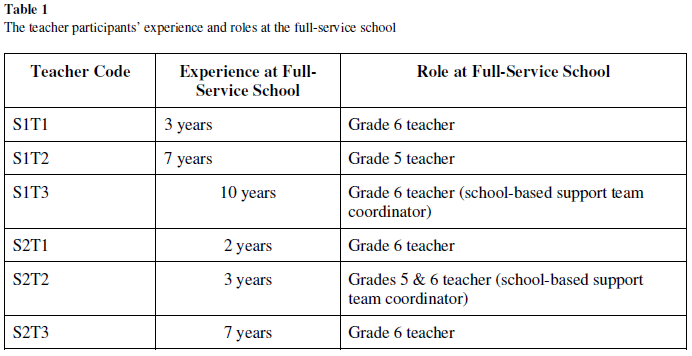
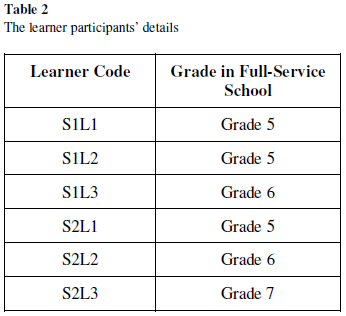
This section presents the study's findings, co-created by the participating teachers and learners. Responses from each participant are identified using pseudonyms. For the teacher participants in School 1, "S1T" and a number are used, while for the learner participants, "S1L" and a number are used. For School 2, "S2T" and "S2L" and a number are used for the teacher and learner participants, respectively. The teachers' experience and roles at the full-service school are summarised in Table 1, and learners' grade levels are summarised in Table 2.
Next, the three themes that emerged from the PAR reflection meetings are discussed.
Theme 1: Understanding the importance of collaboration among support stakeholders
All the co-researchers recognised the importance of collaboration among different stakeholders, but they focused mainly on other aspects, such as other schools and non-governmental organisations, rather than on the learners to whom support is provided. In responding to the question about their understanding of collaborative support provision strategy, participants responded as follows:
Collaborative support is about collaborating with other schools, especially full-service schools like ours. (S1T1)
Collaboration is about working with NGOs [non-governmental organisations] like FAMSA regarding family issues. Our children have issues; so, psychologists and social workers at FAMSA assist our learners with family issues that they have. (S1T3)
Other co-researchers emphasised the importance of working with internal stakeholders, including other teachers, learners, and parents. One co-researcher further highlighted collaboration in completing the SNA1 and DBE126 forms, which is crucial for support provision. Verbatim responses of S1T1, S1T2, and S2T3 are provided below:
Collaborative support is about working together with colleagues, learners, and parents to ensure that every learner's needs are met. It is about shared responsibilities-planning and coordinating support so that learners receive academic, emotional, and social assistance. (S1T1)
It is about working with teachers, learners, and parents in supporting the learners. (S1T2)
It is about working with the learners, teachers, and parents to complete [the] SNA1 form. We also take the DBE126 form to the nearest hospital to be completed by different professionals for concessions and accommodation services. (S2T3)
S1T2 and S2T1 reported that they involved learners through the buddy system and peer tutoring, which are strategies for improving academic performance. They said:
I partner with my learners by identifying challenges and involving them in setting goals. I sometimes provide group tasks that allow learners with different strengths to help one another. (S1T2)
It is about learners working with each other, in the form of [a] buddy system. I observe that this improve the academic performance of our learners as long as they work together. (S2T1)
This finding highlights the co-researchers' understanding of and commitment to collaborative effort in support provision. It implies that the co-researchers use and value collaboration with internal and external stakeholders in support provision. The finding further supports the view of social constructivism, which holds that collaboration in teaching and learning is essential for knowledge construction (Vygotsky, 1978).
The responses above demonstrate an understanding of the importance of collaborative effort in support provision. We have noticed that although collaboration is seen as imperative, it appears to be limited, at least in part, to the feedback of learners rather than applied to decision-making when planning for support needs. It remains unclear what learners' contribution is to the type of support provided to them, as mandated in the Policy on Screening, Identification, Assessment and Support (DBE, 2014), especially for learners aged 12 years and older. During the discussions, the learners did not respond to the question about their understanding of collaborative support provision. Consequently, this finding lacks learners' views on collaborative support provision, which remains a concern. This confirms learners' limited understanding, positioning them as passive recipients rather than active stakeholders in the provision of support (Mena & Waitoller, 2025).
Although Barr et al. (2023) point out that listening to learners' voices is a powerful way to ensure their full participation, teacher dominance continues to take its toll on support services. This not only perpetuates the deficit view associated with barriers to learning but also deprives learners experiencing barriers of their right to meaningful support that is responsive to not only their learning needs but also their interests and preferences (DBE, 2014). This can be seen as the perpetual dominance of teachers' voices, which limits opportunities to tap into the richness of reasoning from every stakeholder in support provision (Mangiaracina et al., 2021).
Theme 2: Deliberate inclusion of learners and parents in the collaborative planning of support provision
The co-researchers attested that they work with learners and parents to provide support, which is a commendable collaborative support strategy. S1T1 and S1T3 made the following remarks in this regard:
I work with learners and parents to ensure that every learner's needs are met. It is about shared responsibilities-planning and coordinating support so that learners receive academic, emotional, and social assistance. (S1T1)
I have developed strategies such as peer tutoring [and] individual learning plans that are co-created with learners to track progress. Learner feedback shapes how I teach and support. When learners express what works or doesn't, I adjust my methods. Their voices help me to create a more inclusive and responsive classroom environment. (S1T3)
In addition to the above narratives from the teachers, learners also described how they experienced support from their teachers. They described this support as follows:
My teacher explains to me what the tasks that we are writing is about. (S1L1)
I failed Term 1; so, I told my teacher that I need extra classes. (S1L2)
I told my teacher that I like to do my work with my friends in class. Sometimes [the] teacher agrees; sometimes she does not agree. (S2L1)
My teacher encourages us to speak about what we want to do in class. I like her because we are free to talk to her. (S2L3)
S1L3 highlighted the involvement of parents as follows:
The teacher allows us to do the work at home with our parents. She always reminds us to ask parents to sign our workbook.
The finding affirms that teachers involve learners and parents in collaborative support provision. It highlights that learners value their teachers' support in their learning and indicates that, to some extent, learners are given a platform to express their views. This finding aligns with social constructivism, which holds that it is the teacher's responsibility to use learner-centred and collaborative teaching approaches (Saleem et al., 2021) as strategies to improve learner engagement and support. In addition, scaffolding and the zone of proximal development are evident given that the learners reported that their teachers explained tasks to them and allowed them to do their homework with their parents. This reflects a sign of hope and co-construction in the scholarship of inclusive education, specifically the collaboration of learners and parents in support provision, as prescribed by the Policy on Screening, Identification, Assessment and Support (DBE, 2014). We contend that while some collaborative efforts are made, a need for deliberateness and intentionality in planning support provision emerged as a necessary strategy. For learners to reach the zone of proximal development, support cannot be about offering extra classes but must be based on informed decisions from all stakeholders involved (Bellande et al., 2010).
Theme 3: A polycrisis in collaborative efforts in support provision
Although the participating teachers and learners unanimously indicated signs of working together in the provision of support, they also highlighted multiple challenges that indicated a polycrisis in realising the aspiration of inclusive education. The co-researchers shared that some parents, mostly those of children who are in real need of support, tend to avoid attending meetings arranged to discuss their children's academic progress. The following was said in this regard:
We have a challenge with parents whose children are struggling; they are not attending intervention and case meetings. When we can [have] meetings, mostly parents who attend do not have struggling children. (S2T1)
This finding suggests that parents may either be in denial about their children's barriers to learning or be unaware of their stakeholder role in the support provided to their children, which confirms Mpya and Sadiki's (2023) assertion that teachers receive minimal support from other stakeholders. This reflects a lack of alignment, indicating a gap between policies on inclusive education and actual practice, further compounded by the fact that not all stakeholders are conversant with their newly assigned roles, largely owing to insufficient communication (Donohue & Bornman, 2014). Given Hugo and Mabara's (2024) assertion about how full-service schools are converted, it is not surprising that some parents are in denial about their children's barriers to learning given that some people still perceive these schools as mainstream schools.
The participating teachers and learners held similar views, suggesting that support may take the form of extra classes. However, learners do not always have a say in the content of these extra classes or in how it is revised. The responses below show that some teachers are willing to make a significant effort to support learners, despite the pressures of the annual teaching plan and parents who do not seem to meet them halfway. The following remarks were made on this topic:
We sometimes wish to support these learners with extra classes, but our learners use scholar transport. Here, most parents do not own cars. So, they are not able to arrange alternative transport. (S2T2)
I love learner support, but the colleagues from the curriculum do not understand when we say we should support learners; they need us to complete the topics according to the ATP [annual teaching plan]. So, hey, this one, it's a challenge. (S1T3)
These responses confirm the crisis experienced by teachers, characterised by curriculum demands and parents who are not readily available to find alternative ways to enable their children to benefit from support, despite transport issues. Although learners seem to appreciate the additional support provided by teachers, it appears that teachers are the only ones trying to support them, which leads to teachers dominating support interventions (Hugo & Mobara, 2024). Therefore, learners do not benefit maximally as they should, owing to the lack of a truly collective effort because some stakeholders, such as parents, do not fully commit to their responsibilities (Mpya & Sadiki, 2023). This crisis experienced by teachers contradicts the view of social constructivism, which values collaborative effort over individualism (Gannar & Kilani, 2025).
Another crisis mentioned by the teachers is a lack of self-efficacy. Despite acknowledging the positive results of collaborative support, they noted that they did not always have the confidence, skills, and knowledge to support all learners with barriers to learning. The following was said in this regard:
At times, I feel like I do not have the skills to support these learners. Sometimes the issues the learners bring to us are too much. (S1T1)
I always refer my learners to [the] SBST [school-based support team] coordinator without doing my interventions because I am not sure if I am doing the right things. Maybe I need some tips. (S2T1)
The training we received does not assist me nix [at all]. It is too much talk and no practice at all. So, this training does not benefit me at all. I think something practical should be done. (S2T2)
This finding indicates a lack of confidence and feelings of incapacity expressed by the teachers as a result of the insufficient teacher development training provided. This finding aligns with Maree et al. (2023), who confirm teachers' reluctance to commit to what inclusive policies stipulate. This may explain why teachers, who are expected to embrace the responsibility of coordinating support networks (see Oswald, 2019), tend to be reserved; they are uncertain about what to do and how to engage those they are expected to collaborate with.
Traumatic experiences are another crisis reported by the participating teachers. The teachers described enduring such experiences while supporting learners at full-service schools. In identifying learners at risk, some teachers indicated that various issues affect their well-being because of what learners share or do, as reflected in the following verbatim statements:
The thing is, we are not trained; so, this ends up affecting our well-being. I personally have trauma now because of support provision. I was informed by a Grade 3 learner that she was sexually abused by a family member. That left me with trauma as an SBST coordinator; so, it is a lot. I think I need therapy myself because I have not healed from that. (S1T2)
Some of our learners have issues from home. Like, one day, there was this learner who was disrespectful to his mother in front of everyone during the intervention meeting. The learners displayed so much anger. So, it is a lot, and sometimes our minds cannot take it. (S1T1)
I feel like some of the issues that the learners have should be referred right away to the social worker, occupational therapist, and psychologists. The thing is, we are not trained; so, this ends up affecting our well-being. (S2T3)
This finding confirms that some teachers experience significant trauma that harms their mental health and well-being, especially when dealing with learners who are victims of abuse and those who display behavioural challenges. Despite inclusive education practices being set to address the inequalities of the apartheid regime as Karimupfumbi and Dwarika (2022) explain, the good intentions of these practices end up costing teachers their mental health and well-being. To support this finding, Badimo and Masisi (2025) reported that in schools where violence stemming from social ills is prevalent, there are no professionals available to provide counselling on the school premises, thereby threatening teachers' emotional well-being. This can lead to reluctance to engage in the screening, identification, assessment, and support process, thereby depriving learners of their right to support (Esteban, 2022) because teachers are mindful of their own well-being. This finding is inconsistent with the aspirations of Education White Paper 6 (DoE, 2001), which mandates teacher training and support as key to the implementation requirements of inclusive education. Furthermore, this finding indicates that although the aspirations of social constructivism, in the form of collaboration and social interactions for the benefit of learners, are met, teachers' mental health and well-being are at risk. This is a result of insufficient focused inclusive education training interventions, which translate into working in unsupported learning environments. Ultimately, learning and support may be a dream instead of a reality.
Limitations of the study
This study used a small sample (n = 12) from two schools in a single district in North West. Therefore, the findings reported in this study should not be generalised as a contextual reflection of all full-service schools in South Africa or of the views of all teachers working at full-service schools. The small sample size and single geographical location also limit the transferability of the findings. Furthermore, we noted that because the participating learners were not accustomed to working closely with their teachers, they did not feel free to express themselves, especially during the first cycle of the project reported in this article. Although we captured their voices by allowing them to speak any language, this aspect did not assist much. However, this limitation informed our decision to consider using art-based data generation methods, such as drawings, collages, and photovoice, in future studies involving learners.
Conclusion
The findings of the study highlighted the importance of understanding the responsibilities assigned to being a stakeholder in support provision, which are mistakenly expected to rest solely with teachers, contrary to what the policies on inclusive education set out. This study explained the concept of stakeholder in its original business context, as well as the implications of its use and the expectations placed on those to whom it is assigned in support services, including parents and learners. Examining how the integration of learners' voices and teachers' insights can be used to co-construct collaborative support provision strategies in full-service schools revealed a polycrisis in the field of inclusive education, which hinders the effective support that can be achieved through collaboration among different stakeholders in support provision.
While the findings confirmed that, to some extent, learners are given a voice in support provision, in this study, their voices were passive and not strong enough to inform decisions about support provision. Hence, deliberate and intentional planning by all stakeholders in support provision, including learners, emerged as an essential overarching strategy. Such planning can be fostered by integrating learners' voices and teachers' insights, promoting a collaborative and inclusive approach in which all stakeholders have a meaningful voice in shaping support provision. Therefore, this study recommends that learners be allowed an active voice in contributing to the design of the support interventions provided for them.
In addition, practical, context-based training interventions are recommended for teachers. These training sessions will help enhance teachers' competencies and confidence, enabling them to draw on the resourcefulness of all stakeholders without being preoccupied with feelings of superiority or inferiority. Feelings of superiority can be seen in the belief that teachers are the only people qualified to know and, therefore, to provide support to learners experiencing barriers to learning. At the other extreme, there is the belief that only teachers with special training should be expected to provide support to learners experiencing barriers to learning. This study contributed to the scholarship on inclusive education in South Africa and internationally.
References
- Akpan, V. I., Igwe, U. A., Mpamah, I. B. I., & Okoro, C. O. (2020). Social constructivism: Implications on teaching and learning. British Journal of Education, 8(8), 49-56. https://eajournals.org/bje/vol-8-issue-8-september-2020/social-constructivism-implications-on-teaching-and-learning/
- Aronson, B., & Laughter, J. (2016). The theory and practice of culturally relevant education: A synthesis of research across content areas. Review of Educational Research, 86(1), 163-206. https://doi.org/10.3102/0034654315582066
- Ayaya, G., Makoelle, T. M., & van der Merwe, M. (2023). Developing a framework for inclusion: A case of a full-service school in South Africa. International Journal of Qualitative Studies in Education, 36(10), 1996-2014. https://doi.org/10.1080/09518398.2021.1956616
- Badimo, T. P., & Masisi, I. M. (2025). Educators' experiences and coping strategies in response to learner violence in Mopani district, Limpopo. The Journal for Transdisciplinary Research in Southern Africa, 21(1), 1527. https://hdl.handle.net/10520/ejc-transd_v21_n1_a1527
- Barr, F., Yeigh, T., & Markopoulos, C. (2025). Student voice, not student echoes: Increasing inclusive learning for students experiencing mild to moderate intellectual disabilities. International journal of inclusive education, 29(8), 1445-1465. https://doi.org/10.1080/13603116.2023.2281487
- Bellande, B. J., Winicur, Z. M., & Cox, K. M. (2010). Commentary: Urgently needed: A safe place for self-assessment on the path to maintaining competence and improving performance. Academic Medicine, 85(1), 16-18. https://doi.org/10.1097/ACM.0b013e3181c41b6f
- Bourne, L. (2005). Project relationship management and the stakeholder circle [Doctoral thesis, RMIT University, Melbourne]. https://www.stakeholdermapping.com/files/6513/3153/0304/P021_L_Bourne_Thesis.pdf
- Braun, V., & Clarke, V. (2019). Reflecting on reflexive thematic analysis. Qualitative research in sport, exercise and health, 11(4), 589-597. https://doi.org/10.1080/2159676X.2019.1628806
- Carmi, T., Guberman, A., & Cohen Brandeis, R. (2025). PLC tools: Promoting learning about learning in a teachers' professional community. Professional Development in Education, 51(2), 231-246. https://doi.org/10.1080/19415257.2022.2077409
- Cleland, D. I. (1989). Project management: Strategic design and implementation. TAB Books. https://www.amazon.de/-/en/David-I-Cleland/dp/0830692908
- Department of Basic Education. (2010). Guidelines for full-service/inclusive schools. https://www.education.gov.za/LinkClick.aspx?fileticket=WbxRkIOFaok%3D&mid=2372&portalid=0&tabid=617
- Department of Basic Education. (2014). Policy on screening, identification, assessment and support. https://www.education.gov.za/Portals/0/Documents/Policies/SIAS%20Final%2019%20December%202014.pdf
- Department of Basic Education. (2015). Report on the implementation of Education White Paper 6 on inclusive education: Overview for the period 2013-2015. https://static.pmg.org.za/160308overview.pdf
- Department of Education. (2001). Education White Paper 6: Special needs education: Building an inclusive education and training system. https://www.education.gov.za/LinkClick.aspx?fileticket=gVFccZLi%2FtI%3D
- Donohue, D., & Bornman, J. (2014). The challenges of realising inclusive education in South Africa. South African Journal of Education, 34(2), 1-14. https://hdl.handle.net/10520/EJC153713
- Jama, P. P., Buka, A. M., Naidoo, S., & Moloi, T. J. (2024). Exploring school support stakeholders' perceptions in identifying learning barriers: the case study of selected rural schools in the Eastern Cape. Perspectives in Education, 42(2), 176-191. https://doi.org/10.38140/pie.v42i2.7108
- Karimupfumbi, F., & Dwarika, V. M. (2022). Teachers' experiences of using the screening, identification, assessment and support strategy to support learners who present with characteristics of dyslexia. South African Journal of Childhood Education, 12(1), a1107. https://doi.org/10.4102/sajce.v12i1.1107
- Major, L. E., & Briant, E. (2023). Equity in education: Levelling the playing field of learning - A practical guide for teachers. Hachette Learning. https://www.hachettelearning.com/inclusion-and-wellbeing/equity-in-education-levelling-the-playing-field-of-learning-a-practical-guide-for-teachers
- Makhalemele, T., Mayimele, R. R., & Jama, P. P. (2025). Views of learners on transforming schools into more inclusive spaces. In M. Carmo (Ed.), Education applications & developments X (pp. 313-326). inScience Press. https://doi.org/10.36315/2025eadX
- Mallinson, L., Sanderson, R., & Winn, J. (2025). Feeling at home in the classroom? Pedagogy, community and the social class background of teachers in rural schools. British Journal of Educational Studies, 73(4), 473-499. https://doi.org/10.1080/00071005.2025.2466148
- Mangiaracina, A., Kefallinou, A., Kyriazopoulou, M., & Watkins, A. (2021). Learners' voices in inclusive education policy debates. Education Sciences, 11(10), art. #599. https://doi.org/10.3390/educsci11100599
- Maree, C., Condy, J., & Meda, L. (2023). Exploring teachers' experiences in implementing the screening, identification, assessment and support policy in South Africa. South African Journal of Education, 43(3), art. #2228. https://doi.org/10.15700/saje.v43n3a2228
- Mbelu, S. E. (2025). Ethical leadership in full-service schools: The (im)possibilities of inclusive practice in South Africa. International Journal of Inclusive Education, 1-21. https://doi.org/10.1080/13603116.2025.2581759
- McTaggart, R. (1997). Participatory action research: International contexts and consequences. Suny Press. https://eric.ed.gov/?id=ED420669.
- Mena, M., & Waitoller, F. R. (2025). Students as agents of school change for inclusive education: International approaches and methodological pluralism. International Journal of Qualitative Studies in Education, 38(3), 331-337. https://doi.org/10.1080/00071005.2025.2466148
- Messiou, K., Bui, L. T., Ainscow, M., Gasteiger-Klicpera, B., Bešić, E., Paleczek, L., & Echeita, G. (2022). Student diversity and student voice conceptualisations in five European countries: Implications for including all students in schools. European Educational Research Journal, 21(2), 355-376. https://doi.org/10.1177/1474904120953241
- Mfuthwana, T., & Dreyer, L. M. (2018). Establishing inclusive schools: Teachers' perceptions of inclusive education teams. South African Journal of Education, 38(4), 1-10. https://doi.org/10.15700/saje.v38n4a1703
- Palinkas, L. A., Horwitz, S. M., Green, C. A., Wisdom, J. P., Duan, N., & Hoagwood, K. (2015). Purposeful sampling for qualitative data collection and analysis in mixed method implementation research. Administration and Policy in Mental Health and Mental Health Services Research, 42(5), 533-544. https://doi.org/10.1007/s10488-013-0528-y
- Phala, T. A., & Hugo, A. (2022). Difficulties in teaching Grade 3 learners with reading problems in full-service schools in South Africa. African Journal of Disability (Online), 11, 1-9. https://doi.org/10.4102/ajod.v11i0.906
- Pienaar, S., & Dreyer, L. M. (2023). Including learners with autism spectrum disorder: Voices of mainstream teachers. Journal of Education, 93, 4-22. https://doi.org/10.17159/2520-9868/i93a01
- Reiche, B. S. (2023). Tackling grand societal challenges and designing consciousness-raising experiences inside and outside the classroom: An interview with global leadership educator Günter K. Stahl. In J. S. Osland, B. S. Reiche, M. E. Mendenhall, & M. L. Maznevski (Eds.), Advances in global leadership (Vol. 15, pp. 243-257). Emerald. https://doi.org/10.1108/S1535-120320230000015008
- Swartz, S. (2011). "Going deep" and "giving back": Strategies for exceeding ethical expectations when researching amongst vulnerable youth. Qualitative Research, 11(1), 47-68. https://doi.org/10.1177/1468794110385885
- United Nations Educational, Scientific and Cultural Organization. (1994). The Salamanca statement and framework for action on special needs education. https://unesdoc.unesco.org/ark:/48223/pf0000098427
- Vygotsky, L. S. (1978). Mind in society: The development of higher psychological processes (M. Cole, V. John-Steiner, S. Scribner, & E. Souberman, Eds.). Harvard University Press. https://www.hup.harvard.edu/books/9780674576292
- Walton, E., & Engelbrecht, P. (2024). Inclusive education in South Africa: Path dependencies and emergences. International Journal of Inclusive Education, 28(10), 2138-2156. https://doi.org/10.1080/13603116.2022.2061608
- Wood, L. (2020). Participatory action learning and action research: Theory, practice and process. Routledge. https://www.routledge.com/Participatory-Action-Learning-and-Action-Research-Theory-Practice-and-Process/Wood/p/book/9781138339064
- Yang, C., Wang, T., & Xiu, Q. (2025). Towards a sustainable future in education: A systematic review and framework for inclusive education. Sustainability, 17(9), Article 3837. https://doi.org/10.3390/su17093837
Accepted: 4 August 2026