Challenging precarity through a mentorship programme for aspirant school principals: A behavioural economics perspective
Abstract
School principals in the Global South, especially those transitioning from teaching or middle management into headship, often face precarious positions characterised by limited induction, inadequate preparation, high turnover, burnout risk, and restricted access to sustained professional support once in a post. Many lack the leadership competencies needed for transformative change. In response, a Johannesburg-based university piloted a mentorship initiative within a Master of Education in Leadership programme, pairing aspirant school leaders with experienced principals for practice-based guidance. This study examined whether such mentorship mitigates the precarious nature of school leadership, offers a sustainable form of informal lifelong learning, and provides insights into supporting aspirant leaders. Using structured and semi-structured interviews with mentors and mentees, the study applied behavioural economics to explore how mentorship shaped participants' understanding of school leadership and highlighted systemic contradictions in education. Concepts such as nudging and choice architecture were used to interpret how subtle structural and relational cues shaped decision-making, engagement, and professional growth. Findings reveal that mentees valued structured goal-setting, emotional and professional support, mentor nudges, access to networks, on-site reflective practice, and learning from mentors' experience. These insights underscore mentorship's potential as a strategic, informal, lifelong learning initiative that complements postgraduate study and cultivates contextually responsive school leadership in South Africa.
school leadership; mentorship; behavioural economics; nudges; precarity
Introduction
The literature highlights the pressing need for school leaders in the Global South to navigate the complexities of implementing and sustaining educational improvements (Ketikidou & Saiti, 2025). This study examined how sustained mentorship by experienced principals can support the development of leadership competencies for aspirant school leaders amid contradictions and conflict. It explored what mentorship reveals about school leadership, the challenges leaders face, and the implications for educational leadership in South Africa.
South African principals operate within systemic and contextual challenges shaped by the country's history of racial discrimination, uneven policy implementation, varied teacher preparedness, and stark wealth disparities that affect class size and resource access (Andrews et al., 2023; Andrews et al., 2019; Naicker, 2007). One defining feature of the South African teaching landscape is the diversity of schooling options, largely determined by socio-economic circumstance and geography (du Plessis, 2017; Khumalo et al., 2018). Schools function as open systems of considerable complexity, where leaders must navigate unpredictable constraints and opportunities. The ability to generate informed solutions can determine whether outcomes are positive or disruptive for learners and teachers (Andrews, 2022; Walton & Osman, 2022).
This study considered the precarious nature of school leadership, particularly for early-career school leaders. Precarity, widely used to describe adverse changes in employment conditions (Apat & Swain, 2023), traditionally refers to "generalised insecurity," linked to declining full-time employment and unstable livelihoods (Means, 2022, p. 1360). More recently, it has expanded to include disillusionment, exploitation, and dehumanisation in teaching (Solomon & du Plessis, 2023). While educator precarity has received growing attention, little is known about how precarity manifests in school leadership. Early-career principals often enter the role overwhelmed, unprepared, and reliant on external support (Grebenau, 2023). Existing studies document this precarity, but rarely examine whether structured interventions, such as mentorship, can reduce it. This study addressed that gap by investigating whether a mentorship programme embedded in a postgraduate leadership qualification can mitigate the precarity of transitioning from teaching or middle management into school leadership in South Africa.
The study explored approaches to reducing precarity in Global South school leadership, focusing on South Africa. It considers mentoring as a potential intervention, examining its impact on everyday leadership actions and decision-making amid systemic contradictions and conflicts. Professional development (PD) initiatives often fail to achieve sustained outcomes (Darling-Hammond et al., 2017). While many factors contribute to this failure (Lynch, 2024), mentoring, coupled with a formal postgraduate leadership degree, could provide ongoing, contextually sensitive, meaningful, authentic, and personal support for aspiring leaders.
To foreground the complexity of sustainable PD, mentee interview findings were analysed through Lynch's (2024) and Thaler's (2018) behavioural economics lens. Concepts such as nudges, small, non-coercive prompts that steer decision-making without restricting options, offer a framework for understanding how mentorship can provide sustainable insights into the dynamic and interrelated components of complex organisational systems.
Research questions
The study was structured around three research questions:
• Can the mentoring of aspirant school leaders by experienced school leaders mitigate the precarious nature of school leadership?
• Does mentoring have the potential to serve as a sustainable form of informal PD?
• What insights does a mentoring programme provide for better supporting aspirant school leaders?
Mentoring
Mentoring is widely recognised as a critical component in the training and PD of aspiring school leaders (Bertrand et al., 2018). Much of the literature, however, tends to define mentoring rather than examine its function as a leadership development strategy, a distinction this review foregrounds. The central question remains: "Which actions or interactions legitimately constitute mentoring?" Bush (2009, p. 379) defined mentorship as "a process where one person provides individual support and challenge to another professional." Peters (2010) elaborated on this conceptualisation, describing mentors as navigators, teachers, sounding boards, and collaborators. Similarly, Cowin et al. (2016) characterised the mentor's role in helping novices integrate experiences and build coping capacities in demanding situations.
It is important to distinguish mentoring from coaching. Mentoring involves a relationship between a senior and novice professional, here, an experienced principal and an aspirant leader, centred on sharing wisdom and lived experience to guide deeper emotional and professional transformation. Coaching, by contrast, is typically delivered by a supervisor through task-based workplace interactions (Beattie, 2002; Ellinger et al., 2003). Coaching addresses immediate performance barriers, assuming employees are motivated to improve (Van Tiem et al., 2001). While both practices share elements such as goal setting, dialogue, and feedback, mentoring is distinguished by its longer-term, holistic engagement grounded in the mentor's direct experiences (Hastings & Kane, 2018). In this study, mentors were experienced school principals engaged in long-term, transformative relationships with mentees. In South Africa, research underscores both the value and constraints to mentoring. Naicker et al. (2014) found it to be a valuable method of PD but cautioned that it needs careful mentor selection and sensitive approaches. Msila (2012) similarly contended that not all mentors are effective, highlighting the need for deliberate selection and structured preparation before assuming this role.
The conceptual framework guiding the mentorship model drew on the sociology of education and international research, particularly Furlong (2000) and Furlong and Maynard (2012). They conceptualised mentoring as reciprocal knowledge-sharing through tasks, feedback, and dialogue. Ragins and Kram (2007, p. 660) emphasised the "reciprocal nature of mentoring relationships," stressing engagement, listening, and respect. Contemporary studies extend these relational foundations. De La Garza et al. (2026) demonstrated that mentor principals shaped aspiring leaders' trajectories beyond programme completion, while Virella and Cobb (2022, p. 81) identified three specific mentor competencies, "metacognitive ability, developmental efficacy, and learning-oriented goal setting," as central to effective mentoring. Beausaert et al. (2023) linked mentoring to bonding social capital, arising through close ties such as family or shared social groups, reflecting common loyalties, interests, norms, and values. Within schools, this form of capital underpins the maintenance of everyday collegial relationships and predicts principals' wellbeing. Drake et al. (2023) showed that mentees' integration into leadership teams was shaped by mentors' actions, underscoring the relational and structural dimensions highlighted by Furlong and Maynard (2012).
Hobson et al. (2009) distinguished developmental mentoring, which promotes holistic growth, from directive mentoring that risks reproducing existing practices uncritically. Colley (2003) highlighted power dynamics, arguing that effective mentorship requires attention to how knowledge is constructed and validated. Daresh (2004) emphasised that mentoring must move beyond technical skills to include reflective practice and identity formation. Thus, the mentorship model adopted here positioned mentoring as a collaborative endeavour supporting aspirant leaders in developing both competencies and critical consciousness. This developmental function is not unique to education. Mentoring also supports career advancement across the public sector, with needs and benefits shifting by career stage and seniority (Baral et al., 2024). This broader perspective is relevant when considering the trajectories of school leaders.
Theoretical framework
Teacher PD has been lauded as a lever for lifelong learning and improved pedagogical practice (Lynch, 2024). However, many PD programmes have proved ineffective (Egert et al., 2018). Scholars have attributed this to flawed models, implementation challenges, inadequate statistical power, teacher resistance, and poor alignment with needs, factors that wasted time and resources (Brown & Herbst, 2023; Hill & Erickson, 2019; Karsenty & Brodie, 2023; Kraft, 2020; Lynch, 2024). Lynch highlighted the difficulty teachers faced in balancing PD with teaching and administrative duties. Overload and time pressure limited attention and "cognitive bandwidth," reducing engagement (Lynch, 2024, p. 510). Lengthy or complex materials exacerbated avoidance, a phenomenon Lynch (2024, p. 510) called the "paradox of choice." More broadly, individuals often prioritise immediate tasks over long-term goals due to time-inconsistent preferences (Hoch & Loewenstein, 1991), a pattern evident in teachers' PD participation (Lynch, 2024).
Insights from behavioural economics offer a lens for improving PD, including mentoring models embedded in leadership degrees (Lynch, 2024). Behavioural economics, drawing on psychology and sociology, explains decision-making and human behaviour (Cartwright, 2018; Lynch, 2024). It identifies responses to complexity, including time-inconsistent preferences, limited attention, and the paradox of choice (Lynch, 2024), and tools to counter them. These include disrupting responses by highlighting information for rational review or leveraging them through strategic defaults when inertia dominates (Koch et al., 2015; Meyer & Rosinger, 2019). Thaler (2018, p. 1283) expanded on "choice architecture" and "nudges." Choice architecture refers to the environment in which decisions occur, shaped by those who design it. In school leadership, this includes structures and supports guiding principals' professional trajectories. Nudges are features of choice architecture that influence decisions without changing incentives. Research has shown that nudges extend beyond teacher PD to broader career development, supporting decision-making at scale (Lent, 2024).
In education, PD design itself constitutes choice architecture in which teachers make decisions about their learning and practice, applying a concept originally developed in relation to decision-making more broadly rather than teachers specifically (Thaler & Sunstein, 2009). Programme designers, coaches, and mentors act as choice architects, shaping how teachers engage with learning. The organisation of PD, including materials, scheduling, and options, creates environments that influence behaviour without altering formal requirements. Thoughtful structuring enables mentors to help teachers navigate complexity and align choices with long-term growth, echoing findings in continuing PD research beyond education (Ekstrom, 2026; Lynch, 2024).
Research design and methodology
This study adopted an interpretive qualitative research design to explore how in-service aspirant school leaders made sense of their participation in a structured mentorship programme (Merriam, 2002; Willig, 2013). Participants were purposively selected based on their active engagement in the mentorship component of the postgraduate degree. Enrolment required students to already hold leadership positions in their respective schools. Of 14 eligible students, 11 initially agreed to be interviewed, but two later withdrew. The final sample comprised nine aspirant leaders from urban schools across greater Johannesburg, reflecting Gauteng's diversity (see Table 1). Given the small, information-rich sample, data saturation was assessed through the concept of information power (Malterud et al., 2016), supported by the absence of new codes during later stages of iterative coding. School type was not a selection criterion; participation depended solely on enrolment in the MEd mentorship programme.
Each mentee was paired with an experienced, retired principal recruited through leadership networks. Selection criteria included their willingness to share knowledge and a proven mentoring record. Mentors received stipends for time and expenses. Pairing considered similarities between mentees' schools and mentors' prior contexts to ensure relevance. The model emphasised mentorship as a reciprocal process of professional learning, not a one-way transfer of knowledge.
Engagement occurred through two modes. First, each mentee received three on-site school visits per academic year over two years, enabling mentors to observe leadership scenarios, set tasks, and facilitate reflection. Second, monthly meetings, either online or in person, provided opportunities to discuss challenges and apply theoretical insights acquired from coursework. The mentorship programme was compulsory but non-credit-bearing, designed to complement the formal MEd curriculum. It was assessed twice annually through student satisfaction questionnaires and mentor reports. Administration was overseen by the university staff member coordinating the MEd course.
Data generation involved three cycles of semi-structured interviews with nine aspirant leaders (see Table 1). Each one-hour interview was conducted individually by the researcher, with a research assistant present as a non-participatory observer responsible for taking field notes on non-verbal cues and contextual observations. All sessions were audio-recorded. Student (mentee) interviews were held online via MS Teams, while mentors were interviewed at locations of their choice, including coffee shops and their homes. Recordings were transcribed verbatim to ensure accuracy and fidelity to participants' narratives. Distinct interview schedules were implemented for the two participant groups and remained consistent across cycles: at the beginning of the programme, midway through the first year, and upon completion after two years.
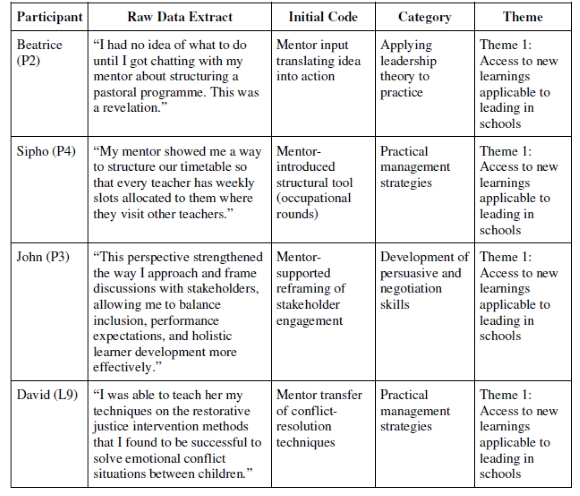
Transcripts underwent inductive thematic analysis to identify recurring patterns and emergent themes (Fereday & Muir-Cochrane, 2006). Reflexive thematic analysis techniques (Braun & Clarke, 2006) involved repeated readings, collaborative discussions with research assistants, and line-by-line coding for depth and precision. To enhance reliability, a subset of transcripts was independently coded by both the researcher and an assistant, with discrepancies resolved through consensus. A thematic coding table supported data organisation and interpretation. Codes were categorised into overarching themes and sub-themes, iteratively reviewed for clarity and relevance to the study's aims (see Annexure 1). These procedures ensured a comprehensive, contextually grounded, and methodologically rigorous account of participants' perspectives on mentorship and leadership development.
Research ethics and responsible science
This study employed strategies to ensure findings were trustworthy, fair, authentic, and credible. Credibility was enhanced by establishing rapport with school leader participants and generating data through thick, rich descriptions of their experiences (Creswell & Creswell, 2018; Creswell & Miller, 2000). Interview transcripts and preliminary interpretations were reviewed by colleagues familiar with the research context, serving as peer debriefing to guard against researcher bias (Creswell & Creswell, 2018; Creswell & Miller, 2000).
Ethical approval was obtained from the university's Human Research Ethics Committee before data collection. All mentors and mentees were invited to participate and interviewed about their mentoring experiences. Interviews were conducted confidentially, with measures taken to protect participants' identities and ensure a secure environment for honest reflection, thereby supporting participants' well-being.
Participants were encouraged to ask questions about the interview process and broader research objectives. Efforts were made to align participants' contextual realities with evidence-based categories used in analysis (Creswell & Miller, 2000). Data source triangulation was achieved by interviewing both mentors and mentees, enabling accounts of the same relationships to be cross-checked for consistency and divergence. Preliminary findings were also shared with a subset of participants to confirm accuracy, and their feedback was incorporated into the final analysis.
The researcher's prior experiences as a deputy principal and principal informed an insider positionality, which was treated reflexively throughout data collection and analysis. Attention was paid to how professional background might shape interpretation, with efforts made to foreground participants' meanings rather than the researcher's assumptions. As coordinator of the mentorship programme within the master's degree, the first author held a close relationship to the research context by overseeing the programme's coordination and administration. The first author was not a lecturer or facilitator on the degree, directly involved in teaching the participants. This positionality afforded valuable insider knowledge of the programme's structure and participant engagement, while maintaining a clear distinction between coordination and research roles. The second author was not involved in programme delivery.
Findings from the introductory interviews with the mentees
Pre-mentorship perceptions of aspiring school leaders
Before being allocated a mentor, participants in the leadership degree revealed their perceptions about assuming school leadership roles. Analysis of pre-mentorship interviews produced four themes: 1) Perceived anxiety and fear of conflict, 2) Perceived workload concerns, 3) Perceived lack of leadership skills, and 4) Perceived lack of professional networks.
Perceived anxiety and fear of conflict
Anxiety and fear of conflict emerged as a prominent concern. Participants expressed unease about navigating collegial relationships in positions of authority, viewing interpersonal dimensions of leadership as particularly threatening. Sally noted, "I get very anxious at the thought of arguing with a colleague" (P1), while John feared exposure of his lack of confidence: "Someone will see that I am not really that confident at all" (P3). Doubts about legitimacy compounded this vulnerability: "I don't think my colleagues are ready to listen to me" (P2); "I feel this sense of dread that they made a mistake giving me this job" (P7). Beatrice and Helen's responses highlighted fragile professional identities not yet stabilised by academic preparation.
Perceived workload concerns
Workload was a distinct source of anxiety. Participants expressed uncertainty about managing expanded administrative and organisational demands. Sipho asked, "How can I manage my time with all these new responsibilities?" (P4). While participants had classroom-level management experience, the cumulative weight of leadership duties represented a qualitatively different challenge.
Perceived lack of leadership skills
A lack of leadership-specific skills was another prominent theme. Participants identified concrete areas of uncertainty, including financial management: "I am so uncertain how to work with budgets" (P9). Sally mentioned difficulty transferring pedagogical strengths to adult professional settings: "I'm good at inspiring kids, but don't know how to do this with adults" (P1). These responses highlighted discontinuities between effective classroom practice and formal leadership competencies. Participants also questioned the adequacy of PD. Precious reflected, "I am not a good project manager, and that workshop did not help" (P6).
Perceived lack of professional networks
Participants expressed considerable uncertainty about cultivating the professional relationships that leadership demands. Effective school leadership depends on collaborative networks and collegial support structures, yet participants reported little confidence in building such connections. Bronwen admitted, "I truly don't know how to develop a support network" (P8), while Precious similarly acknowledged difficulty navigating the relational and organisational landscape of her new role. This theme highlighted a broader relational dimension of leadership readiness that pre-mentorship preparation had not adequately addressed.
Conclusion from the introductory interviews with the mentees
The four themes revealed that aspiring school leaders, despite academic preparation, often felt ill-equipped for the psychological, practical, and relational challenges of leadership. Transitioning from classroom practitioner to school leader required not just technical knowledge but a more fundamental shift in professional identity and interpersonal capacity that coursework alone could not fully support. The mentorship programme sought to address these gaps by pairing participants with experienced leaders, providing a structured yet responsive space to normalise anxiety, model workload strategies, develop leadership-specific skills, and foster professional networks. Mentors thus served as bridges between formal preparation and the realities of school leadership.
Findings during the mentorship programme
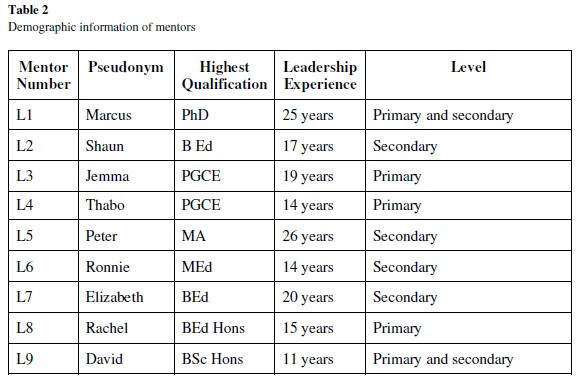
From the second and third interview sessions with aspirant school leaders, four recurrent themes were identified. These themes illuminated mentees' evolving understandings, challenges, and reflections as they engaged with mentors, applied theoretical knowledge in practice, and navigated the complexities of school leadership. However, because mentorship is a reciprocal relationship (Walters et al., 2020), mentee perspectives cannot be considered in isolation. Responses from mentor interviews, conducted at the conclusion of the mentorship programme, are therefore included. The mentors (see Table 2) provided insight into their relationships with mentees and commented on how their interactions affirmed or constrained leadership PD.
Thematic analysis
Themes
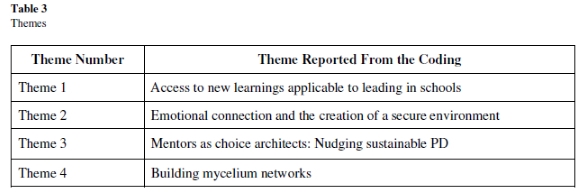
Theme 1: Access to new learnings applicable to leading in schools
Mentees reported gaining valuable insights through sustained dialogue with mentors, often inspiring innovative practices aligned with their leadership portfolios. A recurring theme was the motivation and empowerment mentees experienced when applying leadership theory in their school contexts. For example, Beatrice had long wanted to implement a pastoral care programme to support learners but felt uncertain about how to begin. Through discussions with her mentor, she acquired the confidence and practical knowledge needed to begin planning the programme. She reflected:
I was so desperate to have a support programme or a pastoral programme for children with learning barriers. You know, we just don't have anything-teachers are left to do it themselves. I had no idea of what to do until I got chatting with my mentor about structuring a pastoral programme. This was a revelation, and I have now made plans to get this started at my school. (P2)
Sipho recounted the challenges of becoming a deputy principal without adequate preparation for managing staff collaboration. Concerned about appearing incompetent, he hesitated to seek help. However, his mentor introduced him to "occupational rounds," a structured approach to peer learning among teachers. He explained:
It was a real revelation for me. My mentor showed me a way to structure our timetable so that every teacher has weekly slots allocated to them where they visit other teachers. In these visits they can then learn from the teacher and have a discussion about best teaching practice. I have shown this to my principal and have been given permission to introduce it. (P4)
Mentees all mentioned that mentors provided new ideas and management skills for navigating conflicting agendas, particularly those involving learners with diverse learning needs. John explained that his mentor offered theoretical approaches for including previously excluded learners, along with communication and management skills that helped him become persuasive in meetings, where negotiation and reasoning are critical yet often overlooked.
He helped me consider how reintegrating learners from remedial settings into mainstream environments, particularly those who may lack exposure to sport and broader co-curricular opportunities could be framed as beneficial rather than risky. This perspective strengthened the way I approach and frame discussions with stakeholders, allowing me to balance inclusion, performance expectations, and holistic learner development more effectively. (P3)
These examples, representative of broader patterns across the dataset, underscored mentorship's role as a catalyst for professional learning and leadership innovation. The sessions served not only as spaces for reflective dialogue but also as mechanisms for translating theory into actionable strategies within schools. The mentoring space as a catalyst for informal learning aligns with findings from the thematic review of mentor interviews. This was evident in David's account of assisting his mentee in structuring conflict-management processes between learners, drawing on the principles of restorative justice. He said:
Molly [pseudonym] is a very good administrator, but she struggles when she has to deal with conflict resolution. I was able to teach her my techniques on the restorative justice intervention methods that I found to be successful to solve emotional conflict situations between children. (L9)
These findings aligned with Hansford and Ehrich's (2006) review of literature, which highlighted mentorship as a powerful tool for PD and the exchange of new ideas among educational leaders.
Theme 2: Emotional connection and the creation of a secure environment
Mentees valued mentorship as a secure environment where they could express vulnerability and emotions without fear of professional repercussions. Across interviews, the emotional connection with mentors was consistently described as one of the programme's most meaningful benefits. This environment gave mentees a space to share their anxieties, insecurities, and emotional challenges, experiences often suppressed in their formal leadership roles. Claire, for instance, reflected on the emotional isolation she experienced as a new deputy principal, particularly when a senior teacher regularly questioned her decisions, leaving her anxious and uncertain about her suitability for the role. She shared:
You know, I am an anxious person by nature and sometimes feel that I was the wrong choice for this position. I have one challenge where an older, more experienced teacher is always questioning my decisions. This makes me feel insecure. But it's not like I can express my feelings with my boss . . . I have found that I can feel safe speaking to my mentor about this and it makes me feel so much better and more prepared to do my job. It's like I have a personal therapist. (P5)
Despite external perceptions of her leadership potential, Claire struggled with imposter syndrome, fearing that showing emotional distress might undermine her credibility. Mentorship provided a confidential, affirming space where she could reflect on her experiences and receive empathetic support without concern for career-limiting consequences. Similarly, Precious recounted a traumatic incident involving a Grade 6 learner who had threatened suicide. Although psychiatric intervention resolved the crisis, disagreement among senior management over the decision-making process left her feeling isolated and emotionally overwhelmed. She explained:
I was severely stressed by this incident [threat of suicide]. I have two children of my own. We were able to help the girl, but I was left traumatised, and our leadership team disagreed on how we intervened. It was so helpful to express my fears and feelings of helplessness with John [pseudonym]. He has so many years of experience and has dealt with this type of situation before. His input and reassurance have made all the difference for me. (P6)
Most mentors reported cultivating emotional connections through ongoing mentoring and highlighted the pastoral nature of the role. They reported that mentees often shared personal workplace challenges they would ordinarily feel uncomfortable disclosing to colleagues or leadership teams. Elizabeth explained this in her interview, commenting:
Sally [pseudonym] always spoke about how she would suffer bouts of anxiety when parents made personal attacks on email. She felt very uncomfortable speaking about this with her colleagues. I was able to give her examples from when I was a leader and how I dealt with my feelings of insecurity when dealing with criticism.
A significant caveat emerged from the data: not all mentors were able to establish the necessary rapport with their mentees, limiting the levels of trust needed for sharing the emotional challenges mentees faced. This was evident in Ronnie's comment:
Yes, our relationship was rather transactional and business-like, I think that the generational gap meant that Beatrice [pseudonym] never really felt comfortable to share her feelings about her challenges. She was a very guarded person. (L6)
These findings resonated with Smith's (2007) assertion that mentorship provides a safe, supportive environment for professional reflection and emotional processing. The mentorship space operated as a sounding board, fostering active listening, constructive feedback, and emotional validation. However, Ronnie's account highlighted the need for purposive attention in matching mentors with mentees. Without strong, trusting relationships, the full potential of mentorship cannot be realised.
Theme 3: Mentors as choice architects: Nudging sustainable PD
A prominent theme concerned how mentors shaped the conditions under which mentees made decisions, reflected on their practice, and sustained their PD over time. Based on Thaler's (2018) concepts of nudges and choice architecture, mentors acted as choice architects, creating environments that encouraged mentees to make meaningful decisions about their professional growth and leadership practices, rather than forcing compliance. Thaler's framework was particularly apt here, capturing the subtle yet powerful ways support structures shaped behaviour and outcomes without removing individual agency. Mentors did not direct or prescribe; rather, they designed relational spaces through regular meetings, holistic engagement, and proactive outreach. These spaces enabled mentees to reflect, choose, and develop their practice. This aligns with Lynch's (2024) identification of tools that enable individuals to overcome barriers to sustainable PD, suggesting that mentoring itself functioned as an ongoing, adaptive support structure.
As Molly clearly explained:
My mentor was effective because he was always so supportive. He took the time to schedule regular check-ins and did not limit his guidance to only academic things. Instead, he used a holistic approach and showed genuine interest in my professional responsibilities, my family, and overall well-being. This created a supportive and trusting relationship that allowed me to reflect on my work and really grow as a person. (P9)
This account, representative of participants' experiences, revealed interlocking features of effective mentoring as choice architecture. First, intentionality: mentors anticipated challenges and proactively fostered engagement. Second, holism: by extending interest beyond academic performance to family and well-being, mentors acknowledged the full complexity of mentees' lives, thereby constructing a more truthful and responsive decision-making architecture. Third, trust: consistent, genuine engagement built relational spaces that enabled reflection, a precondition for sustained development (Lynch, 2024).
Interviews also showed that mentors' ongoing interactions nudged mentees to maintain leadership practices. These exchanges formed a cycle of discussion, implementation, reflection, and redesign of the intervention. Regular meetings ensured actions were evaluated and adapted to challenges, protecting the authenticity of PD. This was illustrated in Rachel's comment:
Every time we met up at the coffee shop, Sipho [pseudonym] was very excited to let me know how he was running his teacher workshop series that we planned together.
We always chat about what is working and what is not working. We share ideas about how we can change the workshops to make them more effective to support the teachers.
The regularity and iterative nature of mentor-mentee meetings functioned as a structural nudge. By embedding reflection into a recurring rhythm rather than leaving it to chance, mentors ensured that learning remained continuous, an ongoing process of engagement, refinement, and growth. This mirrored the broader logic of choice architecture: the most effective nudges were not dramatic interventions but quiet, consistent features that made desired behaviour the path of least resistance. Here, the desired behaviour was sustained PD, made accessible and habitual through regular contact and holistic care.
These findings have implications for designing formal mentoring programmes in educational leadership. Effectiveness cannot be assessed through content or curriculum alone; it must also consider the relational architecture of learning, the frequency of contact, the breadth of concern, and the extent to which mentors are empowered and trained to act as genuine choice architects rather than mere subject-matter advisors.
Theme 4: Building mycelium networks
A significant theme emerging across all participant interviews was the development of professional networks through mentoring. Mentees consistently noted that their mentors' established networks expanded their professional circles, providing essential relationships and resources crucial for navigating the complex and often unpredictable demands of educational leadership.
Claire captured this dynamic vividly:
Through discussing and mirroring his approach to leadership, decision-making, and professional relationships, I gained insight into how networks are built and sustained over time. This exposure helped me increase my confidence in engaging with senior colleagues and wider professional circles more intentionally. (P5)
This extract illuminated a dimension of mentoring that extended beyond knowledge transmission. Claire did not merely observe her mentor's network; through mirroring and critical reflection, she internalised the relational strategies underpinning network formation and maintenance. This shift from passive observer to active participant marked a meaningful development in professional identity and agency.
Claire's experience aligned with a theme from mentor interviews. All the mentors reported introducing mentees to colleagues within their networks, empowering them to seek support independently. This was evident from Shaun's interview:
Helen [pseudonym] always spoke about her challenge with bullying in her school. I was able to introduce her to a psychologist friend of mine, who was happy to do some pro bono work with Helen to give her strategies on how to counsel both the bullies and victims and set up school-wide programmes that focus on positive relationships. This introduction led to a friendship between them.
These findings resonated with scholarship on professional learning communities and the social capital embedded in collegial relationships (McAdam et al., 2011). The metaphor of mycelial networks helped conceptualise the structure and function of the networks described. This metaphor was analytically productive because it foregrounded relational qualities that more conventional network language, such as "ties" or "nodes," tends to obscure, namely, the distributed and reciprocal nature of support and the capacity of such networks to sustain resilience even when individual connections were informal or peripheral to formal organisational structures. Fungi sustain themselves through vast, decentralised webs of hyphae, filaments that connect root systems and enable nutrient exchange across great distances. Similarly, mentees described professional networks as distributed, adaptive, and mutually sustaining (McAdam et al., 2011). Each new connection added not only a node but a pathway, extending reach and reinforcing resilience.
This metaphor also highlighted the emergent and largely invisible nature of professional networking. Just as mycelial threads operate beneath the surface before their effects appear above ground, professional relationships often develop quietly, through conversation, observation, and shared experience, before their value becomes apparent in moments of challenge or opportunity. For mentees, mentoring served as the initial thread from which a broader web of professional connections could grow.
These findings suggest that mentoring cultivates the relational infrastructure through which school leaders sustain themselves and their schools over time. Programme design and evaluation must therefore assess not only skill acquisition but also the growth of mentees' professional networks and their capacity to engage those networks with confidence and purpose.
Discussion
Taken together, these four themes demonstrated that behavioural economics constructs operated as more than an interpretive backdrop. In this study, mentors functioned as choice architects whose everyday practices, dialogue around leadership challenges, creation of emotionally safe relational spaces, embedding reflection into recurring contact, and extending professional networks to mentees constituted concrete, observable nudges that shaped mentees' decisions without directing or prescribing them. It was the consistency and design of these practices, rather than any single intervention, that made sustained professional growth the 'path of least resistance' for mentees. This illustrated how nudges and choice architecture were empirically enacted through the mentoring relationships rather than simply theorised.
Conclusion
The mentorship programme demonstrated success across several domains. Mentees drew on mentors' personal and institutional knowledge, receiving contextually grounded guidance not easily replicated through formal training. More significantly, participants consistently identified emotional safety as the programme's most valuable feature. In professional environments where vulnerability is often perceived as weakness, mentorship provided a confidential, affirming space for emotional processing and confidence rebuilding, allowing leaders to re-engage with renewed clarity and resilience (Arora & Rangnekar, 2015). Beyond its immediate emotional and practical benefits, the mentorship programme functioned as a vehicle for leadership identity development, helping mentees reconcile the technical demands of school leadership with a more secure and resilient professional self-concept and identity. Behavioural economics alone cannot fully explain this process, but its depth is enriched when read alongside literature on leader identity development in Southern Africa (Moorosi & Grant, 2018).
The programme's sustained impact can be understood through behavioural economics. Lynch (2024) identifies evidence-based nudges, including structured goal setting, cognitive aids, and deliberate cultivation of networks, that support the longevity of PD. These mechanisms were reflected in participants' experiences: ongoing mentor interaction reinforced skills, guided reflection, and facilitated engagement with broader networks, fostering durable collegial relationships. Mentorship, when structured around nudging principles, thus bridges initial leadership preparation with sustained PD. This study also highlights the underutilised value of formalising partnerships between higher education institutions and experienced or retired school leaders, whose accumulated expertise offers a sustainable, low-cost mechanism for grounding leadership preparation programmes in the lived realities of diverse South African schooling contexts. The value of this is further underscored by the range of leadership pathways represented among mentee participants in this study, whose varied experience, qualifications, and school contexts reflect the diversity of trajectories through which South African school leaders emerge.
Global pressures reshaping educational leadership, including artificial intelligence, the Fourth Industrial Revolution, economic and emotional precarity, and growing classroom diversity (Apat & Swain, 2023; Renta-Davids et al., 2025; Solomon & du Plessis, 2023), have exposed gaps in the preparedness of early career school principals. The findings here offer insights that may inform, rather than dictate, the design of formal leadership training programmes, though further research with larger and more diverse samples is needed to establish their broader applicability. By demonstrating how mentorship enables pedagogical responsiveness and systemic awareness, this research underscores its potential to prepare leaders for contemporary schooling and to contribute to building equitable, responsive, and future-ready educational systems.
It is important to note that this study's qualitative, single-programme design does not permit causal claims about mentorship's effect on mitigating the precarity of school leadership. Without a baseline measure of precarity or a comparison group of non-mentored aspirant leaders, the relationships identified here are best understood as associational: participants perceived and reported reduced precarity in connection with their mentoring experiences, rather than this reduction being causally demonstrated. Establishing causality would require designs incorporating pre- and post-intervention measures, or comparisons between mentored and non-mentored aspirant leaders, which represents an important avenue for future quantitative or mixed-methods research.
This study is further limited by its focus on a single mentorship intervention, without comparison to other forms of PD, such as structured coaching, formal lifelong learning leadership training modules, or peer-led communities of practice. While participants' accounts highlight the perceived value of mentorship, the study cannot assess its relative effectiveness compared to alternative PD models. Future research comparing mentorship against other PD interventions would help clarify its distinct contribution to reducing precarity among aspirant school leaders. Despite these limitations, this study's principal contribution lies in demonstrating how behavioural economics provides a useful explanatory framework for understanding mentorship as a sustainable mechanism for leadership development among aspirant school leaders.
Building on these findings, three directions for future research are proposed. Firstly, research extensions could examine mentorship's influence on precarity longitudinally, by tracking mentees' journeys beyond the completion of the programme to assess whether perceived reductions in precarity are sustained in their roles as leaders. Secondly, model refinement could involve testing variations in mentor-mentee matching criteria, contact frequency, and balance between structured and holistic engagement, to identify which specific design features most reliably function as effective nudges. Thirdly, cross-context testing could extend this mentoring model to other Global South settings with differing resource constraints, governance structures, and leadership pipelines to establish the extent to which these findings and the underlying choice architecture translate beyond the South African context.
Andrews, D. (2022). Considering knotworking as a theoretical tool to enable pedagogical responsiveness in complex systems. In E. Walton & R. Osman (Eds.), Pedagogical responsiveness in complex contexts: Issues of transformation, inclusion and Equity (pp. 95-110). Springer. https://doi.org/10.1007/978-3-031-12718-2_6
Andrews, D., Bischof, J., Emmerich, M., & Osman, R. (2023). Inclusive education and diversity in South Africa and Germany: Concepts, policies, and historical-political paradoxes. In E. Hofmann, E. Mavhunga, T. Bohl, F. Maringe, & D. Diekmann (Eds.), Education in South Africa and Germany: Shared perspectives on national and global questions. Results of the collaborative work between Wits School of Education and Tübingen School of Education (pp. 95-115). Tübingen University Press. http://hdl.handle.net/10900/135153
References
- Andrews, D., Walton, E., & Osman, R. (2019). Constraints to the implementation of inclusive teaching: A cultural historical activity theory approach. International Journal of Inclusive Education, 25(13), 1508-1523. https://doi.org/10.1080/13603116.2019.1620880
- Apat, B., & Swain, P. (2023). Precarity in the lives of contract teachers: A qualitative study from Odisha, India. Frontiers in Education, 8, Article 1043557. https://doi.org/10.3389/feduc.2023.1043557
- Arora, R., & Rangnekar, S. (2015). Relationships between emotional stability, psychosocial mentoring support and career resilience. Europe's Journal of Psychology, 11(1), 16-33. https://doi.org/10.5964/ejop.v11i1.835
- Baral, N., Cerveny, L. K., Penaluna, B. E., Roper, B. B., Shively, D., & Witt, S. (2024). Variations in mentorship across grade levels and career stages among public management professionals. Review of Public Personnel Administration. https://doi.org/10.1177/00910260231196570
- Beattie, R. S. (2002, January). Line managers as facilitators of learning: Empirical evidence from voluntary sector. In Proceedings of Human Resource Development Research and Practice across Europe Conference. Edinburgh Napier University.
- Braun, V., & Clarke, V. (2006). Using thematic analysis in psychology. Qualitative Research in Psychology, 3(2), 77-101. https://doi.org/10.1191/1478088706qp063oa
- Brown, A. M., & Herbst, P. G. (2023). On designing better structures for feedback in practice-based professional development: Using "failure" to innovate. Journal of Mathematics Teacher Education, 26(5), 581-605. https://doi.org/10.1007/s10857-023-09588-1
- Bush, T. (2009). Leadership development and school improvement: Contemporary issues in leadership development. Educational Review, 61(4), 375-389. https://doi.org/10.1080/00131910903403956
- Cartwright, E. (2018). Behavioral economics. Routledge. https://doi.org/10.4324/9781315105079
- Colley, H. (2003). Mentoring for social inclusion: A critical approach to nurturing mentor relationships. Routledge Falmer. https://doi.org/10.4324/9780203458310
- Cowin, K. M., Gates, G. S., & Luckett, K. (2016). The relevance and promise of relational mentoring for school leadership: A conversation. International Journal of Mentoring and Coaching in Education, 5(3), 187-202. https://doi.org/10.1108/IJMCE-09-2015-0030
- Creswell, J. W., & Creswell, J. D. (2018). Research design: Qualitative, quantitative, and mixed methods approaches (5th ed.). SAGE. https://doi.org/10.4135/9781506386706
- Creswell, J. W., & Miller, D. L. (2000). Determining validity in qualitative inquiry. Theory Into Practice, 39(3), 124-130. https://doi.org/10.1207/s15430421tip3903_2
- Darling-Hammond, L., Hyler, M. E., & Gardner, M. (2017). Effective teacher professional development. Learning Policy Institute. https://learningpolicyinstitute.org/product/teacher-prof-dev
- De La Garza, S. A., Valle, F., Palmer, D. L., Almager, I. L., & de León, E. V. (2026). Mentor principals as key facilitators in aspiring leaders' residency programs: The role of school-university partnerships in effective principal preparation. Journal of Educational Administration. Advance online publication. https://doi.org/10.1108/JEA-12-2024-0447
- du Plessis, P. (2017). Challenges for rural school leaders in a developing context: A case study on leadership practices of effective rural principals. Koers, 82(3), 1-10. https://doi.org/10.19108/KOERS.82.3.2337
- Ekstrom, V. (2026). Digital choice architecture in medical education: Applying behavioral economics to online learning environments. JMIR Medical Education, 12, e86497. https://doi.org/10.2196/86497
- Ellinger, A. D., Ellinger, A. E., & Keller, S. B. (2003). Supervisory coaching behavior, employee satisfaction, and warehouse employee performance: A dyadic perspective in the distribution industry. Human Resource Development Quarterly, 14(4), 435-458. https://doi.org/10.1002/hrdq.1078
- Furlong, J., & Maynard, T. (2012). Mentoring student teachers: The growth of professional knowledge. Routledge. https://doi.org/10.4324/9780203813560
- Grebenau, M. (2023). Stretched too thin: A narrative study of the experiences of early career principals in Jewish day schools. Journal of Jewish Education, 89(2-3). https://doi.org/10.1080/15244113.2023.2206060
- Hansford, B., & Ehrich, L. C. (2006). The principalship: How significant is mentoring? Journal of Educational Administration, 44(1), 36-52. https://doi.org/10.1108/09578230610642647
- Hastings, L. J., & Kane, C. (2018). Distinguishing mentoring, coaching, and advising for leadership development. New Directions for Student Leadership, 2018(158), 9-22. https://doi.org/10.1002/yd.20284
- Hill, H. C., & Erickson, A. (2019). Using implementation fidelity to aid in interpreting program impacts: A brief review. Educational Researcher, 48(9), 590-598. https://doi.org/10.3102/0013189X19891436
- Hobson, A. J., Ashby, P., Malderez, A., & Tomlinson, P. D. (2009). Mentoring beginning teachers: What we know and what we don't. Teaching and Teacher Education, 25(1), 207-216. https://doi.org/10.1016/j.tate.2008.09.001
- Hoch, S. J., & Loewenstein, G. F. (1991). Time-inconsistent preferences and consumer self-control. Journal of Consumer Research, 17(4), 492-507. https://doi.org/10.1086/208573
- Karsenty, R., & Brodie, K. (2023). Researching "what went wrong" in professional development (PD) for mathematics teachers: What makes it so important, and so difficult? Journal of Mathematics Teacher Education, 26(5), 573-580. https://doi.org/10.1007/s10857-023-09599-y
- Khumalo, J. B., van Vuuren, H. J., van der Westhuizen, P. C., & van der Vyver, C. P. (2018). Problems experienced by secondary school deputy principals in diverse contexts: A South African study. Problems and Perspectives in Management, 16(2), 190-199. https://doi.org/10.21511/ppm.16(2).2018.17
- Koch, A., Nafziger, J., & Nielsen, H. S. (2015). Behavioral economics of education. Journal of Economic Behavior & Organization, 115, 3-17. https://doi.org/10.1016/j.jebo.2014.09.005
- Kraft, M. A. (2020). Interpreting effect sizes of education interventions. Educational Researcher, 49(4), 241-253. https://doi.org/10.3102/0013189X20912798
- Lent, R. W. (2024). Choice architecture and the potential to nudge career development at scale. Journal of Career Assessment. Advance online publication. https://doi.org/10.1177/10690727241298688
- Lynch, K. (2024). The application of behavioral economics to teacher professional development. Educational Researcher, 53(9), 508-520. https://doi.org/10.3102/0013189X241282296
- Malterud, K., Siedlecki, S. L., & Guest, G. (2016). Sample size in qualitative interview studies: Guided by information power. Qualitative Health Research, 26(13), 1753-1760. https://doi.org/10.1177/1049732315617444
- McAdam, E., Falconer, R. E., Bown, J. L., & Crawford, J. W. (2011). Fungi as metaphors for resource management. In Proceedings of the Third International Conference on Adaptive and Self-Adaptive Systems and Applications (ADAPTIVE 2011) (pp. 1-6). IARIA.
- Means, A. J. (2022). Precarity and the precaritization of teaching. In M. A. Peters (Ed.), Encyclopedia of teacher education (pp. 1360-1364). Springer. https://doi.org/10.1007/978-981-16-8360-1
- Merriam, S. B. (2002). Introduction to qualitative research. In S. B. Merriam (Ed.), Qualitative research in practice: Examples for discussion and analysis (pp. 1-17). Jossey-Bass.
- Meyer, K., & Rosinger, K. O. (2019). Applying behavioral insights to improve postsecondary education outcomes: A review of Obama administration efforts and next steps under the Trump administration. Journal of Policy Analysis and Management, 38(2), 481-499. https://doi.org/10.1002/pam.22123
- Moorosi, P., & Grant, C. (2018). The socialisation and leader identity development of school leaders in Southern African countries. Journal of Educational Administration, 56(6), 643-658. https://doi.org/10.1108/JEA-01-2018-0011
- Msila, V. (2012). Mentoring and school leadership: Experiences from South Africa. Journal of Social Sciences, 32(1), 47-57. https://doi.org/10.1080/09718923.2012.11893041
- Naicker, I., Chikoko, V., & Mthiyane, S. E. (2014). Does mentorship add value to in-service leadership development for school principals? Evidence from South Africa. The Anthropologist, 17(2), 421-431. https://doi.org/10.1080/09720073.2014.11891452
- Naicker, S. (2007). From policy to practice: A South African perspective on implementing inclusive education policy. International Journal of Whole Schooling, 3(1), 1-6. https://files.eric.ed.gov/fulltext/EJ847472.pdf
- Peters, A. (2010). Elements of successful mentoring of a female school leader. Leadership and Policy in Schools, 9(1), 108-129. https://doi.org/10.1080/15700760903026755
- Ragins, B. R., & Kram, K. E. (Eds.). (2007). The handbook of mentoring at work: Theory, research, and practice. SAGE. https://doi.org/10.4135/9781412976619
- Smith, A. A. (2007). Mentoring for experienced school principals: Professional learning in a safe place. Mentoring & Tutoring: Partnership in Learning, 15(3), 277-291. https://doi.org/10.1080/13611260701201767
- Solomon, S., & du Plessis, M. (2023). Temporary academics in South African higher education institutions: Their lived precarity experiences. Journal of Psychology in Africa, 33(5), 522-529. https://doi.org/10.1080/14330237.2023.2246953
- Thaler, R. H., & Sunstein, C. R. (2009). Nudge: Improving decisions about health, wealth, and happiness. Penguin Books. https://doi.org/10.1017/S1474747209990175
- Van Tiem, D., Moseley, J., & Dessinger, J. (2001). Performance improvement interventions: Enhancing people, processes, and organizations through performance technology. ISPI. https://doi.org/10.1002/pfi.4140400111
Accepted: 11 August 2026