Reframing parental involvement as cultural wealth in the lives of black female first-generation post-graduate students
Abstract
Parent support for first-generation students is often overlooked as essential to academic success. I challenge the commonly held stereotype that first-generation families are disengaged from higher education by discussing the voices and experiences of first-generation Black female postgraduate students in South Africa. Using Yosso's (2005) Community Cultural Wealth framework and a narrative inquiry approach, I reveal the diverse, often invisible, forms of support that first-generation student parents provide. The research highlights how the intersecting identities of gender, race, and first-generation status shape these women's experiences, exposing them to unique challenges, while underscoring the resilience and cultural wealth of their families. The study's asset-based approach reframes parental involvement as a source of strength, offering practical insights for institutions to better support first-generation students. This research contributes to a more inclusive understanding of parental involvement and advocates for equitable policies in higher education.
first-generation student; community cultural wealth; parent support; black female post-graduate student; university
Introduction
Literature on first-generation students often adopts a deficit approach, focusing on limited knowledge, lack of access, and self-confidence, while paying little attention to the strengths these students bring or to their often-invisible support systems. This gap is especially noticeable among the families of these students, who are rarely seen as contributors to academic success. Emotional encouragement, parental sacrifices, and informal advocacy are forms of support that often go unnoticed in institutional spaces (Motsabi et al.,2020; Nichols & Islas, 2016).
My research begins with the assumption that we need to look again and listen more carefully to how first-generation students understand and describe the role their families play. In particular, I focus on the Black South African women pursuing post-graduate study, a group rarely centred in literature (Alabi et al., 2019; Gardner & Holley, 2011; Kim et al, 2021; Moodley & Singh, 2015; Wainwright & Watts, 2021). Their stories disrupt the stereotype that first-generation families are uninvolved or indifferent. Instead, they reveal networks of care, resilience, and guidance shaped by culture, faith, and a shared history.
First-generation students in the literature
The literature on first-generation students predominantly adopts a deficit approach to reporting the challenges the group faces, such as low enrolment rates, transitional difficulties, high attrition rates, and low graduation rates (Ives & Castillo-Montoya, 2020; Moodley & Singh, 2015; Nichols & Islas, 2016). Such narratives portray first-generation students as struggling to adjust to higher education and often frame their families as sources of survivor's guilt or barriers to achievement (Capannola & Johnson, 2022; Moreno, 2021). Furthermore, first-generation students frequently internalise these perceptions, causing them to view their parents as incapable of understanding or supporting their higher education experiences.
More recently, the deficit approach has been criticised for its narrow focus on what first-generation students lack rather than on the strengths and resources they bring to higher education. Scholars argue that the deficit perspective overlooks the resilience, resourcefulness, and unique forms of capital that first-generation students and their families possess, particularly in historically marginalised communities (Basit, 2012; Yosso, 2005). By framing first-generation students solely in terms of disadvantage, the literature risks perpetuating stereotypes and undermining the potential of asset-based interventions.
Intersectional factors, such as race, ethnicity, gender, and age, are also overlooked in research on first-generation students, despite these factors shaping their experiences in unique ways (Gardner & Holley, 2011; Kim et al., 2021). This gap is particularly evident in the limited focus on the experiences of first-generation Black female students, whose narratives remain underrepresented in the literature. In South Africa, for example, Black female post-graduate students are often perceived as lacking parental support because of gendered stereotypes, such as the belief that investing in a female child yields a poor return since they are expected to leave their families through marriage (Alabi et al., 2019). Similar trends are observed globally, where the value a family places on education significantly influences the level of support provided to female students (Gofen, 2009; Kim et al., 2021).
Parental involvement and non-traditional forms of support
Despite the deficit narrative, parental involvement remains a critical factor in the academic success of first-generation students, even as they transition into adulthood (Alabi et al., 2019). While first-generation parents may lack exposure to higher education, they often provide nontraditional forms of support, such as emotional encouragement, prioritization of education, and advocacy (Basit, 2012; Nichols & Islas, 2016). In rural South Africa, Motsabi et al. (2020) found that parents play a critical role in motivating their children to succeed academically, even in the absence of financial resources or their own formal education. These findings challenge the deficit narrative and highlight the need for a more nuanced understanding of parental involvement.
The parental support received by first-generation students is distinct in its nature, form, and intent, reflecting the unique challenges and strengths of their lived experiences. Unlike the support provided by parents of continuing-generation students, which often includes direct guidance on navigating higher education systems (Bahack & Addi-Raccah, 2022), the support offered by parents of first-generation students is frequently rooted in cultural resilience, emotional encouragement, and aspirational motivation (Hlatshwayo & Fomunyam, 2019). These forms of support are tailored to address the specific situational, humanistic, and political challenges that first-generation Black women face, such as systemic racism, gendered stereotypes, and financial hardship (Robinson, 2013).
First-generation students often draw on their parents' lived experiences of overcoming adversity to offer themselves emotional and aspirational support (Le Bouef & Dworkin, 2021). These experiences can instil a strong work ethic in students since their parents emphasise the importance of education for achieving upward mobility. Additionally, parents actively advocate for their daughters in overcoming systemic barriers. Although these forms of support may not be easily visible or recognised by traditional metrics, they play a crucial role in the academic success of first-generation students.
Conceptual framework
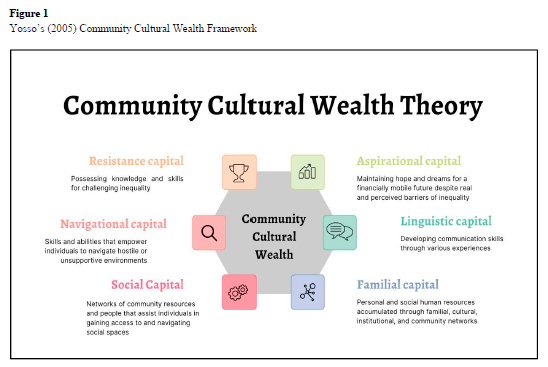
Drawing on Yosso's (2005) Community Cultural Wealth framework, grounded in Critical Race Theory (see Figure 1), I examine the diverse and often underrecognised forms of support that first-generation Black women students receive from their families. In doing so, I highlight the strengths and resources of first-generation families, including their inherent familial, aspirational, and resistant forms of capital (Yosso, 2005), challenge prevailing deficit narratives, and offer a more comprehensive understanding of parental involvement in higher education.
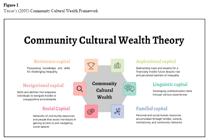
Not only is Community Cultural Wealth a framework for the study of historically minoritised groups, but it also enables the exploration of the nature, form, and intent of the capital that first-generation student parents provide to their children. These forms of capital support their children in overcoming the situational, humanistic, and political challenges they face. These challenges include systemic barriers such as racial and gender inequalities, financial constraints, and a lack of familial exposure to higher education (Mabokela & Mlambo, 2017). By centring first-generation-student parent support, I shift the focus from traditional notions of parental involvement, often defined by middle-class continuing-generation norms, to the unique and often unrecognised forms of support that first-generation students receive from their families (Le Bouef & Dworkin, 2021).
Research design and methodology
To explore parental support experiences from the perspective of first-generation, Black, female post-graduate students, I employed a narrative inquiry approach (Clandinin & Huber, 2010). Using this approach yielded rich data on the experiences of first-generation Black female students, particularly regarding the role of parental support in their academic success. Three participants were purposively selected from a Historically White Institution (HWI) since they represented each of the levels of post-graduate study (honours, master's, and PhD) and represented the three subgroups in the South African Black1 Community. The decision to proceed with a sample size of three is grounded in qualitative research guidance, which emphasises depth, purposeful selection, and information-rich cases rather than numerical representativeness (Patton, 2015). The sample reflects both the racial identity central to the research question and the major post-graduate study levels. Three participants were therefore sufficient to provide depth and achieve saturation for this focused group.
Ethical approval was obtained through a blind review, and informed consent was secured from all participants, with their anonymity and the confidentiality of the study ensured. Hence, the names used in this paper are pseudonymous.
Data was collected through individual semi-structured interviews, followed by a focus group session incorporating a River of Life activity, as described by Clandinin and Huber (2010). For the River of Life activity, participants were asked to depict their educational journeys.
While the interviews collected data on the background of each first-generation student, specifically their academic journeys and the critical role players in those journeys, the focus group session was used to gain deeper insight into the affirming moments, challenging moments, and the sources of support unique to each participant. In this way, the focus group session was used to understand how first-generation black women conceptualise and categorise parental support (Stewart et al., 2007), thereby strengthening the validity of the narratives recorded during the interviews.
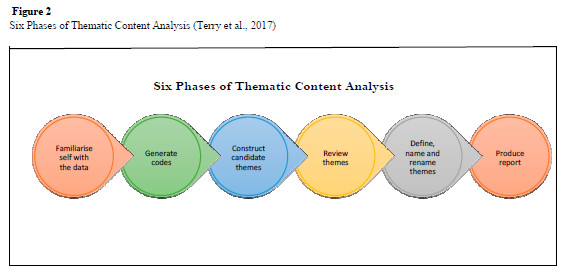
Once all the data collection episodes were completed and manually transcribed, the transcriptions were evaluated for accuracy. Once accuracy was achieved, the data for each participant was collated and prepared for data analysis. Thematic content analysis (Terry et al., 2017), depicted in Figure 2, was used to analyse the data. This was an inductive, data-led approach that involved manual coding (Maher et al., 2018).
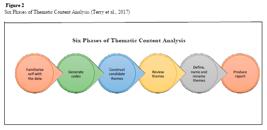
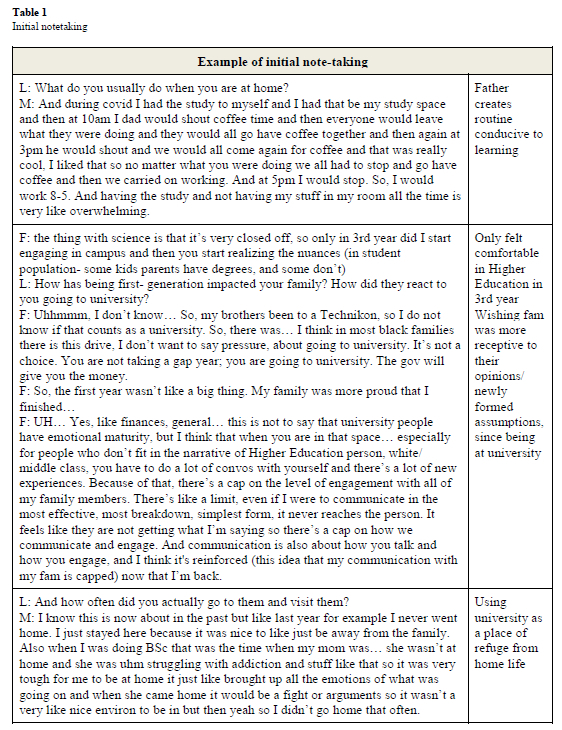
The analysis method employed in this study adhered strictly to the six phases of Thematic Content Analysis as described by Terry et al. (2017). The first phase of thematic content analysis involves familiarising oneself with the data. To do this, I reread all transcripts and wrote down initial notes in the margins of each transcript (Table 1: Initial note-taking). This assisted me in gaining a better understanding of the subjective experiences described by my participants and confirmed the appropriateness of thematic content analysis prior to coding2.
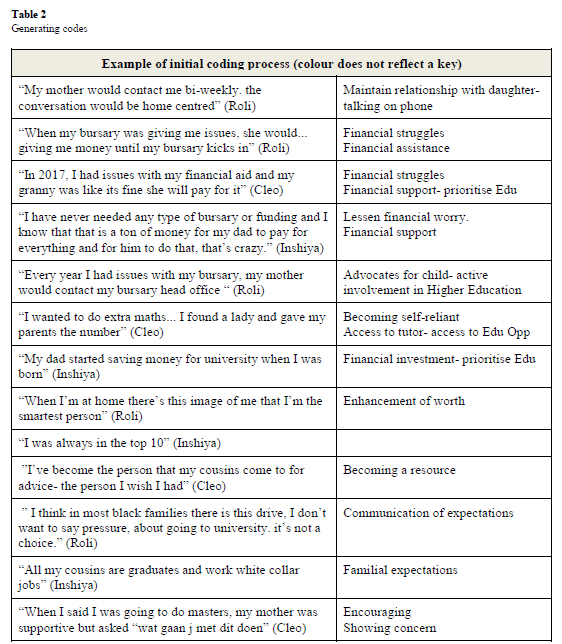
Next, following Maher et al. (2018), code generation was informed by hand-coding. To generate codes, all data segments relevant to the experiences of first-generation Black female post-graduate students regarding their parental support were highlighted (Table 2: Generating codes). This generated 107 data segments, which were placed in a separate document for further coding, yielding 34 NVivo codes.
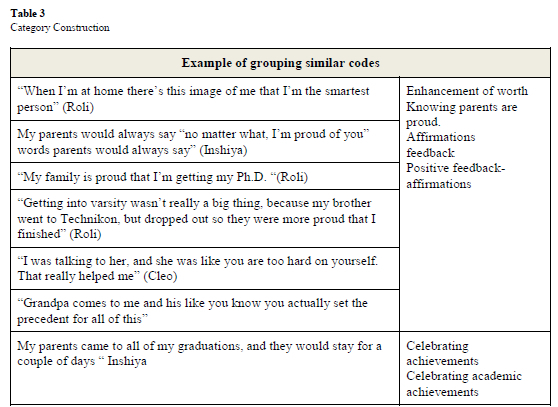
I reviewed the 34 codes again before clustering them into categories. I grouped codes that described similar experiences of support. During the category review phase, I identified uncategorised codes as describing other sources of support, which first-generation students described as influential in their academic success (see Table 3: Category Construction).
I then decided to use the initial categories as subcategories since the main categories were too restrictive. This resulted in three categories: parent involvement; other sources of support; and experiences of first-generation Black women (see Appendix for a list of categories, subcategories, and codes).
Introducing the participants
Cleo
Cleo is a 28-year-old master's student in Social Science. She lives with her grandparents, mother, and cousin in a multigenerational household. Cleo's parents never married, and her grandparents raised her primarily. Her grandmother, who holds the highest educational qualification in the family, completed her nursing education through a religious institution. Although Cleo has faced significant cultural and financial challenges, her academic journey has been shaped by her grandmother's emphasis on the value of education despite the family's limited exposure to higher education. Her grandparents' emotional and aspirational support has been a cornerstone of her academic success, motivating her to pursue her studies in a field that reflects her passion for history and culture.
Her grandparents' unwavering emotional support marked Cleo's academic journey. Her grandparents gave her practical assistance, visiting her weekly with food and pocket money. Cleo said during our interview, "My grandparents would visit me every week. . . they would bring me food and pocket money and ask me if I'm okay." Despite cultural pressures from her grandfather, who questioned the value of prolonged education, Cleo found strength in her grandmother's support. She reflected on her conversations with her grandmother during our interview, saying, "Our mother-daughter conversation is about trusting yourself. My grandmother would always say, 'Everything is going to work out, and everything is going to be fine.'" This points to the spiritual and emotional encouragement she received.
Cleo's experience exemplifies the tenets of Community Cultural Wealth. Familial and communal solidarity were crucial to her academic success.
Roli
Roli is a 28-year-old Black (Zulu) PhD student in Education. She lives with her mother, brother, and sister in a province different from where her university is located, commuting as needed for her studies. Roli's parents divorced when she was young, and she is the youngest of four siblings. Her mother, who completed police officer training, holds the highest educational qualification in the family. Roli's academic journey has been marked by her mother's unwavering support and high expectations, which have driven her to excel despite the challenges of being a first-generation student. Her mother's resilience and determination inspired Roli to navigate the complexities of higher education and pursue her research on educational equity.
Roli faced challenges of geographical isolation and financial instability. Although she now lives with her family in another province, she lived in an apartment close to her university while completing her bachelor's degree. Being from another province and living alone, Roli found it challenging to assimilate into university life, even during her post-graduate studies. She said, "Academics was just the icing on the cake, rent was due, I was starving, but I had to attend class at 8 am while adapting to the weather." Her mother, a police officer, became her primary source of support. Roli explained, "My mother would contact me bi-weekly. The conversation would be home-centred." This provided her with emotional reassurance during her academic journey.
Financial challenges were a constant struggle for Roli. She said, "The cost of living in [city] is high, so my mother would buy me food in our town and post it to me, to help me save money." After graduating with a master's degree in chemistry, Roli described being unable to find a job.
After my master's, I applied for work until I was blue in the face. . . I was at home for one year because I don't know any white people with factories. . . and my mom said my brain is rotting and said I should do a PGCE.
Beyond her immediate family, Roli found support in her extended family and community. Her aunt, a teacher, provided mentorship, while her church community offered emotional and spiritual support. This Community Cultural Wealth-inspired network of support enabled Roli to persevere despite the isolation and financial pressures she faced.
Inshiya
Inshiya is a 22-year-old Indian student pursuing an Honours degree in Education. She lives with friends in a five-bedroom house on campus, while her family lives approximately 21 hours away by car. Inshiya's parents are married, and she has one younger sibling. Her father, who holds an IT certificate, is the most educated member of the family. Her parents' emphasis on education has supported Inshiya's academic journey as a pathway to upward mobility. Despite their limited formal education, her parents have provided emotional and financial support, enabling her to focus on her studies and engage in campus life. Inshiya's commitment to her field reflects her desire to contribute to social and political change, inspired by her family's encouragement and her aspirations.
My dad started saving money for university when I was born. . . and when I showed interest in grad school, dad encouraged it, he did not force employment. . . I am not doing grad school for my parents, but probably because of them. . . because they didn't have the opportunity.
Although Inshiya expressed that she had considered dropping out of her postgraduate program because of its fast-paced nature, she continues to persevere because she understands how difficult life can be without a tertiary education. Her father, who had always dreamed of attending university but was unable to because of financial constraints, became a source of inspiration. Inshiya said,
When I told my parents I was thinking of dropping out, my dad told me that he really wanted to go to university but couldn't. . . so he had to start at the bottom and sacrifice to get to where he is today.
Inshiya's parents also participated actively in her academic journey, helping her make important decisions. When she expressed interest in studying for her BSc, her parents supported her choice, saying, "Okay, go with it, whatever you want to do."
Inshiya's extended family and community also contributed to her success. Her parents' financial contributions, despite the sacrifices they entailed, such as paying for her tuition and living expenses, were complemented by the support of her extended family. This Community Cultural Wealth-inspired support, rooted in collective responsibility, enabled Inshiya to navigate the pressures of higher education and remain focused on her goal of contributing to social and political change.
What their stories reveal
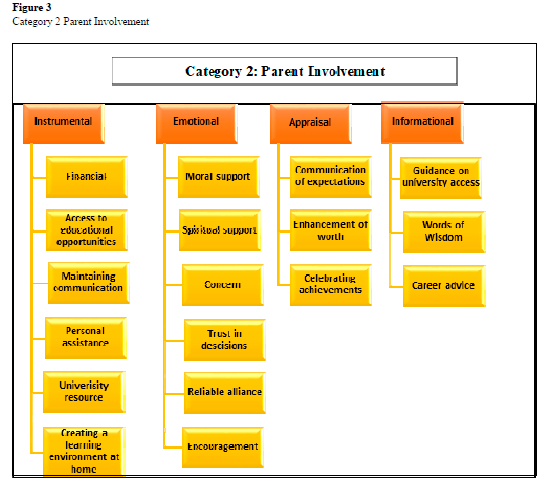
This study reveals that these first-generation Black female post-graduate students received multifaceted support from their parents and families, despite their parents often lacking experiential knowledge of higher education. Using Yosso's (2005) Community Cultural Wealth framework, I highlight how parents provide instrumental, emotional, appraisal, and informational support, collectively empowering their daughters to achieve academic success. However, a closer examination of these narratives reveals that the intersection of gender, race, and first-generation status shapes the nature and impact of this support, exposing students to unique challenges and systemic barriers.
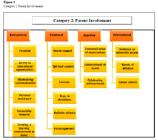
While the data analysis process revealed three main categories, I report here on the category of parent involvement. The figure below illustrates the subcategories of parent involvement and the corresponding codes associated with each of the four subcategories. I discuss each of these subcategories in the next section.
Instrumental parent support
For this article, I define instrumental support as financial support, access to educational opportunities, parents' willingness to maintain a relationship with their daughters, their personal assistance, their serving as a university resource, and their creating a supportive learning environment at home for their daughters (Alabi et al.,2019; Basit, 2012; Capannola & Johnson, 2022; Reed et al, 2018; Wainwright & Watts, 2021; Wang & Sheikh-Khalil, 2014).
The data paints a clear picture: parental support, even when it does not conform to university expectations, plays a role in the academic success of first-generation Black female post-graduate students.
Roli's story, for instance, highlights the kind of resourcefulness many families are forced to develop. Every year, she faced delays in receiving her bursary. However, every year, her mother stepped in, calling offices, covering costs, and making sure Roli had what she needed to stay enrolled. "Every year I had issues with my bursary," Roli recalled. "My mother would contact the bursary head office and give me money until my bursary kicked in." Such help does not come easily for a single-mother household; it requires financial juggling and personal sacrifice. However, it made the difference between dropping out and pushing through.
Inshiya's case is slightly different, but no less powerful. Her father, who never had the chance to attend university himself, began saving for her education the day she was born. "I have never needed any type of bursary or funding," she said. "I know that's a ton of money for my dad to pay for everything." Her father's quiet, long-term investment speaks volumes about the value her family places on education, even if they never set foot on a campus themselves.
Cleo, an English major, expressed gratitude to her family for their financial support during her master's studies. She said, "Still having someone that will pay for your livelihood. . . The fact that they are still willing to support me financially is a big deal." These financial contributions provided the women with navigational and resistant capital, enabling them to thrive academically. However, we also need to underscore the emotional burden carried by students who feel compelled to succeed to justify their families' sacrifices.
Beyond financial support, the parents of these women created supportive learning environments at home. During the COVID-19 pandemic, Inshiya's father established a structured routine to keep her focused. She recalled,
At 10 a.m., my dad would shout 'coffee time,' and everyone would leave what they were doing to have coffee together. We'd do the same at 3 p.m. Having the study room and not having my stuff in my bedroom all the time helped a lot.
This practical support, though seemingly small, played a significant role in helping Inshiya maintain focus and productivity. Similarly, Cleo successfully revised her honours thesis at home, despite initial anxieties. "I would tell them, 'Okay, I'm working, don't disturb me,' and they respected it," she said. These actions demonstrate how familial capital translates into navigational capital, helping students thrive academically. However, they also highlight the resourcefulness of first-generation families, who often find innovative ways to support their children's education despite their lack of formal knowledge about higher education systems.
While Nichols and Islas (2016) found that first-generation students are less likely to receive instrumental support from their parents, the array of lived experiences described to this point tells a different story.
Emotional support
Emotional support played a crucial role in sustaining the participants' academic journeys. However, gendered and cultural expectations often influenced its nature and impact. For this article, the concept of emotional support includes moral support, spiritual support, expressions of concern, trusting their daughter's decisions, being a reliable figure in their daughter's life, and encouraging their child during times of doubt (Basit, 2012; Nichols & Islas, 2016; Wainwright & Watts, 2021).
Cleo often turned to her grandmother for emotional support during challenging moments. When she failed her first physics test, Cleo called her grandmother in tears. She said,
I remember my first ever physics test I ever had I failed. . . I phoned my granny while I was crying, and she encouraged me. I can always phone her and tell her how I'm feeling, and she will support me.
Such emotional support became a cornerstone of Cleo's resilience and academic persistence. However, her experience also reveals the gendered dynamics of familial support. Her grandfather's scepticism about the value of prolonged education for women reflects broader cultural norms that prioritise marriage and domestic responsibilities over academic pursuits. This tension between traditional gender roles and academic aspirations highlights the nuanced dynamics of familial support, where emotional encouragement often coexists with cultural constraints.
Roli's experience also illustrates the gendered nature of emotional support. She explained, "I called my mom and said, 'I'm about to be disappointment number 3.'" Her mother replied, 'Girl, don't waste my time,' and hung up the phone," Roli recalled. This tough love approach, such as hanging up the phone when Roli expressed self-doubt, pushed Roli to persevere. While this approach motivated Roli, it also reflects societal expectations that Black women must be resilient and self-reliant, even in the face of systemic barriers. This raises important questions about how emotional support intersects with gendered racial stereotypes, reinforcing both empowerment and pressure.
Similarly, Cleo's family offered spiritual support in praying for her during exams. "If I tell them I have a test, they will pray for me," she said. Inshiya, on the other hand, turned to her mother during stressful times, stating, "I speak to my mother in times of doubt or when I feel stressed, and it always makes me feel better." This emotional support bolstered the women's aspirational and resistant capital, helping them overcome challenges and internalised stereotypes. However, it also underscores the emotional labour performed by first-generation families who often serve as both cheerleaders and safety nets for their children.
Appraisal support
Appraisal support refers to actions taken by first-generation parents that enhance their children's self-worth and self-esteem (Alabi et al., 2019). In this study, expressions of pride and high expectations served as a powerful motivator for first-generation Black women. Inshiya often felt the weight of her family's high expectations. However, her parents' consistent expressions of pride and admiration reinforced her self-worth. "My parents would always say, 'No matter what, we're proud of you,'" she recalled. This appraisal support, rooted in linguistic and familial capital, encouraged her to pursue her academic goals despite systemic barriers.
Similarly, Cleo reflected on her family's encouragement in saying, "They are always proud of me, no matter what." Support of this kind helped all the women maintain their educational aspirations, but it also put pressure on them to meet familial expectations. Inshiya, for instance, felt compelled to continue her studies despite contemplating dropping out, driven by her father's unfulfilled dream of attending university. This tension reflects the dual nature of appraisal support: while it reinforces motivation and self-worth, it can also contribute to the internalisation of societal and familial pressures to excel.
Informational support
Contrary to deficit narratives that portray first-generation parents as unable to provide informational support (Bui & Rush, 2016; Nichols & Islas, 2016), this study found that parents offered valuable guidance, albeit in non-traditional ways. Cleo's grandmother, for example, found a newspaper article about a bridging course that enabled Cleo to access higher education. "My granny was reading the paper. . . then she told me that she saw the SciMathUS3 thing, and she was like, 'Oh, you should apply for this,'" Cleo recalled. This creative approach to informational support challenges the assumption that first-generation parents lack the knowledge to navigate higher education systems.
Similarly, Roli's mother used her life experience to advise her on choosing the right institution. She explained,
I applied everywhere. . . I got into [university name] for law and [university name] for food science. . . My mother said I should study at [university name] because the degree would lead to more job security. . . Then she helped me look for housing and stuff.
These actions demonstrate how parents leveraged familial and linguistic capital to enhance their daughters' navigational and aspirational capital. However, the reliance on informal networks and creative problem-solving also highlights the limitations of institutional support systems, which often fail to provide accessible information for first-generation families.
Reimagining parental involvement
The stories shared by Roli, Cleo, and Inshiya push us to rethink how parental involvement is defined, recognised, and valued, particularly for first-generation Black female students. Much of the existing literature assumes that support must be institutional, financial, or rooted in formal knowledge of higher education systems. However, for these women, support took a different form. It was their parents' persistence, their daily sacrifices, their belief in their daughters' potential, often expressed through spiritual guidance, firm expectation, or long-distance phone calls, that made higher education possible.
These narratives challenge the notion that first-generation families are disengaged or uninformed. Instead, they reveal families who are resourceful, emotionally invested, and deeply committed to their children's success, even when navigating unfamiliar academic terrain. This is what Yosso (2005) referred to as Community Cultural Wealth, or the collective knowledge and support that exists in families and communities, particularly those historically marginalised by mainstream institutions.
Support does not always come without conflict. In Cleo's case, her grandmother encouraged her to pursue her education, while her grandfather questioned its value, especially for a woman. Roli's mother, though unwavering in her advocacy, expressed her support through tough love, expecting resilience in the face of structural obstacles. These moments of tension and love coexisting are part of the reality for many first-generation students. They reflect the cultural, generational, and gendered negotiations that occur in families as they try to support their daughters in spaces they have never entered.
The intersection of gender, race, class, and first-generation status creates a complex web of experiences that shape how support is given, received, and interpreted. For example, all three participants described feeling a deep sense of responsibility to succeed, not just for themselves, but also for their families. That pressure is both motivating and heavy. It is rooted in love, but also in recognition that access to education, particularly for Black women in South Africa, remains fragile and hard-won.
When institutions overlook these layered forms of support, or worse, dismiss them as irrelevant, they risk reinforcing the very inequalities they claim to be addressing. Instead, we must broaden our understanding of what support entails and where it originates. Recognising the value of community cultural wealth does not mean romanticising hardship; it means seeing the strength and strategy in how first-generation students and their families navigate the higher education system.
These women's stories remind us that parental involvement cannot be measured solely by attendance at parent-teacher meetings or the ability to assist with coursework. It also includes faith, phone calls, meals, and the money saved quietly over the years, as well as the repeated reassurance that their daughters can achieve.
Significance of findings
This study makes a significant contribution to understanding non-traditional students, parental involvement, and the experiences of first-generation Black female post-graduate students. By adopting an asset-based approach, it aligns with Yosso's (2005) Community Cultural Wealth Framework, emphasising the strengths and resources that first-generation students and their families bring to higher education. The findings redefine parental involvement, demonstrating its enduring importance at all educational levels and its role in providing emotional, motivational, and aspirational support. This expands frameworks, such as Yosso's (2005), and addresses gaps in the literature, particularly the underrepresentation of female experiences and the lack of focus on academically successful first-generation post-graduate students. The study counters the misconception that Black first-generation students are underprepared for university, highlighting, instead, their resilience, independence, and maturity as key factors in their academic success.
The women's narratives in this study offer practical insights for higher education institutions, enabling them to better understand and support their diverse student populations. By validating the experiences of first-generation black female post-graduate students, institutions can design targeted support systems that foster inclusion and belonging. The focus group methodology empowered participants, providing a reflective tool for others in similar circumstances and offering insights into coping strategies and resilience. These findings also support institutional transformation agendas, such as those outlined in South Africa's White Paper 3 of 1997 (Department of Education, 1997) by aligning support services with the needs of non-traditional students. Future research could explore the experiences of first-generation students in various cultural or institutional contexts, examine the role of additional support systems (e.g., peer networks), or investigate the long-term impact of parental involvement on academic and professional outcomes.
An intersectional understanding of parental support has significant implications for higher education institutions that seek to support first-generation students. Traditional support systems often fail to recognise the unique challenges faced by students with intersecting marginalised identities, such as black women from working-class backgrounds. Institutions can design more inclusive and equitable support systems by adopting an asset-based approach that acknowledges the diverse forms of capital these students bring.
Conclusion
This study has elucidated the multifaceted ways in which parents of first-generation Black female post-graduate students support their academic success. Despite lacking higher education experience, these parents provide crucial forms of capital, including aspirational and instrumental, that significantly contribute to their daughters' achievements.
The findings contribute to a deeper understanding of parental involvement by demonstrating its enduring importance at all educational levels. By employing Yosso's (2005) Community Cultural Wealth framework, this study highlights the value of recognising and leveraging the diverse forms of capital in minority families. These insights provide a foundation for institutions to support non-traditional students better and foster inclusive environments that acknowledge the unique contributions of first-generation families.
Recognising and valuing this support can empower more students to navigate higher education successfully and achieve their academic goals. This study contributes to the existing body of knowledge and serves as a call to action for institutions to embrace and support the diverse needs of their student communities.
References
- Alabi, O. J., Seedat-Khan, M., & Abdullahi, A. A. (2019). The lived experiences of postgraduate female students at the University of KwaZulu Natal, Durban, South Africa. Heliyon, 5(11), e02731. https://doi.org/10.10167j.heliyon.2019.e02731
- Badat, S. (2016). Deciphering the meanings and explaining the South African higher education student protests of 2015-2016. Pax Academica, 1, 71-106.
- Basit, T. N. (2012). My parents have stressed that since I was a kid: Young minority ethnic British citizens and phenomenon of aspirational capital. Education, Citizenship and Social Justice, 7(2), 171-192. https://doi.org/10.1177/1746197911432597
- Bahack, H., & Addi-Raccah, A. (2022). PhD first-generation and continuing-generation students' academic experience and strengths. Higher Education, 84 (1), 909-925. https://doi.org/10.1007/s10734-021-00777-0
- Biko, S. (1987). I write what I like: A selection of his writings. Heineman.
- Capannola, A. L., & Johnson, E. I. (2022). On being the first: The role of family in the experiences of first-generation university Students. Journal of Adolescent Research, 37(1), 29-58. https://doi.org/10.1177/0743558420913483
- Clandinin, D. J., & Huber, J. (2010). Narrative inquiry. In B. Peterson, E. Baker & B. McGaw (Eds.), International encyclopedia of education (Vol. 6, pp. 436-441). Elsevier. https://doi.org/10.1016/B978-0-08-044894-7.01387-9
- Department of Education. (1997). Education White Paper 3: A programme for the transformation of higher education. Department of Education. https://www.Department+of+Education.+(1997).Education+White+Paper+3%3A+A+programme+for+the+transformation+of+higher+education.
- Gofen, A. (2009). Family capital: How first-generation higher education students break the intergenerational cycle. Family Relations, 58(1), 104-120. https://doi.org/10.1111/j.1741-3729.2008.00538.x
- Kim, J., Miller, S. M., Hwang, J., & Olson, J. S. (2021). Female first-generation college students: A review of challenges and successes. Journal of Global Education and Research, 5(2), 136-150. https://doi.org/10.5038/2577-509X.5.2.1068
- LeBouef, S., & Dworkin, J. (2021). First-generation college students and family support: A critical review of empirical research literature. Education Sciences, 11(6), 294-300. https://doi.org/10.3390/educsci11060294
- Mabokela, R., & Mlambo, Y. (2017). Access and equity in South African higher education: A review of policies after 20 years of democracy. Comparative Education Review, 61(4),780-803. https://doi.org/10.1086/694799
- Maher, C., Hadfield, M., Hutchings, M., & de Eyto, A. (2018). Ensuring rigor in qualitative data analysis: A design research approach to coding combining NVivo with traditional material methods. International Journal of Qualitative Methods, 17(1), 1-13. https://doi.org/10.1177/1609406918786362.
- Moodley, P., & Singh, R. J. (2015). Addressing student dropout rates at South African universities. Alternation in Special Education, 17(17), 91-115.
- Moreno, R. (2021). The guilt of success: Looking at Latino first-generation university students' experience of leaving home. Journal of Hispanic Higher Education, 20(2), 213-231. https://doi.org/10.1177/1538192718801831
- Motsabi, S., Diale, B. M., & Van Zyl, A. (2020). The role of social support in the persistence of first-year first-generation African students in a higher education institution in South Africa. South African Journal of Higher Education, 34(4), 189-210. https://doi.org/10.20853/34-4-3597
- Nichols, L., & Islas, A. (2016). Pushing and pulling emerging adults through university: University generational status and the influence of parents and others in the first year. Journal of Adolescent Research, 31(1), 59-95. https://doi.org/10.20853/34-4-3597
- Patton, M.Q. (2015). Qualitative research & evaluation methods (4th ed.). SAGE.
- Reed, M., Maodzwa-Taruvinga, M., Ndofirepi, E. S., & Moosa, R. (2018). Insights gained from a comparison of South African and Canadian first-generation students: The impact of resilience and resourcefulness on higher education Success. Compare: A Journal of Comparative and International Education, 1-19. https://doi.org/10.1080/03057925.2018.1445968
- Robinson, S.J. (2013). Spoketokenism: Black women talking back about post-graduate school experiences, Race Ethnicity and Education, 16 (2), 155-181. https://doi.org/10.1080/13613324.2011.645567
- Stewart, D. W., Shamdasani, P. N., & Rook, D. W. (2007). Focus groups: Theory and practice (2nd ed.). SAGE.
- Terry, G., Hayfield, N., Clarke, V., & Braun, V. (2017). Thematic Analysis. SAGE https://dx.doi.org/10.4135/9781526405555
- Wainwright, E., & Watts, M. (2021). Social mobility in the slipstream: First-generation students' narratives of university participation and family. Educational Review, 73(1), 111-127. https://doi.org/10.1080/00131911.2019.1566209
- Wang, M.-T., & Sheikh-Khalil, S. (2014). Does parental involvement matter for student achievement and mental health in high school? Child Development, 85(2), 610-625. https://doi.org/10.1111/cdev.12153
- Yosso, T.J. (2005). Whose culture has capital? A critical race theory discussion of community cultural wealth. Race, Ethnicity, and Education, 8(1), 69-91. https://doi.org/10.1080/1361332052000341006
Accepted: 14 August 2025
2 These notes have not been edited in the interests of preserving the original words of the participants.
3 The SciMathUS programme is a one-year bridging course aimed at improving NSC results in Mathematics and Physical Sciences for students from disadvantaged backgrounds.