Coping in complex, changing classroom contexts: An investigation of the bases of pre-service teachers' pedagogic reasoning
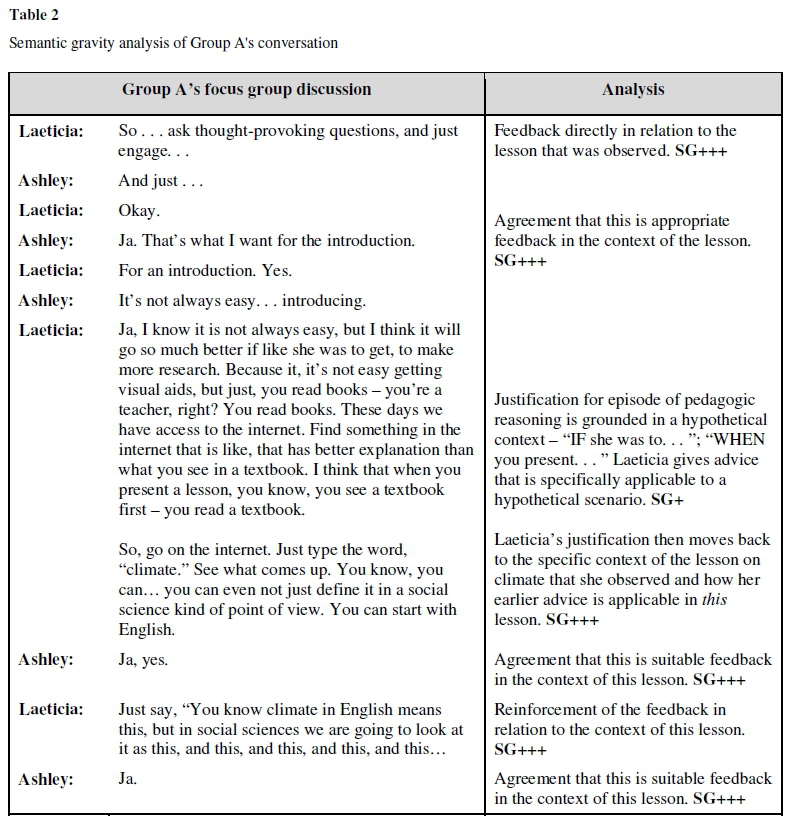
Despite its central role in enabling professional judgements and decision-making in teaching, pedagogic reasoning is a slippery concept and difficult to pin down. Although pedagogic reasoning is understood to inform all aspects of teaching practice, we still do not know what pedagogic reasoning looks like. In this article, I present a conceptual tool, using concepts from Legitimation Code Theory (Maton, 2014), to explore analytically the differences between the abstraction and context-embeddedness of ideas expressed in the pedagogic reasoning of a sample of pre-service teachers. I argue that pre-service teachers who are able to draw on specialised concepts associated with context-independent principles, may be in a better position to distinguish the "formal elements" from the "material elements" of teaching (Morrow, 2005, p. 98). Being able to make this distinction is likely, I argue, to set pre-service teachers up to cope in complex changing classroom contexts.
initial teacher education; pedagogic reasoning; changing contexts; Legitimation Code Theory; semantic gravity; pre-service teachers
 Thumbnail
 Thumbnail