Micro-credentials and job readiness among office management students at universities of technology
Abstract
The workplace is changing faster than ever, which means that higher education institutions must demonstrate that their graduates are truly ready to work. Micro-credentials have developed as focused, competency-oriented learning modules that authenticate transversal skills and facilitate adaptable, lifelong education. This mixed-methods study evaluates the workplace readiness of undergraduate office management students at a South African university of technology, and explores the potential of micro-credentials to address discrepancies between academic training and labour-market demands. Based on employers' feedback on weaknesses in critical thinking, initiative, professionalism, and communication, a survey of 161 final-year students found that they generally thought the academic work was useful; however, they still struggled to apply theory to practice, communicate professionally, and understand how organisations operate. Triangulated findings indicate that micro-credentials, when aligned with industry requirements and integrated into curricula, can more effectively develop and signal essential competencies for future employability.
micro-credentials; employability; workplace readiness; work-integrated learning; office management; curriculum alignment; critical thinking; professional communication; entrepreneurial thinking
Introduction
Universities and universities of technology around the world are under increasing pressure to demonstrate that their graduates are not only academically qualified but also fully prepared for fast-paced, technology-driven workplaces. The rapid rise of automation, the shifting of job roles following the COVID-19 pandemic, and the emergence of artificial intelligence have led people to wonder whether traditional qualifications are sufficient to meet the job market's needs (Petropoulos, 2021). At the same time, there has been an unprecedented growth in short, focused learning opportunities, often delivered online. This has led to the idea of micro-credentials (Omona & O'dama, 2024). Micro-credentials are generally regarded as limited learning units (learn and earn), evaluated against defined criteria, that validate a learner's knowledge, comprehension, or competencies in a specific domain. They are designed to be valuable on their own, but they can also accumulate into bigger rewards (Brown et al., 2023). Increasingly, people view these credentials as helping individuals acquire new skills, make lifelong learning more visible, and strengthen the connection between higher education and the job market (Gamage & Dehideniya, 2025)
In South African universities of technology, where work-integrated learning (WIL) is a key part of many programmes, students' placements often reveal the gap between what the curriculum promises and what happens in the workplace (Jacobs, 2016). A recent qualitative study that interviewed employers who hosted WIL students in an office management and technology programme found that technical skills alone were not enough. According to Jacobs, employers reported that students struggled with critical and strategic thinking, lacked initiative and an entrepreneurial mindset, had difficulty connecting what they learnt in school to real-world business situations, and often exhibited weaknesses in professionalism, work ethic, attitude, and communication. These results align with broader discussions about graduate employability, which are increasingly focused on durable human soft skills, such as critical thinking, adaptability, communication, and collaboration, rather than just technical skills. Micro-credentials have been proposed to clarify, facilitate, and increase employers' visibility of these competencies, thereby augmenting conventional qualifications (Tamoliune et al., 2023). Skills-gap research also shows that employability problems are not just about whether you have the right skills; they're also about how those skills are signalled. Research indicates that students frequently assess their soft skills positively, whereas employers remain sceptical-a case of Dunning-Kruger effect (Pennycook et al., 2017). According to Tamoliune et al. (2023), this discrepancy is partly due to the inadequacy of traditional transcripts in signalling these competencies, creating a challenge in both perception and verification-a gap that micro-credentials may help mitigate.
This article examines three interconnected enquiries regarding workplace preparedness within office management programmes at a university of technology. First, it examines how employers who host WIL students discuss students' strengths and weaknesses in terms of their readiness for work. It focuses on critical and strategic thinking, professionalism, entrepreneurial orientation, and transferable skills. Second, it examines how final-year office management students feel about their academic preparation, WIL experiences, and their readiness to start working. Third, the article examines how micro-credentials can be deliberately designed and integrated to address the specific capability deficiencies identified, based on the similarities and differences between these qualitative and quantitative strands. The study frames the analysis around three questions, positioning micro-credentials not as generic supplements, but as targeted, evidence-based interventions that address both employer expectations and student self-perceptions.
Thus the study is guided by three research questions:
How do employers who host WIL students in office management programmes describe students' strengths and weaknesses in relation to workplace readiness?
How do final-year office management students perceive their academic preparation, WIL experiences, and overall readiness to enter the workplace?
How can micro-credentials be intentionally designed and embedded within the curriculum to address the specific capability gaps identified across employer and student perspectives?
The article contributes to the discourse on micro-credentialisation and employability in the Global South by conceptualising micro-credentials as integrated, evidence-based interventions informed by both employer and student perspectives, rather than merely supplementary qualifications. It also places this conversation within the context of a global body of work that views micro-credentials as both innovative ways to teach, and effective solutions to address the skills gap and the evolving credential ecology
Theoretical foundations: Credentials, capital, and capability
Any discussion of micro-credentials in relation to workplace readiness must begin with an examination of how credentials function within labour markets. From a human capital perspective, micro-credentials can be understood as investments in productive capacity that seek to connect educational achievement to labour market outcomes and economic returns (Oliver, 2019). In this framework, higher education is increasingly evaluated not only in terms of disciplinary knowledge but also in its ability to develop and signal transferable competencies that support long-term adaptability (Tamoliune et al., 2023; Zdunek et al., 2024).
However, human capital theory alone does not sufficiently explain how credentials acquire value. From a signalling perspective, credentials function as institutionalised signals of competence. Drawing on Bourdieu's theory of capital, credentials obtain economic value only when recognised as legitimate symbolic capital within a regulated field. In the South African context, this field is structured by the National Qualifications Framework (NQF), South African Qualifications Authority (SAQA), quality councils, and employer recognition practices. Micro-credentials must therefore achieve recognisability and convertibility within this credential ecology; without institutional and employer validation, they remain latent rather than convertible capital.
The capability approach introduces a complementary analytical lens. Rather than focusing solely on skill acquisition, it shifts attention to the substantive freedoms learners possess to convert learning into meaningful work (Zdunek et al., 2024). Employability, in this sense, extends beyond possession of competencies to the ability to mobilise and apply them within constrained social and economic contexts. Even where micro-credentials achieve formal recognition, learners require supportive conversion factors, including high-quality WIL supervision, digital infrastructure, feedback literacy, and employer engagement, to translate credentialed skills into employment outcomes. The distinction between skill acquisition and skill conversion is central to this study's conceptual framing, and underscores that micro-credentials are examined as potential mechanisms rather than empirically validated solutions.
Micro-credentials in higher education
Building on this theoretical foundation, micro-credentials must be defined and situated within higher education practice. For the purposes of this study, a micro-credential is understood as a concrete manifestation of learning outcomes attained through a short educational experience and evaluated against explicit criteria (Schutte & Kyriazi, 2025). They serve as verifiable evidence of learner achievement and performance (McGreal & Olcott, 2022).
Unlike traditional degrees, micro-credentials are characterised by flexibility and stackability, allowing learners to pause, resume, and accumulate learning over time (Cirlan & Loukkola, 2020). They may take the form of digital badges, competency-based modules, or short courses delivered in either digital or conventional formats (Matkin, 2020). Systematic reviews indicate that they are generally outcomes-based, quality-assured, and conferred by reputable providers, often aligned with qualification frameworks (Ngoc Ha et al., 2023). Importantly, they are typically positioned as supplements to, rather than replacements for, macro-qualifications, enabling more granular signalling of specific competencies (Oliver, 2019).
Design-oriented scholarship further emphasises that effective micro-credentials require clearly articulated learning outcomes, competency-based assessment, and alignment with qualification frameworks and industry standards (Surono, 2023). Within the South African context, alignment with NQF level descriptors and WIL requirements becomes particularly significant. Proposed adjustments such as clearer credit articulation pathways, alignment with WIL quality standards, and stronger employer co-design are therefore treated as enabling conditions rather than guarantees of impact. Micro-credentials are conceptualised here as structured interventions whose effectiveness depends on regulatory coherence, institutional capacity, and employer recognition.
Micro-credentials, employability, and the skills gap
The relevance of micro-credentials becomes more apparent when considered against ongoing debates about graduate employability. Research consistently indicates that employers perceive graduates as underprepared, particularly in critical thinking, communication, initiative, and teamwork (Dolce, 2022; Hoque et al., 2023). Significantly, Dolce (2022) argued that many skills gaps are, in fact, signalling gaps. Competencies may be present but insufficiently visible or verifiable within traditional transcripts, which aggregate performance into module grades rather than disaggregated capabilities.
Within this context, micro-credentials are increasingly conceptualised as structured, assessed, and quality-assured units that make specific competencies explicit and demonstrable (McGreal & Olcott, 2022; Schutte & Kyriazi, 2025). Employers across different contexts are becoming more aware of alternative credentials as potential indicators of job-ready skills, although levels of familiarity and trust vary (Tamoliune et al., 2023). Systematic reviews suggest that micro-credentials may facilitate targeted reskilling, strengthen alignment between workforce competencies and labour market demands, and support more flexible curriculum development (Tamoliune et al., 2023). At the same time, their legitimacy depends on recognition within established credential systems and on employer confidence in their quality.
Empirical evidence on micro-credential design and impact
Empirical research provides cautious support for the potential of micro-credentials while underscoring the importance of contextual conditions. In a quasi-experimental study, Li and Ironsi (2024) found that students participating in structured micro-credential learning environments demonstrated stronger gains in critical thinking, problem-solving, and communication than those in traditional classrooms. These gains were associated with authentic, project-based tasks and structured reasoning activities designed to simulate workplace demands. However, the study was embedded within a specific institutional and technological context, limiting direct generalisability to other higher education systems.
Similarly, Surono's (2023) design-oriented research illustrated how a project management micro-credential can be developed through competency-based skill sets, outcome-based teaching, structured assessment frameworks, and collaboration with professional bodies. The success of such initiatives appears contingent on institutional capacity, regulatory alignment, and industry engagement. Further research by Ngoc et al. (2025) indicated that learners pursue micro-credentials primarily for employability-related reasons, including skill enhancement and improved signalling to employers. Collectively, these studies suggest potential value but stop short of demonstrating universal effectiveness, reinforcing the need for contextualised piloting and evaluation.
WIL and durable capability development
The intersection of micro-credentials with WIL provides a particularly relevant lens for this study. WIL is widely recognised as a mechanism for enhancing employability by integrating practical experience into academic curricula. Research in WIL contexts highlights recurring concerns regarding graduates' preparedness in areas such as strategic thinking, initiative, communication, and professionalism (Jacobs, 2016).
Drawing on the theoretical and empirical strands discussed above, five durable capability domains are conceptualised as central to workplace readiness in office management programmes: critical and strategic thinking, entrepreneurial orientation, professional communication, professionalism and emotional intelligence, and adaptive self-management. These domains are understood not merely as skill clusters but as forms of convertible capital within labour markets. From a capability perspective, they represent functioning that expands graduates' substantive freedom to act effectively within complex organisational environments. From a signalling perspective, they are often difficult to detect in traditional transcripts.
Within this framework, micro-credentials are conceptualised as potential bridging mechanisms that can both develop and make visible these durable competencies. Rather than assuming that micro-credentials inherently produce workplace readiness, this study treats them as pedagogical and signalling tools whose effectiveness depends on deliberate alignment with identified capability gaps, authentic assessment practices, and sustained industry engagement.
Methodology
Research method
This research utilises a mixed-method design, synergistically integrating qualitative and quantitative components (Creswell & Clark, 2017). The design is most accurately characterised as a sequential explanatory design that integrates at the interpretive level.
Phase 1 (qualitative): An interpretive, inductive examination of employers' expectations and perceived deficiencies of WIL students enrolled in an office management programme.
Phase 2 (quantitative): A survey of final-year office management students to assess their perceptions of academic preparation, WIL experiences, deficiencies, and overall readiness (Weyant, 2022).
The qualitative results provided a framework for developing the quantitative instrument. They subsequently facilitated the synthesis of findings, particularly concerning the core competencies of critical/strategic thinking, entrepreneurial thinking, professionalism, and generic skills. This sequential, mixed-methods approach parallels recent research on micro-credential learning environments, which integrate experimental and qualitative data to assess their influence on 21st-century skills (Li & Ironsi, 2024) and enhance design-orientated micro-credential studies that utilise multiple data sources to refine competency frameworks (Surono, 2023).
Phase 1 (qualitative strand): Employers' viewpoints
The qualitative component is derived from a prior study conducted at a South African university of technology (Slabbert & Labuschagne, 2026). Using convenience sampling, 12 businesses that had hosted WIL students from the office management and technology diploma programmes for at least two consecutive years were selected. Employers or workplace supervisors were interviewed in a semi-structured way. ATLAS.ti (Version 23) was used to transcribe and analyse the data collected from the interviews. An inductive thematic approach facilitated the identification of significant themes related to students' cognitive abilities, professionalism, and workplace preparedness (Weyant, 2022).
Phase 2 (quantitative strand): Student survey
Sampling and population
The quantitative component comprised 161 completed responses from final-year undergraduates in office management at a university of technology. Section A of the dataset summarises the demographic profile. Most respondents were women (approximately 86%), while men made up about 14%. The average age of the participants was approximately 27 years (SD ≈ 3.9), with ages ranging from the late teens to the late 30s. Most students had completed a WIL placement that lasted between three and six months.
Sampling method
The analysis file shows that the survey tool was divided into six parts.
Section A: Demographics and placement context. This provided information about the placement, including the person's gender, age, length of WIL, year of graduation, and other details.
Section B: Academic preparation for industry. This includes Likert-scale questions about how relevant subjects are, how well course content matches up with tasks at work, how well students can apply what they learn, how well they can think critically and strategically, how well they can think like entrepreneurs, how well they can communicate, and how professional they are.
Section C: Assessment of industry experience. This includes questions about what is expected of them at work, how well they can meet those expectations, how well they can adapt communication standards, how well they can apply what they have learned, how well they understand their organisation, how well they understand their organisation's goals, how well they take responsibility for their own learning, how well they interact with clients, how well they act professionally, and how well they adapt to different cultures.
Section D: Gaps and challenges. This is a list of questions that asks students whether they had trouble with certain parts of WIL, such as using theory, writing reports, using formal business language, taking initiative, managing their time, understanding goals, and dealing with feedback.
Section E: Perception of readiness. This includes Likert items on how well the programmes prepared students for WIL, how ready they are to enter the workforce, how well they can work alone and think critically, how important WIL is to them, how well the programmes fit with what happens in the workplace, and suggestions for changes to the curriculum.
Section F: Open-ended questions. These ask about the parts of their academic preparation that helped them the most during WIL and the parts of their academic training that WIL showed them were missing (Slabbert & Labuschagne, 2026).
The analysis is descriptive because the dataset included summary tables (frequencies, percentages, means) rather than raw individual responses. It looks at patterns in the distributions. Descriptive statistics, such as frequencies, percentages, and summary notes, were used to analyse Likert-scale and categorical responses. The analysis was carried out in the following steps.
Finding the response distributions for important items in Sections B, C, and E, with a focus on patterns where "most participants agreed/strongly agreed."
Reviewing the reported difficulties in Section D to make a list of common gaps.
Examination of open-ended response categories in Section F to ascertain which aspects of academic preparation were regarded as most beneficial and which deficiencies were most pronounced.
The quantitative patterns were then combined with employers' qualitative themes to identify similarities and differences, informing the design of micro-credential pathways (Weyant, 2022).
Ethical concerns
The Central University of Technology gave ethical approval for the qualitative and quantitative strands. Participants were informed about the study's objectives, that they were free to choose whether to participate, and that their responses would be kept confidential. The quantitative component was integral to the overarching project; participation was voluntary, and no identifying information was disclosed in the aggregated analysis. Summary data were used to develop the curriculum and research initiatives (Weyant, 2022). Internal consistency was good, with Cronbach's (1951) α ranging from .78 to .88 across the scales.
Results
Qualitative findings: Employers' views
Employers consistently stressed that technical proficiency alone is inadequate for success in the workplace. Students generally possessed basic office technology skills but lacked advanced ones. Participants said that students often did not understand how their work fit into the organisation's bigger picture. They had trouble putting together information, thinking about how their work would affect things in the long run, or recognising opportunities to learn in everyday tasks. Employers said that students lacked a "holistic mindset" and struggled to align their actions with the organisation's goals.
Employers reported that students struggled to solve non-routine problems, apply theoretical concepts in practice, and follow directions carefully. Supervisors noted numerous spelling and grammar mistakes in students' writing and observed that instead of questioning the task or requesting more information, students "wait for the next instruction."
There was worry about the low level of initiative in businesses. Students were hesitant to go above and beyond what was asked of them, struggled to link tasks to larger processes, and often exhibited a negative or passive attitude towards learning new skills. Employers characterised these issues as a deficiency in entrepreneurial or intrapreneurial thinking.
Professional behaviour became a major issue of concern. Employers reported that problems included using inappropriate or casual language in emails, failing to be client-focused, struggling to receive and act on feedback, and being unable to handle criticism. There were also mentions of using personal history as an excuse for poor performance at work, which employers thought needed to be challenged by setting clearer standards and expectations.
Lastly, employers found that workers lacked specific skills, such as typing speed and accuracy, proficiency in Excel, report writing, research skills, and professional communication, including formal business language and effective meeting etiquette. Time management and goal setting were also two significant areas for improvement.
Many of the suggested changes, such as getting students involved in the industry earlier, learning through scenarios, shadowing opportunities, and hands-on tasks built into the curriculum, are like micro-credential approaches that create focused, assessable learning units that focus on specific skills.
Quantitative results: Students' points of view
Demographics and WIL context
The data were drawn from Section A (Demographics and placement context) of the questionnaire. As mentioned, most of the 161 students in the sample were women, with an average age in their late twenties. Most students had WIL placements that lasted between three and six months. This is a long time to learn about workplace expectations and put what they learned in school into practice.
How students think about academic preparation
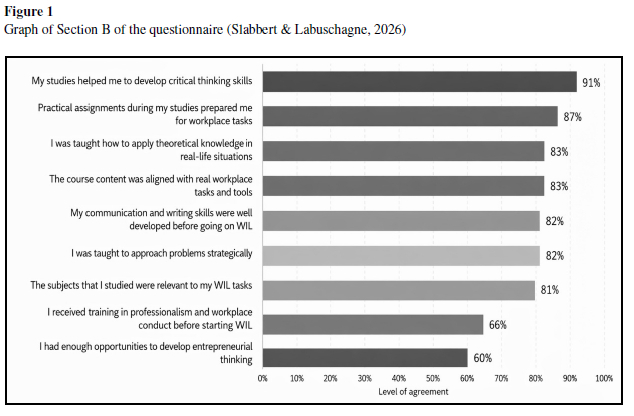
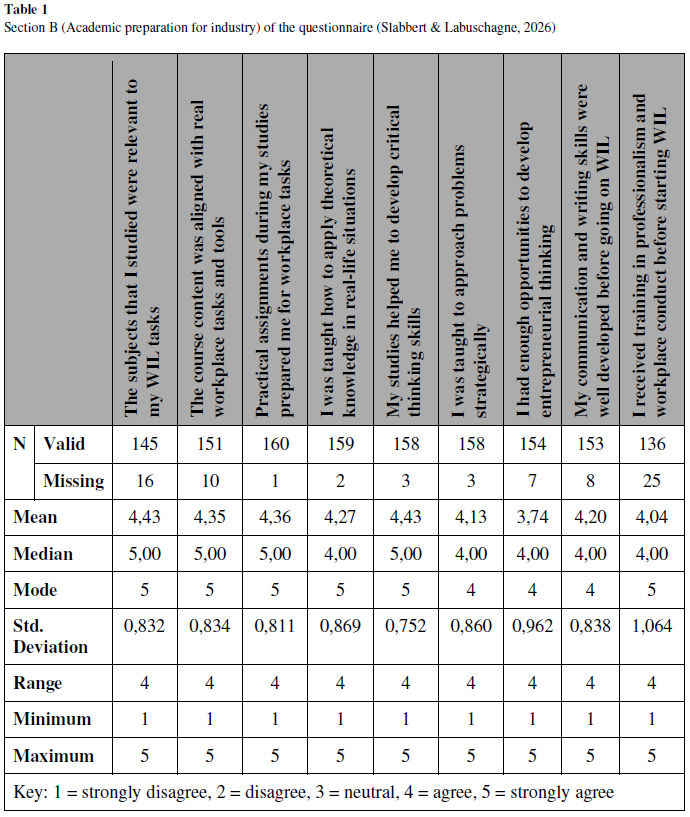
The data were drawn from Section B (Academic preparation for industry) of the questionnaire (see Table 1). Based on the mean, all statements were agreed upon to some extent (means ranging from 3.74 to 4.43). The graph in Figure 1 was generated by adding the agreed and strongly agreed percentages to give a "level of agreement" percentage. The most agreed upon statement was "My studies helped me to develop critical thinking skills," with a mean of 4 (agree) in Table 1 and a 91% level of agreement (Figure 1). The least agreed upon statement was "I had enough opportunities to develop entrepreneurial thinking," however, it also had a mean of 4 (agree) in Table 1, and a 60% level of agreement (Figure 1).
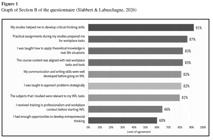
Students had very positive things to say about their academic preparation on several items in Section B. The summary notes for the question "The subjects I studied were relevant to my WIL tasks" say that most students (81%) strongly agreed. Students also agreed that "The course content was aligned with real workplace tasks and tools," with 83% strongly agreeing.
Most students strongly agreed that "Practical assignments during my studies prepared me for workplace tasks" (87%), which shows that they found them very useful. Students said they had been taught how to use what they learned in school in real life, and 83% strongly agreed that they had been prepared for this.
In terms of higher-order skills, most participants (91%) strongly agreed that "My studies helped me to develop critical thinking skills." Most participants (82%) agreed with the statement "I was taught to approach problems strategically." This indicates that they had a somewhat weaker, yet still positive, view of their preparedness for strategic thinking. On the other hand, "I had enough chances to learn how to think like an entrepreneur" received a more mixed response, with most people agreeing (66%) rather than strongly agreeing.
Students also agreed that they were good at writing and communication skills before WIL (83% agreement) and that they had learned how to be professional and behave at work.
All these answers together suggest that students believe their academic programmes are doing a good job of preparing them conceptually and practically, especially in critical thinking, applying theory, and engaging with relevant content. The weaker support for entrepreneurial thinking reflects employers' worries about a lack of initiative.
Evaluation of industry experience
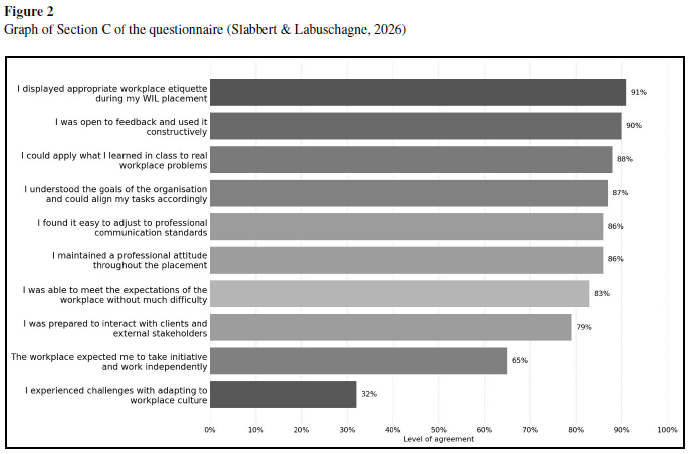
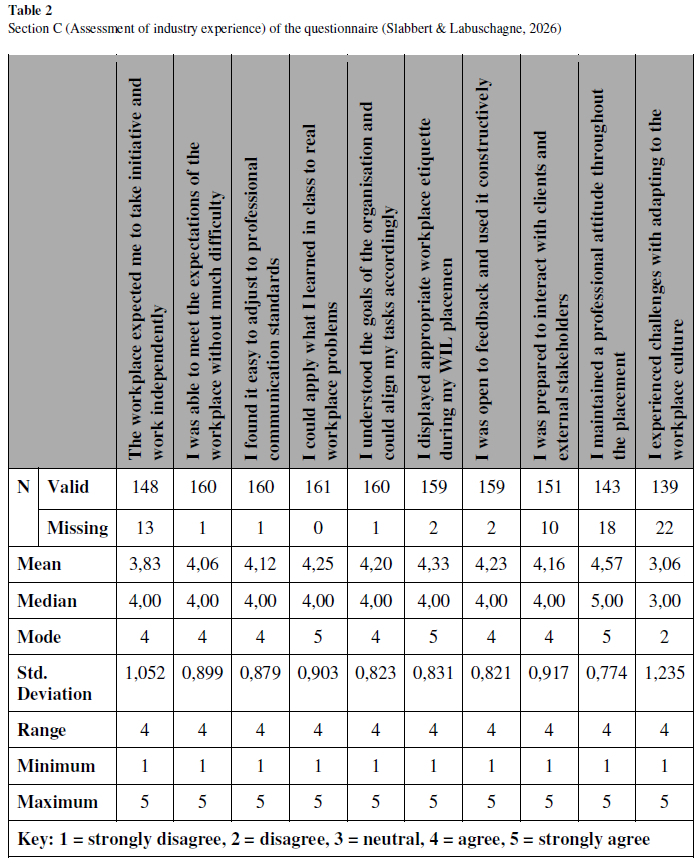
The data were drawn from Section C (Assessment of industry experience) of the questionnaire (see Table 2). The graph in Figure 2 was generated by adding the agreed and strongly agreed percentages to give a "level of agreement" percentage. Based on the mean, the most agreed upon statement was "I maintained a professional attitude throughout the placement," with a mean of 5 (strongly agree) in Table 2, and an 91% level of agreement (Figure 2). Based on the mean, the least agreed upon statement was "I experienced challenges with adapting to workplace culture" with a mean of 3 (neutral) in Table 2 and a 32% level of agreement (Figure 2).
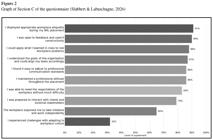
Students' thoughts about their WIL experiences were primarily positive. Most of the participants who answered (65%) agreed that "The workplace expected me to take initiative and work independently." Most (83%) said they could "meet the expectations of the workplace without much trouble."
They adapted relatively easily to professional communication standards. More than half (86%) agreed. Students strongly agreed that they could use what they learned in class to solve problems at work, as shown by the statement "I could apply what I learned in class to real workplace problems," which had a "most students strongly agreed (88%)" pattern.
They also strongly agreed (87%) that they knew what the organisation's goals were and could plan their work around them. A majority (90%) stated that they were open to feedback and utilised it positively.
They also stated that they maintained a professional attitude throughout their placement, with a strong pattern of "strongly agree" responses (86%). For the statement "I experienced challenges with adapting to workplace culture," most participants disagreed (32%), which is interesting because it suggests that cultural adaptation may not have been perceived as the primary issue. Overall, these answers suggest that participants in WIL believed they were highly competent and adaptable.
Gaps and challenges
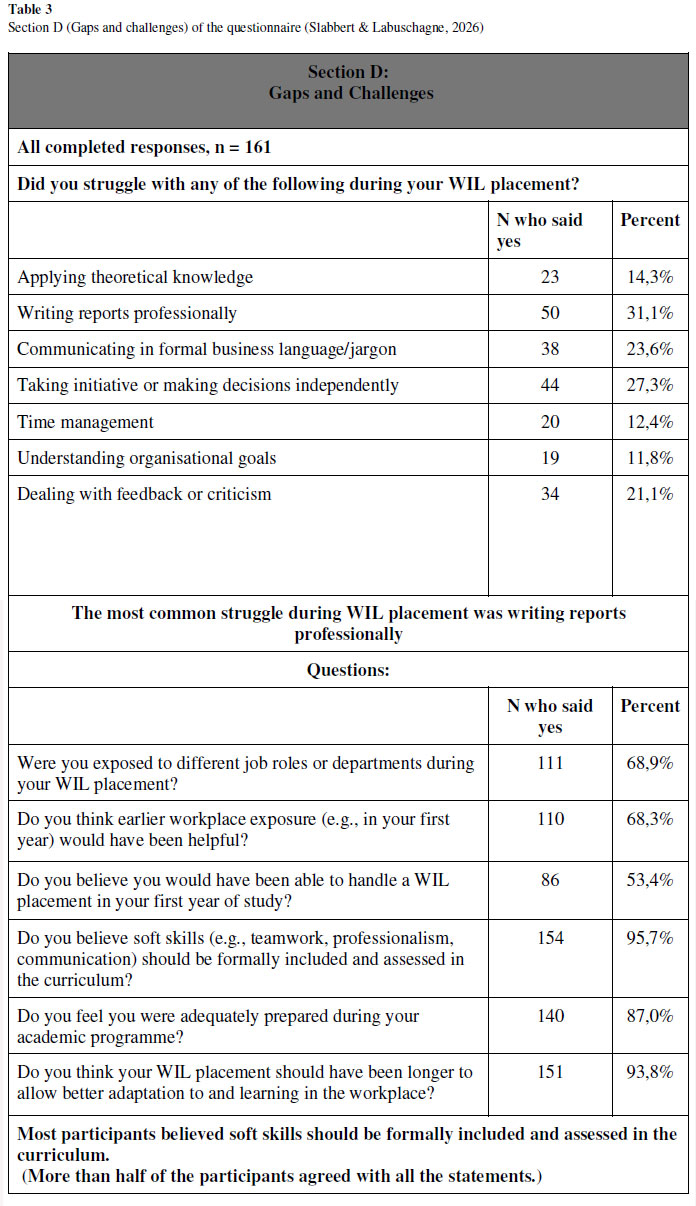
The data were drawn from Section D (Gaps and challenges) of the questionnaire (see Table 3). These findings illustrate a structural rather than purely perceptual gap. The tension between high self-reported readiness and a high incidence of practical struggles suggests that employability is not solely a matter of confidence or knowledge. Instead, it reflects incomplete capability conversion within WIL contexts. Time management and feedback literacy, for instance, are behavioural-regulatory competencies requiring iterative exposure and guided practice. Their prevalence highlights the need for structured, assessable micro-credential interventions that explicitly scaffold these capabilities rather than assuming their organic development. Section D sets itself apart by asking if students had trouble with certain parts of WIL. Many students reported problems in certain areas, despite most of them giving themselves good ratings.
The findings indicate that students generally reported high levels of preparedness and competence during their WIL experience, rather than widespread difficulty. A substantial majority of respondents demonstrated strong capabilities in key areas: approximately 90% indicated that they were open to feedback and used it constructively, while around 87% reported a clear understanding of organisational goals and the ability to align their tasks accordingly. Similarly, about 88% of students reported being able to apply theoretical knowledge to real-world workplace problems, reflecting effective knowledge transfer from the academic to the practical context.
Regarding communication, the results suggest that students were well-equipped for professional environments. Approximately 86% found it easy to adjust to professional communication standards, and over 83% indicated that their communication and writing skills were adequately developed prior to or during WIL. These findings highlight strong preparation in both interpersonal and professional communication competencies.
However, some challenges were identified. Notably, around 32% of respondents reported experiencing difficulties in adapting to workplace culture, suggesting that transitioning into professional environments remains a key adjustment hurdle. Additionally, relatively lower agreement levels (approximately 60-66%) were observed regarding opportunities to develop entrepreneurial thinking, indicating a potential gap in fostering innovation-related skills within WIL programs. Overall, the results suggest that while students are generally well-prepared and confident in applying their skills, targeted support may be needed to ease workplace adaptation and enhance opportunities for entrepreneurial development.
Perception of overall readiness
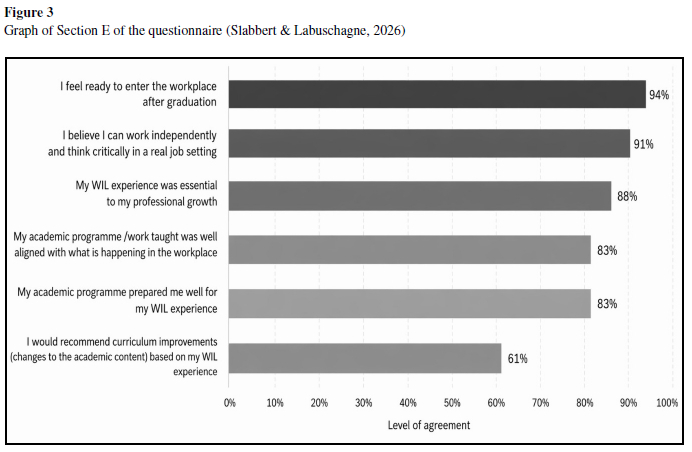
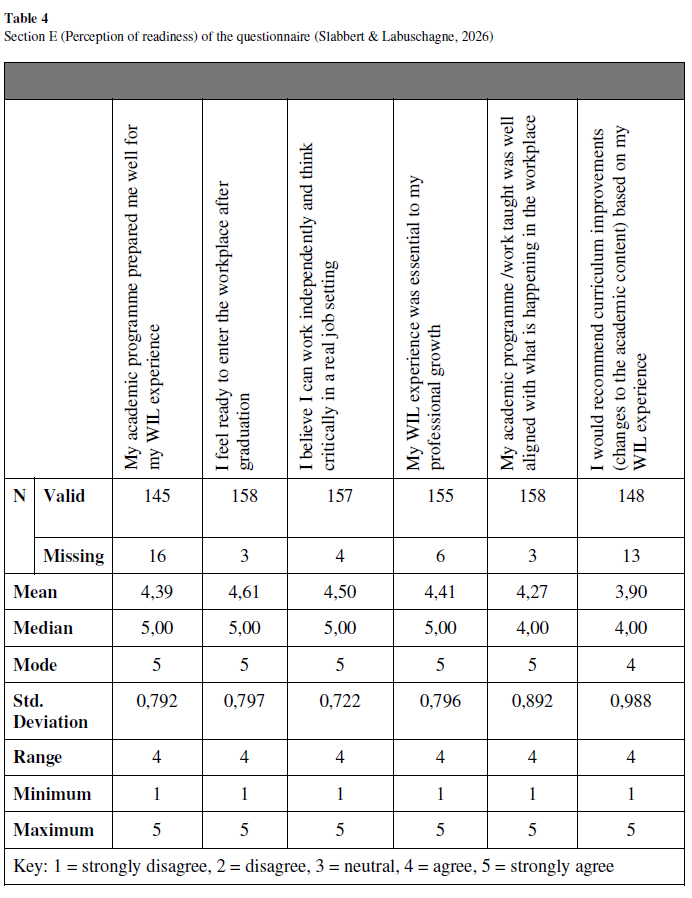
The data were drawn from Section E (Perception of readiness) of the questionnaire (see Table 4). Figure 3 was generated by adding the agreed and strongly agreed percentages to give a "level of agreement" percentage.
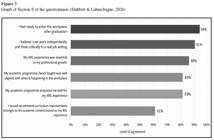
Based on the means (ranging from 3.90-4.61), all statements were agreed upon to some extent. The most agreed upon statement was "I feel ready to enter the workplace after graduation," with a mean of 5 (strongly agree) in Table 4 and a 94% level of agreement (Figure 3). The least agreed upon statement was "I would recommend curriculum improvements (changes to the academic content) based on my WIL experience" with a mean of 4 (agree) in Table 4, and a 61% level of agreement (Figure 3).
Section E focused more explicitly on students' readiness to enter the workplace. For "My academic programme prepared me well for my WIL experience," most participants strongly agreed (83%). On "I feel ready to enter the workplace after graduation," 94% strongly agreed, reflecting strong confidence.
Students also strongly endorsed "I believe I can work independently and think critically in a real job setting" (91% strongly agreed). WIL was widely perceived as essential to their professional growth, with most strongly agreeing (88%). The item "My academic programme/work taught was well aligned with what is happening in the workplace" again received strong support (83% strongly agreed).
Interestingly, for the statement "I would recommend curriculum improvements (changes to the academic content) based on my WIL experience," most participants agreed (61%), suggesting that even confident, ready students see scope for curriculum enhancement.
Open-ended responses
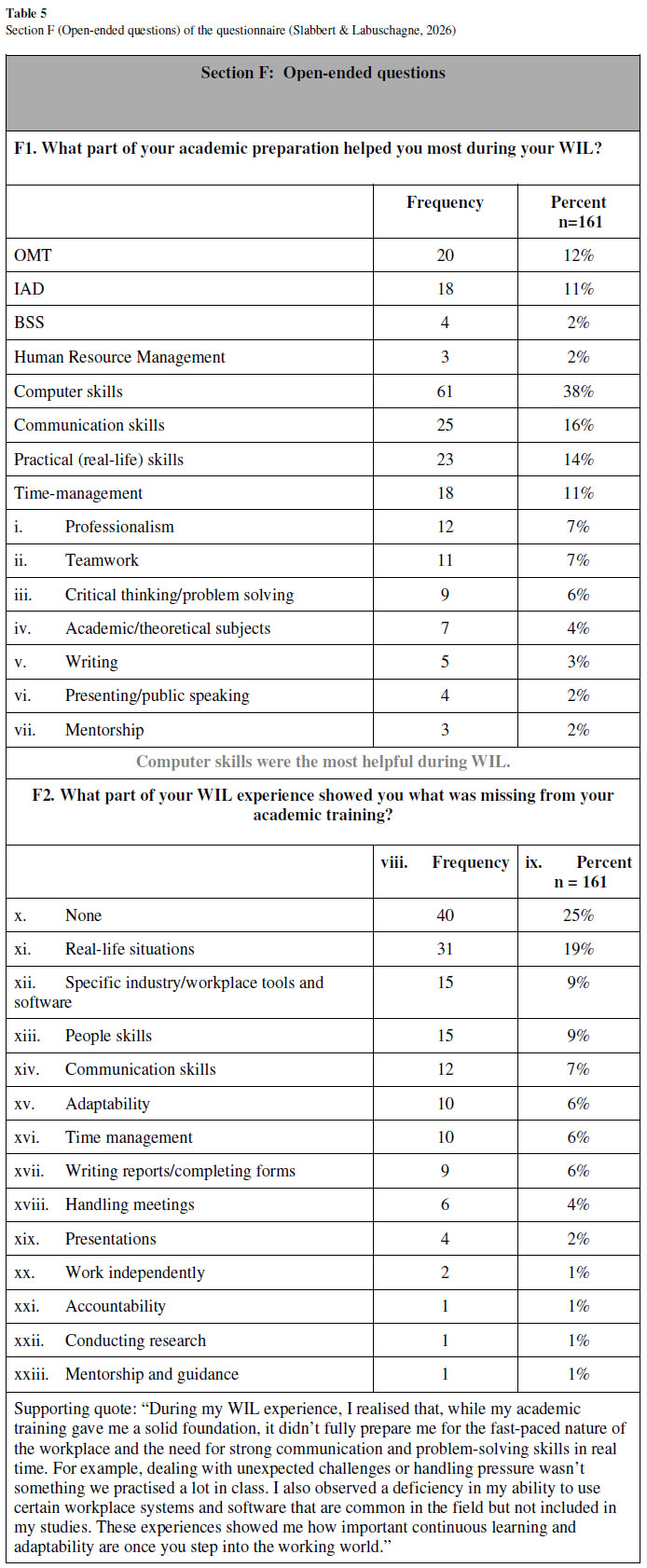
The data were drawn from Section F (Open-ended questions) of the questionnaire (see Table 5). The open-ended items offer greater clarity about what students perceived as helpful and what they considered missing. In response to "What part of your academic preparation helped you most during your WIL?" the most frequently mentioned categories were computer skills (approximately 38% of responses), communication skills (15%), and practical/real-life skills (14%) were the most frequently mentioned, with time management, professionalism, teamwork, and critical thinking and problem-solving also featuring prominently.
For "What did your WIL experience show you was missing from your academic training?" the single largest group indicated "none" (24%), which aligns with the high readiness scores. However, many students identified gaps in their training, including, real-life situations (19%), specific workplace tools and software (9%), people skills and communication skills, adaptability and time management, writing reports/completing forms, independent working, accountability, and conducting research (each with smaller but notable proportions). These categories reflect the employer-identified deficiencies and reinforce the sense that specific capabilities are underdeveloped in practice, even when learners generally feel positive about their preparation.
Discussion
Convergences and divergences between employer and student perspectives
This divergence can be interpreted through the lens of capital convertibility and capability conversion. Students appear to possess foundational knowledge and self-perceived competence (human capital accumulation) yet struggle with situational enactment under real workplace constraints. The high levels of reported difficulty in applying theory, managing time, and handling feedback suggest that the conversion of academic capital into workplace functioning remains incomplete. In capability terms, this indicates friction in the transition from classroom-based learning to applied organisational contexts. In signalling terms, employers may struggle to detect demonstrable competence where assessment remains generalised rather than granular.
Across the two strands, an interesting tension emerges. Students feel confident, report high levels of preparedness, and see their programme as relevant and aligned with workplace realities. Employers, however, identify persistent shortcomings in critical and strategic thinking, initiative, professionalism, and specific skills such as report writing and professional communication. The student data partially corroborate these concerns, particularly in Section D, where high proportions report struggles in exactly these domains. This suggests that self-perceived readiness is not necessarily inconsistent with substantial difficulties; students may feel ready to learn, willing to engage, and confident in their emerging professional identity, yet still encounter capability gaps when confronted with complex, real-world tasks. These convergences between employer concerns and student struggles provide a powerful basis for designing targeted interventions, rather than treating the problem as a general skills deficit. The data point to specific bridges that need to be built between academic preparation and workplace performance.
Dolce's (2022) work on the skills gap reinforces this interpretation by showing that many gaps arise because institutions do not make students' soft skills sufficiently visible or verifiable to employers. Students' confidence in their abilities co-exists with employers' scepticism, precisely because traditional credentials do not clearly signal capabilities such as teamwork, communication, leadership, and civic engagement. Micro-credentials and digital badges are proposed as mechanisms to document concrete evidence of performance (e.g. projects, co-curricular activities, WIL artefacts), thereby improving communication between higher education and the workplace and addressing perception and verification gaps.
Micro-credentials as targeted bridges
The micro-credentials literature emphasises the potential of small, focused, assessed learning units to support re- and up-skilling, improve alignment with employer needs, and formalise the recognition of non-traditional learning. Considering the study's findings, five micro-credential clusters are proposed for the office management context.
Micro-credential in strategic and critical thinking for office professionals
This could be achieved by connecting everyday tasks to organisational strategy, analysing cases, anticipating consequences, and reflecting on decisions. Assessment would be through problem-based scenarios using real organisational documents, and reflective analyses of how tasks align with organisational goals. This responds directly to employers' concerns about siloed thinking and students' struggles to understand organisational goals and apply theory.
Micro-credential in professional communication and report writing
This covers formal business language, email etiquette, report structures, summarising complex information, and writing for diverse audiences. Assessment could be through production of authentic workplace texts (reports, minutes, emails), with feedback cycles and revision. This addresses both employers' frustration with poor written communication and students' own reports of difficulties in report writing and business jargon.
Micro-credential in entrepreneurial and intrapreneurial thinking
This covers initiative, opportunity recognition within organisational constraints, problem ownership, creative problem-solving, and basic innovation skills. Assessment would be through small improvement projects in real or simulated office environments, pitch tasks, and reflective journals on initiative and risk-taking. It addresses the employer-identified lack of initiative and students' relatively weaker endorsement of opportunities to develop entrepreneurial thinking within the current curriculum.
Micro-credential in professionalism, emotional intelligence, and feedback literacy
This addresses work ethic, reliability, constructive handling of criticism, workplace boundaries, respect for diversity, and emotional self-regulation. Assessment might be scenario-based assessments, peer feedback activities, and reflective assignments on feedback episodes during WIL or simulations. It directly tackles the high proportion of students who struggle with feedback and employers' concerns about emotional intelligence and professional demeanour.
Micro-credential in work organisation, time management, and adaptive learning
This would cover prioritisation, task scheduling, dealing with interruptions, managing deadlines, and strategies for independent learning in fast-paced office contexts. Assessment could be through time-management plans, analysis of personal WIL or simulated workweeks, and evidence of adaptation over a period. It responds to the very high percentage of students reporting time-management struggles and the need for sustainable self-management skills.
Each micro-credential could be designed as a short, stackable unit formally aligned to programme outcomes and national qualification frameworks, with clear learning outcomes, authentic assessment, and quality-assured certification. Evidence from other sectors suggests that targeted micro-credentials can indeed develop the capabilities highlighted in this study. Li and Ironsi (2024) demonstrated that a semester-long micro-credential course, built around debates, project-based tasks, and structured reasoning activities, significantly improved students' critical thinking, problem-solving, and communication skills relative to a control group taught in a conventional classroom. Surono (2023) demonstrated how micro-credentials can be specified through competency-based skill sets, outcome-based teaching, and competency-based assessment, and embedded within recognised quality assurance systems, thereby enhancing their credibility as indicators of professional competence.
Embedding micro-credentials in the office management curriculum
Micro-credentials should not be conceptualised as "extras" added onto an already overloaded curriculum. Instead, the data suggest a strategic embedding approach. At the pre-WIL stage, micro-credentials in professional communication, time management, and basic professionalism could be introduced in the second year, immediately before WIL. This would give students tools to navigate workplace expectations from the outset. During WIL, reflective and evidence-based tasks linked to micro-credentials in strategic thinking and feedback literacy could enable students to collect artefacts and reflections from their placements as proof of competence. In the post-WIL/final-year stage, micro-credentials in entrepreneurial thinking and advanced strategic communication could build on WIL experiences as a raw material for deeper learning and integration.
Such an architecture would allow office management students to accumulate a portfolio of micro-credentials that both deepen their learning and provide employers with tangible evidence of specific capabilities. This aligns with the literature's emphasis on stackability, recognition of prior learning, and competence-based approaches in micro-credential ecosystems. It also responds directly to calls in the skills-gap literature for higher education institutions to move beyond generic claims about employability and instead, provide verifiable, skills-based signals that employers can readily interpret (Dolce, 2022).
Strengthening industry partnerships through co-designed micro-credentials
The findings also highlight the importance of co-design with industry. Employers have clear views about where students fall short, but they also propose practical interventions such as job shadowing, earlier exposure to real workplaces, and embedded scenarios. Inviting employers to co-create micro-credentials (by contributing cases, co-assessing student work, or recognising micro-credentials in recruitment processes) could increase the relevance and authenticity of learning, enhance the credibility of micro-credentials in the eyes of employers, offer a structured mechanism for continuous feedback between programmes and industry, and position the university of technology as a proactive partner in regional skills development.
This emphasis on partnership is strongly echoed in Dolce's (2022) action research, where co-curricular micro-credentials were developed in collaboration with regional employers to address skills verification and alignment issues. The study revealed that micro-credentials are most effective when they are grounded in local industry needs and when institutional policies require evidence of employer support for workforce-related offerings. Similarly, Surono (2023) argued that professional bodies and quality assurance units should play an active role in validating micro-credential designs, thereby enhancing acceptability, flexibility, and traceability to national and international competency standards.
Recommendations
For universities and programme leaders
Adopt a micro-credential strategy for office management and related programmes that explicitly targets critical/strategic thinking, entrepreneurial thinking, professionalism, communication, and time management. Map existing curriculum components onto the proposed micro-credential clusters to identify what can be recognised, what needs redesign, and where genuine gaps exist. Ensure alignment with institutional and national frameworks, including clear learning outcomes, credit values (where applicable), and quality assurance mechanisms. Develop an integrated assessment strategy that utilises evidence produced for micro-credentials to support the assessment of core modules, thereby reducing duplication and assessment overload. In doing so, institutions can draw on established design principles from other contexts. Surono's (2023) model, for example, suggests that micro-credentials should be built around (a) competency-based skill-set development, (b) outcome-based learning and teaching, (c) competency-based assessment, and (d) systematic evaluation and continuous improvement. Adapting these elements to an office management context would help to ensure that micro-credentials are coherent, scalable, and aligned with external standards and employer expectations.
For WIL coordinators and industry liaison offices
Use micro-credentials as scaffolds for WIL by requiring students to complete pre-WIL micro-credentials in professional communication and time management, and to gather WIL-based evidence for higher-level micro-credentials. Engage employers in co-design and co-assessment, for example, by inviting them to validate students' micro-credential artefacts or to comment on competency frameworks. Leverage WIL reflections to continually refine micro-credential content, ensuring that it responds to emerging workplace demands (e.g. new software tools, remote collaboration norms). Dolce's (2022) findings suggest that such co-designed, co-curricular micro-credentials can also function as relationship-building tools, strengthening regional workforce development agendas and opening new forms of collaboration, including shared training initiatives and dedicated workforce centres within universities.
For students
View micro-credentials as strategic assets that make otherwise invisible capabilities visible to employers, rather than as additional hurdles to overcome. Use WIL as an opportunity to collect evidence (documents, feedback, reflections) that can be used to complete micro-credential requirements. Reflect critically on where you feel most and least confident and, where possible, select micro-credentials that strengthen weaker capability areas (e.g. feedback literacy, entrepreneurial thinking, advanced business communication).
For policymakers and quality assurance bodies
Recognise micro-credentials as part of a coherent lifelong learning ecosystem, rather than isolated short courses. Guide credit recognition and stacking, especially for universities of technology that wish to embed micro-credentials within diploma and degree structures. Encourage funding and incentives for higher education-industry partnerships that co-create and pilot micro-credentials in priority skills areas such as office management and administrative leadership. Policy frameworks may also consider establishing minimum expectations for micro-credential quality, such as explicit competency standards, alignment with national qualification frameworks, and transparent assessment criteria, in line with emerging international practices (Surono, 2023).
Within the South African regulatory landscape, micro-credential integration must also be read as a system-alignment challenge. The NQF's commitment to mobility and articulation requires that micro-credentials do not operate as parallel or fragmented offerings but as quality-assured units embedded within formal qualification pathways. Emerging national analyses highlight definitional ambiguity, regulatory misalignment, and uneven stackability as potential risks. The proposed micro-credential clusters in this study would therefore need explicit alignment with Higher Education Qualifications Sub-Framework (HEQSF) descriptors, Credit Accumulation and Transfer (CAT) mechanisms, and employer recognition frameworks to ensure that they function as legitimate, stackable capital rather than isolated short courses.
Conclusion
While this article conceptualises micro-credentials as structured bridging mechanisms between higher education and workplace readiness, the study does not empirically test their implementation or impact. The proposed micro-credential clusters should therefore be understood as design propositions that require piloting, evaluation, and industry validation before claims of effectiveness can be made. The next step is not adoption by assumption, but careful co-designed experimentation, structured piloting, and rigorous evaluation within the South African university of technology context.
Limitations and structural concerns
South Africa's emerging micro-credentials agenda is best understood as a system-integration project rather than a simple expansion of short courses. It operates at the intersection of a social-justice-oriented NQF, designed to enable access, mobility, and progression, and ongoing policy discussions led by the Department of Higher Education and Training (DHET) and the SAQA regarding the recognition of smaller units of learning across formal, non-formal, and informal domains (Council on Higher Education [CHE], 2024).
The CHE's Policy on Micro-credentials in South Africa (PoMiSA) country analysis highlights that micro-credential provision is already occurring; however, governance questions remain unresolved. Chief among these is how focused learning achievements can be rendered legible, trustworthy, and quality assured within the existing NQF ecosystem without introducing regulatory fragmentation or undermining articulation pathways. While policy thinking appears to converge on credit-bearing, assessed, and quality-assured designs, concerns persist about definitional ambiguity, stakeholder buy-in, and the risks of commodification and fragmentation (CHE, 2024).
Within this regulatory landscape, WIL becomes pivotal. For micro-credentials to function as credible signals of capability, they must align not only with learning outcomes and NQF levels, but also with structured opportunities for applied learning and workplace-based assessment consistent with DHET programme requirements. Without operationalised credit articulation through CAT and recognition of prior learning (RPL) pathways, stackability risks becoming rhetorical rather than structural.
These concerns are not incidental but systemic. South Africa currently lacks an agreed national taxonomy for micro-credentials, and the full extent of provision-including quality, relevance, usefulness, and stackability-remains unclear (CHE, 2024). Moreover, the HEQSF does not yet clearly accommodate short learning experiences as accreditable offerings, which may create uneven credit recognition practices and administrative burdens for learners.
Equity risks are particularly salient. While micro-credentials may promote flexibility and continuing learning, they may also perpetuate inequality if disadvantaged learners are channelled into fragmented, non-stackable credentials that do not culminate in meaningful qualification-level progression, especially under conditions of digital divide and constrained household resources.
In highly unequal labour markets such as South Africa's, credentials function not only as proof of learning but also as sorting mechanisms. Micro-credentials may therefore either enhance equity-by making specific capabilities visible and accessible-or deepen stratification if only certain institutions can produce employer-recognised and trusted credentials. Their effectiveness ultimately depends on regulatory coherence, institutional capacity, and employer buy-in.
References
Brown, M., McGreal, R., & Peters, M. (2023). A strategic institutional response to micro-credentials: Key questions for educational leaders. Journal of Interactive Media in Education, 2023(1), Article 7, 1-17. https://doi.org/10.5334/jime.801
Cirlan, E., & Loukkola, T. (2020). Micro-credentials linked to the Bologna key commitments (Desk research report). European University Association. https://micro-credentials.eu/wp-content/uploads/sites/20/2020/09/MICROBOL-Desk-Research-Report.pdf
Creswell, J. W., & Clark, V. L. P. (2017). Designing and conducting mixed methods research. SAGE.
Council on Higher Education. (2024). PoMiSA country report: South Africa 2024. Council on Higher Education (CHE). (2024). PoMiSA Country Report: South Africa. Available at: https://pomisa.hec.mu/documents/PoMiSA%20Country%20Report%20South%20Africa%202024.pdf (Accessed: 1 June 2025)
Literature review
- Cronbach, L. J. (1951). Coefficient alpha and the internal structure of tests. Psychometrika, 16(3), 297-334. https://doi.org/10.1007/BF02310555
- Dolce, J. S. (2022). Exploration of the skills gap: Hype, perceptions, problem? [Doctoral dissertation, Northeastern University]. ProQuest. https://eric.ed.gov/?id=ED621490
- Gamage, K. A., & Dehideniya, S. C. (2025). Unlocking career potential: How micro-credentials are revolutionising higher education and lifelong learning. Education Sciences, 15(5), 525. https://doi.org/10.3390/educsci15050525
- Hoque, N., Uddin, M., Ahmad, A., Mamun, A., Uddin, M. N., Chowdhury, R. A., & Alam, A. H. M. N. (2023). The desired employability skills and work readiness of graduates: Evidence from the perspective of employers in an emerging economy. Industry and Higher Education, 37(5), 716-730. https://doi.org/10.1177/09504222231158234
- Jacobs, H. S. (2016). A strategy to optimise the contribution of work-integrated learning towards the employability of students of the Central University of Technology, Free State [Doctoral dissertation, Central University of Technology]. https://cutscholar.cut.ac.za/bitstreams/b3133ce1-4f03-4992-97a6-e0a8239f61d8/download
- Li, W., & Ironsi, C. S. (2024). Efficacy of micro-credential learning spaces in developing students' twenty-first-century skills: Towards graduate work readiness. Education and Information Technologies, 29(1), 1201-1216. https://doi.org/10.1007/s10639-023-12294-3
- Matkin, G. W. (2020). The challenge of digital credentials: How should universities respond? In D. Burgos (Ed.), Radical solutions and eLearning: Practical innovations and online educational technology (pp. 51-61). Springer. https://doi.org/10.1007/978-981-15-4952-6_4
- Ngoc Ha, N. T., Spittle, M., Watt, A., & Van Dyke, N. (2023). A systematic literature review of micro-credentials in higher education: A non-zero-sum game. Higher Education Research & Development, 42(6), 1527-1548. https://doi.org/10.1080/07294360.2023.2168113
- Ngoc Ha, N. T., Van Dyke, N., & Spittle, M. (2025). Micro-credentials in higher education: Perceived benefits for graduate employability and interest levels in micro-credentials. Studies in Higher Education, Advance online publication. https://doi.org/10.1080/03075079.2024.2348801
- Oliver, B. (2019). Making micro-credentials work for learners, employers and providers. Deakin University.
- Omona, K., & O'dama, M. K. (Eds.). (2024). Global perspectives on micro-learning and micro-credentials in higher education. IGI Global. https://doi.org/10.4018/979-8-3693-0343-6
- Pennycook, G., Ross, R. M., Koehler, D. J., & Fugelsang, J. A. (2017). Dunning-Kruger effects in reasoning. Psychonomic Bulletin & Review, 24(6), 1774-1784. https://doi.org/10.3758/s13423-017-1242-7
- Petropoulos, G. (2021). Automation, COVID-19, and labor markets (ADBI Working Paper No. 1229). Asian Development Bank Institute.
- Schutte, F., & Kyriazi, T. (2025). Micro-credentials and the future of learning. Journal of Ethics in Higher Education, 31-69. https://doi.org/10.26034/fr.jehe.2025.8324
- Slabbert, A., & Labuschagne, C. (2026). Micro-credentials and job readiness among office management students at universities of technology [Unpublished manuscript].
- Zdunek, K., Dobrowolska, B., Dziurka, M., Galazzi, A., Chiappinotto, S., Palese, A., & Wells, J. (2024). Challenges and opportunities of micro-credentials in health science education. BMC Medical Education, 24(1), Article 1169. https://doi.org/10.1186/s12909-024-06174-8
Accepted: 17 February 2026