Teacher education in a VUCA world: Towards judgement and responsivity in community of practice
Abstract
When educators are asked to equip learners for a volatile, uncertain, complex, and ambiguous (VUCA) world, being future-fit is often associated with 21st-century skills in which digital technologies feature prominently. This paper cautions that we may be at risk of misdiagnosing the nature of educational contexts and futures and therefore, of inappropriately narrowing teaching and teacher education. The argument is developed through three case analyses. Case 1 reviews Basic Education Lekgotlas and identifies a risk of reducing future readiness to mastering technology. Case 2 reviews accounts of a colonial polycrisis, the Xhosa Cattle Killings, concluding that uncertainty and complexity are enduring conditions. Case 3 unpacks the African Union's standards and competences for the teaching profession. The paper connects these standards with Biesta's (2015) calls for teacher professionalism in the face of complexity, arguing that they too, frame teaching as a teleological practice shaped by the purpose, contextual, and relational nature of education in society. Thus, teacher education must equip teachers with professional judgement and context responsiveness in community of practice.
VUCA; teacher education; professional judgement; context responsive; community of practice
Introduction
Contemporary conditions are often described as VUCA (volatile, uncertain, complex, ambiguous). The term was first used by the United States military in the post-Cold War 1980s to indicate a context in which there was no single, unambiguous enemy (United States Army Heritage and Education Centre, n.d.). The concept has since been applied in various educational contexts including South Africa's Department of Basic Education's (DBE) think-tank on how to prepare teachers and learners for a changing world (DBE, 2025a, 2025b, 2026a, 2026b, 2026c).
There can be little doubt that present conditions-globally and locally-constitute a volatile polycrisis. The year 2020 saw the outbreak of a worldwide pandemic caused by a new virus, Covid-19, accompanied by uncertainty on where it originated and how to contain it. Climate change is also a contested matter, but there is some consensus that it is triggering more frequent and severe storms, floods, and droughts. Rapidly advancing technologies intertwine with ambivalent value systems to activate a post-truth condition, with fake news having disproportionate repercussions in a hyper-connected world. Global agreements and democracy are in disarray. Old conflicts flare up and new wars are started, with increasingly sophisticated weapons, affecting fuel and food prices in faraway locations. It is not surprising that the notion of VUCA is also being applied in education (Besonia, 2024; Hadar et al., 2020; Halil et al., 2025; Mchunu, 2022; Minciu et al., 2025; Moloi & Moloi, 2024; Sarid & Levanon, 2023; Sum, 2022). It may well resonate with South African teachers, confronted on a daily basis with unpredictable, interacting variables in under-resourced contexts.
However, it could be that a Cartesian worldview, with Modernist assumptions about knowledge (Beck, 1992), shapes the expectation that things are normally different-that is, that the world was at some point ordered, with high levels of certainty, where evidence-informed actions consistently led to predictable outcomes in neat, linear sequences. Such assumptions inform managerialism in education, where managers hope to control outcomes by enforcing protocols and procedures and monitoring compliance (Beista, 2015). If, however, we cannot assume certainty and linear change, we would want to equip ourselves to interpret context, use professional judgement (Freidson, 2001) responsively in critical deliberation with others, and with a clear understanding of the multi-facetted purpose of education (Biesta, 2015). We would think of a context-ready education system as one that enlarges teachers' ethical judgement in community with other practitioners (Wenger, 1998), rather than proliferate monitoring and surveillance systems to control teacher behaviour.
Problem statement/purpose
This paper does not aim to dismiss the complexity, uncertainties, and associated anxieties of current realities. Nor does it question whether we should be thinking about the world we are educating for. It aims however to trouble the discourse of future-fit and the notion of VUCA as a new condition, so that we do not inadvertently reduce complexity to being simply the result of new technologies, and the best way to get future-ready as rendering learners competent in using the latest technologies.
The paper is also not an argument against technology education; based on the framing theory and the three cases, it argues that we need educationally sound approaches to all teaching, nested within broad, foundational teacher competencies that include the ability to interpret context and respond ethically and skilfully in critical deliberation with others. The paper will argue that such frameworks do exist, one example being the African Union (AU) African Framework of Standards and Competences for the Teaching Profession (African Union Commission [AUC], 2019), but also that we are at risk of closing the space for teacher judgement and responsivity if we reduce accountability to administrative compliance. With exploratory intent, the paper connects Biesta's (2015) call for teacher professional judgement in context with the AU Standards, suggesting that they, too, frame schooling as a teleological (multi-purposeful) practice that acknowledges the contextual and relational nature of education in society, requiring educators to make judgement calls based on understanding of not only curriculum, pedagogy, and technology, but also of the learners and their contexts.
Research methodology
Research design and research question
Whilst not based on primary, field-based data, the paper nonetheless aims to be more than a viewpoint. Its argument is developed through three small, qualitative, desk-based case studies, using document analysis (Bowen, 2009) and a critical realist lens (Bhaskar, 2008). The analysis was undertaken through retroduction (Danermark et al., 2019; Price, 2016), a mode of inference used to uncover generative mechanisms that produce observable phenomena. Retroductive analysis moves iteratively between empirical data and abstract conceptualisation to determine what mechanisms must exist for a specific event or structure to occur (Danermark et al., 2019; Price, 2016).
The overall research question was broad and exploratory: "Is VUCA only a contemporary condition linked primarily to new technology and if not, what are the implications for teacher education?" Whilst a case study is contextual and not usually a basis for generalisable claims, a social or critical realist case (intensive) methodology (Sayer, 2000) with retroductive analysis can generate hypotheses about generative mechanisms: generalisable conditions that we postulate must be or have been in place, for the empirical phenomena to have been observed (Danermark et al., 2019).
Researcher positionality and selection of case studies
My positionality shaped the research design and selection of case studies. I am a former educational researcher, now in a senior university role with oversight of teacher education programmes. Although my time to conduct research is limited, I engage in the South African Educational Research Association (SAERA) community to inform my executive decisions with scholarly insight informed by collective deliberations. I therefore carve out what time I can to conduct some research and share insights for scrutiny and feedback.
The 2025 SAERA conference theme prompted me to return to notes I made whilst attending DBE Lekgotlas, where I formed a rudimentary hypothesis about a prevalent future-oriented discourse. My hypothesis was that the field was at risk of interpreting future-ready too narrowly, partly because we may assume that volatility and uncertainty are new phenomena largely driven by fast-moving technological change. I therefore chose to systematically unpack the discursive aspects of the Lekgotlas (Case 1) and to compare the future-ready discourse with a historical situation that may also have had VUCA features (Case 2). I chose the Xhosa Cattle Killing Movement of 1856-7 because of its prominence in colonial history, and its well-documented polycrisis features. To consider the findings from the first two cases in relation to teacher education, I chose the AUC (2019) African Framework of Standards and Competences for the Teaching Profession for Case 3, for reasons outlined below.
Document analysis
Document analysis is a systematic research method used to extract meaning from physical and digital texts (Bowen, 2009). Document analysis in critical realist research treats texts not as neutral records or purely social constructions, but as evidence of real, underlying structures, mechanisms, and contexts. It maps text data across a stratified ontology, moving from surface-level empirical content (what is written) to actual events and deep generative mechanisms (the institutional, cultural, or structural factors that shape the documents).
Cases
Case 1 reviews the discourse of the 2025-2026 DBE Lekgotlas. The case material (DBE, 2025a, 2025b, 2026a, 2026b, 2026c) comprises all printed and online texts, programme materials, and panel summaries that were shared with delegates; I attended both events and also took notes. The case establishes the risk of reducing future-readiness narrowly to the ability to use digital technologies.
Case 2 reviews existing accounts of the Xhosa Cattle Killing Movement, notably the historical account by Gqoba (2015), which was the only documented eye-witness account I could find, and more recent analyses by Peires (1985) and Stapleton (1991). The latter two studies stood out among many accounts of the Movement as carefully substantiated. The case establishes that complexity, uncertainty, volatility, and ambiguity have been present at least since the colonial invasion of Southern Africa.
Case 3 reviews the published, official AUC (2019) African Framework of Standards and Competences for the Teaching Profession through the lenses of responsivity and judgement (Biesta, 2015), professionalism (Freidson, 2001), and community of practice (Wenger, 1998). With South Africa's 2011 Minimum Requirements for Teacher Education Qualifications (Republic of South Africa, 2015) still under review (Maphutha, 2026), the AU framework is a continental guideline worth unpacking for its implications for teacher education with a futures orientation. It specifies the knowledge, skills, and conduct expected of teachers and school leaders, connecting these to the Global Sustainable Development Goals and to Africa's development agenda, captured in Agenda 2063: The Africa We Want (AUC, 2015a). Produced under the auspices of the AU by its Education Division, these guidelines were highlighted at both the 2025 and 2026 DBE Lekgotlas. In 2026, for example, Ashipala (DBE, 2026c) presented on the implications of Agenda 2063 and the Continental Education Strategy for Africa 2016-2025 (AUC, 2015b) and its mission to reorient Africa's education and training systems to meet the knowledge, competencies, skills, innovation, and creativity required to nurture African core values and sustainable development at national and continental levels.
Findings: Case analyses
Case 1: DBE Lekgotlas 2025 and 2026
The DBE hosts an annual consultative think tank with the Sesotho/Setswana title Lekgotla denoting its deliberative, strategic intent (DBE, 2026c). Convened by the Minister of Basic Education at the start of each school year, it brings together officials, researchers, industry, and other thought leaders, offers keynote addresses by the country's highest ranking office bearers, national and international expert inputs on the topics regarded as the most strategic to consider, and commissions to formulate actionable recommendations to the State. The specific question guiding Case 1 was the extent to which the Lekgotlas were positioning future-readiness narrowly or broadly.
In 2025, the theme was "Strengthening Foundations for a Resilient, Future-Fit Education System." In 2026, the theme was similar, only replacing "future-fit" with "future-ready." Also telling is that in the preceding period, 2018-2024, one theme dominated: "Equipping Learners With Knowledge and Skills for a Changing World" (DBE, 2026a, p. 5). Educator development was positioned as vital; 2025 discussions of the priorities of the G20 Education Working Group that South Africa led that year, for example, referred to "educational professionals as the backbone of the education sector" and noted a need for "educational professional development for a changing world" (DBE, 2025b, p. 3).
The 2026 Lekgotla's concept document (DBE, 2026a), programme coverage, and presentation titles (DBE, 2026b) suggest that the DBE took a balanced perspective on what knowledge and skills might be needed for a changing world, and what future-ready learning might entail. Plenary presentation topics included "Leveraging Digital Learning, EdTech, and AI Responsibly," but also "Harnessing Partnerships and Innovation" to build "Adaptability and Resilience Across the Education System." "Learning for an Unknown Future" focused on "digital competence" but also on "relevant curricula" and "flexible assessment"; innovation, climate literacy, and problem-solving were named as important "future skills" (DBE, 2026a, p. 6). UNICEF director Johannes Wedenig spoke about the positioning of the education system for Learning to Earn (L2E):
If education is truly the engine of opportunity, then we must re-engineer the engine. It is not about pushing learners into the labour market too early, it is not about vocational training that limits potential, it is not about providing short-term micro-potential linked training on specific technical knowledge. It is about empowering every learner with competencies, confidence and opportunities to transition from education to livelihood and dignity by strengthening the foundations. (DBE, 2026c, para. 6)
But just what might those foundations entail, and how best to lay them? At the 2025 Lekgotla, the Day 2 programme gave considerable weight to technology as an essential focus for "21st-century skills." The plenary session featured several presentations on technology. The scene-setting presentation by a lead academic "Preparing Teachers and Learners for the Rapidly Changing World" introduced the concept of a BANI world (see below) and the age of chaos (DBE, 2025a). This was followed by presentations (not all uncritical) titled "AI and Education Futures," "AI + Language + Education," "Upskilling for Education Officials and School Leaders in AI," "EdTech for All . . . Digital Solutions for Learning," "Harnessing Technology for Education" and "Experience AI With the Raspberry Pi" (which focused on teaching computer programming), and a panel discussion summarised in the archived articles (DBE, 2025b): "The end goal of education is to create productive SA citizens operating in a complex modern Brittle, Anxious, Non-linear and Incomprehensible (BANI) world, with a projection of strategies for preparing teachers for this future world."
These plenaries followed the Day 1 focus on early childhood education and the keynote address by the State President, who noted that he had been impressed by the Finnish group who can teach two-year olds to code-an observation he repeated in his 2026 address.1
If, like Biesta (2015), we consider education to be a teleological endeavour with multiple purposes, we would be careful not to reduce future-oriented education to little more than mastery of the latest digital technologies. Case 1 shows that the whilst the Lekgotlas did not entirely advocate this, they did direct considerable attention to technology use as a 21st-century skill. To be sure that we do not inadvertently narrow our notion of future-readiness, we could critically examine the notion of VUCA, which, like BANI and the age of chaos, captures a sense of extensive, rapid, and unpredictable change, for a deeper grasp of what it may imply about the purpose of education and its current context. One way in which to do that, is to probe the possible presence of VUCA elements in times past, which is the purpose of Case 2.
Case 2: The great Xhosa cattle killing movement of 1856-7
Among historical crisis events, global and local, the Xhosa Cattle Killing Movement stands out as a momentous polycrisis of which several accounts have been published. While many, if not most, details of the Movement are contested, there is some consensus that in 1856, a girl from the Gqaleka clan had a vision that if the amaXhosa-at that time engaged in a protracted conflict with the British Empire-were to kill all their cattle and destroy all their fields and food, their ancestors would on a certain day rise from the sea with new cattle, and drive out the Europeans. Nongqawuse, for this was the name of the young prophetess, relayed this vision to her uncle, Mhlakaza, with whom she lived after her parents died in the Eighth Frontier War. Mhlakaza shared the vision with several Chiefs,2 after which the entire nation was informed.
While some, dubbed "non-believers," did not believe the prophecy, others did. The "believers" slaughtered an estimated 400,000 animals and destroyed their fields and granaries. When the prophecy failed to materialise, some 40,000 people starved to death. A further 50,000 left their homes to seek aid or work. The British Governor, George Grey, ordered his magistrates to only assist those who entered contracts, rendering people who once lived as pastoralists into labourers on land they could no longer call theirs. What had happened here?
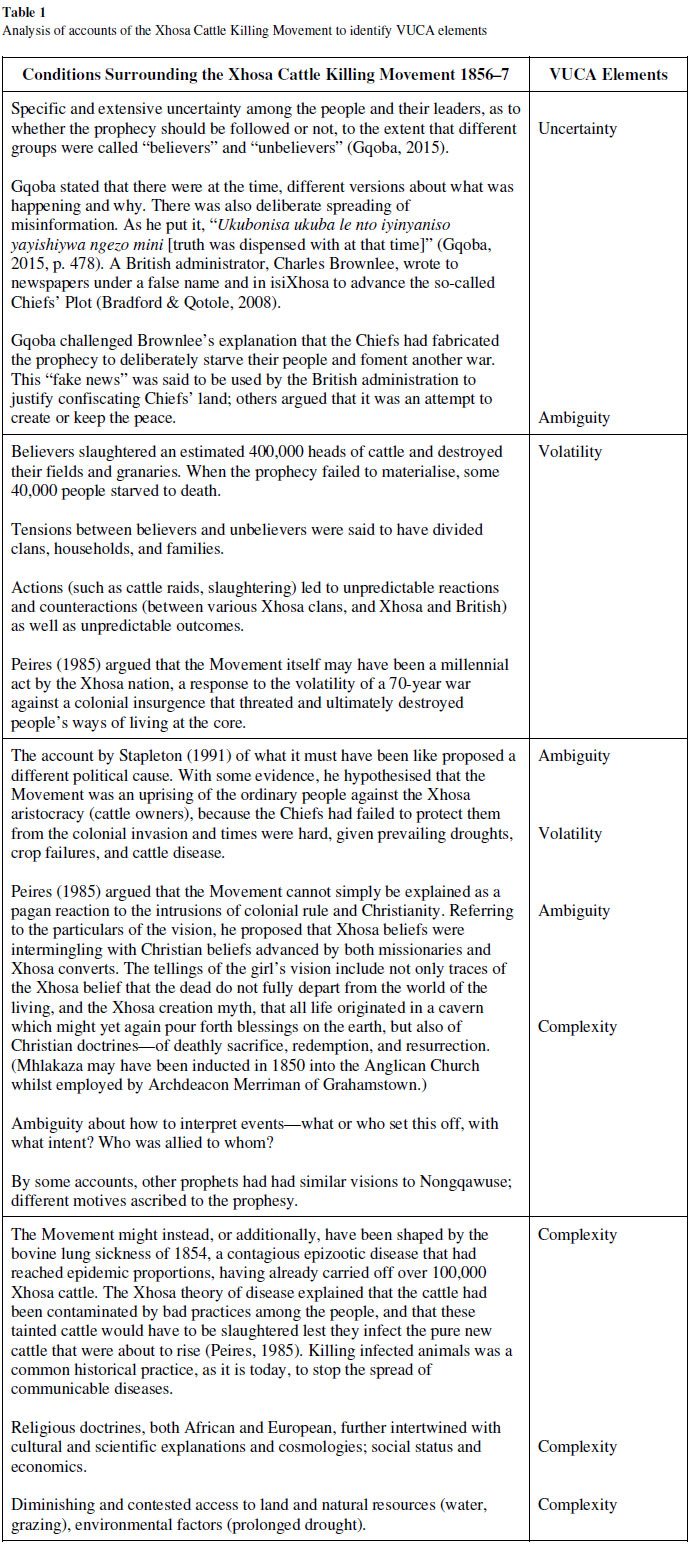
For a secondary analysis of primary accounts, I asked the retroductive questions "What must it have been like, for this to have happened?" "What were the most likely underlying drivers of what transpired, and do these reflect VUCA elements?" The findings are in Table 1. While retroduction is a recognised critical realist analytic tool (Danermark et al., 2019; Price, 2016), explanations of events can be problematic if produced only from outside the cultural context in which they took place. It was therefore important to include among the texts analysed the work of the Xhosa historian, teacher and newspaper editor, William Gqoba (1840-1888), who wrote eyewitness accounts of the Cattle Killings, which were translated and published through the UKZN Press (Gqoba, 2015).
From the analysis it was clear that it is not possible to definitively identify one single mechanism as the "correct" explanation for the Cattle Killing Movement. However, in asking the question "What must it have been like?" there is a strong sense that the time and context was VUCA (Table 1). And although this is only one historical case, analyses of other historical contexts (e.g. Tudor England, or slavery in West Africa) could well establish that volatility, uncertainty, ambiguity, and complexity are common features of the human condition, and we would be mistaken to think of them as new, or simply linked to technology.
If that is the case, teachers are likely to often encounter complexity and uncertainty. Under such conditions, they cannot be guided by standard procedures alone, and have to apply professional judgement (Freidson, 2001). Case 2 also reminds us that teachers need to be alert to challenges to social justice, democracy, and environmental sustainability as potential key features of the context in which they teach. Case 3 is an attempt to determine whether teacher education guidelines do provide for these requirements.
Case 3: The AU standards and competences for the teaching profession
Reviewing the African Framework of Standards and Competences for the Teaching Profession (AUC, 2019) as a case study of guidelines for teacher education, involved reading through the Domains, Standards, and Competencies that make up the Guidelines. Here, it is worth noting:
Competences are the varieties of roles or performances expected with regards to each standard. Defined more formally, a competence is "a complex combination of knowledge, skills, understanding, values, attitudes and desires which leads to effective, embodied human action in the world, in a particular domain." (Deakin, 2008, cited in AUC, 2019, p. 20)
The lenses applied for this reading were informed by Cases 1 and 2, which suggest the importance of a context-responsive, social-justice orientation to education, in which the teacher exercises her professional judgement to make informed and ethical decisions about education. The analytic lenses are further shaped by the work of Freidson (2001) and Biesta (2015). Biesta indicates that the educator's decision-making must be founded on a profound understanding of the purpose of education, which he describes in relation to three domains: qualifying the learners to do something, socialising the learners into acceptable ways of being and doing, and developing the learners as independent subjects. Biesta contrasts this multi-domain teleology with narrow interpretations of education (e.g. as academic achievement). This focus made Biesta's framing particularly useful in this study, with its starting hypothesis regarding the risk of narrowing future-oriented education to technological mastery.
The work of Freidson (2001) was also applied in Case 3 (and as will become apparent later, a need arose to reach for theory about community of practice). Freidson views professionals as people who (1) serve the public good and human well-being, (2) stand in a relationship of authority and trust to those they serve, (3) thus need high levels of knowledge, and (4) must be allowed to skilfully apply that knowledge appropriately to changing contexts, in ways that are (5) open and accountable. Standards and competencies such as the AU Framework, is a guideline for that accountability. Although the entire Framework was reviewed, for the sake of space, and clarity, only extracts that illustrate insight pertinent to the case and purpose of the paper, are presented and interpreted here (extracts from the publicly available document):
In Domain 1, Professional Knowledge and Understanding (AUC, 2019, pp. 21-23), the related standards for the teaching profession are:
1. Knowledge and understanding of human development and the learner
2. Knowledge and understanding of the curriculum
3. Knowledge and understanding of the subject matter
4. Knowledge and understanding of interdisciplinary learning
5. Knowledge and understanding of education theory, pedagogy, and teaching practice
6. Knowledge and understanding of assessment, feedback, monitoring, and evaluation of the learner
7. Knowledge and understanding of education-related policies and legislation, and
8. Knowledge and understanding of digital technologies for teaching and learning.
This is strongly complemented with the ability to get to know the learners and the context. Related competencies include:
Knowledge of a diverse range of learner expectations in the 21st century and best approaches to assist learners to envision and excel in their expectations. (AUC, 2019, p. 22)
This after:
Mapping of the diverse linguistic, cultural, religious, and socioeconomic backgrounds of learners and associated strengths and weakness in learning and the strategic remedies. (AUC, 2019, p. 21)
In other words, proficient educators should be able to develop an understanding of their particular learners in (wider) context to assist them in meeting their skills related expectations. 21st-century skills are important, but a diverse range in context of the particular learner body; at the same time also challenging learners and bringing out their best potential.
Domain 2, Professional Skills and Practices (AUC, 2019, pp. 24-27), includes standards like:
1. Effective teaching and learning
2. Effective classroom organisation and management
3. Effective learner assessment
4. Administration of learning
5. Effective use of technologies for teaching and learning
6. Guidance and counselling, support, school health, and safety.
In Domain 3, Professional Values/Attributes/Commitment (AUC, 2019, p. 29), the standards include the educator being a "Role Model to Learners," with the associated competencies being:
1. Demonstrating awareness and understanding of developments that affect the community, the country, and the planet (e.g. climate change, sustainable development, global citizenship, among others).
2. Demonstrating the behaviour, character and virtues expected of learners by society.
3. Applying practically at all times and in all teaching and learning situations the relevant advocacies trending at the community, national and global levels.
4. Exhibiting exemplary applications of the advocacies trending at the community, national and global levels.
5. Knowing how to work with the local and global community to develop realistic and coherent interdisciplinary contexts for learning, particularly in relation to sustainability.
6. Applying knowledge and skills on interdisciplinary subject matters particularly the Sustainable Development Goals, to create local, national, and global contexts and integrate the same in teaching and learning.
7. Creating teams of colleagues and external experts to work collaboratively on the domestication and implementation of interdisciplinary, multicultural, and international goals and programmes.
The standards regarding sustainability and other inter-disciplinary challenges (AUC, 2019, p. 29) are exemplary in guiding a context-responsive approach to teacher competencies:
• Knows how to work with the local and global community to develop realistic and coherent interdisciplinary contexts for learning, particularly in relation to sustainability.
• Applies knowledge and skills on interdisciplinary subject matters particularly the sustainable development goals to create local, national, and global contexts and integrate same in teaching and learning.
• Creates teams of colleagues and external experts to work collaboratively on the domestication and implementation of interdisciplinary, multicultural, and international goals and programmes.
• Designs and disseminates contextualised local and international benchmarks on interdisciplinary subject matters and strategies for integrating them in teaching and learning.
The Framework furthermore envisages educators as not only knowledgeable and proficient in teaching, but also ethical, caring about their learners' needs, and about issues of local and global importance, and able to apply both their knowledge and care to create powerful contexts for learning. The standards suggest that teachers cannot do this on their own; hence they also need the competencies to work with others-their colleagues and external experts (Competency 7 above), as well as the local and global community (Competency 5).
This requirement, to be able to work with others to create powerful learning opportunities in the face of local and global challenges, is even more evident in Domain 4, Professional Partnerships. The Framework (AUC, 2019, pp. 31-32) includes a standard for "Partnerships With Learners, Parents, Carers, Guardians, Communities, and Stakeholders," which expands on what this means by stating that educators must (again, this list is not comprehensive):
1. Create and sustain appropriate working relationships with all staff, parents, and partner agencies to support learning and well-being, taking a lead role when appropriate.
2. Contribute to community welfare and empowerment by supporting projects and networks.
3. Have organised on a long-term basis activities and programmes that cut across learners, parents, partner agencies, cultures, genders.
4. Motivate colleagues to contribute to projects and programmes of public good.
The Framework does note that teachers and school leaders need to be proficient with digital technologies as teaching and learning tools; in addition, educators should be aware of broader contemporary issues such as climate change and sustainable development, and use them to create contexts in which meaningful learning would take place. The Framework does not specify these socially relevant issues tightly; instead, it refers to them more broadly as trending issues, which we can assume to mean, "whatever is particularly relevant at the time." In relation to these pertinent contextual matters, teaching in meaningful learning contexts must foster foundational learning, which includes values that are also to be shared by example. Domain 3 positions the educator as a role model: "Demonstrating the behaviour, character and virtues expected of learners by society."
Noteworthy, is that the teacher or school leader is not expected to do this alone, but to do so with other members of both the school and the wider community, including global experts. The Framework proposes that this ability to effectively work with others, is a competence in itself, and dedicates the entire Domain 4 to Partnerships. Here, the notion of communities of practice (Wenger, 1998) emerges as key, and will be discussed below in relation to the other findings, starting with Case 3.
Discussion
The findings of Case 3 echo another set of standards for the teaching profession, proposed by the South African Council of Educators (SACE, 2017, p.1), which noted:
Teaching is complex work. . . . As professionals, teachers draw on different kinds of knowledge, namely subject, professional, and contextual, to make suitable choices [and] decide how best to enable learning within the context in which they work. Teachers are expected to make wise decisions in situations that are often complex and unpredictable.
SACE (2017, p. 3) also notes under the Characteristics of a Professional that a member of the profession "accepts accountability for their professional autonomous judgements." The details in the African Framework demonstrate the nature of these judgements. For example, what is "trending"? What is relevant among everything that is trending? What are the particular needs of particular learners? A teacher may, in a South African township or inner-city school, teach a great diversity of learners and, in rural schools, a mix of learners wanting to leave the area and learners wanting to stay and make a difference where they are (Nkosi, 2025).
Case 2 suggests that VUCA are enduring features of the human condition, and we would be mistaken to think of them as new, or simply linked to technology. We do not know whether Nongqawuse felt confident or anxious about her life and her future. We do know that she was orphaned, lived through a turbulent period of overt and violent colonisation, carried a heavy responsibility, was trusted by some in her community and rejected by others. In comparison, present day conditions for most South Africans are possibly less volatile. There is still uncertainty; whilst all South Africans today can vote for their government, it is not clear whether the outcomes would result in a better life. Whilst a majority, including girls, now have access to education, and there are more options for making a living, limited post-school and employment opportunities are a source of anxiety for many. The point is not that life today is more or less VUCA, but that at any time, in any context, there is a degree of VUCA.
We therefore need to challenge assumptions (as Biesta, 2015 did) that outcomes (e.g. of teaching and learning) can be tightly controlled and that we can guarantee outcomes with fixed, prescribed protocols (such as requiring teachers to clock in, sign workbooks, report on everything). Insights into the open-ended nature of social reality (Bhaskar, 2008) and the fallibility of knowledge (Beck, 1992) have implications for teacher education; rather than "training" student teachers to follow protocols, we need to enhance their professional judgement. And even if the rate of change and the range of changing variables, including run-away technology like generative artificial intelligence have exponentially increased since the turmoil of 1856-7, this, too, has profound implications for teacher development: again, to strengthen educators' professional judgement in context.
What is the source of professional judgement? Biesta (2015) argues that teachers' judgement starts with a profound understanding of the purpose of education, combined with the ability to apply it in context. As noted at the DBE Lekgotlas, the purpose of education goes beyond learning to earn. Case 1 reveals the injustices in South Africa's past and, in fact, global social injustices that require all education to have a strong values component. Hence UNESCO'S (2023, p. 14) Recommendation on Education for Peace, Human Rights, and Sustainable Development that there is need to motivate "educators to commit to the principles underpinning a culture of democracy, peace, human rights, sustainability and global citizenship as part of teaching standards and competency frameworks . . . guiding teacher professional development." This social purpose of education (socialisation and subject formation, Biesta, 2015) is well supported by the African Framework.
Whilst Case 1 establishes that the DBE also thinks more broadly about what education is for, in the 2025-2026 Lekgotlas there was nonetheless a discursive focus on future-readiness and a tendency to associate being future-fit, mostly with new technologies. This is a broader social trend. In a blog for American parents, Joe Morgan (2018, para. 2) provocatively writes
What better way to prepare our kids for a future ruled by software than by training them how to build it? . . . And if learning to code is good, then learning earlier is better.
Morgan argues that programmers need staying power, a problem-solving mindset, creativity, and commitment to a well-finished product-and whilst adults can readily learn coding syntax, the best time to learn these more foundational attributes is in the early years. That is, young children's education should develop their curiosity, creativity, and ability to be steadfast problem-solvers.
Educationists need not follow a computer specialist's advice on when children should learn what, but we should be as discerning as he is about how best to equip children for the features of the future that are already in the present. In a systematic meta review of programming interventions in early childhood, Simonsmeier et al. (2025) found only one study where the intervention (robotics related) resulted in creativity and problem-solving skills among children aged 3-7 years, and concluded that unplugged, concrete activities were more effective than screen time. Subject specialists and teachers alike need to choose and use available technologies, gadgets, and resources with professional discernment. This may be what the AU Framework means when it indicates that teachers and school leaders need "Knowledge and understanding of digital technologies for teaching and learning" (Domain 1) and "Effective use of technologies for teaching and learning" (Domain 2).
Technology is but one feature of "the Africa we want" and the Standards also give attention to other features of the context that are important in shaping what our future might look like. These include climate change and sustainable development; democracy, global citizenship, and social justice (Rosenberg et al., in press). Educators need to be aware of a range of trending advocacies that matter to the local community and the common good, and have the competence to apply this knowledge for effective teaching and learning. The African Framework thus gives attention to the educators' responsiveness, consisting of the ability to interpret the context in which they teach, including their particular learners, and to responding accordingly in their choice of content, teaching strategies, and materials.
An example of what teacher professional judgement might mean when faced with the opportunity to teach coding or any other so-called 21st-century skill, could be to ask the following questions:
• How does this serve the purpose of education, in general and in my subject?
• How does it relate to my learners, their aspirations, and their context?
• How do children learn and therefore, how best to teach this (if I am to teach it)?
And in relation to all the above questions: "What do others (experts, trusted peers, mentors, local community, learners) say?"
The AU Standards are clear that teachers should exercise judgement, in the company of others. They should work with fellow educators, the local community, and broader communities. Thus, these standards are well aligned with Freidson's (2001) point that professionals must not only be able to exercise their own judgement, but be transparently accountable within their field. This is complemented with Wenger's (1998) concept of a community of practice, which posits that people-in this case, teachers-get to build up their knowledge and form their professional identities in community with other practitioners. The unit of learning is ultimately neither the individual nor the institution, but the informal communities-which can include the institutions where they graduated or joined professional development programmes and networks-that educators must form if they are to function successfully in context. This framing resonates with the South African experience of schooling, and is an important counterfoil for the potential to individualise the decision-making professional (Rosenberg et al., in press).
Conclusions: Pathways of hope
If we cannot assume certain control over outcomes through recipes and protocols, then we should allow and equip teachers to make professional judgements in context. Surveilling and policing them, with a proliferation of administrative tasks, is unlikely to improve the quality of teaching and learning. Noting that these contexts are complex and filled with uncertainties, teacher education needs to equip teachers with high levels of professional knowledge and understanding-including the ability to interpret context and respond accordingly-informed by a deep understanding of the purpose of education in relation to societal values. Finally, teacher education needs to equip future teachers with the understanding that judgements and application are often best exercised with others, and the ability to work with others is a key feature of teacher professionalism.
There are a number of pathways of hope in South Africa's education communities of practice, spaces where educators can learn to exercise professional and ethical judgement in collectives where they can support each other, develop practical knowledge, and hold each other accountable, responsible, and responsive. These include national-, provincial-, regional-, and local-level professional development communities, both formal and informal. Universities, too, are spaces for ongoing learning and professional development and should be both critical and supportive. In addition to equipping teachers to exercise professional judgement, education faculties and their partners need to connect (future) teachers into networks that will strengthen their ability to make sound professional judgements. Such collectives do not necessarily exist at all schools and in all districts.
SAERA is a particularly important pathway of hope for developing educator professional judgement in community of practice. Its community of practice has been expanding its areas of focus (including a SIG on Educational Technology) and broadening the network as a learning and development space that is responsive, supportive, and also critical. As such it has the potential to engage teacher educators in deeper questions about the purpose of education and how best to achieve it in diverse and possibly changing contexts and how in turn, to share this with student teachers: teacher education for a VUCA world.
Limitations and possibilities
The limitations of this study include the personal selection of the case studies, and their small-scale nature. The findings can only be regarded as indicative, but perhaps they are also thought-provoking enough to be generative. Further research into ways in which teachers' professional judgement can be enhanced through monitoring and reflection, rather than diminished, is one of many areas for further research prompted by this exploratory paper.
African Union Commission. (2015a). Agenda 2063: The Africa we want. African Union. https://au.int/sites/default/files/documents/33126-doc-framework_document_book.pdf
African Union Commission. (2015b). Continental education strategy for Africa 2016-2025. African Union. https://au.int/en/documents/20150914/continental-education-strategy-africa-2016-2025
African Union Commission. (2019). African framework of standards and competences for the teaching profession: The knowledge, skills and conduct expected of teachers and school leaders. African Union. https://www.africateaching-authorities.org/upload/African-Union-Continental-Framework-of-Standards-and-Competences-for-the-Teaching-Profession-2019-r1704979416.pdf
Beck, U. (1992). Risk society. Towards a new modernity. SAGE.
References
- Besonia, B. E. A. (2024). Teachers' knowledge, perceptions, and practices in integrating elements of volatility, uncertainty, complexity, and ambiguity (VUCA) into language teaching. International Journal of Advanced and Applied Sciences, 11(7),19-30. https://doi.org/10.21833/ijaas.2024.07.003
- Bhaskar, R. (2008). A realist theory of science. Routledge.
- Bowen, G. A. (2009). Document analysis as a qualitative research method. Qualitative Research Journal, 9(2), 27-40. https://doi.org/10.3316/QRJ0902027
- Bradford, H., & Qotole, M. (2008). Ingxoxo enkulu ngoNongqawuse (A great debate about Nongqawuse's era). Kronos: Southern African Histories, 34, 66105. https://www.jstor.org/stable/41056603
- Danermark, B., Ekström, M., & Karlsson, J. C. (2019). Explaining society: Critical realism in the social sciences. Routledge. https://doi.org/10.4324/9781351017831
- Department of Basic Education. (2025a). Basic Education Sector Lekgotla 2025: 27 February-1 March 2025. https://www.education.gov.za/Lekgotla2025.aspx
- Department of Basic Education. (2025b). Topics discussed and deliberated during the Basic Education Sector Lekgotla. https://www.education.gov.za/ArchivedDocuments/ArchivedArticles/TopicsdiscussedduringtheBasicEducationSectorLekgotla.aspx
- Department of Basic Education. (2026a). 2026 Basic Education Sector Lekgotla concept.
- Department of Basic Education. (2026b). Basic Education Sector Lekgotla programme.
- Department of Basic Education. (2026c). Setting the scene and unpacking the elements of a resilient education system. https://www.education.gov.za/ArchivedDocuments/ArchivedArticles/Future-ReadyEducationSystems.aspx
- Freidson, E. (2001). Professionalism: The third logic. University of Chicago Press.
- Gqoba, W. W. (2015). Isizwe esinembali (A people with a history): Xhosa histories and poetry (1873-1888) (J. Opland, W. Kuse, & P. Maseko, Eds. & Trans.). UKZN Press.
- Hadar, L. L., Ergas, O., Alpert, B., & Ariav, T. (2020). Rethinking teacher education in a VUCA world: Student teachers' social-emotional competencies during the Covid-19 crisis. European Journal of Teacher Education, 43, 573-586. https://doi.org/10.1080/02619768.2020.1807513
- Maphutha, M. (2026, April 1). National Education Deans' Forum [Presentation]. Council on Higher Education).
- Mchunu, B. S. (2022). Cases of principal leadership responses in a volatile, uncertain and complex school environment. In B. Hernández-Sánchez, J. C. Sánchez-García, A. Carrizo Moreira, & A. Monteiro (Eds.). Psychosocial, educational, and economic impacts of COVID-19 (pp. 389-405). IntechOpen. https://doi.org/10.5772/intechopen.102852
- Morgan, J. (2018, December 6). I'm a developer. I won't teach my kids to code, and neither should you. Slate. https://slate.com/human-interest/2018/12/against-teaching-kids-to-code-creativity-problem-solving.html
- Nkosi, N. S. (2025). Ligotshwa Lise Manzi: Uncovering colonial legacies and possibilities for spatial justice in the productions of space in primary schools in Makhanda [Unpublished doctoral thesis]. Rhodes University.
- Price, L. (2016). Using retroduction to address wicked problems. In P. Næss & L. Price (Eds.), Crisis system: A critical realist and environmental critique of economics and the economy (pp. 109-29). Routledge.
- Rosenberg, E., Lotz-Sisitka, H., & Songqwaru-Kangumu, Z. (in press). Developing climate action competencies in educators: Experiences from Africa. In Innovations in education and skills for climate action: Towards an empowered and resilient Asia-Pacific and beyond. Springer and Asian Development Bank.
- Republic of South Africa. (2015). Revised policy on the Minimum Requirements for Teacher Education Qualifications. https://www.gov.za/sites/default/files/gcis_document/201502/38487gon111.pdf
- Sayer, A. (2000). Realism and social science. SAGE.
- South African Council of Educators. (2017). Professional teaching standards: Draft for consultation with teachers and subject and phase specialists. https://www.sace.org.za/assets/documents/uploads/sace_65860-2017-10-13-SACE%20Professional%20Teaching%20Standards%20LR.%202.pdf
Accepted: 4 August 2026
2 The term "Chiefs" is used because it is prevalent in the historical texts analysed, although today the term "Traditional Leaders" is considered more respectful.