Exploring challenges around integrating music and mathematics for fraction understanding: A task-design experiment
Abstract
In this article, I discuss a task-design experiment of integrating music and mathematics for teaching primary school fractions in response to challenges in fraction teaching and learning, and low mathematics achievement in South Africa specifically. I answer the research question, "What obstacles might task-designers face when integrating music and mathematics for fraction understanding, and how can they be resolved?". Data consists of recordings of Zoom meetings of the three task-designers, including myself, which were analysed thematically. Framed by Realistic Mathematics Education theory and curriculum integration, findings exemplify the process of task-design relating to limitations of musical notation and alignment of mathematical and musical linear representations. Implications include the selection of key representations, maintaining the fidelity of both subjects, designing practical tasks for implementation, and the need for careful planning by a team. This example may resonate with other teachers, task-designers, and researchers looking to trial integrating arts with mathematics, thus suggesting guidelines for making curriculum integration more accessible to teachers and learners.
curriculum integration; music and mathematics integration; fractions; task-design; design research; realistic mathematics education
Introduction
In this article, based on my doctoral study (Lovemore, 2023), I report on a task-design experiment journey in which I sought to integrate music and mathematics in the teaching of fractions at primary school level. Specifically, I discuss the story behind two key obstacles I faced in the design and how I resolved them. Motivation for this study includes international literature on curriculum integration that indicates an oscillating history of scholars and practitioners identifying both the benefits and challenges of implementing it. While previous South African curricula, however, made integration principles explicit, the current
Curriculum and Assessment Policy Statement (CAPS) is relatively silent on how to implement curriculum integration, despite promoting identifying relationships across subjects (Department of Basic Education, 2011). Further motivation was the report by Venkat and Graven (2017) on the negative views of mathematics in relation to low teacher morale, and the specific challenges of teaching and learning fractions reported by Getenet and Callingham (2021).
Mathematical proficiency is especially significant in South Africa, considering the historical disparities in equitable education, since being mathematically literate helps individuals to participate meaningfully in society (Mulaudzi, 2024). International literature about fractions indicates that it is a particularly challenging concept to teach and learn, because there are multiple constructs of fractions depending on the context in which they are used, and also because of the lack of practical experience with these constructs (Getenet & Callingham, 2021).
I saw integration of music and mathematics as an opportune way to increase the understanding of fractions and promote positive views of mathematics. The aim of this study was to design and trial integrated mathematics and music tasks for deepening intermediate phase learners' (Grades 4 - 6) understanding across multiple constructs of fractions. My research question was, "What obstacles might task-designers face when integrating music and mathematics for fraction understanding, and how can they be resolved?". I wanted to make explicit the process for curriculum integration, including the challenges and possible solutions. The process of the task-design experiment may resonate with other local and international teachers, task-designers, and researchers who wish to trial their own ways of integrating arts and other subjects into mathematics. This may offer a strategy to embrace curriculum integration and a way of overcoming the challenges experienced, thus suggesting guidelines for making curriculum integration more accessible to teachers and learners, specifically in Science, Technology, Engineering, Arts, and Mathematics (STEAM) education.
Theoretical and conceptual framework
This study is framed by the theory of Realistic Mathematics Education (RME), an approach to teaching mathematics that enables learners to experience a mathematical scenario and strategise informally to make sense of the scenario (Freudenthal, 1991). RME is considered a way of improving attitudes and dispositions towards mathematics as van den Heuvel-Panhuizen (2020) has argued. My study was guided by three key tenets of RME identified by Cobb et al. (2008). First, a mathematics task should begin with a real experience for learners in which they are actively engaged that helps them to recognise a need for further mathematical thinking. Second, learners must have opportunities to reason informally, discuss, and represent the experience. The third tenet is planning the task to progress to formal mathematical representations, including abstract and symbolic notation of relationships. Task-design in this study uses music as a real experience in which learners can engage, represent and discuss problems informally, and, finally, represent them formally in fraction symbols. RME supports the integration of subjects into mathematics because this allows for real experiences that require informal reasoning and representations that culminate in formal mathematical concepts and symbols.
The conceptual framing of this study is built on curriculum integration. Similar to RME, curriculum integration involves facilitating inquiry into a problem by drawing authentically on different subjects to contribute to understanding and solving the problem. Various studies report that curriculum integration can increase learner attention and interest, as well as encourage engagement and participation (McPhail, 2018; Pluim et al., 2020; Tytler et al., 2021). An integrated curriculum can benefit society positively since learners are exposed to culturally and contextually relevant everyday expectations and problems to solve creatively and critically (Kneen et al., 2020). Despite the benefits, challenges are also noted in the literature, including demands on teachers in terms of time for preparation and concerns that subjects may become diluted (Belbase et al., 2022; McPhail, 2018; Pluim et al., 2020). Additionally, teachers may feel insecure teaching subject matter content in which they are not experts (Gonzalez-Martin et al., 2024).
Internationally, curriculum integration can be traced back as early as the 1940s in the United States, Britain, and New Zealand (Dowden et al., 2024; McPhail, 2018), and curriculum integration has been viewed as a means for educational transformation worldwide (Kneen et al., 2020), including in post-apartheid South Africa (Adler et al., 2000; Naidoo, 2010). Tensions about curriculum integration arose in South Africa, as well as in several other countries, related to persistent concerns about the quality of disciplines (McPhail, 2018; Naidoo, 2010). The 21st Century however, brought about a re-emergence of interest in curriculum integration since it has the potential to support communication, critical and creative thinking, collaborative skills, and skills in democratic citizenship, through making holistic learning experiences relevant to learners' real lives (Dowden et al., 2024; McPhail, 2018). However, teachers are most often not guided on how to implement connections or make the relationships evident.
Specifically, Bresler's (1995) co-equal style of arts integration was appropriate to guide this study because it promotes the equality of art and the academic subjects. It is beneficial to learners insofar as it engages them in higher-order cognitive skills, and it promotes participation, critical thinking, and an appreciation for both subjects (Bresler, 1995). Yet, teachers need skills and knowledge in the art form to integrate it adequately into the subject, and they often lack confidence in their own perceived ability in relation to the art form. With the support of a task-design team and collaboration with colleagues, designing and implementing integrated music-mathematics tasks at a co-equal level is possible.
Despite such an oscillating history, Pluim et al. (2020) described curriculum integration as "persistent" (p. 719), and this is echoed by Dowden et al. (2024). Continued reflection on the benefits and challenges of curriculum integration, and seeking research-informed solutions, as is the motive behind this study, may help to show how the challenges of curriculum integration might be overcome and its benefits harnessed. Tenets from RME, curriculum integration, and Bresler's (1995) co-equal style all promote real experiences and active engagement by learners along with problem-solving, critical thinking, and creative thinking. These guided the task-design experiment.
Integration of music and mathematics
Integration of STEAM education is increasingly popular in countries such as The United States, Europe, Australia, Singapore, Korea, and China (Bautista, 2021; Larkin & Lowrie, 2023). It is a pedagogical model that intends on making the sciences accessible to learners through the arts, with the goal of promoting creativity, risk-taking, problem-solving, and collaboration through connecting two or more subjects (Belbase et al., 2022).
STEAM integration, however, is not free from critique. Tytler et al. (2021) highlighted the concerns that mathematics does not benefit as much as the other subjects, and that challenges exist in ensuring that the integrity of all STEAM subjects is upheld in integrated projects. Henckel (2022) found in her study that teachers in the United States implementing STEAM education would plan tasks in isolation, rather than collaboratively, but, through her professional learning intervention, they recognised the benefit of planning STEAM tasks collaboratively and intentionally, drawing on each other's expertise. This indicates a need to explore ways to support teachers in the task-design of integrated STEAM lessons in a team with members of varying expertise. Hence, I aimed to contribute in this study an example of a STEAM integrated set of lessons, integrating music (arts) and fractions (mathematics), in a way that maintains the fidelity of both subjects.
Much research has been done on integrating music and mathematics (An & Tillman, 2014; Gonzalez-Martin et al., 2024; Hendriks & Cruywagen, 2024; Holmes & Hallam, 2017). Wang et al. (2024) in their meta-analysis found that music integration interventions had a significant impact on mathematics achievement levels. However, research into practical implications for teachers is limited, thus a need for studies such as this one exists. Benefits of integrating music into mathematics include attracting and maintaining learners' interest, increased motivation and participation, and decreased mathematics anxiety (An & Tillman, 2014; Gonzalez-Martin et al., 2024). Samsudin et al. (2019) found that music contributes to improved attitudes and dispositions towards mathematics in Grade 1 learners. These findings present hope in South Africa considering the noted negative dispositions and narrow views of mathematics among teachers and learners (Venkat & Graven, 2017). Music and mathematics integration, furthermore, has been shown to improve conceptual understanding (Samsudin et al., 2019). A possible reason for this is that, in line with RME principles, the opportunity to combine music and mathematics allows for solving complex problems through the identification of relationships in real-life scenarios and connecting mathematical concepts to learners' experiences (Cobb et al., 2008).
Further examples of music benefiting mathematics include the study by Holmes and Hallam (2017) that shows that the spatial-temporal skills (involved in higher order mathematics skills) of young learners of four to seven years of age improved through rhythmic activities.
Stevenson-Milln (2018) used patterns in music to support Grade R learners who were five to six years of age, to understand patterns in mathematics. While studies of music and mathematics, however, tend to concern younger learners, Broza et al. (2024) integrated music and mathematics at a Grade 4 level in their study during which the mathematics and music teachers collaborated to teach concepts of patterns, symmetry, and fractions. My study, the subject of this article, focused on integrating music and mathematics at the Intermediate Phase level (Grade 4 to 6), of learners aged eight to twelve.
Teaching fractions through music
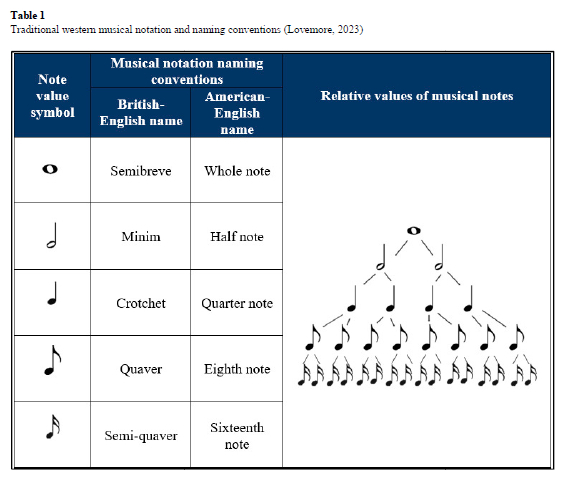
Teaching and learning fractions have been described across time and context as challenging and complex (Cortina et al., 2019; Getenet & Callingham, 2021). An obvious link between music and mathematics is noticed in musical note values (Broza et al., 2024; Wang et al., 2024) that can be broken up into smaller note values through division. A whole note, for example, consists of two half notes, four quarter notes, or eight eighth notes. This relationship is shown in Table 1. Take note of the American-English naming convention that relates directly to fractions.
This fraction relationship found in note values has been explored by other researchers (for example, An & Tillman, 2014; Azaryahu & Adi-Japha, 2020; Broza et al., 2024). All these studies used music examples in a 4/4 time-signature (four beats per bar). This meant that the music examples would allow only for exploring fractions with denominators of two, four, eight, and sixteen, and did not include other denominators. Learners in Grade 4 to 6, according to CAPS, however, are expected to work with fractions up to twelfths including tenths and hundredths (Department of Basic Education, 2011). Therefore, the examples possible with a representation as limited as this are insufficient to provide learners with experiences that relate to the full extent of the curriculum expectations.
Additionally, the focus in these studies was on the fraction-as-whole construct. There are, however, five interrelated constructs of fractions: measure, quotient, ratio, operator, and the part-whole fraction model (Kieren, 1980). Teachers need to provide opportunities for learners to experience all five constructs that are not separated but offer, rather, multiple ways to make sense of the same situation (Siemon & Luneta, 2018; Getenet & Callingham, 2021). The part-whole construct, most prevalent in primary school mathematics, refers to a set of "discrete objects or a continuous amount that can be divided into parts of equal size" (Shahbari & Peled, 2014, p. 373), such as is the case of breaking musical note values up into smaller note values as shown in Table 1. It is likely that this more familiar way of using and representing fractions is what teachers feel comfortable teaching, rather than exploring the more complex ways in which fractions are used in everyday life. Getenet and Callingham (2021) found, in Australian primary schools, that the lack of opportunities to experience fractions in multiple constructs, however, leads to challenges in teaching and learning fractions. To develop conceptual understanding, beyond abstract procedures, learners need opportunities to experience multiple ways in which fractions are used in everyday life (such as in ratio or proportion), as suggested by RME principles. Therefore, focusing solely on the part-whole construct of fractions, by dividing music note values, is not sufficient for supporting learners' development of fraction understanding. Instead, we need to recognise that a need exists for music-mathematics integrated tasks that support the multiple, interrelated constructs of fractions for learners to experience and represent, thus meeting curriculum expectations, as is the goal of this study.
My task-design of music-mathematics activities allows for the fraction as ratio and fraction as measurement constructs to be used in addition to the part-whole construct of fractions. The fraction as ratio construct refers to a comparison or relationship between two quantities (Getenet & Callingham, 2021). In this case musical beats per bar (or the corresponding claps per bar) were compared. The fraction as measure construct refers to a number representing the size of a measured length (Cortina et al., 2019). In this study, the musical element of time was measured.
Taking into consideration the reviewed literature, gaps exists in music-mathematics integration to the solving of which I aim to contribute through this study: (1) integration of music and mathematics tends to be done with younger learners; (2) practical implications for teachers are limited, especially in designing their own tasks; (3) music-mathematics tasks for fraction understanding focus solely on the part-whole construct of fractions.
Research design
This study is an example of design-research guided by a qualitative interpretivist paradigm, since I immersed myself, as researcher and participant, in the natural setting of the design team (see Creswell, 2009). Design-research, according to Bakker (2018), is interventionist, iterative, and explores what education could or should be, rather than describing an existing situation. I labelled this study a task-design experiment, combining task-design and dual-design experiment (after Gravemeijer and van Eerde (2009)).
Here, task-design involves careful selection and justification of resources, representations, and activities to support learning of a mathematical concept (Graven & Coles, 2017). Dual-design research, according to Gravemeijer and van Eerde (2009), refers to "two learning experiments going on at the same time" (p. 520). Here, learners are learning content and skills related to mathematics and teachers are learning about the intervention task. In the broader study, the dualistic nature of experiments is (1) teachers' interaction with learners through implementing the music-mathematics intervention task, on which they observe, reflect, and make adjustments; and (2) the design team's interactions with feedback from teachers to make adjustments to the task design. The latter is the focus in this article. I interacted with ten teachers across two schools and with my doctoral supervisors who also became participants as they entered the design team. I labelled the three small groups in which I worked as micro-Communities of Practice (micro-CoPs), after Wenger (1998).
Ten teachers across two schools in the Eastern Cape Province, who were purposively selected based on availability to trial such integrated tasks, participated in the broader study. Unexpectedly, my two supervisors, Sally-Ann and Mellony, also became research participants three months into the process (and opted for their first names to be used in publications), when we noticed that our meetings were focused on task-design grappling that extended beyond the role of research supervision and that the recorded meetings constituted valuable data. I entered transcriptions and screenshots of visual representations from our recorded meetings into the data set (935 minutes), upon receiving consent, and this formed a large part of the findings in focusing on the process of designing music-mathematics integrated tasks, not just on the product. This unexpected evolution in the study is not uncommon in design-research; as Creswell (2009) pointed out, qualitative methodology is "anything but uniform" (p. 173). This forms the basis of this article that focuses on the obstacles and resolutions of designing the integrated music-mathematics tasks, rather than on teacher interviews. However, I was at the centre of the micro-CoPs at schools and in the design micro-CoP, which allowed me to report on teachers' feedback in our design space, to inform design decisions. It is important to note that the broader study did not have the goal of researching learners' learning in the form of an intervention study, which is a possibility for future research. The focus is, rather, on the design product and the process of integrating music and mathematics.
Gravemeijer and van Eerde (2009) explained that data analysis in design-research starts in the design experiments that focus on reflection and adjustments, followed by a retrospective analysis of the entire data set. This was true for my study since reflections formed the initial analysis which then informed future iterations. In the retrospective analysis, as is the focus in this article, I organised data from the design micro-CoP and was able to show the development of the music-mathematics tasks (lesson sequence, resources, and representations). Initially deductive analysis was done using codes derived from the three tenets of RME theory, but unexpected patterns also emerged. Upon watching and re-watching the recorded Zoom meetings of the design micro-CoP, I noticed a pattern of obstacles and resolutions on different aspects of the music-mathematics task-design. I did an inductive analysis to make sense of these obstacles and resolutions, and used codes relating to (1) representations, (2) practical implementation, and (3) fidelity of subjects. I therefore grouped data into ten obstacle-resolution cycles, using these codes to categorise data to tell the story of the design process. In this article, I focus specifically on two obstacle-resolutions cycles to illustrate some challenges and how we addressed them. These were the first two challenges that arose, and are perhaps most resonant with other STEAM subjects, and they were also the precursor to following obstacles. It is beyond the scope of this article to discuss all ten obstacle-resolution cycles, but these, as well as details of the music-mathematics final product can been seen in Lovemore (2023).
I obtained ethical clearance to conduct the study from the Education Research Ethics Committee of Rhodes University (2020-2678-4653). My supervisors gave consent for our Zoom recorded meetings to be entered into the data set and, as mentioned above, they opted to have their first names used rather than to be anonymous. I took several steps to enhance the trustworthiness of the study, including member-checking. Throughout the study, I was also aware of my positionality as student, researcher, and later design micro-CoP participant. In the design micro-CoP, I, along with my supervisors, recognised the various strengths and expertise that each brought, in line with Wenger's (1998) CoP principles. We also held each other accountable in terms of the research in acting as critical friends to enhance the trustworthiness of the study.
Findings
Findings of this experiment in task-design comprised both the product and the process of the task-design journey. The product included eight music-mathematics integrated lessons with resources and key representations. The process describes the obstacle-resolution cycles of design that took place within the design micro-CoP Zoom meetings, of which two are the focus for this article: (1) musical notation challenges, (2) alignment of mathematical and musical linear representations. This is to show some of the challenges and solutions that may arise when one is integrating STEAM subjects. Below I offer a brief outline of the designed problem scenario which led into the integrated music-mathematics tasks.
An imagined problem scenario for integrating music and mathematics
Guided by the RME principle of starting with an active experience for learners, I opted for the starting point of the teaching and learning sequence to be a story (Lovemore et al., 2025) similar to a South African folktale, of animals needing to cross a river at a specific place. The river allowed for a constant measure of distance and time. Different animals would cross the river using a different number of jumps, for example, Kudu (South African antelope) would cross the river in one long jump, Ostrich would cross the river in two jumps, Zebra in four jumps, and Monkey in eight jumps. Learners would have the opportunity to act out the different jumps across a constant distance, while clapping (a form of body percussion) each other's jumps. Learners would represent their jumps and claps informally and use this to answer questions about the fraction as ratio and measure constructs, thus engaging in mathematical problem-solving and developing fraction understanding.
Musical notation challenges
Musical notation makes use of symbols to convey information about pitch, note value (time duration), and tempo (speed). This, however, can be cognitively taxing for the reader of the musical notation (McLachlan et al., 2010). Teachers were concerned about their own self-reported lack of musical knowledge and skills, in line with literature on curriculum integration (Gonzalez-Martin et al., 2024). Adding musical notation into mathematics lessons could also be more cognitively taxing for learners with the already challenging concept of fractions. I reported these concerns to the design micro-CoP.
Tarryn: I'm considering using a percussion line (one line) rather than the whole stave (5 lines) as it takes away the distraction of the note names (A, B, C . . . ) and focuses only on the note value. It also looks similar to the number line.
Sally-Ann: It also will make the teachers feel a little easier, particularly as non-musicians.
Mellony: You have to be clear about what you're giving fidelity to. . . mathematically, fraction as rate and fraction as measure. . . music is understanding four beats per bar, not being able to read different notes. [design micro-CoP, 2021-03-24]
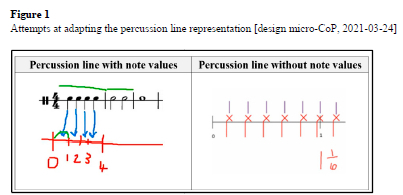
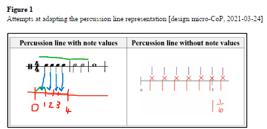
In the design micro-CoP we discussed the use of a single percussion line, rather than the traditional 5-line musical stave, thus removing the complication of teachers and learners having to memorise and read the pitch of the notes (i.e., A, B, C. . .). Percussion is also more closely aligned to indigenous South African music, such as drumming and marimba playing. De Villiers and Oellermann (2024) encouraged the teaching and learning of a combination of western music and African music, as does the CAPS curriculum (Department of Basic Education, 2011). We also noticed, in the design micro-CoP, the benefit of linking the single percussion line to a mathematical number line on which fractions can be represented. Linking the informal musical line with the formal mathematics number line would be in accordance with the RME principles. We experimented with ways to present this over Zoom. Figure 1 shows screenshots of our first and second attempts at linking a percussion line to a number line.
With this resolution, however, a further obstacle persisted. The use of note value symbols would allow only for values that are halved each time, i.e., one whole note is made up of two half notes, four quarter notes, etc. This would therefore link only to fractions with a denominator that is a multiple of two, and not include other fractions such as thirds, fifths, sixths etc., thus not meeting curriculum requirements (Department of Basic Education, 2011). A further concern I noted in the design micro-CoP was that this musical notation, of breaking up a whole note into half or quarter notes, would emphasise the part-whole construct of fractions only, and not focus on the other interrelated constructs of fractions as suggested in the literature (see Getenet & Callingham, 2021). My suggestion to the design micro-CoP was this.
Let's leave the note values, and rather focus on the beats, or the claps, or the jumps across the river, and we use this to show fraction as rate and measure, with no misconceptions or getting stuck in the fraction as part-whole construct. [design micro-CoP, 2021-07-12].
I suggested that we should not use the western musical note value notation, but rather percussion markings (Xs) to indicate the number of beats per bar which would correspond to the number of claps in a bar of music and the number of animal jumps across the river, as per the designed problem scenario. In a later meeting we reflected on this resolution.
Tarryn: I felt that the notes and the bars together was creating possibilities for misconceptions. . . and I felt maybe this is why the teachers in the CoP are hesitant.
Mellony: So, the issue of the changing bars is that they need too much understanding of music now to be able to link the music and the maths. [design micro-CoP, 2021-07-21].
This reflection reminded us of what Mellony said four months earlier: "You have to be clear about what you're giving fidelity to." From these reflections, I realised that it was important to identify which elements of music would be most conducive to supporting an understanding of fractions, without causing misconceptions or diluting one of the subjects, as is cautioned against in curriculum integration (Kneen, 2020; Pluim et al., 2020). Teachers also need to be supported in instances where they feel they are not familiar enough with the art form being integrated (Bresler, 1995; Gonzalez-Martin et al., 2024).
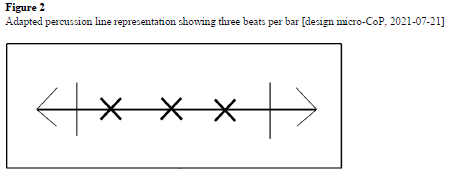
In the design micro-CoP we trialled representing the beats or claps with the traditional use of an X on a stem, as shown in the right of Figure 1. This resolution, however, led to another obstacle of the stems making it too complicated to distinguish between the claps and the number line markings that represent the fractions. We therefore opted to use an adapted version of the percussion notation by using only the X to indicate a beat or clap or animal jump (see Figure 2).
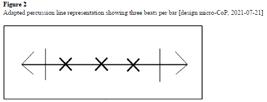
The decision was made, therefore, to use informal notations as a starting point, in line with RME, to represent the problem scenario of animal jumps across a river, and learners' active participation in experiencing the clapping linking to the jumps. Furthermore, this resolution would reduce the cognitive load, for learners and teachers, of having to memorise western notation. This is in line with De Villiers and Oellermann (2024) who called for making music accessible to all to promote inclusivity and social justice in music education. Furthermore, using the informal representations of Xs would also allow for linking to fractions with denominators that are not only multiples of two, for example, three claps per bar, as shown in Figure 2. This representation goes beyond the part-whole construct of fractions and allows for problem-solving in relation to the fraction as ratio construct. For example, a question could be posed: "If there are three claps per bar, how many claps would be in two bars of music?" The fraction as measure construct can also be explored through questions about time, such as, "If it takes 3 seconds for one bar of music, how long will 2 claps take?"
Alignment of mathematical and musical linear representations
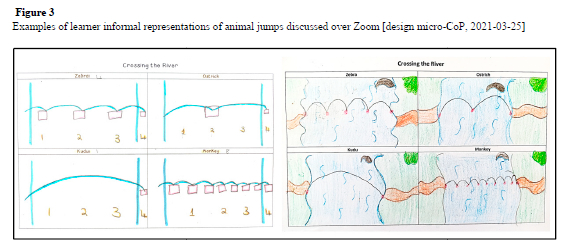
Guided by RME, in the design micro-CoP we opted for learners to be given the opportunity to act out the animal river-crossing jumps and then informally represent them to give them an active experience resulting in a need for representation. The initial problem scenario was that the animals would jump on rocks in the river which the learners would indicate by clapping. This led to obstacles with the representation of musical claps and the mathematical representation on a number line, which we discussed over Zoom while referring to learners' examples. As shown in Figure 3, some learners informally represented the jumps and the clap on the animal's landing. Other learners indicated a marking for the start of the jump (as one does when clapping in music), which means there would be five claps (or rocks) but only four jumps.
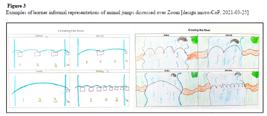
We recognised that this could jeopardise the usefulness of the problem scenario and cause misconceptions about the musical and mathematical concepts. I explained this concern to the design micro-CoP as shown below, with reference to the examples shown in Figure 3.
Tarryn: What I was concerned about when I first started working on this idea was that if you look at notes in a music bar, you will have the notes here [points], in the centre of the bar. . . and then the line is the next whole. The fourth quarter note is before the bar ends, which is why I've placed the jump right on the line here, each time to show that the fourth jump takes us to the whole. The four quarters is the whole, it is the end of the bar, it is the riverbank.
Mellony: . . . you need to start at the zero line. You've got your start 0 line and you would need to start on that line.
Tarryn: To show that it's the whole, but when you have the music bar, it is going to be before the bar line. [design micro-CoP, 2021-03-25]
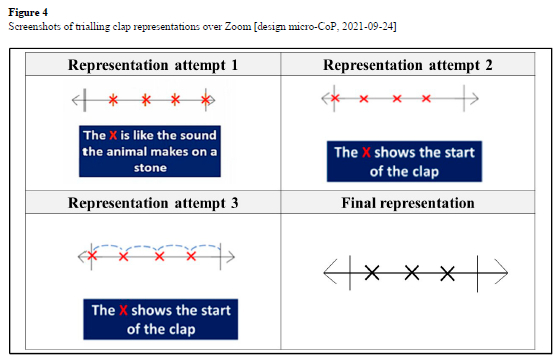
To match the representation to the clap, we first tried clapping on the land of the jump ('jumP'), (see Figure 4, attempt 1) but that was not true to the musical concept of clapping as the count starts (in music we would clap 1, 2, 3, 4 and visually place the beats in the middle of the musical bar). This also created a problem for clapping together musically in groups. If Musician A were to clap two beats per bar and Musician B four claps per bar, they would start together in music, clapping beats 1 and 3 together. However, mathematically equivalence should mean that Musician A's first clap (of two) would align with Musician B's second clap of four, as IMAGEMAQUI
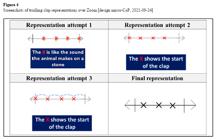
We then tried clapping on the animal jump take off (Jump) (see Figure 4, attempt 2), but this did not cohere with the problem scenario story-the mathematical number line or musical representation. In music we would start immediately counting 1, 2, 3, 4, so that the first clap starts at time 0 seconds, but linking 1 clap to 0 on the number line could also cause confusion for teachers and learners, because 0 ≠ 1. We grappled with this in our design micro-CoP.
Mellony: But where this doesn't then link up is that we've got the sounds based on the animal jumps, and the animal doesn't have a sound when he leaves the bank. The first sound is when he lands.
Sally-Ann: You're trying to do too much at one time. Early on in our discussion, we said that in musical notation, the sound starts at the beginning of the bar, on the zero.
Tarryn: If we move away from the sound of the land and think that each jump in itself is a duration of sound.
Mellony: What's problematic is we have the clap start on the zero line, because at 0 it is 1 clap, and it's problematic when we go to the number line. . . [design micro-CoP, 2021-09-24].
We then tried, in our design micro-CoP to show the duration of the clap with a dotted line (see Figure 4, attempt 3). In this representation the X starts at time 0 and is held for the duration of 1 second on the number line. This then led us to change our focus to duration of jumps rather than on the land or take off. Mellony explained, "It's not the count. . . the number line needs to show the time". And I emphasized, "We are looking at the duration more than the claps" [design micro-CoP, 2021-09-24].
We therefore adapted the problem scenario, in line with design-research (Bakker, 2018), to exclude the rocks in the river. The new task-design included learners jumping and clapping with the jump, allowing, therefore, for the task to maintain fidelity to the musical and mathematical concepts. When integrating subjects, it is important to find ways in which the disciplines support one another rather than having one being diluted or even hindered by the other (Kneen, 2020; Pluim et al., 2020; Tytler et al., 2021). Bresler (1995) warned against the art being sidelined for the sake of the '"superior" subject, but in this study, the task-design sought to give fidelity to both the music and the mathematics.
In our next meeting, we had the revelation, as evidenced in Mellony's comment below, that this adapted representation would now allow for moving to the fraction as ratio construct, rather than just the part-whole construct of fractions.
Mellony: The problem is representing percussion. . . We're actually going to start clapping together and now we're talking beats per bar. They are simply showing claps per bar and now we're not talking number lines anymore now we're talking ratio. [design micro-CoP, 2021-10-20].
With this revelation, we noticed that our musical claps per bar would be discussed in terms of ratio rather than representing a fraction on a number line. This meant that we could revert to the representation of claps as Xs in the middle of the musical bar (see Figure 4, Final Representation). This resolution also meant that we could extend the task-design to include more complex problem solving around the fraction as ratio and measure constructs.
Discussion
From the two examples of obstacle-resolution cycles, four guiding principles emerged for integrated STEAM task design, which form the pedagogical contribution of this article: (1) carefully select key representations for the integrated subjects; (2) tasks must maintain the fidelity of both subjects; (3) strategically design tasks for practical classroom implementation; (4) task-design needs for time for careful planning in a team.
The two obstacle-resolution cycles discussed above are examples of some of the challenges that teachers, researchers, and task-designers may face when trying to integrate subjects. First, the careful selection of key representations for both the mathematics and the music was crucial for the success of the integrated tasks. In the design micro-CoP we therefore had to make decisions, through cycles of trialling, reflecting, and adjusting, to find a notation system that would be useful as a resource in the mathematics lessons, but also not cause misconceptions in the musical concepts, or vice versa. The use of the informal representations of Xs to indicate musical claps proved to be the most useful for linking the mathematical fraction as ratio concept to the music.
The second obstacle-resolution cycle similarly involved integrating the music and mathematical linear representations. Given the differences in the music and mathematical representations, we could not superimpose the lines without potentially causing misconceptions. We had the realisation, after ten months of grappling in the design micro-CoP, to distinguish rather between the fraction as ratio construct (shown on the musical percussion line as claps per bar) and the corresponding mathematical measure of time (shown as fractions on a number line). The realisation that the musical and mathematical representations could be used to show different constructs of fractions, but not superimposed on the same representation, was vital to resolving our obstacle of aligning the representations. It was important that we considered carefully which representation to use for which construct, to be clear to the teachers (and learners) about when each representation would be most valuable. Different representations could engage learners in moving flexibly between and among multiple constructs of fractions through supporting them with complex problem solving.
RME principles informed this task design, promoting real experiences to lead to informal reasoning and representation, as with the musical lines, which would then lead to formal mathematics representations out of a need to solve problems (van den Heuvel-Panhuizen, 2020), which in this case is representing fractions as ratio (claps per bar) and as measure (of time) on a number line. This example of using RME principles is useful for task-designers and teachers looking to integrate arts subjects into mathematics and creating a real experience from which learners can reason mathematically and eventually represent visually and symbolically. There is also a need for those designing such integrated tasks to trial the visual representations and look for possible misconceptions, rather than taking synergies of key representations in different subjects for granted.
The second key finding of the study highlights the importance of designing tasks that maintain the fidelity of both subjects, a known challenge of curriculum integration noted in the literature. In the two obstacle-resolution cycles, I demonstrated how the design micro-CoP grappled to find representations and tasks that would not result in misconceptions in mathematics or in music. Through trialling and reflecting, we recognised the value of adjusting tasks until we found ways to maintain the fidelity of the music and the mathematics. We selected an adapted and simplified musical representation, but one that would not change the musical beats per bar. It also did not interfere with fraction as ratio and measure constructs, for future mathematical problem solving. It is crucial to maintain the fidelity of subjects when one is designing integrated tasks to prevent the challenge of curriculum integration resulting in dilution of one of the subjects.
Third, it was also important to ensure that the designed tasks would be practical for classroom implementation, such as reducing cognitive load by not using the western musical notation. Mathematics teachers did not necessarily have a background in music and including the additional notation system could hinder the teaching and learning of fractions. To make classroom implementation more viable, we realised the need to select which elements of music we would incorporate into the fraction tasks. We had to be strategic in which elements we would draw from the music to integrate into the mathematics. The adapted percussion representations would promote understanding of both disciplines without burdening the teachers or learners with additional elements of musical notation. This is important to consider when designing integrated tasks since one of the criticisms of curriculum integration is that teachers may feel insecure about teaching subjects in which they are not experts. Task-designers therefore need to plan strategically to include the elements that will best support the integrated teaching and learning and how to represent and package the task for successful implementation in the classroom.
Finally, these obstacle-resolution cycles contribute to the understanding of planning for curriculum integration, specifically in STEAM subjects. Planning such activities takes time, including trialling, implementing, reflecting, adapting, and re-trialling, in line with Gravemeijer and van Eerde's (2009) dual-design experiment. Task-design is a careful, purposeful and deliberate process during which designers need to anticipate teachers' needs and learners' possible reactions, responses and (mis)conceptions. Practically speaking, few teachers have the time to engage in this level of task-design for integrating subjects, despite the curriculum call for integrating content. It is no wonder that there are diverse opinions about the success of curriculum integration. In this study, I was part of a design micro-CoP, where three of us (researcher-designers) grappled over a 19-month period, providing the theoretically based expertise. The use of three micro-CoPs allowed spaces guided by Wenger's (1998) CoP principles of having a shared goal and interacting in a conducive and safe space to which we were all able to contribute and critique the task-design. Without this supportive space, the integrated music-mathematics tasks would not have developed as thoroughly as they did, and it is possible that the fidelity of the subjects would not have been maintained. Therefore, I posit that for successful curriculum integrated tasks to be designed, a team of members with diverse expertise, with time to meet and plan carefully, is needed. Teachers should be supported in such teams to find ways to integrate different concepts and subjects to achieve the curriculum aim of identifying relationships across and within subjects. This could become increasingly important in moving into Coding and Robotics, a newer addition to the CAPS curriculum, which emphasises the interdisciplinary and multidisciplinary nature of STEAM subjects (Department of Basic Education, 2024).
Conclusion
In this article, I offer two examples of obstacle-resolution cycles that emerged from the study, a dual-design experiment in task-design. The goal was to find ways to integrate music and mathematics effectively for fraction teaching at the intermediate phase level. The obstacles in the task-design resulted in spending more time than initially anticipated, grappling with removing obstacles to find ways of integrating music and mathematics in a micro-CoP. As demonstrated in the two cycles reported on above, there are some key ideas to designing integrated tasks effectively, that can be applied to other subjects. These include selecting key representations carefully; maintaining the fidelity of both subjects; designing tasks that are practical for classroom implementation; and the time needed for careful planning by a team. I suggest that this study's task-design journey may serve as an example and provide guiding principles to other teachers, researchers, and task-designers on how to approach obstacles when integrating subjects, such as music and mathematics or other STEAM subjects.
This research has been supported by the South African Research Chairs Initiative of the Department of Science and Technology and National Research Foundation (NRF) (Grant No. 74658). The NRF's financial assistance towards paying for my studies is hereby acknowledged. Opinions expressed and conclusions arrived at are entirely mine, however, and should thus not be attributed to the NRF.
References
Acknowledgements
I acknowledge the invaluable support of the late Dr Sally-Ann Robertson in my journey toward this publication and dedicate this article to her memory.
Literature review
- Adler, J., Pournara, C., & Graven, M. (2000). Integration within and across mathematics. Pythagoras, 53, 2-13. https://doi.org/10.15700/saje.v28n2a170
- An, S. A., & Tillman, D. (2014). Elementary teachers' design of arts based teaching: Investigating the possibility of developing mathematics-music integrated curriculum. Journal of Curriculum Theorizing, 30(2), 20-38. https://journal.jctonline.org/index.php/jct/article/view/511
- Azaryahu, L., & Adi-Japha, E. (2020). "MusiMath" - A music-based intervention program for learning patterns and symmetry. The Journal of Experimental Education, 90(2), 319-343. https://doi.org/10.1080/00220973.2020.1799316
- Bakker, A. (2018). Design research in education: A practical guide for early career researchers. Routledge.
- Belbase, S., Mainali, B. R., Kasemsukpipat, W., Tairab, H., Gochoo, M., & Jarrah, A. (2022). At the dawn of science, technology, engineering, arts, and mathematics (STEAM) education: Prospects, priorities, processes, and problems. International Journal of Mathematical Education in Science and Technology, 53(11), 2919-2955. https://doi.org/10.1080/0020739X.2021.1922943
- Bresler, L. (1995). The subservient, co-equal, affective, and social integration styles and their implications for the arts. Arts Education Policy Review, 96(5), 31-37. https://doi:10.1080/10632913.1995.9934564
- Broza, O., Azaryahu, L., & Hershkovitz, S. (2024). In-service teachers' and pre-service teachers' perceptions of interdisciplinary instruction combining music and mathematics, Teacher Development, 29(4), 668-691. https://doi.org/10.1080/13664530.2024.2420757
- Cobb, P., Zhao, Q., & Visnovska, J. (2008). Learning from adapting the theory of realistic mathematics education. Education & Didactique, 2(10), 105-124. https://doi.org/10.4000/educationdidactique.276
- Cortina, J., Visnovska, J., Graven, M., & Vale, P. (2019). Instructional design in pursuing equity: The case of the 'fraction as measure' sequence. In N. Govender, R. Mudaly, T Mthethwa & A. Singh-Pillay (Eds.), Proceedings of the 27th Annual Conference of Southern African Association for Research in Mathematics, Science and Technology Education (SAARMSTE), 16-18. Durban, South Africa. SAARMSTE. ISBN: 978-0-9922269-8-5
- Creswell, J. W. (2009). Research design: Qualitative, quantitative, and mixed methods approaches (3rd ed.). SAGE.
- De Villiers, R., & Oellermann, E. (2024). Social justice in community music and music education: Praxial musicking. Journal of Education, 94, 84-105. http://dx.doi.org/10.17159/2520-9868/i94a06
- Department of Basic Education. (2011). Curriculum and Assessment Policy Statement: Mathematics Intermediate Phase Grade 4-6. https://www.education.gov.za/LinkClick.aspx?fileticket=dr7zg3CFCr8%3d&tabid=572&portalid=0&mid=1568&forcedownload=true
- Department of Basic Education. (2024). Curriculum and Assessment Policy Statement: Coding and Robotics Intermediate Phase Grade 4-6. https://www.education.gov.za/LinkClick.aspx?fileticket=AlKuZ-T5ZvQ%3d&tabid=572&portalid=0&mid=13087&forcedownload=true
- Freudenthal, H. (1991). Revisiting mathematics education: China lectures. Kluwer Academic.
- Gonzalez-Martin, C., Moratonas, M. P., & Royo, J. F. (2024). Music and mathematics: Key components and contributions of an integrated STEAM teaching approach. International Journal of Music Education, 1744-7959. https://doi.org/10.1177/02557614241248267
- Gravemeijer, K., & van Eerde, D. (2009). Design research as a means for building a knowledge base for teachers and teaching in mathematics education. The Elementary School Journal, 109(5), 510-524. https://doi.org/10.1086/596999
- Henckel, T. M. (2022). Curriculum quilting: Action research on high-quality content integration using a collaborative project-based STEAM design. (Publication No. 30246852). [Doctoral dissertation, National University]. ProQuest Dissertations and Theses Global. https://www.proquest.com/dissertations-theses/curriculum-quilting-action-research-on-high/docview/2778627155/se-2
- Holmes, S., & Hallam, S. (2017). The impact of participation in music on learning mathematics. London Review of Education, 15(3), 425-438. https://doi.org/10.18546/LRE.15.3.07
- Kieren, T. E. (1980). The rational number construct - Its elements and mechanisms. In T. E. Kieren (Ed.), Recent research on number learning (pp. 125-149). ERIC/SMEAC.
- Larkin, K., & Lowrie, T. (2023). Teaching approaches for stem integration in pre- and primary school: A systematic qualitative literature review. International Journal of Science and Mathematics Education, 21(4). https://doi.org/10.1007/s10763-023-10362-1
- Lovemore, T. S., Robertson, S-A., & Graven, M. (2025). Making Music Under the African Sky. (C. Ford Illus.). [Unpublished manuscript].
- McLachlan, N., & Greco, L., & Toner, E., & Wilson, S. (2010). Using spatial manipulation to examine interactions between visual and auditory encoding of pitch and time. Frontiers in Psychology, 1. 233. https://doi.org/10.3389/fpsyg.2010.00233
- McPhail, G. (2018). Curriculum integration in the senior secondary school: A case study in a national assessment context. Journal of Curriculum Studies, 50(1), 56-76. https://doi.org/10.1080/00220272.2017.1386234
- Naidoo, D. (2010). Losing the "purity" of subjects? Understanding teachers' perceptions of integrating subjects into learning areas. Education as Change, 14(2), 137-153. https://doi.org/10.1080/16823206.2010.518001
- Pluim, G., Nazir, J., & Wallace, J. (2020). Curriculum integration and the semicentennial of Basil Bernstein's classification and framing of educational knowledge. Canadian Journal of Science, Mathematics and Technology Education, 20(4), 715-735. https://doi.org/10.1007/s42330-021-00135-9
- Shahbari, J.A., & Peled, I. (2014). Modelling in primary school: Constructing conceptual models and making sense of fractions. International Journal and Science and Mathematics Education, 15, 391-391. https://doi.org/10.1007/s10763-015-9702-x
- Siemon, D., & Luneta, K. (2018). Teaching mathematics: Foundation to senior phase (2nd ed.). Oxford University.
- Stevenson-Milln, C. (2018). Researching the development of a programme that merges mathematics and music in Grade R. (Publication No. vital:28084). [Master's Thesis, Rhodes University]. http://hdl.handle.net/10962/61928
- Tytler, R., Mulligan, J., Prain, V., White, P., Xu, L., Kirk, M., Nielsen, C., & Speldewinde, C. (2021). An interdisciplinary approach to primary school mathematics and science learning. International Journal of Science Education, 43(12), 1926-1949. https://doi.org/10.1080/09500693.2021.1946727
- van den Heuvel-Panhuizen, M. (2020). Seen through other eyes-Opening up new vistas in realistic mathematics education through visions and experiences from other countries. In M. van den Heuvel-Panhuizen (Ed.), International reflections on the Netherlands didactics of mathematics. ICME-13 Monographs (pp. 1-20). Springer, Cham. https://doi.org/10.1007/978-3-030-20223-1_1
- Venkat, H., & Graven, M. (2017). Changing teaching through a resources approach. In M. Graven & H. Venkat (Eds.), Improving primary mathematics education, teaching and learning research for development in resource-constrained contexts (pp. 163-178). Macmillan.
Accepted: 7 August 2025