Beyond compliance: Personal protective equipment use and learner safety in mechanical technology workshops
Abstract
Mechanical technology workshops expose learners to a range of occupational hazards, necessitating effective safety management and consistent use of personal protective equipment (hereafter PPE). However, despite legislative and policy frameworks, learner injuries have occurred in school workshops in South Africa. This research aimed to explore the relationships among PPE use, injury incidence, and safety management processes in mechanical technology workshops (hereafter MTWs). A sequential explanatory mixed-methods research design was employed. The quantitative data were gathered through a structured questionnaire survey involving 160 mechanical technology teachers, and eight purposively sampled teachers were interviewed using semi-structured interviews. Descriptive analysis was used to analyse quantitative data, and thematic analysis to analyse qualitative data. The results suggest that learner injuries remain common in MTWs. Finger, hand, and facial injuries were the injuries most experienced, and lack of compliance with PPE requirements, poor learner conduct, and safety practices were found to be some of the major causes for such incidents. Moreover, there was clear evidence of poor legal literacy among teachers, poor incident reporting, and safety- and supervision-related issues. The research adds empirical evidence on learner safety in South African MTWs, indicating that the incidence of injuries is influenced not only by the availability of PPE but also by behavioural, legal, and management factors. The findings highlight the significance of enforcing PPE use, legal literacy, incident reporting, and supervising learners as means of improving their safety and adopting ethical safety management practices in workshops.
affirmative ethics; geborgenheid; learner safety; mechanical technology; personal protective equipment (PPE); safeguarding; safety management
Introduction and problem statement
This article builds on earlier work on learner safety in mechanical technology workshops (MTWs; Jurgens et al., 2019) but extends that research by focusing more explicitly on the role of personal protective equipment (PPE) in relation to injury occurrence, severity, and management, with particular attention to issues of compliance, behaviour, and safety management practices. The safety of learners in South African school workshops is a constitutional and legal obligation. Section 20(1)(e) of the South African Schools Act (Republic of South Africa, 1996) requires schools to ensure learners' safety, while the Occupational Health and Safety Act (Republic of South Africa, 1993) provides for the use of PPE in high-risk environments. Regardless of these regulations, accidents occur in school settings, indicating a significant gap between safety regulations and their practical application (Jurgens, 2023; Kadir et al., 2026). For this reason, this research aims to contribute to ethical approaches to safety management in mechanical technology training programmes.
MTWs pose a high risk of injury and accidents because power equipment and machine tools are used during practical teaching and learning activities (Jurgens et al., 2019; Malta et al., 2024; Santos et al., 2025). Given that the workshops in industries that use power equipment are similar in nature and design to school workshops, the safety risks, injuries, and accidents that occur in industrial workplaces indicate the incidents that could occur in school workshops (Smit, 2022). Summan et al. (2020) also point out that the high-risk activities could expose teachers and learners to various occupational risks, including noise exposure. Oosthuizen et al. (2016) further point out that schools with technology workshops face unique challenges.
Teachers working with learners who disregard instructions often act impulsively and without considering the consequences of their actions. Such types of behaviour may result in inadequate adherence to safety precautions, making the learner and other learners vulnerable to danger. Under such conditions, it becomes the responsibility of teachers, both legally and professionally, to ensure that learners are protected from potential danger. The responsibility is not only about teaching but also about supervising and implementing safety precautions (Oosthuizen, 2016; Taylor et al., 2023). Failing to meet this duty of care to learners would result in teachers becoming legally liable in the event that negligence can be established (Rossouw & Keet, 2011).
One of the most crucial but neglected factors in workshop safety is the use of PPE in school technology workshops. While PPE is recognised as a critical preventive measure in hazardous conditions, its effectiveness is contingent on proper use alongside other safety management measures (Santos et al., 2025; Schoeman, 2013). The literature demonstrates that PPE utilisation in workshop contexts is often inconsistent, thereby reducing the preventive value of this instrument. Such inconsistency has been linked to behavioural factors, lack of supervision, and the lack of enforcement of safety measures (Febriyanti & Widajati, 2025; Malta et al., 2024; Santos et al., 2025).
The contemporary world of education faces several types of pressure that impact teaching and learning processes and learners' well-being. In this regard, the broader context of educational challenges has been characterised as a polycrisis, owing to the combination of several problems that make the situation even harder to cope with than individual issues (Tooze, 2022). These challenges may manifest in MTW through the interplay among potential hazards, learner behaviour, liability issues, and safety management.
In this conception of learner safety, one might consider it not only in terms of compliance with requirements but also in terms of fulfilling ethical and professional responsibilities. Thus, the present research addresses the theme of affirmative ethics, which is to say the process of actively fulfilling one's ethical responsibilities as something that goes beyond mere compliance with rules and regulations towards actual care and responsibility (Braidotti, 2019). It thus follows that safety management in the MTW is essentially a process that fosters accountability and professional judgement.
Within the positive ethical perspective (Braidotti, 2018; Mulcahy, 2022), technology workshop safety in schools is not about rule compliance but rather a manifestation of the ethics of relation based on the principles of responsibility, care, and accountability. This notion is related to the notion of duty of care, according to which teachers must ensure the protection of students from potential and avoidable hazards as well as enhance the well-being of those under their supervision. In that regard, the safety of workshops is the practical application of ethics and safety culture in technology education.
Against this background, the aim of this study is to empirically examine the frequency, severity, and management of accidents and injuries in South African MTWs, with particular focus on the role of PPE compliance, and to generate evidence-based knowledge to support teachers, school leaders, and policymakers in developing more effective and ethically grounded approaches to workshop safety management. The central research question guiding the study is: "To what extent does PPE compliance, or the lack thereof, contribute to the occurrence and severity of accidents and injuries in South African MTWs, and how are such incidents managed?" By focusing on the relationship between PPE use, injury patterns, and safety management practices, the study contributes to a more nuanced understanding of how learner safety is enacted in practice, with implications for teaching practice, school safety management, and policy development.
Theoretical and conceptual framework
This research's theoretical framework rests on the theory of safeguarding/geborgenheid, which posits a sense of safety and security as a fundamental element of quality education. As Oosthuizen (2013) states, all three factors (behavioural, legal, and management) work independently to protect learners in the educational environment. The matter of safeguarding involves both the normative and operational facets. This is a factor in the educational process that requires managing risks associated with the teaching and learning environment. Indeed, in MTWs, learners are introduced to the machines, tools, and processes that may be hazardous. Therefore, in addition to educating learners, the teacher is responsible for creating a safe learning environment by managing risks. Internationally, safeguarding is understood as the responsibility of care, delivered through structures, practices, and monitoring mechanisms, to provide learners with necessary protections (Keeping Children Safe, 2023). This definition aligns with the safety culture framework, which asserts that safety depends not only on regulations but also on how safety practices are implemented and controlled in practice (Clarke, 2010).
Despite the clear guidelines that exist regarding the provision of safety to learners within laws and policies, studies carried out indicate that accidents do happen at schools and workshops, indicating a mismatch between requirements of compliance and actual implementation of the practices (Jurgens et al., 2019; Malta et al., 2024; Smit, 2022). Even under such regulations, accidents still occur in school workshops, indicating a gap between theoretical safety standards and their implementation in educational settings (Kadir et al., 2026). The current research thus aims to contribute to responsible and ethical safety management practices in mechanical technology education.
PPE is important in the context of safeguarding, duty of care, and safety management. In this study, safety management refers to the measures and methods used by teachers to fulfil their duty of care. The use of PPE in safety management includes activities such as regulatory enforcement, supervision, accident reporting, and compliance with laws and legal requirements. PPE is well known as an essential preventive measure in high-risk environments (Jackson & Ssennyonjo, 2021; Santos et al., 2025; Schoeman, 2013). It has been found that inappropriate usage or even lack of usage of PPE has a significant connection to accident occurrences in risky environments. Research studies have shown that a considerable number of occupational injuries can be avoided through proper PPE use, underscoring the importance of always complying with regulations (Aklotsoe et al., 2025; Jurgens, 2023; Malta et al., 2024). In this context, human and behavioural factors come into play because PPE use is often associated with risks. More importantly, the proper use of PPE should not be analysed independently of other safety management processes. Studies indicate that just because PPE is available doesn't mean it is used properly because various factors such as insufficient training, lack of supervision, discomfort, and poor enforcement play important roles (Febriyanti & Widajati, 2025; Khoshakhlagh et al., 2024; Santos et al., 2025).
From a safeguarding perspective, such issues can be regarded as indicators of a weakening sense of safety, security, and trust within the learning environment. In this context, PPE serves not only as a means of protecting learners from injury, but also as an indicator of the effectiveness of broader safety management practices. The use of PPE is closely associated with safety culture, particularly regarding supervision, legal compliance, and management practices (Febriyanti & Widajati, 2025; Jackson & Ssennyonjo, 2021; Jurgens, 2023; Khoshakhlagh et al., 2024). The theoretical linkage underlying this research can be captured in this way: safeguarding serves as the theory underpinning learner protection, which is achieved through the safety management process. Adherence to PPE is one of the processes through which safety management helps prevent injuries and create a safe workshop environment.
Other principles that may be applied within the framework of this theory include the rule of de minimis non curat lex. This means that the law will not concern itself with trivial matters (Neethling et al., 2015). Although there are some restrictions that de minimis non curat lex places on the duty of care in the case of school workshops, they do not release teachers from their duties. Therefore, teachers need to ensure that all reasonable steps are taken to protect learners from foreseeable, preventable dangers (Eckes et al., 2022); however, the duty of care does not require teachers to prevent all possible or minor injuries (Taylor et al., 2023). Thus, it is impossible to hold teachers responsible for every injury experienced by learners, especially when reasonable care has been taken, and the injury could not have been foreseen (Neethling et al., 2015; Smit, 2022). This means that minor injuries, such as cuts and burns, are not necessarily grounds for liability when there has been no negligence. Protection of children and child safety strategies around the world also acknowledge that it is the responsibility of schools and teachers to create safe environments for learners, although the complete elimination of risks is practically impossible. Safeguarding is therefore an ongoing process of risk management and supervision of learners (Keeping Children Safe, 2023; Taylor et al., 2023). Notably, understanding legal principles such as the de minimis principle empowers teachers to act confidently when dealing with trivial situations without undue apprehension about liability. As far as safeguarding is concerned, an understanding of both the reach and the limitations of the teacher's duty of care would enable the creation of a protective environment (Oosthuizen, 2013).
This study employs geborgenheid, safety management, and PPE compliance as an integrated analytical framework to empirically investigate injury occurrence and management in South African MTWs. In doing so, it addresses an identified gap in contextually relevant empirical evidence (Malta et al., 2024; Santos et al., 2025) and contributes to teaching practice, school safety governance, and educational policy.
Research methodology
Research design and paradigm
An explanatory sequential mixed-methods design was used in this study, in which the results from the quantitative phase informed the subsequent qualitative phase (Creswell, 2014). The study adopted a pragmatic approach, combining quantitative and qualitative methods to address the research questions (Creswell & Creswell, 2018; Johnson & Onwuegbuzie, 2004). The design was appropriate because it allowed examination of patterns associated with PPE usage, injury incidence, and safety management, as well as teachers' perspectives on these matters.
Quantitative phase
The target population comprised all mechanical technology teachers in South African public schools at the time of the study (N = 220). Invitations to participate in the research were sent to all these identified teachers, and a total of 160 valid responses were received (72.7%). The respondents came from all nine provinces of South Africa and had varying levels of qualifications and teaching experience. The majority of the respondents (61.26%) had more than 10 years of teaching experience.
For the purposes of this study, a structured electronic questionnaire was developed because no existing instrument adequately addressed the research focus (Fraenkel & Wallen, 2009). The questionnaire was developed from the literature and reviewed by subject experts to establish face and content validity. It included sections on injury occurrence, injury severity, accident causes, PPE use, and safety management practices. Items were measured using categorical response options and Likert-type rating scales appropriate to the variables under investigation.
Construct validity was assessed through exploratory factor analysis, while reliability was evaluated using Cronbach's alpha coefficients, all of which exceeded the recommended threshold of 0.7 (Cohen, 1988; Maree & Pietersen, 2007). Quantitative data were analysed using descriptive statistics, including frequencies and percentages, to identify patterns relating to injury occurrence, PPE compliance, and safety management practices.
Qualitative phase
The qualitative phase followed the quantitative phase. It adopted a phenomenological-interpretivist approach to explore teachers' experiences and perspectives (Ary et al., 2010). Eight mechanical technology (P1-P8) teachers were purposively selected using a non-probability sampling strategy. Participants were chosen from four provinces, namely Western Cape, Gauteng, Free State, and North West, selecting two participants from each province. The selection criteria were based on recommendations from provincial subject advisers regarding teachers' qualifications, experience, and workshop practices. To get various perspectives, participants were sampled from both low-quintile (1-3; four participants) and high-quintile (4-5; four participants) schools. The findings from the quantitative analysis were important in developing the semi-structured interview questions and in identifying the concerns to investigate through the qualitative analysis. These included adherence to PPE, injury reporting, and safety management practices. Individual semi-structured interviews were conducted, audio-recorded, and transcribed. The transcribed interviews were verified through member checking. Qualitative data were analysed using thematic analysis to identify recurring themes in participants' experiences and perspectives regarding PPE compliance, workshop injuries, and safety management (Braun & Clarke, 2006; Creswell, 2014).
Integration of data
Integration of data occurred during the interpretation stage, in which qualitative findings were used to explain and elaborate on trends identified in the quantitative data.
Ethical considerations
Ethical clearance was received from the relevant university ethics committee. Participation was voluntary, and informed consent was gained from all the participants. Anonymity and confidentiality were ensured throughout the research process.
Limitations
This study uses self-reported information, which is prone to social desirability and recall bias. Non-response bias could also be a concern given that there was a 72.7% response rate. The opinions of those teachers who did not respond might be different from those who responded. As a non-probability sample, the results are interpreted with caution when making generalisations to all mechanical technology educators. These issues were taken into account during the interpretation of the results.
Findings
The findings are presented in two parts. Quantitative findings are presented first using descriptive statistics and supporting tables, followed by qualitative findings organised into four themes.
Quantitative findings
Frequency and severity of learner injuries
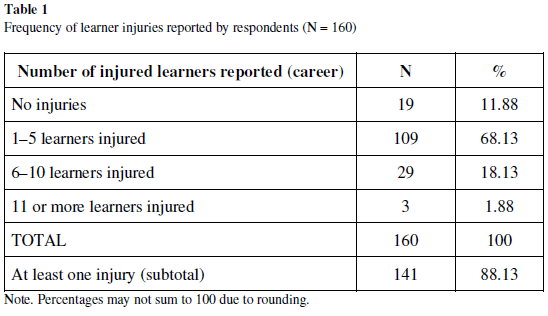
Table 1 shows the frequencies of learner injuries reported by respondents during their careers as mechanical technology teachers. The majority of respondents (88.13%; n = 141 of 160) reported that learner injury incidents have occurred in their workshops, while 11.88% (n = 19 of 160) reported that they have not. The largest category was 1-5 learner injuries (68.13%, n = 109 of 160), followed by 6-10 injuries (18.13%, n = 29 of 160) and 11 or more injuries (1.88%, n = 3 of 160).
Injuries by machinery and equipment type
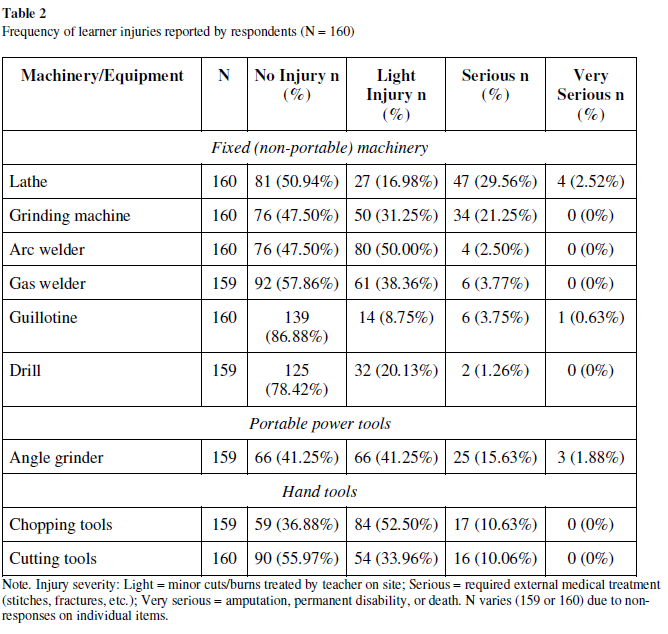
The injury severity caused by machinery and equipment in MTWs is presented in Table 2. The highest incidence of severe injuries occurred with fixed (non-portable) machinery, specifically the lathe (29.56%, n = 47 of 160), whereas four participants (2.52%, n = 4 of 159) reported very severe injuries due to the lathe. In terms of portable power tool injuries, the highest severity occurred among injuries caused by an angle grinder (17.51%, n = 28 of 159). Arc welding was mostly connected with minor injuries (50.00%, n = 80 of 160). Among hand tools, chopping tools accounted for the highest proportion of light injuries (52.50%, n = 84 of 160) and serious injuries (10.63%, n = 17 of 160).
Body parts most frequently injured
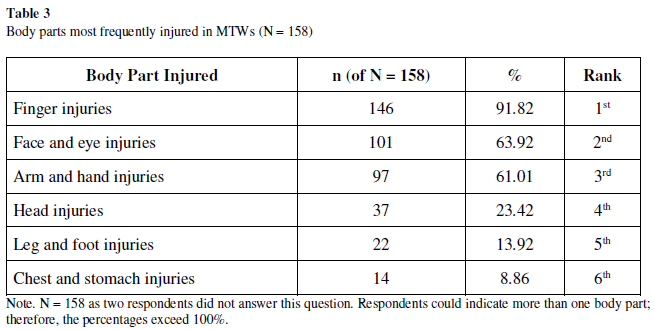
Table 3 presents the body parts most frequently injured in MTWs. Finger injuries were reported most frequently (91.82%, n = 146 of 158), followed by face and eye injuries (63.92%, n = 101 of 158) and arm and hand injuries (61.01%, n = 97 of 158). Head injuries were reported by 23.42% (n = 37 of 158) of respondents, while leg and foot injuries (13.92%, n = 22 of 158) and chest and stomach injuries (8.86%, n = 14 of 158) were reported less frequently.
Perceived causes of accidents
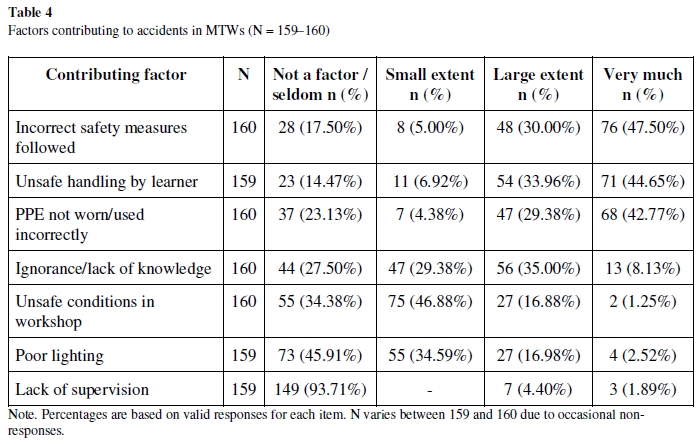
Table 4 presents respondents' ratings of factors contributing to accidents in MTWs. The factors most frequently rated as contributing "very much" to accidents were incorrect safety measures being followed (47.50%, n = 76 of 160), unsafe handling by learners (44.65%, n = 71 of 159), and PPE not being worn or being used incorrectly (42.77%, n = 68 of 160). Ignorance or lack of knowledge was rated as a major contributor to accidents by 43.13% of respondents (n = 69 of 160). Unsafe workshop conditions and poor lighting were generally rated as less significant contributors. Lack of supervision was rated as a significant contributing factor by 6.29% of respondents (n = 10 of 159).
Safety management and incident reporting
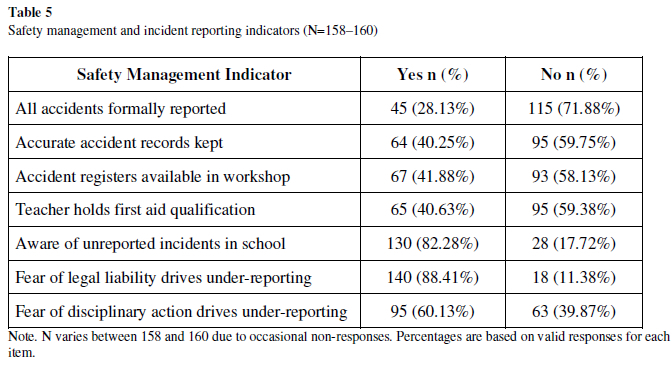
Table 5 presents key indicators of safety management and incident reporting practices. Only 28.13% of respondents (n = 45 of 160) indicated that all accidents are formally reported, while 71.88% (n = 115 of 160) reported that not all accidents are reported. Similarly, 40.25% (n = 64 of 159) indicated that accurate accident records are maintained, and 41.88% (n = 67 of 160) reported that an accident register is available in their workshops. Less than half of respondents (40.63%, n = 65 of 160) reported holding a first aid qualification. A large majority (82.28%, n = 130 of 158) indicated awareness of incidents that had not been formally reported. Fear of legal liability was identified by 88.41% (n = 140 of 158) of respondents, while 60.13% (n = 95 of 158) identified fear of disciplinary action as a reason for under-reporting.
Qualitative findings
Four themes were identified during the thematic analysis of the individual semi-structured interviews (Braun & Clarke, 2006; Creswell, 2014). The themes provide further insight into and context for the quantitative results provided above, and reveal the differences between the quantitative and qualitative findings.
Theme 1: The occurrence and normalisation of workshop injuries
All eight participants reported experiencing learner injuries in their teaching careers, supporting the quantitative result that 88.13% (n = 141 of 160) had experienced at least one learner injury. Learner injuries vary from less serious injuries like cuts and burns, to very serious injuries where learners had to be hospitalised, in some cases even undergoing amputation. P1 discussed one serious case of injuries where the learner needed extensive medical treatment and noted that "the learner was lucky . . . he needed only 20 stitches." Likewise, P4 mentioned an incident where a learner lost his thumb because it got crushed and "the doctor had to amputate it."
Theme 2: PPE non-compliance and unsafe learner behaviour
Qualitative results provide evidence for the quantitative results, showing that non-compliance with PPE use (42.77%, n = 68 out of 160) and learners' unsafe handling (44.65%, n = 71 out of 159) were among the factors most linked to accidents. The participants noted that the learners did not comply with PPE use despite receiving necessary safety instructions and being provided with protective equipment. This is evidenced by P3's statement that one learner's clothing was set on fire while he was welding because he did not wear the apron: "The aprons are hanging there; he only has to put one on." Similarly, P6 reported a serious eye injury sustained while a learner was using a portable grinder without safety goggles: "I told him to put on his safety goggles, but as soon as I walked away, he took them off." Peer influence was also highlighted as a factor affecting the use of PPE; it was observed that once one learner removed their PPE, other learners followed.
Theme 3: Teachers' legal knowledge of learner safety and liability
The other recurring issue that came up during the qualitative interviews was the lack of knowledge concerning their duties under the law, especially those relating to the duty of care towards learners. The above observation is confirmed by the quantitative findings, which showed that 55% of the respondents had never undergone any education law training. The respondents lacked knowledge of basic legal issues relevant to technology workshops. For example, participant P1 was unaware of the principle of de minimis and stated: "I am too afraid of liability, so I don't report anything." Awareness of Section 60 of the South African Schools Act was similarly low. The response from P1 regarding the use of the provision was as follows: "What's that? What has it got to do with us?" Very few participants understood the difference between individual liability and state liability in the event of a learner's injury.
Theme 4: Incident reporting and under-reporting
One area that emerged as a clear point of convergence between the quantitative and qualitative findings was incident reporting. The quantitative results showed high levels of under-reporting of injuries and accidents, while the qualitative findings provided some insight into the reasons contributing to this practice. P2 confessed that he covered up an accident out of fear of liability; P5 stated, "If it is not a serious injury, then we treat it ourselves in the workshop." Participants mentioned that issues regarding accountability and supervision affect reporting procedures. P5 stated: "We can't be in all places at the same time. In case any of them gets hurt, our fear is that they will claim that we have not provided them with adequate supervision." The fear of being held legally liable, facing disciplinary action, or any form of accountability was another reason not to report incidents.
Discussion
The findings reported above present the relationship among injury occurrence, PPE use, and safety management procedures in MTW settings in South Africa. This section explains the results from the perspectives of geborgenheid, safety culture theory, and affirmative ethics.
Behavioural factors and PPE non-compliance
The results show that behaviour-related factors are key in accidents occurring in MTWs. Non-compliance with safety procedures, unsafe learner behaviour, and lack of PPE use were found to be the most common factors in accidents. The results also suggest that safety rules and the availability of PPE are not enough to ensure safety. The qualitative results offer even more insight into this trend. This finding is supported by additional information from the qualitative results, in which participants repeatedly cited cases in which learners deliberately disregarded teachers' instructions, ignored safety procedures, and removed their PPE. This result confirms existing research highlighting the importance of PPE compliance and availability for its effectiveness (Febriyanti & Widajati, 2025; Santos et al., 2025). In relation to the safety culture approach, this indicates that safety behaviour is influenced by established practices in the workshop environment (Clarke, 2010). PPE compliance can thus be considered not only a personal responsibility but also an indication of safety management practices.
PPE compliance and injury patterns
These findings provide additional evidence of the importance of PPE compliance among learners in MTWs. Injuries to fingers, eyes/face, and arms/hands are the injury categories most experienced. These are the body parts that are usually covered by standard workshop PPE such as gloves, safety glasses, a face shield, and protective clothing. This is supported by qualitative findings. Participants reported instances in which learners had removed PPE, improperly put on PPE, or ignored safety guidelines despite prior safety instruction. Similar findings have been reported internationally, where injuries to the hands, fingers, and eyes are usually related to improper use of PPE and poor work practices (Khoshakhlagh et al., 2024; Santos et al., 2025). These results indicate that merely having access to PPE is not enough in preventing injuries. There needs to be compliance, appropriate supervision, and instilling safe behaviour in the workshop in order to ensure proper protection. The association between injury occurrence and body parts covered by PPE demonstrates that compliance with PPE remains an important aspect of injury prevention.
Legal literacy and safety management
The results suggest that a lack of sufficient legal knowledge could have an impact on the way safety incidents in MTW sessions are managed. More than half of the respondents stated that they had not been provided with any legal training in education law. The qualitative data indicated deficiencies in the legal knowledge of the participants with regard to some legal principles and statutes relevant to learners' safety and teachers' duties. A lack of understanding and knowledge of de minimis and Section 60 of the South African Schools Act indicates that such knowledge deficiencies may influence how teachers discharge their duty of care.
It seems that this uncertainty has contributed to liability-related anxieties and may inform decisions about incident reporting and injury management. These results are consistent with the notion that legal literacy is an important component of professionalism in high-risk settings (Taylor et al., 2023). In addition to technical competence and adherence to the workshop guidelines, safety management involves knowledge of the legal context in which teachers' responsibilities operate. Taking into account the concept of duty of care, improved legal competence can help teachers deal effectively with workshop issues while promoting safety management practices.
Incident reporting, accountability, and safety management
It can therefore be concluded that there are some issues with accident reporting in MTWs. Several participants claimed that not all accidents were always reported officially, while some were aware of accidents that had not been reported. Moreover, the qualitative analysis reveals several reasons for not reporting accidents, including liability and disciplinary concerns. The accident reporting process is critical to the safety management system because it helps identify recurring risks and injury patterns.
When accidents are not reported, vital safety information in workshops is not collected. Even though very few respondents attributed accidents to a lack of supervision, there were many references regarding supervision issues in the qualitative interviews. This might indicate that respondents tend to underestimate the importance of supervision in preventing accidents. This discrepancy could be due to social desirability bias, in which teachers are less likely to attribute insufficient supervision as a factor influencing the outcome when responding to their own professional experience. Reporting practices that are transparent result in accountability, continual improvement, and safer learning environments.
Geborgenheid and affirmative ethics: From compliance to active care
In general, there is a gap between MTWs' safety policies and their consistent implementation in practice. The availability of personal protective equipment, safety measures, and reporting processes cannot guarantee effectiveness; rather, effectiveness depends on how these policies are implemented in the classroom. This is in line with the geborgenheid principle, which stresses the importance of developing learning environments that are safe, secure, and characterised by trust (Oosthuizen, 2013). In the case of MTWs, learners' safety will depend not only on safety precautions but also on proper supervision, compliance with protective equipment requirements, and safety management measures. In line with this, the results also uphold an affirmative ethics approach to safety that regards safety as more than just following regulations. In this approach, safety management encompasses responsibility, care, and accountability towards the learners. The wearing of personal protective equipment, accurate reporting of accidents, and proper supervision may thus be not only procedural but also indicative of professionalism and a duty of care.
Contribution to educational practice and policy
This research contributes to the existing body of literature on workshop safety, which encompasses not only equipment and the environment but also human behaviour, legal awareness, and safety procedures. Enhancing learner safety should take into account not only technical issues but also the ethics and professionalism involved in implementing such safety procedures. The research implications could be useful in the field of education. For teachers, the study's findings suggest that implementing the PPE policy warrants serious consideration as an essential component of their profession rather than merely another formal procedure. In the case of teacher training, the implications suggest that legal knowledge should be part of the teacher's training programme, specifically regarding the duty of care. For school administrators and policymakers, this study would be of great importance for subject policies, school policies, and departmental documents.
Conclusion
This research examined the relationship among PPE compliance, injury occurrence, and safety management practices in South African MTWs. Results show that injuries are common in the workshop environment, and lack of PPE compliance, unsafe behaviour, low legal awareness, and poor reporting and safety management are among the factors that pose safety hazards for learners. The research shows that the provision of PPE alone is not enough to prevent injuries. Proper protection of learners requires compliance with PPE, monitoring, reporting, and the application of safety measures. These results also emphasise the importance of legal literacy, especially concerning the teacher's duty of care and the management of workshop accidents. This research adds empirical support to the limited number of studies on workshop safety in South African schools, thereby enhancing knowledge of the effects of behavioural, legal, and management variables on safety outcomes. In relation to geborgenheid, safety culture, and affirmative ethics, learner safety becomes a professional and ethical issue rather than one that revolves around issues of compliance. The results will help inform the development of policies and procedures to enhance learner safety related to PPE compliance in the school environment. Further research could investigate ways to develop a safety culture in school technology workshops.
References
- Aklotsoe, Y. K., Anim, E. A., & Amartey, E. N. L. (2025). A systematic review on the effectiveness of personal protective equipment at the workplace. International Journal of Creative Research Thoughts, 13(8). https://www.ijcrt.org/papers/IJCRT2508442.pdf
- Ary, D., Jacobs, L. C., Razavieh, A., & Ary, C. (2010). Introduction to research in education (8th ed.). Wadsworth.
- Braidotti, R. (2018). Affirmative ethics, posthuman subjectivity, and intimate scholarship. In C. A. Taylor & C. Hughes (Eds.), Decentering the researcher in intimate scholarship: Critical posthuman methodological perspectives in education (pp. 19-32). Emerald Publishing.
- Braidotti, R. (2019). On affirmative ethics. In R. Braidotti, Posthuman knowledge (pp. 163-192). Polity Press.
- Cohen, J. (1988). Statistical power analysis for the behavioral sciences (2nd ed.). Lawrence Erlbaum.
- Creswell, J. W. (2014). Research design: Qualitative, quantitative, and mixed methods approaches (4th ed.). SAGE.
- Creswell, J. W., & Creswell, J. D. (2018). Research design: Qualitative, quantitative, and mixed methods approaches (5th ed.). SAGE.
- Febriyanti, R. S., & Widajati, N. (2025). Factors influencing compliance with personal protective equipment use among manufacturing workers: A literature review. World Journal of Advanced Research and Reviews, 25(3), 1334-1338. https://doi.org/10.30574/wjarr.2025.25.3.0874
- Fraenkel, J. R., & Wallen, N. E. (2009). How to design and evaluate research in education (7th ed.). McGraw-Hill.
- Jackson, W., & Ssennyonjo, A. (2021). Assessment of usage of personal protective equipment and related factors among workers in wood workshops in Mutungo Parish, Nakawa Division, Kampala District. Journal of Environmental and Occupational Health, 11(7), 69-74. https://www.jenvoh.com/jenvoh-articles/assessment-of-usage-of-personal-protective-equipment-and-related-factors-among-workers-in-wood-workshops-in-mutungo-parish-nakawa--73861.html
- Jurgens, C. (2023). Safety in mechanical technology workshops at South African public schools. In N. Popov, C. Wolhuter, Z. L. de Beer, G. Hilton, J. Ogunleye, E. Achinewhu-Nworgu, & E. Niemczyk (Eds.), Recovering education: Using the experiences and learning acquired to build new and better education systems (Vol. 21, pp. 110-116). Bulgarian Comparative Education Society. https://bces-conference.org/onewebmedia/2023%20110-116%20Coenraad%20Jurgens.pdf
- Keeping Children Safe. (2023). The international child safeguarding standards. https://www.keepingchildrensafe.global/international-child-safeguarding-standards/
- Khoshakhlagh, A. H., Malakoutikhah, M., Park, J., Dehghani Kodnoueieh, M., Rafieian Boroujeni, Z., Bahrami, M., & Ramezani, F. (2024). Assessing personal protective equipment usage and its correlation with knowledge, attitudes, performance, and safety culture among workers in small and medium-sized enterprises. BMC Public Health, 24, Article 19517. https://doi.org/10.1186/s12889-024-19517-3
- Malta, G., Matera, S., Plescia, F., Calascibetta, A., Argo, A., & Cannizzaro, E. (2024). Occupational accidents and the use of PPE: A global meta-analysis. Frontiers in Public Health, 12, Article 1368991. https://doi.org/10.3389/fpubh.2024.1368991
- Maree, K., & Pietersen, J. (2007). The quantitative research process. In K. Maree (Ed.), First steps in research (pp. 145-153). van Schaik.
- Neethling, J., Potgieter, J. M., & Visser, P. J. (2015). Law of delict (7th ed.). LexisNexis.
- Oosthuizen, I. J. (2013). Die positivering van geborgenheid met die oog op 'n meer gedissiplineerde onderrig-leeromgewing. Koers, 78(3), 1-7. https://doi.org/10.4102/koers.v78i3.446
- Oosthuizen, I. J. (2016). Die grondslae vir regstoepassing in die onderwysomgewing. In I. J. Oosthuizen (Ed.), Inleiding tot die onderwysreg (3rd ed., pp. 27-42). van Schaik.
- Oosthuizen, I. J., Rossouw, J. P., & de Wet, A. (2016). Die onderwyser as sorgsame toesighouer. In I. J. Oosthuizen (Ed.), Inleiding tot die onderwysreg (3rd ed., pp. 121-139). van Schaik.
- Republic of South Africa. (1993). Occupational Health and Safety Act 85 of 1993. https://www.gov.za/st/documents/occupational-health-and-safety-act
- Republic of South Africa. (1996). South African Schools Act 84 of 1996. https://www.gov.za/sites/default/files/gcis_document/201409/act84of1996.pdf
- Rossouw, J. P., & Keet, W. (2011). Deliktuele aanspreeklikheid van die afrigter in skolesport - 'n sekuriteitsaangeleentheid. Potchefstroomse Elektroniese Regsblad, 14(6), 1-32. https://doi.org/10.4314/pelj.v14i6.1
- Schoeman, J. P. (2013). Die ontwikkeling van 'n veiligheidsmodel ten opsigte van die gebruik van persoonlike beskermende toerusting in die beroepsveiligheidsomgewing [Unpublished doctoral thesis]. Cape Peninsula University of Technology.
- Smit, M. (2022). Die toepassing van die wet op beroepsgesondheid en -veiligheid en ander veiligheidsmaatreëls by skole se tegnologie-werkswinkels. PER/PELJ, 25. https://doi.org/10.17159/1727-3781/2022/v25i0a11952
- Summan, A. S., Bartlett, K., Davies, H., & Koehoorn, M. (2020). Noise exposure among teachers in technology educational shops in selected British Columbia, Canada, high schools. Journal of Occupational and Environmental Hygiene, 17(10), 457-463. https://doi.org/10.1080/15459624.2020.1762783
Accepted: 4 August 2026