Understanding the Media and Information Literacy Experiences of Children in Ghana
Abstract
The media and information literacy experiences of children growing up in digitally mediated environments remain underresearched in developing countries. This study examined the media usage patterns and digital literacy skills of children in Ghana. Using a survey design, primary data were collected from 400 schoolchildren in Accra. Descriptive analysis revealed that children showed a strong preference for the Internet over traditional media such as radio and television, with access occurring primarily through mobile devices at home. The findings indicate that while children demonstrate relatively high informational and social and mobile skills, significant gaps exist in their critical evaluation and creative competencies. Notably, one in three children is unable to determine the accuracy of information encountered online. The study also highlights limited understanding of information disorder concepts, with most children familiar only with the term "fake news" and demonstrating low awareness of "disinformation" and "fact-checking" These gaps suggest that children's digital literacy remains uneven, leaving them vulnerable to online risks. The study underscores the need for strengthened media and information literacy education to enhance children's critical engagement with digital media.
Children and media; digital literacy; digital literacy among children; Ghana; media and information literacy
INTRODUCTION
Children in the twenty-first century are growing up in a dramatically different environment. They have expanding, and sometimes unfettered access to the Internet (Barr, 2022; Kyei-Arthur et al., 2024; Onguner et al. 2024). Globally, one in three children has access to the Internet (UNICEF, 2020). In Africa, about 40% of young people (15 to 24 years of age) have access to the Internet (African Union, 2024). In Ghana, 90.5% of children (8-17) had ever used the Internet, according to a cross-sectional survey of 5024 children (Kyei-Arthur et al., 2024).
Children's early exposure to the Internet and other digital media brings with it unique opportunities and insidious threats. For example, Internet content, conduct/misconduct and contact with people online, including strangers, can both help and hurt children (John & Bates, 2024; Livingstone & Bober, 2004; UNICEF, 2019). As a result, media and information literacy (MIL) competencies are crucial for every child. MIL competencies are essential for fostering informed engagement and critical thinking in digital spaces and other media environments. MIL refers to a set of skills that enable individuals to access, assess, use and contribute media content responsibly (Reineck & Lublinski, 2015).
MIL is a composite concept. It entails a broad spectrum of overlapping competencies that include information literacy, media literacy and digital literacy. Digital literacy skills in particular are crucial for children as many of their daily experiences, such as learning, play and family interaction, have an online dimension (Helsper & Smahel, 2020; Hurwitz & Schmitt, 2020). Without the necessary digital literacy skills, children are highly susceptible to misinformation, disinformation, cyberbullying and other negative practices that have characterised the digital age (Howard et al, 2021).
In Ghana, a national study revealed that despite using digital media frequently, young people (15 to 25-year-olds) do not understand the consequences of disinformation and cyberbullying (DW Akademie, 2020). Another study (Kyei-Arthur et al., 2024) revealed that the majority of children in Ghana use the Internet without supervision from an adult, exposing them to Internet risks such as cyberbullying and sexting. Nonetheless, empirical assessments of digital literacy skills in Ghana tend to focus on youth (Ayisi et al. 2024; Kyei-Gyamfi, 2024; Nkansah & Oldac, 2024). Consequently, the MIL experiences of Ghanaian children are not well understood; this affects the design and implementation of interventions to improve children's MIL levels.
It is necessary to gather evidence from children to understand their MIL experiences and measure their digital literacy skill levels. Parents, teachers and policymakers often make assumptions about children's MIL skills, but self-reported experiences provide more accurate data on how children navigate digital environments. Gathering evidence from children also bridges the generation gap in digital literacy education, ensuring that MIL programmes and interventions for children meet their aspirations, habits and difficulties. This study therefore investigated the MIL experiences of selected school children in Accra, Ghana. Specifically, the study describes children's media usage patterns, assesses their levels of digital literacy and examines their familiarity with selected MIL concepts.
In line with these objectives, the study addressed three related research questions:
1. What are the media usage patterns of school children in Accra?
2. What are the children's levels of digital literacy?
3. What are the children's levels of familiarity with selected MIL concepts?
The remainder of this article presents a review of relevant empirical and theoretical literature. This is followed by the study methodology, findings and discussion, and, finally, the conclusion.
Understanding media and information literacy (MIL)
MIL (media and information literacy) is a composite concept; it amalgamates previously distinct concepts, namely information literacy, media literacy, and information and communication technology literacy. As an umbrella concept, "MIL is defined as a set of competencies that empowers citizens to access, retrieve, understand, evaluate and use, to create as well as share information and media content in all formats, using various tools, in a critical, ethical and effective way, to participate and engage in personal, professional and societal activities" (UNESCO, 2013:29). MIL is essential to creating diverse, inclusive, knowledge-driven and democratic communities. MIL literates are more capable of participating actively in professional and civic spheres, which are now heavily dependent on technology and critical thinking. MIL also helps to create open, pluralistic communities that respect individuality and variety (Guerola-Navarro et al., 2023; UNESCO, 2013).
MIL is an interdisciplinary field that draws on knowledge and methods from various social science fields, including cultural studies, visual communication, sociology, political theory, psychology, race studies and gender studies (Kozlowska-Barrios, 2023). Since its introduction by UNESCO in 2007, MIL has evolved in scope over the years. Consequently, the field is divided into various sub-disciplines that allow for more concentration on different aspects of MIL (Heiss et al., 2023; Kozlowska-Barrios, 2023). The sub-disciplines of MIL include news evaluation or news literacy, misinformation detection and fact-checking, social media literacy and digital literacy (Heiss et al., 2023). This study focuses on digital literacy, but it is important to note that the various sub-fields of MIL overlap.
Digital literacy is a contested terminology. Despite being popularised in 1997 by Paul Gilster (Pangrazio et al. 2020; Press et al.,2019), ironically, the concept has resurfaced in the twenty-first century as a "new literacy'! Digital literacy refers to the competencies and skills one requires to navigate the dynamic and complicated online information ecosystem (Eshet, 2004). It may also be described as the skills and competencies necessary to use digital media, as well as an attitude towards digital technologies that is both critical and creative (Pangrazio et al., 2020). Digital literacy is a multidimensional concept, although scholars differ on the number of dimensions it entails. For example, Ng (2012) opines that digital literacy has three dimensions: technology, social-emotional and cognitive skills. Pérez-Escodaon et al. (2019) identify four dimensions and Martínez-Bravo et al. (2022) propose eight. It suffices that despite its conceptual evolution and growing importance, there remains fragmentation in how digital literacy is defined and measured, with scholars proposing varying dimensions (Ng, 2012; Pérez-Escoda et al., 2019). This lack of conceptual consensus presents challenges for empirical research, particularly in assessing literacy levels across different populations.
Issues about how people locate, understand, interpret, analyse and produce media texts in various formats are the mainstays of MIL research (Rojas-Estrada et al, 2023). Another trend in the literature is the consistent emphasis on critical evaluation skills as central to navigating increasingly complex digital environments (Hobbs, 2017; Polizzi, 2020). MIL research, especially digital literacy, has therefore surged in popularity as media technologies and diverse media content become widely available (Hobbs, 2017). The focus on digital literacy will become even more central given the crucial role of information and digitalisation in the growth of democracy, social inclusion, cultural engagement and active citizenship (Hobbs, 2017; Koltay, 2011; Polizzi, 2020).
While all demographic groups use information and media, children, adolescents and the youth use media more frequently (Chassiakos et al., 2016). Young people spend more time than adults using television, electronic games and the Internet for entertainment, connection and socialisation. They also use media for education, self-expression and civic engagement (Chassiakos et al., 2016; Koltay, 2011). The advent of the COVID-19 pandemic (2020-2023) drove even more young people online as schools had to hold virtual classes in response to pandemic restrictions (Babbar & Gupta, 2021; Dhawan, 2020). Consequently, more children use digital media, but little is known about their digital literacy levels and media literacy experiences.
Digital literacy among children
Children's social, educational and emotional experiences today revolve around digital media. Digital media technologies such as smartphones, tablets, computers and the Internet are widely available to children as they have become integral to many schools and households (John & Bates, 2024). Children's ability to navigate the digital media landscape, assess and produce media is crucial because they spend more time than elsewhere in a digital world learning and playing. The United Nations Children's Fund (UNICEF) and the London School of Economics and Political Social Science (LSE) conducted a groundbreaking study across 11 countries which revealed that, if done right, Internet use could support the development of digital skills among children (9-17 years) as well as enhance their learning opportunities (UNICEF, 2019).
However, many researchers, including Potter (2010), Shtulman (2024), John and Bates (2024), consider children highly vulnerable to the influence of digital media. A systematic literature review of 19 studies on health-related Internet use among children and adolescents showed that although young people use the Internet extensively to seek information on sensitive health issues, they find it difficult to determine the accuracy and reliability of the information they find (Park & Kwon, 2018). Shtulman (2024) also notes that children are gullible; they easily fall for the deceptive trappings of online information disorder when the information source appears to be authoritative or if the information is in a seemingly authentic format. It suffices that while increased exposure to digital media has expanded access to information, there is a critical imbalance as children tend to possess strong access and usage skills but weaker critical evaluation abilities.
Children's digital literacy skills may differ based on gender, educational level, parents' socio-economic status and socio-cultural context. Nonetheless, UNICEF's survey of about 1500 children across 11 countries revealed that, generally, children tend to have higher information-seeking skills than critical evaluation skills. They also tend to report strong privacy and Internet safety skills (UNICEF, 2019). Another empirical study (Jin et al., 2020) conducted to assess the digital literacy level of three different groups of children in Hong Kong revealed that older children (secondary school students) had higher levels of digital literacy than younger children (primary school students). Jin et al. (2020) researchers uncovered a significant gender difference in digital literacy among secondary school students, but not primary school students. Jin et al. (2020) used a test-based model, which simulated a real-life digital online media landscape to assess digital literacy skills. The UNICEF study (UNICEF, 2019), conversely, used a self-reported mechanism where students rated their skills on a Likert-type scale. While existing studies have shown inconsistent results regarding the digital literacy levels of children, these studies have also not focused on children in sub-Saharan Africa.
Digital literacy levels of children differ significantly based on country of residence or geographical area. A survey of adults in 34 African states revealed a substantial digital divide within and between African countries (Krönke, 2020). Also, there is generally low access to information and communication technology (ICT) infrastructure such as electricity, smartphones and computers across the continent which affects children's digital competencies (De Pauw, 2011; Sun et al., 2023). Although the digital literacy levels of children in Africa are sparsely researched, studies that have explored the subject matter report that children in developing countries, many of them in sub-Saharan Africa, have low digital literacy compared to their counterparts in advanced or developed countries (De Pauw, 2011; Livingstone et al., 2021; Sun et al. 2023).
Livingstone and Bober (2004) underscore the significance of comprehending how children's media settings are changing and the necessity of educational interventions that tackle the intricacies of Internet information. Hobbs (2010) adds credence to this viewpoint by arguing that MIL education should encourage critical thinking and equip children to create media responsibly and actively rather than just consume it passively. Rojas-Estrada (2023) also supports the integration of MIL into educational curricula, which they consider crucial to cultivating well-informed, engaged and critical citizens in contemporary society. Developing digital literacy skills at a young age could help children to take advantage of opportunities presented by the Internet while avoiding the pitfalls.
Media literacy theory
This study relied on James Potter's media literacy theory. Potter (2004) argues that media literacy is a cognitive process and a critical approach to media consumption and use. Potter's media literacy theory takes the view that media literates must be able to recognise and deconstruct media symbols whether those are printed pages, images, audio or video. Potter (2004) differentiates skills and competencies to emphasise their importance. According to Potter (2004), competencies are the tools that enable people to access information and engage with the media. Competencies, on the one hand, are dichotomous; people either have them and use them automatically or they do not have them and therefore cannot use them. Skills, on the other hand, are tools that individuals develop over time through practice. Skills are non-dichotomous as there are a range of skills. Media literacy entails both competencies and skills, but it is much more concerned with skills enhancement than competencies (Potter, 2004). Despite Potter 's argument that individuals acquire competencies early in life and apply same automatically, competencies can also be acquired later in life through training and practice (Moore & Hancock, 2022).
Potter (2004) furthers the media literacy theory by developing a cognitive media literacy model. The model is made up of four pillars: knowledge structures, personal locus (goals and drives), set of competencies and skills, and flow of information-processing tasks. Knowledge structures (knowledge about media industries, media effects, media content, the real world and the self) are the cornerstone of the cognitive media literacy model. The second pillar, the personal locus, receives information from the combination of knowledge structures that drives decisions about the processing of information. The third component is the individual's skill set and competencies, which serve as the instruments for processing information. The flow of information processing (media construction and analysis) is the final pillar. The four components interact with one another to form the cognitive media literacy model.
The MIL field has evolved further since Potter espoused his ideas, which were limited to media literacy. However, Potter's theory is relevant because it is consistent with recent developments in the field (Iordache et al., 2017; Kamerer, 2013; Swart, 2021). Potter's ideas about the multidimensional and cognitive nature of media literacy are consistent with UNESCO's MIL model which provides a comprehensive framework for understanding how young people can be educated and trained in media and information literacy. The UNESCO MIL model emphasises the importance of developing skills and competencies in three key areas: (1) critical thinking skills; (2) fostering awareness of the media's role in society; and (3) encouraging ethical engagement with information. These competencies enable children to navigate the complex media landscape, make informed decisions and become responsible citizens (UNESCO, 2013).
Potter's media literacy theory is suitable for this study because it demonstrates the importance of skills and competencies for taking full advantage of the media. The cognitive media literacy model also highlights the interdependence of knowledge (knowledge structures), personal locus (personal values), skills and competencies for information processing and analysis. The theory, however, has some important limitations. Conceptually, it decouples media literacy from information literacy. The theory also does not emphasise content creation and collaboration, which are key aspects of a contemporary understanding of MIL.
Media and information literacy (MIL) in Ghana
Ghana is a lower-middle-income country in West Africa. The country's 31 million population is dominated by young people, of whom 35.3% are 0-14 years old and 38.2% are 15-35 (Ghana Statistical Service, 2021). Ghana's media landscape is vibrant, diverse, pluralistic and generally free (Nyarko, 2024; Tindi & Kwode, 2025; UNESCO, 2023). Traditional media, especially radio and television, dominate the Ghanaian media landscape, but digital media are becoming more accessible and preferred (Twum & Mensah, 2023; Yussif et al., 2024).
Research on media development in Ghana has largely ignored the MIL level of citizens despite the country's thriving media landscape. Studies on MIL in Ghana tend to focus on the youth. For example, a study by Germany's media development agency, DW Akademie, in Ghana, revealed a national youth MIL index of 59.5% (DW Akademie, 2020). Another study reported that Ghana's youth at the secondary school level had high digital access and appreciable MIL skills (Ayisi et al., 2024). Meanwhile, Ghana's basic school curriculum does not teach children MIL. It is only at the tertiary level that communication training institutions teach MIL courses (Cunliffe-Jones et al, 2021). However, ICT courses are taught at the senior high school level and there are calls for MIL courses to be introduced at that level (Ocloo et al., 2022).
Although evidence on children's MIL skills in Ghana is lacking, country-specific factors, family background and social norms of media use shape children's MIL opportunities and outcomes (Livingstone et al. 2021a). Studies conducted in comparable contexts (in Africa) conclude that children in the Global South suffer from infrastructural, cultural and socio-economic challenges that significantly affect their access to digital technologies and MIL opportunities (De Pauw, 2011; Sun et al. 2023). However, Livingstone et al. (2021b) caution that children's MIL experiences in the Global South vary considerably, and the differences must be interpreted cautiously and in the proper context.
METHODOLOGY
This study employed a quantitative research approach, which enhances the generalisability of findings and allows for systematic measurement of variables (Bibi et al., 2022; Holton & Burnett, 2005). A cross-sectional survey design was adopted to capture and describe children's MIL competencies at a single point in time. Surveys are appropriate for observing and measuring population characteristics without manipulating variables (Creswell, 2014; Holton & Burnett, 2005) and have become a standard approach in assessing MIL across diverse age groups (Chetty et al., 2018; Livingstone et al., 2020; Mudhai et al., 2016).
Sample selection
The study was conducted in four basic schools in Accra, Ghana. Basic school represents the foundational stage of Ghana's educational system. It comprises early childhood, primary and junior high school education; it is designed for children typically between the ages of 4 and 15. Basic education in Ghana aims to equip learners with basic literacy, numeracy, critical thinking and problem-solving skills necessary for further education and everyday life. This study focused on children at the upper primary and lower secondary school levels. All the selected schools were members of the UNESCO Associated Schools Network (ASPnet). The selection of ASPnet schools was because they are guided by UNESCO's principles on global citizenship, digital inclusion and MIL. As such, they provided a relevant and policy-aligned context for assessing children's digital literacy competencies, particularly in relation to international MIL frameworks. This made them suitable sites for examining both exposure to and outcomes of structured MIL-related educational initiatives.
The total population for the study was 2,500 basic school children. A sample size of 400 students was selected, consistent with the sample size recommendations of Krejcie and Morgan (1970) for populations ranging from 2,400 to 100,000. Cluster sampling was used to select participants. In this approach, naturally occurring groups (in this case, school classes) served as clusters (Creswell, 2014). Classes were randomly selected within each school until approximately 100 students per school were obtained. Given an average class size of 35 students, multiple classes were selected per school. The final sample comprised students from upper primary (Class 4-6) and junior high school (JHS) levels. Cluster sampling was appropriate because classes function as microcosms of the broader school population, reflecting diverse demographic characteristics while ensuring logistical efficiency in data collection.
Data collection and analysis
Data were collected using an adapted version of the Global Kids Online (GKO) digital literacy questionnaire, a standardised instrument developed by the London School of Economics, UNICEF and EU Kids Online. The tool has been widely validated across multiple contexts, including sub-Saharan Africa (Livingstone et al., 2021a), which made it suitable for this study. The full set of 24 GKO items was retained, with additional questions included to capture demographic information. The reliability of the adapted GKO questionnaire was assessed using Cronbach's alpha. The overall scale demonstrated high internal consistency (α = .914), indicating the reliability of the instrument for measuring children's digital literacy.
Questionnaires were administered in classroom settings between 11 and 31 October 2024. A researcher was present to clarify questions where necessary, ensuring comprehension among respondents. On average, completion took approximately 16 minutes per respondent. Data were analysed using descriptive and inferential statistics in SPSS Version 20.0, allowing for the summarisation of key patterns in children's digital literacy and media use.
Ethical considerations
Ethical approval was obtained from the Directorate of Research and Innovation Development (DRID) at the University of Media, Arts and Communication. Permission to access ASPnet schools was granted by the Ghana Commission for UNESCO and the ASPnet national coordinator. In addition, consent was obtained from headteachers of participating schools, given that respondents were minors. Measures were taken to ensure voluntary participation, confidentiality and the protection of respondents throughout the study.
RESULTS
Demographic characteristics of respondents
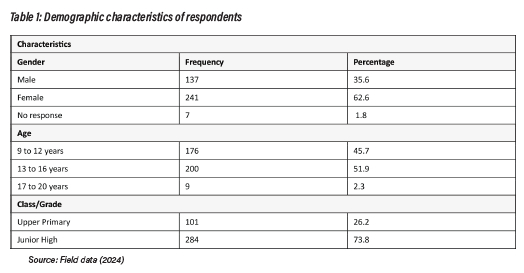
Of the 400 questionnaires administered, 15 were not properly completed. The analysis was therefore based on 385 properly completed questionnaires. Female respondents dominated the sample, numbering 241 and accounting for 62.6% of the sample. This was because one of the schools was a girl's school. Most of the respondents (51.9%) were 13 to 16 years old, 176 (45.7%) were 9 to 12 years old and 9 (2.9%) were 17 to 20 years old. All study participants were basic school children; 101 (26.2%) were at the upper primary school level (class 4 to 6), and the remaining 284 (73.8%) were JHS students. See Table 1 for a summary of the demographic characteristics of respondents.
Media usage patterns of basic school children
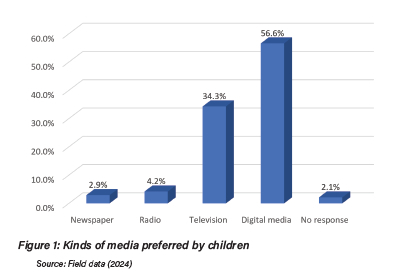
The first objective of the study was to assess the media usage patterns of children. This objective was addressed by obtaining data on students' most preferred media, digital media access and smartphone ownership. The findings about the kinds of media preferred by children are summarised in Figure 1.
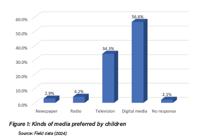
It can be seen from Figure 1 above that more than half (56%) of the children preferred digital media. Figure 1 also shows that 34.3% of children preferred television, 4.2% liked radio and only 2.9% preferred newspapers.
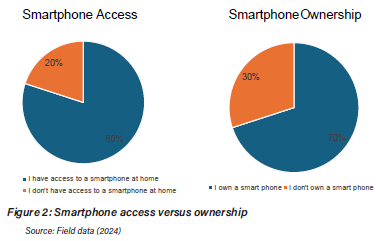
Given the high preference for digital media among children, the researchers enquired from respondents whether they owned smartphones or had access to smartphones at home. Smartphone ownership and smartphone access are juxtaposed in Figure 2.
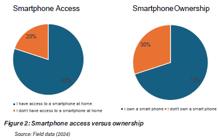
It is evident from Figure 2 that smartphones were available to nearly all children. Most children (70%) claimed they owned smartphones, and 80% had access to smartphones at home. This means that 10% of respondents used smartphones belonging to their relations or friends in their household. It is important to note that even though 20% of respondents did not have access to smartphones at home, they had access to computers in their schools because all four schools that participated in this survey had functional computer laboratories or ICT centres that are accessible to students.
Although this study did not fully examine the uses of digital media among children, it was important to find out if they used social media because it is popular among children. It was found that 186 (48.3%) of children had social media accounts, 195 (50.65%) did not have social media accounts and 4 (1.05%) students skipped this item on the questionnaire. However, not having a social media account must not be understood as not using social media because some children could be using the social media accounts of their family relations and friends.
Digital literacy levels of children
The second research objective concerns the digital literacy levels of children. As intimated in the methodology section, the GKO digital literacy questionnaire was adapted for this study. The questionnaire assesses digital literacy in five skill areas: operational skills, informational skills, social skills, creative skills and mobile skills. Each skill cluster had about five or six questionnaire items that were measured using 5-point Likert-type responses. The findings are presented in separate tables below beginning with operational skills.
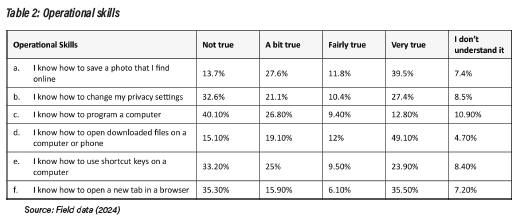
OPERATIONAL SKILLSOperational skills are also known as button knowledge. Operational skills refer to the basic skill set required to operate digital devices such as computers and mobile phones.
Table 2 shows that children possess substantial but greatly uneven operational digital skills. The operational skill most common among all respondents (49.1%) was how to open downloaded files. Also, most of the children (39.5%) responded that they could absolutely (very true for me) save a photo that they found online. The highest deficiency in operational skills was computer programming and opening a new tab in a browser; 40% and 35% of the students, respectively, claimed they did not know how to perform these functions.
Independent-samples t-tests were conducted to examine differences in operational skills by gender and smartphone access. Independent-samples t-tests indicated no significant gender differences in informational skills, t(321.26) = 0.833, p = .406. However, students with smartphone access (M = 14.21, SD = 3.95) had significantly (p = .001) higher operational skills than those without access (M = 13.57, SD = 5.43), t(172) = 3.458.
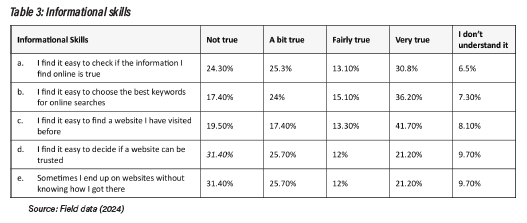
INFORMATIONAL SKILLSInformational skills are a set of skills that allow individuals to successfully search for, find and retrieve information from the Internet safely.
It can be observed from Table 3 that 30.8% of respondents stated that they found it easy to check the truthfulness of information online, but 24.3% of respondents could not perform this function. However, 41.7% of respondents intimated that it was very true that they could easily find websites that they had visited before. Similarly, most respondents (36.2%) claimed they found it easy to choose the best keywords for online searches. Meanwhile, most of the children (31.4%) were unable to decide if a website could be trusted and, cumulatively, 46.9% of children intimated that sometimes they ended up on websites without knowing how they got there. Independent-samples t-tests indicated no significant (p = .987) gender differences in operational skills, t(368) = 0.016. In contrast, students with smartphone access (M = 13.50, SD = 4.12) reported significantly higher (p = .349.) informational skills than those without access (M = 12.88, SD = 5.36), t(102.12) = -0.174.
SOCIAL SKILLS
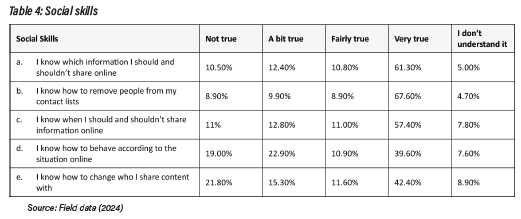
Social skill set refers to the kind of competencies children require to collaborate with their peers and other people safely while using the Internet. Social skills were measured using five items on the questionnaire.
The results displayed in Table 4 show that children are confident about the kinds of information they can share online. A significant majority of children (61.3%) claimed that they absolutely (very true) knew which information they should share and should not share online. Similarly, most of the children (67.6%) indicated in the strongest terms (very true) that they knew how to remove people from their contact list (on social media). However, 8.9% of children did not know how to remove people from their contact list, and 4.7% did not know what that meant. Also, 57.4% of children were sure (very true) about when to share and when not to share information online. Again, 39.6% indicated that they knew how to behave according to the situation online, and 42.4% stated that they knew how to change who they shared content with on social media. There were 21% of children who did not know how to change who they shared content with online and 19% of children did not know how to behave according to the situation online. Further analysis (independent sample t-test) showed no significant (t = .999) gender differences in social skills, t(314.73) = -0.001. Similarly, no significant difference (p = .160) was found between students with smartphone access (M = 16.18, SD = 3.40) and those without access (M = 15.27, SD = 5.39), t(93.66) = 0.080.
CREATIVE SKILLS
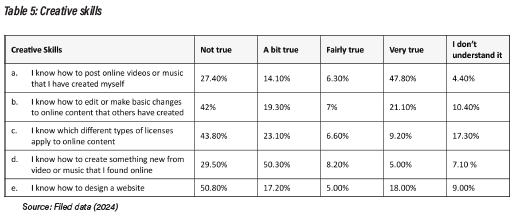
Creative skills are necessary for online self-expression. The ability to demonstrate creativity while using the Internet is considered a higher level of skill because creative users normally benefit more from using the Internet than individuals who do not create content because they lack the skills. The results are shown in Table 5.
It is apparent from Table 5 that children exhibit limited creative skills while using the Internet. Close to half (47.8%) of children who participated in the study claimed absolute knowledge of how to create video or music online. However, most children (42%) did not know how to edit or make basic changes to online content that others had created. Similarly, 43.8% did not know which different types of licenses applied to online content. Again, 50.3% knew how to create something new from video or music that they found online, to a small extent (it is a bit true). More than half of the children (50.8%) did not know how to design a website, 17.2% knew how to design a website to a small extent but 18% claimed absolute knowledge of website design. A t-test was conducted on the results which showed that gender differences in creative skills, t(368) = 0.104, were insignificant (p = .917). Likewise, no significant difference (p = .628) was observed between students with smartphone access (M = 12.76, SD = 4.28) and those without access (M = 12.39, SD = 6.24), t(93.67) = 0.486.
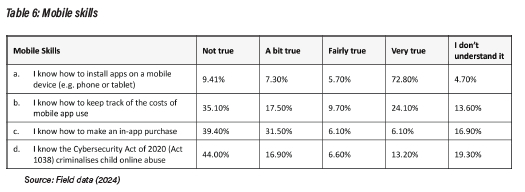
MOBILE SKILLSMobile skills are the skill set required to use smartphones safely online. This skill set is crucial for children in Ghana because mobile phones are more widely available than computers. The results of the study on children's mobile skills are summarised in Table 6.
It is apparent from Table 6 that a significant majority of respondents (72.8%) intimated that they knew how to install an app on a mobile device such as a phone or tablet. More than a third of respondents (35.1%) did not know how to track the costs of mobile app use, but 24% claimed absolute knowledge of how this is done. Similarly, 39.40% did not know how to make an in-app purchase, and 16.9% of children did not know what that meant. Again, most of the children (44%) did not know that the Cybersecurity Act, 2020 (Act 1038) protects children in Ghana from online abuse. Independent-samples t-tests revealed no significant gender differences (p = .249) in mobile skills, t(306.51) = 1.154. Similarly, there was no significant difference (p = .220) between students with smartphone access (M = 10.54, SD = 3.35) and those without access (M = 11.25, SD = 4.73), t(93.64) = -1.234.
Children's familiarity with selected media and information literacy (MIL) concepts
The final objective of this study was to investigate the extent to which children understand concepts associated with information disorder, which is as prevalent a problem in Ghana as in other parts of the world.
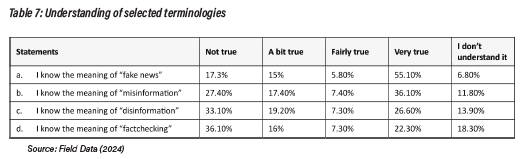
It can be observed from Table 7 that more than half of the respondents (55.1%) claimed that they understood what "fake news" meant; 15% said they understood the terminology to a small extent but 17.3% did not know the meaning at all. Students' familiarity with the term fake news is not surprising because it is used frequently and loosely in the media. Table 7 also shows that 36.1% of respondents knew the meaning of "misinformation". Again, 17.4% claimed they understood the concept to a small extent, but 27.4% did not know the meaning of misinformation. In addition, 7.4% of respondents claimed they somehow understood misinformation.
The results show that children are not familiar with "disinformation" as fake news and misinformation. Table 7 shows that, cumulatively, 47% of respondents did not know what disinformation means, 19.2% understood the term to a small extent and 7.3% understood it somehow. However, 26.5% of respondents stated that they knew the meaning of disinformation. Again, most respondents (36.1%) did not know the meaning of fact-checking and 18.3% did not understand it at all. But 22.1% intimated that they understood the term.
DISCUSSION
The findings indicate that most children prefer digital to traditional media such as radio and television. Consistent with Ayisi et al. (2024), Kyei-Arthur et al. (2024) and Livingstone et al. (2019), children's high level of Internet access is largely facilitated through mobile devices at home. In this study, eight in 10 children reported access to the Internet, slightly lower than the nine in 10 reported by Kyei-Arthur et al. (2024). Nearly half of those with smartphone access also had social media accounts. This widespread access underscores the growing importance of digital literacy skills in enabling children to fully benefit from online opportunities. As media literacy theory suggests, literacy competencies extend across multiple media platforms rather than a single medium (Potter, 2004); thus, children must develop skills relevant not only to print media but also to digital environments.
The study further revealed that children's digital literacy skills vary across the five skill domains. Children demonstrated relatively strong informational, social and mobile skills. Many were confident about what to share online, how to manage their contacts and how to navigate mobile devices. The relatively high levels of social and mobile skills could be attributed to the mobile-first nature of digital access in the study context (James, 2011), and the routine, practice-based nature of these competencies. In addition, access to shared ICT resources in schools may have reinforced these skills among children. These findings suggest that functional digital skills are more easily acquired through repeated use and social interaction, whereas more cognitively demanding skills such as analysis, deduction, evaluation and synthesis require deliberate effort and critical engagement, as emphasised in Potter's cognitive model of media literacy (Potter, 2004).
Despite the generally high informational skills reported, important gaps remain. A substantial proportion of children are unable to verify the accuracy of online information or assess the credibility of websites. This aligns with prior studies (Park & Kwon, 2018; Shtulman, 2024) showing that while children are adept at information access, they often struggle with critical evaluation. In addition, children exhibited low levels of digital creativity, particularly in tasks such as editing online content, understanding content licensing and designing websites. These findings suggest that higher-order and production-oriented skills remain underdeveloped.
Inferential analysis further showed no statistically significant gender differences across all digital skill domains, indicating that boys and girls possess comparable levels of digital literacy. This challenges earlier assumptions of a gender digital divide in skills and confidence. Similarly, smartphone access did not produce significant differences across most skill domains. However, students with smartphone access demonstrated significantly higher informational skills than those without access, suggesting that exposure to digital devices may enhance children's ability to search for and retrieve information online. These findings support Potter's media literacy model, which posits that access to media technologies, while necessary, is not sufficient for the development of comprehensive media literacy (Potter, 2004). The absence of differences in other skill domains highlights the importance of critical engagement, knowledge structures and guided learning in developing higher-order competencies.
Comparatively, the digital literacy profile of Ghanaian children reflects both similarities and differences with findings from other contexts. While informational skills appear relatively strong among Ghanaian children, studies in South Africa report lower informational skills but higher online safety competencies (Livingstone et al., 2021a). More broadly, global evidence suggests that children tend to demonstrate stronger information-seeking and basic safety skills than critical evaluation and creative production skills (UNICEF, 2019). The low levels of digital creativity observed in this study are also consistent with findings from countries such as South Africa and Chile (Livingstone et al., 2021a; UNICEF, 2019). However, such comparisons should be interpreted cautiously due to contextual differences and variations in measurement tools. Nonetheless, older youth generally demonstrate higher levels of MIL than younger children, as shown in previous studies (Livingstone et al., 2021a). These disparities underscore the role of individual, social and contextual factors in shaping digital literacy, lending further support to the cognitive media literacy model, which emphasises the influence of personal locus and knowledge structures (Potter, 2004).
Finally, the study found that children have limited familiarity with key information disorder concepts. While terms such as "fake news" and "misinformation" were relatively well understood, knowledge of "disinformation" and "fact-checking" was notably low. This finding is consistent with earlier research that indicates weak understanding of harmful communication practices among young people (DW Akademie, 2020). Given children's increasing exposure to online environments, this gap is concerning, as it may heighten their vulnerability to misinformation and other forms of information disorder (Shtulman, 2024). Moreover, self-reported understanding may overestimate actual competence, suggesting that children's true levels of knowledge could be even lower. These findings highlight the urgent need for targeted MIL interventions that prioritise critical evaluation and understanding of information disorder.
CONCLUSION
This study assessed children's MIL experiences and digital literacy levels in Ghana. The findings indicate that children exhibit high levels of digital media engagement, with a clear preference for digital media over traditional media. The widespread access to digital media underscores the urgent need for comprehensive and age-appropriate digital literacy education. Equipping children with relevant competencies is essential to enabling them to navigate online environments responsibly, critically evaluate information and fully benefit from the educational and social opportunities afforded by digital media.
While children demonstrated relatively strong informational, social and mobile skills, important gaps remain in their overall digital literacy, particularly in critical evaluation and creative competencies. These deficiencies point to a vulnerability to information disorder, as children may lack the ability to assess the credibility and reliability of online content effectively.
Furthermore, the study revealed limited familiarity with key information disorder concepts among children. Although many children are familiar with the term "fake news" their understanding of "disinformation" and "fact-checking" was notably low. This is particularly concerning given children's frequent exposure to online and social media environments, which increases their likelihood of encountering misleading or harmful information (John & Bates, 2024; Potter, 2010; Shtulman, 2024). The low self-reported familiarity with these concepts may also mask deeper gaps in practical understanding. This study highlights the need to strengthen the integration of MIL into educational curricula. Such efforts should move beyond basic access and functional skills to emphasise critical thinking, evaluation and creative engagement, thereby equipping children to participate safely and meaningfully in the digital environment.
LIMITATIONS AND SUGGESTIONS FOR FUTURE RESEARCHDespite the methodological rigour of this study, the following limitations are acknowledged. First, the study focused exclusively on UNESCO Associated Schools Network (ASPnet) institutions, which are guided by principles of global citizenship, digital inclusion and MIL. While this provided a relevant and policy-aligned context, it may limit the generalisability of the findings to non-ASPnet schools that may not have similar exposure to structured MIL initiatives. Second, all participating schools were located in Accra, Ghana's capital city, resulting in a predominantly urban sample. Consequently, the findings may not fully reflect the experiences and digital literacy levels of children in rural or less-resourced settings, where access to digital technologies and learning opportunities may differ significantly. Third, the study relied on self-reported data, which may be subject to social desirability bias and overestimation of actual competencies. Children's reported digital skills and understanding of key concepts may not always correspond to their demonstrated abilities in real-world contexts.
Future research should address these limitations by including a more diverse sample of schools, particularly from rural and non-ASPnet contexts, to enhance the generalisability of findings. In addition, experiments and mixed-methods approaches incorporating observational or performance-based assessments could provide a more nuanced understanding of children's digital literacy skills. Longitudinal studies are also recommended to examine how digital literacy develops over time and how sustained exposure, education and policy interventions influence children's competencies. Finally, further research should explore the effectiveness of targeted MIL interventions, particularly those aimed at improving critical evaluation and creative skills, as well as children's understanding of information disorder.
REFERENCES
LITERATURE REVIEW
-
African Union (2024). Africa has become the first region in the world to implement a child online safety and empowerment policy. African Union. Available at: https://au.int/en/pressreleases/20240523/child-online-safety-and-empowerment-policy-africa-union
» https://au.int/en/pressreleases/20240523/child-online-safety-and-empowerment-policy-africa-union - Ayisi, A., Yeboah-Banin, A.A., Oye, A. & Ocloo, P.E.D. (2024). Access to digital media and digital literacy among Ghanaian youth: An explore, engage, empower model study. African Journalism Studies:1-20.
-
Babbar, M. & Gupta, T. (2021). Response of educational institutions to COVID-19 pandemic: An inter-country comparison. Policy Futures in Education, 20(4):469-491. https://doi.org/10.1177/14782103211021937
» https://doi.org/10.1177/14782103211021937 -
Barr, R. (2022). Building equitable access and inclusion for children growing up in the digital age. Policy Insights from the Behavioral and Brain Sciences, 9(1):73-80. https://doi.org/10.1177/23727322211068388
» https://doi.org/10.1177/23727322211068388 - Bibi, H., Khan, S. & Shabir, M. (2022). A critique of research paradigms and their implications for qualitative, quantitative and mixed research methods. Webology, 19(2).
-
Chassiakos, Y.R., Radesky, J., Christakis, D., Moreno, M.A. & Cross, C. (2016). Children and adolescents and digital media. Pediatrics, 138(5). https://doi.org/10.1542/peds.2016-2593
» https://doi.org/10.1542/peds.2016-2593 - Chetty, K., Qigui, L., Gcora, N., Josie, J., Wenwei, L. & Fang, C. (2018). Bridging the digital divide: Measuring digital literacy. Economics, 12(1):20180023.
- Creswell, J.W. (2014). Research design qualitative, quantitative, and mixed methods approaches. 4th ed. Thousand Oaks, CA Sage Publications.
- Cunliffe-Jones, P., Gaye, S., Gichunge, W., Onumah, C., Pretorius, C. & Schiffrin, A. (2021). The state of media literacy in sub-Saharan Africa 2020 and a theory of misinformation literacy. Misinformation policy in Sub-Saharan Africa: From laws and regulations to media literacy. University of Westminster Press.
- De Pauw, L. (2011). Girls' speak out: Girls' fast-talk on the potential of information and communication technologies in their empowerment and development. London: Plan International.
-
Dhawan, S. (2020). Online learning: A panacea in the time of COVID-19 crisis. Journal of Educational Technology Systems, 49(1):5-22. https://doi.org/10.1177/0047239520934018
» https://doi.org/10.1177/0047239520934018 - DW Akademie. (2020). Media and information literacy index. Ghana Country Report. DW Akademie.
-
Eshet, Y. (2004). Digital literacy: A conceptual framework for survival skills in the digital era. Journal of Educational Multimedia and Hypermedia, 13(1):93-106. Available at: https://www.learntechlib.org/primary/p/4793/
» https://www.learntechlib.org/primary/p/4793/ - Ghana Statistical Service. (2021). Ghana 2027 Population and Housing Census General Report Volume 3B (age and sex profile). Accra: GSS.
-
Guerola-Navarro, V., Stratu-Strelet, D., Botella-Carrubi, D. & Gil-Gomez, H. (2023). Media or information literacy as variables for citizen participation in public decision-making? A bibliometric overview. Sustainable Technology and Entrepreneurship, 2(1):100030. https://doi.org/10.1016/j.stae.2022.100030
» https://doi.org/10.1016/j.stae.2022.100030 -
Heiss, R., Nanz, A. & Matthes, J. (2023). Social media information literacy: Conceptualization and associations with information overload, news avoidance and conspiracy mentality. Computers in Human Behaviour, 148:107908. https://doi.org/10.1016/j.chb.2023.107908
» https://doi.org/10.1016/j.chb.2023.107908 - Helsper, E. J. & Smahel, D. (2020). Excessive internet use by young Europeans: Psychological vulnerability and digital literacy? Information, Communication & Society, 23(9):1255-1273.
- Hobbs, R. (2010). Empowering learners with digital and media literacy. Knowledge Quest, 39(5):13-17.
- Hobbs, R. (2017). Create to learn: Introduction to digital literacy. John Wiley & Sons.
- Holton, E.F. & Burnett, M.F. (2005). The basics of quantitative research. In Research in organizations: Foundations and methods of inquiry. Scientific Research, 29-44.
- Howard, P. N., Neudert, L. M., Prakash, N. & Vosloo, S. (2021). Digital misinformation/disinformation and children. UNICEF.
- Hurwitz, L.B. & Schmitt, K.L. (2020). Can children benefit from early internet exposure? Short-and long-term links between internet use, digital skill, and academic performance. Computers & Education, 146:103750.
-
Iordache, C., Mariën, I. & Baelden, D. (2017). Developing digital skills and competences: A quick-scan analysis of 13 digital literacy. Italian Journal of Sociology of Education, 9(1):6-30. https://doi.org/10.14658/pupj-ijse-2017-1-2
» https://doi.org/10.14658/pupj-ijse-2017-1-2 -
James, J. (2011) Sharing mobile phones in developing countries: Implications for the digital divide. Technological Forecasting and Social Change 78(4). https://doi.org/10.1016/j.techfore.2010.11.008
» https://doi.org/10.1016/j.techfore.2010.11.008 -
Jin, K.-Y., Reichert, F., Cagasan, L. P., de la Torre, J. & Law, N. (2020). Measuring digital literacy across three age cohorts: Exploring test dimensionality and performance differences. Computers & Education, 157:103968. https://doi.org/10.1016/j.compedu.2020.103968
» https://doi.org/10.1016/j.compedu.2020.103968 -
John, A. & Bates, S. (2024). Barriers and facilitators: The contrasting roles of media and technology in social-emotional learning. Social and Emotional Learning: Research, Practice, and Policy, 3:100022. https://doi.org/10.1016/j.sel.2023.100022
» https://doi.org/10.1016/j.sel.2023.100022 - Kamerer, D. (2013). Media literacy. Communication Research Trends 32(1):1-25.
- Koltay, T. (2011). The media and the literacies: media literacy, information literacy, digital literacy. Media, Culture & Society, 33(2):211-221.
- Kozlowska-Barrios, A. (2023). Media and information literacy (MIL) in library classrooms: Content analysis of news evaluative criteria in instructional worksheets and checklists. The Journal of Academic Librarianship, 49(3):102680-102680.
-
Krejcie, R. V., & Morgan, D. W. (1970). Determining Sample Size for Research Activities. Educational and Psychological Measurement, 30(3), 607-610. https://doi.org/10.1177/001316447003000308
» https://doi.org/10.1177/001316447003000308 - Krönke, M. (2020). Africa's digital divide and the promise of e-learning. Afrobarometer Policy Paper No. 66.
-
Kyei-Arthur, F., Kyei-Gyamfi, S., & Sarpong, S. (2024). Internet usage, access, and supervision among Ghanaian children: a cross-sectional study. Humanities and Social Sciences Communications, 77(1). https://doi.org/10.1057/s41599-024-03482-8
» https://doi.org/10.1057/s41599-024-03482-8 - Kyei-Gyamfi, S. (2024). The benefits of social media among children aged 8 to 17 in Tema metropolitan area in Ghana. SAGE Open, 14(3):21582440241278546.
-
Livingstone, S. & Bober, M. (2004). Taking up online opportunities? Children's uses of the internet for education, communication and participation. E-Learning and Digital Media, 1(3):395-419. https://doi.org/10.2304/elea.2004.1.3.5
» https://doi.org/10.2304/elea.2004.1.3.5 - Livingstone, S., Burton, P., Cabello, P., Helsper, E., Kanchev, P., Kardefelt-Winther, D. ... & Yu, S. H. (2021a). Media and information literacy among children on three continents: Insights into the measurement and mediation of well-being. In MIL Cities and MIL Citizens: Informed, Engaged, Empowered by Media and Information Literacy (MIL). Corporación Universitaria Minuto de Dios-UNIMINUTO.
- Livingstone, S., Mascheroni, G. & Stoilova, M. (2021b). The outcomes of gaining digital skills for young people's lives and wellbeing: A systematic evidence review. New Media & Society, 25(5).
-
Martínez-Bravo, M. C., Sádaba Chalezquer, C. & Serrano-Puche, J. (2022). Dimensions of digital literacy in the 21st century competency frameworks. Sustainability, 14(3):1867. https://doi.org/10.3390/su14031867
» https://doi.org/10.3390/su14031867 -
Moore, C. & Hancock, J. (2022). A digital media literacy intervention for older adults improves resilience to fake news. Sci Rep 10.1038/s41598-022-08437-0
» https://doi.org/10.1038/s41598-022-08437-0 - Mudhai, O.F., Wright, B. & Musa, A. (2016). Gender and critical media-information literacy in the digital age: Kenya, South Africa and Nigeria. Journal of African Media Studies, 8(3):267-280.
-
Ng, W. (2012). Can we teach digital natives digital literacy? Computers & Education, 59(3):1065-1078. https://doi.org/10.1016/j.compedu.2012.04.016
» https://doi.org/10.1016/j.compedu.2012.04.016 - Nkansah, J.O. & Oldac, Y.I. (2024).Unravelling the attributions of digital literacy skills and knowledge gap in Ghana's higher education: Undergraduate students voices in a phenomenological study. Educational Information Technology 29:15249-15268.
- Nyarko, J. (2024). Centre-periphery circulation patterns in Ghana's print media landscape: Exploring the underlying determinants. Communicare Journal for Communication Studies in Africa, 43(2):104-120.
- Ocloo, P.E., Ayisi, A. & Oye, A. (2022). Exploring MIL opportunities in senior high schools in Ghana: Perspectives from teachers and students. Journal of Communications, Media & Society, 8(1):65-87
-
Onguner, S., Şahin, Ş., Akçaboy, M., Açoğlu, E.A., Oğuz, M.M., Yücel, H. ... Şenel, S. (2024). Internet addiction of school-age children and the effects of daily habits. Cyprus Journal of Medical Sciences, 241-248. https://doi.org/10.4274/cjms.2024.2022-23
» https://doi.org/10.4274/cjms.2024.2022-23 -
Pangrazio, L., Godhe, A.-L., & Ledesma, A. G. L. (2020). What Is Digital literacy? a Comparative Review of Publications across Three Language Contexts. E-Learning and Digital Media, 17(6), 442-459. https://doi.org/10.1177/2042753020946291
» https://doi.org/10.1177/2042753020946291 -
Park, E. & Kwon, M. (2018). Health-related internet use by children and adolescents: Systematic review. Journal of Medical Internet Research, 20(4):e120. https://doi.org/10.2196/jmir.7731
» https://doi.org/10.2196/jmir.7731 -
Pérez-Escoda, A., García-Ruiz, R. & Aguaded, I. (2019). Dimensions of digital literacy based on five models of development / Dimensiones de la alfabetización digital a partir de cinco modelos de desarrollo. Cultura Y Educación, 31(2):232-266. https://doi.org/10.1080/11356405.2019.1603274
» https://doi.org/10.1080/11356405.2019.1603274 - Polizzi, G. (2020). Information literacy in the digital age: Why critical digital literacy matters for Informed Societies. Facet Publishing.
-
Potter, J. (2004). The media literacy model. SAGE Publications, Inc. EBooks, 64-73. https://doi.org/10.4135/9781483328881.n4
» https://doi.org/10.4135/9781483328881.n4 -
Potter, W.J. (2010). The state of media literacy. Journal of Broadcasting & Electronic Media, 54(4): 675-696. https://doi.org/10.1080/08838151.2011.521462
» https://doi.org/10.1080/08838151.2011.521462 - Press, N., Arumugam, P.P. & Ashford-Rowe, K. (2019). Defining digital literacy: A case study of Australian universities. In ASCILITE Conference Proceedings: 36th International Conference on Innovation, Practice and Research in the Use of Educational Technologies in Tertiary Education (pp. 255-263). Australasian Society for Computers in Learning in Tertiary Education.
-
Reineck, D. & Lublinski, J. (2015). Media and information literacy: A human rights-based approach in developing countries. DW Akademie. Available at: https://www.dw.com/downloads/29875203/media-information-literacy.pdf.
» https://www.dw.com/downloads/29875203/media-information-literacy.pdf -
Rojas-Estrada, E.-G., & Sánchez-Vilela, R. (2024). Teachers' Perspective on the Integration of Media and Information Literacy into the Uruguayan Educational Curriculum. International Journal of Media and Information Literacy, 9(2). https://doi.org/10.13187/ijmil.2024.2.424
» https://doi.org/10.13187/ijmil.2024.2.424 -
Rojas-Estrada, E.-G., Aguaded, I. & García-Ruiz, R. (2023). Media and information literacy in the prescribed curriculum: A systematic review on its integration. Education and Information Technologies, 29. https://doi.org/10.1007/s10639-023-12154-0
» https://doi.org/10.1007/s10639-023-12154-0 -
Shtulman, A. (2024). Children's susceptibility to online misinformation. Current Opinion in Psychology, 55:101753. https://doi.org/10.1016/j.copsyc.2023.101753
» https://doi.org/10.1016/j.copsyc.2023.101753 - Sun, M., Liu, J. & Lu, J. (2023). Digital literacy in Africa: Exploring its relationship with infrastructure, policy, and social inequality. African Journalism Studies, 44(3): 204-225.
-
Swart, J. (2021). Tactics of news literacy: How young people access, evaluate, and engage with news on social media. New Media & Society, 25(3):505-521. https://doi.org/10.1177/14614448211011447
» https://doi.org/10.1177/14614448211011447 -
Tindi, S. & Kwode, P.A.K. (2025). Surviving digital disruption: Ghanaian newspapers' response to digitalisation. Journalism. https://doi.org/10.1177/14648849251355814
» https://doi.org/10.1177/14648849251355814 - Twum, M.A.A. & Mensah, A.A. (2023). Ghanaians support media's watchdog role but are sceptical of news sources, 1-10. Afrobarometer.
- UNESCO. (2013). Global media and information literacy (MIL): Assessment framework : Country readiness and competencies. Paris, France: United Nations Educational Scientific and Cultural Organization.
- UNESCO. (2023). Assessment of Media Development in Ghana. UNESCO Publishing.
- UNICEF (2019). Global kids online comparative report. LSE/ UNICEF.
- UNICEF (2020). How many children and young people have internet access at home?: Estimating digital connectivity during the COVID-19pandemic. Unicef.
-
Yussif, A.B., Agyepong, L. Odoom, D., Tindi, S. & Dick-Sagoe, C. (2024). Social media and political communication in Ghana: Views of inhabitants of Tema metropolis. Information Impact Journal of Information and Knowledge Management, 15(1):30-46. https://doi.org/10.4314/iijikm.v15i1.4
» https://doi.org/10.4314/iijikm.v15i1.4
Accepted April 2026