Gamification and Prospects for Increasing Readership of Indigenous Language Newspapers: The Alaroye Model
Abstract
For indigenous language press in Africa struggling to break even, gamification as a technological innovation holds both opportunities and threats. Using a qualitative approach, this article explores the potential of gamification in news production to increase the readership of the Alaroye newspaper through user engagement and loyalty. The socio-cognitive theory framed the study as it explains how individual motivation engenders the adoption of news consumption. The study population are management staff and news reporters from Alaroye newspapers. We also included computer scientists, gamification experts, individuals knowledgeable in game development, instructional design and user interface and user experience designs. Telephonic interviews were used for in-depth engagement with study participants. The findings indicate that the level of awareness of journalists about gamification was poor; after further enlightenment, they conceded that although gamified news could be resource intensive, it could potentially increase the readership of Alaroye newspapers. The results also reveal that gamification could drive reader engagement and retention. The Alaroye newspaper can therefore leverage gamification for cultural propagation and preservation. The major challenges of adopting the innovation are finance, technical expertise and user interface design/user experiences of gamified applications. However, the benefits of adopting innovation far outweigh its challenges.
Gamification; impact metrics; Indigenous African language; motivations; online newspapers; user engagement
INTRODUCTION
The widespread impact of media convergence has led traditional media into an existential crisis, with a global decline in newspaper readership (Ferrer Conill, 2018). Although this crisis is experienced worldwide, there are differences in how each news organisation is affected by the situation. In Nigeria, many indigenous language newspapers migrated online to harness the prospects of visibility that media convergence offers on online platforms. Indigenous language media are print and electronic media that use local languages other than the so-called colonial languages of English, French and Portuguese to publish or broadcast news or information (Tshabangu and Salawu, 2022). Newsprints produced in a language indigenous to the people of an area are thus described as indigenous language newspapers (Salawu, 2006). One of the foremost indigenous language newspapers in Southwestern Nigeria is the Alaroye. Despite its online presence, the paper is grappling with survival. Dwindling advertising revenue is a major reason Alaroye barely survives (Onyenankeya, 2022; Salawu, 2006). Typically, many Nigerians find it demeaning to place advertisements in indigenous language newspapers (Salawu, 2006), and advertisers also prioritise websites that gain traction through audience subscription.
News engagement is a way of driving subscription and retention on news websites. Over time, the media has consistently experimented with driving audience engagement through technological innovations, such as participatory journalism, citizen journalism and gamification. Gamification is the application of game elements and principles in non-game contexts for user engagement, motivation and performance (Wulan et al., 2024). Although gamification has become a buzzword applied to various areas, in Africa, little is known about its potential to drive audience engagement in news production on the continent. With gamification, game-like features such as point scoring, badges, leaderboards and bonuses are deployed in a non-game context for e-learning purposes. When game mechanics are infused into serious topics, the playful nature of games engenders expected behavioural changes, such as habit formation and audience engagement. Gamification has proven to be effective in inducing customer engagement and loyalty in marketing (Kumari and Gujral, 2023; Yang et al., 2023). The same is applicable in education, where gamification has been found to increase the motivation and engagement of learners in education, employee training and development (Armstrong and Landers, 2018; Arnold, 2014; Jun and Lucas, 2025; Mirzoyeva, 2021). Gamification has also been effective in inducing positive health behaviours to improve health outcomes among individuals (King et al., 2013; Schmidt-Kraepelin et al., 2020). However, in the West, academic research on gamification in newspaper publishing presents new professional and ethical concerns about applying innovation to news production (Ferrer Conill, 2018; Kim and Werbach, 2016; Marczewski, 2017). Using the social cognitive theory as a framework, this study departs from previous studies as it explores how gamification can propagate and preserve cultural knowledge in African language newspapers.
From all indications, gamification is an uncharted terrain in African language media. However, it is possible for indigenous language media in Africa to adopt gamification without paying due attention to the peculiarity of the environment or the downsides of the innovation. Several scholars have examined different issues related to digital technologies and African indigenous language media (Fadipe and Salawu, 2021; Motsaathebe, 2023; Onyenankeya, 2022; Salawu, 2018). These studies examined the adoption rate of digital technologies in African countries such as South Africa and Nigeria. They explored the online presence of African media, its audience, interactivity, technical personnel, structure, speed and challenges of digital media. However, these studies have yet to fill a gap in terms of the potential of gamification in increasing the readership of local language newspapers in Africa and the perceived challenges of the innovation. Several indigenous language newspapers with an online presence have yet to fully grasp and harness the potential of digital technologies (Onyenankeya, 2022). Currently, young people constitute a higher percentage of web surfers and they are attracted to sites that allow greater interactivity and audience engagement. As Onyenankeya (2022) elaborates, many publishers are confused about the nature of videos, text and content to attract upwardly mobile youth to their pages. It is therefore unclear whether gamification can be a strategy to attract readers to African indigenous language newspapers. Management staff and news reporters from Alaroye newspapers were purposively sampled in this study. We also included computer scientists, individuals knowledgeable in game development, instructional design, and user interface and user experience (UI/UX) design to give insights into the potential of gamifying news.
Objectives
1. This study sought to explore the potential of gamification for user engagement, retention and increased readership of Alaroye newspapers in Nigeria.
2. It also sought to investigate how game mechanics can be deployed in cultural propagation/ preservation and the challenges involved in gamified journalism.
THEORETICAL FRAMEWORKSocial cognitive theory
Social cognitive theory (SCT) explains the dynamic interplay between intrinsic and extrinsic factors of human beings (motivation, beliefs, observational learning and environment), which serve as the fulcrum of human behaviour. This, perhaps, explains the flexibility and applicability of SCT in diverse areas ranging from mental and physical health to education and mass communication. SCT is an extension of Albert Bandura's earlier work, social learning theory. A distinguishing feature of SCT is its incorporation of cognitive processes as part of the explanation for human behaviour, which is a departure from the behaviourist tradition. Nkhata et al. (2019), in explaining the three-pronged interaction among human cognition, environment and behaviour, describe SCT as a bridge between behaviourism and cognitivism. An individual, for example, can undergo a behavioural change based on perceived self-efficacy beliefs, social comparison and persistence to embrace change in the face of barriers and setbacks (Luszczynska, 2015). Oftentimes, individual self-efficacy skills are enhanced through personal experience and mastery, social comparison, verbal persuasion and emotional arousal.
Certain competing factors determine an individual's response to change in life. For example, individual perception of self-efficacy and the positive valence of the behavioural outcome, as well as the goals and perceived impediments/facilitators to change, determine individual responses to change. In this study, the perceived self-efficacy of an individual in relation to gamified news and the positive value of the behavioural outcome in terms of rewards such as incentives may motivate engagement. Potential players are also prone to examining the impediments and facilitators to playing gamified news in terms of the complexity of such games for first-time users. The rewards relative to the time invested in the game could also drive potential players' decision making. New players may be recruited to play gamified news based on the shared experiences of others and the game's immersiveness. One of the drivers of human behaviour, according to SCT, is the environment. The first goal of this study was to investigate the potential of gamification in driving user engagement and retention on African language newspapers online. While gamification has been successfully employed with mainstream English newspapers in the Global North, we sought to identify its potential in the Global South. SCT also drove the derivation of the second objective of this study. Observational learning as a construct of the theory informed the need to investigate how game mechanics can be used in cultural propagation/preservation.
The rationale for increased readership of local language newspapers through the gamification of news
Globally, newspapers are experiencing a downturn in readership with impacts on advertising revenue and a need to re-strategise existing business models. The case of local language newspapers in Africa is more precarious because of readers' preference for English newspapers (Motsaathebe, 2023; Onyenankeya, 2022; Salawu, 2006). This is traceable to colonial legacy and globalisation that resulted in a lack of cultural pride (Salawu, 2006). Historically, African media were instrumental in the crusade for self-emancipation during colonialism in many parts of Africa. For local language media, however, their importance in citizen mass mobilisation for democracy is well documented by scholars (Fasan, 2018; Motsaathebe, 2018). Local language newspapers also play critical roles in the propagation and preservation of cultural knowledge, hence creating a platform for the representation of marginalised voices (Adeyeye & Salawu, 2024). Unfortunately, publications in African indigenous languages are few and sporadic, which consequently legitimises the hegemony of the English language press (Motsaathebe, 2018).
With media convergence and the massive migration of the print media to online platforms, there has been fierce competition for audience attention and engagement (Jebastian et al., 2024). Gamification was introduced into news to break the monolithic news reportorial style through higher levels of interactivity. Dwindling fortunes of the news industry and the increase in subscription to video games necessitated the conflation of the two hitherto different concepts (Arafat, 2020). There is, however, an argument that gamification potentially trivialises news since serious topics are presented in an entertaining manner (Jebastian et al., 2024). These tensions between the professional ethos of journalism and commercial interest of entrepreneurs have formed scholarly debate on gamification in journalism (Von & Perreault, 2020).
Before the advent of the digital age, game elements such as crossword puzzles were common in many newspapers. The earliest examples of crossword puzzles in journalism are of those of the New York world in the 1940s (Arafat, 2020). It is recorded that the first major successful use of gamification in the news was in 2009 when The Guardian digital edition, through a crowd sourcing microsite, invited readers to sign, review and categorise 700,000 documents after which they were rewarded with points placed on leaderboards. A list of top volunteers was provided and a progress bar mounted on its front page to motivate other users (Arafat, 2020). In 2014, Aljazeera introduced Pirate fishing, an interactive news game based on illegal fishing off the coast of Sierra Leone. The news game was initially produced as a documentary. "Hacked: Syrians' Electronic Armies" also produced by Aljazeera in 2018 was based on cyber warfare in the Syrian civil war (Arafat 2020). Both games allowed users to act as investigative journalists by choosing certain actions that advanced the game and promoted news engagement. The two interactive games formed the focus of Arafat's (2020) framing study. For Dowling (2020), the advent of video games has informed the development of multimedia journalism and the introduction of game logic and culture into news production.
While there have been several successful gamified news items particularly in the Global South, there is no evidence from literature to suggest that the gamification of news has been tried in Africa and, more importantly, in African language newspapers.
MATERIALS AND METHODS
A qualitative research design was adopted in this study. An open-ended approach to the interviews was employed to facilitate understanding the opportunities and complexities of gamified news in the African context. We realised that to measure appropriately observational learning and environment, as constructs of SCT, we had to adopt a qualitative research design and employ open-ended means of questioning to detect the meaning of the complex phenomenon of gamification and understand the diverse perspectives of participants in the study. The nature of the study required specialist information that would give insight into the practical implications of gamifying news in the selected environment. Consequently, this study used phone interviews through WhatsApp calls and "Google Meet" to measure the perspectives of journalists and information technology (IT) professionals on the prospects and challenges of deploying gamification in the publishing of indigenous language newspapers.
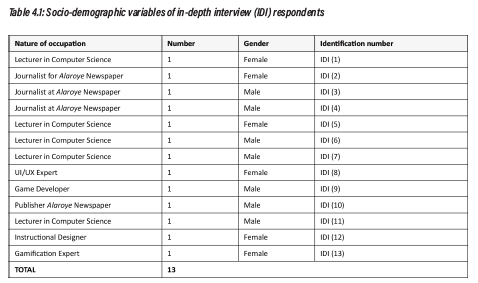
The study population comprised management staff and news reporters from Alaroye newspapers. We also included computer scientists, individuals knowledgeable in game development, instructional design, and user interface and user experience (UI/UX) design. Thirteen individuals were interviewed through a structured interview guide. Unscripted follow-up questions were also allowed during the interview to clarify grey areas. The questions were open-ended to allow the interviewees room to express their views. Four people were interviewed at Alaroye newspapers: three journalists and the newspaper's publisher were purposively recruited for the interview. Although we secured an appointment to interview AlaroyeS manager, she was unavailable for the interview during the field work. There were differences in the interview questions that were asked of journalists, lecturers and game experts. The journalists in Alaroye were recruited purposefully and using a snowball sampling technique since we were unable to determine the total number of journalists at the establishment.
The snowball technique, also referred to as the chain referral method, is a non-probability sampling technique used to access unknown, hard-to-reach or sensitive populations, such as tattooed groups or stigmatised populations (Pasikowski, 2023). The relative ease of constituting a sampling framework has advanced the popularity of snowball sampling as a technique. Thus, we sampled each of the journalists through referrals from colleagues. Two research assistants were recruited in the study, and the interviewees were asked varying questions ranging from their awareness of gamification in journalism to the perceived challenges of implementing the innovation. Opinions on the potential of gamification for increased readership of indigenous language newspapers and cultural propagation among youth were sought. We also elicited responses to questions about the perceived challenges of gamifying news. Finally, the interviewees were asked about the nature of the recent innovation adopted by Alaroye newspapers.
The interviewees were purposively recruited across different tertiary institutions in two geo-political zones of the country, namely the Southwest and North Central zones, where the Alaroye newspaper has readership. The selected institutions were the University of Ilorin, Kwara State, Covenant University Ota in Ogun State, Christopher University Mowe in Ogun State and Dominion University Ibadan, Oyo State. A Computer Science lecturer was sampled across each of the tertiary institutions. Two lecturers were recruited from the Dominion University in Ibadan because one of them combines expertise in Gamification studies and UI/ UX Design. A student trainee in game development and a youth corps member trained in UI UX design were also recruited through snowball sampling. We purposively sampled an instructional designer and a gamification expert from Vancouver in Canada through the gamification group on LinkedIn. Invites were sent to other gamification specialists on LinkedIn, but no one expressed any intention to participate in the study.
We sought to measure the level of awareness of IT professionals about gamification and its prospects and challenges in newspaper publishing. Interview questions were asked about the technicalities of game development, such as the principles guiding game design and implementation to achieve satisfying user experience, engagement and retention. We also asked questions about the malleable aspects of indigenous Yoruba culture that could be incorporated into gamified news. We arrived at a sample size for the study when we reached a saturation point while conducting the interviews, as the interviewees answered the questions in similar ways. The interviews with the journalists were conducted in the Yoruba language. In most cases, journalists responded to questions in the indigenous language. The interviews were conducted in Yoruba with the journalists because we realised while prospecting for the interview that although some of them were interviewed in English, they responded in Yoruba. The journalist responses in the indigenous language were to be expected as they are advocates of the use of African languages. They have thus adopted a decolonial mentality by showing a preference for their native languages. Although it was difficult for one of the research assistants who helped to facilitate some of the interviews as she is a youth and not versed in the repertoire of the Yoruba language, the interviewee provided the required support at critical points. The broader implication of this on the entire finding is that it expanded the duration of the research as we had to translate their responses from Yoruba into English.
In addition to interviewing journalists and IT professionals, one of the research assistants assisted in transcribing the interviews. When the interview transcripts were made available to the researchers, they were read and patterns in the responses were identified thematically to meet the identified research objectives. The data were cleaned to allow for readability. Contrary or divergent responses that did not align with the initial assumptions of the researcher were incorporated into the report as part of efforts to maintain the internal validity of the study. The researchers also ensured that the interview transcripts were accurate through confirmability.
RESULTS
Potentials of gamification for increased newspaper readership
Most of the interviewees agreed that gamification has the potential to increase the readership of African language newspapers. Interestingly, none of the journalists interviewed had prior knowledge of the term "gamification'! Their low level of awareness explains why a few of them were sceptical of the potential of gamification to increase newspaper readership. In contrast, Klouvidaki et al. (2025) in a similar study conducted among editors and media owners argue that interviewees perceive gamifying news as potentially beneficial not only for news engagement purposes but also for providing insights into audience behaviour for actionable editorial planning. Other professionals interviewed in this study showed optimism regarding the potential of gamification to increase newspaper readership, and to foster engagement and retention on online newspaper sites. One of the journalists argued that they may not need any new technological innovation, since Alaroye crime news currently has numerous viewers on YouTube. Another journalist in the same newspaper outlet expressed a contrary opinion. He argued that, "Though we have a presence on social media platforms, the number of viewership and followership on our pages is insignificant compared to those of the British Broadcasting Corporation and other foreign news outlets'. While tracing the antecedents of the dwindling patronage of Yoruba newspapers in the country, Interviewee 3 noted:
The advent of colonialism and missionary activities in Nigeria led to the neglect of African culture, religion and language. We in Yoruba-speaking parts of the country are more interested in the acquisition of English language than the indigenous Yoruba language. In the home, Yoruba is neglected for the English language. As a result, many children are deficient in the oral or written aspects of Yoruba. Consequently, it is difficult for such children to be interested in reading Yoruba newspapers. The majority of those who communicate in the Yoruba are the elderly. How many elderly people buy newspapers? Many are rural dwellers. The reality is that language apathy among youth towards indigenous languages seriously affects the patronage of Yoruba newspapers.
The interviewees conceded that the decrease in patronage for African language newspapers is attributable to the apathy of readers towards the languages. In contrast, Interviewee 9 argued that there is a global decline in newspaper readership:
Not everybody reads newspapers these days, and even the ones that read are elderly people. The younger ones do not care about newspapers, but social media. So, incorporating games into a newspaper is not a guarantee that it will increase readership, but it can if you meet the right audience.
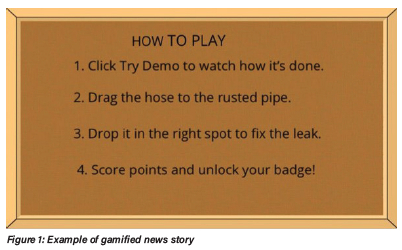
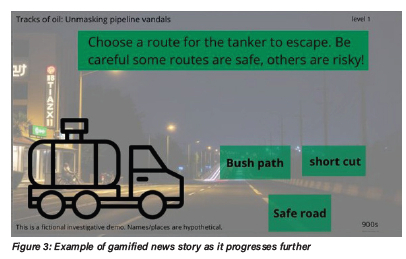
Despite the positions taken by interviewees on the decline in newspaper readership, there was consensus among the interviewees knowledgeable in gamification that the innovation could increase Alaroye's readership if other factors were in place. The patterns of responses of the interviewees to this objective are subsumed into the themes presented. Figures 1 to 4 are pictorial representations of an example of a gamified news story developed by these researchers.




Traffic creation
For interviewees, gamification would create traffic on news websites. Interviewee 1 argued that puzzles have typically attracted readers to physical copies of newspapers in the past. The same principle applies to gamified news. The availability of games on news sites would thus attract new readers and traffic would be created on the site. Interviewee 1 stated:
They can integrate simple games such as "the tap-tap" people play on their mobile phones that link them to external games, such that if you play the games for a certain period, you are likely to win a token. Thus, games such as crosswords, puzzles and sports prediction can be integrated. In addition to that, there are so many available online games that can be integrated to attract young people. Young people can be motivated to participate in games based on motivational rewards, such as recharge cards, which would create traffic on the website.
Other interviewees reiterated this point, albeit in different ways. For many of them, the reward system was a side attraction for readers, which could increase newspaper readership. Interviewee 5 noted this:
If gamification is done properly, it will attract more users to a website, and users will be retained over time. When not properly developed, it can discourage the users. So, as an innovation, I think it is a good idea for a website to employ, but the games must be made from the user's perspective, so that the game will neither be too challenging nor too simple for readers to ensure they are motivated to play the game. The game should include things such as badges or a leaderboard to increase the competitive spirit of users and motivation to play the games, which will increase the retention of readers on the website.
There was consensus among the interviewees that the availability of a reward system on gamified apps usually serves as a side attraction to the readers. This, for them, would attract new readers to such a site. Another interviewee, however, added another twist to the discussion when she argued that gamification is not a magic wand that delivers a miracle, regardless of other factors. According to her (Interviewee 13):
It depends on the audience demographics. Gamification is not a miracle; it must be done appropriately. It is like a topping or salad dressing, but the right ingredients need to be put in place.
It was apparent from the responses that although gamification can attract young readers to news websites, it must be deployed cautiously, as it may be counterproductive. For example, some IT professionals noted that the entire news website should not be gamified; only some aspects of the news should contain games. The games included must also be simple and easy to win to attract readers to the site. This might induce users to share news on social media and engage with news through likes or comments.
Quality content
Another theme that emerged from the interviewees' responses was that gamification cannot be used as a one-size-fits-all technique. Thus, gamification is not a talisman that garners readers' patronage regardless of the content. The interviewees argued that such technological innovation could only produce results when news content was of good quality. The following response from Interviewee 11 emphasises the importance of quality content:
An average youth thrives on anything fun. Most platforms that have gamification on their site would attract audience. The content should be of good quality to attract a larger audience. Quality content on social, psychological and educational issues should be provided. Gamification cannot replace the quality of content.
The pattern of responses from the interviews also suggests that, in addition to incorporating quality content on websites, Alaroye could deploy gamification to introduce a variety of content. Interviewee 12 acknowledged this:
Reading news will become more interesting on the website, and this will distinguish Alaroye newspaper from others. News reading will no longer be boring, and the website will not be monotonous. Gamification will introduce a variety of content to the site. The site will not be predominantly news. It will introduce new and exciting things for people to expect daily.
POTENTIAL OF GAMIFICATION FOR USER ENGAGEMENT AND RETENTIONThe interaction among game mechanics, dynamics and aesthetics contributes to user engagement on news websites. For interviewees, the aesthetics of the game are the visually appealing aspect of the game, which attracts readers to the site. Thus, "game designers' knowledge of the demographics and interests of the target audience would determine how the game was designed to suit audience preferences", argued the gamification expert. We observed from the pattern of responses that some interviewees acknowledged that the UI/UX interface plays a crucial role in user engagement and retention.
Design of the user interface/user experience
An attractive and easy-to-understand UI (user interface) design creates a favourable UX (user experience). "It helps ensure that readers have a good experience while playing the game on a website" said one of the interviewees. The UI is the audience's point of first contact with the game. It is a website's functionality, simplicity and navigation functions. The UX refers to how the design of the interface impacts usability and the emotional experience of the website. The UI and UX are integral aspects of game design and mechanics. According to Interviewee 5, although the UI/UX design facilitates user engagement, its design must be carefully done to avoid distracting people from the news:
UI and UX are the user interface and user experience of a website. These are things done or created before users start interacting with the platform. It is good for the UI and UX to have been drawn for every action the website will perform, including gamification, so that the games will not be overemphasised to the detriment of the news. It will also give developers an idea of the website's usability and interactivity.
Meanwhile, two of the interviewees agreed that gamification cannot foster user engagement if the UI design is complex; hence, for a satisfying UX, game developers are encouraged to include a game demo or tutorial on the website to make the game relatable. According to Interviewee 9:
Games should be developed to facilitate ease of understanding. A game must not be complicated to stimulate the interest of individuals not interested in gaming. A step-by-step guide (tutorial) on how to play the game would motivate people to try playing it.
Similarly, the user interface design on newspaper websites should incorporate a feedback loop to accommodate the UX. This would allow game developers and news agencies to understand readers' experiences of usability and interaction on the website. In addition to the UI design, readers' retention can be facilitated through incentives such as rewards point scoring and leaderboards, some interviewees said. According to Interviewee 12:
Badges are shareable on links. Readers can copy and share the link, so people will believe that they got the Alaroye badge. The badges should be designed in a way that they will bear the inscription of Alaroye. It may also indicate that the readers have completed certain goals on their website. The badges might be instrumental in recruiting readers if the badges are attached to coupons for free items. In other words, the badges should carry an advantage for the readers.
However, the responses of the gamification expert indicate that user engagement and retention may be a mirage if there is no adequate planning in terms of goal setting for the problem statement:
When designing gamification, the most important thing is to have a clear objective and to ensure that the gamification is designed to attract the audience. For example, the gamification of the piano staircase was developed because people were not going to use the normal staircase despite its health benefits; they prefer escalators. So, the normal staircase was changed to a piano case. When you do that, it produces some melody. So, people were willing to try the piano stairs instead of the escalator. People moved up and down the staircase due to the added game elements.
Concerning news sites, reader retention is achievable if there are differences in the game levels. In the beginner stage, the complexity of the game should be moderate to motivate players. The difficulty of the game should be varied across levels to facilitate user engagement and retention. This is the focal point of the next theme under review.
Balance of game complexity
Some interviewees agreed that the difficulty of the game could be enhanced to motivate readers to participate in the games. Interviewee 1 said the following:
In gamification, the games should not be too easy, they should also not be too complex for the readers. If it is too easy for the readers, there will be no challenge, there will be no stimulation. The complexity should be average. Another thing to be considered is the more a person plays a game, the higher their proficiency. The complexity of the game should be increased at different levels; therefore, the higher a reader progresses, the more the complexity. The complexity of the game can range from simple to average and above average to stimulate the reader's interest.
However, Interviewee 11 discussed the issue of balancing the complexity of the game from a different perspective. According to him:
Game mechanics can drive user engagement. If games are boring and not interesting, they cannot drive user engagement. Games should be designed so that they revolve around the message. The design of a game should blend with the message. Game mechanics (characters and animations) should not be too difficult. The aged should have games with which they can easily interact. There should not be stereotypes.
Contrary to the belief that gamified apps appeal to young people with Internet skills and not elderly people, the foregoing statement suggests that gamified news can equally appeal to elderly readers - it all depends on how the mechanics of the game are designed. Furthermore, Interviewee 13 noted that game mechanics may reveal the differences in individual motivation:
We have different types of players (personality types), and people play games for various reasons. Some people play games because they are goal achievers; there are also socialisers, explorers and killers. The socialisers play games because they want to share the results.
Hence, when game mechanics are designed appropriately, third-party apps can test the efficiency of gamification. This metric provides useful feedback to game developers, consultants and news agencies. Gamified news increases the user's time on a website. The average time spent on a news website will thus increase with the incorporation of game elements.
CHALLENGES OF GAMIFICATIONGamification of news may be attractive to local language newspapers, particularly with the prospects it offers. However, there are limitations to the implementation of the innovation which are subsumed in the themes described below.
Concerns about finance/technology
Although the cost of developing gamified news through its sophisticated technology and added incentives was described as huge by participants, their responses also indicate that local language newspapers may have to grapple with orienting readers to the innovation and ensuring its sustainability. According to one of the journalists, Interviewee 3:
Readers may not accept the innovation. We may have to promote it before it is received. Another challenge may be related to finances. The reward system for winners requires financing.
For Interviewee 11, it was important to consider the issue of the sustainability of innovation before implementation: "Whatever they are trying to start now, how will they sustain it?" In contrast, Interviewee 12 argued that "While finance might be a problem, Articulate Storyline has a free trial for a month for whatever needs to be done."
Articulate Storyline is a software for e-learning, with interactive tools for news engagement and immersive storytelling. Its use in gamifying news can be limited by finance, particularly if free trials are not available. On the flip side, Interviewee 11 argued that whatever additional overhead cost may be accrued, these could be recouped over time. He noted the following:
It is going to be an investment/dividend stage. People tend to advertise on a page that has traffic, where there are more readers and engagement. It would not be difficult for businesses to invest when there is gamification.
However, for one of the interviewees, some people perceive games as a complete waste of time. People may feel that the game distracts from the news.
User interface and UX design
The UI (user interface) design of gamified news describes users' ease of navigation online; it determines users' experience of the story and willingness to engage with it or otherwise. Considering the technicalities involved in developing gamified news, journalists and publishers must carefully consider the nuances before adoption. We understood from the perspectives of some IT professionals in this study that a friendly UI design allows readers to navigate a website. Publishers were also warned against gamifying the entire news. Interviewee 5 argued this point:
One of the challenges of gamification is the design of the interface and user experience. If the gamification is simple, there may be no issues, but if it is complex and the users find it difficult to navigate a page, then there will be a challenge. If the gamification is too much in the newspaper, it may distract from the news story.
The foregoing position was echoed by another participant who argued that gamifying all aspects of news on a website would introduce further complexity and might be counterproductive. In addition to complexity, "Readers might get bored/tired, particularly when gamified elements are perceived as difficult or time-consuming" the instructional designer, Interviewee 13, opined. "To protect against reader boredom, it is recommended to attach rewards to gamification and reduce the complexity of the game'; However, Interviewee 11 expressed another perspective on the user interface and user experience. He observed that "publishers may not have the platforms to design a user interface that perfectly fits the Yoruba language. Most existing platforms have challenges regarding other languages besides English'.
Adapting games to individual needs
Going by the procedures for gamifying news, it is important for games to be tailored to suit the peculiarity of individual players. According to Bartle's typology of players, there are the Achievers, Socialisers, Killers and Explorers. Although there are recent changes to it, this typology forms the bedrock of other emergent ones. However, it goes without saying that this typology must be contextualised to reflect the African indigenous culture and cater to the needs of diverse audience categories. "If the game developer does not understand the context of the African culture, it will be difficult to get the game done. Some games like Ayo might not be familiar to young people, so this might discourage them from playing the game" (Interviewee 5).
Interviewee 13 expressed a similar viewpoint, suggesting a way to mitigate the challenge:
You will have to pilot the gamification among a group that shares the same characteristics as the real population. Then you can find out what is going to happen and can work on it.
POTENTIAL OF GAMIFICATION FOR CULTURAL PROPAGATION/PRESERVATION
The interviewees expressed divergent opinions on the useful elements of Yoruba culture for propagation and preservation. From the responses, we deduced that online games can be designed like the typical Ayo game and used for cultural propagation. Some other interviewees argued for the incorporation of proverbs into quizzes.
Cultural-specific games
Developing culture-specific games, for some of the interviewees, would improve the readers' knowledge of the language. For one of the interviewees, however, "Game mechanics should be suited to the things readers are familiar with in the real world. It should not be abstract, to guarantee ease of use'' For another of the interviewees, the introduction of Yoruba cultural principles such as honesty, integrity and other moral conduct could be built into games for cultural propagation. Interviewee 11 observed this:
People are naturally affected by what they see. We can gamify whatever values we want to sustain. Yoruba culture preaches honesty, respect, mutual relationships, integrity and moral conduct. All of these can be translated into gamified applications.
From the perspective of the Alaroye newspaper publisher, it would be easier to incorporate the entertaining aspect of Yoruba culture, such as music and drama, into gamified news. He opined that the Ayo game or traditional wrestling is viable for cultural propagation and preservation. However, for other interviewees, cultural elements could be incorporated into games for educational and recreational purposes. Interviewee 5 acknowledged this:
There can be games to learn Yoruba. For example, the first level of the game can be in the Yoruba alphabet. It can teach users the Yoruba consonant and vowel sounds, after which questions that test user's knowledge and scores based on performance will be given. If their performances are recorded on a leaderboard, users' morale will increase as they will be encouraged to learn more.
One of the interviewees was pessimistic about the rationale for developing and deploying cultural elements in games. Such games, according to her, would have to be developed from scratch.
DISCUSSION OF FINDINGS
Although gamification has been extensively applied to diverse fields of human endeavour in Africa, such as education (Mustafa et al., 2022), marketing (Dogbe, 2023; Nel, 2022) and health promotion (Igwilo et al., 2024; Pozuelo et al., 2023), it is apparent that the concept of gamification has not received much scholarly attention regarding journalistic practices on the continent. This study explored the prospects of gamification for increasing the readership of Alaroye newspaper in terms of user engagement and retention. The construct of SCT informed our decision to investigate whether game elements could be deployed to promote cultural learning on African language news websites. Many of the interviewees affirm that gamification could foster increased readership of indigenous language newspapers. Some interviewees also noted that it could foster cultural learning. This is in tandem with previous scholarly positions on gamified news, as the interactive nature of gamification creates more impactful stories and changes the audience from passive receptors of information to active participants (Jebastian et al., 2024). The interviewees in this study also agreed that the accessibility of the audience to immediate feedback and the increased tendency to revisit news platforms and share experiences are part of the opportunities offered by gamification. These opportunities would, no doubt, induce readers' loyalty to the newspaper website.
The findings in this study also revealed that diverse Yoruba cultural elements such as music, drama, proverbs, vowel and consonant sounds, traditional Ayo and wrestling incorporated into online games could promote the Yoruba cultural heritage among youth. However, such traditional online games could be challenging to develop but would potentially educate young people while entertaining them. The nascent development in game studies in Africa has challenged the availability of African content/ storytelling in online games. According to the findings in this study, developing digital games with African content may be challenging for several reasons. Publishers may not have the platform to design a UI (user interface) that perfectly fits the Yoruba language, as most existing platforms have challenges regarding other languages besides English. Similarly, creating African games online may be herculean because "they have to be developed from scratch". This aligns with the propositions of SCT on the impact of environmental factors on human behaviour as the specificity of geographic boundaries will affect not only people's reception of gamified news but also the availability of resources for its launch.
Nevertheless, Ferrer Conill (2018) argues that digital news media have increasingly used gamification to solve financial problems arising from the audience attrition rate. While newspaper outlets are experiencing declining readership, online gaming has garnered considerable audience attention (Ferrer Conill, 2018). However, some of the interviewees in this study argued that gamification cannot increase newspaper readership, as other extraneous factors could hamper its effectiveness. The UI (user interface) and UX (user experience) of a game app or website can, for example, either enhance gamified news or detract from the news altogether. In the words of one of the interviewees, "the game may distract readers; they may end up not reading the news but playing the game throughout'! This argument is consistent with the submission of Vos and Perreault (2020) who observed that readers were unlikely to gain interest in news for informational purposes, as the entertainment aspects of gamified news were often diversionary. The propositions of SCT state that an individual's perceived self-efficacy with respect to an action, such as gamified news and the positive valence of the behavioural outcome in terms of rewards such as bonuses, tokens and online incentives, can motivate engagement. Individuals may therefore access news websites not necessarily for information seeking but based on the availability of rewards. When readers access news purely for entertainment, it could erode the informational role of the media and portray journalists as charlatans. Meanwhile, African language newspapers are meant to produce a socio-politically informed and empowered citizenry through their reports (Mpofu & Salawu, 2018). Media reports contribute to the quality of democracy in any society (Conill & Karlsson, 2016; Motsaathebe, 2018).
However, gamification has increased in popularity and adoption rate, with a growth in mobile telephony, Internet connectivity and social networking platforms, as users eagerly share their progress and badges won on social media platforms (Garcia et al., 2022). Although the adoption rate of gamification has grown significantly, interviewees advised that caution is a necessary ingredient in its implementation.
For interviewees, an entire news website should not be gamified; only specific aspects of the news should incorporate game elements. This position is similar to those stated in the literature, as some scholars have argued that gamification can be exploitative of consumers, particularly as users' algorithms are harnessed in developing consumer-centric games (Kim and Werbach, 2016; Marczewski, 2017). Harnessing user algorithms in the development of games raises critical ethical concerns, particularly since some games exploit the vulnerability of users and expose them to gambling or dangerous games. This is consistent with the findings of this study as one of the interviewed journalists expressed a similar concern when he argued that "The newspaper may also face opposition from religious people who frown against playing games attached with monetary rewards because they think it can corrupt readers" The popular Pokémon game reportedly put some players in harm's way as they behaved in unsafe ways, and in a particular instance, a player broke into someone else's house. This incident led to online discussions about the morality of developing such games for users (Marczewski, 2017; Wagner-Greene et al., 2017).
In contrast, Marczewski (2017) argues that the game developer is not liable for the actions or inactions of players since players are not compelled to download the game. He further stated that the designers intend to create fun, enjoyment and make money from the enterprise, which, according to him, were valid and positive reasons. Conversely, Bogost (2015) argues that gamification is bullshit. Bullshit in this sense implies to conceal, impress or to coerce. Therefore, gamification, for him, is manipulative and exploitative of consumer interests. Although game designers may use gamification to motivate users in habit formation, it is expedient to state here that humans still have the free will to participate in a gaming context despite online peer pressure. In addition, the downsides of gamification do not exclude the fact that it offers immense benefits in shaping human behaviour. We therefore recommend that to advance theory on the gamification of news in Africa, the peculiarity of the African environment should be considered in terms of her culture and the import of linguistic differences. Hofstede's (2011) categorisation of national culture may provide a framework for the gamification of news. Finally, McGonigal (2011), one of the crusaders of gamification, concludes that with gamification our reality as humans is broken.
CONCLUSION
The Alaroye, an important African language newspaper in Nigeria, has been at the forefront of the campaign for the standard orthographic Yoruba language with implications for its adoption among youth. Unfortunately, Alaroye, like many local language newspapers in the country, is struggling to survive. The high cost of newsprints, poor reading culture among the youth and low advertising revenue are some of the factors affecting the newspaper. We explored the potential and prospects that gamification offers to the newspaper for sustained readership. Although gamification allows for immediate feedback, reader engagement and retention, it must be implemented cautiously, particularly in news reports. Gamification of news may reduce news quality, as game designers who are not trained journalists may be unable to draw the lines between entertainment and facticity - the hallmark of journalism.
REFERENCES
OVERVIEW OF LITERATURE
- Adeyeye, B. & Salawu, A. (2024). Sustainability of select indigenous-language newspapers through advertising in Nigeria: appraising the success of Alaroye and Aminiya newspapers. African Journalism Studies, 45(2):156-170.
- Arafat, R.K. (2020). Rethinking framing and news values in gamified journalistic contexts: a comparative case study of Al Jazeera's interactive games. Convergence, 26(3): 550-571.
- Armstrong, M.B & Landers, R.N. (2018). Gamification of employee training and development. International Journal of Training and Development, 22:162-169.
- Arnold, B.J. (2014). Gamification in education. Proceedings of the American society of Business and Behavioural Sciences, 21:32-39.
- Bogost, I. (2015). Why gamification is bullshit. The gameful world: Approaches, issues, applications, 65:65-79.
- Conill, R.F. & Karlsson, M. (2016). The gamification of journalism. Emerging research and trends in gamification. IGI Global, 356-383.
- Dogbe, D.D. (2023) The impact of gamification and brand engagement on customer loyalty to betpawa ghana. Dissertation: Vilniaus universitetas.
- Dowling, D.O. (2020). The gamification of digital journalism: innovation in journalistic storytelling. Routledge.
- Fadipe I.A. & Salawu A. (2021). Influence of African indigenous language media in Covid-19 digital health messaging. Catalan Journal of Communication and Cultural Studies, 13(2):267-284.
- Fasan, R. (2018). Alaroye: political contestation, genres, innovations and audience in a Yoruba-language newspaper. Africa, 88(4):840-862.
- Ferrer Conill, R. (2018). Gamifying the news: exploring the introduction of game elements into digital journalism. Karlstads universitet.
- Garcia, J.E., Rodrigues, P., Simoes, J. & DA Fonseca, M.J.S. (2022). Gamification strategies for social media. Implementing automation initiatives in companies to create better connected experiences. IGI Global.
- Hofstede, G. 2011. Dimensionalising cultures: the Hofstede model in context. Online Readings in Psychology and Culture, 2(8).
- Igwilo, S.N., Ujuagu, A.N., Alozie, C.P., Anyaeji, E.N. & Okoye, CA (2024). Influence of gamification on students' motivation, attitude, knowledge and engagement in sexual health education among undergraduate adolescents in Awka, Anambra state. Nigerian Journal of Health Promotion, 17.
-
Jebastian, J.H., Kamil, A.H., Periyakannan, K. & Kaviyarasan, D. (2024). Gamification in journalism: transforming news consumption through interactive expereinces. SSRN. https://papers.ssrn.com/sol3/papers.cfm?abstract_id=5087080
» https://papers.ssrn.com/sol3/papers.cfm?abstract_id=5087080 - Jun, M. and Lucas, T. (2025). Gamification elements and their impacts on education: a review. Multidisciplinary Reviews, 8:2025155-2025155.
- Kim, T.W. & Werbach, K. (2016). More than just a game: ethical issues in gamification. Ethics and information technology, 18:157-173.
- King, D., Greaves, F. & Exeter, C. (2013). "Gamification": influencing health behaviours with games. London: Sage Publications, 76-78.
- Klouvidaki, M.I., Antonopoulos, N., Kostarella, I. (2025). Exploring gamification in online journalism: perspectives from media owners through interviews. Journalism and Media, 6(3):151.
- Kumari, H and Gujral, H.K. (2023). A study of gamification and its effect on consumer behaviour. International Journal of Advanced research in computer science 14(4):1-16.
- Luszczynska, A., and Schwarzer, R. (2015). Social cognitive theory. In M. Conner & P. Norman (eds). Predicting and changing health behaviour: Research and Practice with social cognition models. McGraw Hill Education, open university press, 225-251.
- Marczewski, A. (2017). The ethics of gamification. XRDS: crossroads, The ACM Magazine for Students, 24:56-59.
- McGonigal, J. (2011). Reality is broken: Why games make us better and how they can change the world. Penguin.
- Mirzoyeva, L. (2021). Gamification in teaching theoretical linguistic disciplines. Society. Integration. Education. Proceedings of the international Scientific conference. 454-466.
- Motsaathebe, G. (2018). When the subaltern speaks: re-examining indigenous-language media as alternative public sphere during colonial South Africa. Journal of African Media Studies, 10(2):169-183.
- Motsaathebe, G. (2023). Prospects and challenges for indigenous African language media in the digital age. New Journalism Ecologies in East and Southern Africa: Innovations, Participatory and Newsmaking Cultures: 225-249.
- Mpofu, P. & Salawu, A. (2018). Culture of sensationalism and indigenous language press in Zimbabwe: implications on language development. African Identities, 16(3):333-348.
- Mustafa, A.S., Alkawsi, G.A., Ofosu-Ampong, K., Vanduhe, V.Z., Garcia, M.B. & Baashar, Y. (2022). Gamification of e-learning in african universities: identifying adoption factors through task-technology fit and technology acceptance model. Next-Generation Applications and Implementations of Gamification Systems. IGI Global.
- Nel, V.L . (2022). Exploring gamification in the South African fashion retail industry. Dissertation: North-West University South Africa.
- Nkhata, B., Mkandawire, S.B., Nachiyunde, K., Phiri-Nalube, P., Kaani, B., Mulenga, I.M., Phiri, C., Chileshe, B., Sichula, N.K. & Sikayomya, P. (2019). Exploring selected theoreis applicable to educational disciplines and social science research. International Journal of humanities social science and education 6(12) 97-116
- Onyenankeya, K. (2022). Indigenous language newspapers and the digital media conundrum in Africa. Information Development, 38(1):83-96.
- Pasikowski, S. (2023). Snowball sampling and its non-trivial nature. Przeglad Badan Edukacyjnych (Educational Studies Review), 2:105-120.
- Pozuelo, J.R., Moffett, B.D., Davis, M., Stein., Cohen, H., Craske, M.G., Maritze, M., Makhubela, P., Nabulumba, C. & Sikoti, D. (2023). User-centered design of a gamified mental health app for adolescents in sub-Saharan Africa: multicycle usability testing study. JMIR Formative Research, 7:e51423.
- Salawu, A. (2006). Indigenous language media: a veritable tool for African language learning. Journal of Multicultural Discourses, 1(1):86-95.
- Salawu, A. (2018). African language digital media and communication. Routledge London.
- Schmidt-Kraepelin, M., Krohmann, S., Sunyaev, A. & Thiebes, S. (2020). The role of gamification in health behavior change: a review of theory-driven studies. 5rd Hawaii International Conference on Systems Sciences.
- Tshabangu, T. and Salawu, A .(2022). Technology innovation and digital journalism practice by indigenous african-language newspapers: The case of uMthunywa in Zimbabwe. African Journalism Studies, 43:37-52.
- Vos, T.P. & Perreault, G.P. (2020). The discursive construction of the gamification of journalism. Convergence: The international Journal of Research into New Media Technologies, 26(3):470-485
- Wulan, D.R., Nainggolan, D.M., Hidayat, Y. Rohman, T & Fiyul A.Y. (2024). Exploring the benefits and challenges of gamification in enhancing student learning outcomes. Global International Journal of Innovative Research, 2(7):1657-1674.
- Wagner-Greene, V.R., Wotring, A.J., Castor, T., Kruger, J., Mortemore, S., Dake, A.J. (2017). Pokemon go: healthy or harmful. Journal of Public Health, 1:35-36.
- Yang, X., XI, N., Tang, H. & Hamari, J. (2023). Gamification and marketing management: a literature review and future agenda. Americas Conference on information Systems. Association for Information Systems.
Accepted October 2025