Breaking through the clutter and the impact of ambiguous arguments on consumers' purchase decisions
Abstract
The study explored the proliferation and codification of discursive resources related to ambiguous arguments. This has led to a point of clarification. Marketing communication scholars have purposefully neglected the impact of ambiguous arguments, focusing instead on strategic clarity. As a result, there is a lack of conceptualisation and clarity surrounding this topic. Nonetheless, studies about ambiguous arguments are still nascent because of the overbearing criticisms that ambiguity hinders effective communication and persuasion. The study experimented to investigate the impact of ambiguous arguments on consumers' purchase decisions and demonstrated that ambiguous arguments elicit favourable purchase decisions (participants (N=260): ambiguous 130 high and 130 low). The findings reveal that highly ambiguous arguments were rated significantly more with relevance, actuality, accuracy and comprehensiveness. In addition, individuals exposed to highly ambiguous argument advertisements elicited more favourable purchase decisions than those exposed to low ambiguous argument advertisements. The findings suggest that highly ambiguous argument (ads) undoubtedly affect consumers' purchase decisions because of the newness, complexity and irresolvable argument presented. The motivation could not predict the relationship between ambiguous arguments and consumers' purchase decisions. The study tested some of the key predictions of the elaboration likelihood model and strategic ambiguity model with the cues; and discovered that individuals are persuaded by central or peripheral routes based on their capacity to elaborate. The implications and future studies concerning the current theoretical framework and verifiable findings on the impacts of ambiguous arguments are carefully discussed, based on the findings.
Ambiguous arguments; billboard advertisement; discursive resources; elaboration likelihood model; strategic ambiguity
INTRODUCTION
Marketing messages play a crucial role in enhancing brand communication. Their effectiveness depends on whether they resonate with the target audience. However, weak messages and inadequate stimuli in advertisements discourage individuals who are highly involved in processing information, thereby reducing the likelihood of persuasion (McAlister & Bargh, 2016). Brand messages should provide specific information about the benefits and risks of the products. Unfortunately, this requirement is often ignored due to the time constraints imposed by various media platforms. Strategic ambiguity, as a discursive resource (Johansen, 2018), provides advertisers and brands with an opportunity to withhold important information about their products by blurring the product details or providing insufficient information (Nasr, 2023). This is achieved through the use of polysemy, tropes and unconventional wording arrangements in the form of ambiguous cues or discursive resources (Kokemuller, 2021). However, marketing communication scholars have purposefully neglected the impact of ambiguous arguments, focusing instead on strategic clarity. As a result, there is a lack of conceptualisation and clarity about this topic. Studies about ambiguous arguments are still nascent because of the overbearing criticisms that ambiguity hinders effective communication and persuasion.
Based on the conceptual nomenclature of ambiguity in billboard advertising and its influence on consumers' purchase decisions, ambiguity refers to a lack of sufficient information or imagery in a presentation (Han & Hong-Lim, 2015). Ambiguity can be seen as vagueness that arises from limitations in the available information on a specific subject (Eisenberg, 1984; Simonovic & Taber, 2023). When individuals perceive ambiguity about a particular subject, they may engage in doubtful assessment and behavioural circumvention or they might rely on prior knowledge to interpret the subject matter if they perceive creativity in the conceptual nomenclature of ambiguity (Simonovic & Taber, 2022). It is important to note that there is no conclusive evidence that ambiguity always hinders effective communication; ambiguity can sometimes be used as a strategy to facilitate organisational communication and goals. Therefore, information regarding ambiguity as an impediment to effective communication is conflicting because specific advertising content has yet to completely avoid the use of ambiguity in its execution and presentation (Simonovic & Taber, 2023).
Advertisers and companies often intentionally use ambiguous arguments and rhetorical elements to set their brand apart from competitors. This is achieved through the use of rhetorical devices such as phrases, gestures, images, digital effects and colours, which can have different meanings for different individuals. For instance, an advertisement may claim to offer the "hottest and spiciest burger" or be touted as the "best candy" which emphasises qualities such as being "big, strong and reliable" (Kokemuller, 2021). These ambiguous arguments rely on polysemy, tropes and unconventional wording arrangements that lack sufficient information and allow for multiple interpretations among different individuals (Eisenberg, 1984; Gordon, 2022; Han & Hong-Lim, 2015; Park & Shapiro, 2023).
Previous studies have demonstrated the impact of ambiguous messages on audiences in various fields, such as health communication, political communication, marketing communication and medicine. For instance, Nasr (2023), Park and Shapiro (2023), Kellner et al. (2022) and Holford et al. (2022) all emphasise the use of ambiguity to effectively convey meaning and promote openness among different individuals in order to achieve organisational objectives. Strategic ambiguity, as outlined by Simonovic and Taber (2023), involves openly inferring meaning on a specific subject and it remains a central strategy. Despite the increasing use of strategic ambiguity in advertising, empirical literature in this area is limited. There is a need to adequately conceptualise ambiguous arguments in order to bridge the gap and enable inadvertent advertisers and scholars to better understand their effects.
Despite the dimensions and space occupied by billboard advertisements, their strategy of concise messages (consisting of nine words) alongside striking visuals presents a significant degree of ambiguity. This is primarily due to the fact that the majority of brand communications displayed on billboards lack adequate detailed information regarding the associated products and services. As a result, a comprehensive examination of this approach to ambiguity is warranted. Therefore, this study aims to better understand the impact of ambiguous argument on consumers' purchase decisions and how consumers exposed to high ambiguous argument differ from those exposed to low ambiguous argument in their purchase decisions. In addition, one could as what is expected from using ambiguous argument and the impact this offers to companies and practitioners. The study identifies consumers' desirability and tolerance of ambiguous argument in billboard advertisements in terms of their purchase decisions.
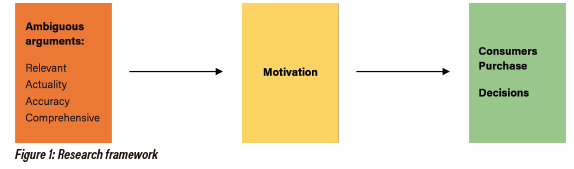
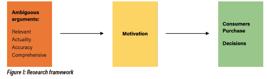
This study contributes to existing research by addressing the influence of ambiguous arguments on consumers' purchase decisions. By focusing on this topic, we hope to fill the gaps in the literature and methodology and add to the growing interest in understanding ambiguous arguments. Moreover, we examine the differences in purchase decisions between individuals exposed to highly ambiguous arguments and those exposed to low ambiguous arguments. In addition, we explore the role of motivation as a mediator in the relationship between ambiguous arguments and purchase decisions. Given the current era, with numerous advertising and media platforms, competition is fierce and it is increasingly challenging to capture consumers' attention.
This article is structured in the following order. First, we begin with a literature review to establish the connection between ambiguous argument cues and consumers' purchase decisions. Next, we outline the methodological perspective used to address the research objectives. Furthermore, we present the study outcomes and emphasise the objectives that support the theory of strategic ambiguity. This theory provides an excellent opportunity to conceal crucial information about products by using blurred or insufficient information, relying on techniques such as polysemy, tropes and unconventional wording arrangements. In addition, we discuss the elaboration likelihood model, which categorises and classifies how individuals process persuasive communication.
Ambiguous arguments
According to Branković and Žeželj (2016) and Pand and Gui (2016), the argument epitomises the provision of livelihood for refuting an unverifiable assertion with the intention of persuading a rational detractor about the appropriateness of the assertion. It is important to note that the argument used in persuasion is either logical or pragmatic. It aims to present information that is evaluated based on the desirability of the outcomes. Accordingly, Pand and Gui (2016) articulate that messages are created to fulfil the purpose of advertising while keeping the brand in mind. The advertisement focuses more on the organisation and structure of the information than the content of the message. The thoughtfulness of message organisation includes argument settings, in which the message has to be convincing to consumers from the very beginning, message sending and related arrangement. At the same time, Flanagin et al. (2020) and Kulkarni et al. (2020) suggest that messages are considered more credible and convincing to individuals who have a high need for cognition. Meanwhile, Kao and Du (2020) mention that argument quality is perceived as the distinction of information received by an audience and is judged based on its effectiveness, relevance and persuasiveness to the recipient.
The new argument refers to a situation or process in which an individual comes across new and uncategorised information (Xu & Tracey, 2015). Previous studies have examined how new arguments in advertisements elicit emotional responses, as shown by Jacobs et al. (2021), Luttrell and Petty (2021), Barrera et al. (2020) and Nye et al. (2008). These studies have found that novel arguments can trigger both positive and negative emotions, as well as cognitive processes that lead to uncertainty and further processing of stimuli. Blair (2020) suggests that individuals are motivated to acquire knowledge and evaluate new cues in order to interpret the context correctly. When encountering and processing unconventional or new ideas or information, individuals tend to form attitudes based on their affective reactions. Luttrell and Petty's (2021) study found that participants rated messages as more persuasive when they were concerned about the safety of others in relation to public health directives. Therefore, a new argument must resonate with consumers' values in order to elicit their affective reactions. Furthermore, Espinoza (2021) explains that rhetorical arguments include threats, which impose sanctions when the opponent does not accept the proponent's proposal; rewards, which are used to entice the opponent to take a specific action by offering another action as a reward or by providing something the opponent needs; and appeals, which aim to persuade the opponent by offering a reward.
Several previous studies have examined strategic ambiguity and its impact on ambiguous arguments.
For instance, Holford et al. (2022), Koniak and Cwalina (2022), Shishkin and Ortoleva (2023), Hopkins et al. (2023) and Simonovic and Taber (2023) have all conducted research in this area. According to Simonovic and Taber (2023), ambiguous health information may not always result in maladaptive effects or behaviour. Participants with a high level of understanding of the information did not generally report differences compared to those with a low level of understanding. Similarly, Holford et al. (2022) found that risk messages that clarified the risk event reduced misinterpretations. However, existing misinterpretations of coronavirus risks, for example, remained resistant to correction due to ambiguity. Participants recognised that the risk involved experiencing severe symptoms, but over half of them also believed that the risk was related to infection. Consequently, nonvulnerable individuals were perceived as less likely to be infected than vulnerable individuals.
Meanwhile, Koniak and Cwalina (2022) demonstrated that the use of argumentative ambiguity by senders can be beneficial for avoiding recipients' objections. However, it can have undesirable consequences for the appraisal of the sender's trustworthiness and the electors' intentions. Shishkin and Ortoleva (2023) discovered that, in standard models, ambiguity-averse agents experience a dilation of belief sets and a decline in the value of bets, while ambiguity-seeking agents saw an increase in the value of bets. Interestingly, they also found that ambiguity-averse individuals did not experience a change in the value of bets, whereas ambiguity-seeking individuals saw a substantial increase. In addition, test bets on ambiguous urns elicited a significant reaction to ambiguous information. Similarly, Hopkins et al. (2023) revealed that individuals who receive ambiguous messages about COVID-19 interpret correct behaviour in a manner similar to those who receive no message, suggesting no evidence of an impact on interpretations. Furthermore, ambiguous messaging increased intentions for insecure socialisation, particularly among individuals aged 18-39 who socialised prior to the pandemic. These studies imply that the use of ambiguous messages to convey meaning among people was counterproductive at the time. These studies failed to acknowledge strategic ambiguity as a discursive resource and the effect of ambiguous arguments in creating unity and expansion of meaning and interpretation to achieve organisational goals. Moreover, Zeng et al. (2020) assert that arguments are linked statements presented for reasoned judgement to defend or refute a viewpoint. They are critical for decision making, knowledge building and bringing forth truths and better ideas.
In conclusion, according to Forster et al. (2010), Brone and Coulson (2010), Broecks et al. (2016) and Feathers (1969), the novel categorisation theory states that events are perceived as new when they do not fit into existing categories. When faced with unfamiliar situations, individuals naturally strive to understand them, leading to comprehensive handling and the creation of stylish and novel content. Broecks et al. (2016) further argue that familiarity with information can sometimes delay or negate the expected response. Overall, this research indicates that consumers are interested in messages that introduce novel or unfamiliar situations.
Relevance of arguments
Consumers perceive the relevance of arguments presented in advertising and marketing campaigns based on various factors. Research suggests that the structure of the argument, including the presence of irrelevant but representative conditionals, hierarchically related claims and multiple data propositions supporting a single claim can significantly influence claim acceptance (Charles & Areni, 2008). Moreover, the cultural congruence between the appeal and argument in an advertisement plays a crucial role in consumer response, especially in a competitive environment (Jain et al., 2020). In addition, Weber et al. (2020) showed that the use of microblogs such as Twitter (now X) for hashtag campaigns can impact brand engagement differently across international and Indian brands, highlighting the influence of cultural differences and the medium of communication on information diffusion. These findings emphasise the importance of considering argument structure, cultural nuances and medium richness in shaping consumer perceptions of advertising arguments.
The relevance of arguments influences consumer attitudes towards products or services. Previous studies indicate that strong argument quality impacts consumer attitudes towards brands, particularly sincere brands, more positively than weak argument quality (Jinfeng et al., 2022). In addition, in the context of online reviews, the relevance of arguments plays a crucial role in enhancing the filtering of useful information for consumers. This affects their decision-making process in e-commerce platforms (Anirban, 2016). Furthermore, structuring statements into arguments can aid in understanding customers' dispositions towards products, highlighting the importance of argumentation in comprehending consumer opinions and preferences (Lah et al, 2019). Therefore, the quality and relevance of arguments significantly impact consumer attitudes and decision-making processes in various contexts. This emphasises the importance of persuasive and relevant messaging in influencing consumer perceptions.
Actuality of argument
The perception of the truthfulness of an argument significantly impacts consumer behaviour. Consumers react differently based on their perception of the authenticity of information presented to them (Beisecker et al., 2024). When consumers perceive a company as being hypocritical, displaying inconsistency between claims and actions, they tend to engage in protest behaviours such as boycotts and negative word-of-mouth (Khan et al., 2023). Consumer cynicism, characterised by a lack of trust in the marketplace, influences consumer activism, criticism behaviours and even marketplace withdrawal behaviours (Mohammad et al., 2023). Culture also plays a vital role in shaping consumer behaviour, as cultural factors deeply influence how consumers use and consume products (Rai & Tripathi, 2020). Furthermore, word-of-mouth communication has a significant positive correlation with consumer buying behaviour, particularly in terms of brand perception, search efforts and risk reduction (Iwama, 2022).
Accuracy of an argument
The accuracy of an argument plays a crucial role in consumer decision-making processes. Extant research suggests that deviations from normative decision making models such as utility theory may not necessarily indicate poor decisions but rather reflect inaccuracies in decision making (Yun et al., 2018). In socio-economic systems, argumentative approaches are used to address decision-making problems, which highlights the importance of defining attack relations for effective decision making (Kretiková & Fašková, 2016). Moreover, in marketing communications, appeals based on behavioural economics and psychology influence consumer decision-making processes, which emphasises the significance of understanding psychological appeals in consumer behaviour (Dellaert et al., 2020). In addition, intelligent argumentation systems aid in collaborative decision making by identifying and clustering arguments based on credibility factors. This ensures that decisions are not negatively impacted by less credible arguments (Liu, 2017). Ultimately, accurate and credible arguments are essential to guiding consumer decisions effectively.
Comprehensiveness of argument
The comprehensiveness of an argument plays a crucial role in consumer decision making (Christina, 2014). Assessment of comprehensiveness moderates the impact of review length and extremity on helpfulness, with more comprehensive reviews being perceived as more helpful (Codou et al., 2021). In the realm of online consumer reviews, the richness of content beyond just length influences decision making, as different aspects of information in a review can efficiently assist consumers in making choices (Yi & Han-fen, 2021). Furthermore, studies on e-commerce consumer review platforms emphasise the importance of argument quality in enhancing information acceptance, which highlights the need to filter useful information based on relevance criteria to meet consumer needs effectively (Anuja & Anubhav, 2021). Therefore, a comprehensive and well-structured argument can significantly influence consumer perceptions and choices in various decision-making scenarios.
THEORETICAL BACKGROUNDA theoretical framework serves as a guide for conducting a study. It provides a structure that outlines the philosophical, epistemological, methodological and analytical approach to the study area in general (Grant & Osanloo, 2014; Varpio et al., 2020). It is a framework that directs academic research by relying on an established theory and is developed through the use of reputable and understandable explanations of specific phenomena and relationships (Grant & Osanloo, 2014). In order to gather essential information and examine the impact on consumer purchase decisions of ambiguous argument in billboard advertisements, it was necessary to have a theoretical framework that enabled an understanding of how consumers process such cues (argument).
Advertisers strategically employ ambiguous arguments to enhance the persuasiveness of their campaigns. They capitalise on the malleability and interpretive nature of ambiguous messages. Research indicates that this strategic use of ambiguity grants organisations greater flexibility and facilitates the alteration of messages or the disavowal of specific interpretations when necessary (von der Wense & Hoffjann, 2024). Ambiguity can deter opposition from the audience, as higher levels of ambiguity often result in greater agreement among recipients, mainly when their prior attitudes are not strongly divided (Dobrosz-Michiewicz, 2017). Furthermore, the source's credibility is crucial; advertisements sponsored by unknown interest groups tend to be perceived as more persuasive, suggesting that ambiguity can confer legitimacy to a message when the source is less identifiable (Weber et al., 2012). However, the ethical implications of these strategies are intricate, as they can be viewed as both protective and intentionally deceptive. This underscores the dual nature of ambiguity in communication (von der Wense & Hoffjann, 2024). The strategic use of ambiguity in advertising creates a nuanced narrative that can shape the audience's perceptions and behaviours.
Companies deliberately use ambiguity to evoke emotions and enhance creativity in their campaigns. Ambiguity can take various forms, such as lexical, referential and syntactic ambiguities. These result in multiple interpretations of an advertisement message (Cahyani & Islam, 2020). This multiplicity enables consumers to engage emotionally, project their meanings onto the ambiguous content and foster a deeper connection with the brand (Mzoughi et al., 2018). Research suggests that advertisements with higher levels of ambiguity tend to be more persuasive, particularly in cross-cultural contexts, such as comparing American and Korean advertisements, where ambiguity is more common in award-winning campaigns (Han & Choi, 2015). However, the effectiveness of ambiguity can vary depending on the audience's tolerance for ambiguity, which moderates their emotional responses and understanding of the message (Mzoughi et al., 2018). Therefore, while ambiguity can enhance emotional engagement, it also requires careful consideration of the target audience's characteristics to maximise its persuasive potential (Hedlund et al., 2020). For instance, Donald J. Trump's slogan "Make America great again" is a high level abstract message that is ambiguous, as the words "great" and "again" are intangible phrases used to create a sense of belonging in the audience without directly touching it in reality.
Elaboration likelihood model
The elaboration likelihood model (ELM), developed by Petty and Cacioppo in 1986, provides an integrative framework for understanding individual persuasive communication processes. According to the ELM, the persuasiveness of a message is determined by the individual's ability and motivation to engage with the message. High levels of elaboration occur when individuals allocate significant time and effort to scrutinising the message and its arguments. In contrast, low elaboration occurs when little time is devoted to this process (Susmann et al., 2022). The ELM distinguishes two types of cognitive processing of persuasive messages: central processing, which involves high levels of cognitive thinking and consideration of arguments, and peripheral processing, which involves minimal cognitive elaboration (Carpenter, 2020).
Information recipients differ extensively in capability of and enthusiasm towards processing information. The central route is active when an individual exhibits greater motivation, knowledge and thoughtfulness in scrutinising messages received (Cao et al., 2017; Gao et al., 2021; Kim et al., 2016; Zhou, 2022). The central route centres on the argument quality to influence consumers and requires an analytical consideration of information implanted in the advertisement, examining the relevance and merits of the arguments. On the contrary, peripheral route processing relies on shortcuts to assess the value of cues in an advertisement. In this approach, individuals rely on emotional shortcuts to evaluate persuasive advertisements, requiring minimal cognitive effort to assess the messages (Markowitz, 2020). For instance, individuals may make purchasing decisions based on the product's shape and colour without considering other technical details because analysing the presented information requires more energy and expertise.
Previous studies have identified the pathways by which people are persuaded as the central and peripheral routes. For instance, Chen et al. (2022), Chang et al. (2020) and Liao and Huang (2021) found two distinct routes through which consumer trust is established and which influence their intention to purchase and willingness to pay more. Consumers who evaluate messages using the central route respond to a post before developing a purchase intention. In contrast, consumers who evaluate messages using the peripheral route tend to form a purchase intention directly if they perceive the post positively. Social media marketing events that aim to introduce content enhance purchase intent through the central route, while events that provide additional information promote purchase intent through the peripheral route. Movie attributes and marketing intensity also impact customers' purchase intention. These studies offer valuable insights into the different ways persuasive communication influences individuals.
The ELM has limitations in predicting consumer behaviour in advertising. Despite its popularity, the ELM faces challenges such as conceptual deficiencies and the need for replication and further development (Nilesh et al., 2017; Yen-Chun et al., 2021). Studies have shown mixed findings regarding factors that influence information processing using the ELM in electronic word-of-mouth (eWOM) communications, indicating a need for a consolidated view of these factors (Elvira et al., 2021). When analysing online customer reviews, existing studies need to pay more attention to the endogeneity of quality indicators, which can lead to potential biases in understanding review helpfulness (Kamel & Haithem, 2022). These limitations highlight the necessity for a more comprehensive and updated approach to using the ELM to predict consumer behaviour in advertising.
Conversely, the ELM accurately predicts consumer behaviour in advertising across various contexts. Research indicates that central cues, such as the persuasiveness of advertising, significantly impact consumers' engagement with advertising, while peripheral cues, such as the social climate, also play a crucial role in shaping consumer attitudes towards advertising (Elvira et al., 2021; Nilesh et al., 2017). The ELM has also been applied to understand how consumers process information online, particularly in electronic word-of-mouth (eWOM), which highlights the distinction between central and peripheral routes of information processing (Masoud & Fereshteh, 2022). Furthermore, studies on advertising effectiveness demonstrate that the ELM-guided analysis can reveal differences in consumer responses based on factors such as levels of engagement and the type of spokes characters used in advertisements (Piao & Hao, 2023). Overall, the ELM framework provides valuable insights into consumer behaviour in advertising by considering both central and peripheral cues.
Studies have shown that advertisements which use informative and comparative content engage consumers through the central route. This leads to deeper cognitive processing and stronger purchase intentions. Emotional and socially responsible advertising often relies on the peripheral route, where consumers are influenced by indirect cues such as brand impressions and emotional responses rather than detailed product information. Strategic ambiguity in taglines can effectively capture consumer attention by prompting cognitive engagement. Consumers deliberate over the ambiguous messages. This engagement is enhanced by positive attitudes and perceptions towards the brand, which are crucial to determining the effectiveness of ambiguous taglines. Therefore, ELM provides a framework for understanding how strategic ambiguity can be used in advertising to influence consumer behaviour. It highlights the importance of both cognitive processing routes in shaping consumer responses (Hasan et al., 2022; Nwankwo-Ojionu et al., 2021; Pan, 2024).
Strategic ambiguity
Strategic ambiguity is a linguistic tool used to influence people's actions and create different interpretations that lead to a sense of unity amid diversity (Eisenberg, 1984). According to Hoffjann (2021) and Eisenberg (1984), strategic ambiguity encompasses various personal, relational, political and advertising factors that create a suitable environment for ambiguity in communication. By harnessing strategic ambiguity, individuals can better achieve their objectives and foster unity in diversity. This approach allows for the preservation of advantageous and deniable positions while facilitating organisational change.
Strategic ambiguity plays a significant role in shaping consumer perception of advertising messages. Research indicates that deliberate ambiguity in messages can enhance consumer attention, promote cognitive thinking and improve brand recall and recognition (Zaki et al., 2022). Strategically ambiguous messages can lead to diverse interpretations among different audience segments, ultimately fostering positive corporate images (Pawet & Wojciech, 2021). However, the impact of ambiguity on consumer perception can vary based on the context. While argumentative ambiguity may help in avoiding objections, it can have negative consequences on the evaluation of the sender's credibility and voters' intentions (Sohn & Heidi, 2018; Vibhanshu et al., 2014). Overall, strategic ambiguity in advertising messages can be a powerful tool for marketers to engage consumers, evoke curiosity and influence perceptions effectively.
Individuals differ in reaction, interpretation and perception, irrespective of their ideology, exposure, education, background and field of endeavour (Childers et al., 1985; Khoshsima & Toroujeni, 2017). How we perceive an object or an idea differs from that of millions of people around us who have been exposed to the same idea or stimuli (Arjulayana & Enawar, 2022). Indeed, the reason is that our level of desirability and acceptance of ambiguous situations interacts with sets of short, novel, contradictory, irresolvable and questioning stimuli that have tampered with our behavioural situation or phenomenon (Marc et al., 2023; Norton, 1975). McLain (2009) notes that the result is acceptance or aversion, which depicts individual differences in most cases.
Previous studies have shown that strategic ambiguity can lead to multiple interpretations and the achievement of various goals for an organisation. For instance, Fitts (2010), Atkin et al. (2008), Oryila and Umar (2016), Arquero et al. (2017) and Arquero and McLain (2010) found that ambiguous advertisements play a significant role in influencing alcohol consumption, but they have limited exposure and may not necessarily result in behavioural intentions. These advertisements have been found to generate various meanings and intentional campaign derivatives, especially among less sophisticated teenagers. The sponsors and message ratings were optimistic. Advertisements promoting alcohol moderation are perceived as more ambiguous than product advertisements. Consequently, consumers may view the advertiser's motives as self-serving, potentially impacting the organisation's reputation. The studies also emphasised that vagueness and ambiguity are employed in advertisements due to factors such as lack of knowledge, errors, chance or intentional purposes. These tactics are used to misinform, complicate, entertain, evade the truth, persuade and make sure ideas, products and services appear more plausible or credible, even if they are not. It goes against the prevailing expectation of clarity and openness in public communication. In conclusion, individuals who perceive ambiguous stimuli as threatening tend to avoid such advertisements, while those who appreciate ambiguity ensure that they decode the messages conveyed in the advertisement.
These theories provide valuable insights that have informed the current study but they have failed to address the role of ambiguous cues as discursive resources in previous scholarly works. For instance, the ELM suggests that persuasive communication involves two routes of information processing: peripheral, which requires effortless processing, and central, which involves scrutinising the details and relevance of the message and which requires effort and cognitive ability. ELM has been applied to analyse consumer interest in products based on factors such as information quality, product diversity and packaging, thus highlighting its relevance in understanding consumer behaviour (Chou et al., 2021; Kim et al., 2020; Nowghabi & Talebzadeh, 2019; Shahab et al., 2021; Teofilus et al., 2023). Strategic ambiguity refers to how organisations use ambiguity to prime communication contexts and create multiple interpretations among individuals to achieve their goals. Similarly, it is essential to note that individual prior knowledge of the context, subjective beliefs and other factors influence how people interpret insufficient and ambiguous information, especially regarding behavioural change (Herz et al., 2023; Li & Wagner, 2020; Neta et al., 2021; Singh et al., 2023; Szubielska et al., 2021). For example, the billboard advertisement for Formula toothpaste featured an image of a man using his teeth to tear a canvas and the message "Builds Strong Teeth" was persuasive due to its high level of abstraction and the use of imagery in encoding the advertisement. This study integrates these theories and examines how strategies using ambiguous arguments impact consumer purchase decisions. This was accomplished by thoroughly reviewing the relevant theories as a discursive resource.
H1: People exposed to high ambiguous arguments elicit more favourable purchase decisions than people exposed to low ambiguous arguments.
H2: Motivation mediates the relationship between ambiguous arguments and consumer purchase decisions.
METHOD AND MATERIALS
Stimuli, participants and procedure
We used a post-test-only-between-subject design in an online survey-embedded experiment. We manipulated ambiguous arguments into (high vs. low). The high group received treatment and the low group (control) received a kind of placebo that did not evoke cognitive processing. This enabled investigating (1) the impact of ambiguous arguments on consumers' purchase decisions and (2) the mediation role of motivation on the relationship between ambiguous arguments and consumers' purchase decisions. The high or low of ambiguous arguments and consumers' purchase decisions represents the post-test-only-between-subject design experiment.
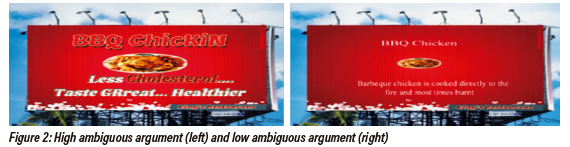
The experiment stimuli were two versions of billboard advertisements. We used Adobe Photoshop CS5 to edit, trace and crop the images and increase hue, saturation, luminance and brightness to create detailed variations before the complex layout design (Dalrymple et al., 2013). We adhered to principles of designing billboard advertisement layout, which include (1) simplicity, (2) extensive and bold text, (3) sticking to one message for consistency, (4) short and sweet message, (5) colourful, (6) readability, (7) avoidance of white backgrounds, (8) use bright, bold colours, (9) design with high contrast, (10) no white space. We started by cropping the background colour to the layout, the most crucial aspect of designing a billboard. Then, we created a restaurant logo and brand name with unique fonts to match the specific context of the fast-food restaurant advertisements. The highly ambiguous arguments billboards were designed using polysemy, weasel words and grammatical deviation that were intended to increase participants' processing, elicit multiple interpretations and influence the participants' decision based on relevance, actuality, accuracy and comprehensive arguments that would engage participants' cognitive processing, as outlined by Pieters et al. (2010) and Puškarević et al. (2018): "BBQ Chicken, less Cholesterol... Taste GRreat...Healthier" The low ambiguous arguments billboard stimulus was designed with a simple layout, irrelevant, bogus, inaccurate, incomprehensive arguments that would not make the participants think about the product on the billboard advertisement, thus, "BBQ Chicken, Barbeque chicken is cooked directly on the Fire and most times burnt.' (Figure 2 below).

A total of 260 participants (130 high and 130 low) were placed in two different conditions (treatment and control). We used convenience sampling to recruit postgraduate and academic staff from a public university with a large number of both foreign and local students. We identified potential participants for this study through social media platforms within the university. To gather participants, we placed an advertisement for an upcoming experiment, clearly stating the type of experiment and the eligibility requirements for this study. Studying university staff and postgraduate students offers several advantages and opportunities for research on the impact of ambiguous cues in billboard advertising on consumers' purchasing decisions. University staff and postgraduate students often represent diverse demographic backgrounds, including age, gender, income levels and educational attainment. This diversity allows for a more comprehensive understanding of how different demographic groups interpret and respond to ambiguous cues in billboard advertising. University staff and postgraduate students typically have higher levels of education compared to the general population. Their higher education levels influence the cognitive processing of advertising messages and their ability to discern ambiguous cues, making them an exciting demographic to study in the context of advertising effectiveness (Crew, 2022; Hurst, 2015).
In order to strengthen the data, participants were required to meet specific criteria. All participants were asked to provide personal information in order to determine their eligibility for the experiment. To be included in the study, participants had to be postgraduate students or academic staff. We specifically focused on working-class participants due to their activities and purchasing power, as the billboard advertisement was related to fast-food restaurants. The data collection was conducted through an online survey with an embedded experiment. Prior to receiving the digital billboard advertisement and completing the questions, participants were randomly assigned to either the high or low ambiguous argument conditions using the Microsoft Excel (Rand) formula.
MEASURESThe survey for the ambiguous arguments consisted of four measures: relevance, actuality, accuracy and comprehensiveness. In addition to these measures, participants were asked to provide their demographic information and indicate if they had seen a billboard before and the number of times they had seen a billboard in a week.
Relevance
The scale was adopted by Bhattacherjee & Sanford (2006), Larasati and Yasa (2017) and Pand and Gui (2016). For example, "Given your experience with the appropriate message on the billboard advertisement you saw, what number would you rate your decision to buy the product?"
Actuality
The scale was adopted from Wixom and Todd (2005), Larasati and Yasa (2017), Bhattacherjee and Sanford (2006) and Pand & Gui (2016). For example, "Given your experience with the brand facts on the billboard advertisement you saw, what number would you use to rate your decision to buy the product? Given your experience with the concise message actuality on the billboard advertisement you saw, what number would you rate your decision to buy the product?"
Accuracy
The scale was adopted from Cheung and Thadani (2012), Larasati and Yasa (2017), Xu and Yao (2015) and Pand and Gui (2016). For example, "Given your experience with the brand's precise messages on the billboard advertisement you saw, what number would you use to rate your decision to buy the product? Given your experience with the accurate messages on the billboard advertisement you saw, what number would you rate your decision to buy the product?"
COMPREHENSIVENESSThe scale was adopted from Cheung and Thadani (2012), Larasati and Yasa (2017) and Bhattacherjee and Sanford (2006). For example, "Given your experience with the comprehensive messages on the billboard advertisement you saw, what number would you use to rate your decision to buy the product? Given your experience with the product exhaustive information on the billboard advertisement you saw, what number would you use to rate your decision to buy the product?"
All were assessed using 7-point extreme adjectival bipolar (1=very unlikely and 7=very likely).
The mediation variable, motivation, was measured with eight constructs from Hung et al. (2017) and Cheng (2017) consisting of relevance, accuracy, realistic, attention, recall, wording arrangement, images and urgent needs. A 7-point extreme adjectival bipolar (1=very unlikely and 7=very likely) was used. For example, "Does relevant information on the billboard advertisement motivate your attention? What number would you use to rate your decision to buy the product? Does useful and accurate information on the billboard advertisement you saw motivate your attention to buy? What number would you use to rate your decision to buy the product?"
The dependent variable, consumers' purchase decisions, was measured with four items (search, evaluation, purchase product, satisfied) (Karimi et al., 2015) using 7-point extreme adjectival bipolar (1=very unlikely and 7=very likely). For example, "Did you evaluate the product information on the billboard advertisement you saw; what number would you use to rate your decision to buy the product?" We used Cronbach's Alpha to determine the reliability of scales and to measure the internal consistency of a group of items, for example, the items used to measure ambiguous arguments, motivation and consumers' purchase decisions. All of the items for this study depicted satisfactory coefficient alpha.
RESULTS
Manipulation check
As a manipulation check, the participants were asked how many times they had seen a billboard advertisement in a week. A significant number agreed to having seen a billboard four to five times a week (88%).
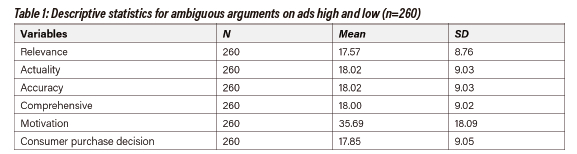
The descriptive statistics of the data collected from participants are in four dimensions of argument (relevance, actuality, accuracy and comprehensiveness), motivation and consumers' purchase decisions (n=260). The findings showed a positive mean score on the consumer purchase decisions in relevance of 17.57 (SD = 8.76), actuality 18.02 (SD = 9.03), accuracy 18.02 (SD = 9.03) and comprehensive 18.00 (SD = 9.02). This shows favourable purchase decisions among the participants, which indicates the effect of ambiguous argument cues on consumer purchase decisions. Blair (2020) avers that arguments signify either a kind of expressive entity or an incident of a definite type of collaborating communication. Arguments are efforts at persuasion and advertisers depend on them (see Table 1 below).
The study corroborated whether consumers exposed to highly ambiguous arguments differed from those exposed to low ambiguous arguments. An independent sample t-test was conducted to verify the experimental manipulations' effectiveness. The result revealed that there was a significant difference in the score for high ambiguous arguments advertisements (M =178.608, SD=37.414) when compared to low ambiguous arguments advertisements (M =70.400, SD =25.298). This demonstrates that a statistical significance was evident between high ambiguous arguments and low ambiguous arguments t(258) = 27.317, p < .001. The result advocates that highly ambiguous arguments affect consumers' purchase decisions. Specifically, our result showed that the likelihood of an increased purchase decision was evident when consumers were exposed to ambiguous arguments. Thus, it supports H1. In their study, Barrera et al. (2020) discovered that alternative (unconventional) facts were highly persuasive. Meanwhile, in their research on billboards, Murwonugroho and Yudarwati (2020) revealed that the newness of the advertisement's visual element structure by reversing outdoor media design principles and the intentional convention of reversed messages evoked a more interactive public response (see Table 2 below).
Mediation analysis for ambiguous arguments
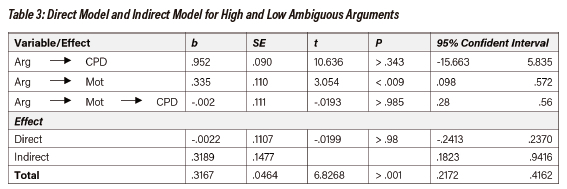
We evaluated the mediation role of motivation in the relationship between ambiguous arguments and consumers' purchase decisions. We conducted mediation analysis using the Process v2.15 macro in SPSS (Hayes, 2013; model 4) to substantiate whether motivation positively and significantly affected the relationship between ambiguous arguments and consumer purchase decisions (H2). Table 3 shows direct and indirect models for high and low ambiguous arguments. The result of the indirect effect based on 1000 bootstrap samples revealed a significant indirect positive relationship between ambiguous arguments (high and low advertisements) and consumer purchase decisions mediated by motivation (a*b = .3189, Bootstrap CI 95% = .1823 and .9416). In other words, we accept the hypothesis that there is a relationship between ambiguous arguments (high and low) and that consumer purchase decisions have an indirect effect because we noticed that there is no "zero" digit within the 95% confidence interval (.1823 to .9416), that is, a*b is not statistically significant. Conversely, there was no statistically direct effect between ambiguous arguments (high and low) and consumers' purchase decisions (b = .952, t = 10.636, p > .343). It posits that the deliberate divergence and innovative nature of ambiguous advertisements direct consumers towards visual indicators without dependence on extrinsic variables in the assessment of advertisements. In this context, complexity directs visual focus towards intricate entities, ensuring their prominence amid uninspired distractions in visual exploration compilations (Sun & Firestone, 2021). Accordingly, Kochoian et al. (2017), Wilson and Suh (2017) and Daugherty et al. (2008) all agree that when a task is seen as prized, the more the motivational consequences are essential. These comprise interest, utility, importance and relative cost. Thus, engaging in activities that earn personal recognition or identity is essential (see Table 3 below).
DISCUSSION
Based on the discursive resources and nomenclature of ambiguous arguments studied in this article and the purposeful neglect by scholars in the field of communication and advertisement in pursuit of strategic clarity, we experimented to investigate the impact of ambiguous arguments on consumers' purchase decisions. The findings showed that high ambiguous arguments (rather than low ambiguous arguments) were rated significantly more in terms of relevance, actuality, accuracy and comprehensiveness. In contrast, low ambiguous arguments (rather than high ambiguous arguments) were rated less in terms of relevance, actuality, accuracy and comprehensiveness.
The study examined the impact of highly ambiguous arguments (ad1) versus low ambiguous arguments (ad5) on consumers' purchase decisions. Results showed a significant difference between high and low ambiguous arguments, indicating that highly ambiguous arguments had a more favourable effect on purchasing decisions. It contradicts earlier findings by Choi and Hwang (2011), which suggest that ambiguity hurt the effectiveness of advertisements. The study suggests that complexity in arguments can encourage adaptive investigative behaviour and curiosity about the relevant presentation in our environment. The likelihood of increased purchase decisions is evident when consumers are exposed to highly ambiguous, relevant, accurate, actual and comprehensive arguments. Breves's (2021) study also found that individuals experiencing high dimensional or spatial presence assessed the content of messages more positively because of heuristic processing. Therefore, unconventional or artful deviation embedded in an argument may encourage the audience to decode using heuristics and save time and energy instead of scrutinising the message systematically.
The findings of the present study support the results of the previous investigations conducted by Fitts (2010) and Konovalova and Petrova (2022) regarding the impact of ambiguous advertisements. Previous studies indicate that unclear advertisements could influence people's opinions on alcohol consumption, but they may not have a significant effect on behavioural intentions with minimal exposure. Overall, alcohol advertising exposure had a positive effect on desirability. In contrast, Pieters and Wedel (2004) discovered that the brand, pictorial and textual elements of advertisements significantly impact capturing and transferring attention, which is equivalent to the commonly held beliefs in advertising practices.
Conversely, the study investigated the effect of motivation on the relationship between ambiguous arguments (high and low) and consumers' purchase decisions. The findings showed a significant indirect positive relationship between ambiguous arguments (high and low) and consumer purchase decisions mediated by motivation. In order words, there was an indirect effect because we perceived no "zero" digit within the 95% confidence interval. Meanwhile, there was no statistically direct effect between ambiguous arguments (high and low) and consumers' purchase decisions. It affirms that artful deviation and creativity of ambiguous advertisements lead consumers to visual cues without relying on third-party variables to evaluate advertisements. This, complexity leads visual attention to complex objects such that they are evident among artless distractions in visual quest collections (Sun & Firestone, 2021). More so, ambiguity can enhance the appeal and effectiveness of advertisements. However, it can also result in different consumer reactions based on their attitudes towards ambiguity. For example, individuals who are neutral towards ambiguity tend to ignore vague signals and are less likely to engage with ambiguous advertisements than those who dislike ambiguity. The latter group may require a higher level of certainty before being persuaded. This dual nature of ambiguity suggests that while it can grab attention and generate curiosity, it can also lead to scepticism, especially if consumers are uncertain about the intended message. Ultimately, the impact of ambiguous advertisement statements depends on the target audience's attitude towards ambiguity and their existing beliefs. Therefore, we accepted the hypothesis that a relationship exists between ambiguous arguments (high and low) and consumer purchase decisions.
Theoretical implications
This study applied strategic ambiguity as an excellent opportunity to conceal vital product information with reliance on blurring the product information. Alternatively, insufficient information about the product built on good words such as polysemy, tropes and unconventional wording arrangements invoked multiple interpretations and dilation across various individuals (Eisenberg, 1984; Gordon & Wu, 2015; Han & Hong-Lim, 2015; Park & Shapiro, 2023). In addition, the ELM categorises and classifies how individuals process persuasive communication (Petty & Cacioppo, 1986). This study has contributed to the knowledge under ambiguous arguments, especially regarding elements used in billboard advertisements, strategic ambiguity and the ELM. Many previous studies have studied the specific impact of billboard advertisements on consumers' purchase decisions in various spheres. However, ambiguous cues as discursive resources have been neglected by previous studies, perhaps due to the controversial nature of ambiguity regarding advertising ethics and clarity - viewed as an impediment to communication. Thus, billboard advertising is organised under distinct routes of the ELM and strategic ambiguity situation due to the insufficient information and more imagery usually seen on billboards. The ELM was combined with strategic ambiguity and applied in this study as an underpinning theory to examine the effects of ambiguous cues. The ELM has repeatedly been proven to assist researchers in understanding different routes to consumer persuasion. In contrast, strategic ambiguity has been used as a discursive resource to explain how organisations communicate and achieve multiple goals by creating diverse meanings and interpretations. In other words, motivation is the mediation variable that explains the craving and the individuals' innermost need to comprehend and make sense of their experiences in the advertisement.
These findings suggest that consumers exposed to highly ambiguous arguments elicit more favourable purchase decisions because of the newness, complexity, insoluble artful deviation and creativity applied to the highly ambiguous arguments. The results showed that highly ambiguous arguments made consumers elicit more favourable purchase decisions because of the advertisements' relevance, accuracy, actuality and comprehensiveness of the message. Ambiguous arguments are strategic and intentionally use rhetorical devices such as good words, polysemy and tropes on billboards to increase the openness in meaning and interpretations towards achieving multiple goals for the organisation.
The study expanded the theories to include ambiguous and specific attribute arguments significantly affecting consumers' purchase decisions. The findings provided compelling evidence that highly ambiguous arguments positively affect consumers' purchase decisions. In addition, highly ambiguous arguments fall under the central routes of the ELM and have proven to be an efficient way of getting consumers' attention to the brand message, given the strategic ambiguity application of creating various interpretations and openness. However, high arguments have been identified as the most crucial construct that influences consumers' purchase decisions. It is understood that the messages are rated more because of the relevance, accuracy, actuality and comprehensiveness which facilitate the processing of the brand message and purchase decisions.
Practical implications
The findings of this study offer an exceptional opportunity for managers to attract potential consumers and sustain actual consumers of the brand. Billboard advertisement is one of the most effective means of attracting potential consumers to a product by using unconventional approaches and applying ambiguous stimuli in billboard advertisements. The empirical evidence of this study provided an avenue for managers and advertisers to leverage ambiguous arguments to differentiate and create a niche for their brand that sustains consumers, achieves loyalty and increases profitability and market share when consumers' attention is fully captured. The rhetorical manipulation of linguistic and visual properties makes the difference from one advertisement to another based on consumers' sophistication and demands. Practitioners need to embrace ambiguous stimuli to increase their earnings and advertising accounts. The findings of this study could serve as a strategy to facilitate the designing of a billboard advertisement that comm unicates and unifies diversity across the different facets of consumers to achieve the organisational goals of a particular advertisement. Mainly, advertisement in a diversified environment has been challenging given that different thoughts present complicated and complex demands, and correlating with the ideological differences could only be conceivable through artful deviation, creativity and ambiguous cues that would harmonise the ideology and communicate effectively.
Furthermore, practical strategies for advertisers to use ambiguous arguments in their marketing campaigns include leveraging rhetorical ambiguity to enhance emotional engagement and persuasion. Ambiguous messaging can be beneficial in avoiding direct objections from the audience, which improves the sender's image and encourages agreement with the message, especially when the audience's initial views are not strongly polarised. The Munchausen Effect emphasises the potential for ambiguity to obscure the truth, making messages more appealing but possibly misleading. Therefore, advertisers should balance ambiguity with clarity to maintain credibility while effectively engaging their audience.
Limitations and future study
The study encountered several limitations. First, there were methodological limitations and construct exclusions in this study. Specifically, a post-test-only-between-subject design was used, which limited the ability to collect and analyse cutting-edge data. This design did not allow for pre-test and repeated measures in data analysis, which could have provided a different perspective on data collection and analysis. Future studies should consider employing more sophisticated research designs, such as factorial designs, to ensure comprehensive data collection and analysis. These designs would help to enhance the robustness of the research process and further explore the constructs examined in this study, such as the colour, size and slogans of billboards, which are crucial elements in billboard advertisements. In addition, the methodological perspective of this study could be improved by incorporating other methods that would ensure more robust data analysis, such as factorial design, pre-test and post-test design linked to repeated measures and advanced statistical analysis.
REFERENCES
LITERATURE REVIEW
-
Anirban, S. (2016). The joint effects of regulatory focus and argument strength of product related information on choice behaviour. Australasian Marketing Journal. Available from: https://doi.org/10.1016/J.AUSMJ.2016.07.001
» https://doi.org/10.1016/J.AUSMJ.2016.07.001 -
Anuja, S. & Anubhav, M. (2021). Effects of visual information and argument concreteness on purchase intention of consumers towards online hotel booking. Vision: The Journal of Business Perspective. Available from: https://doi.org/10.1177/09722629211038069
» https://doi.org/10.1177/09722629211038069 -
Arjulayana, A. & E. Enawar. (2022). Cosmetics advertisement language through discursive psychology. Linguistics. Available from: https://doi.org/10.29300/ling.v8i2.8016
» https://doi.org/10.29300/ling.v8i2.8016 -
Arquero, J.L. & McLain, D.L. (2010). Preliminary validation of the Spanish version of the multiple stimulus types ambiguity tolerance scale (MSTAT-II). The Spanish Journal of Psychology, 13(1):476-484. Available from: https://doi.org/10.1017/S1138741600004029
» https://doi.org/10.1017/S1138741600004029 -
Arquero, J.L., Polvillo, C.F., Hassall, T. and Joyce, J. (2017). Relationships between communication apprehension, ambiguity tolerance and learning styles in accounting students: Relaciones entre aprensión comunicativa, tolerancia a la ambigüedad y estilos de aprendizaje en estudiantes de contabilidad. Revista de Contabilidad-Spanish Accounting Review, 20(1):13-24. Available from: https://doi.org/10.1016/j.rcsar.2015.10.002
» https://doi.org/10.1016/j.rcsar.2015.10.002 -
Atkin, J.L., McCardle, M. & Newell, S.J. (2008). The role of advertiser motives in consumer evaluations of 'responsibility'messages from the alcohol industry. Journal of Marketing Communications, 14(4):315-335. Available from: https://doi.org/10.1080/13527260802141447
» https://doi.org/10.1080/13527260802141447 -
Barrera Lemarchand, F., Semeshenko, V., Navajas, J. & Balenzuela, P. (2020). Polarizing crowds: Consensus and bipolarization in a persuasive arguments model. Chaos: An Interdisciplinary Journal of Nonlinear Science, 30(6):063141. Available from: https://doi.org/10.1063/50004504
» https://doi.org/10.1063/50004504 -
Beisecker, S., Schlereth, C. & Hein, S. (2024). Shades of fake news: How fallacies influence consumers' perception. European Journal of Information Systems, 33(1):41-60. Available from: https://doi.org/101080/0960085x.2022.2110000.
» https://doi.org/101080/0960085x.2022.2110000 -
Bhattacherjee, A. & Sanford, C. (2006). Influence processes for information technology acceptance: An elaboration likelihood model. MIS quarterly:805-825. Available from: https://doi.org/10.2307/25148755
» https://doi.org/10.2307/25148755 -
Blair, J. A. (2020). The persuasive ineffectiveness of arguing and arguments. Available from: https://scholar.uwindsor.ca/ossaarchive/OSSA12/Friday/10/
» https://scholar.uwindsor.ca/ossaarchive/OSSA12/Friday/10/ - Branković, M. & Žeželj, I. (2016). Does it take a good argument to be persuaded? How manipulating quality of evidence affects message persuasiveness. Psihologija, 49(1):1-18.
-
Breves, P. (2021). Biased by being there: The persuasive impact of spatial presence on cognitive processing. Computers in Human Behavior, 119:106723. Available from: https://doi.org/10.1016/j.chb.2021.106723
» https://doi.org/10.1016/j.chb.2021.106723 -
Broecks, K.P., van Egmond, S., van Rijnsoever, F.J., Verlinde-van den Berg, M. & Hekkert, M.P. (2016). Persuasiveness, importance and novelty of arguments about carbon capture and storage. Environmental Science & Policy, 59:58-66. Available from: https://doi.org/10.1016/j.envsci.2016.02.004
» https://doi.org/10.1016/j.envsci.2016.02.004 -
Brône, G. & Coulson, S. (2010). Processing deliberate ambiguity in newspaper headlines: Double grounding. Discourse Processes, 47(3): 212-236. Available from: https://doi.org/10.1080/01638530902959919
» https://doi.org/10.1080/01638530902959919 -
Cahyani, D.A. & Islam, A.F. (2020). The ambiguity of English advertisement. Jo-ELT (Journal of English Language Teaching) Fakultas Pendidikan Bahasa & Seni Prodi Pendidikan Bahasa Inggris IKIP, 4(1):49. Available from: https://doi.org/10.33394/jo-elt.v4i1.2436
» https://doi.org/10.33394/jo-elt.v4i1.2436 -
Cao, X., Liu, Y., Zhu, Z., Hu, J. & Chen, X. (2017). Online selection of a physician by patients: Empirical study from elaboration likelihood perspective. Computers in Human Behavior, 73:403-412. Available from:https://doi.org/10.1016/j.chb.2017.03.060
» https://doi.org/10.1016/j.chb.2017.03.060 -
Carpenter, C. J. (2020). Elaboration likelihood model. The International Encyclopedia of Media Psychology, 1-14. Available from: https://doi.org/10.1002/9781119011071.iemp0070
» https://doi.org/10.1002/9781119011071.iemp0070 -
Chang, H.H., Lu, YY. & Lin, S.C. (2020). An elaboration likelihood model of consumer respond action to Facebook second-hand marketplace: Impulsiveness as a moderator. Information & Management, 57(2):103171. Available from: https://doi.org/10.1016/j.im.2019.103171
» https://doi.org/10.1016/j.im.2019.103171 - Charles, C.S. (2008). How argument structure biases acceptance of advertising claims: Explaining deviations from logical reasoning in terms of subjective probabilities. ACR North American Advances.
-
Chen, C.D., Zhao, Q. & Wang, J.L. (2022). How livestreaming increases product sales: role of trust transfer and elaboration likelihood model. Behaviour & Information Technology, 41(3):558-573. Available from: https://doi.org/10.1080/0144929X.2020.1827457
» https://doi.org/10.1080/0144929X.2020.1827457 -
Cheng, K.H. (2017). Reading an augmented reality book: An exploration of learners' cognitive load, motivation, and attitudes. Australasian Journal of Educational Technology, 33(4). Available from: https://doi.org/10.14742/ajet.2820
» https://doi.org/10.14742/ajet.2820 -
Cheung, C.M. & Thadani, D.R. (2012). The impact of electronic word-of-mouth communication: A literature analysis and integrative model. Decision Support Systems, 54(1):461-470. Available from: https://doi.org/10.1016/j.dss.2012.06.008
» https://doi.org/10.1016/j.dss.2012.06.008 -
Childers, T.L., Houston, M.J. & Heckler, S.E. (1985). Measurement of individual differences in visual versus verbal information processing. Journal of Consumer Research, 12(2):125-134. Available from: https://doi.org/10.1086/208501
» https://doi.org/10.1086/208501 -
Choi, E. & Hwang, J.S. (2011). Ads effectiveness of ambiguous ads message: Focusing on moderating effect of need for cognition and ambiguity tolerance. Journal of the Korean Psychological Association: Consumer · Advertising, 12(2):405-426. Available from: https://doi.org/10.21074/kjlcap.2011.12.2.405
» https://doi.org/10.21074/kjlcap.2011.12.2.405 -
Chou, C.Y., Chen, J.S. & Lin, S.K. (2021). Value cocreation in livestreaming and its effect on consumer-simulated experience and continued use intention. International Journal of Consumer Studies, 46(6):2183-2199. Available from: https://doi.org/10.1111/ijcs.12777
» https://doi.org/10.1111/ijcs.12777 -
Christina, H. (2014). An argument for comprehensiveness as the "special sauce" in a recipe for the patient-centered medical home. Journal of the American Board of Family Medicine. Available from: https://doi.org/10.3122/JABFM.2014.01.130296
» https://doi.org/10.3122/JABFM.2014.01.130296 -
Codou, S., Pooya, T., Ioannis, C., Thanos., V. & Papadakis, M. (2021). Method in the madness? A meta-analysis on the strategic implications of decision comprehensiveness. Strategic Organization. Available from: https://doi.org/10.1177/1476127020904973
» https://doi.org/10.1177/1476127020904973 -
Crew, T. (2022). Classed markers of a working-class academic identity. Journal of Class & Culture. Available from: https://doi.org/10.1386/jclc_00011_1
» https://doi.org/10.1386/jclc_00011_1 -
Dalrymple, K.A., Gomez, J. & Duchaine, B. (2013). The Dartmouth database of children's faces: Acquisition and validation of a new face stimulus set. PloS one, 8(11):e79131. Available from: https://doi.org/10.1371/journal.pone.0079131
» https://doi.org/10.1371/journal.pone.0079131 -
Daugherty, T., Eastin, M.S. & Bright, L. (2008). Exploring consumer motivations for creating user-generated content. Journal of Interactive Advertising, 8(2):16-25. Available from: https://doi.org/10.1080/15252019.2008.10722139
» https://doi.org/10.1080/15252019.2008.10722139 -
Dellaert, B.G., Shu, S.B., Arentze, T.A., Baker, T., Diehl, K., Donkers, B., ... & Steffel, M. (2020). Consumer decisions with artificially intelligent voice assistants. Marketing Letters, 31:335-347. Available from: https://doi.org/10.1007/s11002-020-09537-5
» https://doi.org/10.1007/s11002-020-09537-5 - Dobrosz-Michiewicz, K. (2017). Wieloznaczność poznawcza jako strategia komunikacyjna. Acta Universitatis Lodziensis. Folia Litteraria Polonica, 41(3):213-220.
-
Eisenberg, E.M. (1984). Ambiguity as strategy in organizational communication. Communication monographs, 51(3):227-242. Available from: https://doi.org/10.1080/03637758409390197
» https://doi.org/10.1080/03637758409390197 -
El Hedhli, K., & Zourrig, H. (2022). Dual routes or a one-way to persuasion? The elaboration likelihood model versus the unimodel. Journal of Marketing Communications. Available from: https://doi.org/10.1080/13527266.2022.2034033
» https://doi.org/10.1080/13527266.2022.2034033 -
Elvira, I., Yogesh, K.D. & Rana N.P. (2021). The use of elaboration likelihood model in eWOM Research: Literature review and weight-analysis. Springer Nature. Available from: https://doi.org/10.1007/978-3-030-85447-8_41
» https://doi.org/10.1007/978-3-030-85447-8_41 -
Espinoza, M.M. (2021). Calculating the strength of rhetorical arguments in persuasive negotiation dialogues. Inteligencia Artificial, 24(67):36-39. Available from: https://doi.org/10.4114/intartif.vol24iss67pp36-39
» https://doi.org/10.4114/intartif.vol24iss67pp36-39 -
Feather, N.T. (1969). Attribution of responsibility and valence of success and failure in relation to initial confidence and task performance. Journal of Personality and Social Psychology, 13(2):129. Available from: https://doi.org/10.1037/h0028071
» https://doi.org/10.1037/h0028071 -
Fitts, J.K. (2010). Strategic ambiguity: The effects of viewing ambiguous advertisements on college students. Doctoral dissertation. USA: Washington State University. Available from: https://hdl.handle.net/2376/103252
» https://hdl.handle.net/2376/103252 -
Flanagin, A.J., Winter, S. & Metzger, M.J. (2020). Making sense of credibility in complex information environments: The role of message sidedness, information source, and thinking styles in credibility evaluation online. Information, Communication & Society, 23(7):1038-1056. Available from: https://doi.org/10.1080/1369118X.2018.1547411
» https://doi.org/10.1080/1369118X.2018.1547411 -
Förster, J., Marguc, J. & Gillebaart, M. (2010). Novelty categorization theory. Social and Personality Psychology Compass, 4(9):736-755. Available from: https://doi.org/10.1111/j.1751-9004.2010.00289
» https://doi.org/10.1111/j.1751-9004.2010.00289 -
Gao, X., Xu, XY., Tayyab, S.M.U. & Li, Q. (2021). How the live streaming commerce viewers process the persuasive message: An ELM perspective and the moderating effect of mindfulness. Electronic Commerce Research and Applications, 49:101087. Available from: https://doi.org/10.1016/j.elerap.2021.101087
» https://doi.org/10.1016/j.elerap.2021.101087 -
Gordon, H. (2022). Reconsidering reconsent: Threats to internal and external validity when participants reconsent after debriefing. British Journal of Psychology. Available from: https://doi.org/10.1111/bjop.12561
» https://doi.org/10.1111/bjop.12561 -
Grant, C. & Osanloo, A. (2014). Understanding, selecting, and integrating a theoretical framework in dissertation research: creating the blueprint for your "house." Administrative issues. Journal Education Practice and Research, 4(2). Available from: https://doi.org/10.5929/2014.4.2.9
» https://doi.org/10.5929/2014.4.2.9 -
Han, K.W. & Choi, H.-L. (2015). Use of ambiguity in advertising creativity: A cross-cultural perspective. Indian Journal of Science and Technology, 8(26). Available from: https://doi.org/10.17485/ijst/2015/v8i26/87112
» https://doi.org/10.17485/ijst/2015/v8i26/87112 -
Hasan, Z., Naeem, M., Ahmed, S. & Zeerak, S. (2022). Impact of strategic ambiguity tagline on billboard advertising on consumers attention. Market Forces, 17(1):163-184. Available from: https://doi.org/10.51153/mf.v17i1.538
» https://doi.org/10.51153/mf.v17i1.538 -
Hayes, A.F. (2013). Introduction to mediation, moderation, and conditional process analysis: Methodology in the Social Sciences. Kindle Edition, 193. Available from: https://www.oeaw.ac.at/resources/Record/990003105430504498
» https://www.oeaw.ac.at/resources/Record/990003105430504498 -
Hedlund, J., Kauffeldt, T.F. & Lammert, M. (2020). Persuasion under ambiguity. Theory and Decision, 90(3-4):455-482. Available from: https://doi.org/10.1007/s11238-020-09764-2
» https://doi.org/10.1007/s11238-020-09764-2 -
Herz, M., Diamantopoulos, A. & Riefler, P. (2023). Consumers' use of ambiguous product cues: The case of "regionality" claims. Journal of Consumer Affairs, 57(3):1395-1422. Available from: https://doi.org/10.1111/joca.12548
» https://doi.org/10.1111/joca.12548 -
Hoffjann, O. (2021). Between strategic clarity and strategic ambiguity-oscillating strategic communication. Corporate Communications: An International Journal, 27(2):284-303. Available from: https://doi.org/10.1108/CCIJ-03-2021-0037
» https://doi.org/10.1108/CCIJ-03-2021-0037 -
Holford, D.L., Juanchich, M. and Sirota, M. (2022). Ambiguity and unintended inferences about risk messages for COVID-19. Journal of Experimental Psychology: Applied, 28(3):486-508. Available from: https://doi.org/10.1037/xap0000416
» https://doi.org/10.1037/xap0000416 -
Hopkins, V., Pickup, M. & Matthews, S. (2023). Ambiguous COVID-19 messaging increases unsafe socializing intentions. Journal of Behavioral Public Administration, 6. Available from: https://doi.org/10.30636/jbpa.61.299
» https://doi.org/10.30636/jbpa.61.299 -
Hung, Y., Grunert, K.G., Hoefkens, C., Hieke, S. & Verbeke, W. (2017). Motivation outweighs ability in explaining European consumers' use of health claims. Food quality and preference, 58:34-44. Available from: https://doi.org/10.1016/j.foodqual.2017.01.001
» https://doi.org/10.1016/j.foodqual.2017.01.001 -
Hurst, B. (2015). Not always fun: Older children's play worlds in Australian outside school hours care. Journal of Playwork Practice, 2(1), 7-22. Available from: http://dx.doi.org/10.1332/205316215X14289372671159
» http://dx.doi.org/10.1332/205316215X14289372671159 -
Iwama, Y. (2022). Influence of implicit theories on consumer behavior. J Stage Journal of Marketing. Available from: https://doi.org/10.7222/marketing.2022.008
» https://doi.org/10.7222/marketing.2022.008 -
Jacobs, R.S., Werning, S., Jansz, J. & Kneer, J. (2021). Procedural arguments of persuasive games: An elaboration likelihood perspective. Journal of Media Psychology: Theories, Methods, and Applications, 33(2):49-59. Available from: https://doi.org/10.1027/1864-1105/a000278
» https://doi.org/10.1027/1864-1105/a000278 -
Jain, M., Fernando, A.G. & Rajeshwari, K. (2020). How do consumers perceive brand campaigns on Twitter? In Re-imagining Diffusion and Adoption of Information Technology and Systems: A Continuing Conversation: IFIP WG 8.6 International Conference on Transfer and Diffusion of IT, TDIT2020, Tiruchirappalli, India, December 18-19, 2020, Proceedings, Part II (pp. 438-443). Springer International Publishing. Available from: https://doi.org/10.1007/978-3-030-64861-9_38
» https://doi.org/10.1007/978-3-030-64861-9_38 -
Jinfeng, J., Irwin, P., Levin., G. Gaeth, J. & Chatterjee, S. (2022). Sincere or exciting? Brand personality and argument quality on brand attitude. Journal of Consumer Behaviour. Available from: https://doi.org/10.1002/cb.2078
» https://doi.org/10.1002/cb.2078 -
Johansen, W. (2018). Strategic ambiguity. The International Encyclopedia of Strategic Communication, 1-4. Portico. Available from: https://doi.org/10.1002/9781119010722.iesc0170
» https://doi.org/10.1002/9781119010722.iesc0170 -
Kao, T.F. & Du, Y.Z. (2020). A study on the influence of green advertising design and environmental emotion on advertising effect. Journal of Cleaner Production, 242:118294. Available from: https://doi.org/10.1016/j.jclepro.2019.118294
» https://doi.org/10.1016/j.jclepro.2019.118294 -
Karimi, S., Papamichail, K.N. & Holland, C.P. (2015). The effect of prior knowledge and decision-making style on the online purchase decision-making process: A typology of consumer shopping behaviour. Decision Support Systems, 77:137-147. Available from: https://doi.org/10.1016/j.dss.2015.06.004
» https://doi.org/10.1016/j.dss.2015.06.004 -
Kellner, C., Le Quement, M.T. & Riener, G. (2022). Reacting to ambiguous messages: An experimental analysis. Games and Economic Behavior, 136:360-378. Available from: https://doi.org/10.1016/j.geb.2022.09.007
» https://doi.org/10.1016/j.geb.2022.09.007 -
Khan, S.A., Zainuddin, M. & Al Mahi, M. (2023). From corporate hypocrisy to consumer protest: The role of moral outrage and mobilization networks. Business Research Proceedings, 1(1):38-39. Available from: https://doi.org/10.51300/brp-2023-65
» https://doi.org/10.51300/brp-2023-65 -
Khoshsima, H. & Toroujeni, S.M.H. (2017). An introduction to the ambiguity tolerance: As a source of variation in English-Persian translation. International Journal of Applied Linguistics and English Literature, 6(4):91-103. Available from: https://doi.org/10.7575/aiac.ijaleLv.6n.4p.91
» https://doi.org/10.7575/aiac.ijaleLv.6n.4p.91 -
Kim, S., Jung, A.R. & Kim, Y. (2016). The effects of typefaces on ad effectiveness considering psychological perception and perceived communicator's power. Journal of Marketing Communications, 1-26. Available from: https://doi.org/10.1080/13527266.2020.1765407
» https://doi.org/10.1080/13527266.2020.1765407 -
Kochoian, N., Raemdonck, I., Frenay, M. & Zacher, H. (2017). The role of age and occupational future time perspective in workers' motivation to learn. Vocations and Learning, 10:27-45. Available from: https://doi.org/10.1007/s12186-016-9160-9
» https://doi.org/10.1007/s12186-016-9160-9 -
Kokemuller, N. (2021). What is an ambiguous statement in advertising? Chron, 25 May. Available from: https://Smallbusiness.Chron.Com
» https://Smallbusiness.Chron.Com -
Koniak, P. & Cwalina, W. (2022). Does it pay to avoid speaking straight about controversial issues? Impact of argumentative ambiguity on the perception of the speaker. Journal of Communication Management, 26():84-97. Available from: https://doi.org/10.1108/JCOM-11-2020-0154
» https://doi.org/10.1108/JCOM-11-2020-0154 -
Konovalova, A. & Petrova, T. (2022). Image and text in ambiguous advertising posters. In Proceedings of Seventh International Congress on Information and Communication Technology: ICICT 2022, London, Volume 4, August. Singapore: Springer Nature Singapore, 109-119. Available from: https://doi.org/10.1007/978-981-19-2397-5_11
» https://doi.org/10.1007/978-981-19-2397-5_11 -
Kretiková, E. & Fašková, V. (2016). Influence of Behavioural Economics and Psychology on Consumer Decision Making Process in Marketing Communication. In 3d International Conference on Applied Social Science Research (ICASSR 2015), August. Atlantis Press, 250-252. Available from: https://doi.org/10.2991/ICASSR-15.2016.71
» https://doi.org/10.2991/ICASSR-15.2016.71 -
Kulkarni, K.K., Kalro, A.D. & Sharma, D. (2020). The interaction effect of ad appeal and need for cognition on consumers' intentions to share viral advertisements. Journal of Consumer Behaviour, 19(4), 327-338. Available from: https://doi.org/10.1002/cb.1809
» https://doi.org/10.1002/cb.1809 -
Lah, N.S.B.C., Hussin, A.R.B.C. & Dahlan, H.B.M. (2019). Information relevance factors of argument quality for e-commerce consumer review. In Recent Trends in Data Science and Soft Computing: Proceedings of the 3rd International Conference of Reliable Information and Communication Technology (IRICT2018). Springer International Publishing, 871-881. Available from: https://doi.org/10.1007/978-3-319-99007-1_81
» https://doi.org/10.1007/978-3-319-99007-1_81 -
Larasati, K.L.D. & Yasa, N.N K. (2021). The role of positive emotion in mediating the effect of price discount on impulse buying Indomaret customers in Denpasar city, Indonesia. European Journal of Management and Marketing Studies, 6(2). Available from: http://dx.doi.org/10.46827/ejmms.v6i2.1009
» http://dx.doi.org/10.46827/ejmms.v6i2.1009 -
Li, J. & Wagner, M.W. (2020). The value of not knowing: Partisan cue-taking and belief updating of the uninformed, the ambiguous, and the misinformed. Journal of Communication, 70(5):646-669. Available from: https://doi.org/10.1093/joc/jqaa022
» https://doi.org/10.1093/joc/jqaa022 -
Liao, L. & Huang, T. (2021). The effect of different social media marketing channels and events on movie box office: An elaboration likelihood model perspective. Information & Management, 58(7):103481. Available from: https://doi.org/10.1016/j.im.2021.103481
» https://doi.org/10.1016/j.im.2021.103481 -
Liu, C-H. (2017). Evaluating arguments during instigations of defence motivation and accuracy motivation. British Journal of Psychology. Available from: https://doi.org/10.1111/BJOP.12196
» https://doi.org/10.1111/BJOP.12196 -
Luttrell, A. & Petty, R.E. (2021). Evaluations of self-focused versus other-focused arguments for social distancing: An extension of moral matching effects. Social Psychological and Personality Science, 12(6):946-954. Available from: https://doi.org/10.1177/1948550620947853
» https://doi.org/10.1177/1948550620947853 - Marc, F., Herz.A. D. & Riefler, P. (2023). Consumers' use of ambiguous product cues: The case of "regionality" claims. Journal of Consumer Affairs. Available from: https://doi.org/10.1111/joca.12548
- Markowitz, C. (2020). Sovereign wealth funds in Africa: Taking stock and looking forward. African Perspectives Global Insights.
-
Masoud, M. & Zihagh, F. (2022). A meta-analysis of the elaboration likelihood model in the electronic word of mouth literature. International Journal of Consumer Studies. Available from: https://doi.org/10.1111/ijcs.12814
» https://doi.org/10.1111/ijcs.12814 -
McAlister, A.R. & Bargh, D. (2016), Dissuasion: the elaboration likelihood model and young children. Young Consumers, 17(3):210-225. Available from: https://doi.org/10.1108/YC-02-2016-00580
» https://doi.org/10.1108/YC-02-2016-00580 -
McLain, D.L. (1993). The MSTAT-I: A new measure of an individual's tolerance for ambiguity. Educational and psychological measurement, 53(1):183-189. Available from: https://doi.org/10.1177/0013164493053001020
» https://doi.org/10.1177/0013164493053001020 -
Mohammad, Z,, Amrullah, Z. & Masnun, A.M. (2023). From corporate hypocrisy to consumer protest: The role of moral outrage and mobilization networks. Available from: https://doi.org/10.51300/brp-2023-65
» https://doi.org/10.51300/brp-2023-65 -
Mzoughi, M.-N., Chaieb, S. & Garrouch, K. (2018). The effects of rhetorical ambiguity in advertising on comprehension and persuasion: moderating role of tolerance of ambiguity. Recherches En Sciences de Gestion, N°123(6):103-134. Available from: https://doi.org/10.3917/resg.123.0103
» https://doi.org/10.3917/resg.123.0103 -
Nasr, M. (2023). Varieties of ambiguity: How do voters evaluate ambiguous policy statements? Comparative Political Studies, 56(6):759-787. Available from: https://doi.org/10.1177/00104140221089652
» https://doi.org/10.1177/00104140221089652 -
Neta, M., Berkebile, M. M., & Freeman, J. B. (2021). The dynamic process of ambiguous emotion perception. Cognition and Emotion, 35(4):722-729. Available from: https://doi.org/10.1080/02699931.2020.1862063
» https://doi.org/10.1080/02699931.2020.1862063 -
Nilesh, S.B., Rollins, B.L. & Perri, M. (2017). Impact of animated spokes-characters in print direct-to-consumer prescription drug advertising: An elaboration likelihood model approach. Health Communication. Available from: https://doi.org/10.1080/10410236.2016.1138382
» https://doi.org/10.1080/10410236.2016.1138382 -
Norton, R.W. (1975). Measurement of ambiguity tolerance. Journal of Personality Assessment, 39(6):607-619. Available from: https://doi.org/10.1207/s15327752jpa3906_11
» https://doi.org/10.1207/s15327752jpa3906_11 -
Nowghabi, A.S. & Talebzadeh, A. (2019). Psychological influence of advertising billboards on city sight. Civil Engineering Journal, 5(2):390-397. Available from: http://dx.doi.org/10.28991/cej-2019-03091253
» http://dx.doi.org/10.28991/cej-2019-03091253 -
Nwankwo-Ojionu, C.E., Adzharuddin, N.A., Waheed, M. & Mohd Khir, A. (2021). Impact of strategic ambiguity tagline on billboard advertising on consumers attention. Online Journal of Communication and Media Technologies, 12(1):e202204. Available from: https://doi.org/10.30935/ojcmt/11432
» https://doi.org/10.30935/ojcmt/11432 -
Nye, J.A., Baker, M.R., Bell, R., Kenny, A., Kilbourne, K.H., Friedland, K.D., ... & Wood, R. (2014). Ecosystem effects of the Atlantic multidecadal oscillation. Journal of Marine Systems, 133:103-116. Available from: https://doi.org/10.1016/j.jmarsys.2013.02.006
» https://doi.org/10.1016/j.jmarsys.2013.02.006 - Oryila, S.S. & Umar, A. (2016). Vagueness and ambiguity in print media advertisements. The Beam: Journal of Arts & Science, 9:1-13.
-
Pan, Y. (2024). Research on the influence of advertising content on consumer purchasing behavior based on elaboration likelihood model (ELM). Journal of Education, Humanities and Social Sciences, 27:439-444. Available from: https://doi.org/10.54097/mk0f1454
» https://doi.org/10.54097/mk0f1454 -
Pand, Y.R, & Gui, W. (2016). Influence of advertisement message on fitbar billboard towards brand awareness and its implication to brand image. Humaniora, 7(1):63-76. Available from: https://doi.org/10.21512/humaniora.v7i1.3489
» https://doi.org/10.21512/humaniora.v7i1.3489 -
Park, J.K. & Shapiro, S. (2023). Promoting the ambiguity of a public health crisis can facilitate adjustment: The joint influence of an ambiguous message focus and implicit self-theories. Health Communication, 38(2):326-334. Available from: https://doi.org/10.1080/10410236.2021.1950297
» https://doi.org/10.1080/10410236.2021.1950297 -
Pawet, K. & Cwalina, W. (2021). Does it pay to avoid speaking straight about controversial issues? Impact of argumentative ambiguity on the perception of the speaker. Journal of Communication Management. Available from: https://doi.org/10.1108/JCOM-11-2020-0154
» https://doi.org/10.1108/JCOM-11-2020-0154 -
Petty, R.E. & Cacioppo, J.T. (1986). The elaboration likelihood model of persuasion. In Communication and Persuasion. Springer Series in Social Psychology. Springer, New York, NY. Available from: https://doi.org/10.1007/978-1-4612-4964-1_1
» https://doi.org/10.1007/978-1-4612-4964-1_1 -
Petty, R.E. & Cacioppo, J.T. (1986). The elaboration likelihood model of persuasion. Advances in Experimental Social Psychology, 19, 123-205. Available from: https://doi.org/10.1016/S0065-2601(08)60214-2
» https://doi.org/10.1016/S0065-2601(08)60214-2 -
Piao, P. & Zhang, H. (2023). Research on social media advertising persuasion based on the elaboration likelihood model. SHS web of conferences. Available from: https://doi.org/10.1051/shsconf/202315403024
» https://doi.org/10.1051/shsconf/202315403024 -
Pieters, R., Wedel, M. & Batra, R. (2010). The stopping power of advertising: Measures and effects of visual complexity. Journal of Marketing, 74(5):48-60. Available from: https://doi.org/10.1509/jmkg.74.5.048
» https://doi.org/10.1509/jmkg.74.5.048 -
Puškarević, I., Nedeljković, U. & Pušnik, P. (2018). Characterization of letterform complexity. In Proceedings of 9th International Symposium on Graphic Engineering and Design. 8-10th November 2018, Faculty of Technical Sciences, Novi Sad, Serbia (pp. 605-611). Available from: https://doi.org/10.24867/GRID-2018-p73
» https://doi.org/10.24867/GRID-2018-p73 -
Rai, R. & Tripathi, S. (2020). Consumer buying psychology and brand perception: Influence of word of mouth communication. Journal of Content, Community, and Communication, 12:159-168. Available from: https://doi.org/10.31620/JCCC.12.20/15
» https://doi.org/10.31620/JCCC.12.20/15 -
Shahab, M.H., Ghazali, E. & Mohtar, M. (2021). The role of elaboration likelihood model in consumer behaviour research and its extension to new technologies: A review and future research agenda. International Journal of Consumer Studies, 45(4):664-689. Portico. Available from: https://doi.org/10.1111/ijcs.12658
» https://doi.org/10.1111/ijcs.12658 -
Shishkin, D. & Ortoleva, P. (2023). Ambiguous information and dilation: An experiment. Journal of Economic Theory, 105610. Available from: https://doi.org/10.1016/j.jet.2023.105610
» https://doi.org/10.1016/j.jet.2023.105610 -
Simonovic, N. & Taber, J. M. (2022). Psychological impact of ambiguous health messages about COVID-19. Journal of Behavioral Medicine, 45(2):159-171. Available from: https://doi.org/10.1007/s10865-021-00266-2
» https://doi.org/10.1007/s10865-021-00266-2 -
Simonovic, N. & Taber, J.M. (2023). Effects of construal level on responses to ambiguous health information about alcohol consumption. Health Communication, 38(2):238-251. Available from: https://doi.org/10.1080/10410236.2021.1945197
» https://doi.org/10.1080/10410236.2021.1945197 -
Singh, H., Tiwary, A.K. & Singh, S. (2023). Experimental investigation on the performance of ground granulated blast furnace slag and nano-silica blended concrete exposed to elevated temperature. Construction and Building Materials, 394:132088. Available from: https://doi.org/10.1016/j.conbuildmat.2023.132088
» https://doi.org/10.1016/j.conbuildmat.2023.132088 -
Sun, Z. & Firestone, C. (2021). Curious objects: How visual complexity guides attention and engagement. Cognitive Science, 45(4):e12933. Available from: https://doi.org/10.1111/cogs.12933
» https://doi.org/10.1111/cogs.12933 -
Susmann, M.W., Xu, M., Clark, J.K., Wallace, L.E., Blankenship, K.L., Philipp-Muller, A.Z., ... & Petty, R.E. (2022). Persuasion amidst a pandemic: Insights from the elaboration likelihood model. European Review of Social Psychology, 33(2):323-359. Available from: https://doi.org/10.1080/10463283.2021.1964744
» https://doi.org/10.1080/10463283.2021.1964744 -
Szubielska, M., Ganczarek, J., Pietras, K. & Stolińska, A. (2021). The impact of ambiguity in the image and title on the liking and understanding of contemporary paintings. Poetics, 101537. Available from: https://doi.org/10.1016/j.poetic.2021.101537
» https://doi.org/10.1016/j.poetic.2021.101537 - Varpio, L., Paradis, E., Uijtdehaage, S. & Young, M. (2020). The distinctions between theory, theoretical framework, and conceptual framework. Academic Medicine, 95(7):989-994
-
Vibhanshu, A., Gong, J. & Li, B. (2014). Examining the impact of contextual ambiguity on search advertising keyword performance: A topic model approach. Social Science Research Network. Available from: https://doi.org/10.1184/R1/6471371.V1
» https://doi.org/10.1184/R1/6471371.V1 -
Von der Wense, I. & Hoffjann, O. (2024). They are always ambiguous when they don't know how it will turn out. Dissemination, practices, and ethical assessment of strategic ambiguity. Journal of Communication Inquiry, 01968599231216702. Available from: https://doi.org/10.1177/01968599231216702
» https://doi.org/10.1177/01968599231216702 -
Weber, C., Dunaway, J. & Johnson, T. (2012). It's all in the name: Source cue ambiguity and the persuasive appeal of campaign ads. Political Behavior, 34, 561-584. Available from: https://doi.org/10.1007/s11109-011-9172-y
» https://doi.org/10.1007/s11109-011-9172-y -
Weber, K., Rach, N., Minker, W. & André, E. (2020). How to win arguments: Empowering virtual agents to improve their persuasiveness. Datenbank-Spektrum, 20, 161-169. Available from: https://doi.org/10.1007/S13222-020-00345-9
» https://doi.org/10.1007/S13222-020-00345-9 -
Wilson, R. T. & Suh, T. (2018). Advertising to the masses: The effects of crowding on the attention to place-based advertising. International Journal of Advertising, 37(3):402-420. Available from: https://doi.org/10.1080/02650487.2017.1331967
» https://doi.org/10.1080/02650487.2017.1331967 -
Wixom, B.H., & Todd, P.A. (2005). A theoretical integration of user satisfaction and technology acceptance. Information Systems Research, 16(1):85-102. Available from: https://doi.org/10.1287/isre.1050.0042
» https://doi.org/10.1287/isre.1050.0042 -
Xu, H. & Tracey, T.J. (2015). Reciprocal influence model of working alliance and therapeutic outcome over individual therapy course. Journal of Counseling Psychology, 62(3):351. Available from: https://doi.org/10.1037/cou0000089
» https://doi.org/10.1037/cou0000089 -
Y.J., Sohn. & Edwards, H.H. (2018). Strategic ambiguity and crisis apologia: The impact of audiences' interpretations of mixed messages. International Journal of Strategic Communication. Available from: https://doi.org/10.1080/1553118X.2018.1512111
» https://doi.org/10.1080/1553118X.2018.1512111 -
Yen-Chun, C., Hao-Chun, H. & Liang, T.-P. (2021). Elaboration likelihood model, endogenous quality indicators, and online review helpfulness. Available from: https://doi.org/10.1016/J.DSS.2021.113683
» https://doi.org/10.1016/J.DSS.2021.113683 -
Yi, L., & Hu, H. (2021). Online review helpfulness: The moderating effects of review comprehensiveness. International Journal of Contemporary Hospitality Management. Available from: https://doi.org/10.1108/IJCHM-08-2020-0856
» https://doi.org/10.1108/IJCHM-08-2020-0856 -
Yun, B., Thomopoulos, R., Bisquert, P. & Croitoru, M. (2018). Defining argumentation attacks in practice: An experiment in food packaging consumer expectations. In Graph-Based Representation and Reasoning: 23rd International Conference on Conceptual Structures, ICCS 2018, Edinburgh, UK, June 20-22, 2018, Proceedings 23. Springer International Publishing, 73-87. Available from: https://doi.org/10.1007/978-3-319-91379-7_6
» https://doi.org/10.1007/978-3-319-91379-7_6 -
Zaki, M., Hasan, M., Usman, U., Ahmed, S. & Zeerak, S. (2022). Impact of strategic ambiguity tagline on billboard advertising on consumers attention. Market Forces. Available from: https://doi.org/10.51153/mf.v17i1.538
» https://doi.org/10.51153/mf.v17i1.538 -
Zeng, J., Li, J., He, Y., Gao, C., Lyu, M. & King, I. (2020). What changed your mind: The roles of dynamic topics and discourse in argumentation process. In Proceedings of the Web Conference 2020, April, 1502-1513. Available from: https://doi.org/10.1145/3366423.3380223
» https://doi.org/10.1145/3366423.3380223 -
Zhou, Q. (2022). Influence of parameters of optical fibers on optical soliton interactions. Chinese Physics Letters, 39(1):010501. Available from: https://doi.org/10.1088/0256-307X/39/1/010501
» https://doi.org/10.1088/0256-307X/39/1/010501
Accepted August 2024