Indigenous languages as predictors of understanding and accepting COVID-19 vaccines in Nigeria and South Africa
Abstract
Indigenous African languages have often suffered neglect in health development campaigns until recently. Considering the multi-faceted effects of the COVID-19 pandemic on different peoples and societies worldwide, this article argues that vaccine campaigns in African settings cannot be impactful if they are not disseminated in the indigenous African languages. The article is hinged on Salawu's model of indigenous language for development communication, which affirms the connection between language of communication and people's understanding of the message communicated. The study employed a survey experimental research method. Using the pool sampling technique, both online and offline questionnaires were used to survey the opinions of 191 Nigerian and 114 South African respondents in Lagos and Mafikeng, respectively, about dominant indigenous languages used for COVID-19 vaccine messages, their degree of understanding vaccine messages and their acceptance or rejection of the vaccine messages. Interview sessions were conducted with five purposively selected health communication and media experts to determine the significance of and challenges encountered in the use of indigenous African languages for COVID-19 vaccine campaigns. The quantitative data were analysed using descriptive and inferential statistical tools, such as frequency count and percentage, chi-square, percentile and logistic regression; while the qualitative data were thematically analysed. While respondents mostly identified with messages in Yoruba, Igbo, Setswana and isiZulu, a few respondents identified with a combination of languages, although these languages did not influence their acceptance of vaccines. Aside from other reasons given in reviewed studies, the message quality of COVID-19 vaccine messages was attributed to the ineffective use of indigenous African languages, especially with regard to media campaigners' attitude to indigenous languages and the scarcity of language translators.
Acceptance; COVID-19 pandemic; development communication; indigenous African languages; rejection; vaccine campaigns
INTRODUCTION
Indigenous African languages have long suffered unequal recognition as the foreign languages of colonialism (Wilson & Ogri, 2017) and even the neo-colonialism that has been fostered by the owners of the languages. This fate often shows in health awareness campaigns, where there is usually a discordant tune between the sender and receiver of health messages. Especially in the language of communication strategy, African language use often is seen as a mere afterthought or appendage of the campaign, until recently when language activists like Abiodun Salawu, Gilbert Moothsathebe, Tshepang Molale, Siki Dlanga, Philip Mpofu started exposing the inadequacy in campaign methodologies of the so-called change agents working in African communities. Notable scholars (Fadipe & Salawu, 2021; Mpasha & Lebese, 2015; Nwanummo & Salawu, 2018; Obiora, 2021, Salawu, 2015) have pointed to the significance of indigenous African language use in communicating health messages. Its importance has further been highlighted by the advent of the COVID-19 pandemic whose preventive campaigns have been dominated by foreign languages, even in communities that do not predominantly use these languages. Largely, African media institutions can be blamed for this neglect of indigenous languages in the quest for people's need to be properly enlightened. Obviously, there is a preponderance of colonial language used in published newspapers and magazines, and also for broadcast radio and television. This mentality towards the use of colonial languages is often reflected in health communication campaigns as media practitioners are usually involved in the production and execution of these campaigns. However, oral communication form still exerts a great influence on African people (Chkaipa & Gunde, 2020; Kago & Cissé, 2022; Ochu et al. 2021; Wilson & Ogri, 2017) because it helps people to understand indigenous language-based health communication messages better (Nigussie, 2010; Ogwezzy-Ndisika, 2019). African language use is germane to the socialisation process of learning and education and to the practice of knowledge received in any forms of campaign. Considering the virulent effects of COVID-19 disease in terms of the death toll, and the physical, socio-economic and psychological impact with the concerted efforts towards its prevention and eradication, African language use presents an effective formula through which these impacts could be mitigated, and aspirations achieved in the fight against the disease. This significance is especially so for various stakeholders in African language communities and health campaign experts who need to exploit the advantages in African language use for effective and successful health communication campaigns. This is particularly important in dire situations such as the COVID-19 pandemic. The findings, conclusions and recommendations in this article add to the growing body of literature on African language use in health campaigns and behavioural communication campaign fields. This article argues that indigenous African languages are predictors of people's understanding and acceptance of COVID-19 vaccine messages. The focus is on how these languages are employed in the flyers used for COVID-19 vaccine campaigns produced by non-governmental and government agencies intended to encourage people to be vaccinated. Specifically, the article identifies the prominent indigenous African languages used in COVID-19 vaccine campaigns and how the indigenous language use translated into respondents' levels of health message understanding. Testing respondents' COVID-19 vaccine acceptance, the study determines the degree of vaccine information understanding and periods at which they take the vaccines. Also, it samples opinions regarding the significance and challenges encountered in deploying African languages for COVID-19 vaccine messages. The study's argument is further supported by Salawu's (2001) model of indigenous language use for development communication. This explains the relationship that exists between languages of communication and people's understanding of messages disseminated through the languages, and how they accept or reject the messages. Therefore, this study sought to answer the following research questions:
a. What African languages were mostly identified with by people as deployed in COVID-19 vaccine campaign messages in South Africa and Nigeria?
b. How did African language use in COVID-19 vaccine campaign messages influence people's understanding and acceptance of the vaccine in South Africa and Nigeria?
c. What are the challenges encountered in using African languages for COVID-19 vaccine campaign messages?
INDIGENOUS AFRICAN LANGUAGES AND COVID-19 VACCINE CAMPAIGN MESSAGES
Languages play a significant role in health awareness campaigns (Mphasha & Lebese, 2015; Nwammuo & Salawu, 2018; Ogunyombo & Bello, 2020). Their use falls within the bottom-approach paradigm discourse (Ochu et al., 2021) that encourages engaging people for solutions. This points to the need to look at African local strategies for herd immunity in combating the COVID-19 pandemic. The advantages of indigenous language in awareness campaigns are many (Fadipe & Salawu, 2021). Chkaipa and Gunde (2020) further explain that the use of minority languages simplifies the understanding of information and encourages the participation of speakers who might otherwise be excluded due to language difficulties. In their comment on Indigenous Languages and Global Health, Flood and Rohlof (2018: e134) explain that:
Improving the health of the world's 370 million indigenous people is a crucial global health priority. Indigenous groups worldwide tend to have worse health outcomes than corresponding non-indigenous populations. These disparities stem from structural forces of colonisation, poverty, and marginalisation, as well as from barriers to accessing health care.
Also, these authors highlight the reasons indigenous languages are important in global health priorities. Such reasons include autonomy, rights, research ethics, programme efficacy and revitalisation of the indigenous languages themselves. Meanwhile, the importance of indigenous Nigerian languages for disseminating COVID-19 preventive measure messages, media briefings, health orientation and medical research is acknowledged by Obiorah (2021). For Ude-Akpeh et al. (2020), the use of Igbo as an indigenous language and opinion leaders made people believe in the COVID-19 reality. Yet, Nche and Agbo (2022) observe that religious leaders' role in fighting the COVID-19 pandemic differed between those who promoted public health measures and those who undermined these measures. Olubiyi et al. (2013) examined the role of local languages in effective public health delivery in the Gambia and its implications for psychological assessment. Local languages were discovered to contribute to quality of service delivery, treatment compliance of patients and health improvements in patients. Moreover, Kago and Cissé (2022:1) state that to continue "to promote and its implications in daily life, culture, and environment (science engagement) in more African indigenous languages (AILs), then understanding, confidence, and ultimately trust in science across large audiences on the African continent will increase".
EMPIRICAL CONSIDERATIONThe success or failure of any health campaign relies not only on the message quality but also on the language of communication. This is even more important for the COVID-19 vaccine campaign to encourage people from diverse countries worldwide to achieve herd immunity to bring down the effects of the pandemic. However, the scholars below have examined various factors responsible for people's willingness to take vaccines. Adedeji-Adenola et al. (2022) affirm that people's awareness of the COVID-19 vaccine was influenced by religion, occupation, education and previous diagnosis, while their willingness and perception were affected by prior diagnosis and occupation. Iliyasu et al. (2021) also submit that the COVID-19 vaccine campaign was sub-optimal and influenced by respondents' age, income, comorbidities, risk perceptions and concerns about vaccine safety, efficacy and rumours. Their study was based on how they investigated vaccine acceptability predictors and identified reasons for vaccine hesitancy among adults in urban Kano, Nigeria. In a study by Anjorin et al. (2021), people's vaccine hesitancy among Africa-based respondents was enabled by their perceived risk of coronavirus infections and past experiences. Similarly, Dzinamarira et al. (2021) emphasised the need for campaigners to address community preparedness and vaccine hesitancy in South Africa and Zimbabwe through effective public health awareness. They recommend the provision of sufficient COVID-19 vaccine information, discussion with the communities and the use of politicians, artists and religious leaders to provide correct information to raise awareness levels. Tlale et al's study (2022) demonstrated a high COVID-19 vaccine acceptance rate and a low-risk perception in Botswana, which was influenced by higher comorbidities among the people. Indeed, Gilmore et al. (2020) support the significance of community engagement in overcoming COVID-19, explaining that local leaders, community and faith-based organisations, community groups, health facility committees, individuals and key stakeholders worked together to achieve behavioural change communication goals. Jimenez et al., (2021) discovered that vaccine skepticism and distrust were high in Black and Latinx communities due to past experiences of racism and medical experimentation.
Tsao et al. (2021) discovered that the quality of health information in prevention education videos was one of the themes that scholars focused on in their studies about COVID-19 and social media between November 2019 and November 2020. Dai et al. (2021) emphasised the significance of effective communication strategies such that COVID-19 vaccine information design should include behavioural nudges by highlighting the value of making vaccination easy and inducing feelings of ownership over vaccines to promote people's health decisions. On the contrary, Loomba et al. (2021) assert that online COVID-19 vaccine misinformation had negative effects on people's vaccine uptake in the UK and USA. Their findings further explain that sociodemographic groups were affected differently by exposure to misinformation, and that scientific-sounding misinformation was more strongly associated with a decrease in people's vaccination intent. Combating fake news and deliberate misinformation influences on COVID-19 mitigation, van der Linden et al. (2020) recommended prevention through debunking and rebuttal, which comes with inoculation and ensuring a multi-layered defence mechanism against "post-truth" science denial. They outlined the techniques commonly used to spread misinformation such as conspiracy theories, fearmongering and fake experts. While all of these studies did not specifically harp on the significance of using minority/indigenous languages in propagating the COVID-19 vaccine campaign, they identify sundry issues surrounding acceptance and rejection of the vaccines. As Flood and Rohlof (2018) have acknowledged barriers that prevent especially indigenous people from accessing information on how global health benefits should be dispensed with, this study contends that indigenous African languages can predict people's understanding and acceptance of COVID-19 vaccines.
SALAWU'S MODEL OF INDIGENOUS LANGUAGE FOR DEVELOPMENT COMMUNICATION
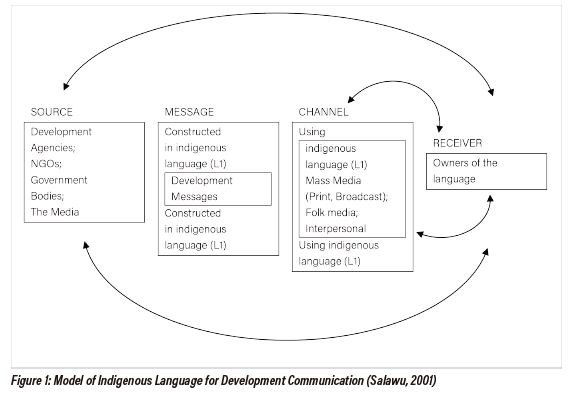
The relationship between communication and development is similar to the relationship that exists between languages of communication and people's understanding of messages disseminated through the languages, and how they accept or reject the messages. This assertion reinforces the study's main objective that indigenous African languages predict how people understand and accept COVID-19 vaccines. It does this through the indigenous languages the people mostly identify with in COVID-19 vaccine campaigns, how these indigenous languages influence their understanding and actions towards the vaccine uptake, and identifying the significance of indigenous language use and challenges faced in using the indigenous languages in health campaigns. Salawu's model of indigenous language for development communication gives further clarification about this interrelationship. Salawu (2015) agrees that the language of development messages is a significant aspect of message treatment and the only language that best suits a language community for message dissemination.
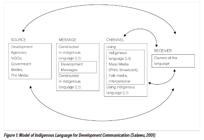
Arguing that indigenous African languages are predictors of understanding and acceptance of COVID-19 vaccines, this model is further used to test the assumption. The different flyers produced in the indigenous languages came from different sources, such as international agencies (United States Agency for International Development, Mac Author Foundation), international media organisations (British Broadcasting Corporation), religious organisations (Redeem Christian Church of God) and government agencies (Nigerian Centre for Disease Control, SA Department of Health, Kwazulu-Natal province). The COVID-19 messages in the flyers revolve around behavioural change and how people understood the indigenous language messages and took the vaccines. Also, it considered the indigenous language nature of respondents. The channel of the vaccine message was digital flyers. The messages in the flyers were disseminated in six African languages: isiZulu, isiXhosa, Setswana, Yoruba, Igbo and Hausa.
METHODOLOGY
Contending that indigenous languages can predict understanding and acceptance of COVID-19 vaccines, and considering indigenous languages' significance to African people's accessing health information where foreign languages have dominated health campaign messages, this study employed the survey experiment research method. Two instruments of data gathering: were used, namely questionnaires and interviews, with the adoption of indigenous Nigerian and South African languages. These languages sought broad and diverse opinions of people with regards to indigenous language use in COVID-19 health campaigns in two selected African settings: Mafikeng and Lagos. The researcher found the survey experiment appropriate because the COVID-19 pandemic affected people worldwide in different ways, which called for the need to understand how people react to health campaigns aimed to mitigate its effects on them. The phenomenon occurred several months before 2022, the year in which the study was conducted. Pool sampling technique that takes samples from different places was adopted because respondents were drawn from different cities in the two nations, but the majority were from Mafikeng and Lagos. The technique was adopted because of the lockdown situations and peoples' peculiar attitudes at the time with regards to their health concerns.
Three indigenous campaign flyer samples from each country, that is, six samples altogether, were added to the questionnaire administered to Nigerian and South African participants to seek their responses on the role of the languages in facilitating their interest in taking doses of available vaccines during the study period. Participation was voluntary, and participants were made aware of this from the onset. The questionnaire contained the consent note and was distributed using online and offline formats. The online format was carried out using Google Forms with links sent to the participants through various social networking sites, such as WhatsApp, Facebook and LinkedIn. The offline approach was done by printing the questionnaire and distributing it. The printed questionnaire copies were administered by trained research assistants in the selected cities (Mafikeng and Lagos) of the two countries. The research assistants went to meet people on the streets, shopping complexes/malls and campuses to administer the copies. They first discussed the questionnaire briefly with them and sought their consent before administering the questionnaire if they agreed. The use of the pool sampling technique led to a total of 305 respondents for the study. Because we were not able to get more than 105 respondents to complete the online questionnaire, we resorted to using offline physical questionnaires. We administered 100 copies each in both Mafikeng and Lagos. The distribution of respondents for online and offline participation revealed that participants from Nigeria totalled 191, while 114 South Africans participated in the study. Of the total, 304 respondents indicated the indigenous languages through which they had received COVID-19 vaccine campaign messages.
Understanding and accepting constructs were the two measurements used for quantitative data of the study. Understanding construct entailed a period of receiving information about the vaccines through the indigenous languages and determining the extent of understanding of that information. The period was measured using day, week, month and year, while understanding parameters within the construct were determined using a scale approach of very great extent, great extent, little extent and no extent. The construct of acceptance was measured using the ways the information helped the participants in the decision-making process with regards to taking the vaccines, and the exact time period of the pandemic for which the participants considered taking the vaccine as important to contain the spread of the virus. Descriptive and inferential statistics were employed for the analysis of the data. Simple frequency count and percentage, chi-square, percentile and logistic regression were specifically used for the analysis. Two South African health communication experts and three Nigerian media experts were also interviewed. This included interviews with a radio producer, a presenter and health communication experts. They were purposively chosen to determine their impressions of using indigenous languages in awareness campaigns, how effective using indigenous languages was for COVID-19 vaccine campaigns, challenges encountered and how these could be improved. The interviews were largely conducted using telephone and email communication due to the lockdown at the time. The qualitative data were subjected to thematic analysis using the study's objectives as content categories. The interview data were used to shed more light on the quantitative data.
RESULTS
In this section, the outcomes of the quantitative data for the constructs are presented. The gathered data through the questionnaire were first analysed using the stated methods of analysis. The presentation is carried out using constructs. The first part focuses on the presentation of the results of understanding the vaccine construct, while the second part entails the acceptance construct of the study. Moreover, the themes derived from the qualitative data were used to complement and interrogate the statistical data.
Understanding the vaccine campaigns
Respondents' understanding of COVID-19 vaccine campaigns was predicated on their identification of the indigenous languages used in the flyers and the extent to which they understood the messages.
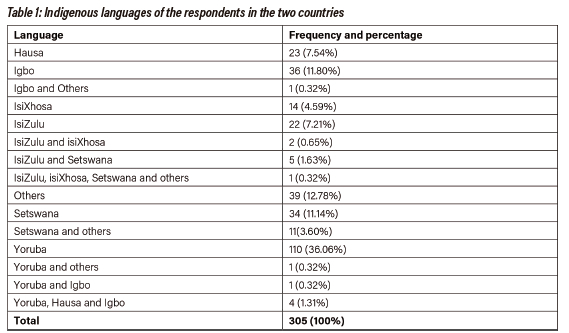
Table 1 establishes the indigenous languages of the respondents. In Nigeria, respondents of Yoruba, 110 (36.20%), and Igbo, 36 (11.80%), tribes identified more with their languages. In South Africa, respondents of Setswana 34 (11.20%) and isiZulu 22 (7.20%) identified more with their languages than those who chose isiXhosa 14 (4.60%). Moreover, in both countries, there were respondents who identified with a combination of these languages, though the multilingual respondent numbers were insignificant. The results show that the majority of the participants were from the dominant ethnic groups in both countries. The proportion of participation is attributable to the use of social media networking platforms and the unconscious concentration of data-gathering activities in the dominant tribes. These outcomes are further examined in Table 2.
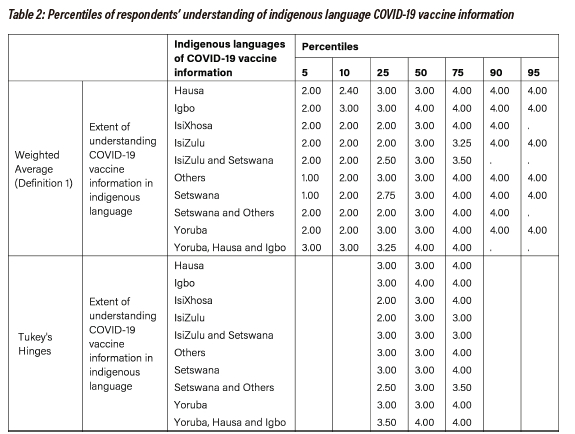
While the data in Table 1 indicates the indigenous languages of the respondents, the data in Table 2 pinpoints the extent to which the respondents understood the COVID-19 vaccine campaign messages. Using weighted average scores and considering the first quartile (25%), the levels at which the respondents understood the messages was quite different. Between the first and second quartiles, Hausa-speaking respondents' (23) understanding of the COVID-19 vaccine messages was at the high end of the measurement scale. However, analysis suggests that 75% of the 23 respondents understood the messages to a large extent. The same outcome was also recorded for Igbo-speaking respondents (36) with a higher level of understanding of the messages in the second and third quartiles, while Yoruba-speaking respondents (110) clearly resonated with the Igbo-speaking respondents, following the same pattern of quartile positioning. In South Africa, analysis shows that understanding of COVID-19 vaccine messages was largely between great and very great extent among the respondents of isiXhosa (14) and Setswana (34) languages. In all, for the weighted average parameter, analysis suggests that understanding more than one indigenous language aided to the participants' understanding of the messages. This is specifically exemplified with the case of four Nigerians in Table 1, who indicated that they understood three dominant languages (Yoruba, Hausa and Igbo) and 11 respondents who indicated understanding Setswana and other indigenous languages in South Africa (11). Overall, at the level of Tukey's Hinges, analysis indicates that 75% of participants who spoke Hausa, Igbo, Yoruba, isiXhosa and Setswana to a large extent understood the messages during the study period.
Accepting the vaccines
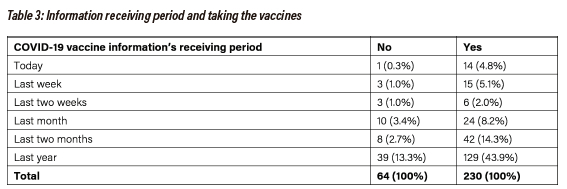
Measuring respondents' COVID-19 vaccine acceptance was determined by certain periods in which they had the vaccine administered and the extent to which they understood the vaccine information. Since a considerable level of understanding of the messages was found, the extent to which the respondents invariably transformed their understanding into accepting the vaccines is considered in Table 3 and subsequent tables.
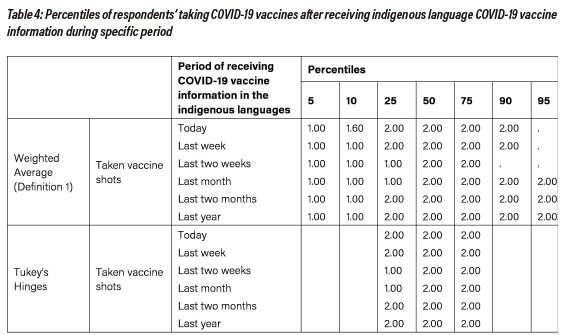
According to the data, 64 respondents of 305 respondents did not take any of the COVID-19 vaccines after receiving the campaign messages. Table 3 indicates that 43.9% of the respondents took the vaccines a year (2021) before the study was conducted, while 14.3% reported that they took the vaccines in the two months preceding the month that the study was conducted. This is closely followed by 8.2% of participants who took the vaccines a month before the month of the study. These results are examined further in Table 4, where attention is paid to the respondents who took the vaccines after being exposed to the indigenous language messages.
Similar to the data presented in Table 2, the data in Table 4 indicate the percentage of respondents who took the vaccines in relation to the period of receiving the COVID-19 indigenous language campaign vaccine messages. From the perspective of the weighted average, analysis shows that between 25% and 75% of the 14 respondents who received the campaign messages during the day of administering the research instrument took one of the available vaccines. This also applies to the respondents who received the messages a week, two weeks, in the past two months and a year before the study. This result is further reinforced by Tukey's Hinges' outcomes, where above 25% of the respondents indicated taking the vaccines after receiving the messages during the periods indicated earlier.
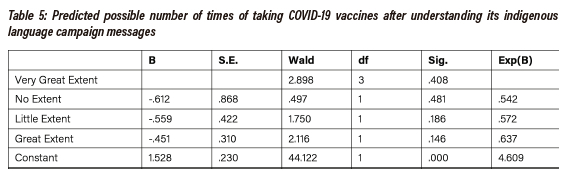
Meanwhile, since understanding respondents' taking of any of the vaccines might not give a possible number of times of considering taking the vaccines after being exposed to various indigenous messages, the data in Table 5 are the outcomes of logistic regression analysis conducted to know how often the respondents might have decided to take the vaccines. Analysis suggests that at the very great extent (Wald=2.898. df=1, P>.408) and great extent (Wald=2.116. df=1, P>.146) scales, the respondents were more than twice as eager to take the vaccines. Analysis further suggests that despite the limited understanding of the messages, a number of respondents were more than once willing to also take any of the available vaccines (Wald=1.750. df=1, P>.186). However, none of this eagerness could be confirmed as central to taking the vaccines when one considers the level of significance, which is higher than expected at a p-value of <.05.
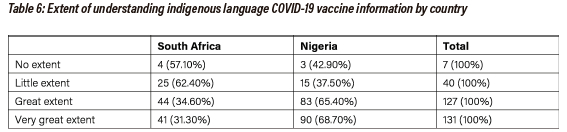
Since data were gathered in both Nigeria and South Africa, Table 6 shows the extent to which respondents in the two countries understood indigenous language COVID-19 vaccine messages. It is obvious that the level of Nigerian respondents' understanding of indigenous language COVID-19 vaccine information was better than their South African counterparts. The difference can be partly attributed to the disparity in the sample size of the two countries.
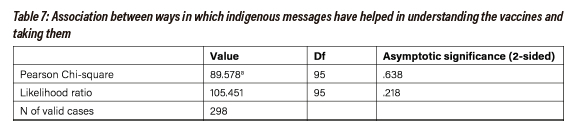
The data in Table 7 summarises the previous outcomes by revealing the link between the themes of the messages and the respondents' interest in taking the vaccines. The need to avert the spread of the virus and protecting lives were mostly reported by the participants as the themes that motivated them to take any of the vaccines. From the data in Table 6 and considering the Pearson Chi-square value of 89.578a at the degree of freedom of 95 and the asymptotic significance (2-sided) of .638, it could be concluded that indigenous language COVID-19 vaccine messages are ineffective in driving acceptance of the vaccines in Nigeria and South Africa because the expected p-value of <.05 was not met. This result suggests that the participants might have actually understood the vaccine campaign messages in other languages. In other words, the previous outcomes that suggest some level of understanding of the indigenous language campaign messages need to be accepted with caution.
USING INDIGENOUS AFRICAN LANGUAGE MEDIA COVID-19 VACCINE CAMPAIGN
Health communication dissemination in Africa has had the misfortune of being disseminated mostly in colonial languages. This occurs in African contexts where indigenous languages predominate, both in rural and urban populations. Consequently, as part of this study indigenous language experts and media scholars' opinions were sampled on the significance and challenges of employing indigenous African media in COVID-19 vaccine campaigns in Africa. On the significance of indigenous languages to vaccine campaigns, an interviewee submitted that:
When the message and information about the vaccine started coming in indigenous languages, there was a better understanding of what the vaccine can do and why people should be vaccinated; the number of people who voluntarily went to the vaccination centres increased tremendously. So using indigenous language for messages in creating awareness is like a game changer in the acceptance rate among the people.
In many African societies, English dominated COVID-19 campaigns at the beginning, such that people found it difficult to relate to the enormity of the pandemic until health agents switched to people's indigenous languages. The use of the colonial language of English is dogged with an avalanche of misinformation and misconception about COVID-19 vaccines and its effects. There are reasons indigenous languages should be adopted in vaccine messages. For one, an interviewee said, "if you want to change my thinking about your idea for the better, put your idea in my language. If you speak my language, you have bridged the gap of misunderstanding and misinformation". Secondly, the sheer number of populations can be reached largely through their own languages, which indicates that using their own languages for vaccine campaigns is effective. The interviewees reckoned that using people's indigenous languages made them accept the vaccine and consider being vaccinated. Furthermore, they encouraged others to get vaccinated. Conviction comes with effective communication through indigenous language use.
The experts who were interviewed, however, also highlighted the challenges in adopting indigenous languages for COVID-19 vaccine campaigns. One complained that convincing campaign producers to employ people's indigenous languages to disseminate vaccine messages was strenuous as they were used to the English language. Another interviewee further explained that:
... at the level of content generation, the producers of these campaign messages don't contact or consult those that have thorough knowledge and understanding of the indigenous language(s). This most times makes the messages to be full of mispronunciations of local names.
In addition, there is the challenge of scarcity of indigenous language translators. An interviewee noted the "difficulty in translating some new COVID-19 registered words. It required consultation with experts to adapt generally acceptable words'. This submission exposed a lack of synergy between indigenous language experts and producers of COVID-19 vaccine campaigns.
DISCUSSION OF FINDINGS
Based on the assumption that indigenous African languages facilitated better understanding and acceptance of COVID-19 vaccines, the following key findings were noted. Respondents identified mostly with vaccine messages in Yoruba, Igbo, Setswana and isiZulu, with a few respondents able to access a combination of two or more vaccine messages. Also, respondents of Yoruba, Hausa, Igbo, isiXhosa and Setswana largely understood COVID-19 vaccine messages. In addition, multilingualism aided some respondents' understanding of the vaccine messages in Nigeria and South Africa. This underscores the significance and advantage of being literate in multiple indigenous languages.
Most of the respondents had already taken the COVID-19 vaccine before they were exposed to the indigenous language messages. Yet, they were willing to take the vaccine with limited understanding of the messages. Although their eagerness was not central to their taking vaccines, it shows that indigenous language COVID-19 vaccine messages are ineffective in driving acceptance of the vaccines in Nigeria and South Africa. It is possible that respondents already understood COVID-19 vaccine messages in non-indigenous or the colonial language of English, which may have driven their willingness to vaccinate. Other factors also appear to be responsible for people taking the vaccines. However, indigenous language broadcasters concur that using indigenous languages in COVID-19 vaccine campaigns increased the number of people who took vaccines, as people better understood the health messages in their own languages. Unfortunately, health campaign creators do not usually use indigenous languages to disseminate messages to people. It maybe that some campaigners were not used to deploying indigenous languages in health campaigns or did not know their effect on the people. Also, there is a dearth of language translators, especially from English to indigenous African languages, which might have impacted on the quality of vaccine messages disseminated to people. In all, this study shows that although indigenous language use in COVID-19 vaccine campaigns helped respondents to understand the messages better, it did not have much effect on respondents' acceptance of COVID-19 vaccines, as most had already taken the shots before being exposed to the messages. This may have been due to insufficient indigenous language vaccine campaign coverage, which might arise from campaigners' disinterest with indigenous language campaigns and translators' insufficiency.
Existing studies (Chkaipa & Gunde, 2020; Flood & Rohlof, 2018) have attested to the significance of indigenous languages in the success of health campaigns. The use of indigenous languages simplifies message understanding and can lead to the participation of people who might be disenfranchised due to language inaccessibility. Particularly, the findings of Obiorah (2021), Ude-Akpeh et al. (2020) and Olubiyo et al. (2013) affirm the importance of indigenous African languages in COVID-19 campaigns because it made people identify with and believe in the messages. Largely in African contexts, the collaboration of science and indigenous African languages needs to be cultivated to make a meaningful impact on people's lives, culture and environment (Kago & Cissé, 2022). With regards to whether indigenous language COVID-19 vaccine messages influenced people's acceptance and taking of vaccines, only Dai et al. (2021) and Dzinamarira et al. (2021) emphasise effective communication strategy significance, which does not specifically refer to indigenous language use in COVID-19 vaccine campaigns. Most reviewed studies (Adedeji-Adenola, 2022; Iliyasu et al., 2021) attribute vaccine acceptance or rejection to socio-demographics, risk perceptions, comorbidities, fear, safety, efficacy and rumour. Since indigenous language COVID-19 vaccine messages were not significant in respondents' acceptance of vaccination, it may be argued that other factors, such as the ones listed above, may be responsible for people taking the vaccines. More so, the quality of indigenous language vaccine information (Tsao et al., 2021) might be insufficient for people to be influenced by it. This assertion could be due to the scarcity of good translators from English to respective indigenous African languages, as the study's findings have established.
Salawu's model of indigenous language for development communication shows that indigenous languages are germane to understanding the message development for the target audience. This assertion is corroborated by the study's findings that when people identify with indigenous languages of COVID-19 vaccine campaigns, they understand the disseminated messages. However, the sources of development communication may be incapacitated by a lack of competent workers, such as translators, and real development-driven campaigners who may be averse to using local languages for development communication. The quality of information in terms of capacity for people's acceptability will be lacking. The drawback of the model lies in the fact that it cannot be used to predict extraneous factors as interfering with the effectiveness of indigenous language use for development communication.
CONCLUSION AND RECOMMENDATIONS
The study contends that indigenous language COVID-19 vaccine messages influenced people in Nigeria and South Africa to get vaccinated. Findings show that even though indigenous languages aided people's understanding of the vaccine messages, they were not strong enough to influence people's decision to get vaccinated. It reveals that other factors might be responsible, which is supported by the empirical studies reviewed. From the submission of health campaign and media experts, the scarcity of competent language translators and campaigners' dismissive attitudes towards indigenous African language use might indirectly affect the quality of the indigenous language vaccine messages. The onus of promoting indigenous African language use in health and development communication is on health campaigners and message designers. People can identify with and understand their languages. The communicators need to be trained in translation skills and the message designs needed to ensure a meaningful impact on their target audience. Beyond this, it is evident that indigenous language use is not the only parameter for measuring people's acceptance of COVID-19 vaccination. More studies could still be carried out in other African countries to determine how indigenous languages have been used in COVID-19 vaccine campaigns. Also, new studies could attempt to look at how these other factors have influenced the acceptance of the COVID-19 vaccine messages. This kind of study encountered difficulty due to the general lockdown that arose from the COVID-19 pandemic. Getting people to attend to survey questions was difficult, despite technology and interconnectivity. It could be presumed that people may have been disturbed psychologically to the extent that they could not interact with fellow humans socially. This may have caused them to remain quiet or to disengage from other people. This situation may have been further compounded by people's economic downturn during this period.
REFERENCES
-
Adedeji-Adenola, H., Olugbake, O.A. & Adeosun, S.A. (2022). Factors influencing COVID-19 vaccine uptake among adults in Nigeria. PLOS ONE, 17(2):e0264371. Available from: https://doi.org/10.1371/journal.pone.0264371.
» https://doi.org/10.1371/journal.pone.0264371 -
Anjorin A.A., Odetokun, I.A., Abioye, A.I., Elnadi, H., Umoren, M.V., Damaris, B.F., et al. (2021). Will Africans take COVID-19 vaccination? PLoS ONE 16(12): e0260575. Available from: https://doi.org/10.1371/journal.pone.0260575.
» https://doi.org/10.1371/journal.pone.0260575 -
Chkaipa, V. & Gunde, A.M. (2020). The role of community radio in promotion of indigenous minority languages and cultures in Malawi. Journal of Radio & Audio Media, Available from: https://doi.org/10.1080/19376529.2020.1751633.
» https://doi.org/10.1080/19376529.2020.1751633 -
Dai, H., Saccardo, S., Han, M.A. Roh, L., Raja, N., Vangala, S., Modi, H., Pandyal, S., Sloyan, M. and Croymans, D.M. (2021). Behavioural nudges increase COVID-19 vaccinations. Nature 597:404-409. Available from: https://doi.org/10.1038/s41586-021-03843-2.
» https://doi.org/10.1038/s41586-021-03843-2 -
Dzinamarira T., Nachipo, B., Phiri, B. & Musuka, G. (2021). COVID-19 vaccine roll-out in South Africa and Zimbabwe: Urgent need to address community preparedness, fears and hesitancy. Vaccines 9:250. Available from: https://doi.org/10.3390/vaccines9030250.
» https://doi.org/10.3390/vaccines9030250 -
Fadipe, I. A. & Salawu, A. (2021). Influence of African indigenous language media in COVID-19 digital health messaging. Catalan Journal of Communication & Cultural Studies 13(2):267-84. Available from: https://doi.org/10.1386/cjcs_00053_1.
» https://doi.org/10.1386/cjcs_00053_1 - Flood, D. & Rohlof, P. (2018). Indigenous languages and global health. The Lancet 6:E134-E135.
-
Gilmore, B., Ndejjo, R., Tchetchia, A., de Claro, V., Mago, E., Diallo, A.A., Lopes, C. & Bhattacharyya, S. (2020). Community engagement for COVID-19 prevention and control: a rapid evidence synthesis. BMJ Global Health 5:e003188. Available from: doi:10.1136/bmjgh-2020-003188
» https://doi.org/10.1136/bmjgh-2020-003188 -
Iliyasu, Z., Umar, A.A., Abdullahi, H.M., Kwaku, A.A., Amole, T.G., Tsiga-Ahmed, F.I., Garba, R.M., Salihu, H.M. & Aliyu, M.H. (2021). They have produced a vaccine, but we doubt if COVID-19 exists: Correlates of COVID-19 vaccine acceptability among adults in Kano, Nigeria. Human Vaccines & Immunotherapeutics 17(11):4057-4064. Available from: DOI: 10.1080/21645515.2021.1974796.
» https://doi.org/10.1080/21645515.2021.1974796 -
Jimenez, M.E., Rivera-Núñez, Z & Crabtree, B.F. (2021). Black and Latinx community perspectives on COVID-19 mitigation behaviors, testing, and vaccines. JAMA Network Open 4(7):e2117074. Available from: doi:10.1001/jamanetworkopen.2021.17074.
» https://doi.org/10.1001/jamanetworkopen.2021.17074 -
Kago, G. & Cissé, M. (2022). Using African indigenous languages in science engagement to increase science trust. Frontiers in Communication 6:759069. Available from: doi: 10.3389/fcomm.2021.759069.
» https://doi.org/10.3389/fcomm.2021.759069 -
Loomba, S., de Figueiredo, A., Piatek, S.J. de Graaf, K. & Larson, H.J. (2021). Measuring the impact of COVID-19 vaccine misinformation on vaccination intent in the UK and USA. Nature Human Behaviour 5:337-348. Available from: www.nature.com/nathumbehav.
» www.nature.com/nathumbehav - Mphasha, L.E. & Lebese, R. (2015). The importance of indigenous languages in health-care services: Some observations from Limpopo province, South Africa. Studies on Ethno-Medicine 9(1):89-95.
-
Nche, G.C. & Agbo, U.M. (2022). The campaign against COVID-19 in Nigeria: Exploring church leaders' role perception and action. Religion, Brain & Behavior. Available from: https://doi.org/10.1080/2153599X.2022.2056911.
» https://doi.org/10.1080/2153599X.2022.2056911 - Nigussie, H. 2010. The use of indigenous communication approaches for HIV/Aids prevention in Erob Woreda, North Eastern Tirgray. Doctoral dissertation. Addis Ababa. Addis Ababa University.
- Nwammuo, A.N. & Salawu, A. (2018). Effectiveness of indigenous language media in disseminating health information to rural women: The case of malaria campaigns via radio in Anambra State, Nigeria. Gender and Behaviour 16(3):12118-12129.
- Obiorah, K.E. (2021). The role of Nigerian indigenous languages in COVID-19 discourse. Journal of Language and Health 2(2):43-52.
- Ochu, C.L., Akande, O.W., Oyebanji, O., Aderinola, O., Ogunbode, O., Atteh, R. & Ihekweazu, C. (2021). Fighting a global war using a local strategy: Contextualism in COVID-19 response in Africa. BMJ Innovation 7:347-355.
- Ogunyombo & Bello, S. (2020). Exploring the use of indigenous languages in antenatal care sessions among mothers in Lagos State. In K.O. Oyesomi & Salawu, A. (eds.). Emerging trends in indigenous language media, communication, gender, and health. Hershey: IGI Publishers, 19-44.
- Ogwezzy-Ndisika, A.O. (2019). Understanding business dynamics of today's journalism. Keynote address delivered at the opening ceremony of the biennial convention of the Nigerian Guild of Editors held in May 2019, at Lagos Airport Hotel, Ikeja, Lagos.
-
Olubiyi, S.K., Olanrewaju, M.K. & Ibitoye, B. (2013). Roles of local languages on effective public healthcare delivery in the Gambia: Implications for psychological assessment. Texila International Journal of Public Health. Aavailable from: DOI: 10.21522/TIJPH.2013.08.01.Art033.
» https://doi.org/10.21522/TIJPH.2013.08.01.Art033 - Salawu, A. (2015). Language, culture, media and development: A nexus of harmony. Public lecture delivered at North West University, Mafikeng, 20 August.
-
Tlale, L.B., Gabaitiri, L., Totolo, L.K., Smith, G., Puswane-Katse, O., Ramonna, E., Mothowaeng, B., Tlhakanelo, J., Masupe, T., Rankgoane-Pono, G., Irige, J., Mafa, F & Kolane, S. (2022). Acceptance rate and risk perception towards the COVID-19 vaccine in Botswana. PLoS ONE 17(2):e0263375. Available from: https://doi.org/10.1371/journal.pone.0263375
» https://doi.org/10.1371/journal.pone.0263375 -
Tsao, S., Chen, H., Tisseverasinghe, T., Yang, Y., Li, L. & Butt, Z. A. (2021). What social media told us in the time of COVID-19: A scoping review. Lancet Digit Health 3:e175-94. Available from: https://doi.org/10.1016/S2589-7500(20)30315-0.
» https://doi.org/10.1016/S2589-7500(20)30315-0 - Ude-Akpeh, C.E., Onyima, T. & Ginikachukwu, A.C. (2020). Influence of indigenous language and authority figure in broadcast of COVID-19 pandemic messages among rural dwellers in South East Nigeria. Journal of Communication and Media Studies 1(2):1-12.
-
Van der Linden, S., Roozenbeek, J. & Compton, J. (2020). Inoculating against fake news about COVID-19. Frontiers in Psychoogy 11:566790. Available from: doi: 10.3389/fpsyg.2020.566790.
» https://doi.org/10.3389/fpsyg.2020.566790 - Wilson, D. & Ogri, E.U. (2017). Mass media, indigenous language broadcasting and national development: A study of selected broadcasting stations in Calabar Metropolis. The Nigerian Journal of Communication (TNJC) 14(1):79-102.
Accepted June 2024