Trends in Research on Strategic Communication, Strategic Integrated Communication, Personal Branding and Brand Advocacy in the Context of Higher Education
Abstract
Higher education institutions in South Africa find themselves in situations of strategic complexity due to contextual changes in the higher education landscape. One of these challenges is the complexity of stakeholders within the higher education context, specifically students and alumni. In this regard, students function as internal stakeholders, and once they graduate, they become external stakeholders. Furthermore, due to their connection with a higher education institution, both students and alumni, through their personal brands, can contribute to or diminish strategic communication endeavours by higher education brands. Thus, an integrated communication approach is needed to strategically align student and alumni personal brands with higher education institution brands. Through a systematic literature review, this study explored the integration of relevant concepts to the problem at hand: strategic communication, strategic integrated communication, brand advocacy and personal branding. The conducted review found that these theoretical concepts had limited theoretical overlap with concepts covered in academic articles found on selected academic databases. The absence of interrelatedness between the theoretical foundations and empirical evidence of these concepts highlights the gap in research on the complexity of stakeholders in higher education from a strategic communication perspective. This article adds value to the perspectives on stakeholders in higher education institutions.
Brand advocacy; higher education; personal branding; strategic communication; strategic integrated communication; systematic literature review
INTRODUCTION
Higher education institutions (HEIs) face various challenges regarding the environments in which they function. These challenges are brought about by factors such as the massification of higher education, increased competition, globalisation, internationalisation and less financial support from various stakeholders (Balaji et al., 2016:3023; Hemsley-Brown et al., 2016:3020). These challenges have forced brand managers in HEIs to conceptualise unique identities, explore the multiple meanings held by different stakeholder groups and find ways to differentiate an HEI's reputation within a highly competitive market (Hemsley-Brown et al., 2016:3019). Branding can support HEIs in communicating the value proposition of an institution to stakeholders, while at the same time differentiating an institution from competitors (Balaji et al., 2016:3023).
Students and alumni can also contribute to the branding of HEIs through advocacy intentions such as safeguarding a university, representing the university when engaging external stakeholders, providing positive word-of-mouth and recruiting prospective students on behalf of the HEI (Balaji et al., 2016:3026). Achieving this requires timely and relevant communication and consistent brand experiences from management with students. Consequently, engaging students and alumni at various brand touchpoints will enable them to turn brand identity into brand reality during engagement with external stakeholders (Dean et al., 2016:3047). However, employing students and alumni as brand advocates to support and strengthen an HEI's brand may lead to possible reputational risk. As much as students and alumni can support branding behaviour, their personal brand or actions can contradict an HEI's strategic intent (dream, purpose and values).
Students and alumni sometimes attach themselves to the brand of an HEI as a reference group to communicate their self-concept to others (Balaji et al., 2016:3026). However, social identities are complex, and students construct them based on various experiences and reference groups. Furthermore, students also differ in their ability to communicate their characteristics to different stakeholder groups when engaging in personal branding (Gorbatov et al., 2018:6). Thus, when a student's personal brand is not carefully constructed or aligned with a university brand's identity and image, their communication behaviour can potentially dilute an HEI's brand image (Choi et al., 2021:328; Ferraro et al., 2013:486). The credibility of a student's social identity and personal brand thus adds credibility to an HEI's identity, image and reputation. HEIs should thus guide students to understand their social identity and teach them how to communicate their personal brand. They should position students as credible brand advocates within their community or industry once they graduate as alumni (Escalas, 2004:170; Ferraro et al., 2013:477). Consequently, if HEIs do not guide students and alumni to construct their personal brands, they may damage the reputation of HEIs in their communities or even industry. A more strategic approach may support HEIs to align students and alumni to their brand identity.
Strategic communication is an interdisciplinary paradigm that provides researchers with an integrated conceptual framework to study how organisations position themselves, interact with stakeholders according to their mission and make sense of issues brought about by poly-contextual environments (Hallahan et al., 2007:16; Verwey & Benecke, 2021:67). Within this paradigm, scholars and professionals within strategic communication should contribute to the development of integrated concepts and theoretical frames that provide a holistic perspective on organisational communication (Werder et al., 2018:349). Due to the complexities created by students and alumni as brand advocates in relation to their personal brands, a more strategic communication approach is required. Through advocacy, students and alumni can help different HEI stakeholders to make meaning and serve as brand voices within a complex poly-contextual environment.
The complexity of the challenges faced by HEIs and the importance of identity, image and reputation to navigate these challenges require a more strategic approach to communication to use students and alumni to support branding initiatives by HEIs. Furthermore, Niemann's (2005) South African Model for Strategic Integrated Communication aligns messages by considering the organisation, stakeholders and the environment. This model takes an outside-in perspective on stakeholder engagement and can ensure direction and mutual understanding between different stakeholders (Niemann-Struweg, 2014:189). By aligning students with the strategic intent of HEIs through communication and branding, students can not only become credible alumni with strong personal brands within industry, but also contribute to an HEIs identity, image and reputation through advocacy behaviour. The question can thus be posed: What are the main research trends in strategic communication, strategic integrated communication, brand advocacy and personal branding within the context of higher education? This article identifies the main research trends on strategic communication, strategic integrated communication, brand advocacy and personal branding within the context of higher education. Consequently, the stance of research and overlap and relationships between concepts can be explored, and current gaps in the research can be identified for future research.
To address this question, a systematic literature review was conducted to explore the existing research trends on strategic communication, strategic integrated communication, brand advocacy and personal branding within the context of higher education. This systematic literature review was conducted to provide an up-to-date overview of the available literature, while systematically following a process to avoid selection bias when synthesising and summarising literature. For this study, the systematic literature review was conducted to identify the conceptual boundaries, research samples and sizes, the evidence available from prior studies and gaps within the research (Xiao & Watson, 2019:99). This article highlights the methodological process followed in conducting the systematic literature review, provides an overview of the analysed data and also provides an overview of the key findings obtained from the systematic literature review.
METHODS
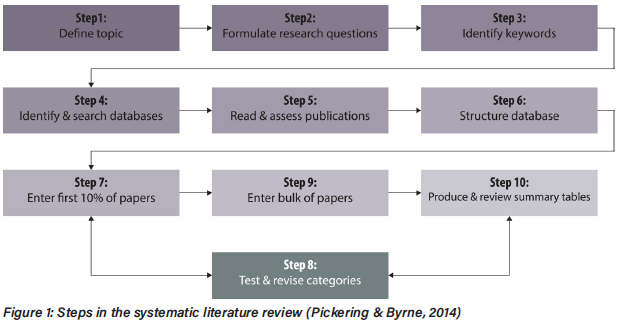
For this study Pickering and Byrne's (2014:539) stages for systematically reviewing and assessing literature were followed, as these stages are beneficial to study emergent and interdisciplinary paradigms (Figure 1). Furthermore, Pickering and Byrne's (2014:538) steps enable scholars to create a map of literature that demarcates the boundaries, gaps, geography, methodologies, deficiencies and most critical subjects available to scholars for future research.
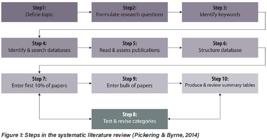
In the background of this article, the topic has been defined (Step 1), and the research question has been outlined (Step 2). To answer the research question, the researchers identified the key terms: strategic communication, strategic integrated communication, personal branding, brand advocacy and higher education (Step 3). No synonyms were used for any of the keywords, except for higher education due to the use of different terminology within different countries to describe HEIs. Thus, only contextual differences in terminology were considered, while no synonyms were used for theoretical constructs to ensure that this study explored the theoretical concepts within their scope of meaning. The following keywords were used to search the titles and abstracts of articles on various databases: "Strategic Integrated Communication",' "Strategic Communication",' "Brand Advoca*", "Personal Brand*", ("higher education" OR "tertiary education" OR universit* OR college*). By clearly defining the topic and formulating the research question, the researchers set the parameters of the study and identified the keywords based on these parameters to add to the validity of the study.
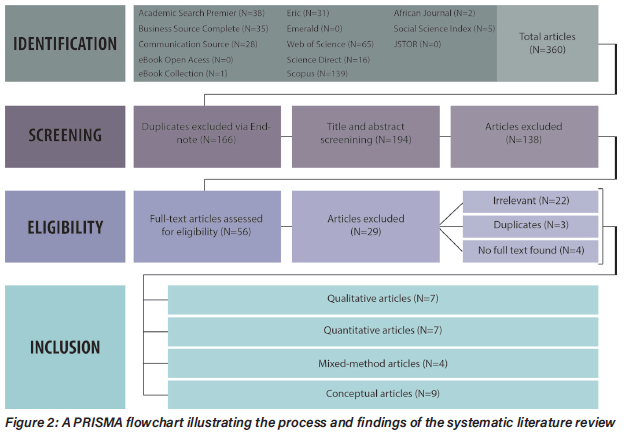
To ensure the validity of this study, a meeting was scheduled with the North-West University Faculty of Humanities Subject Librarian to check the keywords and the use of bullion for the study. Furthermore, the Faculty Librarian advised the researchers on which databases to consult for the systematic literature review to ensure further reliability (Step 4 - see Figure 2 for an overview of the databases consulted). A total of 13 databases were identified for this study, namely Academic Search Premier, Business Source Complete, Communication Source, eBook Open Access, eBook Collection, Eric, Emerald, Web of Science, Science Direct, Scopus, African Journal, Social Science Index and JSTOR. Before the systematic literature review could commence and to ensure the validity of this study, clear inclusion and exclusion criteria had to be identified. For this study, the first criterion was linked to timeframes. No specific timeframes were excluded so as not to limit search findings. The researchers included individual research articles and collective works within the study as the second criterion. The third criterion was that articles had to include two to five keywords. By doing this, 1) the researchers could see the extent to which theoretical constructs have been researched together, and 2) the researchers could determine the extent to which the concepts have been researched in the context of higher education. A fourth criterion was that articles had to be written in English.
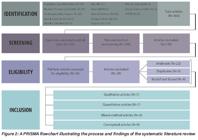
The Preferred Reporting Items for Systematic Reviews and Meta-Analyses (PRISMA) were used to systematically document each step of the literature review process (see Figure 2).
A search was conducted on all 13 databases by including all five keywords and then using a combination of four keywords, then three and, finally, only two (Step 5). The search took place between 17 August 2022 and 30 August 2022. The titles and abstracts of articles on the different databases were scanned to find articles to include in this study. Only articles containing up to two combinations of keywords were found on the databases. The search findings thus indicate that a gap exists regarding existing literature and that no study has identified all of the concepts included in this article (strategic communication, strategic integrated communication, personal branding and brand advocacy) in the context of higher education.
A total of 360 articles were found and imported into the Endnote reference management tool to remove possible duplicates. After removing 166 duplicates, the researchers screened the remaining 194 titles and abstracts of the articles identified through the systematic literature review. During this screening step, the researchers removed 138 articles (review articles, grey literature, irrelevant articles and articles not written in English). A total of 56 full articles and textbooks were then captured in a Microsoft Excel document. These were assessed and coded using ATLAS.ti™ software as part of the eligibility screening (Step 6). It is important to note that despite the textbook consisting of numerous chapters, the collective work was only captured as a single unit in this systematic literature review, despite numerous chapters being included in the analysis. A total of 10% of the articles were entered and coded (Step 7). The codes and articles were then peer-reviewed by a subject specialist to refine categories and sub-categories (Step 8). The peer reviewer received a list of the articles as well as the reason for the inclusion and exclusion of articles. The reviewer was then asked to review 10% of the articles and to indicate whether they agreed with the inclusion and exclusion of articles as well as the categories and sub-categories. No changes were made to the categories and sub-categories constructed during the peer-review process. The remaining articles were then uploaded into the excel document capturing the author details, year of publication, article title and journal name. The essence of the article was also identified and, finally, the research design was identified. From the 56 eligible articles, an additional 29 articles were removed (Step 9). The researchers then analysed the excel document and the ATLAS.ti™ codes to identify patterns and gaps in the literature (Step 10). To ensure intra-coder reliability, clear categories were identified in line with the research aim of the study at hand. Intra-coder reliability was also maintained by carefully documenting each step and indicating the reasons for the inclusion or exclusion of an article in line with the categories. The documentation was provided to the peer reviewer, who checked the reliability of the findings. The coder was transparent throughout the process and provided all relevant information to the peer reviewer to ensure further intra-coder reliability. To ensure the validity of this study, the researchers carefully documented each step of the study and communicated the results and findings in each step (see Figure 2 and Table 1).
FINDINGS
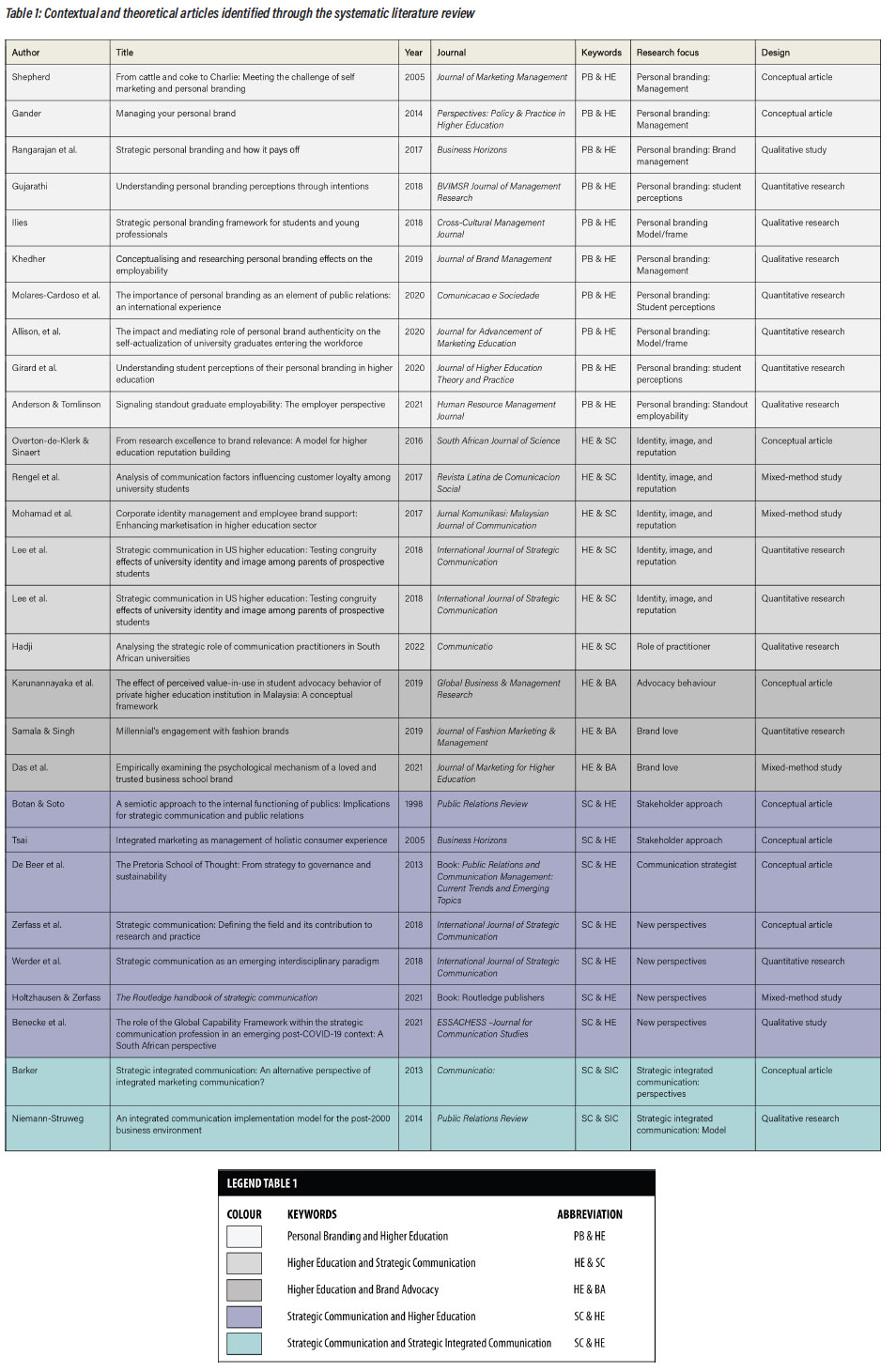
A total of 27 articles were identified that used a combination of different keywords relevant to this study (Table 1).
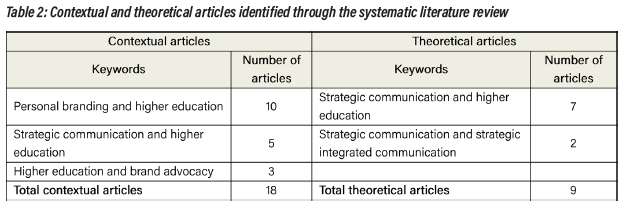
Articles were divided into two categories: mainly contextual articles and theoretical articles (see Table 2). Based on the findings, personal branding has been researched the most in the context of higher education, followed by strategic communication. Lastly, the findings indicate that limited research on brand advocacy exists in the context of higher education. The findings further indicate a minimum overlap between the different theoretical constructs relevant to this study. From the findings, only two articles were found that linked strategic communication with strategic integrated communication.
The characteristics of the articles also yielded varied findings. Most articles identified through the systematic literature review were published after 2011, with only three articles published before 2011. The articles also seemed scattered among various journals, except for three articles from the International Journal of Strategic Communication, two articles identified from the Business Horizons Journal, and two from the journal Communicatio. Lastly, from the 27 articles identified, only three articles were found in South African journals.
The research articles identified through the systematic literature review also differed in research approaches (see Table 1 for list of the articles identified and the research approach used in each article). Most of the articles identified (nine in total) were conceptual articles, followed by quantitative (eight) and then qualitative (seven) articles. Only four articles used a mixed-method approach to research.
The following section discusses the extent to which the leading research trends on strategic communication, strategic integrated communication, brand advocacy and personal branding have been explored within the context of higher education.
DISCUSSION
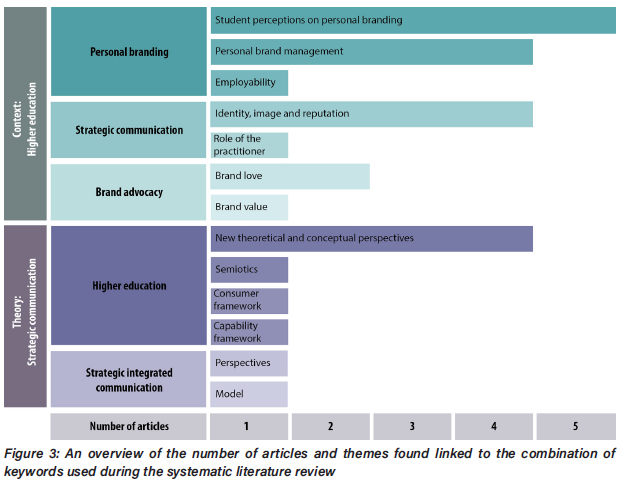
Figure 3 provides an overview of the number of articles found and the broad themes identified in the articles. The first three sub-headings provide insights on personal branding, strategic communication and brand advocacy in the context of HEIs, while the final two sub-headings explore the theoretical developments of strategic communication and strategic communication in academia in general, and do not specifically contextualise information in the higher education sector.
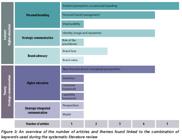
Higher education and personal branding
The keywords that generated the most findings regarding the context were higher education and personal branding. A total of 10 articles were found combining the two terms in the title or abstract. The findings of the systematic literature review provided different perspectives on higher education and personal branding. Three main research trends could be identified about personal branding.
The first theme that emerged was the management of personal brands within the context of higher education, of which four articles contributed to this theme. An article by Shepherd (2005) explored the academic interest in personal branding from a marketing perspective. Shepherd (2005:592) points out that no conceptual framework existed at the time for personal branding and argues that the concepts need more empirical and theoretical evidence to support personal branding as a theoretical construct. Based on this premise, Shepherd criticised personal branding for merely extending concepts from marketing to individuals without considering the complexity of human identity. Thus, in his view, a re-theorising of personal branding was necessary, as the narrative surrounding personal branding was dominated by self-help books, gurus and career advisors, without empirical evidence from academia included in such a narrative (Shepherd, 2005:602). Another article on the management of personal branding was a perspective by Gander (2014) on how stakeholders in the higher education context could build their personal brand. Despite the call for more scientific rigour through research by Shepherd (2005), Gander's (2014) article provides insights from the literature on personal branding. This article seems to advocate including personal branding in career development in higher education by providing practical tips and tools to construct and manage personal brands. From a stronger industry perspective, Rangarajan et al. (2017) conducted 33 interviews with professionals in the United States and Europe. Based on their interview findings, Rangarajan et al. (2017:664) identified four recommendations on how professionals could manage their personal brand (balance respect-building and relationship-building, bolster personal branding with organisational support, embrace flexibility and evaluate brands over time to adapt). From this perspective, Rangarajan et al. (2017:665) highlight the importance of personal branding in the industry and emphasise the importance of organisational support to improve employees' personal brands to benefit the organisational brand. A study conducted by Khedher (2019) among 54 Tunisian university graduates also explored how personal branding could shape employment outcomes. Based on Khedher's (2019:104) research, cultural capital, social capital, appearance, authenticity and mediated and verbal presentations all play a role when positioning oneself in an industry to be employed. From this perspective, Khedher (2019:107) found a positive relationship between personal branding and employability. This study also confirmed a variation in how graduates engaged in personal branding and highlighted how personal branding is becoming a key differentiator among university graduates.
A second theme identified that supports the arguments made by Khedher (2019) was an article written by Anderson and Tomlinson (2020) on signalling standout employability. Nineteen interviews were conducted with 19 organisations (Anderson & Tomlinson, 2019:681). Based on their findings, Anderson and Tomlinson (2019:689) argue that HEIs must enable students to articulate their narratives to communicate and improve their personal brands in a way that meets the employers' signalling expectations. Based on this article, qualifications, personal qualities, psychological qualities, personal branding, work-related experience, person-organisation fit and back stories all play an essential role in signalling graduate employability. From the analysis of this article, standout employability does, to some extent, link to personal branding. However, various other conditions can contribute to signalling standout employability. Thus, standout employability could be seen as a lesser theme in relation to personal branding in the higher education context. From this perspective, personal branding is seen as one of many factors that could signal standout employability, while the argument could be made that qualifications, personal qualities, psychological qualities, work-related experience and back stories all contribute to the development of a personal brand. The narrative communicated regarding one's personal brand would then give an indication of the person-organisation fit, which could signal standout employability.
A third theme evident from the research was students' perceptions of the development of personal brands. Five studies were identified through the systematic literature review. The first study conducted by Ilies (2018), who observed 286 Romanian communication, public relations and advertising students over a period of five years, found that students want to have fulfilling and dynamic professional careers. Ilies (2018:46) maintains that students need assistance with developing their personal brands. Due to this, Ilies (2018) developed a strategic personal branding plan to guide students and young professionals to develop a personal brand. In another study, Gujarathi and Kulkarni (2018) explored students in management's perceptions of personal branding. The study randomly sampled 51 graduates who completed their MBA/ PGDMA from a public university in Mumbai (Gujarathi & Kukarni, 2018:211). The study measured students' perceptions of their university's support in enabling students to gain employment. The study found a favourable attitude towards the institution for assisting students with their personal brand development. From the articles above, it becomes evident that students, to some extent, view it as the responsibility of HEIs to invest in their personal brand development. In turn, developing student brands to increase the probability of employment also seemed to create a positive attitude towards the institution.
In line with the theme of students' perceptions of the development of personal brands, Molares-Cardoso et al. (2020) examined the degree of knowledge that students in communication had on personal branding and its application to the field of public relations. The study included 300 students from two Spanish universities and one Portuguese university (Molares-Cardoso et al., 2020:23). Through their research Molares-Cardoso et al. (2020:32) found that Spanish students showed an interest in the topic of personal branding, showcasing the need for an increase in education on personal branding. The study further found that Portuguese students were more aware of the importance of personal branding. Despite the differences in awareness between students in different countries, Girard et al. (2020) administered a questionnaire to students at two differently owned universities within the United States (one private and one public university). From the questionnaire 298 responses were obtained from participants (Girard et al. 2020:138). Instead of measuring the awareness held by students regarding the topic, the study aimed to understand the most important attributes of personal branding to students. The study found that most of the important attributes of a personal brand were linked to intrinsic attributes such as self-motivation, work ethic and problem-solving (Girard et al. 2020:144). Even though students are responsible for the development of their intrinsic attributes, Girard et al. (2020:144) maintain that educational experience can support the development of these attributes. Thus, learning environments and educational experiences should be strategically planned to address gaps in students' intrinsic attributes. Improving personal branding attributes aligned with the university's strategic intent could improve the student's personal brand and the university's image. Furthermore, improving a student's attributes is linked to personal branding. Research conducted among 117 undergraduate business school students in the United States by Allison et al. (2020) not only confirmed the importance of personal branding, but found that higher levels of personal brand authenticity led to increasing students' self-actualisation. The study further argues that students tend to focus on personal branding only as they get closer to graduation. However, as personal branding is a long-term process, it should be started earlier in a student's academic career. Personal branding activities should be incorporated into the university curriculum to prepare students better to construct and develop their personal brands.
From the literature identified through the systematic literature review, it is evident that since 2005, academia has made various empirical and contextual contributions regarding personal branding. Various authors have explored the management of personal branding in the context of higher education by focusing on the management of brands and students' perceptions of personal branding. Despite the limited number of resources found regarding personal branding in higher education, the literature included in this study shows that strides have been made to explore the relevance of personal branding in the context of higher education. Despite this, the systematic literature review did not adequately identify studies exploring the theoretical foundations of personal branding concerning higher education. This gap in theoretical foundations poses a problem for HEIs, as the empirical studies identified above allude to the fact that students see it as the responsibility of HEIs to support them with personal brand development.
Higher education and strategic communication
The keywords that provided the second-most findings regarding context were higher education and strategic communication. Five articles were identified through the systematic literature review. Most of the articles were linked to identity, image and reputation, and how these link to strategic communication in the higher education context, while one article focused on the role of strategic communication practitioners in HEIs.
An article by Overton-de Klerk (2016) criticises reputation development in HEIs due to their linear and modernist focus on university rankings linked to research excellence. Overton-de Klerk (2016:7) advocates alternative ways of differentiation of HEIs through brand relevance and co-creating brand meaning through collaborating with stakeholders. She adds that a stakeholder-centric approach is required that includes internal stakeholders, end-users and communities to reflect on the brand relevance and purpose of an HEI. Overton-de Klerk (2016:7) concludes her conceptual article by stating that only when a higher education brand has found their niche and purpose that adds value to society, should their attention be placed on building an international reputation.
Rengel et al. (2017) explored the communication factors among distance learning undergraduate students that influence customer loyalty at an Ecuadorian university. Using a mixed-method approach, surveys and in-depth interviews were used to explore the phenomena at hand (Rengel et al., 2017:756). The study found that students had a 66% satisfaction level regarding processes and services at their university (Rengel et al., 2017:761). Conclusions from the study found that loyalty was linked to the attention and the perceptions that students have of the values of an institution. The study suggests that HEIs need to personalise induction programmes to communicate an institution's identity and culture. The aim of these programmes should thus create a sense of belonging and tailor communication and experiences to consider the different student profiles registered for distance learning programmes (Rengel et al., 2017:761).
Mohamad et al. (2017) examined the extent to which employee brand support links to corporate identity management in the Malaysian higher education sector. In their study, Mohamad et al. (2017:186) surveyed 472 academic staff from Malaysian public universities. Findings from the study suggested that aspects of corporate identity management were critical to employees and thus affected their brand support behaviour. Furthermore, the study found that relationship communication regarding employee brand support was essential. The study, therefore, showcases the importance of academic staff's perceptions when corporate identity strategies or employee development programmes are developed inside an organisation (Mohamad et al., 2017:190).
A study by Lee et al. (2018) explored the extent to which strategic communication constructs such as identity and image influence parents of prospective students at universities in the United States. Surveys were completed by 314 parents using a database (Lee et al., 2018:316). The study found a link between internal stakeholders' judgement and parents' perceptions of HEIs. Furthermore, the study found that parents had a favourable attitude towards institutions when there was a match between image and identity. Lee et al. (2018:32) maintain that identity plays a more significant role than the image in the minds of stakeholders. The study thus found that university rankings did not matter as much as great employee and internal relations.
A study conducted by Hadji (2022) explored the role of senior-level communication practitioners in the South African higher education context. A qualitative approach was followed, and interviews were held with seven communication practitioners and three university planners from seven South African universities (Hadji, 2022:116). This study found that communication practitioners in HEIs were not integrated into university management and could, therefore, not assist management as environmental scanners, which could provide management with intelligence regarding dynamic environments. The study also found that the role of strategic communication in the context of higher education is still very ill-defined, and thus communication practitioners could not contribute meaningfully to strategic management processes (Hadji, 2022:128).
Based on the articles identified through the systematic literature review, identity, image and reputation in the higher education context need to be reconceptualised within a strategic communication perspective, as proposed by Overton-de Klerk (2016). From the viewpoint of Rengel et al. (2017), Mohamed et al. (2017) and Lee et al. (2018), it would be advisable for HEIs to take a more stakeholder-orientated approach to identity and image in the higher education context. Thus, the idea of students, alumni, university staff and local communities co-creating HEI brands is becoming increasingly important. However, as Hadji (2022) found, the role of strategic communication practitioners working in the higher education context would have to be better defined and reconceptualised to be able to add value to HEIs. This means that strategic communication practitioners need to be integrated more into management meetings to advise management more strategically regarding information and insights from stakeholders and the environment. Strategic communication practitioners thus need to be able to consult management to better identify the opportunities for co-creation with stakeholders regarding identity, image and reputation.
Higher education and brand advocacy
Only three articles were identified regarding brand advocacy in higher education. A study by Karunanayaka et al. (2019) explored the importance of behaviour, self-brand connection and brand prominence in affecting private higher education students' advocacy behaviour. This conceptual article explores how HEIs should involve students in internal branding efforts to establish and maintain relationships with students to co-create the HEI's brand to ultimately become brand advocates. By doing this, students can create positive word-of-mouth and defend or represent the brand if needed. Despite the contributions of this article, there was no empirical evidence to support the claims by Karunanayaka et al. (2019). The study also lacked depth regarding the theoretical foundations of brand advocacy.
Conversely, Dass et al. (2021) argue that HEIs, especially business schools, are functioning in a very competitive market regarding marketing and branding. Owing to this competitiveness, they conducted research to explore drivers of brand loyalty and advocacy by identifying the connections between experience, love and trust in the context of business schools. In their study, 298 respondents completed a questionnaire from five different business schools in India (Dass et al. 2021:31). This study found that affective, sensory and intellectual brand experiences could indirectly affect brand trust mediated through brand love. The study found that brand experiences, usually short-lived, should lead to significant increases in brand love to impact brand trust positively. The article thus found the connectedness of the concepts of brand experience, trust and love, despite these concepts being distinct from one another (Dass et al. 2021:35). This study argues that business schools need to create intellectually stimulating learning environments through teaching and learning with an involved faculty that facilitates the intellectual brand experience to motivate students towards brand advocacy.
Similarly, Samala and Singh (2019:2) explored millennial brand engagement with self-concept, brand love and brand advocacy for fashion brands. For this study, Samala and Singh (2019:6) received 621 responses from university students at a specific university through their quantitative questionnaire. It is important to note that the context of this study is only partially focused on the higher education context. However, this study was included due to the focus on university students. This study found that brand engagement with consumers' self-concept plays a mediating role in brand love and advocacy. Furthermore, this study indicated that involvement within a brand would increase brand love, which would increase further involvement. This study found that brand love and high levels of involvement in purchase decisions affect customer engagement with the brand and the extent to which they relate the brand back to their self-concept. This study also found that the more subjective a customer's knowledge of a brand, the more brand engagement with self-concept would occur. This could lead to advocacy behaviour due to higher knowledge levels (Samala & Singh, 2019:6). Despite the focus on fashion brands, this study also enables researchers to identify behavioural patterns of students that may provide crucial theoretical insight into how students could be advocates of university brands. By creating opportunities for brand engagement with self-concept, university brands could increase brand love.
The articles above found that brand advocacy by students may provide a competitive advantage to higher education brands. However, internal branding may be required to build and maintain relationships with students and to co-create the brand to achieve that. By doing this, more brand experiences could be created for students, increasing brand love and trust. This would enable students to be advocates of brands, as more profound engagement with a brand could influence students' self-concepts. The following two themes focus more on the theoretical developments of strategic communication and strategic integrated communication in academia and practice in general, rather than the higher education context.
Strategic communication and higher education
No studies were found that linked the theoretical foundations of personal branding, brand advocacy and strategic communication. However, six studies were identified that explored the theoretical foundations of strategic communication using the keywords strategic communication and higher education. Two studies were also identified that combined the keywords strategic communication and strategic integrated communication. Although strategic communication has already been explained in the context of higher education earlier in this article, this section touches more on theoretical developments in the strategic communication paradigm. Based on the analysis of the literature, five themes arose.
The first theme identified focuses on meaning creation when communicating strategically. In an article written by Botan and Soto (1998), the assumptions that publics are reactive when exposed to strategic communication were questioned. This conceptual article argues that a semiotic approach to strategic communication should be taken, in which logic, grammar and rhetoric act together to provide an unlimited semiosis. In this regard, semiosis refers to the process in which a message's interpretation ascribes meaning to a message. Thus, meaning is not something designed by the creator of a message, nor does it lie in the message itself (Botan & Soto, 1998:35). This process of semiosis helps publics to generate their own identity (Botan & Soto, 1998:38). This article thus provides theoretical insight into the meaning-making processes that stakeholders go through when engaging in strategic communication.
The second theme that was evident from the systematic literature review focuses on creating a more meaningful consumer experience. In a study by Tsai (2005), a holistic consumer experience management framework that combines perspectives of strategic communication and brand management was conceptualised. The holistic consumer experience management framework transcends traditional marketing approaches by viewing customers as emotional beings in search of self-identity, social groups and culture. In this framework, Tsai (2005:439) maintains that brand managers need to consider not just the consumers' basic needs, but their hearts and minds, by viewing the consumer as more than just a client. Marketing experience can be constructed to create a holistic experience. In this framework, the synergy between departments is also encouraged to think holistically about the consumer experience from different departmental perspectives. Thus, all departments need to consider the consumer's expectations, aspirations and fantasies (Tsai, 2005:440).
The third theme that emerged from the review focuses on the conceptualisation of the Pretoria School of Thought (De Beer et al., 2013). From this perspective, researchers at the University of Pretoria focused on the management and governance of communication at a strategic organisational level, while including multidisciplinary concepts such as sustainability and corporate governance in institutionalisation (De Beer et al. 2013:319). It is clear from this theme that the Pretoria School of Thought provides a particular and narrow communication management perspective that is based on research conducted at the University of Pretoria.
The fourth theme that arose from the systematic literature review focuses on the conceptualisation of the emergent strategic communication paradigm. Two articles and one textbook were identified that explored the conceptualisation of the strategic communication paradigm. The first was an article from Zerfass et al. (2018), which critically explores the state of strategic communication that will help scholars and practitioners to expand on the existing body of knowledge on strategic communication. This article argues that one of the obstacles to developing strategic communication lies in the fragmented focus of different research within this discipline. Zerfass et al. (2018:502) advocate a shared language by integrating existing and new perspectives on communication to transcend common sense through scientific principles. Adding to the ideas of Zerfass et al. (2018), Werder et al. (2018) maintain that there has been an increase in productivity among researchers in the strategic communication discipline. Despite this increase in publications, Werder et al. (2018:333) propose definitional refinements to strategic communication to increase interdisciplinary research linked to strategic communication in order to strengthen the consistency and purpose of future research and theory building on strategic communication. Werder et al. (2018:349) advocate a more integrated and holistic view of communication to develop interdisciplinary concepts and frameworks that are linked to strategic communication. This led to a collective textbook by various strategic communication scholars. Holtzhausen and Zerfass (2020) served as editors of a collective handbook on strategic communication from a multidisciplinary perspective. In their work, they maintain that communication lies at the centre of society and, therefore, how communication is enacted in all types of organisations (for-profit, non-profit, government, political parties, etc.) based on power and interest needs to be explored (Holtzhausen & Zerfass, 2020:xx). This work provides insights into the different metatheoretical approaches to strategic communication, organisational variables affecting strategic communication, communication from strategic communicators with stakeholders, and different areas of practice in strategic communication. The contributors in Holtzhausen and Zerfass's (2020) handbook provide a redefinition of the strategic communication paradigm by providing theoretical and empirical evidence from a strategic communication perspective to redefine the paradigm of strategic communication.
The final theme that arose from the systematic literature review is the role of the Global Capability Framework that provides a professional development structure and guideline for professionals and postgraduate students working as strategic communication practitioners in industry (Benecke et al., 2021:143). The aim of this study was to determine the adoption of the Global Capability Framework in South Africa. This study sampled 10 practitioners and academics from the Public Relations Institute of Southern Africa's membership database, based on their roles and experience levels. A qualitative research approach was followed to conduct interviews with five academics and five professionals to explore the viability of the Global Capability Framework. This study found that a guiding framework for industry and academia is needed due to the complexity of the environments in which these professionals' function. The study further found that although the value of and need for the Global Capability Framework were identified, there was a limited application in industry (Benecke et al., 2021:155). Furthermore, the study highlighted the need for more collaboration between academia and industry, and how they should use change leadership to address challenges brought about by dynamic and changing environments. The final findings of this article highlight the importance of a transformational mindset, the changes brought about by the COVID-19 pandemic and, finally, the role of digital platforms in the fourth industrial revolution to facilitate stakeholder engagement (Benecke et al., 2021:156). This article provides important insights into the skills required by communication practitioners to adequately guide organisations to strategically communicate.
Despite the existing theory regarding strategic communication, there has been a strong move towards multi- and interdisciplinary research in strategic communication. What is essential about this move is that research on strategic communication should strive towards redefining the discipline by constructing new theories and frameworks on strategic communication. The Routledge Handbook for Strategic Communication by Holtzhausen and Zerfass (2020) provides theoretical and empirical research that adds value to the paradigm of strategic communication. In line with this thinking, Benecke et al. (2021) advocate applying the Global Capability Framework to provide guidelines for communication professionals in South Africa. From the findings in this section, it becomes evident that strategic communication has a good theoretical foundation, but that more empirical research is needed to build, redefine and align the conceptual foundations of strategic communication.
Strategic communication and strategic integrated communication
Two articles were identified through the systematic literature review. Both of these articles have a solid theoretical focus linked to strategic integrated communication.
Barker (2013) asserts that integrated marketing communication has been continuously challenged within the emerging paradigm of strategic communication. In her article, Barker advocates re-orientating a strategic perspective that focuses more on strategic integrated communication. Barker (2013:118) maintains that the move to strategic integrated communication could not be ascribed to theoretical foundational changes, but primarily due to the changing digital environment in which stakeholders' function. Barker (2013:119) calls for an alternative perspective to communication through which an organisation considers the various integrated dimensions of media and the dynamic changes brought about by changing environments in which organisations function. The conclusion is that strategic integrated communication requires future studies to build on the concept and enhance scholars' understanding of the paradigmatic changes that emerge from the strategic communication paradigm.
In 2014, Niemann-Struweg built on the narrative of strategic integrated communication by publishing an article based on the model she conceptualised in 2005 for her doctoral thesis. Niemann-Struweg's (2014:191) article based on her 2005 South African Model for Strategic Integrated Communication is premised on two principles, namely 1) the organisation's strategic intent should direct that communication integration, and 2) the broader environment in which an organisation functions should be considered when repositioning the organisation. Niemann-Struweg (2014:191) further contends that integration should also occur in three areas: organisational integration, stakeholder integration and environmental integration. The article provides a significant contribution as it builds on existing models of integrated communication, but also aims to address barriers to integrated communication not considered by prior models.
From the articles above, research on strategic communication concerning strategic integrated communication has been limited. Despite the alternative perspective that Barker (2013) suggests, only Niemann-Struweg (2014) has explored the theoretical foundations of strategic integrated communication in the for-profit sector. However, these foundations of strategic integrated communication were mainly inspired by Niemann's South African model conceptualised in 2005 for her doctoral thesis. Due to the limited amount of research articles available, strategic integrated communication has not been successfully adopted as a research topic, unlike strategic communication. Despite the focus on strategic communication as a paradigm, strategic integrated communication could provide relevant theoretical insights that may be relevant to HEIs in South Africa.
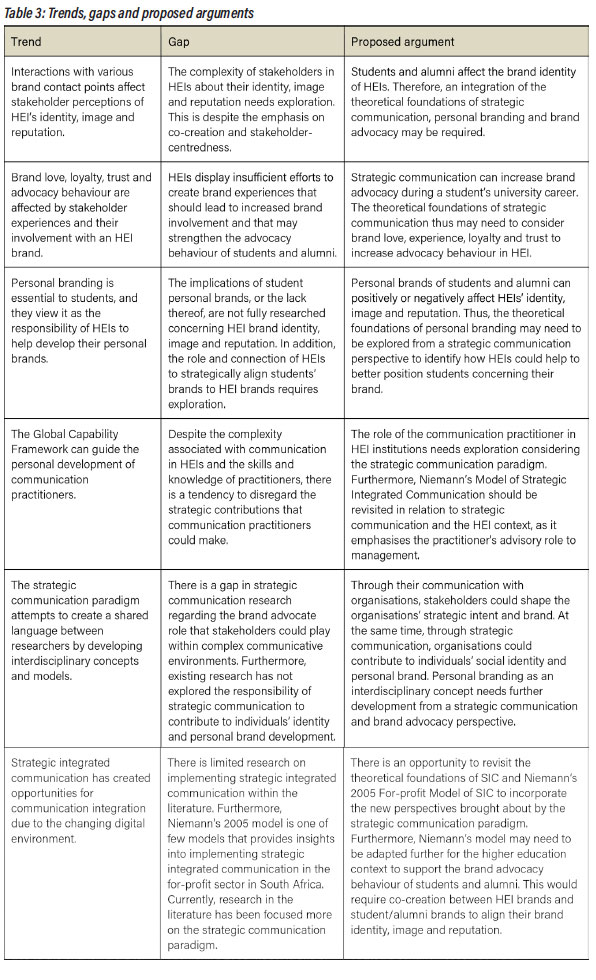
KEY CONCLUSIONSBased on the discussions in the section above, Table 3 provides key conclusions of the research trends and gaps currently found in literature in relation to strategic communication, strategic integrated communication, brand advocacy and personal branding in relation to the higher education context.
The trends in Table 3, identified through the systematic literature review, indicate that current research mainly focuses on strategic communication, personal branding and, to some extent, brand advocacy. Furthermore, the systematic literature review highlighted the increased focus on the theoretical development of the strategic communication paradigm and showed the limited research on strategic integrated communication. Despite the relevant contextual literature on strategic communication, personal branding and brand advocacy, research on these concepts seems to be conducted in silos with limited integration of their theoretical foundations when researching HEIs. Similarly, strategic communication and strategic integrated communication tend not to explore dimensions of personal branding or brand advocacy in their theoretical foundations. Although these concepts are independent theoretical constructs, integrating them could add value to theory and communication practice in different contexts. In the context of higher education, combining the theoretical foundations of strategic communication, strategic integrated communication, personal branding and brand advocacy could contribute to navigating the strategic complexities caused by stakeholders, specifically students and alumni, in HEIs.
CONCLUSION
The study posed the research question: What are the main research trends in strategic communication, strategic integrated communication, brand advocacy and personal branding within the context of higher education? To answer this question, a systematic literature review was conducted on the research trends in strategic communication, strategic integrated communication, personal branding and brand advocacy in higher education. The systematic literature review found that limited studies focused on combining the concepts above in their titles and abstracts. In some cases, only combinations of two keywords were found in titles and abstracts. Furthermore, the eligibility screening articles were divided into contextual and theoretical categories. Contextually, personal branding had been researched the most in the context of higher education, followed by strategic communication and, finally, brand advocacy. Despite the research articles identified, there is further opportunity to research the concepts of strategic communication, strategic integrated communication, personal branding and brand advocacy in higher education, due to the absence of overlap between these concepts from a theoretical perspective.
Based on the current lack of theoretical and contextual integration between concepts (strategic communication, strategic integrated communication, personal branding and brand advocacy in higher education), as evident in the trends and gaps in the literature, future research should explore the communicative complexities regarding identity, image and reputation created by stakeholders such as students and alumni transitioning from internal to external stakeholders. In addition, future research should explore what HEIs are doing to align student and alumni brands to HEI brands to communicate a consistent brand message through advocacy behaviour. Similarly, the perceptions of students and alumni regarding brand-building initiatives may need to be explored to understand how the HEI brand affects their personal brand development and advocacy behaviour.
The value of this future research is based on the ability of students and alumni to positively or negatively influence HEIs' identity, image and reputation through their behaviour. As stakeholders, they play a vital role in positioning and representing HEIs on a micro level in their communities and industry. Communication practitioners in HEIs can thus incorporate students and alumni in brand-building initiatives through brand advocacy. However, students and alumni also have their own identities, which may contradict the identity of the HEI brand. Furthermore, the credibility of the social identity of students or alumni as articulated through their personal brand may also affect the success of advocacy behaviour. Strategic communication is thus required to position students' and alumni's personal brands to serve as brand advocates who can strengthen an HEI's identity, image and reputation. In addition, communication practitioners and higher education management should create communicative opportunities to align students and alumni with the HEI brand identity. By creating these opportunities, HEI brands, through co-creation, may redefine their strategic intent by adapting to environmental and stakeholder expectations. Through this interaction, strategic integrated communication may occur by not only redefining the strategy of the HEI, but also aligning HEI brand messages with messages communicated by students and alumni in communities and industries. However, guiding models and frameworks may be required to support HEIs in implementing strategic communication.
REFERENCES
- Allison, L., Blair, J., Jin Ho, J. & Boutin Jr, P.J. (2020). The impact and mediating role of personal brand authenticity on the self-actualization of university graduates entering the workforce. Journal for Advancement of Marketing Education, 28(2):3-13.
-
Anderson, V. & Tomlinson, M. (2021). Signaling standout graduate employability: The employer perspective. Human Resource Management Journal, 31(3):675-693. Available from: https://doi.org/10.1111/1748-8583.12334
» https://doi.org/10.1111/1748-8583.12334 -
Balaji, M.S., Roy, S.K. & Sadeque, S. (2016). Antecedents and consequences of university brand identification. Journal of Business Research, 69(8):3023-3032. Available from: https://doi.org/10.1016/j.jbusres.2016.01.017
» https://doi.org/10.1016/j.jbusres.2016.01.017 -
Barker, R. (2013). Strategic integrated communication: An alternative perspective of integrated marketing communication? Communicatio, 39(1):102-121. Available from: https://doi.org/10.1080/02500167.2013.741071
» https://doi.org/10.1080/02500167.2013.741071 -
Benecke, D.R., Muir, C., Porthen, D., Van Wyk, H. & Du Plessis, N.M. (2021). The role of the global capability framework within the strategic communication profession in an emerging post COVID-19 context: A South African perspective. ESSACHESS - Journal for communication studies, 14(1):137-159. Available from: https://essachess.com/3/index.php/jcs/article/view/141
» https://essachess.com/3/index.php/jcs/article/view/141 -
Botan, C.H. & Soto, F. (1998). A semiotic approach to the internal functioning of publics: Implications for strategic communication and public relations. Public Relations Review, 24(1):21-44. Available from: https://doi.org/10.1016/S0363-8111(98)80018-0
» https://doi.org/10.1016/S0363-8111(98)80018-0 -
Choi, Y., Kroff, M.W. & Kim, J. (2021). Developing brand advocacy through brand activities on Facebook. Journal of Consumer Marketing, 38(3):328-338. Available from: https://dx.doi.org/10.1108/jcm-10-2019-3460
» https://dx.doi.org/10.1108/jcm-10-2019-3460 -
Dass, S., Popli, S., Sarkar, J. G., & Vinay, M. (2021). Empirically examining the psychological mechanism of a loved and trusted business school brand. Journal of Marketing for Higher Education, 31(1):23-40. Available from: https://doi.org/10.1080/08841241.2020.1742846
» https://doi.org/10.1080/08841241.2020.1742846 - de Beer, E., Steyn, B. & Rensburg, R. (2013). The Pretoria school of thought: From strategy to governance and sustainability. In Public Relations and Communication Management: Current Trends and Emerging Topics. New York: Taylor and Francis, 303-323.
-
Dean, D., Arroyo-Gamez, R.E., Punjaisri, K. & Pich, C. (2016). Internal brand co-creation: The experiential brand meaning cycle in higher education. Journal of Business Research, 69(8):3041-3048. Available from: https://doi.org/10.1016/j.jbusres.2016.01.019
» https://doi.org/10.1016/j.jbusres.2016.01.019 -
Escalas, J.E. (2004). Narrative processing: Building consumer connections to brands. Journal of consumer Psychology, 14(1-2):168-180. Available from: https://doi.org/10.1207/s15327663jcp1401&2_19
» https://doi.org/10.1207/s15327663jcp1401&2_19 -
Ferraro, R., Kirmani, A. & Matherly, T. (2013). Look at me! Look at me! Conspicuous brand usage, self-brand connection, and dilution. Journal of Marketing Research, 50(4):477-488. Available from: https://doi.org/10.1509/jmr.11.0342
» https://doi.org/10.1509/jmr.11.0342 -
Gander, M. (2014). Managing your personal brand. Perspectives: Policy & Practice in Higher Education, 18(3):99-102. Available from: https://doi.org/10.1080/13603108.2014.913538
» https://doi.org/10.1080/13603108.2014.913538 -
Girard, T., Pinar, M. & Lysiak, L. (2020). Understanding student perceptions of their personal branding in higher education. Journal of Higher Education Theory and Practice, 20(13):136-146. Available from: http://www.na-businesspress.com/JHETP/JHETP20-13/10_GirardFinal.pdf
» http://www.na-businesspress.com/JHETP/JHETP20-13/10_GirardFinal.pdf -
Gorbatov, S., Khapova, S.N. & Lysova, E.I. (2018). Personal branding: Interdisciplinary systematic review and research agenda. Frontiers in Psychology, 9. Available from: https://doi.org/10.3389/fpsyg.2018.02238
» https://doi.org/10.3389/fpsyg.2018.02238 -
Gujarathi, R. & Kulkarni, S. (2018). Understanding personal branding perceptions through intentions. BVIMSR Journal of Management Research, 10(2):207-217. Available from: https://www.researchgate.net/profile/Thiruvenkadam-Thiagarajan/publication/331036367_Organizational_Climate_for_Innovation_and_Creativity/links/5c6293d7299bf1d14cbfbcce/Organizational-Climate-for-Innovation-and-Creativity.pdf#page=79
» https://www.researchgate.net/profile/Thiruvenkadam-Thiagarajan/publication/331036367_Organizational_Climate_for_Innovation_and_Creativity/links/5c6293d7299bf1d14cbfbcce/Organizational-Climate-for-Innovation-and-Creativity.pdf#page=79 -
Hadji, M.J. (2022). Analysing the strategic role of communication practitioners in South African universities. Communicatio. Available from: https://doi.org/10.1080/02500167.2022.2086593
» https://doi.org/10.1080/02500167.2022.2086593 -
Hallahan, K., Holtzhausen, D., van Ruler, B., Verčič, D. & Sriramesh, K. (2007). Defining strategic communication. International Journal of Strategic Communication, 1(1):3-35. Available from: https://doi.org/10.1080/15531180701285244
» https://doi.org/10.1080/15531180701285244 -
Hemsley-Brown, J., Melewar, T.C., Nguyen, B. & Wilson, E.J. (2016). Exploring brand identity, meaning, image, and reputation (BIMIR) in higher education: A special section. Journal of Business Research, 69(8):3019-3022. Available from: https://doi.org/10.1016/j.jbusres.2016.01.016
» https://doi.org/10.1016/j.jbusres.2016.01.016 - Holtzhausen, D. & Zerfass, A. (2020). The Routledge Handbook of Strategic Communication. New York: Taylor & Francis.
-
Ilies, V.I. (2018). Strategic personal branding for students and young professionals. Cross-Cultural Management Journal, 20(1):43-51. Available from: https://seaopenresearch.eu/Journals/articles/CMJ2018_I1_6.pdf
» https://seaopenresearch.eu/Journals/articles/CMJ2018_I1_6.pdf -
Karunanayaka, D.C., Arokiasamy, L. & Masri, R. (2019). The effect of perceived value-in-use in student advocacy behavior of private higher education institution in Malaysia: A conceptual framework. Global Business and Management Research, 11(1):407-418. Available from: https://doi.org/10.1051/shsconf/20185602001
» https://doi.org/10.1051/shsconf/20185602001 -
Khedher, M. (2019). Conceptualizing and researching personal branding effects on the employability. Journal of Brand Management, 26(2):99-109. Available from: https://doi.org/10.1057/s41262-018-0117-1
» https://doi.org/10.1057/s41262-018-0117-1 -
Lee, Y.A., Park, H. & Cameron, G.T. (2018). Strategic communication in US higher education: Testing congruity effects of university identity and image among parents of prospective students. International Journal of Strategic Communication, 12(3):308-327. Available from: https://doi.org/10.1080/1553118X.2018.1445091
» https://doi.org/10.1080/1553118X.2018.1445091 -
Mohamad, B., Ismail, A.R. & Bidin, R. (2017). Corporate identity management and employee brand support: Enhancing marketisation in higher education sector. Jurnal Komunikasi: Malaysian Journal of Communication, 33(3):178-195. Available from: http://dx.doi.org/10.17576/JKMJC-2017-3303-11
» http://dx.doi.org/10.17576/JKMJC-2017-3303-11 -
Molares-Cardoso, J., de Aguileta, C.L. & Lago, B.L. (2020). The importance of personal branding as an element of public relations: an international experience. Comunicacao e Sociedade, 2020:19-35. Available from: https://doi.org/10.17231/comsoc.0(2020).2738
» https://doi.org/10.17231/comsoc.0(2020).2738 -
Niemann-Struweg, I. (2014). An integrated communication implementation model for the post-2000 business environment. Public Relations Review, 40(2):184-192. Available from: https://doi.org/10.1016/j.pubrev.2013.08.011
» https://doi.org/10.1016/j.pubrev.2013.08.011 - Niemann, I. (2005). Strategic integrated communication implementation: Towards a South African conceptual model. Pretoria: University of Pretoria.
-
Overton-de Klerk, N. & Sienaert, M. (2016). From research excellence to brand relevance: A model for higher education reputation building. South African Journal of Science, 112(5):47-54. Available from: https://doi.org/10.17159/sajs.2016/20150365
» https://doi.org/10.17159/sajs.2016/20150365 -
Pickering, C. and Byrne, J. (2014). The benefits of publishing systematic quantitative literature reviews for PhD candidates and other early-career researchers. Higher Education Research & Development, 33(3):534-548. Available from: https://doi.org/10.1080/07294360.2013.841651
» https://doi.org/10.1080/07294360.2013.841651 -
Rangarajan, D., Gelb, B., D. & Vandaveer, A. (2017). Strategic personal branding - And how it pays off. Business Horizons, 60(5):657-666. Available from: https://doi.org/10.1016/j.bushor.2017.05.009
» https://doi.org/10.1016/j.bushor.2017.05.009 -
Rengel, V.K.D., Ramirez, M.E.A. & Benavides, A.V.V. (2017). Analysis of communication factors influencing customer loyalty among university students. Revista Latina De Comunicacion Social, 72(7):751-764. Available from: http://www.revistalatinacs.org/072paper/1190/40en.html
» http://www.revistalatinacs.org/072paper/1190/40en.html -
Samala, N. & Singh, S. (2019). Millennial's engagement with fashion brands. A moderated-mediation model of brand engagement with self-concept, involvement and knowledge. Journal of Fashion Marketing and Management, 23(1):2-16. Available from: https://doi.org/10.1108/JFMM-04-2018-0045
» https://doi.org/10.1108/JFMM-04-2018-0045 -
Shepherd, I.D.H. (2005). From cattle and coke to Charlie: Meeting the challenge of self-marketing and personal branding. Journal of Marketing Management, 21(5-6):589-606. Available from: https://doi.org/10.1362/0267257054307381
» https://doi.org/10.1362/0267257054307381 -
Tsai, S.P. (2005). Integrated marketing as management of holistic consumer experience. Business Horizons, 48(5):431-441. Available from: https://doi.org/10.1016/j.bushor.2005.02.005
» https://doi.org/10.1016/j.bushor.2005.02.005 - Verwey, S. & Benecke, D.R. (2021). Paradigms, perspectives and paradoxes. In S. Verwey, D.R. Benecke T. Phumo, T. (eds). Strategic communication: South African perspectives. Cape Town: Oxford University Press, 5-32.
-
Werder, K.P., Nothhaft, H., Verčič, D. & Zerfass, A. (2018). Strategic communication as an emerging interdisciplinary paradigm. International Journal of Strategic Communication, 12(4):333-351. Available from: https://doi.org/10.1080/1553118X.2018.1494181
» https://doi.org/10.1080/1553118X.2018.1494181 -
Xiao, Y. & Watson, M. (2019). Guidance on conducting a systematic literature review. Journal of Planning Education and Research, 39(1):93-112. Available from: https://doi.org/10.1177/0739456X17723971
» https://doi.org/10.1177/0739456X17723971 -
Zerfass, A., Verčič, D., Nothhaft, H. & Werder, K.P. (2018). Strategic communication: Defining the field and its contribution to research and practice. International Journal of Strategic Communication, 12(4):487-505. Available from: https://doi.org/10.1080/1553118X.2018.1493485
» https://doi.org/10.1080/1553118X.2018.1493485
Accepted March 2025