Managing Corporate Reputation in Higher Education: The Case of the North-West University
Abstract
The objective of this article is to evaluate the corporate reputation of the North-West University during a period characterised by significant challenges, such as transformation within the higher education sector and the impact of global trends such as the Covid-19 pandemic, the Fourth Industrial Revolution and the emergence of new stakeholder groups. These challenges possess the potential to affect North-West University's corporate reputation. The article explores North-West University's corporate reputation with an emphasis on the importance of staff members as a key stakeholder group of which to take note. The article assesses this stakeholder group's perceptions through semi-structured interviews and an online survey characterised by RepTrak™. The findings of the article suggest that there is room for North-West University to improve its corporate reputation among staff members, as these stakeholders perceive the university's corporate reputation as average. The findings also suggest a need to improve corporate reputation management and the need for development of a formal strategy to achieve this at NorthWest University. The article furthermore proposes reasons staff members at North-West University perceive the university's corporate reputation as average and provides recommendations for improving it.
Corporate reputation management and measurement; higher education; North-West University (NWU); RepTrak™; semi-structured interviews
INTRODUCTION
Over the past decade, the corporate environment has evolved with a shift from profit maximisation to customer satisfaction (Panwar et al., 2016:154). Corporate communication activities, particularly corporate reputation, play a crucial role in enhancing competitive advantage and public perception (Abratt & Kleyn, 2012:1059; Cornelissen, 2020:2).
South Africa's higher education sector (HES) faces challenges like the corporate sector but differs in objectives, funding, stakeholders and structure. The HES aims to create inclusive environments for diverse stakeholders and contribute to the economy through competent graduates and innovative research. Funding sources include tuition fees, government funding and third-stream income. The HES's diverse stakeholder landscape and multifaceted pressures make it unique when compared to the corporate sector.
The Department of Higher Education and Training (DHET, 2020) aims to transform South Africa's HES into a high-quality, demographically representative and opportunity-rich sector. Traditional and comprehensive universities dominate, while smaller institutions contribute to competitiveness. Higher enrolment rates boost interest in corporate reputation scoring (Degenaar, 2018:71).
Higher education institutions (HEIs) must ensure effective communication activities to produce a satisfactory bottom line and successful tangible and intangible outputs (Ansoglenang et al., 2018:2; O'Loughlin et al., 2015:406). Traditional approaches focused on finance have proven unsatisfactory, leading to the need to define corporate reputation practices for the HES (Dholakia & Acciardo, 2014:144). The sector includes six categories: universities of technology, traditional universities, comprehensive universities, private universities and colleges, TVET (technical and vocational education and training) colleges and SETAs (sector education and training authority)(DHET, 2020). SETAs and other bodies play significant roles in managing and supporting these institutions. HEIs must compete with other post-school institutions and must adhere to sector guidelines (Degenaar, 2018:2; DHET, 2020).
South Africa's HES has been influenced by various trends, including the Fourth Industrial Revolution (4IR), Covid-19, racial and cultural hostilities, political campaigns, student protests and financial factors. North-West University (NWU) has also been affected by additional changes of its own volition. Pressure from the Council of Higher Education (CHE) and the DHET to transform the sector probed NWU into restructuring itself (NWU, 2016:2). NWU, previously a mother-brand with three separate campuses, underwent restructuring in 2017 to create a holistic institutional identity (Kgwadi, 2016:2). The new strategy and structure, which included a unitary model, restructuring and alignment processes, impacted the university's corporate reputation (Pretorius, 2017:130). Challenges such as new reporting structures, increased travel for staff and the Covid-19 pandemic further impacted the university's workplace, causing overwork and dissatisfaction among staff.
The new unitary model of NWU, a three-campus institution, fails to recognise the importance of corporate reputation management (CRM) in managing challenges and crises. This article suggests that NWU should focus on its CRM and measure its effectiveness. It investigates the theoretical points of departure, approach and staff perceptions of the university's current CRM using the RepTrak™ measurement instrument.
This article reviews CRM and measurement, discusses methodology, presents findings and offers recommendations to enhance NWU's reputation among staff members.
The sections of the literature review aim to answer the first research question posed by the study. The research question was as follows:
RQ1: What are the theoretical points of departure regarding corporate reputation management?
Corporate communication
Corporate communication can be regarded as an organisational asset focused on all relevant internal and external stakeholders of an organisation. It typically comprises activities aimed at positively influencing the relationship between an organisation and its stakeholders, positioning the organisation favourably in the market and improving its reputation (Cornelissen, 2020:2; Van der Vyver, 2020:91). Scholars such as Troise and Camilleri (2021:165) differentiate between three types of corporate communication, namely management communication, marketing communication and organisational communication. Management communication occurs between management and employees at all levels of an organisation, influencing internal stakeholders and their relationship with management (Troise & Camilleri, 2021:165; Van Riel & Fombrun, 2007:15;). Marketing communication focuses on external stakeholders, specifically customers, and supports product and brand sales through advertising, personal selling, sales promotion, public relations and direct marketing (Todorova, 2015:369; Van Riel & Fombrun, 2007:17). Organisational communication is strategic and targets a range of stakeholders, both internal and external, including shareholders, investors and regulatory bodies (Harris & Nelson, 2018:12; Van Riel & Fombrun, 2007:20).
Corporate communication is also comprised of various activities. The proceeding section identifies corporate reputation as one such activity.
Corporate reputation
Corporate reputation can be regarded as a measurable asset within an organisation, offering both tangible and intangible benefits (Gangi et al., 2020:1975; Pool et al., 2016:1425). Corporate reputation embodies the collective perception, whether positive or negative, held by stakeholder groups of an organisation (Aula & Mantere, 2008:15; Fombrun et al., 2015:5). These perceptions evolve over time and are based on past experiences as well as future interactions with the organisation (Cornelissen, 2020:63; Doorley & Garcia, 2017:3). When effectively managed, a strong corporate reputation cultivates uniqueness, confers a strong competitive advantage and contributes to the long-term success of an organisation (Ansoglenang et al., 2018:2; Van der Waldt, 2015:106).
Corporate reputation must regularly be measured, monitored and managed to ensure that the organisation is able to take advantage of opportunities, compare well to competitors and reduce risk and crises (Doorley & Garcia, 2017:5; Pollák et al., 2021:93). Stakeholders are defined as any individual or group who can affect, or are affected by, the actions of an organisation. Therefore, they have the power to affect the organisation's corporate reputation (O'Loughlin et al., 2015:406; Pérez-Cornejo et al., 2021:2). Corporate reputation thus depends on stakeholder relations; effective stakeholder management can aid effective CRM (Aula, 2011:30; Van der Waldt, 2015:110).
4IR has significantly impacted stakeholder management, rendering traditional approaches insufficient as the business environment is now increasingly influenced by new technology-driven trends (Van der Waldt, 2015:111). Virtual stakeholders, which are challenging to manage, have emerged from such trends. These stakeholders have the potential to have an immediate global impact on organisations' corporate reputation through the Internet (Ghadge et al., 2020:670). It is evident that corporate reputation is strongly influenced through stakeholder relations and perspectives, and it is important that these relations and perspectives be effectively monitored and managed. Monitoring and managing corporate reputation can assist in monitoring and managing stakeholder relations and perspectives, and vice versa.
Corporate reputation and stakeholder relations
Stakeholders, defined as any person or group affecting or affected by an organisation's actions, significantly impact corporate reputation (Matuleviciene & Stravinskiene, 2015:78; Reddiar et al., 2012:32). This interdependence necessitates that organisations proactively manage stakeholder relations from the outset of their CRM strategies (Aula, 2011:30; Aula & Mantere, 2008:30). Stakeholders can be categorised into various groups, such as internal/external, primary/secondary, normative/functional and regulatory/shadow groups, each with a unique importance to the organisation (Brandão et al., 2017:162; Matuleviciene & Stravinskiene, 2015:78-80). Employees and customers are often considered the most critical stakeholders. Effective management of customer relations ensures that customers feel valued and receive high-quality service, which fosters trust and loyalty and enhances corporate reputation (Schrock & Lefevre, 2020:6). Similarly, employees contribute to positive financial outcomes, competitive advantage and customer perceptions, making them vital to the organisation's success and reputation (Brandão et al., 2017:162; Cravens & Oliver, 2006:294). However, some literature suggests that the importance of stakeholder groups varies by organisation, and each should identify its key stakeholders based on its unique context (Matuleviciene & Stravinskiene, 2015:80). In the 4IR era, traditional approaches to stakeholder management are insufficient. The rise of virtual stakeholders, enabled by the Internet and social media, presents new challenges and opportunities for CRM (Ghadge et al., 2020:670; Van der Waldt, 2015:111). Effective online communication strategies are crucial as they influence stakeholders' perceptions globally and immediately (Aula, 2011:30). Therefore, organisations must closely monitor and manage both stakeholder relations and corporate reputation as they are interconnected.
Employer branding and corporate reputation
In the evolving landscape of the HES, characterised by rapid technological advancements and innovative educational strategies, institutions face the need to attract and retain high-quality support and academic staff (Silva & Dias, 2023:2). This necessity stresses the importance of creating a strong employer brand.
Employer branding refers to the strategic development and implementation of corporate communication strategies that are aimed at attracting and retaining high-quality employees that have strong and proven track records within their fields, thereby fostering an environment where these employees can feel valued, secure and equipped to excel within their domain (Pandita, 2022:557; Silva & Dias, 2023:2). Such an environment not only enhances employee satisfaction but also contributes to competitive advantage within the sector, which increases the institution's corporate reputation, making it more attractive to prospective employees (Santos et al., 2023:224).
New trends surrounding corporate reputation
Both corporate reputation and the corporate environment are dynamic and susceptible to change (Van der Waldt, 2015:117). Together, this contributes to the establishment of new trends that affect organisations and their corporate reputation (Panwar et al., 2016:154; Vitale, 2020).
Adding to Van der Waldt (2015:117-121) and Pollák and Markovic (2022:18), the study identifies seven trends that influence CRM, namely the impact of Covid-19, 4IR, virtual organisations, digital information, social technologies, social media parody accounts and online reputation management. Given these influences, it is imperative for NWU to remain aware of and adapt to the emerging trends that may affect its corporate reputation and the management thereof.
Corporate reputation elements
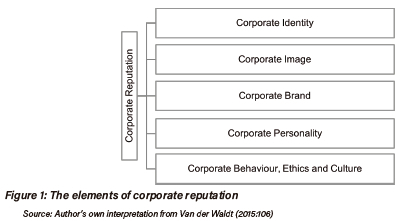
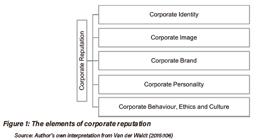
Corporate reputation comprises five elements, namely corporate identity, corporate image, corporate brand, corporate personality and corporate behaviour, ethics and culture (Drugä, 2021:104; Van der Waldt, 2015:106). How organisations define, manage and measure each of these elements contributes to the overall success of the organisation's corporate reputation.
Corporate reputation management
Corporate reputation is an essential corporate asset that is crucial to the success of an organisation. It should therefore be effectively managed.
While literature documents CRM extensively, a framework for this is still lacking (Pérez-Corenjo et al., 2021:4; Reputation Institute, 2018:1). However, through considering the principles and guidelines of corporate reputation, CRM is manageable to an extent (Doorley & Garcia, 2017:3).
CRM involves a proactive approach by an organisation's top management and specialist communication staff (Henisz, 2017:120; Van der Waldt, 2015:110). CRM should encompass all dimensions of the organisation and should be integrated into strategic stakeholder relations (Doorley & Garcia, 2017:40; Reddiar et al., 2012:31).
Communication practitioners play a vital role in CRM through ensuring that the organisation can communicate with its stakeholders, possessing expertise in risk management and crisis communication, maintaining transparency and credibility, managing stakeholder relations and overseeing corporate reputation elements (Aula, 2011:30; Doorley & Garcia, 2017:28-32, 40; Henisz, 2017:121).
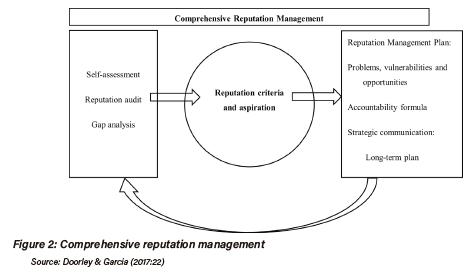
As stakeholder management significantly influences corporate reputation, identifying key stakeholder groups is considered essential (Aula, 2011:30; Doorley & Garcia, 2017:40-41). However, CRM is more complicated than effective stakeholder relationship management (Doorley & Garcia, 2017:5). Instead, organisations should plan and implement a CRM strategy that is specific to the organisation. Comprehensive reputation management assists in developing and implementing effective CRM strategies.
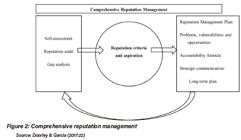
Comprehensive reputation management is an approach that attempts to measure, audit and manage corporate reputation within the main departments of an organisation. It suggests that organisations assess, audit and analyse through seven activities. An organisation should first develop a reputation template that outlines what it wants to measure, achieve or change. Second, the organisation should perform reputational audits pertinent to the organisation's stakeholders, aimed at identifying reputational gaps within the organisation's corporate reputation (Doorley & Garcia, 2017:20-22). Third, organisations should identify their reputational goals (Rainey et al., 2014:233). The fourth activity includes the development of a CRM plan that is aligned with the objectives of the organisation derived from activities one through three (Doorley & Garcia, 2017:20-22). The fifth activity involves compiling an accountably formula and identifying reputational components and departments responsible for attaining the identified goals ( Esenyel, 2020:31; Van der Waldt, 2017:79). Once organisations reach activity six, activities one through five must be fine-tuned. Activity six requires organisations to implement annual follow-up audits and assessments of the organisations' corporate reputation, whereby risk and improvement areas are identified, and organisational goals become more specified and better understood (Cohen & Sayag, 2010:296). Here, organisations essentially build upon their strategy or go back to the drawing board. Finally, activity seven includes developing reports that provide insight and an overview of stakeholders and their perceptions of the organisation (Doorley & Garcia, 2017:20-22).
Measuring corporate reputation
Corporate reputation measurement should consider an organisation's definition, stakeholder group and organisational nature, with holistic reports involving all stakeholders but individual measurements for each group (Barchiesi & Colladon, 2021:2; Dowling, 2016:211). The choice of a corporate reputation measurement instrument is crucial, as no single instrument can measure every organisation's reputation across all stakeholders, and a multi-faced approach is more effective as it incorporates specific elements of corporate reputation and therefore stakeholder perception (Eckert, 2017:146; Pires & Trez, 2020:49).
In addition, not all instruments measure all elements of corporate reputation. Many instruments focus on tangible aspects such as finance to measure corporate reputation in terms of capital, which does not provide a holistic stakeholder perspective of the organisation (Bigus et al., 2023:149). With this, RepTrak™ has gained traction from academia and practice as a measurement for corporate reputation that encompasses the assessment of several organisational dimensions.
RepTrak™ offers a standardised framework that evaluates perceptions across various stakeholder groups, facilitating a nuanced understanding of corporate reputation. Recent developments in corporate reputation measurement tools, such as FTI Consulting's RepScore developed in 2024, leverage advanced artificial intelligence (AI) and analytics to provide real-time insights into stakeholder perceptions, further enhancing the precision and responsiveness of reputation management strategies. In essence, RepScore aims to provide companies with a platform to manage their corporate reputation in 2025 and beyond through using data to simplify the process (FTI Consulting, 2024).
Reptrak™
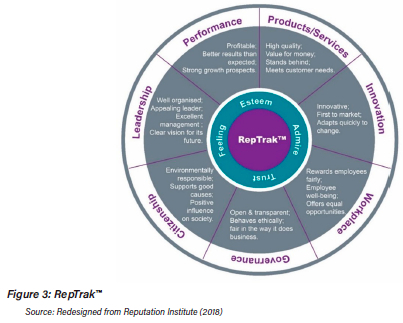
RepTrak™ comprises four themes: trust, admiration, esteem and feeling (Chan et al., 2018:204; Sah & Abdullah, 2016:36;). These are "emotional dimensions" (Wepener, 2014:7). Understanding these feelings allows organisations to identify what areas require improvement (Reputation Institute, 2018).
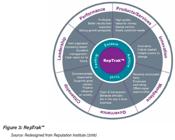
RepTrak™ further encompasses seven dimensions (products and services, innovation, workplace, governance, citizenship, leadership and performance). Each dimension is divided into three or four attributes (Reputation Institute, 2018).
Products and services are the key value creators of an organisation (Cunningham et al., 2018:141). Measuring this dimension allows organisations to establish how stakeholders perceive organisational offerings and value (Osterwalder et al., 2015:82; Sah & Abdullah, 2016:36). As purchasing offerings are often the first experience that stakeholders have with an organisation, this dimension has a considerable influence on the organisation's corporate reputation (Fombrun et al., 2015:6). This dimension aims to understand stakeholders' perceptions of an organisation's product and service quality, its commitment to these offerings and their alignment with consumer needs (Reputation Institute, 2018).
Innovation is the capacity of an organisation to evoke emotional responses from its customers and the rate at which it can create novel and innovative offerings (Fombrun et al., 2015:6). Stakeholders will perceive an organisation's ability to adapt to change and generate innovative products, services or ideas favourably, which will encourage purchases that overlook high prices (Van der Waldt, 2015:110).
Workplace refers to the organisation's ability to provide a good working environment that facilitates productivity and a positive atmosphere for employees. Thus, when employees perceive their workplace as pleasant, they are more likely to remain with an organisation and endorse it (Fombrun et al., 2015:6-7).
Governance describes the systems and procedures that distribute and exercise authority within an organisation, as well as the responses taken by these systems and procedures in challenging times (Sah & Abdullah, 2016:34). Stakeholder perception of these behaviours is influenced by how effectively an organisation communicates with stakeholders. In this regard, stakeholder communication should cover the nature of the problem, its cause, the organisation's response and the steps that the organisation will take to prevent future occurrences. This communication should be transparent, showing that the organisation takes accountability and accepts responsibility (Coombs, 2010:27; Heide & Simonsson, 2014:5). When stakeholders perceive an organisation as ethical and transparent, they will trust and admire the organisation (Fombrun et al., 2015:7).
Citizenship describes how much an organisation is seen as a good citizen by its stakeholders. It includes an organisation's performance - whether it makes a difference in society, promotes worthy causes and protects the environment (Fombrun et al., 2015:7; Reputation Institute, 2018).
Leadership refers to the management structures of an organisation and the individuals who fulfil these positions. Strong leadership is required as it enhances organisations' financial performance and attracts positive media attention, investors and trust in the organisation (Fombrun et al., 2015:8; Sung & Choi, 2021:6).
An organisation's reputation can be strongly predicted by its financial performance (Ramos & Casado-Molina, 2021:122). Organisations that demonstrate solid and consistent financial performance will likely enjoy greater stakeholder trust, which will increase the possibility that it will continue to grow (Fombrun et al., 2015:8). These organisations will also benefit from other advantages such as the capacity to develop and introduce new offerings and an efficient workforce (Sah & Abdullah, 2016:33).
In implementing RepTrak™, each attribute is presented as a statement rated by a Likert scale. Together, these attributes measure the dimension they comprise (Fombrun et al., 2015:9; Reputation Institute, 2018). The result is a corporate reputation score of 0-100.
RESEARCH METHODOLOGY
The study used a mixed-method approach, combining qualitative and quantitative methods, to assess NWU's current approach to CRM and to determine the perceptions of NWU staff of the university's current corporate reputation.
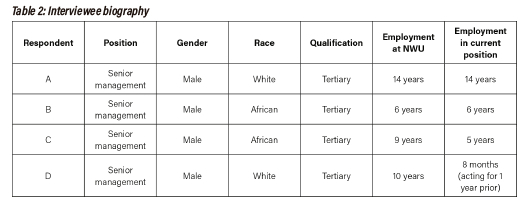
The qualitative approach included a literature review and four semi-structured interviews with NWU Director: Corporate Relations and Marketing (DCRM) management, including the Executive Director and three directors of DCRM's sub-departments, for analysis and discussion. The study used 29 open-ended questions to gather demographic information and knowledge pertaining to CRM from respondents. Data was processed through qualitative relational content analysis, including transcription, repeated analysis and presentation of findings. Transcription was done verbatim. Repeated analysis and reflection on the dataset allowed for conclusions to be drawn. In the presentation of the data, the researchers discussed, compared, found links between and presented the uncovered themes.
To ensure methodological rigour, interview questions were designed based on key themes identified in the literature review to ensure alignment with corporate reputation constructs. In addition, the study employed investigator triangulation by comparing interview findings with secondary data sources, such as internal NWU reports pertaining to the restricting process and academic literature. Coding of interview transcripts was conducted using statistical software, which allowed for a systematic identification of recurring themes and relationships between different responses. This process strengthened the credibility and trustworthiness of the qualitative data collected and discussed by the study.
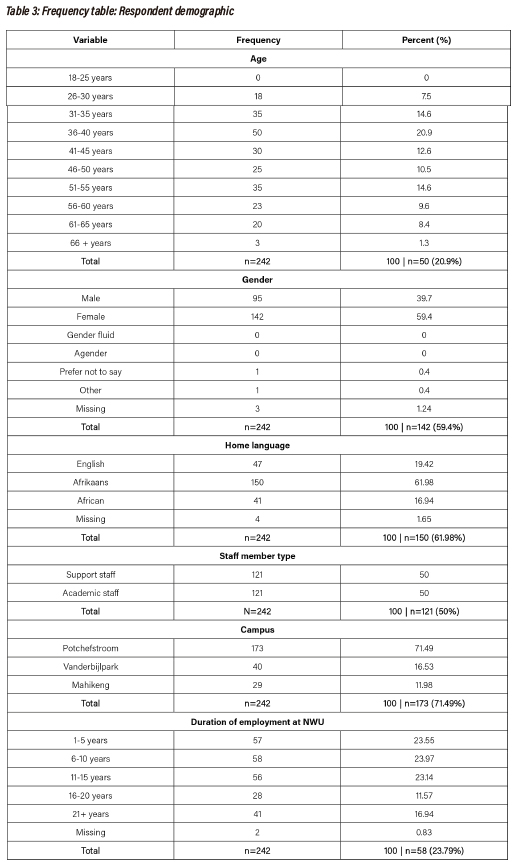
The quantitative approach used an online RepTrak™ survey to gauge respondents' perceptions of NWU staff's evaluation of RepTrak™. From this, descriptive statistics were generated from the ratings provided by respondents, and these opinions and ratings were analysed and debated to understand their evaluations. The survey was sent to all NWU staff, inviting participation via the NWU Daily Comms newsletter. The survey was available for two months, with 6,594 respondents identified as the population. However, not all potential respondents participated, and the the rater focused on a sample of the population instead of the entire population, with 242 submissions received. The interpretation of the findings is therefore focused on a sample rather than that of the population.
NWU Statistical Consultation Services (SCS) assisted researchers in data processing, including AMOS and SPSS Versions 27 for descriptive statistics, exploratory factor analysis (EFA) to assess underlying dimensions within the RepTrak™ framework, and confirmatory factor analysis (CFA) to validate the construct structure. Cronbach's alpha was used to measure reliability, yielding a score above 0.7, which indicated strong internal consistency across survey items. Nonparametric correlations were also performed to identify significant relationships between reputation attributes.
In addition to descriptive statistics, inferential statistical methods were applied to gain deeper insights. Independent T-tests and one-way ANOVAs were conducted to determine whether perceptions of corporate reputation varied significantly across different demographic groups, such as academic versus support staff, years of service and campus location. This allowed for a more granular analysis of how different stakeholder segments perceive NWU's reputation. Furthermore, response bias was assessed by comparing early and late responses to detect potential non-response bias as changes that could affect respondent's perspectives had occurred internally at the NWU during the duration of the data collection process.
Google Forms provided descriptive statistics, which were discussed to identify themes, dimensions and attributes that scored well, average or poorly. The researchers then compared the data and drew observations.
RESULTS AND FINDINGS
The results and findings section presents that of the second and third specific research questions posed by the study. To begin, the second research question focused on NWU's approach to CRM. This was determined through semi-structured interviews.
RQ2: What is the North-West University's approach to corporate reputation management? (Determined through semi-structured interviews)
In terms of understanding corporate reputation, the interviewees provided sufficient understanding of the concept and recognised its importance. Interviewees had difficulty identifying the trends that affect corporate reputation, but mentioned factors such as technology, digital marketing, and social media. Interviewees also struggled to identify the elements of corporate reputation but displayed a fair understanding of each when presented with the list obtained from the literature review. Interviewees showed confusion about what encompassed corporate identity, brand and image. Interviewees exhibited a strong understanding in correctly identifying all NWU stakeholders and achieving consensus on the ranking thereof. The group showed a good understanding of CRM and its alignment with NWU's strategic goals. However, the absence of comprehensive reputation management knowledge at an individual level was a concern. When questioned on corporate reputation measurement, the interviewees showed an average understanding thereof. The group was not able to effectively discuss what measurement instruments NWU used and participants were unable to reach consensus on measurement frequency and timing. Interviewees had varying opinions on RepTrak™'s dimensions: while they perceived products and services, governance, performance and leadership positively, they remained divided on workplace and citizenship. The group perceived innovation at NWU as lacking. While they exhibited strong understanding of the advantages of strong corporate reputation, their understanding as to how it could improve the workplace was lacking. When asked how they perceived NWU in comparison with its competitors, the group felt that the university performed well considering the challenges it faced.
In summary, all interviewees demonstrated sufficient comprehension of corporate reputation, its management and measurement. While some areas for improvement were identified, such as how and when corporate reputations should be formally measured, the interviewees also added valuable additions to the study such as the identification of climate change initiatives as a trend that affects corporate reputation in a university setting.
The third research question aimed to determine how staff at NWU perceive the university's corporate reputation.
RQ3: What are the perceptions of NWU staff regarding the university's corporate reputation management according to the RepTrak™ measurement instrument?
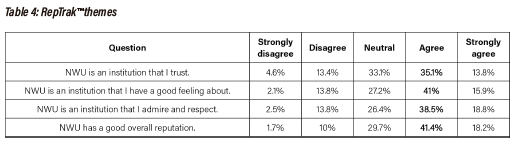
Overall, NWU fared well in terms of trust, admiration, respect and perception, with no significant concerns noted in the following statistics. Considering trust, 35.1% of respondents agreed that they trusted NWU, while 33.1% remained neutral. Although many were neutral, more respondents leaned towards agreement than disagreement. Only 18% had below-average trust, while 48.9% had above-average trust. Interestingly, this theme had the most "strongly disagree" responses. Considering feeling, 41% agreed they had a good feeling about NWU. The difference between those who strongly agreed and those who were neutral was 11.3%, while 15.9% had a below-average feeling. Collectively, 56.9% had an above-average positive feeling about NWU. Considering admiration, 38.5% agreed they admired and respected NWU, while 26.4% were neutral and 16.8% had below-average admiration. In total, 57.3% had above-average admiration, with 18.8% strongly agreeing. Finally, considering esteem, 41.4% agreed with the positive statement about NWU's corporate reputation, 29.7% were neutral and 11.7% had below-average ratings. Overall, 59.6% rated their perception as above average.
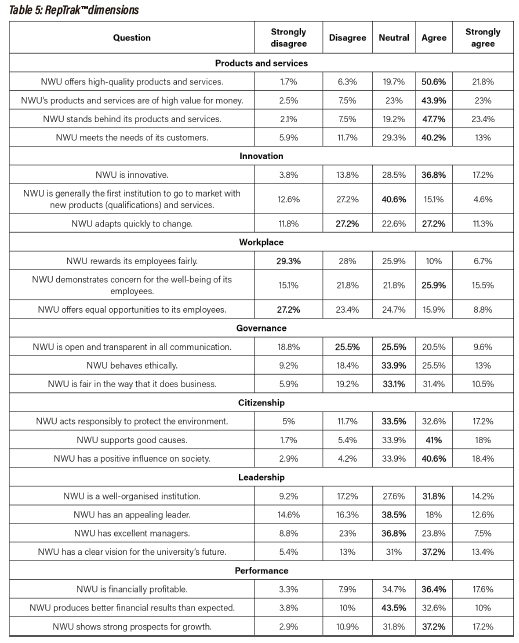
Considering the dimensions and attributes, the sample had a favourable opinion of NWU's products and services. The majority of the sample agreed with each of the attributes, and each obtained a solid statistical review. The majority of the sample agreed with each attribute for this dimension. For each, this ranged between just above 40% and 50%. Around 20% of the sample strongly agreed with each attribute, except for meeting the needs of customers, which was indicated by 13% of the sample. Between 19% and 30% of the sample remained neutral on each attribute and between 6% and 12% did not agree with each. Each attribute only showed a strongly disagree of under 6%. The sample concluded that NWU provided high-quality goods and services, that its offerings were cost-effective, that it stood behind those offerings and that it satisfied the expectations of its customers.
Not everyone perceived innovation the same way. Most respondents agreed with only one of the three statements, while the remaining two were neutral or divided. For the attribute of innovation, 36.8% agreed that NWU was innovative, with 28.5% remaining neutral. In addition, 17.2% strongly agreed, 13.8% disagreed and only 3.8% strongly disagreed. Overall, 54% had a positive perception of innovation, while 17.6% had a negative perception, resulting in a positive differential of 36.4%. Regarding NWU being the first to market with new products and services, 40.6% remained neutral. Meanwhile, 39.8% disagreed or strongly disagreed, and only 19.7% agreed or strongly agreed. This resulted in a negative differential of 20.1%, indicating below-average perceptions with a significant portion remaining neutral. For adaptability to change, the sample was divided, with 27.2% agreeing and 27.2% disagreeing, along with 11.3% strongly agreeing and 11.8% strongly disagreeing. The differential was slightly negative at 3.5%, with 22.6% remaining neutral. Overall, with one attribute measuring well, one below average and one divided, the dimension of innovation is concluded to be average but requires attention. Although average is not negative, the ideal would be a positive perception.
The dimension of the workplace at NWU had the lowest rankings from the sample. For the first attribute, "rewarding employees fairly", a significant 29.3% of respondents strongly disagreed, and 28% disagreed, with 25.9% remaining neutral. This means that 57.3% had a negative perception, the highest rate of strong disagreement among all 23 attributes measured. Only 16.7% had a positive perception (10% agreed, 6.7% strongly agreed), resulting in a negative differential of 40.6%. The second attribute, "concern for employee well-being" fared better. In the sample group. 25.9% agreed and 15.5% strongly agreed, totalling 41.4% with a positive perception. However, 21.8% remained neutral and 36.9% had a negative perception (21.8% disagreed, 15.1% strongly disagreed). The positive differential was 19.6%. The third attribute, "offering equal opportunities" was negatively perceived. Of the respondents, 27.2% strongly disagreed, 23.4% disagreed, with 24.7% neutral. Only 24.7% had a positive perception (15.9% agreed, 8.8% strongly agreed), producing a negative differential of 25.9%. Overall, the dimension of the workplace was rated poorly, with significant concerns regarding fair rewards and equal opportunities, though perceptions of concern for employee well-being were better.
The dimension of governance at NWU measured as average, with most respondents remaining neutral on each attribute. For the first attribute, "open and transparent communication", 25.5% were neutral, 25.5% disagreed and 18.8% strongly disagreed, producing a collective negative perception of 44.3%. Only 35.1% had a positive perception (20.5% agreed, 9.6% strongly agreed), indicating an average to below-average rating with a less than 10% negative differential. The second attribute, "ethical behaviour" showed 33.9% neutral responses. However, 38.5% had a positive perception (25.5% agreed, 13% strongly agreed), while 27.6% had a negative perception (18.4% disagreed, 9.2% strongly disagreed), producing a positive differential of more than 10%. Despite this, the attribute was rated average with a slight positive inclination. The third attribute, "fairness in business practices", had 33.1% neutrality. A collective 41.9% had a positive perception (31.4% agreed, 10.5% strongly agreed), while 25.1% had a negative perception (19.2% disagreed, 5.9% strongly disagreed), producing a positive differential of 16.8%. This attribute is concluded to be average with a positive inclination. Overall, the governance dimension was average, with two attributes leaning positively and one negatively. However, the ethical behaviour attribute's average rating is a concern, suggesting the need for re-evaluation to achieve a more positive overall perception of NWU's corporate reputation.
Overall, the dimension of citizenship was perceived positively by the sample. The first attribute, NWU's responsibility to protect the environment, had a majority neutral perception (33.5%), but the positive perception (agree, strongly agree) outweighed the negative perception (disagree, strongly disagree) with a 33.1% difference. However, due to the majority remaining neutral, the attribute was considered average, leaning slightly towards positive perceptions. The second attribute asked about NWU's support for good causes, which was well perceived with 59% of the sample agreeing or strongly agreeing. Only 7.1% disagreed. Although a large portion (33.9%) remained neutral, the positive perceptions outweighed the negative by 51.9%. The third attribute, about NWU's positive influence on society, also measured well, with 59% of the sample perceiving it positively. Again, the difference between positive and negative perceptions was 51.9%. Overall, all three attributes showed a strong inclination towards positive perceptions, indicating a positive perception of the citizenship dimension by the sample, which is beneficial for NWU's corporate reputation.
In terms of leadership, the overall perception of the sample was divided between average and positive. Two attributes received a majority rating of neutral and two a majority rating of agree. For the first attribute, respondents were asked if they felt NWU was a well-organised institution. Most of the sample agreed or strongly agreed, totalling 46%. A smaller part remained neutral at 27.6%, and 26.4% did not agree. The positive perceptions outweighed the negative by 19.6%, indicating an overall positive perception. The second attribute asked if respondents felt NWU had an appealing leader. The majority remained neutral, with positive and negative perceptions almost equally divided. While the negative perceptions slightly outweighed the positive, the study concluded the attribute measured as average, not inclined towards positive or negative perceptions. The third attribute asked if respondents felt NWU had excellent managers. Again, most of the sample remained neutral, with positive and negative perceptions equally divided. With less than a 1% difference between positive and negative perceptions, the attribute measured average. The fourth attribute measured whether respondents felt NWU had a clear vision for its future. A majority agreed or strongly agreed, totalling 50.6%. Although a large part of the sample remained neutral, the positive perceptions outweighed the negative by 32.2%, indicating an overall positive perception. Overall, two attributes measured as average, and two showed a positive perception, producing an overall evaluation of the dimension as average to good.
In the dimension of performance, most of the sample either remained neutral or showed a positive perception for each attribute. For the first attribute, respondents were asked if they thought NWU was financially profitable. A majority of 36.4% agreed, while a similar percentage of 34.7% remained neutral. In addition, 17.6% strongly agreed, totalling 54% of the sample feeling that NWU was financially profitable. A much smaller percentage, 11.2%, indicated they did not think so. The differentiation between positive and negative perceptions was 42.8% in favour of the positive, providing sufficient evidence that the sample felt NWU was financially profitable. The second attribute asked if respondents felt NWU produced better financial results than expected. The majority remained neutral at 43.5%. However, 42.6% felt NWU produced better financial results than expected, and 13.8% did not. The differentiation of 28.8% suggests the attribute measures as average but with a stronger inclination to positive perceptions. The third attribute asked if respondents felt NWU had strong prospects for future growth. The majority agreed at 37.2%, with 31.8% remaining neutral. In addition, 17.2% strongly agreed, totalling 54.4% positive perceptions. The collective negative perceptions comprised 13.8%. The differentiation between positive and negative perceptions was 40.6%, indicating a strong positive perception. As two attributes measured well and one measured average with an inclination to positive, the overall dimension of performance can be concluded to measure well.
Respondents also provided general comments regarding NWU's corporate reputation. These included the following perceptions: discrimination exists between academic and support staff, and between staff of the three campuses; NWU offers poor remuneration compared to other universities; NWU performs well financially, which frustrates respondents regarding lack of appropriate remuneration; NWU does not communicate transparently with stakeholders; NWU is an innovation follower; NWU does not look after the well-being of employees with psychological and physical disabilities; some respondents indicated that the managers of NWU were both good and bad, but others indicated a negative perception of managers; respondents could not present an opinion on leadership, as it had changed during the period of the study; and respondents felt that NWU was doing well in terms of its citizenship, but that there was room for improvement.
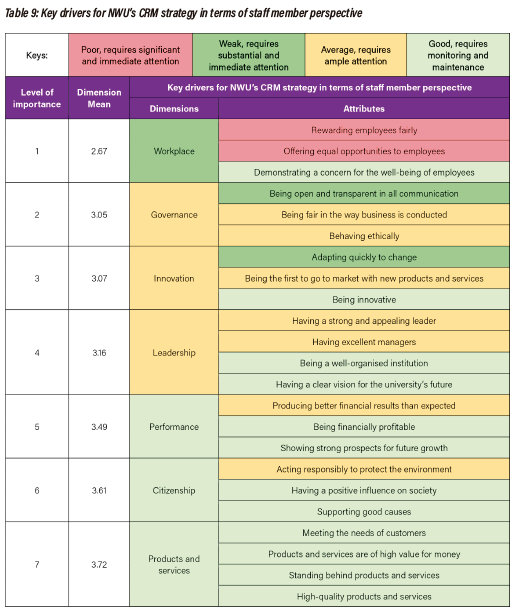
The best faring theme was respect, while trust was perceived as the worst. The dimension that recorded the highest mean value was products and services. In terms of general comments in comparison with the other dimensions, products and services was one of the best perceived dimensions, if not the best. The dimension that recorded the lowest mean value was workplace. This was also a dimension that presented concerns in the general comments. Other dimensions such as governance and innovation also had lower means. These dimensions also presented concerns in the general comments. The means of each remaining dimension (citizenship, performance and leadership) were perceived as average, although performance bordered on average and good.
Reliability and validity
Reliability is the assessment of whether a method would yield the same results when repeatedly applied to the same scenario (Babbie & Mouton, 2012:119; Noble & Smith, 2015:34). In the qualitative method, four NWU employees at a senior managerial level, who regularly work with NWU's corporate reputation, were interviewed. These interviewees were selected for their professional capacity and knowledge. For the quantitative method, reliability was ensured by surveying all NWU staff across all three campuses. In addition, the application of Cronbach's alpha by SCS confirmed the reliability of the quantitative method.
Validity refers to the extent of integrity and application of empirical methods used in a study and how well the findings reflect the topic of investigation (Babbie & Mouton, 2012:119; Noble & Smith, 2015:34). It assesses whether the instrument measures what it is supposed to measure. In the qualitative method of this study, validity was ensured by asking each interviewee the same set of pre-determined questions. All four interviews occurred within one month to ensure NWU's current position was consistent and to avoid any unforeseen factors that could influence responses. Interviews took place in respondents' offices or via MS Teams in comfortable, private and quiet settings, allowing truthful and competent responses. The researcher recorded answers without background interference.
For the quantitative method, an online RepTrak™ survey, validity was ensured by sending the same questionnaire to all NWU staff between April 2022 and May 2022, including new staff members, via NWU Daily Comms. Respondents could complete the survey in comfortable settings for truthful and competent answers. SCS confirmed the survey's validity using CFA in AMOS Version 25.
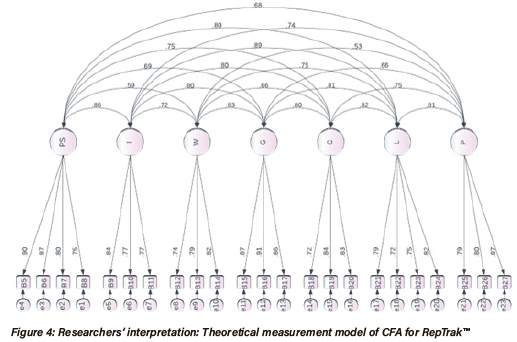
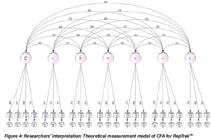
Figure 4 shows that all dimensions and attributes of RepTrak™ fit well within their intended constructs. Standardised regression estimates ideally should be above 0.3 and close to 1, indicating strong relationships. Each attribute scored well above 0.3, ranging from 0.72 to 0.91. For products and services, the standardised regression estimates for each attribute ranged between 0.75 and 0.90, innovation between 0.77 and 0.84, workplace between 0.74 and 0.82, governance between 0.86 and 0.91, citizenship between 0.72 and 0.84, leadership between 0.72 and 0.82, and performance between 0.79 and 0.87. This provides sufficient evidence that the dimensions and attributes fitted well within the constructs they aimed to measure. In addition, the dimensions each displayed a p-value which was smaller than 0.001, also indicating that the dimensions and attributes fitted well within the measurable constructs.
The discussion on the CFA shows how well the dimensions correlated with one another. Correlation scores ranged from 0.53 to 0.89, indicating sufficient relevance among dimensions. The strongest correlations (0.80 and above) were between products and services and innovation, products and services and leadership, innovation and governance, innovation and citizenship, innovation and leadership, workplace and governance, governance and citizenship, governance and leadership, citizenship and leadership, and performance and leadership. Moderate correlations (0.72 to 0.75) included products and services and citizenship, innovation and workplace, performance and innovation, workplace and leadership, and performance and citizenship. Lower correlations (0.53 to 0.68) involved products and services and workplace, products and services and governance, performance and products and services, performance and workplace, workplace and citizenship, and performance and governance. All correlations had p-values less than 0.001, showing statistical significance. Despite the range in correlation strength, the connections among dimensions justify using the full RepTrak™ instrument with minor adjustments for wording and a comment section.
From this, the theoretical measurement model of CFA for RepTrak™ is presented in Figure 4 below.
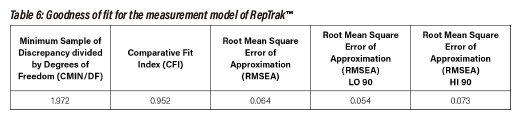
In addition, the validity assessment of RepTrak™ included a goodness of fit test, presented in Table 6.
The chi-square test assesses how well a dataset fits its theoretical model and is considered an "overly strict model of fit" The ratio is divided by the Degrees of Freedom, ideally around 2, but can be as high as 3-5 (Bryant & Satorra, 2012:373; Mueller & Hancock, 2010:109). A CMIN/DF of 1.972 indicates an excellent fit. Mueller and Hancock (2010:379) suggest presenting at least three fit indices for validity. Besides the chi-square test, incremental and non-centrality indices were used. The model showed an excellent fit with a comparative fit index (CFI) of 0.952, where a CFI above 0.9 is ideal (Normalini et al., 2019:507).
Regarding non-centrality measures, the Root Mean Square Error Approximation (RMSEA) is reported in Table 6. The RMSEA should be as small as possible, ideally closer to 0. Literature varies on the maximum acceptable RMSEA score, suggesting it should be smaller than 0.06 - 0.1 (Blunch, 2012:116). With an RMSEA of 0.064, and a 90% confidence interval of 0.054 - 0.073, the model is considered an excellent fit.
Therefore, data obtained from the survey fits well into the theoretical model, confirming the validity of RepTrak™ as used in this study. This study contributes to literature, proving that RepTrak™ can be used within a South African and university context.
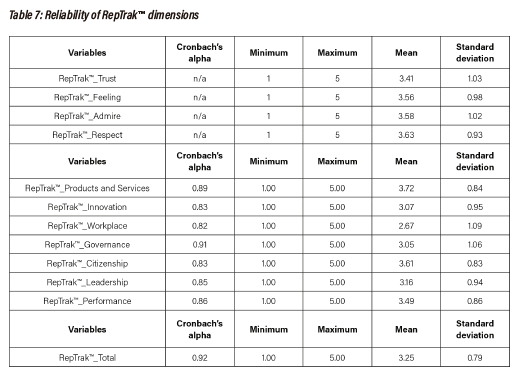
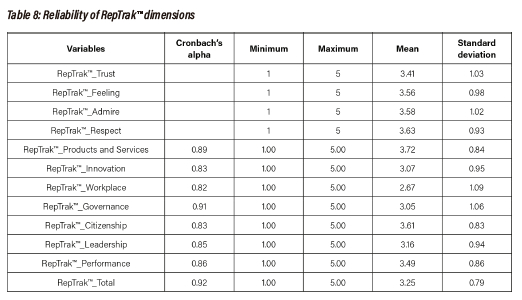
Considering the reliability of RepTrak™, all 242 surveys in the sample were deemed reliable, with none excluded. Cronbach's alpha was used to test reliability, providing values from 0 to 1. The closer to 1, the more reliable the model. According to Mueller and Hancock (2010:381), a value of 0.70 or higher is acceptable. Table 7 presents the reliability of RepTrak™ and its variables.
Table 7 does not indicate Cronbach's alpha values for RepTrak™ themes as each comprises only one statement. However, dimensions (three to four statements each) present high Cronbach's alpha values of 0.82-0.91, indicating high reliability. Respect ranked highest with a 3.63 mean, while trust was lowest at 3.41. Products and services had the highest mean value among dimensions at 3.72, perceived well by the sample, while workplace had the lowest at 2.67, indicating concerns. Governance and innovation had means of 3.05 and 3.07, respectively. Citizenship, performance and leadership had means of 3-4, indicating average perception, with performance bordering on good.
Demographic variables' effects on RepTrak™ were examined using nonparametric correlations, independent T-tests and one-way ANOVAs. Most demographic variables did not affect RepTrak™, except for home language and campus. Nonparametric correlations showed that age and employment duration did not affect RepTrak™. Independent T-tests revealed that gender and staff type had no effect. One-way ANOVAs indicated that home language had a medium effect: respondents who spoke African languages had a better perception of NWU's corporate reputation than English- and Afrikaans-speaking respondents, with English speakers perceiving it slightly better than Afrikaans speakers. The campus had a medium to high effect on RepTrak™: Mahikeng Campus (MC) had a more positive perception of NWU's corporate reputation than Vanderbijlpark Campus (VC), and Potchefstroom Campuses' perceptions were closer to VC but did not differ as much from MC as VC did.
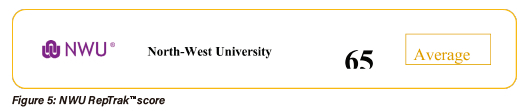
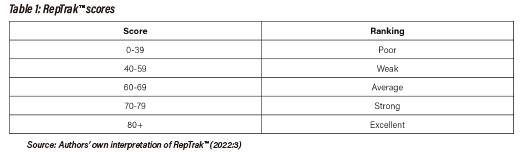
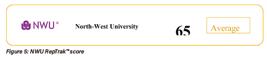
To determine the overall score of RepTrak™, a score of 0-100 is calculated. NWU received a score of 65/100, and therefore has an average corporate reputation. This shows that NWU has room to enhance its corporate reputation from a staff member perspective.
CONCLUSIONS AND RECOMMENDATIONS
According to the results, in order of importance, the key drivers for NWU's CRM strategy should include workplace, governance, innovation, leadership, performance, citizenship and products and services. Workplace focus should be on employee rewards, opportunities and well-being, while governance should be open and transparent. Innovation should be adaptable to change, and leadership should be strong and effective. Performance should be financially profitable and citizenship should focus on environmental protection and positive societal influence. Products and services should be of high quality, reflect value for money and meet customer needs.
The recommendations derived from the study are divided into three groups: NWU DCRM management, NWU's CRM strategy and improvement of RepTrak™ dimensions within NWU.
Two recommendations for NWU DCRM management are presented. First is to clearly conceptualise and uncover the core elements of corporate reputation. NWU DCRM management arrange a strategic session to define corporate reputation, its management and measurement, as well as identify and define the elements of corporate reputation and trends that affect it to ensure that the holistic DCRM department and management are idiomatic. A consolidated document identifying and defining all aspects of corporate reputation for NWU should result. This should be used when developing a strategic plan for CRM at NWU. Second is to use the study's findings within the context of NWU. It is suggested that NWU DCRM management consider addressing the concerns raised by the sample of the study with university management.
Nine recommendations are presented for NWU's CRM strategy. NWU DCRM should share a mutual understanding of what corporate reputation is. This entails understanding what corporate reputation comprises, by what it is affected, what benefits it can yield and how it should be managed and measured. Each sub-department of DCRM should understand what their role in the implementation of the corporate reputation strategy is, and what results they are expected to deliver within a specified timeframe. All stakeholders of NWU should be identified and the management strategies for each re-evaluated to ensure relevance. A strategy template for CRM should be developed. This should speak to the unique nature of NWU and include what NWU wants to achieve, change or measure when considering its corporate reputation. A formal corporate reputation assessment should be conducted at NWU on a larger scale to identify concerns regarding corporate reputation among its stakeholder groups. Based on such an assessment, NWU should set objectives or goals that it wants to achieve for its corporate reputation. After implementing each of the recommendations and assessing the results, NWU should review their strategy template. A detailed document that presents NWU's CRM strategy should follow and must be aligned with the strategic goals of the university, the objectives of its corporate reputation and the basic principles surrounding CRM in theory. NWU should then determine who is responsible for attaining each of these objectives. Thereafter, annual follow-up assessments of how the university's stakeholders perceive the university should be conducted. Finally, the university should ensure maintenance of their CRM strategy. This strategy should be implemented in all dimensions of the university. Results of follow-up assessments should be used to determine whether the efforts made by the university to improve its corporate reputation were successful, and appropriate actions should follow. Once a favourable corporate reputation has been achieved across all stakeholder groups, NWU should strive towards maintaining these positive perceptions through proactive and regular evaluation and action.
Recommendations to improve the dimensions of RepTrak™ within the context of NWU are presented for each dimension. When considering workplace, NWU should provide serious and immediate consideration to this dimension. NWU should evaluate and enhance the way in which employees are compensated and offer equal chances to all employees. Here, it would be wise to reconsider pay increases and give academic and support employees more aligned incentives. NWU should also keep expressing concern for the welfare of its employees. In terms of governance, NWU should prioritise ensuring that all stakeholder interaction and communication is open, transparent and sincere. NWU should evaluate how it can become fairer and behave more ethically in its daily operations. For innovation, NWU should implement strategies and processes to ensure that it is able to adapt to change in a more timeous manner. The university ought to support NWU research and services to produce new products and solutions to market and industry problems ahead of their competitors. NWU should keep working to become a cutting-edge university. Stability within the dimension of leadership must be attained. Thereafter, NWU should carry out an official evaluation of how the university's leadership is seen. Managers at NWU should receive training and have a standard management strategy used by all managers at the institution. NWU should continue to be a well-run organisation with a distinct future goal. When considering performance, NWU should focus on delivering more superior financial results than stakeholders anticipate. The university should continue to be financially successful and maintain its promising possibilities for future expansion.
In terms of citizenship, NWU should continue to promote a constructive impact on society and assist deserving projects. By actively attempting to lower its carbon footprint, the university might enhance citizenship. Finally, NWU should try to maintain high-quality products and services that are greatly valued by consumers and satisfy their needs. NWU should also keep supporting these products and services.
While this study identifies key actions to enhance NWU's corporate reputation, effectively translating these recommendations into practice requires a structured implementation approach. Drawing on insights from CRM literature as discussed in the relevant section above, the study outlines practical implementation of strategies that can support the successful execution of these recommendations at NWU.
As discussed in this article, the CRM model developed by Doorley and Garcia in 2017 emphasises the need for organisations to develop a tailored integrated framework for CRM that encompasses a multi-stakeholder approach. This framework should be tailored to the specific nature of the organisation and implementation and revision thereof should be a continuous activity. The researchers conclude that applying this model at NWU would involve the following specific activities: reputation audits, planning and implementation of corporate communication strategies, leadership and employee engagement programmes, innovation and institutional positioning, and continuous monitoring and adaptation of the implemented strategies.
In practice, reputation audits at NWU should therefore include conducting systematic assessments to measure NWU staff perceptions of the institution and identify any reputation gaps that arise within the stakeholder group. Not only does this align with the Doorley and Garcia's CRM model, but it also aligns with RepTrak™ investigation findings, which indicate areas requiring targeted interventions among staff at NWU.
In terms of planning and implementation of corporate communication strategies, the researchers recommend that NWU develop internal and external communication strategies that address the transparency concerns among their staff and enhance stakeholder engagement. Given the feedback on governance and workplace issues, this would involve a more direct and open communication channel with the stakeholder group.
By implementing leadership and employee engagement programmes, NWU would be able to start addressing concerns related to workplace fairness, recognition and well-being of its employees.
Innovation and institutional positioning activities at NWU should include activities that enhance NWU's corporate reputation for innovation by fostering a culture of research-driven advancements and strategic partnerships that position the institution as a leader in higher education.
Finally, through establishing a continuous review of these strategies and activities, leveraging RepTrak™ metrics and qualitative feedback to refine and adapt reputation management strategies over time should be a continuous activity undertaken by NWU.
The results of the study can only aid NWU in developing a CRM strategy based on the key drivers of the university's corporate reputation in terms of staff member perception. The study also only focused on a sample of the university's staff, and not the entire population.
The study can be applied as a framework to evaluate how NWU manages its corporate reputation regarding the university's other stakeholders and to create a CRM plan tailored to NWU. The study can be reproduced and expanded upon to examine CRM from the standpoint of different stakeholders at other South African HEIs, or to create models for CRM and measurement for South African HEIs. The research can also be used to support the adoption of RepTrak™ as a recognised indicator of corporate reputation in South Africa and tertiary institutions.
The study's conclusions and recommendations, if considered by NWU, could help the institution to change how its staff perceives the organisation. The corporate reputation of NWU may be enhanced by changing these perceptions, which would also make managing it easier going forward.
REFERENCES
LITERATURE REVIEW
-
Abratt, R. & Kleyn, N. (2012). Corporate identity, corporate branding and corporate reputations: Reconciliation and integration. European Journal of Marketing, 46(7-8):1048-1063. DOI: 10.1108/03090561211230197
» https://doi.org/10.1108/03090561211230197 -
Ansoglenang, G., Awugah, S. & Thompson, J. (2018). Conceptual tools for building higher education institutions corporate image and reputation. American Journal of Educational Research and Reviews, 3(28):1-16. DOI: 10.28933/ajerr-2018-08-1701
» https://doi.org/10.28933/ajerr-2018-08-1701 - Aula, P. & Mantere, S. (2008). Strategic reputation management: Towards a company of good. London: Routledge.
-
Aula, P. (2011). Meshworked reputation: Publicists' views on the reputational impacts of online communication. Public Relations Review, 37(1):28-36. DOI: 10.1016/j.pubrev.2010.09.008
» https://doi.org/10.1016/j.pubrev.2010.09.008 - Babbie, E. & Mouton, J. (2012). The practice of social research. South African edition. Cape Town: Oxford University Press Southern Africa.
-
Barchiesi, M.A. & Colladon, A.F. (2021). Corporate core values and social responsibility: What really matters to whom. Technological Forecasting and Social Change, 2021(170). DOI 10.1016/j.techfore.2021.120907
» https://doi.org/10.1016/j.techfore.2021.120907 -
Bigus, J., Hua, KPM. & Raithel, S. (2023). Definitions and measures of corporate reputation in accounting and management: Commonalities, differences, and future research. Accounting and Business Research, 54(4):304-336. DOI 10.1080/00014788.2022.2149458
» https://doi.org/10.1080/00014788.2022.2149458 - Blunch, N. (2012). Introduction to structural equation modelling using IBM SPSS statistics and AMOS. London: Sage.
-
Brandão, I., Diógenes, A. & De Abreu, M. (2017). Value allocation to stakeholder employees and its effect on the competitiveness of the banking sector. Review of Business Management, 19(64):161-179. DOI: 10.7819/rbgn.v0i0.3199
» https://doi.org/10.7819/rbgn.v0i0.3199 - Bryant, F.B & Satorra, A. (2012). Principles and practice of scaled difference chi-square testing. Structural Equation Modeling: A Multidisciplinary Journal, 19(3):372-398.
-
Chan, T.J., Sathasevam, T., Noor, P.N.M., Khiruddin, A.M. & Hasan, N.A.M. (2018). Application of selected facets of RepTrak™ reputation model on Carlsberg Malaysia as one of the companies in tobacco, gambling, alcohol and pornography (TGAP) industry. International Journal of Academic Research in Business & Social Sciences, 8(1):203-217. DOI: 10.6007/IJARBSS/v8-i1/3804
» https://doi.org/10.6007/IJARBSS/v8-i1/3804 -
Cohen, A. & Sayag, G. (2010). The effectiveness of internal auditing: An empirical examination of its determinants in Israeli organisations. Australian Accounting Review, 20(3):296-307. DOI: 10.1111/j.1835-2561.2010.00092.x
» https://doi.org/10.1111/j.1835-2561.2010.00092.x - Coombs, W.T. (2010). Parameters for crisis communication. In W.T. CoombsS.J. & Holladay (eds.). The handbook of crisis communication. Oxford: Blackwell, 17-52.
- Cornelissen, J. (2020). Corporate communication: A guide to theory and practice. 6th ed. London: Sage.
-
Cravens, K.S. & Oliver, E.G. (2006). Employees: The key link to corporate reputation management. Business Horizons, 49(4):293-302. DOI: 10.1016/j.bushor.2005.10.006
» https://doi.org/10.1016/j.bushor.2005.10.006 -
Cunningham, J., Menter, M. & O'Kane, C. (2018). Value creation in the quadruple helix: A micro level conceptual model of principal investigators as value creators. R & D Management 48(1):136-147. DOI: 10.1111/radm.12310
» https://doi.org/10.1111/radm.12310 - Degenaar, H.J. (2018). Assessing the marketing communication plan for student recruitment at the North-West University. Master's dissertation. Potchefstroom: NWU.
-
DHET (Department of Higher Education and Training). (2020). Higher education and training. https://www.dhet.gov.za/
» https://www.dhet.gov.za/ -
Dholakia, R. & Acciardo, L. (2014). Branding a state university: Doing it right. Journal of Marketing for Higher Education, 24(1):114-163. DOI: 10.1080/08841241.2014.916775
» https://doi.org/10.1080/08841241.2014.916775 - Doorley, J. & Garcia, H.F. (2017). Reputation management: The key to successful public relations and corporate communications. 4th ed. New York: Routledge.
-
Dowling, G.R. (2016). Defining and measuring corporate reputations. European Management Review, 13(1):207-223. DOI: 10.1111/emre.12081
» https://doi.org/10.1111/emre.12081 -
Drugã, R.I. (2021). The impact of the customer-based corporate reputation scale on the behavioural intentions. Revista Economica, 73(3):97-109. DOI: 10.56043/reveco-2021-0025
» https://doi.org/10.56043/reveco-2021-0025 -
Eckert, C. (2017). Corporate reputation and reputation risk: Definition and measurement from a (risk) management perspective. The Journal of Risk Finance, 18(2):145-158. DOI: 10.1108/JRF-06-2016-0075
» https://doi.org/10.1108/JRF-06-2016-0075 -
Esenyel, V. (2020). Corporate reputation as a strategic management tool: Through the lens of employees. International Journal of Management and Sustainability, 9(1):24-42. DOI:10.18488/journal.11.2020.91.24.42
» https://doi.org/10.18488/journal.11.2020.91.24.42 -
Fombrun, C., Ponzi, L. & Newburry, W. (2015). Stakeholder tracking and analysis: The RepTrak® system for measuring corporate reputation. Corporate Reputation Review, 18(1):3-24. DOI: 10.1057/crr.2014.21
» https://doi.org/10.1057/crr.2014.21 -
FTI Consulting Strategic Communications. (2024). Managing reputation in 2025 - how data can bring simplicity to corporate reputation management: RepScore. Available from: https://fticommunications.com/repscore/
» https://fticommunications.com/repscore/ -
Gangi, F., Daniele, L. & Varrone, N. (2020). How do corporate environmental policy and corporate reputation affect risk-adjusted financial performance? Business Strategy and the Environment, 29(5):1975-1991. DOI: 10.1002/bse.2482
» https://doi.org/10.1002/bse.2482 -
Ghadge, A., Kara, M., Moradlou, H. & Goswami, M. (2020). The impact of Industry 4.0 implementation on supply chains. Journal of Manufacturing Technology Management, 31(4):669-686. DOI: 10.1108/JMTM-10-2019-0368
» https://doi.org/10.1108/JMTM-10-2019-0368 - Harris, T. & Nelson, M. (2018). Applied organization communication: Theory and practice in a global environment. 4th ed. New York: Routledge.
-
Heide, M. & Simonsson, C. (2014). Developing internal crisis communication: new roles and practices of communication professionals. Corporate Communications: An International Journal, 19(2):128-146. DOI: 10.1108/CCIJ-09-2012-0063
» https://doi.org/10.1108/CCIJ-09-2012-0063 - Henisz, W.J. (2017). Corporate diplomacy: Building reputations and relationships with external stakeholders. New York: Routledge.
-
Kgwadi, N. (2016). NWU performance and strategic plan 2016. Available from: http://www.nwu.ac.za/sites/www.nwu.ac.za/files/files/i-governance-management/documents/2016.03.11%20Annual%20Perf%20Plan%20and%20Strategic%20Plan.pdf
» http://www.nwu.ac.za/sites/www.nwu.ac.za/files/files/i-governance-management/documents/2016.03.11%20Annual%20Perf%20Plan%20and%20Strategic%20Plan.pdf -
Matuleviciene, M. & Stravinskiene, J. (2015). The importance of stakeholders for corporate reputation. Engineering Economics, 26(1):75-83. DOI: 10.5755/j01.ee.26.1.6921
» https://doi.org/10.5755/j01.ee.26.1.6921 - Mueller, R.O. & Hancock, G.R. (2010). Structural equation modeling. In G.R. Hancock & R.O. Mueller (eds). The reviewer's guide to quantitative methods in the social sciences. New York: Routledge, 371-383.
-
Noble, H. & Smith, J. (2015). Issues of validity and reliability in qualitative research. Evidence Based Nursing, 18(2):34-35. DOI: 10.1136/eb-2015-102054
» https://doi.org/10.1136/eb-2015-102054 -
Normalini, M.K., Ramayah, T. & Shabbir, M.S. (2019). Investigating the impact of security factors in e-business and internet banking usage intention among Malaysians. Industrial Engineering & Management Systems, 18(3):501-510. DOI: 10.7232/iems.2019.18.3.501
» https://doi.org/10.7232/iems.2019.18.3.501 -
NWU (North-West University). (2016). Annual performance plan and strategic plan, 2016. Available from: http://www.nwu.ac.za/sites/www.nwu.ac.za/files/files/i-governance-management/documents/2016.03.11%20Annual%20Perf%20Plan%20and%20Strategic%20Plan.pdf
» http://www.nwu.ac.za/sites/www.nwu.ac.za/files/files/i-governance-management/documents/2016.03.11%20Annual%20Perf%20Plan%20and%20Strategic%20Plan.pdf -
O'Loughlin, D., McPhail, A. & Msetfi, R. (2015). The rhetoric and reality of research reputation: Fur coat and no knickers. Studies in Higher Education, 40(5):806-820. DOI: 10.1080/03075079.2013.842224
» https://doi.org/10.1080/03075079.2013.842224 - Osterwalder, A., Pigneur, Y., Bernarda, G. & Smith, A. (2015). Value proposition design: How to create products and services customers want. Hoboken: Wiley.
-
Pandita, D. (2022). Innovation in talent management practices: Creating an innovative employer branding strategy to attract generation Z. International Journal of Innovation Science, 14(3/4):556-569. DOI 10.1108/IJIS-10-2020-0217
» https://doi.org/10.1108/IJIS-10-2020-0217 -
Panwar, N., Sharma, S. & Singh, A.K. (2016). A survey on 5G: The next generation of mobile communication. Physical Communication, 18(2):64-85. DOI: 10.1016/j.phycom.2015.10.006
» https://doi.org/10.1016/j.phycom.2015.10.006 -
Pérez-Cornejo, C., de Quevedo-Puente, E. & Delgado-Garcia, J.B. (2021). The role of national culture as a lens for stakeholder evaluation of corporate social performance and its effect on corporate reputation. BRQ Business Research Quarterly, 1:1-15. DOI: 10.1177/23409444211007487
» https://doi.org/10.1177/23409444211007487 -
Pires, V. & Trez, G. (2018). Corporate reputation: A discussion on construct definition and measurement and its relation to performance. Revista de Gestão, 25(1):47-64. DOI 10.1108/REGE-11-2017-005
» https://doi.org/10.1108/REGE-11-2017-005 - Pollák, F. and Markovic, P. (2022). Challenges for corporate reputation - online reputation management in times of global pandemic. Journal of Risk and Financial Management, 15(6):250.
-
Pollák, F., Dorcák, P. & Markovic, P. (2021). Corporate reputation of family-owned businesses: Parent companies vs. their brands. Information, 12(2):89-105. DOI: 10.3390/info12020089
» https://doi.org/10.3390/info12020089 - Pool, A., Pool, M. & Taghipourian, J. (2016). Customer satisfaction through corporate reputation: The mediating role of perceived value. International Journal of Humanities and Cultural Studies, 3(2):1424-1434.
-
Pretorius, C. (2017). Forging unity: The story of the North-West University's first years. Potchefstroom: NWU. Available from: http://hdl.handle.net/10394/26089
» http://hdl.handle.net/10394/26089 -
Rainey, H.J., Pollard, E.H., Dutson, G., Ekstrom, J.M., Livingstone, S.R., Temple, H.J. & Pilgrim, J.D. (2014). A review of corporate goals of no net loss and net positive impact on biodiversity. Oryx, 49(2):232-238. DOI: 10.1017/S0030605313001476
» https://doi.org/10.1017/S0030605313001476 -
Ramos, C.M. & Casado-Molina, A.M. (2021). Online corporate reputation: A panel data approach and a reputation index proposal applied to the banking sector. Journal of Business Research, 122(1):121-130. DOI: 10.1016/j.jbusres.2020.08.061
» https://doi.org/10.1016/j.jbusres.2020.08.061 -
Reddiar, C., Kleyn, N. & Abratt, R. (2012). Director's perspectives on the meaning and dimensions of corporate reputation. South African Journal of Business Management, 43(3):29-39. https://hdl.handle.net/10520/EJC124096
» https://hdl.handle.net/10520/EJC124096 -
Reputation Institute. (2018). Corporate reputation measurement. Available from: http://www.reputationinstitute.com/reputation-measurement-services/reptrak-framework#framework
» http://www.reputationinstitute.com/reputation-measurement-services/reptrak-framework#framework -
Sah, N.F.M. & Abdullah, Z. (2016). The customers' perception toward secret recipe's reputation by using the RepTrak™ model. In J. Pyeman, W. Wan Rashid, A. Hanif, S. Syed Mohamad & P. Tan (eds.). Proceedings of the 1st AAGBS International Conference on Business Management 2014 (AiCoBM 2014). Singapore: Springer. Available from: https://link.springer.com/book/10.1007/978-981-287-426-9
» https://link.springer.com/book/10.1007/978-981-287-426-9 -
Santos, S., Augusto, L., Ferreira, S., Espírito Santo, P. & Vasconcelos, M. (2023). Recommendations for internal communication to strengthen the employer brand: A systematic literature review. Administrative Sciences, 13(10):223. DOI 10.3390/admsci13100223
» https://doi.org/10.3390/admsci13100223 -
Schrock, E.M. & Lefevre, H.L. (2020). The good and the bad news about quality. New York: Marcel Dekker, Inc. Available at Google Play Books: https://play.google.com/books/reader?id=LOgJEAAAQBAJ&pg=GBS.PA5&hl=en
» https://play.google.com/books/reader?id=LOgJEAAAQBAJ&pg=GBS.PA5&hl=en -
Silva, A.J. & Dias, H. (2023). The relationship between employer branding, corporate reputation and intention to apply to a job offer. International Journal of Organizational Analysis, 31(8):1-16. DOI 10.1108/IJOA-01-2022-3129
» https://doi.org/10.1108/IJOA-01-2022-3129 - Sung, S.Y. & Choi, J.N. (2021). Leader status behaviors and team creativity: The role of collective interactions and status conflict among members. Journal of Organizational Behavior, 42(8):1120-1133.
-
Todorova, G. (2015). Marketing communication mix. Trakia Journal of Sciences, 13(1):368-374. DOI: 10.15547/tjs.2015.s.01.063
» https://doi.org/10.15547/tjs.2015.s.01.063 - Troise, C. & Camilleri, M.A. (2021). The use of digital media for marketing, CSR communication and stakeholder engagement. In M. Camilleri (ed.). Strategic corporate communication in the digital age. Emerald Publishing Limited. DOI: 10.1108/978-1-80071-264-520211010
- Van der Vyver, J. (2020). A conceptual communication model to mitigate reputational risk within a higher education institution. PhD thesis. Vanderbijlpark: North-West University.
- Van der Waldt, D.L.R. (2015). Corporate reputation management through integrated communication. In D. Mulder. & I. Niemann-Struweg (eds.). Strategic integrated communication. Pretoria: Van Schaik, 103-133.
-
Van der Waldt, D.L.R. (2017). Exploring corporate reputation variables to measure personal reputations. Communicare, 36(2):75-93. DOI: 10.10520/EJC-ca33cdbb5
» https://doi.org/10.10520/EJC-ca33cdbb5 - Van Riel, C.B & Fombrun, C.J. (2007). Essentials of corporate communication: Implementing practices for effective reputation management. Routledge.
-
Vitale, V. (2020). What to do when your business environment changes. MDM Distribution Intelligence. Available from: https://www.mdm.com/article/strategy-research/strategy/what-to-do-when-your-business-environment-changes/
» https://www.mdm.com/article/strategy-research/strategy/what-to-do-when-your-business-environment-changes/ - Wepener, M.L. 2014. The development of a new instrument to measure client based corporate reputation in the service industry. PhD thesis. Stellenbosch: Stellenbosch University.
Accepted April 2025