Employee engagement in the South African short-term insurance sector: repositioning communication climate as a job resource
Abstract
Measuring employee engagement is a popular means for contemporary organisations to assess employee commitment and engagement. It is evident from literature that a strong relationship exists between improved employee engagement levels and positive business outcomes. However, globally and in South Africa, employees tend not to be engaged, with non-managerial employees showing lower engagement compared to their managerial counterparts. From this perspective, disengagement, resulting in untapped employee potential, has significant financial implications. Traditional employee engagement models list a positive communication climate as one of many job resources that contribute to improved engagement, alongside resources such as performance feedback, employee autonomy and opportunities for learning and development. Against this background, this research argues that a positive communication climate could possibly play a more expanded role in driving non-managerial employee engagement than is currently recognised. Survey data were collected from four short-term insurance organisations in the South African financial sector. Data analysis was done using factor analysis and structural equation modeling. The results show a reasonable fit and support the notion that a positive communication climate may have an impact on all job resources, which could lead to higher levels of employee engagement among non-managerial staff. The results show that communication climate may possibly be the foundation of job resource effectiveness. As such, management can address communication climate when seeking to improve engagement levels of non-managerial employees.
Communication climate; drivers; employee engagement; financial sector; internal communication; job resources; South Africa; structural equation modeling
INTRODUCTION
Employees are arguably the most important stakeholder group leading the organisation to improved growth and financial success (Kundariyah et al., 2022). Organisations aiming to achieve this growth and success can improve employee performance by engaging more effectively with their employees (Al Zeer et al., 2023). Measurement of employee engagement is a popular tool used by human resource and communication departments to determine employees' commitment to and engagement with their specific jobs and the organisation in general (Pincus, 2023; Sun & Bunchapattanasakda, 2019), with the ultimate aim of improving performance. Studies consistently show a positive relationship between high employee engagement levels and improved business outcomes, such as talent retention, lowered absenteeism, increased productivity, enhanced customer satisfaction and, ultimately, higher shareholder returns (Aon Hewitt, 2017).
However, a trend persists across sub-Saharan Africa in which employee engagement levels remain significantly lower than the global average. Only 20% of employees in this region report feeling fully engaged, compared to a global average of 23% (Harter, 2021). This low engagement represents a significant disadvantage for organisations (Gallup, 2023). These findings are supported by Hayes et al. (2019) who illustrate that engagement levels in South Africa are as low as 16%.
In this context, South African managers are more engaged than non-managerial employees (Reyneke, 2019), which coincides with global findings (Hakanen et al., 2019; Hayes et al., 2019). Conventional methods using job resources to improve engagement among non-managerial employees therefore seem insufficient, as this group consistently demonstrates lower engagement compared to their managerial counterparts.
Various theories explicate ways to improve employee engagement. This article draws on the work of Demerouti et al. (2001), who identify specific job resources as controllable factors within an organisation that can drive employee engagement. These job resources include among others communication, performance feedback, autonomy and opportunities for learning and development (Bakker & Demerouti, 2008; Demerouti & Bakker, 2011; Rothmann et al., 2006; Schaufeli et al., 2009).
A positive relationship between internal organisational communication and employee engagement has recently been established and presented by various authors. Abduraimi et al. (2024), Gómez-González and Gallardo-Echenique (2023), Mbhele and De Beer (2021), Santoso et al. (2023), Verčič et al. (2021) and Verčič and Men (2023) show that improved internal communication leads to higher levels of employee engagement.
Redding (1972) conceptualises internal communication as communication climate, which is defined as the character of an organisation's communication system. Goldhaber (1993), furthermore, affirms that communication climate involves the perceptions held by employees regarding the quality of communication in an organisation. For the purpose of this study, the concept of communication climate is used to define internal communication.
This article provides a perspective on how a positive communication climate can foster employee engagement, particularly among non-managerial employees in the South African short-term insurance sector. A positive communication climate could play a more expanded role than is currently recognised, acting as more than simply one among many job resources. It could act as the foundation upon which other job resources are built, ultimately leading to higher engagement levels.
The following literature review explores the current understanding of employee engagement, its drivers (that is, job resources) and the view of communication climate in fostering employee engagement. The review also determines whether there is theoretical support for this proposed new perspective. Subsequently, factor analysis and structural equation modeling (SEM) are used to investigate whether the empirical evidence supports this perspective.
Employee engagement
Employee engagement is a well-researched concept. Kahn (1990) offers one of the first working definitions, stating that engaged employees perceive themselves to be physically, emotionally and cognitively connected to their work. It is also argued that a positive psychological state of connectivity to their work positively affects employees' willingness to contribute towards creating a successful organisation (Albrecht, 2010). Dhanesh (2017) puts forward a contemporary definition of engagement by criticising the concept, particularly in the context of digital, employee and stakeholder engagement. Much of the research done on employee engagement looks at the concept more holistically by focussing on psychology and organisational behaviour theories that conceptualise engagement as having cognitive, affective and behavioural dimensions. However, engagement should not be conflated with concepts such as employee satisfaction and commitment. Dhanesh (2017:925) defines engagement as "an affective, cognitive and behavioural state wherein publics and organisations, who share mutual interest in salient topics, interact along continua that range from passive to active and from control to collaboration, and is aimed at goal attainment, adjustment, and adaption for both publics and organisations"
Schaufeli et al. (2002) developed another widely used definition that describes employee engagement as a positive psychological work-related state of mind characterised by vigour, dedication and absorption. Engaged employees perform their work with more energy, commitment and enthusiasm. They are willing to take on more challenges and are able to concentrate more effectively to complete tasks. Importantly, engagement is not a single, momentary event, but it is a persistent state of being focused on the job (Schaufeli & Bakker, 2004).
The outcomes of employee engagement are of particular importance, as these impact an organisation's financial performance, among other areas (Merry, 2013). Aon Hewitt (2017) categorises the potential positive business outcomes into four areas: talent, operational, customer and financial outcomes. Talent outcomes include higher retention rates, improved employee wellness and lower levels of absenteeism. Operational outcomes comprise higher levels of productivity and safety in the workplace. In terms of customer outcomes, employee engagement leads to higher levels of customer satisfaction and retention. Financial outcomes include increased sales or revenue growth, improved operational income margins and better shareholder returns (Aon Hewitt, 2017). Highlighting the importance of engagement, Aon Hewitt (2017) (as cited by Merry, 2013) furthermore indicates that with each percentage point that employee engagement improves, the organisation can expect a 0.6% growth in sales. Given these benefits, it is crucial to understand the factors that drive employee engagement.
Job resources as drivers of employee engagement
The definition of employee engagement determines the factors or drivers that influence it. Numerous sets of drivers have been proposed in previous research. This article focuses on research by Demerouti et al. (2001) on the Job Demands-Resources (JD-R) model to understand these drivers. This model explains how employees experience burnout and engagement in the workplace. It shows that employees are often overwhelmed by the demands of their job and that their own resources, as well as the resources provided by the organisation in the workplace (job resources), are insufficient in terms of support. Consequently, employees are more likely to experience the negative consequences of burnout, such as exhaustion. The model emphasises the importance of job resources - the physical, social and organisational aspects of an employee's job that will support them to perform their job. These job resources also enable employees to achieve their work goals and promote personal growth, learning and development (Bakker, 2011; Bakker & Demerouti, 2008; Demerouti et al., 2001).
Several studies show a positive relationship between job resources and employee engagement (Bakker, 2011; De Braine & Roodt, 2011; Demerouti et al., 2001; Rothmann & Rothmann Jr, 2010; Rothmann et al., 2006; Schaufeli et al., 2009). These job resources include, but are not limited to, communication, autonomy, performance feedback, opportunities for learning and development, supportive superiors and colleagues, participation in decision making, salary or wages, career opportunities, job security and role clarity (Bakker & Demerouti, 2008; Demerouti & Bakker, 2011; Demerouti et al., 2001; Rothmann et al., 2006; Schaufeli et al., 2009).
For the purpose of this study, autonomy, performance feedback and opportunities for learning and development were chosen for investigation together with communication climate, as previous research showed a positive relationship between these individual job resources and improved employee engagement (Maslach et al., 2001; Schaufeli et al., 2009; Slatten & Mehmetoglu, 2011). These three resources - autonomy, performance feedback and opportunities for learning and development - also play an instrumental role in employees' ability to grow and achieve their work goals (Gruman & Saks, 2011).
Traditionally, communication climate is identified as one of several job resources influencing employee engagement (Aon Hewitt, 2017; Rothmann et al., 2006). However, this study proposes that a positive communication climate can possibly play a more expanded role than was previously thought.
Communication climate potentially enables the job resources employed by the organisation to increase employee engagement.
Communication climate as a significant job resource
As previously noted, numerous recent studies support the notion that internal communication has a positive impact on employee engagement levels. Abduraimi et al. (2024) examine the relationship between internal organisational communication and employee engagement among employees in the educational non-profit context in the Republic of North Macedonia. Their study strongly correlates internal organisational communication with employee engagement defined by vigour, dedication and absorption. Thus, "in order to increase employee engagement, it is essential to focus on internal organisational communication" (Abduraimi et al., 2024:158). Gómez-González and Gallardo-Echenique (2023) found a statistical correlation between satisfaction with internal communication and engagement defined by vigour, dedication and absorption. Mbhele and De Beer (2021) identified internal communication as a key driver of employee engagement in the South African context. Santoso et al. (2023) interviewed human resource officers to better understand the role of internal communication in building trust and employee engagement during the COVID-19 epidemic.
Internal communication is crucial "to strengthen the relationships between the organisation and its employees and among employees themselves" (Santoso et al., 2023:200). Using a survey of 1,805 employees, Vervič et al. (2021) explored the relationships between internal communication satisfaction and employee engagement with mediating effects of social exchange quality indicators. From this perspective, internal communication satisfaction indeed led to higher employee engagement. Verčič and Men (2023), furthermore, examined how internal communication could help to create workplaces where employees are engaged and satisfied. This is important as employees act as brand ambassadors and advocates to the external environment. The business, therefore, needs engaged employees to promote a positive reputation. Internal communication impacts employee engagement through the mediating effect of perceived organisational support and employer attractiveness. Against this background, it is essential for managers to prioritise internal communication in organisational strategy (Verčič & Men, 2023).
As previously stated, for the purpose of this research, the concept communication climate is used to define internal communication. Communication climate, introduced by Redding (1972) and later refined by Dennis (1974), describes the character of an organisation's internal communication system. Dennis (1974:29) defines communication climate as "a subjectively experienced quality of the internal environment of an organisation". The communication climate influences the way in which people talk, whom they talk to and like, their feelings towards events, their work ethic, their creativity and their ability to innovate (Dennis, 1974).
Falcione et al. (1987:203) further argue that communication climate "also affects perceptions of work conditions, supervision, compensation, advancement, relationships with colleagues, organisational rules and regulations, decision-making practices, available resources, and ways of motivating an organisation's members" A positive communication climate can, therefore, be an important factor in the success of an organisation by functioning as a driver that improves employee engagement.
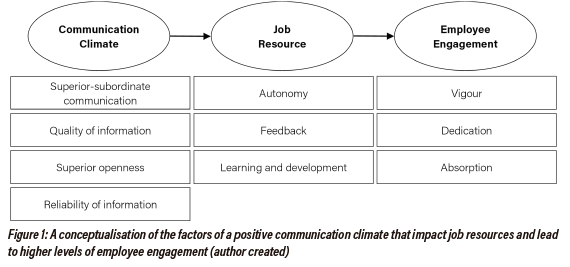
Redding (1972) and Dennis (1974) identify five dimensions to explain communication climate: superior-subordinate communication, quality of information, superior openness, opportunities for upward communication and reliability of information. Superior-subordinate communication refers to the level of support that employees receive from their managers that is communicated in the form of encouragement, understanding and fairness (Balakrishnan et al. 2013; Dennis, 1974; Redding, 1972; Rooney & Gottlieb, 2007). Quality of information pertains to employees' perception of the quality and accuracy of information they receive from their manager. This dimension focusses on whether employees are satisfied with their manager's way of communicating information and whether employees have a clear understanding of their job requirements and work objectives (Balakrishnan et al., 2013; Dennis, 1974; Karanges et al. 2015; Redding, 1972). Superior openness involves employees' perception of how open and honest they experience their manager to be when information is shared (Balakrishnan et al., 2013; Dennis, 1974; Redding, 1972). Opportunities for upward communication show the extent to which employees feel that their views are being heard and whether these views are incorporated into the workplace, that is, whether their superiors are listening to them (Balakrishnan et al., 2013; Dennis, 1974; Macnamara, 2015; Redding, 1972). Reliability of information refers to whether employees feel that they can trust the information they receive from their manager, that is, the credibility of the information itself. Furthermore, the superior and subordinate need to trust each other so that information can be perceived as reliable (Balakrishnan et al., 2013; Barbera & Young, 2010; Dennis, 1974; Redding, 1972).
Conceptualising the expanded role of communication climate
As noted earlier, research indicates a positive relationship between job resources that include a positive communication climate and employee engagement (Bakker & Demerouti, 2008). However, a persistent challenge exists as non-managerial employees often demonstrate lower levels of engagement compared to their managerial counterparts (Reyneke, 2019). This article positions a positive communication climate as the foundational element that underpins all the other job resources and leads to improved levels of employee engagement.
For the purpose of this study and to conceptualise the proposed expanded position, the dimensions of communication climate are used. The point of departure is that all job resources require a positive communication climate to positively impact employee engagement. Figure 1 illustrates this process using three job resources: autonomy, performance feedback and opportunities for learning and development. The discussion that follows provides a brief explanation of each driver and explores how communication climate dimensions influence their effectiveness.
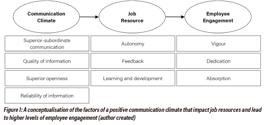
First, employees experience autonomy when they feel that they have a measure of independence, flexibility, discretion and control over how they perform their work (Menguc et al., 2013). This sense of control is crucial for growth and goal achievement. For employees to feel autonomous, there must be some degree of support from their manager (superior-subordinate communication) which enables them to take control of their work (Menguc et al., 2013). Even when having a fair degree of autonomy, employees still need information to perform their job and attain their objectives (Knutson, 2023). The quality of the information that employees receive from their manager, especially in terms of their work objectives, enables them to identify their objectives and how to achieve them (Knutson, 2023). If they do not trust their manager to share credible and reliable information (superior openness), their performance is negatively affected (Aguinis, 2013). Autonomy also fuels creativity. With opportunities for upward communication, this creativity can be used, for example, to solve problems (Gao & Jiang, 2019). To achieve autonomy, supportive dialogue is needed. Open dialogue, facilitated by opportunities for upward communication, allows employees to share ideas, concerns and new approaches with managers (Knutson, 2023). This two-way communication ensures that employees' autonomy is used productively, fosters a sense of ownership over their work and, ultimately, contributes to improved performance (Akre et al., 1997; Stone et al., 2008). In summary, good information from a quality source that supports the employee, as well as the ability to share new and creative ideas with a manager, greatly enhance an employee's ability to work autonomously.
Second, performance feedback from managers is a crucial job resource that assists employees in improving their performance and reaching their full potential. Effective feedback should assess a range of employee behaviours, including persistence, proactivity and adaptability. Feedback can be delivered through both formal appraisals and informal sessions (Gruman & Saks, 2011; Schaufeli et al., 2009). A supportive environment fostered through good communication (superior-subordinate communication) allows employees to feel safe and receptive to critical feedback (Gruman & Saks, 2011). Employees expect quality information during feedback on their performance to know what is expected from them and to obtain the tools to effectively perform their work (Gopal, 2006). Employees must also trust that their manager will be open and honest (superior openness) during feedback sessions (Aguinis, 2013). During a feedback session, employees must be given the opportunity to provide their view on their own performance (opportunities for upward communication) and, in more formal performance appraisals, they need to be able to participate in setting their work goals (Gruman & Saks, 2011). Employees must be empowered through dialogue to share their opinions and ideas (Aguinis, 2013; Robertson-Smith & Markwick, 2009). They then feel heard and will take ownership of their work objectives (Baker et al., 2013). When information is credible and trustworthy (reliability of information), employees can improve their performance and reach their objectives (Dahling & O'Malley, 2011). In summary, a supportive feedback environment is characterised by high quality information delivered tactfully by the manager, with the latter being a knowledgeable and credible source of such information.
Lastly, opportunities for learning and development equip employees with the necessary skills and knowledge to perform their jobs optimally while managing the demands and stresses of the job (Gruman & Saks, 2011; Schaufeli et al., 2009). Managers need to support their employee's growth (superior-subordinate communication) through formal learning and development programmes as well as informal learning processes (Aguinis, 2013). Managers must, therefore, create a supportive environment for learning to take place (Aguinis, 2013; Mazutis & Slawinski, 2008). This can be done by cultivating a learning culture in which dialogue is used to transfer knowledge and skills (Berg & Chyung, 2008). Moreover, managers need to use open, honest and transparent dialogue to promote learning (superior openness) and encourage employees to question assumptions and ideas (opportunities for upward communication) (Mazutis & Slawinski, 2008; Robertson-Smith & Markwick, 2009).
RESEARCH OBJECTIVESTwo research objectives were formulated to investigate the potential expanded influence of communication climate on job resources to improve employee engagement:
i. To determine whether communication climate influences specific job resources;
ii. To determine whether specific job resources influence employee engagement.
METHOD
A quantitative research design was adopted to test the influence of communication climate on certain job resources and their subsequent influence on employee engagement.
The population consisted of four short-term insurance organisations in the South African financial sector (named organisations A-D). A limited number of organisations agreed to participate, despite numerous organisations being approached based on industry contacts. Consequently, the organisations were selected through a non-probability sampling technique. Human resource representatives were approached for consent to participate, and they provided the lists of names of employees working within the white-collar or knowledge-worker space - employees performing office-based jobs that generally require formal education and are higher paid than their blue collar counterparts (Saraç et al., 2017). These lists were coded to conceal the individuals' identity. Each organisation consented to the study, and each individual participated voluntarily and anonymously.
A stratified random sampling technique (with the strata identifying employees as either managers or non-managers) ensured a representative sample of 600 non-management employees targeted across all departments and areas of the organisations. Random samples were drawn within each organisation using Microsoft Excel. Human resource departments at organisations A, B and C converted the anonymised samples back to non-managerial employee identities and invited them to participate. In organisation D, non-managerial employees on the provided list were directly emailed to invite participation. Of those invited to voluntarily participate in the study, 319 non-managerial employees completed the survey.
Data were collected via a self-administered survey using the online tool Qualtrics. The questionnaire consisted of four parts. The first section collected basic demographic information, including gender, age, race and organisational level. The second part used the validated 17-item Likert Utrecht Work Engagement scale to measure employee engagement levels (in terms of vigour, dedication and absorption). The standardised response categories included "never", "almost never" (a few times a year), "rarely" (once a month), "sometimes" (a few times a month), "often" (once a week), " very often" (a few times a week) and "always" (every day). The third part made use of the nine-item Likert Job Demand-Resource scale measuring job resources (autonomy, performance feedback and opportunities for learning and development). The standardised response categories included "never", "sometimes", "regularly", "often" and "very often". Finally, the Dennis Communication Climate scale, a 40-item Likert scale, assessed the employee's experience of the communication climate (superior-subordinate communication, quality of information, superior openness, opportunities for upward communication and reliability of information). The standardised response categories included "to no extent", "to a little extent", "to some extent", "to a great extent" and "to a very great extent"
The data analysis made use of the statistical software programmes SSPS and AMOS. Confirmatory factor analysis with appropriate fit indices was conducted to establish construct validity and reliability. Exploratory factor analysis was then performed to confirm the hypothesised structure of the measurement model. Finally, SEM was used to determine the strength and significance of the relationships between the constructs within the proposed model.
Mediation is defined as "a chain of relations by which an antecedent variable affects a mediating variable, which in turn affects a dependent variable" (MacKinnon et al., 2012:313). The above conceptual model presented itself as a mediation model. The role and impact of the mediator should be further investigated.
RESULTS
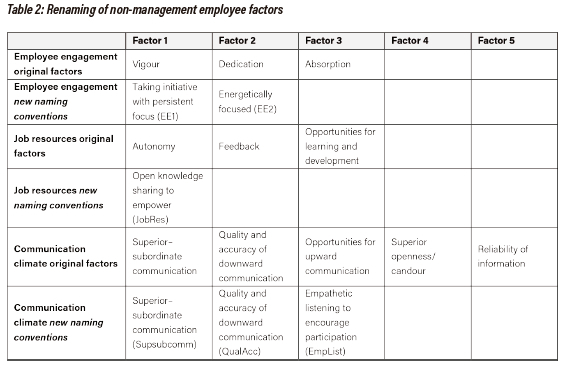
The statistical data analysis started with confirmatory factor analysis of the three existing measurement scales used. The results did not show a good model fit in most instances. Exploratory factor analysis subsequently revealed a new set of factors, probably as a result of the unique context (that is, knowledge workers in short-term insurance organisations in the South African financial sector) for which data had not yet been gathered for the identified themes. SEM was then performed to test the strength of the relationships between the newly identified factors.
Confirmatory factor analysis
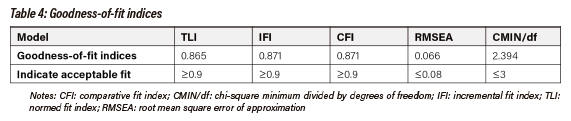
Confirmatory factor analysis was conducted to determine how well the measurement models fit the data. The model adequacy (fit) was tested using goodness-of-fit measures. The set of measures included the fit indices comparative fit index (CFI), incremental fit index (IFI), normed fit index (TLI), root mean square error of approximation (RMSEA) and chi-square minimum divided by degrees of freedom (CMIN/df).
The results for the original models showed an unacceptable model fit for employee engagement. Acceptable values of 0.897 for the TLI and 0.912 for the CFI were found given the threshold of 0.9 (Raykov & Marcoulides, 2006). However, the RMSEA was 0.094, which was above the acceptable threshold of 0.08, and the CMIN/df was 5.408, which was also above the acceptable value of 3 (Schreiber et al., 2006).
The job resources results showed an acceptable fit. The TLI and CFI had values of 0.969 and 0.979, respectively. The RMSEA of 0.075 indicated an acceptable fit, and the CMIN/df value was 2.798.
The communication climate results also showed an unacceptable fit. The values of 0.809 for the TLI and 0.828 for the CFI were below the acceptable threshold of 0.9. The RMSEA value of 0.103 showed an unacceptable fit, and the CMIN/df value was 4.393, which was above the acceptable value of 3. The data were subsequently subjected to exploratory factor analysis to determine the underlying factor structure for the instruments.
Exploratory factor analysis
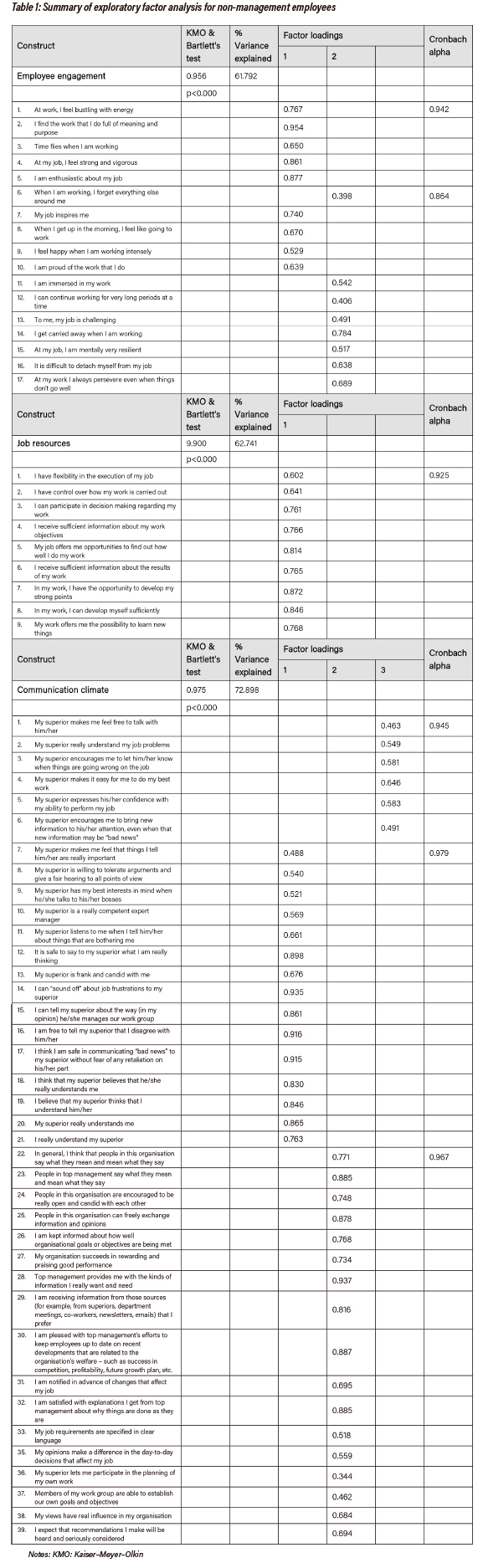
The factor extraction method used was principal axis factoring, and the rotation method was promax with Kaiser normalisation. In terms of the Kaiser-Meyer-Olkin measure of sampling adequacy, all variables tested above the recommended threshold of 0.5 (Table 1). Bartlett's test of sphericity showed a statistical significance (p<0.000) for all the constructs.
In terms of employee engagement, the factor analysis identified only two factors that explained a total of 61.79% of the variance. The Cronbach's alpha values for the two factors were above the acknowledged threshold of 0.7 (Table 1). In terms of job resources, the factor analysis identified a single factor that explained a total of 62.74% of the variance (Table 1). The Cronbach's alpha values for this factor were above the acknowledged threshold. Although the confirmatory factor analysis indicated a fit for job resources, multicollinearity was present between the three constructs. Lin (2007:13) states that "if the absolute value of Pearson correlation is close to 0.8 (such as 0.7), collinearity is likely to exist". Therefore, an exploratory factor analysis was also conducted on job resources. The factor analysis of communication climate indicated three factors, which explained a total of 72. 9% of the variance. The Cronbach's alpha values for the factors were above the acknowledged threshold (Table 1).
Renaming the factors
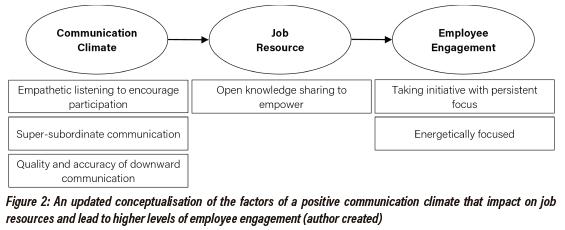
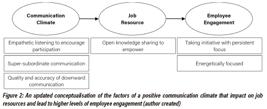
The exploratory factor analysis indicated a different factor structure for the specific context in which the measurement instrument was used. The items that loaded onto each factor were studied and renamed (taking into account the current literature on the constructs). Table 2 compares these new naming conventions with the original constructs.
Factors needed to be renamed. Figure 2 below reflects these changes more accurately.
Construct descriptors
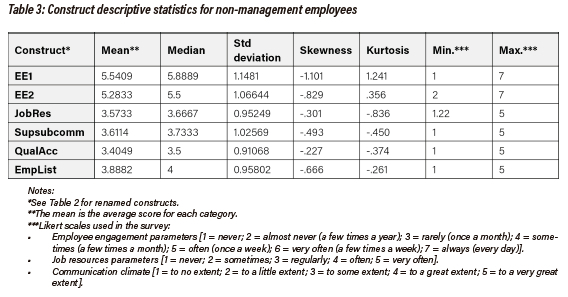
The construct descriptive statistics, based on the three measurement instruments, are presented in Table 3. Three respondents did not answer question 8 and these answers have been replaced with the mean. According to Kline (2016), missing values of less than 5% of the total data set are negligible. One method to solve the problem is to "replace a missing score with the overall sample mean" (Kline, 2016:83).
The descriptives indicate that the construct "taking initiative with persistent focus" (EE1) had the highest mean value of the three employee engagement constructs. The construct with the highest mean value for communication climate was "empathetic listening to encourage participation" (EmpList). The skewness and kurtosis values for employee engagement, job resources and communication climate concepts indicate that the assumption of normality could be made.
Structural equation modeling (SEM)
The following section shows the results of SEM conducted on the conceptual model for non-management employees. This relates to the influence of communication climate on job resources to improve employee engagement. The model adequacy (fit) was tested using goodness-of-fit measures. The set of measures included were the fit indices CFI, IFI, TLI, RMSEA and CMIN/df.
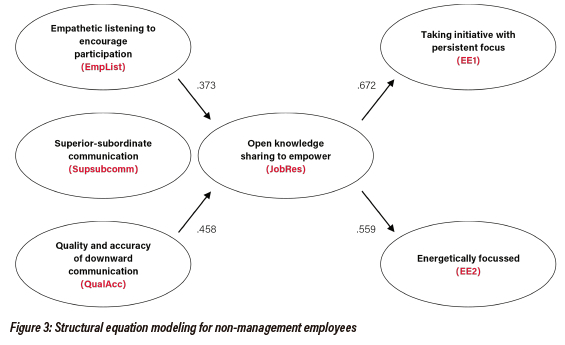
The first step was to determine how well the conceptual model fit the data. Two factors for employee engagement (EE1 and EE2), one factor for job resources (JobRes) and three communication climate factors (Supsubcomm, QualAcc and EmpList) were used. The structural model did not show an acceptable fit across the set of fit indices considered. Although the RMSEA and CMIN/df showed an acceptable fit with values of 0.074 and 2.296, respectively, the TLI, IFI and CFI values did not reach the acceptable threshold of 0.90. Improvements on the model were made by (1) deleting items with loadings of less than 0.5, (2) deleting non-statistical significant paths and (3) studying the modification indices for potential additional covariances with the condition that these needed to be theoretically justified. Table 4 shows this optimisation based on the above-mentioned criteria. The TLI, IFI and CFI values showed an unacceptable fit, whereas the RMSEA and CMIN/df values showed an acceptable fit.
SEM was then performed to determine the strength of the relationships between the newly identified constructs. Given that in the structural model two fit statistics (RMSEA and CMIN/df) showed a model fit, the structural coefficient could be provisionally interpreted. A total of four statistically significant paths were identified, as represented in Figure 3 below.
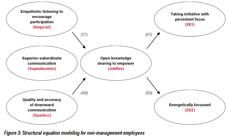
The structural path coefficient from EmpList (empathetic listening to encourage participation) to JobRes (open knowledge sharing to empower, 0.373) was statistically significant, indicating a moderate positive significant relationship. Higher levels of EmpList were related to higher levels of JobRes. The structural path coefficient from Supsubcomm (superior-subordinate communication) to JobRes was not statistically significant. The structural path coefficient from QualAcc (quality and accuracy of downward communication) to JobRes (0.458) was statistically significant, indicating a moderate positive significant relationship. Higher levels of QualAcc were, therefore, related to higher levels of JobRes. The structural path coefficient from JobRes to EE1 (taking initiative with persistent focus, 0.672) was statistically significant, indicating a strong positive significant relationship. Higher levels of JobRes were, therefore, related to higher levels of EE1. The structural path coefficient from JobRes to EE2 (energetically focused, 0.559) was statistically significant. This indicated a positive significant relationship. Higher levels of JobRes were, therefore, related to higher levels of EE2.
DISCUSSION
The SEM analysis yielded a partial fit based on indices such as the RMSEA and CMIN/df. These results partially support the conceptual model, suggesting that communication climate may, within reason, influence job resources. In turn, this could contribute to improving employee engagement.
Addressing the first research objective (to determine whether communication climate influences specific job resources), the analysis reveals that several communication climate constructs potentially influence the identified job resource "open knowledge sharing to empower". The results show that "empathetic listening to encourage participation" has a moderately positive significant relationship with "open knowledge sharing to empower'. This aligns with Baker et al. (2013) who highlight the importance of dialogue during feedback sessions for employee empowerment and autonomy. Superiors should, therefore, listen to the opinions of their subordinates, and their perspectives should be acknowledged (Akre et al., 1997; Stone et al., 2008).
The construct of "superior-subordinate communication" is not significantly related to "open knowledge sharing to empower" A moderately positive significant relationship exists between "quality and accuracy of downward communication" and "open knowledge sharing to empower" This finding is supported by Yang and Choi (2009) who emphasise the need for accurate information flow from superiors to improve employee performance and decision making. The results suggest that for non-management employees to be engaged, a communication climate should exist where managers listen to them, encourage participation and share high quality information. Non-managers are, therefore, empowered through the knowledge that they receive.
Regarding the second research objective (to determine whether specific job resources influence employee engagement), the results suggest a positive relationship between certain job resources and employee engagement. The construct of job resources may influence both the employee engagement constructs "taking initiative with persistence focus" and "being energetically focused" This finding aligns with prior research by Schaufeli and Bakker (2004), Schaufeli et al. (2009) and Maslach et al. (2001) who identify a positive relationship between job resources and employee engagement.
In terms of non-management, the results show that "open knowledge sharing to empower" is the only driver that could improve employee engagement. However, open knowledge sharing can only take place (1) when managers listen to their subordinates to encourage them to participate; and (2) where the information shared with subordinates by their managers is accurate and of a high quality (Aguinis, 2013; Gruman & Saks, 2011; Knutson, 2023; Mazutis & Slawinski, 2008; Robertson-Smith & Markwick, 2009). For management, these results emphasise the importance of fostering a communication climate that encourages active listening and knowledge sharing. By implementing these practices, managers can empower employees and improve their engagement levels.
In summary, while the SEM analysis did not reveal an absolute model fit, key fit indices provide evidence for a good model fit (RMSEA and CMIN/df). These findings suggest that communication climate, to some degree, has a positive influence on certain job resources. In turn, this contributes to employee engagement and highlights the importance of communication climate within organisations striving to improve employee engagement among non-management personnel.
CONCLUSION
Employees are among the most important stakeholder groups, and their performance is vital to the success of an organisation. Employee engagement is, furthermore, a leading factor in improving organisational performance, growth and success. Current models suggest that various job resources, which include a positive communication climate as one of many, contribute to improving employee engagement levels. Low employee engagement, particularly among non-managerial staff, remains a persistent challenge across the globe and particularly in South Africa, and leads to decreased productivity and talent retention. This study proposes that communication climate can play a more fundamental role in employee engagement. It could possibly act as a foundation for other job resources leading to higher employee engagement levels.
The statistical analysis for the study, using SEM, yielded a good model fit for some fit indices, which supported the research objectives. There is some evidence that communication climate influences job resources, which, in turn, contributes to employee engagement. These results highlight the importance of communication climate for organisations seeking to improve employee engagement, especially among non-managerial staff.
To address low engagement, managers should prioritise fostering a positive communication climate. This includes actively listening to employees, encouraging participation and ensuring accurate and transparent information flow. By implementing these practices, managers can empower employees, strengthen job resources and, ultimately, drive higher engagement levels.
LIMITATIONSLiterature acknowledges numerous other potential drivers of engagement beyond the scope of this investigation. However, only the specific job resources identified here were deemed applicable to the research problem investigated in this study. For example, while concepts such as organisational support and climate are recognised as contributors to employee engagement, they fall outside the scope of this investigation. Furthermore, this research was conducted within a limited context in South Africa and the findings can, therefore, not be generalised to a broader context and population.
RECOMMENDATIONS FOR FURTHER RESEARCHThis study paves the way for further research on the possible expanded role of communication climate in relation to employee engagement. More investigation is needed on this topic and it should be tested in broader settings in South Africa and internationally. In addition, examining alternative job resources could determine whether they would produce similar effects.
Finally, it is worth noting that many individual- and organisational-level factors influence both communication climate and employee engagement, including leadership strategies, employee satisfaction and commitment, and organisation climate. These concepts may also be investigated in relation to employee engagement.
REFERENCES
LITERATURE REVIEW
- Abduraimi, P.B., Bilalli, M., Islami, X. & Maçani. F. (2024). Does internal organization communication enhance employee engagement? Economic Studies Journal, 33(3):144-165,
- Aguinis, H. (2013). Performance management. 3rd ed. Upper Saddle River, NJ: Pearson Education.
-
Akre, V., Falkum, E., Hoftvedt, B.O. & Aasland, O.G. (1997). The communication atmosphere between physician colleagues: Competitive perfectionism or supportive dialogue? A Norwegian study. Social Science & Medicine, 44(4):5019-5026. Available from: doi: 10.1016/S0277-9536(96)00178-5
» https://doi.org/10.1016/S0277-9536(96)00178-5 -
Al Zeer, I., Ajouz, M. & Salahat, M. (2023). Conceptual model of predicting employee performance through the mediating role of employee engagement and empowerment. International Journal of Educational Management, 37(5):986-1004. Available from: doi: 10.1108/ IJEM-03-2023-0095
» https://doi.org/10.1108/ IJEM-03-2023-0095 - Albrecht, S.L. (2010). Employee engagement: 10 key questions for research and practice. In S.L. Albrecht (ed.). Handbook of employee engagement: Perspectives, issues, research and practice. Cheltenham, UK: Edward Elgar, 3-19.
-
Aon Hewitt. (2017). Trends in global employee engagement: Global anxiety erodes employee engagement gains. Available from: https://www.google.com/search?q=aon+hewitt+employee+engagement+2017&ie=utf-8&oe=utf-8&client=firefox-b-ab&gfe_rd=cr&ei=wg8kWb-bMY-p8we5tIDICA
» https://www.google.com/search?q=aon+hewitt+employee+engagement+2017&ie=utf-8&oe=utf-8&client=firefox-b-ab&gfe_rd=cr&ei=wg8kWb-bMY-p8we5tIDICA -
Baker, A., Perreault, D., Reid, A. & Blanchard, C.M. (2013). Feedback and organizations: Feedback is good, feedback-friendly culture is better. Canadian Psychology, 54(4):260-268. Available from: doi:10.1037/a0034691
» https://doi.org/10.1037/a0034691 -
Bakker, A.B. & Demerouti, E. (2008). Towards a model of work engagement. Career Development International, 13(3):209-223. Available from: doi: 10.1108/13620430810870476
» https://doi.org/10.1108/13620430810870476 -
Bakker, A.B. (2011). An evidence-based model of work engagement. Current Directions in Psychological Science, 20(4):265-269. Available from: doi: 10.1177/0963721411414534
» https://doi.org/10.1177/0963721411414534 -
Balakrishnan, C., Masthan, D. & Chandra, V. (2013). Impact of internal communication on employee engagement - A study at Delhi International Airport. International Journal of Scientific and Research Publications, 3(8):1-13. Available from: https://www.ijsrp.org/research-paper-0813/ijsrp-p2059.pdf
» https://www.ijsrp.org/research-paper-0813/ijsrp-p2059.pdf - Barbera, K.M. & Young, S.A. (2010). The role of employee trust in understanding engagement. In S.L. Albrecht (ed.). Handbook of employee engagement: Perspectives, issues, research and practice. Cheltenham, UK: Edward Elgar.
-
Berg, S.A. & Chyung, S.Y.Y. (2008). Factors that influence informal learning in the workplace. Journal of Workplace Learning, 20(4):287-300. Available from: doi: 10.1108/13665620810871097
» https://doi.org/10.1108/13665620810871097 -
Dahling, J.J. & O'Malley, A.L. (2011). Supportive feedback environments can mend broken performance management systems. Industrial and Organizational Psychology, 4(2):268-284. Available from: doi: 10.1111/j.1754-9434.2011.01327.x
» https://doi.org/10.1111/j.1754-9434.2011.01327.x -
De Braine, R. & Roodt, G. (2011). The Job Demands-Resources model as predictor of work identity and work engagement: A comparative analysis. South African Journal of Industrial Psychology, 37(2):889-901. Available from: doi: 10.4102/ sajip.v37i2.889
» https://doi.org/10.4102/ sajip.v37i2.889 -
Demerouti, E. & Bakker, A.B. (2011). The Job Demands-Resources model: Challenges for future research. South African Journal of Industrial Psychology, 37(2):1-9. Available from: doi: 10.4102/sajip.v37i2.974
» https://doi.org/10.4102/sajip.v37i2.974 -
Demerouti, E., Nachreiner, F., Bakker, A.B. & Schaufeli, W.B. (2001). The Job Demands-Resources model of burnout. Journal of Applied Psychology, 86(3):499-505. Available from: doi: 10.1037/0021-9010.86.3.499
» https://doi.org/10.1037/0021-9010.86.3.499 - Dennis, H.S. (1974). A theoretical and empirical study of managerial communication climate in complex organizations. Doctoral thesis. West Lafayette, IN: Purdue University.
-
Dhanesh, G.S. (2017). Putting engagement in its proper place: State of the field, definition and model of engagement in public relations. Public Relations Review, 43(5):925-933. Available from: doi: 10.1016/j.pubrev.2017.04.001
» https://doi.org/10.1016/j.pubrev.2017.04.001 - Falcione, R.L., Sussman, L. & Herden, R.P. (1987). Communication climate in organizations. In F.M. Jablin (ed.). Handbook of organizational communication: An interdisciplinary perspective. Newbury Park, CA: Sage Publications, 223-253.
-
Gallup. (2023). State of the global workplace: Global insights. Available from: https://www.gallup.com/workplace/349484/state-of-the-global-workplace.aspx#:~:text=Employee%20engagement%20is%20highest%20in,Europe%2C%20with%2013%25%20engaged
» https://www.gallup.com/workplace/349484/state-of-the-global-workplace.aspx#:~:text=Employee%20engagement%20is%20highest%20in,Europe%2C%20with%2013%25%20engaged -
Gao, A. & Jiang, J. (2019). Perceived empowering leadership, harmonious passion, and employee voice: The moderating role of job autonomy. Frontiers in Psychology, 10(1484):1-9. Available from: doi: 10.3389/fpsyg.2019.01484
» https://doi.org/10.3389/fpsyg.2019.01484 - Goldhaber, G.M. (1993). Organizational communication. Dubuque, IA: Brown and Benchmark.
-
Gómez-González, A. & Gallardo-Echenique, E. (2023). Impact of satisfaction with internal communication on work engagement: Correlational analysis. Comunicación y Sociedad, 10:1-20. Available from: doi: 10.32870/cys. v2023.8407
» https://doi.org/10.32870/cys. v2023.8407 -
Gopal, A. (2006). Worker disengagement continues to cost Singapore. Available from: https://static1.squarespace.com/static/578c4a19197aea41c7eed064/t/59af9d06a9db09ad7b9c3e0b/1504681224814/+Disengagement+Continues+to+Cost+Singapore+%28Gallup+Management+Journal%29.pdf
» https://static1.squarespace.com/static/578c4a19197aea41c7eed064/t/59af9d06a9db09ad7b9c3e0b/1504681224814/+Disengagement+Continues+to+Cost+Singapore+%28Gallup+Management+Journal%29.pdf -
Gruman, J.A. & Saks, A.M. (2011). Performance management and employee engagement. Human Resource Management Review, 21(2):101-111. Available from: doi: 10.1016/j. hrmr.2010.09.004
» https://doi.org/10.1016/j. hrmr.2010.09.004 -
Hakanen, J.J., Ropponen, A., Schaufeli, W.B. & De Witte, H. (2019). Who is engaged at work?: A large-scale study in 30 European countries. Journal of Occupational and Environmental Medicine, 61(5):373-381. Available from: doi:10.1097/JOM.0000000000001528
» https://doi.org/10.1097/JOM.0000000000001528 -
Harter, J. (2021). Globally, employees are more engaged - and more stressed. Available from: https://www.gallup.com/workplace/506798/globally-employees-engaged-stressed.aspx
» https://www.gallup.com/workplace/506798/globally-employees-engaged-stressed.aspx -
Hayes, M., Chumney, F., Wright, C. & Buckingham, M. (2019). Global study of engagement: The technical report. ADP Research Institute. Available from: https://www.adp.com/-/media/adp/resourcehub/pdf/adpri/adpri0102_2018_engagement_study_technical_report_release%20ready.ashx
» https://www.adp.com/-/media/adp/resourcehub/pdf/adpri/adpri0102_2018_engagement_study_technical_report_release%20ready.ashx -
Kahn, W.A. (1990). Psychological conditions of personal engagement and disengagement at work. Academy of Management Journal, 33(4): 692-724. Available from: doi: 10.5465/256287
» https://doi.org/10.5465/256287 -
Karanges, E., Johnston, K., Beatson, A. & Lings, I. (2015). The influence of internal communication on employee engagement: A pilot study. Public Relations Review, 41(1):129-131. Available from: doi: 10.1016/j.pubrev.2014.12.003
» https://doi.org/10.1016/j.pubrev.2014.12.003 - Kline, R.B. (2016). Principles and practice of structural equation modeling. 4th ed. New York, NY: Guilford Press.
- Knutson, V. (2023). How does job autonomy influence workplace motivation? Bachelor thesis. Stavanger, Norway: University of Stavanger.
-
Kundariyah, S., Tjahjono, H.K., Aini, Q. & Setyonugroho, W. (2022). Employee performance measure at Aisyiyah Klaten Hospital using the human resources scorecard approach. Disease Prevention and Public Health Journal, 16(1):47-54. Available from: doi: 10.12928/dpphj.v16i1.4585
» https://doi.org/10.12928/dpphj.v16i1.4585 -
Lin, L. (2007). Using SPSS for multiple regression. Available from: https://www.google.com/l?sa=t&rct=j&q=&esrc=s&source=web&cd=9&cad=rja&uact=8&ved=0ahUKEwjNrLy6kavcAhXDIcAKHceJDjEQFghTMAg&url=http%3A%2F%2Fcourses.washington.edu%2Furbdp520%2FUDP520%2FLab7_MultipleRegression.pdf&usg=AOvVaw3exSKlHnmhTlVXtcIO7qSv
» https://www.google.com/l?sa=t&rct=j&q=&esrc=s&source=web&cd=9&cad=rja&uact=8&ved=0ahUKEwjNrLy6kavcAhXDIcAKHceJDjEQFghTMAg&url=http%3A%2F%2Fcourses.washington.edu%2Furbdp520%2FUDP520%2FLab7_MultipleRegression.pdf&usg=AOvVaw3exSKlHnmhTlVXtcIO7qSv - MacKinnon, D.P., Cheong, J. & Pirlott, A.G. (2012). Statistical mediation analysis. In H.M. Cooper, H.M., & P.M. Camic (eds.). APA handbook of research methods in psychology. Washington, DC: American Psychological Association.
- Macnamara, J. (2015). Creating an "architecture of listening" in organizations: The basis of engagement, trust, healthy democracy, social equity and business sustainability. Broadway, New South Wales: Sydney, U.O.T.
-
Maslach, C., Schaufeli, W.B. & Leiter, M.P. (2001). Job burnout. Annual Review of Psychology, 52(1):397-422. Available from: doi: 10.1146/annurev.psych.52.1.397
» https://doi.org/10.1146/annurev.psych.52.1.397 -
Mazutis, D. & Slawinski, N. (2008). Leading organizational learning through authentic dialogue. Management Learning, 39(4):437-456. Available from: doi: 10.1177/1350507608093713
» https://doi.org/10.1177/1350507608093713 -
Mbhele, S. & de Beer, E. (2021). Achieving employee engagement through effective internal communication. Communicare Journal for Communication Studies in Africa, 40(2): 153-182. Available from: doi: 10.36615/jcssa.v40i2.1315
» https://doi.org/10.36615/jcssa.v40i2.1315 -
Menguc, B., Auh, S., Fisher, M. & Haddad, A. (2013). To be engaged or not to be engaged: The antecedents and consequences of service employee engagement. Journal of Business Research, 66(11):1890-1899. Available from: doi: 10.1016/j.jbusres.2012.01.007
» https://doi.org/10.1016/j.jbusres.2012.01.007 -
Merry, J. (2013). Aon Hewitt's 2013 trends in global engagement: Where do organizations need to focus attention? Strategic HR Review, 13(1):38-43. Available from: doi: 10.1108/shr-07-2013-0073
» https://doi.org/10.1108/shr-07-2013-0073 -
Pincus, J.D. (2023). Employee engagement as human motivation: Implications for theory, methods, and practice. Integrative Psychological and Behavioral Science, 57(4):1223-1255. Available from: doi: 10.1007/s12124-022-09737-w
» https://doi.org/10.1007/s12124-022-09737-w - Raykov, T. & Marcoulides, G.A. (2006). First course in structural equation modeling. Mahwah, NJ: Lawrence Erlbaum.
- Redding, W.C. (1972). Communication within the organisation. Lafayette, IN: Purdue Research Foundation.
- Reyneke, A. (2019). The influence of communication climate on job resources to improve employee engagement. Doctoral thesis. Pretoria: University of Pretoria.
-
Robertson-Smith, G. & Markwick, C. (2009). Employee engagement: A review of current thinking. Available from: https://www.employment-studies.co.uk/system/files/resources/files/469.pdf
» https://www.employment-studies.co.uk/system/files/resources/files/469.pdf -
Rooney, J.A. & Gottlieb, B.H. (2007). Development and initial validation of a measure of supportive and unsupportive managerial behaviors. Journal of Vocational Behavior, 71(2):186-203. Available from: doi: 10.1016/j.jvb.2007.03.006
» 10.1016/j.jvb.2007.03.006 -
Rothmann, S., Mostert, K. & Strydom, M. (2006). A psychometric evaluation of the Job Demands-Resources scale in South Africa. SA Journal of Industrial Psychology, 32(4):76-86. Available from: doi: 10.4102/sajip.v32i4.239
» https://doi.org/10.4102/sajip.v32i4.239 -
Rothmann, S. & Rothmann Jr., S. (2010). Factors associated with employee engagement in South Africa. SA Journal of Industrial Psychology, 36(2):1-12. Available from: doi: 10.4102/sajip.v36i2.925
» https://doi.org/10.4102/sajip.v36i2.925 -
Rothmann, S., Mostert, K. & Strydom, M. (2006). A psychometric evaluation of the job demands resources scale in South Africa. SA Journal of Industrial Psychology, 32(4):76-86. Available from: doi: 10.4102/sajip.v32i4.239
» https://doi.org/10.4102/sajip.v32i4.239 -
Santoso, N.R., Sulistyaningtyas, I.D. & Pratama, B.P. (2023). Employee engagement and trust relationships during COVID-19 pandemic: The expanded role of internal communication. Communication & Society, 36(2):187-204. Available from: doi: 10.15581/003.36.2.187-204
» https://doi.org/10.15581/003.36.2.187-204 -
Saraç, M., Meydan, B. & Efil, I. (2017). Does the relationship between person-organization fit and work attitudes differ for blue-collar and white-collar employees? Management Research Review, 40(10):1081-1099. Available from: doi: 10.1108/MRR-07-2016-0160
» https://doi.org/10.1108/MRR-07-2016-0160 -
Schaufeli, W.B. & Bakker, A.B. (2004). Job demands, job resources, and their relationship with burnout and engagement: A multi-sample study. Journal of Organizational Behavior, 25(3):293-315. Available from: doi: 10.1002/job.248
» https://doi.org/10.1002/job.248 -
Schaufeli, W.B., Bakker, A.B. & van Rhenen, W. (2009). How changes in job demands and resources predict burnout, work engagement, and sickness absenteeism. Journal of Organizational Behavior, 30(7):893-917. Available from: doi: 10.1002/job.595
» https://doi.org/10.1002/job.595 -
Schaufeli, W.B., Salanova, M., Bakker, A.B. & Gonzales-Roma, V. (2002). The measurement of engagement and burnout: A two-sample confirmatory factor analytic approach. Journal of Happiness Studies, 3(1):71-92. Available from: doi: 10.1023/A:1015630930326
» https://doi.org/10.1023/A:1015630930326 -
Schreiber, J.B., Nora, A., Stage, F.K., Barlow, E.A. & King, J. (2006). Reporting structural equation modeling and confirmatory factor analysis results: A review. The Journal of Educational Research, 99(6):323-337. Available from: doi: 10.3200/JOER.99.6.323-338
» https://doi.org/10.3200/JOER.99.6.323-338 -
Slatten, T. & Mehmetoglu, M. (2011). Antecedents and effects of engaged frontline employees: A study from the hospitality industry. Managing Service Quality, 2(1):88-107. Available from: doi: 10.1108/09604521111100261
» 10.1108/09604521111100261 -
Stone, D.N., Deci, E.L. & Ryan, R.M. (2008). Beyond talk: Creating autonomous motivation through self-determination theory. Journal of General Management, 34(3):34-47. Available from: doi: 10.1177/030630700903400305
» https://doi.org/10.1177/030630700903400305 -
Sun, L. & Bunchapattanasakda, C. (2019). Employee engagement: A literature review. International Journal of Human Resource Studies, 9(1):63-80. Available from: doi:10.5296/ijhrs.v9i1.14167
» https://doi.org/10.5296/ijhrs.v9i1.14167 -
Verčič, A.T. & Men, L.R. (2023). Redefining the link between internal communication and employee engagement. Public Relations Review, 49(1):1-9. Available from: doi: 10.1016/j. pubrev.2022.102279
» https://doi.org/10.1016/j. pubrev.2022.102279 -
Verčič, A.T., Galić, Z. & Žnidar, K. (2021). The relationship of internal communication satisfaction with employee engagement and employer attractiveness: Testing the joint mediating effect of the social exchange quality indicators. International Journal of Business Communication, 60(4):1313-1340. Available from: doi: 10.1177/2394884211053839
» https://doi.org/10.1177/2394884211053839 -
Yang, S.B. & Choi, S.O. (2009). Employee empowerment and team performance: Autonomy, responsibility, information, and creativity. Team Performance Management, 15(6):410-423. Available from: doi: 10.1108/13527590910983549
» https://doi.org/10.1108/13527590910983549
Accepted October 2024