Posthuman communication design in South Africa
Abstract
This article investigates the evolving landscape of visual communication design within a Posthumanist framework, in the context of South African design. It addresses the dearth in research regarding the interconnectedness of Posthumanism and communication design practice, specifically aiming to bridge the gap between human-centric design solutions and the traditional commercial facets of visual communication. This article builds upon a review of existing literature to engage in a dialogue where the shared attributes discernible in both Posthumanism and design practice are explored. Framed by the research question -"What elements contribute to Posthumanism in South African communication design, and how do these elements intersect?"- this study aims to uncover commonalities between Posthumanist principles and elements evident in contemporary visual communication design practice. Furthermore, the concept of Ubuntu is scrutinised, leveraging it as a contextual lens through which to understand the integration of Posthumanism within visual communication in an African context. This study goes beyond the theoretical foundations of Posthumanism by suggesting six practical dimensions that were identified through the analysis of significant keywords appearing in the literature. These dimensions aim to enable practitioners to incorporate Posthumanism into design practice in South Africa, thereby bridging the gap between philosophical concepts and the practical aspects of the field.
Communication design practice; Posthumanism; Ubuntu; visual communication design
INTRODUCTION
Twenty years ago, design academic Richard Buchanan (2001:9) stated "[D]esign is the creative human power of conceiving, planning, and realising products that serve human beings in the accomplishment of their individual and collective purposes." Within the profession of communication design, visual communication design, communication design, and graphic design are synonymous phrases that refer to the identical creative business. It is worth mentioning that within industrial practice, the word "graphic design" is commonly employed, while "visual communication design" is predominantly utilised as an academic designation. Visual communication design is no longer categorised as either primarily a human occupation or a commercial venture, as was once the case (Friedman, 2012). Although the larger environment of design is still increasingly influenced by human experiences and decision-making, design products could instead be used for animal, industrial, technological or environmental objectives rather than mainly being designed for human use. Designing environments, ecosystems, or habitats can prioritise the well-being and preservation of non-human species and ecosystems over human needs. The growing use of AI (artificial intelligence) in design poses a challenge to the belief that humans are the exclusive originators and beneficiaries of design outcomes. Posthumanism encourages designers to create products and services reflecting this understanding.
Considering the factors mentioned above, communication design practice has fundamentally changed over the past decades (Forlano, 2017). The availability of and common integration of AI enable designers to use their skills to streamline design production and analyse and enhance results to fit customer needs. In this environment, technology aggregates, sifts, and changes existing graphic information, typefaces, and images to generate a 'new' design (Laing & Masoodian, 2015). Consequently, designers assume a diminished role in shaping the physical aesthetics of the product, instead prioritising the product's integrity and compliance with appropriate quality standards (Matthews et al., 2023).
This article seeks to identify the main intersections between Posthumanism, Ubuntu, and communication design in existing literature. The goal is to provide a path for enhancing design practice. Posthumanism and Ubuntu, though originating from distinct philosophical traditions (Western and African, respectively), converge on several key concepts that challenge traditional anthropocentric views of humanity. Both frameworks emphasise interconnectedness, suggesting that all living things are intricately linked and interdependent. This contradicts the concept of human detachment from or dominance over nature. Moreover, they promote the concept of decentering the human, which involves rejecting the notion that people have a pivotal position in the cosmos. Alternatively, they propose that humans are simply a constituent of a broader, interrelated framework. Ultimately, Posthumanism and Ubuntu share a focus on relationships, emphasising the importance of co-existence with other beings, encompassing both human and non-human entities (Braidotti, 2019; Ewuoso & Fayemi, 2021). In essence, both frameworks offer valuable tools for re-imagining ourselves as part of a vast and interconnected web of existence.
Technology, sustainability, and environmental issues are increasingly influencing design practice, and this research questions what theoretical foundations assist design practitioners in dealing with increasingly complex issues. This article aims to provide context, discuss the predominant theoretical framework, and provide an overview of relevant studies to establish a foundation for future research.
BACKGROUND
Scholars have reconsidered the concept of humanism as fundamental in meeting the expectations of stakeholders in design practice. From an ontological perspective, the humanistic assumption argues that visual communication design is exclusively a human activity and, as a result, promotes human values and perceptions (Wakkery, 2020). However, this assumption has been challenged in recent years, as technology has become more integrated into design practice, blurring the boundaries between humans and machines. Therefore, design academics have proposed a more inclusive approach, considering the deep relationship between humans, technology, and nature (Laurel, 2018; Norman, 2023; Resnick, 2019).
At present, we are faced with uncertainty and confronted with issues such as environmental degradation, economic downturns, poverty, and gender and racialised inequality. This necessitates a reassessment of our aspirations in a world that goes beyond human-centred perspectives, as well as a re-evaluation of design approaches (Du Preez et al., 2022). Posthuman design, informed by Ubuntu's spirit of interconnectedness, can create a future where design benefits not just humanity, but all beings. However, an intersectional lens is crucial to ensure this future is equitable as Posthumanism, in its emphasis on a technologically transformed universal human, overlooks how current disparities rooted in race, gender, aptitude, and other factors will shape who benefits and who is left behind in this future, potentially creating new forms of marginalisation. By examining the influence of social identities and power structures on the impact of design, we may establish a society where the advantages of coexistence between humans and technology are equitably distributed (Susen, 2022). Considering this, designers are discovering new ways of thinking and practice in response to the developing Posthuman discourses.
Humanism sees agency as the natural and deliberate ability of people to act on the world (Mazzei, 2013). Human-centred design (HCD) processes, such as co-design, employ designers' agency to collaborate with stakeholders to develop creative solutions (Sanders & Stappers, 2008). Posthumanism suggests that agency does not exist only in humans, but "results in a complex network of human and non-human actors'' (Barad, 2007:23). In contemporary design, agency refers to the amalgamation of both human and non-human factors that exert influence over the process and outcomes of design creation. This shift in thinking has led to a focus on how technology can be used to enhance the creative process rather than simply replace human labour.
METHODOLOGY
To answer the research question: "What elements contribute to Posthumanism in South African communication design, and how do these elements intersect?", this article reports on a literature review that formed part of a larger case study to initiate a dialogue that examines the intersections between Posthumanism, visual communication design practice and Ubuntu in a South African context. The relevance and scope of this research topic are limited to the exploration of Posthuman practices in the visual communication design profession in South Africa. The identification of search terms and criteria ("visual communication design", "communication design" "graphic design" "Posthumanism", "Ubuntu") was carried out in accordance with the study question.
In addition to extracting information from pertinent literature, the following instruments were utilised in database searches: Google Scholar, Semantic Scholar, and Elicit software. In this regard, the artificial intelligence-based software Elicit proved particularly useful, as it selects relevant literature based on a research question and provides a summary of the results. This facilitated the efficient sorting of pertinent sources. Additionally, use was made of the Al-enhanced online tool Connected Papers, which creates a visual of academic papers that have overlapping citations and thus may contain related subject matter. Following the literature search, emergent keywords were analysed using Atlas.ti. These fundamental keywords serve not only as the foundation for the proposed practical dimensions for improved practice, but also as a framework for reimagining communication design in South Africa. By integrating these dimensions into their core design process, South African designers can leverage the lenses of Posthumanism and Ubuntu. This framework empowers them to transcend anthropocentric limitations and pursue a more responsible, ethical, and interconnected design practice.
The inclusion criterion for article selection comprised publications that incorporated at least two of the keywords and encompassed a wide variety of publication dates, spanning from 1999 to the present. 1999 was designated as a threshold for publishing, since it was conceived that the bulk of papers preceding this year would not sufficiently address the digital advancements in visual communication design practice. These are crucial in understanding the integration of humans and technology in the context of Posthumanism. Posthumanism investigates the potential transformation of human beings by technology, leading to a merging of human and machine identities. In communication design desktop publishing and digital design applications like Adobe Photoshop and Macromedia Freehand were major innovations developed in the 1990s. Digital technology allowed designers to explore more freely, alter their work quickly, and develop designs with unequalled accuracy (Meggs & Purvis, 2016).
The resultant review of the literature found limited previous research in the areas of visual communication design, Posthumanism, and Ubuntu. A Boolean search using the keywords "design" AND "Posthumanism" (17 200 results with minimal results in graphic or visual communication design), "graphic design" AND "Posthumanism" (474 results), "graphic design practice" AND "Posthumanism" (1 result), and "graphic design" AND "Posthumanism" AND "Ubuntu" (2 results) found research limited to general topics on design and Posthumanism (Forlano, 2017; Wakkary, 2020), but none that was relevant to visual communication design practice, Posthumanism, or Ubuntu. Boolean searches allow for the efficient combination of words and phrases by employing Boolean operators such as AND, OR, and NOT inside search engines or databases. These operators have the function of limiting, broadening, or precisely defining a search (Ryan, 2022).
The extant literature described in this article explores the adaptations of visual communication design to changing social expectations and technological advances, with a focus on the shift from a human-centric approach to a more inclusive approach that considers the deep relationship between humans, technology, and nature, leading to the development of Posthuman discourses in design practice. Here Ubuntu serves as a guiding principle that can inform the design approach by considerations of inclusion and sustainability. Currently, there is no existing literature on the intersections between communication design practice, Posthumanism, and Ubuntu. However, this link is explored in a separate case study that is not included in this article.
Contemporary communication design practice
Socially focused design
The existing literature on the interrelationships among graphic design, Posthumanism, and Ubuntu is mostly focused on the integration of either Posthuman or Ubuntu principles into academic courses (Raina, 2020; Van Zyl & Carstens, 2023). However, there is a lack of exploration on how these three concepts might synergistically interact. The following discussion will explore the changing role of the designer and attempt to contextualise Posthumanism and Ubuntu within the practice.
The ideas of Enlightenment humanism, which include free will, societal drive, acceptance of individual progress, and a focus on human exceptionalism, serve as the foundation for the prevailing anthropocentric approaches to design. Human-centred design (HCD) is a philosophy embraced by designers that want to bring about societal change by adding a social dimension and working together to produce solutions that fulfil the demands of stakeholders. HCD is a design approach related to humanistic paradigms such as social responsibility in design, user centricity, and the role of the audience in the design process. Using an HCD approach, practitioners focus on developing outcomes to improve societal needs rather than purely commercial interests (Steen, 2008). By integrating HCD with the methodologies of design thinking (Manzini, 2015), it is possible to generate design solutions that promote a fairer society. Conversely, critics of the human-centred process argue that designers cannot "know" all users and stakeholders in the design process, given that the output of the design process may be crafted for a global audience (Norman, 2023). IDEO, a globally renowned design and innovation agency, is acknowledged for its emphasis on human-centric design methodology and has developed toolkits and resources to aid individuals and organisations in implementing this design approach.
The IDEO Human-Centred Design Toolkit facilitates the development of user-centric solutions by designers and teams. This resource is useful for anybody seeking to incorporate human-centred design principles into their projects and enhance creativity by prioritising the desires and experiences of users. However, human-centred design approaches, such as IDEO's field guide to HCD, unintentionally place designers in positions of power, suggesting Said's (2013:214) view of "flexible positional advantage" IDEO's HCD model focuses on vulnerable and often non-Western communities. As mentioned previously, a designer's agenda is often rooted in the desire for commercial success. Utilising IDEO's design methodology enables designers to engage with the global community, but also places them in positions of power and influence over stakeholders from non-Western contexts, as Cesaire (1972:63) calls the "tools of production". A critique of a human-centred approach is that it uncritically places stakeholders at the centre of the design process without questioning humanistic theoretical positions. Thus, HCD practices contribute to an anthropocentric agenda that, according to Posthuman theory, can support patriarchal, colonial, and capitalist structures (Braidotti, 2019). A Posthumanist perspective compels us to consider beneficiaries beyond humans, including animals, the environment, and even technology itself. However, an intersectional lens reminds us of inherent power dynamics. One may ask who defines the needs of these non-human stakeholders? To create a more fair and just future, design interventions should aim to be inclusive, and actively question and disrupt current systems of power (Susen, 2022).
Continual adaptation to new ideas and technological advances is common in communication design. Although this study discovered relevant literature on visual communication education that is in line with human-centred methods, it does not redefine visual communication within the developing framework of automation or artificial intelligence (Matthews et al., 2023). Tools and methods used in contemporary design must address the dynamics of cultural differences and perspectives. Regardless of the shifts taking place in society and in the use of technology, design outcomes are still developed primarily using the same Eurocentric thinking that has historically shaped relationships between countries (Bonsu, 2019). The presence of Eurocentric thinking in design can result in the neglect of the needs and viewpoints of individuals belonging to marginalised communities. Ubuntu-focused design, like posthumanism, could advocate for a comprehensive strategy that takes into account the broader influence of technology on all individuals, rather than a select privileged few.
Towards embodied design
Socially focused design processes such as HCD emphasise understanding people as independent, individual subjects. New relationships with nature and sociotechnical systems are challenging this understanding (Forlano, 2017). Both designers and academics agree that design must remain in contact with theoretical and methodological advancements (Forlano, 2017). Braidotti (2013:47) rejects the 'selfish individualism' of design and proposes a post-human approach to promoting communal well-being, based on 'environmental entanglement'.
Posthumanism offers a better understanding of human and non-human knowledge and supports the development of design methodologies, frameworks, and practices that are better suited to the challenges we face as a species. The previous perceptions of the world are challenged by new relationships with the natural world and socio-technical systems. In the context of Posthumanism, agency is inherently connected to matters of responsibility and accountability. Humans are inherently answerable to not just other humans, but also to non-human entities with whom we are interconnected (Barad, 2007).
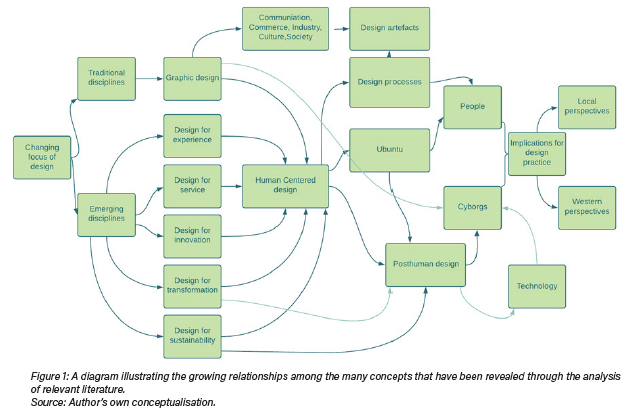
Design practitioners have long questioned the role of design in society (Papanek, 1984). While some focus on incorporating innovative approaches into design practice (Dorst, 2010; Norman & Draper, 1986), many (Buchanan, 2013; Margolin & Margolin, 2002) are concerned with the apparent lack of educational foundations that focus on the consideration of human and societal needs for sustainable design practice. Recent discussions have focused not only on (local) social and environmental issues (Escobar, 2018), but also on considering human needs to support the needs of non-human actors (Forlano, 2017). The focus is on design beyond current practice. Figure 1 aims to organise and illustrate the concepts that play a role in the communication design profession while highlighting their interrelationships.
Design has also been criticised for its contribution to environmental decline through the proliferation of products and services that are unsustainable and contribute to the depletion of the earth's resources (Fry, 2009). A collaborative approach between designers and clients is crucial to consider the entire life cycle of a project. Careful selection of tools and materials can minimise the negative impact on the environment, society, and the economy throughout the design, production, and usage phases.
Posthuman design, especially through the lens of the Fourth Industrial Revolution, shows that nonhuman actors, such as animals or artificial intelligence, require new knowledge and expertise (Forlano, 2017). In contrast to designers who concentrate on human-centred projects, designers who engage with Posthuman design will have to consider a broader range of criteria when developing design solutions. Within this framework, the rise and use of generative AI is viewed advantageously, with a specific emphasis on the untapped possibilities to enhance partnerships between humans and technology. Embracing the principles of Ubuntu would contribute to the development of the Fifth Industrial Revolution (5IR) in Africa (Goode & Potter, 2023).
Technologically focused design
The field of design is undergoing transformation in response to the increasing use of digital technologies. The transition from analogue tools to a digital workflow, which is employed in nearly all facets of the design process, has proven to be highly consequential. The utilisation of digital tools enables designers to enhance their productivity and unlocks novel opportunities within the realms of visual communication, interactive, and multimedia design (Kiernan & Ledwith, 2014). This technological evolution has resulted in the development of new design disciplines that may be connected to the skill set required of visual communication designers, such as user experience (UX) design and user interface (UI) design (Dziobczenski & Person, 2017). These disciplines focus on the development of digital experiences that emphasise user-friendliness, accessibility and engagement. They have a vital role in the creation of digital products that are both efficient and engaging.
Moreover, the emergence of technology has enabled improved cooperation and collaboration among designers, allowing for effortless engagement with clients, colleagues and stakeholders worldwide. This has optimised the process of collaborating on projects at a distance and enabled the quick and seamless exchange of design work.
Contemporary design practice must consider sustainability. In digital design, an environmental consideration may be observed in the case of an application or website that possesses a streamlined interface, which necessitates reduced user interaction, hence leading to a decrease in energy usage. Within the realm of conventional visual communication design, the practice of sustainable design entails making deliberate choices such as prioritising whitespace over colour in printed designs or using recycled materials in design for packaging (Dziobczenski et al., 2018).
The integration of technology into design practice has been transformative, but raises concerns about its potential impact on designers. In the 1960s, Marshall McLuhan speculated that the social transformation brought on by the media affected human beings in different ways. Some scholars (Huber et al., 2020; Sun & Zhao, 2018) have argued that designers are becoming increasingly reliant on technology to the point where they are essentially becoming cyborgs and unable to function without it (Särmäkari & Vänskä, 2022). McLuhan recognised that electronic media could bring about a reconfiguration so extensive as to change the nature of "man" (Hayles, 1999:34).
In her seminal work published in 1999, titled "How We Become Posthuman," Hayles argues that technology is progressively assuming the role of an extension of the human body, hence erasing the boundaries that traditionally demarcate individuals from machines. The author refers to this phenomenon as Cyborgian hybridisation, which involves the amalgamation of human and non-human elements to generate a novel organism (Hayles, 1999). Visual communication designers are progressively integrating technology into their practice, enhancing their abilities and expanding their scope of influence. Similarly, technology has a significant impact on (design) employment, leading to a convergence between humans and non-humans (Haraway, 2004). Haraway's (2004) concept of 'cyborg feminism' entails the dismantling of boundaries that traditionally separate individuals from technology, resulting in the emergence of a novel entity. According to this stance, technology has the potential to assist designers in surpassing their inherent physical limitations.
The correlation between technology and design practices is not straightforward. The impact of technology on design work is undeniable, as it undergoes a transformation that is concurrently influenced by the designers themselves. Designers have an active role in determining the development and use of technology, rather than being passive recipients (Rock, 2009). In addition, designers have always depended on tools to facilitate the creation of their work, including a wide spectrum of instruments such as brushes, pens, and eventually computer software and AI. The use of digital tools signifies the latest chapter in communication design's ongoing story of tool integration (Wakkery, 2021). The use of interactive software, for example, enables designers to create a highly personalised user experience that can be constantly adapted to fit users' individual needs. In an academic space, visual communication designers such as Anastasiia Raina (2020), consider the incorporation of the human elements of randomness and irrationality into "technocratic cultural paradigms" as a critical component of Posthuman design aesthetics. Snaza and Weaver (2015) state that from a Pothumanist perspective humans and non-human objects are irrevocably entangled, but while the lines between human and machine may blur in the future, a complete cyborgian designer reliant solely on technology is improbable.
A Posthumanist perspective suggests a future of collaboration. Designers might leverage AI for specific tasks, but human judgment, creativity, and emotional intelligence will remain paramount. This future could see the rise of new forms of co-design, where humans and AI work together to push the boundaries of the field. Ultimately, the enduring human element in design - empathy, understanding user needs, and translating emotions - will likely ensure that designers do not become solely reliant on technology (Haddow, 2021).
THEORETICAL UNDERPINNINGAccording to Braidotti (2019), the Critical Posthumanist opposes human exceptionalism and believes that Posthuman studies, ecocriticism, technology studies, and ethics have all converged to shape human behaviour. The goal of Braidotti's (2013, 2019) Critical Posthumanism is to develop affirmative perspectives on the Posthuman subject and to affirm the productive potential of the Posthuman predicament (the need to connect with the more-than-human world and our growing dependence on technology). This perspective is informed by Braidotti's anti-humanist roots (Du Preez et al., 2022). Braidotti (2019) acknowledges that an increasingly relationship-based paradigm is replacing the humanistic and anthropocentric paradigms, where subjects are asked to reflect on their relationships with others, especially non-humans. Thus, a critical aspect of Posthumanism is the re-evaluation of the self, considering technology, biotechnology, design, and artefacts.
Whilst often discussed together, Posthumanism and transhumanism are separate ideologies with divergent objectives. Posthumanism endeavours to surpass the tenets of humanism and the anthropocentric perspective of the world, whereas transhumanism strives to augment human capabilities by technological progressions and cognitive alterations, while remaining faithful to humanistic ideals. While Posthumanism promotes a societal transition towards a broader worldview that does not prioritise people as the central focus, transhumanism is centred towards enhancing and altering inherent human characteristics via technology (Wolfe, 2009).
Within this context, Posthumanism re-defines what it means to be human and develops a number of new principles to describe the relationships humans have in the world. While humans are typically privileged, Critical Posthumanism commits to 'thinking with' humans and non-humans alike (Wakkery, 2020). Importantly, both the European heritage and non-Western sources of moral and intellectual inspiration lend credence to Braidotti's (2013) cosmopolitan view of Posthumanism.
A prominent methodological characteristic of Posthumanism is its commitment to interdisciplinary, transdisciplinary and supradisciplinary inquiry. Braidotti's (2019) Posthumanities exist within and outside of advanced capitalism's neoliberal framework. Some of its interests include influencing global capital flows, finance, and corporate culture. In contrast, it aims to undermine neoliberalism's hold over popular opinion.
Braidotti (2019) argues for a Critical Posthumanist perspective that challenges the idea that humans are special and emphasises the importance of relationships with non-humans, technology, and the more-than-human world.
The manifestation of Posthuman theories in design
The development of the practice and stylistic content in visual communication design has been influenced by various movements, including avant-garde ideals of a utopian society, postmodernism's embrace of mass culture and scepticism towards universal truth, and the emergence of Posthumanism, which explores the deconstruction of the human in the context of globalisation, technology, capitalism and climate change (Wakkery, 2020).
Implications of Posthumanism for design practice
To provide solutions for society and address issues within complex sociotechnical systems, it is crucial to consider the fundamental principles that support previous methodologies, models and frameworks, and strive to integrate new social theories. The act of designing items, processes, and environments demonstrates an understanding of and embodies a creative response to the complex underlying and practical challenges, interconnections and interrelationships in our world (Hroch, 2014).
Visual communication design practice is a continuously expanding field, and recently the roles and responsibilities of designers have changed due to technological advancements and rapid globalisation. Therefore, the skill set required for design practitioners is constantly evolving and is impacted by developments in technology or changing theoretical positions. Research has not fully addressed the essential inquiries regarding the methods by which visual communication designers enter the workplace and the specific design proficiencies that employers seek in potential recruits.
In 2018, a study based in the European Union defined the skills for visual communication designers as (1) process management skills, (2) conceptual design skills, (3) technical design skills, and (4) digital and software skills (Dziobczenski et al., 2018). These abilities were chosen based on the ones that appear most commonly in visual communication design job postings. The ability to work as part of a multidisciplinary team, as well as proficiency in the Adobe Creative Cloud suite of design software is still seen as being particularly valuable and has been a feature of communication design job advertisements for some time. These skills, however, make no concessions to the recent developments in AI and its significant impact on the design profession. More recently, the AIGA (American Institute of Graphic Arts) has considered the following future design trends important: complicated challenges, aggregation and curation, linking physical and digital experiences, fundamental values, resilience, making sense of the data economy, and accountability (https://www.aiga.org/resources/design-futures-research). A local study has found that advertisements require certain essential skills, but they do not require communication designers to have expertise in inclusive practices or sustainability. However, it is worth noting that several South African design education institutions incorporate concepts of Ubuntu, citizenship, and ethics into their design curricula, as evidenced by literature from Cassim (2013) and Costandius and Botes (2018). The literature suggests that students may be helped to shed an ethnocentric, Western, white hegemonic perspective on design by purposefully focusing on comparative, global viewpoints on beauty, aesthetics, and design (Matthews et. al., 2023).
This finding underscores the evident gap between academic pursuits and the expectations of the design industry and highlights the ongoing developmental nature of communication design practice in South Africa (Van Zyl & Carstens, 2023). Regardless of the demands of the industry, designers must be cognisant of the developments in their profession and be willing to incessantly upgrade their capabilities to remain relevant.
AN AFRICAN PERSPECTIVEWestern philosophies consider Anthropos as human, thus emphasising the individual and unwittingly relegating human-centeredness to a form of anthropocentricism. By considering humanness through the lens of Eastern philosophy, design researchers such as Yoko Akama emphasise humanness in relation to others (Akama et al., 2016). In this article, humanness as a tenet of social design, and connectivity as espoused by Posthumanism, are contextualised via the African philosophy of Ubuntu.
The Ubuntu worldview holds a prominent and substantial position within the context of sub-Saharan Africa. This African philosophy rose to prominence in post-apartheid philosophical literature. Notable scholarship on this philosophy has been embarked on by Mogote Ramose, Thaddeus Metz, Desmond Tutu, Christian Gade, Kevin Behrens and Motsamai Molefe (Ewuoso & Fayemi, 2021). Former South African president Nelson Mandela described Ubuntu as a philosophy that establishes "a universal truth, a way of life, which underpins an open society" (Modise, 2006). Accordingly, the philosophy of Ubuntu embodies the concept of human beings and their relationship with the community that characterises the ethics that define Africans and their social behaviours (Dia, 1992; Mbigi & Maree, 2005). Hence, communalism and collectivism are essential to the spirit of Ubuntu philosophy. Similarly essential is the characteristic of teamwork (English, 2002; Poovan et al., 2006). Through Ubuntu, individuals contribute their best efforts for the betterment of the entire group (Khomba, 2011). Du Preez et al. (2022) maintain that instead of being anthropocentric and parochially speciesist, as some have said, Ubuntu is a symbol of the interconnectedness of all creatures in the universe.
Thus, Ubuntu takes a relational view that emphasises the importance of an individual's close ties to and deep respect for other individuals as well as "animals living or dead, rocks, insects, the land, and so forth" (Schreiber & Tomm-Bonde, 2015:658-659). This ontology is a direct contradiction to the dualistic thinking that typified Enlightenment philosophy and, through colonialism, had significant implications on what became known as design (Kotze et al., 2018:26).
In Badmington's (2003) view of Posthumanism, the term refers to the imagining of Otherness as it is expressed in culture and speaks to the 'othering' of particular groups of people. It may be argued that globalisation has contributed to the notion of the 'other' through the highlighting of not only the interconnectedness between people, but also their differences. The Ubuntu emphasis on the capacity for communal relationships can be a useful tool for reducing this negative view, since it ensures that harmonious communal relationships are central in all uses of emerging technologies (McDonald, 2010).
The concept of Ubuntu entails an imperative for individuals to cultivate greater moral humanity, facilitate the development or expansion of personal opportunities, cultivate profound communal connections with others, manifest their inherent ability to engage as both subjects and objects within relationships, and thereby promote and elevate their sense of dignity. Likewise, through the application of a Posthuman stance, designers have the capacity to positively affect the lives of certain groups through a communal, participatory approach to developing design outcomes. In South Africa, Ubuntu may be seen as an "endogenous discourse" (Pieterse, 2006:63) and thus design practice underpinned by Ubuntu could aim at channelling design's capacity towards ways of being and doing that are deeply attuned to local social and environmental concerns.
In the context of South African design, the interrelationships among graphic design practice, Posthumanism and Ubuntu could potentially underscore the significance of inclusion, sustainability, and community participation. Following these paradigms designers can develop designs that are more sensitive, socially conscious, and reflective of the different experiences and viewpoints within South African society by considering the relationships between humans, non-humans, and cultures.
To address this imbalance, the field of communication design practice, when examined from a Posthumanist perspective, may incorporate the concept of Ubuntu by acknowledging the innate connectivity and interdependence among all entities. Designers are obliged to consider the potential consequences of their outcomes on the wider environment. It is fundamental for practitioners to acknowledge that design choices possess social and cultural ramifications that can significantly influence society. Importantly, designers should consider the needs and perspectives of marginalised or underrepresented communities and strive to create communication design that promotes social justice and equality. Industry can play a crucial role by offering internships and workshops focused on social impact design, whereas policymakers can incentivise educational institutions to integrate social responsibility into design curriculums, potentially through funding or accreditation processes (Shah, 2024).
The literature (Escobar, 2018; Manzini & M'Rithaa, 2016) maintains that design is a powerful force for social change. Through its focus on community, Ubuntu promotes empathy and compassion whilst Posthumanism manifests in designs that value the needs and perspectives of all beings, including non-human entities. The embodiment of Ubuntu can be detected in the behaviours of Posthuman designers, who vigorously foster a culture of collaboration and cooperation. Designers must recognise that they are integral participants in a larger ecosystem that includes fellow designers, stakeholders, and users. It is critical for designers to embrace collaboration to develop outcomes that are sustainable, ethical, and inclusive (Manzini & M'Rithaa, 2016).
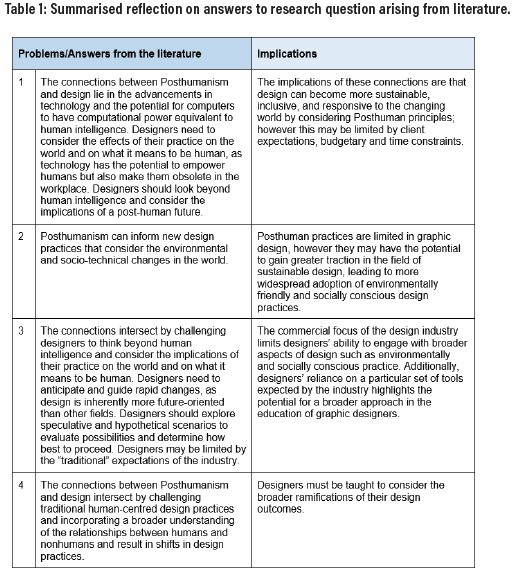
SIGNIFICANT TAKEAWAYSThe convergence of Critical Posthumanism and Ubuntu offers a compelling lens through which to explore the intersections between visual communication designers, technology, and the wider societal landscape shaped by their interactions. In answering the research question, the findings of this literature review suggest that the relationship between Posthumanism, Ubuntu, and South African graphic design practice is limited. An abridged reflection on answers to the research question arising from literature appears in Table 1 below.
Underpinned by Posthumanism and Ubuntu, six fundamental dimensions for improved practice become apparent from an analysis of the keywords that appear from the literature and provide a lens for further explorations of communication design in the South African context. These dimensions transcend theoretical abstractions, instead serving as actionable pillars for reimagining design practice with both philosophical complexity and pragmatic application.
Relationality, echoing the Ubuntu philosophy, underscores the inherent interconnectedness that binds humans to one another and the world around them. Visceral Engagement dismantles the artificial barriers between humans, nature, and technology, urging design to embrace them as an interwoven dance of embodied experience. The dimension of More-than-Human Agency acknowledges the inherent value and influence of non-human entities, prompting design to move beyond anthropocentrism and engage with animals, technologies, and ecosystems as active participants in the narrative. Hybrid Identities celebrates the fluidity and interconnectedness of individual and collective identities, challenging rigid binaries and embracing multiplicity. Ubuntu-informed Ethics positions design as a tool for social commentary, guiding it to address issues of equality, diversity, and inclusion through the combined lens of Posthumanist and Ubuntu values. Finally, Beyond Anthropocentrism champions the idea of transcending the limitations of the self, urging design to move beyond human-centeredness and consider the needs and perspectives of all beings.
Identifying and exploring these dimensions is the cornerstone contribution of this study. It offers a potential framework for further investigation into the intersections of Posthumanism and Ubuntu within the context of South African communication design, paving the way for innovative and responsible design practices that resonate with the complexities of our shared world.
CONCLUSION
In summary, academic papers that explore the expressions of Posthumanism and Ubuntu in communication design are rare. The existing literature describes both concepts in relation to the academic instruction of graphic designers (Kotze et al., 2018; Van Zyl & Carstens, 2023), but not in relation to graphic design professional practice.
Visual communication design, a historically creative profession encompassing diverse disciplines, faces growing anxiety about its future (Matthews et al., 2023). As AI and machine learning automate design tasks once requiring human expertise and investment, educators and researchers must question the evolving role of humans in this domain (Kaiser, 2019; Matthews et al., 2023).
However, the integration of technology has facilitated the ability of designers to participate in collaborative endeavours and improve communication. Nevertheless, there is a prevailing concern regarding the potential excessive reliance of designers on technology, which could potentially hinder their capacity to function independently.
Open design and collaborative practices like HCD have enabled the participation of those without professional backgrounds in the design process, thus promoting its democratisation. Moreover, the emergence of connectivity and digital technology has resulted in substantial transformations in the approaches utilised by designers and non-designers alike in the process of generating and distributing their designs.
In her work, Braidotti (2019) presents a compelling case for adopting a critical Posthumanist framework. This perspective seeks to question the notion of human exceptionalism and instead places significant emphasis on the significance of our connections with non-human entities, technology, and the broader, more-than-human world.
Ubuntu, with its focus on interconnection, empathy, and social justice, is compatible with the concepts of Posthumanism and may be a guiding philosophy for designers aiming to build inclusive and socially responsible products. Designers possess the ability to exert a beneficial influence on various physical issues, such as the environment, architecture, and artefacts. Additionally, they play a significant role in shaping individuals' understanding and interpretation of the surrounding environment through communication design and its related disciplines.
This article described how technological and social integration play a role in bringing Posthumanism and Ubuntu into the field of communication design. Within the South African environment, the attitudes towards non-human entities, the incorporation of ecological and sustainable principles, the emphasis on collaboration, and ethical approaches align with the concept of Ubuntu, hence resonating with South African designers. The purpose of this article was to present an overview of existing literature on the topic and is by no means exhaustive.
REFERENCES
-
AIGA. (2023). Design Futures Research. Available from: https://www.aiga.org/resources/design-futures-research/ (Accessed: 13 June 2023).
» https://www.aiga.org/resources/design-futures-research/ - Akama, Y., Keen, S. & West, P. (2016). Speculative Design and Heterogeneity in Indigenous Nation Building, DIS '16: Proceedings of the 2016 ACM Conference on Designing Interactive Systems: 895-899.
- Badmington, N. (2003). Theorizing Posthumanism. Cultural Critique 53, Posthumanism (Winter, 2003):10-27.
- Barad, K. (2007). Meeting the universe halfway: Quantum physics and the entanglement of meaning. Durham: Duke University Press.
- Boehnert, J. (2014). Design vs. the Design Industry. Design Philosophy Papers, 12(2):119-136.
- Bonsu, G.A. (2019). Design interventions for re-conceptualising sustainable graphic design practices in Ghana. Cape Peninsula University of Technology.
- Braidotti, R. (2013) Posthuman Humanities. European Educational Research Journal, 12(1):1-19.
-
Braidotti, R. (2019). A Theoretical Framework for the Critical Posthumanities. Theory, Culture and Society, 36(6):31-61. Available from: https://doi.org/10.1177/0263276418771486
» https://doi.org/10.1177/0263276418771486 - Buchanan, R. (2001). Design research and the new Learning. Design Issues, 17(4):3-23.
- Buchanan, R. (2013). Wicked problems in design thinking. Design Issues, 8(2):5-21.
- Cassim, F. (2013) Hands On, Hearts On, Minds On: Design Thinking within an Education Context. International Journal of Art and Design, 32(2):190-202.
- Cesaire, A. (1972). Discourse on colonialism. New York: Monthly Review Press.
- Costandius, E. & Botes, H. (2018) Educating citizen designers in South Africa. Stellenbosch: Sun Press.
- Dia, M. (1992). Indigenous management practices: Lessons for African management in the 1990's. Culture and Development in Africa: 165-192.
- Dorst, K. (2010) The Nature of Design Thinking. Proceedings of the 8th Design Thinking Research Symposium, (DTRS8):131-141.
- Du Preez, P., Le Grange, L. & Simmonds, S. (2022). Re/thinking Curriculum Inquiry in the Posthuman Condition: A Critical Posthumanist Stance. Education as Change, 26:2-20.
- Dziobczenski, P.R.N. & Person, O. (2017). Graphic designer wanted: A document analysis of the described skill set of graphic designers in job advertisements from the United Kingdom. International Journal of Design, 11(2):41-55.
- Dziobczenski, P.R.N., Person, O., Merilainen, S. (2018). Designing Career Paths in Graphic Design: A Document Analysis of Job Advertisements for Graphic Design Positions in Finland. The Design Journal, 21(3):1-22.
- English, J. (2002). Managing cultural differences to improve industrial efficiency. Building Research and Information, 30(3):196-204.
- Escobar, A. (2018). Designs for the Pluriverse: Radical Interdependence, Autonomy, and the Making of Worlds. Durham and London: Duke University Press.
- Ewuoso, C. & Fayemi, A.K. (2021). TransHumanism and African Humanism: How to Pursue the Transhumanist vision without jeopardising humanity. Bioethics, 35(7):634-645.
-
Forlano, L. (2017). Posthumanism and Design, She Ji, 3(1):16-29. Available from: https://doi.org/10.1016/j.sheji.2017.08.001
» https://doi.org/10.1016/j.sheji.2017.08.001 - Friedman, K. (2012). Models of design: Envisioning a future design education. Visible Language, 46.1(2):132-153.
- Fry, T. (2009). Design Futuring: Sustainability, Ethics and New Practice. Oxford: Berg Publishers.
- Goode, H. & Potter, M.A. (2023). Who authors learning? Teaching design with intelligent technology. Proceedings of the 17th DEFSA conference - Vulindlela - making new pathways, held in Centurion, 21-23 September 2023: 22-32.
- Haddow, G. (2021). Embodiment and everyday cyborgs: Technologies that alter subjectivity. Manchester: Manchester University Press.
- Haraway, D. (2004). Cyborgs, Coyotes, and Dogs: A Kinship of Feminist Figurations, and: There are always more things going on than you thought! Methodologies as Thinking Technologies. The Haraway Reader, Routledge:321-341.
- Hayles, N.K. (1999). How we become Posthuman: Virtual Bodies in Cybernetics, Literature, and Informatics. Chicago: The University of Chicago Press.
- Hroch, P. (2014). Sustaining Intensities: Materialism, Feminism and Posthumanism meet Sustainable Design. Doctor of Philosophy Thesis. University of Alberta, Canada.
- Huber, A.M., Waxman, L.K. & Dyar, C. (2020). Using systems thinking to understand the evolving role of technology in the design process. International Journal of Technology and Design Education, 32:447-477.
- Kaiser, Z. (2019) Creativity as computation: Teaching design in the age of automation. Design and Culture, 11(2):173-92.
- Khomba, J.K. (2011). Redesigning the balanced scorecard model: An African perspective. University of Pretoria.
- Kiernan, L. & A. Ledwith. (2014). Is design education preparing product designers for the real world? A study of product design graduates in Ireland. The Design Journal, 17(2):218-237.
- Kotze, R., Perold-Bull, K., Costandius, E. & Alexander, N. (2018). Posthumanist and New Materialist perspectives as navigational tool in art education research: A diffractive analysis. Cristal - Critical Studies in Teaching and Learning, 6(1):35-57.
- Laing, S. & Masoodian, M. (2015). A study of the role of visual information in supporting ideation in graphic design. Journal of the Association for Information Science and Technology, 66(6):1199-1211.
- Laurel, B. (2018). New Media Futures: The rise of women in the digital arts. Champaign, Illinois: University of Illinois Press.
- Manzini, E. (2015). Design, when Everybody Designs: An Introduction to Design for Social Innovation. Cambridge Massachusetts: MIT Press.
- Manzini, E. & M'Rhitaa, M. (2016). Distributed Systems and Cosmopolitan Localism: An emerging design scenario for resilient societies. Sustainable Development, 24(5):275-280.
- Margolin, V. & Margolin, S. (2002). A 'Social Model' of Design: Issues of Practice and Research. Design Issues, 18(4):24-30.
- Maringira, G. & Ryan, S. (2021). Politics, (Re)Possession and Resurgence of Student Protests in South African Universities. Politikon South African Journal of Political Studies. 48(2):1-20
- Matthews, B.R., Shannon, B. & Roxburgh, M. (2023). Destroy All Humans: The Dematerialisation of the Designer in an Age of Automation and its Impact on Graphic Design-A Literature Review. International Journal of Art & Design Education, 42(1): 2-17.
- Mazzei, L. (2013). A voice without organs: Interviewing in posthumanist research. Internal Journal of Qualitative Studies in Education. 26(6):732-740.
- Mbigi, L. & Maree, J. (2005). Ubuntu: The spirit of African transformation management. Johannesburg: Knowledge Resources.
- McDonald, D.A. (2010.) Ubuntu bashing: The marketisation of 'African values' in South Africa. Review of African Political Economy, 37(124):139-152.
- Meggs, P.B. & Purvis, A.W. (2016). A History of Graphic Design. 6th Edition. Hoboken, NJ: John Wiley and Sons.
-
Modise T. (2006). [Video Recording]. Experience Ubuntu: Interview with Nelson Mandela [Online:]: http://embraceubuntu.com/2006/06/01/the-meaning-of-ubuntu-explained-by-nelson-mandela/ (Accessed: 1 April, 2013).
» http://embraceubuntu.com/2006/06/01/the-meaning-of-ubuntu-explained-by-nelson-mandela/ - Norman, D. (2023). Design for a Better World. Cambridge, Massachusetts: MIT Press.
- Norman, D. & Draper, S. (1986). User Centred System Design New Perspectives on Human-computer Interaction. 1st edition. Florida: CRC Press.
- Papanek, V. (1984). Design for The Real World: Human ecology and social change, London: Thames & Hudson.
- Pieterse, J.N. (2006). Emancipatory cosmopolitanism: Towards an agenda. Development and Change, 37(6):1247-1257.
- Poovan, N., Du Toit, M.., & Engelbrecht, A.S. (2006). The effect of the social values of Ubuntu on team effectiveness, South African Journal of Business Management, 37(3):17-27.
-
Raina, A. (2020). Speculations on the Posthuman Age. [Online:] https://www.risd.edu/news/stories/graphic-design-faculty-anastasiia-raina-on-posthumanism-and-design (Accessed: 2 February 2022).
» https://www.risd.edu/news/stories/graphic-design-faculty-anastasiia-raina-on-posthumanism-and-design - Resnick, E. (2019). The Social Design Reader. London: Bloomsbury Visual Arts.
- Rock, D. (2009). Your Brain at Work. New York: Harper Business.
-
Ryan, E. (2022). Boolean Operators | Quick Guide, Examples & Tips. [Online:] https://www.scribbr.com/working-with-sources/boolean-operators/ (Accessed: 6 November 2023).
» https://www.scribbr.com/working-with-sources/boolean-operators/ -
Said, E.W. (2013). Orientalism reconsidered, Arab Society: Continuity and Change, (1):105-122. Available from: https://doi.org/10.4324/9780203517345
» https://doi.org/10.4324/9780203517345 - Sanders, E. B.-N. & Stappers, P.J. (2008.) Co-creation and the new landscapes of design. CoDesign, 4(1):5-18.
- Sanders, E.B.N. & Stappers, P.J. (2014). Probes, toolkits and prototypes: Three approaches to making in codesigning. CoDesign, 10(1):5-14.
- Särmäkari, N. & Vänskä, A. (2021). 'Just hit a button!' - fashion 4.0 designers as cyborgs, experimenting and designing with generative algorithms. International Journal of Fashion Design, Technology and Education, 15(2):211-220.
- Schreiber, R. & Tomm-Bonde, L. (2015). Ubuntu and constructivist grounded theory: An African methodology package. Journal of Research in Nursing, 20(8):655-664.
-
Shah, S. (2024). The Importance of Internships in Design to Bridge the Gap Between Academics and Industry. [Online:] https://www.linkedin.com/pulse/importance-internships-design-bridge-gap-between-academics-shah-jhfdf/ (Accessed: 12 March 2024).
» https://www.linkedin.com/pulse/importance-internships-design-bridge-gap-between-academics-shah-jhfdf/ - Snaza, N. & Weaver, J.A. (2015). Introduction:Education and the posthumanist turn: 1-14. Posthumanism and Research Education. New York, NY: Routledge.
- Steen, M. (2008). The fragility of human-centred design. Delft Technical University.
- Sun, L. & Zhao, L. (2018). Technology disruptions: Exploring the changing roles of designers, makers, and users in the fashion industry. International Journal of Fashion Design, Technology and Education, 11(3):362-374.
- Susen, S. (2022). Reflections on the (Post-)Human Condition: Towards new forms of engagement with the world?. Social Epistemology, 36(1):63-94.
- Van Zyl, H.M. & Carstens, L. (2023). Communication design industry - in search of unicorns or new pathways? DEFSA conference - Vulindlela - making new pathways, 21-23 September 2023:22-32.
- Wakkery, R. (2020) Nomadic practices: A posthuman theory for knowing design. International Journal of Design, 14(3):117-128.
- Wakkery, R. (2021) Things we could design for more than Human-centred worlds. Massachusetts: MIT Press.
- Wolfe, C. (2009). What is Posthumanism? Volume 8 of Posthumanities Series. Minneapolis: University of Minnesota Press.
Accepted May 2024