Re-Imagining Broadcasting in the Public Interest: SABC TV Broadcasting in a Commercialised Competitive Media System
Abstract
The article looks at the South African Broadcasting Corporation as a case study to examine the impact of liberalisation and competition by examining scheduling and programming to ascertain diversity. The public sphere theory was used to evaluate its performance as a public service broadcaster. The article challenges the arguments that, first, liberalisation commercialises public service broadcasting which results in the erosion of the public sphere through excessive similarity in programming, thus excluding certain perspectives, fragmenting audiences and limiting its social and integrative role. Second, commercial interests have undermined the service mandate of public service broadcasting and it has lost legitimacy and relevance. It also decries the dominance of public service broadcasting literature from the North which focuses on the public-private dichotomous approach that emphasises collective interest over personal choice, and commonality over diversity. Findings show that the South African Broadcasting Corporation programming is diverse with high local content, and that responses to competition are not deterministic, while commercialisation and convergence are inherent risks that can be mitigated by creative programming strategies and regulation. Findings further provide insight to the approach of the South African Broadcasting Corporation to scheduling and programming through broadcasting the rainbow nation, a construct that suggests ideals of nation building, unity and diversity as public interest embedded in the broadcasting legislative and organisational frameworks. The notion of the rainbow nation is rooted in diverse cultures and the different racial make-up of South Africa.
Broadcasting the rainbow nation; diversity; liberalisation; public service broadcasting; public sphere; SABC
INTRODUCTION
This article explores the effects of liberalisation on diversity in public service broadcasting (PSB) by examining diversity of genres to ascertain variety or lack thereof, and scheduling to ascertain similarity or disparity. This is done to evaluate the theory of erosion of the public sphere. The aim is to determine whether the South African Broadcasting Corporation (SABC) lives up to its mandate and commitment to be accessible to all by catering for diverse interests while competing with other broadcasters. Diversity is understood here as a mix of variety, balance and disparity, where variety refers to different genres/ programme types, and balance refers to the amount of time devoted to every genre. Disparity is the difference between the genres (Hendrickx et al., 2019). Diversity is a stated objective for the PSB in South Africa (South African Government, 1999). The issue is whether in the case of the SABC, market forces have compromised it to the extent that the democratic character of the public sphere has been eroded. This article unpacks the SABC's response to liberalisation of television broadcasting in relation to its public service mandate, as evidenced by programmes and scheduling.
The article makes a case for the continued significance and role of PSBs in democratic engagement and their ability to transform and adapt to changes to remain relevant and valuable (Syvertsen, 2003). It challenges the argument that liberalisation commercialises PSB, leading to convergence in programming and fragmentation of audiences, which erodes the common space for public engagement and expression (Golding & Murdock, 1991; Keane, 1991; McChesney,1999; McQuail, 1998; Murdock, 1994). Liberalisation refers to changes in regulatory approach that remove restrictions and obligations, particularly around ownership, control and content, and that is in favour of less regulation (Hitchens, 2006). PSB here refers to all forms of public broadcasters that have a combination of a level of regulatory arrangement, public service obligations or some type of programming that is regarded as valuable to society, and privileges including public funding (Syvertsen, 2003). In the case of the SABC, it is similar to other African PSBs. It is characterised by strong public intervention through legislation that determines its constitution, ownership and content (South African Government, 1999), but it has limited funding and is heavily reliant on advertising and sponsorships (76%), television licence fees (15%), government grants (3%) and other revenue sources (6%) (SABC, 2019). As Berger et al. (2009:7) put it, "the theoretical correspondence of public ownership, public financing and public service was never quite there from the start". Even as a monopoly, the SABC has always been commercialised, generating more income from advertising than license fees (Hayman & Teer-Tomaselli, 1989). However, in the democratic and liberalised dispensation, the influence of advertising revenue is tapered by content regulations. Liberalisation merely resulted in the emergence of privately owned commercial broadcasters in direct competition with the SABC.
To a large extent, the article relies on outdated sources from the North and from South Africa due to a lack of research on the topic. From the rest of Africa, literature is even more scarce. Most of the available literature on PSB is largely based in the North (Golding & Murdock, 1991; Jacka, 2003; Keane 1991; McChesney, 1999; McQuail, 1998; Mouffe, 1992; Murdock, 1994). This may be attributable to literature on policy studies which predicted the demise of PSB as an outdated model (Fourie, 2003; Lowe & Steemers, 2012; Price & Raboy, 2011; Steemers, 2003). Among the cited challenges is the proliferation of communication channels through liberalisation and digital platforms, which has led to competition for audiences and advertising revenue. This pending demise, however, has not materialised. Instead, there is a body of literature that demonstrates that PSBs are adapting to changing broadcasting environments and are providing value; (D'Arma & Labio, 2017; Esser & Jensen, 2015; Freedman, 2018; Hendrickx et al., 2019; Newton, 2016; Stollfuß, 2021; Strömbäck, 2017; Syvertsen, 2003). A substantial number of these studies show that public service media generate more political knowledge and cover news more frequently than private media (Newton, 2016; Strömbäck, 2017). Viewers of PSB tend to be more informed about politics and are likely to participate in political activities (Iyengar et al., 2010). This article adds to this body of literature, demonstrating that contrary to the anticipated demise of PSB, it continues to provide freely and equally accessible diverse programming that caters for all interests and tastes.
Unlike literature from the North, which focuses on news and current affairs, emerging literature from the South reflects a growing interest in the role of popular culture in democratic engagements (Barnett, 1999a; Evans, 2010; Fuchs, 2020; Hermes, 1998; Milton et al., 2013; Morley, 2006). It is unclear whether PSBs in the South are adapting like their counterparts in the North and, if they do, what that means for their public service remit.
While literature on the performance of PSBs in Africa is scarce, available studies express concerns about falling short on its PSB mandate and its commercialisation, political interference and bad governance (Duncan, 2015; Fourie, 2003; Hadland et al., 2008; Tleane & Duncan, 2003; Wasserman & Garman, 2012). Wasserman and Garman (2012) and Duncan (2015) lament the commercialisation of South African media for fragmenting audiences and favouring elites, curtailing their ability to serve as inclusive diverse spaces for political engagement. Meanwhile, Teer-Tomaselli (cited in Hadland et al., 2008) argues that SABC has always been commercialised without affecting programming until liberalisation, which led to an increased number of channels and broadcasting hours that resulted in more entertainment programmes and less education, public affairs and regional affairs content (Hadland et al., 2008). Further, Ciaglia (2017) argues that the SABC is caught between the market and the state, while Fourie (2003) and Tleane and Duncan (2003) argue that the SABC is falling short of its public service mandate. Furthermore, the SABC is criticised for politicisation, political interference and bad governance (Arndt, 2018; Dannhauser, 2013; Skinner, 2011), and abandoning the working class and vulnerable groups (Hodes, 2014). Afrika (2021) claims it fails to play a role in the cultural public sphere. However, Dibetso and Smith (2012) show that SABC scheduling and programming is diverse even though news is least covered. Literature on PSBs in South Africa suggests liberalisation and commercialisation as some of its key challenges in delivering on its public service mandate. Barnett (1999b) notes that South Africa chose liberalisation over public service objectives. Similarly, Horwitz (2001) expresses concern about commercialisation at the cost of PSB. In the main, research on the SABC performance of its public service mandate reflects concerns and suggests an institution in crisis (Tager & Chasi 2013). This article examines scheduling and programming by three SABC television channels to evaluate the accuracy of these criticisms that suggest erosion of the public sphere.
Updating and calibrating the public sphere theory
The public sphere, as theorised by Habermas (1989), is more of a conceptual platform than physical space for people to assemble as a public with the purpose of engaging on state matters. His ideal type of a bourgeois public sphere is characterised as a space that lies somewhere between the market and the state, free from both (Habermas, 1989). It is dynamic and has transformed over time; it thrives in its changed form and its evolution continues in mediated communication (Boeder, 2005). Its value lies in continuing to provide a viable option for the future of PSB in its changed form of a multiplicity of public spheres unconstrained by rationality and consensus seeking, and PSB that is no longer a monopoly. From the public sphere perspective, public interest (not profits) serves as the measure of media performance (Croteau & Hoynes, 2006), especially PSB. However, Habermas (1989) argues that due to commercialisation, expansion of communication networks, growing capital requirements and large-scale publishing, opportunities for access to public communication came under great selection pressure, giving media new influence and power, eroding the common space for public engagement.
The public sphere (Habermas 1989) is a conceptual starting point for evaluating PSB and its performance in a context dominated by a neoliberal perspective that favours individual choices over collective interest. Authors Garnham (1992, 2003), Dahlgren (1995), Sparks (1995), Dahlgren and Sparks (1991) use citizenship and public interest to justify PSB. They argue that the shift from collective interest to consumer choice erodes the public sphere. Meanwhile, advocates of market competition claim communication markets ensure consumer satisfaction through freedom of choice (Fowler & Brenner, 1982; Golding & Murdock, 1989). However, PSB is complex: the dichotomous distinction between citizenship vs consumerism, collective vs individual and public vs private fails to appreciate the realities of both approaches (Dawes, 2013). Hence, neither perspective alone can provide an adequate defence of PSB and its role and value in a competitive broadcasting media system. There is a need for a nuanced approach that combines certain aspects of free market and public sphere approaches (Curran & Gurevitch, 1991; Picard & Siciliani, 2013), an approach that is sensitive to the theoretical arguments of both perspectives (Dawes, 2013) to be able to explain how public and private interests, and citizen and consumer identities, are constantly negotiated and reconfigured (Dawes, 2013).
With the seemingly contrasting approaches to democratic engagement and the public sphere within democracy-based perspectives, Karppinen et al. (2008) make a case for theoretical eclecticism. They advocate engagement with developments in political theory that bring the approaches of Mouffe and Habermas closer. Contrary to Habermas (1989), Mouffe (1992) challenges the notion of the universal public good, arguing that in a pluralised society, it is impossible to have common interests, wherein personal interests defer to public interests. As Karppinnen et al. posit, the public sphere is best understood as an arena of articulating expressions of both solidarity and difference (Karppinen et al., 2008). Thus, in terms of the role of media institutions, PSB represents an institutional compromise that reflects a need to reconcile unity and difference (Karppinen et al., 2008). Through the principle of universality (Scannell, 1989), PSB is able to provide a neutral space for rational debate on issues of common interest while at the same time, through the principles of diversity and distinctiveness (Scannell, 1989), it is able to provide content that is not only different, but oppositional, that reflects dissent and divergent views in society. Similarly, Dahlgren (2005), advocates expansive reading of the rational communication aspect of the public sphere that does not exclude aesthetic-affective modes, where reflexivity "include[s] aesthetic, intuition and imagination which draw[s] on feeling," and that "positions worth defending will usually be articulated and reasoned with a degree of passion and commitment" (Dahlgren, 2005:116-117).
Ncube and Tomaselli (2019) provide a perspective that reflects the expanded reading of the public sphere and which reconciles political and cultural/entertainment communication using Dariro and Dare concepts. These concepts are precolonial African communication systems used by Shona people in Zimbabwe. Dariro and Dare place importance on inclusivity, accommodating everyone, encouraging universal participation (Ncube and Tomaselli, 2019). As Ncube and Tomaselli (2019) demonstrate, these communication models highlight democratic aspects excluded by Habermas' public sphere, providing platforms that are available to all people to freely express themselves (culture, identity and entertainment), resolve disputes (address difference and dissent) and build unity (consensus) while encouraging diversity and difference. Democratic engagements, agency and public contestation are hallmarks of these precolonial African communication systems, which, at times, surpass democratic practices and principles espoused in Habermasian public sphere (Ncube & Tomaselli, 2019). Their use of the precolonial African communication systems illustrates similarities and differences with the Habermasian public sphere but updating and calibrating it for appropriate application in the South.
This understanding of the public sphere is embedded in the origins of the political public sphere, with its roots in the cultural public sphere, which provided the basis for its development. The Dariro and Dare concepts are indicative of such origins and provide a good framework for updating the public sphere theory. They show that the cultural and political public spheres were never separate as they always worked together. Similarly, broadcasting the rainbow nation as a conceptual framework suggests the political role of culture and the part played by broadcasting in it to facilitate the understanding and explanation of links and interactions between politics, culture and institutional arrangements. This enables the updating of the public sphere theory with local context and concepts. This conceptualisation in new democracies allows an understanding of the public interest role and function of PSB as one of the key platforms for development, nation building, national unity and development of public opinion and government accountability. In a similar way, this article uses broadcasting the rainbow nation as a conceptual framework to update and expand the reading of the public sphere.
Framework: Broadcasting the rainbow nation
The SABC's performance of its public service mandate can be understood in terms of its links to the notion of the "rainbow nation" which, Mathebe (2002) suggests, is regarded as one of the main pillars of social cohesion and nation building. This article employs broadcasting the rainbow nation as a conceptual framework to understand the linkages and how the SABC facilitates them. The concept of broadcasting the rainbow nation was first used by Barnett, who viewed television as critical in "symbolic representations of the rainbow concept of 'One Nation, Many Cultures'" (1999a:275) in reference to South Africa. It was also used by Teer-Tomaselli (2001), illustrating its workings through mythology building, everyday programming and thematic content of dramas. It was later used by Evans (2010:310), who claims that "rainbow nationalism owes much to the ways in which the mass media operates".
As a construct, broadcasting the rainbow nation suggests that broadcasting has a political and cultural role of integration of individuality and collectivism, nation building and national unity (Kula, 2024). Principally, broadcasting the rainbow nation entails the use of television broadcasting in pursuit of social, economic, political and cultural goals of nation building, social integration, unity and diversity, and economic transformation as elements of public interest. As a conceptual framework, it posits that through scheduling, programming and channel branding, SABC television facilitates, supports, perpetuates and reinforces the notion of the rainbow nation as part of nation building and national unity objectives, by emphasising representations of unity in diversity as representing and reflecting the nation to itself. Broadcasting the rainbow nation concept regards the idea of reinforcing the rainbow nation as a public interest, hence nation building constitutes a key consideration for PSB (Teer-Tomaselli, 2001). Broadcasting the rainbow nation suggests that the ideology of the rainbow nation is embedded in broadcasting regulation, PSB mandate, SABC corporate frameworks, culture, processes and programming. It serves to influence broadcasting output in a manner that aspires and inspires unity in diversity (Kula, 2024).
RESEARCH METHODOLOGY: CASE STUDY USING MIXED METHODS
This research is a case study using a combination of qualitative and quantitative methods to leverage the strengths of both (Creswell, 2014) by using multiple sources and techniques of data collection and analysis. The study used content analysis to collect and analyse quantitative data from television schedules and utilised qualitative data from interviews to understand and contextualise data. Content analysis is widely used in diversity and programming analysis (Bishop & Hakanen, 2002; Hendrickx et al., 2019; Park, 2005). The analysis examined which genres were present and how much broadcasting time was allocated to each particular genre. The interviews sought to understand the context in which they were produced.
The research compares current performance to existing standards (public service mandate and content quota). The selection of SABC television as the subject of the study was necessitated by the SABC as the only PSB and specificity of the case (Stake, 1994). The research required in-depth understanding of the performance of the PSB mandate in a competitive media environment through a holistic examination and to understand the meaningful characteristics (Yin, 2003), that is, scheduling, programming and production context in South Africa. As suggested by Yin (2003), the use of a case study was to understand "how" and "why" SABC television as a PSB is affected by liberalisation. The single case study was sufficient - the three channels cater for different audiences and, when viewed together, they cater for all South African audiences.
Non-probabilistic, that is, purposive and random sampling were used for both content analysis and interviews. For content analysis, purposive and random sampling was used to select one full calendar month of SABC 1, SABC 2 and SABC 3 daily television schedules (24 hours), from 1 to 31 August 2020. A full calendar month was sufficient as SABC television schedules are in 24-hour and weekly blocks and are repeated over 12 months.
For the interviews of broadcasting professionals, purposive, random and convenient sampling were used to select four television broadcasting professionals who had experience as general managers, heads of channels, scheduling and programming, based on their knowledge, experience and decision-making roles in programming and scheduling, and their willingness to participate. More potential participants (16) were approached, but declined. Only four accepted. Data was collected from interviews conducted between June 2022 and August 2024 based on the availability of the participants. Two interviews were conducted face to face and two online using Microsoft Teams, with semi-structured open-ended questions. In the article, participants are identified as Interviewee 1 to 4 to protect their identities.
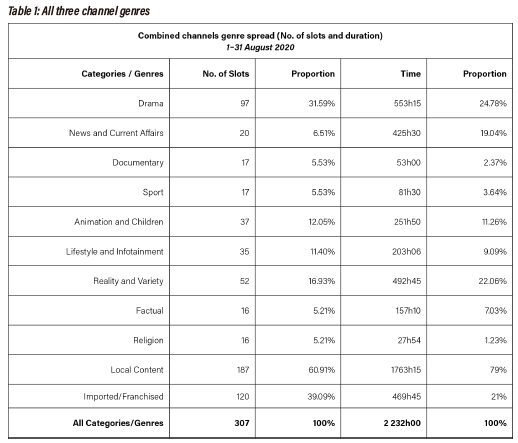
Quantitative data were collected by downloading television schedules from the SABC and Truter websites on a daily basis for the indicated month, following which they were saved onto an excel spreadsheet. Data were prepared and coded by grouping into 11 categories/genres (codes)1 as units of observation. The preparation, coding and tabulation for analysis were conducted as shown in Table 1, by creating a column for the category/genre, the number of slots, the airtime in hours and the percentage for each channel. Analysis included enumeration - the establishing and mentioning of the number of categories/genres/programme types - and was subjected to rudimentary statistical (arithmetical) analysis, which included counting the types of genres and the number of their slots, and the amount of broadcast time. Analysis of qualitative data from interviews involved the interpretation of open-ended responses and the identification of explanatory or illustrative statements/phrases/examples. The techniques for analysis involved explanation building (Yin, 2003) to generate meaning, and direct interpretation (Stake, 2000) of interview responses to enable the drawing of conclusions.
FINDINGS AND DISCUSSION
SABC TV variety and balance
The study found the three SABC television channels broadcast a variety of genres, which were distributed differently within and across the channels. For the combined channels, as illustrated in Table 1, genres had variable numbers of programmes and duration. Overall, the allocated airtime difference (comparison of duration expressed in hours and percentages) between the main genres was not huge. For instance, Drama 553h15 (24.78%) has a gap of 3% and 5% from its nearest genres, Reality and Variety 492h45 (22.06%) and News and Current Affairs 425h30 (19.04%) respectively. From there on, it is more than 8%. This suggests a balance between genres without domination of a particular genre, as anticipated by McChesney (1999) and McQuail (1998). This finding does not support the notion of erosion of the public sphere. To the contrary, it illustrates that SABC as a PSB, through principles of comprehensive programming and universal access, is able to guard against the erosion of the public sphere by excessive similarity that leads to exclusion of unpopular genres and minority tastes. Broadcasting professionals attribute this to the influence of regulations saying that, at the base, the core of programming and scheduling strategies is prescribed by regulation (Interviewees 1 and 4).
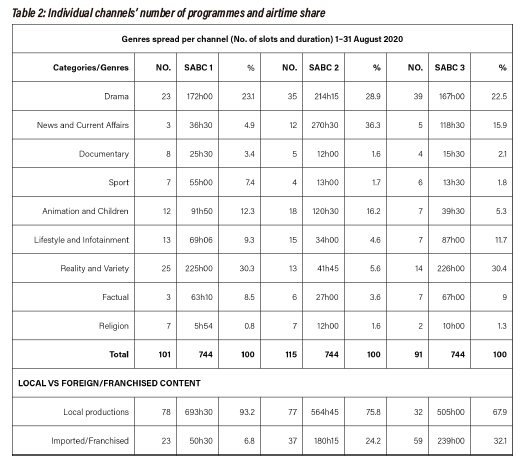
All three of the SABC channels featured 11 genres with varying numbers of programmes and amount of airtime, as shown in Table 2. The top three genres by airtime per channel were Reality and Variety (225h00) followed by Drama (172h00) and then Animation and Children (91h50) on SABC 1; News and Current Affairs (270h30) followed by Drama (214h15) and then Animation and Children (120h30) on SABC 2; Reality and Variety (226h00) followed by Drama (167h00) and then News and Current Affairs (118h30) on SABC 3. Drama does not appear at the top on all three SABC channels, while News and Current Affairs dominated SABC 2 and Reality and Variety dominated SABC 1 and SABC 3. This suggests a variety and balance between news and entertainment or cultural programming, contradicting the predicted increase and domination of entertainment programming (see; Keane, 1991; McChesney, 1999; McQuail, 1998; Murdock, 1994). In the South African context, broadcasting the rainbow nation emphasises balanced scheduling and programming of political and cultural content that facilitates equal access, unity, diversity and difference, and accommodation of all tastes (SABC, 2020, 2022).
The domination of entertainment information, which market critics argue is a consequence of commercialisation (see Keane, 1991; McChesney, 1999; McQuail, 1998; Murdock, 1994), does not appear to be supported by evidence on the three SABC channels (see Table 2). The significance of this finding is that it points to the effectiveness of the role of PSB in ensuring an inclusive mixed programming output (see Scannell et al, 1992; Walker, 2000). At the SABC, this balance in programming and diversity of content occurs through a deliberative effort to ensure that scheduling and programming guarantee free and equal access, diversity of content and cater for everyone (Interviewee 3). This is achieved through broadcasting the rainbow nation, a commitment to represent and reflect society united in diversity, by utilising the three channels to target different audiences. This was confirmed by the television professionals who said they were required to provide scheduling and programming that was universally accessible technically, and through languages and representations, to accommodate all South Africans (Interviewee 3).
The diversity is attributable to nuances in scheduling strategies and the complexities of programming strategies in a regulated mixed (public and commercial) broadcasting market. For instance, programming of slots avoided direct (like-for-like genre) slot competition between the three SABC channels. Personnel from the three channels sit together at the beginning of each year and co-strategise to ensure that their schedules do not clash (Interviewees 1 and 2). This illustrates the role of scheduling and programming strategies and how they can be effectively employed to counter competition and commercial pressures, and achieve PSB mandates.
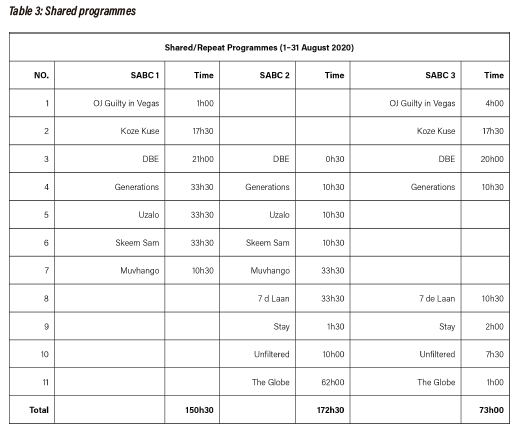
Findings show that cross channel programme rebroadcasts amount to 3% of programmes on the three SABC channels, with airtime duration share of 3.76% of the total broadcasting hours of all three channels, as shown in Table 3. These comprise mainly prime-time dramas, educational programmes and news and current affairs programmes.
The small percentage of broadcast airtime duration of these multichannel rebroadcasts during daytime and midnight to early morning, as unprogrammed hour fillers, does not have major implications on diversity, as anticipated (see Keane, 1991; McChesney, 1999; McQuail, 1998; Murdock, 1994). They cater to certain categories of viewers who are unable to watch them in the original channel or flighting slot. Their rebroadcast is not a simple financial decision, it is also a strategic (space filler) and public interest decision (Interviewee 2). Also, content quota requirements discourage uncontrolled repeats (Interviewee 1). Again, this finding suggests effectiveness of regulation in countering commercial pressures.
SABC TV distinctiveness
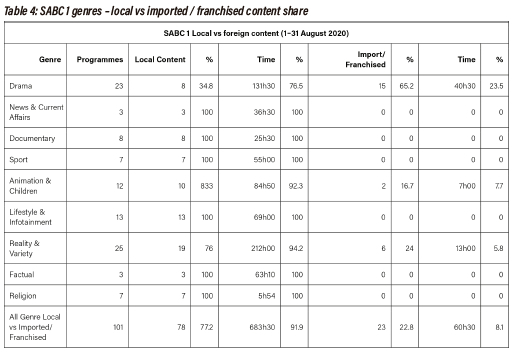
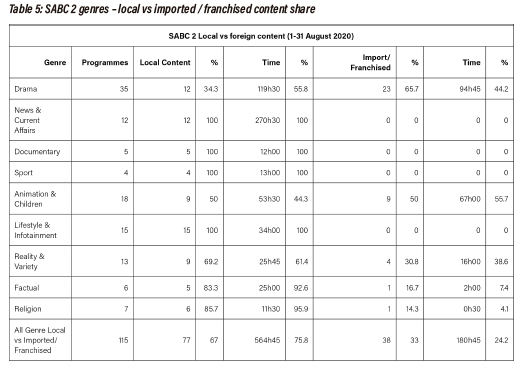
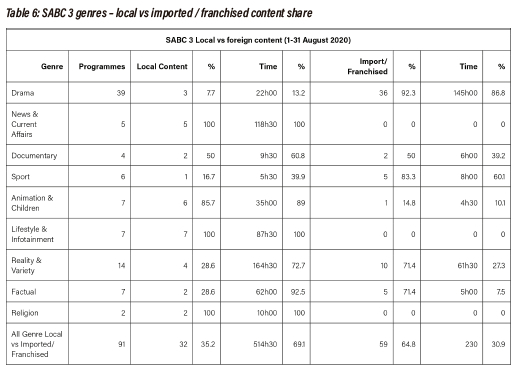
The findings show that SABC scheduling and programming is distinctive. The distinctiveness is based on in its channel programming of all 11 genres, use of the 11 official languages, meeting all content quotas and exceeding many of them. Data show that SABC television channels not only comply but far exceed the content requirements. Tables 4-6 illustrate the breakdown of Local vs imported/Franchised content in terms of genre airtime share and programme slot share per channel. The content quotas that were exceeded were due to the popularity and alignment with broadcasting the rainbow nation. The concept of broadcasting the rainbow nation appears in sync with what the audiences want. This was confirmed by one of the television broadcasting professionals who said that South Africans in their diversity want to see themselves, their culture and hear their languages in television programmes (Interviewee 4).
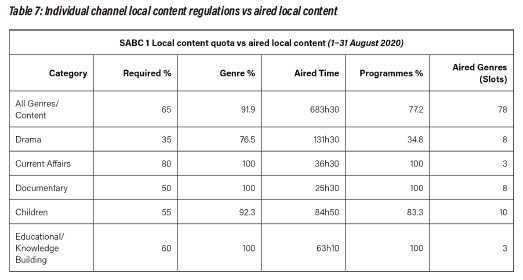
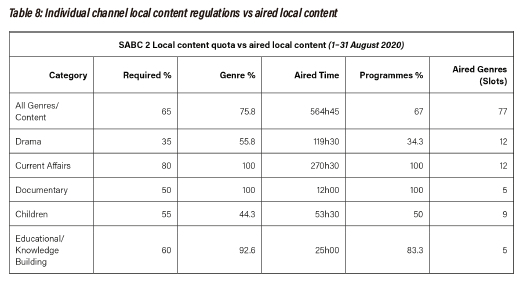
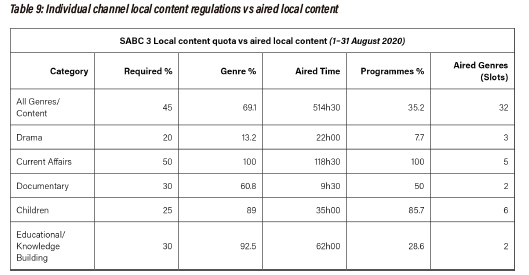
Tables 7-9 illustrate the individual channels' performance against local content regulations, reflecting both the required percentages of airtime allocation and the actual time and number of programmes flighted. SABC 1 exceeded local content targets by achieving 100% for three, which exceeded others by more than 25%. SABC 2 achieved 100% on two, but fell short by 10.7% on Children (44.3%). SABC 3 achieved 100% on one, exceeded others and fell short by 6.7% on the Drama target. This suggests that it was not just a matter of compliance, but a result of broadcasting the rainbow nation commitment.
The distinctiveness of the SABC is in line with the principles of PSB (Scannell et al, 1992; Walker, 2000). It reflects mixed programming output which provides a wide range of genres and use of 11 official languages to ensure free, universal and equal access. Intensive, demanding and expensive shows that require research and significant funding to commission are programmed, such as the Factual genre which includes education, science, history and nature programmes that are high quality, niche and expensive to produce. Therefore, the assumption of erosion of the distinction between high culture and low culture (Keane, 1991) appears to be contradicted. The finding supports literature on the contribution of PSB in a single or mixed media system and to democratic politics (Strömbäck, 2017). The distinctiveness continues to provide legitimation of PSB, especially in competitive markets where it has to justify its value by setting itself apart from commercial broadcasters.
SABC TV production context
The study found that the broadcaster's financial position impacted on programming. Responses from interviewees show that when a broadcaster is financially constrained, it does not have sufficient funds to commission content, and train and keep talent. Its decision making becomes too commercialised, resorting to cheap content and prioritisation of profitable programmes (Interviewee 3). The SABC Board chairperson, Bongumusa Makhathini, also alluded to the inability to "honour payments to service providers, adhere to its committed contracts, and commission local content productions" (SABC, 2019:13). This finding supports the literature that expresses fears of the impact of commercialisation of PSB (see Keane, 1991; McChesney, 1999; McQuail, 1998; Murdock, 1994). In the case of the SABC, this was mitigated by content quotas and innovative strategies (Interviewees 1 to 4). While in theory the public sphere can potentially be eroded by commercial pressures, this depends on the context, and political and legislative arrangements. As shown in the South African case, regulation and production context (editorial policies, core values, codes and scheduling, and programming protocols) serve to limit the risk of public sphere erosion.
The study also found that broadcasting competition influences the development and utilisation of scheduling and programming strategies aimed at maximising or retaining audiences, getting a competitive edge, complying with regulations and ensuring commercial viability (Interviewee 3). SABC looks for alternative competitive scheduling and programmes; they use different editorial approaches to both the format and content of programmes (Interviewee 2), thus employing distinctiveness and quality programming as a competitive edge.
Overall, the findings appear to contradict Barnett (1999b) who argues that SABC chose liberalisation over public service objectives. Further, the findings do not confirm Horwitz's (2001) concern of commercialisation at the cost of PSB. While they confirm Fourie's (2003) claim that competition pressured SABC to adopt commercial strategies, and Duncan and Glenn (2010), who argue that South African media is dominated by commercialism, the findings do not support their feared compromise of public interest programming. Scheduling and programming strategies of the SABC do not fit into the convergence scenario in that, while the channels follow the theoretical responses to competition (see Keane, 1991; McChesney, 1999; McQuail, 1998; Murdock, 1994), broadcasting rainbow nation influences the ultimate schedules and programmes that are broadcast, making them diverse.
CONCLUSION AND RECOMMENDATIONS
This study set out to examine and explain scheduling and programming at the SABC to understand the impact of liberalisation and competition, and to evaluate its performance of the public service mandate. Using the case of the SABC, it emphasises the importance of regulation and organisational context in shaping PSB output. The SABC employs broadcasting the rainbow nation as a conceptual framework to explain how the SABC as a PSB performs its public service mandate in a competitive and commercialised environment.
Broadcasting the rainbow nation is a broadcasting approach that facilitates free equal access universally, appreciation of unity, diversity and different expression of identities, experiences, perspectives, interests, tastes and voices. As a construct, it encompasses the use of television broadcasting in pursuit of social, economic, political and cultural goals of nation building, social integration, unity despite diversity and economic transformation as elements of public interest. This article proffers that, through corporate strategies and editorial frameworks that facilitate scheduling, programming and channel branding, SABC television supports, perpetuates and reinforces the notion of the rainbow nation as part of nation building and national unity by emphasising reflection and representations of unity and diversity. Its significance as a conceptual framework lies in its ability to explain the links and interactions between politics, culture and institutional arrangements, such as PSB, regulation, mandates and strategies, and editorial frameworks, among others, and the outcome of such links, thus broadcasting output that serves public interest.
At the general level, broadcasting competition influences the development and utilisation of scheduling and programming strategies aimed at maximising audiences, gaining a competitive edge and ensuring commercially viability. As demonstrated by the findings, despite being commercialised, the SABC still performs its public service mandate through its commitment to broadcasting the rainbow nation, which enables it to deploy editorial frameworks, strategies, processes and protocols that direct scheduling and programming towards public interest. The conclusion is that liberalisation and the resultant competition do not by themselves predetermine responses and behaviour of broadcasters, which are not uniform across all societies and systems. They are influenced by historical, political, cultural and organisational circumstances. While liberalisation and resultant competition commercialise SABC as a PSB, this has not resulted in the decline of the public sphere (erosion). Therefore, accuracy of such decline in the South African context is not confirmed.
To the public sphere theory, this study adds to the small but growing number of studies that challenge the narrow reading of the public sphere theory that tends to emphasis the public-private dichotomy, which ignores the role of alternative democratic strategies employed by PSBs to enhance the public sphere. The application of the concept of broadcasting the rainbow nation provides a conceptual framework that transcends the dichotomy of public vs private by acknowledging representation and reflection of unity and diversity pursued as public interest.
RECOMMENDATIONSIt is recommended that parliament and government reconsider the funding model of the public service broadcaster, and ensure that it is sufficiently funded, especially public interest programming. Such a model could review the television licence regime or approach.
While this study answers the question about what competition does to the SABC, questions remain about the impact on PSB in the Southern African Development Community (SADC) as a region. More research is needed to understand what competition does to PSB in the SADC region, to ascertain whether or not this is an exclusively South African phenomenon.
DATA AVAILABILITY
The data used in the study are available from the corresponding author on request.
REFERENCES
LITERATURE REVIEW
- Afrika, L.G. (2021). The media's role in the consolidation of democracy in South Africa: The case of the SABC's soap operas as a cultural public sphere. Doctoral thesis. Cape Town: University of Cape Town.
- Arndt J.C. (2018). The post-apartheid politicisation of the South African Broadcasting Corporation. Doctoral thesis. Oxford: University of Oxford.
- Barnett, C. (1999a). Broadcasting the rainbow nation: Media, democracy, and nation-building in South Africa. Antipode, 31(3):274-303.
- Barnett, C. (1999b). The limits of media democratization in South Africa: Politics, privatization and regulation. Media, Culture & Society, 21(5):649-671.
- Berger, G., Banda, F., Duncan, J., Mukundu, R. & Machado, Z. (2009). Beyond broadcasting: The future of state owned broadcasters in Southern Africa. 13th Highway Africa Conference 6-8 September, Grahamstown. Rhodes University.
-
Bishop, R. & Hakanen, E.A. (2002). In the public interest? The state of local television programming fifteen years after deregulation. Journal of Communication Inquiry, 26(3):261-276. doi.org/10.1177/0196859902026003002
» https://doi.org/doi.org/10.1177/0196859902026003002 -
Boeder, P. (2005). Habermas' heritage: The future of the public sphere in the network society. First Monday, 10(9). doi.org/https://firstmonday.org/ojs/index.php/fm/article/download/1280/1200
» doi.org/https://firstmonday.org/ojs/index.php/fm/article/download/1280/1200 -
Ciaglia, A. (2017). Explaining public service broadcasting entrenched politicization: The case of South Africa's SABC. Journalism, 18(7):817-834. doi.org/10.1177/1464884915614245
» https://doi.org/doi.org/10.1177/1464884915614245 - Creswell, J.W. (2014) Research design: Qualitative, quantitative and mixed methods approaches. 4th Ed. London: Sage.
- Croteau, D. & Hoynes, W. (2006). Media markets and the public sphere. In The business of media: Corporate media and the public interest. 2nd ed. London: Sage Publications, 15-40.
- Curran, J. & Gurevitch, M. (1991). Mass media and society. London: Arnold.
- Dahlgren, P. (1995). Television and the public sphere - Citizenship, democracy and the media. London: Sage.
-
Dahlgren, P. (2005). The internet, public spheres, and political communication: Dispersion and deliberation. Political Communication, 22(2):147-162. doi.org/10.1080/10584600590933160
» https://doi.org/doi.org/10.1080/10584600590933160 - Dahlgren, P. & Sparks, C. (1991). Communication and citizenship. London: Routledge.
- Dannhauser, P. (2013). Local documentaries on the SABC 2000 to 2010: The imaging of national identity, transformation and commercial imperatives. In M. Tager & C. Chasi (eds). Tuning in Volume 1. Cape Town: Liesbet van Wyk, 44-69. doi.org/10.1016/S0378-777X(75)80019-9
-
D'Arma, A. & Labio, A. (2017). Making a difference? Public service broadcasting, distinctiveness and children's provision in Italy and Spain. International Journal of Digital Television, 8(2):183-199. doi.org/10.1386/jdtv.8.2.183_1
» https://doi.org/doi.org/10.1386/jdtv.8.2.183_1 - Dawes, S. 2013. Broadcasting regulation and the public-private dichotomy. Doctoral thesis. United Kingdom: Nottingham Trent University.
- Dibetso, L.T. & Smith, T. (2012). Lack of diversity (repeat). Analysis of SABC news and programming. Media Monitoring Africa Report. Johannesburg.
- Duncan, J. (2015). Pluralism with little diversity. South African experience of transformation. In P. Valcke, M. Sukosd & R.G. Picard (eds). Media pluralism and diversity concepts, risks and global trends. Cham: Springer.
- Duncan, J. & Glenn, I. (2010). Television policy and practice in South Africa. In D. Moyo & W. Chuma (eds). Media Policy in changing Southern Africa: Critical reflections in media reforms in the global age. Pretoria: UNISA.
-
Esser, A. & Jensen, P.M. (2015). The use of international television formats by public service broadcasters in Australia, Denmark and Germany. International Communication Gazette, 77(4):359-383. doi.org/10.1177/1748048514568766
» https://doi.org/doi.org/10.1177/1748048514568766 -
Evans, M. (2010). Mandela and the televised birth of the rainbow nation. National Identities, 12(3):309-326. doi.org/10.1080/14608944.2010.500327
» https://doi.org/doi.org/10.1080/14608944.2010.500327 -
Fourie, P.J. (2003). The future of public service broadcasting in South Africa: The need to return to basic principles. Communicatio, 29(1-2):148-181. doi.org/10.1080/02500160308538025
» https://doi.org/doi.org/10.1080/02500160308538025 - Fowler, M.S. & Brenner, D.L. (1982). A marketplace approach to broadcast regulation. Texas Law Review, 60:207-257
-
Freedman, D. (2018). "Public service" and the journalism crisis: Is the BBC the answer? Television and New Media, 20(3), 203-218. https://doi.org/10.1177/1527476418760985
» https://doi.org/10.1177/1527476418760985 - Fuchs, C. (2020). University of Westminster. In Communication and capitalism. University of Westminster Press, 2-4. doi. org/10.1108/nfs.2008.01738bab.037
- Garnham, N. (1992). The Media and the public sphere. C. Calhoun (ed.). Massachusetts: The MIT Press.
- Golding, P. & Murdock, G. (1989). Informational poverty and political inequality: Citizenship in the age of privatized communication. Journal of Communication, 39(3):180-195.
- Golding, P. & Murdock, G. (1991). Culture, communications, and political economy. In J. Curran & M. Gurevitch (eds). Mass Media and Society. London: Arnold.
- Habermas, J. (1989). Structural transformation of the public sphere. An inquiry into a category of the bourgeois society. Polity Press.
- Hadland, A., Louw, E., Sesanti, S. & Wasserman, H. (2008). Power, politics and identity in South African media: Selected seminar papers. Cape Town: HSRC Press.
-
Hayman, G. & Teer-Tomaselli, R. (1989) Ideology and technology in the growth of South African broadcasting, 1924-1971. In K. Teer-Tomaselli, R. Tomaselli & J. Muller (eds). Currents of power: State broadcasting in South Africa. Chicago: Lake View Press. Available at: https://doi.org/10.2307/219128
» https://doi.org/10.2307/219128 -
Hendrickx, J., Raats, T., Ranaivoson, H. & Opgenhaffen, M. (2019). 'Distinctiveness' and programme diversity in public broadcasting revisited: A seven-country comparison. International Journal of Media and Cultural Politics, 15(3):283-302. doi.org/10.1386/macp_00002_1
» https://doi.org/doi.org/10.1386/macp_00002_1 - Hermes, J. (1998). Cultural citizenship and popular fiction. In K. Brants, L. Van Zoonen & J. Hermes (eds). The media question: Popular culture and public interest. London: Sage.
- Hitchens, L. (2006). Broadcasting pluralism and diversity: A comparative study of policy and regulation. Oxford: Hart Publishing.
-
Hodes, R. (2014). Broadcasting the pandemic: A history of HIV on South African television. Cape Town: HSRC Press. Available from: www.hsrcpress.ac.za.
» www.hsrcpress.ac.za - Horwitz, R.B. (2001). Communication and democratic reform in South Africa. Cambridge: Cambridge University Press. doi.org/10.2307/3097606
- Iyengar, S., Curran, J., Lund, A.B., Salovaara-Moring, I., Hahn, A.S. & Coen, S. (2010). Cross-national versus individual-level differences in political information; A media systems perspective. Journal of Elections, Public Opinion and Parties, 20(3):291-309.
-
Jacka, E. (2003). "Democracy as defeat": The impotence of arguments for public service broadcasting. Television and New Media, 4(2):177-191. doi.org/10.1177/1527476402250675
» https://doi.org/doi.org/10.1177/1527476402250675 - Karppinen, K., Moe, H. & Svensson, J. (2008). Habermas, Mouffe and political communication. Javnost - The Public, 15(3):5-21.
- Keane, J. (1991). The media and the democracy. Cambridge: Polity Press.
- Kula, M. (2024). Broadcasting the rainbow nation: Diversity in public service broadcasting programming in South Africa. Doctoral thesis. Johannesburg: University of Johannesburg.
- Lowe, G.F. & Steemers, J. (2012). Regaining the initiative for public service media. Gothenburg: Nordicom.
- Mathebe, L. (2002). Bound by tradition: The world of Thabo Mbeki. Pretoria: UNISA Press.
- McChesney, R. (1999). Rich media poor democracy. Communication politics in dubious times. Chicago: University of Illinois Press.
- McQuail, D. (1998). Commercial and beyond. In D. McQuail & K. Siune (eds). Media Policy: Convergence, concentration and commerce. London: Sage.
-
Milton, V.C., Wasserman, H. & Garman, A. (2013). Media, citizenship and the politics of belonging in contemporary South Africa. Communicatio, 39(4):405-414. doi.org/10.1080/02500167.2013.864447
» https://doi.org/doi.org/10.1080/02500167.2013.864447 - Morley, D. 2006. Media, modernity and technology. The geography of the new. London: Routledge.
- Mouffe, C. (1992). Dimensions of radical democracy: Pluralism, citizenship, community. London: Verso.
- Murdock, G. (1994). New mogul empires: Media concentration and control in the age of convergence. Media Development 4:4-6.
- Ncube, L. & Tomaselli, K.G. (2019). "Watch my back and I watch yours": Beyond Habermas' public sphere concept in democratic and participatory dimensions of pre-colonial Shona society public spaces. Journal of African Studies, 11(1):35-50.
-
Newton, K. (2016). Public service and commercial broadcasting: Impacts on politics and society. Political Quarterly, 87(1), 31-38. https://doi.org/10.1111/1467-923X.12214
» https://doi.org/10.1111/1467-923X.12214 - Park, S. (2005). Competition's effects on programming diversity of different program types. The International Journal on Media Management, 7(1-2):39-52.
-
Picard, R.G. & Siciliani, P. (2013). Is there still a place for public service television? Effects of the changing economics of broadcasting. Available from: https://reutersinstitute.politics.ox.ac.uk/fileadmin/documents/Publications/Working_Papers/Is_There_Still_a_Place_for_Public_Service_Television.pdf.
» https://reutersinstitute.politics.ox.ac.uk/fileadmin/documents/Publications/Working_Papers/Is_There_Still_a_Place_for_Public_Service_Television.pdf - Price, M. & Raboy, M. (2011). Public service broadcasting in transition: A documentary reader. University of Pennsylvania.
- SABC. (2019). SABC 2019 Annual Report. SABC Annual Report. Johannesburg: SABC.
- SABC. (2020). SABC Editorial Policy Book. Johannesburg: SABC.
- SABC. (2022). SABC Launches a new brand campaign: "Everywhere for everyone, always" Johannesburg: SABC.
- Scannell, P. (1989). Public service broadcasting and modern public life. Media, Culture and Society, 11:135-166.
- Scannell, P., Schlesinger, P. & Sparks, C. (1992). Culture and power. Media culture and society reader. Los Angeles: Sage.
- Skinner, K. (2011). The South African Broadcasting Corporation: The creation and loss of a citizenship vision and the possibilities for building a new one. In J. Daniel, P. Naidoo, D. Pillay & R. Southall (eds). New South African Review 2. New paths. Old compromises? Johannesburg: Wits University Press, 369-386.
- South African Government. (1999). Broadcasting Act. South Africa: Government Gazette.
- Sparks, C.S. (1995). The future of public service broadcasting service in Britain. Critical Studies in Mass Communication, 12(3):325-341.
- Stake, R.E. (1994). Case studies. In N. Denzin & Y. Lincoln (eds). Handbook of qualitative research. California: Sage, 236-247.
- Steemers, J. 2003. Public service broadcasting is not yet dead: survival strategies in the 21st century. In Lowe, G.F. & Hujanen, T. (eds.). Broadcasting & convergence: New articulations of the public service remit. Goteborg: Nordicom, 123-136.
-
Stollfuß, S. (2021). The platformisation of public service broadcasting in Germany: The network 'funk' and the case of Druck/Skam Germany. Critical Studies in Television, 16(2):126-144. doi.org/10.1177/1749602021996536
» https://doi.org/doi.org/10.1177/1749602021996536 -
Strömbäck, J. (2017). Does public service TV and the intensity of the political information environment matter? Journalism Studies, 18(11):1415-1432. doi.org/10.1080/1461670X.2015.1133253
» https://doi.org/doi.org/10.1080/1461670X.2015.1133253 -
Syvertsen, T. (2003). Challenges to public television in the era of convergence and commercialization. Television and New Media, 4(2):155-175. doi.org/10.1177/1527476402250683
» https://doi.org/doi.org/10.1177/1527476402250683 -
Tager, M. & Chasi, C. (2013). Tuning in title page to be dropped in by design department. M. Tager & C. Chasi (eds). Cape Town: Pearson Education South Africa. Available from: www.pearsoned.co.za.
» www.pearsoned.co.za - Teer-Tomaselli, R. (2001). Nation building, social identity and television in a changing media landscape. In Culture in the new South Africa. Kwela Books, 117-138.
- Teer-Tomaselli, R. & Tomaselli, K. (2001). Transformation, nation-building and the South African Media. In K. Tomaselli & H. Dunn (eds). Media democracy and renewal in Southern Africa, 1993-1999. Colorado Springs: International Academic Publishers.
- Tleane, C. & Duncan, J. (2003). Public broadcasting in the era of cost recovery: A critique of South African Broadcasting Corporation's crisis of accountability. Johannesburg: Freedom of Expression Institute.
- Walker, K. (2000) Public service broadcasting and new distribution technologies: Issues of equality, access and choice in the transactional television environment. In Waytt, S., Henwood, F., Miller, N. & Senker, P. (eds.). Technology and in/equality. Questioning the information society. London: Sage.
- Wasserman, H. & Garman, A. (2012). Being South African and belonging: The status and practice of mediated citizenship in a new democracy. The 7th Global Conference 'Pluralism, Inclusion and Citizenship,' Prague, Czech Republic, 12-14 March 2012. In The 7th Global Conference "Pluralism, Inclusion and Citizenship"
- Yin, R. (ed.) (2003). Case study research: Design and methods. 3rd ed. Thousand Oaks: Sage.
Accepted February 2025