Assessing Indigenous Media Performance in Mobilizing Citizens for National Identity Enrolment in Rural Southwest Nigeria
Abstract
This article investigates the effectiveness of domestic media in mobilising rural citizens towards national identity registration in Nigeria's southwest region, based on Yoruba-language media. Rural involvement has been low, despite the government's efforts to increase enrolment. A culturally responsive survey was administered to 960 rural participants to measure their involvement with 10 of the most significant indigenous media outlets. Radio broadcasts, banners and interpersonal messages were the most effective ways to communicate the message, with religious and community leaders playing a central role in mobilising citizens. However, these efforts were hindered by systemic challenges such as insufficient registration centres, inconsistent service availability, misinformation and the corrupt monetisation of ostensibly free services. Discussion transcript analysis uncovered ethical concerns in media content, including fear-based tactics, panic-inducing messaging and false information. Contrary to common assumptions, rural citizens did not always fully comprehend their indigenous language, as questionnaire responses revealed discrepancies in understanding, reading and speaking. Expanding grassroots infrastructure, employing culturally appropriate media outlets and developing more partnerships with community leaders to establish credibility are critical to complementing the media in raising enrolment. These findings have the potential to overcome system barriers and incorporate cultural sensitivity into national identity programme planning and execution.
Culturally responsive methodology (CRM); indigenous media; media performance; national identity enrolment; Southwest Nigeria; Yoruba
INTRODUCTION
The Nigerian government started the national identity programme in 2007 to allot every Nigerian, permanent resident and foreigner who has stayed in the country for at least two years a unique National Identity Number (NIN) that helps verify their identities and makes them traceable. Its agency, the National Identity Management Commission (NIMC), has been using NINs to improve financial inclusion and widen citizens' access to healthcare, education, welfare and immigration services with the support of the World Bank and European Union, and in tandem with the Sustainable Development Goal 16 (SDG 16). However, there is a concern: Nigerians are not enrolling as they should.
NIMC's website (NIMC, 2023) shows that, as of 31 December 2023, Nigeria had 104.16 million NINs, distributed almost equally between male and female registrants. One of Nigeria's dominant, urban-based media outlets, thecable.ng.com, escalated to 107.33 million on 10 May 2024, marking a three percent increase. On 16 September 2024, another urban-based media house, AriseNews (arise.tv), elevated to 110 million, indicating a 2.4% rise, meaning that between December 2023 and December 2024, NIN registrations increased by 7.4%.
At a glance, these figures look impressive. However, they paint an unimpressive picture of the future following NIMC's pledge to create a robust, inclusive and secure identity system for all Nigerians in the next 10 years. The population of Nigeria was 232,679,478 in 2024 (Worldometer, 2024), premised on the 2.12% increase on the United Nations data that estimated the country's population in 2023 at 227,882,945.
The math corroborates the concern. If these growth rates remain stable, the population would increase by approximately 23.2% to 280,800,000 over the next decade, while national identity registrations would grow by about 104.1% to 212,500,000. The difference between the projected population and identity registrations after 10 years would be 68,300,000 (280,800,000 - 212,500,000). Since the growth rate of national identity registrations (7.4%) is significantly higher than the population growth rate (2.12%), enrolments would increase relatively faster. However, the total population would still be larger by some 68.3 million, meaning that 25% of the population will remain unregistered by NIMC over the next decade.
The projected 25% deficit has a rural dimension to it. NIMC's activities have been visibly successful in urban areas but unimpressive in rural communities, a situation the commission constantly looks for ways to turn around. While each state in the country has its share of rural communities, the agency's website dashboard figures show that of the country's 36 states, the 10 with preponderant urban areas have a total of 56,278,402 enrolments compared to 13,813,489 associated with the 10 that are replete with the most rural areas. This indicates that most of the estimated 68.3 million unregistered folks will be rural dwellers.
Low awareness and a lack of trust have consistently been identified as barriers to rural participation in African government programmes. However, empirical data to substantiate this claim are often scarce (Angrist et al., 2021; Canen & Wantchekon, 2022). Notwithstanding NIMC's recognition of the contribution that media publicity makes to promoting its programmes, it is not apparent that it has implemented a framework media engagement policy that will affect NIN enrolments in rural communities. Scholars have further highlighted that the absence of reliable data poses a challenge in formulating effective policies in Nigeria, a problem rooted in systemic issues inherited from the military era (Uzochukwu et al., 2016).
This study covers this gap by exploring the role of Yoruba-language outlets in enhancing rural participation in national identity programmes. It also provides actionable recommendations to help ensure they are more inclusive and effective in reaching underserved populations. This is vital in countries such as Nigeria and India that encompass hundreds of ethnic groups and languages and where communication strategies that transcend one-size-fits-all approaches are so much in need (Dutta, 2011; Ethnologue, 2023; Ojebode, 2002; Pavarala & Malik, 2007). It is on this note that the following objectives were floated:
1. To identify the Yoruba-language media outlets available in rural areas where enrolment agents operate and determine rural dwellers' awareness of them.
2. To examine the role of Yoruba indigenous media in mobilising citizens for identity registration in Southwest Nigeria.
3. To evaluate the effectiveness of Yoruba indigenous media in driving actual participation in identity registration.
PLACING THE INFLUENCE OF INDIGENOUS MEDIAEvidence shows that indigenous media have supported national identity registration in various countries (Adeyeye, et al., 2020; Dowell, 2006; Goldscheider, 2002; Omojola, 2009). The case of the United Kingdom shows that information about the NIN system and internal security is provided in several languages, including Yoruba, to accommodate the country's multicultural population. Similarly, in Germany, the Personalausweis (national ID card) registration process involved public broadcasters and local media to inform citizens in multiple languages (Breckenridge, 2014). In the United States alone, where about 350 languages are used, cultural group leaders have helped translate the Social Security Number (SSN) system into Chinese, Arabic and Tagalog, among other languages, and its association with digital services (Solove, 2020). South Africa uses indigenous media in its Smart ID system in reaching out to rural communities (Magoma, 2020). Kenya's Huduma Namba initiative leveraged local media to educate the public, building trust despite concerns about privacy and data misuse (Nyakundi, 2020).
In Ghana, the National Identification Authority (NIA) project used mobile registration units to reach remote areas in local languages (Thiel, 2017), while India's Aadhaar system used indigenous language radio stations to educate marginalised communities (Chin et al., 2015; Khanna & Raina, 2012). These stations play a significant role in educating people about the programme's digital benefits and registration processes, notwithstanding that some news published was negative (Chin et al., 2015; Khanna & Raina, 2012).
In Nigeria, Yoruba-language media are regarded as essential in promoting government initiatives. Radios stations such as Bond FM and Faaji FM use dialects, culturally appropriate proverbs and stories to reach rural populations, making complex information simple (Folarin, 1998). Yoruba media are reportedly more successful in rural areas compared to mainstream media because they engage with local languages and cultural environments. However, the data that corroborate or debunk this hardly exist (Salawu, 2016), more so concerning citizens' mobilisation for the NIN enrolment project NIMC (2023).
THEORETICAL CONSIDERATION: CULTURALLY RESPONSIVE METHODOLOGY IN PRACTICE
This study is situated in culturally responsive methodology (CRM), which extends beyond surface-level cultural acknowledgement to actually centre research design, data collection and analysis within the cultural values, communication practices and community structures of the target population. CRM contends that effectiveness in engaging marginalised communities is contingent upon respect for and inclusion of their cultural paradigms (Gay, 2010; Ladson-Billings, 1995; Paris & Alim, 2017).
Within the context of this research, CRM provides a necessary lens through which to view the performance of local media. It frames the underlying research problem not as a simple absence of information across rural areas, but rather as a potential failure to situate the NIN enrolment message in terms that are locally meaningful. CRM is used to explain that indigenous media will not only adopt a grassroots language of communication, but also culturally recognisable forms (such as proverbs, storytelling and music) that are well known to its local audiences in an attempt to make complex information easier to comprehend and recall (Abdulai et al., 2023; Folarin, 1998).
These media can also perform their social responsibility function through exploiting credible cultural agents, which involves collaboration with renowned community influencers (traditional leaders, religious leaders, elders, for example) who are information validators and can mobilise citizens successfully (Aondowase et al., 2023). This paves the way for participatory engagement that accommodates feedback from the community and is reactive to local concerns, and also in line with the principles of participatory communication theory (Freire, 1970; Servaes, 2020).
This CRM system allows for the proper analysis of the empirical data and aids in describing why certain media succeed where others do not. CRM also uncovers gaps where media outreach is linguistically Yoruba but not necessarily culturally responsive. Furthermore, the system formally cautions against the presumption of a monolithic culture, preparing us to challenge such subtleties as dialectical differences and variation in levels of literacy in the native language - a finding this study later exposes.
METHODOLOGY
This study's population consists of rural dwellers in the six states of Southwest Nigeria - Lagos, Ogun, Oyo, Osun, Ondo and Ekiti. The region is one of six in the country, with others being southeast, south-south, northwest, northeast and northcentral. It is the most viable area, controlling over 60% of the country's $453 billion gross domestic product (GDP). Some 160 respondents received copies of the questionnaire in each state, making 960 across the six states. The attempt to randomise the questionnaire distribution failed because authentic population figures for rural communities are unreliable, making sampling frames indeterminate. This challenge is one of the issues the government plans to address in the proposed census in or before 2027. An availability sampling method was, therefore, adopted. The technique helped the research assistants to select participants based on ease of access and willingness to participate, making the exercise practical and cost effective. The non-random sampling enabled the continual distribution of questionnaires to target respondents until 160 copies were returned for each state.
The items on the questionnaire were drawn in Yoruba, the indigenous language of the region, and not in English, the official language of the nation. To the surprise of all, some of the respondents experienced problems reading and understanding them. They indicated that their Yoruba oral language may not equal reading. This kind of difference was noted with the riverine communities in Lagos and Ondo states. They claimed the differential in reading, writing and understanding occurred because their dialects were at the fringes of the Yoruba language, making only speaking mutually intelligible with the popular Yoruba dialect. Respondents' eligibility was the ability to answer the questions in Yoruba. The respondents were 16 years and above, and they were the group approved by the government to register in the national exercise without being accompanied by a guide.
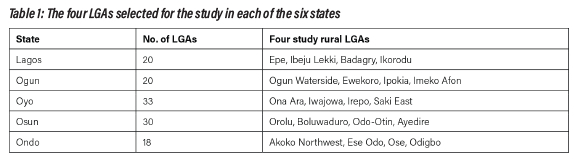
The six states (Table 1) have rural areas, though Lagos has many more urban communities than all others. Four local government areas (LGAs) were selected from each state since this number was enough and appropriate to achieve the objectives. Although Lagos State has officially categorised four of its 20 LGAs - Epe, Ibeju Lekki, Badagry and Ikorodu - as rural, the remaining five states do not have this classification. The study, therefore, relied on the suggestions of the state's top officials regarding what LGAs they considered as rural.
The research was implemented in communities with proof of NIN enrolment centres. A centre could be mobile or fixed. The mobile deployment of registration facilities involves using smartphones and biometric facilities powered by the Android system. Each centre was operated by one, two or three persons, including the centre coordinator. A mobile centre could not operate beyond the surrounding communities. Each centre's activities were tracked remotely by both NIMC or a principal agent or both.
PROBLEMATISATION AND JUSTIFICATION FOR THE AVAILABILITY SAMPLING STRATEGYThe ideal sampling approach for this study of rural dwellers in Southwest Nigeria would have been a probabilistic method to ensure statistical generalisability (Yilmaz, 2013). However, this was precluded by the stated fundamental constraint: the absence of a reliable sampling frame due to outdated census data and a lack of authentic population figures for rural communities, a well-documented challenge for research in Nigeria (Kiregyera, 1982; Thompson, 2019). Without a comprehensive population list, the application of true random sampling techniques is scientifically impossible (Elliott & Valliant, 2017). Selection bias was minimised by extending the questionnaire distribution to several sections of the population.
Consequently, the adopted availability system became the most pragmatic and feasible alternative. This non-probability technique is scientifically justified in exploratory research where the primary aim is to gain initial insights and understand phenomena within a specific context. Despite susceptibility to bias, a variety of strategic controls were employed to limit constraints and expand credibility and transferability of findings - the qualitative parallel to generalisability (Lincoln & Guba, 1985). Such controls were exercised through maintaining small quotas (160 per state, 40 per LGA) to maintain geographical diversity and requesting researchers to seek heterogeneity among villages, ages and genders within sites (Müller & Renes, 2021). A large sample size (n=960) was employed to identify robust patterns across sites. Furthermore, methodological triangulation through the use of mixed methods increased the validity of inferences obtained (Kim, 2019). Therefore, even though not statistically generalisable, the research methodology is warranted and the controls employed ensure that the results reflect an analytically transferable, well-balanced and empirically rich investigation.
DATA ANALYSISYoruba-language media outlets available in rural areas where NIN centres operate and rural dwellers' awareness
A preliminary survey of all available indigenous media was conducted to determine respondents' awareness of NIN enrolments. The ones listed below showed study prospects. Others, including Yoruba newspapers and magazines, were excluded because either they did not exist or there was the need to avoid wasting research resources.
1.Radio stations: These stations broadcast primarily in Yoruba or in English with Yoruba programmes.
2.Television stations: Yoruba-language stations or English stations that broadcast Yoruba programmes.
3.Online media: Yoruba-language blogs, social media platforms and video content on platforms such as YouTube that cater to Yoruba.
4.Public service announcements from government, traditional institutions or private organisations.
5.Banners (produced usually from clothing or flex materials).
6.Posters and flyers: The survey showed that 84.2% of centres with posters also printed flyer versions.
7.Religious media, including sermons in churches, mosques and other religious organisations.
8.Interpersonal message passing: This could be called interpersonal media. It involves transmitting information from one person to another about identity registration processes. Messages can be verbal or in the form of short messages sent via mobile phones or messaging apps.
9.No awareness: This is a situation where the rural populace was unaware of NIN registration due to non-exposure to any medium.
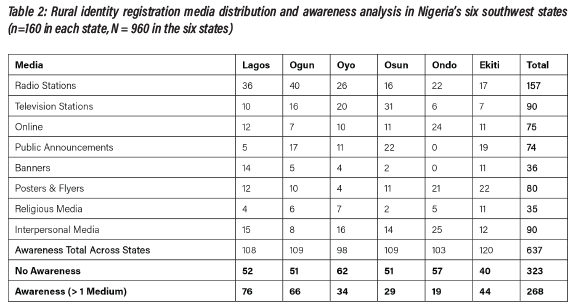
Table 2 reveals that radio remains the most widely accessed medium in rural areas, with 157 mentions overall, particularly in Ogun (40) and Lagos (36). Television usage, though significant, was less consistent, with Osun (31) leading and Ondo (6) trailing. Online platforms showed moderate adoption, with Ondo (24) and Lagos (12) leading. Public service announcements were relatively effective in Osun (22) and Ekiti (19), while posters and flyers were widely used in Ekiti (22) and Ondo (21), suggesting their practicality in low-resource settings. Interpersonal media, such as word-of-mouth, was highly effective in Ondo (25) and Lagos (15), suggesting community networking. Many respondents were exposed to more than one media outlet. However, the high number of respondents with no awareness (323 out of 960), especially in Oyo (62) and Ondo (57), highlights significant gaps in reaching rural populations. Lagos emerged with the highest exposure to more media outlets than one.
THE ROLE (FUNCTIONS) OF YORUBA INDIGENOUS MEDIA IN MOBILISING CITIZENS FOR NATIONAL IDENTITY REGISTRATION IN SOUTHWEST NIGERIA
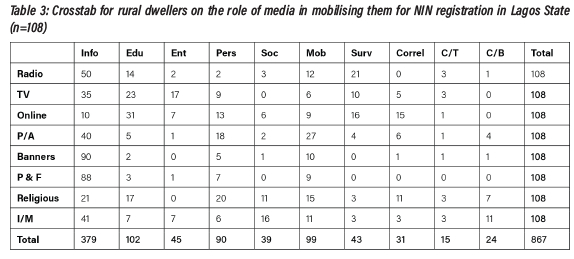
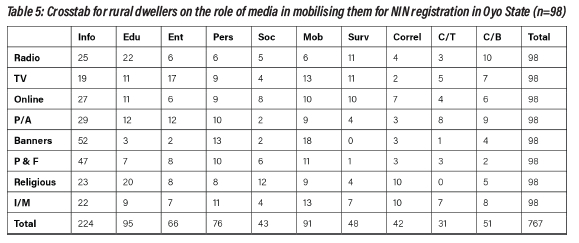
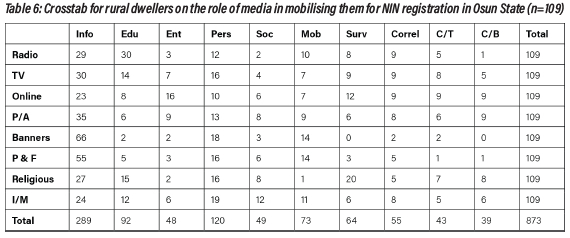
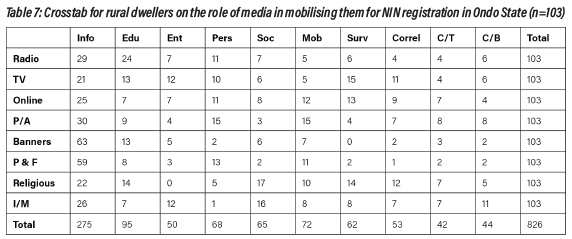
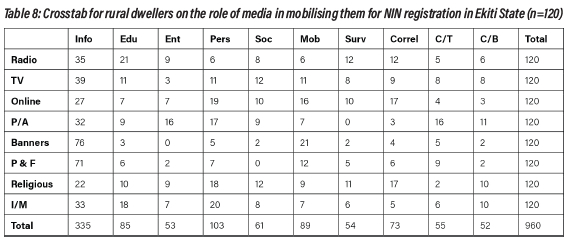
This article operationalises the social responsibility role in terms of 10 functions they perform and how media audiences see those roles performed: namely information (Info), which means providing news and reports to keep the public informed; education (Edu), offering educational content to inform, teach, or raise awareness; entertainment (Ent), engaging audiences to amuse or entertain, and persuasion (Pers), influencing opinions, attitudes or behaviours.
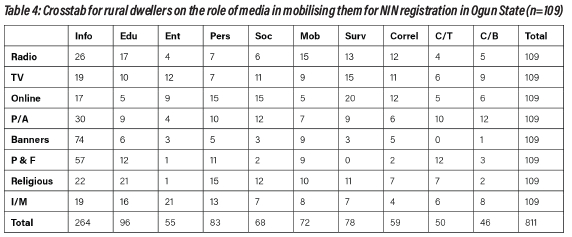
Others are socialisation (Soc), which means helping to shape cultural norms, values and behaviours; mobilisation (Mob), motivating people to take action; surveillance (Surv), acting as a "watchdog"; correlation (Correl), interpreting and contextualising messages for a broader understanding; cultural transmission (C/T), preserving cultural heritage and traditions, and community building (C/B), which involves fostering a sense of belonging by connecting people with shared interests. A contingency table for each state was built to show the rural dwellers' ratings of each media outlet's role in mobilising them for NIN registration.
Table 3, Table 4, Table 5, Table 6, Table 7 and Table 8 all show that information was the most dominant function in mobilising rural dwellers for NIN registration. Banners and posters and flyers consistently emerged as the most effective for delivering information, with frequencies exceeding 50 in most states. Radio and public announcements also played significant roles. The education function was the second most prominent, with radio, television and religious media being the primary sources of educational content. Online media showed growing relevance, especially in Lagos, where it was commonplace (31) in education. Religious media also stood out for its role in education, particularly in Ogun and Osun States, indicating its influence.
The mobilisation function was moderately represented, with public announcements and religious media being the most effective in motivating rural dwellers to take action. Entertainment, cultural transmission and community building were less emphasised, suggesting that these roles were not a primary focus in NIN enrolment media activities. However, religious media and interpersonal media showed potential for addressing these gaps, particularly in states such as Ekiti and Ondo.
The effectiveness of Yoruba indigenous media in driving actual participation in identity registration
A focused discussion was organised for six community leaders who provided evidence of NIN enrolment and demonstrated knowledge of it. They agreed to discuss the following questions on the WhatsApp messaging platform:
. Did Yoruba indigenous media play a role in your decision to enrol for NIN?
. Which medium motivated you the most to enrol?
. Were there specific messages that stood out for you?
. How did the media address your concerns about NIN registration?
. Would you have participated in NIN registration without the media?
The discussants summarised each point made to ensure proper articulation of the transcripts. While the discussions were mainly in Yoruba, at least four discussants code-switched a few times ((Nwokwu et al., 2018), using English for some Yoruba expressions. The transcripts were compiled in Yoruba before being translated into English. The quotations were compiled, after which a thematic analysis was implemented. Researchers had stated that quotations in discussion analysis were key to ensuring authenticity, credibility and transparency in qualitative research (Braun & Clarke, 2006; Yilmaz, 2013). Quotations humanise the data and are concrete evidence for the themes, so that readers can verify interpretations and listen to the data in participants' own words. They are used to show crucial linguistic and cultural sensitivities that would not be evident in a summary of discussions. They also make the results useful, especially for policymakers and stakeholders.
Predominance of interpersonal and localised communication channels
While mass media played a role, the most trusted and effective vectors for information were hyper-local and interpersonal. The following quotations from the respondents across the states corroborate the effective role of word-of-mouth:
Ogun: "I saw the Baale (local chief) asking people to go and register"
Ondo: "It was a Baale from Italeto [a village] who came around to inform us."
Osun: "I just arrived from the farm when a friend told me he heard it on the radio."
Ekiti: "Information flows regularly about NIN from people to people."
Official mass media often served as an initial trigger, but the information was catalysed into action through trusted community figures (Baales, pastors, imams) and personal networks. This suggests that in these rural contexts, social capital and traditional hierarchies are more effective for mobilisation than broadcast messages alone.
Use of fear and urgency as primary motivational tactics
The messaging strategy relied heavily on creating a sense of fear, scarcity and urgency to compel action, directly addressing the reviewer's point on "fear tactics'!
Lagos: "No bank and passport for you without NIN... That scared me"
Osun: "Register now, tomorrow may be too late"
Ondo: "Se kia, ma d'agunla!" [Hurry now, don't delay!]
Ogun: Blogger's message: "if we don't register now, Fulani herdsmen will take our place."
The most memorable messages were not about the benefits of a national identity but about the negative consequences of not having one (loss of access to services) or existential threats. This tactic was effective in generating initial interest but may have contributed to public anxiety.
Pervasive structural and logistical barriers
This was the most consistent and powerful theme across all discussants. It encompasses the reviewer's points on "limited access" "fewer registration centres" and "absence of relevant information"
Oyo: "Nobody tells us where we can find centres ... We saw the poster but no enroller."
Osun: "The worst thing is that when I got to the NIN centre, one man said they only come there once in a week."
Ondo: "Only one centre was servicing more than 25 rural communities ... Government should wake up."
Ekiti: "The distance people have to travel ... is another issue ... only 20 enrolment centres in Ekiti. Too few."
The media successfully raised awareness but could not compensate for the state's failure to provide adequate infrastructure and consistent service. This created a frustrating paradox where citizens were motivated to act but were systematically hindered from doing so, leading to feelings of neglect ("Government should remember the ruralites").
The role of religious and traditional institutions in legitimisation
Religious leaders acted as crucial amplifiers and legitimisers of the government's message, often translating it into a moral or communal imperative.
Ogun: "During a Sunday service, the pastor told everyone to go and enrol ... saying we couldn't renew passports without NIN"
Oyo: "Our mosque's imam said we shouldn't be bothered about the initial crowd, adding that the situation would soon improve."
Ekiti: "During a rural evangelism programme ... the preacher said we should not pay the NIN centre operators."
The pulpit and mosque became key channels for dissemination. Religious leaders not only spread information but also addressed practical concerns (crowds) and countered corruption, lending their authority to the process.
Circulation of disinformation and rumours
The information vacuum and anxiety were fertile ground for the spread of falsehoods, as noted by the reviewer under "disinformation"
Oyo: "WhatsApp that Fulani herdsmen from Niger and Chad have crossed into Nigeria ... to register for NIN. That message was alarming but I knew it was exaggerated"
Ogun: Blogger's message about Fulani herdsmen taking their place.
The lack of clear, consistent and official information from trusted sources allowed ethnically charged disinformation to flourish, particularly on social media platforms such as WhatsApp and Facebook. This highlights the double-edged sword of digital media in rural mobilisation.
Corruption and exploitation of citizens
The chaotic rollout and scarcity of registration services created opportunities for exploitation, directly addressing "corruption".
Ekiti: "The banners said NIN is free but I have heard some people complain that the centre operators demanded for money before enrolment"
Ondo: "Some people came with a bus and offered to take us to council but only after we had paid them money"
The promise of a free government service was undermined by informal gatekeepers who monetised access, eroding public trust in the entire exercise. The media's role was silent on this critical issue.
Inconsistent and unreliable media coverage
The reviewer's point on "insufficient information" is reflected here. Media coverage was patchy, often lacking the critical details needed for action.
Oyo: "They didn't tell anybody where to register ... NTA ... mentioned NIN but NEPA took light before expatiating."
Ondo: "No media carried it. Even if they carried it, we wouldn't know because radio and TV signals are weak."
Ekiti: "I doubt the NIN matter is a priority for them [local radio]"
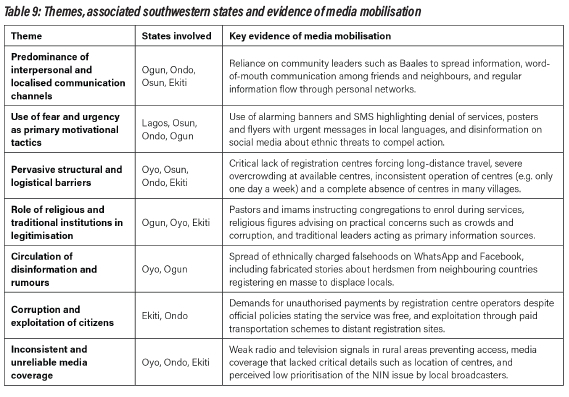
Table 9 below is a summary of the analysis.
The thematic analysis reveals a complex picture. Yoruba indigenous media did play a role in mobilising citizens, but it was a secondary and often flawed one. The primary mobilising forces were interpersonal communication and local leaders. The media strategy relied heavily on fear, which was effective for awareness but counterproductive to informed participation. Above all, all media initiatives essentially were compromised fundamentally by overwhelming structural challenges - most notably the severe lack of registration centres and trusted services - and by the emergence of corruption, characterised by commercialisation of ostensibly free services. Therefore, while indigenous media initiated the discussions on the national identity registration, the government's failure to act on logistic and ethical deficits ultimately shaped the lived experience of NIN enrolment for Southwest Nigerian rural citizens.
DISCUSSION OF FINDINGS
The findings of this study present a complex picture that both affirms and challenges the principles of CRM in the context of mobilising rural citizens for NIN enrolment. The empirical data reveal not only which media were effective but, when viewed through the CRM lens, explain why they were effective and where the strategy ultimately faltered.
The quantitative results strongly affirm CRM's emphasis on culturally familiar formats and trusted agents (e.g. Yoruba-Language radio broadcasts, religious leaders, community leaders - Baales and local chiefs - and interpersonal communication or word-of-mouth, which were crucial for mobilisation). The Chi-square results, which show p-values < 0.001 for all six state tables, confirm a significant association between media type and its perceived mobilising roles. This statistical validation means the choice of medium was not incidental but fundamentally shaped how the message was received. Delving deeper, the Cramer's V analysis provides crucial nuance: the strongest associations were found between banners and information (V ≈ 0.4) and between religious media and mobilisation (V ≈ 0.35).
This trend is in perfect harmony with CRM's very core principles. The ubiquity of banners as a medium of information can be reinterpreted: their very literal presence in public environments (markets, central squares) and dependence on concise, bold Yoruba-language headings are a modern, graphical "proverb" - a culturally inscribed form that is instantly readable and readily transmitted. Conversely, the strong connection between religious media and mobilisation reminds us of CRM's general principle of using credible cultural agents. Religious leaders are not just message carriers; they are authenticators of information. They lend a layer of cultural trust to the information that converts an official government directive into a compelling community appeal, owing to its powerful mobilising effect. This finding, quantified here, is often absent or merely anecdotal in previous studies on indigenous media (Cordova, 2021; Mushengyezi, 2003; Nemec, 2021), making this empirical contribution significant.
Furthermore, the qualitative data bring these statistical associations to life, while also revealing a critical limitation in the application of CRM: the assumption of linguistic homogeneity. The discussion confirms that radio, interpersonal communication and community leaders were highly effective. As the Ogun discussant noted, getting the news from the Baale or a pastor was a prime motivator. But one unexpected yet vital finding emerged: the process showed that speaking ability in Yoruba did not automatically mean reading ability. This disparity, particularly noted in the riverine communities with their own dialects, challenges a basic assumption of using standardised indigenous language print materials. It contends that a truly culturally responsive approach must address dialectical diversity and oral-aural preference, with a priority for spoken-word media over standard text. This nuance is a critical addition to the CRM framework in practice.
This work exposes how systemic failures (e.g. insufficient centres, misinformation and fear-based messaging, and corruption, etc.) sabotage even the most culturally-grounded efforts, creating a fundamental breach of trust that CRM seeks to build. The transcripts are replete with frustrations -from the Osun discussant who found centres only operational once a week to the Ondo discussant who was forced to pay for a supposedly free service. The confirmation of extremely low numbers of enrolment offices (e.g. 18 in Ondo, 20 in Ekiti) describes a stark infrastructural deficit. The populace can be effectively mobilised by the media and leaders but if, in due course, the system of government fails to deliver effective, reliable services, it undermines the intervention of the people and poisons the well for future campaigns. Furthermore, the ethical concerns around fear-based and panic-driven messaging (e.g. "Fulani herdsmen will take our place"), while momentarily effective, contradict the ethos of CRM, which is built on empowerment, respect and transparent dialogue, not coercion and misinformation.
CONCLUSION: TRUST, TACTICS AND ETHICAL CONTRADICTIONS IN MEDIA-LED MOBILISATIONS
This study confirms that Yoruba indigenous media are mobilising forces, deriving strength from language and a symbiotic relationship with traditional rulers that mediates social trust through culturally resonant forms. However, their effectiveness is deeply compromised by systemic and ethical contradictions, as their significant potential to inform and mobilise is lethally undercut by the same systemic problems - such as corruption and unavailable services - that undermine the very trust these media attempt to establish,. This makes it clear that the success of any culturally engaging media effort is intimately tied to the integrity and availability of the government services it promotes.
Yet, this mobilisation model is perilously shallow. Media campaigns successfully compelled citizens to act, but they significantly failed to report critically or act on the debilitating systemic challenges -few registration centres and corrupt procedures - facing them. In magnifying the call to action without concurrently promoting accountability and accessibility, the media became unintentionally an accomplice to a violation of trust. Such ensuing public disillusionment erodes the credibility of both the media and the mainstream leaders they cover, annihilating the very social capital required for future mobilisation.
Furthermore, the large-scale use of fear campaigns and misinformation is an intrinsic ethical perversion. Measures such as "No bank for you without NIN" short change compliance for political expediency at the expense of principle, playing on fears instead of challenging them with realities. While there is a bank's NIN requirement, this coercive strategy contradicts the participatory ethos of culturally responsive communication and fails to build the long-term, trust-based relationship necessary for sustainable civic engagement.
The success of indigenous media performance cannot be measured by reach alone. Actual effectiveness hinges on the balancing act between mobilisation and accountability. For media-driven mobilisation to be not only ethical but also sustainable, it must transcend only passing messages to also critically scrutinising realities on the ground, advocating viable systems as energetically as it advocates citizen registration.
CAUTION AND RECOMMENDATIONSIn order to overcome the identified obstacles, the following suggestions are made with a word of caution as follows:
Caution
Policy makers, researchers and media practitioners ought to shed the homogenising assumption that all citizens in folk communities necessarily read, write or understand standardised forms of their indigenous languages. This study revealed significant dialectal variations and literacy disparities, particularly in riverine areas. Research assistants observed that questionnaires were difficult to read and understand for riverine respondents in Lagos and Ondo states, despite the fact that they were competent Yoruba speakers. It was this challenge, which they rationalised as their dialects being outside of the core Yoruba language, that revealed differences between oral proficiency and literacy and established that understanding could not be assumed even in a community sharing a common language. A genuinely culturally responsive strategy must account for this linguistic nuance, prioritising oral and visual communication (e.g. radio, town criers, visual banners) over standardised print text for many communities.
Recommendations
A policy for refined hyper-local media strategy is necessary to move government's communication strategy beyond simple translation. This is a strategy that moves beyond broad regional Yoruba-language media to target specific villages, communities and even social networks with tailored messaging and trusted messengers. It would involve targeting specific localities, leveraging micro-level trusted agent and using deeply contextual formats (e.g. using dialects and cultural references specific to that immediate area to ensure comprehension). It must be grounded in empirical research on what media types are optimal for a particular function. Radio and interpersonal networks must take priority in such a policy to provide space for oral-aural and dialectal differences.
Effective public outreach requires a fundamental shift in communications strategy away from scare-mongering and panic-based tactics that risk misinformation and damage long-term credibility. Instead, messaging will need to emphasise the actual benefits of enrolment, such as access to financial services, health care and welfare. Developing ethical guidelines for media messages with community leaders will also ensure that outreach is respectful and compelling. At the same time, investment in infrastructure must be dealt with as a cultural imperative, not merely a logistics matter. The current shortfall - evidenced by the fact that there are only 18 centres in a state such as Ondo - needs to be the priority. A culturally responsive media campaign is ultimately self-defeating if it mobilises citizens to non-existent or dysfunctional centres, an outcome that only breeds cynicism and undermines the entire programme.
Enforcement of the integrity of the enrolment process should involve adopting open anti-corruption policies, defining clear accountability procedures, and punishing corrupt operators. Partnerships with prominent religious and community leaders to maintain neutrality as observers and sources of comment can further help with these efforts. Studies should continue to examine the ethical implications and long-term effectiveness of fear-based and benefit-based messages in indigenous media. Extensive research needs to be conducted to map specific issues of dialectical understanding in order to direct more effective, hyper-local models of communication.
REFERENCES
-
Abdulai, M., Ibrahim, H. & Anas, L.A. (2023). The role of indigenous communication systems for rural development in the Tolon District of Ghana. Research in Globalization, 6. Available from: https://doi.org/10.1016/j.resglo.2023!00128
» https://doi.org/10.1016/j.resglo.2023!00128 - Adeyeye, B., Amodu, O., Odiboh, O., Omojola, O., Adesina, E. & Ben-Enukora, C.A. (2020). A SWOT analysis of indigenous language use in agricultural radio programming in Nigeria. In A. Salawu & K. Oyesomi (eds). Emerging trends in indigenous language media, communication, gender, and health. Hershey (PA): IGI Global, 188-209.
- Angrist, N., Goldberg, P. K. & Jolliffe, D. (2021). Why is growth in developing countries so hard to measure? The Journal of Economic Perspectives, 35(3):215-242.
-
Aondowase, S., Ackar, A. & Ubong-Archibong U.N. (2023). Indigenous media and rural mobilization for development programmes in Nigeria. World Journal of Advanced Research and Reviews, 20(03):095-103. Available from: https://doi.org/10.30574/wjarr.2023.20.3.2201
» https://doi.org/10.30574/wjarr.2023.20.3.2201 -
Braun, V. & Clarke, V. (2006). Using thematic analysis in psychology. Qualitative Research in Psychology, 3(2):77-101. Available from: https://doi.org/101191/1478088706qp063oa
» https://doi.org/101191/1478088706qp063oa - Breckenridge, K. (2014). Biometric state: The global politics of identification and surveillance in South Africa, 1850 to the Present. Cambridge: Cambridge University Press.
- Canen, N. & Wantchekon, L. (2022). Political distortions, state capture, and economic development in Africa. The Journal of Economic Perspectives, 36(1):101-124.
-
Chin, R.J, Hennessy, G. & Madubuko, T. (2015). India's Aadhaar Project: The unprecedented and unique partnership for inclusion. Journal of Administrative Science, 12(1):1-16. Available from: https://jas.uitm.edu.my/images/CURRENT_ISSUES/1.pdf.
» https://jas.uitm.edu.my/images/CURRENT_ISSUES/1.pdf - Cordova, A. (2021). Indigenous media detonations. In S. Macdonald. P. R. Zimmermann with J. Tulke. Flash Flaherty: Tales from a Film Seminar. Bloomington: Indiana University Press, 287-290.
- Dowell, K. (2006). Indigenous media gone global: strengthening indigenous identity on- and offscreen at the First Nations\ First Features film showcase. American Anthropologist, 108(2):376-384.
- Dutta, M. J. (2011). Communicating Social Change: Structure, Culture, and Agency. London: Routledge.
- Elliott, M.R. & Valliant, R. (2017). Inference for Nonprobability Samples. Statistical Science, 32(2):249-264.
-
Ethnologue. (2025). Federal Republic of Nigeria: summary. Available from: https://www.ethnologue.com/country/NG/
» https://www.ethnologue.com/country/NG/ - Folarin, B. (1998). Theories of mass communication: an introductory text. Ibadan: Stirling-Horden Publishers.
-
Freire, P. (1993). Pedagogy of the oppressed. New York: Continuum.Available from https://envs.ucsc.edu/internships/internship-readings/freire-pedagogy-of-the-oppressed.pdf
» https://envs.ucsc.edu/internships/internship-readings/freire-pedagogy-of-the-oppressed.pdf - Gay, G. (2010). Culturally responsive teaching: theory, research, and practice, 2nd ed. New York: Teachers College Press.
- Goldscheider, C. (2004). Ethnic categorizations in censuses: comparative observations from Israel, Canada, and the United States. In David I Kertzer & Dominique Arel (eds). Census and Identity: The Politics of Race, Ethnicity and Language in National Censuses. Cambridge: Cambridge University Press, 71-91.
- Khanna, T. & Raina, A. (2012). Aadhaar: India's 'Unique Identification' System. Harvard Business School Case 712-412.
- Kim, Y. (2019). New opportunities for sociological research: a discussion of the usefulness of mixed methods with data science. Journal of Asian Sociology, 48(3) (September 2019):343-358.
- Kiregyera, B. (1982). Some sources of nonsampling errors in African census and survey work: a review. International Statistical Review/ Revue Internationale de Statistique, 50(3):305-316.
- Ladson-Billings, G. (1995). Toward a theory of culturally relevant pedagogy. American Educational Research Journal, 32(3):465-491.
- Lincoln, Y.S. & E.G. (1985). Naturalistic inquiry. Beverly Hills (CA): Sage.
- Müller, D. & Renes, S. (2021). Fairness views and political preferences: evidence from a large and heterogeneous sample. Social Choice and Welfare, 56(4) (May):679-711.
- Mushengyezi, A. (2003). Rethinking indigenous media: rituals, 'talking' drums and orality as forms of public communication in Uganda. Journal of African Cultural Studies, 16(1, Special Issue Focusing on the Media in and about Africa):107-117.
- Nemec, S. (2021). Can an indigenous media model enrol wider non-Indigenous audiences in alternative perspectives to the 'mainstream.' Ethnicities, 21(6):997-1025.
-
NIMC (2023). Annual Report on National Identity Registration. NIMC. Available from: https://nimc.gov.ng/annual-reports/
» https://nimc.gov.ng/annual-reports/ -
Nyakundi, F. N. (2020). Huduma Namba: Kenya's transformation into an informational state. Master's thesis. University of Washington. Available from: https://digital.lib.washington.edu/researchworks/items/24202281-3e3f-43c0-a901-0fe7da80848f.
» https://digital.lib.washington.edu/researchworks/items/24202281-3e3f-43c0-a901-0fe7da80848f - Nwokwu, F.A., Chukwuokoro, I. & Ogayi, M.C. (2021). Code-mixing and code-switching among selected Igbo English undergraduate bilinguals in Ebonyi State University, Abakaliki. EBSU Journal of Social Sciences and Humanities, 11(1):113-122.
- Omojola, O. (2009). English-oriented ICTs and ethnic language survival strategies in Africa. Global Media Journa, 3(1):33-45.
- Owolola, O. (2018). A sociolinguistic study of the effects of Yoruba-English code-mixing on the Yoruba language. Jurnal Arbtrer, 5(1):23-30.
- Ojebode, A. (2002). Radio as a development communication medium: types, formats, roles and limitations. In E.O. Soola (ed.). 2003 Communicating for Development Purposes. Ibadan: Kraft Books Limited.
- Paris, D., & Alim, H. S. (2017). Culturally sustaining pedagogies: teaching and learning for justice in a changing world. New York: Teachers College Press.
- Pavarala, V. & Malik, K.K. (2007). Other voices: the struggle for community radio in India. London: Sage Publications.
-
Salawu, A. (2016). Indigenous language media and democracy in Africa. In A. Salawu & M.B. Chibita (eds). Indigenous language media, language politics and democracy in Africa. London: Palgrave Macmillan. available from: https://doi.org/10.1057/9781137547309_2
» https://doi.org/10.1057/9781137547309_2 - Servaes, J. (2020). Handbook of communication for development and social change. Singapore: Springer.
- Singh, S., Forde, S. & Lawton, J. (2024). 'The sole source of truth': Harnessing the power of the spoken word through indigenous community radio. In D. Bargallie & N. Fernando. Critical Racial and Decolonial Literacies: Breaking the Silence. Bristol: Bristol University Press, 246-258.
- Solove, D.J. (2020). The digital person: technology and privacy in the information age. New York: NYU Press.
- Thiel, A. (2017). Entangled temporalities: Ghana's national biometric identity registration project. Anthropology Today, 33(1):3-5.
- Thompson, M.E. (2019). Combining data from new and traditional sources in population surveys. International Statistical Review, 87:S79-S89.
-
Uzochukwu, B., Mbachu, C., Onwujekwe, O., Okwuosa, C., Etiaba, E., Nyström, M.E. & Gilson, L. (2016). Health policy and systems research and analysis in Nigeria: examining health policymakers' and researchers' capacity assets, needs and perspectives in south-east Nigeria. Health Research Policy and System 14, 13. Available from: https://doi.org/10.1186/s12961-016-0083-6
» https://doi.org/10.1186/s12961-016-0083-6 - Yilmaz, K. (2013). Comparison of quantitative and qualitative research traditions: epistemological, theoretical, and methodological differences. European Journal of Education, 48(2):311-325.
-
Worldometer, (2024). Nigerian population (live). Available from: https://www.worldometers.info/world-population/nigeria-population/ (Accessed 17 December 2024).
» https://www.worldometers.info/world-population/nigeria-population/
Accepted September 2025