Centre-periphery circulation patterns in Ghana's print media landscape: Exploring the underlining determinants
Abstract
After 202 years (1822-2024) of its inception in the then Gold Coast, now Ghana, and witnessing an unprecedented upsurge in publication since 1992, the circulation of print media appears unevenly distributed between the centre (capital) and the peripheries. Since there are not enough studies that explore the circulation of print media under Ghana's fourth republic to show its circulation patterns, this article analyses print distribution figures and views sourced from newspaper firms to examine the situation within the participatory communication and the political economy of the media frameworks. It uncovers that a few newspaper firms have regional offices but do not print in those locations. They function only as bulk distribution and administrative centres that gather news to feed their headquarters in the capital. Ghana's print industry operates a centre-periphery production and distribution framework. Furthermore, the study unveils that four factors contribute to newspaper concentration in urban centres, namely ownership tendencies, revenue motives, skilled labour availability and seat of government, and urban media credibility. Thus, Ghana experiences wide rural-urban print disparities which retard timely information sourcing, consensus building and participatory development communication. The findings from the study have implications for Africa.
Community; distribution patterns; newspaper; participation; rural; urbanisation
INTRODUCTION
The Ghanaian media industry is diverse and pluralistic (Owusu, 2011) and can be described as the epitome of a thriving democracy (Yeboah-Banin & Adjin-Tettey, 2023). Generally, "pluralism is associated with diversity in the media; the presence of a number of different and independent voices of different political opinions and representation of culture within the media" (Doyle, 2005:12). However, Ghana's print media availability does not imply accessibility (African Media Barometer [AMB], 2017). To Temin and Smith (2002), this pluralistic perception is an overestimation of the significance and influence of newspapers in daily discourse. In the views of Adesonaye (1990) and Picard (2003), the existence of media resources alone does not guarantee that actual information dissemination occurs, but rather that their relevant use as tools to enable society to have full participation in building consensus is key. In Ghana, direct subscription is required to access most of both the local and foreign print, which tends to be an index of socio-economic class differentiation (International Research and Exchanges Board [IREX], 2012). The situation lingers. Although print firms give access to news online in Ghana (Amadu et al., 2018; Fiadzawoo et al., 2022) buttressed by Daily Graphic's NewsPlus App at a subscription fee, newspaper still plays a significant role in disseminating information as a major news source preference (AMB, 2017). However, access limitations tend to hinder rural societies from getting or sending information even though more than two thirds of Ghana's population resides there (Ghana Statistical Service [GSS], 2021). To this end, Lister (2011) argues that it is not merely the eradication of restraints on our work to report that is so vital, but also the degree to which disadvantaged communities can access media to voice their opinions. The concerns about media concentration in cities coupled with the political and economic control over important communication resources informed the design of the "community media notion" as a step in the right direction (Coyer, 2011). However, it appears that "community print" has received less attention than broadcasting in Ghana and Africa. This trend seems true in other parts of the world. Gicheru (2014) maintains that the potential of newspapers should be exploited for development rather than neglecting them.
Prior print media studies in Ghana have explored how economic, political, socio-cultural and professional factors informed the development of English language newspapers and Ghanaian (African) language newspapers with a focus on how they contrasted during the colonial and post-colonial eras (Anyidoho, 2016). Amadu et al. (2018) explored circulation and readership of newspapers in Ghana's northern regional capital, Tamale, where they observed that although online news led to a decline in print newspaper readership, readers still preferred paper-based newspapers as a reliable and authentic news source. Nevertheless, studies have drawn attention to a declining reading culture (Awuttey, 2020; Ibrahim, 2021; Owusu, 2020) that tends to negatively impact newspaper readership. There are hardly any studies under Ghana's fourth republic that have analysed the centre-periphery print distribution patterns nationally following the influx of print media in the 1992 democratisation drive. While this article does not intend to downplay the significance of global media transformation from analogue to digital, of which Ghana and Africa are part, it argues that the uniqueness of paper-based news format is worth preserving because it tends to enhance discourse in society. Referring to media academic Michael Schudson, Lovaas (2008:246) reiterates: "All media is important in a democracy, but some media, mainly print media, counts most because it investigates, gathers, and reports news." No wonder Amadu et al. (2018) find newspapers to be credible sources of information. By this, Nyarko (2016) concludes that the print has remained the agenda-setting base in Ghana through "newspaper review" broadcast shows. This article attempts to explore the centre-periphery distribution patterns of newspapers in Ghana and their implications on news consumption. The article identifies the factors that contribute to them and, more significantly, to conceptualise the production model used by the print media in Ghana.
RESEARCH QUESTIONS1. What are the implications of print media concentration in cities on news consumption?
2. To what extent is centre-periphery print disparity a challenge to participatory communication?
3. What factors contribute to widening print disparities between the centres and peripheries?
HISTORICAL OVERVIEW OF GHANA'S PRINT MEDIA
Coloniality and its globality have a long-term impact on media structures and performance. As a previously colonised nation, the history of Ghana's media remains incomplete without reference to global geo-political economy structures. Generally, Jones-Quartey (1974) and Wilcox (1975) recorded that the beginning of African media could be traced to publications of colonial administrations and that this was evident in both British and French territories. In 1801, the first official African print was published in Sierra Leone, called the Royal Gazette. Later in 1822, the Gold Coast (now Ghana) also published a handwritten paper called Gold Coast Gazette under the governorship of Charles McCarthy in Cape Coast (Jones-Quartey, 1974). Specifically, the history of African media in British colonised territories traces its roots to four categories of early publication: "(i) the official government gazettes, (ii) the missionary press, (iii) privately owned newspapers and (iv) the underground political, anticolonial news sheets" (Faringer 1991:3). This pattern is evident in today's media ownership ecology of Ghana, Africa and other colonised parts of the globe where media is categorised as public/state/government, private, political and religious/ philanthropic.
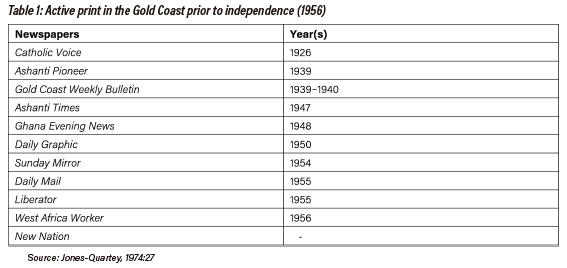
The publication of the Royal Gazette ceased abruptly two years after its launch in 1824. After prolonged silence in the landscape, two Ghanaian brothers, Charles Bannerman and Edmond Bannerman, published a new paper in the Gold Coast in 1857 (Twumasi, 1981). The brothers launched the hand written paper Accra Herald in Cape Coast and later renamed it West African Herald (Jones-Quartey, 1974). This paper occasionally appeared in the newsstands between 1873 and 1874 until it halted. J.H. Brew's two-week Gold Coast Times surfaced in the print landscape until 1885. Subsequently, the periodically published Western Echo also followed. The inception and growth of Ghana's press at the time was unstable and could be described as a "baton-relay pattern" during which papers collapsed and others emerged. In the nineteenth and twentieth centuries, several newspapers sprung up. The fairly liberalised atmosphere at the time meant that ownership was in private African hands and spanned across the 1930s and 1940s. In 1931, J.B. Danquah published the premier daily newspaper in the Gold Coast, Times of West Africa (Twumasi, 1981). These media developments show that the colonial administration's grip on the colony was loosening as the independence struggle intensified. Between 1931 and 1956, there were 40 different newspapers but only 11 appeared on the newsstands at the onset of 1956 (see Table 1).
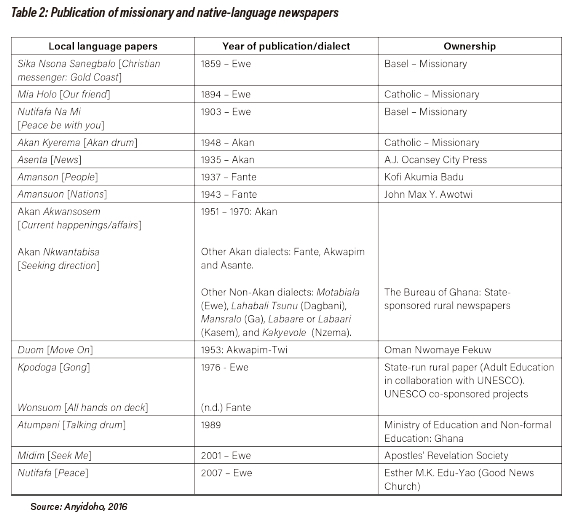
In another account, Twumasi (1981) showed that newspapers published between 1929 and 1939 in the Gold Coast reflected the following circulation statistics: out of a total of 14 papers, Accra alone pulled eight, Cape Coast three and Kumasi, Saltpond and Koforidua had one each. Because of this, many African papers attempted to reach the national population but to no avail. The Pioneer newspaper (published in 1939), for instance, would have been more vibrant financially and in agenda-setting terms if it had covered only the Ashanti regional capital (Kumasi) of Ghana rather than trying to supply Accra and the other regional capitals (Hachten, 1975). Anyidoho (2016) sums this up professionally, noting that Ghana's print journalism comes in three phases. The premier phase comprises amateur printing dating back to 1822 by colonial governors, missionaries and native Ghanaians. The second phase covers papers published between 1931 and 1945, which aimed at being critical of the colonial government policies prior to independence and had commercial intent. The final phase covers the emergence of journalism training institutions and papers such as Nkrumah's Evening News (1947), Morning Telegraph (1949), Daily Graphic (1950) and Sunday Mirror (1953). At this stage, contemporary facilities and technology, language skills, formal education and appropriate funding models were emphasised in Ghana's journalism practice. During this period, local language papers were run to serve local language readers but most of them ended abruptly (see Table 2).
Ghana's media environment at independence in 1957 was vibrant because many of the privately owned press that led the freedom fight were operational. Kwame Nkrumah established the Ghana News Agency and took over the vibrant foreign-run outlet, The Daily Mirror Group (Jones-Quartey, 1974). However, by April 1974, only three newspapers existed actively in Ghana, composed of two government-owned and one party-political paper. No private ownership existed at the time (Wilcox, 1975). Prior to the 1992 constitution, there were roughly 13 newspapers that intermittently surfaced on the newsstands (IREX, 2012). At the beginning of the fourth republic, the democratic winds saw the upsurge of private outlets publishing tabloids alongside the two state-owned prints in Ghana (Morrison, 2004). This is because the 1992 constitution abrogated media controls (Hasty, 2005) to some extent and assigned a chapter to media freedoms and expressions (Alhassan, 2005), thus liberalising the media landscape (AMB, 2011). These events marked a new take-off point in the print media industry in Ghana with its chequered past (Temin & Smith, 2002). This development is reminiscent of the many newspapers that sprung up in Ghana after the colonial liberation. Despite this print influx of the 1990s, the cover prices ranged between GH¢4.00 and GH¢3.00 (USD 0.36 at the time of study). Due to low economic and living standards, many people in Ghana could not afford newspapers and flanked newsstands to read front pages without buying them. Sometimes, a single paper bought was read by many people (Temin & Smith, 2002), which formed a reading network numbering hundreds (Hasty, 2005).
THEORIESThe study pertaining to this article employed participatory communication (PC) and the political economy of media (PEM). PC sees communication as a measure of inclusivity in the process of taking decisions for a development agenda (Ifeduba & Bolarinwa, 2016; Waisbord, 2008). Communication designs should emphasise "participation" to build consensus and explain that the aim of the "democratic principle of distribution" is to achieve pluralistic and liberalised media equity to enable communities to partake in discourse (Baker, 2006:8). Meier and Trappel (1998) call for unrestricted access to information and to the means to impart information. Van Cuilenburg (1999:185) distinguished between "access to" and "accessibility of communication". To Van Cuilenburg, this distinction reflects the concepts of exclusion and inclusion where the higher the extent of accessibility of communication, the more inclusive citizens are and vice versa. To Tufte and Mefalopulos (2009:12), "what is often not made explicit in PC approaches is the important role of media access, which is crucial considering the rapid changes in media tools, coverage and worldwide use. PC is also about visibility and voice in the mediated public sphere, which leads us to ask further: what more concrete roles do the media play in PC Also, Yoon (n.d) concurs. Drawing on Paulo Freire's dialogic communication, Tufte and Mefalopulos (2009:11) stipulate that "strengthening community media can ensure [that] the most marginalised groups have a platform to voice their concerns, engage in public debate and solve problems". To this end, Ifeduba and Bolarinwa (2016) contend that a significant aspect of PC is "variety" in a defined community which encourages involvement of the masses in development and stresses media pluralism and diversity. The expectation is that newspapers are distributed equitably among the populace and in ways that enhance easy access.
PEM, conversely, is concerned with resource allocation in capitalist communities. PEM encapsulates studying ownership and control, power relations, class systems and structural inequalities (Wasko, 2014). Furthermore, PEM is "the study of the social relations, particularly power relations, that mutually constitute the production, distribution and consumption of resources" including communication resources (Mosco, 1996:25). By this, mass media emerged as the foremost and key industrial and commercial organisation engaged in the production and distribution of commodities (Murdock & Golding, 1974). Profiteering became the norm (Wasko, 2014) because communication and information are key marketing variables executed through public relations and advertising (Murdock & Wasko, 2007), among other contents. The foregoing is rooted in "The Blindspot Debate" which maintains that audiences are the major product of media that media firms sell to advertisers (Smythe, 1977). Due to the stiff competition in such capitalist markets, media becomes concentrated (Murdock & Golding, 1974) where news and public information is provided. However, Mosco (1996) notes that different forms of PEM exist but many of them try to decentre media. According to Picard (2003), this ensures that multiple content is created which enables many voices and opinions to be heard in society. Generally, PEM in Africa is fragile financially and could hardly support the independence of the media or curb concentration (Cag'e, 2014; Nyarko, 2023).
In the application of PC and PEM models, the former argues that urban-centred newspaper retards grassroots participation and consensus building in public discourse. PC, in this context negates global efforts to reduce inequality in information access. PEM helps to understand the politico-economic influences of concentration of media at the centres and their implications for newspaper distribution.
METHODOLOGICAL ISSUES
Country and print media statistics
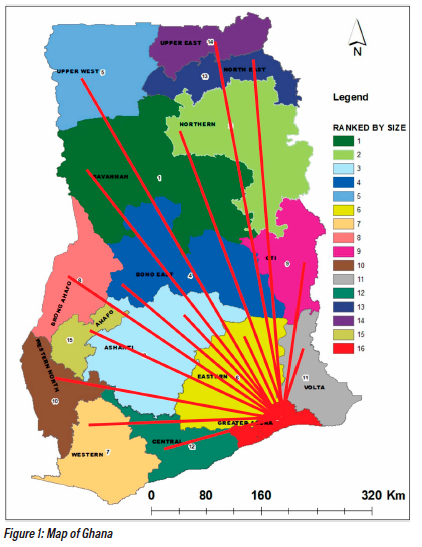
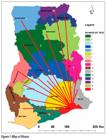
Ghana is a country with a population of 31,699,675 (World Population Review, 2021) inhabiting a land area of 238,533 km2 with a 69.8% literacy rate (GSS, 2021). The national daily wage for 2023 was GHC14.88 [USD 1.43] (Atawoge, 2022). Ghana has had four republics; the onset of the fourth republic saw the promulgation of the 1992 constitution which triggered the proliferation of several print media houses. This has been attributed to the country's liberalised environment. The print ecology of Ghana (newspaper, magazines and journals) grew to 466 (IREX, 2012). Of these, registered newspapers were 135, according to the National Media Commission [NMC] (Media Ownership Monitor, 2017) and the top 15 newspapers circulate 4,549,000 copies daily (Geopoll, 2017). Despite this growth, some residents outside the capital and other cities seem starved of access to dailies and weeklies of their choice. Figure 1 shows Ghana with 16 regions. It pinpoints the location of its capital city (Accra) from where it appears print media firms are located and distribute the news.
Approach
This article analyses print distribution figures as well as interview responses sourced from four newspaper firms: Daily Graphic, Daily Guide, Ghanaian Times and the Public Agenda in Ghana. The selection of Daily Graphic, Daily Guide and Ghanaian Times was based on reach. Public Agenda was purposively selected to create a balance of state and mainstream private-owned as this newspaper is NGO-owned. After collecting the regional/zonal print distribution data from respective outlets, further conversations were held with their distribution/sales managers to uncover the underlying determinants for distribution disparities. According to Hammersley and Atkinson (2007), these dialogues and conversations are seen as a form of interview. Berg (2001) sums it up noting that, basically, interviewing is a conversation with a purpose, mainly to gather information. The interview was unstructured due to the conversational nature of the researcher's foremost interaction with the representatives (distribution/sales managers) of the firms to collect the print distribution statistics. Berg (2001) defines an unstructured interview as the type that does not use a predetermined list of questions and enables the researcher to develop, adapt and generate appropriate questions to probe the situation under investigation. Owing to the dynamic nature of news consumption by audiences in relation to their distribution patterns, the print outlets were approached to update their distribution data. The print distribution statistics were obtained directly from the print firms and, subsequently, the interview interactions were manually captured.
Data analysis
The data were presented in tabular and narrative formats. First, the distribution of newspapers across Ghana was analysed to ascertain their concentration or otherwise. The higher the number of copies of newspapers assigned to a zone, the more concentrated they are and vice versa. Second, the responses obtained from the interactions with the distribution/sales managers were organised and re-organised in ways that enabled categories to be used as units of analysis. Putting this into perspective and in line with Yin's (2009) definition of textual analysis, data were regrouped into various patterns to meet the interest of the researcher and, more significantly, the objective of this study. With two data sources assembled for this study, data triangulation becomes necessary. Triangulation, according to Berg (2001:5), is "used largely to describe multiple data-collection techniques designed to measure a single concept or construct"' The responses from the distribution/sales managers were expected to buttress and deepen the understanding of the distribution figures they gave and vice versa. Ethical and consent requirements were adhered to. Gatekeeping letters were dispatched to all the print firms and approval was received before data collection commenced. The distribution managers (DM) were labeled DM1, DM2, DM3 and DM4 for anonymity purposes.
RESULTS
Print distribution patterns under the Fourth Republic
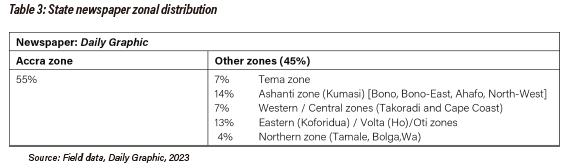
The Ghanaian print media landscape is concentrated in the capital, Accra, and its twin city, Tema. The circulation in the capital city alone supersedes those in the other regional capitals. The hinterlands appear virtually excluded, as is evident in the following statistics in Tables 3 and 4.
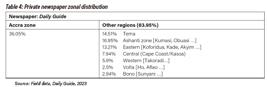
From Tables 3 and 4, Daily Graphic and Daily Guide circulate newspapers across Ghana. However, their distribution is besieged with an acute imbalance in which 55% and 36.05% circulate at the centre (Greater-Accra zone) alone and the remaining newspapers at 45% and 63.95% respectively are distributed among the other regional zones respectively: (Tema [7%], Ashanti [14%], Western [7%], Eastern [13%], Northern [4%]) and (Tema [14.51], Ashanti [16.95%], Eastern [13.21%], Central [7.94%], Western [5.9%], Volta [2.5%], Bono [2.94%]). Considering the proximity of Tema to Accra, which could be described as a "twin city" the centre by extension is 62% (Daily Graphic) and 50.56% (Daily Guide). Note that the Daily Guide does not allocate papers to the northern zone. This means newspapers are southern based and the regions beyond Accra are not represented equitably in public discourse. This makes the "opinion sections" of many newspapers that of city dwellers. To Daily Graphic, the complex nature of newspaper distribution makes them define Kasoa as an extension of Accra, although geographically it is part of the central region. According to the sales manager of Daily Guide, the firm suspended serving the northern zone due to its commercial viability but they expected that some copies from the Ashanti and Sunyani zones may have reached there. The copies distributed to the major zones may not reach their peripheries.
Capital and regional printing patterns
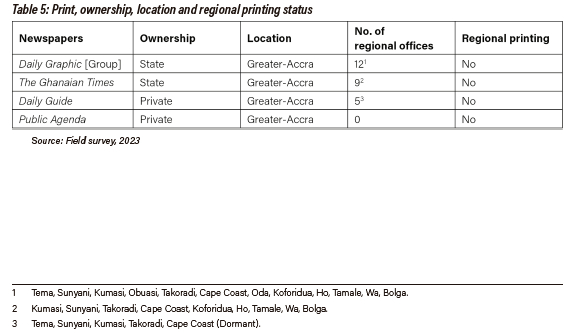
In terms of geographical locations, Table 5 shows that all the print firms are headquartered at the centre (Accra). While three of the firms also run regional offices in Ghana - Daily Graphic (12), Ghanaian Times (9) Daily Guide (5) - none of the regional offices print news. They only operate as stories and advertising collection units to feed their headquarters for publication and as bulk distribution centres (BDC) that redistribute newspapers from the centres. Moreover, many firms cannot afford to send reporters to the peripheries to gather stories and those who could, receive their inputs to print at the centre. Finally, the news may not get back to the peripheries and tends to fall into the hands of the central audience. The concentration of firms in the centre, coupled with distribution costs, poses a challenge to disseminating newspapers to the peripheries. This accounts for the peripheries lacking news or reading dead news. Ghana's print industry runs a centre-periphery production and distribution (CPPD) model that shows a one-way news production flow from the centre to regional capitals, which trickles down to the peripheries in smaller quantities. In the end, the number of regional offices of state media over the private epitomises the national-ness of the state media and broader news circulation impacts.
Bulk Distribution Centres: Newspaper circulation strategy
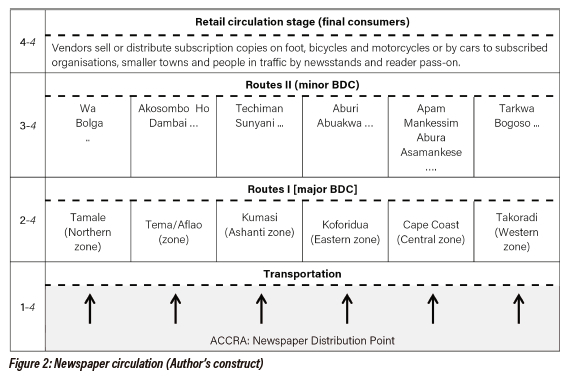
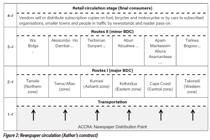
Due to financial and logistical constraints, newspapers are strategically distributed along selected zonal routes to attempt nationwide coverage. Accra is the centre and the newspaper production hub so all distributions start there and move to the peripheries (outskirts) through different means. This makes newspapers southern-Ghana based (see Figures 1 and 2). State and private print operate similar distribution trends. The difference is that private outlets are unable to serve the northern zone due to its geographical location and commercial viability factors. First, newspapers are transported to major BDC routes: Northern (Tamale), Tema/Aflao, Ashanti (Kumasi), Eastern (Koforidua), Central (Cape Coast) and Western (Sekondi-Takoradi) zones by using their own vehicles, the State Transport Company (STC) or other commercial buses that travel to those routes/cities. Due to the remoteness of the northern route from the centre; both firms used to airlift their newspapers but have now stopped due to high costs. Daily Graphic now transports newspapers to the north by road. Second, newspapers that arrive at the minor BDCs (suburban towns) are further redistributed to other settlements. The identification of major and minor BDCs is determined by access, transport and commercial viability. The permutations: 1-4, 2-4 and 3-4 in Figure 2 show that newspaper vending and circulation are intertwined at all stages (1, 2, 3, 4) because circulation is a continuous process. For instance, in the Accra zone, vendors distribute through newsstands, cycling and vehicular traffic to readers. With this flexibility, newspapers assigned to the central zone serve Apam, Winneba, Mankessim andSaltpond townships, among others, before arriving at the major BDC in Cape Coast.
Contributory factors to centre-periphery newspaper distribution
Four determinants influence the distribution pattern of newspapers nationally. These are ownership tendencies; revenue motives; skilled labour availability, literate population and seat of government; and urban media credibility. On the ownership determinant front, DM2 explained:
Media ownership is a big challenge in Ghana and the contention lies especially in politicians and businessmen owning media outlets. With the promulgation of the 1992 constitution, private newspapers, particularly those in politics, have shown that they are not in the printing game to inform the public, but to satisfy their political ambition and second, an avenue to make money hence gravitate towards city centres. It has got nothing to do with providing information.
From the foregoing, owners and investors of media determine the location of their establishments in line with their personal aspirations. This tends to sway them from the media's core mandate and function of pursuing public interest. The centredness of print in the cities seems to illustrate a growing media capture by print owners who are mainly political and corporate actors. DM2's response pointed to the fourth republican constitution for opening the print ownership space and blamed the private sector for flooding the mainland for politico-economic reasons. Furthermore, DM4 from the study showed the following:
The population in the urban area is a great motivation for owners to site and distribute their newspapers there. For instance, the Greater-Accra region, which is the most populous region in the country, has more newspaper vendors than the other regions. This is because the demand by residents for newspapers is much higher than in areas outside the capital.
Based on the economic principle of demand and supply, newspaper owners are always driven to establish their outlets in densely populated areas. The high demand and consumption of newspapers by readers propel media enterprises to produce and supply more copies. This correlates directly with the high number of vendors that operate in the city. Moreover, the observation that the national capital alone has more vendors than all the other regions typifies the concentration of newspapers in the city. Related to the foregoing is the revenue-determinant factor. In line with this, DM1 reported that:
Sale influences the siting of media outlets in cities because revenue plays a critical part in newspaper establishment, which is why the state media is also established there. Since newspapers largely depend on circulation and advertisement, it is pertinent to note that Accra provides the opportunity for the print media to generate revenue to sustain the increasing production cost.
DM1 explained that the concentration of print outlets in cities is not perpetuated by only private enterprises but also includes government-owned media. Accra's huge population implies a huge readership and translates into sales and income that help print firms to meet increasing production/ operational costs of printing. With Ghana's free market system, owners freely determine the geographical siting of their investment in the cities and, consequently, tend to marginalise the peripheries to access the news. In addition, DM3 noted:
Residents in the centres are deemed part of the middle/high class with disposable income that enables them to spend on newspapers without much financial struggle. This feeds into the number of vendors in the centres as against the outskirts. Many outskirt residents do not fall under the formal sector of the economy and hence do not see the need to purchase newspapers that cover those sectors. For instance, the Komenda-Edina-Eguafo-Abrem (KEEA) municipality has only one newspaper vendor stationed at Elmina Chapel Square and this serves the entire population there.
This respondent argued that higher standards of living were evident in cities and hence residents there could afford to purchase and consume newspapers. This drives print firms to distribute more of their publications there. It is in this respect that Daily Graphic and Daily Guide distribute 55% and 36.05% of their publications respectively in Greater-Accra alone (see Tables 3 and 4). According to DM3, this culminated in the plethora of vendors in the capital. Moreover, many citizens in the peripheries are not employed in mainstream official and white-collar jobs and hence find the need to consume news about them insignificant. In the end, the concentration of the print in the capital was illustrated by an entire municipality having only one vendor to serve the information needs of the populace.
The third determinant is the existence of a skilled labour force, an enlightened populace and the seat of government. In line with this, DM2 observed:
The availability of qualified human resources is a pre-requisite to the gathering, production and dissemination of news. Moreover, the location of key government ministries in the capital city constitutes essential raw material (information/news sources) for publication. Also, low literacy rates in rural communities make cities attractive for print establishments.
Generally, firms are located based on their proximity to the most needed resources. To this manager, skilled workforce abounds in Ghana's capital and they facilitate the processing of newspapers from information assembly, production, circulation and consumption. Considering the media's core mandate as a watchdog on officialdom regarding the city centre location of the political machinery, the media is attracted to the vicinity. Finally, DM2 justified their location in the cities to its highly educated populace. Furthermore, another manager (DM1) summed the foregoing determinant as follows:
Higher literacy rates and reading culture are major factors in newspaper distribution. Parents imbibe the culture of reading into their children [in cities]. In contrast, the peripheries tend to have lower literacy rates and limited access to education which inadvertently reduce the demand for newspapers. Moreover, the peripheries are logistically challenged with limited transportation infrastructure and digital connectivity to facilitate efficient distribution [of news].
Newspaper consumption and largely its circulation patterns are determined by the differences in literacy levels and reading habits between the centre and periphery zones. DM1 identified the following limitations in the peripheries to explain the concentration of print in the centres: parental role in the education of their wards, education access, transport facilities and unstable Internet network. To access news, DM4 observed that: "more folks in the peripheries prefer to listen to radio than read. The inability of many of the residents there to read gets them glued to radio and TV which usually broadcast in the local language".
The final determinant is the "urban media credibility perception" Here, DM3 remarked:
Routinely, people tend to regard print media outlets in the cities and the capital as more credible institutions than their periphery counterparts. As a result, many entities are willing to do business only with urban-based media outlets.
Oftentimes, urbanisation occurs on the presumption that conditions of life are better in city centres, especially in relation to the briskness of socio-economic activities in a densely populated environment. This mindset implies that individual and corporate clients prefer to engage in the services of urban-based media. To take advantage of this perception, many print media firms are established in the urban centres. From another perspective, DM4 showed that sections of the peripheral dwellers themselves seem disinterested in accessing the news by questioning the significance of consuming newspapers whose agenda does not cover their developmental needs. DM4 stated thus:
What is the relevance of patronising print content if it does not champion the interests of rural populations but focuses on urban issues because it is presumed as more salient. The peripheries find themselves distanced from the urban areas and the print may not be important to them.
This concern epitomises the centredness of the print to the marginalisation of the peripheries because the agenda set is urban focused. Overall, these determinants reflect the reason print firms are headquartered in Ghana's capital. Table 5 illustrates this trend.
Discussion
In Ghana, huge disparities exist between the national capital (Daily Graphic [55%] / Daily Guide [36.05%]) and other regions (Daily Graphic [45%] and Daily Guide [63.95%]). That is, the twin-city nature of the Accra-Tema enclave worsens the centre concentration of the print at 62% (Daily Graphic) and 50.56% (Daily Guide). Daily Graphic explained that even a town such as Kasoa, which geographically is in the central region, is demarcated as an integral part of the Accra-Tema zone for newspaper distribution purposes. Thus, the farther away from the centre, the fewer the number of newspapers in circulation. Daily Guide, for instance, does not distribute newspapers to the northern zone because it is not commercially profitable. Under this guise, newspapers impact southerners because opinion columns are voiced by them, thereby marginalising the peripheries in public discourse. In India, Sahoo (2017) noted that "the division between the information rich and the information poor has grown exponentially. Thus, the process of social development among different social and marginalised communities differs according to the nature of consumption of mediated information and communication". However, the media's function is to serve all citizens equitably (Bertrand, 2002) as PC demands. In this light, the Pigouvian School asserts that information is a public good and its consumption should be more inclusive than exclusive.
In Ghana, newspaper outlets are headquartered in the national capital and only three of them (Daily Graphic, Ghanaian Times and Daily Guide) have regional branches. Kekezi and Mellander (2018:96) observe in Sweden that due to media urbanisation, "53% of journalists now live in the capital region of Stockholm'. Furthermore, they report that the number of local editorial offices in Sweden reduced from 668 to 273 over 28 years and that local media were shifting to urban centres at an alarming rate. Despite efforts at creating a regional-level presence in Ghana, the actual printing of newspapers is still done at the national capital, thereby rendering the branches as information and advertisement-seeking gateways as well as BDCs. Here, two major challenges emerge. First, the information sourced from the peripheries may not get back to them as news. Sahoo (2017) reiterates that even where issues of marginalised groups are reported and discussed, it remains a one-way communication and the chance for the peripheries to participate is quashed. Second, the cost of distribution and redistribution at the centre and periphery levels, respectively, is high. To attempt national coverage starting from Accra as the centre of production to the peripheries, newspapers in Ghana are distributed through designated zones called the BDCs. The determination of major and minor BDCs is dependent on commercial vibrancy, transportation and accessibility. Comparatively, IREX (2010) observes that a lack of good roads in rural Malawi accounts for print concentration in cities while in Madagascar newspapers are not distributed at all.
The centre-periphery imbalance in print distribution is determined by four PEM factors. First, print owners establish their firms in the national capital to take advantage of the huge population there for business and political gains. This grip on the media by politico-economic actors depicts that media capture is at play in Ghana. Smaele (2006:41) observes that "political and economic elites try to secure via the media their own wealth, status and influence'. These objectives create media concentration. In Ghana, four firms (Daily Graphic, Ghanaian Times, Daily Guide, B&FT) headquartered in Accra control 95% of Ghana's readership thereby making a handful of media owners gain considerable influence over public opinion (Reporters Without Borders, 2017). This negates pluralism in media, as Doyle (2005) espouses. As a challenge, Musa (1996) concludes that Nigeria could have a relevant fourth estate if there were to be a dramatic change in its media ownership patterns in which resources were given directly to communities to publish their own newspapers.
Second, print firms, both private and state, are attracted to the huge market size and revenues from circulation and advertising in the capital. Newspapers' extreme over-dependence on sales and advertising income (Nyarko, 2023) to sustain themselves financially in the market leaves them no option but to operate in commercially vibrant zones. Moreover, Ghana's capitalist system does not prohibit their establishment in cities. AMB (2011) observes that most media entities are business focused and aim at exchanging the advertiser's money for a huge audience. However, Eugene Roberts, the renowned U.S. newspaper editor, condemns many newspaper's concentration on increasing profits to please shareholders (Bertrand, 2002). To this end, the marginalisation of the peripheries from access to news is attributed to poverty and inability to afford newspapers in those parts of Africa (IREX, 2010; Opuamie-Ngoa, 2010; Wahl-Jorgensen & Cole 2008;). Although Cape Coast was Ghana's capital between 1929 and 1939, most of the vibrant newspapers, totalling eight, were rather located in Accra due to the brisk economic activities there. Anyidoho (2016:109) reaffirms this: "The readers [of newspapers] were mainly European traders and pre-independence administrators" who lived mainly in the cities. Thus, print firms and city siting are symbiotic. In the urban centres of Africa where big conglomerates exist, economic and political activities abound (Opuamie-Ngoa, 2010). Annabel (nd) observes that in Lagos and other urban cities in Nigeria, small crowds of people gather around newsstands and gaze at the displayed newspapers and magazines. Many of them read front-page headlines and accompanying first paragraphs while other readers pay less than the cover price to read more pages.
Third, the availability of a skilled workforce, educated population, residence of the political hub and developed infrastructure in the capital serve as incentives for the smooth functioning of print firms. Conversely, IREX (2010) reports that in Angola, poor transport, ICT infrastructure and illiteracy in rural areas limit citizens' access to print media. Moreover, Gavin Stewart, a former member of the South African National Editor's Forum (SANEF) concurs that economic and geographic boundaries hamper news accessibility and noted that the "more urban you are, the more voices you hear" (IREX 2012:382). Adesonaye (1990) maintains that communication skewed in such a manner cannot be deemed as sharing in line with PC. In Ghana, the erstwhile People & Places (P&P) newspaper is youth-focused, but only students in Accra-Tema and a few cities enjoy its educative content. This concern informed the Lebanese Ambassador to Ghana to donate GhC5,000.00 ($1,300.00 at the time) to support the free distribution of Junior Graphic to serve disadvantaged schools in rural areas (Badu Jnr. 2014). Despite this stride, print coverage of the peripheries is still inadequate. Exploring the economics of the sub-Saharan African media, Cag'e (2014:2) observes that "the newspaper market expands as literacy steadily increases"
Fourth, the perception by clients that urban media is more credible than their periphery counterparts drives many print firms to the centre to take advantage of this notion. In view of this, it is not totally wrong that in the majority of the Commonwealth states of which Ghana is a part, the government owns a section of the print because it ensures that at least the state media exist where none [private media] might go, and can encourage others to follow in its wake (Ross, 1999). UNESCO (2014:16) concurs: "While the state media still cover stories that have developmental dimension, most other commercial media have tended to ignore issues affecting the peripheries where the majority of people in the Asia and Pacific region live". This marginalisation fuels Van Cuilenburg's observation that communication is not participatory when access to it is denied.
To this end, PEM variables revolve around media institutions in Ghana, their markets, society, technologies and other structural changes. Media political economists should not passively look on while these changes occur (Winseck, 2011). With this, Bland (2021) explains that media firms must navigate these constraints and incentives in ways that maintain readership and financial viability. Like the Ghanaian experience, Carson (2014) observes that due to political-economic issues, newspapers in the developed world have also become concentrated and are experiencing dwindling advertising and circulation incomes, closures and cutbacks. In relation to Australia, Carson notes that PEM elements have rendered weak the investigative role of newspapers in exposing corporate transgressions.
CONCLUSION
From the foregoing discussion, the concentration of print media in the cities implies that (i) the information sourced from the peripheries to the centres for publication may not return to their source to benefit them; (ii) there is a high cost of distribution and redistribution through the BDCs; (iii) the peripheries may read dead news due to slow distribution; and (iv) the public interest focus of the media is diverted to pure commercialisation where demand and supply determine the pattern of news distribution. Again, it is evident that the sharing of print news is not democratised because it is skewed towards the national capital and largely the southern enclave of Ghana at the exclusion of the huge number of residents in the outskirts. This defeats and challenges the PC principle of inclusivity because, as a public good, the fourth estate is expected to distribute news equally among citizens in all communities. This is exacerbated by the opinion sections of newspapers dominated by the views of city residents, which leads to centre-focused agenda setting. To this end, peripheral dwellers who could access newspapers decline to do so because the agenda relevant to their communities is not covered. Finally, (i) owner hegemony, (ii) financial viability, (iii) skilled labour, literate population and information from government seats and (iv) credibility perceptions are the determinants of print concentration. These PEM determinants illustrate the power of print owners to locate their firms in the centre and distribute their publications along strategic routes to ensure their financial sustainability but also to hinder PC. The print industry in Ghana operates a centre-periphery production and distribution (CPPD) model depicting a one-sided pattern of news production from the centre to BDCs and filters down to the peripheries in fewer copies. Thus, newspaper consumption in Ghana depends on the physical proximity of the audience to the centre. This tends to be the situation in some parts of Africa (Nigeria, Malawi, Angola, Madagascar and South Africa, among others) because it excludes community-level participation to an appreciable extent.
LIMITATIONSGenerally, newspaper distribution data and literature are limited in Ghana, and largely in Africa. This has been exacerbated by the unwillingness of some print firms in Ghana to share their publication and distribution figures. While all four of the outlets willingly participated in the interviews pertaining to this study, only two firms (Daily Graphic and Daily Guide) released their distribution figures for the study. Moreover, the sample size was inadequate and the study lacked the experiences of vendors in newspaper circulation and distribution. However, the four outlets are leading players in the industry and hence the data from them serve as authentic and are representative of the ecology of the Ghanaian print media.
RECOMMENDATIONS/WAYFORWARD
The media is captured in circumstances where political and business print media owners single-handedly determine the location of their firms for purposes other than pursuing public interest agenda. The regulator (NMC), in colloaboration with media stakeholders and civil society, should lobby government and lawmakers to spell out modalities that define the geographical confines within which prospective print outlets can site to decongest the centre. This is expected to help to reverse the "centre production approach" to a "periphery production approach" to ensure community-level publications amid the existing nationwide newspapers.
With the central government running national dailies, municipals, district councils and NGOs are encouraged to fund and run their own newspapers to enable the masses to participate fully in the development of their communities and to enhance broad consensus building in shaping public opinion. Thus, operationalising regional printing is vital to reduce the long chain of sharing the news through the BDCs to curb high distribution cost.
On the basis that the PEM factors that drive print firms to the centre are largely financial, the media fraternity in Ghana is encouraged to revive the media development fund launched in 2009. Strategising about incentive packages to help sustain prospective print firms in the peripheries could be valuable.
As postulations that broadcast and Internet media will make extinct print media appear to be an illusion because newspapers are still found to be credible news sources, it becomes imperative that newspaper is sustained based on its merit as a paper format medium that enhances pluralism and development. With this, the implementation of print initiatives to ensure wider coverage and audience participation should be separated from broadcast/Internet media policies because they have different formats. For instance, Ufuoma's (2012) observation that "community radio" bridges the information disparity gap between sections of a country is a positive trend; however, such a notion also comes as a pretext to further neglect the print as the medium that "cannot get there',' "gets there late" and "in fewer quantities'.. Moreover, Noam (2009) observes that, globally, the Internet, which is being touted as a replacement, is neither a solution to a concentration of the media nor immune to it. In Ghana today, strong Internet connectivity is an urban phenomenon because the farther away from the centre, the weaker the speed and hence news consumption. This suggests that efforts to bridge the print disparity space should not be tackled through the lens of broadcasting.
Future researchers are encouraged to use large sample size and also include vendors to share their rich experiences in the newspaper circulation process.
FUNDINGThis article was fully funded by the researcher.
REFERENCES
- Adesonaye, F. (1990). On mass communication and mass in communication in Nigeria. Africa Media Review, 4(1):60-74,
-
African Media Barometer (AMB). (2011). First home grown analysis of the media landscape in Africa, Ghana. FES. Available from: https://library.fes.de/pdf-files/bueros/africa-media/09204.pdf
» https://library.fes.de/pdf-files/bueros/africa-media/09204.pdf -
African Media Barometer (AMB). (2017). The first home grown analysis of the media landscape in Africa: Ghana 2017, FES. Available from: https://library.fes.de/pdf-files/bueros/africa-media/14078.pdf
» https://library.fes.de/pdf-files/bueros/africa-media/14078.pdf - Alhassan, A. (2005). Market valorisation in broadcasting policy in Ghana: Abandoning the quest for media democratization. Media Culture Society, 27:211-228.
- Amadu, M.F., Mohammed, A.M., Alhassan, A. & Mohammed, F. (2018). Assessment of newspaper circulation and readership in northern Ghana. UDS International Journal of Development, 5(2),108-120.
-
Annabel, F. (n.d.). Newspaper production and distribution in Nigeria. Available from: www.academia.edu/.../Newspaper_production_and_distribution_in_Nigeria
» www.academia.edu/.../Newspaper_production_and_distribution_in_Nigeria - Anyidoho, P. (2016). Ethnography of print and broadcast media in Ghana. Imperial Journal of Interdisciplinary Research. (2)7:104-114.
-
Atawoge, K. (2022). Minimum wage now ¢14.88; Government workers to get 15% COLA. Available from: https://citinewsroom.com/2022/11/minimum-wage-now-gh%C2%A214-88-govt-workers-to-get-15-cola/
» https://citinewsroom.com/2022/11/minimum-wage-now-gh%C2%A214-88-govt-workers-to-get-15-cola/ - Awuttey, W.M. (2020). A study of newspaper reading habits among members of the Debaters' Club of Okuapemman School, Akropong-Akuapem. E-Journal of Humanities, Arts and Social Sciences, 1(1):58-67.
-
Badu Jnr, F. (2014). More Junior Graphic for deprived communities. Daily Graphic. Available from: https://www.graphic.com.gh/news/general-news/lebanese-community-donates-to-support-free-distribution-of-junior-graphic.html
» https://www.graphic.com.gh/news/general-news/lebanese-community-donates-to-support-free-distribution-of-junior-graphic.html - Baker, C.E. (2006). Media concentration and democracy: Why ownership matters. Cambridge University Press.
- Berg, B.L. (2001). Qualitative research methods for the Social Sciences. Fourth ed. Boston: Allyn & Bacon, Boston.
- Bertrand, C.J. (2002). Media ethics and accountability systems. New Brunswick: Transaction Publishers.
-
Bland, A. (2021). Daily Telegraph plans to link Journalists' pay with article popularity. Available from http://www.theguardian.com/media/2021/mar/15/daily-telegraph-plans-link-journalists-pay-article-popularity.
» http://www.theguardian.com/media/2021/mar/15/daily-telegraph-plans-link-journalists-pay-article-popularity -
Cag'e, J. (2014). The economics of the African media. Available from: https://juliacage.com/wp-content/uploads/2019/11/economics_african_media_cage_2014.pdf
» https://juliacage.com/wp-content/uploads/2019/11/economics_african_media_cage_2014.pdf - Carson, A. (2014). The political economy of the print media and the decline of corporate investigative journalism in Australia. Australian Journal of Political Science, 49(4):726-742.
- Coyer, K. (2011). Community media in a globalised world: The relevance and resilience of local radio. In R. Mansell & M. Raboy (eds.). The Handbook of Global Media and Communication Policy, 166-179. Oxford: Wiley-Blackwell.
- Doyle, G. (2005). Media ownership. Gates-head, Tyne and Wear: Athenceum Press Limited.
- Faringer, L. G. (1991). Press Freedom in Africa. New York: Praeger Publishers.
- Fiadzawoo, J.K., Mahama, E.S. & Attati, F. (2022). Online news patronage among students of university for development studies, and its pedagogical perspectives for language teachers. European Journal of Education Studies, 9(5):229-247.
-
Geopoll. (2017). Ghana media measurement report: Top TV, radio, and print outlets in 2017. Available from: https://www.geopoll.com/blog/ghana-media-measurement-report-top-tv-radio-printoutlets2017/#:~:text=NEWSPAPER%20READERSHIP&text=GeoPoll%20found%20that%20Daily%20Graphic,Times%20in%20third%20at%20532%2C000
» https://www.geopoll.com/blog/ghana-media-measurement-report-top-tv-radio-printoutlets2017/#:~:text=NEWSPAPER%20READERSHIP&text=GeoPoll%20found%20that%20Daily%20Graphic,Times%20in%20third%20at%20532%2C000 -
Ghana Statistical Service. (2021). Ghana 2021 population & housing census: General report, volume 3A. Available from: https://statsghana.gov.gh/gssmain/fileUpload/pressrelease/2021%20PHC%20General%20Report%20Vol%203A_Population%20of%20Regions%20and%20Districts_181121.pdf
» https://statsghana.gov.gh/gssmain/fileUpload/pressrelease/2021%20PHC%20General%20Report%20Vol%203A_Population%20of%20Regions%20and%20Districts_181121.pdf -
Gicheru, C. (2014). The challenges facing independent newspapers in Sub-Saharan Africa. Available from: https://reutersinstitute.politics.ox.ac.uk/our-research/challenges-facing-independent-newspapers-sub-saharan-africa
» https://reutersinstitute.politics.ox.ac.uk/our-research/challenges-facing-independent-newspapers-sub-saharan-africa - Hachten, W.A. (1975). Ghana's Press under the N.R.C.: An authoritarian model for Africa. Journalism Quarterly, 52(3):458-464.
- Hammersley, M. & Atkinson, P. (2007). Ethnography: Principles in practice. Third ed. Routledge.
- Hasty, J. (2005). The press and political culture in Ghana. Bloomington: Indiana University Press.
-
Ibrahim, S.M. (2021). Encouraging the reading culture in a developing country - Ghana's social media era. Available from: https://www.linkedin.com/pulse/encouraging-reading-culture-developing-country-ghanas-sumaila/
» https://www.linkedin.com/pulse/encouraging-reading-culture-developing-country-ghanas-sumaila/ - Ifeduba, E.C. & Bolarinwa, O. (2016). Expanding media arena, communication skills and youth participation in newspaper discourse. Journal of Media and Communication Studies, 8(2):15-24.
-
IREX. (2010). Media sustainability index: The development of sustainable independent media in Africa. Available from: http://www.irex.org/project/media-sustainability-index-msi-africa
» http://www.irex.org/project/media-sustainability-index-msi-africa -
IREX. (2012). Media sustainability index: South Africa at glance. Available from: http://www.irex.org/sites/default/files/u128/SouthAfrica.pdf
» http://www.irex.org/sites/default/files/u128/SouthAfrica.pdf - Jones-Quartey, K.A.B. (1974). A summary history of the Ghana press. Accra: Ghana Information Services Department.
- Kekezia, O. & Mellander, C. (2018). Geography and consumption of local media. Journal of Media Economics, 31(3-4):96-116.
- Lister, G. (2011). Independence won, but freedom is still at stake. In G. Berger (ed.). Media in Africa:twenty years after the Windhoek Declaration on press freedom. Cape Town: MISA, 48-49.
- Lovaas, S. (2008). Manufacturing consent in democratic South Africa: Application of the propaganda model. Johannesburg: University of the Witwatersrand (1-333).
-
Media Ownership Monitor. (2017). Print market in Ghana. Available from: https://ghana.momgmr.org/en/media/print/
» https://ghana.momgmr.org/en/media/print/ - Meier, W.A. & Trappel, J. (1998). Media concentration and the public interest. In D. McQuail & K. Siune, Media policy: Convergence, concentration & commerce. London: Sage Publications, 38-51.
- Morrison, K.C. (2004). Political parties in Ghana through four republics: A path to democratic consolidation. Comparative Politics, 36(4):421-442.
- Mosco, V. (1996). The political economy of communication: Rethinking and renewal. London: Sage.
- Murdock, G. & Golding, P. (1974). For a political economy of mass communications. In R. Miliband and J. Saville, Socialist Register London: Merlin, 205-234).
- Murdock, G. & Wasko, J. (eds.). (2007). Media in the age of marketization. Hampton: Cresskill.
- Musa, D. (1996). The sleeping dog cannot bark: Media and mass disempowerment of civil society in Africa. Africa Media Review. 10(3): 79-92.
- Noam, E. (2009), Media ownership and concentration in America, Oxford: Oxford University Press.
- Nyarko, J. (2016). Newspaper review show in the broadcast media space in Ghana: An exploratory qualitative study. Sage Open, 6(2):1-10.
-
Nyarko, J. (2023). Media diversification: Redefining reliance on advertising revenue and autonomy implications. Cogent Social Sciences, 9(1). Available from: DOI: 10.1080/23311886.2023.2193382
» https://doi.org/10.1080/23311886.2023.2193382 - Opuamie-Ngoa, N.S. (2010). Functional democracy and mass media: A critique. Global Media Journal African Edition, 4(2):1-19.
-
Owusu, N. I. (2020). An epoch of Nadiral readership: Encouraging the reading culture in Africa-the Ghana Case. Working paper. Available from: https://ssrn.com/abstract=3608425 or http://dx.doi.org/10.2139/ssrn.3608425
» https://ssrn.com/abstract=3608425 - Owusu, Y.W. (2011). The Ghanaian media landscape: How unethical practices of journalists undermine progress. Michaelmas and Hilary, Sponsor: Thomson Reuters Foundation.
- Picard, R.G. (2003). Media economics, content and diversity: Primary results from a Finnish Study. In P. Hovi-Wasastjerna, Media Culture. Research Programme, Helsikni: University of Art and Design, 107-120.
-
Reporters without Borders (2017). Who owns the media in Ghana? Available from: https://rsf.org/en/news/who-owns-media-ghana
» https://rsf.org/en/news/who-owns-media-ghana -
Ross, L. (1999). The Independence of the commonwealth media and those working within it. Commonwealth Press Union. Available from: http://cpu.org.uk/wp-content/uploads/2014/10/The-Independence-of-the-Commonwealth-Press.pdf
» http://cpu.org.uk/wp-content/uploads/2014/10/The-Independence-of-the-Commonwealth-Press.pdf -
Sahoo, J.R. (2017). Marginalisation, communication and media life: An explorative study of santal community in India. Global Media Journal. Available from: http://www.globalmediajournal.com/open-access/marginalisation-communication-and-media-life-an-explorative-study-ofsantal-community-in-india.php?aid=85881
» http://www.globalmediajournal.com/open-access/marginalisation-communication-and-media-life-an-explorative-study-ofsantal-community-in-india.php?aid=85881 - Smaele, H. (2006). 'In the name of democracy': The paradox of democracy and press freedom in post-communist Russia. In K. Voltmer, Mass media and political communication in new democracies. London: Routledge, 35-48.
- Smythe, D.W. (1977). Communications: Blindspot of western Marxism. Canadian Journal of Political and Social Theory, 1(3):1-27.
- Temin, J. & Smith, D.A. (2002). Media matters: Evaluating the role of the media in Ghana's 2000 elections. African Affairs, 101:585-605.
-
Tufte, T. & Mefalopulos, P. (2009). Participatory communication: A practical guide. World Bank Working Paper No. 170, Washington DC. Available from: https://documents1.worldbank.org/curated/en/682081468166154717/pdf/499270PUB0comm101Official0Use0Only1.pdf
» https://documents1.worldbank.org/curated/en/682081468166154717/pdf/499270PUB0comm101Official0Use0Only1.pdf - Twumasi, Y. (1981). Media of mass communication and the third republican constitution of Ghana. African Affairs, 80(318):13-27.
- Ufuoma, A. (2012). Community radio regulation and its challenges in Ghana. Journal of African Media Studies, 4(2):193-207.
- UNESCO. (2014). World trends in freedom of expression and media development: Regional overview of Asia and the Pacific. Paris: UNESCO.
- Van Cuilenburg, J. (1999). On competition, access and diversity in media, old and new: Some remarks for communications policy in the information age. New Media & Society, 1(2), 183-207.
- Wahl-Jorgensen, K. & Cole, B. (2008). Newspapers in Sierra Leone: A case study of conditions for print journalism in a post conflict society. Ecquid Novi: African Journalism Studies, 29(1):1-20.
- Waisbord, S. (2008). The institutional challenges of participatory communication in international Aid. Social Identities, 14(4):505-522.
- Wasko, J. (2014). The study of the political economy of the media in the twenty-first century. International Journal of Media & Cultural Politics. 10(3):259-271.
- Wilcox, D.L. (1975). Mass media in Black Africa: Philosophy and control. Praeger special studies in international politics and government, New York, 145-164.
- Winseck, D. (2011). The political economies of media and the transformation of the global media industries. In D, Winsek & D. Yong Jin., The Political Economies of Media: The Transformation of the Global Media Industries. London: Bloomsbury Academic, 3-48.
-
World Population Review. (2021). Ghana Population 2021 (Live). Available from: https://worldpopulationreview.com/countries/ghana-population
» https://worldpopulationreview.com/countries/ghana-population -
Yeboah-Banin, A. A. & Adjin-Tettey, T. D. (2023). Financial viability of the Ghanaian media. State of the Ghanaian Media Report, 31-46. https://www.researchgate.net/profile/Theodora-Dame-Adjin-Tettey/publication/371276880_Financial_viability_of_the_Ghanaian_media/links/647bb91479a72237650c2620/Financial-viability-of-the-Ghanaian-media.pdf
» https://www.researchgate.net/profile/Theodora-Dame-Adjin-Tettey/publication/371276880_Financial_viability_of_the_Ghanaian_media/links/647bb91479a72237650c2620/Financial-viability-of-the-Ghanaian-media.pdf - Yin, R.K. (2009). Case study research: Design and methods. Fourth ed. Thousand Oaks, CA: Sage.
-
Yoon, C.S. (nd). Participatory communication for development. In Participatory Development Communication: A West African Agenda. Available from: http://www.southbound.com.my/communication/parcom.htm
» http://www.southbound.com.my/communication/parcom.htm
Accepted September 2024