Digital divide: a phenomenon of unequal adoption of technology by SMMEs in the agribusiness sector in South Africa
Abstract
The digital evolution and the adoption of technology have made it possible for information access and management to improve the social and economic impacts of the tourism sector globally. Technology has undoubtedly become the prime driver of modern e-commerce. This article examines the digital divide as a barrier to the adoption of technology by small, medium, and micro enterprises (SMMEs) in the agribusiness sector in the city of Tshwane, South Africa. The study adopted a quantitative approach and data were collected through a self-administered questionnaire. The data were subsequently analysed by using descriptive statistics. The relationships between variables were compared and interpretations were made. The results showed that a digital divide is hampering the adoption of technology by SMMEs in the agribusiness sector. The results further revealed that the high cost of technology/online platforms, limited funds and a lack of technical know-how are some of the obstacles faced by SMMEs in the adoption of information and communication technologies. However, the study also established that if these obstacles could be addressed, the benefits would be substantial. It is concluded that empirical work is required to investigate the extent to which SMMEs in South Africa are adapting to the challenges posed by the digital divide.
Agribusiness; barriers to ICTs; digital divide; diffusion and adoption of technology; e-commerce; information and communication technology; innovation; social inclusion
INTRODUCTION AND BACKGROUND TO THE STUDY
There is no escaping the fact that information and communication technologies (ICTs) offer many advantages, such as greater access to information, cost reduction in the labour sector and greater connectivity between people. However, digitalisation is not happening equally all over the world because imbalance exists - this is known as the digital divide. The current statistics show that inequality relating to the Internet and ICT access, popularly known as the digital divide, affects 52% of women and 42% of men worldwide. It is important to note that this gap becomes even wider when one look at the regions. For instance, in 2024 in Africa only 43.1% of its inhabitants had Internet access, compared to 88.4 % of Europeans and 93.4 % of Americans (Statista, 2024). The digital divide is a serious challenge that affects several people from all walks of life. It is defined by experts as the gap that exists between those who have access to the Internet and reliable devices and those who do not (Ragnedda & Muschert, 2013; Van Dijk, 2020). Some experts argue that it is a multifaceted issue. However, there are two key characteristics that describe this gap, namely access to high-speed Internet and access to reliable devices (Lai & Widmar, 2021; Ramsetty & Adams, 2020). It has been observed that several people who struggle with the digital divide face both these challenges. In some areas, Internet access is limited, unavailable or unaffordable to those who could be equipped. Even with a reliable Internet connection, access to certain digital spaces can remain a challenge and always just out of reach for those who cannot afford costly tools such as laptops and software. This leaves several individuals reliant on public computers or their mobile devices as their only tools to exist in an increasingly digital world. It leaves many more, including those living in rural areas or under the poverty line, without even that. Several scholars argue that there is no one digital divide. At a high level, the digital divide is the gap between those with Internet access and those without it. But the digital divide is multifaceted and includes many factors, such as access, affordability, quality and relevance (Lai & Widmar, 2021; Ragnedda & Muschert, 2013; Ramsetty & Adams, 2020; Van Dijk, 2020).
It has been observed that South Africa's agricultural sector is one of the world's most diverse, consisting of corporate and private intensive and extensive stock and crop-farming systems. These systems include vegetable, fruit, nuts and grain production. Sectors related to agriculture include food and beverage manufacturing; food and beverage stores; food services and eating/drinking places; textiles, apparel and leather products; and forestry and fishing. Grains and cereals are South Africa's most important crops, occupying more than 60% of the land under cultivation in the 1990s and beyond (Calzadilla et al., 2014; Mbatha & Masuku, 2018; Ndhleve et al., 2017; Zwane, 2019). Undoubtedly, agriculture is central to fostering economic growth, reducing poverty and improving food security in the Southern African region. This is attributed to the fact that it provides most of the world's food and fabrics. For instance, cotton, wool and leather are all agricultural products. In addition, agriculture provides wood for construction and paper products. It has been observed that South Africa has a highly diversified agricultural sector, which includes the production of all the major grains, oil seeds, deciduous and subtropical fruits, sugar, citrus, wine, most vegetables, cattle, pigs, sheep, broilers, ostriches, and eggs and dairy (Calzadilla et al., 2014; Mbatha & Masuku, 2018; Ndhleve et al., 2017; Zwane, 2019). In 2021, agriculture contributed around 2.47% to the gross domestic product (GDP) of South Africa, whereas industry and services contributed 24.5% and 63.02% of the total value added, respectively (Zwane, 2019; Ndhleve, Obi & Nakin, 2017; Mbatha & Masuku, 2018; Calzadilla et al., 2014). Technology has a distinct role in transforming the agricultural sector in South Africa. In the current tough economic climate, it is vital that South Africa's small businesses embrace the relevant technology to remain competitive and enhance work productivity and creativity. The problem investigated in this article stems from the reality that several small, medium and micro enterprises (SMMEs) in South Africa face numerous challenges emanating from the digital divide. Several studies confirm that many businesses in South Africa are failing to participate in the digital economy due to the digital divide (Lai & Widmar, 2021; Ragnedda & Muschert, 2013; Ramsetty & Adams, 2020; Van Dijk, 2020). This is attributed to the fact that most businesses lack proper ICT infrastructure that is crucial for participating in the digital economy.
This article examines the digital divide as a barrier to the adoption of technology by SMMEs in the agribusiness sector in the city of Tshwane, South Africa. To realise the aforementioned aim, the following questions were answered: (a) What types of ICTs are adopted by SMMEs and how frequently do they use them? and (b) What ICT-related challenges do SMMEs face in their operations? The researcher reviewed previous studies on the role of the digital divide in hampering the complete adoption of ICTs by SMMEs. The research methodology that was adopted to conduct the study is explained, followed by the results and a discussion. This article ends with concluding remarks and recommendations for further studies.
The Food and Agriculture Organization of the United Nations estimates that the world's population will increase by 2 billion by 2050, and during the same period the amount of land under cultivation will surge by 4% (Dharmaraj & Vijayanand, 2018). It has been observed that fostering sustainable agricultural practices is fundamental to eliminating hunger in South Africa. The agribusiness sector has the potential to contribute towards GDP. Notwithstanding its insignificant contribution towards GDP, agriculture plays a crucial role in economic development in South Africa (Tennant, 2018). In addition, it is a crucial provider of employment in South Africa. It is estimated that approximately 8.5 million South Africans are directly or indirectly reliant on the industry for their income and job opportunities (Tennant, 2018). In 2019, South Africa's agriculture sector comprised 35,000 registered commercial farmers, 40% of whom were engaged in field-crop farming and 60% of whom were focused on livestock farming (Gillwald et al., 2019).
Undeniably, recent transformations and development in technology have transformed how people live, conduct business and engage with one another. Since the complexity of systems upsurges, new and innovative strategies and management approaches are fundamental to cope (Malinga & Oosthuizen, 2021). Various scholars argue that the Fourth Industrial Revolution plays a distinct role in transforming the agricultural sector in South Africa (Nkosi & Agholor, 2021). However, it is important to note that SMMEs face several challenges that hinder their growth, and these include the digital divide. For instance, it has been found that because of the digital divide small businesses are struggling to sustain cash flows with which to survive, in the face of tardiness on the part of their bigger counterparts to pay them for work done (Savrul et al., 2014; Tolstoy et al., 2022; Zaied, 2012). Consequently, several small businesses are being forced to close after struggling to remain in operation for as long as possible (Dal-Tayyar et al., 2021; Nkosi & Agholor, 2021). Technology is transforming the way business is conducted in all sectors, while also fostering opportunities for businesses. As a result, it is crucial for small businesses to adopt technology in order to enjoy its benefits for expanding when presented.
In their study, Ngcobo and Sukdeo (2015) argue that a lack of jobs is a serious challenge faced by several countries across the globe. South Africa is no exception. Consequently, SMMEs have been identified as vehicles for driving economic growth and job creation in South Africa. However, because of numerous challenges, including the digital divide, very few small businesses experience success such that they can significantly contribute to the alleviation of unemployment in South Africa.
Even though SMMEs are faced with a myriad of challenges in the adoption of ICTs, many experts regard e-commerce as a new driver of economic growth all over the world (Savrul et al., 2014; Tolstoy et al., 2022; Zaied, 2012). The SMME sector plays an important role in contributing to the national economy through the wealth created and through the people employed. We live in an era of globalising economies where several markets are increasingly becoming international and competitive. ICTs enable businesses to procure, sell and co-operate on a global scale. In fact, several SMMEs prefer to operate in a global context to survive in this new and challenging business environment. Unfortunately, more often than not, globalisation exposes small businesses to numerous challenges emanating from the impact of the digital divide. Although South Africa boasts the most developed startup ecosystem in Africa, many South African startups fail to pass the three-year mark as there are specific contextual constraints in the region, such as the digital divide. It has been noted that businesses that can innovate are more likely to grow quickly than those that cannot. Interestingly, several SMMEs in South Africa are established by individuals who are looking to find an alternative to unemployment, rather than as a way to access more opportunities while they are already gainfully employed (Abd Hamid et al., 2019; Dahbi & Benmoussa, 2019; Eliaet al., 2019; Foya & Garikayi, 2021; Mohan & Ali, 2019).
Theoretical framework
This article is informed by the Unified Theory of Acceptance and Use of Technology (UTAUT), which was proposed by Venkatesh, Morris, Davis and Davis in 2003. It explains how individuals adopt technology based on several social factors. The theory describes four major determinants of technology adoption, as well as four moderators of key relationships, namely performance expectancy, effort expectancy, social influence and facilitating conditions.
a. Performance expectancy
This is the degree to which a person believes that using a specific system will enhance their job performance (Venkatesh et al., 2003). This is based on the ideas advanced by Davis (1989) and Davis, Bagozzi and Warshaw (1989), which focus on the individual perceiving that engagement in an activity will lead to advantageous gains. In the context of this article, one can argue that the reason SMMEs adopt technology is because there is an expectation of enhanced work productivity and creativity. If business owners perceive technology as a tool that can increase productivity and creativity, they are more likely to adopt it for business purposes.
b. Effort expectancy
This moderator refers to the extent to which technology is perceived as superior to its predecessor (Moore & Benbasat, 1991). This means SMMEs adopt technology to enhance previous ways of doing business. In addition, SMMEs need to perceive technology as user-friendly before they can adopt it to enhance business processes.
c. Social influences
Social influences deal with the degree to which an individual believes that using a specific system will be hassle-free. In addition, individuals take their cue from other important people who believe that they should be able to use a new system (Venkatesh et al., 2003). SMMEs adopt technology, hoping that it will only improve business processes. However, the digital divide is prohibiting the complete adoption of technology by several small businesses. It is important that those hired in the SMMEs will be motivated to adopt technology to improve business operations, as intended by business owners.
d. Facilitating conditions
This refers to the perceptions of internal and external constraints on behaviour and encompasses self-efficacy and resource and technology-facilitating conditions. The provision of computer support is also a determining factor in getting individuals to use a new system (Venkatesh et al., 2003). Small business owners who believe that they have relevant and sufficient IT infrastructure and resources to enhance their business operations will be more likely than others to adopt technology.
UTAUT's relevancy of the study
As a theory, UTAUT explains the user's intentions to use technology and, subsequently, usage behaviour. In addition, this theory provides constructs that assist in understanding factors that allow for the use of new innovations and those that hamper the utilisation and adoption of such. According to the performance expectancy, one can argue that the reason SMMEs adopt technology is because they expect to enhance work productivity and creativity. If business owners perceive technology as a tool that can enhance work productivity and creativity, they are more likely to adopt it for business purposes. Regarding the effort expectancy element, it can be deduced that SMMEs adopt technology to improve traditional methods of doing business. Thus, SMMEs need to perceive technology as user-friendly before they can adopt it to enhance business processes. Social influences relate to the degree to which an individual believes that using a specific system will be hassle-free. With regard to the facilitating conditions, small business owners who believe that they have relevant and sufficient technological infrastructure and resources to enhance their business operations will be more likely use technology.
RESEARCH METHODOLOGYThe study was conducted in the city of Tshwane, South Africa, targeting SMMEs in the agribusiness sector. A quantitative approach was adopted and data were collected by means of a self-administered questionnaire. The researcher decided on a survey method because it is a relatively quick and cheap way of obtaining data from a target population (Kara, 2015). It is also an effective and reliable quantitative method of obtaining data (Adams et al., 2014). This approach allowed the researcher to carefully choose the population and organise and present the data systematically. The target population consisted of 76 SMMEs that were selected using simple random sampling. Descriptive statistics were used to analyse the data, compare relationships between variables and interpret the data (Hanushek & Jackson, 2013). Ethical clearance was granted by the University of South Africa's Research Ethics Committee. The research respondents took part in the study voluntarily. An information leaflet was provided to them to ensure that they knew what the study was about. Respondents had to complete a form giving their informed consent to participate in the study. The research results obtained from the SMMEs owners were kept confidential and treated anonymously.
The validity of the data collection instrument was enhanced by the fact that questions were based on the objectives of the study. Each question was checked to determine whether it contributed to the research objectives. As far as internal validity was concerned, the researcher critically scrutinised the work to ensure that the study measured what it was intended to measure. Internal validity was also ensured by reviewing studies by other researchers in the same field. Regarding reliability, the research instrument was pre-tested in a pilot study for clarity, completeness, relevance and shortcomings. The pilot study aimed to test the subject matter of the current research, the population it was to cover, its spatial variability and the possible reactions of respondents to questions. The reliability of the research instrument was improved by including closed-ended and open-ended questions in the survey. The researcher ensured that the wording of the questions was simple, direct and unbiased.
RESULTS AND DISCUSSION
The results below are presented under the following headings: the demographic profile of SMMEs, the frequency at which SMMEs were using ICTs and how they were using them, and challenges faced by SMMEs in their operations.
Demographics of the SMMEs
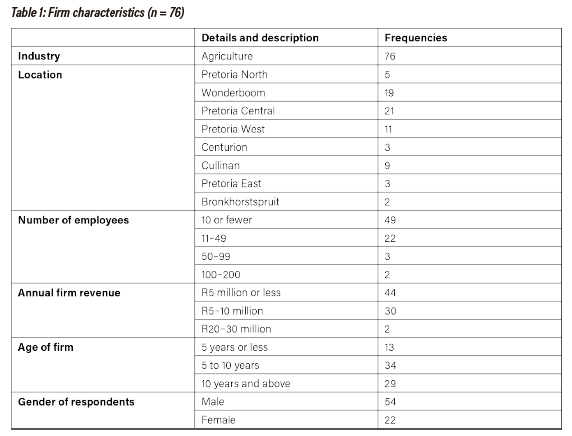
As indicated in Table 1 below, the 76 SMMEs who participated in the study were in the agriculture sector and were located in various regions of the city of Tshwane. Most of the firms were located in central Pretoria (the city of Tshwane). In addition, the majority of the SMMEs (49; 64.4%) had 10 or fewer employees. Most of the SMMEs (44; 57.8%) had an annual revenue of R5 million or less and only 2 (2.6%) had a revenue of between R20 million and R30 million. It was found that 34 (44.7%) had been in existence for between five and 10 years. Furthermore, 54 (71.0%) of the SMMEs owners were males, while 22 (29.9%) were females.
The frequency at which SMEs are using ICTs and how they are using them
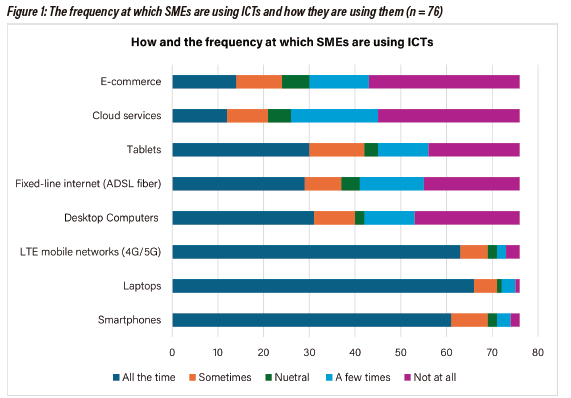
Respondents were asked to indicate the frequency at which they were using selected ICT tools and services. A Likert scale ranging from "Not at all" to "All the time" was used to measure their responses. Figure 1 below presents the results.
The results in Figure 1 show that 14 (18.4%) of the SMMEs were using e-commerce all the time, while 10 (13.1%) used it sometimes, 6 (7.8%) were neutral, 13 (17.1%) used it a few times and 33 (43.2%) did not use e-commerce it at all. Cloud services were used all the time by 12 (15.7%) SMMEs, while 9 (11.8%) used it sometimes, 5 (6.5%) were neutral, 19 (25%) used it a few times and a significant number - 31 (40.7%) -never used it. Furthermore, the results showed that many SMMEs (30; 39.4%) were using tablets all the time, while 12 (15.7%) sometimes used it, 3 (3.9%) were neutral, 11 (14.4%) used tablets a few time, and 20 (26.3%) never used tablets. Many (29; 38.1%) used ADSL fibre all the time, while 8 (10.5%) sometimes did, 4 (5.2%) were neutral, 14 (18.4) used it a few times and 21 (27.6%) never used ADSL fibre. Figure 1 also depicts that a significant number (31; 40.7%) of SMMEs were using desktop computers regularly, while 9 (11.8%) were using them sometimes, 2 (2.6%) were neutral, 11 (14.4%) used them a few times and 23 (30.2%) never used desktop computers. Insofar as long-term evolution (LTE) mobile networks such as 4G and 5G were concerned, the majority of SMMEs (63; 82.8%) were using them all of the time, followed by those who were using them sometimes, while 2 (2.6%) were neutral, 2 (2.6%) used them a few times and 3 (3.9%) did not use LTE at all. It can also be seen in Figure 1 that the majority of the SMMEs (66; 86.8%) used laptops all the time, followed by 5 (6.5%) who used them sometimes, while 1 (1.3%) was neutral, 3 (3.9%) used them a few times, and only 1 (1.3%) did not use laptops. Most of the SMMEs (61; 80%) used smartphones, followed by those who sometimes used them (8; 10.5%), while 2 (2.6%) were neutral, 3 (3.9%) used them a few times and only 2 (2.6%) did not use smartphones at all.
Digital divide faced by SMMEs
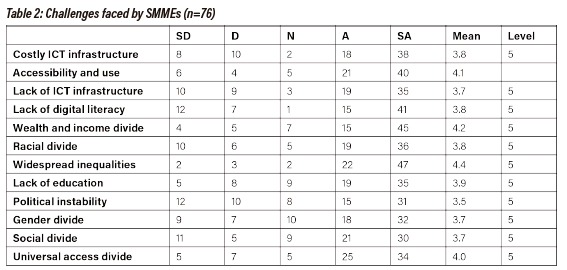
The respondents were asked to indicate the types of digital divide they were facing as a business. A Likert scale of "Strongly disagree 1 (SD); disagree 2 (D); neutral 3 (N); agree 4 (A); and strongly agree 5(SA)" was used to measure their responses. Table 2 below presents the results.
It can be seen in Table 2 that 8 (10.5 %) of the SMMEs strongly disagreed that costly ICT infrastructure was one type of digital divide they were facing as a business, while 10 (13.1%) disagreed, only 2 (2.6%) were neutral, 18 (23.6%) agreed and a significant number (38; 50%) strongly agreed. In addition, Table 2 depicts that 6 (7.8%) of the businesses strongly disagreed that they were facing a digital divide relating to accessibility and use, 4 (5.2%) merely disagreed, 5 (6.5%) were neutral, 21 (27.6%) agreed and a large number of 40 (52.6%) strongly agreed. Table 2 further shows that 10 (13.1%) of the SMMEs strongly disagreed that they were facing a digital divide relating to a lack of ICT infrastructure, while 9 (11.8%) disagreed, 3 (3.9%) were neutral, 19 (25%) agreed and 35 (46%) strongly agreed. The results also show that 12 (15.7%) of the SMMEs strongly disagreed that lack of digital literacy was a challenge they were facing, while 7 (9.2%) merely disagreed, only 1 (1.3%) was neutral, 15 (19.7%) agreed and the majority (41; 53.9%) strongly agreed. Regarding wealth and income divide, 4 (5.2%) strongly disagreed that it was a challenge they were facing, while 5 (6.5%) disagreed, 7 (9.2%) were neutral, 15 (19.7%) agreed and 45 (59.2%) strongly agreed. It can also be seen that 10 (13.1%) of the SMMEs had no issues with racial divide (strongly disagreed), while 6 (7.8%) disagreed, 5 (6.5%) were neutral, 19 (25%) agreed and the majority (36; 47.3%) strongly agreed that racial divide was a challenge.
Of the SMMEs surveyed, 2 (2.6%) strongly disagreed that widespread inequalities were a problem, while 3 (3.9%) disagreed, only 2 (2.6%) were neutral, 22 (28.9%) agreed and the majority (47; 61.8%) strongly agreed that this was a problem. With regard to a lack of education, 5 (6.5%) SMMEs had no issues with this (strongly disagreed), while 8 (10.5%) disagreed, meaning they also had no problem in that respect, 9 (11.8%) were neutral, 19 (25%) agreed and 35 (46%) strongly agreed that lack of education was an issue. Among the SMMEs, 12 (15.7%) strongly disagreed that political instability was a challenge and 10 (13.1%) disagreed, while 8 (10.5%) were neutral, 15 (19.7%) agreed and 31 (40.7%) strongly agreed that political instability was a problem. Table 2 depicts that 9 (11.8%) of the businesses strongly disagreed that gender divide was a problem, 7 (9.2%) disagreed, 10 (13.1%) were neutral, 18 (23.6%) agreed and a large number strongly agreed (32; 42.1%). It can be seen from Table 2 that 11 (14.4%) of the SMMEs strongly disagreed that social divide was one form of the digital divide they were facing as a business, while 5 (6.5%) disagreed, only 9 (11.8%) were neutral, 21 (27.6%) agreed and a significant number (30; 39.4%) strongly agreed. Regarding universal access divide, 5 (6.5%) strongly disagreed that this was a challenge they were facing, while 7 (9.2%) disagreed, 5 (6.5%) were neutral, 25 (32.8%) agreed and 34 (44.7%) strongly agreed.
DISCUSSION OF FINDINGS
The digital divide exists globally and has impacted people of different ages, races, genders, education levels and economic standing. As a result, the divide has exacerbated existing inequities, which makes it more difficult for disadvantaged groups to improve their circumstances. For example, a lack of access to ICTs could limit businesses' access to the digital economy and prevent them from accessing information that could help with economic advancement. It is a well-known fact that small business owners often lack the capital to fund their efforts and do not have a convincing enough credit profile to receive funding. These issues are exacerbated by cycles of social injustice and income inequality emanating from South Africa's history. Added to this mix is a culture of conservatism among many major banks in South Africa. Financial institutions are not keen to issue loans to start-ups established by younger persons, because they are perceived as a risky investment. In addition, acquisition costs are extremely high, and SMMEs often lack the same spending power as larger and more established firms.
Significantly, the study also revealed the lack of digital literacy in most SMMEs - a problem that hampers their full adoption of technology. In support of these results, numerous studies confirm that one of the areas where SMMEs struggle is losing their skilled workforce to competitors, especially the bigger ones in the same industries (Dahbi & Benmoussa, 2019; Rahayu & Day, 2015). In addition, hardworking employees can be the making of a business, but it is not as easy for small businesses to attract good human resources as it is for more established firms. It has also been observed that most people starting a new business lack proper and relevant skills to run the business. For instance, many business owners do not have any background in accounting or bookkeeping (Elia et al., 2019; Kartiwi et al., 2018; Lestari et al., 2021; Mohan & Ali, 2019). As a result, keeping on top of finances can be time-consuming and stressful.
The results show that most of the SMMEs lacked funds for ICT infrastructure. Every business needs capital to operate. Often, however, small businesses find it hard to secure funding, regardless of whether the idea is good or not (Esmaeilpour et al., 2016; Tolstoy et al., 2021; Yang et al., 2015). It is important to note that, for any business to succeed, relevant resources are required. These resources help the business to increase its ability to deliver on its mandate, efficiency and quality. Regrettably, access to many of these resources can be realised only by having capital. The surveyed SMMEs reported that a lack of capital or cash flow was their main obstacle. Most SMMEs mentioned that inadequate ICT infrastructure was a serious challenge that impeded their complete adoption of technology. Other than ICT infrastructure, having reliable and constant access to water, electricity, proper roads, affordable communication services, and safe and reliable public transport were extremely crucial factors for business success and growth. Several SMME owners start operating in their households and, if they lack sufficient and relevant utilities, they fail to produce goods, conduct services, or effectively communicate with existing and potential customers, including business partners.
The results in Table 2 show that most of the businesses are facing infrastructure divide. A lack of modern infrastructure in different regions plays a big part in the digital divide. For example, rural communities often lack access to high-speed internet and other telecommunications services in their towns and communities. Businesses that lack the proper infrastructure to support broadband and other ICT needs are unable to take advantage of modern economic opportunities. In addition, the results show that most of the SMMEs are facing a wealth and income divide. Similarly to the infrastructure of different regions, wealth and income play determinative roles in businesses' access to ICT. Racial divide was reported as a stumbling block to the growth of SMMEs. The racial digital divide gives name to ICT access divide between white people and people of colour. For instance, a study conducted by the Pew Research Centre established that while 8 in 10 white households reported owning a laptop or desktop computer, only 69% of Black adults and 67% of Hispanic adults reported the same (Pew Research Centre, 2021).
Although the digital divide remains an important challenge to overcome around the world in developed and developing countries alike, the impact on developing countries differs from the impact on developed countries. For instance, compared to developed countries, developing countries are more likely to experience numerous challenges. One of these challenges relates to widespread inequalities. Scholars argue that in developed countries, access to resources such as computers is typically available through public institutions such as libraries (Elia et al., 2019; Kartiwi et al., 2018; Lestari et al., 2021; Mohan & Ali, 2019). In developing countries, inequalities from a lack of Internet connectivity or because of 5G deployment challenges ccould cause divides across a larger percentage of the population. Resources are not available through alternative means, so many people simply do not have any access. The results further show that most SMMEs strongly agreed that lack of education contributes to maintaining the digital divide. This is attributed to the fact that, in developed countries, individuals may struggle to get an adequate education, but public education is available, and there are programmes to help children catch up (Esmaeilpour et al., 2016; Tolstoy et al., 2021; Yang et al., 2015). In developing countries, individuals might not have access to education for any number of reasons, including a lack of transportation. The majority of SMMEs revealed that political instability was also a challenge. Experts argue that in developing countries, political limitations on technological access and unstable governments could prevent individuals from having consistent access to the resources needed to close the digital divide (Esmaeilpour et al., 2016; Tolstoy et al., 2021; Yang et al., 2015).
The results further show that the majority of SMMEs felt that gender divide was a challenge that affected them. It has been observed that women were less likely to own a phone or have access to the Internet, illustrating a gender gap in mobile connectivity. The results also show that social divide was reported as a challenge. Social divide is defined by experts as unequal access to the Internet which contributes to social stratification, as groups without Internet access cannot reap the benefits of interaction with online peer groups (Dahbi & Benmoussa, 2019; Rahayu & Day, 2015). It can be seen in Table 2 that a significant number of businesses strongly agreed that they were facing a universal access divide. This kind of digital divide refers to individuals with physical disabilities not having access to or the ability to use hardware and software. The reasons for this type of divide could include digital illiteracy, low education levels and poor broadband infrastructure.
Interpreted in light of UTAUT, it is worth noting that although SMMEs are facing several challenges emanating from the digital divide, at least they understand the significance of technology integration in their operations. For instance, the performance expectancy element suggests that the main reason SMMEs adopt technology is because they want to transform and improve work productivity and creativity. This is because business owners perceive technology as a critical tool for transforming business operations. Regarding the effort expectancy element, it can be deduced that SMMEs adopt technology to improve traditional methods of doing business. Therefore, SMMEs perceive ICT as a tool that is not complex to operate for enhanced business operations. In addition, the social influences element suggests that SMMEs are using technology because it is hassle-free. Although the results show that the majority of SMMEs lack relevant ICT infrastructure, it is important to note that the facilitating conditions element implies that business owners who have relevant and sufficient technological infrastructure are most likely using technology to enhance business processes and improve work productivity and creativity.
CONCLUSION AND RECOMMENDATIONS
This article sought to examine the digital divide as a barrier to the adoption of ICTs by SMMEs in the agribusiness sector in the city of Tshwane, South Africa. To realise the aforementioned aim, the paper answered the following questions: (a) What types of ICTs are adopted by SMMEs and how frequently do they use them? and (b) What kinds of digital divide are faced by SMMEs in their operations? Although a variety of ICTs were being used by SMMEs in the agribusiness sector to enhance their business processes, many of these tools were not optimally used for a variety of reasons mainly emanating from the digital divide. The ICTs tools that were adopted included cloud services, tablets, fixed-line internet (ADSL fibre), desktop computers, LTE mobile networks (4G/5G), laptops and smartphones. The results showed that some of the ICT tools were used more frequently than others. There are several reasons for this, for instance, one could have a smartphone but still not use it for business purposes related, possibly, to a lack of skills on how to use such a tool for e-commerce purposes. Interestingly, although most SMMEs owners indicated that they had access to smartphones, laptop computers and LTE mobile networks, very few were using e-commerce. Cloud services also play a critical role in e-commerce, yet only a few SMMEs indicated that they used them. This could be attributed to challenges such as a lack of proper ICT infrastructure, a lack of funds and a lack of digital skills. Many of these challenges emanate from the digital divide. In general, it is important to note that the digital divide may prohibit businesses from coping with market competition, the attraction of new customers, a lack of funding/ capital, managing business expansion, reduced revenue, a lack of digital literacy and lack of proper ICT infrastructure. The results revealed that upskilling SMME owners on digital technologies to enhance work productivity and creativity and to allow them to take part in e-commerce is an immediate necessity. The adoption of technology has the potential to enable SMMEs to play a crucial role in poverty alleviation and improving the economy of South Africa. Therefore, the reskilling of the SMME workforce in digital skills and capability is of the utmost importance.
Given that the digital divide exists globally and has impacted people of different ages, races, genders, education levels and economic standing, SMMEs are no exception. Consequently, the digital divide has exacerbated existing inequities, which makes it more difficult for disadvantaged groups and SMMEs to improve their circumstances. This article found that some common types of digital divide include infrastructure divide; wealth and income divide; racial divide; widespread inequalities; lack of education; and political instability. The lack of modern infrastructure in South Africa plays a big part in the digital divide. SMMEs located in areas that lack the proper infrastructure to support broadband and other ICT needs are unable to take advantage of modern economic opportunities. The digital divide is a significant challenge that needs to be eradicated for SMMEs to strive, but solutions do exist. The digital divide can easily be closed by implementing digital inclusion policies, programmes and tools that take into consideration the following: affordable, robust broadband internet service; internet-enabled devices that meet the needs of the user; access to digital literacy training; quality technical support; and applications and virtual content designed to enable and encourage self-sufficiency, participation and collaboration. To address the challenges faced by SMMEs in South Africa, this article recommends a conducive and stable ICT policy that will not only promote and advocate complete access to digital technologies, but also allow for ICT infrastructural development that will address the challenges faced by businesses in accessing digital technologies.
REFERENCES
LITERATURE REVIEW
- Abd Hamid, N., Ibrahim, N.A., Ibrahim, N.A., Ariffin, N., Taharin, R. & Jelani, F.A. (2019). Factors affecting tax compliance among Malaysian SMEs in e-commerce business. International Journal of Asian Social Science, 9(1):74-85.
- Adams, J., Khan, H.T. & Raeside, R. (2014). Research methods for business and social science students. India: SAGE Publications.
- Calzadilla, A., Zhu, T., Rehdanz, K., Tol, R.S. & Ringler, C. (2014). Climate change and agriculture: Impacts and adaptation options in South Africa. Water Resources and Economics, 5(1):24-48.
- Dahbi, S. & Benmoussa, C. (2019). What hinder SMEs from adopting E-commerce? A multiple case analysis. Procedia Computer Science, 158(1):811-818.
- Dal-Tayyar, R.S., Abdullah, A.R.B., Abd Rahman, A. & Ali, M.H. (2021). Challenges and obstacles facing SMEs in the adoption of e-commerce in developing countries: A case of Saudi Arabia. Studies of Applied Economics, 39(4):33-44.
- Davis, F. (1989). Perceived usefulness, perceived ease of use, and user acceptance of information technology. MIS Quarterly, 13(3):319-339.
- Davis, F.D., Bagozzi, R.P. & Warshaw, P.R. (1989). User acceptance of computer technology: a comparison of two theoretical models. Management Science, 35(8):982-1003.
- Dharmaraj, V. & Vijayanand, C. (2018). Artificial intelligence (AI) in agriculture. International Journal of Current Microbiology and Applied Sciences, 7(12):2122-2128.
- Elia, S., Giuffrida, M. & Piscitello, L. (2019). Does e-commerce facilitate or complicate SMEs' internationalisation? ICE, Revista de Economía, 909(1):61-73.
- Esmaeilpour, M.A.J.I.D., Hoseini, S.Y. & Jafarpour, Y. (2016). An empirical analysis of the adoption barriers of e-commerce in small and medium sized enterprises (SMEs) with implementation of technology acceptance model. The Journal of Internet Banking and Commerce, 21(2):10-21.
- Foya, D. & Garikayi, V.R. (2021). The impact of Covid-19 related restrictions on e-commerce adoption and use by SMEs in Zimbabwe: Case of Bulawayo province (March 2020 to October 2021). Indiana Journal of Humanities and Social Sciences, 2(1):55-74.
-
Gillwald, A., Calandro, E., Sadeski, F. & Lacave, M. (2019). Unlocking the potential of the Fourth Industrial Revolution in Africa. Available from: https://4irpotential.africa/wpcontent/uploads/2019/10/4IR_SOUTHAFRICA_V01PRINT.pdf
» https://4irpotential.africa/wpcontent/uploads/2019/10/4IR_SOUTHAFRICA_V01PRINT.pdf - Hanushek, E.A. & Jackson, J.E. (2013). Statistical methods for social scientists. New York: Academic Press.
- Kara, H. (2015). Creative research methods in the social sciences: A practical guide. Chicago: Policy press.
- Kartiwi, M., Hussin, H., Suhaimi, M.A., Mohamed Jalaldeen, M.R. & Amin, M.R. (2018). Impact of external factors on determining E-commerce benefits among SMEs in Malaysia. Journal of Global Entrepreneurship Research, 8(1):1-12.
- Lai, J. & Widmar, N.O. (2021). Revisiting the digital divide in the COVID-19 era. Applied Economic Perspectives and Policy, 43(1):458-464.
- Lestari, D., Siti, M., Wardhani, W. & Yudaruddin, R. (2021). The impact of COVID-19 pandemic on performance of small enterprises that are e-commerce adopters and non-adopters. Problems and Perspectives in Management, 19(3):467.
- Malinga, A.L. & Oosthuizen, R. (2021). Technology road mapping and systems engineering -A symbiotic relationship? 15th INCOSE SA Annual Conference, Pretoria, South Africa, September 2021.
- Mbatha, M.W. & Masuku, M.M. (2018). Small-scale agriculture as a panacea in enhancing South African rural economies. Journal of Economics and Behavioural Studies, 10(6):33-41.
- Mohan, V. & Ali, S. (2019). Challenges faced by Indian MSMEs in adoption of internet marketing and e-commerce. Academy of Marketing Studies Journal, 23(1):1-9.
- Moore, G. & Benbasat, I. (1991). Development of an instrument to measure the perceptions of adopting an information technology innovation. Information Systems Research, 2(3):192-222.
- Ndhleve, S., Obi, A. & Nakin, M.D.V. (2017). Public spending on agriculture and poverty in Eastern Cape province, South Africa. African Studies Quarterly, 17(2):23-46.
- Ngcobo, S. & Sukdeo, R. (2015). Challenges facing SMMEs during their first two years of operation in South Africa. Corporate Ownership and Control, 12(3):505-512.
- Nkosi, M. & Agholor, A.I. (2021). The Fourth Industrial Revolution and its implication for agricultural advisory services in South Africa: a review. Turkish Online Journal of Qualitative Inquiry, 23(1):44-56.
-
Pew Research Centre. (2021). Home broadband adoption, computer ownership vary by race in the US. Available from: https://www.pewresearch.org/short-reads/2021/07/16/home-broadband-adoption-computer-ownership-vary-by-race-ethnicity-in-the-u-s/ [accessed 13/8/2023]
» https://www.pewresearch.org/short-reads/2021/07/16/home-broadband-adoption-computer-ownership-vary-by-race-ethnicity-in-the-u-s/ - Ragnedda, M. & Muschert, G.W. (2013). The digital divide. Florence, KY: Routledge.
- Rahayu, R. & Day, J. (2015). Determinant factors of e-commerce adoption by SMEs in developing country: Evidence from Indonesia. Procedia - Social and Behavioral Sciences, 195(1):142-150.
- Ramsetty, A. & Adams, C. (2020). Impact of the digital divide in the age of COVID-19. Journal of the American Medical Informatics Association, 27(7):1147-1148.
- Savrul, M., Incekara, A. & Sener, S. (2014). The potential of e-commerce for SMEs in a globalizing business environment. Procedia - Social and Behavioral Sciences, 150(1):35-45.
- Statista (2024). Internet usage worldwide - Statistics & Facts. Available from: https://www.statista.com/topics/1145/internet-usage-worldwide/
-
Tennant, J. (2018). SA's key economic sectors. Brand South Africa. Available from: https://www.brandsouthafrica.com/investments-immigration/business/investing/economicsectors-agricultural
» https://www.brandsouthafrica.com/investments-immigration/business/investing/economicsectors-agricultural - Tolstoy, D., Nordman, E.R., Hánell, S.M. & Özbek, N. (2021). The development of international e-commerce in retail SMEs: An effectuation perspective. Journal of World Business, 56(3):101165.
- Tolstoy, D., Nordman, E.R. & Vu, U. (2022). The indirect effect of online marketing capabilities on the international performance of e-commerce SMEs. International Business Review, 31(3):101946.
- Van Dijk, J. (2020). The digital divide. Hoboken, USA: John Wiley & Sons.
- Venkatesh, V., Morris, M.G., Davis, G.B. & Davis, F.D. (2003). User acceptance of information technology: Toward a unified view. MIS Quarterly, 12(1):425-478.
- Yang, T., Xun, J. & He, X. (2015). British SMEs' e-commerce technological investments and firm performance: an RBV perspective. Technology Analysis & Strategic Management, 27(5):586-603.
- Zaied, A.N.H. (2012). Barriers to e-commerce adoption in Egyptian SMEs. International Journal of Information Engineering and Electronic Business, 4(3):9-23.
- Zwane, E.M. (2019). Impact of climate change on primary agriculture, water sources and food security in Western Cape, South Africa. Jamba: Journal of Disaster Risk Studies, 11(1):1-7.
Accepted September 2024