The Impact of Leadership and Rewards on Project Management Success, Mediated by Employee Perception and Team Cohesion
Abstract
The increasing competition in companies necessitates an emphasis on project management to accomplish success. Leaders must possess both technical and social skills, as their management and perception significantly influence decision-making and team cohesion. The usage of diverse leadership rewards, and styles, both non-financial and financial, by project management leaders, nurtures team cohesion, promotes team essence, and motivates necessary project decisions. This study investigates the impacts of directive and supportive leadership, mediated by work team cohesion and non-financial, and financial rewards, on project success. A research model was established based on a literature review, analyzing the relationship between the causes and effects of the research variables. A questionnaire was collected from 237 individuals in project management teams over the last 6 months from the Munich Bavaria region of Germany. From the results obtained, it appears that directive leadership and supportive leadership positively influence the cohesion of work teams. In this work, it was also found that directive leadership has a positive impact on the success of project management for the client and that financial rewards have an opposite effect. It is concluded that organizations must value the importance that adjusted leadership, on the part of the manager, has in team cohesion and that the financial rewards system used by companies is something to take into account when they set out to achieve success. The importance of this research lies in the fact that with its empirical findings, it provides information on how the various types of leadership and reward systems impact team cohesion and project success, which has been a substantial gap in project management literature and is of great symbolic help to the developing organization with the effective leadership and motivational strategies, which can impact the project outcome results.
Employee Perception Directive Leadership; Project Management; Team Cohesion; Supportive Leadership; Rewards
1. INTRODUCTION
Project management has become an important part of professional development, and task-based work is common in organizations. Team members play an important role in a project's tasks, and project success is determined by its objectives, stakeholder satisfaction, meeting deadlines, and project expenditures. It is important for project managers to recognize and understand the concept of critical success factors (CSFs) was introduced by (Ibrahim et al., 2017), who defines it as the set of decisions necessary for a manager to achieve his or her goals A strong sense of leadership is considered successful if it is important for businesses. Another key success factor identified in the literature that motivates them to put in any effort is a reward system, whether financial or non-financial rewards can be divided into two categories: non-financial rewards, such as promotions, job security, and autonomy, and financial rewards, such as bonuses, prizes, and bonuses, indicating that employee commitment determines capable outcomes see for the success of the organization and the business.
In short, project management plays an important role in the development of the enterprise, and understanding and implementing the critical success factors (CSFs) is essential to the success of the project (Malynovska et al., 2022). By focusing on those factors, project managers can ensure the survival and success of their projects and promote a positive working environment (Raziq et al., 2018). Analysis of critical success factors in business emphasizes the importance of leadership, rewards, and teamwork.
1.1.
Research GapThe research's goal is to look into the effect of leadership styles (directive vs. supportive) on team cohesion in project management. One main reason for this gap is that not much work has been completed in this area and more evidence needs to be gathered about the leadership impact on team dynamics and project outcomes (Akgun et al., 2022). Consequently, the paper shall compare the influence of financial vs. non-financial rewards on project success. The authority of the financial method is pretty high but very little is known about how the introduction of non-financial measures helps in reward promotion and project performance.
1.2.
Contribution to Existing KnowledgeThe study will form the evidential base of efficient leadership techniques by proving the leadership styles, team cohesion, and project success relationships experimentally (Engelsberger et al., 2022). It will specify the team building methods that are most useful to make the team a team that shares a common vision (Shen et al., 2023). The work will also provide a great contribution by giving experimental results on the efficiency of different reward systems. It will show how financial and non-financial rewards can be used to raise project outcomes and employee satisfaction more effectively (Reeves et al., 2008).
1.3.
Research ObjectivesBased on the identified gaps and contributions, the research objectives can be stated as follows:
• Objective 1: The study hypothesizes that directive leadership strongly influences the team's solidarity within project management scopes.
• Objective 2: On the other hand, supportive leadership is likely to increase the cohesiveness of the team and the same effect can be transferred to the project outcome.
• Objective 3: This study will also seek to determine the difference between team cohesion and project success through the application of financial rewards when non-financial rewards are also implemented.
• Objective 4: Typical factors that moderate employee perception of the leadership style, rewards, and project management outcome are the subjects of this research.
The reached goals are exactly related to the open issues located in the literature and they should be moved toward a better understanding of crucial parts of project management, leadership legitimacy, and motivational strategies.
This review of literature aims to clarify the topic of project management and its success, citing various authors who have studied it over the years. It presents the concepts of project management and the factors influencing its success.
2.1. Project Management
Project definition focuses on creating a single product or service, while the second approach considers organizations as dynamic and constantly evolving. Both definitions emphasize the project's temporary nature, but the second approach is more comprehensive, considering the creation of products and services as a means to achieve strategic objectives for organizational competitiveness. Project management is unique and aims to take operational command of resources, execute procedures in a coordinated manner, minimize errors, and achieve success. The British Standard in Project Management 6079 (1966) defines project management through four phases: planning, monitoring, control, and motivation. The "iron triangle" criteria for success in project management are cost, time, and quality (Walumbwa et al., 2011). However, these criteria are now seen as a way of measuring project success rather than success factors (Ahmad et al., 2022). Project success is subjective and influenced by the perspective of the person measuring it. Project success is measured by criteria and time, cost, and quality, while project management success uses general objectives. However, project and management success is not directly related (Herzer et al., 2012).
2.1.1. Critical success factors
Critical success factors (CSFs) are a set of objectives that project managers commit to achieving to achieve project success and achieve desired results (Walker & Lloyd-Walker, 2019). They are defined based on the project's general objectives and must be managed by management. Over time, various studies have defined CSFs as characteristics, variables, or conditions that, if managed correctly, propel a project on the path to success (Engelsberger et al., 2024). The concept of CSFs has evolved over time, with some researchers referring to them as Critical Failure Factors. The study emphasizes the importance of top management support in project management, as it ensures motivation, focus, and necessary resources for project managers and their teams ((Ahmad et al., 2023).
2.2.
LeadershipProject managers' leadership is crucial for project success, as it helps solve technical and social problems, providing motivational support to team members (Bale & Jenkins, 2018). Leadership styles include distributed, horizontal, vertical, structural initiation, service, transactional, and transformational (Pons, 2008). Transactional leadership promotes intelligence, rationality, and problem-solving, while directive leadership is task-oriented, and supportive leadership is oriented toward team behavior (Phillips & Bullock, 2020). Project managers must exhibit high levels of both types of leadership in order to be successful. Understanding the difference between strategic and supportive leadership is important for research on project management success (Petrucci & Rivera, 2018).
Strategic leadership is a management style in which managers direct team members to tasks, control discussions, and manage communication (Osanlou & Hull, 2017). This approach contributes to individual and team efficiency and success (Nasiopoulos et al., 2014). However, it can lead to a lack of cohesion and transparent communication, negatively affecting team cohesion (Mocinic et al., 2022). On the other hand, supportive leadership focuses on meeting employees' needs, creating an appropriate working environment, and resolving conflicts, which will ultimately lead to successful project management (Livia, 2006).
2.3.
Team CohesionCohesion refers to the attraction and motivation of team members to work together to achieve a common goal (Lim & Goh, 2023). An understanding of effective leadership and inter-team communication is important for managers and work teams (Kodama, 2005). It leads to increased focus, performance, and innovation in organizations (Lee & Oguntebi, 2012). Studies show that team cohesion positively impacts company performance, with some companies restructuring management models to provide more efficient and flexible responses to complex work (Kazemi et al., 2020). Cohesion can be interpreted through two perspectives: task execution and social issues (Jarvis & Quick, 1995). The ultimate goal is to unite the group to successfully complete the project (Jankowski, 2006). Effective leadership behavior and style within the work group are essential for cohesion, as groups with an individualistic tendency may be less receptive to social and corporate behaviors.
2.4.
RewardsProject managers and senior management are increasingly focusing on strategies to motivate team members and achieve success (Iqbal, 2021). Feldman's research suggests that the sector of activity and projects significantly influences employee remuneration, with rewards increasing as employees move up the hierarchy. Effective human resources management can positively impact project results, and a reward system that includes increased remuneration and career promotion can increase success.
2.4.1. Financial rewards
Project management team managers often use financial rewards to avoid dissatisfaction among team members. While money may not be the best motivation, it is appreciated for its value and individual value. Organizations develop reward programs based on remuneration and benefits to attract and retain employees (Hung et al., 2017). Financial rewards such as base salaries, performance bonuses, allowances, and special bonuses greatly affect employee motivation and performance. Companies with higher salaries have higher levels of motivation, focus, and success teams because they recognize sacrifice, dedication, and recurring personal recognition (Hogan, 2011).
2.4.2. Non-financial rewards
Project managers should motivate their teams through non-financial rewards such as autonomy, trust, and support. These awards can create a sustainable competitive advantage for the management and the organization. Program managers can empower and autonomize team members in decision-making, demonstrate confidence in their work, and encourage sustained efforts to succeed (Hoang et al., 2021). The relationship between compensation, motivation, and job satisfaction is critical to creating dynamic knowledge and an environment for management success. Although organizations place a high value on financial compensation, it is important for managers to choose compensation that is appropriate for the needs of each team member. It is important not to assume that all employees have the same objectives and that using the same strategy will produce the same positive results.
2.5.
Employee Perception of SuccessEmployee perception has an effect on the entire success of a firm. A pleasant and encouraging work environment is favorably connected with employee engagement and motivation, which in turn frequently translates into increased job satisfaction and productivity. It is impossible to exaggerate the importance of employee perception in determining project management. Pleasant perceptions encourage inclusion, openness, and trust, which develop a pleasant work atmosphere where staff members feel respected and empowered. Negative perception, on the other hand, undermines morale and erodes trust by encouraging skepticism, resentment, and disengagement (Hanna, 2001).
2.6.
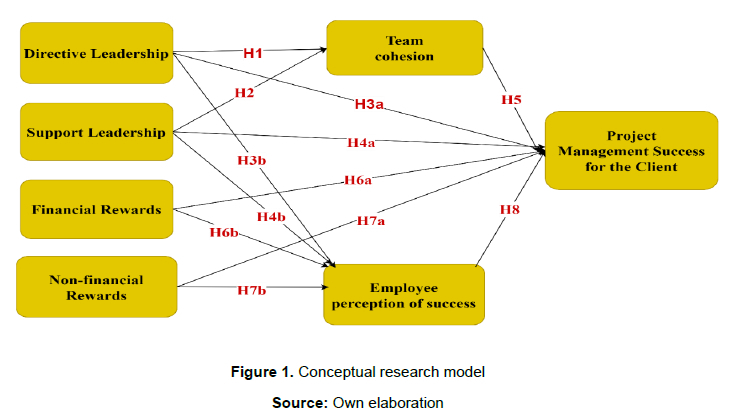
Research hypotheses and conceptual modelThe literature review highlights the impact of leadership, team cohesion, and financial rewards on project management success. A directive leader directs project teams toward success, keeping them focused and performing tasks effectively (Getzin et al., 2016). This leadership style is particularly beneficial during project growth and role definition and in short-term projects or emergency situations. The study in question aims to analyze the following research hypothesis:
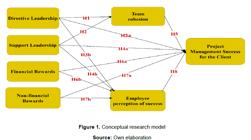
Hypothesis 1: Directive leadership positively influences the cohesion of project teams.
Supportive leadership is a leadership style that prioritizes team members' preferences and enjoyment, fostering a friendly environment where they feel part of the project. This style encourages debate, and participation in decision-making, and promotes cohesion among team members. It also dissuades conflicts, creating a climate of mutual assistance. Therefore, this study will test the following research hypothesis:
Hypothesis 2: Supportive Leadership positively influences the cohesion of project teams.
The behavior of a directive leader reduces indecision regarding employee decision-making, clarifying how they should act in the face of the project's needs, and how their role and effort inherent to the functions they perform contribute to success (Andersen, 2010). In this way, directive leadership focuses on providing precise and detailed instructions, in order to facilitate the perception of team members regarding their role and how they should perform it, curbing creativity and the dispersion of ideas and contributing to the team's productivity and consequently the success of the project. In this context, the study carried out will test the following research hypothesis:
Hypothesis 3: Directive Leadership positively influences the success of the project.
From another point of view, supportive behavior on the part of the project manager, by focusing on the needs of each member of the project team, develops a favorable work climate, encouraging creativity and the sharing of ideas, which can be a differentiating factor in achieving success (Badi, 2024). By encouraging discussion and intervention from all members of the group, the manager seeks to support and understand the entire team, contributing to a climate of well-being that motivates everyone to focus on work. Therefore, the following research hypothesis will be tested:
Hypothesis 4: Supportive Leadership positively influences project success.
By strengthening social ties between team members, we can reduce conflicts between them, which becomes effective in improving project performance (Brannon et al., 2009). The team reveals a greater capacity for work when it is motivated by the cohesion that exists between the different team members, so the project has a greater chance of being successful as the team is more likely to exchange opinions with each other develop and encourage the success of the project. Therefore, the following hypothesis is formulated and will later be tested:
Hypothesis 5: The cohesion of project teams positively influences the success of the project.
Rewards can enhance team satisfaction, despite challenges in choosing appropriate motivations. Project management team managers use financial rewards as a short-term motivation method, but long-lasting teams value non-financial rewards (Dominguez et al., 2016). Non-financial rewards, based on human capital motivation, are considered a competitive advantage, creating a dynamic and unique environment for the project and organization. Financial rewards may leave gaps in team knowledge and skills, while non-financial rewards provide tools like autonomy, trust, and support for project leaders to direct and motivate their teams.
Hypothesis 6: Financial rewards positively influence project success.
Hypothesis 7: Non-financial rewards positively influence project success.
Employee perception significantly impacts a company's success. Positive and supportive work environments increase engagement, motivation, productivity, and job satisfaction. Project management is significantly influenced by employee perception (Denning, 2019). Positive perception fosters trust, transparency, and inclusivity, while negative perception leads to skepticism, resentment, and disengagement, eroding trust and morale. Therefore, a positive work environment is crucial for a company's success.
Hypothesis 8: Test to confirm that employee perception of success influences project management success.
2.6.1. Conceptual model
The research model, designed based on study hypotheses, aims to assess the influence of leadership and rewards on project management success, influenced by team cohesion.
2.6.2. Conclusion of the theoretical framework
The study aims to understand the perception of project management teams regarding leadership style, rewards, and team cohesion. It focuses on the expanding business world and the importance of understanding employees' perceptions of leadership and rewards. The study aims to determine if effective leadership reinforces team cohesion and if a reward system that represents the project team's characteristics positively influences project success. Understanding these factors is crucial for project success.
3. METHODOLOGY
This study uses the deductive method to investigate events or technical systems without interfering with random data collection. The purpose is a confirmatory methodological approach, defining multiple alternatives or hypotheses. Data is collected to verify the support of defended theories (Hauptman & Hirji, 1999). The research is conclusive-causal of a transversal nature, providing clarifications on the problem. The data collected is measured and quantified, subjecting it to analysis methods and techniques. The research is classified as quantitative, as it can be measured and quantified.
The deductive method chosen for this analysis seems to be the most rational one as the research is about testing hypotheses that are derived from the existing theories about leadership, rewards, and team health in project management (Zhu et al., 2013). The step is to have a structured study where authors can systematically evaluate the quality of interactions and the role of the variables in project success (Willerton, 1999). The deductive reasoning is in line with the prevalent literature on project management, which posits that leadership styles and reward systems have an important impact on team dynamics and outcomes.
To ensure the reliability and validity of the questionnaire foremostly, a comprehensive procedure should be specified. Reliability can be tested with methods like test-retest or internal consistency measures (e.g., Cronbach's alpha), which make the tool produce stable and consistent results over time (Unger-Aviram et al., 2013). Checks on validity should include content validity, with experts reviewing the questionnaire, thus deciding that it corresponds adequately to the constructs being measured, and construct validity, which will examine whether the questionnaire accurately reflects theoretical concepts in leadership and team cohesion (Tan et al., 2019). Over time, the researchers must maintain the quality of their findings through such tough checks, thus, increasing the credibility of their study and offering some useful suggestions of their own for successful project management.
3.1.
Sample DefinitionThis academic study focuses on a sample of project management teams in Munich Bavaria region Germany companies from January to May 2024. The target population is voluntary and non-probabilistic. Data collection was conducted during the post-pandemic, making it difficult to physically visit companies. The sample size was set at 237 elements, considering the robustness of the data processing software. The study was disseminated through email and LinkedIn, aiming to gather information about project management teams in the region.
3.2.
Instruments and Procedures for Data CollectionA questionnaire is a tool used by researchers to gather relevant information about individuals under study. It is divided into three parts: company purpose, project management, variables under analysis, and respondents' characteristics. The questionnaire was adapted from previous studies and scales, with questions from authors like (Sung, 2011). The data collection process began through email to companies in the Munich Bavaria region of Germany and online through LinkedIn, where project management teams in the last 6 months in the region completed the questionnaire. The questionnaire was finalized with final validation to avoid errors after distribution to end users.
3.2.1. Operationalization of variables and measurement scales
The literature review suggests using nominal scales for the first and third parts of the questionnaire, allowing for more information about respondents. For the second part, 5-point Likert scales are used to measure specific variables, ranging from Totally disagree to Totally agree. The study included additional questions in a questionnaire to provide sociodemographic characterization and project framing. The questionnaire aimed to characterize companies and respondents based on activity sector, reference model, worker numbers, project durations, categories, gender, age, seniority, academic qualifications, functions, and salary levels.
4. PRESENTATION AND DISCUSSION OF RESULTS
4.1
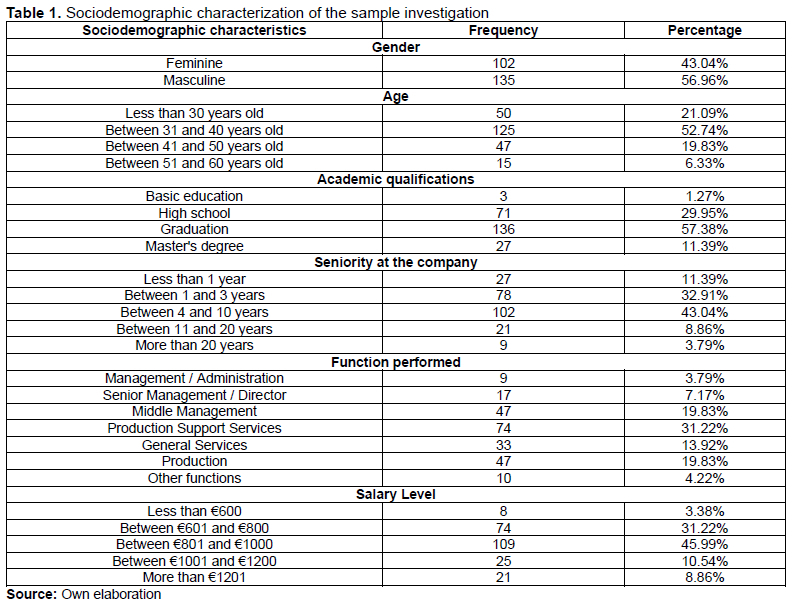
Sociodemographic Characterization of the SampleThe study collected 237 observations from 237 respondents, with 102 (43.04%) female and 135 (56.96% male) aged between 31 and 60 years old. The majority of respondents had a degree (54.9%). The seniority of respondents was found to be 102 (43.04%) with a tenure of 4 to 10 years, with 32.91% having a tenure of 1 to 3 years. The majority of respondents performed production support services 74 (31.22%), with 47 (19.83%) performing production functions. The remaining respondents performed middle management functions, including administrative, accounting, marketing, and human resources. The majority of respondents earned a salary between €601 and €1000, inclusive, with 183 (77.21%) earning between €601 and €1000.
4.2
Descriptive StatisticsTable 1 shows the mean ranking of environmental conservation attributes influencing sustainable energy delivery. It is indicated that the overall most ranked variables are reduction in fossil fuel consumption (MIS = 4.56), adoption of clean, environmentally friendly technology (MIS = 4.37) and use of cleaner energy facilities for SeD (MIS = 4.35). While the least ranked variables are wildlife protection (MIS = 4.10) and less use of natural gas (MIS = 4.04). Furthermore, the value of Cronbach alpha for the measuring variables was given as 0.872.
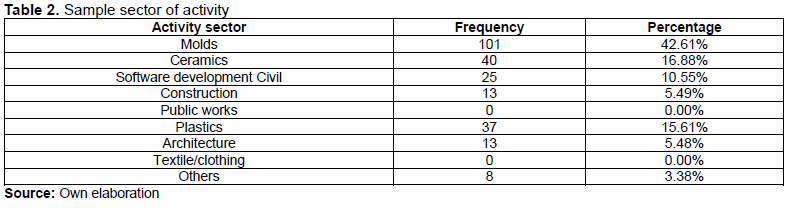
Data was collected on the companies' sectors of activity, primarily in molds and ceramics, to characterize the sample, as the respondents' managed projects in these sectors.
Related to the size of the company of each project management member, Table 3 shows how the sample is distributed. Thus, 116 of the project team members (49.00%) work in SME companies, up to 50 workers (N=107; 45.14%).
When characterizing the sample, the number of projects being executed simultaneously in the company was also analyzed (Table 4) and it was verified that 4 or more projects were being executed simultaneously in the companies (N=195; 82.4%).
Table 5 shows the average project duration (in months). In this sense, it is possible to observe that, in most cases (N=198; 83.4%), projects take, on average, more than 4 months.
There are 88 respondents who carry out projects related to new products, 12.75% enter new markets, 35 focus on technology development and information systems, 16 on engineering and construction, 7, 2, and 1 on research and development, organizational change, and changes in operation/production. 52 (21.75%) of project management team members have completed or have completed multiple projects in their companies.
4.2. Information Processing and Statistical Techniques
The study used SPSS statistical analysis software to collect empirical data through questionnaires. A database was created to define the profile of the surveyed individuals. Descriptive analysis was performed to understand the results from the structural model estimation. An exploratory factor analysis was conducted to verify measurement error. The results showed no single factor explaining the majority of variance, but the first factor explained 26%. Bartlett's tests of sphericity and Kaiser-Meyer-Olkin (KMO) confirmed the factor analysis's fit. The study concluded with Smart PLS 4 software for further analysis.
The study used a deductive method and confirmatory approach, with 237 participants, mostly male, aged 31-40, with bachelor's degrees, working in production support roles, and an average monthly income of €801-€1,000. A questionnaire was chosen for data collection, with a 5-point Likert scale used for measurement. The questionnaire was disseminated to Munich Bavaria in Germany's companies via email and LinkedIn, and the data was analyzed using SPSS 25 and Smart PLS 4.
The study involves three phases: measurement model consistency and validity, multicollinearity analysis, structural equation model estimation, and results interpretation, focusing on factors affecting project success.
4.3 Study of the Consistency and Validity of the Measurement Model
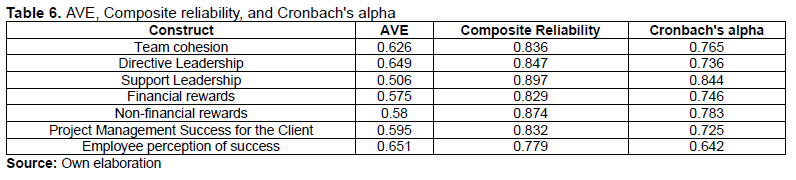
The study analyzed the measurement model and divided project success into two dimensions: client success and employee perception of success. Hypothesis 8 was added to reflect the impact of employee perception on client success. The indicator of average variance extracted (AVE) was used to verify positive correlations between latent variables. Values above 0.5 indicate a significant representation of the construct. Following the thought described, it can be seen in Table 6 that all constructs under investigation have convergent validity.
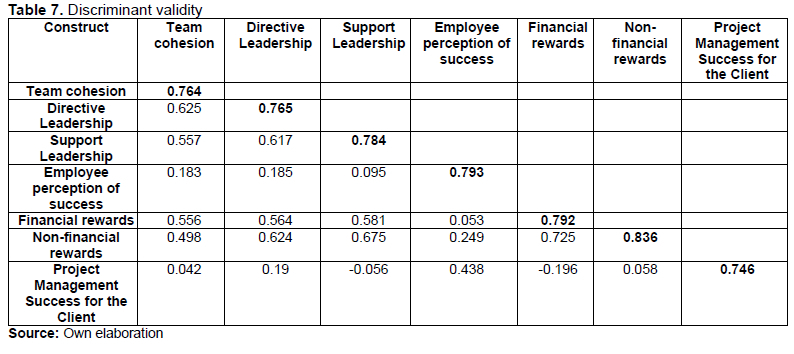
The study assessed the internal consistency of factors using the composite reliability index, which ranges from 0 to 1, and Cronbach's alpha coefficient to determine the reliability of concepts. Cronbach's alpha values range from 0 to 1, with values above 0.7 indicating reasonable reliability. Discriminant validity was also checked to understand the differences between the questions used to measure a construct. The study analyzed discriminant validity using Fornell and Larker's criteria, comparing square roots of AVE values with correlations between concepts or latent variables. The correlation matrix presented connections between different concepts.
In the analysis carried out on the validity and reliability of the measurement model, it is considered that the concepts under analysis verify the assumptions to consider that the measures used are valid and reliable so that it is possible to estimate the structural model and, therefore, test the hypotheses under study.
4.3.1 Multicollinearity analysis
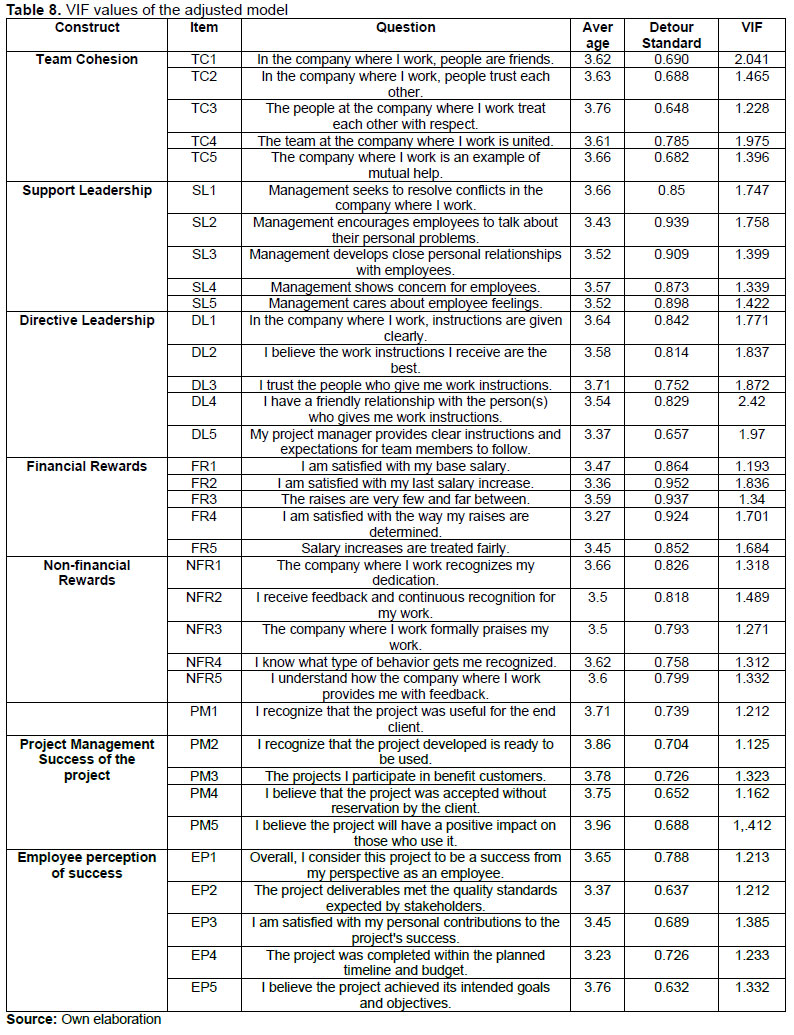
The study presents a descriptive analysis of variable measurement indicators using a 5-point scale. The results show that the highest average values are found in the items measuring the characteristics of project success. The highest average is found in items measuring the positive impact of the project on those who use it, meeting client's requests, and meeting the original schedule. The standard deviation of these items ranges from 0.812 to 0.952. The lowest averages are recorded in questions evaluating financial rewards, with the lowest averages referring to the way salary increases are determined, the treatment of salary increases fairly, and the recognition of dedicated employees financially. The standard deviation of these items is high, ranging between values of 0.841 and 0.952. In short, project team members value the success of their project within their team, giving greater value to their perspective of customer satisfaction. The study analyzes the reliability and validity of items and then examines multicollinearity using the VIF coefficient. Items with VIF values greater than 5 are eliminated, resulting in Table 8 showing VIF values for items with VIF < 5 and no multicollinearity issues.
4.4 Structural Model Estimation Results
The structural equation model was estimated using Smart PLS 4, a software with advantageous characteristics for complex model construction and understanding relationships between constructs.
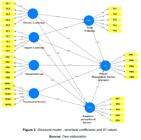
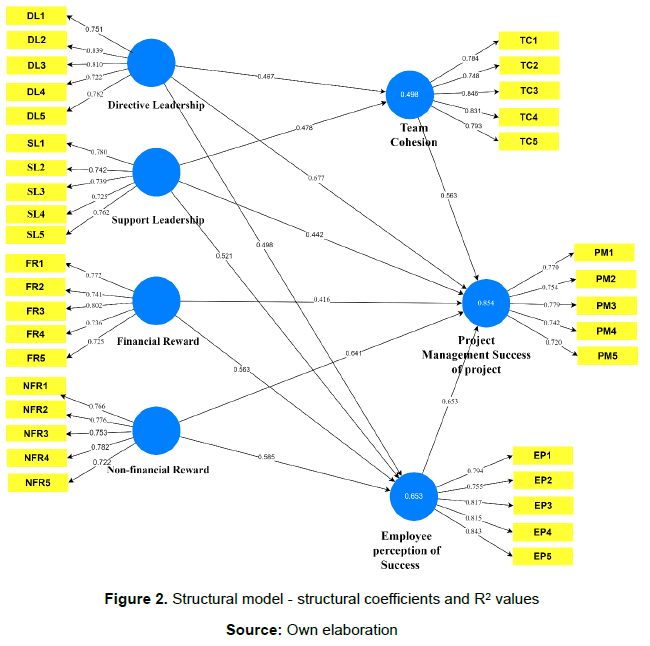
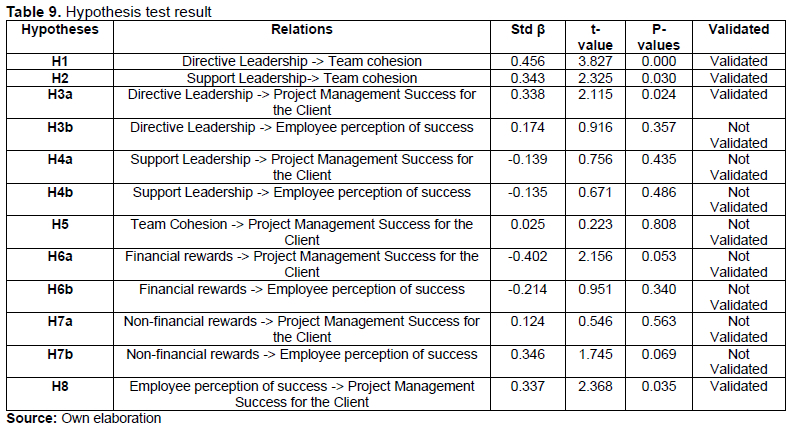
The study aimed to break down the "project success" variable into two dimensions: client success and employee perception of success. The structural model was used to evaluate Pearson's coefficients of determination (R2) and validate or reject the proposed model. The values of team cohesion, project management success for the client, and employee perception of success were analyzed. The significance of the statistical relationships was determined using the resampling technique bootstrapping with 5000 samples. The standardized path coefficients (Std β) associated with R2 indicated the probability of confirmation or rejection of hypotheses. Table 9 presents the result of the hypothesis test.
Table 9 confirms that 12 hypotheses, H1, H2, H3a, and H8, are statistically relevant and have values of students equal to or greater than 1.96. Hypothesis h6a, which predicted a negative effect on success, was not corroborated.
4.5 Discussion of Results
The study finds directive and support leadership to play a major part in improving cohesiveness required for team effectiveness to achieve successful projects. To increase reporting, it is important to mention whether the observed relations are statistically significant and determine trends. Directive Leadership plays an important role in facilitating team cohesion by giving clear direction and expectations that lead to a more structured team climate. The statistical test verified this relationship is statistically significant at an acceptable level of confidence (e.g., p < 0.05). Supportive Leadership: Likewise, supportive leadership, which focuses on the well-being and needs of team members, also seems to generate cohesion among team members. Once more, it is determined this influence is statistically significant and compared to directive leadership in terms of effect size. In summary, a leadership styles directive and supportive both seem to be having a positive influence on team cohesion of a team, it is still highly important and necessary to support claims in a scientific manner through rigorous statistical proof. This establish there is a statistically significant relationship and be more informative concerning how these results can be applied to leadership practices in project management settings.
One of the studies about the influence of leadership styles and reward systems on project management success shed light on important aspects of team dynamics. The validated hypotheses showed that both directive and supportive leadership styles have a positive influence on team cohesion with beta coefficients of 0.456 and 0.343, respectively. Strong t-values, such as 3.827 for directive and 2.325 for supportive leadership with low p-values, 0.000 and 0.030 respectively strongly confirm that effective leadership maintains team connection and motivation. However, the relationship between styles of leadership and project management success is much more complex. Directive leadership strengthens group cohesion but modestly influences the success of projects (β = 0.338, t = 2.115, p = 0.024). This argues that its consequence on outcome results is intricate, hence likely moderated through variables such as group dynamics or contextual influences.
Results proved that no hypothesized association between leadership styles and financial rewards and project management success was supported. In other words, Directive Leadership, H3b, had a small positive effect on Employee Perception of Success, 0.174, which is statistically insignificant, p = 0.916. Meanwhile, Supportive Leadership, H4a, and H4b reflected negative relations with the Project Management Success for the Client, -0.139, and Employee Perception of Success, -0.135, statistically insignificant, with p = 0.756 and p = 0.671, correspondingly. Results about Financial Rewards, H6a, and H6b, also reflected negative relations with Project Management Success for the Client, -0.402, and Employee Perception of Success, -0.214, but p-value does not support this in appropriateness, with p = 0.053 and p = 0.951 accordingly. The findings affirm that the expected positive influences of leadership and financial motives did not support project success and the perceptions of employees, which require a more profound examination within the framework of establishing other factors that could cause these links to operate in a project management setting. This accords with much current opinion, which is that, whereas financial rewards are important, they do not relate necessarily to more engaged employees or improved outcomes from the project.
Lastly, non-financial rewards showed some promise with hypothesis H7b close to significance in that β = 0.346, t = 1.745, p = 0.069, suggesting a trend toward a positive effect on employee perceptions of success. This means that more motivational strategies other than monetary compensation should be developed to get a more committed workforce. The verified hypothesis H8 shows that the perceptions of success by the employees and effective project management are positively and significantly related, as evidenced empirically by: β = 0.337, t = 2.368, and p = 0.035. This ensures that perception by employees can stand at the fore in leading to the determination of the results; this further supports the identification and encouragement of leadership. This research focuses on the aspect of leadership styles in the enhancement of team cohesion and success in project management. The findings in relation to the reward systems highlight that organizations have to reconsider motivational strategies through a mix of both financial and non-financial rewards, tailor-made for the specific needs of their teams, in order to drive project outcomes.
5. CONCLUSION
This study aimed to analyze the impact of leadership, team cohesion, and rewards on project management success. A literature review was prepared to characterize the variables and formulate hypotheses. Two multidimensional variables were identified: leadership (directive and supportive leadership) and project management success (success for the client and employee perception of success). The study used structural equations to evaluate the model, with a sample of 237 individuals, mostly males aged 31-40, working in molds and production support services.
Results showed that directive and supportive leadership positively influence team cohesion when well executed by project managers. Financial rewards had a negative impact on project management success for the client, as explained by (Strang, 2012). The study also confirmed that employees' perception of project success positively influences the client's perception of success. A directive leadership style, which focuses on task definition, control discussions, and increased focus on work, was defended by (Solem et al., 2023).
This study emphasizes the importance of a project manager with a defined leadership style and adaptability to create a cohesive team. While financial rewards negatively impact project success, team cohesion does not. The perceived success of project management for the client depends on the employee's perception of success. Organizations should provide financial support to project managers to develop a transparent and diversified reward system. The balance between financial rewards, sustainable leadership, and motivation is crucial for project management success and a competitive advantage. The study contributes to understanding the impact of directive and supportive leadership, team cohesion, and rewards on project success, calls for leader training, and emphasizes the project manager's role in ensuring all decisions are on the path to success.
5.1. Practical Implications
This directive and supportive leadership style research on the success of project management can be utilized in organizations that need team performance. By studying the advantages of directive and supportive leadership, managers can modify their styles in a manner to provide a more unified and inspired working environment. Organizations need to highlight leadership qualities such as respect and autonomy to motivate employees. This creates collaboration and work in alignment with goals for higher project success. Companies implementing these practices will experience enhanced employee satisfaction, productivity, and project performance, filling an important void in project management. Project managers must be aware of leadership and team cohesion so that they can make their projects successful and make the workplace enjoyable.
5.2.
Research ImplicationsThe results from this examination stress the significance of leadership styles influencing such phenomena as team cohesion that, hence, determine the outcome of a project. It is shown that the directive leadership type positively influences team cohesion, however, financial rewards are said to be a disadvantage, and thus, the study indicates that the project managers are required to adopt a supportive leadership style in order to create an appealing environment for everyone. This furthermore implies the need for corporations to concentrate on training leaders on supportive practices and strive to set up non-financial rewards in order to build a better team communication and leadership networks. Additionally, the research adds to the existing literature by filling a gap that was noted in the impact analysis of leadership on the team dynamics and the performance of a project, and balanced reward programs as a tool that could be employed by the managers to enhance team functioning can be one of the areas of future research. In the end, it is clear that the results can lead to a better understanding and practice in project management through a focus on leadership ability and reward systems.
5.3.
Limitations and Suggestions for Future WorkThis study has limitations, including a small sample size and non-probabilistic convenience, which may lead to caution in drawing conclusions for the general population. The data was collected at a single point in time and from the same source, posing a risk of contamination due to common method variance. Future research should include a larger sample size, more sectors of activity, and different countries. It is also suggested to include other critical success factors, such as internal communication and emotional intelligence of project managers, to verify their influence on project management success.
For future investigations, the project definition should be further refined, dividing it into simple and complex projects to ensure data divergence. The distinction between public and private companies in the sample definition is also considered interesting, as they represent different work realities. Case studies and pilot projects should be conducted in companies to add value to the business fabric and highlight the difficulties faced by business teams in project management. This will make more relevant information available to organizations.
REFERENCES
ACKNOWLEDGEMENTS
This study has mostly focused on the fundamental research aspect. Each of the writers indicated above made a noteworthy contribution to the creation and advancement of this study. This research study is unfunded. The author(s) of this study have explicitly indicated that they do not have any potential conflicts of interest in relation to the research, writing, and publication of this work.
2. LITERATURE REVIEW
- Ahmad, M. K., Abduhamid, A. B., Wahab, S. A., & Nazir, M. U. (2023). Can the Project Manager's Transformational Leadership Lead to Project Success? Empowerment, Goal Clarity, and CR Leadership. International Journal of Information Technology Project Management, 14(1), 11-21. https://doi.org/10.4018/ijitpm.323206
- Ahmad, M. K., Abdulhamid, A. B., Wahab, S. A., Pervaiz, A. N., & Imtiaz, M. (2022). Direct and indirect influence of project managers' contingent reward leadership and empowering leadership on project success. International Journal of Engineering Business Management, 14, Article 18479790211073443. https://doi.org/10.1177/18479790211073443
- Akgun, A. E., Keskin, H., Golgeci, I., & Ozerden, S. S. (2022). Error management in new product development teams. Technology Analysis & Strategic Management, 34(10), 1202-1214. https://doi.org/10.1080/09537325.2021.1950674
- Andersen, E. S. (2010). Are We Getting Any Better? Comparing Project Management in the Years 2000 and 2008. Project Management Journal, 41(4), 4-16. https://doi.org/10.1002/pmj.20197
- Badi, S. (2024). Relationship between organisational culture and collective coping strategies in project teams: an exploratory quantitative study in the UAE construction industry. International Journal of Productivity and Performance Management, 73(3), 794-816. https://doi.org/10.1108/ijppm-12-2021-0685
- Bale, L., & Jenkins, C. (2018). Nursing students' experiences of delivering dementia friends sessions to peers [; Research Support, Non-U.S. Gov't]. Nursing older people, 30(6), 32-37. https://doi.org/10.7748/nop.2018.e1046
- Brannon, S. D., Kemper, P., & Barry, T. (2009). North Carolina's direct care workforce development journey: The case of the North Carolina New Organizational Vision Award Partner Team. Health Care Management Review, 34(3), 284-293. https://doi.org/10.1097/HMR.0b013e31819ca92b
- Denning, S. (2019). The ten stages of the Agile transformation journey. Strategy & Leadership, 47(1), 3-10. https://doi.org/10.1108/sl-11-2018-0109
- Dominguez, C., Moura, I. C., & Varajao, J. (2016). High Performance Teams: Do Perceptions and Reality Match? International Journal of Information Technology Project Management, 7(2), 72-82. https://doi.org/10.4018/ijitpm.2016040105
- Engelsberger, A., Cavanagh, J., Bartram, T., & Halvorsen, B. (2022). Multicultural skills in open innovation: relational leadership enabling knowledge sourcing and sharing. Personnel Review, 51(3), 980-1002. https://doi.org/10.1108/pr-10-2019-0539
- Engelsberger, A., Cavanagh, J., Bartram, T., & Halvorsen, B. (2024). Maximizing team development for open innovation in digital product development: the role of collaborative HRM and relational leadership. Personnel Review, 53(4), 1022-1038. https://doi.org/10.1108/pr-09-2022-0657
- Getzin, A., Bobot, B. L., & Simpson, D. (2016). Sustaining Family Physicians in Urban Underserved Settings. Family Medicine, 48(10), 809-813. <Go to ISI>://WOS:000387121300009
- Hanna, E. (2001). Thriving in a changing environment. Healthcare management forum, 14(1), 29-34. <Go to ISI>://MEDLINE:11338165
- Hauptman, O., & Hirji, K. K. (1999). Managing integration and coordination in cross-functional teams: an international study of Concurrent Engineering product development [Review]. R&D Management, 29(2), 179-191. https://doi.org/10.1111/1467-9310.00128
- Herzer, K. R., Mirrer, M., Xie, Y., Steppan, J., Li, M., Jung, C., Cover, R., Doyle, P. A., & Mark, L. J. (2012). Patient safety reporting systems: sustained quality improvement using a multidisciplinary team and "good catch" awards. Joint Commission journal on quality and patient safety, 38(8), 339-347. https://doi.org/10.1016/s1553-7250(12)38044-6
- Hoang, G., Wilson-Evered, E., & Lockstone-Binney, L. (2021). Leaders influencing innovation A qualitative study exploring the role of leadership and organizational climate in Vietnamese tourism SMEs. Employee Relations, 43(2), 416-437. https://doi.org/10.1108/er-07-2019-0279
- Hogan, J. (2011). The Leadership Lever. It Professional, 13(3), 10-13. https://doi.org/10.1109/mitp.2011.47
- Hung, S.-Y., Lai, H.-M., Yen, D. C., & Chen, C.-Y. (2017). Exploring the Effects of Team Collaborative Norms and Team Identification on the Quality of Individuals' Knowledge Contribution in Teams. Data Base for Advances in Information Systems, 48(4), 80-106. <Go to ISI>://WOS:000419300400006
- Ibrahim, C. K. I. C., Costello, S. B., Wilkinson, S., & Walker, D. (2017). Innovation in alliancing for improved delivery of road infrastructure projects. International Journal of Managing Projects in Business, 10(4), 700-720. https://doi.org/10.1108/ijmpb-11-2016-0088
- Iqbal, A. (2021). Innovation speed and quality in higher education institutions: the role of knowledge management enablers and knowledge sharing process. Journal of Knowledge Management, 25(9), 2334-2360. https://doi.org/10.1108/jkm-07-2020-0546
- Jankowski, C. (2006). Engineering as a profession: expectations and realities. IEEE Potentials, 25(3), 6-17. https://doi.org/10.1109/mp.2006.1657744
- Jarvis, P., & Quick, N. (1995). INNOVATION IN ENGINEERING-EDUCATION - THE PAMS PROJECT. Studies in Higher Education, 20(2), 173-185. https://doi.org/10.1080/03075079512331381683
- Kazemi, A., Ghasvari, M., Eshlaghi, L. E., Moradi, F., & Molavi, H. (2020). A Model for Measuring the Impact of Organisational Factors on the Effectiveness of the Knowledge Sharing System. Journal of Information & Knowledge Management, 19(4), Article 2050037. https://doi.org/10.1142/s0219649220500379
- Kodama, M. (2005). Customer value creation through knowledge creation with customers: case studies of IT and multimedia businesses in Japan. International Journal of Innovation and Learning, 2(4), 357-385. https://doi.org/10.1504/ijil.2005.006661
- Lee, v., & Oguntebi, J. (2012). Toward learning and knowledge creation: operationalising the Social Learning Cycle. Journal of General Management, 37(4), 29-53. https://doi.org/10.1177/030630701203700402
- Lim, M. S. H., & Goh, Y. M. (2023). Development and validation of the Design-for-Safety (DfS) climate measurement tool. Journal of Risk Research, 26(12), 1331-1352. https://doi.org/10.1080/13669877.2023.2288003
- Livia, H. (2006). Project manager's role in team development. Bulletin of the Transilvania University of Brasov, Series A, 13(48), 115-118. <Go to ISI>://INSPEC:10569611
- Malynovska, Y., Bashynska, I., Cichon, D., Malynovskyy, Y., & Sala, D. (2022). Enhancing the Activity of Employees of the Communication Department of an Energy Sector Company. Energies, 15(13), Article 4701. https://doi.org/10.3390/en15134701
- Mocinic, S., Lazaric, L., & Gortan-Carlin, I. P. (2022). COMPETENCIES OF UNIVERSITY TEACHERS AND CHANGES FOR WORKING IN THE KNOWLEDGE SOCIETY. Interdisciplinary Description of Complex Systems, 20(4), 429-453. https://doi.org/10.7906/indecs.20.4.9
- Nasiopoulos, D. K., Sakas, D. P., Vlachos, D. S., & Mavrogianni, A. (2014, 2015 Sep 05-08). Simulation of Generation of New Ideas for New Product Development and IT Services.AIP Conference Proceedings [International conference on integrated information (ic-ininfo 2014)]. 4th International Conference on Integrated Information (IC-ININFO), Madrid, SPAIN.
- Petrucci, T., & Rivera, M. (2018). Leading growth through the digital leader. Journal of Leadership Studies, 12(3), 53-56. https://doi.org/10.1002/jls.21595
- Phillips, S., & Bullock, A. (2020). Longitudinal impact of Welsh clinical leadership fellowship. Leadership in Health Services, 33(1), 1-11. https://doi.org/10.1108/lhs-06-2019-0033
- Pons, D. (2008). Project Management for New Product Development. Project Management Journal, 39(2), 82-97. https://doi.org/10.1002/pmj.20052
- Raziq, M. M., Borini, F. M., Malik, O. F., Ahmad, M., & Shabaz, M. (2018). Leadership styles, goal clarity, and project success: Evidence from project-based organizations in Pakistan. Leadership & Organization Development Journal, 39(2), 309-323. https://doi.org/10.1108/lodj-07-2017-0212
- Reeves, B., Malone, T. W., & O'Driscoll, T. (2008). Gaining leadership skills from online games. Engineers Australia, 80(7), 62, 64-67. <Go to ISI>://INSPEC:10461290
- Shen, Y., Li, Y., Ju, C., Ashraf, H., Hu, Z., He, C., & Memon, S. A. (2023). Foundational Effects of Organizational Climate on Perceived Safety Climate: A Multiple Mediation Model. Sustainability, 15(22), Article 15759. https://doi.org/10.3390/su152215759
- Solem, B. A. A., Fredriksen, J. I., & Sorebo, O. (2023). Dynamic capabilities in the realisation of omnichannel retailing. International Journal of Retail & Distribution Management, 51(1), 21-38. https://doi.org/10.1108/ijrdm-12-2021-0599
- Strang, K. D. (2012). Group cohesion, personality and leadership effect on networked marketing staff performance. International Journal of Networking and Virtual Organisations, 10(2), 187-209. https://doi.org/10.1504/ijnvo.2012.045734
- Sung, T. K. (2011). Dynamics of CSFs for business innovation: Normal vs. Crisis economic conditions. Technological Forecasting and Social Change, 78(8), 1310-1318. https://doi.org/10.1016/j.techfore.2011.04.002
- Tan, C. K., Ramayah, T., Teoh, A. P., & Cheah, J.-H. (2019). Factors influencing virtual team performance in Malaysia. Kybernetes, 48(9), 2065-2092. https://doi.org/10.1108/k-01-2018-0031
- Unger-Aviram, E., Zwikael, O., & Restubog, S. L. D. (2013). Revisiting Goals, Feedback, Recognition, and Performance Success The Case of Project Teams. Group & Organization Management, 38(5), 570-600. https://doi.org/10.1177/1059601113500142
- Walker, D., & Lloyd-Walker, B. (2019). The future of the management of projects in the 2030s. International Journal of Managing Projects in Business, 12(2), 242-266. https://doi.org/10.1108/ijmpb-02-2018-0034
- Walumbwa, F. O., Christensen, A. L., & Hailey, F. (2011). Authentic leadership and the knowledge economy: Sustaining motivation and trust among knowledge workers. Organizational Dynamics, 40(2), 110-118. https://doi.org/10.1016/j.orgdyn.2011.01.005
- Willerton, D. (1999). After the curtain was pulled away. Ieee Software, 16(5), 114-117. https://doi.org/10.1109/52.795110
- Zhu, H., Kraut, R. E., & Kittur, A. (2013). Effectiveness of Shared Leadership in Wikipedia. Human Factors, 55(6), 1021-1043. https://doi.org/10.1177/0018720813515704

Revised: 08-01-2025; 28-01-2025
Accepted:11-02-2025