Safe schools Africa: Ensuring the provision of safe infrastructure for school children on donor-financed road projects
Abstract
Sub-Saharan Africa (SSA) has the world's highest road traffic injury rates, and rates are increasing as the continent develops and mobilises. However, roads are a cornerstone of economic development, and so governments across the continent - supported by development partners - invest heavily in developing their road networks. No government or lending institution wants people - above all children, who are among the most vulnerable road users - to be injured or killed on the roads they finance and build. Making roads safe is not a controversial proposition. The challenge lies in changing the existing practices that allow high-risk roads to be built. This paper looks at a program, 'Safe Schools Africa', which seeks to address the challenge of ensuring that the existing road procurement, design, and construction systems and practices consider the specific road safety requirements of school children. The program ensures that provision is made to safeguard school children and other vulnerable road users in the design and construction of new and rehabilitated roads used by this group. Safe Schools Africa is operated and administered by the FIA Foundation and Amend. The FIA Foundation and Amend work together on advocacy and project identification, while Amend carries out the community engagement and technical engineering services and manages the logistics of project delivery. The paper will examine examples of the ongoing application of 'Safe Schools Africa' on donor-financed projects in Ghana, Mozambique, Tanzania, and Zambia and share some lessons learnt to date.
paediatric injury; road safety; school zone safety; non-governmental organisation
1. INTRODUCTION
Road traffic injuries continue to pose a significant public health concern, especially in low-and middle-income countries, where nearly half of all road fatalities comprise pedestrians, cyclists, and motorcyclists, underscoring the pressing need to prioritise these road users in road safety initiatives. As Sub-Saharan Africa (SSA) undergoes development, urbanisation, and increased mobility, the incidence of road traffic injuries has risen and currently ranks as the highest in the world, with pedestrians and other vulnerable road users - including children - being most at risk (World Health Organization, 2020). Among the vulnerable pedestrian population, child pedestrians face the most difficulties with traffic and are particularly susceptible to injury or fatality in the event of traffic crashes (Ampt, 1995). This phenomenon has been attributed to the children's limited traffic experience, physical stature, and inability to accurately assess the dangers in road environments (Ampofo-Boateng and Thompson, 1990; Schieber and Vegega, 2002). Many previous studies have suggested that road safety education and engineering interventions are essential to reduce the number and severity of child pedestrian crashes. For instance, Percer (2009) and Cross et al. (2000) evaluated the effects of education and engineering countermeasure strategies on child pedestrian safety. both Percer (2009) and Cross et al. (2000) acknowledged that even though children's safety knowledge is increased through education, observations showed that children still show unsafe road crossing behaviours (Zeedyk et al., 2001). In cases where engineering interventions have been implemented, Cross et al. (2000) found that children's safety is highly improved compared to areas with only education. Many road safety experts believe that it should be unacceptable to burden children with the responsibility of safely crossing roads and navigating the traffic environment, considering their limited knowledge and understanding of traffic risks. To address this issue, the Safe Systems Approach to road safety emphasises the importance of designing roadways with safer speed measures that account for human error and injury tolerance as part of its "Safe Roads" pillar. In resource-limited settings like SSA, low-cost roadway re-engineering projects like installation of speed calming devices (e.g., speed bumps, rumble strips), street lighting, roadway markings and roadway shoulder improvements may prove very useful in reducing pedestrian injuries (Agyemang et al., 2022).
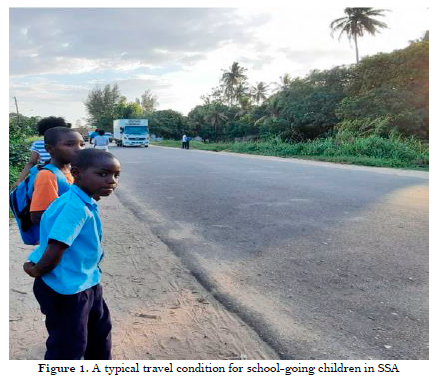
The safety and travel concerns of school children have been known and studied extensively for many years (e.g., Ampofo-Boateng and Thompson, 1990; Jones and Larter, 2001). In low-and middle-income countries, many school children must cover long distances and spend a considerable amount of time commuting to and from school. Unfortunately, appropriate pedestrian facilities that should support this mobility trend are non-existent, and in places where they exist, most of the walking and crossing facilities are in poor and deteriorated condition (Li and Zhao, 2015). Additionally, the careless driving behaviour of motorised vehicle operators further compounds the issue, leading to an uptick in pedestrian crashes. school zones have been identified as high-risk areas for child pedestrian crashes, making them a particularly sensitive location for improving road safety in the immediate school environment (Ipingbemi and Aiworo, 2013; Poku-Boansi et al., 2019). To contribute towards achieving goal 4 of the United Nations Sustainable Development Goals (SDGs), which aims to ensure that all girls and boys complete free, equitable, and quality primary and secondary education by 2030 (Target 4.1), it is essential to prioritise the safety of roadways within school zones. This will not only help to reduce the level of risk exposure to school children but also go a long way in promoting their well-being. As part of the efforts to improve road safety for school children, Amend (a non-governmental organisation working in SSA dedicated to reducing road crash injury among children and other vulnerable road users) has developed safe school zones at over 80 schools in nine countries across Africa through its award-winning School Area Road Safety Assessments and Improvements (SARSAI) project. These zones have been equipped with vital infrastructure like footpaths, crosswalks, and speed humps, resulting in a positive impact on over 85,000 school children and hundreds of thousands of community members. The infrastructure installed, coupled with behavioural education and advocacy, have played a significant role in saving lives and preventing serious road traffic injuries among school children, further averting the financial and emotional burden that families suffer when a child is injured (Amend, 2023). According to Poswayo et al. (2019), the SARSAI program led to a significant reduction in child pedestrian road traffic injuries and the greatest improvements was observed in motorcycle-pedestrian crashes, vehicle-pedestrian crashes and crashes that occurred in the morning.
Road construction is key to improving access to education, health services, and socioeconomic activities and therefore constitutes a significant part of development spending in SSA and indeed, many low- and middle-income countries. Pedestrian facilities are essential for promoting road safety for all road users, and their design and maintenance are a top priority for transportation planners and engineers. However, it has been revealed that over 95% of roads in SSA are rated only 1- or 2-star for pedestrians, meaning they fail to offer an acceptable level of safety (World Bank, 2019). As roads are a vital component of economic growth, governments throughout the continent are heavily investing in the expansion and development of their road networks but with little to no attention to incorporating pedestrian facilities in the design and construction of these facilities (Jacobs and Aeron-Thomas, 2000; Agyemang et al., 2022). This, in fact, is despite the recent introduction of important safeguards, such as the World Bank's Environmental and Social Framework and Road Safety Screening and Appraisal Tool, which ensure that roads that are built meet the minimum 3-star standard. It has been observed that factors such as lack of local technical capacity, lack of local political will, and governments' and development banks' inability to procure the necessary resources, may be some of the essential reasons why dangerous roads are still being designed and built in Sub-Saharan Africa (Amend, 2023). This paper looks at a program, 'Safe Schools Africa', which seeks to address the challenges of ensuring that the existing road procurement, design, and construction systems and practices consider the specific road safety requirements of school children. The program is spearheaded by Amend. the Safe Schools Africa program helps ensure that provision is made to safeguard school children and other vulnerable road users in the design and construction of new and rehabilitated roads used by this group.
2. THE SAFE SCHOOLS AFRICA PROGRAM
Since Amend's founding in 2005, the organisation has aimed to use science, evidence-based programs, and advocacy to help ensure safe, healthy and equitable journeys in developing countries as they grow and mobilise. Amend have offices in Ghana, Mozambique, and Tanzania and run programs in more than a dozen countries in the developing world at any given time, with a focus on sub-Saharan Africa. Considering the high rate of road traffic fatalities on the continent (World Health Organisation, 2019), improving road safety is at the core of Amend's presence in SSA. Safe Schools Africa is one of Amend's flagship programs that offers specialised technical support for road projects in Sub-Saharan Africa. Through this support, Safe Schools Africa ensures secure commutes for children to their schools across the continent while fostering long-term, systemic improvements in the processes that currently result in a disproportionate number of road fatalities among African children compared to their peers in high-income countries. Additionally, besides minimising the risk of injuries and deaths, enhancing safety for pedestrians and other vulnerable road users also leads to environmental, social, and health-related disadvantages.
The Safe School Africa process entails 8 main steps:
Step 1 - Review of project documentation
• Design reports, design drawings, road safety audits, etc.
Step 2 - Identify and map out schools along project corridors.
Step 3 - Community Engagement (to understand road safety concerns and needs)
• Engage school heads, teachers, parents, children.
• Meet with local leaders (ward leaders, etc.)
• Engage vendors, motorcycle taxi riders, etc.
Step 4 - Undertake assessments and analysis
• Detailed observations
• Mode of travel to schools
• Student catchment area mapping
• Pedestrian counts (including identification of major student crossing points)
• Vehicle counts.
• Speed surveys.
Step 5 - Make road safety infrastructure recommendations.
Step 6 - Engagement with project team (government departments, design engineers, etc.) on recommendations
Step 7 - Design engineers make additions/revisions to designs where required.
Step 8 - Monitoring and support during construction
Safe Schools Africa's initial launch involved two pilot projects in Tanzania: the Tanzania Strategic Cities Project (TSCP) and the Dar es Salaam Metropolitan Development Project (DMDP). TSCP was a US$175 million World Bank funded project that aimed to help cities in Tanzania improve the quality of and access to basic urban services, and DMDP was a US$330 million World Bank funded project, which included the construction and rehabilitation of roads across Dar es Salaam. In the TSCP project, Amend proposed road designs that were modified to consider the communities' needs, incorporating proven-effective road safety measures such as footpaths, zebra crossings, speed humps, signage, guardrails, and school walls. Many of the suggested measures were adopted. Under the DMDP project, Amend conducted road safety audits for 31.5km of roads, providing recommendations for improving safety for all road users. Amend then delivered targeted technical support specifically for school areas. The consulting engineers who worked on the project implemented Amend's recommendations on the audited roads and adopted some of the safe infrastructure principles across the broader project.
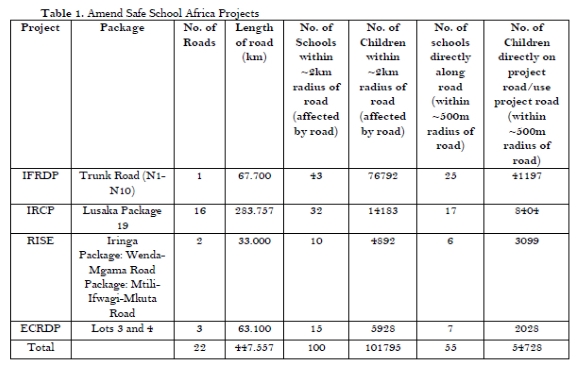
Other projects in Mozambique, Zambia, Tanzania, and Ghana for which Safe Schools Africa has provided technical assistance since its launch in June 2022 are presented below. Table 1 presents some detailed description of the projects and the affected school and school children information.
2.1
Integrated feeder road development project (IFRDP), MozambiqueThis US$185 million World Bank funded project in Mozambique involves the construction of roads in Zambezia and Nampula provinces and the rehabilitation of a segment of the N1/N10 trunk road from Quelimane to Namacurra. The N1/N10 is a major paved single carriageway trunk road and is being upgraded to include widening at some sections. The project is currently in the construction phase. Amend has surveyed the schools near the N1/N10 and collaborated with communities, government officials, and road contractors to promote the modification of road designs, prioritising the safety of children on the road.
From Table 1, 76,792 children and 43 schools are within approximately a 2km radius of the roadway segment being considered for the IFRD project. Furthermore, about 41,197 children attend schools that are within 500m of the project road. Ten (10) schools open directly into the project road (within 50m).
2.2
Improved rural connectivity project (IRCP), ZambiaIRCP is a US$ 200 million World Bank funded project which has the objective of improving rural road accessibility for communities. Amend's Safe School Africa input is currently being carried out on one package of roads in the Lusaka Province (Package 19). The roads are in rural Zambia and are currently unpaved (mostly tracks) and will be upgraded to a more durable unpaved standard. The project is at the end of the feasibility/planning stage, and contractors with design consultants are currently being procured to carry out the detailed design before moving into construction.
Over 14,000 children attend the 32 schools within 2km of the project road. Seventeen (17) out of the 32 schools are directly along the road within 500m radius.
2.3
Roads to inclusion and socioeconomic opportunities (RISE), TanzaniaThe World Bank has financed RISE with US$350 million to enhance access to rural roads and create employment opportunities for people living in rural areas. Amend's Safe Schools Africa input is currently being carried out on the district road upgrades in Iringa region. The roads are currently unpaved and are being upgraded to a paved standard. Presently, the project is in the detailed design phase and will soon move into the construction phase.
Six (6) out of 10 schools that are within 2km radius of the affected roads are located directly along the project roads. In terms of the number of children affected by the projects, 4,892 are within 2km of the affected roads, and 3,099 children attend schools that are within 500m radius of the road projects.
2.4
Eastern corridor road development program (ECRDP), GhanaThe African Development Bank (AfDB) has allocated US$113 million to fund Phase 1 of the ECRDP project in Ghana. Amend's Safe Schools Africa input is currently being carried out on both Lot 3 and Lot 4. The roads are being upgraded to paved standards. The detailed designs of the roads have been completed and contractors are being procured for the construction works.
As part of the project, Safe Schools Africa has conducted assessments at several schools in close proximity to the roads being constructed. These assessments involved 15 schools that are located within a 2km radius of the Eastern Corridor Road, of which 7 of these schools are located directly along the road or within 500m radius. In all, nearly 6,000 children attend schools within a 2km of the road and a little over 2,000 of these children attend schools that are within 500m radius and are more likely to use the road corridor.
3. SAFE SCHOOL AFRICA'S APPROACH TO IMPROVE CHILD PEDESTRIAN SAFETY IN SUB-SAHARAN AFRICA
The Safe Schools Africa's approach is grounded in the principles of the SARSAI program, which has been recognised with awards for its effectiveness in conducting school area road safety assessments and implementing corresponding improvements. The program won the Prince Michael Road Safety Award in 2018 and the WRI Prize for Cities in 2019. Developed with the backing of the FIA Foundation, the SARSAI program was created by Amend, initially in Tanzania, and subsequently expanded to encompass nine African nations. The program's goal was to demonstrate that enhancing pedestrian infrastructure around schools and on the routes to school could be a successful means of safeguarding the lives of children in African countries. A crucial objective of SARSAI is to establish a separation between child pedestrians and vehicles while also lowering speeds to 30km/h or below in areas where pedestrians and vehicles come into contact. This is because research, such as that by Tingvall and Haworth (1999), has demonstrated that the risk of injury rises exponentially when the impact speed exceeds this threshold. Together with the United States Centers for Disease Control and Prevention (CDC), Amend carried out a population-based impact evaluation of SARSAI over several years. The findings of this study revealed that the program led to a reduction of over 26% in injuries among children, as well as a decrease in the severity of injuries that do occur (Poswayo et al., 2019).
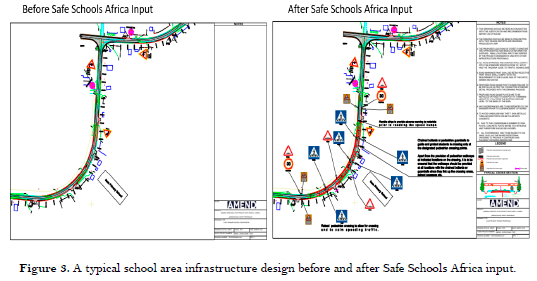
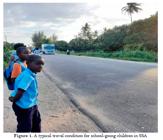
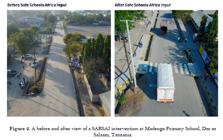
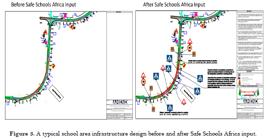
In general, the contributions of Safe Schools Africa can be categorised into four areas: planning, design, modifications, and retrofitting. Safe Schools Africa has the capability to offer planning assistance during the feasibility study phase of comprehensive road projects that will enhance multiple roads over several years. The organisation can integrate efficient community engagement and design for school children and other vulnerable road users right from the beginning. At the preliminary or detailed design phase, Safe Schools Africa can offer guidance on design and aid consulting engineers in integrating effective safety measures into their designs that align with the community's requirements. Furthermore, Safe Schools Africa can also produce specific design recommendations for school areas prior to construction. Finally, Safe Schools Africa can provide design recommendations to improve safety on roads that have already been constructed. Figures 1 and 2 show some examples of SARSAI and Safe Schools Africa's input in a roadway modification project to improve road safety in a school zone and recommendations on a roadway design project incorporating safety features that will help to save lives. The figures show the before and after scenarios to highlight the program's approach to improving road safety for children around schools in the sub-region.
3.1 Safe Schools Africa's ongoing endeavours
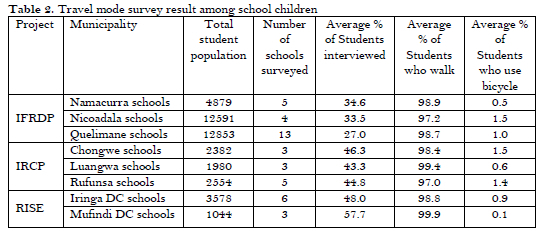
Presently, Amend has undertaken mode of school travel survey and speed surveys near the schools on three projects under the Safe Schools Africa program: IFRDP, IRCP, and RISE. Table 2 presents the mode of school travel survey results. From Table 2, it can be observed that the predominant mode of transport for the school children in these schools is walking. The survey results show that more than 98% of the students walk to and from school. Only one school (Chibengelele Primary School in the Rufunsa Municipality as part of the IRCP in Zambia) had 7.7% (18 students) of the students interviewed indicating their mode of transport as car. Bicycles are the second popular mode of travel to school in the project regions. However, their use is very limited. The highest proportion of students who use bicycles for school travel are in Chongwe and Rufunsa schools. In the Namacurra municipality of the IFRD project, 2.7% of students in EPC de Dualia use motorcycles for their school travel compared to 1.8% who use bicycle. For all the schools within the immediate vicinity of the projects, none of them had a wall around them or had a gate at the entrance of the school. This is an indication of increased risk of exposure to traffic incidents.
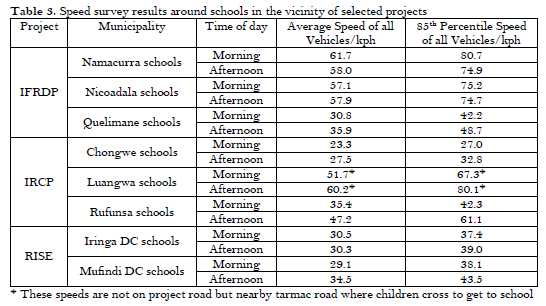
Table 3 displays the average bi-directional speeds of all vehicles measured during morning hours (06:30-07:45) and afternoon hours (14:50-15:50) on a particular weekday at school crossing points near the projects. The chosen survey periods correspond to the times when school children arrive at and depart from school. The 85th percentile speed for each survey location was also determined. During the survey periods, data were collected by the trained enumerators on the types of vehicles that were using the roads. While motorcycles make up the highest proportion of vehicles at some of the survey sites (e.g., Iringa municipality for the RISE project), mini-vans, light trucks and heavy trucks make up the highest proportion in others (e.g., Namacurra municipality for the IFED project). Consistent with the results of the SARSAI project, morning vehicular speeds were generally lower than afternoon speeds. Table 3 highlights that the 85th percentile speed in the afternoon at school crossing points in Luangwa district (IRCP) was remarkably high at 80km/h. Average speeds in Chongwe (IRCP) were generally lower during both the morning and afternoon periods. Although speeds of 30km/h or less are desirable in school zones, the speed survey results indicate that this is not the case in most of the project locations. These findings suggest the level of risk faced by school children and all child pedestrians in the project areas. This reinforces the relevance and potential benefits of the Safe Schools Africa program for these projects.
The above four projects are ongoing and have already achieved some notable successes, including:
Zambia: IRCP Lusaka Package 19
• A summary of initial findings from the school assessments was taken on by the road agency Project Team, and aspects were included as an Addendum to the Request for Proposals (RfP) for Project Contractors and Consultants.
• A minimum requirement for the safety of school children was thus written into the project documentation, and is likely to receive budget allocation, indicating that it is likely to produce built results.
Tanzania: RISE Project Iringa Roads
• The Amend team has received positive feedback from a project engineer from the road agency on the Safe Schools Africa methodology. The project engineer has specifically asked for Amend's protocols so these could be applied on other projects.
Some of the challenges faced to date and possible solutions are:
i. There are sometimes project budget constraints for the improvements recommended under Safe Schools Africa. The development stage of the project at which Safe Schools Africa input is made is crucial - the earlier, the better, especially before construction budgets are finalised.
ii. At times, there is little appreciation of the risks and dangers faced by school children on the project road by project teams, meaning that implementing the recommendations is not always a priority. This is addressed by gathering case studies of children attending schools close to the project road and those who have previously been involved in a road traffic crash. These case studies are presented to the project teams to put a 'human face' to the road traffic injury statistics. On the other hand, it has been found that injury information can sometimes be very sensitive to project teams, especially if not officially reported. The Safe Schools Africa team thus obtains as much information on injuries as is possible, including checking if these injuries were reported to the Police.
iii. Sometimes the initial identification of relevant projects and getting introductions to road project teams can be a challenge. To address this, use is made of existing networks for further identification of projects and introductions.
4. CONCLUSIONS
Pedestrian facilities are essential for promoting road safety for all road users, and their design and maintenance are a top priority for transportation planners and engineers. Improving road safety needs intervention at several levels, from engineering safer roads to improving enforcement of relevant legislation. Child safety around school zones is a complex issue that requires a multi-faceted approach. Road safety measures, pedestrian safety measures, and the design and management of school zones all play important roles in ensuring child safety. The issue of school children safety concerns in SSA is of particular concern to relevant stakeholders because many school children travel to school by walking, in contrast to what pertains in most developed countries, where car transportation is the primary mode of transportation for children travelling to schools. Amend, a non-governmental organisation working in Sub-Saharan Africa, has over the years dedicated to decreasing paediatric road traffic injuries through a variety of projects that cut across the use of science, evidence-based programs, and advocacy to help ensure safe, healthy and equitable journeys. Amend, through their SARSAI award-winning program, has achieved over 26% reduction of in injuries among children, as well as a decrease in the severity of injuries that do occur. Amend's road safety efforts fit into the global push for the adoption of Safe Systems Approach towards a Vision Zero traffic deaths, where greater emphasis is placed on retrofitting existing roadways and building new ones to account for human limitations.
This paper looked at one of Amend's programs, 'Safe Schools Africa', which seeks to address the challenge of ensuring that the existing road procurement, design, and construction systems and practices consider the specific road safety requirements of school children. The program is currently in four African countries (Tanzania, Mozambique, Zambia, and Ghana). The projects in these countries have a substantial number of schools in the project vicinities. This means that a very high number of pedestrians who will be using these facilities will be school children. To better tailor interventions to achieve maximum benefits, Amend undertook community consultations and detailed surveys including school travel and vehicular speed surveys in selected schools around the projects. The results revealed that walking remains the primary mode of travel for many school children in the regions where these projects are being built. In fact, at many of the study locations, all the students interviewed walked to school. Although bicycle was the second highest mode of travel, it is used by less than 2% of the student population, and mostly among secondary school students. With respect to the vehicular speed survey, some of the school zones recorded speeds as high as 60km/h. Generally, it was observed that vehicular speeds were lower in the morning compared to afternoons. These findings underscore the importance of Safe Schools Africa program as it has the potential to improve road safety around schools and indirectly promote school access across the African sub-region. The Safe Schools Africa program offered recommendations for safe infrastructure for school children using the project roads, some of which have already been included as part of project documentation, such as on the IRCP Lusaka Package 19 in Zambia.
Safe Schools Africa presents a unique, focused, time-sensitive opportunity for funding partners to save children's lives on roads that are being built now, while also advocating for and building capacity to re-engineer existing roads to improve safety around schools across the continent.
Funding: Funding for Safe Schools Africa projects was provided by a grant for 2022-24 by the FIA Foundation
Agyemang, W., Adanu, E. K., Liu, J., and Jones, S. (2022). A latent class multinomial logit analysis of factors associated with pedestrian injury severity of inter-urban highway crashes. Journal of Transportation Safety and Security, 1-21.
Amend (2023). Our work. http://www.amend.org/our-work/#sarsai (accessed on March 29, 2023).
5. ACKNOWLEDGMENT
Partners: World Bank, Global Road Safety Facility, Tanzania Rural and Urban Roads Agency, Road Development Agency (Zambia), Ghana Highway Authority, National Roads Administration (Administração Nacional de Estradas - ANE, Mozambique), Zambia Road Safety Trust (ZRST).
REFERENCES
- Ampofo-Boateng, K., and Thompson, J. A. (1990). Child pedestrian accidents: A case for preventive medicine. Health Education Research: Theory and Practice, 5, 265-274.
- Ampt, E. (1995). The travel of Children in perspective-their exposure to risk of accidents. In 7th World conference on transport research (pp. 343-355). Sydney, Australia.
- Cross, D., Stevenson, M., Hall, M., Burns, S., Laughlin, D., Officer, J., and Howat, P. (2000). Child pedestrian injury prevention project: student results. Preventive medicine, 30(3), 179-187.
- Ipingbemi, O., and Aiworo, A. B. (2013). Journey to school, safety and security of school children in Benin City, Nigeria. Transportation research part F: traffic psychology and behaviour, 19, 77-84.
- Percer, J. (2009). Child pedestrian safety education: Applying learning and developmental theories to develop safe street-crossing behaviors (No. DOT HS 811 190). United States. National Highway Traffic Safety Administration.
- Poku-Boansi, M., Amoako, C., and Atuah, D. O. (2019). Urban travel patterns and safety among school children around Accra, Ghana. Journal of Transport and Health, 15, 100660.
- Poswayo, A., Kalolo, S., Rabonovitz, K., Witte, J., and Guerrero, A. (2019). School Area Road Safety Assessment and Improvements (SARSAI) program reduces road traffic injuries among children in Tanzania. Injury prevention, 25(5), 414-420.
- Schieber, R.A, and Vegega, M.E. (2002). Reducing childhood pedestrian injuries. Inj Prev. 8(S1):i3-i8.
- Tingvall C and Haworth N. (1999) Vision Zero - An ethical approach to safety and mobility. 6th ITE International Conference Road Safety and Traffic Enforcement: Beyond 2000; Melbourne.
- World Bank (2019), Guide for Road Safety Opportunities and Challenges: Low- and Middle-Income Countries Country Profiles (Washington, D.C., US: World Bank)
- World Health Organization. (2020). Road safety.
- Zeedyk, M., Wallace, L., Carcary, B., Jones, K., and Larter, K. (2001). Children and road safety: Increasing knowledge does not improve behaviour. British Journal of Educational Psychology, 71, 573-594.