Exploring Critical Measures for Developing Market Intelligence Culture in Construction Companies
Abstract
In today's highly competitive environment, integrating market intelligence (MI) is paramount to enhancing organisational decision-making processes. Despite its significance, measures for improving MI culture remain underexplored in the construction marketing literature. Therefore, the objective of this study was to identify critical measures for improving MI culture within construction companies. Employing a sequential exploratory mixed-method approach, twelve key measures were initially derived from exploratory interviews and subsequently validated through an extensive review of relevant literature. The 215 construction companies that assessed these measures classified them as either 'very critical' or 'critical.' Factor analysis identified 'top management commitment' and 'active internal marketing' as the principal measures. It is recommended that construction companies allocate sufficient financial, technological, and human resources to nurture and sustain a strong MI culture. Furthermore, companies should view employees as internal customers, recognising their crucial role in improving MI culture. By fostering a robust MI culture, construction companies can strengthen decision-making capabilities and secure a competitive advantage through more accurate forecasting of market trends, customer preferences, and optimised pricing strategies. This study is the first to explore this subject within the construction industry, laying a foundation for future research.
Competitive environment; Construction industry; Market intelligence; Organisational culture
1. INTRODUCTION
In today's rapidly evolving business environment, companies face numerous challenges, including intense competition, fluctuating market opportunities, heightened customer expectations, and technological changes (Oesterreich and Teuteberg, 2016; Collier et al., 2018). This is especially true for firms in the construction industry, particularly construction contractors (henceforth, construction companies) (Tan et al., 2012). As project-based businesses, construction companies experience difficulties and uncertainties (ibid). They depend on clients' real demand for market opportunities (Setiawan et al., 2015). However, client demand for construction services typically arises infrequently, often limited to one or two occasions in a client's lifetime (Drew, 2010). In addition, construction companies face competition from a diverse range of others with varying strengths, capabilities, and specialisations. They are usually selected for projects through a competitive tendering process. The limited market opportunities intensify competition among construction companies, compounded by the number of firms offering similar services (Bremer and Kok, 2000). As a result, the rate of business failure among construction companies remains notably high (Ogbu, 2018).
Under these circumstances, construction companies continue to seek strategies to outbid their competitors and penetrate new markets that offer increased job opportunities and higher profits (Polat and Donmez, 2010). Organisation theory suggests that an organisation relies on its environment and needs to align with it to function effectively (Ho, 2015). As Kourteli (2005) posits, the structure and decision-making processes within an organisation are influenced by environmental complexity and volatility, as indicated earlier. Consequently, the importance of MI cannot be underestimated by construction companies (Du Plessis and Gulwa, 2016). MI assists construction companies in pricing their services competitively, identifying market opportunities, making informed bid decisions, and fostering innovation (Mochtar and Arditi, 2002; Segarra-Oña et al., 2015; Hayes et al., 2016; Mokhtariani et al., 2017). These differentiation strategies would enable a construction company to distinguish itself from competitors, attract and retain clients, and enhance its competitive edge.
MI is a process that generates actionable information about the firm and its external environment to aid in market-related decision-making (De Almeida et al., 2016). Its relevance extends beyond developing competitive advantage toward enhancing the sustainable growth of a business (Stefanikova et al., 2015). In the context of construction, studies (Mochtar and Arditi, 2001; Schieman and Mlambo, 2016) have highlighted the potential of MI in addressing the marketing challenges various companies face. However, another body of literature (Yisa et al., 1996; Arthur-Aidoo et al., 2016) reveals that construction companies often fail to incorporate MI into their business functions. This failure is largely attributed to a lack of understanding and recognition of MI's true value. This is because construction companies do not consider marketing capability an important source of competitive advantage (Dikmen et al., 2005).
Construction companies do not consider MI a critical business function, as MI is not conducted in a systematic order (Low et al., 2016). As a result, marketing decisions are predominantly intuition-driven rather than intelligence-based (Lackman and Lanasa, 2013). They do not equip themselves with good MI capability (Li and Ling, 2012). Most construction companies tend to be reactive (Jaafar et al., 2008), focusing on traditional transactional marketing and task-oriented activities (Toor and Ofori, 2008). There is a lack of awareness that increased competition necessitates greater MI utilisation (Zwerenz, 2020). Minimal emphasis is placed on relational marketing by construction companies (Arthur-Aidoo et al., 2016), a key advantage of MI. These issues collectively underscore the deficiency of an MI culture within construction companies. The problem is especially pronounced in developing countries, where construction companies are slow to adopt effective marketing practices (Ogbu, 2018).
In organisations where a robust MI culture is established, the significance and relevance of MI are not questioned (Prinsloo, 2016). Thus, successful organisations cultivate strong MI cultures (Viviers et al., 2005), as this is paramount to realising the myriad benefits associated with MI (Evangelista, 2005). MI culture is an intrinsic organisational factor that sustains all MI activities and cannot be externally sourced (Hedin et al. (2014). To effectively address the numerous challenges faced by construction companies and to achieve competitive advantage and growth, they must develop their MI culture (Yisa et al., 1996; Langford and Male, 2001; Ameer and Othman, 2011).
Many studies (S0ilen, 2017; Yiu et al., 2021) have proposed both conceptual and practical measures, indicating that the basic elements of MI culture are consistent across industries. However, studies exploring measures for improving MI culture within the construction industry remain underexplored (Mochtar and Arditi, 2001; Mokhtariani et al., 2017). To address this gap, this study identifies critical measures (CMs) for improving MI culture in construction companies in Ghana. This focus is particularly important because the Ghanaian construction industry, like those in other developing countries, has been slow to adopt expected marketing practices (Ogbu, 2018), limiting its potential to compete effectively in dynamic markets. The remainder of the paper is organised into four sections: literature review, research gap, research methods, data analysis and discussion, and the conclusion.
2.1 MI Culture
MI culture, akin to organisational culture, represents the value system within a company that becomes the norm for its employees (Hedin et al., 2014). MI culture is essential as it fosters the generation, sharing, and utilisation of intelligence, ultimately creating value and contributing to organisational success (Kohli and Jaworski, 1990). Evangelista (2005) emphasises that for an organisation to benefit from MI, it must establish an organisation-wide MI culture, as this ensures that MI processes are ingrained in everyday practices and decision-making. Hedin et al. (2014) further define MI culture as the organisational environment and set of practices that prioritise and support the effective utilisation of MI. According to Yiu et al. (2021), cultivating a culture that underscores the significance of MI among employees can enhance a company's competitive advantage, making it challenging for competitors to replicate. This aligns with findings by Gupta et al. (2000), who assert that MI culture is instrumental in enabling the creation, sharing, and learning of rare knowledge within organisations-capabilities that contribute to sustained competitive advantage. Moreover, MI culture influences employee behaviours in a way that extends beyond direct managerial oversight, as it inherently guides how the employees behave toward intelligence activities (Mian et al., 2009; Lyu and Zhang, 2017). Through fostering an environment where intelligence is valued, MI culture supports the continuous generation, sharing, and use of MI, which are essential for developing competitive strategies and ensuring long-term organisational success.
2.2 Measures for Improving MI
The measures for improving MI culture within organisations have been the subject of various studies (Hedin et al., 2014; Hattula et al., 2015; S0ilen, 2017), highlighting a range of strategies that contribute to successful MI practices. Effective MI culture is crucial for organisations as it enhances decision-making processes, supports strategic initiatives, and promotes competitive advantage. The role of top management is widely recognised as essential for establishing a robust MI culture. Mann (2009) emphasises that top management involvement is critical for MI practices to be fully implemented, as it facilitates change management, resource allocation, and collaboration across business units. Supporting this view, Kivrak et al. (2008) highlight that management's commitment helps bridge cross-functional collaborations as an essential element of a thriving MI culture. 'Integration of technology' has also been identified as a key enabler of MI culture. Lyu and Zhang (2017) argue that leveraging technology tools enhances the efficiency of intelligence activities by promoting collaboration and improving information accessibility. Technology, therefore, not only facilitates the gathering and dissemination of MI but also supports a culture of data-driven decision-making within organisations. Allocating dedicated budgets for MI activities is another strategy linked to improving MI culture. According to Cacciolatti and Fearne (2013), financial investment in MI allows organisations to utilise diverse sources and techniques, which is critical for identifying and meeting organisational intelligence needs. This finding suggests that budgeting for MI should be considered a priority for firms aiming to strengthen their MI culture.
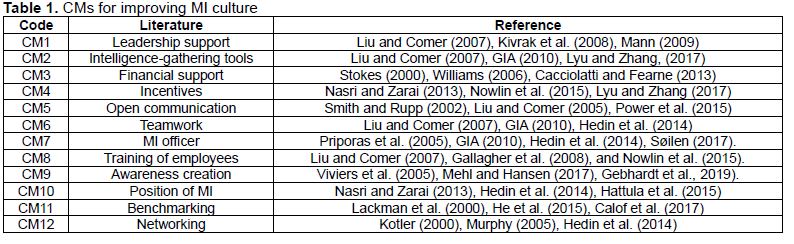
Employee motivation through positive rewards has also been identified as a significant contributor to MI culture. Viviers et al. (2005) note that incentivising employees encourages active participation in intelligence efforts, embedding MI into the organisational culture. Rewarding employees for their contributions to MI can help sustain long-term engagement and a proactive approach to intelligence activities. The structure of an organisation plays a crucial role in promoting MI culture. Hedin et al. (2014) found that an open and low-hierarchical working environment fosters a culture of information sharing. Low hierarchies tend to facilitate a more collaborative and transparent environment, which is conducive to effective MI practices. In a related study, S0ilen (2017) emphasises the importance of formalising MI practices, such as appointing dedicated personnel and providing continuous training, to reinforce MI as a core organisational function. The awareness and strategic positioning of MI within an organisation are also critical factors in building MI culture. Nasri and Zarai (2013) and Hattula et al. (2015) underscore the importance of raising awareness among employees about MI and aligning the MI function with corporate strategies. Creating this alignment not only enhances MI's impact on organisational decision-making but also fosters a more cohesive MI culture. Calof et al. (2017) expand on strategies for improving MI culture by emphasising the importance of building internal and external networks, benchmarking, and utilising effective analytical techniques. These strategies ensure that MI culture is not only embedded within the organisation but also aligned with broader organisational goals, making it an integral component of strategic planning. Table 1 presents the CMs and their sources.
2.3 Gap in the Literature
While the foundational elements of MI culture may apply across industries, Hedin et al. (2014) point out that implementation often requires tailored insights unique to each sector. A review of the existing literature reveals a significant gap concerning MI culture within the construction industry, where research on the development and improvement of MI culture is limited (Mochtar and Arditi, 2001; Mokhtariani et al., 2017). This lack of sector-specific insights indicates a clear knowledge gap and underscores the need for further research to explore how MI culture can be cultivated within construction companies. Given the industry's unique characteristics and challenges, such research could provide valuable guidance for construction companies seeking to leverage MI for competitive advantage.
3. METHODOLOGY
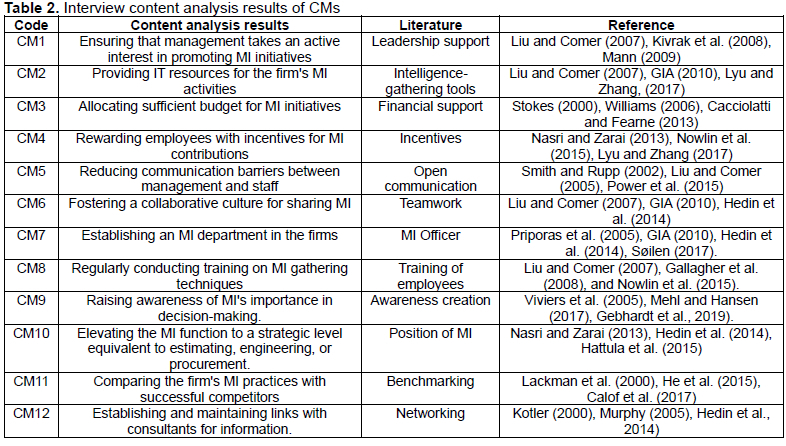
To achieve the objective of this study, a sequential exploratory mixed-methods approach was used, specifically the 'qual→QUAN' variant. (Creswell and Plano-Clark, 2018). Given the unexplored nature of CMs within construction literature, initial exploratory interviews were conducted (Shiyanbola et al., 2021). These interviews were crucial for obtaining a comprehensive understanding of CMs in the context of construction companies. This was important for enhancing the validity and reliability of the research instruments used for data collection (Mihas, 2019). The respondents for the exploratory interviews were identified from a list of construction firms obtained from the works directorates of public universities and were interviewed at their respective project sites. The interviews were recorded with permission and analysed for content. The results of the content analysis, presented in Table 2, were corroborated by existing literature and pilot-tested to assess their suitability for the second phase of the data collection. Pilot respondents were asked to suggest additional measures; however, no additions were proposed.
Considering the importance of the right respondents for research quality, data were collected from large-size construction companies, locally known as D1K1 firms, with a minimum of ten years of experience (Peters et al., 2019). Due to the difficulty in identifying suitable and active construction companies, the work directorates of 25 public universities were used to locate qualifying firms. Two phases of data collection were employed for the study; hence, two sample sizes were used. During the exploratory phase, interviews were conducted at the participants' project sites. Saturation in information collection is commonly achieved within 9 to 17 interviews (Hennink and Kaiser, 2022). In this study, saturation was observed after eleven interviews. To ensure comprehensive coverage during the survey phase (Saunders et al., 2016), the study undertook a census survey of 279 construction companies obtained from work directorates of 25 public universities.
The questionnaire, using a five-point Likert scale, covered demographic data and CMs. It was reviewed, pilot-tested, and achieved a reliability coefficient (Cronbach's Alpha) of 0.906, exceeding the 0.7 threshold (Hair et al., 2017). A Google Form questionnaire was distributed via email and WhatsApp technology. Of the 279 questionnaires sent, 226 were returned, with 215 suitable for analysis, resulting in a favourable response rate of 77.1% (Babbie, 2007). Mean score (MS) and exploratory factor analysis (EFA) were used to analyse the data for this study. MS was used to ascertain the significance level for each CM on a five-point Likert scale, with a mid-MS value of 3.0 considered significant (Asante et al., 2018). EFA reduced the 12 subfactors (CMs) to a smaller set of principal factors (key CMs) (Tavakol and Wetzel, 2020). Cronbach's Alpha was used to assess the correlation of subfactors within each principal factor identified through EFA (Hair et al., 2017).
4. RESULTS AND DISCUSSION
4.1 Background of Respondents
The survey participants primarily consisted of engineers, project managers, and quantity surveyors of construction companies. Notably, 82% reported having more than ten years of experience, thus comprising diverse professional backgrounds with substantial working experience. They predominantly occupy senior or middle-management roles within their companies, indicating their profound understanding of strategic objectives (Kukah et al., 2023). Moreover, the educational qualifications of the respondents were notably high, with 67.9% holding master's degrees, 24.2% possessing first degrees, 2.3% having Higher National Diplomas, and 5.6% possessing terminal degrees. This level of academic attainment suggests a propensity among respondents to engage critically with the survey questions (Naudé et al., 2003). This demographic characteristic enriched the survey data, enhancing its reliability and validity (Peters et al., 2019). Among the 215 participants, 33.5% indicated a very high level of familiarity, 52.6% reported a high level, 12.6% expressed a moderate level, and 1.4% noted a low level of familiarity with the subject.
4.2 Descriptive Statistics of Respondents
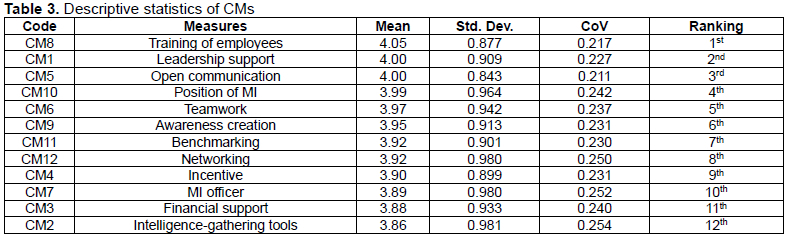
The respondents were asked to rate the significance of each measure, derived from exploratory interviews and confirmed by the literature, on a five-point Likert scale ranging from "1 = least critical" to "5 = extremely critical." The results are presented in Table 3. The mean value analysis and rankings of the set of 12 CMs show mean scores ranging from 4.05 (very critical) to 3.86 (critical), and the standard deviation values ranged from 0.843 to 0.981. Three CMs were considered 'critical' in assessing measures for improving MI culture in construction companies. These CMs include "training of employees," "leadership support," and "open communication." Among the top three CMs, "training of employees" was the highest ranked among the list (CM8=4.05, SD=0.877, CoV=0.217). Training of employees as CMs implies construction companies should regularly conduct training on MI gathering techniques (Nowlin et al., 2015) to improve MI culture in construction companies. Six other CMs have mean scores ranging from 3.99 to 3.90: "position of MI," "teamwork," "awareness creation," "benchmarking," "networking," and "incentive." Also shown in Table 3, three CMs, namely, "MI officer," "financial support," and "intelligence-gathering tools," are ranked as critical, with mean scores ranging from 3.89 to 3.86. The above findings indicate that to nurture or develop MI culture, management of construction companies should take an active interest in MI initiatives (Liu and Comer, 2007).
Notably, the findings suggest that marketing departments, which are traditionally viewed as supplementary rather than complementary to technical functions like engineering, estimating, and quantity surveying (Cicmil and Nicholson, 1998), should be regarded and treated as strategic functions like technical functions within construction companies (Hattula et al., 2015). This strategic recognition is crucial, as intelligence-gathering is the most effective way for any organisation to understand its market environment. Additionally, teamwork was ranked as the fifth most critical measure, underscoring the importance of fostering a collaborative culture for sharing MI, which can significantly enhance the MI culture within construction companies (GIA, 2010). Further analysis of the coefficient of variance values highlights the necessity of reducing communication barriers between management and staff to enhance organisational effectiveness and improve the MI culture within construction companies (Hedin et al., 2014). It is noteworthy that there was consensus among respondents on the significance of all measures, as indicated by standard deviations of less than 1.0 (Field, 2005). Overall, the results demonstrate that all the selected CMs are relevant for improving MI culture in construction companies.
4.3. Factor Analysis of CMs
Factor Analysis was performed to identify the major CMs for improving MI culture in construction companies. Factor analysis was conducted to explore the underlying relationships among the 12 sets of CMs. This analysis was crucial and significant because it reduced the 12 sets to a small group to enhance interpretability and detect hidden structures in the data (JadidAlEslami et al., 2018). Furthermore, through the Factor Analysis, construction companies will understand the relationships among several CMs within each major CM. However, before major factors can be extracted, it is recommended that a factorability test be conducted to ensure that the dataset meets the necessary assumptions for factor analysis. The Kaiser-Meyer-Olkin (KMO) and Bartlett's Test of Sphericity are the two basic tests for determining the factorability of a dataset (Xu et al., 2010). The KMO measures sampling adequacy (Pallant, 2010), while Bartlett's Test of Sphericity evaluates hypothetical relationships within the correlation matrix (Oyedele, 2013). From Table 4, Bartlett's Test of Sphericity is 0.000 (i.e., <0.05) with a chi-square value of 1452.171. The Kaiser-Meyer-Olkin test result is 0.893. This is above the recommended threshold of 0.70 (Li et al., 2020). Notably, these preliminary statistics indicate that the sample size is adequate for factor analysis. Furthermore, the results validate the suitability of factor analysis for this study (Brown, 2015).
4.3.1 Extraction, naming, and validation of components
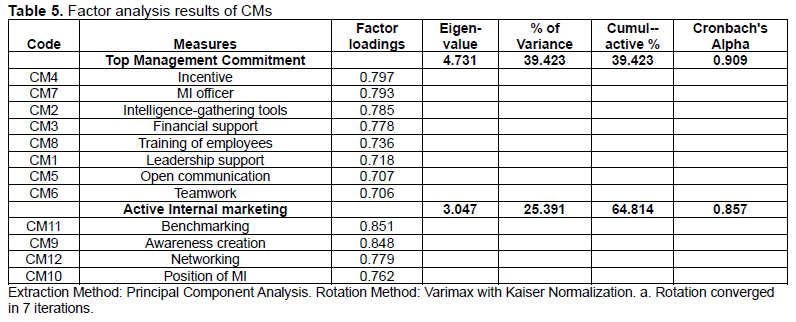
Components (or factors) were extracted using principal component analysis with varimax rotation. This method facilitates the attainment of a simple structure by minimising the inclination towards a 'general' component in the solution (Gorsuch, 1983). Table 5 explains the eigenvalues, cumulative percentage, variance explained by each extracted component, and Cronbach's alpha values. The extraction of components was predicated upon their respective eigenvalues, adhering to the commonly applied criterion in factor analysis studies of eigenvalue >1 (Osei-Kyei et al., 2020). Consequently, the two components extracted account for a cumulative total of 64.8% of the variance. This indicates that these two factors together explain a majority of the variance in the data. In naming the components, Williams et al. (2010) recommended grounding the nomenclature in theoretical frameworks informed by subjective judgment. Hedin et al. (2014) identified 'top management commitment' and 'active internal marketing' as pivotal elements in sustaining an intelligence culture. Accordingly, the components were named to reflect these key drivers. This approach ensures that the nomenclature is both theoretically sound and empirically validated, capturing the correlations among all variables within each respective component. To further validate the coherence of the items within each component, a Cronbach's alpha test was administered to the extracted components (Vaske et al., 2017). The results indicated that each component consistently measures a single underlying construct, as evidenced by Cronbach's alpha values exceeding 0.7 (Hair et al., 2014).
Top management commitment - This factor has an eigenvalue greater than 1, a common threshold for significance in factor analysis. It accounted for approximately 39.4% of the total variance in the data, indicating the substantial importance of top management commitment. The cumulative percentage reveals that this single factor explains 39.4% of the total variance. The Cronbach's alpha value exceeds the acceptable threshold of 0.7, demonstrating excellent internal consistency among the measures associated with this factor.
The high loadings for incentive (0.797), MI officer (0.793), intelligence-gathering tools (0.785), financial support (0.778), employee training (0.736), leadership support (0.718), open communication (0.707), and teamwork (0.706) suggest a strong relationship with the construct of top management commitment. The importance of top management commitment in fostering an MI culture within an organisation is well-documented in management literature.
Studies confirm that MI flourishes with unwavering senior management support, and as such, backing legitimises and underscores the significance of MI activities (Evangelista, 2005). Top management plays a critical role in shaping the vision, policies, and decision-making processes essential for the growth and sustainability of the firm (Intakhan, 2014). They also develop systems that support and reward employees in achieving organisational goals (Chiou and Chang, 2009). Thus, top management is primarily responsible for creating an environment conducive to successful projects and program implementation. This factor group accounted for 39.423% of the total variance, with a combined eigenvalue of 4.731.
Top management support manifests in various ways, including aiding teams in overcoming obstacles, demonstrating unwavering commitment to the work, and fostering encouragement among subordinates (Kivrak et al., 2008). The active engagement of top management is crucial for cultivating a desirable MI culture (Babbar and Rai, 1993). Therefore, top management support is a critical factor for deploying MI practices throughout the organisation. The overriding influence on effective intelligence activities in a business environment lies in management support (Mann, 2009). High commitment to MI activities is visibly demonstrated by top management in organisations where MI is well-established (Hedin et al., 2014). Implementing MI requires significant resources and unwavering top management commitment in every organisational context. Authentic support from senior management deepens the MI culture, emerging as a critical factor in fostering an intelligence culture within the organisation (Hedin et al., 2014).
Marceau and Sawka (1999) aptly capture this sentiment, asserting that "Without a doubt, the one thing that all effective intelligence activities have in common is the direct support of top management." The successful deployment of intelligence activities depends significantly on top management's role in creating a successful MI culture within organisations, including their dedication, vision, and support. Genuine support from upper management is essential for creating an environment conducive to developing an intelligence culture.
Active internal marketing - This factor also has an eigenvalue greater than 1, indicating that it is significant and explains a meaningful amount of variance in the data. It accounted for about 25.4% of the variance, which is considerable, though less than the first factor. The Cronbach's Alpha value is above the 0.7 threshold, suggesting good internal consistency among the measures related to Internal Marketing. Measures such as benchmarking (0.851), awareness creation (0.848), networking (0.779), and position of MI (0.762) all have high loadings, indicating they are strongly related to the Internal Marketing construct.
This factor is particularly significant because cultivating an intelligence culture begins with systematic internal marketing of MI. Internal marketing focuses on influencing employee behaviour (Hedin et al., 2014) by aligning employees with the brand values, mission, and vision of the company's MI. Effective internal marketing creates meaningful associations that can enhance confidence and loyalty among internal customers (Romaniuk and Nenycz-Thiel, 2013), who are the employees in this context. Systematic branding of MI activities initially raises employees' awareness, fosters acceptance within the organisation as a recognised approach to managing business information and, ultimately, creates intelligence deliverables (Hedin et al., 2014).
MI branding should be interpreted broadly (Hedin et al., 2014). It encompasses the entire identity of the intelligence program and various elements such as its name, symbols, slogans, and the quality of the intelligence deliverables, all of which contribute to business impact. MI requires developing a network involving key stakeholders across the business, maintaining regular communication, and robust self-promotion (Webb, 2012). The lack of active and assertive branding of intelligence activities is a major obstacle to cultivating an intelligence culture within the organisation (Hedin et al., 2014). MI services must be branded similarly to how firms brand their products or services (Skyrme, 2007).
Therefore, it is essential to instil intelligence awareness among employees to ensure the effective execution of MI with broad involvement (Nasri, 2010). For successful implementation, management should integrate the intelligence system into the entire organisation rather than treating it as a distinct function. Awareness among internal stakeholders about the existence of MI is critical for facilitating intelligence production and sharing within the organisation. Increasing MI acceptance among internal stakeholders begins with a systematic branding approach (Hedin et al., 2014), involving clear communication of MI benefits, which encourages feedback from users (Webb, 2012). Effective branding should encompass the entire identity of the intelligence system, including its name, symbols, slogans, and the quality of the content in intelligence deliverables, all of which contribute to business impact (Hedin et al., 2014). A significant obstacle to developing an intelligence culture is the absence of proactive branding. Effective branding improves the acceptance and integration of MI activities within the organisational structure.
5. CONCLUSION
The purpose of the research was to establish the influence of environmental conservation attributes on sustainable energy delivery. The review of extant literature made it possible to identify a pool of environmental conservation attributes and subsequently subject to analysis. The study employed a five-stage data analysis process involving data reliability and validity, descriptive statistics, principal component analysis, and model testing and fit statistics. The initial four stages were achieved with the use of SPSS Version 27, while the last stage was attained using EQS Version 6.4. Analysis from the CFA showed that only four indicator variables were affirmed from the test of factorial validity that was eventually adopted for the assessment of the environmental conservation attributes model goodness-of-fit. The identified environmental conservation attributes factors that influence SED for this study were the reduction of fossil fuel consumption, reduction of greenhouse gas emission, land conservation, wildlife protection, building an institutional framework that supports SED, boosting the support systems of SED research and development, building stronger energy facilities for SED, the usage of cleaner energy facilities for SED, less use of natural gas, good indoor environmental quality control, efficient energy use for less consumption and the adoption of clean, environmentally friendly technology. The findings of the study showed that the identified outcomes were influenced directly by the exogenous and endogenous variables analysed in this study. The findings of this study also showed that the identified outcomes were consistent across various sources in the literature on SED. In addition, based on the CFA, less use of natural gas was the highest-ranked influence environmental conservation has on the outcome of an SED model. This finding was consistent with the findings in the literature that advocates for the adoption of innovative technologies in the quest to minimise the over-reliance on fossil fuels as the major component of energy production. The findings from the literature showed further that more research was needed to dive more deeply into the adoption of each of the renewable energy technologies available.
In today's highly competitive environment, intelligence-gathering is crucial for enhancing an organisation's competitive edge. A robust MI culture is essential for sustaining intelligence activities, as it cannot be effectively sourced externally. This culture is vital for facilitating the sharing, learning, and creation of knowledge within an organisation. The objective of this study was to identify critical measures for developing MI culture in construction companies.
The study identified twelve critical measures (CMs) through exploratory interviews, which were confirmed by the literature and rated as either 'very critical' or 'critical' on a five-point Likert scale. 'Regular training on MI', 'active management involvement in promoting MI initiatives' and 'reducing communication barriers between management and staff were considered 'very critical' measures. Factor analysis revealed that the twelve measures could be grouped into primary categories: 'top management commitment' and 'active internal marketing.' Top management commitment is about the dedication and involvement of senior leadership in fostering a culture that prioritises systematic MI collection, analysis, and utilisation. Active internal marketing involves strategically engaging and motivating employees to understand and embrace the company's MI values, goals, and strategies.
It is recommended that construction companies integrate MI practices throughout their organisation and align these activities with the company's strategic objectives. This can be achieved by emphasising the value of MI, leading by example in using MI insights for decision-making, and treating MI as a strategic function. Additionally, construction companies should allocate financial, technological, and human resources to develop and maintain robust MI systems. Employees should be treated as internal customers and actively involved in promoting MI. This includes establishing feedback channels, raising awareness about MI's importance, and implementing reward systems for contributions to MI activities.
5.1 Implications
The study presents two primary implications. Practically, construction companies can utilise the identified critical measures (CMs) to develop a robust MI culture that enhances their decision-making processes. By embedding MI culture within their organisational framework, construction companies can gain a competitive advantage through more accurate predictions of market trends and customer needs. This improved decision-making capability can lead to a more competitive bidding strategy, higher profit margins, and successful project completions.
Theoretically, the study contributes significantly to the understanding of MI by identifying specific measures that strengthen MI culture in construction companies. It also establishes a benchmark for future research exploring MI culture in different geographical regions. This facilitates comparative studies and enhances the global body of knowledge on MI culture within the construction industry.
5.2 Limitations and Future Studies
The research has several limitations that may impact the generalisation of the findings. First, the study was conducted within a specific context, which may limit the applicability of the results to construction companies operating in different market dynamics or regulatory environments. Additionally, the study did not address the practical challenges and barriers associated with implementing the identified critical measures for developing MI culture. Given these limitations, future research should explore these measures across diverse geographical regions to provide a broader understanding of their applicability. Further investigations are also needed to examine the practical obstacles to MI implementation and identify strategies to overcome these challenges.
REFERENCES
2. LITERATURE REVIEW
- Ameer, R., & Othman, R. (2012). Sustainability practices and corporate financial performance: A study based on the top global corporations. Journal of Business Ethics, 108, 61-79.
- Arthur-Aidoo, M. B., Aigbavboa, O. C., & Thwala, D. W. (2016). Attitudes of owners which impede firm growth: A case of small and medium-sized construction firms in Ghana. Procedia Engineering, 164, 230-234.
- Asante, J., Kissi, E., & Badu, E. (2018). Factorial analysis of capacity-building needs of small- and medium-scale building construction firms in developing countries: Ghana as a case study. Benchmarking: An International Journal, 25(1), 357-372.
- Babbar, S., & Rai, A. (1993). Competitive intelligence for international business. Long Range Planning, 26(3), 103113.
- Babbie, E. (2007). The practice of social research (11th ed.). Thompson Wadsworth.
- Bremer, W., & Kok, K. (2000). The Dutch construction industry: A combination of competition and corporatism. Building Research & Information, 28(2), 98-108.
- Brown, T. A. (2015). Confirmatory factor analysis for applied research (2nd ed.). New York, NY: Guilford Publications.
- Cacciolatti, L., & Fearne, A. (2013). Marketing intelligence in SMEs: Implications for the industry and policymakers. Marketing Intelligence & Planning, 31(1), 4-26.
- Calof, J. (2017). Canadian competitive intelligence practices: A study of practicing strategic and competitive intelligence professionals' Canadian members. Foresight, 19(6), 577-589.
- Chiou, J. S., & Chang, T. Z. (2009). The effect of management leadership style on marketing orientation, service quality, and financial results: A cross-cultural study. Journal of Global Marketing, 22(2), 95-107.
- Cicmil, S., & Nicholson, A. (1998). The role of the marketing function in operations of a construction enterprise: Misconceptions and paradigms. Management Decision, 36(2), 96-101.
- Collier, J. E., Barnes, D. C., Abney, A. K., & Pelletier, M. J. (2018). Idiosyncratic service experiences: When customers desire the extraordinary in a service encounter. Journal of Business Research, 84, 150-161.
- Creswell, J. W., & Plano-Clark, V. L. (2018). Designing and conducting mixed methods research (3rd ed.). Thousand Oaks, CA: SAGE.
- de Almeida, F. C., Lesca, H., & Canton, A. W. (2016). Intrinsic motivation for knowledge sharing: Competitive intelligence process in a telecom company. Journal of Knowledge Management, 20(6), 1282-1301.
- Dikmen, I., Birgonul, M. T., & Ozcenk, I. (2005). Marketing orientation in construction firms: Evidence from Turkish construction firms. Building and Environment, 40, 257-265.
- Drew, D. S. (2010). Competing in construction auctions (1st ed.). Routledge.
- du Plessis, T., & Gulwa, M. (2016). Developing a competitive intelligence strategy framework supporting the competitive intelligence needs of a financial institution's decision-makers. South African Journal of Information Management, 18(2), 1-8.
- Erdis, E., Coskun, H., & Demirci, M. (2015). Perceptions of Turkish construction firms about the marketing concepts. Technological and Economic Development of Economy, 21(3), 423-440.
- Evangelista, E. (2005). Pairing up. Pharmaceutical Executive, 25(10), 100-103.
- Field, A. (2005). Reliability analysis. In A. Field (Ed.), Discovering statistics using SPSS (2nd ed., Chapter 15). Sage.
- GIA. (2010). How to develop a world class market intelligence function. GIA White Paper 1/2010.
- Gupta, B., Iyer, L. S., & Aronson, J. E. (2000). Knowledge management: Practices and challenges. Industrial Management and Data Systems, 100(1), 17-21.
- Hair, J. F., Hult, G. T. M., Ringle, C. M., & Sarstedt, M. (2017). A primer on partial least squares structural equation modelling (PLS-SEM). Sage.
- Hattula, D. J., Schmitz, C. C., Schmidt, M., & Reinecke, S. (2015). Is more always better? An investigation into the relationship between marketing influence and managers' market intelligence dissemination. International Journal of Research in Marketing, 32, 179-186.
- Hedin, H., Hirvensalo, I., & Vaarnas, M. (2014). The handbook of market intelligence (2nd ed.). John Wiley & Sons, Ltd.
- Hennink, M., & Kaiser, B. (2022). Sample sizes for saturation in qualitative research: A systematic review of empirical tests. Social Science and Medicine. https://doi.org/10.1016/j.socscimed.2021.114523.
- Ho, P. H. K. (2015). Analysis of competitive environments, business strategies, and performance in Hong Kong's construction industry. Journal of Management in Engineering, 32(2), Article 04015044.
- Intakhan, P. (2014). Direct and indirect effects of top management support on ABC implementation success: Evidence from ISO 9000 certified companies in Thailand. Procedia - Social and Behavioral Sciences, 164, 458-470.
- Jaafar, M., Aziz, A. R. A., & Wai, A. L. S. (2008). Marketing practices of professional engineering consulting firms: Implement or not to implement? Journal of Civil Engineering and Management, 14(3), 199-206.
- Jadid Al Eslami, S., Saghatforoush, E., & Ravasan, A. Z. (2018). Constructability obstacles: An exploratory factor analysis approach. International Journal of Construction Management. https://doi.org/10.1080/15623599.2018.1534044
- Kivrak, S., Arslan, G., Dikmen, I., & Birgonul, M. T. (2008). Capturing knowledge in construction projects: Knowledge platform for construction firms. Journal of Management in Engineering, 24(2), 87-95.
- Kourteli, L. (2005). Scanning the business external environment for information: Evidence from Greece. Information Research, 11(1), 1.
- Kukah, A. S., Owusu-Manu, D., Badu, E., & Edwards, D. J. (2023). Evaluation of risk factors in Ghanaian public-private-partnership (PPP) power projects using fuzzy synthetic evaluation methodology (FSEM). Benchmarking: An International Journal, 30(8), 2554-2582.
- Lackman, C., & Lanasa, J. M. (2013). Competitive intelligence and forecasting systems: Strategic marketing planning tool for SMEs. Atlantic Marketing Journal, 2(2), 98-110.
- Langford, D., & Male, S. (2001). Strategic management in construction (2nd ed.). Blackwell.
- Lattin, J., Carroll, J. D., & Green, P. E. (2003). Principal components analysis and exploratory factor analysis. In Analysing multivariate data (pp. 108-165). Pacific Grove, CA.
- Li, N., Huang, J., & Feng, Y. (2020). Construction and confirmatory factor analysis of the core cognitive ability index system of ship C2 system operators. PLoS ONE, 15(8).
- Li, S., & Ling, F. (2012). Critical strategies for Chinese architectural, engineering and construction firms to achieve profitability. Engineering, Construction and Architectural Management, 19(5), 495-511.
- Liu, S. S., & Comer, L. B. (2007). Salespeople as information gatherers: Associated success factors. Industrial Marketing Management, 36, 565-574.
- Low, S. P., Gao, S., & Mohdari, M. M. (2016). Marketing importance and marketing performance measurement.
- Lyu, H., & Zhang, Z. (2017). Incentives for knowledge sharing: Impact of organisational culture and information technology. Enterprise Information Systems, 11(9), 1416-1435.
- Marceau, S., & Sawka, K. (1999). Developing a world-class CI program in telecoms. Competitive Intelligence Review, 10(4), 30-40.
- Mian, M. A., Tauno, K., & Kaj, U. K. (2009). Role of organisational culture for knowledge sharing in project environments. International Journal of Project Organization and Management, 1(4), 358-374.
- Mihas, P. (2019). Learn to use an exploratory sequential mixed method design for instrument development. SAGE Publications.
- Mochtar, K., & Arditi, D. (2001). Role of marketing intelligence in making pricing policy in construction. Journal of Management in Engineering, 17(3), 140-148.
- Mokhtariani, M., Sebt, M. H., & Davoudpour, H. (2017). Construction marketing: Developing a reference framework. Advances in Civil Engineering. https://doi.org/10.1155/2017/7548905.
- Nasri, E. (2012). Conceptual model of strategic benefits of competitive intelligence process. International Journal of Business and Commerce, 1(6), 25-35.
- Nasri, W., & Zarai, M. (2013). Key success factors for developing competitive intelligence in organisations. American Journal of Business and Management, 2(3), 239-244.
- Naudé, P., Desai, J., & Murphy, J. (2003). Identifying the determinants of internal marketing orientation. European Journal of Marketing, 37(9), 1205-1220.
- Ogbu, P. C. (2018). Survival practices of indigenous construction firms in Nigeria. International Journal of Construction Management, 18(1), 78-91.
- Osei-Kyei, R., Chan, A. P., & Dansoh, A. (2020). Project selection index for unsolicited public-private partnership proposals. International Journal of Construction Management, 20(6), 555-566.
- Oyedele, L. O. (2013). Analysis of architects' demotivating factors in design firms. International Journal of Project Management, 33(3), 342-354.
- Pallant, J. (2010). SPSS survival manual: A step-by-step guide to data analysis using the SPSS program (4th ed.). McGraw Hill.
- Peters, E., Subar, K., & Martin, H. (2019). Late payment and nonpayment within the construction industry: Causes, effects, and solutions. Journal of Legal Affairs and Dispute Resolution in Engineering and Construction, 11(3), 112.
- Romaniuk, J., & Nenycz-Thiel, M. (2013). Behavioral brand loyalty and consumer brand associations. Journal of Business Research, 66(1), 67-72.
- Saunders, M., Lewis, P., & Thornhill, A. (2016). Research methods for business students (7th ed.). Pearson.
- Schieman, E., & Mlambo, C. (2016). An exploration into marketing within the construction industry in the Eastern Cape Province of South Africa. International Journal of Economics, 9(10), 551-568.
- Setiawan, H., Erdogana, B., & Ogunlana, O. S. (2015). Proactiveness of contractors: A study of Indonesia. Procedia Engineering, 125, 60-67.
- Shiyanbola, O. O., Rao, D., Bolt, D., Brown, C., Zhang, M., & Ward, E. (2021). Using an exploratory sequential mixed methods design to adapt an illness perception questionnaire for African Americans with diabetes: The mixed data integration process. Health Psychology and Behavioral Medicine, 9(1), 796-817.
- Skyrme, D. J. (2007). Developing successful marketing intelligence: A case study. Management Decision, 28(1), 5461.
- Søilen, K. S. (2017). Why care about competitive intelligence and market intelligence? The case of Ericsson and the Swedish Cellulose Company. Journal of Intelligence Studies in Business, 7(2), 27-39.
- Stefanikova, L., Rypakova, M., & Moravcikova, K. (2015). The impact of competitive intelligence on sustainable growth of the enterprises. 26(15), 209-214.
- Tavakol, M., & Wetzel, A. (2020). Factor analysis: A means for theory and instrument development in support of construct validity. International Journal of Medical Education, 6(11), 245-247.
- Toor, S. R., & Ofori, G. (2008). Leadership for the future construction industry: Agenda for authentic leadership. International Journal of Project Management, 26, 620-630.
- Vaske, J. J., Beaman, J., & Sponarski, C. C. (2017). Rethinking internal consistency in Cronbach's alpha. Leisure Sciences, 39(2), 163-173.
- Viviers, W., Saayman, A., & Muller, M. L. (2005). Enhancing a competitive intelligence culture in South Africa. International Journal of Social Economics, 32(7), 576-589.
- Webb, S. (2012). Implementing an effective market intelligence strategy in aerospace, defence and security: Overcoming challenges creates opportunities. Frost and Sullivan.
- Williams, B., Onsman, A., & Brown, T. (2010). Exploratory factor analysis: A five-step guide for novices. Journal of Emergency Primary Health Care (JEPHC), 8(3), 1-13.
- Xu, Y. L., Chan, A. P. C., & Yeung, F. Y. (2010). Developing a fuzzy risk allocation model for PPP projects in China. Journal of Construction Engineering and Management, ASCE, 136(8), 894-903.
- Yisa, S. B., Ndekugri, I., & Ambrose, B. (1996). A review of changes in the UK construction industry: Their implications for the marketing of construction services. European Journal of Marketing, 30(3), 47-64.
- Yiu, D. M. L., Yeung, L. C. A., & Cheng, E. C. T. (2021). The impact of business intelligence systems on profitability and risks of firms. International Journal of Production Research, 59(13), 3951-3974.
Joseph Asante
Department of Building Technology, Sunyani Technical University
Sunyani, Ghana
Email address:

Revised: 16-10-2024
Accepted:18-11-2024