Re-use of COVID-19 waste facemasks for modification of Nigeria's naturally occurring bitumen for road construction
Abstract
Nigeria currently imports bitumen for road construction despite the presence of a significant amount of naturally occurring bitumen (NOB) in Ondo state. The use of facemasks during the COVID-19 pandemic has led to environmental challenges due to their non-biodegradable and harmful nature. This study explores the potential of utilising waste facemasks in modifying NOB for road paving in Nigeria. The physiochemical properties of NOB were determined, and tests were conducted to assess its suitability for road construction. The results showed that the neat NOB had high penetration, low softening point, and high viscosity, making it unsuitable for road construction in Nigeria's tropical region. However, the modified NOB, when blended with waste facemasks, exhibited reduced penetration and increased softening point, aligning with the AC-10 grade bitumen requirements. Further testing using the Dynamic Shear Rheometer (DSR) is recommended to determine the rheological properties of the modified NOB. This study is the first of its kind to explore the use of waste facemasks in modifying naturally occurring bitumen for road construction. It proposes a novel solution that not only addresses the environmental issues associated with waste facemasks but also offers a sustainable alternative to imported bitumen. Future works include long-term performance studies, comparative evaluations, environmental impact assessments, and scaling-up studies to assess the feasibility and practicality of implementing this approach on a larger scale.
asphalt; binder; construction; naturally-occurring bitumen; road; waste-facemasks
1. INTRODUCTION
The transportation industry's inexorable growth, fuelled by population expansion and global industrialisation, has led to a significant increase in fuel consumption and, consequently, greenhouse (Hunt et al., 2018). This pressing issue has garnered considerable attention from policymakers and transportation experts worldwide. In response to these environmental concerns, the majority of nations have signed the COP 21 Paris Pact, a global agreement aimed at limiting CO2 emissions to mitigate global temperature increases beyond 2°C compared to pre-industrial levels (Schreurs, 2016).
The implementation of such policies will inevitably lead to a reduction in demand for petroleum products, directly affecting the quality and availability of bitumen. This poses a significant challenge for industries heavily reliant on bitumen, particularly the road construction sector (Sorrell et al. 2010).
Furthermore, researchers anticipate that the extraction of petroleum resources will begin to decline by 2030 due to the continued depletion of crude oil. This poses an additional threat to related industries, exacerbating environmental concerns. Consequently, the availability of bitumen for engineering applications is expected to diminish (Sorrell et al. 2010).
Bitumen, a crucial material in various technical applications, finds its use in adhesives, sealants, preservatives, waterproof agents, and pavement constructions. The global demand for bitumen is estimated to reach approximately 100 million metric tons annually (Polacco et al., 2005). Notably, pavement construction accounts for an overwhelming 85% of global bitumen consumption (McNally, 2011). Given the anticipated decline in crude oil bitumen production, relevant industries must explore alternative solutions.
Naturally occurring bitumen (NOB) presents itself as a promising green alternative for pavement construction. Composed of a blend of bitumen and mineral debris found naturally on Earth, NOB offers a sustainable option (Anupam et al., 2023). According to Meyer and De Witt (1990), bitumen deposits are distributed across various locations worldwide, with an estimated global volume of 1,856,853 billion barrels, of which 864,841 billion barrels are inferred ((Mayers et al.1990).
NOB can be found in countries such as Canada, Venezuela, Madagascar, Utah, California, Mexico, Kentucky, Indonesia, Albania, Romania, Kazakhstan, France, Switzerland, Italy, Greece, and Nigeria (Ondo, Edo, and Lagos) (Anupam et al., 2023)
Nigeria is ranked sixth globally in terms of naturally occurring bitumen reserves, with an estimated 42.74 billion metric tons (Mt). Despite this abundance, these reserves, located within the Dahomey Basin, remain largely unexplored due to insufficient research on their engineering properties (Olabemiwo et al., 2016).
Nigeria's road network encompasses approximately 195,000 km, of which 60,000 km are paved, and 135,000 km are unpaved (NAN, 2022). To enhance the country's road infrastructure, significant efforts are required to upgrade unpaved roads to paved standards. This endeavour necessitates substantial quantities of bitumen and other virgin materials for road construction. The country's rapid urbanisation, population growth, and escalating vehicular volume and traffic have strained the existing road infrastructure, leading to widespread deterioration (Ukpata and Etika, 2012)
The increase in traffic volume has exacerbated road surface defects such as cracking and rutting. Bitumen, in its original form, often encounters challenges due to inadequate mechanical properties, primarily resulting from its thermal susceptibility. Consequently, there is a growing demand for high-quality bitumen. Several factors contribute to bitumen pavement failures, including rutting and fatigue cracks. Among these, traffic loading and environmental conditions play significant roles, with temperature being the primary environmental factor responsible for rutting (Adeyemi et al., 2021).
The exploration of naturally occurring bitumen as a sustainable alternative in road construction offers a promising approach to address the challenges posed by declining crude oil bitumen production and the associated environmental concerns. With Nigeria's substantial NOB reserves, further research is warranted to investigate the engineering properties of these deposits and assess their potential for use in road construction. By embracing sustainable alternatives such as NOB, the road construction industry can contribute to reducing greenhouse gas emissions and mitigating the environmental impact of transportation infrastructure (Anupam et al., 2023).
Fatigue is a critical factor influencing the performance and durability of bitumen, particularly in pavement construction. As the bitumen phase of a mixture experiences a higher prevalence of fatigue phenomena, understanding the bitumen's structure is essential for enhancing its durability throughout its lifespan (Omar et al., 2020).
Improving the qualities of the bitumen mixture is crucial, as poor performance necessitates increased maintenance, repairs, and, in many cases, complete replacement of the bitumen, leading to the consumption of additional bitumen and other virgin materials. In this context, the utilisation of waste materials as additives, aggregates, or fillers in bitumen presents significant engineering and environmental advantages (Mohi et al., 2007).
The COVID-19 pandemic has had a profound impact on global health, the economy, and the environment. The widespread use of personal protective equipment (PPE), particularly face masks and plastic gloves, has surged during the pandemic (Saberian et al., 2021; Zambrano-Monserrate et al., 2020). Many countries have implemented mandatory facemask policies in public spaces, resulting in the improper disposal of these masks into the environment (Teymourian et al., 2021).
In Nigeria alone, an estimated 69 million facemasks were required daily to respond to the COVID-19 pandemic. The daily facemask usage in Africa is estimated to exceed 700 million, while in Asia, it surpasses 2.2 billion (Selvaranjan et al., 2021; Ludwig-Begall et al., 2020; Zambrano-Monserrate et al., 2020).
Globally, it was estimated in June 2020 that approximately 129 billion facemasks were being used and discarded daily due to the pandemic, ultimately ending up in landfills or being incinerated (Silva et al., 2021)
2.1
Environmental implications of disposable facemasksThis US$185 million World Bank funded project in Mozambique involves the construction of roads in Zambezia and Nampula provinces and the rehabilitation of a segment of the N1/N10 trunk road from Quelimane to Namacurra. The N1/N10 is a major paved single carriageway trunk road and is being upgraded to include widening at some sections. The project is currently in the construction phase. Amend has surveyed the schools near the N1/N10 and collaborated with communities, government officials, and road contractors to promote the modification of road designs, prioritising the safety of children on the road.
From Table 1, 76,792 children and 43 schools are within approximately a 2km radius of the roadway segment being considered for the IFRD project. Furthermore, about 41,197 children attend schools that are within 500m of the project road. Ten (10) schools open directly into the project road (within 50m).
Facemasks are primarily composed of polymers such as polyurethane, polyacrylonitrile, polycarbonate, polystyrene, polypropylene, polyester, and polyethylene (Potluri and Needham, 2005). Improper waste management of these disposable facemasks poses significant threats to the environment, contributing to environmental degradation.
Despite being discarded in garbage cans, the lightweight nature of used facemasks makes them vulnerable to weather conditions such as wind and rain (Wang et al., 2022). Consequently, discarded facemasks are often found contaminating the environment, particularly in oceans and seas, posing risks to the biosphere.
These single-use masks are composed of non-biodegradable plastics, requiring hundreds of years to degrade, creating a new environmental challenge. Furthermore, excluding transportation-related emissions, each facemask generates approximately 50g of CO2 during production, contributing to global warming (Selvaranjan et al., 2021; Victor et al., 2022).
2.2
Current recycling methods and their limitationsPresently, the primary recycling methods for waste facemasks include incineration, landfill collection, mechanical recycling, chemical recycling, and high-temperature recycling (Dharmaraj et al., 2021). High-temperature combustion requires high temperatures and releases harmful byproducts that severely pollute the environment.
Landfill collection involves the breakdown of polymers by soil-based microorganisms, which is time-consuming and detrimental to the soil. Mechanical recycling crushes waste masks into low-quality products for further use. Melt processing combines waste masks with polymer (Aragaw, 2020).
Chemical recycling employs processes like pyrolysis or gasification to break down high molecular-weight polymers into smaller molecules, which are then reconstituted to generate new materials. This complex and energy-intensive process is known as chemical recycling. Consequently, the current methods of recycling and treating used facemasks pose environmental and economic challenges (Hantoko et al., 2021).
2.3 Potential of waste facemasks as a bitumen additive
Research conducted by Nizamuddin et al. (2021) investigated the mechanical and thermal properties of bitumen binders modified with two different types of waste polyethene. The results demonstrated significant improvements in high-temperature performance parameters, such as rutting, compared to commercial polymer-modified binders (Nizamuddin et al., 2021).
The utilisation of plastic waste, including waste facemasks, as an aggregate in construction materials has been explored. Plastic waste has been successfully incorporated into the production of bricks, coatings, concrete aggregate, soil material, and asphalt binder/mixture, demonstrating its potential as a versatile engineering construction material (Akinwumi et al., 2019; Wang et al., 2022; Zand and Heir, 2020; Mohan et al., 2022).
Wang et al. (2022) investigated the use of waste plastics in hot bituminous mixtures as an anti-peeling agent. Their findings demonstrated that waste plastic effectively increased the mixture's resistance to moisture, indicating its potential as an anti-peeling agent (Wang et al., 2022).
Nizamuddin et al. (2021) emphasised the need for cost-effective and recyclable resources in the production of polymer-modified hot bitumen mixes. Their study explored the impact of adding waste plastic on the technical properties of stone mastic asphalt. By evaluating the mechanical and volume characteristics of mastic bitumen samples with varying percentages of waste plastic, they determined the optimal additive ratio to be 6% (Nizamuddin et al., 2021).
Limited research has been conducted on the use of facemasks as construction materials for roads. Mashaan (2022) employed waste polyethylene terephthalate (PTP) plastic to modify bitumen. The modified binders underwent standard binder tests, while the mixed samples were evaluated using the Marshall Indirect Tensile and tyre traction methods. Their results indicated that incorporating PTP decreased the penetration values and increased the softening points of the bituminous binders. They also observed an increase in the mixtures' strength, with the addition of 12% PTP extending the bitumen pavement's service life by 2.81 times (Mashaan et al., 2022).
Rheman and Khalid (2021) conducted a study on the improvement of fat-clay using facemasks (FM) as fibre reinforcement and silica fumes (SF) as a cementing agent in the form of composite binary admixture (CBA). They compared the performance of the proposed CBA to SF and FM as the sole stabilisers through extensive geotechnical testing. While SF treatment enhanced the soil's strength characteristics, it compromised its ductility, leading to sudden failure and instability under certain dynamic loading. The study concluded that CBA not only improved soil strength more than SF but also regulated the ductility and deformability of the treated soil due to the FM fibre (Rehman and Khalid, 2021).
Wang (2022) presented an innovative approach to reducing pandemic-generated waste by recycling discarded facemasks (FM) with recycled concrete aggregate (RCA) in pavement foundations and sub-base layers. The study demonstrated that RCA combined with three different percentages (i.e., 1, 2, and 3%) of facemasks satisfied the stiffness and strength requirements for pavement base/sub-base. Furthermore, the addition of shredded facemasks enhanced the ductility and flexibility of RCA/FM mixes while increasing their strength and stiffness, making them suitable as base or sub-base materials (Wang et al., 2022).
Researchers have also investigated the use of waste facemasks with styrene-butadiene styrene (SBS) as a binder. By comparing the physio-chemical and rheological properties of modified binders, studies have shown that adding waste facemasks and SBS to neat bitumen increases the binders' softening point and viscosity while decreasing the penetration value. Overall, binders modified with waste facemasks exhibit improved elastic properties (Singh et al., 2020).
2.4
Research gap and significance of the current studyAfter reviewing the relevant literature, it is evident that there is a lack of research on the modification of naturally occurring bitumen with waste facemasks.
• There is a lack of research on the engineering qualities and potential applications of naturally occurring bitumen (NOB) especially in road construction.
• The use of waste facemasks in modifying naturally occurring bitumen is a novel approach that has not been explored before now.
• Before these studies, there was no investigation into the modification of naturally occurring bitumen with waste facemasks for road construction.
• Limited studies have been conducted on the use of COVID-19 waste facemasks, and none have focused on their modification with naturally occurring bitumen.
2.5
Aim and objectivesThis study aims to explore the potential of utilising waste facemasks in modifying naturally occurring bitumen (NOB) for road construction in Nigeria. Amidst the following objectives.
• Investigating the potential of utilising waste facemasks to modify naturally occurring bitumen as a road construction material.
• To determine the physiochemical properties of naturally occurring bitumen and assess its suitability for road construction.
• To address the environmental challenges posed by the waste facemasks and provide an alternative method for utilising them in road construction.
• The study also assesses the compatibility of waste facemasks with NOB and evaluates their influence on the thermal stability of the modified bitumen.
To the best of the authors' knowledge, this is the first study of its kind exploring the use of COVID-19 waste facemasks with naturally occurring bitumen in road construction.
3. RESEARCH METHOD
The materials used in this research were facemasks and neat naturally occurring bitumen (NOB) obtained from the bitumen lake in Ondo State, Nigeria, specifically from Agbabu village, located at Longitude 4° 50' 13" N and Latitude 6° 18' 04" E. The NOB sample was collected in lumps at a shallow depth of approximately 50 cm into a plastic drum and transported to the laboratory.
The bitumen sample contained impurities and water due to the collection method and the rainy season. To remove these impurities, the distillation process was employed. Subsequently, the distilled neat NOB was left to cool outside for further laboratory investigations. Sterile medical facemasks were procured and utilised for this study in compliance with laboratory health and safety regulations.
The facemasks consisted of three layers: Outer Layer, Water-repellent or impermeable, typically harder and colorful. Middle Layer: Composed of melt-blown or spun-bond non-woven propylene PES (Polysulfone) with high fibre density and a fluffy texture for efficient filtration. Inner Layer: Comprising spun-bond or thermos propylene, non-woven, or their mixtures.
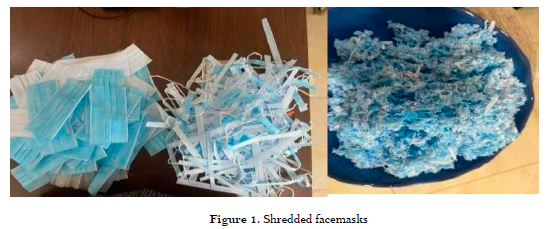
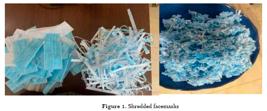
Before shredding, the metal strips and ear loops of the facemasks were removed. An electronic paper shredder was employed to shred the facemasks until they achieved a flake-like consistency, as depicted in Figure 1.
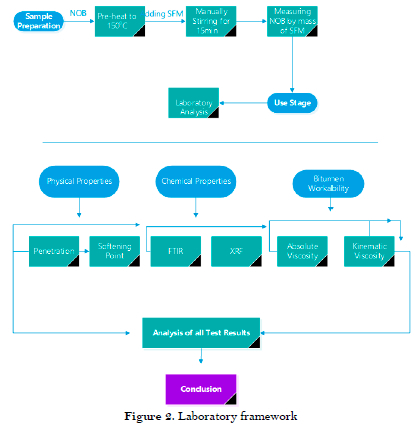
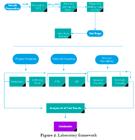
The physical properties of the facemasks were determined through specific gravity, melting point, and water absorption tests. Additionally, X-ray fluorescence (XRF) analysis was conducted to assess the chemical composition of the facemasks. The framework for this study is schematically presented in Figure 2.
The neat NOB was heated to a temperature of 150oC ± 5oC for 30 minutes. Subsequently, 200g of the heated NOB was carefully measured into a mixing canister equipped with a homogeneous heat source, which was precisely controlled to maintain a temperature of 170 ± 5oC.
The shredded facemasks (SFM) were then introduced into the heated bitumen at varying percentages by mass of the bitumen: 1.5, 3, 4.5, 6, 7.5, and 9%. Mechanical mixing was employed to achieve a homogeneous blend of NOB and the facemasks, thus preventing any early ageing effects.
Table 2 presents the various tests and corresponding standards that were conducted on the neat and modified NOB samples:
4. RESULTS AND DISCUSSION
4.1 Physical and chemical characteristics of facemasks
The physical properties of the facemasks were determined through specific gravity, water absorption, and melting point tests. The results indicated a specific gravity of 1.1, water absorption of 0.0% after 24 hours, and a melting point of 155oC.
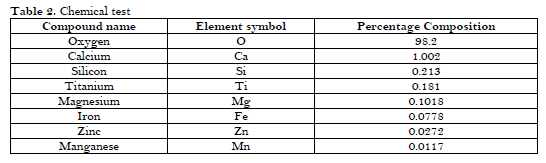
Furthermore, X-ray fluorescence (XRF) analysis was conducted to assess the chemical composition of the facemasks. Table 2 presents the major element composition and their respective percentage compositions.
4.2 FTIR analysis of neat NOB samples
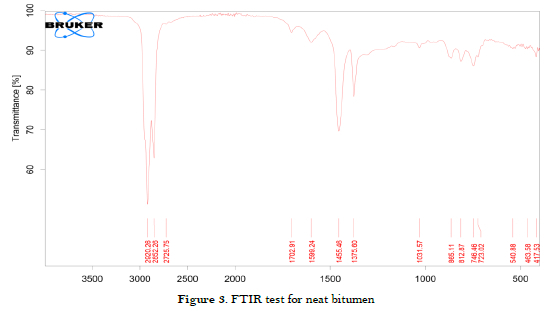
Figure 3 clearly illustrates the chemical structure of the neat bitumen sample. The maximum absorbance peaks were observed at 2920 cm-1, 2852 cm-1, 2725 cm-1, 1702 cm-1, and in the shoulder peak region at 1031 cm-1, 865 cm-1, 723 cm-1, 540 cm-1, and 417 cm-1.
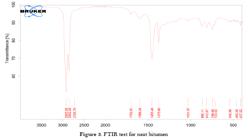
The wave number range between 1800 and 600 cm-1 represents the most crucial fingerprint region that describes the chemical composition of bitumen. This region exhibits specific correlations to absorption vibrations of carbonyls, methylene (-CH2-), and alkane or cycloalkane groups, as earlier confirmed by Mayers (2020).
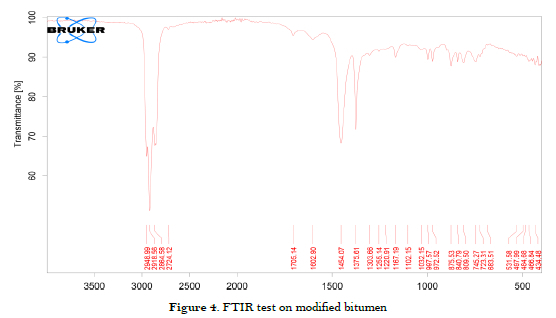
Figure 4 shows that the properties of the modified bitumen shown in the FTIR results appear to be unchanged when compared with the spectra of the neat bitumen shown in Figure 3. This indicates that the facemask did not affect the chemical structure of the NOB and this may be because the original material used to produce facemasks is a petroleum derivative from the same origin as the bitumen.
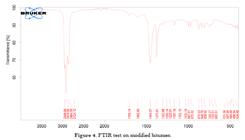
Therefore, only physical changes were observed from the blending of the two materials. A similar study was carried out by Yalcin et al. (2022), which supported the present study accordingly, as both the bitumen and the modified material used for the research have the same functional groups (active chemical group) thanks to their petroleum origin. Calcium, Silicon, and Oxygen indicate the polarity of the NOB, while Oxygen shows Ketones and Phenols, leading to a concentration of polar atoms, which easily form the functional group exhibited by the FTIR analysis.
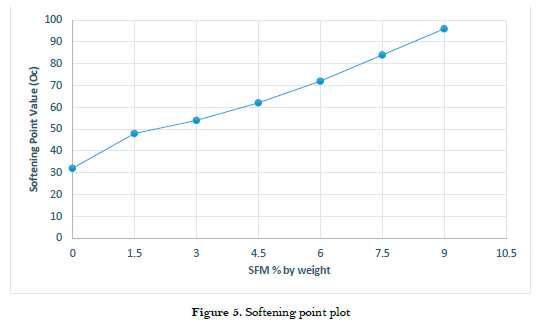
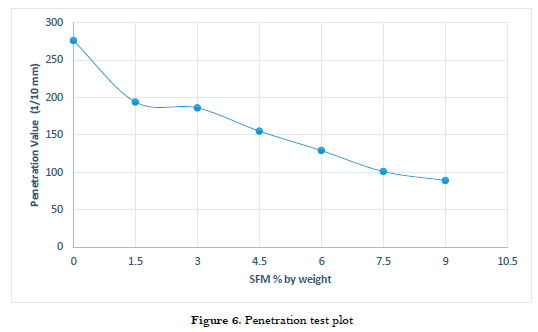
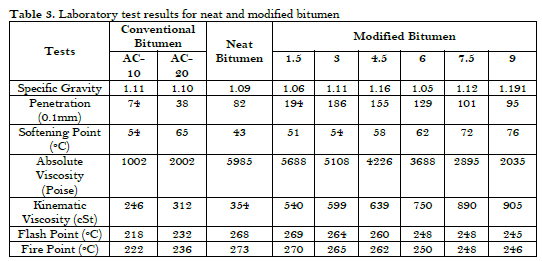
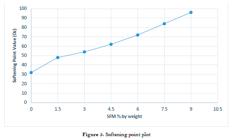
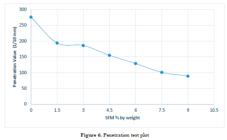
Table 3 presents the average findings of the tests conducted. The penetration values indicate a consistent decrease upon the addition of SFM to the neat bitumen. Conversely, the softening point values exhibit a gradual increase with each increment of SFM in the NOB.
The observed increase in softening point suggests that incorporating shredded facemasks into the neat NOB as a binder enhances the thermal resistance of the binders. Bitumen with higher softening point values demonstrates an improved ability to maintain its isoelastic behaviour at elevated temperatures. Figure 5 shows the plot for the softening point.
These findings align with previous studies that reported a significant increase in softening point and a corresponding decrease in penetration values with an increase in polypropylene content (Zhu et al., 2014). As shown in the plot in Figure 6
The viscosity of the NOB sample, which represents the workability of its mixture, was measured at 90oC and 135oC. The obtained results are consistent with those reported by Wu and Mantulvo (2021). It was observed that the rotational viscosity increased with each increment of SFM, while the temperature and viscosity exhibited an inverse relationship.
4.3 Limitations of the Study
The study only focused on the physical-chemical properties of naturally occurring bitumen (NOB) and its modification with waste facemasks for road construction. It did not investigate the long-term performance or durability of the modified NOB in actual road paving applications.
The paper did not include testing of the rheological properties of the modified NOB using a Dynamic Shear Rheometer (DSR), which could provide further insight into its performance characteristics.
The study did not discuss the potential challenge or limitation of scaling up the use of waste facemasks for modifying NOB on a large scale for road construction. The study did not address the potential environmental impact associated with the use of waste facemasks in road construction, such as the release of microplastic or its disposal after its service life.
5. CONCLUSION
The physiochemical properties of naturally occurring bitumen (NOB) were determined, and it was found that the neat NOB had high penetration, low softening point, and high viscosity, making it unsuitable for road construction in Nigeria.
The modified NOB, when blended with facemasks, showed reduced penetration value and increased softening point, making it suitable for road paving with a range of AC-10 grade bitumen.
The modification of NOB with waste facemask only affected the physical properties and did not influence its thermal stability. The addition of waste facemasks decreased the absolute viscosity, making it consistent with the workability and the specification of bitumen used in road construction.
The modification of NOB with shredded facemasks increased its stiffness and reduced temperature susceptibility, with every addition of shredded facemasks, the rotational viscosity increased while the temperature and viscosity decreased.
The FTIR analysis also confirmed the originality of the waste facemasks being made of polypropylene material.
The study highlights the potential of utilising naturally occurring bitumen with waste facemasks as a sustainable alternative to petroleum-based bitumen, reducing the environmental impact and the cost of road construction.
6. FURTHER RESEARCH AND RECOMMENDATIONS
Further testing is recommended to be carried out on the naturally occurring bitumen (NOB) using a Dynamic Shear Rheometer (DSR) to determine its rheological properties. This would provide a more comprehensive understanding of the performance characteristics of the modified NOB for road construction.
Long-term pavement performance and durability studies should be conducted to assess the effectiveness of the modified NOB in actual road construction. This would help determine its suitability and longevity in real-world scenarios.
Comparative studies should be conducted to evaluate the modified NOB with other alternative materials or methods for road construction. This would provide insight into the advantages and disadvantages of using NOB as a sustainable alternative to petroleum-based bitumen.
An Environmental impact assessment should be conducted to evaluate the potential environmental implications of using waste facemasks in road construction. This would help identify any potential challenges or risks associated with the use and disposal of the modified NOB.
REFERENCES
2. LITERATURE REVIEW
- Adeyemi, G. A., Fadairo, A. S., Oladepo, A. D., Ayoola, A., Ilusemiti, T., and Oguezuonu, S. (2021). Modification of Nigerian bitumen using locally source materials. IOP Conference Series: Materials Science and Engineering, 1107(1), 12205.
- Akinwumi, I. I., Domo-Spiff, A. H., and Salami, A. (2019). Marine plastic pollution and affordable housing challenge: Shredded waste plastic stabilised soil for producing compressed earth bricks. Case Studies in Construction Materials, 11, e00241. https://doi.org/10.1016/j.cscm.2019.e00241
- Anupam, K., Akinmade, D., Kasbergen, C., Erkens, S., and Adebiyi, F. (2023). A state-of-the-art review of Natural bitumen in pavement : underlining challenges and the way forward. Journal of Cleaner Production, 382, 134957. https://doi.org/10.1016/j.jclepro.2022.134957
- Aragaw, T. A. (2020). Since January 2020 Elsevier has created a COVID-19 resource centre with free information in English and Mandarin on the novel coronavirus COVID- 19 . The COVID-19 resource centre is hosted on Elsevier Connect , the company ' s public news and information. Marine Pollution Bulletin, 159(January), 111517. https://doi.org/10.1016/j.marpolbul.2020.111517
- Dharmaraj, S., Ashokkumar, V., Hariharan, S., Manibharathi, A., Show, P. L., Chong, C. T., and Ngamcharussrivichai, C. (2021). The COVID-19 pandemic face mask waste: A blooming threat to the marine environment. Chemosphere, 272, 129601. https://doi.org/10.1016/j.chemosphere.2021.129601
- Hantoko, D., Li, X., Pariatamby, A., Yoshikawa, K., Horttanainen, M., and Yan, M. (2021). Challenges and practices on waste management and disposal during COVID-19 pandemic. Journal of Environmental Management, 286, 112140. https://doi.org/10.1016/j.jenvman.2021.112140
- Hunt, J. D., Byers, E., Riahi, K., and Langan, S. (2018). Comparison between seasonal pumped-storage and conventional reservoir dams from the water, energy and land nexus perspective. Energy Conversion and Management, 166, 385-401. https://doi.org/10.1016/j.enconman.2018.04.044
- Ludwig-Begall, L. F., Wielick, C., Dams, L., Nauwynck, H., Demeuldre, P.-F., Napp, A., Laperre, J., Haubruge, E., and Thiry, E. (2020). The use of germicidal ultraviolet light, vaporised hydrogen peroxide and dry heat to decontaminate face masks and filtering respirators contaminated with a SARS-CoV-2 surrogate virus. Journal of Hospital Infection, 106(3), 577-584.
- Mashaan, N. S., Chegenizadeh, A., and Nikraz, H. (2022). Evaluation of the Performance of Two Australian Waste-Plastic-Modified Hot Mix Asphalts. Recycling, 7(2). https://doi.org/10.3390/recycling7020016
- Mayers et al. (1995). (n.d.). Physico-chemical modification of asphalt bitumens by reactive agents Modificación físico-química de betunes asfálticos mediante agentes reactivos Memoria para optar al grado de doctor presentada por. McNally, T. (2011). Polymer modified bitumen. In Polymer Modified Bitumen. https://doi.org/10.1533/9780857093721
- Mohi, I., Din, U., Marik, S., and Student, P. G. (2007). Influence of Fillers on Paving Grade Bitumen. International Journal of Innovative Research in Science, Engineering and Technology (An ISO, 3297. https://doi.org/10.15680/IJIRSET.2015.0412167
- NAN. (2022)). News Agency of Nigeria. In News Paper, 6, 2-12.
- Nizamuddin, S., Boom, Y. J., and Giustozzi, F. (2021). Sustainable polymers from recycled waste plastics and their virgin counterparts as bitumen modifiers: A comprehensive review. In Polymers (Vol. 13, Issue 19). MDPI. https://doi.org/10.3390/polym13193242
- Olabemiwo, O. M., Esan, A. O., Adediran, G. O., and Bakare, H. O. (2016). The performance of Agbabu natural bitumen modified with polyphosphoric acid through fundamental and Fourier transform infrared spectroscopic investigations. Case Studies in Construction Materials, 5, 39-45. https://doi.org/10.1016/j.cscm.2016.06.003
- Potluri, P., and Needham, P. (2005). 6 - Technical textiles for protection. In R. A. Scott (Ed.), Textiles for Protection, 151 -175. Woodhead Publishing. https://doi.org/https://doi.org/10.1533/9781845690977.1.151
- Saberian, M., Li, J., Kilmartin-Lynch, S., and Boroujeni, M. (2021). Repurposing of COVID-19 single-use face masks for pavements base/subbase. Science of the Total Environment, 769, 145527. https://doi.org/10.1016/j.scitotenv.2021.145527
- Schreurs, M. A. (2016). The Paris climate agreement and the three largest emitters : China , the United States , and the European Union. 4(3), 219-223. https://doi.org/10.17645/pag.v4i3.666
- Selvaranjan, K., Navaratnam, S., Rajeev, P., and Ravintherakumaran, N. (2021). Environmental challenges induced by extensive use of face masks during COVID-19: A review and potential solutions. Environmental Challenges, 3, 100039. https://doi.org/https://doi.org/10.1016/j.envc.2021.100039
- Silva, A. L. P., Prata, J. C., Walker, T. R., Duarte, A. C., Ouyang, W., Barcelò, D., and Rocha-Santos, T. (2021). Increased plastic pollution due to COVID-19 pandemic: challenges and recommendations. Chemical Engineering Journal, 405, 126683.
- Singh, P. K., Suman, S. K., and Kumar, M. (2020). Influence of recycled acrylonitrile butadiene styrene (ABS) on the physical, rheological and mechanical properties of bitumen binder. Transportation Research Procedia, 48, 3668-3677. https://doi.org/10.1016/j.trpro.2020.08.081
- Sorrell et al 2010. (n.d.). Global Oil Depletion.
- Teymourian, T., Teymoorian, T., Kowsari, E., and Ramakrishna, S. (2021). Challenges, strategies, and recommendations for the huge surge in plastic and medical waste during the global COVID-19 pandemic with circular economy approach. Materials Circular Economy, 3(1). https://doi.org/10.1007/s42824-021-00020-8
- Victor, C., Mansor, M. L. N., Yaacob, M. F., Nordin, M. A., and Shafie, F. A. (2022). An approach to pandemic era-proper handling of the used face mask: life in pandemic era series. MAEH Journal of Environmental Health, 4(1), 16-18.
- Wang, G., Li, J., Saberian, M., Rahat, M. H. H., Massarra, C., Buckhalter, C., Farrington, J., Collins, T., and Johnson, J. (2022). Use of COVID-19 single-use face masks to improve the rutting resistance of asphalt pavement. Science of the Total Environment, 826. https://doi.org/10.1016/j.scitotenv.2022.154118
- Zand, A. D., and Heir, A. V. (2020). Emerging challenges in urban waste management in Tehran, Iran during the COVID-19 pandemic. Resources, Conservation, and Recycling, 162, 105051. https://doi.org/10.1016/j.resconrec.2020.105051