Exploring the Barriers Facing the Adoption of Building Automation Systems for Energy Efficiency in a Developing Economy
Abstract
Building automation systems (BAS) play a crucial role in the operations and management of modern buildings, affecting energy efficiency for a better living. Despite the numerous benefits that BAS technology can contribute to the economic landscape of society, its adoption is still significantly low. This study explores the barriers facing the adoption of BAS for energy efficiency in a developing economy such as South Africa (SA). The study adopted a quantitative research approach with data gathered from the respondents saddled in the affairs of sustainable construction practices, such as construction managers, building energy managers, facility managers, contractors, etc. Mean item score (MIS) and factor analysis (FA) served as the method of data analysis. The findings revealed the most significant barriers facing the adoption of BAS for energy efficiency to be power supply issues, high initial costs, resistance to change, and regulation challenges; also revealed from the factor analysis that three significant constructs that serve as the major barriers facing the adoption of BAS technologies are digital divide barriers, access barriers, and compliance barriers. Conclusively, the study outlined the weight and strength of the barriers facing BAS adoption and a viable approach to mitigate such limitations in favour of socio-economic development. This guarantees energy optimisation in developing economies such as SA and contributes to the sustainable construction practices domain.
Building automation systems; developing economy; energy efficiency; South Africa; sustainable construction
1. INTRODUCTION
Building Automation Systems (BAS) can coordinate electrical and mechanical devices through a control network to save energy and improve thermal comfort (Salam and Salam, 2020). Digitalisation of buildings is a promising solution for achieving net-zero emissions in buildings (Ndlovu, 2022). Humans spend a large part of their day in buildings, and this has resulted in around 90% of their living in buildings, which makes their behaviour directly impacts energy performance in buildings (Cao et al., 2016). Thermal comfort is necessary to produce an indoor environment that building occupants feel thermally pleasant while saving energy and enhancing building sustainability and economics (Gonzalez-Ruiz et al., 2018). In 2050, over 70% of people in the world will live in urban centres, which will result in an increase in the density of buildings in urban areas, particularly city centres, changing the characteristics of indoor spaces, which have become increasingly dependent on intelligent systems for their proper functioning (Murillo et al. 2024). Olanrewaju et al. (2022) reported that adopting BAS can lead to improved thermal comfort and reduced occupant complaints. Verma and Jain (2019) further stated that Building comfort, security and vitality management can be improved by the adoption of BAS. The adoption of BAS can help minimise maintenance and operational expenses. This can assist in predicting and mitigating technical issues before they become reactive, helping save operational costs and reducing downtime and repair costs. Li et al. (2020) found that BAS implementation in a hotel led to improved operational efficiency by automating tasks such as lighting and HVAC control. Likewise, Qiang et al. (2023) corroborated that the deployment of BAS has led to improved working efficiency due to proactive building monitoring and control of building systems in university buildings.
BAS adoption can help reduce energy use and greenhouse gas emissions, making it an important pillar of sustainable building practices. The concept of eco-friendly targets comprises three primary dimensions: social, environmental, and economic. Qiang et al. (2023) showed that BAS could contribute to achieving sustainability objectives by reducing consumption through support for the use of renewable energy sources in buildings. In the same vein, Ghazali and Zahari (2023) show that BAS can help buildings meet energy efficiency targets set by governments and organisations. Achieving cost savings and reductions in costs can reduce the impact on the economy and reduce operating costs through the use of a life cycle assessment, including both hard and soft costs assessments. (Hafez et al., 2023).
The potential to reduce energy expenditure and to facilitate the operation, monitoring, and maintenance of buildings while improving occupant comfort is feasible with the adoption of BAS. Several initiatives aimed at enhancing energy optimisation and reducing energy consumption have been implemented in South Africa and other developing countries, and this will assist South Africa in meeting its pledge to a decarbonised economy and cutting carbon emissions. In 2011, the SANS 10400-XA building code for energy savings was adopted in South Africa, with a view to enhancing and optimising the performance of newly developed buildings. The code establishes a rigorous and unyielding set of energy efficiency standards for all new structures, a visionary mandate that will usher in a new era of sustainable and environmentally responsible construction. The adoption of BAS for energy efficiency is considered a smart investment that will save energy and maintenance costs, improve building performance, increase property value, and enhance occupant comfort (Jia et al., 2018).
In recent years, electricity prices in South Africa have been rising sporadically, making energy optimisation a major concern in the country (Khobai and Le Roux, 2017). BAS can help optimise energy use and associated costs by controlling HVAC systems based on occupancy and weather patterns. This is evidenced by the adoption of BAS in office buildings, which has led to energy savings of up to 33% and considerable cost reductions (Domingues et al., 2016). Similarly, Zhang et al. (2023) found that the adoption of BAS in the hotel industry has led to up to 27% energy reductions, resulting in cost savings of up to $42 000 per year. According to Ngobeni et al. (2022), in South Africa, the prices of new green buildings are 1.1% to 5% higher than those of conventional buildings. This suggests that the additional expenses of green construction are small. The lifecycle of green buildings offers much lower running costs than conventional buildings, with energy expenditures as an important component.
Noncompliance with building codes and regulations is an important barrier to BAS adoption in South Africa; adoption will drive energy efficiency standards across the region. The adoption of BAS can help meet these standards by monitoring energy consumption, optimising HVAC systems, and controlling lighting systems. Additionally, the government offers incentives and rebates for buildings that meet or exceed these standards, further motivating BAS adoption. A study by Melo et al. (2023) found that BAS can help buildings comply with energy efficiency standards and codes, such as LEED and ASHRAE, by providing Comprehensive building monitoring and control. SANS 10400-XA is a stringent energy efficiency standard for all infill development in South Africa. It supports the National Building Regulations and requires compliance with SANS 204, which sets limits on energy use for different building types in different climatic zones (Ngobeni et al., 2022).
In the same vein, energy optimisation has been considered as a viable economic alternative to longterm economic development and reducing the world's ever-increasing energy usage. (Ingezi-lotz and Pouris, 2012). This provides a unified strategy for seizing these possibilities in the best interests of the populace. The strategy's raison d'être was to improve energy resilience, dissociate energy appetite from increases, and enhance global competitiveness through technological and economic development. The strategy has clearly and effectively laid out ways to implement economic policies, including the establishment of government mechanisms to promote and coordinate affairs. It is imperative that government institutions find viable and effective solutions to this enormous limitation.
Many BAS solutions are not interoperable with solutions from other suppliers; instead, they lock customers into specific product lines and enforce closed specifications. These solutions are too complex to be used by untrained personnel; they work well only under precise, tailor-made conditions, are inflexible, and do not cover all the functions expected of a BAS. The adoption of BAS for energy efficiency is difficult due to several barriers.
Even though BAS provides significant long-term energy savings, the initial investment can be a deterrent for building owners and managers, especially in older buildings that require retrofitting to accommodate these features. The expense of continuing maintenance and improvements might also be an issue (Feldmann, 2022). Opawole et al. (2022) stated that overestimating capital costs and underestimating potential cost savings are among the barriers to the adoption of BAS for energy efficiency. Abuimara et al. (2021) also stated that the main challenge building management professionals face throughout their careers is limited financial resources. The cost of replacing manual processes with automated machines and robotics is a core challenge (Feldmann, 2022). In the same vein, Palm and Bryngelson (2023) observed that a common financial obstacle was inadequate funding for low-energy-use measures, such as continuous expenditure, which may be a core deterrent for organisations with low budgets.
The complexity of technology can be daunting for building managers and owners who may not have expertise in the area, as well as for those concerned about data privacy and cybersecurity. BAS technology is still maturing; however, a suitable building automation protocol is missing, which leads to security challenges and limited flexibility in smart buildings. Another technical barrier is compatibility issues, which can arise when different BAS products or components cannot work together (Carlander and Thollander, 2023). Abuimara et al. (2021) postulated that for a correct operation process of the BAS components, a reliable power supply is required. Disruption of the BAS, affecting building operations and efficiency, can be experienced in areas with unstable electricity networks or persistent power blackouts. The importance of backup power solutions and surge protection is highlighted as a challenge. Energy supply may be a barrier to the automation of systems, especially in countries where electricity grids are unreliable. The frequency of power failures are frequent in these countries, which can have dire consequences for the automation systems. This may lead to productivity and economic losses, as well as safety risks. Domingues et al. (2016) mentioned that building automations can work well in the exact conditions they were designed for, but cannot do so well when the working environment changes because of a lack of flexibility. (Okwe et al., 2023) conducted research in one of the developing countries, Nigeria, and found that a lack of adequate power supply is among the barriers to BAS adoption.
Also, project delays, errors, and budgetary overruns may be caused by a lack of experience, coupled with a high degree of professional experience that unpractised players may not have needed to cope with the complexities involved in integrating different components and ensuring optimum performance. The key hurdle to the adoption and efficient exploitation of BAS benefits is a lack of experience and expertise. The sapience and finesse necessary for the full-lifecycle asset oversight of such complex systems are often lacking among building owners and managers. There may be several challenges, including poor system performance, energy waste, and even safety risks. (Carlander and Thollander, 2022)
In the evidence-based research conducted by Aigbavboa et al. (2017), which explored perceptions of building experts in the South African built environment on "lazy view", vital impediments to environmentally sustainable building in the built industry are: limited understanding of sustainability benefits, lack of mobilisation for sustainable building and increased costs related to constructing sustainably built buildings. Many building owners and managers are unaware of the potential of building automation systems and the energy savings they can deliver. This lack of awareness often leads to reluctance to invest in this technology, especially when the cost of installation and maintenance is a concern. Another major obstacle has been identified as Energy illiteracy; the knowledge exchange was hampered by the lack of a platform for the stakeholders to collaborate and learn from each other. (Palm and Bryngelson, 2023). Furthermore, Opawole (2022) stated that the lack of adequate knowledge of the concepts is a barrier to adoption. This negligence can lead to a lack of support for the adoption of BAS (Caputo and Pasetti, 2017). Instead of relying on the existing knowledge base, the absence of consensus in the field and the presence of functional gaps lead solution developers to constantly redefine fundamental concepts and create endless solutions. (Domingues et al., 2016).
In many developing countries, the lack of legislation and policies governing sustainable construction has made it less likely that industry players will embrace sustainable construction practices (Aghimien et al., 2019). However, South Africa has regulations and frameworks, such as the Green Energy Accord and the National Green Building Council, which is authorised to certify environmentally friendly structures. Simpeh and Smallwood (2015) argue that the lack of legislative consistency, as well as stakeholders' fear of liability and court cases, has made it difficult to incorporate sustainability into South Africa's construction sector. Palm and Bryngelson (2023) also mention that the absence of clear guidance can make it difficult to adopt and may even lead to poor implementation. The full realisation of the benefits outlined by the adoption of BAS in South Africa can be achieved through education and awareness policies, cost-effective solutions and infrastructural upgrades to align with the needed technology for BAS adoption. The study aims to mitigate the barriers to the full adoption of BAS technology for energy efficiency in South Africa.
3. RESEARCH METHODOLOGY
The method used in this study was a quantitative research approach to achieve the study's aim. Quantitative methods relate to positivism and factual data (Park and Park, 2016). The quantitative research method is one of the robust methods used to achieve research objectives and plays a critical role in justifying a research study (Park and Park, 2016). The questionnaire was developed from a wide range of literature reviews and is not part of any existing survey instrument. The study used a non-probability sampling technique, and 124 respondents participated. Practising BAS professionals in the South African construction industry (SACI) were engaged in collecting primary data on the barriers to adopting BAS for energy efficiency. Cronbach's alpha was used to assess the instrument's reliability. The Likert scale (strongly agree = 5, agree = 4, neutral = 3, disagree = 2, strongly disagree = 1) was adopted. The mean item score (MIS) was used to present the Likert-scale findings in decreasing order.
Exploratory factor analysis (EFA) is one of the two types of factor analysis (FA). It is often deployed during the initial stage of research by researchers to collate information about the interrelationships within a set of variables (Pallant, 2011). EFA results were obtained to confirm the validity and reliability of the barriers to adopting BAS for energy efficiency, with the highest likelihood indicated by an eigenvalue greater than 1. Together with the varimax rotation, EFA was used specifically for this study. Statistical Package for the Social Sciences (SPSS) software version 29.0 was used to conduct the EFA for this research. The descriptive results show the rankings of all factors from first to last for each variable, with the table showing the individual variables' mean scores and standard deviations.
4. RESULTS AND DISCUSSION
4.1
Background InformationThe data shows that quantity surveyors constituted the largest professional group, representing 32.9% of the respondents, followed by civil engineers and builders at 21.3% and 17.4%, respectively. The majority of respondents held bachelor's degrees (56.6%), with a significant proportion also holding higher academic qualifications, such as master's degrees (19.0%) and PhDs (5.8%). Additionally, most firms represented in the survey were privately owned (85.3%), and a substantial proportion had staff strength of 1 to 60 employees, indicating that the survey primarily captured data from small- to medium-sized firms. The professionals who made up the respondents were engineers, accounting for 23% of the total respondents. This is closely followed by construction managers, building, energy managers, facility managers and contractors with 23%, 2.7%, 1.4%, 2.7% and 16.2% respectively. The Concerning years of professional experience, findings showed respondents with 1-2 years of professional experience accounted for 29.7% of the aggregate number of respondents, while those with less than a year professional experience accounted for 25.7%, 2-3 years made up of 12.2%, 3-5 made up 17.6%, 5-10 years made up 9.5%, 10-20 years made up 4.1% and finally more than 20 years made up 1.4%. Based on the highest educational qualification, which ranges from 20 to 55 years and above, the highest educational qualification of the respondents is Diploma, bachelor's degree, honours' degree, master's degree and Doctorate degree.
4.2
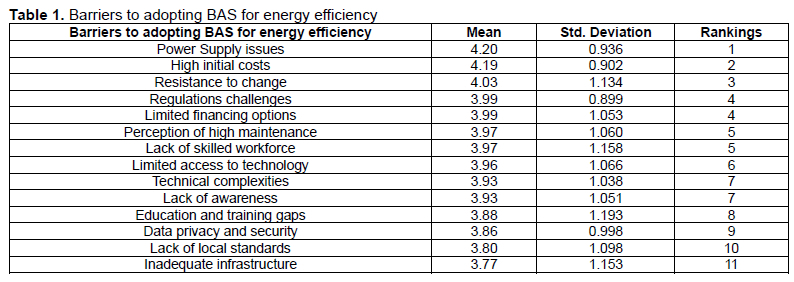
Descriptive StatisticsTwo descriptive statistics were carried out, which are in the form of mean item scores. The variables were ranked using mean item scores; likewise, factor analysis was carried out to identify the variables measuring the same underlying effects (Ledwaba, 2012). The mean ranking of the variables presented depicts the individual views reached by the respondents. The test results are shown in Table 1. Table 1 also includes the standard deviation of the variables.
4.3. Exploratory Factor Analysis
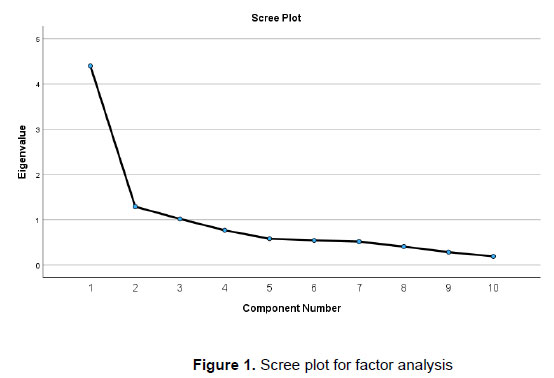
The EFA results on the adoption of BAS in the SACI are depicted in Tables 1, 2, 3, 4, and Figure 1. A total of 11 variables were outlined, none of which were missing. The following were the variables identified with the potential barriers of BAS for energy efficiency. Factor analysis is vital in breaking down a number of large variables and breaking them into simpler clusters for better interpretations (Ahadzie et al., 2008). Table 2-4 and Figure 1 show that the Kaiser-Meyer-Olkin (KMO) measure of sampling adequacy attained a high score of 0.782. (Table 2) The Bartlett test of sphericity was also important; it suggests that the population matrix is not an identity matrix (Ledwaba, 2012). In addition, the Cronbach alpha, which measures internal consistency, is 0.782, suggesting that the reliability of the researcher's instrument is quite good (Park and Park, 2016).
Data was regulated with principal component analysis (with varimax rotation). The eigenvalues have a high value of more than 1. As represented in Figure 1, the factor loading extracted was three components with the eigenvalues more than 0.5, as represented in Table 3 (also see fig. 1 scree plot). Table 3 also shows that the variables formed three factors based on their interrelationships. For the total variance (see table 4), as explained by each component extracted, component 1 (43.968%), component 2 (12.904%), and component 3 (10.193%). Therefore, the results of the principal component analysis (PCA) and the extracted factors accounted for 67.065% of the total cumulative variance.
The principal axis factoring showed that three (3) factors were present, with eigenvalues greater than 1, as shown in Table 4 above. Owing to careful observation of the inherent connections among the variables under each factor, the following assessments were made: Factor 1 was described as digital divide barriers, Factor 2 as access barriers, and Factor 3 as compliance barriers, as depicted in Table 4. The term used to describe these factors was derived from close observation of the variables within each factor. The three extracted factors and their constituent indicators are explained below, along with a comprehensive description of how the factors were described in the factor section.
5. DISCUSSION
5.1 Component 1: Digital Divide Barriers
The four (4) derived items were loaded to this component, which included: Market competitiveness (80.2%), Limited access to technology (76.9%), Technical complexities (73.1%) and Lack of awareness (59.3%). All these variables analysed speak directly to the barriers facing BAS adoption for energy efficiency. Knowledge gap, lack of awareness of the BAS technology, is a challenge that must be addressed (Caputo and Pasetti, 2017). The studies by Aigbavboa et al. (2017), Palm and Bryngelson (2023), and Domingues et al. (2016) agree on the barriers to the adoption of BaS for achieving adequate energy efficiency.
5.2. Component 2: Access Barriers
The four (4) compiled items were loaded to this component, which consisted of: High initial costs (82.8%), Power Supply issues (67.1%), Regulations challenges (65.4%) and Inadequate infrastructure (59.0%). All these variables analysed speak directly to the barriers facing BAS adoption for energy efficiency in the South African built environment. These findings agreed with the studies by (Opawole et al. 2022:116), (Abuimara et al., 2021), and (Palm and Bryngelson, 2023), who found that Investment anxiety and limited financial resources were the major barriers to the adoption of BAS for energy efficiency. On the other hand, (Domingues et al., 2016) and (Ogunde et al,.2018) mentioned that inadequate power supply is a challenge as these automation systems are built to work well in the exact conditions they were designed for, but can't do it so well when the working environment changes because of a lack of flexibility. According to Aghimien et al. (2018), many developing countries lack the legislation and policies needed to govern sustainable construction, thereby hindering stakeholders from embracing sustainable construction practices.
5.3. Component 3: Compliance Barriers
The two (2) compiled items were loaded to this component, which included: Lack of local standards (82.2%) and Data privacy and security (80.5%). All these variables analysed directly address the barriers to BAS adoption for energy efficiency in the South African built environment. These findings agreed with the studies of Simpeh and Smallwood (2015), who found that adoption of BAS is relatively slow due to inconsistent Litigation-fearing regulations and stakeholders' concerns over the efficacy of novel sustainable products and systems. (Palm and Bryngelson, 2023) also note that the absence of clear guidance can make adoption difficult and may even lead to poor adoption.
6. CONCLUSIONS
To achieve the objective of this research, as stated in the introduction of this paper, a thorough literature review was conducted, which enabled the identification of the barriers to BAS adoption for energy efficiency. The outcome is the expected barriers that need to be addressed for BAS adoption to thrive in a developing economy such as SA. The identified barriers to BAS adoption were power supply issues, high initial costs of acquiring BAS technology, regulatory challenges, limited financing options due to a poor policy framework, perceptions of high maintenance among potential stakeholders and users, a lack of a skilled workforce to execute these technical tasks, and restricted access to technology. The findings were consistent across various sources in the literature on the barriers facing BAS adoption for energy efficiency in a developing economy. Based on the EFA, three factors were identified: digital divide barriers, access barriers, and compliance barriers. The findings call for urgent government intervention to develop policies and measures that support the adoption of BAS for energy efficiency. Therefore, the South African built environment must span the chasm in education and training for innovative technologies that can positively transform society's economic landscape. This study has made an outstanding theoretical contribution that will bridge a gap in the literature on BAS adoption. The use of EFA enabled the identification of barriers to the adoption of BAS for energy efficiency. Also, this study will assist developing nations worldwide in determining and addressing the enormous barriers to the adoption of BAS, both industrially and domestically. The adoption of BAS will lead to technological advancement, infrastructural development and economic growth. The study established the need for government and policymakers to be intentional in adopting BAS for the public's overall interest.
REFERENCES
2. LITERATURE REVIEW
- Abuimara, T., Hobson, B. W., Gunay, B., O'Brien, W., & Kane, M. (2021). Current state and future challenges in building management: Practitioner interviews and a literature review. Journal of Building Engineering, 41, Article 102803.
- Aghimien, D., Oke, A., Aigbavboa, C., & Musenga, C. (2019). Drivers of sustainable construction practices in the Zambian construction industry. Energy Procedia, 158, 3246-3252.
- Aigbavboa, C., Ohiomah, I., & Zwane, T. (2017). Sustainable construction practices: "Lazy view" of construction professionals in the South African construction industry. Energy Procedia, 105, 3003-3010.
- Cao, X., Dai, X., & Liu, J. (2016). Building energy-consumption status worldwide and the state-of-the-art technologies for zero-energy buildings during the past decade. Energy and Buildings, 128, 198-213.
- Caputo, P., & Pasetti, G. (2017). Boosting the energy renovation rate of the private building stock in Italy: Policies and innovative GIS-based tools. Sustainable Cities and Society, 34, 394-404.
- Carlander, J., & Thollander, P. (2022). Drivers for implementation of energy-efficient technologies in building construction projects-Results from a Swedish case study. Resources, Environment and Sustainability, 10, Article 100078.
- Domingues, P., Carreira, P., Vieira, R., & Kastner, W. (2016). Building automation systems: Concepts and technology review. Computer Standards & Interfaces, 45, 1-12.
- Feldmann, F. G. (2022). Towards Lean Automation in Construction-Exploring Barriers to Implementing Automation in Prefabrication. Sustainability, 14(19), Article 12944.
- Ghazali, F., & Zahari, W. M. (2023). Energy efficiency management towards sustainable development: The need for an energy efficiency legal framework. IIUMLJ, 31, 179.
- González-Ruiz, J. D., Botero-Botero, S., & Duque-Grisales, E. (2018). Financial eco-innovation as a mechanism for fostering the development of sustainable infrastructure systems. Sustainability, 10(12), Article 4463.
- Hafez, F. S., Sa'di, B., Safa-Gamal, M., Taufiq-Yap, Y. H., Alrifaey, M., Seyedmahmoudian, M., Stojcevski, A., Horan, B., & Mekhilef, S. (2023). Energy efficiency in sustainable buildings: A systematic review with taxonomy, challenges, motivations, methodological aspects, recommendations, and pathways for future research. Energy Strategy Reviews, 45, Article 101013.
- Inglesi-Lotz, R., & Pouris, A. (2012). Energy efficiency in South Africa: A decomposition exercise. Energy, 42(1), 113-120.
- Jia, R., Jin, B., Jin, M., Zhou, Y., Konstantakopoulos, I. C., Zou, H., Kim, J., Li, D., Gu, W., Arghandeh, R., & Nuzzo, P. (2018). Design automation for smart building systems. Proceedings of the IEEE, 106(9), 1680-1699.
- Khobai, H., Mugano, G., & Le Roux, P. (2017). The impact of electricity price on economic growth in South Africa. International Journal of Energy Economics and Policy, 7(1), 108-116. Available at: https://www.econjournals.com/index.php/ijeep/article/download/2977/2410/10191
- Ledwaba, M. J. (2012). Informal settlements and organisations in post-apartheid South Africa: The case of Bethlehem, Tshwane (Mini dissertation). Available online at: http://hdl.handle.net/10210/532
- Li, W., Koo, C., Hong, T., Oh, J., Cha, S. H., & Wang, S. (2020). A novel operation approach for the energy efficiency improvement of the HVAC system in office spaces through real-time big data analytics. Renewable and Sustainable Energy Reviews, 127, Article 109885.
- Melo, G., Nascimento, N., Alencar, P., & Cowan, D. (2023). Identifying factors that impact levels of automation in autonomous systems. IEEE Access, 11, 56437-56452.
- Murillo, K. G. L., Morejon, M. B., & Silva, J. (2024, October). Trends in the evaluation of energy efficiency and thermal comfort in buildings. In 2024 9th International Engineering, Sciences and Technology Conference (IESTEC) (pp. 481-486). IEEE.
- Ndlovu, L. Evaluating the influence of stakeholder participation in the M&E process of green technology projects (A case study of the SANEDI Biogas Digester Projects in South Africa).
- Ngobeni, T. S., Ngele, T. H., & Hoffman, D. J. (2022, June). Stakeholder participation trends in the South African green building industry: 2016-2018 perspectives. In Construction in 5D: Deconstruction, Digitalisation, Disruption, Disaster, Development: Proceedings of the 15th Built Environment Conference (pp. 363-373). Cham: Springer International Publishing.
- Olanrewaju, O. I., Enegbuma, W. I., Donn, M., & Chileshe, N. (2022). Building information modelling and green building certification systems: A systematic literature review and gap spotting. Sustainable Cities and Society, 81, Article 103865.
- Opawole, A., Olojede, B., Oshin, F., & Yusuf, A. (2022). Assessment of the level of awareness of intelligent buildings in Lagos State, Nigeria. Acta Structilia, 29(2), 116-149.
- Overview on the National Energy Efficiency Strategy (NEES) IEP Public Workshop. (n.d.). Available at: https://www.energy.gov.za/files/IEP/DurbanWorkshop/Overview-on-the-National-Energy-Efficiency-Strategy.pdf
- Pallant, J. (2011). Multivariate analysis of variance. In SPSS survival manual. Allen & Unwin.
- Palm, J., & Bryngelson, E. (2023). Energy efficiency at building sites: Barriers and drivers. Energy Efficiency, 16(2). https://doi.org/10.1007/s12053-023-10088-7
- Qiang, G., Tang, S., Hao, J., Di Sarno, L., Wu, G., & Ren, S. (2023). Building automation systems for energy and comfort management in green buildings: A critical review and future directions. Renewable and Sustainable Energy Reviews, 179, Article 113301.
- Salam, A., & Salam, A. (2020). Internet of things in sustainable energy systems. In Internet of things for sustainable community development: Wireless communications, sensing, and systems (pp. 183-216).
- Simpeh, E. K., & Smallwood, J. (2015). Factors influencing the growth of green building in the South African construction industry. In Proceedings of the Smart and Sustainable Built Environment Conference, 9-11 December 2015, Pretoria.
- Verma, N., & Jain, A. (2019, October). Energy efficient building automation system. In 2019 2nd International Conference on Power Energy, Environment and Intelligent Control (PEEIC) (pp. 27-32). IEEE.
- Zhang, F., Chan, A. P., & Li, D. (2023). Developing smart buildings to reduce indoor risks for safety and health of the elderly: A systematic and bibliometric analysis. Safety Science, 168, Article 106310.
Emmanuel O Ayorinde
Department of Civil Engineering Technology, Faculty of Engineering and the Built Environment, University of Johannesburg, South Africa
Email address:

Revised: 30-09-2025
Accepted: 05-12-2025