Influence of team emotional intelligence on the performance of construction design teams
Abstract
Emotional Intelligence (EI) is an important competence in teamwork settings. Predominantly, previous EI studies on teams have focused on individual-level EI, neglecting the synergy of team members in a team. Therefore, this study aimed to assess the influence of team EI on the performance of construction design teams. A mixed method approach was used to collect data by means of a questionnaire survey and focus group interviews. The questionnaire was used to collect data on team EI and team performance, while the focus group interview was conducted to give insights on team activities based on the results from the questionnaire survey. A total of 50 projects were selected, constituting eight (8) teams through convenience and purposive sampling techniques. The 8 teams consisted of 38 individuals. Thus, the questionnaire was administered to 38 respondents, of whom 17 valid responses were received, while the focus group interview was conducted with members of one team. Means, percentages and correlational analysis were utilised in the analysis of the quantitative data, while content analysis was used to analyse the qualitative data. The results obtained for team EI and performance were used for correlational analysis, which revealed that team EI has a significant positive association with the team's self-direction and average (overall) performance, as indicated by the correlation results (τb= .432, p=.046) and (τb= .401, p=.042) respectively. The content analysis revealed that team norms improved with participation in multiple projects. This suggests that TEI contributes significantly to the performance of the construction design teams. This study holds significant practical implications for the training of construction professionals, with the potential to foster the development of high emotional intelligence (EI). Furthermore, it extends its relevance to client organizations seeking to hire design team consultants who possess emotional intelligence. To achieve improved team performance, it is suggested that client organisations consider incorporating a team-based EI assessment alongside the evaluation of technical expertise during the hiring process.
Construction; Emotional Intelligence; Performance; Teams
1. INTRODUCTION
The project-based nature of construction requires different professionals to come together as teams for project success. The Construction Design Team (CDT) is one of the numerous teams in a construction project comprising several professionals, such as Architects, Builders, Civil Engineers, Quantity Surveyors (QS), and Service Engineers. The interdisciplinary and temporary nature of CDTs pose a challenge in managing people effectively to ensure successful project delivery (Loosemore et al., 2003). However, Emotional Intelligence (EI) competencies have also been found to improve team effectiveness. Lindebaum (2008) and Lindebaum and Jordan (2012) pointed out the contribution of EI to the relational and interpersonal performance of construction project managers and, consequently, to the success of project teams.
Barinua, et al. (2022) revealed a significant relationship between emotional intelligence and team effectiveness. Several studies have shown that there is a positive relationship between the team leader EI and the team performance in work, virtual and students' teams (Coleman and Ali, 2022; Mysirlaki and Paraskeva, 2020; Zhang et al. 2019). However, these studies on TEI have largely focused on individual-level EI by studying team leader EI and individual emotional intelligence of team members (Rezvani et al., 2018; 9; Hobbs and Smyth, 2012; Leicht et al., 2009; Polychroniou, 2009). However, Feyerhem and Rice (2002) and Druskat and Wolff (2001) found that individuals with high EI working in teams do not necessarily make an emotionally intelligent team. This is because of the more complicated nature of team interaction to attend to another level of awareness and regulation. Barinua et al. (2022) reported that the relationship between team performance and team leader emotional intelligence is complex. This suggests that teamwork success does not depend solely on leader EI, but also on the collective EI of team members (i.e. team emotional intelligence).
Peltola (2016) found that TEI does not contribute to team performance in financial service teams, while Koman and Wolff (2008) established that a team leader's EI influences the formation of team EI norms which further influences team performance in military teams. However, Lee and Wong (2019) reported that team emotional intelligence is positively related to team performance in various companies within several sectors, such as banking, investment, health care, information technology, and pharmaceutical industries. While these relationships have been reported in other sectors, none of these studies are representative of the construction industry because of the temporary and interdisciplinary nature of teams in construction. In particular, construction does not promote a culture of control by leaders, as found in other settings, such as the military. Therefore, this creates a gap in knowledge regarding team EI and performance in construction, particularly because the construction industry has been characterised as having adversarial relationships and diverse competences, which can be effectively moderated by emotional competences. Thus, the aim of this study was to assess the influence of team EI on the performance of construction design teams.
2.1 Concept of team emotional intelligence
EI generally refers to the ability of an individual to recognise and regulate emotions in one's self and others. It has been proven that EI abilities promote greater performance in individuals. Recently, EI has gained popularity as an essential personal factor for effective teamwork. Studies have established that leaders and team members with high EI positively influence team interaction and productivity (Barczak et al., 2010; Cole et al., 2019; Mills, Prati, et al., 2003). Barczak et al. (2010) established that emotional intelligence significantly promotes team trust which in turn, fosters a collaborative culture that enhances the creativity of the team among student teams. This suggests that EI could play a crucial role in shaping team dynamics and outcomes. However, it is important to note that this study focused on student teams, and the findings may not fully translate to professional settings. While Cole et al. (2019) examined the impact of EI on collaboration among professionals working in teams. Their findings indicated a significant regression of collaboration on emotional intelligence, highlighting the potential importance of EI in facilitating effective teamwork. Results also found a significant indirect effect between emotional intelligence and collaboration as mediated by factors such as strengths, opportunities, aspirations, and results. This suggests that EI may not only directly influence collaboration but also affect it indirectly through other variables. The context of these studies may make generalisation of findings inappropriate due to differences in experience and context.
Nevertheless, the concept of Emotional Intelligence (EI) has gained significant attention, particularly in the context of teamwork. EI encompasses an individual's ability to recognize and manage emotions, both in oneself and in others, and has been linked to improved performance. Recent research has highlighted the importance of EI in promoting effective teamwork, suggesting that leaders and team members with high EI can positively influence team dynamics and productivity. However, it is important to distinguish between individual-level EI and team-level EI. While individual EI focuses on personal emotional awareness and regulation, team emotional intelligence (TEI) or group emotional intelligence (GEI) refers to the collective emotional awareness and regulation within a team or group. For consistency, the term TEI refers to EI in groups and teams. Team El's theory is based on the framework of awareness and regulation of emotion at the group level and is very different from the individual-level EI of group members (Wolff, 2006). While individual EI is important, TEI adds another layer of complexity to the understanding of emotional intelligence in the context of teamwork, highlighting the importance of considering group dynamics and interactions in addition to individual skills.
The concept of TEI can be further understood through the framework of Team Performance Theory, which posits that effective team functioning is influenced by a combination of task-related and socio-emotional elements. This theory suggests that TEI is a key component in boosting team performance by facilitating effective communication, coordination, and conflict resolution among team members. Notably Team Performance Theory highlights the importance of emotional awareness and regulation for team effectiveness. Team EI is rooted in the idea that within a team, specific patterns of behavior and norms emerge as the group carries out its tasks. This notion, as described by Wolff (2006), highlights the collective nature of emotional intelligence within a team setting, where the interactions and dynamics among team members shape the overall emotional climate and effectiveness of the team. The development of Team EI can be traced back to the foundational works of Goleman and Boyatzis on Emotional Intelligence (EI). EI, characterised by the ability to recognize and regulate emotions in oneself and others, is considered crucial for effective team interaction and productivity. In a team context, the team leader plays a pivotal role in motivating collective action and fostering supportive relationships among team members, as noted by Prati et al. (2003). The multifaceted nature of emotional dynamics within teams, as highlighted by Barsade and Gibson (1998), revealed the key aspects of the group/team context to be the ability to evoke and manifest emotions at various levels, including individual, group, and inter-group levels. This underscores the significant impact that emotions can have on member behavior and group outcomes. Understanding and managing these emotions collectively are essential for promoting a positive team environment and achieving successful outcomes.
Norms are standards of behaviour shared by members of a social group which can be unspoken and often unwritten sets of informal rules that reflect the group's expectations of action and interactions (Druskat and Wolff 2001). In addition, norms define what behaviours are acceptable or not, good or not, right or not, or appropriate or not (O'Hair & Wiemann, 2004). In addition, Emmit and Gorse (2003) stated that norms can be said to be the most powerful and influential form of social control in a group setting, yet they are often the least visible. Thus, TEI can be defined as "the ability of a team to create norms that manage emotional processes so as to cultivate trust, group identity, and group efficacy" (Druskat & Wolff, 2001 p.17). Later, the term was redefined as "the ability of a team to generate a set of norms that guide the emotional experience in a team in an effective way (Wolff, 2017 p.33)." This makes group EI a developed competency of behaviours and capabilities that allows for the perception, recognition, understanding and management of emotions by the group such that the group is able to successfully manage its own emotional state and also understand its context, purpose and interaction with the larger organisational emotional system (Ghuman, 2011).
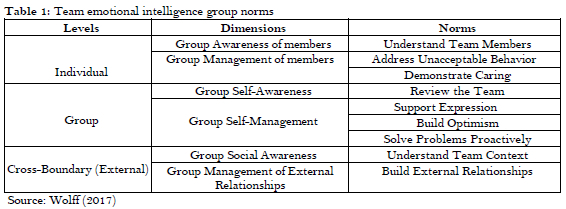
In this study, TEI refers to the ability of group members to generate a set of norms that effectively guides the emotional state of the team. Thus, emotional intelligence exists in teams as a collection of norms (expectations about how team members should behave in a team) which is more than an individual team member's ability. This was based on Druskat and Wolff s TEI theory, which contains a set of nine emotionally competent norms, as shown in Table 1.
The team EI norms outlined in table 1 formed the basis of the instrument used in determining team EI as developed by Druskat and Wolff and offered through the Group Emotional Intelligence (GEI) partners.
2.2 Team interaction
Effective management of workgroups requires an understanding of the psychological and social influences on behaviour within organisations (Kramer, 2006). In addition to the 'personal self the individual also has a number of 'selves' derived from different social contexts and membership of groups. Thus, work teams can be better understood in the context of both individual and social interaction resulting from group activities in the form of group norms and group social capital. By recognizing and understanding these psychological and social influences on behaviour, managers can better manage workgroups and create environments that foster collaboration, communication, and productivity.
Groups develop a pattern of informal social relations, codes and practices that constitute acceptable group behaviours known as norms (Mullins, 2010). Mullins further added that norms provide in addition to acceptable behaviour, system of sanctions to members who do not conform to the group norms as well as provide method of controlling conflict within the group. Established norms have been proven to improve performance (Brown, 1997). Although the behaviour and characteristics of groups change and develop over time, it is well known that groups develop (and are subject to) behavioural norms. Norms mature over time, as newly formed groups develop patterns of interaction (Heinicke and Bales, 1953; Keyton, 1999). Hare (1976) stated that group norms can be so influential that some members express a judgement that differs from the one they hold privately.
The social capital concept has been widely used to explain the importance of social factors in increasing the level of performance and achieving an organisation's goals. Edwards (2004) refers to social capital as "networks, together with shared norms, values and understanding that facilitate co-operation within and between groups". Thus, an organisation's ability to foster social capital by bringing people together for recurrent interaction over time provides organisations with a performance advantage (Nahapiet and Ghoshal, 1998). The basic idea of social capital is that it improves communication between individuals, generates cooperation that can benefit individuals, and also for the organisation in general. Milana and Maldaon (2015) found that social capital can be generated through social interactions between individuals or groups which could be either negative (i.e. negative feelings are characteristic of relations between the parties) or a positive push toward achieving benefits. Thus, social capital is the main explanation for the success of the human group (whether an organisation or society) interaction, as well as a more realistic indicator of the development of a group, community, or society (Milana and Maldaon, 2015).
Studies have linked social capital, emotional intelligence, and productivity to high integration (Brooks and Nafukho, 2006). Specifically, Nazem and Gheytasi (2014) established the existence of a positive significant relationship between principals' emotional intelligence and social capital in education departments. Additionally, the four dimensions of employees' EI have a significant positive impact on structural and relational social capital, thereby suggesting that social capital levels can be improved by enhancing the identification, development, and cultivation of EI (Xiao, 2020). These studies highlight the importance of emotional intelligence in fostering social capital, which in turn can enhance productivity.
2.3
Team performanceAccording to Mickan and Rodger (2000), effective teamwork is at three different levels: organisational, team, and individual. The organisational structural characteristics of teamwork refer to relatively stable procedures of coordination and control. The team processes describe subtle aspects of interaction and patterns of organising that transform inputs into outputs. Finally, individual contributions are perceived as prerequisite characteristics of effective teamwork. This study used the team performance measure developed and validated by Druskat et al. (2003) to assess the performance of construction design teams. This measure contains the following five items:
i. Efficiency in getting things done
ii. Quality of their work
iii. Ability to be self-directed
iv. Performance against all other teams in the division that perform similar tasks.
v. Ability to continue working together effectively in the future.
These items provide a comprehensive evaluation framework that considers both the tangible outcomes of teamwork (efficiency, quality) and the intangible aspects (self-direction, teamwork continuity). This approach allows for a more holistic assessment of team performance, taking into account the multifaceted nature of effective teamwork.
2.4
Overview of teams in constructionProject teams within construction consist of consultants, contractors, specialists and others who come together to design, manage and construct a product" (Winch, 2002). These teams have designated functions and each team's contribution affects the overall outcome of the project. Construction teams are multi-disciplinary in nature and are most often derived from several organisations to form the project team (Emmit and Gorse, 2003). These characteristics of teams within the construction industry are bound to affect their effectiveness as there will be potential conflicts arising from differing perspectives and priorities. Thus, there is a need to effectively manage interactions between members for successful project delivery (Emmitt, 2010; Herrera et al., 2020; Songer and Walker, 2004). The interactions can be effectively managed by the use of EI skills. Herrera et al. (2020) classified interactions into traditional interactions and commitment management. The traditional dimensions of interaction include the transfer of information, linking of trust, coordination, collaboration, and learning among team members. The dimensions of interaction associated with commitment management are associated with each of the speech acts: requirements, negotiation, declaration of completion, and declaration of acceptance (Long and Arroyo, 2018).
The consultants in a construction project are mainly known as the construction design team (CDT). The design team consists of professionals who articulate clients' needs into reality. These professionals are; Architects, Quantity Surveyors, Services Engineers, Structural Engineers and Project managers (represent the client). Thus, making the CDT a multidisciplinary team with its membership is more often derived from separate organisations that come together mainly for the achievement of the project goal. However, CDT members have different values, attitudes, and goals (Loosemore et al. 2003). This diversity within the CDT increases the likelihood of conflicts arising. Walker (2007) defined a team as a group that ideally ensures that the business objectives of organisations are aligned within teams through common design/project objectives; conflicting and contrasting business objectives and lack of mutual accountability are known to exist in typical construction teams (Garbharran et al., 2012; Takim and Adnan, 2008). Interaction is particularly important at the design stage because decisions made are significant to all subsequent stages.
2.5
Procurement routes and team formation in constructionDespite the existence of several procurement routes such as Design and Build, management Contracting, Public-Private partnerships, and so on, several studies have reported that the traditional procurement system is the most used procurement method in the procurement of public infrastructure in Nigeria (Babatunde et al., 2010; Adenuga and Dosumu, 2012; Aje et al., 2018). The predominance of the traditional procurement system in Nigeria can be attributed to the strong support it receives from the Public Procurement Act (PPA), which favors traditional procurement routes. The Traditional method involves the client engaging the services of design consultants (design team) to develop a design and prepare contract documents. It is based on the outcome of the design phase, known as the pre-contract stage, in which the construction takes place. Larmour (2011) stated that this method is used to describe procurement which involves the client's design team producing a full construction design. Usually, the design consultant is from separate organisations and seldom from a single organisation, unlike the design and build method in which the design consultants belong to the contracting organisation. This type of team formation makes it difficult for members to collaborate and trust each other. The reliance on a sequential design-bid-build process in the traditional approach can lead to inefficiencies and delays compared to more integrated and collaborative procurement routes such as Design and Build or Public-Private Partnerships. However, EI can foster collaboration and trust among team members. Individuals with high EI are more likely to exhibit empathy, communicate effectively, and build positive relationships, which are essential for successful teamwork.
2.6
Emotional intelligence and performance in constructionEmotional intelligence has proven to be a performance indicator at both individual and team levels. Despite a few studies within construction, there are studies that show the relevance of EI and performance within construction. At the individual level, Mischung et al. (2015) established that construction project workers with higher EI exhibit higher satisfaction, greater commitment to their job, and lower turnover intentions, which in turn positively affect performance. Similarly, Azad (2011) found that emotional intelligence relates positively to team performance. Thus, individuals and teams with high levels of EI are more likely to maintain effective and open communication with others. In addition, Rezvani et al. (2018) found that, in a large-scale construction project, teams with high levels of EI were more likely to regulate their emotions to work towards a productive outcome. Thus, there is some evidence to suggest that EI is positively related to both individual and team performance in construction, however, the literature is limited, and more research is needed to fully understand the impact of EI on performance different contexts and project settings.
3. RESEARCH METHOD
3.1
Research approachThe objective of this research was to establish the relationship between team-level emotional intelligence and team performance. This research used a mixed method approach through the collection of quantitative and qualitative data and appropriate analysis for each of the different types of data collected.
3.2
Population and sample selectionThe population for this study is building project teams for institutional projects sponsored by the Tertiary Education Trust Fund (TETfund) projects in three selected institutions in the northwest region of Nigeria which were awarded between 2010 and 2015. However, a study of samples from which inferences about population can be drawn is needed because of the difficulties of attempting to study the whole population (Fellows and Liu, 2003). However, TEI, as conceptualised by Druskat and Wolff, requires teams to interact regularly and must have worked for at least six (6) months. These conditions may not be present in all CDTs; therefore, the teams studied were carefully selected to fulfil these criteria. Therefore, the exact number of teams fulfilling these criteria could not be ascertained.
Thus, owing to the temporary nature of construction teams, the nature of the study, and the absence of an exact population, teams were first identified through a snowballing technique and purposive sampling based on the following criteria:
i. Same team composition for at least two (2) projects.
ii. The two variables that affect group development are the length of time that a group has existed and the number of occasions that the group has met (Emmit, 2010). Thus, teams with one (1) or more projects within the defect liability period, as at the time of data collection, were selected.
iii. Availability and consent of all design team members to participate in the survey.
iv. The completed design stage of at least one (1) project so as enables the team to assess the major role of the design phase.
A total of 58 projects were identified; however, only 50 completed the design stage of the projects at the time of data collection. These 50 projects were further examined, and it was revealed that some teams were engaged in more than one project thereby eight (8) distinct teams were identified. The eight (8) teams consisted of thirty-seven (37) individuals, with each team comprising the project manager, architect, quantity surveyor, service engineer, and structural engineer.
3.3
Instrument for data collectionThe data collection instrument used in this study was a structured questionnaire administered electronically. The questionnaire comprised two sections: the Team Emotional Intelligence (TEI) survey and the team performance measure. The TEI survey is a proprietary tool developed by Druskat and Wolff and offered through the Group Emotional Intelligence (GEI) partners. This measure (TEI survey) was chosen to gather data from the construction design teams under investigation due to its proven reliability and validity in previous studies. It consists of 68 statements grouped into nine norms, including Group Fundamentals and social capital of teams (see Table 1). The TEI survey utilizes a 5-point Likert scale ranging from "Strongly Disagree" to "Strongly Agree" for participants to rate their responses.
The measurement of design team performance was based on a self-assessment team performance measure developed and validated by Stubbs (2005). This measure employs a 5-item questionnaire using a 3-point Likert-type scale: poor, average, and outstanding. The decision to use self-assessment measures was supported by Busseri and Palmer's (2000) findings, which established a positive correlation between construction design teams' self-assessment ratings of team process and team outcomes.
Additionally, a focus group interview was conducted using a semi-structured approach. The purpose of the interview was to gain deeper insights into the results obtained from the quantitative study. The questions asked during the interview were strictly based on the findings of the questionnaire survey, focusing on the experiences of the projects examined in this study, as well as drawing on relevant experiences from other projects.
3.4
Data analysisData obtained from the questionnaire survey were compiled and entered into Microsoft Excel. The data analysis involved the use of means for assessing team emotional intelligence and team performance. Further analysis was carried out using Kendall's tau correlation analysis to establish relationships between the variables. Kendall's tau is a non-parametric test that assesses statistical associations when the sample size is small and provides a direct interpretation in terms of the probabilities of observing the agreeable (concordant) and non-agreeable (discordant) pairs. Content analysis was used to analyse the results of the focus group interaction which lasted 25 minutes and was recorded using a mobile device. The recorded interview was later transcribed and analysed to identify major themes from the discussions.
3.5
Research ethical considerationsAll participants were fully informed of the purpose of the research by means of a preamble in the email detailing the purpose, procedure, and expected duration for completing the questionnaire. In addition, the information provided by participants was treated with strict confidentiality, and the findings were only used for research purposes. All participants were granted anonymity.
4. RESULTS, ANALYSIS AND DISCUSSION
4.1 Responses obtained from questionnaire survey and focus group interview
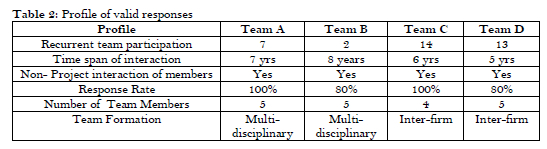
The survey was administered to eight (8) teams consisting of 37 team members. Twenty-four (24) responses were obtained as shown in Table 2.
4.2 Correlational analysis between team EI and performance of construction design teams
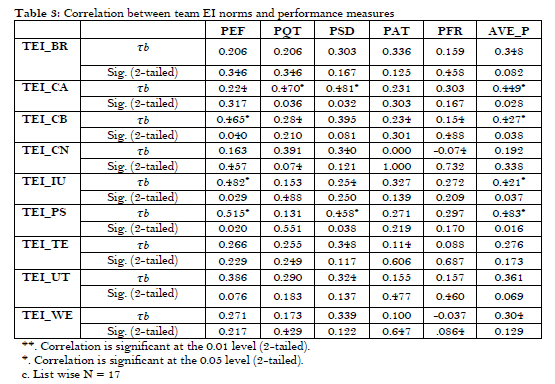
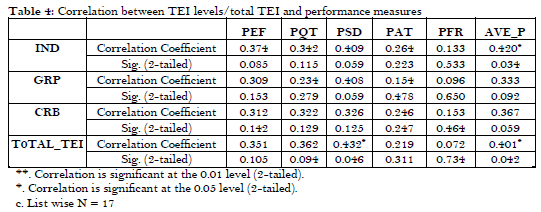
To establish the relationship between team emotional intelligence and the performance of the construction design team, Kendall's tau b was carried out between TEI norms and performance, Team emotional intelligence levels/ total TEI and performance. The result of the analysis is presented in Table 3 and 4 for team norms and team levels respectively.
A two-tailed Kendall's tau-b correlation was conducted to examine the relationship between the nine (9) team emotional intelligence (TEI) norms and five (5) performance measures. The results identified specific norms that influence team performance. The team performance measures assessed were Team Efficiency (PEF), Quality of Teamwork (PQT), Teams' Ability of Self-Direction (PSD), Performance against Similar Teams (PAT), and Teams' Possible Future Relationship (PFR). The findings indicate that the "Build External Relationships" (TEI_BR) norm showed a weak positive association with all five performance measures (PEF, PQT, PSD, PAT, and PFR). However, the association between TEI_BR and average performance was not statistically significant. Therefore, the ability of a team to facilitate positive external contact, obtain support, and secure resources did not significantly contribute to team performance in the studied construction design teams. The correlational analysis revealed a positive association between the "Build Optimism" (TEI_CA) norm and all performance measures. Two measures, PQT and PSD, showed statistical significance at the 95% confidence level (τb = .470, p = .036; τb = .481, p = .032, respectively). Additionally, the association between TEI_CA and average performance was significant at 95% confidence level (τb = .499, p = .028). These results suggest that a team's ability to foster a positive group affect and maintain an optimistic outlook significantly contributes to teamwork quality, team self-direction, and overall performance.
Similarly, a positive association was found between the "Demonstrate Caring" (TEI_CB) norm and all performance measures, with only the PEF measure showing statistical significance at the 95% confidence level (τb = .465, p = .040). Furthermore, TEI_CB had a significant positive association with average performance at the 95% confidence level (τb = .427, p = .038). This indicates that team members' ability to communicate affection, appreciation, and respect to one another significantly contributes to team efficiency and overall performance.
Regarding the "Address Unacceptable Behavior" (TEI_CN) norm, the correlation analysis revealed a positive association with four performance measures and a negative association with the PFR measure. However, the association between TEI_CN and average performance was positive but not statistically significant. Therefore, a team's adherence to conduct rules and the ability to address unacceptable behavior may not significantly impact performance measures and could even deter the possibility of future relationships. Furthermore, the analysis between the "Understand Team Members" (TEI_IU) norm and all performance measures was similar to that of the TEI_CB norm. Positive associations were found with all performance measures, with only the PEF measure showing statistical significance at the 95% confidence level (τb = .482, p = .029). Additionally, TEI_IU had a significant positive association with average performance at the 95% confidence level (τb = .421, p = .037). These findings suggest that team members' ability to understand each other's feelings, interests, concerns, strengths, and weaknesses significantly contributes to team efficiency, team self-direction, and the potential for future relationships.
The correlational analysis between the "Solve Problem Proactively" (TEI_PS) norm and all performance measures revealed a positive association with all measures, with two measures showing statistical significance at the 95% confidence level. Specifically, the measures PEF and PSD showed statistical significance at 95% (τb = .515, p = .020) and (τb = .458, p = .038) respectively. Furthermore, the association between TEI_CA and average performance was significant at 95% confidence level (τb = .483, p = .016). These results indicate that a team's ability to anticipate and provide solutions to situations before they occur significantly contributes to team efficiency, team self-direction, and average performance. On the other hand, the "Understand Team Context" (TEI_UT) and "Review the Team" (TEI_TE) norms showed a non-significant positive association with all performance measures, including average performance. This suggests that team members' ability to understand the socio-political system of the organization and evaluate team activities, including emotional states, strengths, and weaknesses, may not significantly impact any of the performance measures.
Finally, the "Support Expression" (TEI_WE) norm exhibited a positive association with four performance measures but had a negative association with the PFR performance measure. Consequently, the association of TEI_CN with average performance was positive but non-significant. These findings indicate that team members' ability to accept emotions as part of the group and encourage the expression and examination of feelings is not significant for any performance measure and may even deter the possibility of future relationships (PFR) performance measure.
In summary, only four team emotional intelligence norms showed positive significant associations with some of the performance measures. The other five TEI norms demonstrated non-significant positive associations, except for TEI_CN and TEI_WE norms, which had a negative association with the PFR measure.
The results indicate that all associations between TEI levels and performance measures have a non-significant positive relationship, except for the association between individual (IND) level and average performance, which is significant at the 95% confidence level (τb = 0.420, p = .034). Additionally, the total TEI score shows a significant positive association with the PSD measure and average performance at the 95% confidence level (τb = .432, p = .046) and (τb = 0.401, p = .042) respectively. The τb values for all significant associations indicate a moderate strength of association.
4.3 Association of TEI norms with group fundamentals and social capital
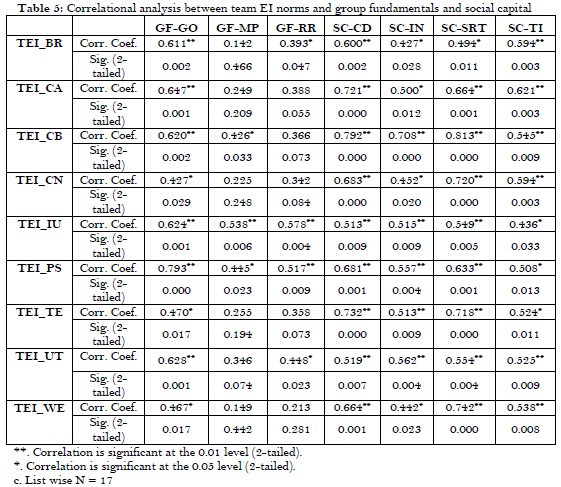
The theory of team emotional intelligence, as conceptualized by Druskat and Wolff (2001), incorporates team social capital and group fundamentals. Social capital encompasses aspects of the social structure and facilitates interactions that lead to positive outcomes (Nahapiet and Ghoshal, 1998). Team emotional intelligence norms are predictive of group fundamentals and social capital within a team. To explore the relationship between social capital/group fundamentals and team EI, a correlational analysis was conducted. The results of the analysis are presented in Table 5.
The results of the two-tailed Kendall's tau-b correlation between team emotional intelligence norms and the group fundamentals/social capital of construction design teams demonstrate positive associations. However, not all associations reached statistical significance, as indicated by the p-values. The relevant associations are as follows:
The Understand Team Members (TEI_IU) and Solve Problem Proactively (TEI_PS) norms showed significant associations with all the group fundamentals and social capital attributes, albeit at varying levels of significance. TEIIU had significance at 99% for all attributes, except for Team Identity (SC_TI) at 95% significance. TEI_PS showed two significant associations at 95% significance for Meeting Procedures (GF_MP) and Team Identity (SC_TI) attributes.
Additionally, three norms showed significant associations with two group fundamentals attributes and all social capital attributes. Build External Relationships (TEI_BR) and Understand Team Context (TEI_UT) were relevant for predicting the Goal and Objectives (GF_GO) and Roles and Responsibilities (GF_RR) attributes. Demonstrate Caring (TEI_CB) showed significant associations with GF_GO and GF_MP. These associations varied in significance levels, with TEI_BR at 99% significance for GF_GO, Creating Debate (SC_CD), and SC_TI, and at 95% significance for GF_RR, Innovation (SC_IN), and Safety and Risk Taking (SC-SRT). All significant associations of TEI_UT were at 99% significance, except for GF_RR at 95% significance. Similarly, all significant associations of TEI_CB were at 99% significance, except for GF_MP at 95% significance.
Lastly, four TEI norms showed significant associations only with the GF_GO attribute of group fundamentals and all social capital attributes. These norms are Address Unacceptable Behavior (TEI_CN), Support Expression (TEI_WE), Build Optimism (TEI_CA), and Review the Team (TEI_TE). The significance levels of associations with GF_GO were 99% for TEI_CA and 95% for TEI_CN, TEI_TE, and TEI_WE. The significance levels of the social capital attributes were 99% for TEI_CA, TEI_CN, and TEI_WE with SC_CD, SC_SRT, and SC_TI, and 95% for SC_IN. TEI_TE showed significance at 99% for SC_CD, SC_IN, and SC-SRT, and at 95% for SC_TI.
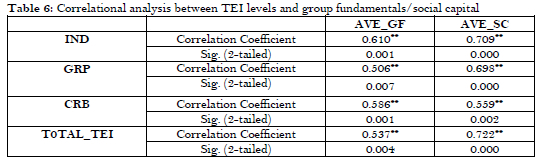
In summary, all team emotional intelligence norms demonstrated significant positive associations with all social capital attributes and the Goals and Objectives attribute of group fundamentals. Additionally, Kendall's Tau-b correlation was performed to explore the relationship between total group fundamentals and social capital with all team emotional intelligence levels/Total EI, and the results are presented in Table 6.
The results indicate that all levels of team emotional intelligence, including Individual (IND), Group (GRP), and Cross-Boundary (CRB), have positive and significant associations with Group Fundamentals at a 99% significance level. Similarly, all TEI levels show positive and significant associations with Social Capital. Consequently, the overall team emotional intelligence levels exhibit positive and significant associations with both Group Fundamentals and Social Capital at a 99% significance level.
4.4 Result from content analysis of focus group interview
All four teams were approached for a focus group session, but only members of team B expressed their availability and willingness to participate. Therefore, the focus group interaction was conducted with three individuals from team B, including the team leader and two team members. Prior consent was obtained to record the discussion, which lasted for 25 minutes. Subsequently, the recorded conversation was transcribed and analyzed using content analysis to identify pertinent themes. The discussions revolved around the survey results as well as the participants' experiences from other similar projects that were not covered in the questionnaire. The findings are presented as follows:
i. Will the findings on team emotional intelligence (TEI) also hold true for other teams in which you have participated, and why?
The participants responded by acknowledging that team norms differ across the various teams they have been a part of, primarily due to factors such as leadership and commitment. Additionally, one team member noted that "in the initial stages of working together as a team, it can be challenging for members to demonstrate adherence to team norms. However, with more projects and increased participation, team norms tend to improve."
ii. How does the performance of this team compare to other similar teams in which you have participated?
All participants unanimously agreed that despite the challenges inherent in the projects under consideration, the performance of their team was superior to most of the other projects they have been involved in. They attributed this success to the team leader's emotional intelligence, which played a crucial role in influencing the team's emotional norms. When asked if they would prefer to work together in future projects, all participants responded affirmatively. Furthermore, they expressed that even with the same team members, they may choose not to work with certain clients. This demonstrates that the potential for a future relationship with other team members depends not only on the team itself but also on the nature of the client involved.
4.5 Discussion of results
The analysis of the nine (9) team emotional intelligence (TEI) norms in relation to performance attributes, as illustrated in Table 3, demonstrates that four of the TEI norms effectively predict three key performance indicators: the quality of work (PQT), efficiency in task completion (PEF), the team's self-directiveness (PSD), and overall performance levels. This discovery aligns with previous research, particularly the study conducted by Koman and Wolff in 2008, which also identified a significant relationship between TEI norms and the performance of military teams. Specifically, the Build Optimism (TEI_CA) norm significantly predicts PQT, while the Demonstrate Caring (TEI_CB), Understand Team Members (TEI_IU), and Solve Problem Proactively (TEI_PS) norms are significant in predicting the efficiency of construction design teams. This implies that these norms serve as predictive norms for enhancing group efficiency within construction design teams, thus suggesting that empathy is evident among the construction design team members, contrary to the popular belief of the existence of an adversarial relationship in the industry (Humphreys et al., 2003). Additionally, the content analysis uncovers that establishing team norms might present challenges for teams collaborating for the first time. However, as teams engage in more projects, they tend to enhance their norms. This observation can be linked to the transient nature of teams in the construction project context. Moreover, the content analysis highlights that, even within teams that have previously achieved successful collaboration, the potential for future projects is influenced not solely by team composition but also by the client in question. This corroborates with Druskat et al.'s (2007) study, which also identified that high-performing teams within cross-functional development teams were more proactive in seeking support compared to their average-performing counterparts.
In Table 4, the associations between TEI levels and performance are presented, showing non-significant positive relationships, except for the association of the individual (IND) level with average performance. This reveals that individual-level TEI has a substantial impact on a team's self-direction, suggesting that individuals with high emotional intelligence (EI) play a pivotal role in fostering self-directed teams where members proactively take ownership of their tasks and responsibilities. Consequently, total TEI exhibits a significant positive association with the PSD measure and overall performance, which further emphasizes that the TEI will predict not only team self-direction but also the team performance in CDTs. These findings provide further evidence of the importance of team emotional intelligence, contradicting the findings in financial service teams reported by Peltola (2016) and corroborating the results of Lee and Wong (2019), which indicate a positive relationship between team EI and team performance.
Moving on to the relationship between team emotional intelligence and group fundamentals, the Demonstrate Caring (TEI_CB), Understand Team Members (TEI_IU), Understand Team Context (TEI_UT), and Solve Problem Proactively (TEI_PS) norms are relevant in predicting all the Group Fundamentals attributes. These four TEI norms were also found to be relevant to some of the performance measures. Additionally, the Support Expression (TEI_WE) norm is relevant in predicting only the Goal and Objectives (GF_GO) attribute, while the Build External Relationships (TEI_BR), Build Optimism (TEI_CA), and Review the Team (TEI_TE) norms are relevant in predicting the GF_GO as well as the Roles and Responsibility (GF_RR) attributes, and by extension, team performance. These findings establish a distinct correlation between team Emotional Intelligence (EI) norms and the fundamental components of group operation. This underscores the notion that well-defined roles among design team members contribute to the formulation of TEI norms. Consequently, these results align with the conclusions drawn by Svalestuen et al. (2015), who emphasized that "identifying the design team member's role" is a critical indicator of team performance. Although, Senaratne and Gunawardane (2015) pointed out that design teams in the construction industry were primarily formed based on functional roles rather than team roles.
Furthermore, the results in Table 6 demonstrate that all team EI levels are significantly associated with the Group Fundamentals of the construction design teams. This finding suggests that TEI levels, as well as the overall team emotional intelligence, have the potential to predict the Group Fundamentals, which in turn can influence team performance. These findings align with the assertions of Druskat and Wolff (2008) and other researchers who have highlighted the positive association between TEI norms and Group Fundamentals. This finding reveals that the team's ability to adhere to group guidelines and foster positive norms is crucial for team performance as previously established by Druskat et al. (2007).
Relationship between team emotional intelligence and social capital
All team EI norms exhibit significant positive relationships with all the Social Capital attributes, indicating that all the TEI norms are relevant in describing the Social Capital dynamics within the group. Similarly, all team emotional intelligence levels (IND, GRP, and CRB), as well as the total TEI, are associated with all the Social Capital attributes, including Safety and Risk Taking (SC_SRT), Team Identity (SC_TI), Innovation (SC_IN), and Creating Debate (SC_CD). This is noteworthy as it suggests that TEI norms have a broad and consistent relevance in describing the dynamics of Social Capital within a group. These findings support the findings of Druskat and Wolff (2008) and Richer (2015) about TEI norms and Social Capital as highly significant to team effectiveness. It is evident that Social Capital serves as a valuable predictor of a team's ability to develop and adhere to positive norms. It also highlights the bidirectional relationship between Social Capital and TEI norms, shedding light on how the social dynamics within a team influence the establishment and adherence to norms.
5. CONCLUSION
Based on the findings discussed earlier, this study concludes that the total team emotional intelligence (TEI) has a significant positive association with the Self-direction measure and the overall performance of construction design teams. These findings suggest that TEI plays a significant role in contributing to team performance in the context of construction design teams involved in institutional public projects procured through traditional procurement routes and funded by the tertiary education trust fund (TETfund). It is important to note that these conclusions are specific to this particular type of project and team members who have had interactions in multiple projects of a similar nature. It is possible that the results may vary for different types of projects and teams. Further research is needed to explore the impact of TEI on team performance in various project contexts to gain a comprehensive understanding of its significance
6. IMPLICATIONS OF FINDINGS
This study holds significant practical implications for the training of construction professionals, with the potential to foster the development of high emotional intelligence (EI). Furthermore, it extends its relevance to client organizations seeking to hire design team consultants who possess emotional intelligence. Thus, the study suggests that the pre-qualification criteria for potential design team members in the construction industry should be enhanced to address the fragmented nature of the industry and promote teamwork. This can be achieved by including an evaluation of previous team participation in addition to individual evaluation. By considering team experience and performance in previous projects, the evaluation process can identify professionals who have demonstrated the importance of teamwork and have the ability to work effectively in a team setting.
Furthermore, the study recommends incorporating an assessment based on Group Fundamentals and Social Capital into the pre-qualification criteria. This would enable the identification of professionals who are likely to contribute to the formation of positive team emotional norms. By evaluating attributes related to Group Fundamentals and Social Capital, such as the ability to establish clear goals and roles within a team, promote innovation, foster a sense of team identity, and encourage open communication and debate, the selection process can identify individuals who possess the necessary skills and attitudes to enhance team performance.
Overall, enhancing the pre-qualification criteria to include evaluations of previous team participation and assessments of Group Fundamentals and Social Capital can contribute to creating teams that prioritize teamwork, collaboration, and effective communication, ultimately leading to improved project outcomes in the construction industry.
7. LIMITATIONS AND RECOMMENDATIONS FOR FURTHER STUDIES
The study acknowledges the limitation of a relatively small sample size, which may affect the statistical significance and generalizability of the findings. To gain further insight and assess the extent of generalizability, a focus group interview was conducted. This adds depth to the study and forms a basis for future comprehensive research.
To strengthen the research and enhance generalizability, it is recommended to replicate the study using a larger sample size. This would provide a more robust statistical analysis and increase the representativeness of the findings. Additionally, expanding the study to other team-related work environments within and outside the construction industry, such as teaching and learning in higher education institutions, hospitals, and financial institutions, would allow for a broader understanding of team emotional intelligence in different contexts.
Furthermore, the study suggests replicating the research in other procurement routes, such as design and build and public-private partnership. This would enable a comparison of findings across different project delivery methods, providing a more comprehensive understanding of the impact of team emotional intelligence.
In summary, conducting future research with larger samples and in various work environments and procurement routes will contribute to a more comprehensive understanding of the role of team emotional intelligence. This will enhance the generalizability of the findings and provide valuable insights into the importance of team emotional intelligence across different contexts.
REFERENCES
8. ACKNOWLEDGMENT
I acknowledge the GEI partners for the consent given to use the proprietary instruments to obtain data for team emotional intelligence.
2. LITERATURE REVIEW
- Adenuga, O. A., and Dosumu, O. S. (2012). Assessment of procurement methods used for executing maintenance works in Lagos state. Ethiopian Journal of Environmental Studies and Management, 5(4), 475-481.
- Aje, I. O., Adedokun, O. A., and Igbalaye, W. O. (2018). Appraising the State of Procurement Methods on Educational Building Projects in Abuja, Nigeria. In: Embracing our smart world where the continents connect: enhancing the geospatial maturity of societies, FIG Congress ,Istanbul, Turkey.
- Azad, S. A. K. (2011). Emotional Intelligence (EI) And Performance Improvement System (PIS) in Construction Industry UsingDigital Monitoring Smart Test: A Key for Effective Construction Organization. Int. Journal for Housing Science, 35(3), 159-169.
-
Barczak, G., Lassk, F., and Mulki, J. (2010). Antecedents of Team Creativity: An Examination of Team Emotional Intelligence, Team Trust and Collaborative Culture. Creativity And Innovation Management, 19(4) , 322-345. doi:10.1111/j.1467-8691.2010.00574.x
» https://doi.org/10.1111/j.1467-8691.2010.00574.x -
Barinua, V., Chimere-Nwoji, C. C., and Ford, H. O. (2022). Manager's Emotional Intelligence and Team Effectiveness: A Theoretical Review. Saudi J Bus Manag Stud, 7(5), 120-124. DOI: 10.36348/sjbms.2022.v07i05.001
» https://doi.org/10.36348/sjbms.2022.v07i05.001 - Brooks, K., and Nafukho, F. M. (2006). Human resource development, social capital, emotional intelligence: Any link to productivity?. Journal of European industrial training, 30 (2), 117-128. https://doi.org/10.1108/03090590610651258
- Brown, T. J. (1997). Using norms to improve the interpretation of service quality measures. Journal of Services Marketing.
- Busseri, M. A., and Palmer, J. M. (2000). Improving teamwork: the effect of self-assessment on construction design teams. Design Studies, 21(3) , 223-238.
- Cole, M. L., Cox, J. D., and Stavros, J. M. (2019). Building collaboration in teams through emotional intelligence: Mediation by SOAR (strengths, opportunities, aspirations, and results), Journal of Management and Organization, 25(2), 263-283.
-
Coleman, A., and Ali, A. (2022). Emotional Intelligence: Its importance to HE professional services team members during challenging times. Management in Education, 08920206221085794. DOI: https://doi.org/10.1177/08920206221085794
» https://doi.org/10.1061/(ASCE)CO.1943-7862.0001841 - Druskat, V. U., and Wolff, S. B. (2001). Building the emotional intelligence of groups. Harvard Business Review, 79(3), 81-90.
-
Druskat, V. U., and Wolff, S. B. (2008). Group-level emotional intelligence. Research companion to emotion in organizations, 441-454.
» https://doi.org/10.1108/02621710810840767 - Druskat, V. U., Mangino, M., and Flynn, E. (2007). What makes good teams work better: research-based strategies that distinguish top-performing cross-functional drug development teams. Organization Development Journal, 25(2), 179-186.
- Druskat, V. U., Wolff, S. B., Koman, E. C. S., and Messer, T. E. (2003). Emotionally competent group norms and group effectiveness. In Annual Academy of Management Conference.
- Edwards, R. W. (2004) Measuring Social Capital. Australian Bureau of Statistics. Available from: http://www.ausstats.abs.gov.au/ausstats/free.nsf/Lookup/13C0688F6B98DD45CA256E360077D526/$File/13780_2004.pdf
- Emmitt, S., and Gorse, C. (2003). Construction communication. Oxford, UK: Blackwell Publishing Ltd.
- Fellows, R., and Liu, A. (2003). Research Methods for Construction. Oxford, London: Blackwell Science.
- Feyerhem, A. E., and Rice, C. L. (2002). Emotional intelligence and team performance: The good, the bad and the ugly. The International Journal of Organizational Analysis, 10(4), 343-362.
- Garbharran, H., Govender, J., and Msani, T. (2012). Critical Success Factors Influencing Project Success in the Construction Industry. Acta Structilia, 19(2), 90-108.
- Ghuman, U. (2011). Building a Model of Group Emotional Intelligence. Team Performance Management: An International Journal, 17(7/8), 418 - 439. doi:http://dx.doi.org/10.1108/13527591111182661
- Hare, A. P. (1976). Handbook of small group research
-
Hobbs, S., and Smyth, H. (2012). Emotional Intelligence in Engineering Project Teams. Paper presented at the The Joint CIB International Symposium of W055, W065, W089, W118, TG76, TG78, TG81 AND TG84, Montreal, Canada.
» https://doi.org/10.1080/17452007.2013.802980 - Heinicke, C., and Bales, R. F. (1953). Developmental trends in the structure of small groups. Sociometry, 16(1), 7-38.
- Humphreys, P., Matthews, J., and Kumaraswamy, M. (2003). Pre-construction project partnering: from adversarial to collaborative relationships. Supply Chain Management, 8 (2) : 166-178. https://doi.org/10.1108/13598540310468760
- Keyton, J. (1999). Relational communication in groups. The handbook of group communication theory and research, 192-222.
-
Kramer, Roderick M. (2006). Social Identity and Social Capital: The Collective Self at Work. International Public Management Journal, 9(1) : 25-45. doi:10.1080/10967490600625316
» https://doi.org/10.1080/10967490600625316 - Larmour, J. (2011). A study of procurement routes and their use in the commercial sector (Doctoral thesis, University of Cambridge)
- Leicht, R. M., Lewis, A., Riley, D. R., Messner, J. I., and Darnell, B. (2009). Assessing Traits for Success in Individual And team Performance in an Engineering Course. Paper presented at the Construction Research Congress.
-
Lindebaum, D., and Jordan, P. J. (2012). Relevant but Exaggerated: The Effects of Emotional Intelligence on Project Manager Performance in Construction. Construction Management and Economics, 30(7), 575-583. doi:10.1080/01446193.2011.593184
» https://doi.org/10.1080/01446193.2011.593184 - Long, D., and Arroyo, P. (2018). Language, moods, and improving project performance. In Presentado en 26th Annual Conference of the International Group for Lean Construction. Chennai, India.
- Loosemore, M., Dainty, A. R. J., and Lingard, H. (2003). Human Resource Management in Construction Projects: Strategic and Operational Approaches. London: Spon Press.
- Milana, E., and Maldaon, I. (2015). Social capital: A comprehensive overview at organizational context. Periodica Polytechnica Social and Management Sciences, 23(2): 133-141.
- Mickan, S., and Rodger, S. (2000). Characteristics of effective teams: a literature review. Australian Health Review, 23(3), 201-208.
- Mischung, J. J., Smithwick, J., Sullivan, K. T., and Perrenoud, A. (2015). Using Skills-based Emotional Intelligence Training to Improve Team Performance in Construction Management Programs. Paper presented at the 122nd ASEE Annual Conference and Exposition.
- Mullins, L. J. (2010). Management and organisational behaviour. Pearson education.9th ed
-
Nahapiet, J., Ghoshal, S. (1998) Social Capital, Intellectual Capital, and the Organizational Advantage. Academy of Management Review. 23 (2), 242-266. DOI: 10.1016/b978-0-7506-7222-1.50009-x
» https://doi.org/10.1016/b978-0-7506-7222-1.50009-x - Nazem, F., and Gheytasi, S. (2014). Prediction of social capital based on the emotional intelligence in education ministry. Indian Journal of Fundamental and Applied Life Sciences, 4, (4).
- O'Hair, D., and Wiemann, M. O. (2004). The Essential Guide to Group Communication. Bedford/St. Martin's. https://books.google.com.ng/books?id=NdcBPQAACAAJ
- Peltola, M. (2016). The connections between team emotional intelligence and team effectiveness in financial services-case X OYJ (Master's thesis, University of Tampere).
- Polychroniou, P. V. (2009). Relationship between Emotional Intelligence and Transformational Leadership of Supervisors : The Impact on Team Effectiveness. Team Performance Management: An International Journal, 15(7/8) : 343-356. doi: http://dx.doi.org/10.1108/13527590911002122
- Prati, L. M., Douglas, C., Ferris, G. R., Ammeter, A. P., and Buckley, M. R. (2003). Emotional Intelligence, Leadership Effectiveness, and Team Outcomes. The International Journal of Organizational Analysis, 11(1), 21-40. doi: http://dx.doi.org/10.1108/eb028961
- Richer, L. D. (2015). Understanding the relationship between emotional intelligence and team effectiveness in global, high-technology engineering teams. Unpublished Dissertation, Boston University School of Education.
- Songer, A. D., and Walker, B. (2004). Central Contractor Emotional intelligence in the Construction Industry. Paper presented at the 20th Annual Conference of the Association of Researchers in Construction Management.
- Stubbs, E. C. (2005). Emotional Intelligence Competences in the Team and Team Leader: a Multilevel Examination of the Impact of Emotional Intelligence on Group Performance. (Doctor of Philosophy). Case Western Reserve Universtiy.
- Svalestuen, F., Froystad, K., Drevland, F., Ahmad, S., Lohne, J., and Lœdre, O. (2015). Key Elements to an Effective Building Design Team. Procedia Computer Science, 64, 838-843. doi:https://doi.org/10.1016/j.procs.2015.08.636
- Takim, R., Adnan, H. (2008). Analysis of Effectiveness Measure of Construction Project Success in Malaysia. Asian Social Science, 4(7), 74-91.
- Winch, G. M. (2002). Managing Construction Project: An Information Processing Approach. UK: blackwell Publishing.
- Wolff, S. B. (2006). Group emotional intelligence (GEI) survey technical manual.
- Wolff, S. B. (2017). Accreditation program technical manual for team emotional intelligence.
- Xiao, N. (2020). Influence of emotional intelligence of employees on their innovative behaviour and the mediating effect of internal social capital. Revista Argentina de Clínica Psicológica, 29(2), 1.