An Examination of Unethical Practices in the Construction Sector: The Case of Government Projects in the Wa Metropolis, Ghana
Abstract
Although several studies have been conducted on unethical practices in the construction industry worldwide, little has been done in Ghana's Wa Metropolis, especially regarding government contracts. As a result, it is necessary to look into how unethical actions affect government construction projects in Wa Metropolis. The study used a mixed-methods approach. The survey included 212 respondents, while the interviews were conducted with 16 participants. Data were gathered using questionnaires and interviewing guides and then analysed using thematic analysis, factor analysis, Spearman's rank correlation, and descriptive statistics. The results revealed that unethical practices in the construction industry are driven by contractors' competition, bribery, profit maximisation, illegal contract awards, a lack of transparency, job insecurity, and excessive love of money. The effects of unethical practices in the construction industry were also found to include poor craftsmanship, short project lifespans, inexperienced contractors, safety concerns, fatalities, misallocation of resources, inflated project costs, and project abandonment. Overall, projects were negatively impacted by unethical behaviour in the construction industry. To enhance ethical conduct in the construction sector, the Association of Contractors should adopt and enforce a comprehensive code of ethics as a foundation for its operations, supported by robust regulatory oversight, strict adherence to public procurement laws, transparent bidding processes, and ongoing ethical awareness initiatives. The originality of this study lies in its focus on ethical issues within the construction industry, specifically in the Wa Metropolis. Unlike most prior studies in Ghana, which tend to address ethical concerns more broadly, this research uniquely concentrates on government projects.
Ethics; unethical construction practices; construction industry; government projects; Ghana
1. INTRODUCTION
As part of the broader business world, the construction industry must also embrace ethics. The construction industry involves building, maintaining, and repairing structures and is pivotal to socioeconomic development, contributing significantly to infrastructure development, job creation, and economic growth (Alaloul et al., 2021; Kuoribo et al., 2021). Fei et al. (2021) state that the construction sector is crucial in realising the Sustainable Development Goals (SDGs). For example, in 2023, Ghana's construction industry contributed approximately 11.5 billion Ghanaian cedis (about 775.5 million U.S. dollars) to the nation's Gross Domestic Product (GDP) (Sasu, 2024). This marked a decline from the 12.7 billion GHS recorded in 2022. The highest value added during the observed period occurred in 2021, reaching around 13.7 billion GHS. Overall, the construction sector remains a key contributor to Ghana's GDP (Sasu, 2024).
Nevertheless, unethical practices frequently afflict the construction industry, eroding its credibility and effectiveness. Due to the emergence of unethical practices, professional ethics is a popular topic in the construction industry (Shah and Alotaibi, 2017). Substandard quality and specifications, collusive tendering, conflicts of interest, unjust conduct, proprietary violations, bribery, and environmental violations are all examples of unethical practices in the sector (Liu et al., 2004). Anikwe et al. (2021) also identify corruption, bid rigging, overbilling, underbidding, and the use of substandard materials as standard unethical practices, leading to financial losses, project delays, compromised safety, and poor-quality construction. Weak regulatory frameworks, inadequate law enforcement, and a culture of impunity further exacerbate these issues (Ameyaw et al., 2020; Owusu-Manu et al., 2019).
The success of an initiative can be substantially influenced by the conduct of its leader (Al-sweity, 2013). Notwithstanding this, candid discussions regarding ethical conduct in the construction sector are uncommon (Miller, 2011). According to Kahlela (2018), construction project managers encounter many ethical dilemmas when making decisions. These dilemmas include clashes between organisational objectives and personal values, leadership concerns, power struggles, ethical politics, and unethical business practices. In the construction industry, extensive unethical concerns have been identified by Saatoah and Dercardi-Nelson (2014), Le et al. (2014), and Shah and Alotaibi (2017). Some examples include dishonesty, unreliable temporary staff, nepotism, conflicts of interest, corruption, bribery, extortion, collusive tendering, exaggeration of capabilities, fabrication of experience, and professional negligence.
Contractors, subcontractors, engineers, architects, procurement officers, consultants, suppliers, regulatory and standard-setting bodies, auditors, and professional associations are all implicated in these unethical practices (Miller, 2011). Unethical practices within the construction industry have repercussions that transcend mere financial detriment. It affects the overall quality and safety of construction projects, leading to structures that may not meet required standards and posing risks to public safety (Anikwe et al., 2021). Additionally, unethical practices can result in significant project delays and cost overruns, further straining public resources and reducing the potential benefits of infrastructure investments (Okolie and Edo, 2023). According to research conducted by Agyekum et al. (2021), Anikwe et al. (2021), Kuoribo et al. (2021), and Amoah and Steyn (2023), unethical practices result in time and cost overruns, substandard project delivery, elevated construction expenses, structural collapses, inflated contract sums, and increased maintenance expenses.
Although prior studies have explored construction ethics (Agyekum et al., 2021; Al-sweity, 2013; Amoah and Steyn, 2023; Kahlela, 2018; Kuoribo et al., 2021; Moris et al., 2022; Shah and Alotaibi, 2017), most have been conducted outside the Wa Metropolis and did not specifically focus on government construction projects. Le et al. (2014) conducted research in China on the origins of corruption in the construction industry. In contrast, Shah and Alotaibi (2017) investigated unethical practices in the construction industry and potential preventative measures in Saudi Arabia. A study conducted in Malaysia by Moris et al. (2022) examined the determinants of safety ethics concerns and potential mitigation strategies. Amoah and Steyn (2023) identified obstacles for construction professionals in South Africa regarding the prevention of corruption and adherence to codes of conduct. Existing literature extensively examines unethical practices in the construction industry, covering their prevalence, causes, and impacts across multiple countries, including Ghana, Nigeria, South Africa, Saudi Arabia, and Malaysia. However, a critical research gap remains: few studies adopt an integrated approach to assess how contributory factors, ethical awareness, enforcement mechanisms, and actual behaviours interact within specific national contexts, particularly in Ghana.
The investigation of critical ethical behaviours exhibited by professionals in Ghana's construction industry was the primary focus of Kuoribo et al.'s (2021) study. Aside from establishing and enforcing ethical standards, Asamoah and Decardi-Nelson (2014) sought to foster confidence and trust in the construction sector. In Ghana, ethical misconduct during the invitation-to-tender, tender evaluation, and award phases of construction contracts was investigated by Agyekum et al. (2021). However, these studies (Agyekum et al., 2021; Asamoah and Decardi-Nelson, 2014; Kuoribo et al., 2021) did not specifically target the Wa Metropolis or focus exclusively on government construction contracts, leaving a knowledge gap that warrants further investigation. Thus, research on unethical practices in government-funded construction projects remains scarce, especially in Ghana's Wa Metropolis, highlighting a significant knowledge gap that warrants further investigation. However, ethical issues are particularly critical in the Wa Metropolis, which has numerous ongoing and upcoming government construction projects, including roads, dams, residential housing, commercial buildings, and recreational centres (Wa Municipal Assembly, 2023, 2024, 2025). Projects often show signs of deterioration even before they are commissioned, suggesting shoddy contractor work, yet qualified engineers sometimes approve them. It raises concerns about the ethical practices of both contractors and engineers, especially given that government funds, which are often limited, are spent on these projects. Consequently, these projects frequently require rehabilitation soon after completion. Therefore, this study aims to investigate unethical practices in government construction projects in the Wa Metropolis. Specifically, the study examines these objectives:
i. To identify and describe the various forms of unethical practices prevalent in government construction projects.
ii. To examine the key factors that contribute to the occurrence of unethical practices in government construction projects.
iii. To assess the consequences of unethical practices in government construction projects.
2.1. Theoretical and Conceptual Framing
This study is guided by ethical egoism and rational choice theories, with the driving concepts including ethics, business ethics, professional ethics, and the construction industry. Fritzsche (1997) identifies ethical egoism as a subset of teleological ethical theory that emphasises the maximisation of self-interest for an individual or an organisation. In conjunction with the fundamental tenets of teleological ethics, or consequentialism, ethical egoism examines whose interests the outcomes ought to be most advantageous to. According to this interpretation of consequentialism, people ought to act in their self-interest. Because no one truly understands what others desire, Browne (2004) argues that we should concentrate on pleasing ourselves and avoid attempting to please others. Egoistic decision-making is characterised by pursuing maximum personal or organisational satisfaction, irrespective of the consequences for others (Boadu, 2013). Individuals who form ethical judgments according to egoistic standards have their self-interest as their only concern. Hence, ethical egoism asserts that individuals have a moral responsibility to advance and serve their interests (Boadu, 2013). This approach emphasises the personal repercussions of one's actions. Ethical egoism helps explain unethical practices in the construction sector by highlighting how individuals or firms may prioritise their own short-term self-interest, such as profit maximisation or cost-cutting, over legal obligations, professional standards, and the broader public good.
According to the rational choice theory, when faced with a decision, a mutual entity or an individual chooses or determines alternative actions, action sequences, or repertoire of viable alternatives that are identified and feasible (Burns and Roszkowska, 2016). The principle posits that the outcomes and potential rewards associated with each decision are determined by the individual making the action and that the actor is presumed to be cognizant of the pragmatic ramifications of the alternatives available to him or her (Burns and Roszkowska, 2016; Sato, 2010). An agent chooses the optimal option from a set of alternatives by assigning consequences, prioritising and valuing them, and weighing a limited number of alternatives (Burns and Roszkowska, 2016; Dekker, 2017). Consequently, rational decision-making is driven by the individual's self-interest in the outcomes they perceive or define (Burns and Roszkowska, 2016). The actor evaluates the advantages and disadvantages of numerous alternatives, emphasising the personal repercussions, and ultimately chooses the one that provides the most significant overall advantage or "utility" (Burns and Roszkowska, 2016; Sato, 2010; Dekker, 2017). Rational choice theory has been applied to personal and household decisions concerning savings and consumption, and to economic and business decisions concerning output, expenditure, technological advancement, and productivity (Burns and Roszkowska, 2016). Consequently, it helps construction workers understand the significance of ethics and the factors contributing to unethical conduct within the sector.
Moral principles that establish the rightness or wrongness of human actions and suggestions are called ethics. It comprises accepted standards of behaviour regarding a particular category of human behaviours and individual ethical principles (Delbridge et al., 2000). An alternative definition of ethics is a set of moral principles that govern an individual's conduct (Al-Sweity, 2013). Ray et al. (1999) state that business ethics comprises a collection of moral principles or values that are universally applicable to society and the business community, and that govern conduct. Hartman (2005) defines business ethics as the moral evaluation of an organisation's conduct. As defined by McDowell (1991), professional ethics concerns the challenges individuals encounter within a particular profession or collective, and the effects these challenges have on society. It emphasises impartiality towards colleagues, the public, and clients (Johnson, 1991). According to Al-Sweity (2013), professional ethics dictates that individuals should treat others with the same degree of integrity they would desire in return. The construction industry comprises entities and individuals actively engaged in building design, construction, and operation (Ahmed et al., 2014). This group comprises architects, building and property proprietors, developers, and contractors.
2.2 Empirical Review
2.2. lUnethical practices prevalent in construction projects
The studies by Kuoribo et al. (2021), Ameyaw et al. (2017), Aigbavboa et al. (2016), Ibrahim et al. (2019), and Shah and Alotaibi (2017) collectively highlight the widespread prevalence of unethical practices in the construction industry across different regions, including Ghana, South Africa, and Saudi Arabia. These unethical practices include collusive tendering, extortion, fraud, favouritism, and disregard for regulations and environmental ethics. Kuoribo et al. (2021) emphasise the ethical behaviours that construction professionals in Ghana consider most crucial, including precision, responsibility, integrity, dependability, impartiality, and regard for peers. Their study reveals significant awareness of unethical conduct among industry professionals. Ameyaw et al. (2017) focus on the prevalence of unethical practices in Ghana's bid evaluation, tendering, and contract implementation phases, identifying behaviours that lead to client dissatisfaction, substandard construction, and declining public confidence. Similarly, Aigbavboa et al. (2016) document unethical practices in South Africa, including collusive tendering, extortion, fraud, falsification of experience, and illegal tender awarding. These practices result in client dissatisfaction, substandard construction, and a decline in public trust. Ibrahim et al. (2019) provide a broader review of unethical practices in the construction industry, identifying prevalent behaviours such as collusive tendering, favouritism, negligence, and disregard for environmental ethics. The review underscores the impact of these practices on the industry's integrity and effectiveness.
Shah and Alotaibi (2017) discuss the importance of adhering to ethical principles in the Saudi Arabian construction industry, particularly regarding legal measures such as delaying payment procedures and transferring project manager responsibilities. Their study highlights the universal challenge of maintaining ethical conduct under various pressures and incentives. The studies by Okolie and Edo (2023), Amoah and Steyn (2023), Moris et al. (2022), Agyekum et al. (2021), Kuoribo et al. (2021), and Shah and Alotaibi (2017) collectively explore the prevalence, causes, and consequences of unethical practices in the construction industry across various regions and suggest potential countermeasures. Okolie and Edo (2023) identify the primary catalysts for unethical conduct in the construction industry in Nigeria, including a lack of retribution, collusion among stakeholders, deficiencies in project monitoring, ineffective law enforcement, and financial avarice. The study also highlights severe consequences, including poor artistry, substandard project delivery, excessive construction costs, structural collapses, and inflated contract sums. Recommended countermeasures include prosecuting offenders, implementing whistleblower protection policies, bolstering institutions and anti-corruption agencies, allocating contracts based on merit, and engaging civil society for supervision and participation. Amoah and Steyn (2023) examine the obstacles construction professionals in South Africa face in adhering to their code of conduct and deterring unethical practices. The study identifies discrimination, inflated tender prices, overpricing rates, kickbacks, bribery, unethical project execution practices, and substandard materials. The primary obstacles include avarice, acceptance of corruption as the norm, ignorance of the code of conduct, and peer pressure.
Moris et al. (2022) focus on safety ethics in the Public Works Department of Kapit, Sarawak, Malaysia. The study reveals that noncompliance with specifications and detailed design significantly threatens safety ethics. Leaders' disregard for team contributions and lack of occupational health and safety training are critical factors contributing to these concerns. Agyekum et al. (2021) investigate unethical behaviour during the invitation-to-tender, tender evaluation, and award phases of construction contracts in Ghana. The study identifies prevalent unethical practices, including disclosing additional information to preferred bidders, inflating prices for gratuities, and engaging in fraudulent, collusive, coercive, or corrupt practices, as well as political interference. Immediate intervention is needed to address these critical issues. Kuoribo et al. (2021) also identify prevalent unethical practices in Ghana, such as favouritism, extortion, corruption, professional negligence, falsification, fraud, and overbilling. The study underscores the importance of addressing these unethical behaviours to ensure ethical conduct in the construction industry. Shah and Alotaibi (2017) examine unethical practices in the Saudi Arabian construction industry and identify motivating factors, including delayed legal action, transfer of project manager responsibilities, payment process delays, bid shopping, underbidding, overbilling, proposal cutting, and acceptance of bribes. The study highlights the universal prevalence of accepting favours, gifts, and conflicts of interest.
222 Factors that contribute to the occurrence of unethical practices in construction projects
The studies by Aigbavboa et al. (2016), Hamimah et al. (2012), Shah and Alotaibi (2017), and Hawkins (2013) collectively examine the factors contributing to unethical practices within the construction industry and propose potential preventive measures. Aigbavboa et al. (2016) identify several factors contributing to unethical practices in South Africa, such as political influence, favouritism, avarice, monopoly by larger firms, pressure to meet unrealistic objectives, personal conduct issues, lack of transparency, insufficient executive oversight, and deficient ethical consciousness among industry participants. These factors are echoed by Hamimah et al. (2012), who added that economic downturn, lack of ethical education, cultural shifts, intense competition, and the complexity of construction projects further exacerbate unethical behaviour. Shah and Alotaibi (2017) emphasise that lax oversight, insufficient monitoring, and the acceptance of bribes encourage unethical practices in the Saudi Arabian construction industry. Similarly, Hawkins (2013) points to inadequate institutional capability, governance deficiencies, and weak regulatory mechanisms as underlying causes of unethical behaviour.
2.2.3 Consequences of unethical practices in construction projects
Unethical practices in the construction industry have been widely documented, resulting in significant adverse outcomes worldwide. According to Aigbavboa et al. (2016), such practices result in client dissatisfaction, substandard artistry, erosion of professionalism, substandard infrastructure development, erosion of public trust, diminished productivity and efficiency of project teams, inadequate project coordination, exorbitant maintenance expenses, industry expansion delays, conflicts between clients and construction teams, cost overruns, and disruptions to the project schedule. Hamzah et al. (2010) further emphasise the detrimental impact of unscrupulous and corrupt practices on human resources, the economy, and industry. Despite oversight rules and regulations governing procurement processes, ethical dilemmas persist, ultimately leading to a decline in project quality (Hamimah et al. 2012). Ameh and Odusami (2010) report that in Nigeria, building failures are often due to design, construction, and product failures, all linked to unethical practices such as carelessness, neglect, professional incompetence, and fraudulent activities. Olusegun et al. (2011) provide anecdotal evidence that corruption and extortion lead to project abandonment, upward contract reviews, increased expenses, prolonged schedules, and shortened building lifespans. Hamzah et al. (2010) confirm these findings through a survey in Malaysia, highlighting that unethical practices significantly impact the quality of construction projects and affect various public-sector initiatives. Studies suggest that codes of conduct alone are insufficient to address these challenges. The reviewed literature extensively documents the prevalence, causes, and consequences of unethical practices in the construction industry across various regions, including Ghana, Nigeria, South Africa, Saudi Arabia, and Malaysia. However, there is a notable gap in context-specific empirical studies that holistically assess the interplay between contributory factors, ethical awareness, institutional enforcement mechanisms, and actual behavioural outcomes within specific national construction sectors-particularly Ghana-through an integrated analytical framework. Moreover, in Ghana-and specifically in the Wa Metropolis-there is a limited body of research on unethical practices in government construction projects, thereby creating a significant knowledge gap.
3. METHODOLOGY
3.1 Research Approach
The present investigation utilises a mixed-methods research design. An investigation employing mixed methods integrates qualitative and quantitative research methodologies (Creswell, 2003; Zohrabi, 2013). This methodology enables researchers to address inquiries in many ways, rather than restricting their options (Johnson and Onwuegbuzie, 2004). Furthermore, researchers adopt a divergent approach to method selection when undertaking specific studies. The study employed a concurrent mixed methods design, integrating qualitative and quantitative data to investigate the research issue (Creswell, 2003) thoroughly. The concurrent mixed methods design was utilised in this study because objectives one through three focused on collecting both quantitative and qualitative data simultaneously. Further, the design is suitable for this study as it provides a comprehensive understanding of unethical practices (Creswell and Clark, 2018). It combines quantitative data on their prevalence with qualitative insights into the underlying causes and stakeholder experiences. This approach enhances the validity of findings through triangulation and supports context-specific recommendations for policy and practice in government construction projects (Creswell and Clark, 2018; Fetters et al., 2013; Tashakkori and Teddlie, 2010). In conclusion, this research design is suitable for this investigation as it enables the simultaneous application of statistical and non-statistical analysis methods (Creswell and Clark, 2018).
3.2
Sampling DesignSimple random sampling was used to select the respondents from the sampling frame of companies with D2K2 classification. This sampling technique was used because construction companies are homogeneous, as they execute government road and building contracts (Kumar, 2019; Sarantakos, 2013). Also, this gives each artisan an equal chance of being included. These three firms have a total artisan population of 450. Yamani's (1967) formula, n=N/[1+N(0.05)2 ], was used to calculate the sample size. The sample size is n, the population is N, and the confidence level is e. As a result, n=450/[1+450(0.05)2 ] yielded a sample size of 212 construction artisans who have worked or are working on government projects. Artisans are chosen as study participants because they represent a critical group directly involved in the day-to-day execution of construction activities and are often first-hand witnesses or victims of unethical practices. Their life experiences provide practical, grounded insights into how unethical behaviours manifest on construction sites, particularly in government projects where favouritism, corruption, underpayment, misallocation of resources, and safety violations may occur (Kumar, 2019).
The qualitative sample comprises the 16 participants (P1-P16). This sample size was determined by the researchers, aligning with the qualitative research approach, which favours a smaller sample for in-depth data collection (Ritchie et al., 2013). It was made up of four contractors and four procurement officers. Further, it had one engineer from the Municipal Assembly, Feeder Roads, Urban Roads, and the Ghana Highway Authority. The rest are two tender committee members and two engineers from Consultancy firms in the metropolis (AESL, A and QS Consortium, and North West Consultant). Purposive sampling was used to select these participants. It was used because it helped ensure that only people aware of any unethical practices associated with government construction projects were selected (Kumar, 2019; Neuman, 2014).
3.3
Instruments, Data Collection and AnalysisA questionnaire and an interview guide were used to collect data. Questionnaires are appropriate for this study because they enable the efficient collection of data from a large sample, facilitate the identification of trends and patterns, provide standardised responses for easy comparison, and offer anonymity that encourages honest reporting on sensitive issues such as unethical practices (Creswell and Creswell, 2018; Kumar, 2019; Sarantakos, 2013). The researcher designed the questionnaires and distributed them to 212 construction artisans. The questionnaires focused on respondents' characteristics, such as sex, duration, and type of project, as well as unethical construction practices, factors contributing to them, their consequences, and the components of ethical policies for the construction industry.
Interview guides were also developed by the researchers and used to collect data from the research participants. An interview guide is suitable for this study because it allows for in-depth exploration of participants' experiences, offers flexibility to probe sensitive issues, facilitates the collection of rich contextual data, and helps uncover underlying motivations behind unethical practices (Kumar, 2019; Sarantakos, 2013). The interview guide covered issues such as unethical construction practices, the factors contributing to them, their consequences, and the components of ethical policies for the construction sector.
Before commencing the fieldwork, the Institutional Review Board of Skills Training and Entrepreneurial Development at Akenten Appiah-Menka University granted ethical clearance. Additionally, informed consent was obtained from the respondents. The questionnaire commenced with an opening statement that addressed informed consent and solicited the respondents' consent. The above were reiterated to the participants before each interview. Participants were requested to provide informed consent via a consent letter. The participants were duly apprised that their rights would be safeguarded upon their consent to participate in the research, and that their involvement was entirely voluntary.
The questionnaire was pre-tested in Wa Metropolis with 35 construction artisans to assess its validity and address any ambiguities prior to the main data collection (Babbie, 2020; Creswell and Creswell, 2018; Kumar, 2019). Fieldwork was conducted from January 10 to 30, 2023, by three trained research assistants who administered printed questionnaires ethically and consistently. For the participant interviews, each lasting about 40 minutes, the researchers conducted them with participants' consent and audio-recorded them.
The gathered information comprised both quantitative and qualitative data. As a result, quantitative and qualitative analyses were necessary. Before commencing the analyses, the quantitative data underwent a series of procedures: editing, coding, inputting into SPSS version 27, and cleaning. To analyse the collected data, a combination of descriptive and inferential statistical tools was employed to ensure clarity and analytical depth. Descriptive statistics were used to summarise the dataset's characteristics, providing insights into central tendencies, variability, and the overall distribution of responses. This was essential for gaining a general understanding of participant demographics and the patterns emerging from their responses (Gravetter and Wallnau, 2017). To assess the instrument's reliability, Cronbach's alpha was calculated. This measure tested the internal consistency of the scale items and ensured that the constructs under investigation were being measured coherently and dependably (Tavakol and Dennick, 2011). The reliability of an instrument is assessed by examining its capacity to produce consistent measurements. This evaluation is typically performed utilising Cronbach's alpha, as stated by Khamkham (2017). Utilising the test, internal consistency among the measures utilised in a study is determined. The Cronbach alpha should exceed 0.7 to indicate that the measured items are consistent and reliable (Field 2013). Therefore, Cronbach's alpha, an internal consistency metric, was employed to assess the overall reliability of the measurement scale for corrupt construction practices. Field (2013) states that the alpha value of 0.94 for the twenty-one items on the scale exceeds the acceptable threshold of 0.70 for the reliability coefficient. The scale can be considered reliable due to its adherence to the criterion of unidimensionality.
Exploratory Factor Analysis (EFA) using Principal Component Analysis (PCA) was employed in this study to reduce a large number of observed variables on unethical practices in the construction industry into a smaller set of components that represent underlying patterns of misconduct. PCA was appropriate because it maximises explained variance and aids in uncovering key dimensions such as bribery, favouritism, and contract manipulation, thereby supporting data-driven interpretation and practical recommendations (Hair et al., 2019; Jolliffe and Cadima, 2016; Leech et al., 2013; Pallant, 2020). Given the ordinal nature of some variables and the potential non-normality in the data distribution, Spearman's rank correlation was used to examine the strength and direction of relationships among key variables. This non-parametric test was particularly appropriate for understanding monotonic associations without assuming linearity or normality (Field, 2018). Additionally, cross-tabulation was applied to explore relationships between categorical variables. This method allowed comparison of response patterns across different demographic or categorical groupings, thereby revealing important associations within the data (Bryman and Cramer, 2011). The quantitative findings were displayed through tables and figures. Conversely, the qualitative data analysis was conducted manually through thematic analysis using inductive methodology. Unlike automated software-assisted methods, manual coding allows the researcher to engage more intimately with the textual content, promoting reflexivity, contextual understanding, and iterative interpretation, critical features of qualitative inquiry (Basit, 2003; Braun and Clarke, 2013). The inductive method establishes a robust correlation between the identified themes or codes and the data (Thomas, 2006). Thematic analysis enabled researchers to systematically identify and interpret patterns in qualitative data, producing rigorous, context-sensitive insights grounded in participants' perspectives and aligned with the study's theoretical framework (Braun and Clarke, 2006; Guest et al., 2012). The interview data analysis involved identifying and refining codes until no further codes were discovered (Yukhymenko et al., 2014). The emergence of patterns contributed to the formation of crucial discussion themes. The qualitative findings were presented in the form of figures and texts.
4. RESULTS AND DISCUSSION
Mellahi and Harris (2016) assert that response rate is frequently used as the primary metric for assessing the quality and validity of questionnaire data. Of the 212 sent, 193 were received with valid data, for a response rate of 91%. The response rate falls within the acceptable range of 50%, as suggested by Cycyota and Harrison (2006). Consequently, the quantitative results will be presented based on this sample of 193 respondents.
4.1 Background Characteristics
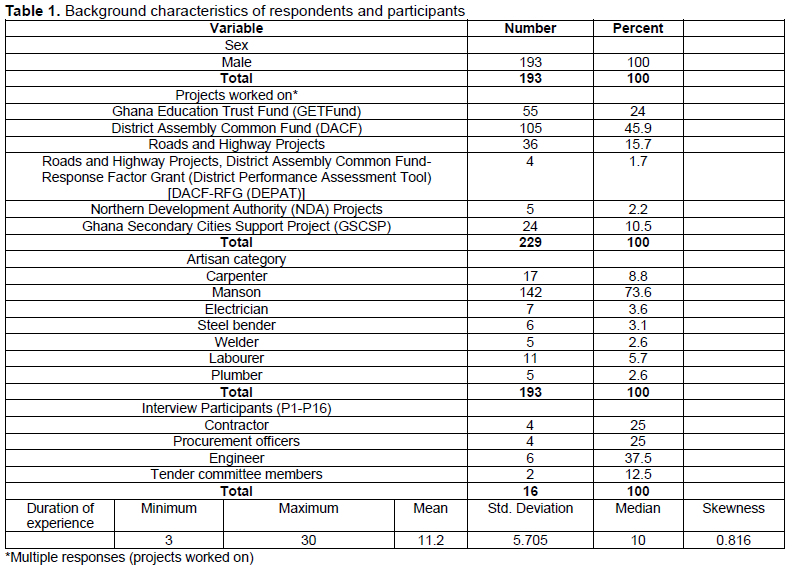
The research investigated three demographic characteristics of the participants. The participants' background characteristics include gender, service length in the construction industry, involvement in government initiatives, and artisan category (Table 1). Regarding the workers' sex, all (100%) are male. However, Aigbavboa et al. (2016) found that females were also engaged in the construction sector, while males remained in the dominant category. It demonstrates that the construction sector is male-dominated. This could be because it requires much strength to carry out the tasks. It is also observed that the DACF (45.9%) and GETFund (24%) projects were the major government construction projects on which the artisans were either working or had worked. As for the categories of artisans, the most cited were masons (73.6%) and carpenters (8.8%). The respondents' duration of experience in their various professions ranges from a Minimum of 3 years to a Maximum of 30 years, with a Mean of 11.2 (Std. deviation=5.705, Skewness=0.816, Median=10). The results showed that most respondents have been engaged in the construction sector for extended periods and have extensive experience, particularly regarding ethical issues. In South Africa, Aigbavboa et al. (2016), however, found that the average experience of workers in the field was eight (8) years. Among the participants, the majority were engineers (37.5%) and contractors (25%).
4.2 Unethical Practices in Construction Projects
It was critical to identify whether the construction firms' respondents' employers had an ethical code and, if so, whether it was applied (Table 2). Regarding whether the firms have an ethical code, most (98.4%) of the 190 respondents indicated that their organisations do not have an ethical code. This suggests they are likely to be involved in unethical practices, knowingly or unknowingly, since there is nothing to guide them in that regard. Of the three respondents who noted that their organisation had an ethical code, 66.7% indicated that it does not apply. This hints that unethical practices may become the order of the day. However, during interviews with the participants, it emerged that their associations and organisations have ethical codes they follow. Some ethical codes include the Public Procurement Act, the Public Financial Management Act, and the Public Procurement Authority (PPA) 2016 manual. Pearl et al. (2005) and George (2006) reported similar findings: many engineering societies and engineering education organisations, among other professionals, have ethical codes that guide their operations in the field.
Of the 193 respondents, most (97.9%) stated they were certain that unethical practices occur in the construction sector. This overwhelming proportion suggests that many of them might have experienced such practices. This gives the impression that unethical practices are rampant in the construction contracts issued by the Wa Metropolitan Assembly. The presence of unethical construction practices may spell doom for the sector. According to studies conducted by Le et al. (2014), Asamoah and Dercardi-Nelson (2014), and Aigbavboa et al. (2016), unethical practices were identified in the respective construction sectors of Pakistan, China, Ghana, India, and South Africa. It suggests that these unscrupulous construction industry practices are widespread internationally.
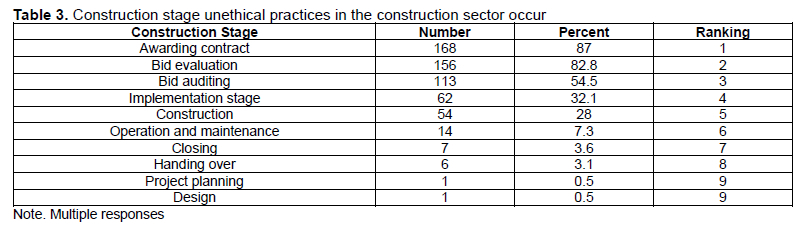
The stage at which the unethical practices occurred in the construction sector was investigated (Table 3). It is evident from the multiple-response results that the most cited stages within the construction sector where unethical practices occur include awarding the contract (87%), bid evaluation (80.8%), bid auditing (54.5%), implementation (32.1%), and construction (28%). The last listed stages where unethical construction practices occurred in the construction industry were operation and maintenance, handover, closing, project planning, and design. The participants noted related stages of unethical issues in the construction sector. A typical situation was when P9 reported, "I think that the tender documentation process, awarding, and procurement project audit are the stages in the construction cycle where unethical practices mostly occur." Aside from that, P12 reported that "unethical practices might occur during bidding, site visits, documentation processing, interim payment certificate preparation, and evaluation." The results suggest that unethical practices can occur at virtually all significant stages of the construction process. It also illustrates that unethical practices concerning government contracts are rife in the construction sector in the Wa Metropolis. Similar findings were reported by Ameyaw et al. (2017) in Ghana, where unethical practices typically occur during bid evaluation, tendering, and contract implementation.
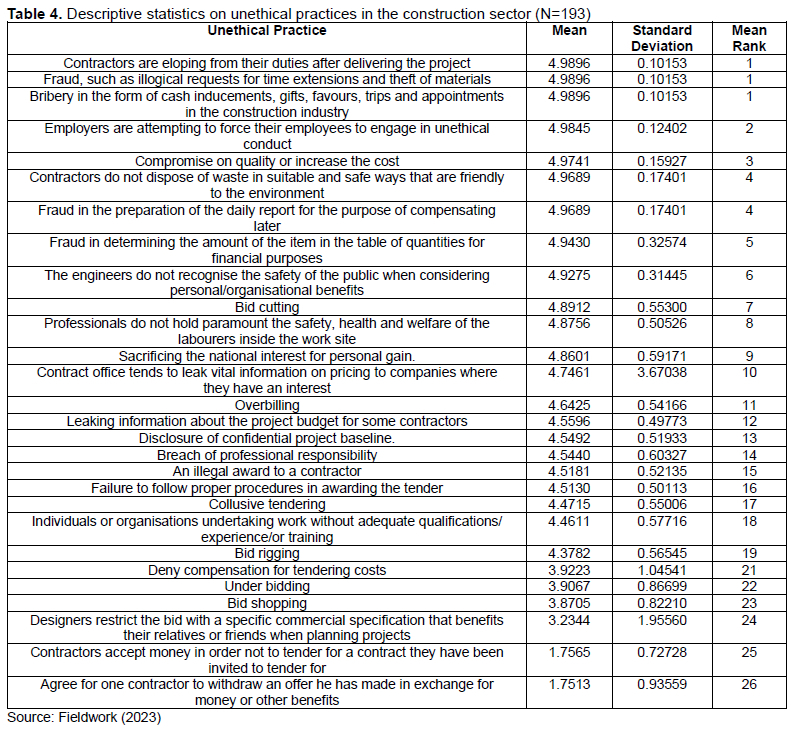
Unethical practices in the construction industry appear pervasive. Consequently, identifying precise unethical practices in the construction sector was paramount. The results from Table 4 indicate a ranking of unethical practices in the construction sector based on their prevalence and severity as perceived by the respondents. The top three unethical practices, all with the highest mean score (4.9896), include contractors abandoning their duties after delivering the project, fraudulent activities such as illogical time extension requests and theft of materials, and bribery in various forms (e.g., cash inducements, gifts, and favours). These findings highlight significant ethical concerns that undermine trust and efficiency in the industry. Other notable unethical practices include employers forcing employees to engage in unethical actions, compromising quality or inflating costs, and improper waste disposal. Practices like bid rigging, underbidding, and bid shopping received lower mean scores, suggesting they may be less frequent but still problematic. The least prevalent unethical behaviours reported include contractors accepting money not to tender for projects and agreeing to withdraw bids for financial benefits. Overall, the data reveal widespread unethical behaviour, emphasising the need for stronger regulatory measures and enforcement of ethical codes in the construction sector. The participants gave similar unethical construction practices in the construction industry. For instance, P16 remarked that "unethical practices in the construction sector experienced included interference from politicians and heads of departments from government institutions." Another, P3 noted "unethical behaviours in our sector include bid selling, unqualifying artisans and engineers, refusal to follow specifications, payments for unapproved levies such as supervision and cost of the site visit." The findings presented in this study align with the conclusions drawn by Maseko (2017), Asamoah and Dercardi-Nelson (2014), and Shah and Alotaibi (2017). These researchers identified several prevalent unethical practices in the construction industry, including collusive tendering, underbidding, nepotism, overbidding, and underbidding.
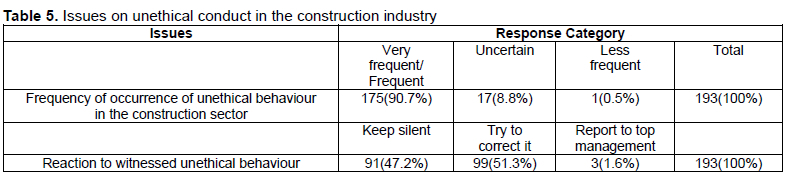
The frequency of unethical practices and the observed reactions to them were assessed (Table 5). The results revealed that most of the respondents stated that the frequency of occurrence of unethical behaviour in the construction sector was very frequent/ frequent (90.7%). This illustrates that unethical practices in the construction sector have become a ritual that can potentially negatively affect the quality of work executed by the contractor. On the other hand, 51.3% of the respondents noted that if they witnessed unethical practices, they would try to correct them. In comparison, 47.2% stated they would keep silent if they observed unethical practices. Since the majority noted they would try to correct it, it is laudable; however, it might not yield any positive outcome, as they do not have the power to change the situation.
A Spearman's Rank correlation was conducted to determine the association between variables on unethical behaviour in the construction industry (Table 6). The results revealed a weak negative correlation (-0.102) between the frequency of unethical behaviour and the response to witnessing unethical behaviour. This suggests that as the frequency of witnessing unethical behaviour increases, the likelihood of taking action slightly decreases. This correlation is not statistically significant. The correlation between the response to witnessing unethical behaviour and the impact of unethical construction practices is -0.141, which is statistically significant at the 0.05 level (*). This negative correlation indicates that as the tendency to take action when witnessing unethical behaviour decreases, the perceived impact of these practices increases. There is a weak positive correlation (0.212) between the frequency of unethical behaviour and the perceived impact of unethical construction practices, which is statistically significant at the 0.01 level (**). This suggests that as the frequency of unethical behaviour increases, the perceived negative impact on the construction sector also increases. The correlation between the impact of unethical construction practices and the response to witnessing unethical behaviour is -0.141, indicating a slight inverse relationship, as mentioned previously. The matrix reveals significant relationships among the frequency of unethical behaviour, responses to witnessing such behaviour, and the perceived impact of these practices on the construction sector. Increased frequency of unethical behaviour is associated with a greater perceived impact on the sector. There is a tendency for lower action to be associated with a higher perceived impact of unethical practices. These insights can help inform strategies to address unethical practices by highlighting the importance of encouraging proactive responses to unethical behaviour to mitigate its perceived impact.
4.3 Factors that Contribute to Unethical Practices in Construction Projects
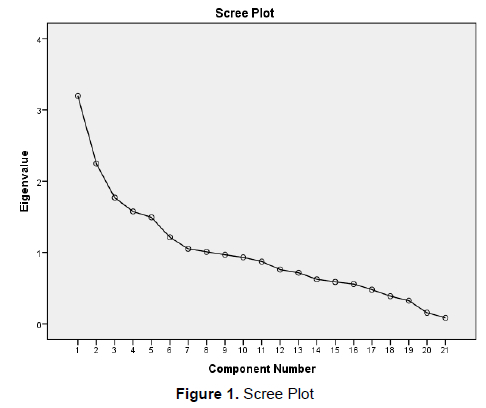
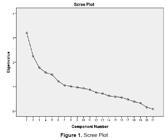
Principal components analysis was performed on the 21 items about unethical construction practices, utilising SPSS Version 24. Before undertaking principal component analysis, an evaluation was performed to determine whether the data were appropriate for factor analysis. Upon closer examination of the correlation matrix, numerous coefficients were identified at or above 0.3. The Kaiser-Meyer-Oklin value surpassed the suggested threshold of 0.6 (Kaiser 1970, 1974), which was 0.79. The factorability of the correlation matrix was confirmed by Bartlett's Test of Sphericity (Bartlett 1954), which yielded a statistically significant result (χ2 = 1102.792; df = 210; p-value = 0.003) at the 5% confidence level. The analysis of principal components revealed eight components with eigenvalues exceeding 1. These components accounted for the following proportions of variance: 7.50%, 7.11%, 5.78%, 5.01%, and 4.80%, respectively. After examining the scree plot, a distinct break was observed following the fifth component. A decision was made to retain five components for subsequent investigation using Catell's (1966) scree test (Figure 1).
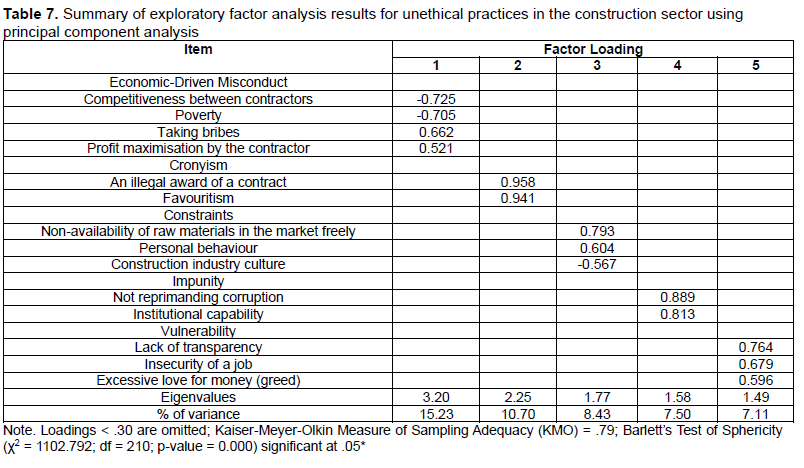
To facilitate understanding of these five components, a Varimax rotation was performed, as shown in Table 7. The rotated solution revealed a straightforward structure (Thurstone, 1947), in which each component showed multiple substantial loadings, and all variables loaded significantly onto a single component. The five-component solutions explained 48.97% of the variance in corrupt construction practices. Component 1 accounted for 15.23% of the variance, Component 2 for 10.70%, Component 3 for 8.43%, Component 4 for 7.50%, and Component 5 for 7.11% (Table 7).
The findings demonstrate that Component 1 is heavily loaded, whereas Components 2 and 4 exhibit the least loading. Following the completion of the factor analysis, five overarching themes-Economic-Driven Misconduct, Cronyism, Constraints, Impunity, and Vulnerability-emerged, each encompassing key factors that collectively explain the prevailing circumstances. A total of 14 dominant factors were identified under these themes: Economic-Driven Misconduct included contractor competitiveness, poverty, bribery by contractors, and profit maximisation motives; Cronyism encompassed illegal contract awards and favouritism; Constraints involved the limited availability of raw materials, individual behaviour, and the prevailing culture within the construction industry; Impunity was defined by the lack of sanctions for corruption and weak institutional capability; and Vulnerability captured issues related to lack of transparency, job insecurity, and excessive greed. Related findings emerged from the participant interviews. An instance was when a P2 stated that "factor accounting for unethical behaviours occurred when contractors refused to abide by the conditions of contracts and engineers' instructions, as well as engineers taking bribes from contractors, these factors account for unethical practices in the construction sector." In Saudi Arabia, Shah and Alotaibi (2017) found that inadequate oversight, bribery collection under ostensible means, and a lack of supervision are factors that incentivise unethical conduct. Similarly, several scholars (Haminah et al., 2012; Hawkins, 2013; Aigbavboa et al., 2016) have identified several factors contributing to unethical practices in the construction industry. These include inadequate governance, regulatory mechanisms, and institutional capability; insufficient legislative enforcement; intense competition; the economic downturn; expenses; a dearth of ethical education from professional organisations and schools; cultural shifts; and the immense complexity of construction projects. This discovery is consistent with Browne's (2004) view that the sole alternative is to satisfy one's interests. Ethical egoism theory holds that, since it is impossible to know others' desires, it is more prudent to prioritise self-satisfaction rather than to strive to appease others. Also, people engage in unethical behaviour because they have weighed the costs and benefits and realised that the costs to them are less; as such, they would engage in unethical behaviour, as argued by the rational choice theory (Burns and Roszkowska, 2016; Dekker, 2017).
4.4 Consequences of Unethical Construction Practices
The results showed that the majority (99.5%) of respondents believed that unethical construction practices had an adverse effect. The participants upheld this viewpoint, noting that unethical practices in the construction sector have negative repercussions. This illustrates that appropriate measures must be instituted to reverse the situation. This finding is consistent with Aigbavboa et al.'s (2016) report that unethical construction practices may be costly.
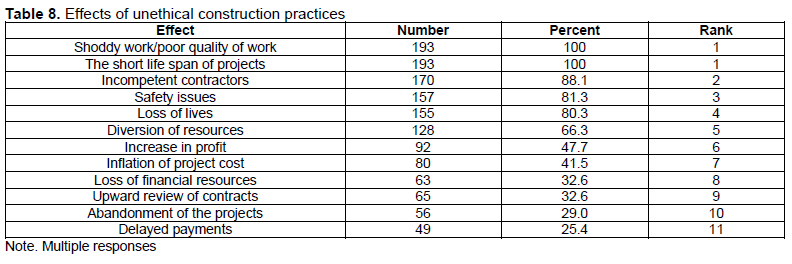
It is argued that unethical practices in the construction sector usually affect construction activities (Aigbavboa et al., 2016). Consequently, it becomes imperative to examine the specific types of effects of unethical behaviours in the construction industry (Table 8). The results of the multiple responses revealed that the most cited effects were shoddy work/poor quality of work (100%), the short life span of projects (100%), incompetent contractors (88.1%), safety issues (81.3%), loss of lives (80.3%), diversion of resources (66.3%) and increase in profit (47.7%). The least cited effects are inflation of project cost, loss of financial resources, upward review of a contract, abandonment of the project, and delayed payments. The participants made related assertions. P7, for example, reported that "the effects of unethical behaviours in the construction sector comprised client specifications not being adhered to, shoddy work, poor masonry, weak facility, and short lifespan of finished facilities." Equally, P16 the effects of the unethical practices; they indicated shoddy work, the short life span of projects, incompetent contractors, diversion of resources, inflation of project cost, upward review of a contract and abandonment of the projects.
Ameh and Odusami (2010). Hamzah et al. (2010). Olusegun et al. (2011). Aigbavboa et al. (2016). Ameyaw et al. (2017) and Ibrahim et al. (2019) made related findings that design floors, poor project quality, loss of lives, incompetent contractors, incompetent consultants, building collapse, abandonment of the project, upward review of a contract, loss of financial resources, diverted resources, delayed payment and environmental harm are some of the effects of unethical practices in the construction sector. From a theoretical perspective, egoistic decisions are made to maximise the satisfaction of the agent (individual or organisation) making the decision or acting, regardless of the consequences to others (Boadu, 2013). Individuals who make ethical judgments based on an egoistic criterion are solely concerned with their self-interest. Thus, ethical egoism asserts that one's moral obligation is limited to serving and promoting one's interests (Boadu, 2013). This means people become selfish, meeting their needs regardless of the consequences of their actions. Further, since actors in the construction industry behave unethically, they do so rationally, according to rational choice theory, in which rational decision-making is motivated by the individual's (self-)interest in outcomes as perceived or defined by the individual (Burns and Roszkowska, 2016). Here, the actor weighs the costs and benefits of many options, focusing on the consequences for herself, and selects the option with the greatest net benefit or "utility" (Burns and Roszkowska, 2016; Sato, 2010; Dekker, 2017).
As regards what happens to people who are unethical in the procurement of construction works, all the respondents (project artisans) noted that nothing happened. On the other hand, while some participants indicated that nothing happens to those who are unethical, others held a contrary view. An instance was, "I have noticed that since I started working, I have seen ethical breaches, but nothing happened to those offenders", according to P3. The mere fact that nothing happens to those found to have acted unethically would not serve as a deterrent but rather motivate them to continue along that trajectory. This may negatively affect the quality of projects executed.
In contrast, some noted that nothing had been done to the culprits; others stated that such contractors might be backlisted when identified. For example, a P5 remarked, "Nothing happens to the contractor when it is realised after the defect liability period." From the quotations, it is evident that people who engage in unethical behaviours do so because they know nothing will happen to them, and even if they are sanctioned, they may be able to circumvent it and continue to exhibit such behaviours. Therefore, it tends to embolden them to continue along that path. Similar findings were made by Hawkins (2013) in the United Kingdom, where ethical issues occurred in the construction sector due to inadequate institutional capability, governance deficiencies, and weak regulatory mechanisms. On the contrary, another participant noted that "people who are found culpable are normally blocked" (P8). This suggests that, to some extent, sanctions are imposed on people engaged in ethical malpractice.
5. CONCLUSION
This study examined unethical practices in government construction projects within Wa Metropolis, Ghana, and its findings provide critical insights aligned with the study's core objectives. Firstly, the investigation revealed various unethical practices, including illegal contract awarding, overbilling, underbidding, bid rigging, and collusive tendering. Other notable malpractices include bribery, disclosure of confidential project information, breaches of professional responsibility, and fraudulent claims related to project timelines. These behaviours reflect systemic ethical lapses at multiple levels of the procurement and implementation process. Secondly, the study identified several interrelated factors contributing to these unethical practices. Key drivers included intense competition among contractors, poverty, a culture of profit maximisation, and acts of bribery and favouritism. Structural and institutional challenges, such as a lack of transparency, weak enforcement mechanisms, job insecurity, and ingrained cultural norms within the construction sector, further exacerbate the problem. Finally, the consequences of these unethical practices were overwhelmingly negative, including compromised quality of public infrastructure, misallocation of resources, and erosion of public trust in state institutions. Alarmingly, those engaged in unethical conduct often go unsanctioned, highlighting a significant gap in accountability and institutional response.
Based on the study's findings, it is recommended that the contractors' association establish and enforce a comprehensive code of ethics, with clear sanctions for violations, to institutionalise professional integrity. Existing regulations, including the Public Procurement Act and the Public Financial Management Act, must be rigorously enforced, with officials held accountable for non-compliance. Strengthening regulatory frameworks in the construction sector through regular monitoring, enforcement of labour and environmental standards, and transparent reporting mechanisms is critical to deterring misconduct. Transparency and accountability should be enhanced through open procurement systems, public disclosure of project information, and robust whistleblower protections. Lastly, sustained efforts in ethics education, stakeholder engagement, and awareness campaigns are essential for embedding a culture of ethical responsibility in the construction industry.
6. IMPLICATIONS
6.1
Implications for ResearchAddressing persistent unethical practices in government construction requires longitudinal and comparative studies, alongside gendered and stakeholder-focused inquiries that illuminate how institutional culture and marginalised perspectives influence ethical compliance.
6.2
Implications for PracticeEmbedding accountability in Ghana's construction sector demands the institutionalisation of enforceable ethical codes and targeted training, alongside systemic procurement reforms that enhance transparency, digitise records, and strengthen financial oversight to deter collusion and favouritism.
6.3
Implications for SocietyTo restore public trust and ensure infrastructure quality, there is an urgent need to institutionalise civic participation and whistleblower protections, enabling communities to demand transparency, monitor public projects, and hold officials accountable for ethical lapses that compromise public resources and service delivery.
REFERENCES
2. LITERATURE REVIEW
- Agyekum, K., Adinyira, E., & Amudjie, J. (2021). Ethical misconduct within the invitation to tender and tender evaluation and award stages of construction contracts in Ghana. Journal of Engineering, Design and Technology, 19, 101-1123.
- Ahmed, K., Hatira, L., & Valva, P. (2014). The construction industry in Ghana, West Africa (Master's thesis). Blekinge Institute of Technology, Karlskrona, Sweden.
- Aigbavboa, C., Oke, A., & Tyali, S. (2016). Unethical practices in South African construction industry. In F. Emuze (Ed.), 5th Construction Management Conference (pp. [include pages if available]). Department of Construction Management, Nelson Mandela Metropolitan University, Port Elizabeth.
- Alaloul, W. S., Musarat, M. A., Rabbani, M. B. A., Iqbal, Q., Maqsoom, A., & Farooq, W. (2021). Construction sector contribution to economic stability: Malaysian GDP distribution. Sustainability, 13, 5012.
- Al-sweity, A. Y. (2013). Unethical conduct among professionals in the construction industry (Master's thesis). Islamic University of Gaza.
- Ameyaw, E. E., Parn, E., Chan, A. P. C., Owusu-Manu, D., Edwards, D. J., & Darko, A. (2017). Corrupt practices in the construction industry: A survey of Ghanaian experience. Journal of Management in Engineering, 33, 05017006.
- Amoah, C., & Steyn, D. (2023). Barriers to unethical and corrupt practices avoidance in the construction industry. International Journal of Building Pathology and Adaptation, 41, 85-101.
- Anikwe, N. J., Agha, K. A., & Ogbonna, N. J. (2021). A critical analysis of unethical professional practices in the construction industry in Southeast Nigeria. African Research Journal of the Environment, 4, 44-48.
- Asamoah, R. O., & Dercardi-Nelson, I. (2014). Promoting trust and confidence in the construction industry in Ghana through the development and enforcement of ethics. Information and Knowledge Management, 3, 63-68.
- Babbie, E. R. (2020). The practice of social research (15th ed.). Boston, MA: Cengage Learning.
- Bartlett, M. S. (1954). A note on the multiplying factors for various approximations. Journal of the Royal Statistical Society, 16, 296-298.
- Basit, T. N. (2003). Manual or electronic? The role of coding in qualitative data analysis. Educational Research, 45(2), 143-154.
- Boadu, M. (2013). Ethical dimensions of corporate governance practice in Ghana: Building a theoretical perspective (PhD thesis). Plymouth University.
- Braun, V., & Clarke, V. (2013). Successful qualitative research: A practical guide for beginners. London: SAGE Publications.
- Browne, H. (2004). The unselfishness trap. In How I Found Freedom in an Unfree World (Original work published 1973).
- Bryman, A., & Cramer, D. (2011). Quantitative data analysis with IBM SPSS 17, 18 & 19: A guide for social scientists. Routledge.
- Burns, T., & Roszkowska, E. (2016). Rational choice theory: Toward a psychological, social, and material contextualization of human choice behavior. Scientific Research, 6, 1-16.
- Catell, R. B. (1966). The scree test for number of factors. Multivariate Behavioral Research, 1, 245-276.
- Creswell, J. W. (2003). Research design: Qualitative, quantitative and mixed methods approaches (2nd ed.). London: SAGE Publications.
- Creswell, J. W., & Creswell, J. D. (2018). Research design: Qualitative, quantitative, and mixed methods approaches (5th ed.). Sage Publications.
- Creswell, J. W., & Plano Clark, V. L. (2018). Designing and conducting mixed methods research (3rd ed.). Thousand Oaks, CA: SAGE Publications.
- Cycyota, C. S., & Harrison, D. A. (2006). What (not) to expect when surveying executives: A meta-analysis of top manager response rates and techniques over time. Organisational Research Methods, 9, 133-160.
- Dekker, S. W. (2017). Rasmussen's legacy and the long arm of rational choice. Applied Ergonomics, 59, 554-557.
- Delbridge, A. (2000). Macquarie Dictionary. Macquarie Point, NSW.
- Fei, W., Opoku, A., Agyekum, K., Oppon, J. A., Ahmed, V., Chen, C., & Lok, K. L. (2021). The critical role of the construction industry in achieving the sustainable development goals (SDGs): Delivering projects for the common good. Sustainability, 13, 9112.
- Fetters, M. D., Curry, L. A., & Creswell, J. W. (2013). Achieving integration in mixed methods designs-principles and practices. Health Services Research, 48(6pt2), 2134-2156.
- Field, A. (2013). Discovering statistics using SPSS. USA: SAGE Publications.
- Field, A. (2018). Discovering statistics using IBM SPSS statistics (5th ed.). Sage Publications.
- Fritzsche, D. J. (1997). Business ethics: A global and managerial perspective. San Francisco: McGraw-Hill.
- George, C. (2006). Engineering ethics: Peace, justice, and the earth. United States of America: Morgan and Claypool.
- Gravetter, F. J., & Wallnau, L. B. (2017). Statistics for the behavioral sciences (10th ed.). Cengage Learning.
- Guest, G., MacQueen, K. M., & Namey, E. E. (2012). Applied thematic analysis. Thousand Oaks, CA: SAGE Publications.
- Hair, J. F., Black, W. C., Babin, B. J., & Anderson, R. E. (2019). Multivariate data analysis (8th ed.). Cengage Learning.
- Hamimah, A., Hashim, N., Yusuwan, N., & Ahmad, N. (2012). Ethical issues in the construction industry: Contractor's perspective. Procedia-Social and Behavioral Sciences, 35, 719-727.
- Hamzah, A., Wang, C., & Yap, X. W. (2010). How professional ethics impact construction quality: Perception and evidence in a fast developing economy. Scientific Research and Essays, 5, 3742-3749.
- Hartman, L. (2005). Perspectives in business ethics. Boston: McGraw-Hill/Irwin.
- Hawkins, J. (2013). How to note: Reducing corruption in infrastructure sectors. Evidence on Demand. http://dx.doi.org/10.12774/eod_cr.may2013.Hawkins.
- Ibrahim, Z., Hamzah, N., & Khoiry, M. A. (2019). Research on the unethical conducts and practices among professionals in the construction industry. International Journal of Recent Technology and Engineering (IJRTE), 8, 1130-1136.
- Johnson, D. G. (1991). Ethical issues in engineering. New Jersey, USA: Prentice Hall.
- Kahlela, T. (2018). Ethics in construction industry: Project managers' case study (Master's thesis). Durban University of Technology.
- Kaiser, H. (1970). A second generation little jiffy. Psychometrika, 35, 401-415.
- Kaiser, H. (1974). An index of factorial simplicity. Psychometrika, 39, 31-36.
- Khamkham, M. (2017). Development of an integrated quality management framework for manufacturing organisations (PhD thesis). Sheffield Hallam University.
- Kumar, R. (2019). Research methodology: A step-by-step guide for beginners (5th ed.). SAGE.
- Kuoribo, E., Owusu-Manu, D. G., Yomoah, R., Debrah, C., Acheampong, A., & Edwards, D. J. (2021). Ethical and unethical behaviour of built environment professionals in the Ghanaian construction industry. Journal of Engineering, Design and Technology, 21, 840-861.
- Le, Y., Shan, M., Chan, A. P., & Hu, Y. (2014). Investigating the causal relationships between causes of and vulnerabilities to corruption in the Chinese public construction sector. Journal of Construction Engineering and Management, 140, 05014007.
- Leech, N. L., Barrett, K., & Morgan, G. A. (2013). SPSS for intermediate statistics: Use and interpretation (2nd ed.). Routledge.
- Liu, A. M. M., Fellows, R., & Ng, J. (2004). Surveyor's perspective on ethics in organisational culture. Engineering Construction and Architectural Management, 11, 438-449.
- Maseko, C. (2017). Literature on theory and practice on unethical practices in the construction of projects: A case of an emerging economy. Risk Governance and Control: Financial Markets and Institutions, 7, 214-224.
- McDowell, B. (1991). Ethical conduct and the professional's dilemma. New York, USA: Quorum Books.
- Mellahi, K., & Harris, L. C. (2016). Response rates in business and management research: An overview of current practice and suggestions for future direction. British Journal of Management, 27, 426-437.
- Miller, D. (2011). Improve poor ethics in construction: Set consequences. Colorado Real Estate Journal online. http://www.google.ps/url?sa=t&rct=j&q=&esrc=s&frm=1&source=web&cd=2&cad=rja&hsqi=2&ved=0CDEQFjAB&url=http%3A%2F%2Fstatic.ow.ly%2Fdocs%2FCREJ%2520-%2520Warranty%2520Contributed2520Article_iuL.pdf&ei=Nm51UfuROsLcOemBgagC
- Moris, N., Sarpin, N., Mohamed, S., Wee, S. T., & Khalid, Z. (2022). The factors of safety ethics issues among construction industry personnel. Research in Management of Technology and Business, 3, 441-454.
- Neuman, W. L. (2014). Basics of social research: Qualitative and quantitative approaches. Pearson Education Inc.
- Okolie, U. C., & Edo, Z. O. (2023). Issues and failure of infrastructure project implementation in Nigeria. Social Sciences, Humanities and Education Journal (SHE Journal), 4, 580-596.
- Owusu-Manu, D. G., Jehuri, A. B., Edwards, D. J., Boateng, F., & Asumadu, G. (2019). The impact of infrastructure development on economic growth in sub-Saharan Africa with special focus on Ghana. Journal of Financial Management of Property and Construction, 24, 253-273.
- Pallant, J. (2020). SPSS survival manual: A step by step guide to data analysis using IBM SPSS (7th ed.). Routledge.
- Pearl, R., Bowen, P., Makanjee, N., Akintoye, A., & Evans, K. (2005). Professional ethics in the South African construction industry: A pilot study. In Proceedings of the Australian Universities Building Educators Association Conference, Brisbane.
- Ray, R., Hornibrook, J., & Skitmore, R. (1999). Ethics in tendering: A survey of Australian opinion and practice. Construction Management and Economics, 17, 39-153.
- Ritchie, J., Lewis, J., Nicholls, C. M., & Ormston, R. (Eds.). (2013). Qualitative research practice: A guide for social science students and researchers. London: SAGE Publications.
- Sarantakos, S. (2013). Social science research (4th ed.). Palgrave Macmillan.
- Sasu, D. D. (2024). Annual contributions of construction to GDP in Ghana 2013-2023. Statista. https://www.statista.com/statistics/1271654/annual-contributions-of-the-construction-industry-to-gdp-in-ghana/
- Sato, Y. (2010). Rational choice theory. Sociopedia Isa, 13, 1-10.
- Tavakol, M., & Dennick, R. (2011). Making sense of Cronbach's alpha. International Journal of Medical Education, 2, 53-55.
- Thomas, D. R. (2006). A general inductive approach for analysing qualitative evaluation data. American Journal of Evaluation, 27, 237-246.
- Wa Municipal Assembly. (2023). Composite budget for 2023-2026 programme based budget estimates for 2023. https://wamunicipal.gov.gh/wp-content/uploads/2023/09/Composite-Budget-2023_compressed.pdf
- Wa Municipal Assembly. (2024). Composite budget for 2024-2027 programme based budget estimates for 2024. https://mofep.gov.gh/sites/default/files/composite-budget/2024/UW/Wa.pdf
- Wa Municipal Assembly. (2025). Composite budget for 2025-2028 programme based budget estimates for 2025. https://mofep.gov.gh/sites/default/files/composite-budget/2025/UW/Wa.pdf
- Yamane, T. (1967). Statistics: An introductory analysis (2nd ed.). New York: Harper and Row.
- Yukhymenko, M. A., Brown, S. W., Lawless, K. A., Brodowinska, K., & Mullin, G. (2014). Thematic analysis of teacher instructional practices and student responses in middle school classrooms with problem-based learning environment. Thematic Analysis of Teacher Instructional Objectives, 1, 93-109.
Rauf Siita
Department of Construction and Wood Technology, Akenten Appiah-Menka University of Skills Training and Entrepreneurial Development
Kumasi, Ghana
Email address:

Revised: 05-04-2025; 12-07-2025
Accepted:11-11-2025