Management of fiscal and monetary policies interdependence in South African economy: A Bayesian VAR approach
Abstract
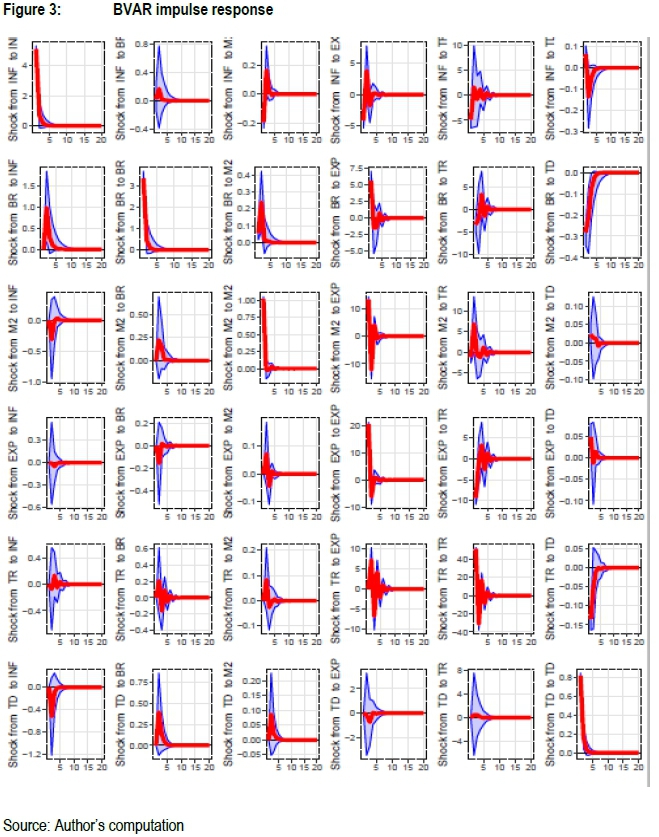
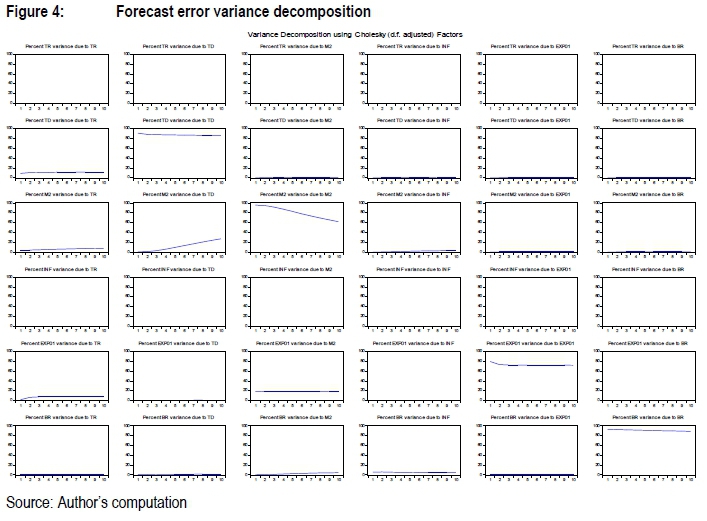
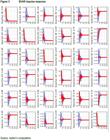
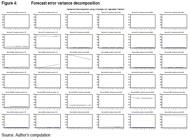
PURPOSE OF THE STUDY: This study revisits the management and interaction aspects between fiscal and monetary policies in South Africa using a Bayesian vector autoregressive model (BVADESIGN/METHODOLOGY/APPROACH: Monthly data on the inflation rate, interest rate, money supply, tax revenue, government spending and government debt for the period 2009 - 2019 were sourced from the South African Reserve BankFINDINGS: The impulse response analysis shows that positive shocks to money supply prompt monetary authority to raise the economy's interest rate, which increases the bank rate. Inflation does not respond to shock to government spending and could drive inflation in the South African economy from the supply side rather than the demand side. Tax revenue and money supply shocks are significant sources of variation in inflation. These variables account for 7 and 18 percent variation in government spendingRECOMMENDATIONS/VALUE: The study concludes that monetary authority must employ supply-side measures to manage the price levelMANAGERIAL IMPLICATIONS: Monetary policy makers must ensure that management of the economy is tailored towards the supply-side of the economy and remove the various structural rigidities in the economy in order to ensure the stability of the price and other macroeconomic fundamentalsJEL CLASSIFICATIONS: E42, E62
BVAR; economy; fiscal policy; management; monetary policy
 Thumbnail
 Thumbnail
 Thumbnail
 Thumbnail