Internal service quality and employees' perceptions of rail commuter service quality in Johannesburg
Abstract
Public transport especially commuter rail in large cities is difficult to manage in terms of meeting commuters' expectations. Johannesburg, which is served by the Gautrain and Metrorail which serve different customer segments, faces huge service quality problems. This study investigates employee perceptions of service quality offered to rail commuters from a provider's perspective. A descriptive research design was applied. Independent samples t-test was used to test the differences in employee perceptions. Canonical correlation analysis (CCA) was used to investigate the relationship between internal service quality (ISQ) and employee perceptions of service quality offered to customers. A significant difference between Gautrain and Metrorail employees' perceptions of service quality was established. A direct positive relationship was established between ISQ and employee perceptions of service quality. Although Metrorail offers a highly subsidised service it still struggles to meet its customers' expectations, hence it should focus on ISQ to improve its overall service quality. The low service quality at Metrorail and the likely customer segment that Gautrain targets could be discouraging public transport adoption by the middle level commuters who might not be covered by the two operators. The findings make a contribution to urban public transport literature by establishing a relationship between ISQ and external customer service quality.
Canonical correlation analysis; Gautrain; internal service quality; Johannesburg; Metrorail; rail commuter and transport
1. INTRODUCTION
Cities across the globe are struggling to develop safe public transport systems that can accommodate as many passengers as possible to reduce the negative effects associated with the use of private cars such as congestion, noise and pollution De Oha, De Oha & Calvo (2012:11164). Rail transport is considered a safe mode that can accommodate huge numbers of passengers at once and has been embraced in many cities, especially in the developed world. For example, 1.3 billion train passenger trips are run per annum in London (Ellis 2015:1), similarly, 3.3, 2.5 and 1.66 billion journeys in Tokyo, Seoul and New York (International Association of Public Transport 2014:1).
Some cities in Africa, especially Johannesburg also operate commuter trains. There are two commuter trains in Johannesburg namely: the Gautrain, which targets high-end commuters and Metrorail, which is usually used by low-end commuters. Gautrain completes over 15 million passenger trips per year (Gautrain Management Agency 2018:95), while Metrorail aims at reaching 574 million train passenger trips by the end of 2018 (Passenger Rail Agency of South Africa (PRASA) 2016:35). The Johannesburg figures are lower than those of cities in developed countries such as Japan, UK and USA (International Association of Public Transport 2014:1). The low figures might imply that the uptake of rail transport among commuters in Johannesburg is relatively low. Prior research has established that business success is determined by how well a service provider interacts with its customers and rail commuter transport is no different (Parasuraman, Zeithaml & Berry 1994:201; Ramseook-Munhurrun, Naidoo & Lukea-Bhiwajee 2009:541; Zahari, Ismail & Ali 2010:226). Customers expect the trains to be reliable, readily available and offer a good service at a low or reasonable cost (Wang & Qu 2017:144). Service quality is thus critical to the success of rail passenger transport in Johannesburg as well as other cities in developing countries, as argued by Ramseook-Munhurrun et al. (2009:541) and Zahari et al. (2010:227).
To make rail commuter transport attractive, its service quality should be high and continuously monitored to ensure that customer needs are met (Vilakazi & Govender 2014:259). In South Africa and in Johannesburg in particular, public transport operators have not provided appropriate service levels to commuters (Vilakazi & Govender 2014:266). The problems associated with frequent service breakdowns discourage commuters from using rail, although Madumi (2018) argued that poor service is characteristic of state owned enterprises in developing countries. These service breakdowns may be due to delayed trains, overcrowding, inaccessibility, poor or unreliable communication, safety and security threats, amongst others (Heyns & Luke 2018:472). The expectation is that these challenges should be solved by management through service employees of the rail operators (Zahari et al. 2010:227). Employees can only mitigate the challenges if ISQ adequately if the required resources are provided in time, taking care of employee welfare, and having supportive service procedures (Brandon-Jones & Silvestro 2010:1306; Prakash & Srivastava 2019:12). Whereby, ISQ refers to the satisfaction of workers with the services provided by other workers in the same organisation (Prakash & Srivastava 2019:2). As such, prior research has established that employee attitudes are correlated with customer satisfaction (Schneider & Bowen 1985; Zahari et al. 2010). This implies that if employees are unhappy this might filter through into their service delivery and is likely to result in poor service (Bouranta, Chitiris & Paravantis 2009:276; Schneider & Bowen 1985:423). It is therefore important to investigate the link between ISQ and the service offered to external customers.
The service quality phenomenon has been widely investigated from a customer perspective given its impact on profits as well as overall enterprise performance (Bouranta et al. 2009:275). Zahari et al. (2010:230) argued that external customers' service quality can also be measured by polling employees to rate their perception of the quality of services they offer to customers. Surveying employees to measure perceived service quality provides an easier way for the organisation to understand how external customers are experiencing its services and can result in quick actions to make the company more competitive (Zahari et al. 2010:229). Prakash and Srivastava (2019:3) claim that employee perceptions of service quality tend to mirror external customer perceptions of the quality of services offered by an organisation, thus external customer service quality perception can be investigated from an employee perspective and this determines the uniqueness of this study.
Despite the stated importance of employee perception of the services they offer to external customers, little is known on how it is impacted by ISQ (Eboli & Mazzulla 2015:186; Kang, Jame & Alexandris 2002:278; De Oha et al. 2012:11164; Zahari et al. 2010:227). There are a few studies that have investigated service quality from the employees' perspective, for example, Ehrhart, Witt, Schneider, and Perry (2011:7) found that ISQ influences the service quality provided to external customers; Johnston (2008:225) identified internal service limitations to achieving high external service quality as poor culture and limited resources. Similarly, Kang et al. (2002:287) claimed that reliability and responsiveness strongly influence ISQ and Sharma, Kong and Kingshott (2016:787) concluded that ISQ is a key driver of employee satisfaction as well as performance. It is also observed that studies on Gautrain and Metrorail in Johannesburg (Anastasiou 2016; Heyns & Luke 2018) have left a gap regarding ISQ and employee perceptions of the service quality offered to external customers and this forms the purpose of the current study. The findings from the study have made a significant contribution to urban rail commuter transport literature by identifying the dimension and drivers of ISQ. Based on the findings, recommendations are made to improve ISQ at Gautrain and Metrorail to achieve high customer satisfaction. Specifically, the following research questions are answered:
1. What is the difference between the Gautrain and Metrorail employees' perception of service quality offered to customers?
2. What is the relationship between internal service quality and employee perceptions of service quality offered to customers by the Gautrain and Metrorail in Johannesburg?
2. LITERATURE REVIEW AND HYPOTHESES
This section presents a review of literature on internal service quality; employee perceptions of service quality offered to customers as well as the study hypotheses.
2.1 Gautrain and Metrorail in Johannesburg
Johannesburg is South Africa's largest commercial hub and is amongst the largest cities by gross domestic product (GDP) in sub-Saharan Africa (Smith 2018). Gautrain is a high-speed train providing a premium rail service on an 80 kilometre network between Johannesburg, Pretoria and OR Tambo International Airport (Gautrain Management Agency 2016:36). On the other hand, Metrorail is a low cost, narrow gauge commuter's train that operates many locations within Johannesburg city. The Gautrain operates only within the Gauteng Province, while Metrorail operates in many other regions such as Cape Town, Durban and Pretoria; however, its largest presence is in Johannesburg. Therefore, a sample drawn from both the Gautrain and Metrorail employees in Johannesburg was likely to be representative of rail commuter service providers in South Africa.
The Gautrain is managed by the Gautrain Management Agency and Metrorail is operated by the Passenger Rail Agency of South Africa (PRASA). Commuters using the Metrorail train have always complained of its service as being unsafe, prone to low levels of security, being delayed frequently and congested (Nicolson & Simelane 2015; Weiner 2018). On the other hand, the Gautrain has generally been known to offer a higher quality transport service, although occasional technical issues and industrial unrest caused service disruptions which management tried to solve as fast as possible (Koza 2018; Phakgadi 2018). The two rail transport operators offer varied service levels in the different segments that they serve, with the Gautrain generally meeting its customer requirements more frequently than Metrorail (Kenny 2019).
A well-coordinated ISQ is identified as a prerequisite for superior service quality to external customers (Prakash & Srivastava 2019:11). In addition, Sharma et al. (2016:789) claimed that when employees receive excellent service internally, they are likely to offer superior service to external customers. There is a need to investigate ISQ and how it influences employees' perception of the service quality they offer to external customers.
2.2 Internal service quality
A conducive internal organisational environment enhances service delivery to both internal and external customers (Vella, Gountas & Walker 2009:408; Zahari et al. 2010:227). Zahari et al. (2010) identified some factors that can create an internal working environment that supports employees to deliver outstanding customer experiences. The factors identified relating to ISQ include a conducive working environment, working procedures and regulations, commitment to service quality and availability of resources. In addition, top management are expected to recognise and communicate internal customer needs to internal suppliers (i.e. a department that services other functions in the same orgarnisation) to improve ISQ (Akroush, Abu-ElSamen, Samawi & Odetallah 2013:305).
In general, effective coordination between departments, an efficient service delivery system, training, top management support, skilled human resources, use of technology as well as good management of office space are great drivers of ISQ (Zahari et al. 2010:228). Vella et al. (2009:413) further claimed that relevant job competencies for employees, use of standard procedures and developing policies and practices directed towards service excellence enhance ISQ. The presence of these enabling factors results in effective job performance and employee satisfaction as well as employee loyalty (Sharma et al. 2016:775). The importance of a favourable work environment as a promoter of ISQ was also emphasised by Akroush et al. (2013:324) who identified internal communication, staff retention and loyalty as its enablers. ISQ therefore can be measured through factors such as employee satisfaction, loyalty, working environment, organisational rules and regulations as well as an organisations' commitment to service quality (Sharma et al. 2016:785; Zahari et al. 2010:236).
Poor ISQ is prevalent in organisations with unsupportive top management, inefficient working procedures, weak service delivery systems, bureaucratic processes, lack of interdepartmental coordination, resistance to change as well as lack of a performance measurement system (Zahari et al. 2010:235). According to SeyedJavadin, Rayej, Yazdani, Estiri and Aghamiri (2012:513), a high level of ISQ develops when there is close partnering between organisational units and it is likely to differ from one organisation to another. As such, organisations that have an enabling environment are likely to offer higher ISQ and vice versa (SeyedJavadin et al. 2012:524). It is thus hypothesised that:
H1: There is no difference between the Gautrain and Metrorail ISQ
2.3 Employee perceptions of service quality
Service quality is a judgement regarding the value of services provided by an organisation (Bouranta et al. 2009:277; Zahari et al. 2010:226). Service quality research has traditionally focused on how to meet or exceed external customer requirements (Bouranta et al. 2009:275). Researchers usually seek opinions of customers to establish the effectiveness of the service delivered by the organisation in terms of matching customer needs (Kang et al. 2002:280). Service quality can also be investigated from a providers' perspective by seeking employees' opinion on the service they offer to customers. For the purpose of this study, employee perceptions of service quality refer to the perceived level of excellence of services provided by employees as well as their colleagues to the organisations' customers (Sharma et al. 2016:775). As such, employees can evaluate the service they offer with the likelihood that if they satisfy internal customers, external customers are likely to be satisfied (Pantouvakis & Mpogiatzidis 2013:35). ISQ, which is concerned with the work environment is likely to have an influence on how employees perceive the service they offer to external customers (Zahari et al. 2010:227).
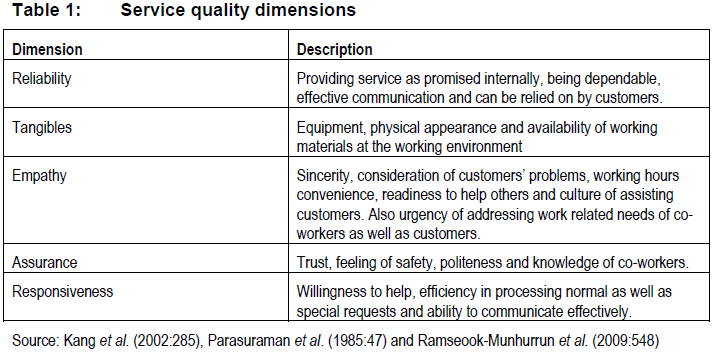
Singh (2016:29) argued that ISQ creates a service orientated enterprise internally as well as an effective service delivery system to external customers. Similarly, Prakash and Srivastava (2019:2) asserted that organisations can improve the service quality offered to customers by responding to employee needs. In addition, Bouranta et al. (2009:275) emphasised that ISQ has a direct positive impact on external service quality. Thus, an organisation's internal environment should support employees to offer high service levels to internal and consequently external customers. Employee perceptions of the service quality offered to customers has been investigated in prior research using the SERVQUAL dimensions (Parasuraman, Zeithaml & Berry 1985:44; Parasuraman et al. 1994:202; Edvardsson, Larsson & Setterlind 1997:257; Kang et al. 2002:282; Bouranta et al. 2009:284). The SERVQUAL dimensions were identified as reliability, empathy, tangibility, assurance and responsiveness (Parasuraman et al. 1994:207). Descriptions of each of the service quality dimensions from a service providers' perspective is presented in Table 1. The Parasuraman et al. (1985:47) and Parasuraman et al. (1994:207) dimensions have been modified in other studies by adding more dimensions, rewording the items or removing some dimensions to meet the requirements of specific studies (Bouranta et al. 2009:284; SeyedJavadin et al. 2012:521; Ghotbabadi, Feiz & Baharun 2015:279). The service quality dimensions can be applied in various industries including banking, call centres, hospitality, education and logistics to investigate employee perceptions (Parasuraman et al. 1985:43). For example, Ramseook-Munhurrun et al. (2009:541) investigated service quality from the employees' perspective using a modified model of Parasuraman et al. (1985) model in a call centre. Other studies that have investigated service quality from employees' perspective include Bourantas et al. (2009:284) in the hospitality industry, Zahari et al. (2010:233) in local governments and SeyedJavadin et al. (2012:513) in the energy sector.
Prior research supports nurturing ISQ as it contains essential elements of an overall service quality strategy of an organisation, which may result in cost savings and higher customer satisfaction and performance (Pantouvakis & Mpogiatzidis 2013:34) as well as improved external service quality of an organisation (Bouranta et al. 2009:275). Similarly, Ramseook-Munhurrun et al. (2009:551) argued that an effective internal customer-supplier relationship helps reduce the service quality gap, which is the difference between service quality expectations and the actual service provided. The study on ISQ and employees' perceptions of service quality offered to rail commuters is important to establish relationships and identify areas of improvement of the working environment to offer superior public transport service. The hypothesises is thus::
H2: There is no difference between the Gautrain and Metrorail employees' perception of service quality offered to customers.
H3: There is no relationship between ISQ and employee perception of service quality.
ISQ is likely to vary from one enterprise to another because of organisational culture, job types, size and ownership, which might result in different internal policies and management styles (Eid, Al Zaabi, Alzahmi & Elsantil 2019:1481). For instance, government agencies tend not have a strong service quality agenda because they usually serve an exclusive market with little or no competition, compared to private entities (Eid et al. 2019:1480). In the recent past, government enterprises are determined to satisfy their customers, hence it is imperative that they identify the factors that drive ISQ to improve customer service.
The nature of the internal environment in which employees operate has a great influence on the service quality they are likely to offer to external customers. The significance of ISQ to external service quality is emphasised by Zahari et al. (2010:227) who argued that employees can only deliver high quality service to external customers if the internal environment is enabling. Similarly, Prakash and Srivastava (2019:12) claimed that a conducive internal environment promotes ISQ which in turn results in a customer centred enterprise. Some studies have established a positive influence of ISQ on perceived service quality including Akroush et al. (2013:327), Singh (2016:28) and Bouranta et al. (2009).
3. METHODOLOGY
This section presents the research design, sampling, questionnaire and procedures and data analysis.
3.1
Research designThe study is based on the positivism philosophical orientation, which states that an objective reality can be obtained by applying scientific methodology to empirically confirmed statements of ideas (Straub, Boudreau & Gefen 2004:383). Positivism was appropriate for this study because it sought to confirm the level of ISQ in two commuter rail operators in Johannesburg using a structured questionnaire. As such, a quantitative research approach was followed. A descriptive survey research design was followed to investigate employee perceptions of service quality offered by the rail commuter transport operators in Johannesburg. A descriptive survey was appropriate as it allowed for the establishment of associations between ISQ and employee perceptions of service quality (Nenty 2009:26).
3.2
SamplingThe sample for this study consists of rail commuter transport employees of the Gautrain and Metrorail. As such, the unit of analysis is the Gautrain and Metrorail. Responses were sought from employees of the selected operators. The total number of Gautrain employees was 87 (Gautrain Management Agency 2018:80). All the 87 employees were sampled to respond to the questionnaire. The number of Metrorail employees countrywide was estimated at 12530 (PRASA 2019:64), the actual number in Johannesburg could not be established. To meet the objectives of the study, a total sample of 200 employees was targeted. The sample of 200 was deemed sufficient given the time constraints of the study as well as resource constraints. Studies in ISQ have used relatively similar sample sizes for instance Chermack and Nimon (2013:820) had a sample of 129, while Ramseook-Munhurrun et al. (2009:541) used a sample of 130. It was expected to provide sufficient responses to fully investigate ISQ as well as identify the factors that influence ISQ. A total of 60 usable questionnaires (30 from each of the operators) were returned giving a response rate of 11% (Gautrain) and 8.5% (Metrorail).
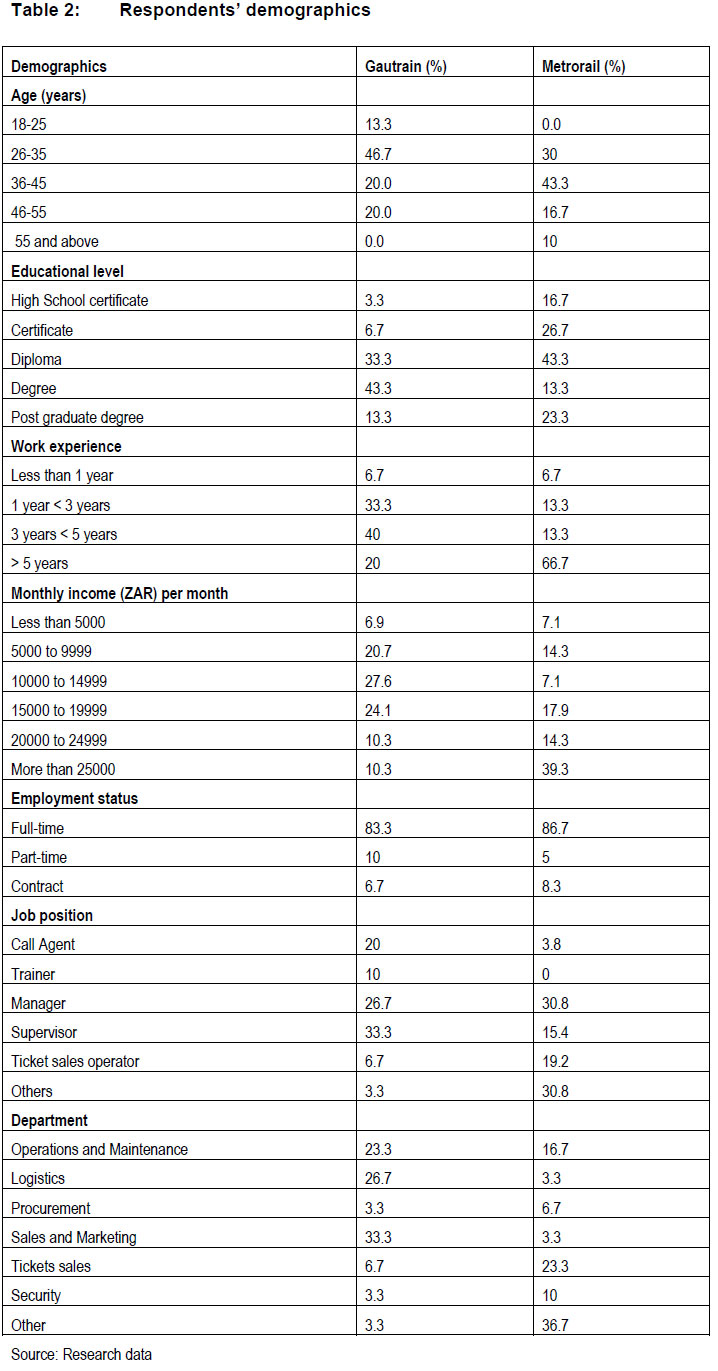
The respondents represented various departments, the percentages per department were operations and maintenance (23.3; 16.7 percent respectively), logistics (26.7; 3.3 percent), procurement (3.3; 6.7), sales and marketing (40; 26.6), security (3.3; 10) and other (3.3; 36.7) as illustrated in Table 2. Eid et al. (2019:1493) claimed that ISQ might vary depending on the type of jobs employees performed and, as such, it is important to collect data from as many departments as possible to get a representative view of an enterprise. The other (36.7%) category in Metrorail included respondents from technical, information technology, finance, human resources, asset management and legal departments. Although 39.3 % of Metrorail employees earned above ZAR 25,000, the vast majority in both enterprises made less per month, with Gautrain employees generally earning less per month than Metrorail employees. A list of the demographic characteristics of the sample, including age, educational level, working experience, employment status and job position, are presented in Table 2.
3.3
Questionnaire and procedureThe data used in this research was collected from rail commuter transport operators. The main objective of the study was to investigate the relationship between ISQ and employee perception of service quality offered to customers. The questionnaire contained questions relating to ISQ and employee perception of service quality. The items related to internal service quality included working environment (11 items), internal service rules and regulations (four items) and organisational commitment to service quality (six items) all adapted from Zahari et al. (2010:228). The questionnaire also included items related to job satisfaction (seven items) and loyalty (four items) adapted from Sharma et al. (2016:777,783). The measures of employee perception of service quality were reliability (five items), responsiveness (four items), assurance (three items), empathy (three items) and tangibles (three items) all adapted from Frost and Kumar (2000:367) as well as Parasuraman et al. (1985:47) and modified for this study. All the questionnaire items were measured on a five-point Likert-type scale (anchored from 1 = strongly disagree to 5 = strongly agree) in line with related previous studies such as (Sharma et al. 2016:782). The respondents were contacted at their workplace during breaks and requested to complete the questionnaires.
3.4
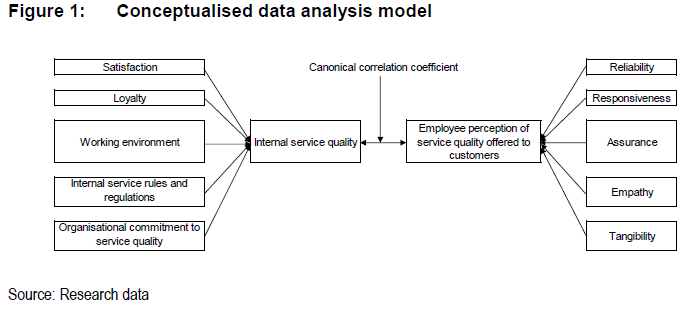
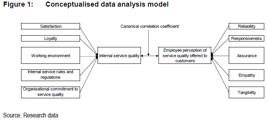
Data analysisThe study aimed at answering two research questions which are (1) what is the difference between Gautrain and Metrorail employees' perception of service quality offered to customers? and (2) what is the effect of ISQ on employee perception of service quality offered to customers? To answer question one, descriptive statistics were calculated and compared. In addition, the differences between Gautrain and Metrorail ISQ were analysed using the independent samples T-test. The second question was answered by analysing the data through canonical correlation analysis (CCA) to establish the relationship as well as relationship dimensions between the multiple measures of ISQ and multiple variables of employee perceptions of service quality as illustrated in Figure 1. CCA was preferred owing to its ability to test a relationship in which there are multiple dependent variables unlike multiple regressions (Chermack & Nimon 2013:822; Ogbu & Asuquo 2018:360).
The validity of the data was tested by examining the significance of the Wilks' lambda statistic to explain the predictability of the model. The standardised canonical coefficients, canonical loadings as well as canonical cross-loadings were also examined. Reliability was measured by examining the Cronbachs' alpha. A Cronbachs' alpha value of 0.6 and above reveals an acceptable internal consistency of the data (Hair, Hult, Ringle & Sarstedt 2014:102).
4. ETHICAL CONSIDERATIONS
Relevant ethical considerations were taken into account during study formulation, data collection, data analysis and reporting to ensure that the respondents' confidentiality was not breached. For instance, ethical clearance was sought from the University Ethics Committee and granted. The respondents were requested to participate voluntarily and were informed that they could withdraw from the survey at any stage if they wished. The closed ended questionnaire used to collect data ensured respondent anonymity. The respondents were also assured of the confidentiality of the data collected and assured that it would only be used for academic purposes. They were also informed that their information would be collated and that they would not be able to be identified in any way in the research process. Ethical clearance was granted by the University of Johannesburg Department of Transport and Supply Chain Management Ethics Committee Wainwright and Sambrook (2010:282).
5. RESULTS
5.1 Demographics
Based on the mean, Gautrain respondents rated most of the items higher than Metrorail respondents did. The high mean might imply that Gautrain respondents were more comfortable with their internal working environment as well as the service they provided to their customers more than Metrorail. There is an exception with the item "I am ready for any changes within the department" in which Metrorail employees were slightly readier for change (mean = 4.21; SD = 0.940) than Gautrain (mean = 4.13; SD = 1.008). In addition, many of the Metrorail respondents agreed to "I wish to work for this organisation for the next 10 years" (mean = 3.70; SD = 1.236) than Gautrain (mean = 3.53; SD = 1.279) as well as "people with different cultures work well together" (mean = 3.9; SD = 1.145) than Gautrain (mean = 3.83; SD = 1.037). This might imply the respondents consider Metrorail to be inclusive and an employer of choice.
5.2 Reliability analysis
Reliability was measured using the Cronbach's alpha, in which good values that indicate high internal consistency range from 0.6 to 1 (Eiras, Escoval, Grillo & Silva-Fortes 2014:114). Examining scale reliability revealed that the overall Cronbachs' alpha is above the threshold value of 0.6 (Eira et al. 2014:114) for all the constructs (for example, reliability = 0.933 and satisfaction = 0.914) indicating high internal consistency (Table 3). In addition, for a scale with high internal consistency the reliability values under the column Cronbach's alpha if item is deleted should not be greater than the overall Cronbach's alpha (Pallant 2010:99) as revealed in Table 3. The scale inter-item correlations were also examined and found to be positive implying that all scales items were measuring same underlying characteristics (Pallant 2010:100).
5.3 Differences of service quality dimensions in Gautrain and Metrorail
This study set out to test three hypotheses namely H1: there is no difference between the Gautrain and Metrorail ISQ; H2: There is no difference between Gautrain and Metrorail employees' perception of service quality offered to customers and H3: There is no relationship between ISQ and employee perception of service quality.
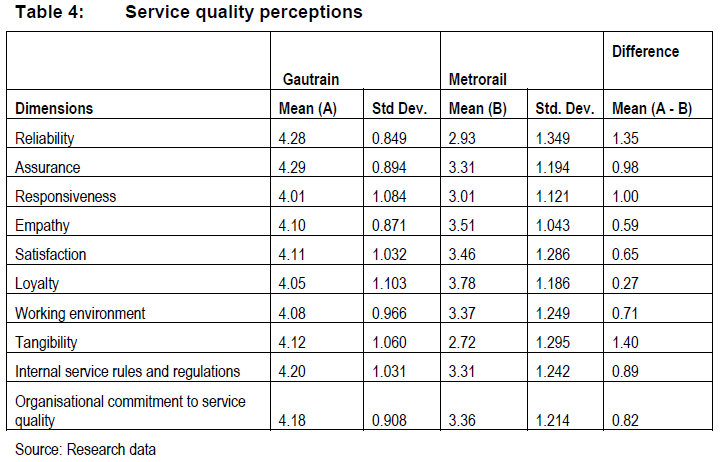
Examination of mean statistic of the ISQ dimensions for rail transport operators revealed that internal service rules and regulations (M=4.20; SD=1.031) was the highest ranked in Gautrain, followed by organisational commitment to service quality (M=4.18; SD=0.908). This might imply that internal rules were supportive of employees' endeavour to offer excellent service to customers. At Metrorail, loyalty (M=3.78; SD=1.186) was the highest ranked among the ISQ dimensions, thus suggesting that it was the most important, closely followed by satisfaction (M=3.46; SD=1.286). Generally, the high mean ratings from the Gautrain might be an indication that respondents more than Metrorail's that their internal environment promoted a higher service quality. In addition, given the high variability of Metrorail data (as per the high standard deviations), might be an indication of varied internal service quality levels based on job position held or even the type of work performed (Eid et al. 2019:1493).
To identify important dimensions for each of the operators, a mean rank of all the dimensions was calculated (Table 4). Amongst the dimensions of employee perceptions of service quality offered to customers, assurance (M=4.29; SD=0.894) and reliability (M=4.28; SD=0.849) were ranked as the highest in the Gautrain. In Metrorail, empathy (M=3.51; SD=1.043) was the highest ranked followed by assurance (M=3.31; SD=1.194). Tangibility (M=2.72; SD=1.295) was the least important.
The mean differences of ISQ as well as employees' perceptions of service quality dimensions were analysed. The largest difference between the Gautrain and Metrorail ISQ was revealed in the reliability (1.35) dimension, while the lowest was in empathy (0.59). This might imply that the respondents of the Gautrain perceived their service to be highly reliable compared to the perceptions of Metrorail employees. The low mean ratings on perception of Metrorail's reliability confirm the customer complaints regarding delayed trains reported in literature (Nicolson & Simelane 2015; PRASA 2019:14). Based on the findings of this study, the Gautrain might be perceived as offering a higher level of ISQ, as well as a higher perceived service quality to external customers, than Metrorail in all the dimensions, as illustrated in the difference column (Table 4).
5.3.1 Difference between Gautrain and Metrorail's ISQ
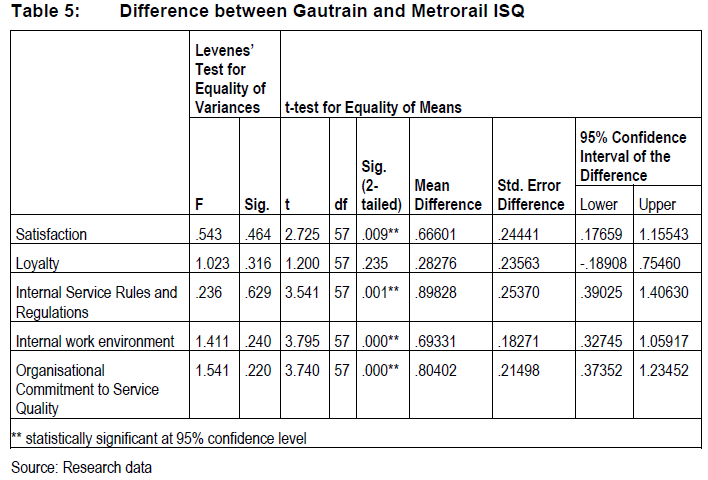
Further, the difference between the Gautrain and Metrorail's ISQ was investigated to test hypothesis H1. The independent samples t-test was conducted, with satisfaction, loyalty, working environment, internal service rules and regulations and organisational commitment to service quality as test variables and the Gautrain and Metrorail as the grouping variables. A statistically significant difference between the Gautrain and Metrorail's ISQ was observed in four dimensions, that is, satisfaction (p=0.009), working environment (p=0.000), internal service rules and regulations (p=0.001) and organisational commitment to service quality (p=0.000) except loyalty (p=0.235). The finding implies that the internal working environment at the Gautrain is significantly different from Metrorail's although employees' loyalty was the same. The hypothesis: H1: there is no difference between the Gautrain and Metrorail internal service quality is rejected.
5.3.2 Difference between Gautrain and Metrorail's service quality offered to customers
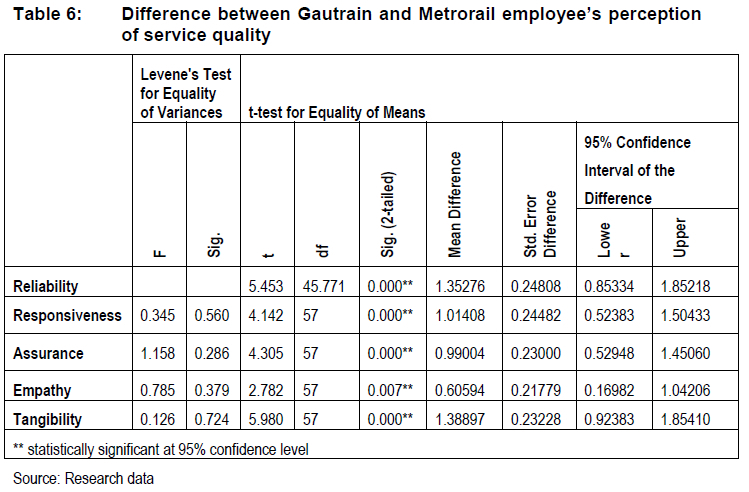
A statistically significant difference (p<0.05) between the Gautrain and Metrorail's employee perceptions on service quality offered to customers was observed on all dimensions at 95% confidence level (Table 6). The result implies that the level of service quality offered to customers at the Gautrain is statistically different from Metrorail's. This confirms the mean rating examined earlier and implying that the Gautrain's employees consider themselves to be offering a better service to their customers compared to Metrorail's. The hypothesis: H2: there is no difference between the Gautrain and Metrorail employee's perception of the service quality offered to customers is rejected. It is observed that the service quality was reported by employees and may be biased, based on variables such as jobs performed, management styles and existing service quality policies, as argued by Eid et al. (2019:1493).
Employees' perception of the service quality offered to customers at the Gautrain and Metrorail are significantly different in terms of reliability, responsiveness, assurance, empathy and tangibility dimensions.
5.4 ISQ and Employee perception of service quality
The interrelationships between ISQ and employees' perception of service quality are investigated. Conceptually the five factors (dimensions) are the measures of ISQ. The objective is to establish a latent relationship (that is, relationship between composites of variables) between ISQ (as independent variables) and employees' perception of service quality offered to customers (as dependent variables). To meet the set objective, CCA was performed to establish the relationships or significant canonical variates that can be used to explain the relationship. CCA was chosen over multiple regression analysis because it allows for investigation of dependence relationships involving multiple dependent and independent variables (Hair et al. 2014). The distribution of the data was examined to ensure that it does not violate the multivariate analysis assumptions as advised by Hair et al. (2014). The examination found the data to be normally distributed upon observing the normal P-P plots and scatter plots; effects of outliers was ruled out after finding that the Mahalanobis distances were within the acceptable range. Problems associated with multicollinearity as well as collinearity were also ruled out. Upon satisfaction that the multiple regression assumptions were met, CCA was conducted.
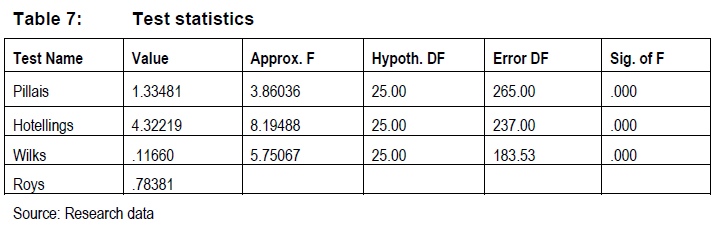
The significance of the full model was evaluated using four test statistics (Table 7). The Wilk's lambda (A) was selected to evaluate the model due to its general applicability (Sherry & Henson 2005). Wilk's A = 0.11660, F = 5.75067, p=0.000 revealed that the overall model was statistically significant. Ogbu and Asuquo (2018) claimed that the Wilk's A revealed the unexplained variance, meaning that 1 - A = r2 = 0.8834 is the explained variance of the full model. This implies that the overall canonical model explained a substantive 88.34 % of the variance of the full model.
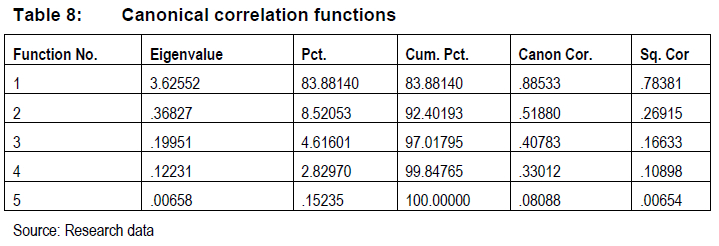
Five canonical functions were derived with canonical correlation coefficients of 0.8853, 0.5188, 0.4078, 0.3301 and 0.0809 for functions 1, 2, 3, 4 and 5 respectively. To determine which functions to interpret, Sherry and Henson (2005) advised that the effect size of each function as well as the statistical significance should be examined. As such, function 1 and 2 explained 78.4 % and 26.9 % of the variance within their functions respectively. While functions 3, 4 and 5 explained only 16.6, 10.9 and 0.7 % of the variance respectively as illustrated in Table 8. Functions 1 and 2 are further noted to explain a substantive 83.88 and 8.52 % of the variance respectively.
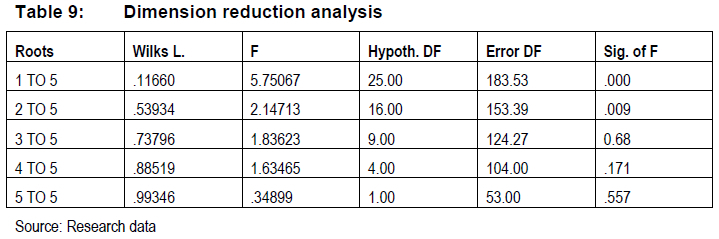
Examination of the dimension reduction helped to test statistical significance of the hierarchically arranged functions. It confirmed that root or function 1 to 5 F (25, 183.53) = 5.75; p<0.05 and function 2 to 5 F (16, 153.39) = 2.15; p<0.05 were statistically significant (Table 9) and hence can be considered for interpretation, as advised by Sherry and Henson (2005).
There is a relationship between the measures of ISQ and employee perception of service quality as revealed by the canonical correlations and statistical significance of functions 1 and 2. In addition, function 1 and 2's canonical effect (that is, R 2c) is 76.842 and 7.918 % respectively. As such, only functions 1 and 2 will be interpreted.
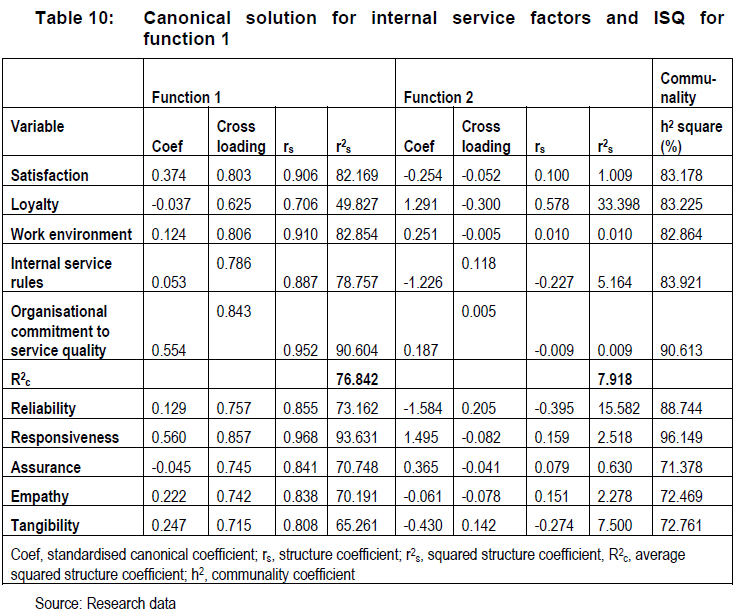
To explain fully the nature of the relationship the standardised coefficients, cross loadings and structure coefficients corresponding to the first and second canonical functions presented in Table 10 were examined. This is because only the first and second functions satisfied the criteria for interpretation, which included statistical significance and canonical effect size.
For function 1, satisfaction (0.374) and organisational commitment to service quality (0.554) were identified as the most relevant predictor variables based on the standardised coefficients, while working environment had marginal relevance. Examining the standardised coefficients of the criterion variables of function 1 reveals that responsiveness (0.560), empathy (0.222) and tangibility (0.247) are the most relevant variables while reliability (0.129) was marginal and assurance (-0.045) was not relevant given the low negative coefficient. Assurance was also inverse to all the other criterion variables.
Observing the standardised coefficients of function 2 reveals satisfaction (0.254), working environment (0.251) and organisational commitment to service quality (0.187) as the most relevant predictor variables, while only assurance was relevant among the criterion variables.
Cross loadings related to both the predictor (ranging from 0.625 to 0.843) and criterion (ranging from 0.715 to 0.857) variables loaded heavily on function 1. The cross-loading reveal that the variables loaded substantially (above 0.5) to only the first canonical function confirming the high significance of the model.
The canonical correlations or structure loadings (rs) also reveal high loadings in function 1 thus signifying a strong direct relationship between the predictor and criterion variables. Satisfaction (rs = 0.906), loyalty (rs = 0.706), working environment (rs = 0.910), internal service rules (rs = 0.887), organisational commitment to service quality (rs = 0.952) were identified as relevant contributors to the predictor synthetic variable for function 1. The contributors to the criterion synthetic variable were reliability (rs = 0.855), responsiveness (rs = 0.968), assurance (rs = 0.841), empathy (rs = 0.838) and tangibility (rs = 0.808). The findings confirm that satisfaction and work environment contribute most to the relationship among the predictor variables, while responsiveness and reliability dimensions contributed the most among the criterion variables for function 1. Function 1 reveals a strong positive direct relationship between ISQ and employee perception of the service offered to customers.
Examining Function 2 canonical structure coefficients reveals that loyalty (rs = 0.578) was the only relevant predictor variable and internal service rules and regulations (rs = -0.227) was a weak predictor of employee perception of service quality offered to customers. Tangibility (rs = -0.274) and reliability (rs = -0.395) were the only contributors to the criterion synthetic variable. The finding implies that loyalty had an inverse relationship with tangibility and reliability as well as internal service rules and regulations in Function 2. The structured coefficient for function 2 was quite low with only loyalty and reliability contributing 33.4% and 15.6% respectively. Hair et al. (2014) argued that in interpreting the canonical functions, the standardised coefficients have high volatility and may not be reliable. As such, based on the structure coefficients and cross loadings, function 2 displays a very weak relationship dimension with only loyalty and reliability having a structured coefficient above 0.3.
The communalities (h2) revealed that all the variables in this study were very useful to the full model given the high values (above 70%) with great contributions coming from function 1. Close examination shows that organisational commitment to service quality is the most useful among the predictor variables while responsiveness and reliability are the most useful among the criterion variables.
The high loadings in Function 1 reveal a high degree of inter-correlations between the ISQ variables and employee perception of the service quality offered to customers. The finding implies that the predictor variables are relevant predictors of the outcome (Hair et al. 2014), and the rail operators should focus their efforts on these variables. In addition, the observed canonical loadings in the first canonical variate (first function) closely correspond to the dimensions that would be extracted in factor analysis, thus, reinforcing its high practical significance (Sherry & Henson 2005; Hair et al. 2014) to rail operators in explaining the relationship between ISQ and employee perception of the service quality offered to customers.
Calculation of the model redundancy was also done to estimate the predictiveness of employee perception of the service quality offered to customers by ISQ variables. A redundancy of 0.6803 and 0.0410 for function 1 and 2 respectively was obtained. The redundancy values imply that the relationship dimension established by function 2, although statistically significant is very weak with very low predictiveness confirming the low cross loadings and structure coefficients. Nevertheless, CCA has helped to identify relationship dimensions between the dependent and independent variables and to maximise relationships between the variable sets. The results reveal that a single relationship dimension exists supported by the high practical significance of the first canonical function with all the variables being relevant. The second relationship dimension (function 2) show that only loyalty and internal service rules and regulations were associated with reliability and tangibility and were the only relevant variables. This implies that the set of five dependent variables create a well-defined criterion synthetic variable representing employee perceptions of service quality offered to customers at Gautrain and Metrorail. Similarly, the five independent set of variables predict the criterion variables when acting as a set. The hypothesis (H3) there is no relationship between ISQ and employee perception of service quality offered to customers is rejected.
6. DISCUSSION
The objective of this study was two-fold. First, to establish the difference between the Gautrain and Metrorail's ISQ and employees' perception of the service quality offered to customers. Second, to determine the relationship between internal service quality and employee perception of the service quality offered to customers. To fully investigate the research problem and answer the research questions, three hypotheses were formulated and tested.
6.1 ISQ at Gautrain and Metrorail
Gautrain employees generally perceived their working environment to be more conducive compared to their Metrorail counterparts. At Metrorail, the employees indicated that the resources required to perform their work effectively were either missing or not up to date, thus affecting their service quality internally. The finding supports Nicolson and Simelane (2015) who observed that Metrorail has a low capacity, poor ticketing systems, and inadequate security arrangements. In addition, PRASA (2019:21) identified internal inefficiencies in Metrorail's supply chain department, resulting in employees not getting job-related inputs as expected. In contrast, Gautrain employees rated their internal working environment as well coordinated, resulting in a quick response time, especially when handling commuter queries. The finding supports Eid et al. (2019:1493) who observed that a service oriented organisation delivers a high service quality to internal and external customers. The service quality level, as per the surveyed dimensions in this study, confirmed what the practise of the two institutions is already (Gautrain Management Agency 2018; PRASA 2019).
Although, the employees in both organisations indicated loyalty to their organisations, there was a difference in terms of satisfaction, working environment, internal service rules and regulations, as well as commitment to service quality dimensions. Similarly, the likely low ISQ level in Metrorail was exhibited by employees as they would less likely refer potential clients to their organisation, when compared to their Gautrain counterparts. On the other hand, when asked about their career prospects with the current employer, the Gautrain employees observed that they would work for less than ten years compared to Metrorail, although marginally. Based on these findings, Metrorail management should consider improving their ISQ by enhancing effective communication between departments and with their customers, as also claimed by Eid et al. (2019:1495). They should also ensure that the employees have the required resources to perform their duties. Although the findings indicate that the Gautrain offers superior ISQ, management should consider making the organisation more attractive to the current employees, given that it is perceived as not an employer of choice for the next ten years, as per the loyalty dimension.
The low ISQ in Metrorail is confirmed by Nicolson and Simelane (2015) that although Metrorail offers an affordable transport service, internally it is laden with labour disputes, poor communication and generally frustrated operational staff. On the contrary, Phakgadi (2018) observed that the Gautrain holds fruitful negotiations with unions representing its workers and always vouches for a win-win negotiated agreement, thus, creating a favourable internal working environment. The negotiation with unions is a likely indicator of the Gautrain's effective communication within the organisation and is likely to create a conducive working environment that promotes high levels of ISQ as established in this study. Similarly, Eid et al. (2019:1495) asserts that effective internal communication results in high levels of ISQ. The internal environments in the Gautrain and Metrorail are significantly different based on the opinions of employees of each of the The findings presented on ISQ in this study support other studies which claimed that high ISQ is likely to result in superior service to external customers (Bouranta et al. 2009; Parasuaraman et al. 1985; Sharma et al. 2016; Vella et al. 2009).
6.2 Employee perception of service quality
Although many studies use the gap-measure, in this study the perceptions-only measure was used, and it is known to be an equally reliable and valid measure (Brandon-Jones & Silvestro 2010). Employee perceptions of the service quality offered to external customers of the Gautrain and Metrorail was measured in terms of reliability, responsiveness, assurance, empathy and tangibility. This was in line with Ramseook-Munhurrun et al. (2009:541) who claimed that service quality can be investigated from an employee perspective using a modified SERVQUAL model to mirror the likely service quality offered to external customers.
Employees' perceptions of the service quality offered to customers of the Gautrain were significantly different from that of Metrorail, based on all the five dimensions. On examining the mean statistic and the independent samples t-test results, it was observed that Gautrain employees offer a higher service quality to their customers. The highest difference was in the reliability dimension, whereby Gautrain employees indicated that they provide all relevant information to their commuters, as expected. This supported Anastasiou (2016) who claimed that whenever there were technical issues with the railroad track; the Gautrain provided information to commuters through all media platforms including social media and SMS service, and employs effective service recovery measures in case of service failure (Koza 2018), when compared to Metrorail. It clearly reveals that they effectively communicate with their commuters, thus supporting Akroush et al. (2013:312) as well as Eid et al. (2019:1485) who emphasised the importance of communication to external service quality. On the other hand Nicolson and Simelane (2015) claimed that Metrorail fails to provide relevant information regarding anticipated delays or during breakdowns negatively affecting reliability of the transport service. The perceived high service quality in the Gautrain supports the Gautrain Management Agency (2019:22) report which estimated its customer service levels above 99 %. Similarly, the finding relating to low service quality in Metrorail supports PRASA (2019:38) report which estimates service performance at about 55 %. A notable difference was also established in the tangibility, responsiveness and assurance dimensions, supporting the annual reports from the two operators (Gautrain Management Agency 2019; PRASA 2019).
6.3 The relationship between ISQ and employee perception of service quality
The relationship between ISQ and employee perception of service quality offered to customers was examined through CCA. CCA was selected as it allowed examining the relationship in which both the dependent and independent constructs had multiple variables. ISQ (the predictor variable) and employee perception of service quality offered to customers (the criterion variable), were each measured by five factors. A direct strong positive relationship was established between ISQ and employee perception of the service quality offered to customers confirming Bouranta et al. (2009) concludes that ISQ associates with external service quality. Organisational commitment to service quality contributed the most to the relationship followed by working environment, satisfaction, internal service rules and regulations and loyalty in that order. The finding implies that when the ISQ is high, employees perceive to offer high service quality, thus supporting the studies by Frost and Kumar (2000), Bouranta et al. (2009) and Sharma et al. (2016) as well as Ramseook-Munhurrun et al. (2009:541) who found that satisfied employees deliver high quality service resulting in excellent service to external customers. The findings also imply that an organisation committed to service quality is likely to promote effective communication internally, provide relevant resources to employees to enable them to perform their duties effectively as well as define responsibilities of each worker to create efficiencies and effectiveness in service delivery. Akroush et al. (2013) claim that perceived service quality is high when employees perceive the internal environment as being supportive or conducive; this is also supported by the study. It is also expected that the internal service rules and regulations should help create efficiencies and effectiveness of internal operations to support delivery of a reliable and responsive service to external customers.
7. CONCLUSION
In this study perceptions-only measures were used to compare ISQ and employees' perception of service quality offered to customers in both the Gautrain and Metrorail. The ISQ levels in the two rail operators were significantly different in all the dimensions except employee loyalty to the organisation. This implied that the internal organisational environments in terms of operational effectiveness and efficiencies differ between the organisations. The Gautrain was perceived to have a better overall working environment as well as superior service quality to its customers. The finding implies that Metrorail has some ground to cover to improve its ISQ and, consequently, the service to its customers, the rail commuters. The likely service quality to external customers as measured from employee perspective in the Gautrain was significantly different from Metrorail in all dimensions -reliability, assurance, responsiveness empathy and tangibility. The highest difference was observed in the reliability dimension. Like in prior studies (Prakash & Srivastava 2019:3), in this study, ISQ was found to positively influence employee perception of the service quality offered to customers. Management of the rail operators in Johannesburg should develop strategies that enhance the internal working environment, humanise internal rules and regulations, mitigate internal service challenges and promote commitment to service quality so as to achieve the high ISQ which is likely to result in service excellence to commuters (Prakash & Srivastava 2019:12; Vella et al. 2009:407).
7.1
Managerial ImplicationsManagement is informed by the findings that ISQ is likely to impact employees' service delivery to external customers. The strong inter-correlations among the five ISQ set of variables provides a clear indication to managers of rail commuter services of the need to focus on the full set to improve service quality of external customers. This is because a poor rating of any of the independent variables is likely to have a negative influence on the total service quality offered to external customers.
It is also important that the management of the rail service providers frequently evaluate their ISQ to identify areas that negatively affect employee perceptions as well as performance to achieve smooth operations. To deliver high service quality to customers, managers need to create a conducive internal working environment by providing the right tools and equipment, enhancing proper communication between departments, developing enabling standard operating procedures as well as deliberate commitment to superior service quality. In addition, rail commuter service managers should be ready to address employee concerns in a timeous manner to avoid industrial unrest, which usually leads to complete service breakdown and thus negatively affects service quality to external customers. Finally, it is recommended that service quality be surveyed effectively using perceptions-only measures from an employee perspective. This offers managers a quick view of the areas of service in which they should address issues, to improve service quality. Finally, the authors argue that the low service quality at Metrorail discourages urban commuters from using public rail transport. The middle level commuters are further discouraged given that the Gautrain targets the high end customer segment. There is a likely customer segment of urban commuters in Johannesburg who are not served by either the Gautrain or Metrorail and this calls managers and planners into action.
7.2
Limitations and future research directionsThe research and findings are limited to the Gautrain and Metrorail in Johannesburg. For this reason, it may not be conclusive and replicable to other areas in the country. A wider study is advised to incorporate other cities within the southern African region. Only cross-sectional data was collected for this research. Longitudinal data may provide a better perspective of the variations in ISQ at the two rail operators over time and how it relates to employee perceptions of the service quality offered to customers. A self-administered survey was the most appropriate approach for the current study; however future studies can consider interviews to get more insight on how external service quality is influenced by ISQ and how it can be improved. Finally, Future research directions might include the comparison of high speed rail service quality between South Africa, United States, China, Japan and Europe.
ACKNOWLEDGEMENTS
The authors acknowledge the effort of honours students Kulani Emock Holeni, Kesaobaka Oseile, Tshepiso Makhubela and Maphare Pholotho for collecting the data used in this research.
REFERENCES
-
AKROUSH MN, ABU-ELSAMEN AA, SAMAWI GA & ODETALLAH AL. 2013. Internal marketing and service quality in restaurants. Marketing Intelligence & Planning 31(4):304-336. (DOI:10.1108/02634501311324834.
» https://doi.org/10.1108/02634501311324834 -
)
» https://ewn.co.za/2016/06/01/gautrain-experiencing-technical-problems-between-sandton-park-station -
]
» https://doi.org/10.1108/01443571011094271 -
BOURANTA N, CHITIRIS L & PARAVANTIS J. 2009. The relationship between internal and external service quality. International Journal of Contemporary Hospitality Management 21(3):275-293. (DOI:10.1108/09596110910948297.
» https://doi.org/10.1108/09596110910948297 -
)
» http://dx.doi.org/10.1016/j.eswa.2012.03.037 -
)
» https://doi.org/10.1080/02642069700000014 -
CHERMACK TJ & NIMON K. 2013. Drivers and outcomes of scenario planning: a canonical correlation analysis. European Journal of Training and Development 37(9):811-834. (DOI:http://dx.doi.org/10.1108/EJTD-03-2013-0030.
» http://dx.doi.org/10.1108/EJTD-03-2013-0030 -
)
» http://dx.doi.org/10.1108/IJOA-09-2018-1548 -
)
» https://doi.org/10.1108/08876040010340991 -
EBOLI L & MAZZULLA G. 2015. Relationships between rail passengers' satisfaction and service quality: a framework for identifying key service factors. Public Transport 7(2):185-201. (DOI:http://dx.doi.org/10.1007/s12469-014-0096-x.
» http://dx.doi.org/10.1007/s12469-014-0096-x -
)
» http://gma.gautrain.co.za/performance/Shared%20Documents/GMA%20Integrated%20Annual%20Report%202018.pdf -
)
» https://doi.org/10.6007/IJARBSS/v5-i2/1484 -
EHRHART KH, WITT LA, SCHNEIDER B & PERRY SJ. 2011. Service employees give as they get: Internal service as a moderator of the service climate-service outcomes link. Journal of Applied Psychology 96(2):423. (DOI:https://psycnet.apa.org/doi/10.1037/a0022071.
» https://psycnet.apa.org/doi/10.1037/a0022071 -
)
» http://www.satc.org.za/assets/2c_heyns.pdf -
)
» http://dx.doi.org/10.1108/09564230810869748 -
EIRAS M, ESCOVAL A, GRILLO, MI & SILVA-FORTES C. 2014. The hospital survey on patient safety culture in Portuguese hospitals: Instrument validity and reliability. International Journal of Health Care Quality Assurance 27(2):111-122. (DOI:https://doi.org/10.1108/IJHCQA-07-2012-0072.
» https://doi.org/10.1108/IJHCQA-07-2012-0072 -
)
» https://dailyfriend.co.za/news/andrew-kenny/a-tale-of-two-trains - )
-
GAUTRAIN MANAGEMENT AGENCY. 2019. GMA Integrated Annual Report 2019/18. [Internet:http://gma.gautrain.co.za/performance/Pages/annual-reports.aspx; downloaded on 11 October 2019.
» http://gma.gautrain.co.za/performance/Pages/annual-reports.aspx -
]
» https://www.dailymaverick.co.za/article/2015-03-12-metrorail-in-johannesburg-a-community-problem/ - ]
-
GAUTRAIN MANAGEMENT AGENCY. 2016. GMA Integrated Annual Report 2015/16. [Internet:http://gma.gautrain.co.za/uploads/doc/GMA-Annual-Report-2016.pdf; downloaded on 04 November 2018.
» http://gma.gautrain.co.za/uploads/doc/GMA-Annual-Report-2016.pdf -
]
» https://doi.org/10.1016/0022-4359(94)90033-7 -
)
» https://www.prasa.com/Annual%20Reports.html - HAIR FJ, HULT TG, CHRISTIAN RINGLE R & SARSTEDT M. 2014. A Primer on Partial Least Squares Structural Equation Modeling (PLS-SEM). Thousand Oaks, CA: Sage Publications.
-
]
» http://dx.doi.org/10.1108/09604520910984364 -
INTERNATIONAL ASSOCIATION OF PUBLIC TRANSPORT. 2014. Statistics brief: world metro figures. [Internet:http://www.uitp.org/sites/default/files/cck-focus-papers-files/Metro%20report%20Stat%20brief-web_oct2014.pdf; downloaded on 15 May 2019.
» http://www.uitp.org/sites/default/files/cck-focus-papers-files/Metro%20report%20Stat%20brief-web_oct2014.pdf -
]
» https://doi.org/10.1108/02656711211230508 -
)
» https://doi.org/10.1207/s15327752jpa8401_09 -
KANG GD, JAME JD & ALEXANDRIS K. 2002. Measurement of internal service quality: application of the SERVQUAL battery to internal service quality. Managing Service Quality: An International Journal 12(5):278-291. (DOI:http://dx.doi.org/10.1108/09604520210442065.
» http://dx.doi.org/10.1108/09604520210442065 -
)
» https://www.fin24.com/Economy/view-africas-10-wealthiest-cities-20180915-2 -
]
» https://www.mirror.co.uk/news/uk-news/record-numbers-people-use-train-5068779 -
KOZA N. 2018. Gautrain introduces midibus service in three areas. [Internet:https://ewn.co.za/2018/10/09/gautrain-introduces-midibus-service-in-three-new-areas; downloaded on 02 November 2018.
» https://ewn.co.za/2018/10/09/gautrain-introduces-midibus-service-in-three-new-areas - ]
-
)
» https://doi.org/10.1016/j.ejor.2016.08.040 -
NENTY HJ. 2009. Writing a quantitative research thesis. International Journal of Educational Sciences 1(1):19-32. (DOI:10.1080/09751122.2009.11889972.
» https://doi.org/10.1080/09751122.2009.11889972 -
)
» https://doi.org/10.1108/14725961011058857 - ]
-
OGBU CP & ASUQUO CF. 2018. Ethical and cost performances of projects: a canonical correlation. International Journal of Ethics and Systems 34(3):352-371. (DOI:http://dx.doi.org/10.1108/IJOES-01-2018-0015.
» http://dx.doi.org/10.1108/IJOES-01-2018-0015 - )
-
PANTOUVAKIS A, & MPOGIATZIDIS P. 2013. The impact of internal service quality and learning organization on clinical leaders' job satisfaction in hospital care services. Leadership in Health Services 26(1):34-49. (DOI:10.1108/17511871311291714.
» https://doi.org/10.1108/17511871311291714 - )
- )
-
PARASURAMAN A, ZEITHAML VA & BERRY LL. 1985. A conceptual model of service quality and its implications for future research. The Journal of Marketing 49(Fall):41-50. (DOI:https://doi.org/10.1177/002224298504900403.
» https://doi.org/10.1177/002224298504900403 - )
- ]
-
PASSENGER RAIL AGENCY OF SOUTH AFRICA (PRASA). 2016. Annual report 2015/16. [Internet:https://www.prasa.com/Annual%20Reports/Prasa%20Annual%20Report%202015-16.pdf; downloaded on 04 November 2018.
» https://www.prasa.com/Annual%20Reports/Prasa%20Annual%20Report%202015-16.pdf - ]
-
PHAKGADI P. 2018. Fedusa pleased with Gautrain wage talks outcome. [Internet:https://ewn.co.za/2018/08/13/fedusa-pleased-with-gautrain-wage-talks-outcome; downloaded on 02 November 2018.
» https://ewn.co.za/2018/08/13/fedusa-pleased-with-gautrain-wage-talks-outcome - ]
-
PRAKASH G, & SRIVASTAVA S. 2019. Role of internal service quality in enhancing patient centricity and internal customer satisfaction. International Journal of Pharmaceutical and Healthcare Marketing 13(1):2-20. (DOI:https://doi.org/10.1108/IJPHM-02-2018-0004.
» https://doi.org/10.1108/IJPHM-02-2018-0004 - )
- )
-
SCHNEIDER B & BOWEN DE. 1985. Employee and customer perceptions of service in banks: Replication and extension. Journal of applied Psychology 70(3):423. (DOI:https://psycnet.apa.org/doiLanding?doi=10.1037%2F0021-9010.70.3.423.
» https://psycnet.apa.org/doiLanding?doi=10.1037%2F0021-9010.70.3.423 - )
- )
-
SHARMA P, KONG TTC & KINGSHOTT RP. 2016. Internal service quality as a driver of employee satisfaction, commitment and performance: Exploring the focal role of employee well-being. Journal of Service Management 27(5):773-797. (DOI:10.1108/JOSM-10-2015-0294.
» https://doi.org/10.1108/JOSM-10-2015-0294 - )
- )
-
SINGH K. 2016. Influence of internal service quality on job performance: A case study of Royal Police Department. Procedia-Social and Behavioral Sciences 224:28-34. (DOI:10.1016/j.sbspro.2016.05.396.
» https://doi.org/10.1016/j.sbspro.2016.05.396 - )
- ]
-
STRAUB D, BOUDREAU MC & GEFEN D. 2004. Validation guidelines for IS positivist research. Communications of the Association for Information Systems 13(1):380-427. (DOI:10.17705/1CAIS.01324.
» https://doi.org/10.17705/1CAIS.01324 - )
- ]
-
VELLA PJ, GOUNTAS J & WALKER R. 2009. Employee perspectives of service quality in the supermarket sector. Journal of Services Marketing 23(6):407-421. (DOI:10.1108/08876040910985870.
» https://doi.org/10.1108/08876040910985870 - )
-
WAINWRIGHT D & SAMBROOK S. 2010. The ethics of data collection: unintended consequences? Journal of Health Organization and Management 24(3):277-287. (DOI:https://doi.org/10.1108/14777261011054617.
» https://doi.org/10.1108/14777261011054617 - )
- )
-
WEINER J. 2018. Metrorail. [Internet:https://hsf.org.za/publications/hsf-briefs/metrorail; downloaded on 10 November 2018.
» https://hsf.org.za/publications/hsf-briefs/metrorail - ]