The influence of psychological competencies on the willingness of employees involved in dirty work to become entrepreneurs
Abstract
Little is known about the influence of psychological competencies (innovation capacity, emotional intelligence and resilience) on the willingness to become entrepreneurs for employees involved in dirty work, classified to be physical (for example, garbage collectors, cleaners, and groundsman), and who are facing stigma because of their occupation. This study investigated the influence of psychological competencies on willingness to become an entrepreneur among a sample of employees involved in dirty work while adding to the debate on factors leading to new venture creation. The study is quantitative in nature and descriptive by design. Primary data was gathered through a self-administered questionnaire and statistical techniques were used for analysis purposes. It was found that emotional intelligence and resilience successfully predicted willingness to become entrepreneurs for employees involved in dirty work. The contribution of innovation capacity to the regression model was found to be insignificant. The understanding that emotional intelligence and resilience are key factors for willingness to become entrepreneurs among stigmatised individuals is critical given that practitioners and researchers can now develop proper educational tools and awareness campaigns around these factors to stimulate entrepreneurial behaviour.
Dirty work; psychological competencies (innovation capacity, emotional intelligence and resilience) and willingness to become an entrepreneur
1. INTRODUCTION
In his study, 'Psychology, entrepreneurship and the critical mess', Gartner (2007) challenged scholars from various disciplines to go beyond narrow disciplinary perspectives as they begin to understand the entrepreneurship phenomenon. Although emphasis was on qualitative approaches, Gartner hoped that if practitioners from diverse disciplines focus on entrepreneurship, there is a chance that new knowledge can be gained that could lead to new insights about, a) the process of starting a new venture, and b) the personal actions that predict new entity success. A decade later, calls continue to be made for research to investigate further on issues that trigger new venture creation. This is an indication that there is limited common understanding on the issue (Salamzadeh & Kirby 2017).
Shepherd and Patzelt (2011) argued that convincing evidence exists pointing to the notion that tasks associated with self-employment could be sources of considerable emotions. This study sought to expand on this argument by investigating the influence of innovation capacity, emotional intelligence and resilience on the willingness of dirty workers (classified to be physical) to become entrepreneurs. Literature classified innovation capacity, emotional intelligence and resilience as dimensions of psychological competencies (Costa, Caetano & Santos 2016; Santos, Caetano & Curral 2013; Spagnoli, Santos, Caetano & Lo Presti 2016). The mentioned factors are therefore referred to as psychological competencies hereafter.
1.1 The study's context
Employees involved in dirty work face the stigma that society attaches to the occupation (Ashforth & Kreiner 2014). In South Africa, people involved in dirty work, both skilled and semi-skilled, to a certain degree are viewed as people who cannot express themselves intelligently, are semi-literate, and are always physically dirty (Van Rooyen, Du Toit, Botha & Rothmann 2010). Bothma and Roodt (2012) pointed out that given the different roles that people play in society, they would want to think positively about themselves. In addition, people always look to others for approval.
Since a significant portion of society perceives cleaners and garbage collectors as dirty workers, their identity is placed under severe threat (Petriglieri 2011). Stigma is identified in this study as a push factor that equally challenges employees involved in dirty work to become entrepreneurs. Indicated in this study, self-employment is considered an effective alternative means for fighting unpleasant work circumstances, for example stigma (Costa et al. 2016).
Although push (stigma) and pull factors contribute immensely towards becoming an entrepreneur, the success of the new venture creation process heavily depends on various competencies, among them psychological (Mitchelmore & Rowley 2013; Seabela & Fatoki 2014). This study therefore argues that the mentioned psychological competencies predicts willingness of dirty workers to become an entrepreneur (Costa et al. 2016). The goal of this study was therefore to contribute to literature by investigating the influence of psychological competencies on the willingness to become an entrepreneur among employees involved in dirty work, classified to be physical, contemplating career change owing to stigma attached to their current occupation.
2.1
Psychological competenciesSantos et al. (2013) pointed out that a broad set of characteristics exist that can be categorised among psychological competencies. The broad set comprises various skills and attributes that distinguish individual entrepreneurs (Chell 2008). This set also constitutes situational characteristics that can be found in all entrepreneurs. For example, being your own boss, the need for emotional stability, demand for social contact, flexibility, the preparedness to tackle change and trying out of new ideas. Similar to the approach taken by Santos et al. (2013), given the broad set of psychological competencies, this study relied on personal traits typical among entrepreneurs, namely innovation capacity, emotional intelligence and resilience. These are discussed in the next sections.
2.2
Innovation capacityAccording to Marvel and Lumpkin (2007), innovative ability is one of the critical characteristics of entrepreneurial human capital. Innovativeness can be described as an individual characteristic. Taking this into account what is more important is the effective implementation of innovativeness, which largely depends on teams or groups of persons, thereby qualifying innovativeness as a characteristic of an entrepreneurial entity (Klein & Sorra 1996; Kreiser & Davis 2010). Research further suggested that it is possible to draw the line between entrepreneurs and non-entrepreneurs by looking at their achievements, self-esteem, personal control and innovation (Robinson, Stimpson, Huefner & Hunt 1991). Research by Lewis, Ricard, Klijn & Figueras (2017) and Lewis, Ricard and Klijin (2018) defined innovation and innovation capacity from a public sector perspective. According to Lewis et al. (2018), innovation, 'is the process from ideas to successful implementation of these, which makes a substantial difference to an organisation's understanding of the needs it is addressing and the services it delivers'. From this definition, Lewis et al. (2018) went on to define innovation capacity indicating that these are key elements that supports or encourage the innovation process to unfold. The authors argue that these elements could either be positive or negative. Positive elements could be the existence of infrastructure and easy access to technology among other things. Such positive elements must be seen to have a positive impact on the innovation process (Eckhardt, Ciuchta & Carpenter 2018). In addition, facing negative elements could also trigger a person or an organisation to be innovative so that they can eliminate or mitigate challenges that may negatively impact on public image or the organisation's profitability (Reinhardt, Hietschold & Gurtner 2017; Rogers 2003). Similarly, employees involved in dirty work who are facing stigma may be forced to be innovative and pursue entrepreneurship as a career to build a positive image and assume a better identity in the society.
2.3 Emotional intelligence
Emotional intelligence can be defined as an individual's ability to express emotions, the ability to utilise emotions to facilitate thinking, to understand and argue by means of emotions and to manage them internally without negatively affecting the communication process with other parties involved (Mayer, Salovey & Caruso 2000). Mayer, Salovey and Caruso (2004:197) also expanded on the definition of emotional intelligence to include a person's ability to access, generate and regulate emotions for the purposes of promoting emotional and intellectual growth. Extant literature speaks to four branches of emotional intelligence, namely; perceiving emotions, the use of emotions to facilitate thought, understanding emotions and the management of emotions (Mayer & Salovey 1997; Mayer, Caruso & Salovey 2016). Research that has put this notion to test has argued for a three-factor model and proposed that the use of emotions to facilitate thought should be excluded as it is not convincingly supported by empirical evidence (Legree, Psotka, Robbins, Roberts, Putka & Mullins 2014; MacCann, Joseph, Newman & Roberts 2014). The four branches of emotional intelligence outlined in literature are discussed in the paragraphs to follow.
2.3.1 Perceiving emotions
Perceiving emotions relates to a person's nonverbal reception and expression of emotions (Salovey & Mayer 1990; Mayer et al. 2016). In other words, this speaks to the person's ability to decode emotions in the face or in the voice of other individuals with accuracy (Mayer & Salovey 1997). This is considered the most crucial starting point with regards to understanding of higher order emotions (Mayer 2004).
2.3.2 The use of emotions to facilitate the thought process
The use of emotions to facilitate the thought process relates to 'the capacity of the emotions to enter into and guide the cognitive system and promote thinking' (Mayer 2004:5). In line with this thinking, Mayer pointed out that scientists argue that emotions prioritise the thought process. This is to say, what an individual responds to emotionally, must be something that will have grabbed his or her attention. In that regard, if a person has a better emotional input system, it should help directing the thinking process of that individual to focus on critical issues (Salovey & Mayer 1990; Mayer & Salovey 1997).
2.3.4 Understanding emotions
Understanding emotions relates to an individual's ability to comprehend that emotions, convey information and the capacity to reason with and about those emotional messages (Mayer 2004). For example, when an individual is happy, a desire to meet others and share the happiness is often experienced (Lazarus 1991). On the other hand, when the person is angry, a person may develop a desire to cause harm or attack others. An angry person may as well engage in various activities which include seeking revenge, or negotiating for peace. As a result, the understanding of emotional messages and taking relevant constructive steps associated with the messages is an important part of this emotional intelligence dimension.
2.3.5 Managing emotions
With an understanding that emotions convey messages, it therefore follows that emotions can be managed. This is a voluntary exercise in the sense that the individual chooses to remain open to emotional signals that he or she can handle and can either choose to block those that may overwhelm him or her (Mayer & Salovey 1997). Among individuals, the process of managing and regulating emotions goes beyond the ability to manage and regulate their own emotions but also being able to influence emotions of other people for the purposes of promoting personal and social goals (Mayer et al. 2000).
Through a review of empirical literature, Baron and Markman (2000) sought to answer the question why other entrepreneurs are more successful than others in establishing new entrepreneurial ventures. In the process, they came up with a list of social skills relevant to the demonstration of entrepreneurial activities with success. The item of interest in the list is that of social perception, which they defined as a person's ability to perceive accurately the emotions, traits, motives and intentions of others. Given the expanded definition of emotional intelligence provided by Mayer et al. (2004), as well as that of social perception by Baron and Markman (2000), one can be compelled to argue that these two definitions are somehow similar. Baron and Markman (2000) therefore concluded that extant literature concurs that one of the reasons some entrepreneurs perform better than others in establishing new entrepreneurial ventures was because they had a higher score on social perception than others. Additionally, the model by Zampetakis, Kafetsios, Bouranta, Dewett & Moustakis (2009) provided evidence that emotional components are communicated through feelings and emotions, thereby determining attitude towards entrepreneurial intentions in the process.
2.4 Resilience
Given that the entrepreneurship process is associated with high levels of uncertainty compared to other entity settings, entrepreneurs are mandated to strategise and implement adaptable behaviours (Santos et al. 2013). The study by Awotoye and Singh (2017) pointed out that in the entrepreneurship domain; resilience refers to the entrepreneurs' courage, zeal and determination to persist in the midst of challenges that are associated with running entrepreneurial entities. The study by Duchek (2018) discussed resilience from a psychological perspective and pointed out that psychological resilience is an individual's ability to deal with significant changes, risks and hazards. What these two definitions have in common is that the entrepreneurial process is a risky exercise and they all suggest that the presence of resilience is key to neutralising these risks. Liu (2019) concurs and points out entrepreneurs have to build resilience if they are to tackle risk and grow their entrepreneurial entities. Extant literature further defines resilience as an individual's capacity to adapt, bounce back or overcome challenging circumstances (Bonanno 2004; Branicki, Sullivan-Taylor & Livschitz 2018). This capacity somehow depends on resources available to the individual (Windle, Bennett & Noyes 2011).
Evidence exists indicating that entrepreneurs have greater persistence levels compared to non-entrepreneurs (Battisti & Deakins 2012; Brinckmann & Kim 2015; Friborg, Hjemdal, Rosenvinge, Martinussen, Aslaksen & Flaten 2006; Graham 2007). As alluded to by Santos et al. (2013), that entrepreneurship is closely related to risk, it was therefore relevant for this study to investigate the ability of employees involved in dirty work to deal with unfriendly circumstances, threats and possibly, failing projects. In the light of this premise, this study argues that resilience is a significant predictor of entrepreneurial success given that the level of risk faced by entrepreneurs is relatively high when compared to other organisational settings. Kantur and iseri-Say (2012) also argue that a relationship, although not yet clear and specified in research does exist between entrepreneurial initiatives and resilience strategies. Hayward, Forster, Sarasvathy & Fredrickson (2010) adopted the broaden-and-build theory of positive emotions developed by Fredrickson (2001) and found that entrepreneurs could develop emotional, cognitive, social and financial resilience that can be harnessed and mobilised for a subsequent new venture launch.
2.5 Willingness to become an entrepreneur
The definition of 'opportunity' is given in this section as it is closely linked to an individual's willingness to become an entrepreneur. Van Praag and Van Ophem (1995) defined opportunity as 'the possibility to become an entrepreneur if one wants to'. Wickham (1998) defined opportunity as a 'gap left in the market by those who currently serve it'. According to Fiet (2019), from an entrepreneurship perspective, opportunities are those situations that require an individual to invest resources, which when quantified in monetary terms are significantly lower than the expected or realised pay out. Willingness is therefore the outcome of a comparison of the opportunity to become an entrepreneur and working as an employee (Van Praag & Van Ophem 1995). The interaction between willingness and opportunity is critical to the start-up decision and is negatively influenced by a lack of financial capital, human capital or unfavourable environmental circumstances. The argument put forward by this study is that factors which could negatively affect willingness to become an entrepreneur could be that employees involved in dirty work perceive themselves as possessing insignificant levels of psychological competencies.
Fornahl (2007) successfully developed a stylised stage model in relation to the entrepreneurial development process describing how an agent develops and ends up willing to become an entrepreneur. The model dimensions include opportunity perception, willingness to establish a business entity, the test of possibilities to market the product or service, and the test of own abilities to establish a business entity. It is reported that the presence of role models who happen to be successful regional entrepreneurs has a positive impact on all the dimensions of the stylised model. Fornahl (2007) explained that the presence of role models positively changed the mental mode of individuals, thereby positively influencing their willingness to become entrepreneurs, including the likelihood of discovering entrepreneurial opportunities. In 1961 and in 1965, McClelland also echoed the same sentiments although he referred to role models as heroes. According to McClelland (1961 & 1965), the heroes conquered obstacles and pushed the limits of the possible, which led to succeeding generations modelling their behaviours based on their model heroes.
Van Praag (2011) investigated the relationship between entrepreneurship status and the willingness to become an entrepreneur. Similar to this study, Van Praag (2011) measured willingness to become an entrepreneur as a dependent variable. In Van Praag's (2011) study, respondents were asked that if they could choose, would they rather be entrepreneurs or employees. The majority of the respondents, represented by 61%, indicated that they were willing to demonstrate entrepreneurial activities compared to being employees. In explaining this phenomenon, Van Praag and Van Ophem (1995:515) pointed out 'willingness is positive whenever self-employment is seen as the best available (career) option'. In other words, willingness to become an entrepreneur positively relates to perceived attractiveness of the idea of pursuing entrepreneurship as a career option. Backes-Gellner and Moog (2013) relied on a sample of 2000 German students in an attempt to investigate willingness to become an entrepreneur based on an individual's human and social capital composition. Backes-Gellner and Moog's (2013) study adopted Lazear's (2005) jack-of-all-trades theory. The thinking by Backes-Gellner and Moog (2013) was that individuals with a more balanced portfolio of human and social capital should be willing to become entrepreneurs as opposed to those who exhibit lower levels of human or social capital.
Backes-Gellner and Moog (2013) further reported that masters-in-one, that is, individuals with certain specialties, were better off as employees than being entrepreneurs. Lazear (2004 & 2005) conducted studies relying on Stanford University students enrolled for the Masters in Business Administration (MBA) degree. The MBA students who were taking classes in many fields and who happened to be actively taking part in various roles in the labour market were more willing to become entrepreneurs compared to being employees. The section to follow describes how willingness to become an entrepreneur was measured.
3. HYPOTHESES DEVELOPMENT
3.1 Innovation capacity and willingness to become an entrepreneur
Wienclaw (2013) referred to innovation as products or processes that are new or significant improvements of the products or process that have been in the marketplace for a certain period. For entrepreneurs, luck alone is not enough to be able to come up with innovations to cater for the needs of individuals and businesses globally. Several sources of innovation exist and if entrepreneurs do focus on these, they could come up with innovations that have the capacity to change the marketplace (Merton 2013). Regardless of whether the original idea may have been based on a sudden insight, to succeed as an innovator, the entrepreneur should analyse statistics, data, and industry trends, as well as talk to potential customers and users to find out more about their needs (Robles 2015). In addition, the entrepreneur should be able to think outside the box. A significant number of innovation sources exist and it is the duty of the entrepreneur to constantly scan them (Wienclaw 2013).
One source relates to the industry. Industry relates to how things are done in a certain sector versus what they should be.
Other sources of innovation include the changing structure of the industry, demographics, new knowledge, and changes in perception (Robles 2015). The mentioned innovation sources can all lead the alert individual to develop a marketable innovation with the capacity to change the marketing landscape. Research by Plehn-Dujowich (2013) found that innovation in young, small firms averaged at least six more patents per million dollars compared to large firms. These findings testify to the notion that innovation plays a pivotal role in the success and competitiveness of small firms. Through innovation, small firms gain survival chances in a market characterised by heightened competition owing to globalisation and dynamic consumer needs. In support, Friedman and Carmeli (2018) pointed out that as much as small firms are constantly facing resources challenges, somehow they thrive on innovation when compared to large entities. Research also highlights that the innovative process requires a significant amount of resources (Sok, O'Cass & Miles 2016; Terziovski 2010; Vermeulen, De Jong & O'Shaughnessy 2005). These vary ranging from finance, technology and human capital and given that small entrepreneurial firms are resource constraint, research findings on the impact of innovation on small entrepreneurial entities' performance is mixed and inconclusive (Expósito & Sanchis-Llopis 2019).
Harper (2005) argued that individuals do not need to be inventors to pursue boundaryless careers such as entrepreneurship successfully. This is because on one end, the world is full of people with unmet needs and on the other; the world is full of inventors who continuously come up with goods to satisfy consumer needs. In this regard, an entrepreneur could be anyone who adds value to the market by bringing these two groups together for a profit, just as Fred Smith did with Federal express and Pirre Omidayar when he created eBay. Research exists indicating that most inventors lack business skills and capital required for commercialising their inventions, hence the need for entrepreneurs who are innovative but non-inventors (Ástebro & Yong 2016; Dottore & Kassicieh 2017; Mukata & Swanepoel 2015; Wall 1997). From Harper's (2005) remarks, it can be learnt that although individuals do not need to be inventors to become successful entrepreneurs, largely, it does help if they have some degree of innovative ability. Given that employees involved in dirty work have a high innovation score, this would indicate that they are innovative. Innovation is a critical ingredient to individuals who contemplate pursuing entrepreneurship as a career option. Research is not forthcoming in this regard and this study will contribute to literature by bringing out the influence of an individual's innovative capacity, among other dimensions, in willingness to become an entrepreneur.
3.2 Emotional intelligence and willingness to become an entrepreneur
Although research indicates that, the success of an entrepreneurial entity is largely dependent on its performance (Musa, Taib, Li, Jabar & Khalid 2016a; Musa, Ab Rahim, Azmi, Shibghatullah & Othman 2016b), to become a successful entrepreneur, an individual should exhibit a high level of self-confidence, teamwork, self-awareness, trustworthiness and service orientation (Rajiani, Musa & Hardjono 2016). In agreement with this, Ahmetoglu, Leutner and Chamorro-Premuzic (2011) indicated that emotional intelligence is an important predictor of entrepreneurial success. By definition, emotional intelligence refers to an individual's ability to keep track of their feelings and emotions and those of people around them (Mayer & Salovey 1997). Keeping track of their own and other people's feeling enables the entrepreneur to navigate carefully around them, without triggering unwarranted responses through applying the information in respect to feelings and emotions with intelligence, for the purposes of guiding actions Mayer, Caruso, Zigler and Dreyden (1989).
Through emotional intelligence, entrepreneurs are able to recognise their own feelings and those of others to motivate themselves. In the face of adversity, entrepreneurs exhibit high levels of optimism, enthusiasm and perseverance. According to Baron (2008), entrepreneurs show intense commitment to and enthusiasm about the ideas they generate. The study by Baron (2012) outlined that entrepreneurs frequently experience strong emotions and they are highly relevant to their efforts of creating something valuable. Factors such as passion, extraversion and expressiveness are positively linked to emotions and feelings. Hmieleski and Baron (2008) found that entrepreneurs were high in optimism compared to non-entrepreneurs. Research by Ciavarella, Buchholtz, Riordan, Gatewood & Stokes (2004) found that entrepreneurs when compared to non-entrepreneurs scored high in extraversion - that is the tendency to be outgoing, sociable and expressive. In addition, research by Markman and Baron (2003) also reached the conclusion that entrepreneurs are relatively high in expressiveness - that is the propensity to communicate their feelings and emotions. Research by Baron and Tang (2009) also concurred with the previous findings that entrepreneurs are remarkably expressive. The ability to recognise emotions accurately have been described by literature as critical particularly for those who consider pursuing entrepreneurship as a career. Assuming that employees involved in dirty work exhibit high emotional intelligence, the chances are good that it will help them to advance in reaching important goals, this includes pursuing entrepreneurship as a career.
3.3 Resilience and willingness to become an entrepreneur
The pursuit of wealth by entrepreneurs through new products is a task that is associated with high stress (Manzano-Garcia & Calvo 2013). This is because products and services do not come easily. Instead, they require complex production processes, continuous development and sound competing strategies (Kruger, Ramphal & Maritz 2013). Although a marketing mix can be developed, the market still offers no guarantee of success. For example, in South Africa, at least 10 000 new products are introduced in the market by Fast Moving Consumer Goods (FMCG) firms each year. Despite this number of products introduced, the majority of these fail (Lamb, Hair, Mcdaniel, Boshoff, Terblanche, Elliot & Klopper 2015). The high failure rate of new products is a global phenomenon, with the failure rate in the USA, for example, standing at 80% (Lamb et al. 2015). In agreement to Smallbone, Deakins, Battisti & Kitching (2012) remarks, Doern (2016) further reiterated that small businesses have little customer bases and a small product line given that they have little resources when compared to large entities. As a result, they are unable to spread the risk rendering them less resilient when compared to large firms. For this reason, Awotoye and Singh (2017) sought to differentiate between entrepreneurial resilience from the general construct of resilience. They pointed out that general living challenges (low-impact challenges) are distinct from entrepreneurial challenges (high-impact challenges), for example, intellectual property theft and intense competition. Ayala and Manzano (2010) observed that regardless of harsh market conditions, through resilience, entrepreneurs are able to continue to look forward.
From time to time, entrepreneurs have to make life-changing decisions. The unavailability of relevant information often leads to varying degrees of misjudgement (Ayala & Manzano 2010). To address this challenge, and probably succeed as a market leader, entrepreneurs constantly revise their goals. As entrepreneurs go head to head with entrepreneurial challenges on a daily basis, resilience or the ability to adapt, persevere, withstand and manoeuvre negative scenarios become very important persona to entrepreneurs (Markman & Baron 2003; Wu, Wang, Lee, Lin & Guo 2019). Cooper, Estes and Allen (2004) agreed with this notion and pointed out that resilient entrepreneurs work hard and are dedicated to achieve their goals, and are quick to adapt to changes in order to exploit newly arising opportunities. A recent South African study by Botha, Carruthers and Venter (2019) found that existing entrepreneurs had low perseverance score often linked to resilience, compared to other competencies, for example, problem solving among others. London (1993) also pointed out that resilient entrepreneurs do not give up and learn from their failures. Extant literature testifies to the notion that resilience is an underlying factor regarding the success of entrepreneurial entities (Markman & Baron 2003; Envick 2005; Hayward et al. 2010; Fisher 2011; Stoltz 2000). Given that employees involved in dirty work exhibit resilience, the probability is high that they could pursue entrepreneurship as a career with success (Ayala & Manzano 2010). Based on the discussion, this study hypothesised that:
H1: Innovation capacity, emotional intelligence and resilience predict willingness of dirty workers to become entrepreneurs.
4. METHODOLOGY
This section outlines the strategies chosen for sampling, data collection, analysis, and interpretation as guided by the research paradigm chosen in this study.
4.1
Research paradigmGay and Airasian (2003) defined a positivist study as that in which the researcher takes a stand that is supported by positive beliefs or assumptions. These beliefs and assumptions state that most phenomena currently in existence in this world can be observed and objectively measured (Anderson 2009). A positivist study is associated with a deductive form of logic where theories and hypotheses are chosen, formulated and later tested (Bakkabulindi 2015). Walliman (2016) concurred and highlighted that in deductive studies, concepts, variables and hypotheses are drafted before the research work commences and remain fixed throughout the study. This study fits within the positivist paradigm as it sought to test theory that relates to variables, measured by numbers and analysed by statistical procedures.
4.2
Research strategyTo fully address the research problem, a survey strategy was pursued to gather quantitative data (Wiid & Diggines 2015). A self-administered questionnaire was issued to respondents.
4.3
Research designThe study is quantitative by nature and cross-sectional by design. The quantitative data collection process was carried out on more than one case and at a single point in time in connection with four variables (Bryman & Bell 2011). Thus, data was collected to investigate whether innovation capacity, emotional intelligence and resilience predict willingness of dirty workers to become entrepreneurs.
4.4 Research instrument and measures
The study's self-administered questionnaire had three sections. Section A was designed to gather demographic data of the respondents, Section B was designed to gather psychological competency data of respondents and Section C was designed to gather data of the outcome variable, willingness to become entrepreneurs.
4.4.1 Measuring psychological competencies
The psychological competencies dimensions were sub-divided into innovation capacity measured by a five-item scale which required respondents to rate themselves on a five point Likert scale from 1 (not at all true about myself) to 5 (true of myself). The five items from the innovation capacity scale were adopted and modified from De Noble, Jung and Ehrlich (1999). An example of the scale item reads as follows, 'I am good at developing business ideas'. Emotional intelligence was measured through an eleven-item scale and respondents rated themselves on a five point Likert scale from 1 (not at all true about myself) to 5 (true of myself). Eleven items making up the emotional intelligence scale were adopted from the scale developed by Petrides and Furnham (2001). An example of the scale item reads as follows, 'Expressing my emotions with words is not a problem for me'. Resilience was measured on a seven-item scale and respondents rated themselves on a five point Likert scale from 1 (not at all true of myself) to 5 (true of myself). Items in the resilience scale were adopted from a scale developed by Smith, Dalen, Wiggins, Tooley, Christopher & Bernard (2008) and an example of the scale item reads as follows, 'I have a hard time making it through stressful events'. The higher the score on these items indicates that employees involved in dirty work classified to be physical have strong psychological competencies. Literature suggests that a higher score in psychological competencies is critical if one is to consider entrepreneurship as a career option.
4.4.2 Measuring willingness to become entrepreneurs
Mitchell, Seawright and Morse (2000) developed the cognitive scripts made up of arrangements, willingness and ability scripts. In their study, the mentioned scripts were predictor variables of which two scripts showed a positive association with the venture creation decision, which is willingness and ability scripts. Mitchell et al. (2000:978) wrote about 'venture willingness' which they described as the commitment to demonstrate entrepreneurial activities and the extent to which a person is receptive to the idea of establishing an entrepreneurial entity. They further indicated that willingness scripts are equivalent to knowledge structures that inform the entrepreneur's commitment to establish a new venture. The mentioned knowledge structures vary and include (1) implementable thoughts concerning opportunity seeking (Kirzner 1982; Krueger & Brazeal 1994), (2) implementable thoughts concerning commitment tolerance (Ghemawat 1991; Hisrich 1990), and (3) implementable thoughts concerning entity opportunity pursuit (McClelland 1987; Sexton & Bowman-Upton 1985).
Mitchell et al. (2000) went further to describe the stated knowledge structures. They pointed out that the implementable thought that focuses on opportunity seeking revolves around the motivation, openness and the orientation towards identifying new situations, and committing resources to try new things that an individual has never tried before. Conversely, committing resources, such as money at a risk project where the individual's livelihood will entirely depend on taking calculated risks, and assuming responsibilities relevant to a newly established entity, are described by Mitchell et al. (2000) as actionable thoughts associated with the commitment tolerance script. The belief that missing an opportunity that an individual could have exploited is worse than trying and failing and getting on with the task -these are actionable thoughts associated with an opportunity motivation script.
In the context of this study, opportunity seeking, commitment tolerance and venture opportunity pursuit are factors that allow employees involved in dirty work who are contemplating a career change to be willing to experience manageable risks associated with demonstrating entrepreneurial activities (Heath & Tversky 1991; Krueger 1993). With negative willingness, the probability of establishing a new venture is very low (Leddo & Abelson 1986). In the context of this study, this is because employees involved in dirty work will not have the necessary drive and commitment to conclude decisions pertaining to new entity creation (Krueger 1993). The study's dependent variable, willingness to become an entrepreneur, was sub-divided into nine dimensions each originally measured by an interval scale developed by Mitchell et al. (2000). This was converted to a five-point Likert scale and the respondents rated the items from 1 (not at all true about myself) to 5 (true of myself). An example of the scale item reads, 'I have high respect for service'. An averaging technique was employed across the mentioned scales (psychological competencies and willingness to become an entrepreneur) to come up with composite scores.
4.5 Population and sample
This study was undertaken in selected towns of the Eastern Cape Province, South Africa. The targeted population were cleaners and garbage collectors working in private companies and municipalities. Our efforts to establish the exact number of employees involved in dirty work in these towns proved fruitless, as there were no reliable records from authorities to determine the exact number of people involved in dirty work classified to be physical. A large sample size ranging from 300 to 400 was considered large enough to provide sufficient data for the problem under investigation. As a result, 600 questionnaires were issued of which 348 were returned with sufficient data to proceed to the data analysis stage. Data was gathered only from individuals involved in dirty work classified to be physical. Purposeful sampling was used. This is a technique where respondents have to meet certain criteria for them to be considered fit to participate in the study (Bertram & Christiansen 2014).
4.6 Data analysis
The statistical tool utilised for the purposes of data analysis was the Statistical Package for Social Sciences (SPSS) version 24. The analysis of the data comprised two stages. First, confirmatory factor analysis was carried out to identify psychological competency dimensions. Hypotheses testing were undertaken making use of the multiple linear regression analysis.
5. RESULTS
The statistical tool utilised for the purposes of data analysis was the Statistical Package for Social Sciences (SPSS) version 24. The analysis of the data comprised two stages. First, confirmatory factor analysis was carried out to identify psychological competency dimensions. Hypotheses testing were undertaken making use of the multiple linear regression analysis. Principal component analysis was conducted on the 41 items with oblique rotation (direct Oblim). The Kaiser-Meyer-Olkin (KMO) measure verified the sampling adequacy for the analysis, KMO = .89 with a significance level of .000. Hutcheson and Sofroniou (1999) pointed out that KMO values in the .80s are meritorious. Given the observed KMO values, it was therefore reasonable to proceed with a factor analysis (Field 2013). After a closer look at the factor analysis output (the scree plot and the total variance explained), four factors were extracted explaining 62.398% of the variance. 'Factor 1' represented emotional intelligence with seven items with an Eigen value of 13.152 and a reliability coefficient value of .927 explaining 41.1% of the variance. 'Factor 2' with four items represented willingness to become an entrepreneur with an Eigen value of 2.684 explaining 8.387% of the variance with a reliability coefficient of .71. 'Factor 3' had five items with an Eigen value of 2.153 explaining 6.727% of the variance and a reliability coefficient score of .866. The third factor was named resilience. 'Factor 4' (innovation capacity) had four items with an Eigen value of 1.979 explaining 6.185% of the variance and a reliability coefficient score of .936.
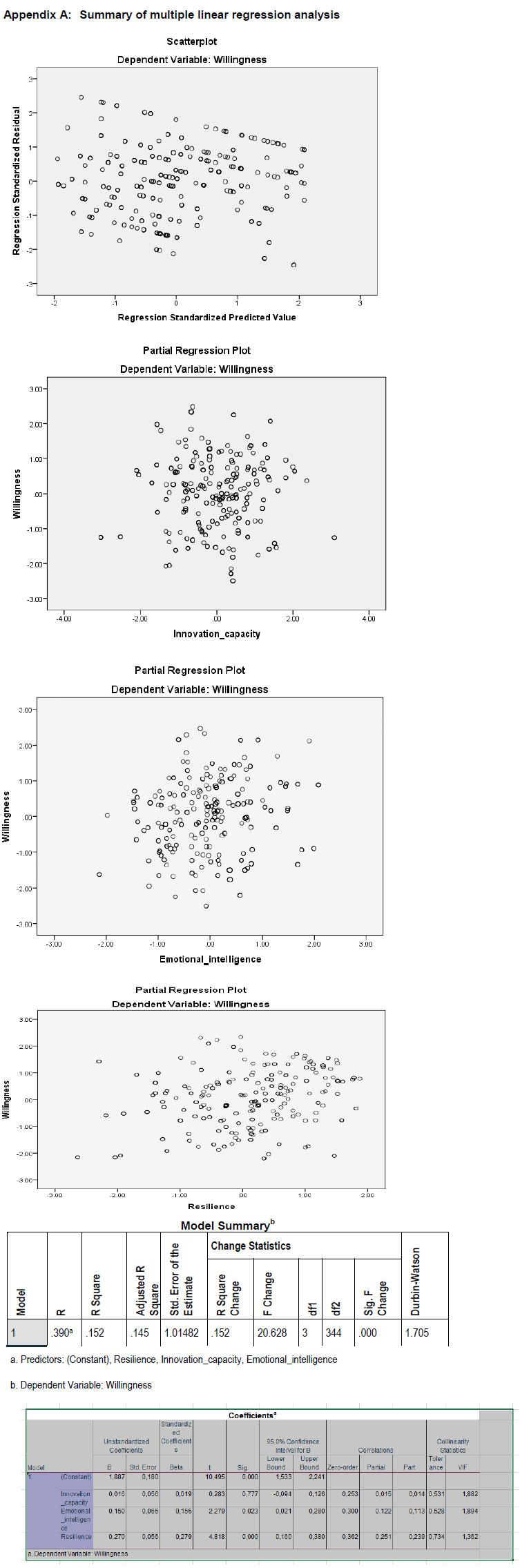
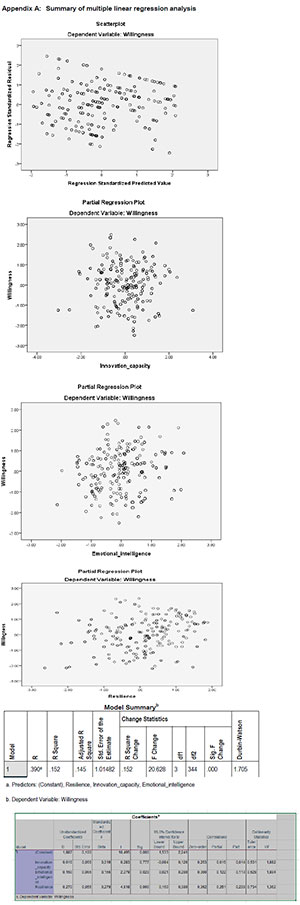
Multiple linear regression was undertaken to investigate the predictive capacity of psychological variables on willingness of dirty workers to become entrepreneurs. In order for us to rely confidently on multiple linear regression, the data was first investigated to determine whether it met the assumption of independent errors. The Durbin-Watson statistic was requested and observed. The Durbin-Watson statistic of 1.705 was obtained and this value is close to 2 indicating that the assumption had almost been met. According to Field (2013), the Durbin-Watson statistic 'less than 1 or greater than 3 should raise alarm bells'. To investigate whether there was collinearity in the data, variance inflation factors (VIF) and tolerance statistics were examined. The VIF values were all below 10 (innovation capacity = 1.882; emotional intelligence = 1.894; resilience = 1.362) and tolerance values all were above .2 (innovation capacity = .531; emotional intelligence = .528; resilience = .734). Research points out that if the largest VIF value is above 10, it could indicate the presence of multicollinearity (Bowerman & O'Connell 1990; Myers 1990). Given the VIF and tolerance statistics observed, it can be concluded that there is no collinearity in the data. Research that used the same approach and reached a similar conclusion exist (Al Mamun Fazal & Muniady 2019). In addition the data was further investigated to determine whether it satisfied the assumption of linearity and homoscedacity. Thus, plots of standardised residuals against predicted values were examined. The obtained graphs showed a random array of dots without funnelling out and no curve was observed (see Appendix A). The points between the dots were evenly dispersed throughout the plots. Field (2013) pointed out that 'this pattern is indicative of a situation in which the assumption of linearity and homoscedacity has been met'. Studies that have also relied on scatter plots to investigate linearity between variables exist for example (Botha et al. 2019; Du Toit 2015).
5.1 Multiple linear regression analysis for psychological competencies
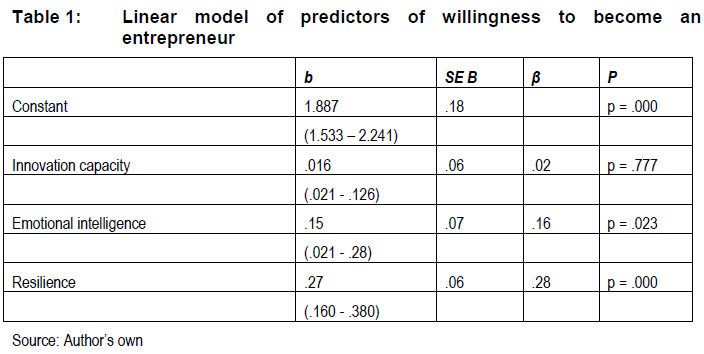
As highlighted earlier, psychological competencies (PC) comprised innovation capacity (IC), emotional intelligence (EI) and resilience (R). Thus, H1 stated that innovation capacity, emotional intelligence and resilience predict willingness of dirty workers to become entrepreneurs. From the multiple linear regression output, the Pearson correlation (r) between the independent variables and the outcome variable showed that the psychological competence variables are positively and significantly correlated with willingness to become an entrepreneur (WEE). Thus, Pearson's r for IC-WEE = .253; Pearson's r R-WEE = .362; and the Pearson's r = .3 for EI-WEE. This indicates that employees involved in dirty work with a high psychological competence score are more likely to be willing to consider entrepreneurship as an alternative career. Table 1 summarises the multiple linear regression results focusing on beta weights, standard errors and the p-values associated with them.
The multiple linear regression model with all three predictors produced R2 = .152, F (3, 344) = 20.628, p < .001. As can be seen from Table 1, the psychological competence variables had significant positive regression weights except for innovation capacity (positive but insignificant). In other words, a unit increase in resilience is associated with a .27 units increase in the willingness to become an entrepreneur for employees involved in dirty work. Similarly, a unit increase in emotional intelligence is associated with a .15 units increase in the willingness to become an entrepreneur for employees involved in dirty work.
6. DISCUSSION
The results make several contributions to theory and practice. The study contributes to literature as the authors examined key factors that significantly contribute to new venture creation. The first contribution is that, data was gathered from a unique sample that most scholars seem to ignore; employees involved in dirty work, classified to be physical. Until now, very little was known about the willingness to become entrepreneurs as far as dirty workers are concerned. This study argued that, when people are faced with unfriendly circumstances they are likely to act with the goal of improving their circumstances. The unfriendly phenomenon was identified as the stigma attached to their occupation. As a result, it is argued that employees involved in dirty work contemplating career change could become entrepreneurs. The following factors were examined: perceived innovation capabilities, emotional intelligence and resilience and the authors argue that if they have high scores in these aspects; chances are high that they could be willing to become entrepreneurs. This thinking is supported by empirical evidence in Costa et al. (2016), Santos et al. (2013) and Spagnoli et al. (2016).
The multiple linear regression results indicated that willingness to become an entrepreneur for employees involved in dirty work, classified to be physical, is best predicted by resilience and emotional intelligence (significant positive relationship). Branicki et al. (2018) also reported similar findings with regard to individual resilience. In their study, they examined the nature and impact of entrepreneurial resilience of small and medium-sized entities (SMEs) in the United Kingdom (UK). Their study provides evidence that individuals demonstrating entrepreneurial activities link their ability of coping with unfriendly circumstances to well-being, self-efficacy and social connections. According to Branicki et al. (2018), the mentioned characteristics are categorised under individual resilience, which are key drivers of SME resilience. Given the findings, it could be pointed out that employees involved in dirty work do possess the prerequisites of SME resilience that when put to proper use could lead to a fruitful entrepreneurial career. A positive significant relationship was also found between emotional intelligence and willingness to become an entrepreneur. Research by Mikolajczak, Luminet & Menil (2006) and Tsaousis and Nikolaou (2005) support the findings and point out individuals with a high score in emotional intelligence show high adaptability to unfriendly circumstances, for example, environmental stress. Given a relatively high score in emotional intelligence, employees involved in dirty work are more likely to adapt to stressful entrepreneurial environments that could lead to a prosperous entrepreneurial career, hence their willingness to become entrepreneurs.
The practical contribution of these findings are that, from a South African perspective, this study provides evidence that emotional intelligence and resilience play a critical role as far as willingness to become an entrepreneurs is concerned. In other words, among other competencies practitioners who may consider recruiting employees involved in dirty work which is classified to be physical, for the purposes of new venture creation training must consider their emotional and resilience scores.
This will enable them to allocate resources to the people who possess key competencies of entrepreneurship. In addition, this can also help educators who are concerned about entrepreneurship education. These findings provide evidence that emotional intelligence and resilience are important factors and education programmes should prioritise such areas that positively affect people's entrepreneurial behaviour.
This study provides evidence that innovation capacity does not contribute anything unique to the regression model as far as willingness to become entrepreneurs for employees involved in dirty work is concerned. Galindo and Méndez-Picazo (2013) found that innovation plays a pivotal role in driving the entrepreneurial entity's profitability scale owing to activities such as the introduction of new technologies and possibly new products. A positive but nonsignificant relationship between innovation capacity and willingness to become entrepreneurs was found. It therefore implies that upon successfully establishing their entrepreneurial ventures, employees involved in dirty work would struggle to introduce new marketing methods, products and services as they are not innovative unless they assemble or hire an innovative team to carry out such tasks.
7. MANAGERIAL IMPLICATIONS
The study contributes to the existing body of knowledge by investigating the predictive capacity of psychological competencies on willingness to become an entrepreneur among employees involved in dirty work. The results indicate that employees involved in dirty work possess the emotional intelligence and resilience to become entrepreneurs. To stimulate entrepreneurial behaviour, managers, educators and practitioners should design task and education programmes that seek to augment individual resilience and emotional intelligence.
8. LIMITATIONS AND FUTURE RESEARCH
Despite the mentioned contributions of the study, its main limitation is that of failure to identify the exact number of employees involved in dirty work in the selected towns. In addition, we acknowledge common methods bias in the sense that primary data was gathered from a one group of respondents although measures were undertaken to resolve the bias. Multi scales were used to gather data for different variables. As mentioned earlier, four separate scales were combined as one instrument for the purposes of gathering primary data. Future research can be in the form of a longitudinal study with the goal of examining whether employees involved in dirty work, facing stigma yet possessing high psychological competences (emotional intelligence and resilience), actually establish entrepreneurial entities. In addition, future research can also investigate issues inhibiting employees involved in dirty work who possess psychological competencies not to take action to become entrepreneurs.
9. CONCLUSION
Understanding the willingness of employees involved in dirty work to become entrepreneurs is equally important with other areas that have received significant attention from scholars. More importantly is the understanding of factors, especially psychological factors that significantly influence their willingness. The study findings not only add to the stated literature but also call on policy makers, practitioners and researchers to further investigate the impact of psychological competencies on willingness to become entrepreneurs on various population groups faced with unpleasant circumstances and who are willing to improve their current circumstances.
REFERENCES
2. LITERATURE REVIEW
- AHMETOGLU G, LEUTNER F & CHAMORRO-PREMUZIC T. 2011. EQ-nomics: Understanding the relationship between individual differences in trait emotional intelligence and entrepreneurship. Personality and Individual Differences 51(8):1028-1033.
- AL MAMUN A, FAZAL SA & MUNIADY R. 2019. Entrepreneurial knowledge, skills, competencies and performance: A study of micro-enterprises in Kelantan, Malaysia. Asia Pacific Journal of Innovation and Entrepreneurship 13(1):29-48.
- ANDERSON V. 2009. Research methods in Human Resources Management. 2nd ed. London: Chattered Institute of Personnel and Development (CIPD).
- ASHFORTH BE & KREINER GE. 2014. Dirty work and dirtier work: Differences in countering physical, social, and moral stigma. Management and Organization Review 10(1):81-108.
- ÁSTEBRO T & YONG K. 2016. Invention quality and entrepreneurial earnings: the role of prior employment variety. Entrepreneurship Theory and Practice 40(2):381-400.
- AWOTOYE Y & SINGH RP. 2017. Entrepreneurial Resilience, High Impact Challenges, and Firm Performance. Journal of Management Policies and Practices 18(2):28-37.
- AYALA JC & MANZANO G. 2010. Established business owners' success: Influencing factors. Journal of Developmental Entrepreneurship 15(3):263-286.
- BACKES-GELLNER U & MOOG P. 2013. The disposition to become an entrepreneur and the jacks-of-all-trades in social and human capital. The Journal of Socio-Economic 47:55-72.
- BAKKABULINDI F. 2015. Positivism and Interpretivism: Distinguishing characteristics, criteria and methodology. In Okeke C & Van Wyk M. Eds. Educational Research: An African approach. Cape Town: Oxford University Southern Africa Press. (pp 19-38.
- )
- BARON RA. 2012. Entrepreneurship: An evidence-based guide. Northampton: Edward Elgar Publisher.
- BARON RA. 2008. The role of affect in the entrepreneurial process. Academy of Management Review 33(2):328-340.
- BARON RA & MARKMAN GD. 2000. Beyond social capital: How social skills can enhance entrepreneurs' success. The Academy of Management Executive 14(1):106-116.
- BARON RA & TANG J. 2009. Entrepreneurs' social skills and new venture performance: Mediating mechanisms and cultural generality. Journal of Management 35(2):282-306.
- BATTISTI M & DEAKINS D. 2012. Perspectives from New Zealand small firms: crisis management and the impact of the Canterbury earthquakes. In New Zealand Centre for Small & Medium Enterprise Research. Eds. BusinesSMEasure. Palmerston North: Massey University. (pp 1-41.
- )
- BERTRAM C & CHRISTIANSEN I. 2014. Understanding research: an introduction to reading research. Pretoria: Van Schaik Publishers.
- BONANNO G. 2004. Loss, trauma, and human resilience have we underestimated the human capacity to thrive after extremely aversive events? American Psychologist 59(1):20-28.
-
BOTHA M, CARRUTHERS TJ & VENTER MW. 2019. The relationship between entrepreneurial competencies and the recurring entrepreneurial intention and action of existing entrepreneurs. Southern African Journal of Entrepreneurship and Small Business Management 11(1):a214. [Internet: https://doi.org/10.4102/sajesbm.v11i1.19; downloaded on 15 May 2019.
» https://doi.org/10.4102/sajesbm.v11i1.19 - ]
- BOWERMAN BL & O'CONELL RT. 1990. Linear statistical models: An applied approach. 2nd ed. Belmont, CA: Duxbury.
- BRANICKI LJ, SULLIVAN-TAYLOR B & LIVSCHITZ SR. 2018. How entrepreneurial resilience generates resilient SMEs. International Journal of Entrepreneurial Behaviour & Research 24(7):1244-1263.
-
BRINCKMANN J & KIM SM. 2015. Why we plan: The impact of nascent entrepreneurs' cognitive characteristics and human capital on business planning. Strategic Entrepreneurship Journal 9(2):153-166. [Internet:Phttps://doi.org/10.1002/sej.1197; downloaded on 10 April 2019.
» https://doi.org/10.1002/sej.1197 - ]
- BRYMAN A & BELL E. 2011. Business research methods. 3rd ed. Oxford: Oxford University Press.
- CHELL E. 2008. The entrepreneurial personality: A social construction. London: The Psychology Pres/Routledge.
- CIAVARELLA M A, BUCHHOLTZ AK, RIORDAN CM, GATEWOOD RD & STOKES GS. 2004. The Big Five and venture survival: Is there a linkage? Journal of Business Venturing 19(4):465-483.
- COOPER N, ESTES CA & ALLEN L. 2004. Bouncing back. Parks and Recreatio 39(4):28-35.
- COSTA CF, CAETANO A & SANTOS SC. 2016. Entrepreneurship as a career option: Do temporary workers have the competences, intention and willingness to become entrepreneurs? The Journal of Entrepreneurship 25(2):129-154.
- DE NOBLE AF, JUNG D & EHRLICH SB. 1999. Entrepreneurial self-efficacy: the development of a measure and its relationship to entrepreneurial actions. USA, Babson College: Frontiers of entrepreneurship research.
- DOTTORE A & KASSICIEH SK. 2017. Predicting Future Technopreneurs among Inventors. International Journal of Innovation and Technology Management 14(03):1750008.
- DUCHEK S. 2018. Entrepreneurial resilience: a biographical analysis of successful entrepreneurs. International Entrepreneurship Management Journal 14:429-455.
- DU TOIT E. 2015. Revisiting the relationship between different financial risk measures and the market return on ordinary shares in South Africa. South African Journal of Economic and Management Sciences 18(2):218-231.
- ECKHARDT JT, CIUCHTA MP & CARPENTER M. 2018. Open innovation, information, and entrepreneurship within platform ecosystems. Strategic Entrepreneurship Journal 12(3):369-391.
- ENVICK BR. 2005. Beyond human and social capital: The importance of positive psychological capital for entrepreneurial success. The Entrepreneurial Executive 10:41-52.
- FIELD A. 2013. Discovering statistics using IBM SPSS statistics. 4th ed. Thousand: Oaks, CA Sage.
- FIET OJ. 2019. Time, space and entrepreneurship. 1st ed. London: Routledge.
- FISHER R. 2011. Passion, resilience, obsession & sustained entrepreneurial action: The path to entrepreneurial success. Swinburne University of Technology. (Doctoral dissertation.
- )
- FORNAHL D. 2007. Changes in regional firm founding activities: A theoretical explanation and empirical evidence. New York: Routledge.
- FREDRICKSON BL. 2001. The role of positive emotions in positive psychology: The broaden-and-build theory of positive emotions. American Psychologist 56(3): 218-226.
- FRIBORG O, HJEMDAL O, ROSENVINGE JH, MARTINUSSEN M, ASLAKSEN PM & FLATEN MA. 2006. Resilience as a moderator of pain and stress. Journal of Psychosomatic Research 61(2):213-219.
- FRIEDMAN Y & CARMELI A. 2018. The influence of decision comprehensiveness on innovative behaviors in small entrepreneurial firms: the power of connectivity. Innovation: Organisation & Management 20(1):61-83.
- GARTNER WB. 2007. Psychology, entrepreneurship, and the 'critical mess'. In Baum JR, Frese M & Baron RA. Eds. The Psychology of Entrepreneurship. Mahwah, NJ: Lawrence Erlbaum Associates. (pp 325-34.
- )
- GAY L & AIRASIAN P. 2003. Educational Research: Competences for analysis and applications. 7th ed. New Jersey: Merrill/Prentice-Hall.
- GHEMAWAT P. 1991. Commitment: The new dynamics of strategy. New York: Free Press.
- GRAHAM LT. 2007. Permanently failing organizations? Small business recovery after September 11, 2001. Economic Development Quarterly 21(4):299-314.
- HARPER SC. 2005. Extraordinary entrepreneurship: the professional guide to starting an exceptional enterprise. Hoboken, New Jersey: John Willey & Sons.
- HAYWARD ML, FORSTER AWR, SARASVATHY SD & FREDRICKSON BL. 2010. Beyond hubris: How highly confident entrepreneurs rebound to venture again. Journal of Business Venturing 25(6):569-578.
- HEATH C & TVERSKY A. 1991. Performance and belief ambiguity and competence in choice under uncertainty. Journal of Risk and Uncertainty 4(1):5-28.
- HISRICH RD. 1990. Entrepreneurship/intrapreneurship. American Psychologist 45(2):209-222.
- HMIELESKI KM & BARON RA. 2008. When does entrepreneurial self-efficacy enhance versus reduce firm performance? Strategic Entrepreneurial Journal 2(1):57-72.
- HUTCHESON GD & SOFRONIOU N. 1999. The multivariate social scientist: Introductory statistics using generalized linear models. London: Sage.
- KANTUR D & ÍS.ERI-SAY A. 2012. Organizational resilience: a conceptual integrative framework. Journal of Management & Organization 18(6):762-773.
- KIRZNER IM. 1982. The theory of entrepreneurship in economic growth. In Kent CA, Sexton DL & Vesper KH. Eds. Encyclopaedia of entrepreneurship. Englewood Cliffs, NJ: Prentice-Hall. (pp 272-276.
- )
- KLEIN KJ & SORRA JS. 1996. The challenge of innovation implementation. Academy of Management Review 21(4):1055-1080.
- KREISER PM & DAVIS JD. 2010. Entrepreneurial orientation and firm performance: The unique impact of innovativeness, proactiveness and risk-taking. Journal of Small Business Management and Entrepreneurship 23(1):39-51.
- KRUEGER Jr NF & BRAZEAL DV. 1994. Entrepreneurial potential and potential entrepreneurs. Entrepreneurship Theory and Practice 18(3):91-104.
- KRUEGER N. 1993. The impact of prior entrepreneurial exposure on perceptions of new venture feasibility and desirability. Entrepreneurship Theory and Practice 18(1):5-21.
- KRUGER D, RAMPHAL R & MARITZ M. 2013. Operations Management. 3rd Ed. Cape Town: Oxford University Southern Africa Press.
- LAMB CW, HAIR JF, MCDANIEL C, BOSHOFF C, TERBLANCHE N, ELLIOT R & KLOPPER HB. 2015. Marketing. 5th Ed. Cape Town: Oxford University Press, Southern Africa.
- LAZARUS RS. 1991. Emotion and adaptation. New York: Oxford University Press.
- LAZEAR EP. 2004. Balanced skills and entrepreneurship. The American Economic Review 94(2):208-211.
- LAZEAR EP. 2005. Entrepreneurship. Journal of Labour Economics 23(4):649-680.
- LEDDO J & ABELSON RP. 1986. The nature of explanations. In Galambos JA & Black JB. Eds. Erlbaum, Hillsdale, NJ: Knowledge structures. (pp 103-122.
- )
- LEGREE PJ, PSOTKA J, ROBBINS J, ROBERTS R.D, PUTKA DJ & MULLINS HM. 2014. Profile similarity metrics as an alternate framework to score rating-based tests: MSCEIT reanalyses. Intelligence 47:159-174.
- LEWIS JM, RICARD LM & KLIJN EH. 2018. How innovation drivers, networking and leadership shape public sector innovation capacity. International Review of Administrative Sciences 84(2):288-307.
- LEWIS JM, RICARD LM, KLIJN EH, & FIGUERAS TY. 2017. Innovation in City Governments: Structures, Networks and Leadership. New York, NY, and London: Routledge
- LIU Y. 2019. Contextualising Risk and Building Resilience: Returnees Versus Local Entrepreneurs in China. Applied Psychology: An International Review 0(0):1-29.
- LONDON M. 1993. Relationships between career motivation, empowerment and support for career development. Journal of Occupational and Organizational Psychology 66(1):55-69.
- MACCANN C, JOSEPH DL, NEWMAN DA & ROBERTS RD. 2014. Emotional intelligence is a second-stratum factor of intelligence: Evidence from hierarchical and bifactor models. Emotion 14:358-374.
- MANZANO-GARCIA G & CALVO JCA. 2013. Psychometric properties of Connor-Davidson Resilience Scale in a Spanish sample of entrepreneurs. Psicothema 25(2):245-251.
- MARKMAN GD & BARON RA. 2003. Person-entrepreneurship Fit: Why some people are more successful as entrepreneurs than others. Human Resource Management Review 13(2):281-301.
-
MAYER JD. 2004. What is Emotional Intelligence? UNH Personality Lab.8. [Internet:https://scholars.unh.edu/personality_lab/8; downloaded on 01 September 2019.
» https://scholars.unh.edu/personality_lab/8 - ]
- MAYER JD, CARUSO DR & SALOVEY P. 2016. The ability model of emotional intelligence: Principles and updates. Emotion Review 8:1-11.
- MAYER JD, CARUSO DR, ZIGLER ER & DREYDEN JI. 1989. Intelligence and intelligence-related personality traits. Intelligence 13(2):119-133.
- MAYER JD & SALOVEY P. 1997. What is emotional intelligence? In Salovey P & Sluyter . Eds. Handbook of intelligence. Cambridge: Cambridge University Press. (pp 396-420.
- )
- MAYER JD, SALOVEY P & CARUSO DR. 2004. Emotional intelligence: Theory, findings, and implications. Psychological Inquiry 60:197-215.
- MAYER JD, SALOVEY P & CARUSO DR. 2000. Models of emotional intelligence. In Stenberg RJ. Ed. Handbook of intelligence. Cambridge: Cambridge University Press. (pp 396-420.
- )
- MCCLELLAND DC. 1961. The achieving society. New York: Free Press.
- MCCLELLAND DC. 1965. Achievement and entrepreneurship: A longitudinal study. Journal of Personality and Social Psychology 1(4):389-392.
- MCCLELLAND DC. 1987. Characteristics of successful entrepreneurs. The Journal of Creative Behaviour 21(3):219-233.
- MERTON RC. 2013. Innovation risk. Harvard Business Review 91(4):48-56.
- MIKOLAJCZAK M, LUMINET O & MENIL C. 2006. Predicting resistance to stress: incremental validity of trait emotional intelligence over alexithymia and optimism. Psicothema 18:79-88.
- MITCHELMORE S & ROWLEY J. 2013. Entrepreneurial competencies of women entrepreneurs pursuing business growth. Journal of Small Business and Enterprise Development 20(1):125-142.
- MUKATA CM & SWANEPOEL E. 2015. Business problems encountered when developing an own business in a financially constrained environment: The north-eastern regions of Namibia. Southern African Business Review 19(2):74-98.
- MUSA H, TAIB MSM, LI SCH, JABAR J & KHALID FA. 2016a. Drop-shipping Supply Chain: The Characteristics of SMEs towards adopting it. Social Science 11 (11):2856-2863.
- MUSA H, AB RAHIM N, AZMI FR, SHIBGHATULLAH AS & OTHMAN NA. 2016b. Social media marketing and online small and medium enterprises performance: Perspective of Malaysian small and medium enterprises. International Review of Management and Marketing 6(7S):1-5.
- MYERS R. 1990. Classical and modern regression with applications. 2nd ed. Boston, MA: Duxbury.
- PETRIDES KV & FURNHAM A. 2001. Trait emotional intelligence: psychometric investigation with reference to established trait taxonomies. European Journal of Personality 15(6):425-448.
- PETRIGLIERI JL. 2011. Under threat: Responses to and the consequences of threats to individuals' identities. Academy of Management Review 36(4):641-662.
- PLEHN-DUJOWICH JM. 2013. Product innovations by young and small firms. Advocacy: The Voice of Small Business in Government 1-28.
- RAJIANI I, MUSA H & HARDJONO B. 2016. Ability, motivation and opportunity as determinants of green human resources management innovation. Research Journal of Business Management 10(1-3):51-57.
- REINHARDT R, HIETSCHOLD N & GURTNER S. 2017. Overcoming consumer resistance to innovations-an analysis of adoption triggers. R&D Management 2017(1):1-17.
- ROBINSON PB, STIMPSON DV, HUEFNER JC & HUNT K. 1991. An attitude approach to the prediction of entrepreneurship. Entrepreneurship Theory and Practice 15(4):13-31.
- ROBLES E. 2015. How to Identify Disruptive New Businesses. Review of Business and Finance Studies 6(1):121-130.
- ROGERS EM. 2003. Diffusion of Innovations. New York : Free Press.
-
SALAMZADEH A & KIRBY DA. 2017. New venture creation: how start-ups grow? AD-minister 30:929. [Internet:https://dx.doi.org/10.17230/ad-minister.30.1; downloaded on 02 September 2019.
» https://dx.doi.org/10.17230/ad-minister.30.1 - ]
- SALOVEY P & MAYER JD. 1990. Emotional intelligence. Imagination, cognition and personality 9(3):185-211.
- SANTOS SC, CAETANO A & CURRAL L. 2013. Psychosocial aspects of entrepreneurial potential. Journal of Small Business and Entrepreneurship 26(6):661-685.
- SEABELA M & FATOKI O. 2014. The entrepreneurial competencies of non-business university students in South Africa. International Journal of Education Science 6(3):375-381.
- SEXTON DL & BOWMAN-UPTON N. 1985. The entrepreneur: A capable executive and more. Journal of Venturing 1(1):129-140.
- SHEPHERD DA & PATZELT H. 2011. The new field of sustainable entrepreneurship: Studying entrepreneurial action linking 'what is to be sustained' with 'what is to be developed'. Entrepreneurship Theory and Practice 35(1):137-163.
- SMALLBONE D, DEAKINS D, BATTISTI M & KITCHING J. 2012. Small business responses to a major economic downturn: Empirical perspectives from New Zealand and the United Kingdom. International Small Business Journal 30(7):754-777.
- SMITH BW, DALEN J, WIGGINS K, TOOLEY E, CHRISTOPHER P & BERNARD J. 2008. The brief resilience scale: assessing the ability to bounce back. International Journal of Behavioural Medicine 15(3):194-200.
- SPAGNOLI P, SANTOS SC, CAETANO A & LO PRESTI A. 2016. A contribution towards the validation of the Italian version of the Entrepreneurial Potential Assessment Inventory. BPA-Applied Psychology Bulletin (Bollettino di Psicologia Applicata) 64:(275):37-49.
- STOLTZ PG. 2000. Adversity quotient at work: Make everyday challenges the key to your success. New York: HarperCollins Publishers.
- TERZIOVSKI M. 2010. Innovation practice and its performance implications in Small and Medium Enterprises (SMEs) in the manufacturing sector: a resource-based view. Strategic Management Journal 31: 892-902.
- TSAOUSIS I & NIKOLAOU I. 2005. Exploring the relationship of emotional intelligence with physical and psychological health functioning. Stress and Health 21(2):77-86.
- VAN PRAAG C & VAN OPHEM H. 1995. Determinants of willingness and opportunity to start as an entrepreneur. Kyklos 48(4):513-540.
- VAN PRAAG M. 2011. Who values the status of the entrepreneur? In Audretsch DB, Falck O, Heblich S & Lederer A. Eds. Handbook of research on innovation and entrepreneurship. Cheltenham, UK: Edward, Elgar. (pp 24-44.
- )
- VAN ROOYEN L, DU TOIT DH, BOTHA E & ROTHMANN S. 2010. Artisan retention in an organisation in South Africa. South African Journal of Human Resource Management 8(1):1-8.
- VERMEULEN PAM, DE JONG JPJ & O'SHAUGHNESSY KC. 2005. Identifying key determinants for new product introductions and firm performance in small service firms. Service Industry Journal 25(5): 625-640.
- WALL J. 1997. Familial flush. Insight 6:68.
- WALLIMAN N. 2016. Social Research Methods. 2nd ed. Thousand Oaks, CA: Sage.
- WICKHAM PA. 1998. Strategic entrepreneurship: A decision-making approach to new venture creation and management. London: Pitman.
-
WIENCLAW RA. 2013. Research Starters: Business. Online Edition. [Internet:http://0-eds.b.ebscohost.com.wam.seals.ac.za/eds/detail/detail?vid=1&sid=18f7f319-c6ef-4300-934a-892dd56d39dd%40sessionmgr102&bdata=JnNpdGU9ZWRzLWxpdmUmc2NvcGU9c2l0ZQ%3d%3d#AN=89164007&db=ers, downloaded on 13 April 2018.
» http://0-eds.b.ebscohost.com.wam.seals.ac.za/eds/detail/detail?vid=1&sid=18f7f319-c6ef-4300-934a-892dd56d39dd%40sessionmgr102&bdata=JnNpdGU9ZWRzLWxpdmUmc2NvcGU9c2l0ZQ%3d%3d#AN=89164007&db=ers - ]
- WIID J & DIGGINES C. 2015. Marketing research. 3rd ed. Cape Town: Juta.
- WINDLE G, BENNETT KM & NOYES J. 2011. A methodological review of resilience measurement scales. Health and Quality of Life Outcomes 9:8-18.
- WU W, WANG H, LEE HY, LIN YT & GUO F. 2019. How Machiavellianism, Psychopathy, and Narcissism Affect Sustainable Entrepreneurial Orientation: The Moderating Effect of Psychological Resilience. Frontiers in Psychology 10:779.
- ZAMPETAKIS LA, KAFETSIOS K, BOURANTA N, DEWETT T & MOUSTAKIS VS. 2009. On the relationship between emotional intelligence and entrepreneurial attitudes and intentions. International Journal of Entrepreneurial Behaviour and Research 15(6):595-618.