An empirical investigation of factors affecting the adoption of e-government services
Abstract
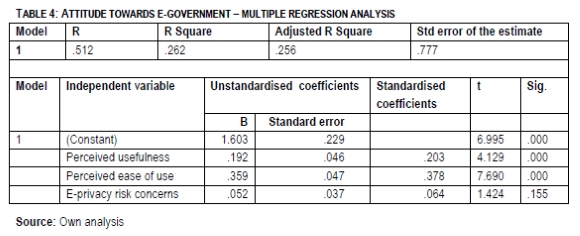
Most governments in Africa are known to have embraced the concept of e-government be it to varying degrees. This is mainly because of the potential of e-government to help improve public service delivery. Success of such initiatives however largely depends on how widely the new delivery channels are accepted by intended users. This paper investigates from the citizens' perspective factors that affect adoption of e-government services provided by mainstream government departments. The study was conducted in Gauteng, South Africa. Data was collected from a total of 380 respondents using a structured questionnaire. The results show that perceived usefulness, perceived ease of use, privacy risk concerns and attitude towards e-government are important factors that influence citizens' decisions to adopt or not adopt e-government services. The findings have wide implications on government efforts aimed at encouraging more citizens to make use of such services and these have been highlighted in the paper.
adoption; Africa; citizens; e-government; TAM; South Africa